






Abstract
This paper presents a finite-time fault-tolerant control strategy based on a novel reaching law, which is proposed as a solution to the trajectory tracking problem of a quadrotor unmanned aerial vehicle (UAV) in the presence of external disturbances, system uncertainties, and actuator faults. First, a novel adaptive reaching law is proposed, which enables the sliding mode surface to approach the origin with minimal rate, thus effectively reducing the chattering. Then, a high-order sliding mode observer (HOSMO) is designed to estimate the unmeasured linear velocity and the lumped uncertainties. Furthermore, the controller is designed by combining a non-singular fast terminal sliding mode (NFTSM) and the novel reaching law. It is demonstrated that the controller is capable of achieving convergence of the tracking error to zero within a finite time frame. The simulation outcomes substantiate the efficacy of the proposed control methodology, particularly in mitigating chattering.
Keywords
1. Introduction
In recent years, quadrotor UAVs have been widely utilized in military and civilian operations, including terrain mapping, fire monitoring, cargo delivery, surveillance, and reconnaissance. Their versatility, which stems from their robust hovering and vertical takeoff and landing capabilities, simple structure, and rapid maneuverability, has made them a valuable asset in a variety of settings. The dynamics of quadrotor UAVs are nonlinear and underdriven, and their small size and underdriven characteristics render them susceptible to malfunctions and external disturbances (Najafi et al., 2022). From the control point of view, it is of paramount importance to consider the presence of disturbances, system uncertainties, and actuator faults of UAVs in the control design session.
A robust flight control scheme must be designed to ensure that UAVs can effectively perform their ground missions. For this reason, a multitude of control methodologies have been proposed, such as PID control (Pounds et al., 2012), backstepping control (Koksal et al., 2020; Labbadi and Cherkaoui, 2019), sliding mode control (Ahmed et al., 2024a; Wang et al., 2020), model predictive control (Alexis et al., 2012; Jalili et al., 2018), neural network-based control (Wang et al., 2021), and so forth. Nevertheless, these control methods are only robust to slight disturbances and are unable to directly address the effects of actuator faults. In the practical application of UAVs, the prolonged operation of propellers or motors may result in the deterioration of the components, leading to potential failure and subsequent degradation of the flight performance, or even an inability to fly normally. In order to address the issue of actuator faults, it is necessary to implement fault-tolerant control (FTC) methods to enhance the safety performance of quadrotor UAVs.
In terms of ensuring the reliable operation of UAVs, both steps of fault diagnosis and fault-tolerant control are required. Fourlas and Karras (2021) listed research works on actuator fault diagnosis with two main strategies: the Kalman filter algorithm and the observer. In Caliskan and Hajiyev (2016), an adaptive linear Kalman filter algorithm was employed to detect and isolate sensor and actuator faults. Zuo and Yao (2024) utilized a nonlinear adaptive observer with fault term estimation for fault localization and detection. In Tutsoy et al. (2023), a reduced order Thau observer has been developed that can detect rotational state estimation errors in the presence of quadrotor faults. Nonlinear observers, Thau observers, and Kalman filter algorithms typically employ the residual method for fault detection. These methods rely on an accurate mathematical model of the observed object. Quadrotor UAVs possess complex dynamics, and obtaining an accurate model in the presence of faults, uncertainties, and disturbances is a challenging endeavor. As documented in Yan and Edwards (2007), sliding mode observers have the capacity to effectively address the uncertainty inherent to dynamic systems, including the direct estimation of actuator faults.
FTC is typically classified into two categories: active FTC and passive FTC. Passive FTC does not rely on fault information but is resilient to predefined faults by designing robust controllers (Patel and Shah, 2019). Tang et al. (2021) propose a passive FTC for quadrotors that does not require a fault diagnostic module, where the controller is designed by adaptive parameter uncertainties and actuator faults. Passive FTC relies on the robustness of the controller to handle faults; however, additional measures are necessary when faults exceed the bounds of robustness. Active FTC employs a fault detection and isolation module to identify faults and compensate for them by modifying the controller structure and parameters, and this control system must be capable of accurately diagnosing and estimating faults. In Zhou et al. (2021), a safe control strategy for UAVs with multiple actuator faults and unknown disturbances is proposed. The estimation of actuator faults and disturbances is achieved through a fixed-time sliding mode observer. Mallavalli and Fekih (2023) developed observer-based fault detection and diagnostic mechanisms to estimate faults under different types of actuator faults for a quadrotor.
Motivated by above discussions, this paper presents a non-singular terminal sliding mode fault-tolerant control strategy for the trajectory tracking problem of a quadrotor UAV in the presence of external disturbances, system uncertainties, and actuator faults. In comparison to previous studies, this paper makes the following contributions: • We consider the situation where the linear velocity of the quadcopter is not directly available. • A novel reaching law is proposed to decrease the convergence speed of the sliding mode surface when it is close to zero, thereby mitigating chattering. • By combining the novel reaching law with NFTSM, the controller is designed to ensure high tracking precision, achieve finite-time convergence, and facilitate an effective reduction of chattering.
The paper is structured as follows. The quadrotor UAV dynamics model is described in Section 2. In Section 3, the proposed reaching law was studied. Section 4 presents the design process of the NFTSMC with the proposed reaching law. Section 5 is about simulation and analysis. Finally, conclusion is given in Section 6.
2. Quadrotor UAV dynamics model and problem statement
2.1. Dynamics model
Quadrotor UAVs are widely utilized due to their high maneuverability, compact size, and lightweight construction. The quadrotor generates diverse lift and rotational torque by regulating the rotational speeds of its four rotor blades, enabling it to navigate in three displacement directions and three rotational directions. As thus, the quadrotor can be regarded as an underdriven nonlinear system. The dynamics of a quadrotor UAV have been extensively studied in previous research, with the quadrotor dynamics equation expressed as (Cai et al., 2024)
Failure fault is the most common quadrotor UAV actuator faults, the fault model can be expressed as
(Mechali et al., 2021) We assumed in our study that the uncertainty of the model, that is, the internal unmodeled dynamics, is the aerodynamic and gyroscopic effect moments denoted by τ
a
and τ
g
, which are expressed as Besides, we assume that the drag force F
a
, which contains the aerodynamic coefficients K
x
, K
y
, and K
z
, is parameter uncertainty. These parameter uncertainties are defined as Based on Assumption 1, while considering actuator faults, rewrite (1) as To simplify the control design, (2) can be generalized for the translational subsystem and rotational subsystems. Translational subsystem:
Previous studies have typically assumed that the linear velocities can be obtained directly. However, the measurement of linear velocities of quadcopter UAVs is challenging in practical applications. Therefore, it is reasonable to assume that they cannot be acquired. Rotational subsystem:
2.2. Problem statement
The objective of this study is to investigate the robust trajectory tracking control problem. In particular, the focus is on the design of robust controllers for (3) and (4) that are susceptible to external disturbances, system uncertainties, and actuator faults; the design of controllers is to ensure that the position tracking error
The total thrust u1 and the desired Euler angles ϕ
d
and θ
d
can be obtained as
(Liu et al., 2022) To prevent the abrupt change in the UAV’s state, the desired positions and yaw angle satisfy xd (i), yd (i), zd (i), ψd (i) are bounded, for i = 1, 2, where (i) is the ith-order derivative of the variable. The desired trajectory is bounded in practice so that the tracking task can be accomplished. Otherwise, the feasible flight controller is unrealistic for the QUAV. This paper employs a HOSMO to estimate the linear velocity and lumped disturbances, a non-singular fast terminal sliding mode controller based on a novel reaching law to guarantee non-singularity and finite-time convergence of the tracking error. The control method’s design structure is illustrated in Figure 1.

The structure diagram of the proposed control strategy.
3. Proposed reaching law
3.1. Two conventional reaching laws
Constant plus proportional rate reaching law (CPPRL) (Gao and Hung, 1993):
This reaching law is one of the most widely utilized reaching laws, exhibiting the convergence rate of the constant λ1 plus the linear term λ2s. When s is far from the origin, it provides a greater convergence speed than the constant convergence law, and as s approaches zero, the convergence speed decreases to λ1.
The exponential reaching law (ERL) (Fallaha et al., 2010):
According to (8), it can be seen that the gain of the ERL varies between k
c
and k
c
/μ. When
Both CPPRL and ERL are able to adaptively adjust the gain; however, it is important to note that when
3.2. Studying the proposed reaching law
Considering the above-mentioned limitations, the idea of designing the reaching law in this paper is not to affect the fast convergence ability while reducing the convergence speed as s approaches the origin. Inspired by Alyoussef and Kaya (2023), a novel reaching law is proposed, which enables s to approach zero with near zero velocity.
The proposed reaching law is as follows:
N(|s|) plays a decisive role in the convergence speed. When
Figure 2 illustrates the impact of the parameter ϑ on s. The value of ϑ determines the moment at which the approach speed begins to reduce, the change in s is only evident when ϑ is small. It can be observed that when ϑ is greater than 0.2, changing ϑ has less effect on s. In fact, similar results are obtained for different initial values of s and for the different gain parameter of the reaching law. Furthermore, the overwhelming majority of cases are

The sliding surface s(t) of the proposed reaching law for different values of ϑ.
In the process of convergence of s, the gain of the ERL and of the PRL is similar in the The convergence of the sliding mode surface using the new reaching law is shown below.

The sliding surface s(t).
If the reaching law used is (9), the sliding mode surface s(t) is able to converge to zero in finite time.
Given that Integrating the above equation gives When
Assuming s(0) > ϑ, the convergence process is divided into two stages, s (0) → s = ϑ and s = ϑ → s = 0. In the first stage, Φ1(s) plays a more crucial role since N(|s|) = sb/e
ξs
is small and can be obtained: In the second stage, Φ2(s) plays a more crucial role since N(|s|) ≈ s− b is large and can be obtained: Therefore, the convergence time is
Assuming s(0) < −ϑ, the convergence process is likewise divided into two stages, s(0) → s = −ϑ and s = −ϑ → s = 0. Following a comparable methodology, the convergence time can be determined: The equation can thus be obtained: Furthermore, when Hence, for any initial condition s(0), s(t) can converge to zero in finite time t
s
:
4. NFTSMC design with proposed reaching law
4.1. HOSMO design
In order to address the χ2,p variable that is not directly measurable, and the lumped disturbances D
p
(t) in the translational subsystem, a HOSMO (Cano-González et al., 2021) is designed to obtain estimates of these variables.
Suppose D
i
is bounded and its derivative is bounded, that is, Taking the observation error The third-order system (20) has the form of a non-recursive exact robust differentiator, with Assumption 3 being a prerequisite. Consequently, the errors ɛ1,p, ɛ2,p, and ɛ3,p will converge to zero in finite time if the gains γ1, γ2, and γ3 are chosen appropriately (Levant, 2003). Cano-González et al. (2021) prove that the convergence time of this observer is t
o
, that is, when t > t
o
, there are A similar approach can be taken to design a HOSMO for the attitude.
4.2. NFTSM
In order to guarantee that the tracking error converges in a finite time frame and to circumvent singularities while maintaining robust performance in the face of lumped disturbances, a non-singular fast terminal sliding mode surface (Yang and Yang, 2011) is selected as follows:
The following equation is provided for consideration:
According to (22), the derivative of the sliding mode surface (21) is expressed as
It has been shown in the literature (Yang and Yang, 2011) that e1 is able to converge to zero with convergence time
4.3. Design of position controller and stability analysis
First, the tracking error of the position is defined as
The derivative of equation (24) is
Then, in order to achieve convergence of the sliding mode surface to zero, a switching control law is derived according to the proposed reaching law, with the substitution of the uncertainty term D
p
by
It is established that the derivative of the sliding mode surface is equal to zero is a necessary condition for the sliding mode surface to cease variation. Following the acquisition of an appropriate switching control law, the equivalent control law is then designed. In accordance with the condition
Finally, the control laws are obtained as
Consider the system (3), and the sliding mode surface utilized is (24). When the control law is designed as (28) and the observer (19) is employed, the position tracking error of the quadrotor UAV is capable of converging to zero within a finite time frame.
Consider the following Lyapunov function: Substituting (3), (24), and (28) into the derivatives of V yields When t > t
o
, ɛ2,p = 0, and ɛ3,p = 0, which gives Therefore, s
p
can converge to zero, and it is shown below that this convergence is achieved in finite time. When t > t
o
, define First consider the case e2,p ≠ 0. This gives Then consider the case e2,p = 0. Substituting the control law (28) into the second equation of the translational subsystem (3) gives Since e2,p = 0, equation (33) is rewritten as From (34), it is evident that As previously stated, e1,p converges to zero in time t
n
after s
p
= 0. Consequently, the position tracking error e1,p can converge to zero in a finite amount of time, with a total convergence time T
p
= T
S
+ t
n
< t
s
/ℏmin + t
o
+ t
n
. Therefore, the proof is complete.
4.4. Design of attitude controller
The design of the attitude controller is analogous to that of the position controller. As the value of χ2,η can be derived from measurements, the design of the attitude controller and the stability analysis are simplified. To avoid redundancy, the attitude controller equation is given directly below.
The tracking error of the attitude is defined as
Ultimately, the attitude controller is designated as follows:
5. Simulation results and discussions
Model parameters of the quadrotor UAV and design parameters of the sliding mode surface.

Parameters of the controllers.
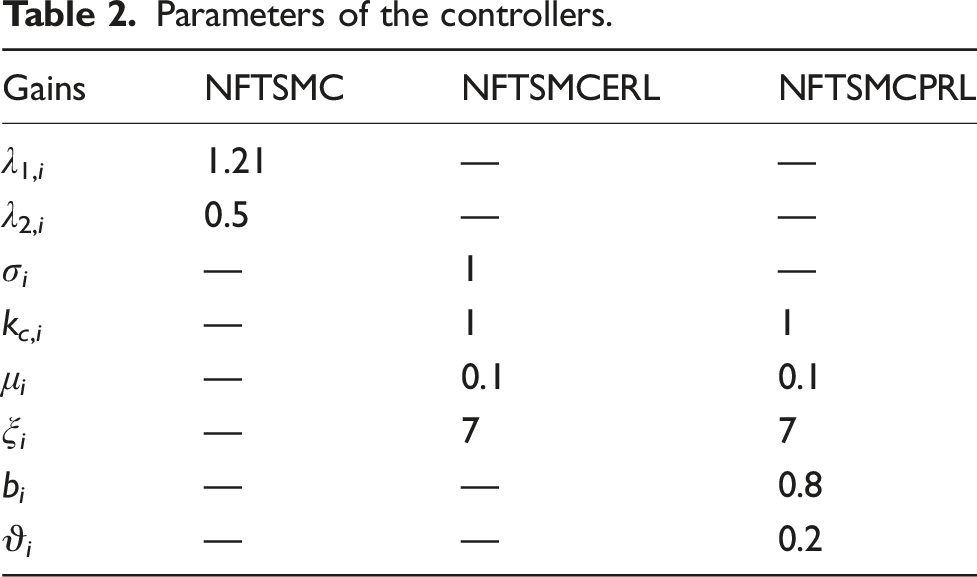
The initial state of the UAV are designated as states
Three scenarios are assumed. Scenario 1: No external disturbances, system uncertainties, and actuator faults. Scenario 2: After t > 5 s, external disturbances are d
i
= sin (2t), the system uncertainties are 0.1 cos (0.5t), and actuator faults are ρ
j
= 0.2. Scenario 3: After t > 5 s, external disturbances are d
i
= 2 sin (2t), the system uncertainties are 0.2 cos (0.5t), and actuator faults are ρ
j
= 0.4.
The UAVs in the three scenarios are subjected to increasingly severe impacts, and the efficacy of the three methods in controlling these effects is evaluated through this process.
5.1. Scenario 1
Figure 4 demonstrates that in the ψ direction, the NFTSMCERL and NFTSMCPRL method both track the reference trajectory in approximately 2.5 s, while the NFTSMC method takes around 6 s. As shown in Figure 5, the tracking error provides a visual representation of the aforementioned description. From Figures 6 and 7, it can be observed that the control input of the NFTSMCPRL method experiences a brief period of chattering immediately following the start, followed by a reduction in chattering. In contrast, the NFTSMC method and the NFTSMCERL method continue to exhibit severe chattering after 1 s, with the NFTSMCERL method displaying a more pronounced degree of chattering. Tracking results for position and yaw angle in scenario 1. Tracking errors for position and yaw angle in scenario 1. Control inputs u1 and u2 in scenario 1. Control inputs u3 and u4 in scenario 1.


5.2. Scenario 2
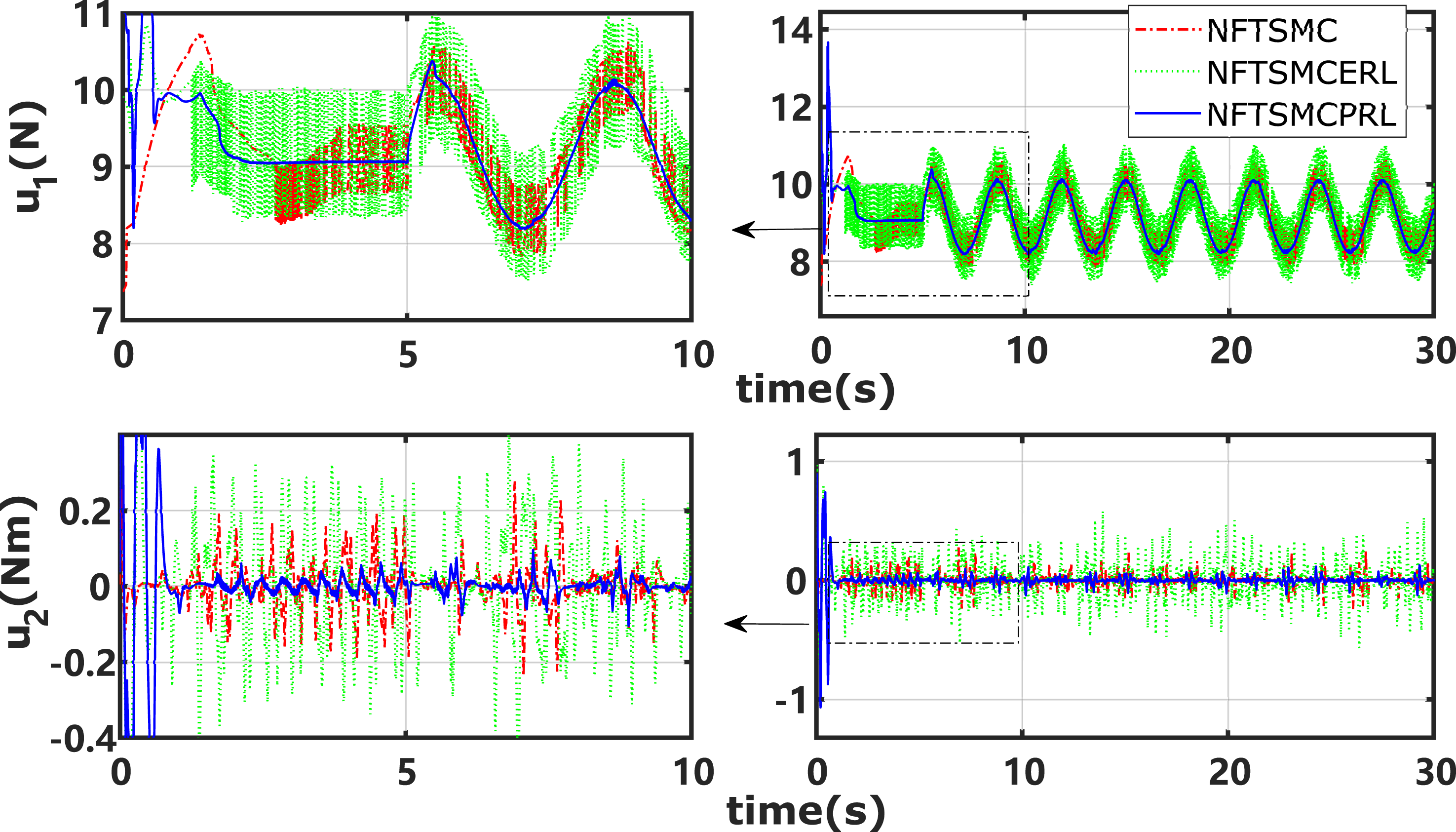
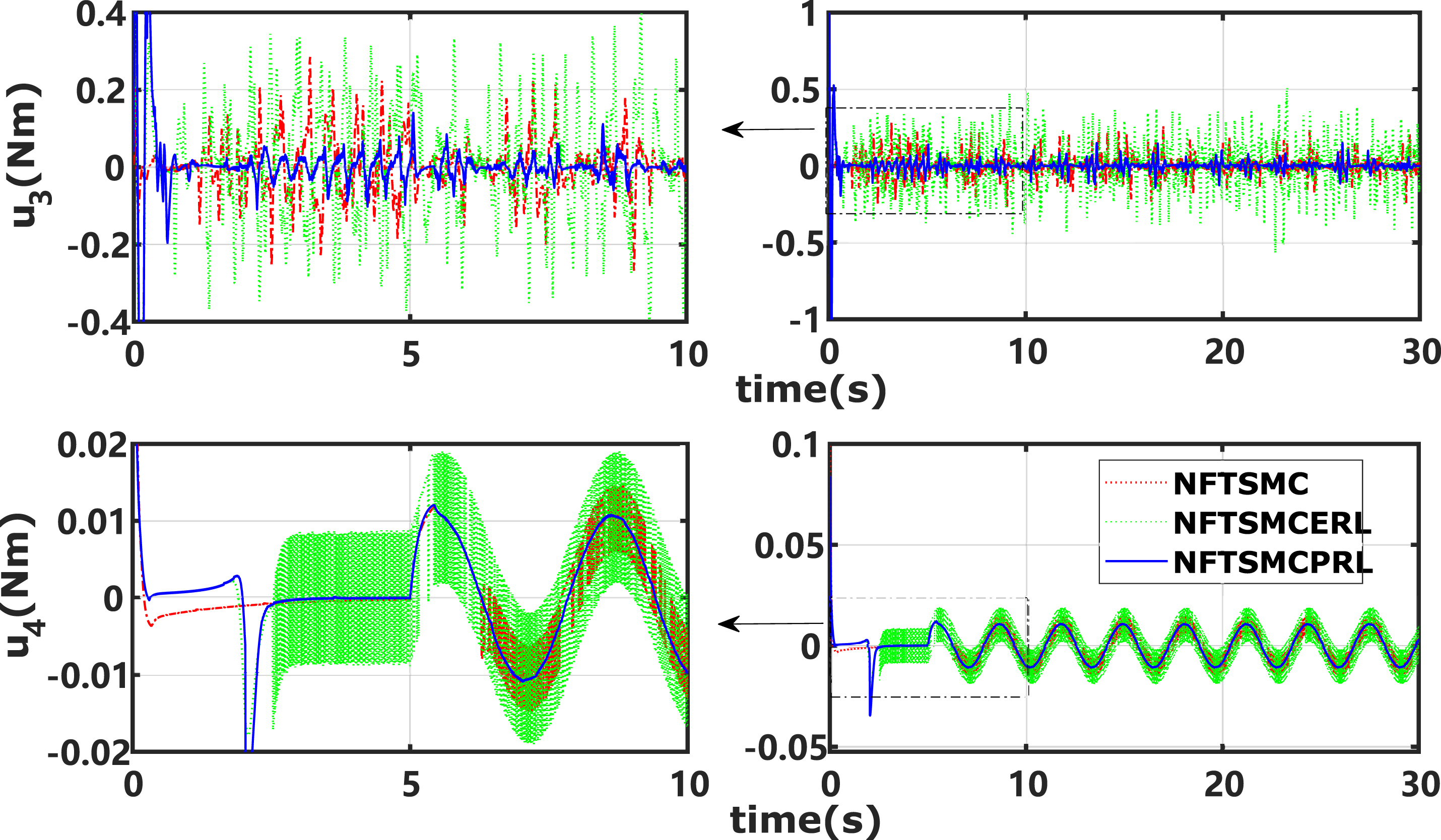
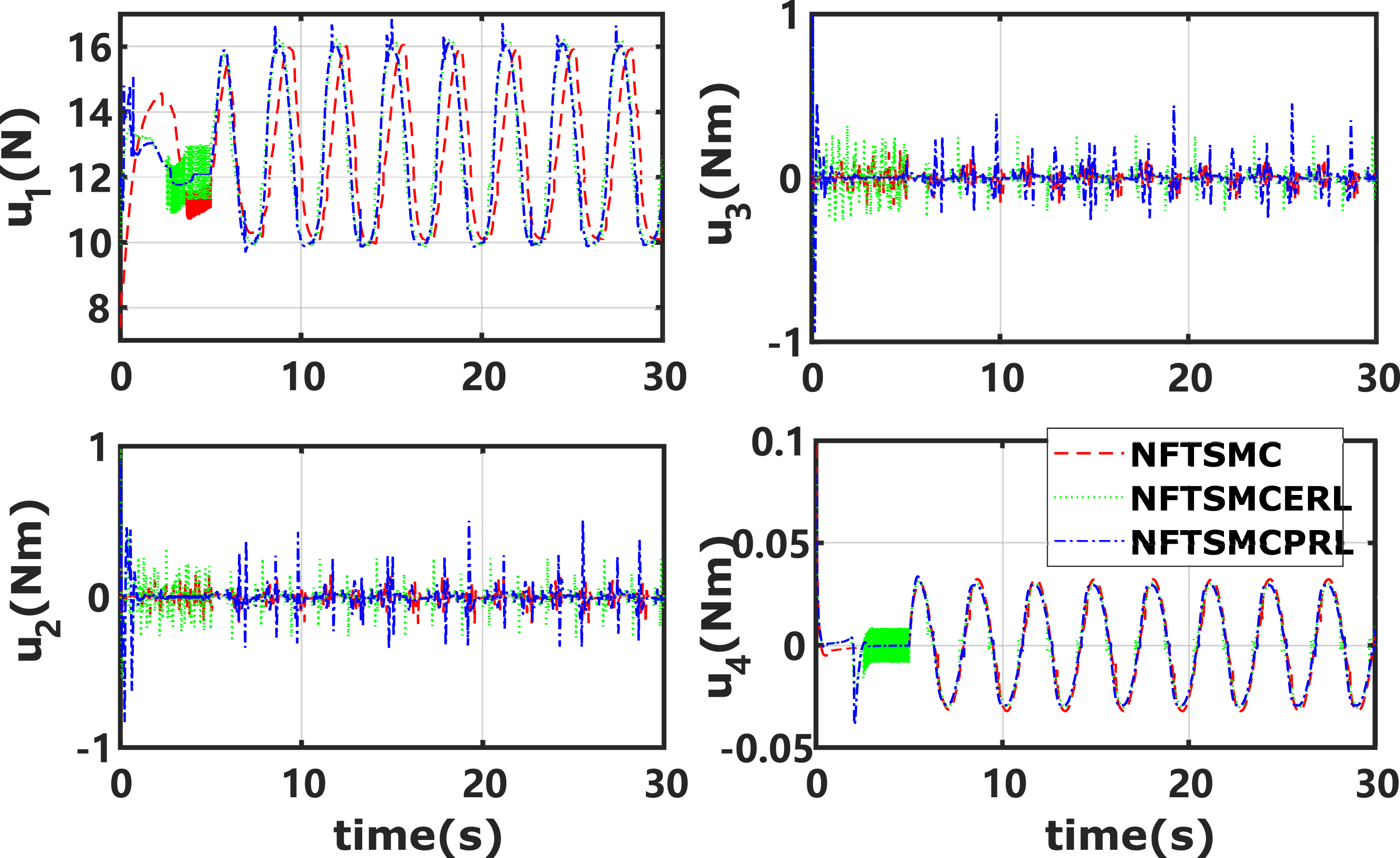
As Figure 8 indicates, the NFTSMC method is unable to track the reference trajectory in a stable manner in the x and y directions. Furthermore, the time required for tracking in the z and ψ directions is approximately 3 s longer than that of the other two methods. Figure 9 illustrates that the tracking error for the NFTSMC in the x and y directions never reaches a stable zero point. Figures 10 and 11 illustrate that the control input of the NFTSMCPRL method experiences transient chattering immediately following the start, which then diminishes. In contrast, the NFTSMC method and the NFTSMCERL method exhibit severe chattering after a few seconds, with the NFTSMCERL method experiencing this earlier and more intensely. Tracking results for position and yaw angle in scenario 2. Tracking errors for position and yaw angle in scenario 2. Control inputs u1 and u2 in scenario 2. Control inputs u3 and u4 in scenario 2.

5.3. Scenario 3
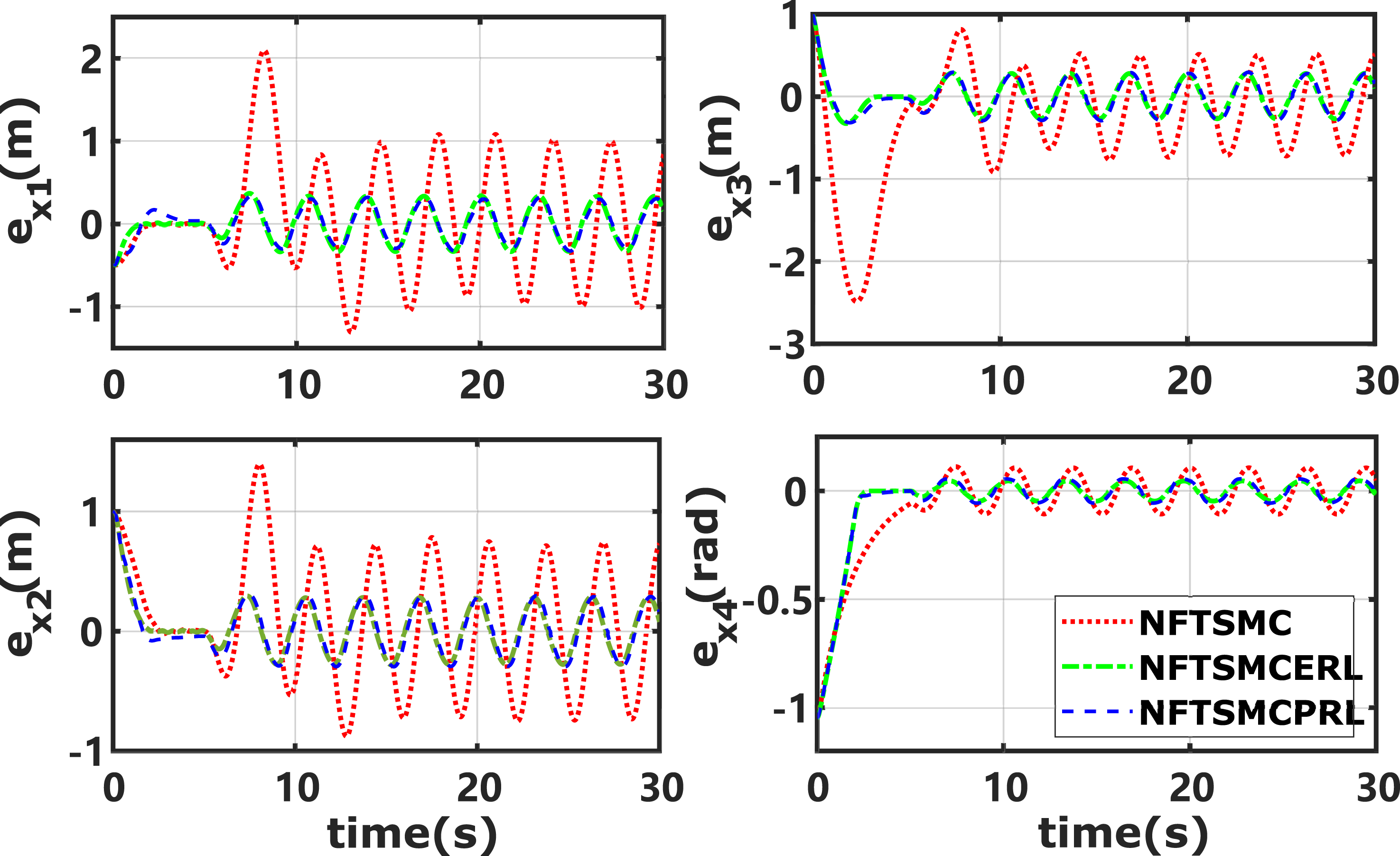
As Figures 12–14 reveal, the NFTSMCPRL and NFTSMCERL methods can still achieve satisfactory tracking performance even when subjected to significant external disturbances, system uncertainties, and more severe actuator faults. Nevertheless, the u1 and u4 of the NFTSMCERL method still produce intolerable and severe chattering around 4 s. In contrast, the tracking results of the NFTSMC method show large fluctuations around the reference value, consistently show large tracking errors, and u1 shows severe chattering around 4 s, which illustrates the poor robustness and fault-tolerance of this method. Tracking results for position and yaw angle in scenario 3. Tracking errors for position and yaw angle in scenario 3. Control inputs u1, u2, u3, and u4 in scenario 3.
5.4. Discussions
In scenario 1, the NFTSMCPRL method demonstrates satisfactory performance in tracking and is capable of effectively reducing chattering, while the NFTSMC and NFTSMCERL methods exhibit superior tracking performance with more powerful control inputs. This outcome corroborates the assertion made in Remark 4, namely that PRL entails a slight compromise in convergence speed relative to ERL, yet effectively mitigates chattering.
In scenario 2, NFTSMCERL and NFTSMCPRL exhibited robust tracking performance, whereas NFTSMC did not. Meanwhile, the NFTSMCPRL method is able to effectively reduce chattering, but the other two methods are not. This is evidenced by the fact that the u1 and u4 of the NFTSMCPRL method are very smooth, while the amplitude of chattering in u2 and u3 is significantly lower than that of the other two methods.
In scenario 3, the control inputs of the NFTSMCPRL and NFTSMCERL methods are remarkably similar, suggesting that in such scenario, the action time of the reaching law for both methods is relatively brief, with the majority of the time being spent by the equivalent control law of the same, which ultimately leads to comparable control outcomes.
The results of the simulation, conducted under three scenarios, demonstrate that the NFTSMCPRL method proposed in this paper is an effective solution for the trajectory tracking problem of a UAV in the presence of external interference, system uncertainties, and actuator faults. The NFTSMCPRL method not only guarantees the accuracy of tracking but also effectively attenuates the chattering phenomenon.
6. Conclusion
This paper investigates the trajectory tracking problem of a UAV in the presence of external disturbances, system uncertainties, and actuator faults. The main innovation is the proposal of a novel reaching law, and the capacity of this reaching law to reduce the system chattering and the time to make the sliding mode surface converge are also studied. Furthermore, HOSMOs are designed for the estimation of unmeasurable linear velocities and the lumped disturbances. The novel reaching law and non-singular fast terminal sliding mode surfaces were employed in the design of the controllers for the translational and rotational subsystems. These controllers are capable of ensuring precision tracking, finite-time convergence, and an effective reduction of chattering. Ultimately, the simulation outcomes in three scenarios demonstrate that the control methodology utilizing the proposed reaching law is superior to the methodologies employing the conventional reaching law and exponential reaching law. Actuator faults are susceptible to input saturation issues, which will be the subject of future research.
Footnotes
Declaration of conflicting interests
The author(s) declared no potential conflicts of interest with respect to the research, authorship, and/or publication of this article.
Funding
The author(s) disclosed receipt of the following financial support for the research, authorship, and/or publication of this article: This work was supported by the National Natural Science Foundation of China (grant number 62103204).
