







Abstract
The utilization of flexural, longitudinal, and torsional modes in functionally graded piezoelectric (FGP) annular plates depends on their geometric features. The investigation of the relationship between geometric features and vibrational characteristics offers valuable insights for optimal design. In this paper, the double Legendre polynomial method (DLPM) is extended for the first time to study the three-dimensional (3D) flexural vibration of FGP annular plates from two-dimensional (2D) axisymmetric vibration based on 3D elasticity theory. The validity of the proposed method is verified by literature results and finite element method (FEM) results. The influence of the relationship between the radial wall thickness and the height on the flexural, longitudinal and torsional vibrations of FGP annular plates is systematically revealed. The results provide comprehensive guidance for the design and application of FGP annular plates in domains requiring high precision, high stability, and high sensitivity.
Keywords
1. Highlights
1. The DLPM is extended for the first time to investigate the 3D vibration of FGP annular plates from 2D vibration. 2. The effects of the radial wall thickness and the height on the vibration characteristics are revealed. 3. This paper provides comprehensive and detailed insights for the design and application of FGP annular plates.
2. Introduction
Functionally graded materials (FGMs) have attracted extensive attention from mechanics scholars due to their exceptional mechanical performance such as weak stress concentration and minimized residual stresses (Birman and Byrd, 2007). With the rapid development of electromechanical systems, there is a greater demand for high-performance intelligent materials. Functionally graded piezoelectric materials (FGPMs) have great research value in the fields of aerospace, structural health detection, and precision electronic devices due to their excellent mechanical properties and electromechanical coupling characteristics (Feri et al., 2021; Ghemari et al., 2023; Jian et al., 2023; Wang et al., 2022).
The functionally graded piezoelectric (FGP) annular plate exhibits flexural, longitudinal and torsional vibration modes, and has good application prospects in the fields of energy harvesting (Panda et al., 2022; Sezer and Koç, 2021), structural health monitoring (Aabid et al., 2021; Huan et al., 2019), and acoustics (Wang et al., 2023). Choosing the appropriate vibration mode according to different requirements and conditions is an important way to achieve the best design effect. The flexural mode which is sensitive to external changes is suitable for high sensitivity environment (Belardinelli et al., 2020; Tu et al., 2022); the longitudinal mode is suitable for occasions with high transmission and conversion efficiency (Cao et al., 2021; Piao et al., 2020); the torsional mode is suitable for monitoring changes in the rotating system (Pal and Das, 2020; Zafarani et al., 2021).
The geometric parameters of the FGP annular plates significantly influence their vibration characteristics. Yang et al. (2024) studied the symmetric and asymmetric free vibration of rotating eccentric annular plates in a uniform thermal environment based on the first-order shear deformation theory. Liu et al. (2021) investigated the influence of the inner radius and outer radius of an annular plate on the torsional vibration and transmission effects by using the wave method. Sharma and Ahlawat (2024) proposed a semi-analytical technique based on Taylor’s series method to solve the axisymmetric natural frequency of FGM annular plates with different radius ratios. Zhong et al. (2021) employed a semi-analytical model to analyze the in-plane vibration of porous annular plates with different radius ratios. Yang et al. (2023) discussed the influence of the height and inner radius of rotating graphene sheet reinforced composite annular plates on symmetric and asymmetric free and forced vibration in a thermal environment. Roshanbakhsh et al. (2020) proposed a simple and effective analytical method to solve the non-dimensional frequencies of FGM circular plates at different heights. The influence of geometric parameters on vibration characteristics is also investigated in foam metal plates (Arshid et al., 2023b, 2024b; Givi et al., 2024; Khoddami Maraghi et al., 2024; Yao and Arshid, 2024). Arshid et al. (2023a) explored the influence of the relationship between the core thickness and the total thickness on the natural frequency characteristics of the FG GNPs-RPN annular plates with piezoelectric/metallic coatings. Arshid et al. (2024a) analyzed the influence of radius ratio on the free vibration characteristics of annular sector microplates based on the first-order shear deformation theory.
Heshmati and Jalali (2019) focused on the longitudinal vibration of sandwich circular and annular plates made of FGM porosity materials at different heights and inner radii based on the first-order shear deformation theory. Guru and Jain (2020) applied the Chebyshev collocation technique to analyze the influence of core thickness, surface thickness, and radius ratio on the free axisymmetric vibration frequency of annular sandwich plates based on Reddy’s high-order shear deformation theory. Huang et al. (2005) determined the flexural, longitudinal, and tangential vibration modes of the piezoelectric disk by theoretical analysis, numerical simulation and experimental measurement, and analyzed the influence of the radius ratio on the natural frequencies of the three modes. Huang et al. (2021) applied Mindlin and Kirchhoff plate models to study the transverse and in-plane vibration characteristics of piezoelectric ceramic disks with different radius-to-height ratios. The generalized differential quadrature method is a traditional method to study mechanical problems (Alhaifi et al., 2023; Arshid et al., 2025; Babaei et al., 2024; Khoddami Maraghi and Arshid, 2024; Rasooli Jazi et al., 2024). The advantage of the double Legendre polynomial method (DLPM) with good orthogonality for solving FGP structural mechanics problems is that the model does not need to be layered, the calculation efficiency is high, and the convergence speed is good. However, this method has the disadvantage of long calculation time for multi-layer structures. It can be obtained from the above literature analysis that the influence of geometric features on vibration characteristics is often concentrated on the individual change of height and radius ratio in a small range. However, the influence of the geometric relationship between height and radial wall thickness on flexural, longitudinal and torsional vibration characteristics is not considered. The geometric dimensions and vibration mode determine the natural frequency and affect the frequency stability and anti-interference ability. Appropriate geometric parameters and vibration modes are essential for the development of high-performance piezoelectric resonators.
The methods of the three-dimensional (3D) analytical solution for FGP annular plates also need to be further enriched. At present, Legendre polynomial method (LPM) has already been used in the field of axisymmetric vibration (Khalfi et al., 2023; Zhou et al., 2023) and wave propagation (Liu et al., 2024; Wang et al., 2021a; Yu et al., 2022; Zhang et al., 2025). However, the flexural vibration characteristics of FGP annular plates have not been investigated by this method. The flexural mode shows higher sensitivity in the fields of sensors, transducers and acoustics. In this paper, DLPM is extended to study the flexural, longitudinal and torsional vibrations of FGP annular plates. This method can efficiently obtain the analytical solutions of flexural, longitudinal, and torsional modes in FGP annular plates by combining with analytical integration. The influence of the geometric relationship between the radial wall thickness and the height on the flexural, longitudinal, and torsional vibration of the FGP annular plate is first revealed.
3. Mathematics and formulations of the problem
3.1. Description of the model
The research object of this paper is a finite-size FGP annular plate with height H, outer radius a, inner radius b, and radial wall thickness a-b, as shown in Figure 1. The perfect conductive electrode with zero thickness completely covers the upper and lower surfaces of the FGP annular plate. These electrodes are connected to a time-dependent electrical excitation source FGP annular plate structure.
Based on the 3D elastic theory, there are three types of parameters with different aspects in the constitutive equation. The constitutive equation can be expressed as (Zhou et al., 2023):

In the cylindrical coordinate system, the relationship between strain and displacement can be expressed as (Zhou et al., 2023):

The electric field is defined as (Zhou et al., 2023): (a) Free boundary condition (FF): (b) Clamped boundary condition (CC):



The electrical boundary conditions are as follows:

The vibration control equation automatically incorporates the boundary conditions by introducing the functions

The expressions of stress and electric displacement are obtained by substituting equations (2)–(5) into equation (1), respectively:


The Hamilton’s principle is used to discuss the motion equations of various engineering structures (Amir et al., 2020; Arshid et al., 2024c; Kaveh et al., 2024; Mousavi et al., 2021) according to kinetic energy and potential energy. In this paper, the DLPM is extended to study the 3D flexural vibration from 2D axisymmetric vibration. The flexural vibration control equation of FGP annular plate is as follows:

The harmonic solution expression is as follows:

3.2. Material properties
The Voigt mixing rule is used to describe the volume fraction and material properties:

The material constants of the FGP annular plate can be defined as a function of the variable z, which is then fitted as an expression of the sum of the power function:

3.3. Method of solutions
The following equations can be derived by substituting equations (6), (7), (9), and (11) into equation (8):


The displacement amplitude in equations (12a)–(12d) can be expanded into the form of double Legendre orthogonal polynomial series:

The series of

Multiply both sides of equations (12a)–(12d) by

The following expression is obtained by substituting the


The expression of matrix
In this paper, the traditional analytical integral (Wang et al., 2021b) is extended, and the improved analytical integral method is applied to the study of the flexural vibration of FGP annular plate, which greatly reduces the computational complexity and shortens the calculation time. The expression of the analytic integral is shown in Appendix B.
4. Numerical results and analyses
Material properties.

Unit:
4.1. Convergence analysis
In this section, the natural frequencies of flexural, longitudinal, and torsional modes of FGP annular plates under different cut-off orders M and N are solved. A physical quantity that can represent the relative error is defined as
Convergence of natural frequencies of flexural, longitudinal and torsional modes for the FF FGP annular plates.

4.2. Validation analyses
Due to the lack of analysis of the flexural vibration of FGP annular plates, the piezoelectric circular plate is analyzed (Section 4.2.1). In addition, the natural frequencies of flexural, longitudinal, and torsional modes (Section 4.2.2) are solved for the FF FGP annular plates by theoretical and finite element methods, respectively.
4.2.1. Flexural vibration of piezoelectric circular plate
Comparison of natural frequencies of flexural mode for the FF piezoelectric circular plates (kHz).

aNumbers represent the results proposed by Huang et al. (2021).
4.2.2. Vibration characteristics of FGP annular plates
Comparison of natural frequencies of flexural, longitudinal, and torsional modes for the FF FGP annular plates (kHz).

4.3. Computational efficiency
Comparison of the calculation time of the two methods.

aNumbers represent the results proposed by Liu et al. (2008).
The natural frequency of the flexural mode gradually converges with the increase of M and N, and the theoretical results after convergence are in good agreement with the results of Liu et al. (2008). The calculation efficiency of the analytical method can be improved by more than 99%.
4.4. Effects of height-to-diameter ratio on the vibration characteristics
In this section, the effects of the height-to-diameter ratio H/2a on the non-dimensional natural frequencies of the flexural, longitudinal, and torsional modes are studied for the FF and CC FGP annular plates, as shown in Figure 2. The geometric parameters of the FGP annular plate with the gradient index g = 1 are considered as the outer radius a = 20 mm and the inner radius b = 10 mm. The non-dimensional natural frequency is defined as Variation of non-dimensional natural frequency Ω1 with the height-to-diameter ratio H/2a: (a) flexural modes, (b) longitudinal modes, and (c) torsional modes.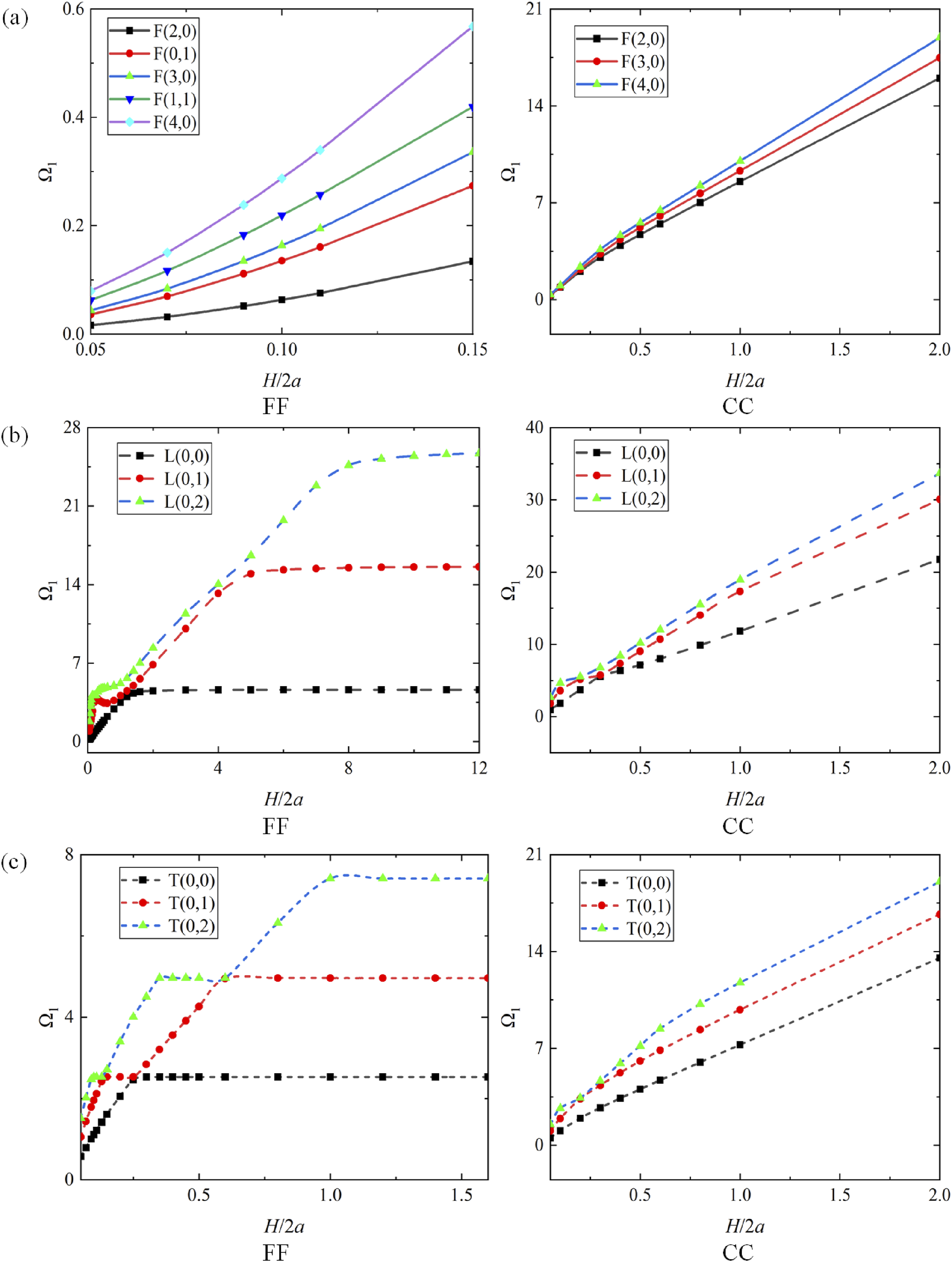
Figure 2 demonstrates that Ω1 of flexural mode increases as H/2a increases under the FF boundary condition. Ω1 of the longitudinal mode increases first and then tends to be stable as H/2a increases. When H/2a exceeds 1.4, 5, and 9, Ω1 of modes L (0, 0), L (0, 1), and L (0, 2) remain constant at 4.6, 15.5, and 25.6, respectively. When H/2a exceeds 0.25, Ω1 of mode T (0, 0) remains constant at 2.53. When H/2a is in the range of (0.13, 0.25) or greater than 0.6, Ω1 of mode T (0, 1) remains constant at 2.53 and 4.96, respectively. When H/2a is in the range of (0.1, 0.13), (0.35, 0.6) or greater than 1, Ω1 of mode T (0, 2) remains constant at 2.53, 4.96, and 7.41, respectively.
Ω1 of the flexural, longitudinal and torsional modes under the CC boundary condition increases as H/2a increases. When H/2a = 0.25, Ω1 of modes L (0, 0) and L (0, 1) are equal, and Ω1 of modes T (0, 1) and T (0, 2) are also equal.
4.5. Effects of radius ratio a/b on the vibration characteristics
4.5.1. Flexural modes
The geometric parameters are the inner radius b = 10 mm and the heights H = 2, 6, and 12 mm, respectively. The non-dimensional natural frequency is defined as Variation of non-dimensional natural frequency Ω2 of the flexural mode with the radius ratio a/b: (a) H = 2 mm, (b) H = 6 mm, and (c) H = 12 mm.
The increase of the outer radius a has a weakening effect on Ω2 of flexural vibration for the CC FGP annular plate, and the weakening effect presents a trend of first sharp and then gentle as a/b increases.
4.5.2. Longitudinal modes
The variation of the longitudinal as the radius ratio a/b increases for the FF and CC FGP annular plates is shown in Figure 4. The longitudinal mode for the FF FGP annular plate first increases, then decreases, and finally stabilizes as the radius ratio a/b increases. When the heights H = 2, 6, and 12 mm, Ω2 of modes L (0, 1) and L (0, 2) are equal at a/b = 1.2, 1.6, and 2.2, respectively. When a reaches the condition where the radial wall thickness a-b and height H are equal, Ω2 of the modes L (0, 1) and L (0, 2) are approximately equal at that point. Variation of non-dimensional natural frequency Ω2 of the longitudinal mode with the radius ratio a/b: (a) H = 2 mm, (b) H = 6 mm, and (c) H = 12 mm.
Ω2 of longitudinal mode decreases sharply as a/b increases in the range of a − b < H for the CC FGP annular plate. Ω2 of longitudinal mode changes slightly as a/b increases in the range of a − b > H.
4.5.3. Torsional modes
The influence of the radius ratio a/b on the torsional mode with the heights H = 2, 6, and 12 mm is shown in Figure 5. Ω2 of modes T (0, 0) and T (0, 1) are approximately equal at a/b = 1.2, 1.6, and 2.2, and Ω2 of modes T (0, 1) and T (0, 2) are very close at a/b = 1.4, 2, and 3 for the FF FGP annular plate. Variation of non-dimensional natural frequency Ω2 of the torsional mode with the radius ratio a/b: (a) H = 2 mm, (b) H = 6 mm, and (c) H = 12 mm.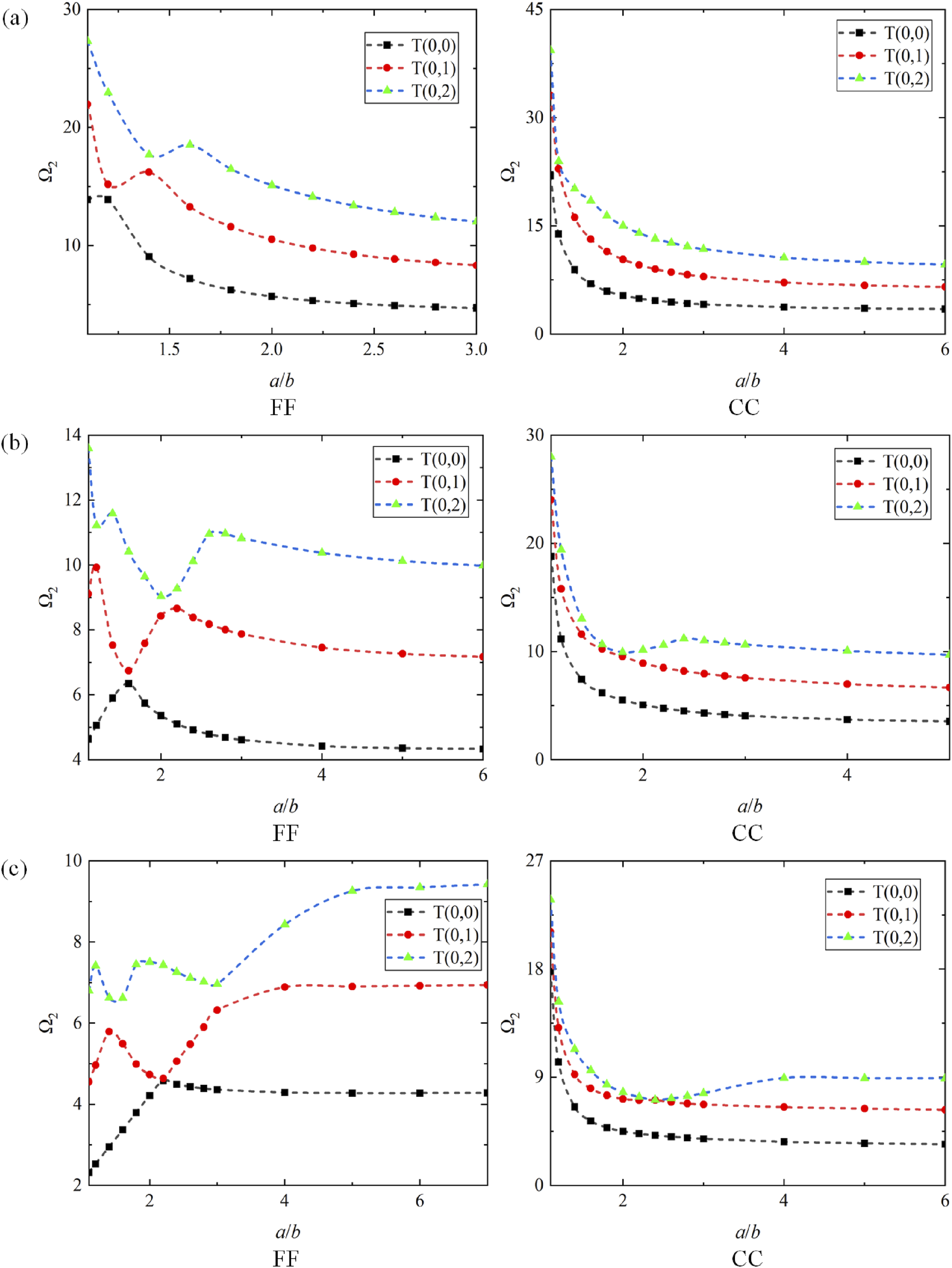
Ω2 of the torsional mode decreases significantly as a/b increases in the range of a − b < H for the CC FGP annular plate; Ω2 of the torsional mode remains stable as a/b increases in the range of a − b > H. When a − b = H, Ω2 of modes T (0, 1) and T (0, 2) are approximately equal.
4.6. Effects of inner radius b on the vibration characteristics
4.6.1. Flexural modes
The influence of inner radius b on the non-dimensional natural frequencies of flexural modes is shown in Figure 6. The geometric parameters are considered as the outer radius a = 40 mm and the heights H = 10, 13 and 16 mm, respectively. The non-dimensional natural frequency is defined as Variation of non-dimensional natural frequency Ω3 of the flexural mode with the inner radius b: (a) H = 10 mm, (b) H = 13 mm, and (c) H = 16 mm.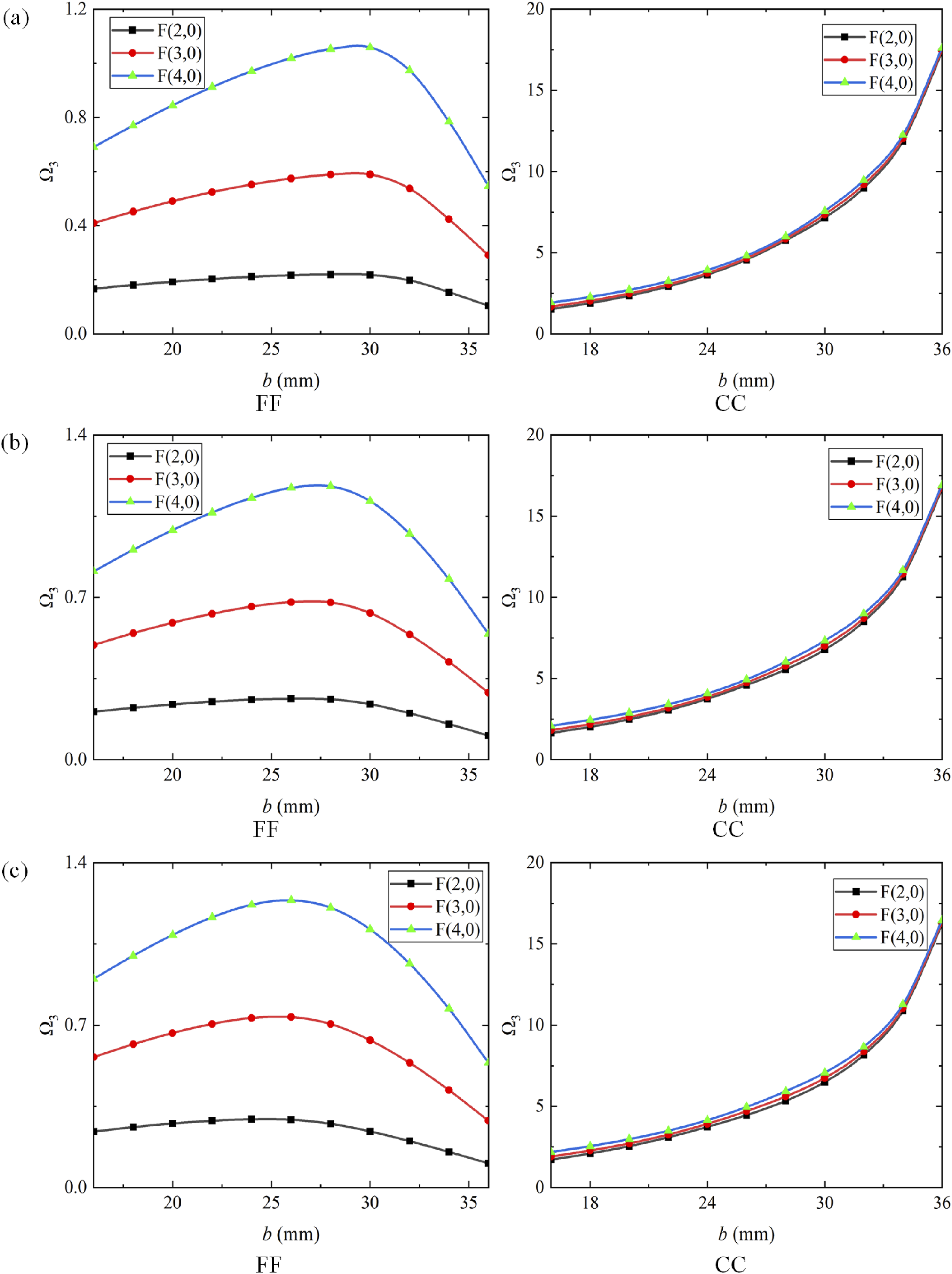
4.6.2. Longitudinal modes
The influence of inner radius b on Ω3 of longitudinal modes for the FF and CC FGP annular plates is shown in Figure 7. When the heights H = 10, 13, and 16 mm, Ω3 of the modes L (0, 1) and L (0, 2) are nearly identical at b = 30, 27, and 24 mm for the FF FGP annular plate. Ω3 of modes L (0, 1) and L (0, 2) are approximately equal at a – b = H. The influence of inner radius b on Ω3 of mode L (0, 0) is very weak. Figures 4 and 7 indicate that when a − b equals H, the geometric symmetry is enhanced, the adjacent modes of longitudinal vibration show similar stiffness, and the values of the natural frequencies are close. Variation of non-dimensional natural frequency Ω3 of the longitudinal mode with the inner radius b: (a) H = 10 mm, (b) H = 13 mm, and (c) H = 16 mm.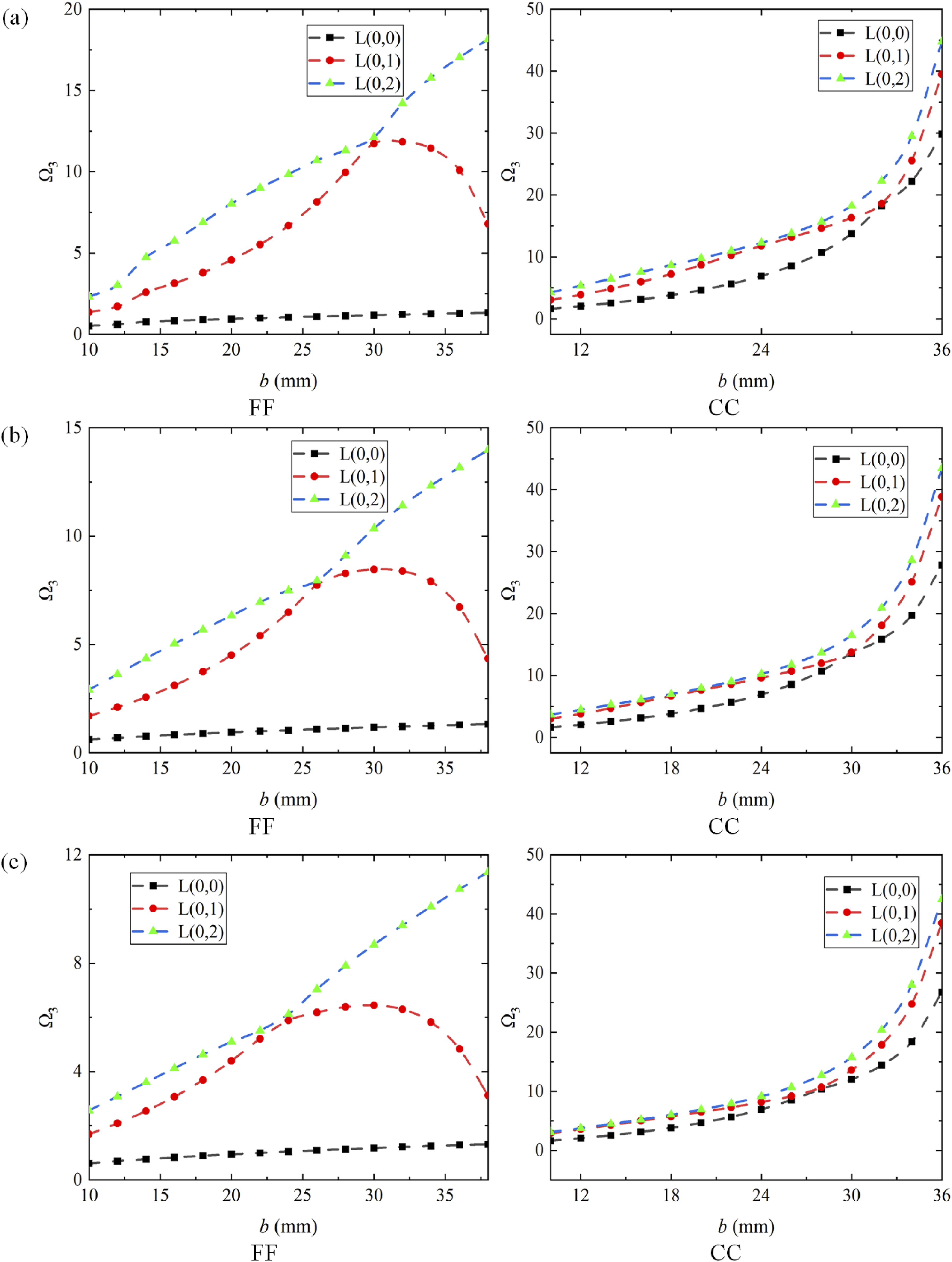
Ω3 of the longitudinal mode increases as b increases for the CC FGP annular plate. Ω3 of the longitudinal mode increases slightly as b increases in the range of a − b > H. Ω3 of the longitudinal mode increases sharply as b increases in the range of a − b < H.
4.6.3. Torsional modes
The influence of the inner radius b on Ω3 for torsional mode with outer radius a = 40 mm is shown in Figure 8. When the heights H = 10, 13, and 16 mm, Ω3 of modes T (0, 0) and T (0, 1) are nearly identical at inner radius b = 30, 27, and 24 mm for the FF FGP annular plate, respectively. When a-b = H, the Ω3 of modes T (0, 0) and T (0, 1) are nearly identical. Similarly, Ω3 of modes T (0, 1) and T (0, 2) are nearly identical when a − b = H/2. It can be observed from Figures 5 and 8 that when a − b equals H, the geometric symmetry is enhanced, the adjacent modes of torsional vibration exhibit similar stiffness, and the values of the natural frequencies are close. Variation of non-dimensional natural frequency Ω3 of the torsional mode with the inner radius b: (a) H = 10 mm, (b) H = 13 mm, and (c) H = 16 mm.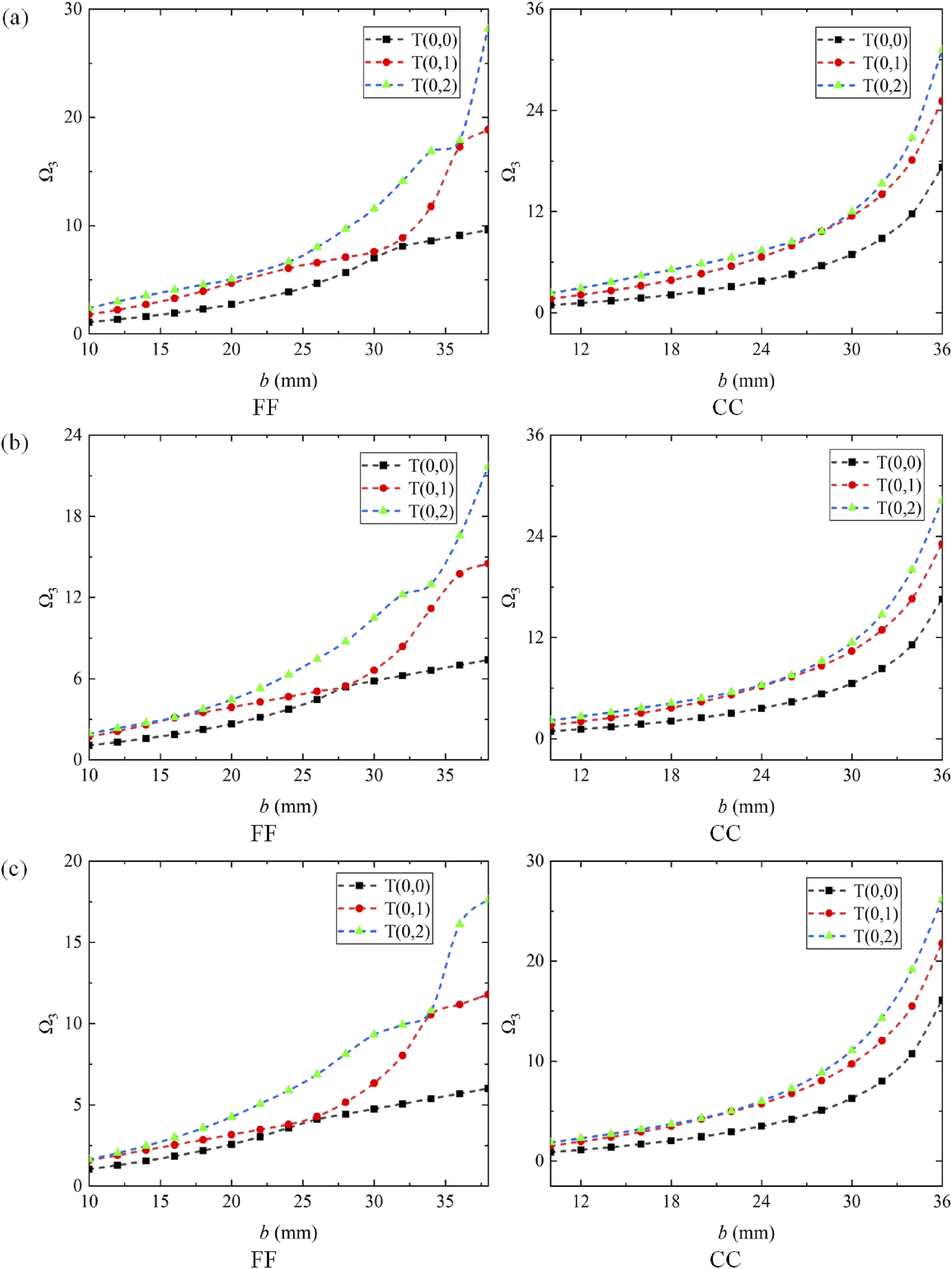
Ω3 of the torsional mode increases slightly as b increases in the range of a − b > H for the CC FGP annular plate. Ω3 of the torsional mode increases sharply as b increases in the range of a − b < H. Ω3 of the modes T (0, 1) and T (0, 2) are nearly identical at a – b = H.
4.7. Mode shape
The analysis of vibration modes is an important way to understand the flexural, longitudinal and torsional modes of the FGP annular plate. In this section, the vibration modes at the interface of FGP annular plate are analyzed.
The geometric relationship of the FGP annular plate is considered as 2a/H = 20, where the outer radius a = 30 mm and the inner radius b = 6 mm. The radial (u), circumferential (v), and axial (w) displacements of modes F (2, 0) under FF and CC boundary conditions are shown in Figure 9. Mode shapes of mode F (2, 0) of FGP annular plate at 2a/H = 20: (a) u displacement, (b) v displacement, and (c) w displacement.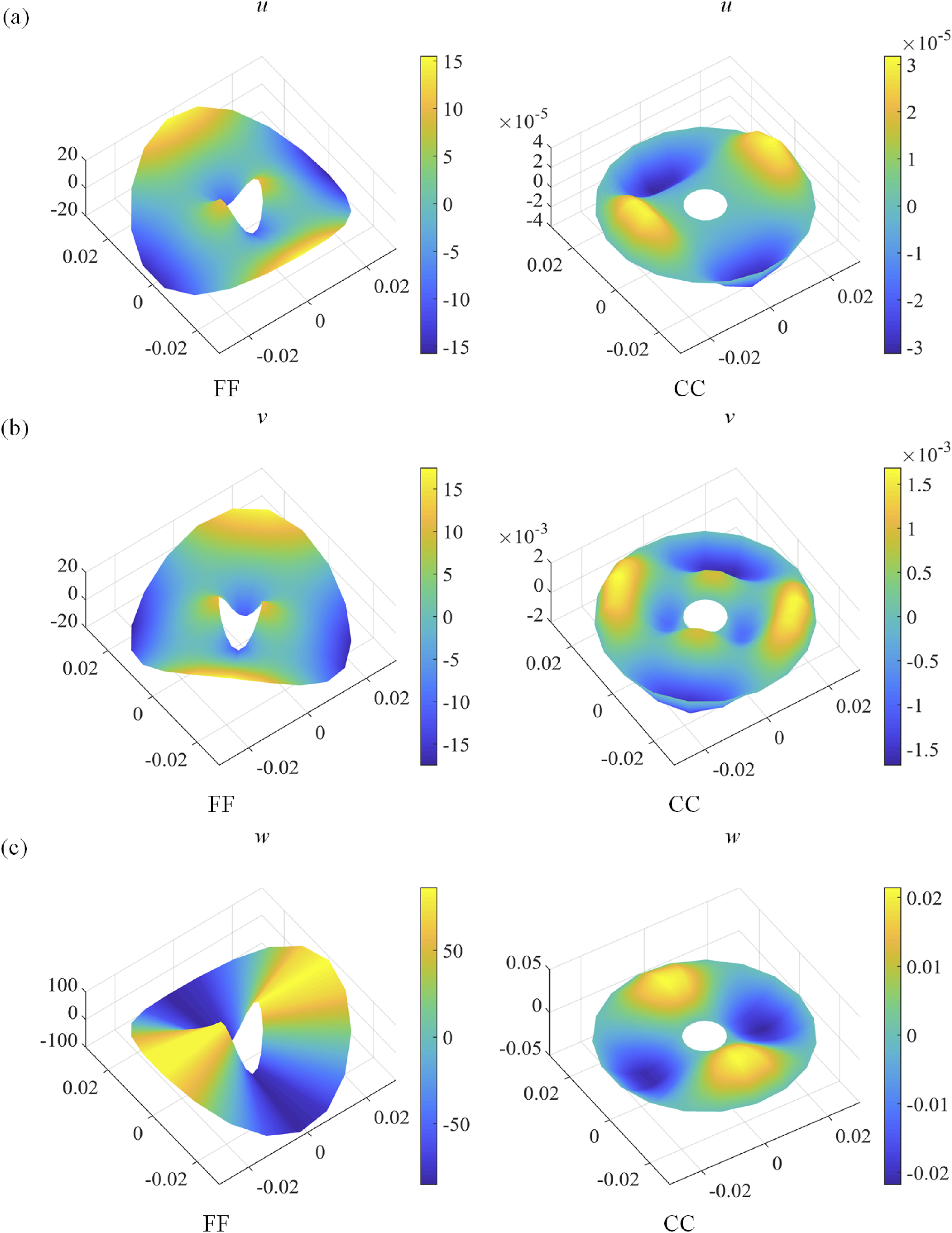
5. Conclusion
The flexural, longitudinal, and torsional vibrations of FGP annular plates exhibit distinct advantages and disadvantages in terms of sensitivity, stability, and precision of piezoelectric elements. There exists a close correlation between vibration characteristics and geometric features. In this paper, the double Legendre polynomial method (DLPM) is extended to study the flexural vibration of FGP annular plates from axisymmetric vibration. In addition, the influence of the relationship between radial wall thickness a-b and axial height H on the flexural, longitudinal and torsional vibrations is revealed for the first time. The main conclusions are as follows: (1) The DLPM is extended for the first time to study the flexural vibration of FGP annular plates from axisymmetric vibration. (2) Under the FF boundary condition, when the outer radius a and the inner radius b reach the condition where the radial wall thickness a-b equals the height H, the non-dimensional natural frequency of flexural vibration attains its maximum value. (3) Under the FF boundary condition, when the outer radius a and the inner radius b respectively reach the condition where the radial wall thickness a-b equals the height H, the non-dimensional natural frequencies of the modes L (0, 1) and L (0, 2) are approximately equal, and the non-dimensional natural frequencies of the modes T (0, 0) and T (0, 1) are also approximately equal. (4) Under the CC boundary condition, when the outer radius a and inner radius b reach the condition where the radial wall thickness a-b is less than the height H, the non-dimensional natural frequencies of the longitudinal mode and the torsional mode decrease sharply as the radial wall thickness a-b increases.
Footnotes
Declaration of conflicting interests
The author(s) declared no potential conflicts of interest with respect to the research, authorship, and/or publication of this article.
Funding
The author(s) disclosed receipt of the following financial support for the research, authorship, and/or publication of this article: The authors gratefully acknowledge the support by the Henan University Science and Technology Innovation Team Support Plan (No. 23IRTSTHN016), Natural Science Foundation of Henan Province (242300420248) and Henan Polytechnic University double first-class discipline creation project (AQ20240744).
