







Abstract
A quasi-zero-stiffness-lever-inertial-amplification coupled sandwich meta-structure plate (QZS-LIA CSMP) is proposed to achieve an ultra-low-frequency broadband vibration bandgap (below 10 Hz) for sandwich meta-structure plates. The dispersion relation and transmission characteristics of the proposed structure are investigated. It is found that the QZS-LIA CSMP can open a bandgap from 4.3 Hz to about 10 Hz. The bandgap opening frequency is reduced by 83.8%, and the bandgap width is increased by 33% compared to the conventional meta-structure plate. The main mode shape of the proposed oscillator, as determined by the bandgap formation mechanism, is that the lever amplifies the mass while compressing the QZS model, reducing stiffness without applying a pre-displacement, while keeping the actual mass and stiffness constant. The double oscillators enhance the suppression force of the sandwich periodic substrate, which increases the bandgap width. The proposed structure is lightweight, load-bearing, and has a broadband vibration bandgap at ultra-low frequencies. It provides a solution for ultra-low-frequency vibration control of sandwich meta-structure plates.
Keywords
1. Introduction
Sandwich plates, due to their superior specific stiffness, are widely used in engineering structures and are popular among researchers across many fields (Balcı et al., 2017; Bella et al., 2012; Crupi et al., 2013; Li et al., 2021a; Li et al., 2021b; Li et al., 2021; Vinson, 2001; Zhang et al., 2021). However, since they are the carriers that generate and transmit vibrations, managing their low-frequency vibrations has long been a major concern. In particular, their ultra-low-frequency vibration control below 10 Hz remains a key issue in engineering vibration control and requires further attention.
Meta-structure is a type of artificial microstructure composed of periodic arrangements. By micro-designing its substructure, it can be made to have extraordinary physical properties compared to conventional structures (Barri et al., 2021; Jiao et al., 2020, 2023; Li et al., 2023; Mei et al., 2021; Zheng et al., 2014), such as vibration bandgap characteristics, which suppress vibration in a specific frequency range when the elastic wave passes through it. Liu et al. (2000) first proposed the concept of locally resonant meta-structure. Since locally resonant meta-structures circumvent the dependence of conventional bandgap structures on lattice constant, small-scale periodic structures can be used to broaden the bandgap at lower frequencies. Thus, it has been widely investigated for reducing low-frequency vibrations in sandwich meta-structures. The researchers (An et al., 2023; Chen et al., 2021; Guo et al., 2024a) combined local oscillators with sandwich plates to construct local resonance sandwich meta-structure plates, and found that they could produce significant low-frequency vibration bandgaps. However, the bandgap location is only related to the natural frequency of the local oscillator (Li et al., 2025). The use of local resonance sandwich meta-structure plates to reduce low-frequency vibration requires either a reduction in structural stiffness or an increase in structural mass. This results in a decrease in structural load-bearing capacity or an increase in structural mass, making it difficult to achieve lightweight, high-stiffness, low-frequency vibration. Therefore, the development of lightweight, high-stiffness sandwich meta-structure plates with ultra-low-frequency bandgaps has emerged as a pressing issue that must be addressed immediately.
For this reason, some scholars have incorporated the inertial-amplification (IA) mechanism into the local resonance meta-structures, achieving a low-frequency bandgap while maintaining the structural mass unchanged. Yilmaz et al. (2007) were the first to discover that a locally resonant meta-structure with inertial-amplification effects can produce bandgaps in lower frequency ranges. Zeng et al. (2022a) and Xu et al. (2025) studied truss-type inertial-amplification local resonance meta-structures and demonstrated their ability to induce lower frequency bandgaps. However, their application is limited because they occupy too much space. Therefore, some researchers (Gao et al., 2024; Xi et al., 2023; Zeng et al., 2022b) studied lever-type inertial-amplification (LIA) meta-structures and found that bandgaps in the lower frequency range can be achieved by adjusting the lever arm length ratios.
In addition, some scholars have introduced the quasi-zero-stiffness/negative-stiffness (QZS/NS) mechanism into local resonance meta-structures, achieving a low-frequency bandgap while maintaining structural stiffness unchanged. Carrella et al. (2009) proposed a QZS isolator to achieve compatibility between high static stiffness and low dynamic stiffness. Zhou et al. (2017, 2019) introduced QZS local oscillators into meta-structure beams and found that the bandgap can be shifted to a lower frequency range by adjusting the stiffness of the oblique springs. However, the QZS local oscillator, constructed with positive- and negative-stiffness springs, is prone to assembly errors and shifts the bandgap towards higher frequencies. To overcome this disadvantage, some researchers (Cai et al., 2022; Guo et al., 2024b; Lin et al., 2022; Liu et al., 2024) have used compliant mechanisms to replace composite spring mechanisms, thereby achieving quasi-zero-stiffness. These have been incorporated into meta-structure designs to achieve low-frequency bandgap characteristics. It was found that the bandgap can be shifted to a lower frequency range by applying additional pre-displacement.
Although the IA or the QZS mechanism can alone significantly reduce the bandgap position in local resonance meta-structures, the effect of further lowering the bandgap opening position to form an ultra-low-frequency (below 10 Hz) bandgap only by a single IA or the QZS principle is still limited. At the same time, the traditional QZS principle requires additional pre-displacement to achieve low-frequency vibration reduction, which limits its use in this application.
Inspired by the QZS and the IA mechanisms, we propose the quasi-zero-stiffness-lever-inertial-amplification coupled oscillators to address the difficulty of forming an ultra-low-frequency bandgap due to the incompatibility of the lightweight, high-stiffness sandwich meta-structure plate with the low-frequency bandgap. By introducing them into the sandwich structure plates, we create the quasi-zero-stiffness-lever-inertial-amplification coupled sandwich meta-structure plates (QZS-LIA CSMP). In addition, since the lever amplifies the mass while compressing the QZS model to achieve stiffness offset, it avoids the drawback of conventional QZS models for low-frequency vibration reduction, namely, the need to apply pre-displacement.
2. Theoretical models
Figure 1 depicts the formation principle of the QZS-LIA CSMP, with Figures 1(a) and (b) showing the overall structural model and unit model, respectively. The sandwich meta-structure plate unit is arranged periodically in the x- and y-directions to form the proposed sandwich meta-structure plate, as shown in Figure 1(a). Schematic diagram of the formation of the QZS-LIA CSMP: (a) overall model and (b) unit model.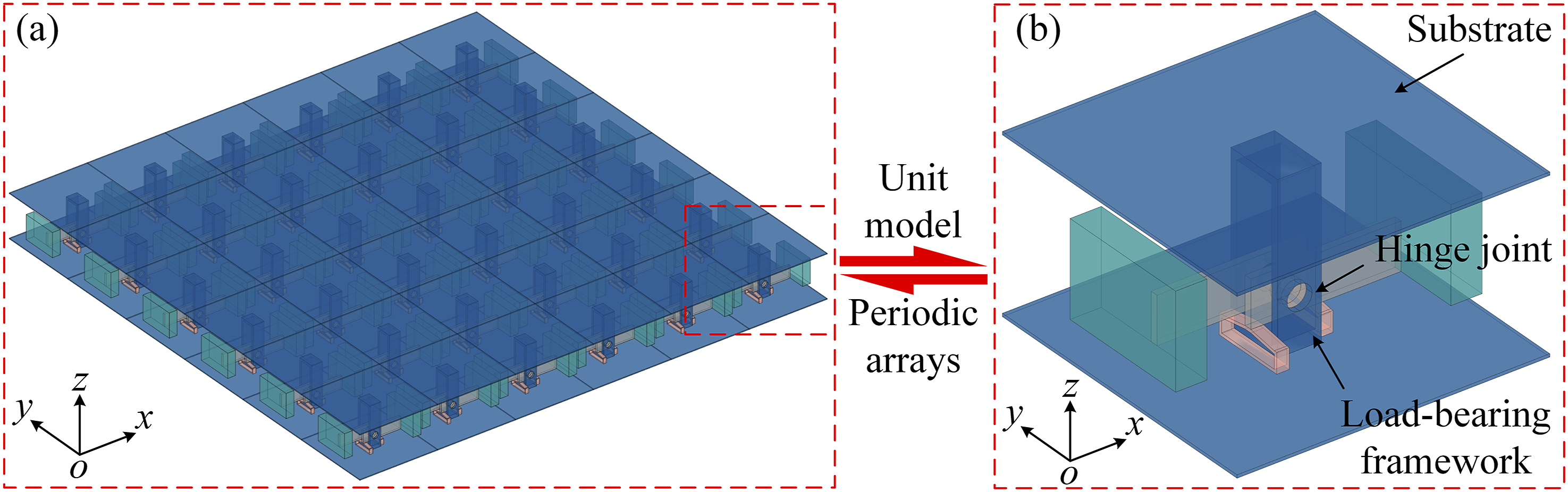
Figure 2 presents the sandwich meta-structure plate unit, combining a sandwich unit with quasi-zero-stiffness-lever-inertial-amplification coupled oscillators. Each oscillator includes a QZS model, a lightweight lever, and a mass block. The sandwich unit consists of two substrates and a load-bearing frame. Levers and frame are hinge-connected through pre-drilled holes. Schematic diagram of the composition process of QZS-LIA CSMP unit: (a) unit model and (b) the model of the sandwich unit and the proposed oscillators.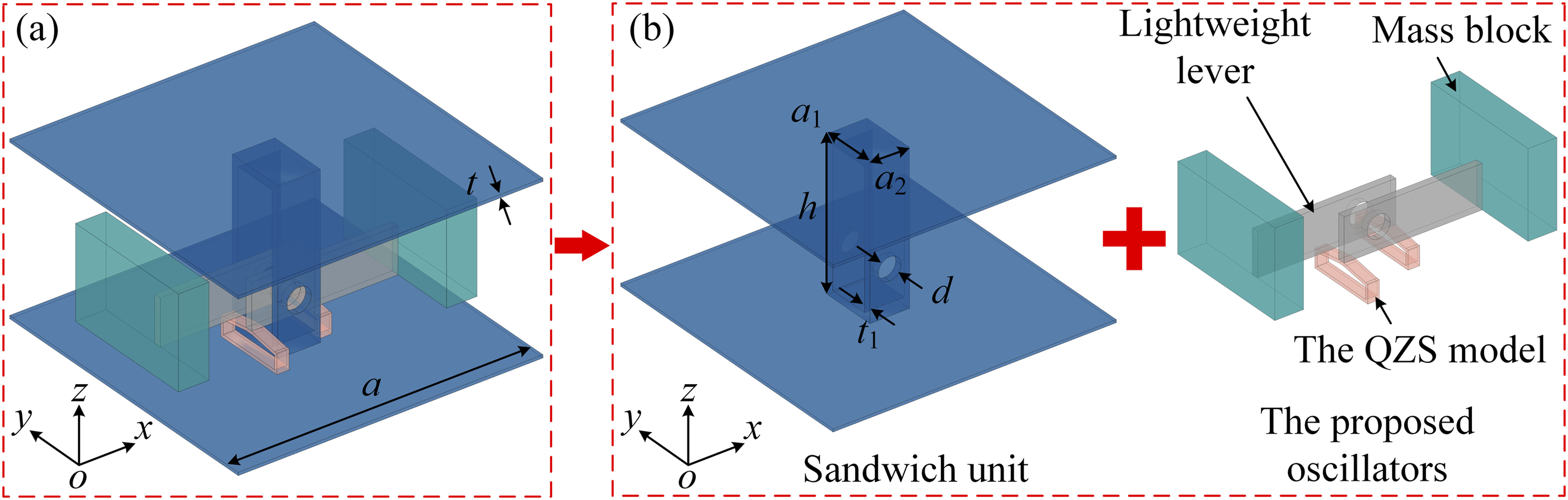
Since the proposed oscillators are symmetrical, their single structure is shown in Figure 3(a). The QZS model in xoz view is shown in Figure 3(b). It is composed of the connection element ①, the negative-stiffness (NS) element ②, the positive stiffness (PS) element ③, and the support element ④. Element ① transfers load. When the lever compresses element ② in the z-axis, the element buckles. It creates NS, meaning the resistance force actually drops as it is pushed further. Element ③ deforms outward under z-axis compression to provide PS, where the reaction force increases in proportion to the displacement. Element ④ provides structural support. The integration of negative and positive stiffness components achieves a QZS characteristic. (a) The model of the proposed oscillator and (b) the xoz view and composition of the QZS model.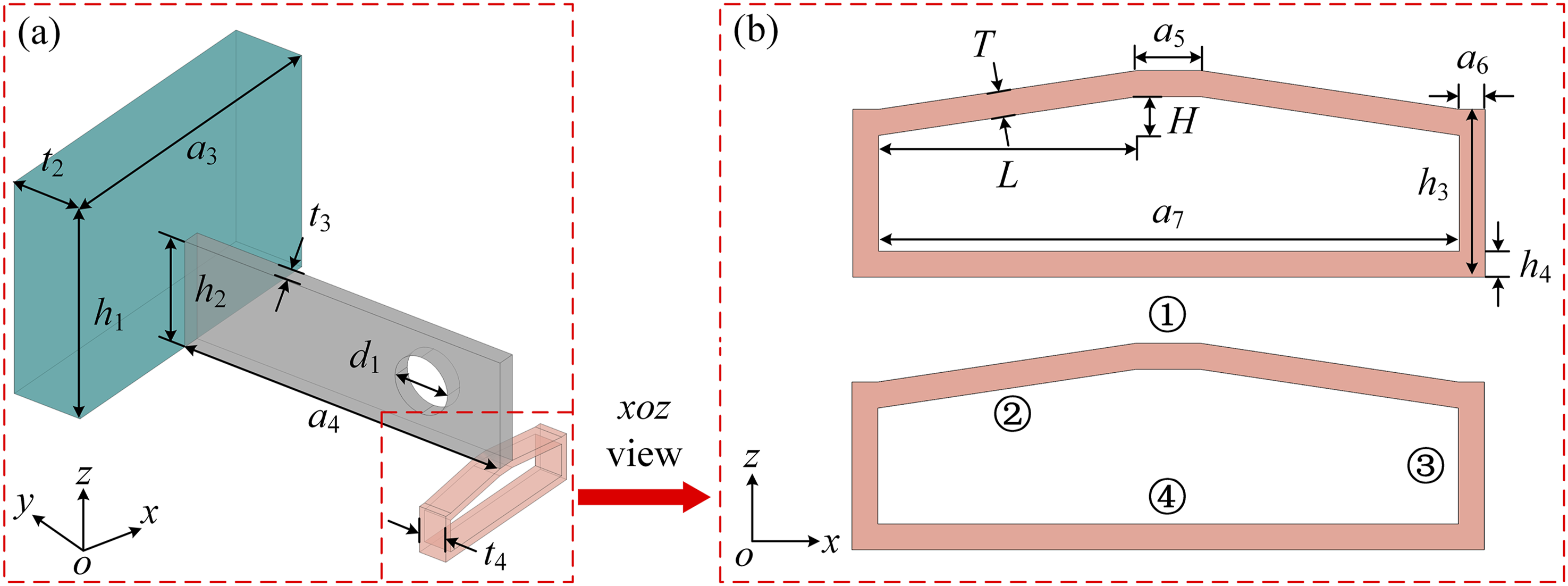
When the structure is under vibrational excitation, the mechanism pries the mass to amplify dynamic equivalent mass while compressing the QZS model to reduce dynamic equivalent stiffness, while their actual mass and stiffness remain unchanged. It eliminates the QZS pre-displacement requirements and enables lightweight, high-stiffness meta-structures with ultra-low-frequency bandgaps.
3. Results and discussion
3.1. Analysis of bandgap characteristics
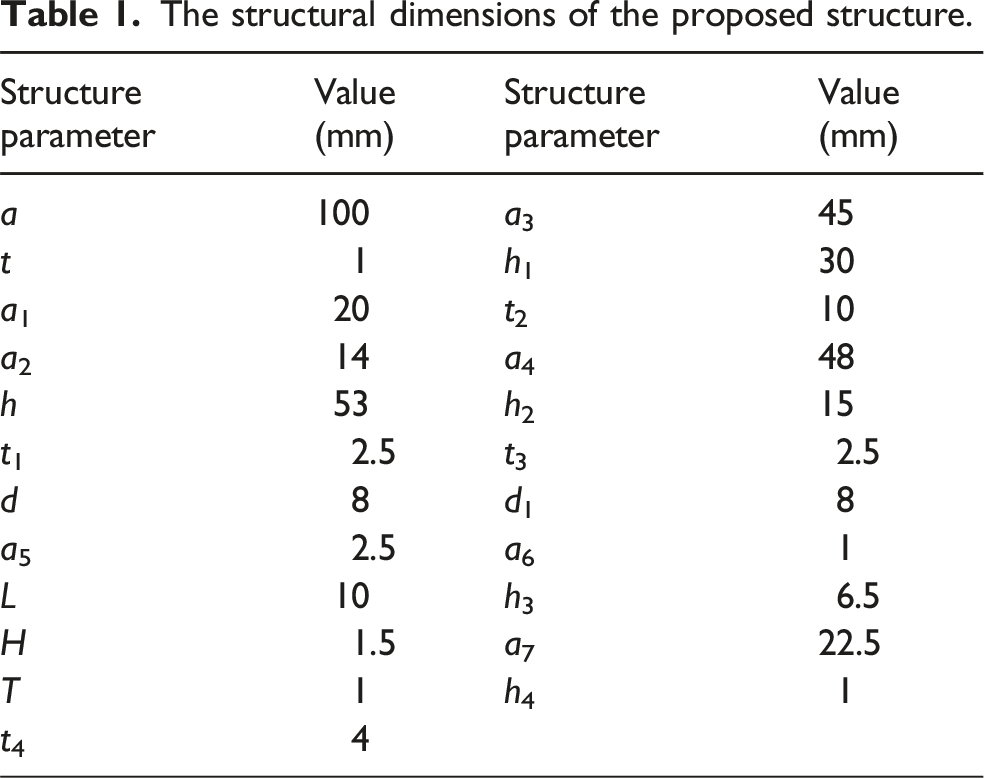
The structural dimensions of the proposed structure.
Material parameters of the structure.

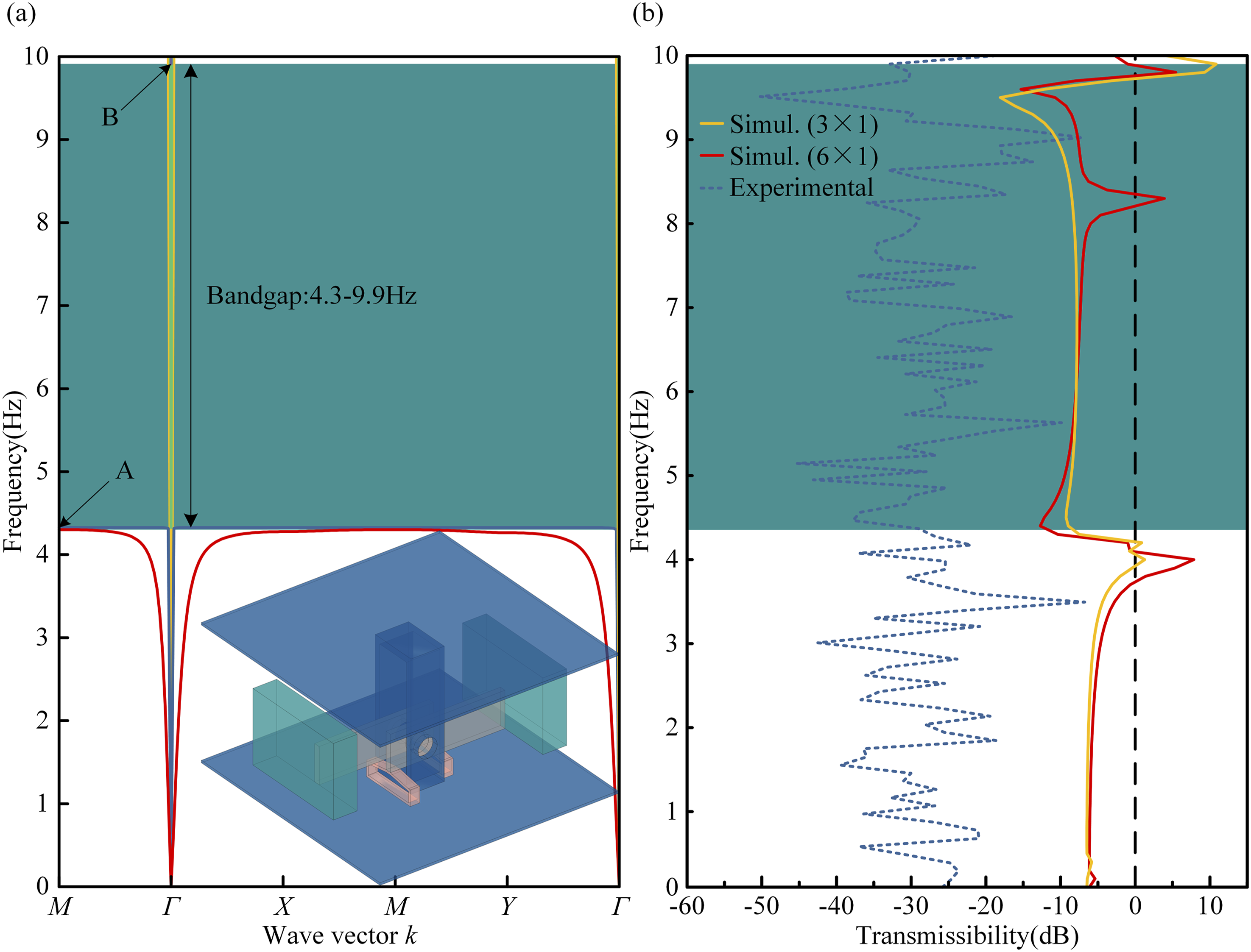
(a) Band structure of the QZS-LIA CSMP and (b) comparison of the vibration transmission spectra of the QZS-LIA CSMP: simulation results for 3 × 1 and 6 × 1 finite-period structures and the experimentally measured results.
Figure 4(a) shows that the bandgap within 10 Hz forms between two specific boundaries. The lower boundary at 4.3 Hz, marked as point A, corresponds to the local resonance flat band of the oscillator. Similarly, the upper boundary at 9.9 Hz, marked as point B, aligns with the transverse vibration out-of-plane band of the sandwich unit. The design produces a bandgap between 4.3 Hz and 9.9 Hz. Transverse vibrations are suppressed across this entire 5.6 Hz bandwidth.
The finite element method was used to calculate the band structures of a sandwich meta-structure plate (SMP) featuring a single oscillator and a lever-inertial-amplification (LIA) counterpart. These calculations demonstrate the ultra-low-frequency broadband characteristics of the proposed structure, as shown in Figure 5. As shown in Table 3, the QZS-LIA CSMP reduces the lower boundary of the bandgap by 83.8% and increases its width by 33.3% compared to the reference. Band structure of (a) the SMP with a single oscillator and (b) the LIA SMP. A comparison of the bandgaps of three types of sandwich meta-structure plates.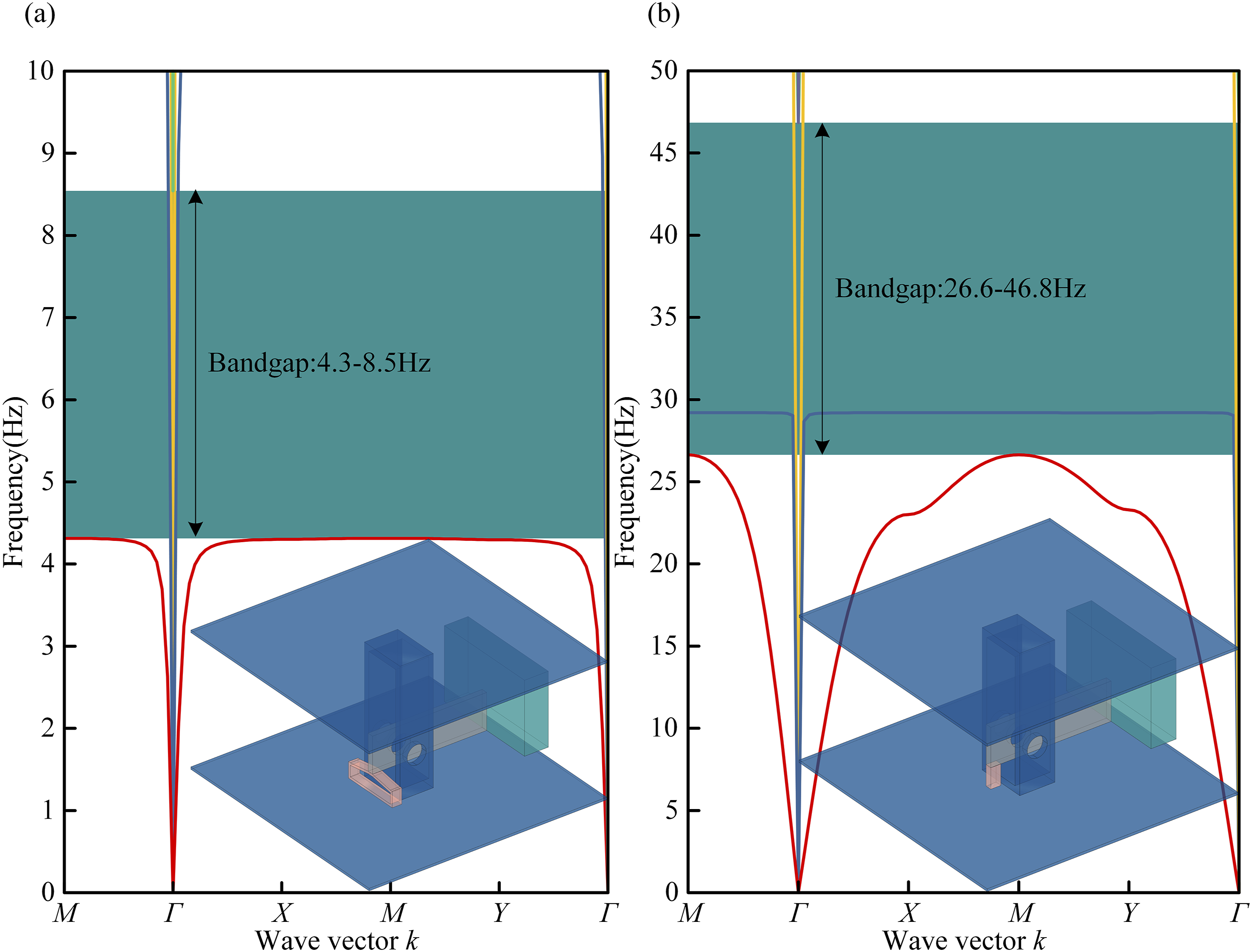

3.2. Analysis of the bandgap mechanism
To verify the ultra-low-frequency broadband bandgap mechanism in the QZS-LIA CSMP, the mode shapes at points A (lower boundary) and B (upper boundary) from Figure 4(a) are extracted and presented in Figures 6(a) and (b), respectively. (a) The mode shape of point A of the bandgap lower boundary frequency and (b) the mode shape of point B of the bandgap upper boundary frequency.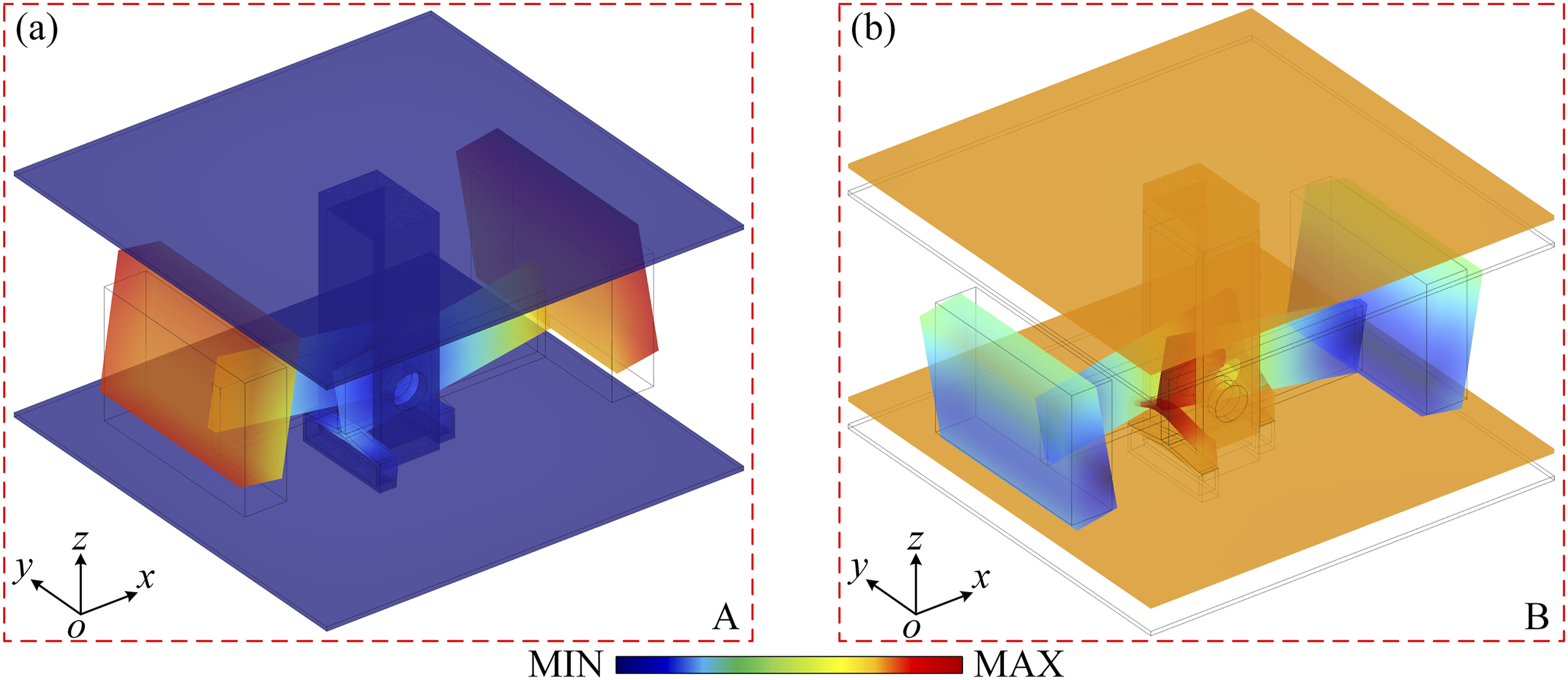
Figure 7(a) illustrates the eigenmode shape of the proposed oscillators, and Figure 7(b) presents a simplified schematic of the sandwich meta-structure unit. Corresponding QZS model diagrams extracted from these results are shown in Figures 8 and 9, respectively. Schematic diagram of (a) the eigenmode shape of the proposed oscillators and (b) the simplified principle of the proposed sandwich meta-structure plate unit. Schematic diagram of (a) the eigenmode shape of the QZS model and (b) the simplified principle of the QZS model. Equivalent schematic diagram of (a) the QZS model after loading and (b) the proposed oscillator under loading.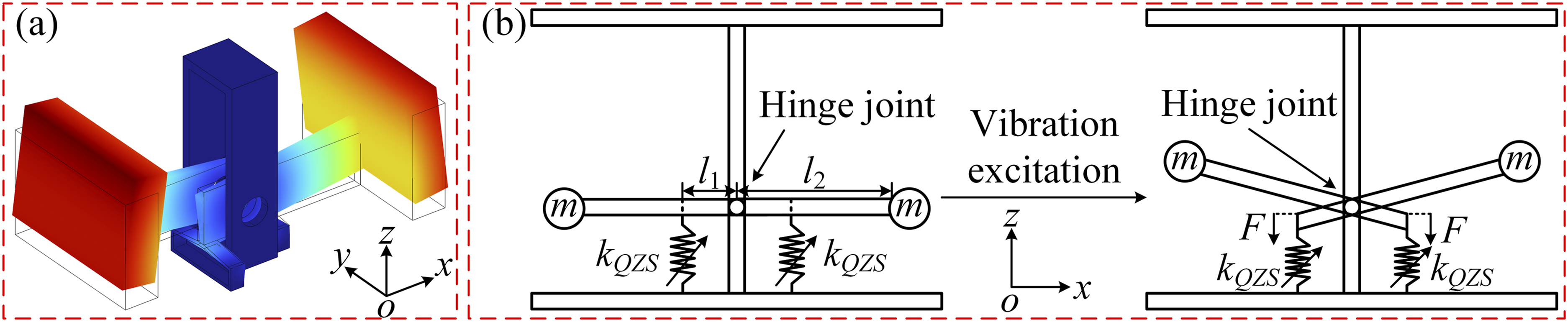

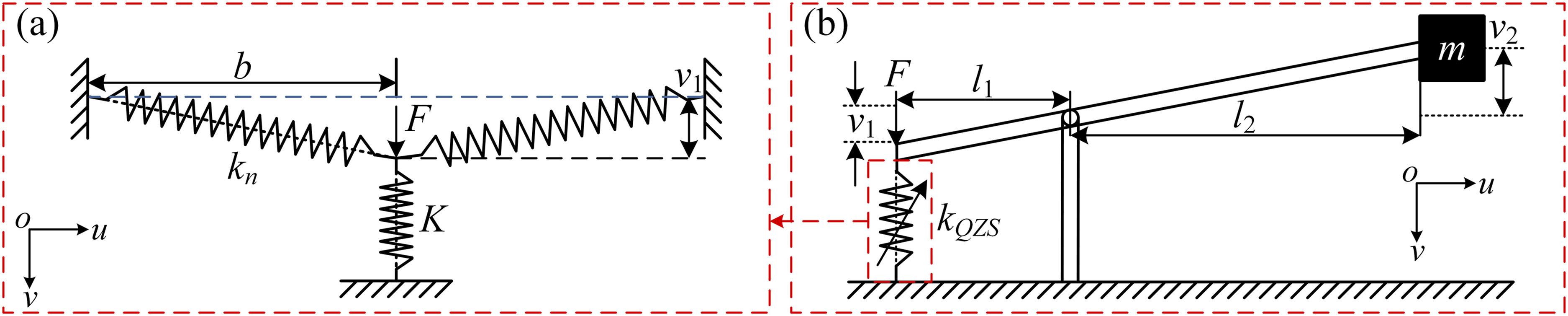
The mechanism of formation of its ultra-low-frequency broadband vibration bandgap is first investigated theoretically. In Figure 9(b), F is the vibration excitation force; v1 and v2 are the displacement amplitudes of the left and right ends of the lever; l1 and l2 are the distances from the left and right ends of the lever to the hinge joint, respectively, where l2>l1; and k
QZS
is the actual stiffness of the QZS model. It is assumed that the lever is a massless rigid rod. The movement is only considered along the vertical direction v. When the right end of the lever is subjected to transverse excitation, the mass m is displaced with amplitude v2, and the lever oscillates around the hinge, causing the left end of the lever to compress the QZS model k
QZS
and deform with amplitude of compression v1. The dynamic equation of the mechanism can be obtained from the force analysis:
Let M = (l2/l1)2m in equation (1). Since l2 > l1, the equivalent transformation of the proposed oscillator of Figure 9(b) shows that the actual mass m is amplified to a dynamic equivalent mass M, with an amplification factor of (l2/l1)2.
To quantify the impact of the inertial effects due to the distributed mass of the lever on the overall equivalent mass M, we consider the total length of the lever as a4 = l1 + l2, linear density as ρ
l
, and total mass as m
l
= ρ
l
× a4. The total moment of inertia Itotal of the lever about the hinge point (located at a distance l1 from the left end connected to the QZS model k
QZS
and l2 from the right end connected to the mass block m) is composed of the distributed mass of the lever and the mass block at its end:

According to the principle of kinetic energy equivalence, the overall equivalent mass Meff corresponding to the degree of freedom v1 satisfies the relation 
After rearranging the above equation, we obtain the following expression:
Here, the first term “(l2/l1)2m” represents the contribution from the mass block m amplified by the lever, which is the dynamically equivalent mass M. Moreover, second term corresponds to the additional equivalent mass due to the distributed mass of the lever.
The calculated values are as follows: the lightweight lever has a mass of m
l
≈ 0.00017 kg, and the mass block has a mass of m ≈ 0.106 kg. The lever arm length ratio used in this study was l2/l1 = 3. The contribution from the mass block can be calculated as M = (l2/l1)2m = 0.954 kg, while the contribution from the lever’s distributed mass is approximately
Additionally, for the sandwich meta-structure plate proposed in this study, the band structure was computed via numerical simulation for a lever composed of conventional epoxy resin with a density of 1180 kg·m-3. The resulting bandgap ranges from 4.29 to 9.7 Hz. In comparison to the case where the lightweight epoxy resin with a density of 100 kg·m-3 is used, which yields a bandgap of 4.3–9.9 Hz, the absolute error in the bandgap opening frequency is 0.01 Hz with a relative error ≈0.23%. In contrast, the absolute error in the bandgap closing frequency is 0.2 Hz (relative error ≈2%). Therefore, this confirms that, within the current design, the error introduced by the idealized “massless rigid rod” assumption is negligible.
Further analysis of the actual stiffness k
QZS
of the QZS model in Figure 9(b) gives the equivalent schematic diagram after loading, as shown in Figure 9(a). Here, k
n
is the stiffness of the oblique spring, which can be equivalent to the element 

This expression indicates that the value of λ can be tailored by adjusting the stiffness ratio of the oblique spring k n to the vertical spring K and the dimensionless parameter β.
Therefore, at the blue dashed line V1 = 0, the stiffness of the mechanism can be written as follows:
Let k = k QZS = λK, and since 0 ≤ λ < 1, the actual stiffness K is reduced to the dynamic equivalent stiffness k with a reduction factor of λ.
For the equivalent QZS model k
QZS
to exhibit an approximately linear stiffness λK around the static equilibrium position, the dimensionless oscillator displacement V1 is determined through optimization of the parameter β. The specific expression is given in the following form (Zhou et al., 2017):
By taking the derivative of the parameter β in equation (9), the optimal value of β that satisfies the condition k
QZS
= λK for the equivalent QZS model at a given dimensionless displacement V1 is obtained in the following manner: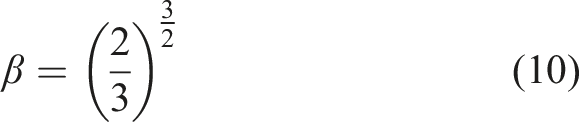
By substituting equation (10) into equation (9), the maximum value of the dimensionless displacement V1 of the oscillator is obtained as
Combining equations (1) and (8) yields the dynamic equation of the proposed oscillator shown in Figure 9(b) as follows:
The natural frequency ω0 is given as:
It can be seen that the equivalent model shown in Figure 9(b) transforms the proposed oscillator, reducing its natural frequency from (K/m)1/2 to [λ1/2/(l2/l1)](K/m)1/2 by a factor of [λ1/2/(l2/l1)]. This process is achieved only by prying the mass m and compressing the QZS model k QZS with a lever. Moreover, the actual mass and stiffness of the oscillator remain unchanged, resulting in ultra-low-frequency characteristics.
In addition, to investigate the causes of bandgap broadening, it is known that the width of the bandgap is proportional to the strength of the suppression force of the oscillator on the main mode of the matrix. The bandgap width increases with the suppression force, and the suppression force F1 is given by the following:
Here, k1 is the actual stiffness of the oscillator, and |A| is the main mode displacement of the oscillator, which belongs to the natural characteristics of the structure. In comparison to the sandwich meta-structure plate with a single proposed oscillator in Figure 5(a), the bandgap width of the QZS-LIA CSMP is 5.6 Hz, which is approximately 33% wider. It is due to the parallel arrangement of the two oscillators. The equivalent actual stiffness is given by k1 = 2k QZS . Thus, compared with the single-oscillator configuration, the suppressive force acting on the main mode of the substrate is increased to 2F1. Thus, an ultra-low-frequency broadband vibration bandgap is formed.
Based on the theoretical analysis presented above, the ultra-low-frequency broadband vibration bandgap formation mechanism of the QZS-LIA CSMP is further analyzed from a physical deformation perspective. The eigenmode shape of the proposed oscillators is shown in Figure 7(a). As an independent motional mechanism, its eigenfrequency is 4.29 Hz, which is comparable to the lower bandgap boundary frequency of the proposed structure, 4.3 Hz. When the vibration excitation frequency is close to the natural frequency of the proposed oscillators, the mode shape of the oscillators shown in Figure 6(a) is activated and amplified, and the lever oscillates along the z-direction in the xoz-plane, with the hinge of the load-bearing frame serving as the center. One end pries the mass block m to amplify it into a dynamically equivalent mass (l2/l1)2m, while the other end compresses the QZS model k QZS to reduce its dynamic equivalent stiffness to λK. At this time, the vibration mode of the oscillators is coupled with the vibration mode of the sandwich unit along the z-direction, and the sandwich unit is in a static condition. As a result, out-of-plane waves cannot propagate through the sandwich meta-structure plate, and the ultra-low-frequency bandgap is formed.
In order to further illustrate the action mechanism of the QZS model, a theoretical model of the QZS model shown in Figure 3(b) is established, as shown in Figure 8(b). Lines AB and BC denote oblique and straight beams, respectively. The dashed lines A'B' and B'C indicate the oblique and straight beams after deformation, respectively. The bottom of the straight beam BC is fixed. The structure considers deformation only in the z-direction. When the structure is subjected to force F, the oblique beam AB bends to the A'B' to produce NS characteristics induced by buckling deformation, while the straight beam BC bends to the B'C to produce PS characteristics. The QZS characteristics are achieved by coupling the deformation effects of oblique and straight beams. By zooming in on the eigenmode shape of the QZS model in Figure 7(a) and showing it in Figure 8(a), the end of the lever pries the mass block, while the other end compresses the QZS model. It causes the element
A finite element simulation was performed on the structure shown in Figure 3(b) to verify the NS characteristics of element (a) Finite element setup of the QZS model and schematic diagram of the buckling deformation of element 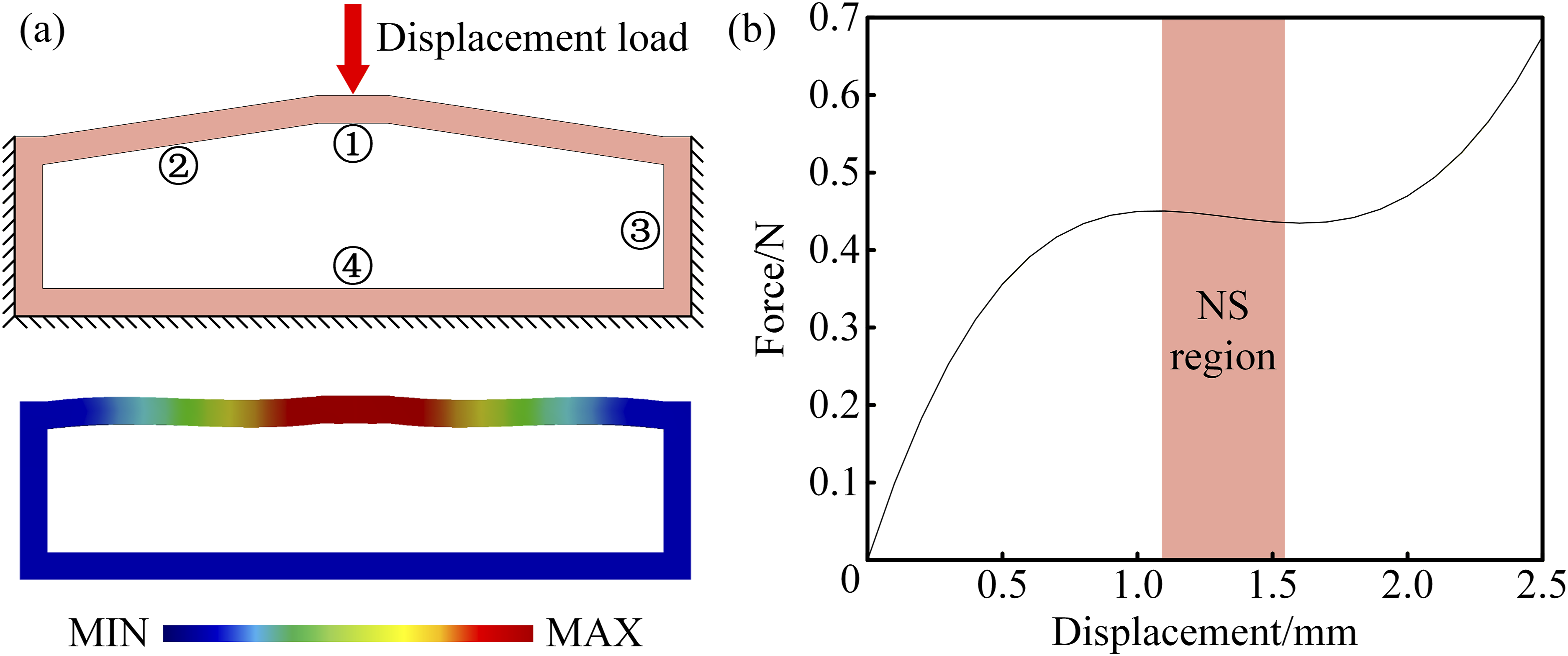
For the structure shown in Figure 3(b), the parameter λ for the QZS model in Figure 3(b) can be derived from equation (8) as λ = k
QZS
/K. The equivalent stiffness k
QZS
is calculated using finite element static simulation, in which the element 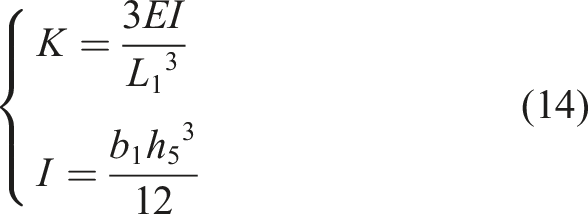
Here, E is the Young’s modulus of the material, I is the cross-sectional moment of inertia of the beam, L1 is the length of the cantilever beam, which is the height h3 of the element 
3.3 Analysis of vibration transmission characteristics
To evaluate vibration attenuation, transmission tests were performed on 3 × 1 and 6 × 1 finite periodic configurations (Figures 11 and 12). Acceleration was applied along the thickness direction at one end, and the response was recorded at the other. Figure 4(b) shows that within the bandgap, the 3 × 1 configuration attenuates vibration as effectively as the 6 × 1 configuration, with an average difference of only 1.8 dB. The structure effectively suppresses transverse vibration within the bandgap, confirming that the proposed QZS-LIA CSMP delivers excellent ultra-low-frequency vibration isolation. Mode shapes of the 3 × 1 finite-period sandwich meta-structure plate: (a) frequencies near the bandgap opening frequency (4.1 Hz, 4.2 Hz, 4.3 Hz) and (b) frequencies outside the bandgap range (0.8 Hz, 2 Hz, 10.3 Hz). Mode shapes of the 6 × 1 finite-period sandwich meta-structure plate: (a) frequencies near the bandgap opening frequency (4.1 Hz, 4.2 Hz, 4.3 Hz) and (b) frequencies outside the bandgap range (0.8 Hz, 2 Hz, 10.3 Hz).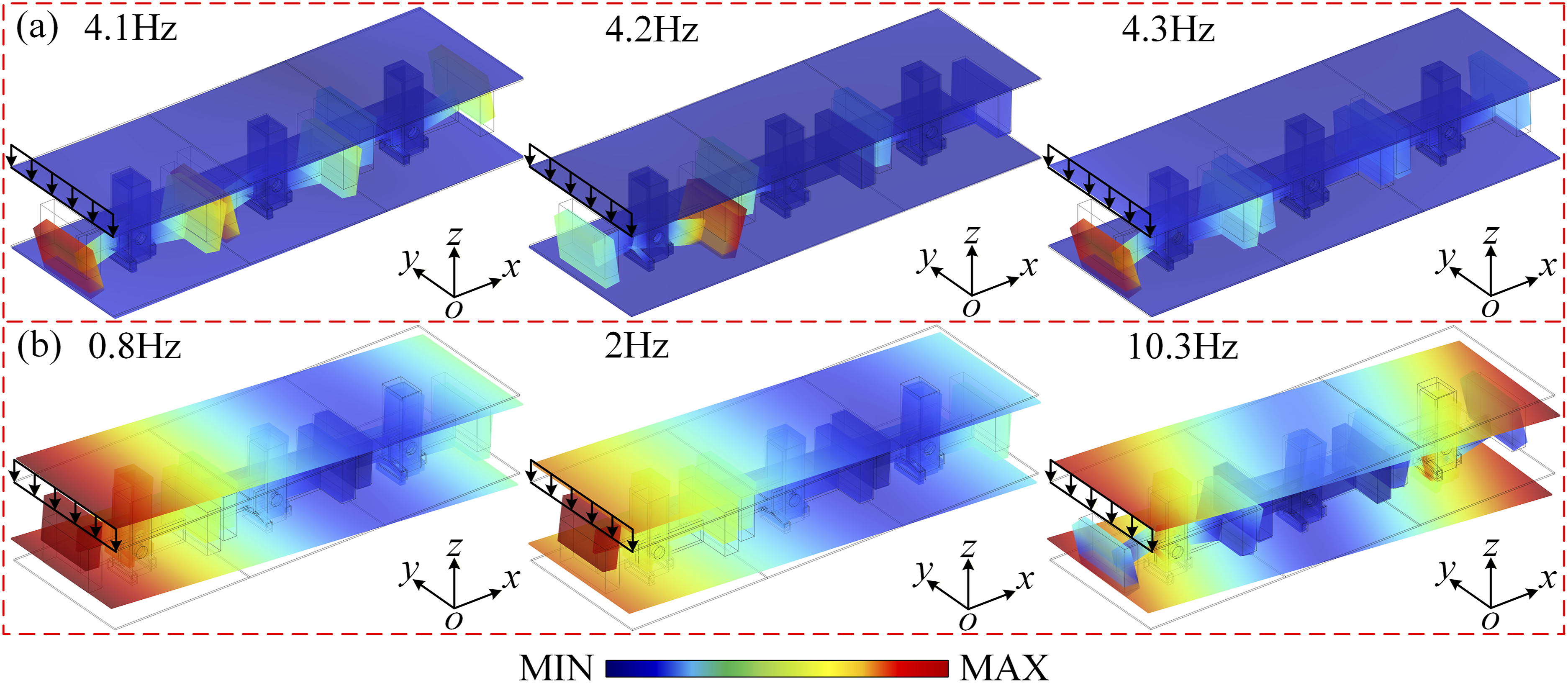
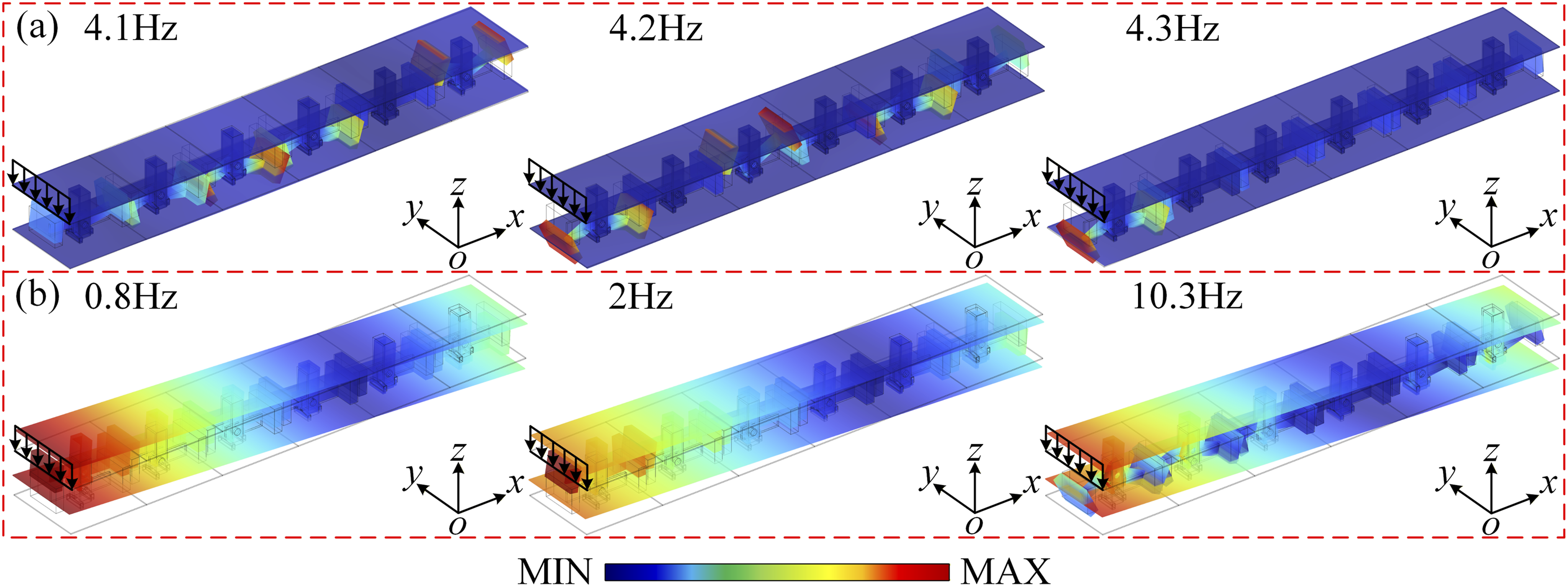
Furthermore, the mode shapes of the finite-period structures at frequencies near the bandgap opening frequency (4.1 Hz, 4.2 Hz, 4.3 Hz) and outside the bandgap range (0.8 Hz, 2 Hz, 10.3 Hz) are extracted from Figure 4(b) and presented in Figures 11 and 12, respectively. In the frequency range near the bandgap opening, the sandwich periodic substrate is mostly stationary. The proposed oscillator vibrates along the z-direction, absorbing and dissipating the excitation energy, resulting in significant attenuation of vibrations within the bandgap. Outside the bandgap range, transverse vibrations are distributed over the whole sandwich meta-structure plate, causing it to vibrate according to its mode shape. The oscillators do not introduce attenuation, allowing the excitation to propagate through the proposed structure.
3.4. Experimental validation
Experimental structural parameters of the QZS model and the substrate.

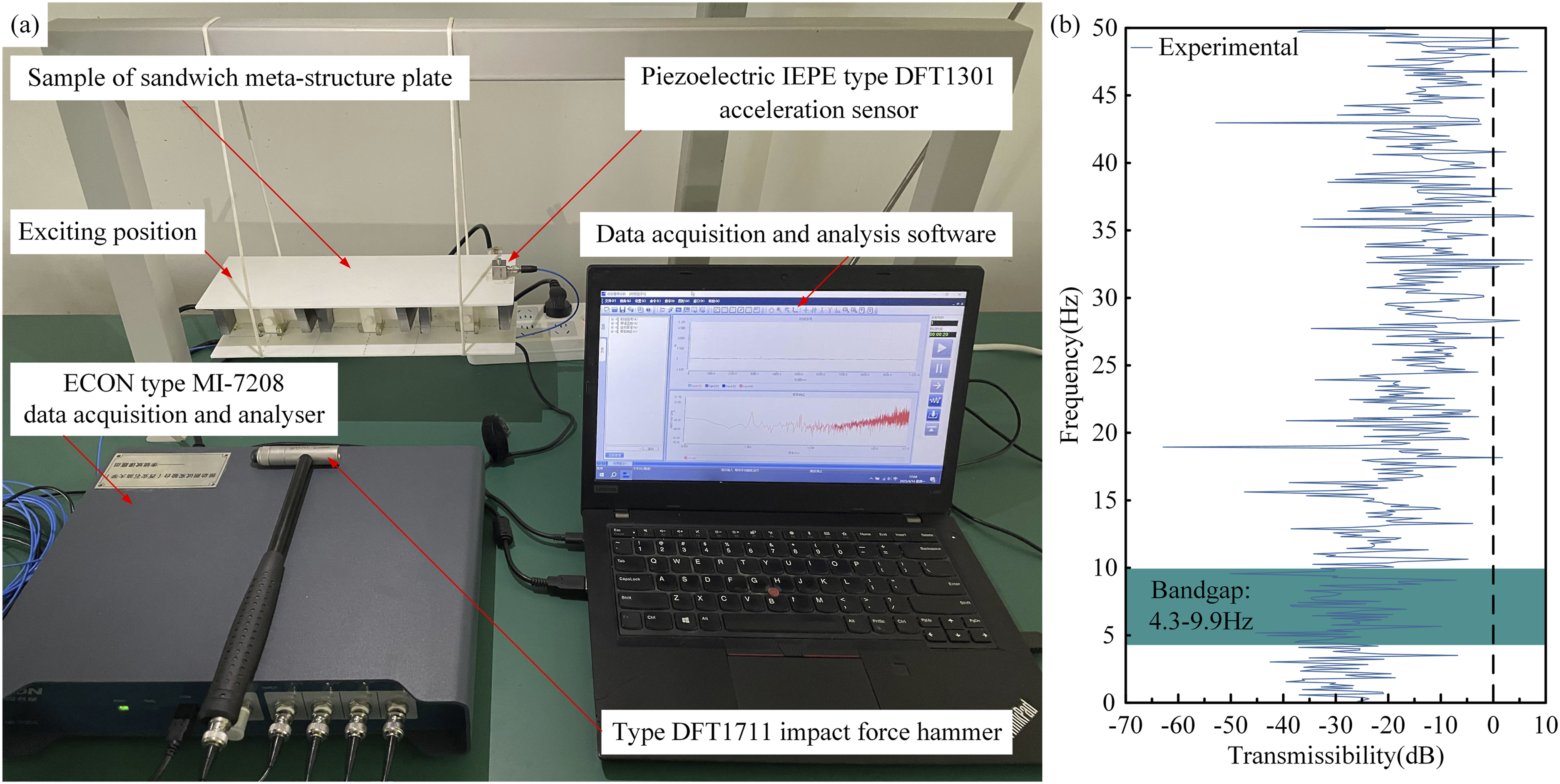
(a) Schematic diagram of the vibration transmission test and (b) experimental transmission spectrum (0–50 Hz).
As illustrated in Figure 4(b), simulation and experimental results show good agreement in bandgap range (4.3–9.9 Hz), attenuation trend, and bandwidth. Both vibrations exhibited significant attenuation within the bandgap range. The troughs in the experimental spectrum at 4.49 Hz and 9.57 Hz are in good agreement with the corresponding troughs in the simulated spectrum at 4.4 Hz and 9.6 Hz, displaying consistent trends within the bandgap range. The frequency shift for the former trough is 0.09 Hz, with a relative deviation of approximately 2.0%. In comparison, the frequency shift for the latter trough is 0.03 Hz, with a relative deviation of about 0.3%. Furthermore, the bandgap frequency range determined from the experimental vibration transmission spectrum is approximately 4.19–9.96 Hz. At the bandgap onset (4.3 Hz) and cutoff (9.9 Hz), experimental deviations from simulation are only 2.6% and 0.6%, respectively. The discrepancies between the experimental and simulation results are primarily due to manufacturing tolerances, assembly errors, and hinge friction, rather than the difference in the number of unit cells. The experimental data clearly demonstrate that the proposed sandwich meta-structure plate has excellent ultra-low-frequency broadband vibration-reduction performance.
4. Conclusions
Inspired by the QZS and IA mechanisms, we propose a QZS-LIA CSMP to achieve an ultra-low-frequency broadband vibration bandgap. The following conclusions are obtained from the study:
The proposed sandwich meta-structure achieves an ultra-low-frequency bandgap (below 10 Hz) because its oscillator amplifies dynamic equivalent mass and reduces dynamic equivalent stiffness without changing actual parameters or requiring pre-displacement. Its symmetric design enhances substrate vibration suppression. The bandgap opens at 4.3 Hz—83.8% lower than conventional structures—with a 33% wider bandwidth, providing excellent attenuation across the ultra-low-frequency range.
The proposed QZS-LIA CSMP introduces a novel concept for reducing ultra-low-frequency vibrations in sandwich meta-structures, with promising engineering applications.
Footnotes

Funding
The authors disclosed receipt of the following financial support for the research, authorship, and/or publication of this article: This research is supported by the Program of Natural Science Basic Research Plan on Shaanxi Province of China (Project No. 2023-JC-YB-405), the Program of State Key Laboratory for Strength and Vibration of Mechanical Structures (Project SV2023-KF-20), and the Graduate Student Innovation Foundation of Xi’an Shiyou University (Project YCX2412031).
Declaration of conflicting interests
The authors declared no potential conflicts of interest with respect to the research, authorship, and/or publication of this article.