






Abstract
We study a weakly nonlinear locally resonant metastructure in which each host cell is coupled to a local resonator and the attachment channel is augmented by fractional-order memory and delayed feedback. For the passive infinite lattice, we derive the Bloch dispersion relation in closed form and prove the exact open locally resonant band gap. For the passive finite ring, we diagonalize the linear dynamics by the discrete Fourier transform, identify the exact discrete acoustic and optical spectra, and prove the corresponding discrete-gap theorem. For the controlled linear lattice, interpreted strictly in the steady-state harmonic sense, we prove persistence of every compact real-frequency interval strictly inside the passive gap for the harmonic compatibility determinant under sufficiently small fractional-delay control, and we derive a local first-order complex edge-shift formula for simple passive harmonic edge zeros. For the nonlinear forced problem, we identify the exact synchronous optical manifold associated with the q = 0 optical edge and reduce the dynamics exactly to a scalar fractional-delay Duffing-type equation for the host–resonator relative motion. On that manifold, we derive first-harmonic amplitude, phase, backbone, fold, and cusp relations together with a complete algebraic classification of multistability for the reduced amplitude equation, and periodic Fourier collocation recovers the predicted coexistence windows. A supplementary weak-symmetry-breaking computation shows that the reduced optical predictions remain accurate under mild forcing heterogeneity. The controlled linear result is therefore exact at the level of the real-frequency harmonic determinant, whereas the nonlinear conclusions are restricted to the synchronous optical branch and to the first-harmonic closure used there.
Keywords
1. Introduction and literature review
Locally resonant periodic media provide one of the best-known routes to low-frequency vibration attenuation. The central idea goes back to the seminal work of Liu et al. (2000), who showed that resonant microstructures can generate attenuation intervals at wavelengths much larger than the lattice spacing. Since then, the subject has developed into a mature branch of wave and vibration engineering, with broad analytical and computational treatments of phononic and resonant structures; see, for example, Hussein et al. (2014). For finite realizations, the relation between the continuous Bloch picture and the discrete attenuation behavior of a bounded chain is more delicate, and explicit finite-chain analyses help clarify how local-resonance gaps emerge before the infinite-lattice limit is reached (Al Ba’ba’a et al., 2017). Within the vibration-and-control literature, this viewpoint is particularly attractive because it turns structural vibration suppression into a spectral filtering and tuning problem.
Recent work in vibration and control confirms that locally resonant structures remain an active topic of direct relevance to vibration mitigation. Bao et al. (2022) investigated a locally resonant beam with horizontal-spring coupling and quantified how unit number, damping, mass, and stiffness change the band-gap behavior and the finite-structure response. Xu et al. (2024) studied a locally resonant meta-plate with a stiffness-adjustable low-frequency resonator and analyzed both band gaps and finite-size vibration dynamics. These studies make clear that the journal scope is fully compatible with theoretical work on resonator-enabled attenuation in structures.
A second important line of development concerns nonlinear local resonance. Once the local resonators or the host structure operate at finite amplitude, attenuation is no longer a purely linear spectral property. Band edges shift, branches bend, multistability may appear, and attenuation can break down through nonlinear transmission mechanisms. Fang et al. (2018) analyzed bridging-coupling band gaps in nonlinear acoustic metamaterials and showed how nonlinear resonances can reorganize the effective suppression regime. Recent reviews further show that amplitude-dependent band gaps, harmonic control, broadband attenuation, and nonlinear wave manipulation have become central themes in nonlinear acoustic and elastic metamaterials (Fang et al., 2025). For a mathematically oriented vibration paper, this observation is decisive: if the control mechanism is expected to operate beyond infinitesimal excitation, then weakly nonlinear edge dynamics should be part of the theory.
A third line of development introduces fractional memory and delayed feedback. Kaczmarek and HosseinNia (2023) studied elastic metamaterials with fractional-order resonators and showed that fractional-order attachments change the attenuation behavior in a one-dimensional lumped setting. Cai et al. (2024) developed control design and optimization results for a fractional-order delayed resonator aimed at complete vibration absorption, while Liu and Cheng (2024) extended the delayed resonator concept to primary structures with nonlinear stiffness. These works show that fractional and delay effects are not merely formal generalizations; they already form an active vibration-control paradigm. On the analytical and computational side, recent studies of fractional-delay equations have also developed existence, uniqueness, and polynomial-Galerkin approximations for Hilfer, Mittag-Leffler, and other nonsingular-kernel formulations (Sweis et al., 2022, 2023b, 2023a, 2024). Those works are not metastructure papers, but they strengthen the broader methodological context for fractional-delay modeling and computation.
At the same time, damped periodic media require interpretive care. Once loss, memory, or delay is present, the physically complete dispersion picture generally involves complex frequencies, complex wavenumbers, or both; see Hussein (2009) and Frazier and Hussein (2016). For this reason, strong statements about “band-gap persistence” under control must be formulated carefully. A theorem that excludes real-frequency harmonic Bloch waves on a compact interval is robust and rigorous, but it is not identical to a full generalized Bloch analysis for damped media.
The literature therefore motivates a focused analytical study of a weakly nonlinear locally resonant chain in which fractional memory and time delay act through the resonator channel. The main contributions are as follows: (i) For the passive infinite lattice, we derive the exact acoustic and optical dispersion branches and the exact open locally resonant band gap. (ii) For the passive finite ring, we diagonalize the linear dynamics exactly, identify the discrete acoustic and optical spectra, and prove the associated discrete-gap theorem. (iii) For the controlled linear infinite lattice, we prove persistence of every compact real-frequency interval strictly inside the passive gap for the associated real-frequency harmonic compatibility determinant under sufficiently small fractional-delay control. (iv) For simple passive harmonic edge zeros, we prove local complex-frequency continuation under weak fractional-delay control and obtain an explicit first-order edge-shift formula. (v) For the nonlinear forced problem, we pass to a finite periodic ring and identify an exact synchronous invariant manifold corresponding to the optical q = 0 branch under spatially uniform forcing. (vi) On that manifold, we reduce the full system exactly to a scalar fractional-delay Duffing-type oscillator and derive, within a first-harmonic truncation, an explicit amplitude law, phase law, backbone curve, hardening/softening criterion, and fold condition together with a complete algebraic classification of multistability, no-jump regimes, and cusp onset for the resulting amplitude equation. (vii) We compute periodic solutions of the reduced steady-state problem by Fourier collocation and compare them with the algebraic response curves.
Relative to earlier studies on fractional resonators, delayed resonator control, and nonlinear locally resonant systems, the novelty of the present paper is intentionally precise rather than broad. The passive spectral part is exact and simultaneously treats the infinite Bloch lattice and the finite periodic ring. The controlled linear part is a perturbative theorem for the real-frequency harmonic compatibility determinant, not a generalized complex Bloch theory for the full damped spectrum. The nonlinear part is an exact synchronous reduction at the optical q = 0 edge followed by a clearly identified first-harmonic closure, rather than a full nonlinear Bloch-branch analysis. This exact/perturbative/first-harmonic separation is built into both the theorem statements and the numerical illustrations.
For ease of navigation, the analytical status of the main results is as follows. The passive dispersion formulas, the passive gap theorems, the finite-ring spectral diagonalization, the local finite-ring well-posedness statement, and the synchronous invariant-manifold reduction are exact within the stated model class. The attenuation-window persistence theorem and the local edge-continuation formula are perturbative results for weak fractional-delay control at the level of the harmonic determinant. The amplitude law, phase law, backbone relation, fold condition, and multistability diagrams belong to the first-harmonic reduced nonlinear theory on the synchronous q = 0 optical branch. The host-link cubic coefficient α is retained in the ring model for completeness, but it vanishes on the synchronous branch and therefore does not enter the reduced formulas derived below.
2. Model and mathematical setting
We use two complementary realizations of the same unit-cell physics so that the linear spectral analysis and the forced weakly nonlinear analysis are treated in their natural settings.
2.1. Infinite lattice for passive and controlled linear spectral analysis
For the exact band-gap theory and the controlled real-frequency attenuation theorem, we consider the infinite one-dimensional lattice indexed by


Here,


The passive lattice corresponds to ɛ = 0. For background on Caputo-type operators and their integral-equation reformulations, see Diethelm (2010) and Podlubny (1999). For related existence, uniqueness, and Galerkin-type approximation results for fractional-delay equations in other kernel settings, see Sweis et al. (2022, 2023b,a, 2024).
Physical interpretation of the control parameters. The coefficient γ measures the strength of the fractional-memory feedback acting through the attachment channel, while the order ρ ∈ (0, 1) sets how strongly that memory is long-tailed: smaller ρ corresponds to a slower decay of hereditary influence. The coefficient δ is the gain of the delayed resonator feedback and τ is the corresponding delay horizon. The small parameter ɛ scales the weak-control, weak-nonlinearity, and weak-forcing regime used throughout the paper, so that the effective linear control gains are ɛγ and ɛδ, while the nonlinear coefficients and forcing amplitude enter as ɛα, ɛβ, and F = ɛf.
The infinite lattice is used only for the linear spectral problem. This is the correct setting for continuous Bloch wavenumbers q ∈ [0, π] and exact pass-band/gap statements.
2.2. Finite periodic ring for the forced weakly nonlinear optical branch
For the weakly nonlinear forced dynamics, we consider an N-cell ring with periodic boundary conditions:

The full weakly nonlinear controlled model is
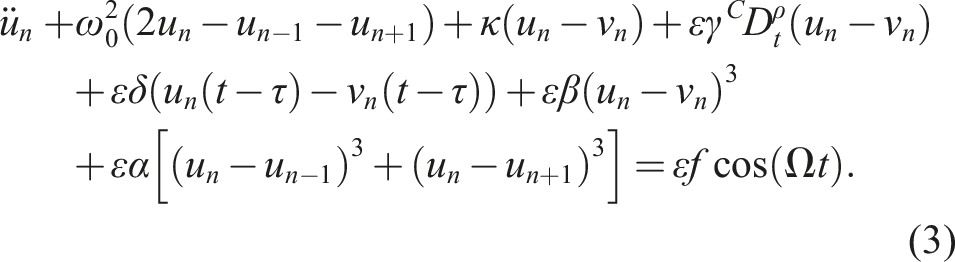

The ring problem is introduced only after the spectral analysis. It provides a finite-dimensional realization of the q = 0 synchronous optical branch under spatially uniform forcing, which is the branch studied in the weakly nonlinear analysis below.
The host-link cubic coefficient α is retained in (3) because it belongs to the full weakly nonlinear ring model and is relevant for non-uniform branches. The nonlinear analysis developed here is restricted to the synchronous optical manifold selected by uniform forcing. On that manifold α vanishes identically, so it does not enter the reduced equations of Sections 5–7.
2.3. Interpretation of the fractional harmonic calculations
The paper uses the Caputo derivative in the time-domain model because that is the natural initial-value formulation for the controlled lattice. Two later calculations are carried out in a steady-state harmonic sense rather than as exact statements about the full Caputo initial-value problem.
Whenever Sections 4 and 6 substitute a complex harmonic factor into the fractional term, the resulting symbol is interpreted as the compatibility relation for the steady-state harmonic response after transient contributions have been discarded. Thus, the determinant calculation in Section 4 is an exact statement for the corresponding real-frequency compatibility determinant, while the formulas in Section 6 are formal first-harmonic balance relations for the reduced oscillator. No claim is made that the Caputo initial-value problem possesses exact periodic solutions represented by those formulas.
In the time-domain model, ɛ ≥ 0 is a physical control-strength parameter. In the perturbative arguments of Section 4, we occasionally allow ɛ to vary in a small signed neighborhood of 0 in order to apply continuity and analytic-implicit-function arguments. Every physical conclusion is then obtained by restricting those local perturbative statements back to the branch 0 ≤ ɛ≪ 1.
2.4. Local well-posedness for the finite ring
The finite ring is introduced primarily as a finite-dimensional realization of the synchronous optical branch. Since the later reduction arguments only require a classical local solution concept, we record here a self-contained local existence statement based on an explicit Volterra-delay formulation rather than on a general abstract theory. This choice keeps the proof tailored to the present metastructure model, while recent well-posedness and Galerkin studies for broader fractional-delay classes may be found in Sweis et al. (2022, 2023a, 2023b, 2024).
Let

Define the periodic discrete Laplacian


For the cubic terms write


Then (3) and (4) is equivalent to the first-order Volterra-delay system
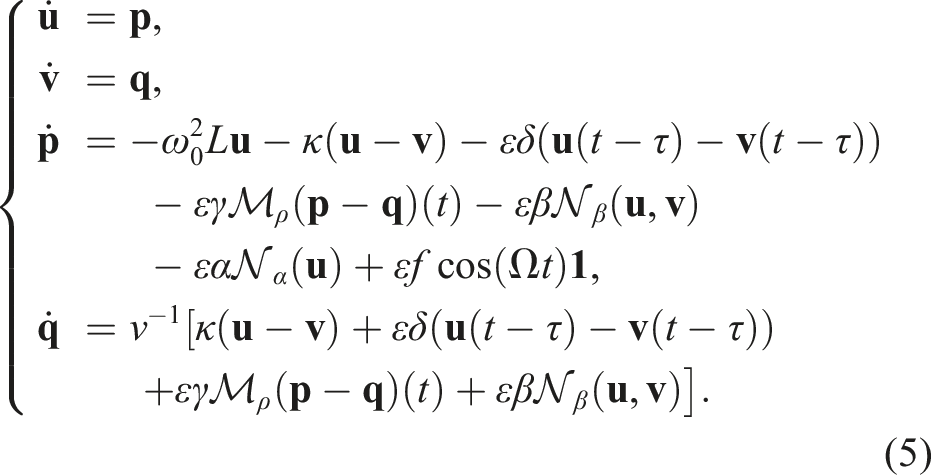
For the delay histories, define

The proof below is a direct contraction argument for the associated Volterra-delay integral equation; compare the standard delay-equation framework in Hale and Verduyn Lunel (1993). Local well-posedness for the finite ring. Fix


Then there exists T > 0 such that the finite-ring problem (3) and (4) admits a unique solution satisfying


Moreover, the solution can be continued uniquely as long as

Fix T > 0 and let


Write
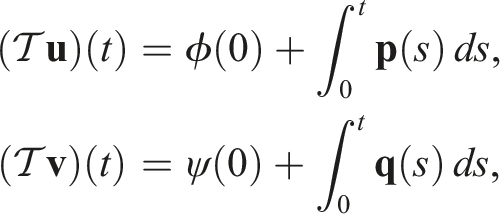
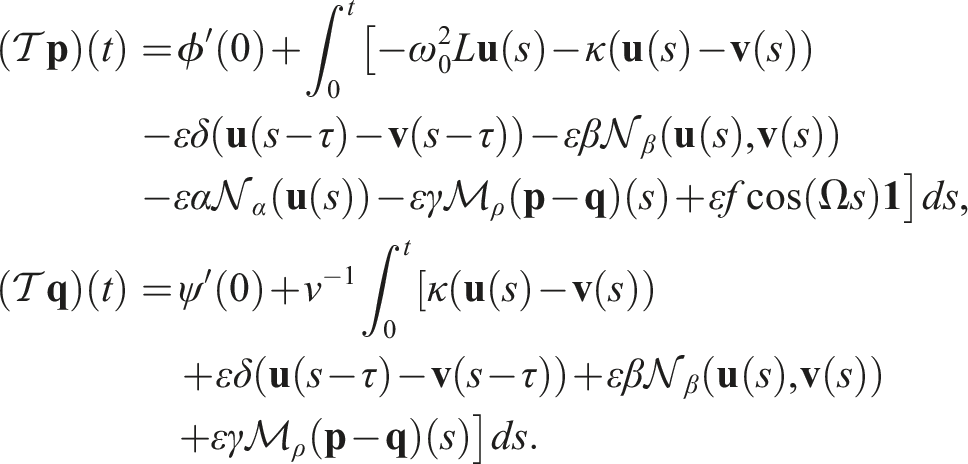
A fixed point of
Let

For the memory operator, if
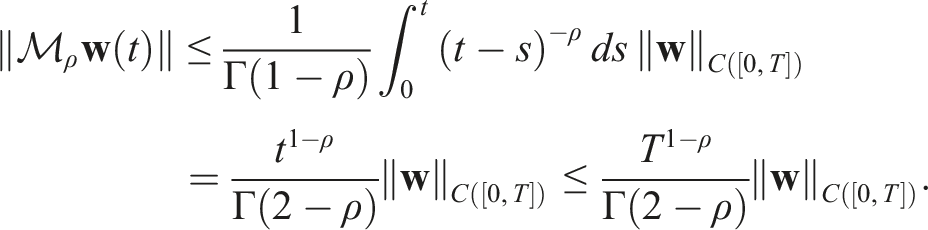



Choose T > 0 so that



This proves local existence and uniqueness.
For continuation, suppose the solution is defined on [0, T∗) and satisfies

Fix t0 ∈ (0, T∗) and define the shifted unknown

The delay segment on [−τ, 0] is known from the already constructed solution. The memory term splits as

The theorem is used to justify the classical finite-ring dynamics needed for the exact synchronous reduction in Section 5. No global dissipativity or long-time attractor statement is needed here.
3. Exact passive dispersion and band-gap formula
In this section, we set ɛ = 0 in (1) and (2). The passive infinite lattice is


Seek Bloch waves of the form

Set
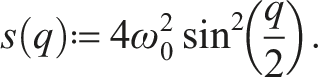
Then the spectral system becomes Exact passive dispersion relation. The passive lattice has two dispersion branches

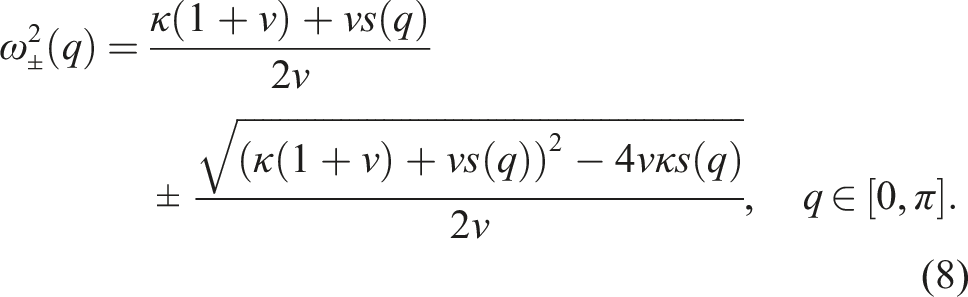
Equivalently, with x = ω2, the dispersion equation is The determinant condition is Exact passive locally resonant band gap. Define


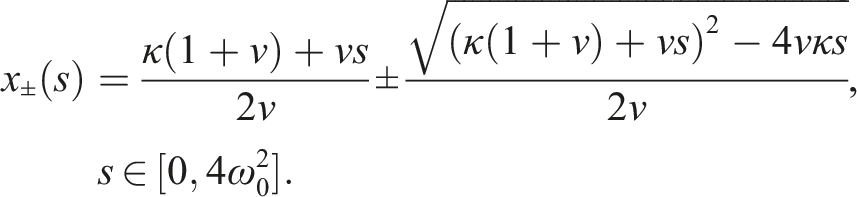
Then both x−(s) and x+(s) are strictly increasing on Let


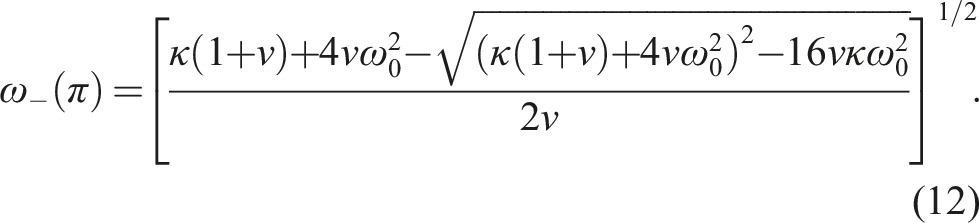

For each
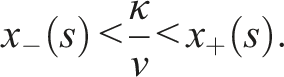
Indeed,

Since P(0, s) = κs > 0 and P(x, s) → +∞ as x → +∞, the point κ/ν lies strictly between the two roots.
Differentiate P(x±(s), s) = 0 with respect to s:

For the lower root, both sides are negative, hence

Exact passive spectrum and discrete gap for the finite ring. Consider the passive finite ring obtained by setting ɛ = 0 in (3) and (4). Let


Then the passive linear ring is diagonalized by the discrete Fourier transform, and its spectrum is exactly


Define

Then the passive finite ring possesses the exact open discrete gap

For the passive ring, write the discrete Fourier expansions

Because the periodic discrete Laplacian is diagonalized by the Fourier basis,


Seeking modal harmonics

Now every passive ring eigenfrequency belongs either to the discrete acoustic set
4. Real-frequency attenuation-window persistence under weak fractional-delay control
We now return to the controlled linear infinite lattice (1) and (2). In view of Remark 2.5, the next calculation is interpreted in the steady-state harmonic sense associated with the Caputo kernel after transient removal.
For the steady-state harmonic determinant, we use the time convention


Define


The Bloch determinant then becomes

A useful algebraic simplification is Persistence of compact real-frequency attenuation windows. Let K = [ω
a
, ω
b
] be any compact interval satisfying


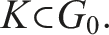

At ɛ = 0, Theorem 3.2 implies



Because memory and delay destroy self-adjointness, the complete damped spectral problem is more subtle than the passive one and may require complex frequencies or complex wavenumbers (Frazier and Hussein, 2016; Hussein, 2009). For this reason, the next theorem is stated only for prescribed real frequencies and the associated harmonic compatibility determinant.
Define

Then

Choose ɛ∗ > 0 so that ɛ∗M
K
L
K
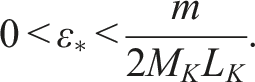
< m/2. For every 0 ≤ ɛ < ɛ∗,

So (19) holds. □
A concrete sufficient choice is any
Since


Weak fractional-delay control cannot destroy the entire passive attenuation regime at once: any compact real-frequency window strictly inside the passive gap survives for sufficiently small control magnitude.
The time convention used in this section matches the signs in Section 6. If one instead uses ei(qn−ωt), then the control symbol is replaced by its complex conjugate. Since Theorem 4.2 is a zero/nonzero statement on compact real-frequency sets, that conjugation does not change the conclusion. The local continuation theorem below is stated directly for the chosen convention.
4.1. Local continuation and first-order shift of simple harmonic edge zeros
The next result is local in character. It shows that each positive simple zero of the passive harmonic determinant persists, for small control, as a nearby zero of the complexified determinant. In accordance with Remark 2.6, the proof temporarily treats ɛ as a signed perturbation parameter near 0 and the final physical statement is obtained by restriction to ɛ ≥ 0.
For λ in a simply connected neighborhood of a positive real edge point that does not intersect the branch cut of the principal power, define


For ɛ = 0, this reduces to the passive determinant Local complex-frequency continuation and edge shift. Fix q∗ ∈ [0, π] and σ ∈ { − , + } such that ω
σ
(q∗) > 0, and set


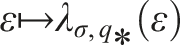

Moreover,


By the factorization of the passive determinant,

Since ω
σ
(q∗) > 0 and ω+(q∗) ≠ ω−(q∗), differentiation with respect to λ gives

Thus, ω∗ is a simple zero of the analytic function
Because the neighborhood in the statement is chosen so as not to intersect the branch cut of the principal power, the map λ↦(iλ)
ρ
is analytic there, and therefore

To obtain the first-order shift, differentiate



Solving for
Theorem 4.6 provides a local complex-frequency continuation result for simple harmonic determinant zeros. Its real part has a direct interpretation only at the level of the adopted real-frequency harmonic diagram: if

5. Exact synchronous optical reduction on the finite ring
The spatially uniform forcing in (3) naturally selects the synchronous manifold

On
Exact invariant-manifold reduction. The manifold


If r = u − v and c = u + νv, then


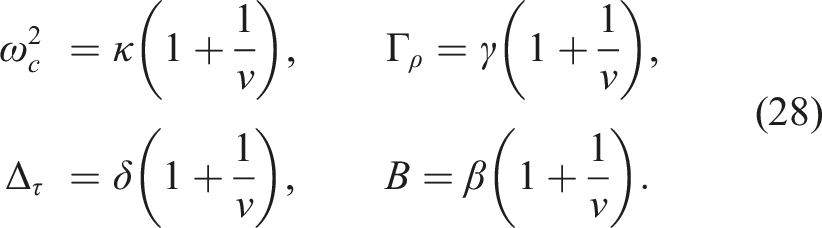

The invariance of
The reduction is exact. In particular, the host-link cubic coefficient α plays no role in the synchronous branch because the host nearest-neighbor differences vanish identically on
The linear frequency in (26) satisfies
by (11). Hence the reduced oscillator is centered exactly at the passive optical-branch edge corresponding to q = 0.
6. Weakly nonlinear optical-branch response by first-harmonic balance
Equation (26) is an exact scalar fractional-delay Duffing-type oscillator for the relative optical motion on the synchronous q = 0 optical manifold. In this section, we derive near-edge steady-state formulas by first-harmonic balance in the classical sense of nonlinear oscillation theory (Nayfeh and Mook, 1979), while keeping the steady-state interpretation of Remark 2.5. The resulting formulas describe the synchronous optical edge singled out by Proposition 5.1. Throughout this section we work in the weak-forcing, near-edge scaling

6.1. Amplitude and phase equations
Assume that the steady response is dominated by the fundamental harmonic,


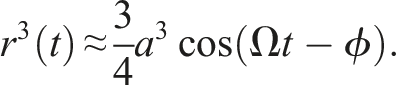
We also introduce the physical forcing amplitude

Then we obtain the following first-harmonic amplitude–phase law.
First-harmonic amplitude–phase law. Under the ansatz (30) and first-harmonic truncation, the amplitude a and phase ϕ satisfy




Equivalently,

The phase is given by

Substitute (30) into (26). The inertial and linear restoring terms contribute to the in-phase component. The fractional term contributes a phase-shifted harmonic with phase advance πρ/2, and the delay term contributes a phase lag Ωτ. Writing those contributions in the basis {cos(Ωt − ϕ), sin(Ωt − ϕ)} and neglecting the third harmonic of r3 gives the two balance equations

Squaring and adding yields (32), and division yields (37). The equivalent form (36) follows from (31).
The fractional and delay contributions split naturally into in-phase and quadrature parts. The quantity K(Ω) plays the role of an effective detuning/stiffness correction, while C(Ω) is an effective first-harmonic damping term. This formula provides a first-harmonic approximation to the near-resonant steady response after transient terms have been discarded. In particular, the later backbone and fold relations are derived within the same approximation.
6.2. Backbone curve and hardening/softening criterion
The resonance edge is described by the backbone curve obtained by balancing the in-phase contribution to leading order near Ω = ω c .
Backbone curve. Within the first-harmonic truncation and under the near-edge scaling (29), the backbone relation is given by

Equivalently,

Expanding about Ωbb = ω
c
gives the formal edge law
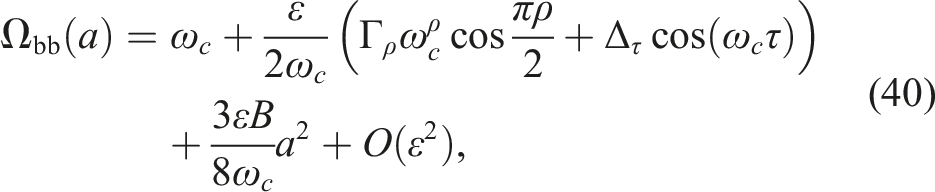
Within the first-harmonic truncation, the resonance edge is obtained by suppressing the leading in-phase detuning in (32), that is, by imposing K(Ω) + μa2 = 0. This yields (38) and hence (39). Expanding the right-hand side about Ωbb = ω
c
under (29) gives (40). Since B = β(1 + 1/ν), the sign of the amplitude-dependent term is exactly the sign of β.
Optical-branch bending direction. Within the synchronous optical manifold, the bending direction of the resonance edge is determined entirely by the cubic attachment coefficient β. The host-link cubic coefficient α does not enter the first-harmonic optical-branch law.
6.3. Fold condition and jump onset
The same amplitude law yields an explicit fold criterion for the frequency-response curve.
Fold condition. For fixed forcing frequency Ω, the first-harmonic frequency-response curve defined by (32) has a fold only at amplitudes a > 0 satisfying

Therefore, the onset of jump resonance is controlled by the interaction among detuning K, effective damping C, and nonlinear stiffness μ.
Differentiate (32) with respect to a at fixed Ω:


Control interpretation. At a prescribed forcing frequency Ω, the delay and the fractional term contribute


Thus, a delay choice with Δ τ sin(Ωτ) < 0 enhances the effective quadrature damping, whereas a choice with Δ τ sin(Ωτ) > 0 opposes it and may sharpen the resonance.
6.4. Exact algebraic classification of multistability and cusp onset
For a fixed forcing frequency Ω, set


Multistability and cusp classification of the amplitude equation. Fix Ω > 0 and abbreviate

Assume μ ≠ 0. (i) Positive fold points of the first-harmonic response curve exist if and only if (ii) Under (43), the number of positive amplitudes a > 0 solving (32) is classified as follows: • if • if • if (iii) If either Kμ ≥ 0 or K2 ≤ 3 C2, then Φ′(z) ≥ 0 for all z ≥ 0, with equality possible only at a single tangency point when K2 = 3 C2. Consequently, for every F > 0 the amplitude equation (32) has exactly one positive solution. In particular, the first-harmonic response curve is single-valued and no jump resonance occurs. (iv) The cusp threshold is characterized exactly by




At that point the two fold points coalesce at

Differentiating (42) with respect to z gives

This is a quadratic polynomial in z with positive leading coefficient. Its discriminant is

Hence Φ′ has two distinct real roots if and only if K2 > 3C2, and a double real root if and only if K2 = 3C2.
Assume first that K2 > 3C2. The product and sum of the two roots of (47) are

Therefore, both roots are positive if and only if their sum is positive, namely if and only if Kμ < 0. This proves the sharp fold condition (43). The explicit roots are given by (44); after ordering them as 0 < z− < z+, the sign pattern of Φ′ is
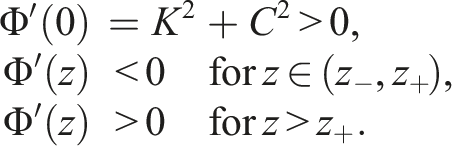
Thus, z− is a local maximum point and z+ is a local minimum point of Φ. Since

Now suppose either K2 < 3C2 or K2 = 3C2. In the first case Φ′ has no real roots; in the second case it has one repeated root. Because Φ′(0) = K2 + C2 > 0 and the leading coefficient of Φ′ is positive, it follows that Φ′(z) ≥ 0 for all z, with equality only at the repeated root in the borderline case K2 = 3C2. If in addition Kμ ≥ 0, then even in the case K2 > 3C2 the two real roots of Φ′ cannot be positive because their sum is nonpositive. Hence in all cases covered by part (iii), one has Φ′(z) > 0 for every z ≥ 0, except possibly at a single tangency point where the derivative vanishes but does not change sign. Therefore, Φ is strictly increasing on [0, ∞), and the equation Φ(z) = F2 has exactly one nonnegative root for each F > 0. Since Φ(0) = 0 and F > 0, that root is strictly positive.
Finally, the cusp threshold occurs precisely when the two fold points coalesce, that is, when Δ
z
= 0 and the resulting double critical point lies on (0, ∞). This gives (45). Solving (47) = 0 under K2 = 3C2 yields
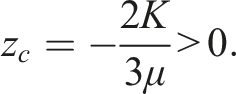
At the same point,


Exact no-jump criterion within the first-harmonic law. For a fixed forcing frequency Ω, the first-harmonic response curve is single-valued for every F > 0 whenever

Equivalently, jump resonance and multistability can occur only when the detuning and the cubic coefficient have opposite signs and the effective quadrature damping is not too large.
7. Numerical illustrations and nonlinear periodic validation
To illustrate the analytical results, we evaluate the exact formulas from Sections 3 and 4, the first-harmonic amplitude law from Section 6, and a periodic collocation discretization of the reduced nonlinear oscillator (26). Throughout the linear illustrations, we use Numerical illustration of Theorems 3.1–3.3 for ω0 = 1, κ = 1.4, and ν = 0.6. Left: the exact acoustic and optical branches ω−(q) and ω+(q) with the passive gap G0 = (1.2233, 1.9322) shaded. Right: discrete ring eigenfrequencies ω±(q
m
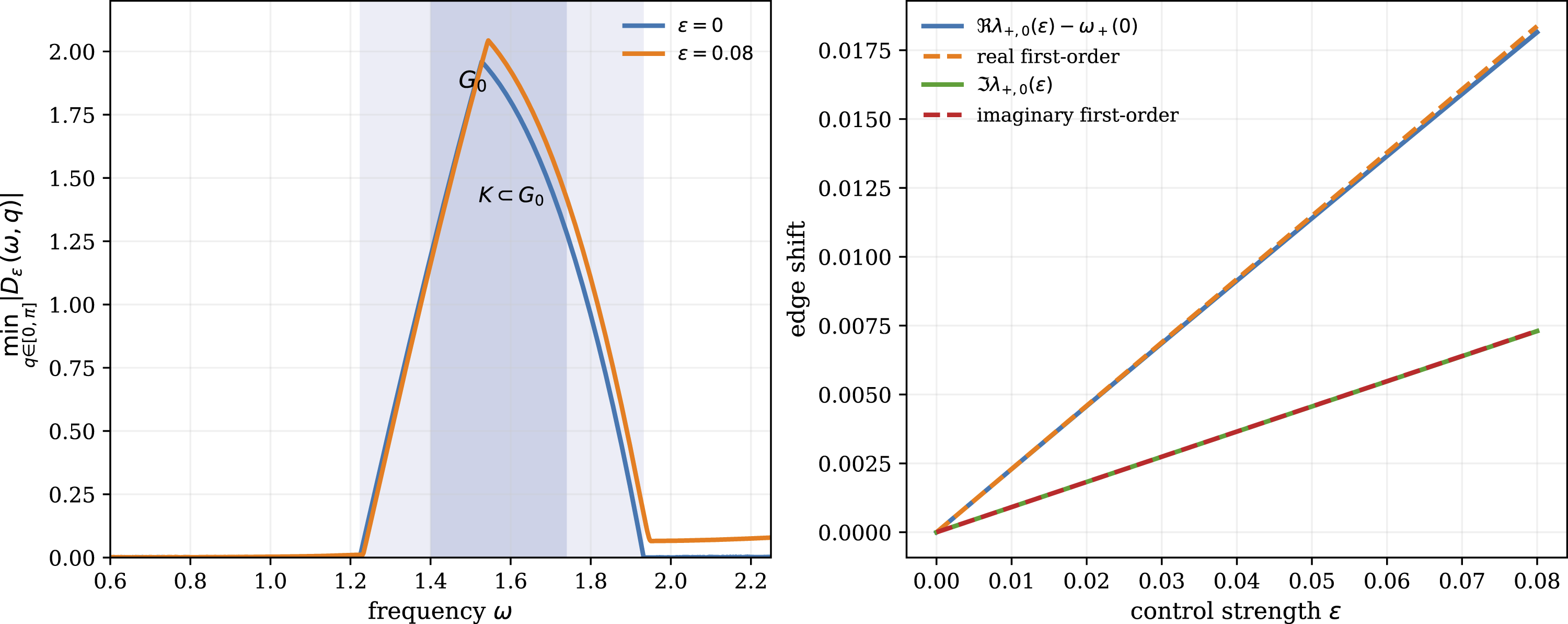
) for N = 12 and N = 13. The even ring reaches the same lower gap endpoint as the infinite lattice, while the odd ring leaves a slightly larger discrete gap, exactly as predicted by Theorem 3.3. Numerical illustration of the controlled linear theory for ρ = 0.55, γ = 0.35, δ = 0.25, τ = 0.8, and ɛ = 0.08. Left: the minimum determinant magnitude m
ɛ
(ω) = minq∈[0,π]|D
ɛ
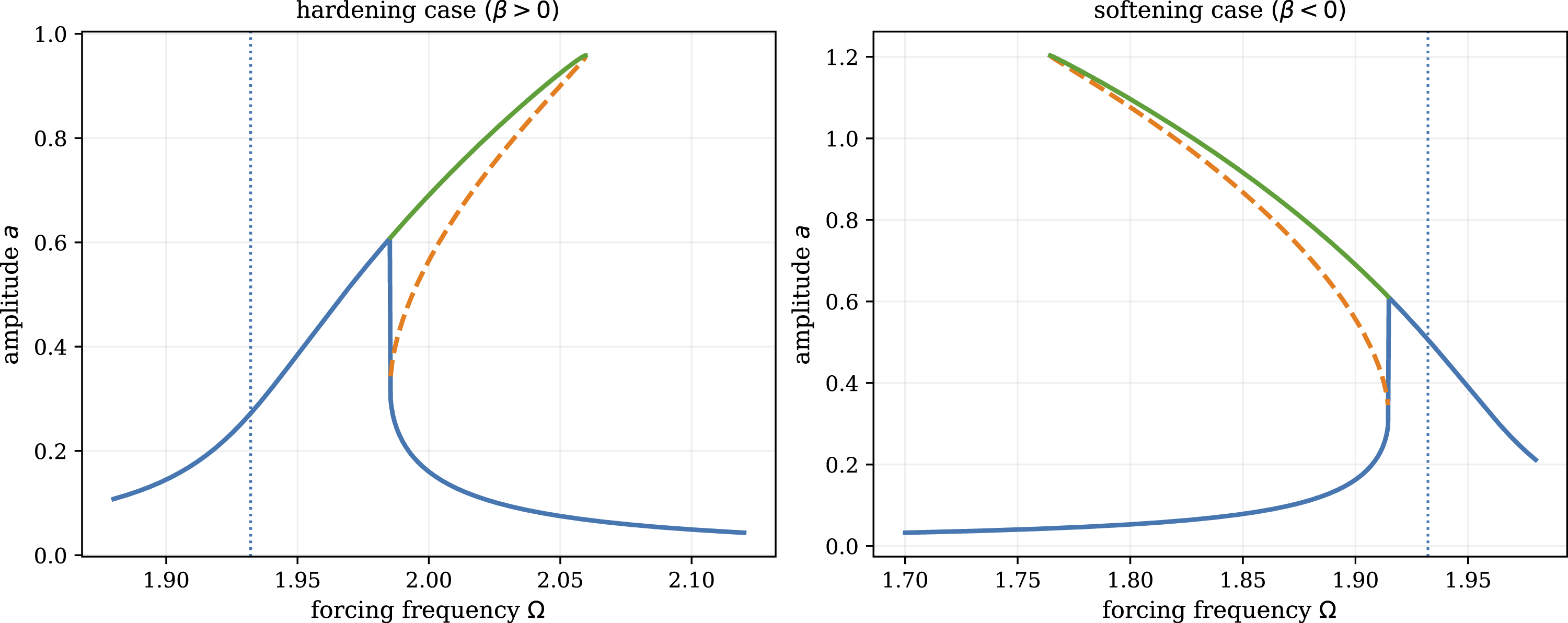
(ω, q)| for ɛ = 0 and ɛ = 0.08, with the passive gap G0 and the compact window K = [1.40, 1.74] shaded. The curve stays strictly above zero on K, confirming Theorem 4.2. Right: numerical continuation of the upper edge zero λ+,0(ɛ) together with the first-order approximation from Theorem 4.6. The real and imaginary shifts agree to graphical accuracy throughout the plotted control range. Numerical solution branches of the first-harmonic amplitude equation (32) for F = 0.03 and the baseline parameters used above. Left: hardening case β = 3. Right: softening case β = −3. The dotted vertical line marks the passive optical edge ω
c
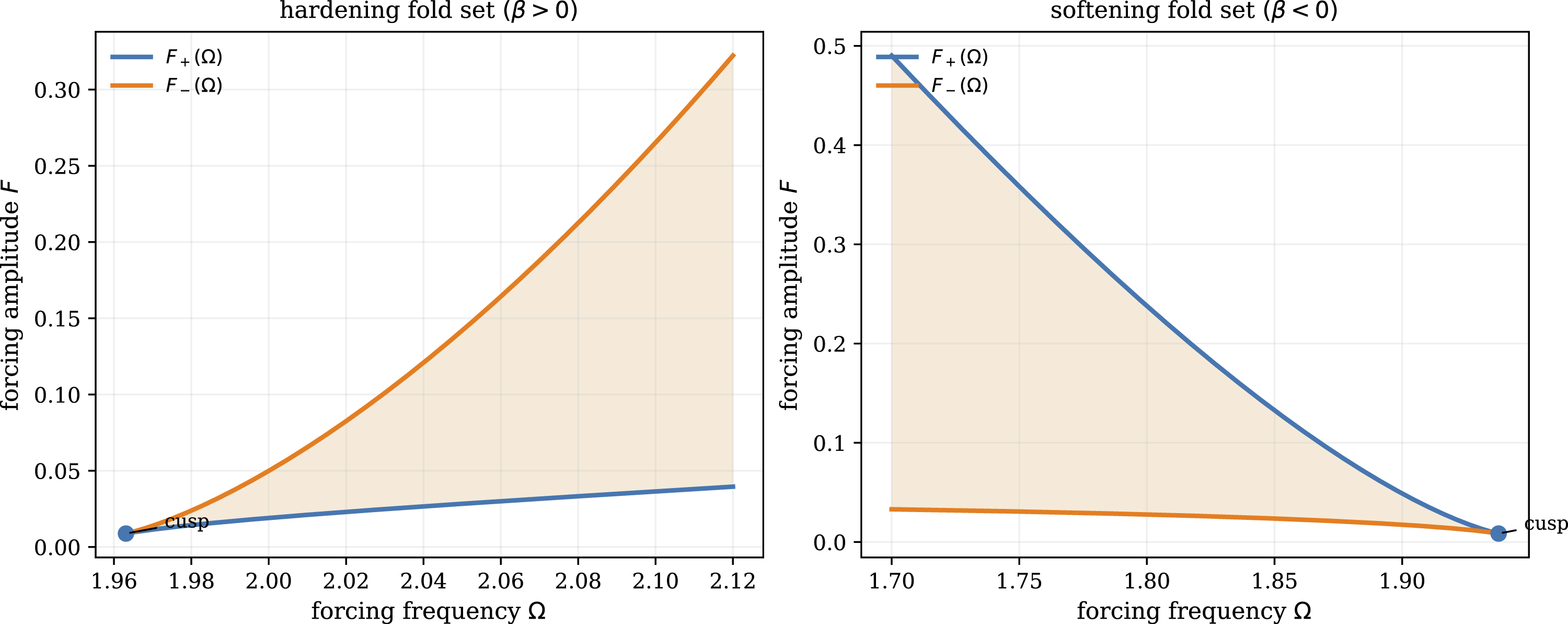
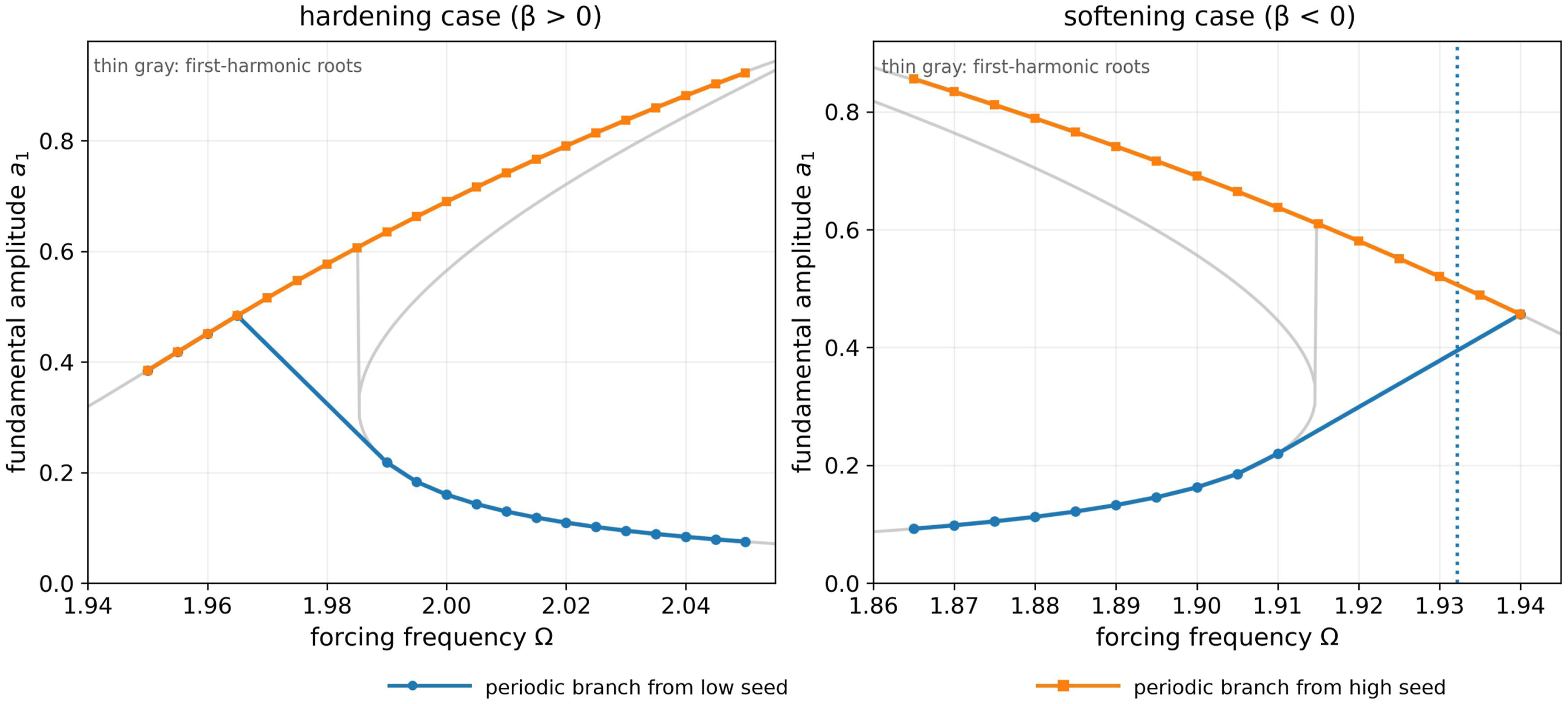
= ω+(0). The frequency-response curve bends to the right for β > 0 and to the left for β < 0, in agreement with Proposition 6.3. The dashed segment separates the middle algebraic branch visually. Fold curves and cusp points for the first-harmonic amplitude equation with the same baseline parameters as in Figure 3. Left: hardening case β = 3. Right: softening case β = −3. The shaded region between the fold curves is the parameter zone in which the cubic amplitude equation admits three positive roots. The marked cusp points agree with Theorem 6.7 and separate the single-valued and multistable regimes. Periodic-collocation validation of the reduced nonlinear oscillator (26) for the same baseline parameters as in Figures 3 and 4. Thin gray curves show the first-harmonic roots of (32). Colored curves show numerically recovered periodic solutions of the full reduced steady-state equation, plotted through their fundamental amplitude a1. Left: hardening case β = 3, where low- and high-seed continuation recovers two coexisting periodic branches across the predicted multistable window. Right: softening case β = −3, where the coexistence region is shifted to the low-frequency side. The close agreement away from folds supports the first-harmonic optical-edge formulas, while the visible deviations near turning points reflect higher-harmonic corrections retained by the collocation solve.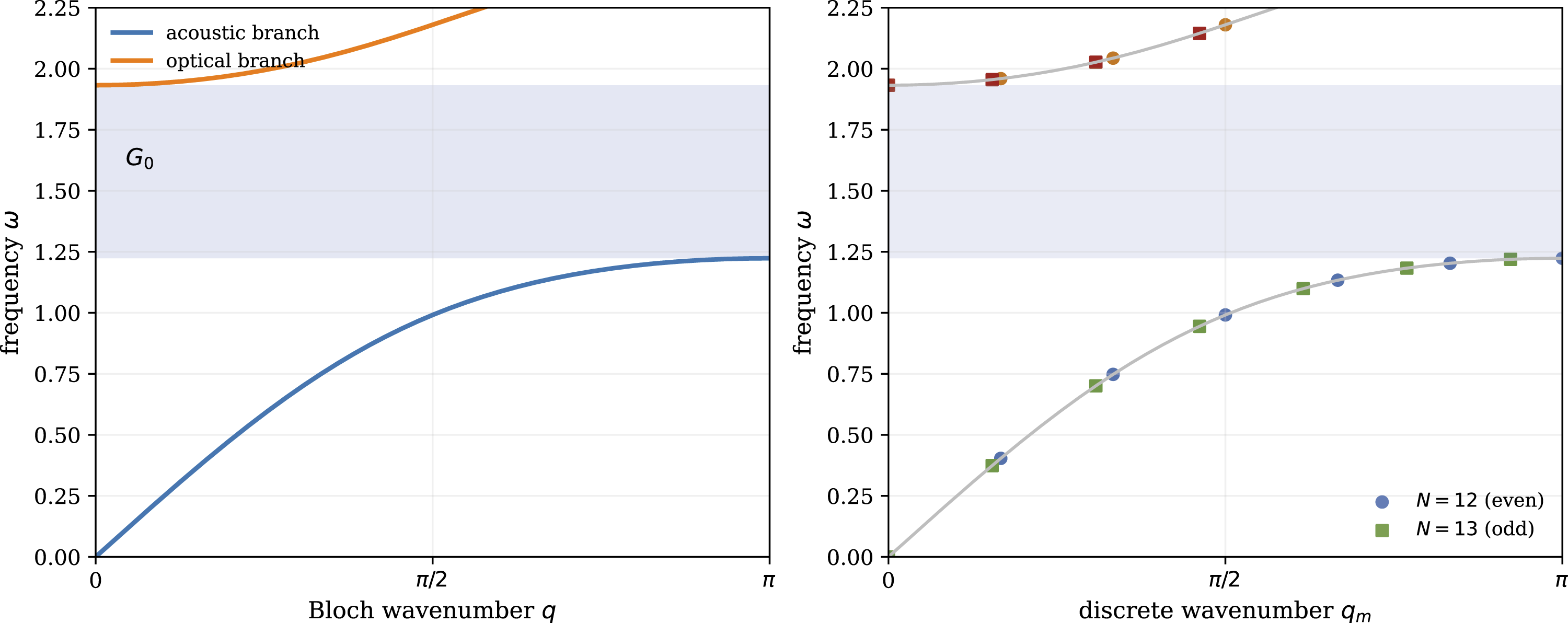

The collocation computation is used to compare the reduced periodic branches with the first-harmonic predictions. We therefore report branch geometry and coexistence windows without assigning dynamical stability labels to the plotted curves. Determining branch stability would require an additional Floquet- or monodromy-type analysis for the reduced Caputo-delay oscillator and is beyond the present scope.
For the passive lattice, Theorems 3.1, 3.2, and 3.3 predict two monotone branches and an open gap between the acoustic and optical bands. For the baseline choice above, the exact passive gap is

Figure 1 confirms this directly. The continuous branches reproduce the exact gap, while the discrete ring spectra for N = 12 and N = 13 lie on the same two branches. The even ring reproduces the lower gap endpoint exactly, whereas the odd ring leaves a slightly wider discrete gap, again in agreement with Theorem 3.3.
For the same baseline lattice, we choose the compact interval

The left panel of Figure 2 plots


The right panel tracks the analytic continuation of the upper passive edge zero at q = 0. The numerically continued branch and the first-order shift formula from Theorem 4.6 are almost indistinguishable on the plotted scale, and at ɛ = 0.08, they give

We now illustrate the first-harmonic formulas from Section 6. Figure 3 plots the positive roots of the amplitude equation (32) for fixed forcing amplitude F = 0.03 and for the two choices β = 3 and β = −3. The dotted vertical line marks the passive optical edge ω c = ω+(0). The response bends to the right when β > 0 and to the left when β < 0, exactly as stated in Proposition 6.3. In the parameter windows where three positive roots are present, the dashed branch is included only to separate the middle algebraic branch visually; no dynamical stability interpretation is assigned to the line style.
The fold curves from Proposition 6.5 and Theorem 6.7 are shown in Figure 4. The shaded region between F+(Ω) and F−(Ω) is the three-root zone of the cubic amplitude equation. The two cusp thresholds occur at


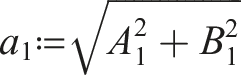
To go beyond purely algebraic response curves, we solve the full reduced steady-state problem (26) numerically on one forcing period. For each prescribed frequency Ω, one period is discretized by M = 41 equispaced collocation nodes, the periodic profile is represented by its discrete Fourier coefficients, and the operators

This computation retains the full cubic nonlinearity and all harmonics resolved on the collocation grid while remaining within the steady-state harmonic setting of Remark 2.5. We use it to compare periodic branch geometry and coexistence windows with the first-harmonic theory. The most reliable agreement is observed on the outer branches away from folds; near turning points, higher harmonics and local conditioning effects amplify the discrepancy between the collocation solution and the cubic first-harmonic closure.
Figure 5 compares the periodic collocation branches with the first-harmonic roots of (32). In both the hardening and softening cases, distinct low- and high-amplitude periodic solutions are recovered numerically in the frequency windows predicted by the first-harmonic multistability theory. The collocation branches track the two outer first-harmonic branches closely, while the discrepancy becomes most visible near turning points where higher-harmonic content is strongest. The computation therefore supports the reduced synchronous optical theory and quantifies the higher-harmonic corrections near folds.
8. Discussion, contributions, and limitations
The preceding sections establish exact passive spectral results, a perturbative attenuation result for the controlled lattice, and a reduced nonlinear theory on the synchronous optical branch. We close by summarizing the computational checks and the scope of the analytical claims.
Figure 6 gathers two numerical checks for the reduced model. Panel (a) reports collocation self-convergence for the representative hardening-branch periodic orbit at Ω = 1.99. The recovered fundamental amplitude stabilizes rapidly, with a1(41) = 0.634983 and residual norm Reduced-model numerical checks. Panel (a) shows a collocation self-convergence study for the representative hardening-branch periodic orbit at Ω = 1.99, using the M = 41 solution as numerical reference. The rapid decay of both the amplitude discrepancy and the waveform discrepancy, together with the small residual at M = 41, shows that the reduced periodic branch is well resolved. Panel (b) compares the collocation waveform with a direct time-domain simulation of the scalar fractional-delay oscillator over the final forcing period. The small phase-aligned relative L2 error confirms close agreement between the two reduced-model computations.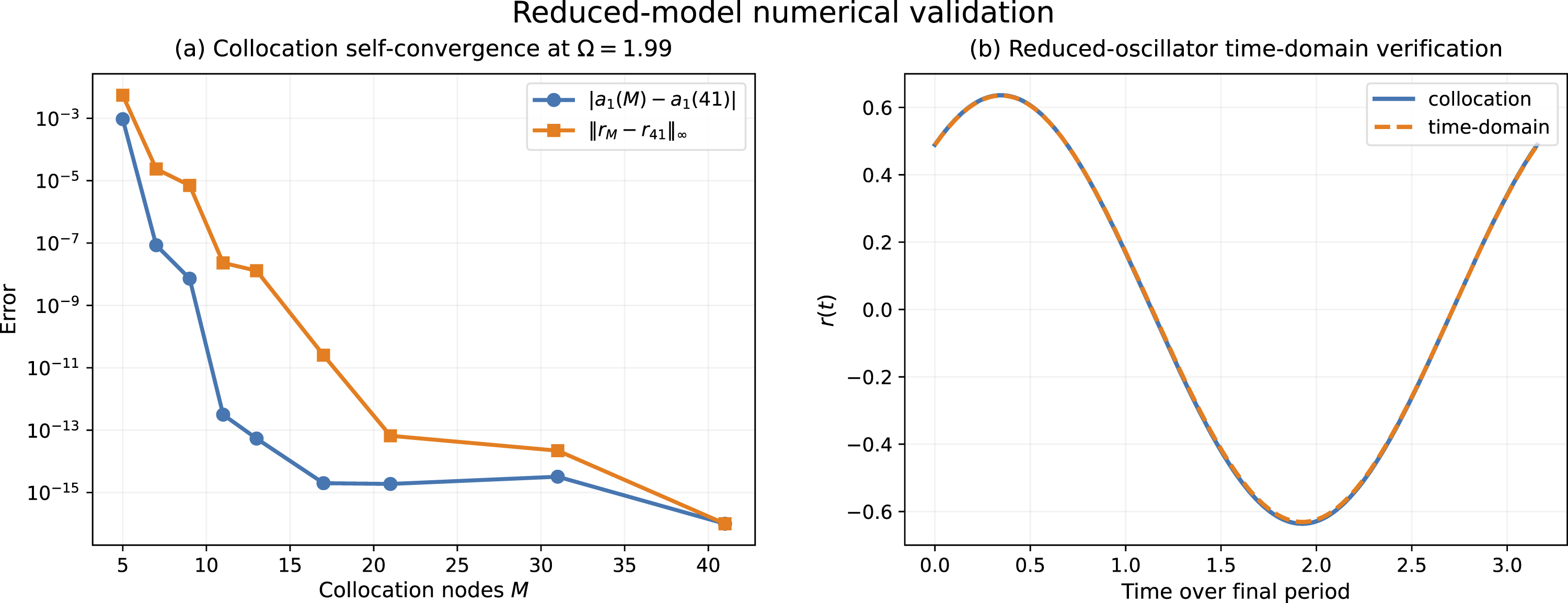
Panel (b) of Figure 6 compares the collocation waveform with a direct time-domain simulation of the reduced scalar fractional-delay equation, initialized with the reconstructed collocation profile as periodic history. The phase-aligned relative L2 discrepancy over the final forcing period is 7.838 × 10⁻³, which confirms the consistency of the frequency-domain and time-domain reduced-model computations.
Figure 7 addresses realization and design interpretation. Panel (a) shows the synchronous response on the full finite ring. Since Proposition 5.1 proves invariance of the synchronous manifold, the computation is initialized on that manifold and the cellwise relative motions u
n
− v
n
remain synchronized up to round-off level, with maximum defect 1.11 × 10⁻¹⁶. Panel (b) plots, on the same delay interval, both the first-order optical-edge shift from Theorem 4.6 and the quadrature term C(ω
c
) from (34). For the displayed baseline parameters, the edge shift remains positive but strongly tunable with τ, while C(ω
c
) stays positive on the same interval. Together with the cusp diagram in Figure 4, this gives a practical interpretation of how delay affects attenuation-window placement and resonance management. Full-ring realization and delay-dependent design interpretation. Panel (a) shows the exact synchronous realization of the reduced optical branch on the full finite ring under spatially uniform forcing. Because the computation is initialized on the invariant synchronous manifold, the cellwise relative motions remain synchronized up to round-off level, confirming consistency between the full ring and the reduced branch. Panel (b) plots both the first-order real edge shift from Theorem 4.6 and the quadrature term C(ω
c
) against the delay τ. For the displayed baseline parameters, delay tuning produces a positive but strongly adjustable edge shift while keeping C(ω
c
) positive throughout the shown interval.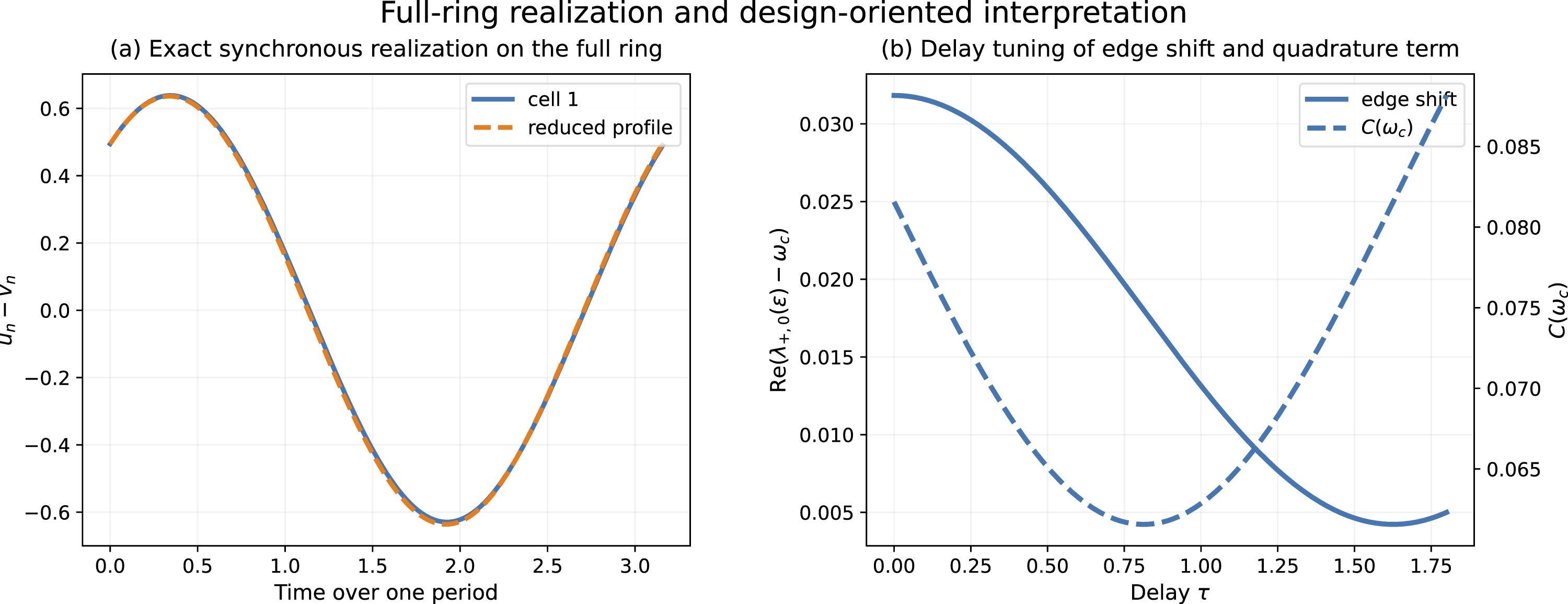
A supplementary symmetry-breaking robustness check is shown in Figure 8. To isolate the effect of imperfect symmetry from the additional host-link nonlinearity that is inactive on the exact synchronous branch, we set α = 0 and replace the spatially uniform forcing in the hardening case by the weakly non-uniform profile Supplementary weak-symmetry-breaking test for the hardening branch. The same baseline parameters as in Figure 3 are used, but the forcing is replaced by F
n
= F(1 + η cos(2πn/N)) with η = 0.05, N = 8, and α = 0. Left: the mean full-ring first-harmonic response 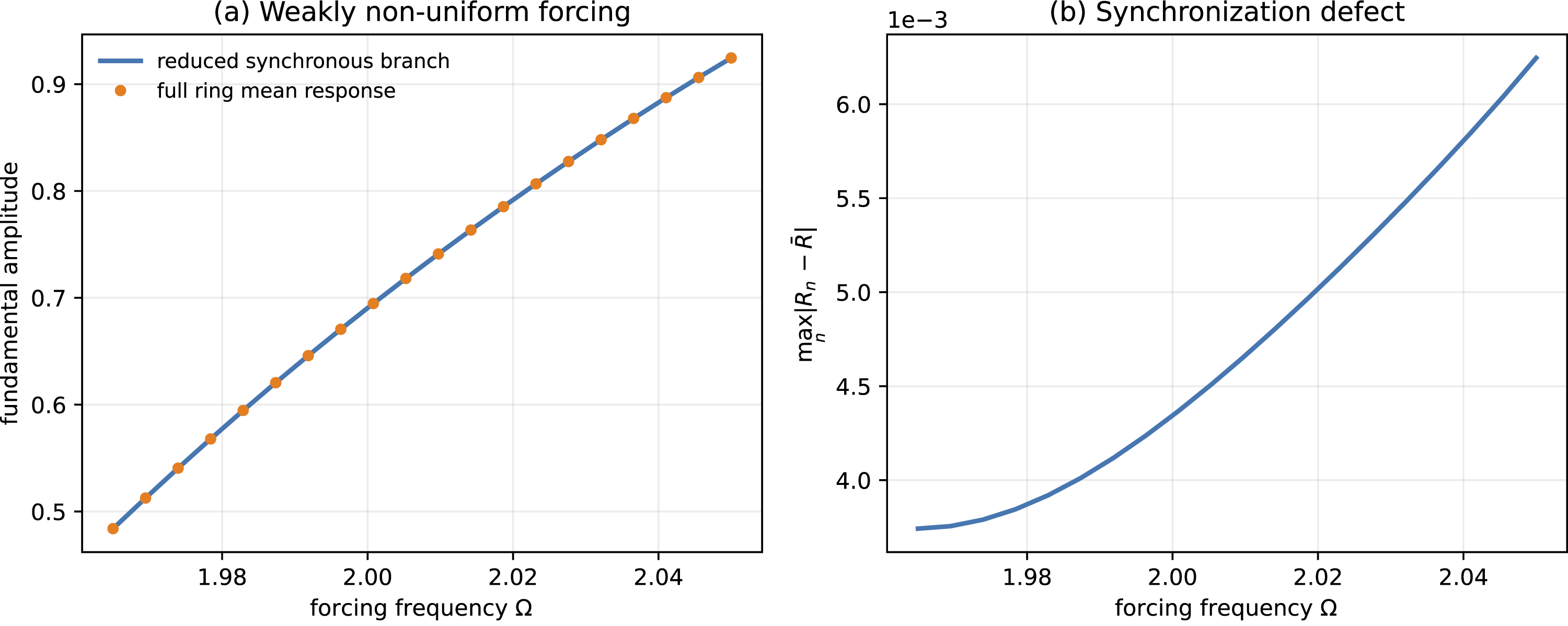

The resulting full-ring first-harmonic algebraic system is then solved directly by continuation in Ω. Although the synchronous manifold is no longer exactly invariant, the mean relative response
8.1. Exact results
The passive infinite-lattice dispersion formula, the exact passive gap, the passive finite-ring spectrum and discrete-gap theorem, the classical local finite-ring well-posedness statement, and the synchronous invariant-manifold reduction are exact within the stated model class. The real-frequency attenuation-window persistence theorem is exact at the level of the harmonic compatibility determinant introduced in Section 4. The local edge-continuation result is exact as a local analytic statement for simple zeros of the complexified harmonic determinant, and the multistability/cusp theorem is exact for the cubic amplitude equation generated by the first-harmonic truncation.
8.2. Approximate nonlinear results
The amplitude law, phase law, backbone curve, and fold condition are consequences of a first-harmonic truncation for the scalar reduced equation after transient removal. The multistability and cusp theorem is exact for that reduced cubic amplitude equation, but it is derived within the same first-harmonic level of approximation as the amplitude law.
8.3. Main contribution
The contribution of the paper is the combination of exact passive band-gap analysis, a rigorous compact-window persistence theorem for the real-frequency harmonic determinant under weak fractional-delay control, a local analytic edge-shift formula, an exact synchronous optical reduction for the forced chain, and a closed-form first-harmonic description of multistability and cusp onset for the reduced nonlinear response.
8.4. Limitations
The paper does not develop a full generalized Bloch theory for the controlled dissipative lattice, it does not provide exact periodic-solution theory for the forced Caputo-delay oscillator, and it does not analyze non-uniform nonlinear Bloch branches where the host-link nonlinearity α becomes active. Accordingly, the controlled linear theorem should be read as a statement about the real-frequency harmonic determinant rather than the complete damped spectrum, and the nonlinear conclusions should be read as synchronous optical-edge predictions within the first-harmonic closure. The collocation computations validate the reduced nonlinear oscillator, not a full nonlinear lattice theory. The weak-symmetry-breaking test in Figure 8 is supplementary numerical evidence only and does not replace such a theory.
9. Conclusion
This paper develops an analytical framework for a weakly nonlinear locally resonant metastructure with fractional-delay resonator control. For the passive infinite lattice, the acoustic and optical dispersion branches are obtained in closed form and yield an exact open locally resonant gap. For the passive finite ring, the linearized dynamics are diagonalized exactly and the discrete acoustic and optical spectra are identified, leading to an exact discrete-gap theorem. For the controlled linear infinite lattice, every compact real-frequency interval strictly inside the passive gap persists as a non-propagation window for the associated harmonic compatibility determinant under sufficiently small fractional-delay control, and every positive simple passive harmonic edge zero admits a unique local complex-frequency continuation with an explicit first-order edge-shift formula. For the forced finite ring, the synchronous optical manifold is an exact invariant subspace, and the controlled host–resonator relative motion reduces exactly to a scalar fractional-delay Duffing-type equation whose linear frequency coincides with the passive optical edge at q = 0. On that manifold, first-harmonic balance yields explicit formulas for the amplitude–phase law, the backbone relation, the hardening/softening criterion, and the fold condition, and the resulting cubic amplitude equation can be classified completely in terms of multistability, no-jump regimes, and cusp onset.
The conclusions must be read at two deliberately restricted analytical levels. First, the attenuation-persistence theorem concerns the real-frequency harmonic determinant and is not a claim about the complete complex damped Bloch spectrum. Second, the nonlinear multistability theory is confined to the exact synchronous q = 0 optical branch and then closed by first-harmonic balance. Within that reduced setting, fractional memory and delay separate naturally into in-phase and quadrature contributions, the attachment cubic nonlinearity determines the bending direction, periodic collocation confirms the predicted coexistence windows, and the supplementary weak-symmetry-breaking test shows that the reduced optical predictions remain quantitatively informative under mild forcing heterogeneity.
Natural extensions include a generalized complex Bloch analysis for the damped controlled lattice, exact steady-state or periodic-solution theory for the forced Caputo-delay oscillator, and non-uniform weakly nonlinear branch analysis in which the host-link nonlinearity α becomes active.
Footnotes
Acknowledgments
The author gratefully acknowledges the reviewers for their careful reading, constructive comments, and valuable suggestions, which led to substantial improvements in the clarity, scope, and presentation of this paper.

Funding
The author received no financial support for the research, authorship, and/or publication of this article.
Declaration of conflicting interests
The author declared no potential conflicts of interest with respect to the research, authorship, and/or publication of this paper.