We investigate the existence, uniqueness, and controllability of a class of fractional differential system, specifically system containing semi-linear neutral integro-delay equations with impulsive effects, governed by the Atangana-Baleanu Caputo fractional derivatives. Using the Banach fixed-point theorem, we establish sufficient conditions for the well-posedness of the system. Furthermore, by combining semi-group theory with Darbo’s fixed-point theorem, the controllability results are obtained. The chosen fractional derivative effectively captures memory and hereditary properties, providing a refined representation of the system’s complex dynamics. To address analytical challenges arising from impulsive effects and time delays, we employ the Kuratowski measure of non-compactness. A numerical example, given at the end, illustrates the practical applicability of the theoretical findings. Overall, this work offers a robust and comprehensive analytical framework for modeling and controlling intricate fractional-order dynamics, by supplying valuable tools for addressing problems in engineering, physics, and related applied sciences.
The notion of fractional calculus dates back to 1695, when Newton and Leibniz introduced the concept, and L’Hopital posed the question regarding the meaning of a derivative of order 1/2. In recent past, fractional derivatives (FDs) have gained significant attention due to their effectiveness in modeling different physical phenomena. Traditional mathematical approaches based on integer-order differential equations often fail to correctly describe systems depending on memory or hereditary effects. Thus, fractional calculus has become an essential tool in a wide range of disciplines such as image analysis, mechanical systems, population modeling, viscoelastic materials, electrochemical processes, fluid dynamics, medical sciences, and various branches of engineering (Kilbas et al., 2006; Miller and Ross, 1993; Syam and Al-Refai, 2019). Although many forms of FD have been introduced, the Riemann-Liouville (RL) and Caputo definitions remain the most widely used in practical applications. These two derivatives are strongly connected, but the Caputo form is often preferred in time-fractional models because it allows the use of standard initial conditions, whereas the RL derivative requires initial values involving fractional integrals. Another useful feature is that the Caputo derivative (CD) of a constant is zero, which aligns with the behavior of the classical Fréchet derivative on . In view of these observations, the Caputo FD naturally incorporates the idea of a memory dependent rate of change, meaning that the present behavior of the system is influenced by its past states. For this reason, CD is often considered more suitable than other definitions for modeling different physical processes, that exhibit memory effects.
The benefits of RL and Caputo FD have been extensively examined in Agarwal et al. (2017) and Balasubramaniam (2021). However, both of these derivatives, as well as the Grünwald-Letnikov formulation, involve singular kernels, as noted in Kilbas et al. (2006) and Podlubny (1999). Despite this limitation, a substantial body of work has emerged that establishes existence, controllability, and stability results for dynamical systems modeled with the RL and Caputo FDs formulated within Banach spaces (BS) of both finite and infinite dimensions; detailed discussions can be found in the related literature. To address some of these issues, Hilfer (Hernández and O’Regan, 2013) introduced a generalized form of the RL derivative, known as the Hilfer FD and is denoted as . This operator unifies the RL derivative for ν = 0 and the CD for ν = 1, but also retains a singular kernel. In contemporary studies, extensive qualitative analysis of dynamical systems involving Hilfer FD have been developed in both and abstract BS (Bedi et al., 2020; Saravanakumar and Balasubramaniam, 2021). As all the RL, Caputo and Hilfer FDs involve kernels that are singular at the origin, as their solution formulas typically include exponential functions or Mittag-Leffler (ML) functions. This singular behavior reduces their practical applicability (Balasubramaniam, 2021). In addition, employing CD requires the computation of the classical derivative of the underlying function, which may not always be convenient or feasible. This requires smoothness in differentiation. Memory can be represented as a function through the kernel of an integro-differential operator. In essence, memory refers to the fact that the current output of a system is determined by all previous values of the input over a certain time interval, which may be finite or infinite. To establish the physical foundation of fractional operators with various memory effects, Caputo and Fabrizio in 2015 proposed a definition of FD of order ∝ on a BS, which does not involve a singular kernel (Caputo and Fabrizio, 2015).
where is a Sobolev space defined by and the normalization function with . Shortly thereafter, numerous researchers extended its applications, demonstrating its usefulness in thermodynamics, engineering, and groundwater studies. For further details, see Bas and Ozarslan (2018) and Bastos (2018).
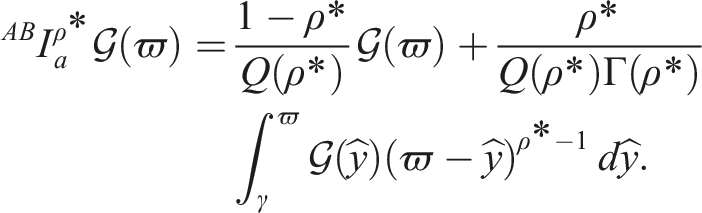
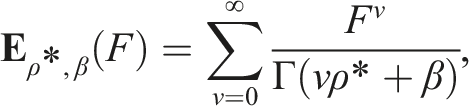
Atangana and Baleanu extended the earlier established mathematical models by proposing a new fractional derivative whose kernel is based on the ML function (Atangana and Baleanu, 2016). This approach naturally blends features of both exponential behavior and power-law decay, focusing on a more flexible representation of memory effects. The kernel (memory) function plays an important role in the analysis of different systems, containing economic dynamics, the continuous-time Harrod-Domar growth model, and phenomena involving nonlocal effects in electromagnetic and thermodynamics (Pfitzenreiter, 2004; Wang and Li, 2011). Recently, considerable attention has been paid to the qualitative behavior of AB FDEs, mainly due to their extensive applicability in different phenomena (Atangana and Baleanu, 2016; Atangana and Koca, 2016; Jarad et al., 2018; Ravichandran et al., 2019). As a result, the development of fractional derivative definitions incorporating non-singular kernels such as the Caputo-Fabrizio and Atangana-Baleanu (AB) FDs has become particularly important. The motivation for introducing non-singular kernels also arises from phenomena involving fractional operators characterized by dissipativity (Hristov, 2019), for more recent applications of FDEs, we recommend Khan et al. (2025) and Shah et al. (2025).
Hammerstein-type integro-differential equations represent an important class of nonlinear models that combine Volterra or Fredholm integral operators with nonlinear composition terms. The mentioned equations arise naturally in different applications, such as heat transfer, population dynamics, and control theory. The investigation of these equations in fractional form has attracted considerable research interest in recent years. Dadsetadi et al. analyzed the existence and uniqueness (EU) of solutions for a class of nonlinear fractional integro-differential equations of Hammerstein type in BS (Dadsetadi et al., 2022). They utilized Schauder’s fixed point theorem for the existence and the general form of Banach fixed point theorem for uniqueness, with the Caputo fractional derivative. In a related work (Dadsetadi and Nouri, 2020), they developed analytical and numerical methods for fractional Hammerstein equations, transforming the fractional equations into Volterra integral equations using differential transformation methods and obtaining approximate solutions through modified block pulse functions. Shah and Zada examined the existence, uniqueness, and various stability properties, specifically Ulam-Hyers (UH) and Ulam-Hyers-Rassias (UHR) stability, for nonlinear impulsive Hammerstein integro-differential dynamic systems on time scales (Shah and Zada, 2019). More recently, the authors in Shah et al. (2024) analyzed the stability and controllability of nonlinear Volterra-Fredholm Hammerstein impulsive integro-dynamic systems with delay on time scales, employing fixed point techniques and control functions to establish their results. In Tunç et al. (2023), the authors studied the EU of solutions for nonlinear Hammerstein-type functional integral equations using Burton’s method of progressive contractions in BS with the Chebyshev norm. In Ahmed et al. (2025), the authors developed numerical methods based on quadratic B-spline functions for solving nonlinear systems of Volterra integro-FDEs of Hammerstein type in the Caputo sense, transforming the system into nonlinear algebraic equations solvable by Newton’s method.
The framework of impulsive differential equations naturally emerges in models that involve abrupt changes in the system’s state at specific moments (Shu et al., 2011; Wang et al., 2015). Depending on the duration of the impulsive effect, impulses can be classified into two categories. The first type involves instantaneous impulses, where the impact occurs in an extremely short time. The second type corresponds to Non-instantaneous (NI) impulses, where the effects persist over a finite time interval. The authors in Hernández and O’Regan (2013) introduced NI impulsive effects that frequently appear in the modeling of evolution systems. The qualitative behavior of both instantaneous and NI fractional differential systems has been extensively studied in the literature (Agarwal et al., 2017; Bas and Ozarslan, 2018; Saravanakumar and Balasubramaniam, 2021), often using fixed point theorems. Significant contributions in this area include the work (Jolić and Konjik, 2023) on time-varying systems, as well as the studies by Dineshkumar et al. (2022) and Johnson et al. (2023) on stochastic differential models involving AB CDs. Furthermore, in Hussain et al. (2023), the authors investigated the fractional evolution inclusions. Additional developments include the analysis by Algolam et al. (2025) of stochastic impulsive systems driven by Rosenblatt noise, along with studies by Raghavendran et al. (2024) on neural network models and Jothilakshmi and Vadivoo (2025) on systems that incorporate infinite delays.
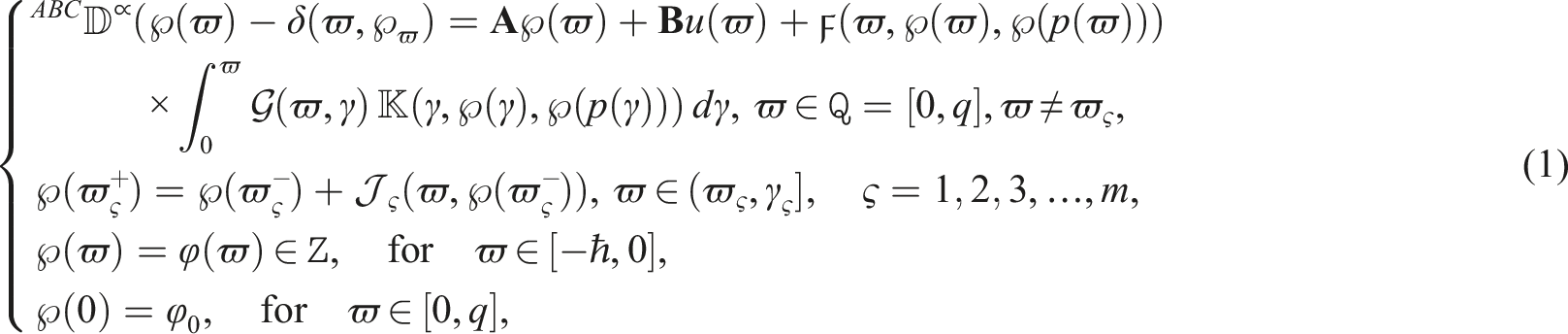
The present work significantly extends the controllability results established in Aimene et al. (2019) for neutral systems subject to NI impulses. Moreover, the existence results reported in Hernández and O’Regan (2013); Ravichandran et al. (2019); and Shu et al. (2011) are further extended to encompass neutral systems. The obtained results are derived under relaxed Lipschitz and linear growth conditions imposed on the nonlinear neutral terms and the NI impulsive components. Additionally, as far as the author is aware, currently no work has addressed the controllability of neutral Non-instantaneous impulsive functional differential equations (NIFDEs) involving the AB Caputo FD. Motivated by the preceding considerations, we formulate the required conditions to ensure the EU and controllability of the below model using the measure of non-compactness.
while ℘ is the variable state, and is the Caputo FD AB with lower limit at “0” the order ∝ ∈ (0, 1). is the infinitesimal generator of a ∝-resolvent family , and is the solution operator defined on a BS . Assume that the control function , where this space consists of square-integrable functions taking values in the BS . Moreover, let B denote a bounded linear operator acting from to .
Let be continuous throughout, except at a finite set of points γ, where κ(γ−), κ(γ+) exists and . , where and , 0 = ϖ0 = γ0 < ϖ1 < γ1 < ϖ2… < ϖm < γm < ϖm+1 = q for ς = 1, 2, 3, …, m, respectively, and , denote left and right-hand limits of the function ℘(ϖ) at that satisfies ℘ϖ(a) = ℘(ϖ + a), a ∈ [−ℏ, 0], ℘ϖ(.) is the state history up to ϖ, from ϖ − a. Moreover, , and with p(ϖ) ≤ ϖ, is the right-dense continuous delay function. Section 2 establishes the foundational concepts by presenting the necessary definitions. In Section 3, the EU results for equation (1) are derived and proved under the given assumptions. Section 4 presents the controllability results for (1). The theoretical developments are illustrated in Section 5 with a detailed example. Section 6, offers the concluding remarks, and Section 7 provides a glossary of abbreviations.
Very recent developments have expanded the applications of fractional operators and computational techniques in novel directions. Ghafoor et al. developed a numerical method for solving one- and two-dimensional Burgers’ equations involving the time-fractional AB CD with a non-singular kernel (Ghafoor et al., 2024). Their approach combines a quadrature rule for the fractional derivative with Haar wavelet approximations, reducing the fractional problems to systems of linear equations through a collocation procedure. The approach presents second-order convergence and stability with the help of Lax-Richtmyer method, by numerical examples appreciating its effectiveness. In different applications area, Sher et al. employed deep neural networks for the computational analysis of coupled systems of fractional integro-differential equations, demonstrating the potential of machine learning techniques in dealing fractional-order complex systems (Sher et al., 2025). They also developed a neural network and fractals-based, analysis for the fractional cases to predict infections in eye diseases caused by the conjunctivitis viruses, illustrating the need of combining fractional calculus with new computational intelligence for diverse applications. Also, in Abdulwasaa et al. (2024), the authors conducted the statistical and computational analysis for a corruption and poverty model using Caputo-type FDEs, emphasizing how fractional operators can effectively capture the complex dynamics of socioeconomic phenomena.
2. Basics
Before delving into the main discussion, we first introduce some fundamental definitions, theorems, and lemmas that will serve as the basis for this article.
By we denote a BS consisting of all continuous functions from to . Define the norm κ on as , and such that , where is the restriction of . Also, with , is a BS for each for .
(Banaś, 1980) Let be a bounded set. The Kuratowski measure of noncompactness of ϝ, denoted by , is defined as: , where the diameter of is .
(Banaś, 1980) Letbe a real BS, and letandbe bounded subsets of. Then
• Ifthen.
• whilerepresents the closure of.
• is relatively compact in.
• .
• ,where.
• .
• for any.
(Aimene et al., 2019) Letis uniformly integrable and there existssatisfying, for almost everywherethenis Lebesgue integrable onand.
(Aimene et al., 2019) For BS, the boundedness ofimplies that∃a countable subsetwhere.
(Aimene et al., 2019) Assumebe a BS andbe equi-continuous and bounded in, then, where.
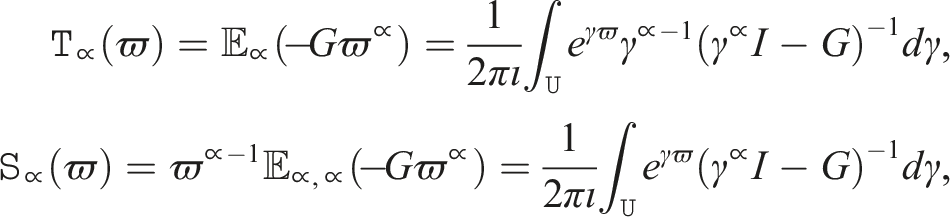
where the linear operators K = n/nI − A, G = −dA/nI − A and n = Q (∝)(1−∝)−1,
is specific on ∑ı,ȷ and .
In view of the above, we have.
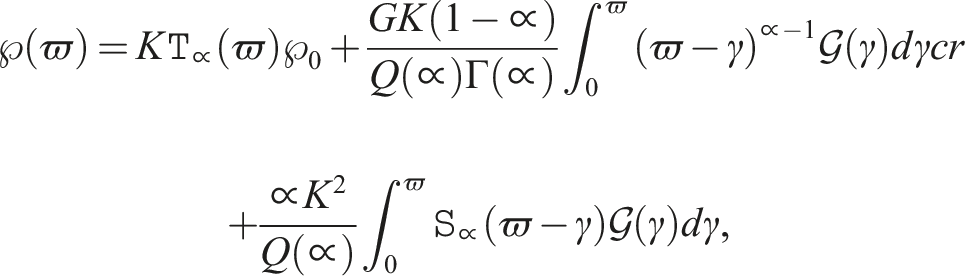
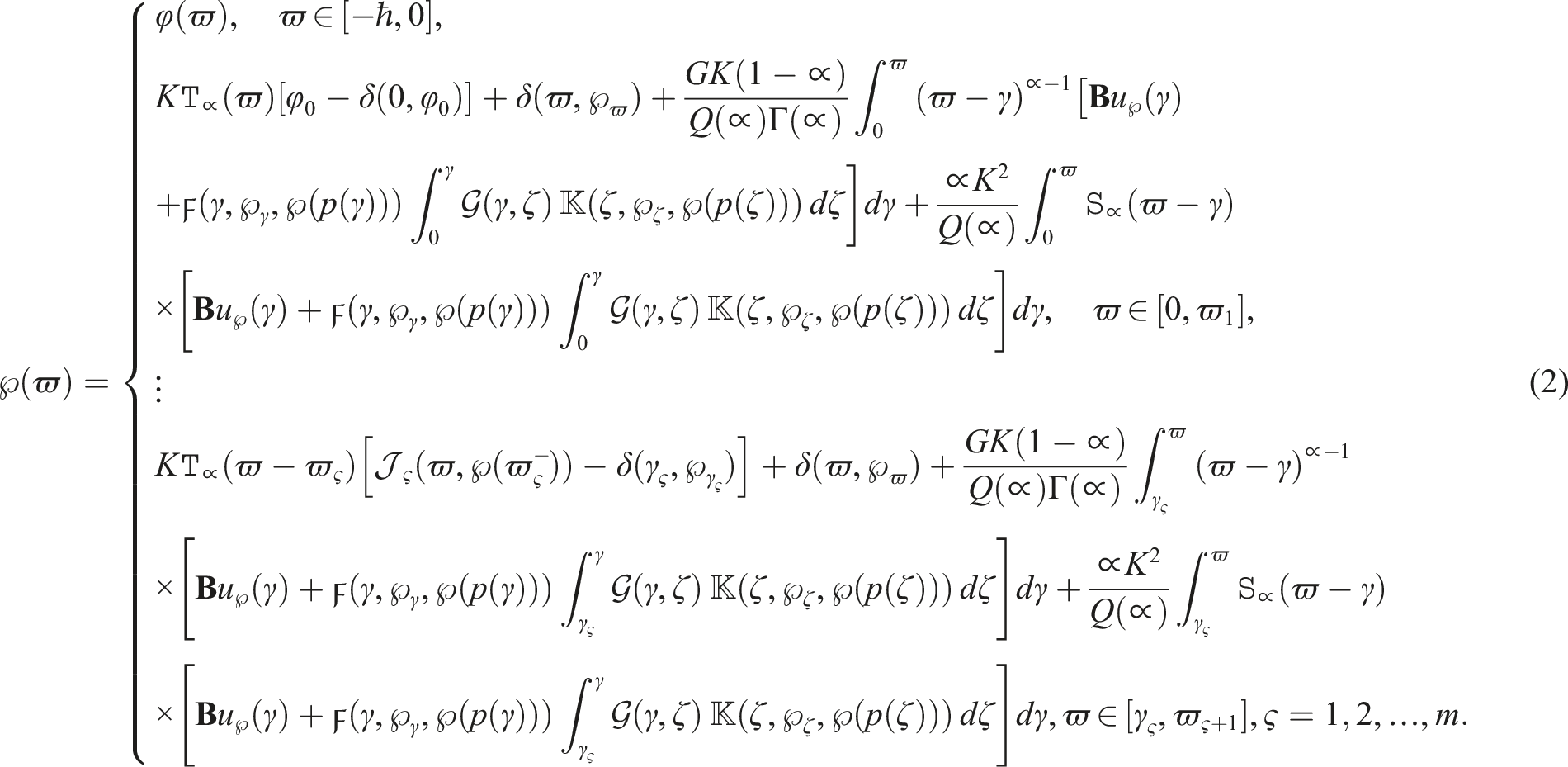
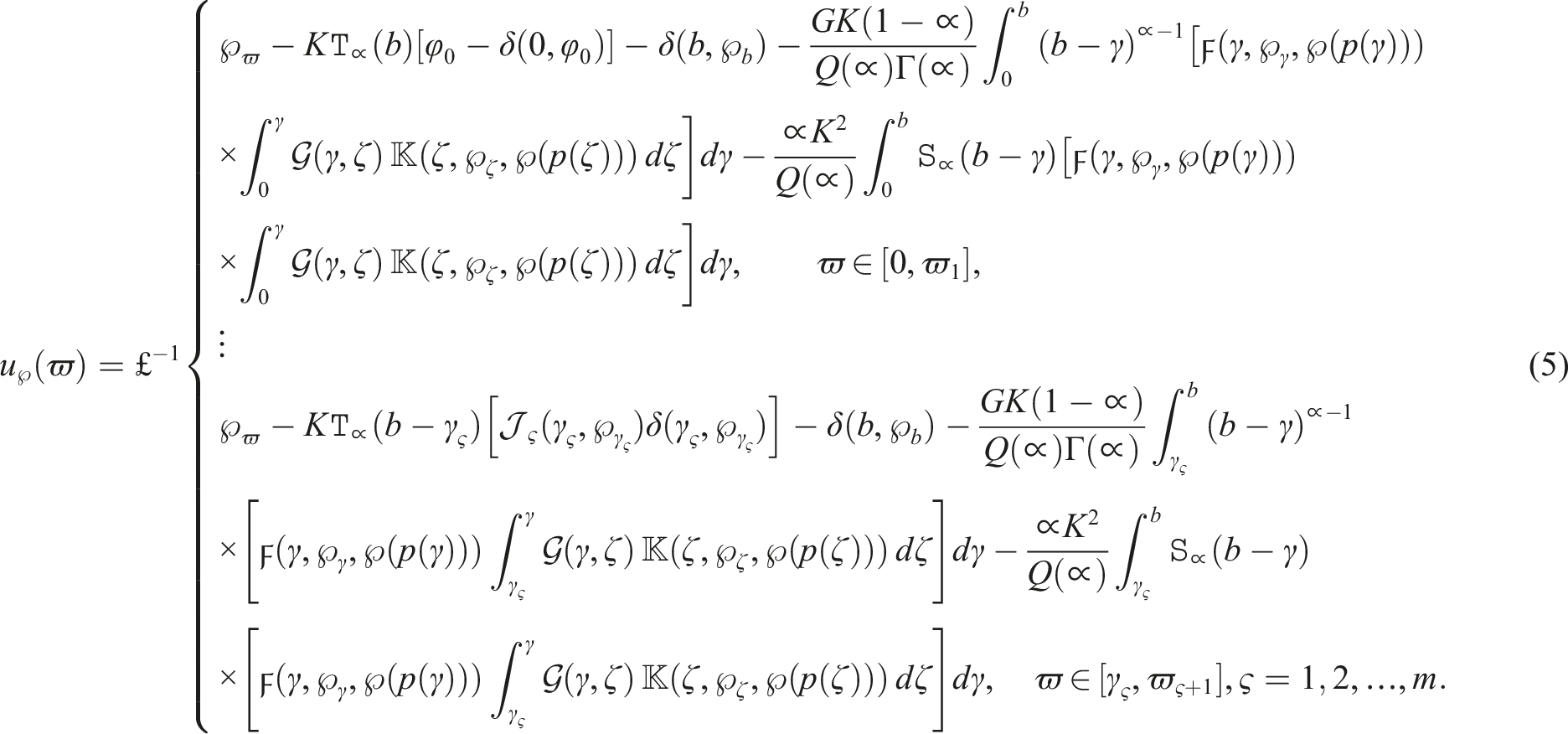
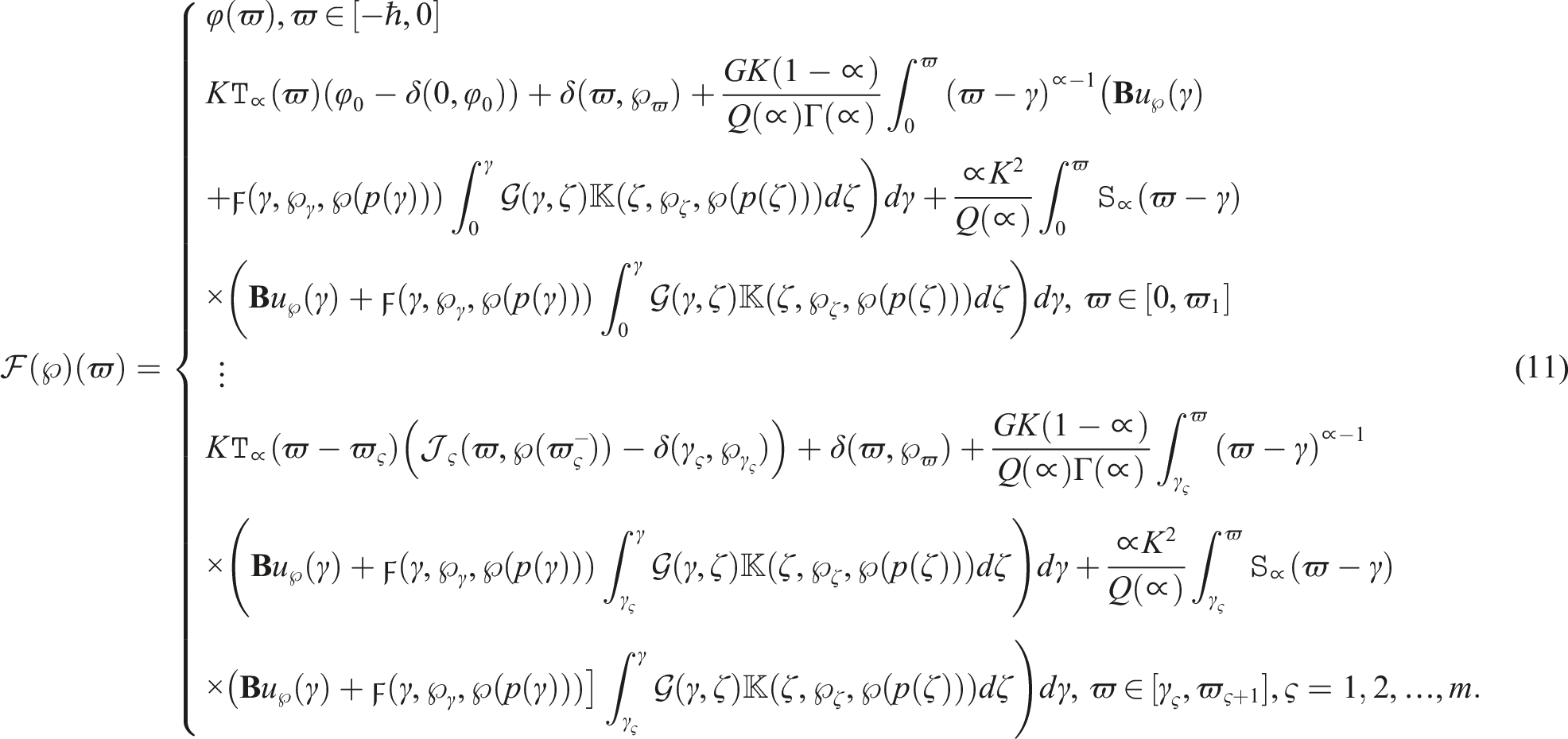
A function is said to be a mild solution of (1) if ℘(ϖ) = φ(ϖ) on satisfies the impulsive condition and then,
3. Results
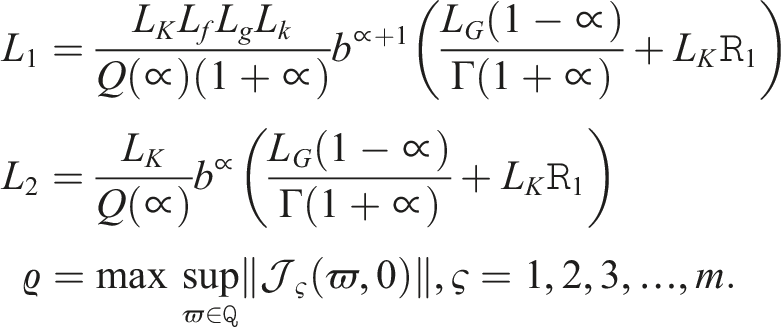
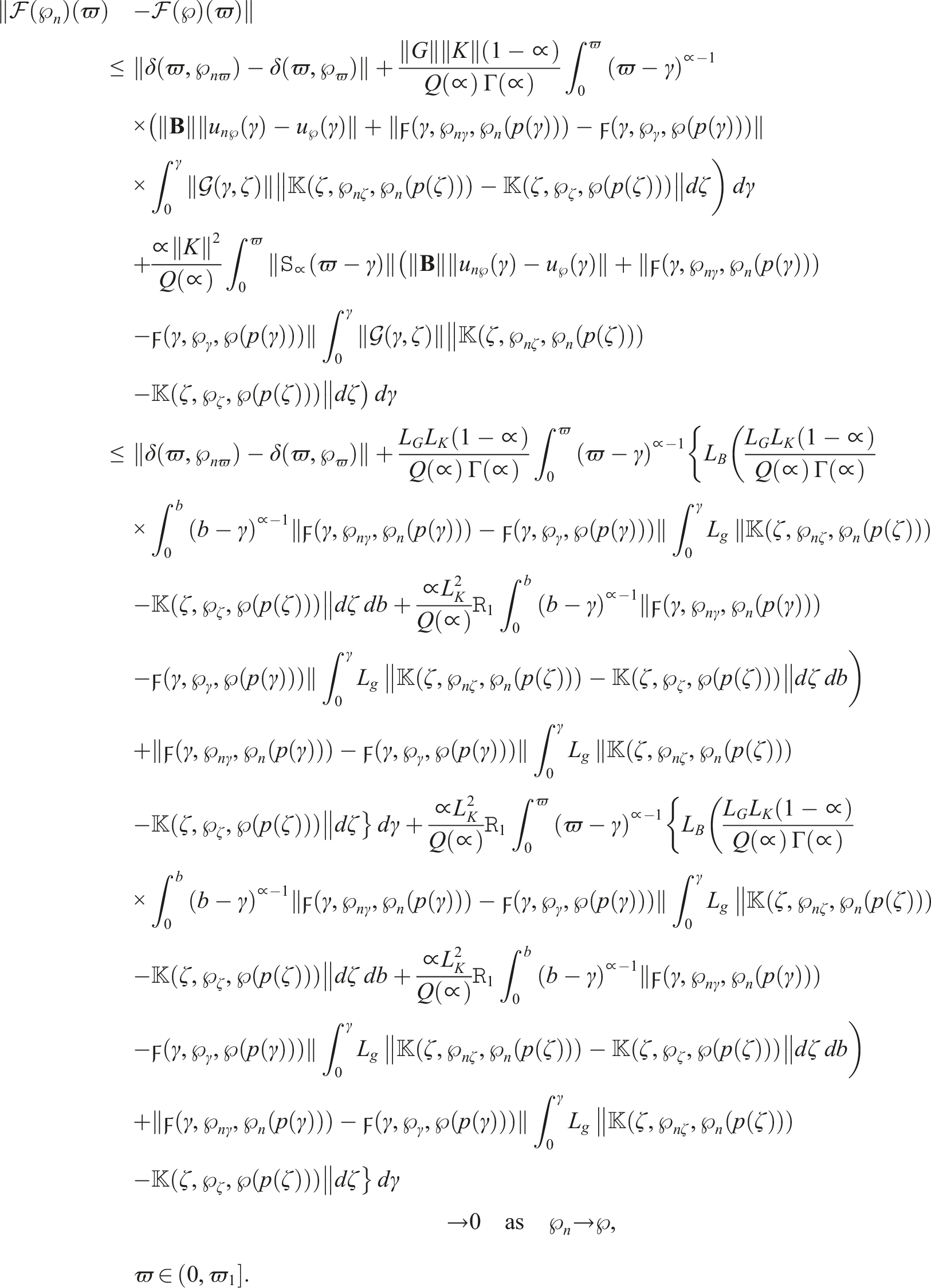
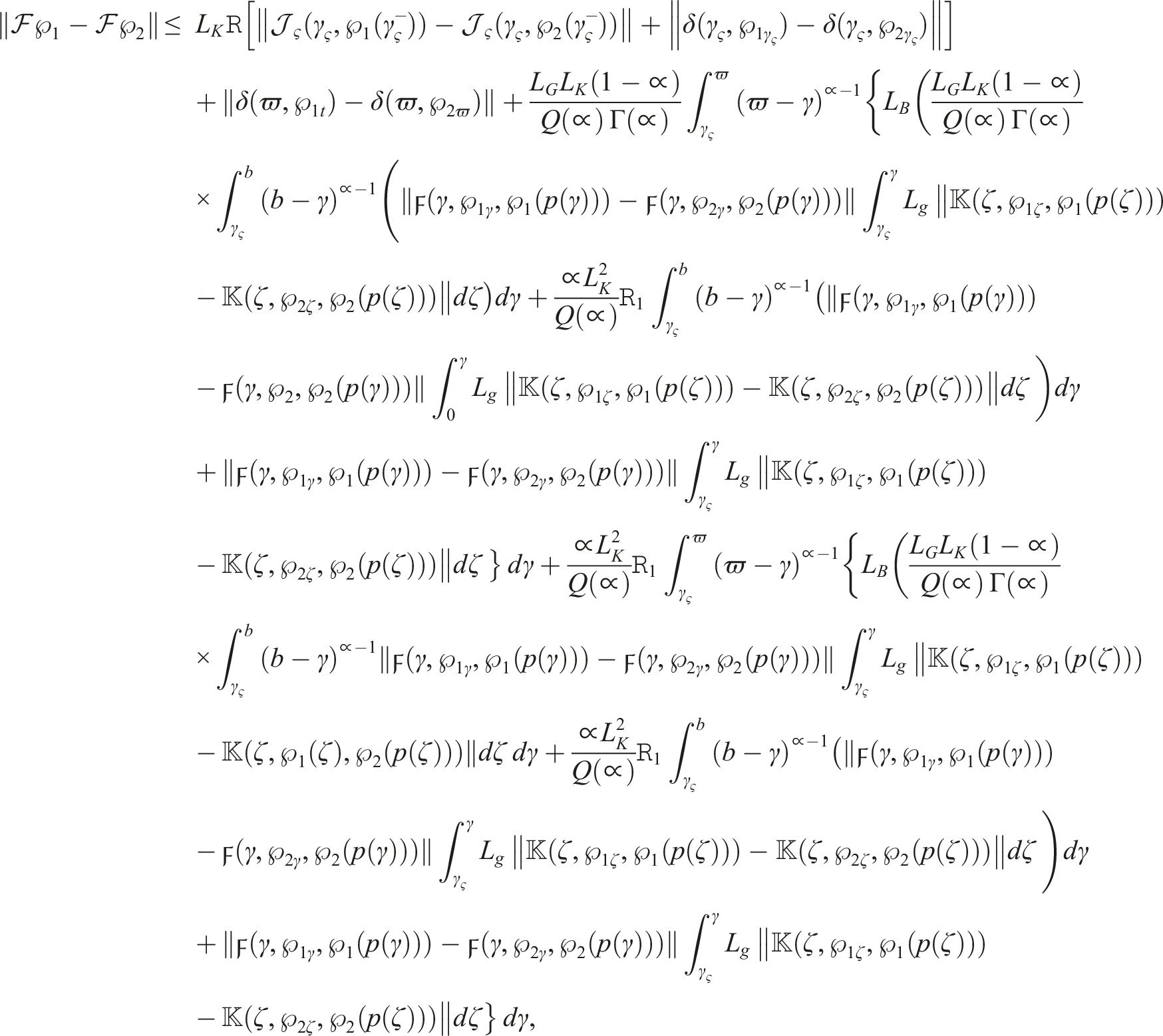
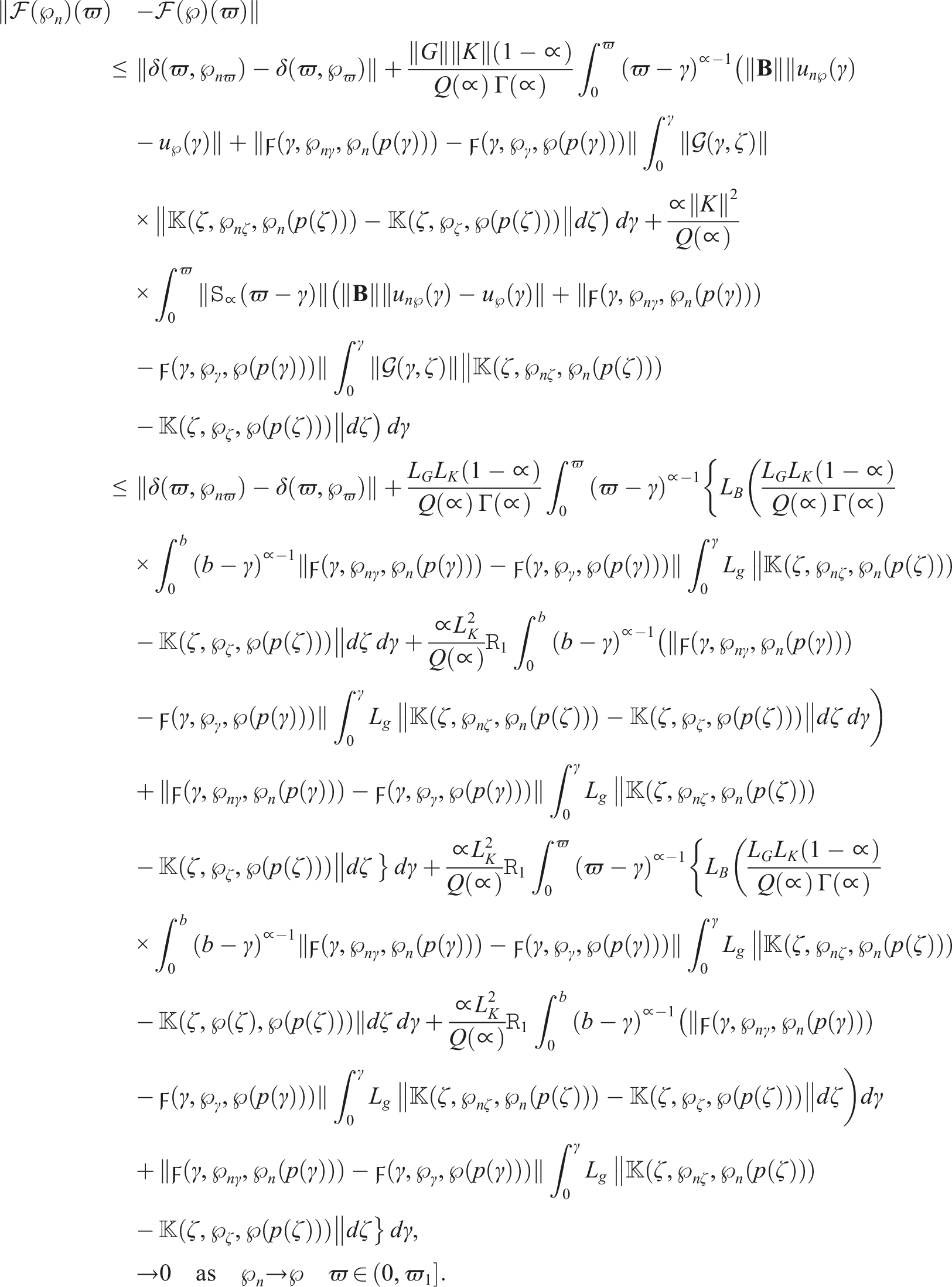
We now investigate the EU of mild solutions corresponding to (1). Assuming A ∈ A∝(ı0, ȷ0), the inequalities and are valid ∀ ϖ > 0 and v > v0. So, . Hence, we obtain ; for more details, see Shu et al. (2011). From this point onward, we will use the following notation.
Next, we give some assumptions which are required to establish the results of this paper as follows:
(S1) The function which satisfies Caratheodory conditions and such that . Also ϝ satisfies for and .
(S2), and . Also ∃ Lk > 0 such that and .
(S3) The function is continuous and for such that and
(S4) The continuous functions satisfy and LJ > 0. Also .
(S5) and K are bounded and ‖K‖ ≤ LK, where .
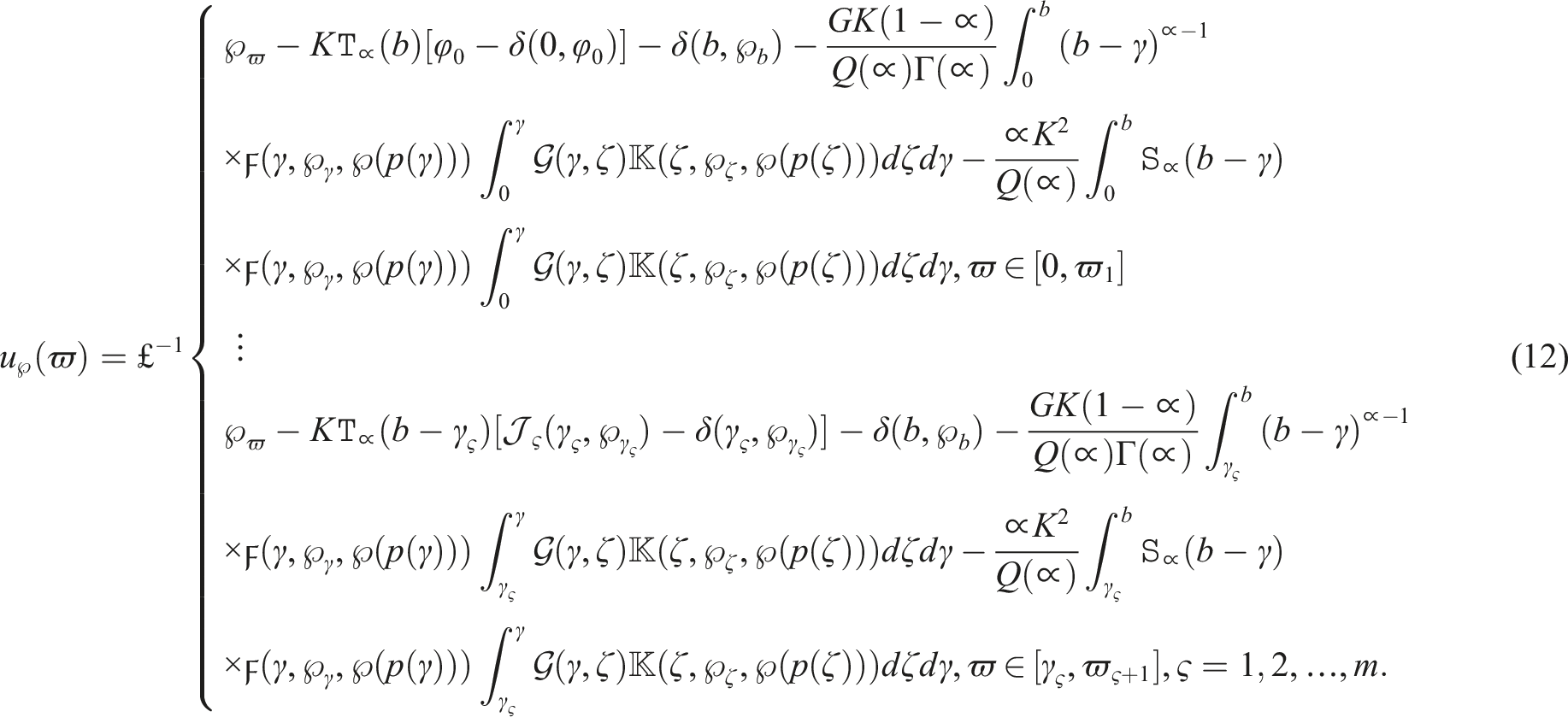
(S6), the linear operator spacified as has an inverse bounded operator , so ∃ LB > 0 & L£ > 0 such that ‖B‖ ≤ LB and ‖£−1‖ ≤ L£.
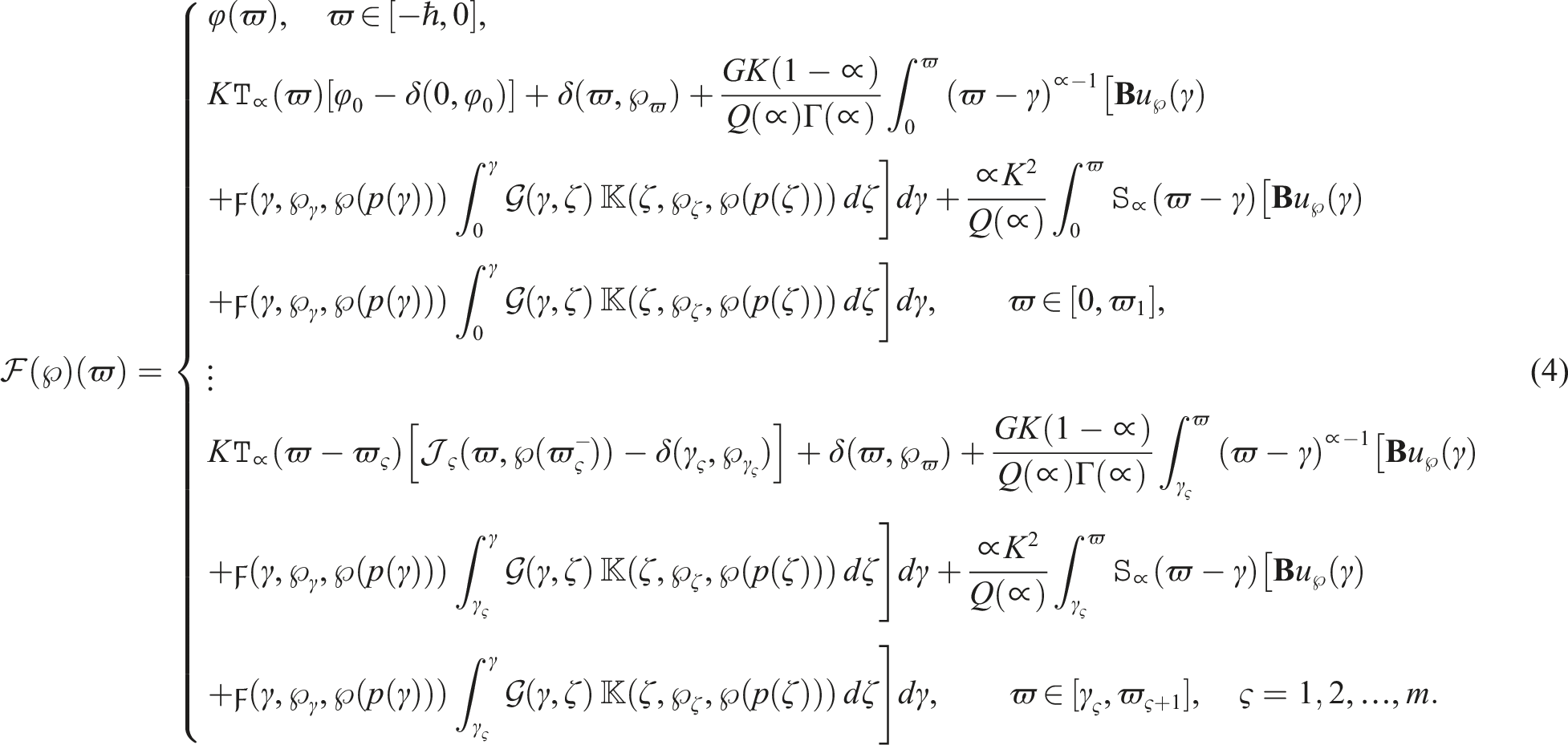
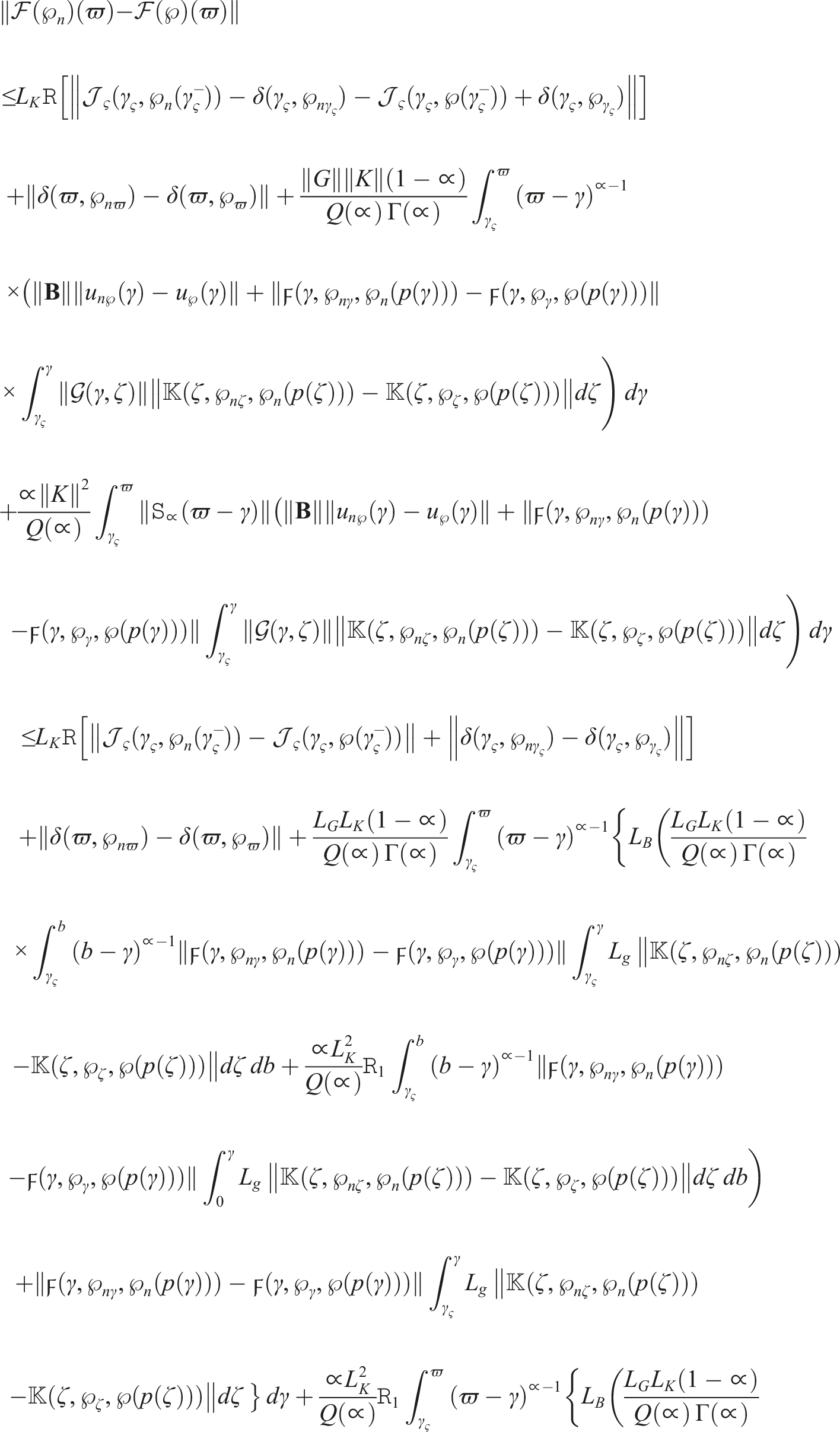
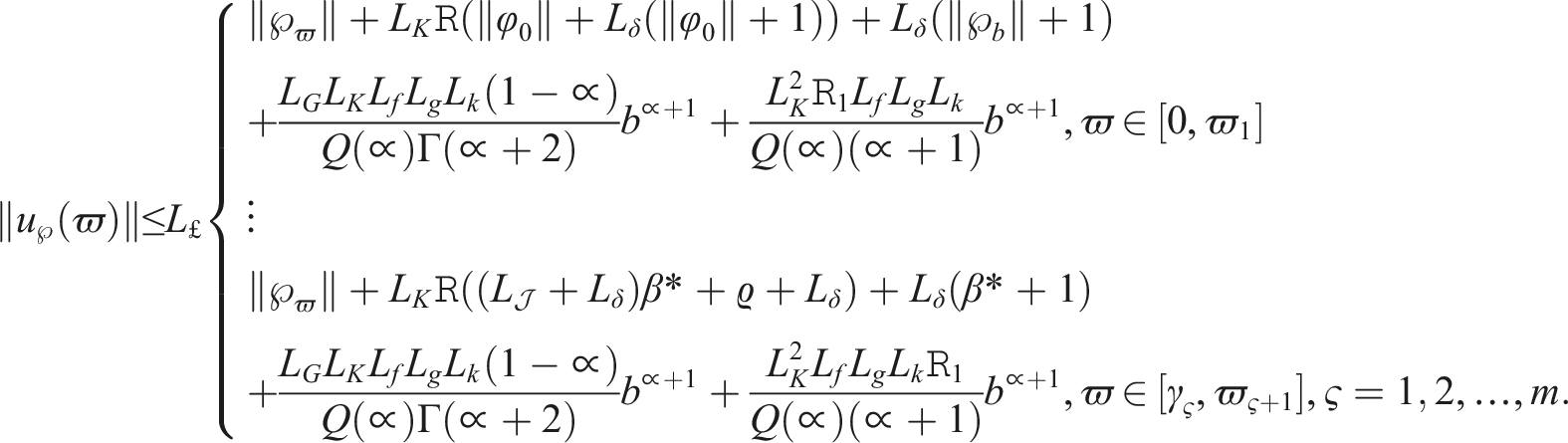
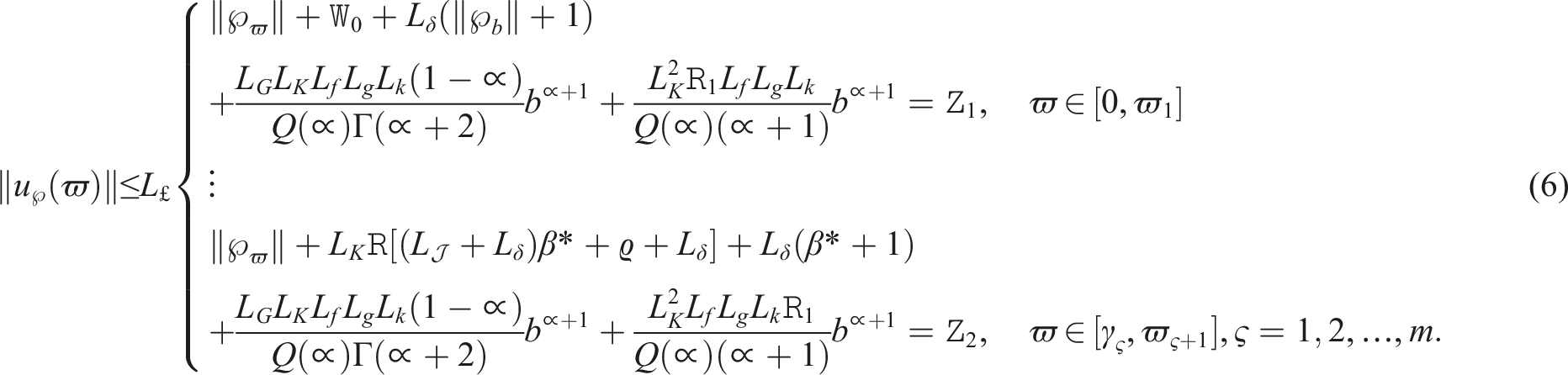
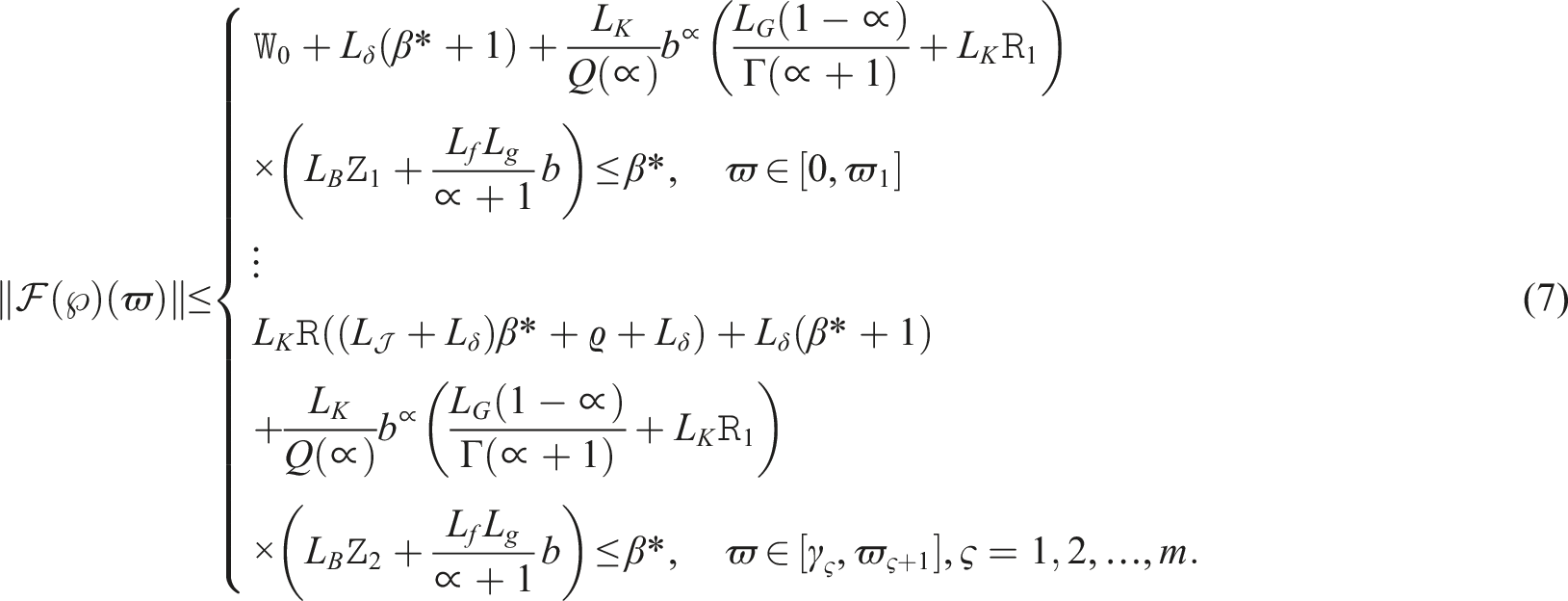
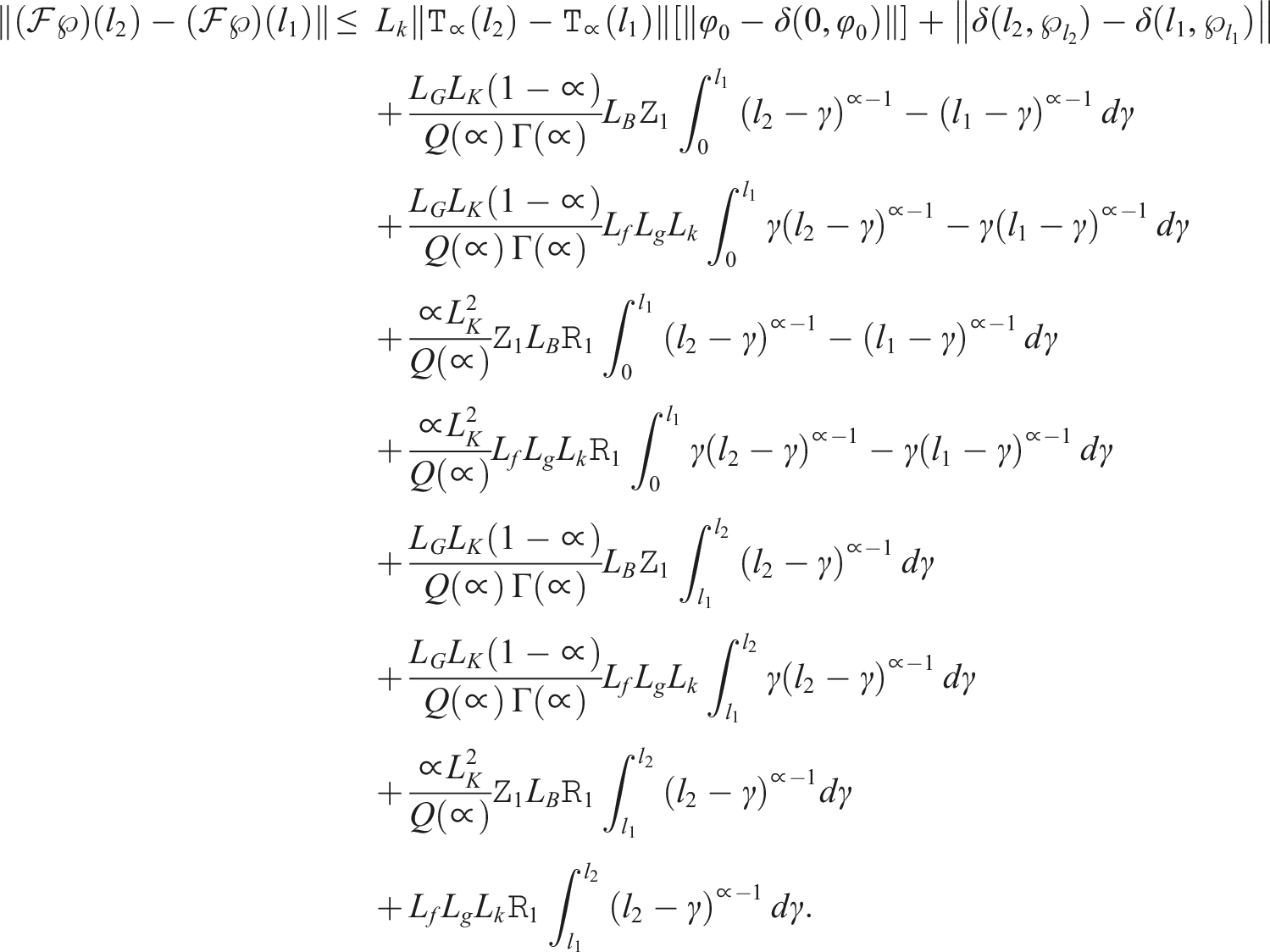
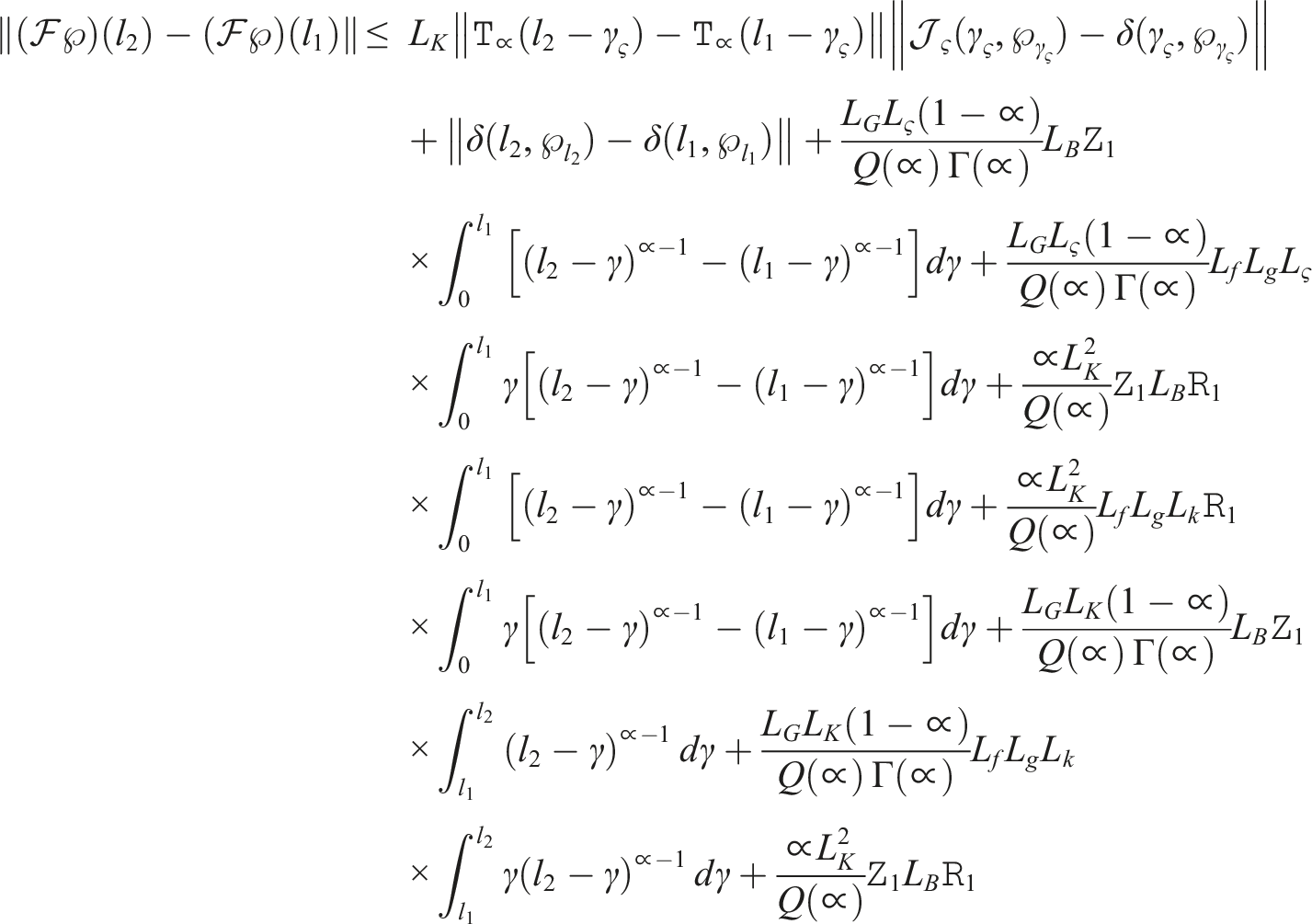
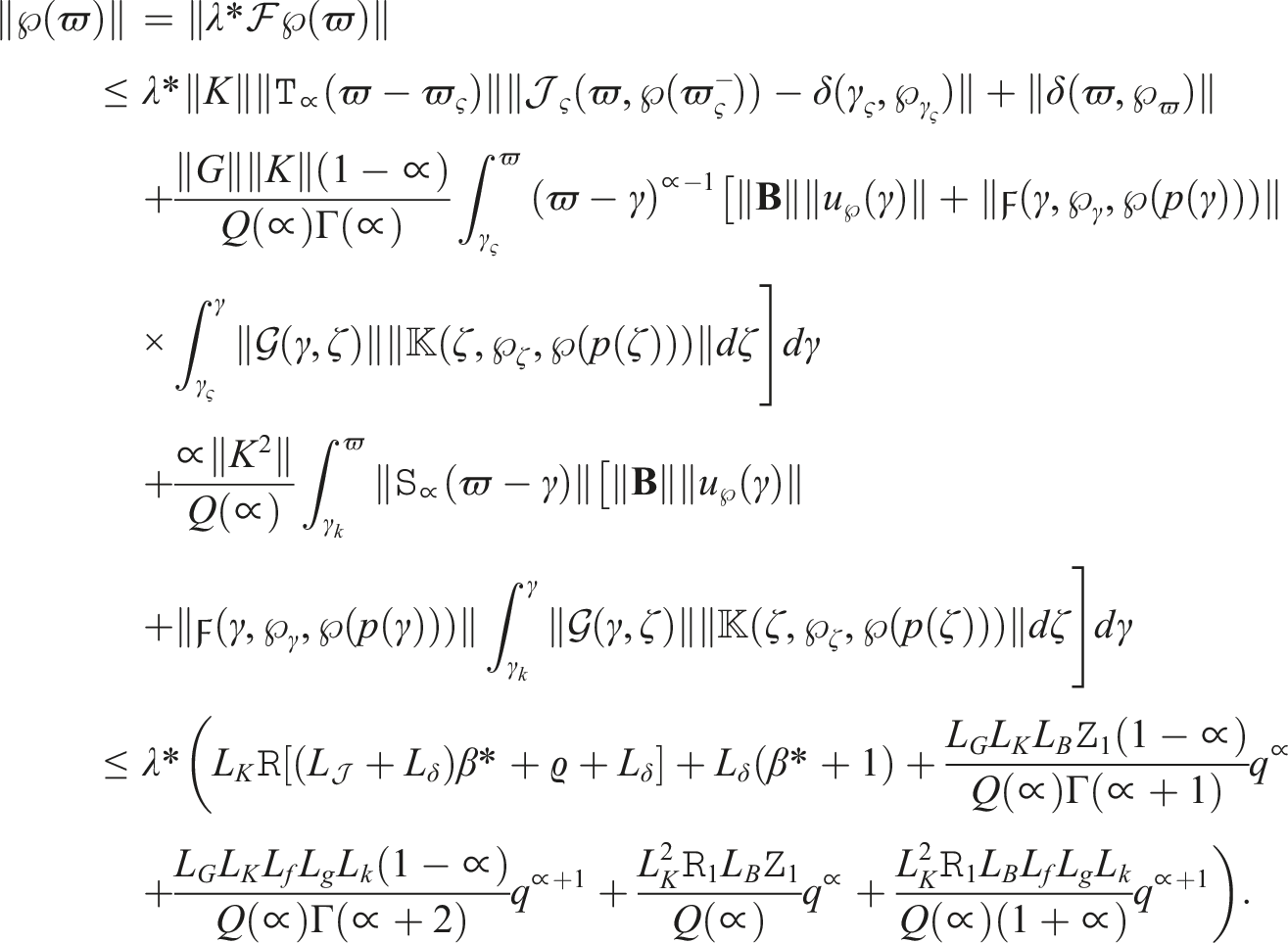
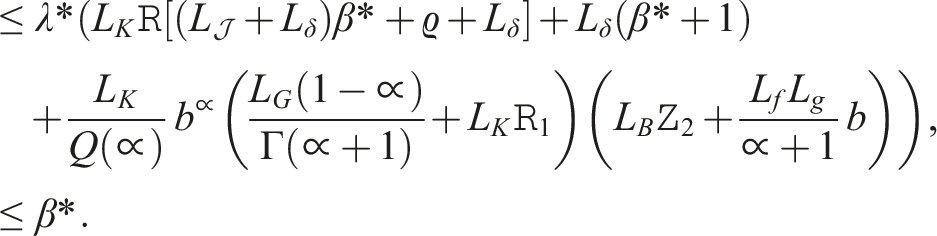
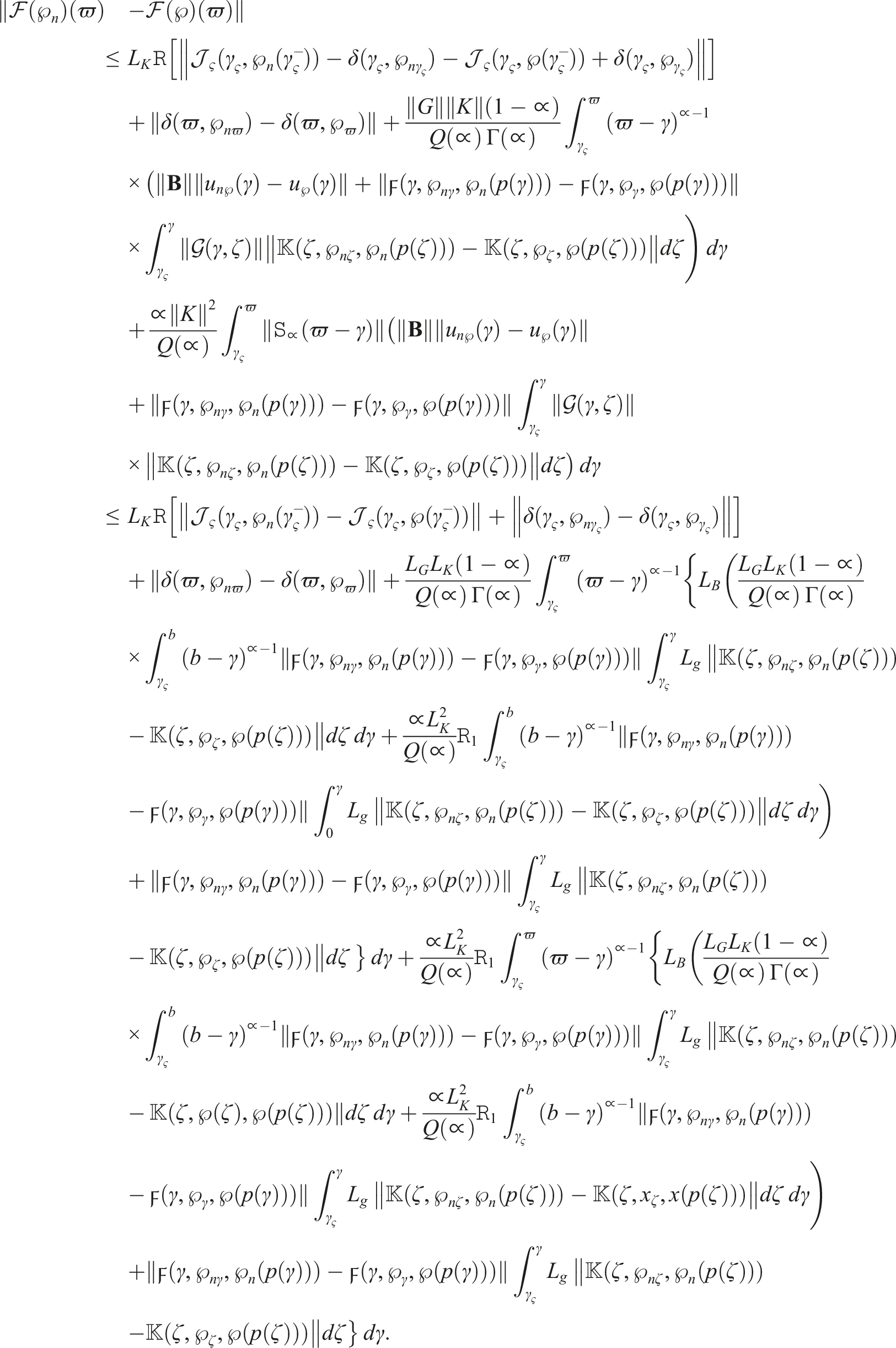
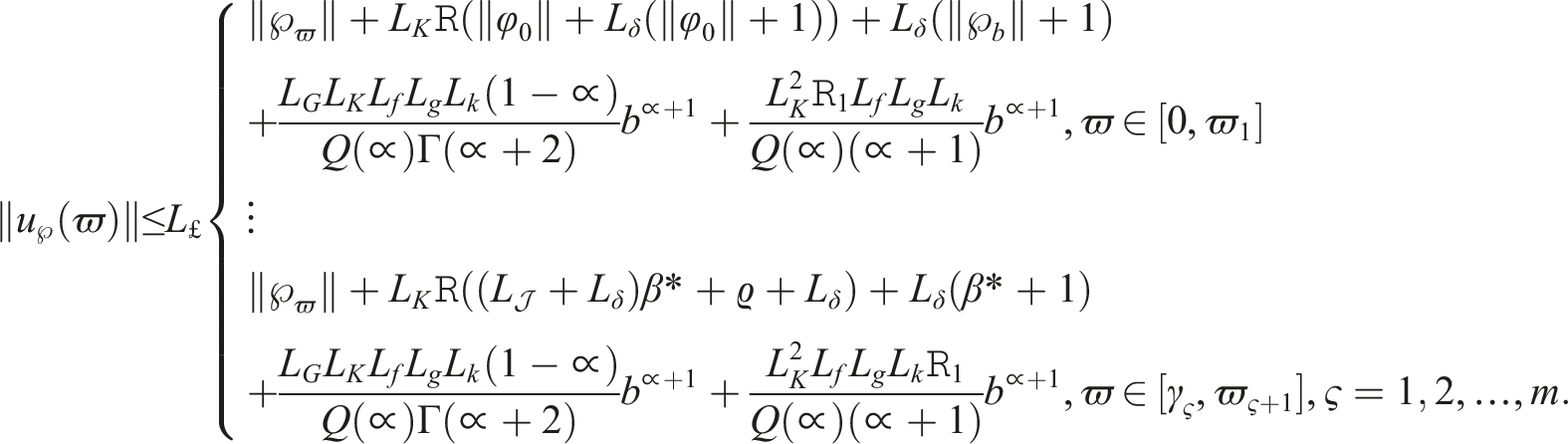
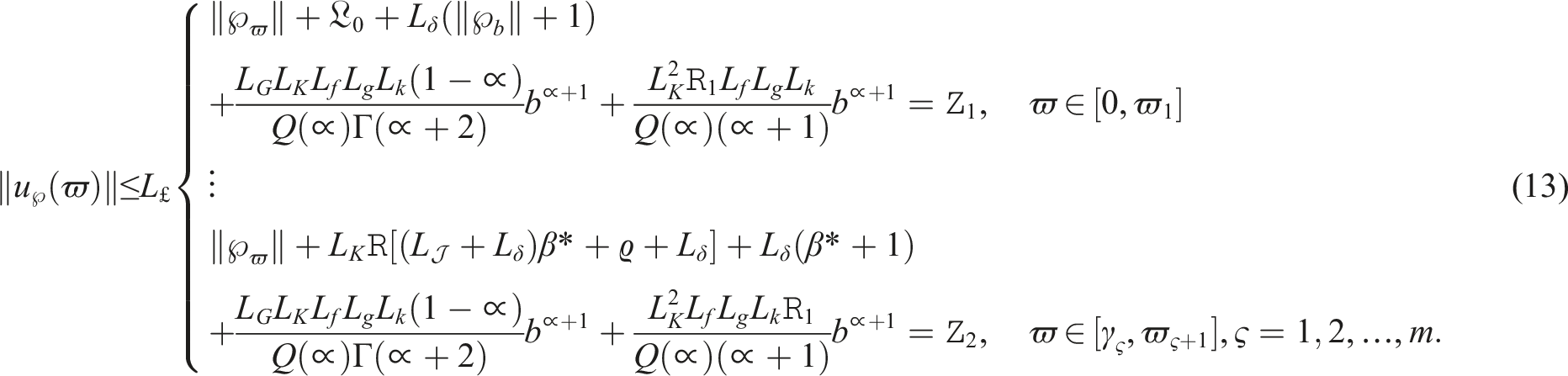
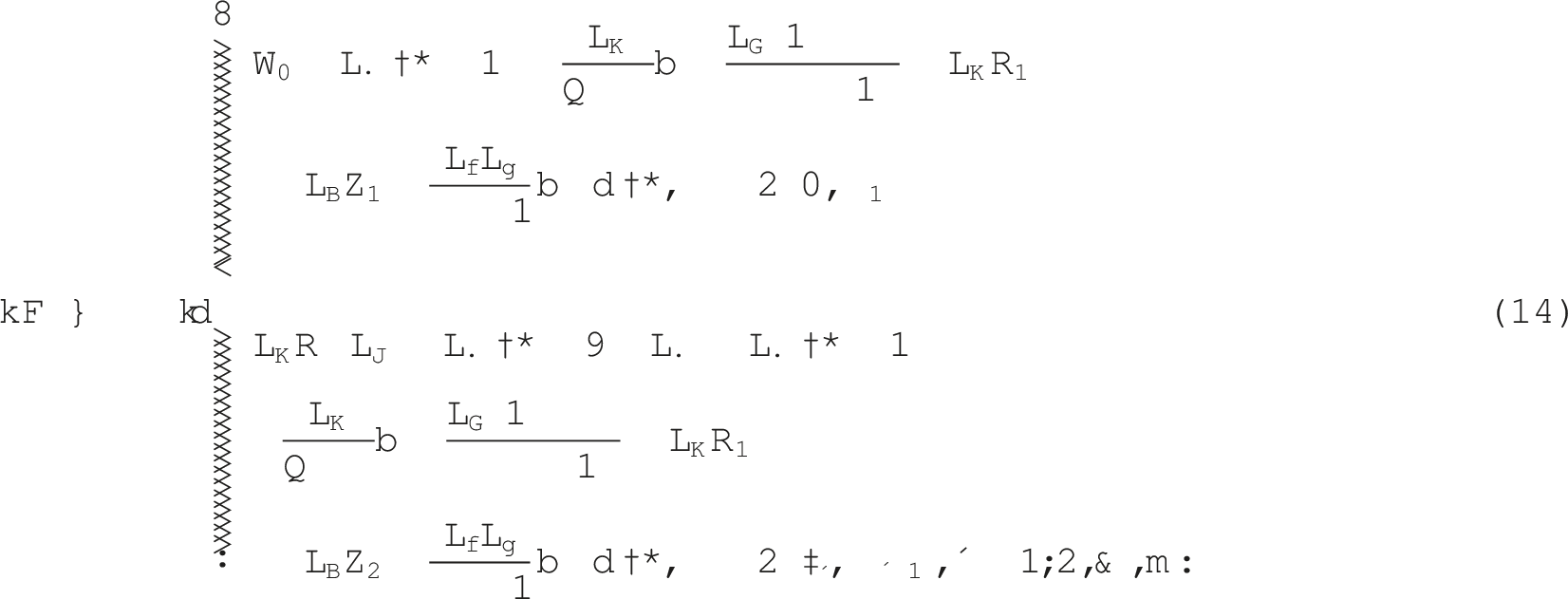
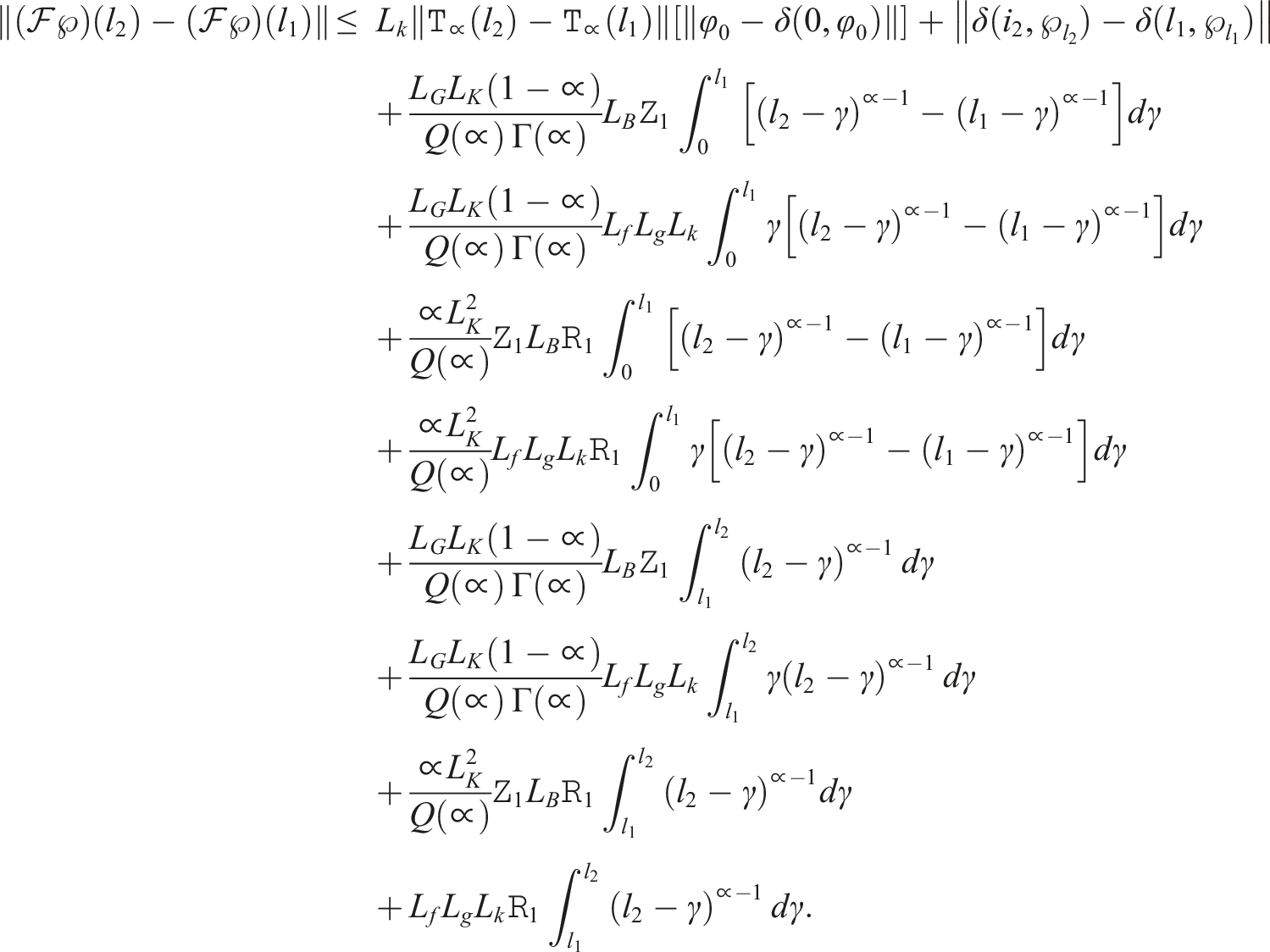
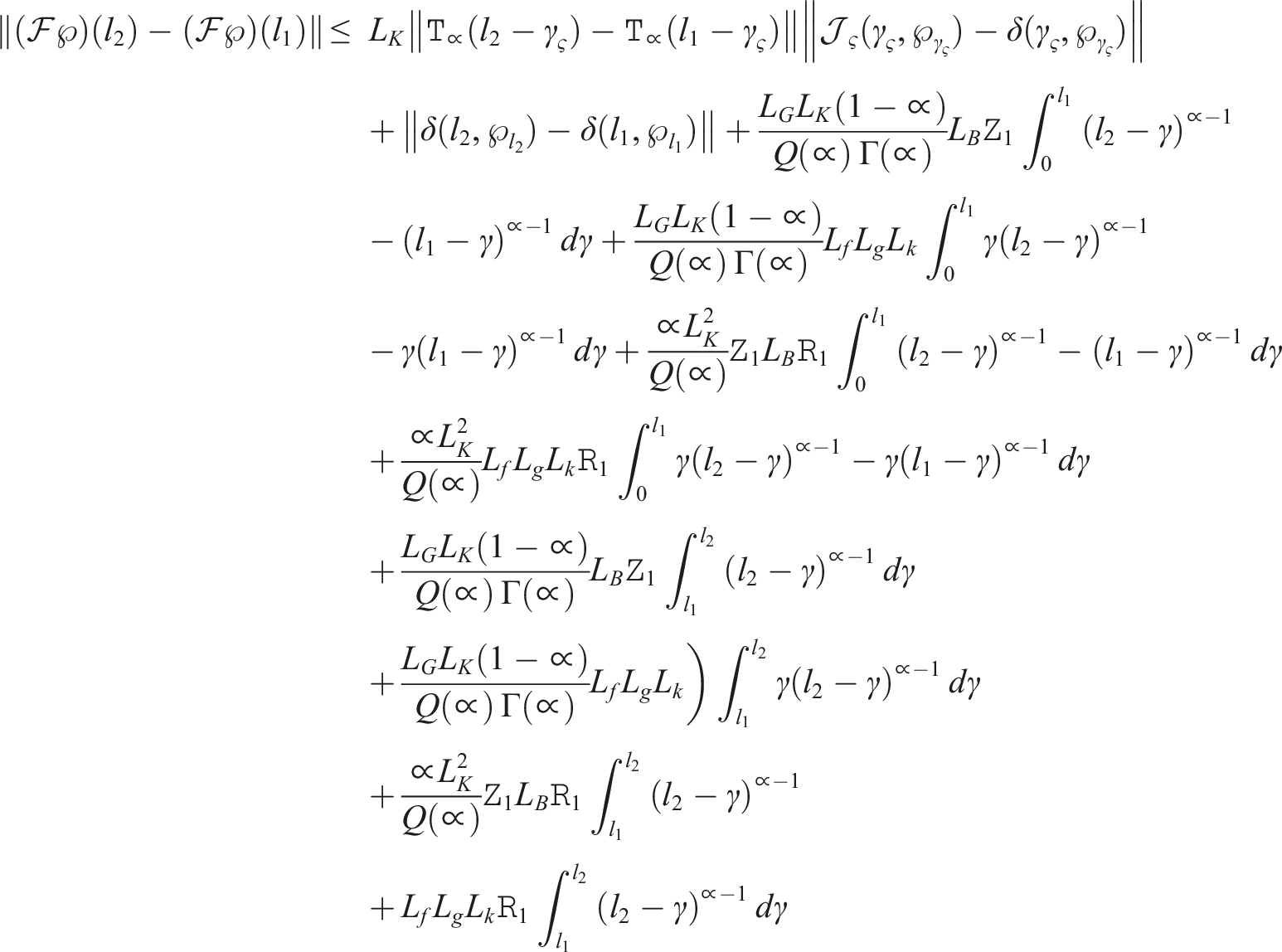
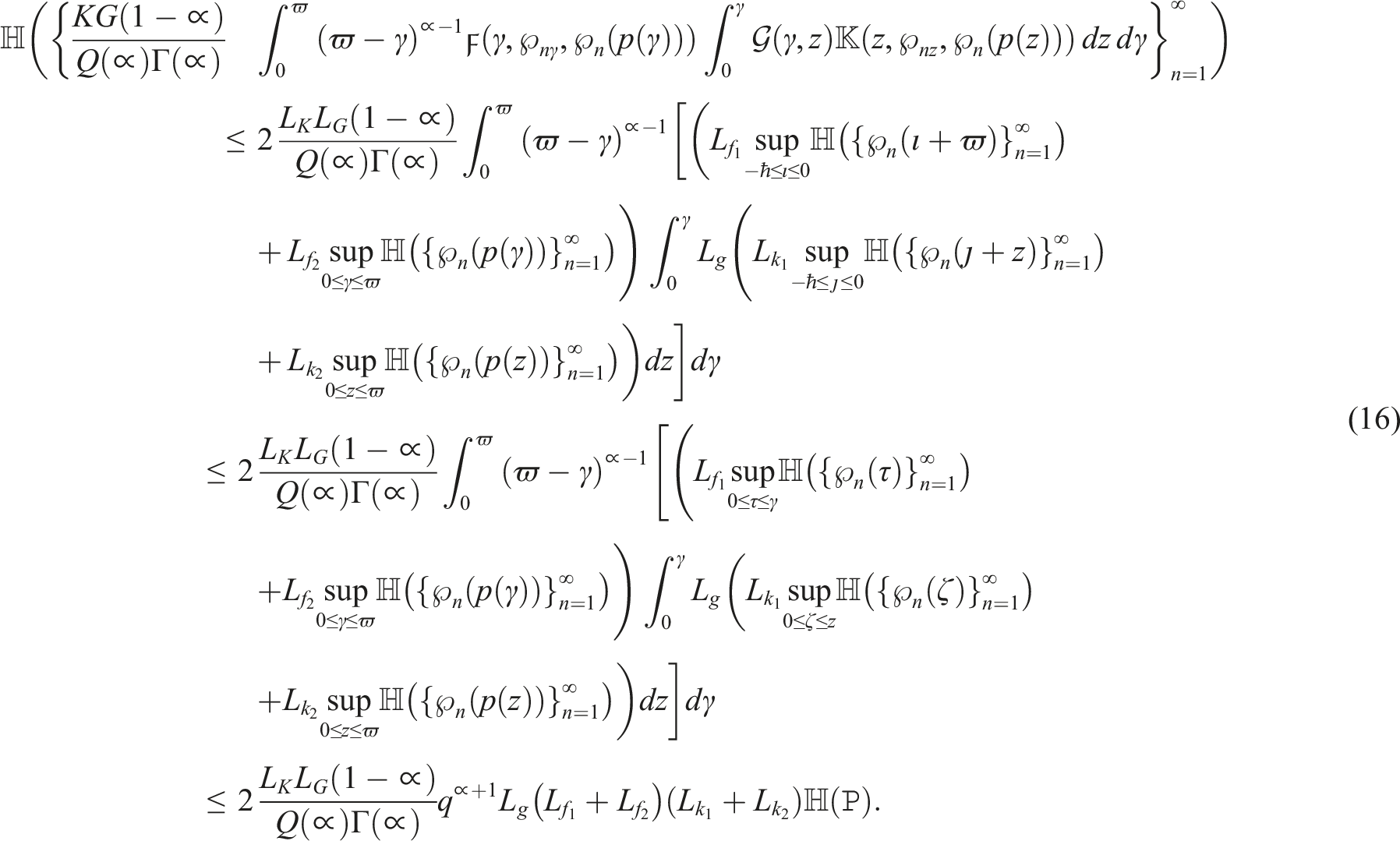
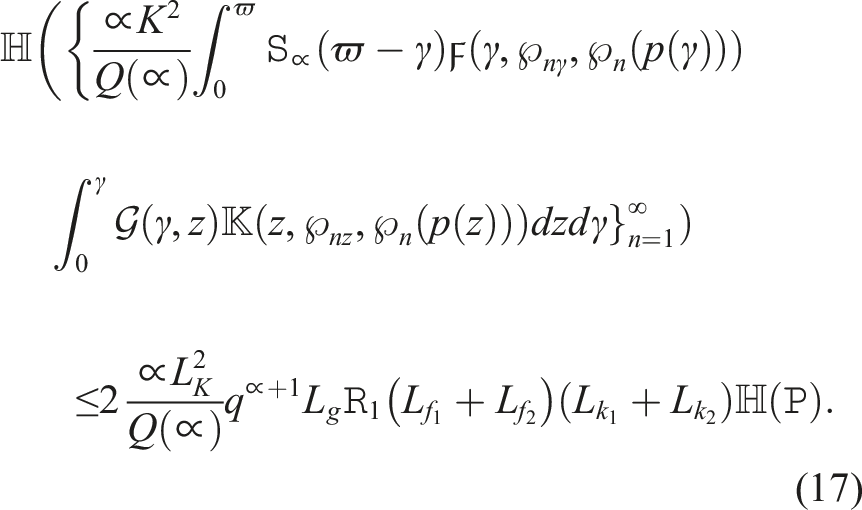
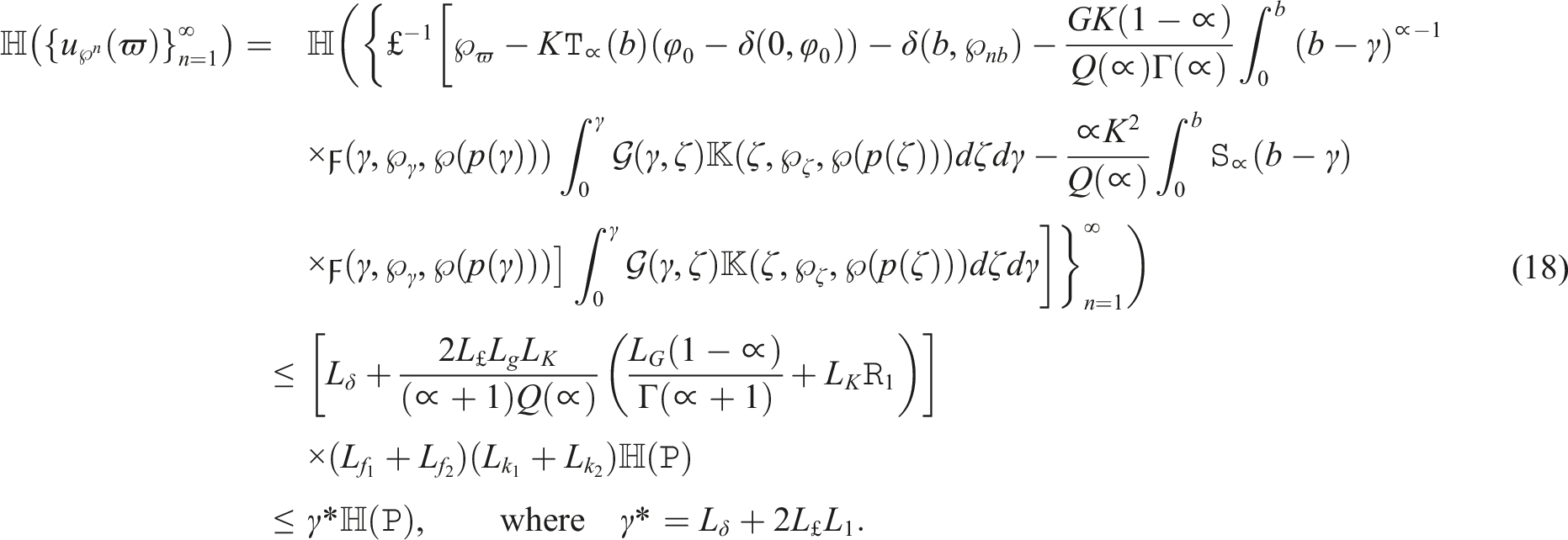
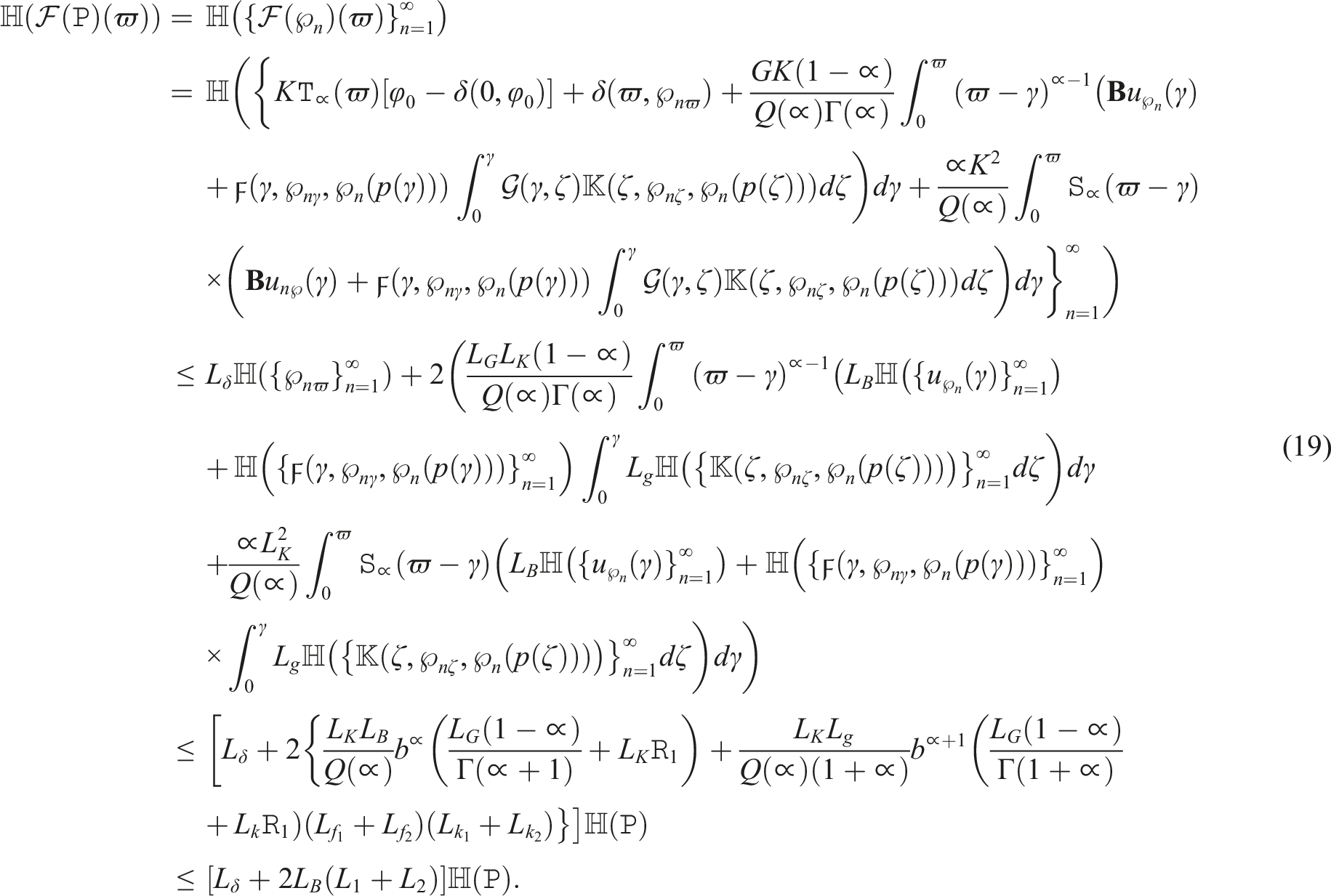
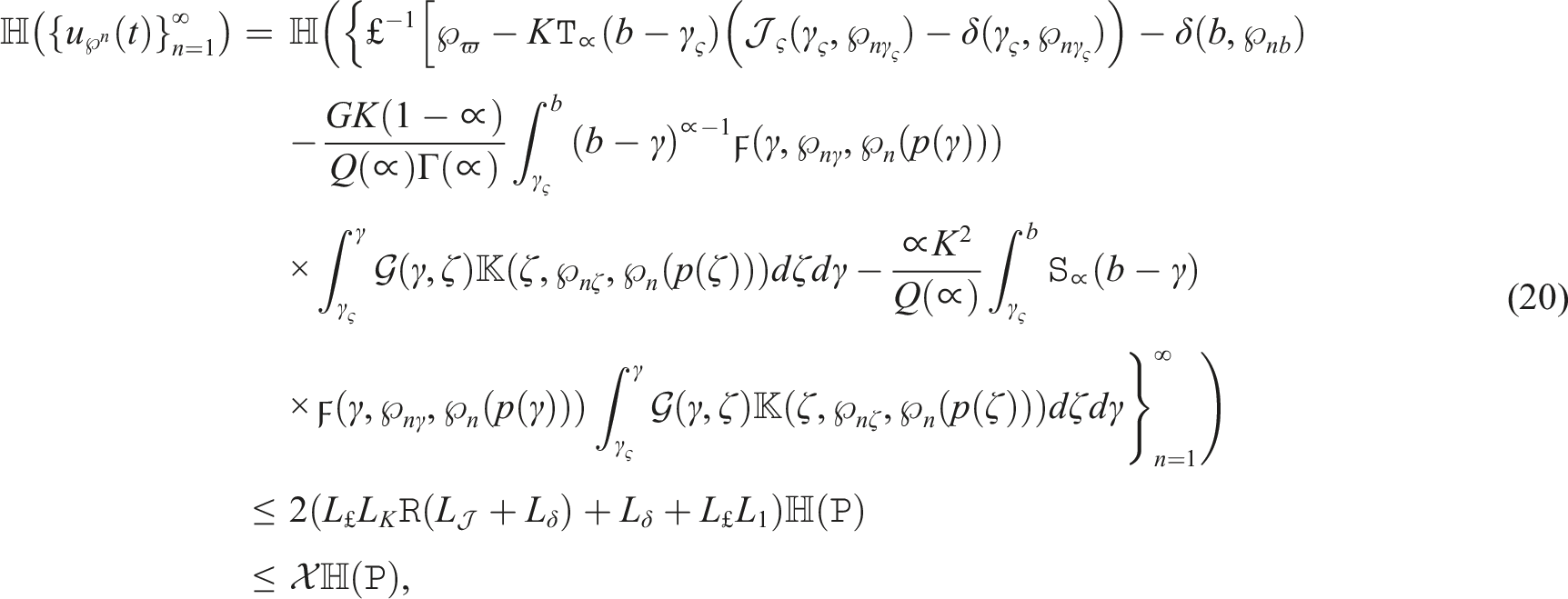
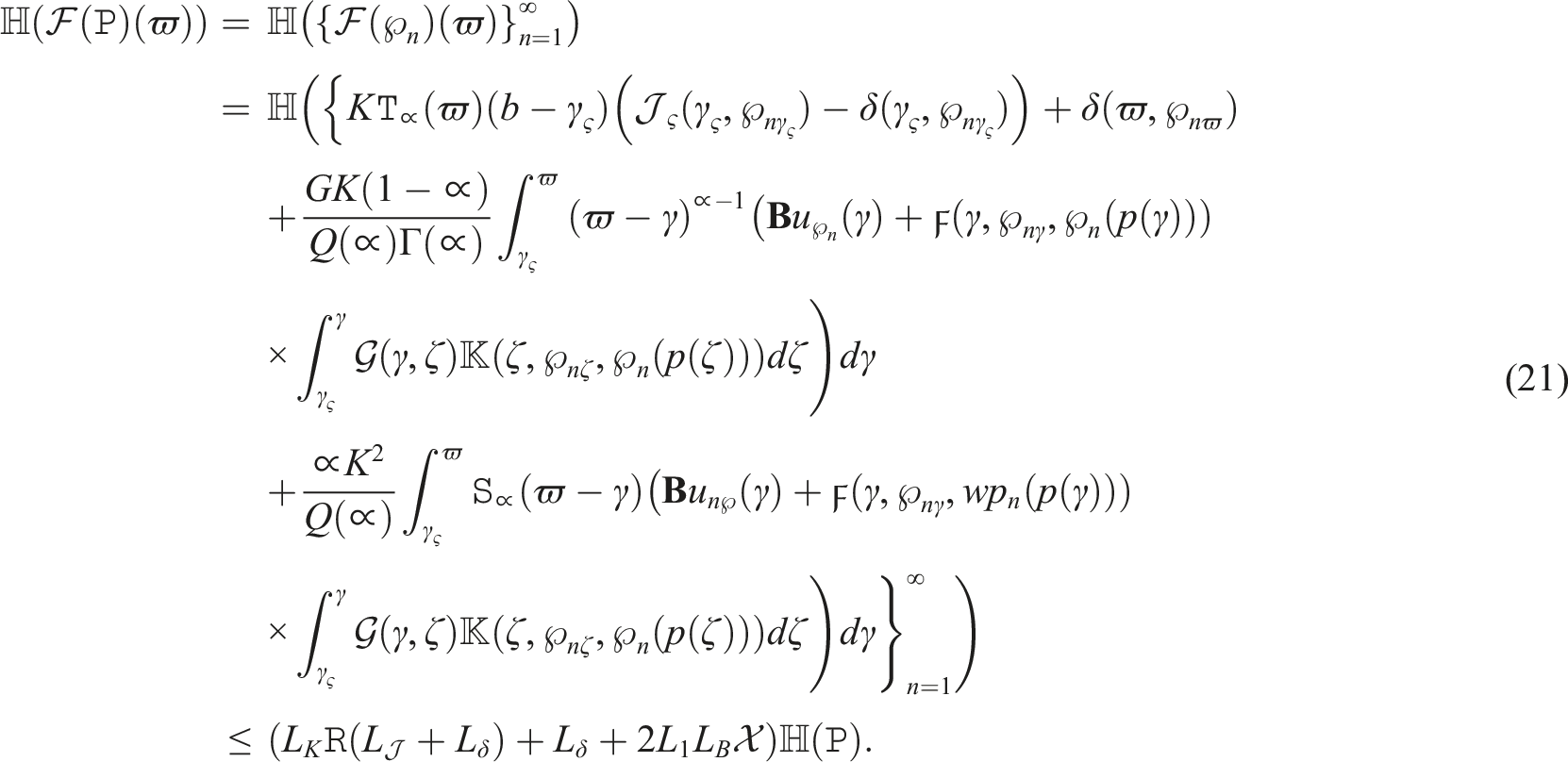
For ϖ ∈ (γς, ϖς], ς = 1, 2, 3, …, m, we know that . By using the above calculation for ϖ ∈ (0, ϖ1], we can extend the above for ϖ ∈ (γς, ϖς+1], ς = 1, 2, 3, …, m by using (S7), (16)–(18), and from (12)
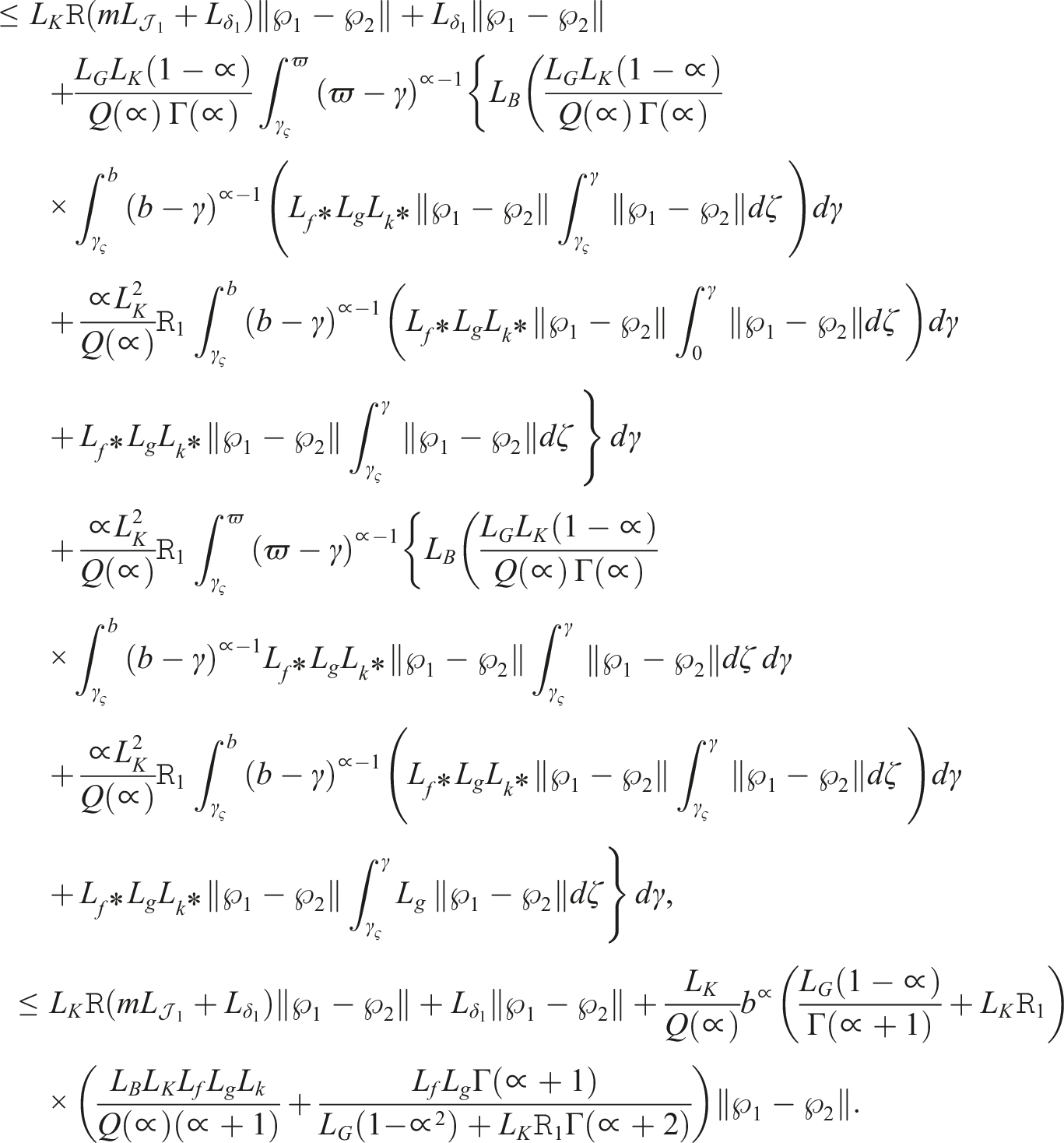
Thus, the set contraction fulfills all the conditions of 4.2 and (4.3). Therefore, (1) is controllable on because .
5. Example
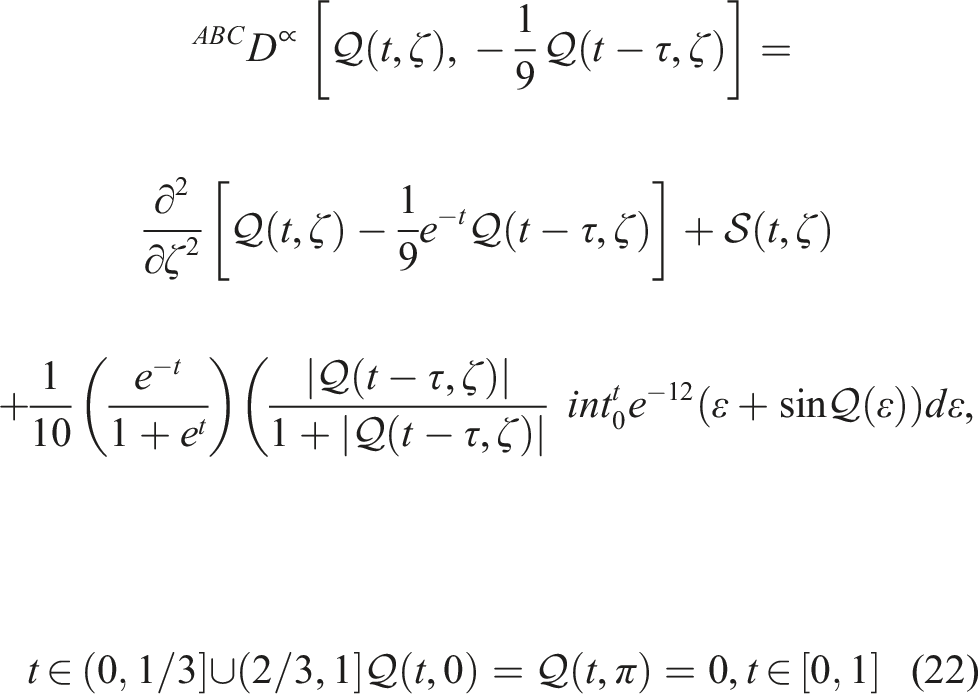
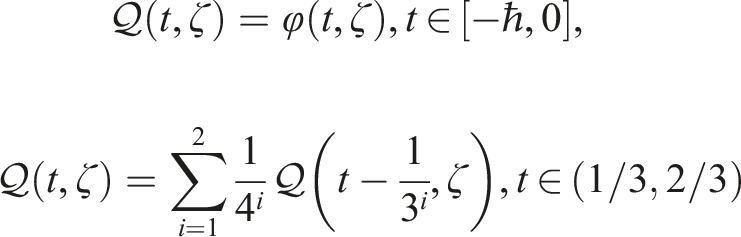
Consider the following semi-linear impulsive HIDDE for ζ ∈ [0, π],
where ∝ ∈ (0, 1), τ > 0 and is discontinuous on where . defined by with are absolutely continuous, . Then . Here, is an orthogonal set of the eigenvector . is a generator of an analytic semi-group in given by . an operator is a uniformly bounded compact semi-group such that . Also, the subordination principle of solution operator such that for t ∈ [0, 1].
Thus, for (t, ζ) ∈ [0, 1] × [0, π], σ ∈ [−ℏ, 0], one can define the following , , and .
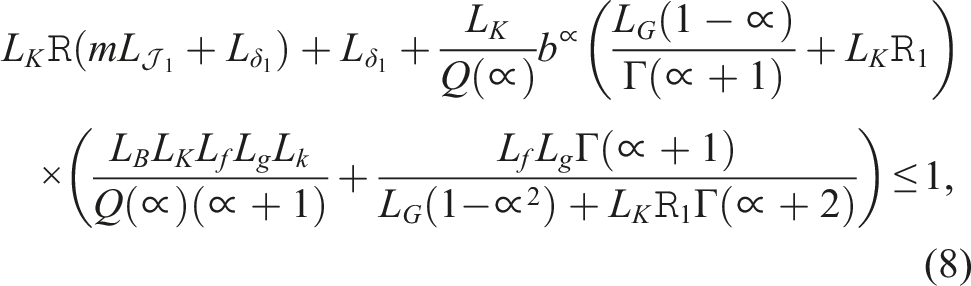
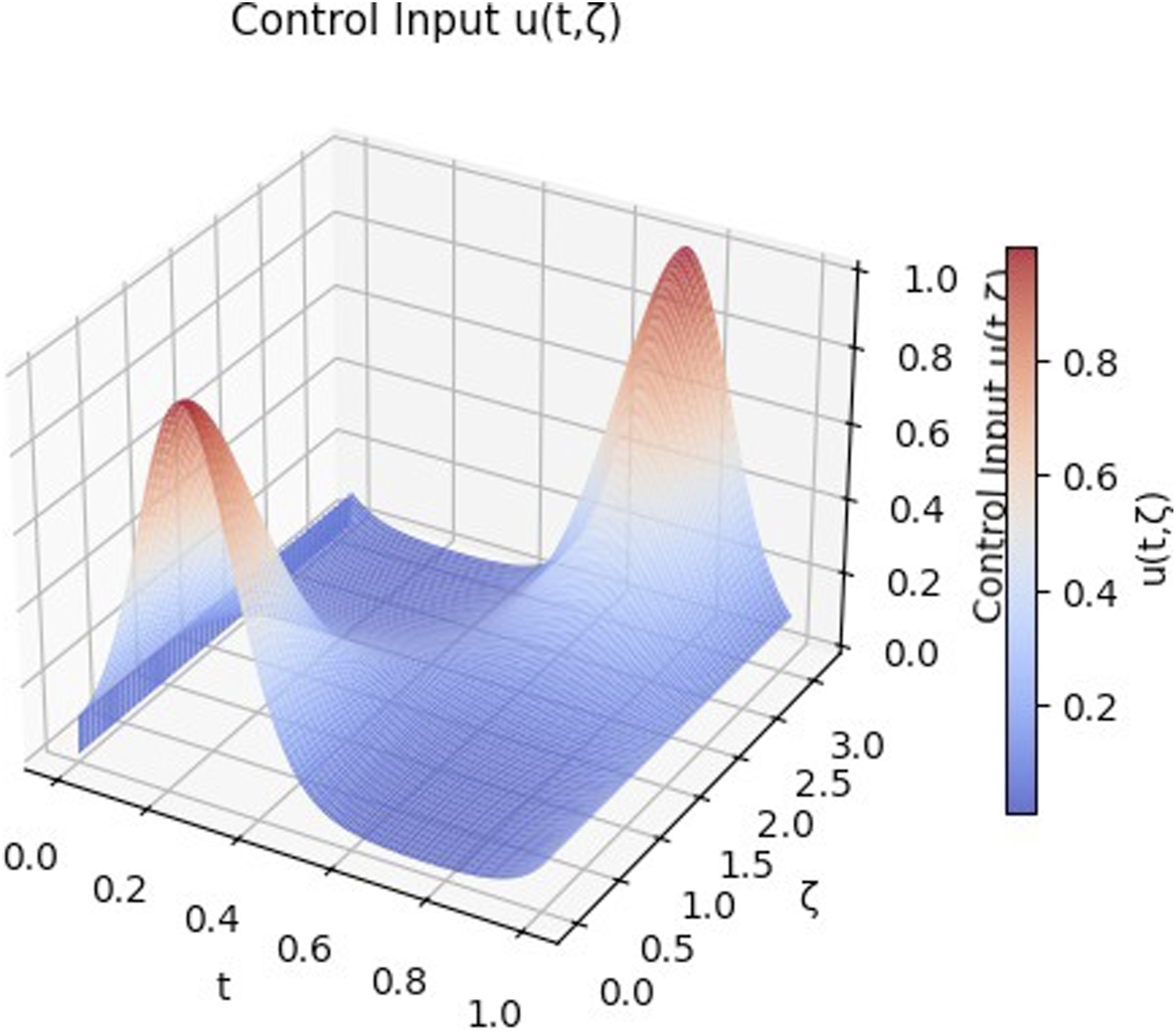
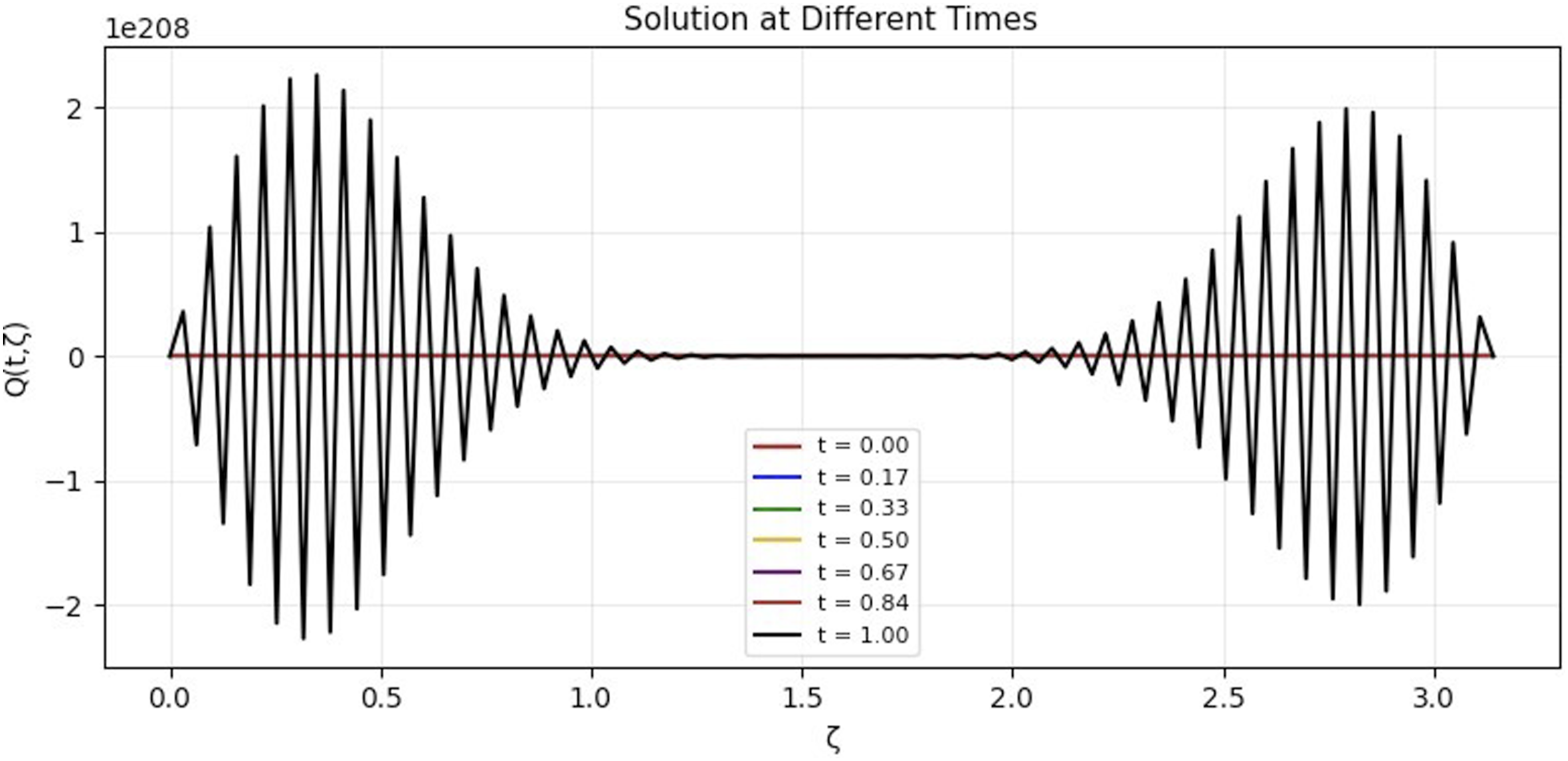
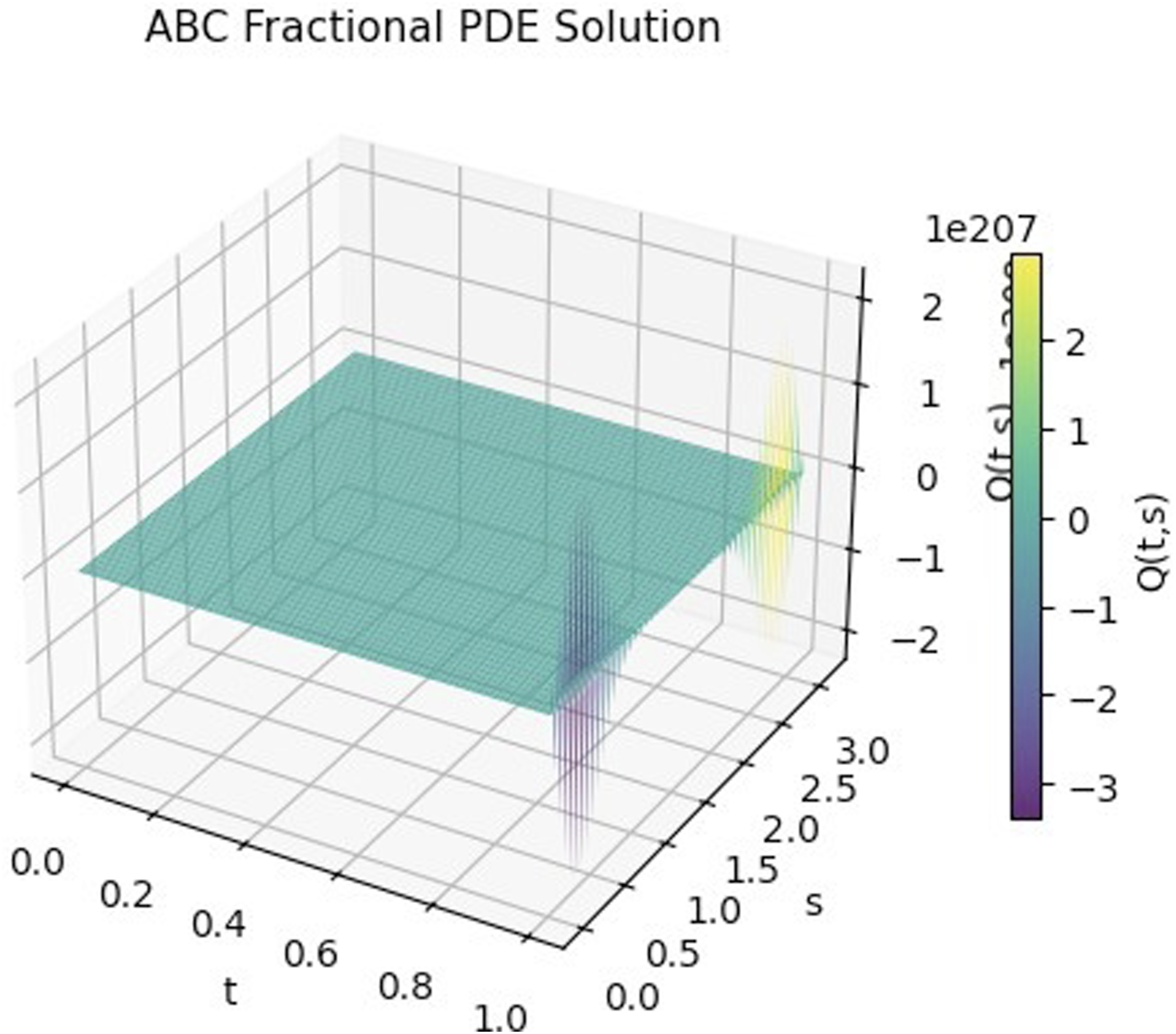
Based on the above framework, it can be directly checked that the hypotheses S1–S7 together with (8) are fulfilled when estimates and Lk = 1 = Lg are used. Consequently, the abstract form of (22) coincides with (1), and therefore (22) is controllable on . The visual analysis of the example is shown in Figures 1 and 2.
The 3D plot illustrates the evolution of u (t, ζ) for (22) governed by impulsive fractional-order PDE. This visualizes the distribution of time-spatial to (22) controllability. In this setup, t ∈ [0, 1] is the time variable, while ζ ∈ [0, π] corresponds to the spatial domain.
The figure displays the behavior of at different selected moments t = 0, t = 0.17, t = 0.33, t = 0.50, t = 0.67, t = 0.84 and t = 1. These plots describe how the system evolves under the influence of the AB FD, the nonlinear components, the delay term, and the imposed impulsive condition. A noticeable jump appears at t = 0.5, which reflects the action of the impulse defined by , causing an instantaneous change in the trajectory of the solution.
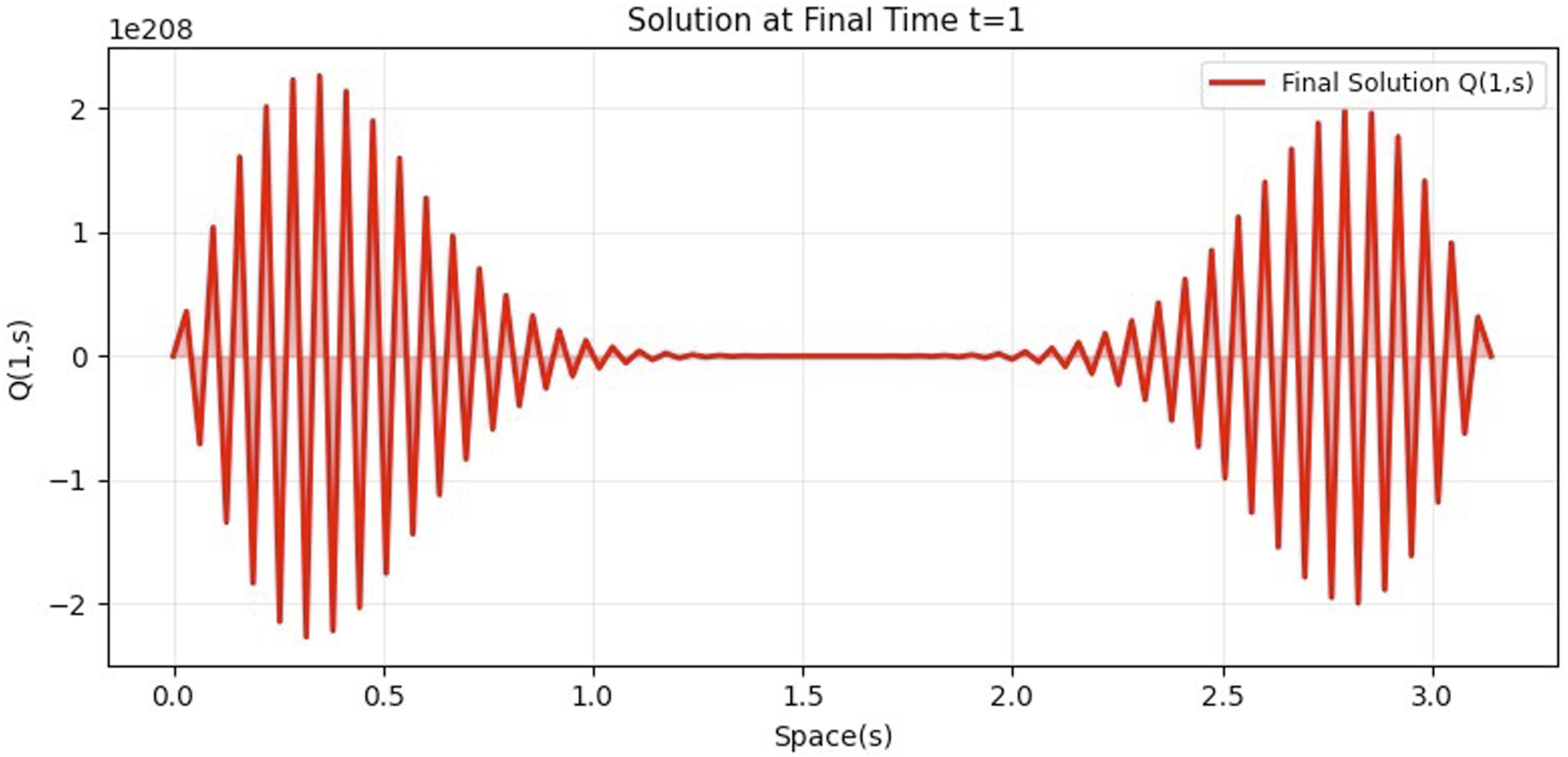
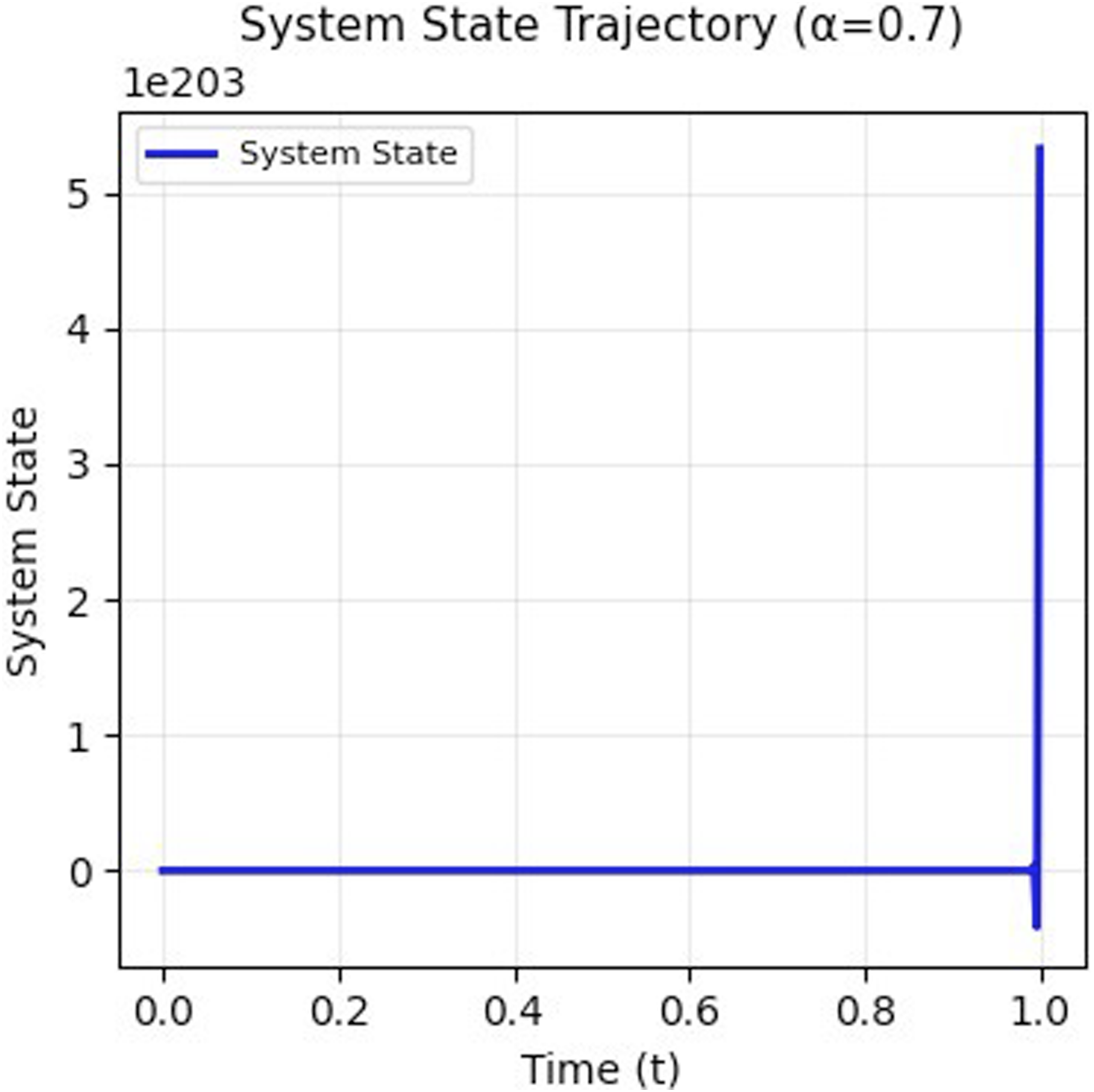
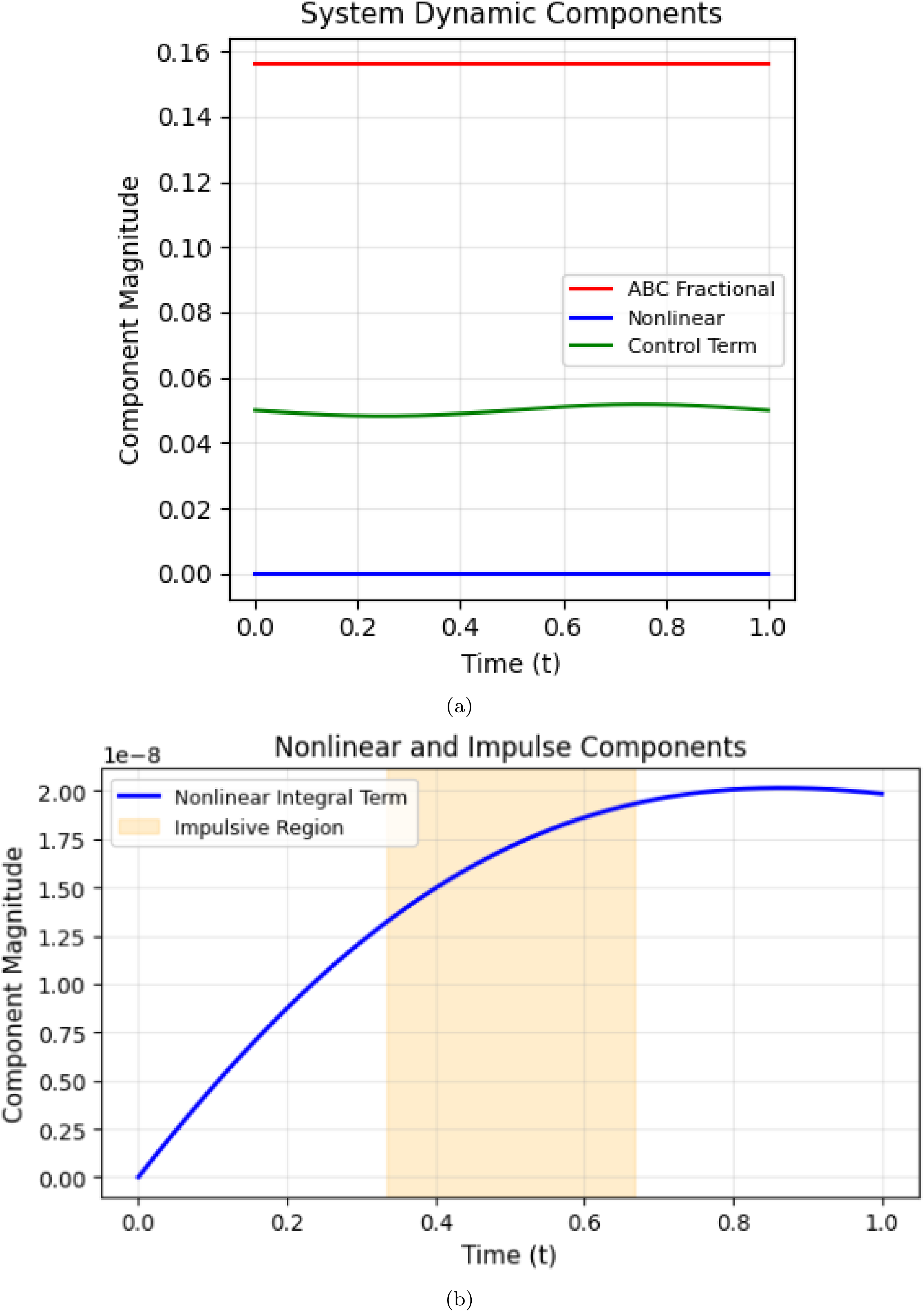
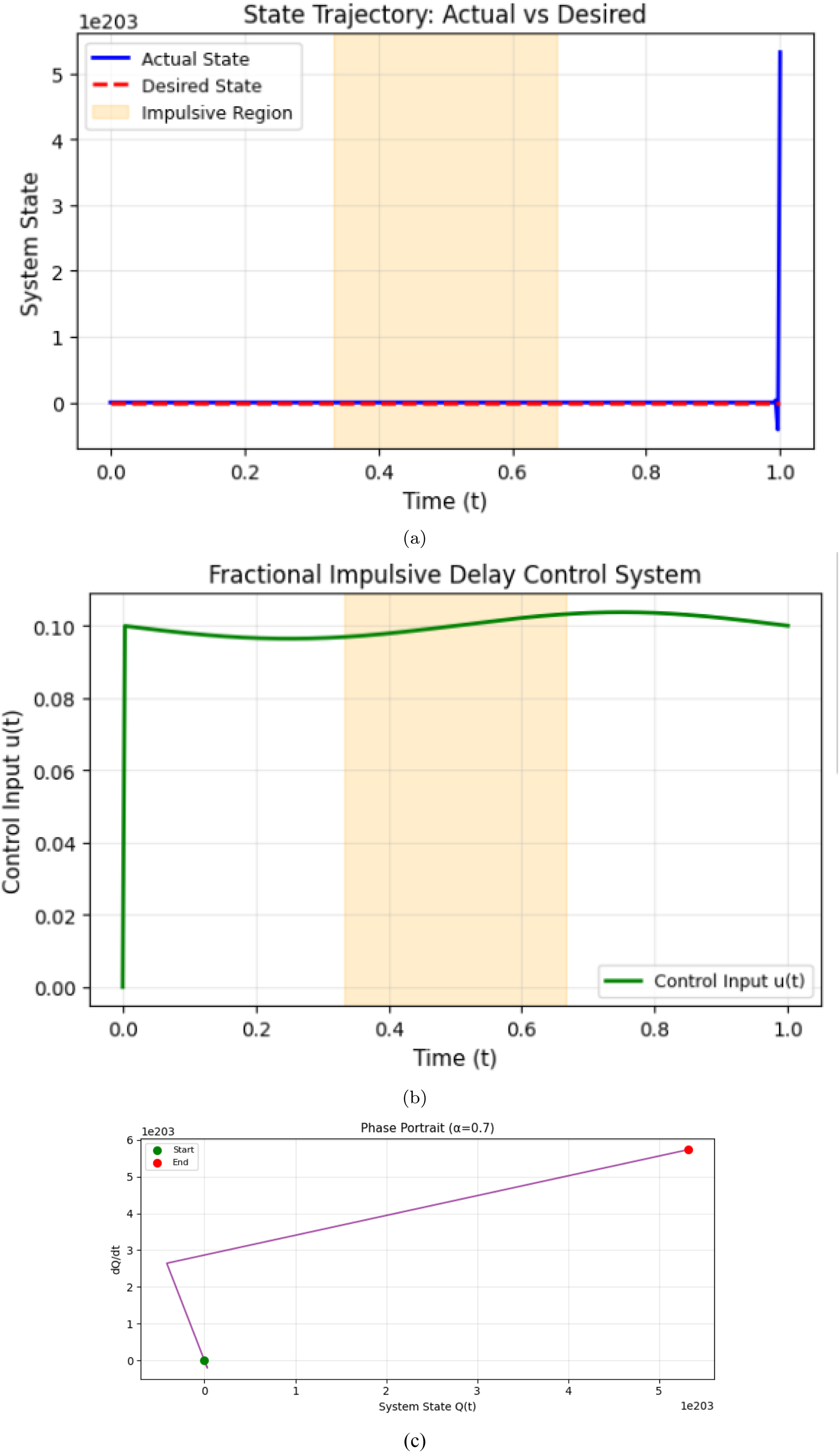
Given the chosen operators, nonlinear, terms and parameter values, all assumptions (S1)–(S7) together with inequality (10) are satisfied. Consequently, (4.3) guaranties that (1) is controllable on . Figures 3 and 4 provide a graphical representation of the visual analysis corresponding to the example. The numerical simulation results of the proposed example are visually demonstrated in Figures 5–7.
The 3D plot of on [0, 1] × [0, π] show how the develops in both space and time when governed by ∝ = 0.7, δ = 0.15, and nonlinear interaction terms. The color shading on the surface indicates the amplitude of , revealing the intricate, wave-like patterns that naturally arise in systems driven by fractional diffusion effects.
The spatial distribution of at the final time is plotted over s ∈ [0, π]. This one-dimensional slice highlights the stabilized profile reached by (22), illustrating the long-term behavior shaped by interplay of the fractional time operator, the incorporated delay effects, and the imposed impulsive conditions.
State trajectory of for ∝ = 0.7, illustrating the system’s evolution and the distinct changes produced by the applied impulse actions.
Breakdown of the system’s behavior into its fundamental components, showing the individual contributions from the linear dynamics, control input, delay effects, and nonlinear impulsive terms.
Controllability investigation of (22) with impulses, featuring the state trajectory, the corresponding control input, and the associated phase portrait.
6. Conclusion
This paper established results concerning the existence, uniqueness, and controllability of a class of semi-linear impulsive neutral HIDDEs, incorporating non-instantaneous impulses and the AB Caputo FD. To address the complexities introduced by impulsive effects and time delays, the analysis employed conditions formulated using measures of non-compactness. By combining Darbo’s fixed point theorem, the Kuratowski measure of non-compactness, and semi-group theory, controllability criteria were derived. A numerical example was provided to support the theoretical findings and to demonstrate the practical relevance of the results. Future research may extend this framework to stochastic systems influenced by random noise, apply the developed controllability conditions to optimal control problems, adapt the methodology to fractional derivatives of variable order or to problems with general boundary conditions, and construct numerical schemes for efficient simulations. Such extensions would enhance the applicability of the theoretical framework across engineering and the applied sciences.
Footnotes
ORCID iD
Akbar Zada
Author contributions
Akbar Zada: Conceptualization, Methodology, Formal analysis, Investigation, Writing—original draft, and Supervision. Sohail Khan: Conceptualization, Methodology, Formal analysis, Investigation, and Writing–original draft. Sultan Hussain: Conceptualization, Methodology, Formal analysis, and Investigation.
Funding
The authors disclosed receipt of the following financial support for the research, authorship, and/or publication of this article: This work was supported and funded by the Deanship of Scientific Research at Imam Mohammad Ibn Saud Islamic University (IMSIU) (grant number IMSIU-DDRSP2603).
Declaration of conflicting interests
The authors declared no potential conflicts of interest with respect to the research, authorship, and/or publication of this article.
Data Availability Statement
No new data were generated in this study. All analysis are based on previously published data, which are cited in the references.*
Appendix
References
1.
AbdulwasaaMAKawaleSVAbdoMS, et al. (2024) Statistical and computational analysis for corruption and poverty model using caputo-type fractional differential equations. Heliyon10(3): e25440. https://doi.org/10.1016/j.heliyon.2024.e25440
2.
AgarwalRHristovaSO’ReganD (2017) Non-instantaneous impulses in caputo fractional differential equations. Fractional Calculus and Applied Analysis20(3): 595–622. https://doi.org/10.1515/fca-2017-0032
3.
AhmedMRAhmedSSSabirPO (2025) Utilizing quadratic b-spline functions to solve nonlinear systems of volterra integro-fractional differential equations with variable coefficients. Physica Scripta100(5): 055223. https://doi.org/10.1088/1402-4896/adca67
4.
AimeneDBaleanuDSebaD (2019) Controllability of semilinear impulsive atangana-baleanu fractional differential equations with delay. Chaos, Solitons & Fractals128: 51–57. https://doi.org/10.1016/j.chaos.2019.07.027
5.
AlgolamMSHussainSYounisBA, et al. (2025) Stability and controllability analysis of stochastic fractional differential equations under integral boundary conditions driven by rosenblatt process with impulses. Fractal and Fractional9(3): 146. https://doi.org/10.3390/fractalfract9030146
6.
AtanganaABaleanuD (2016) New Fractional Derivatives with Nonlocal and Non-singular Kernel: Theory and Application to Heat Transfer Model. Therm. Sci.20, 763-769. Avaible at:https://doi.org/10.2298/TSCI160111018A
7.
AtanganaAKocaI (2016) Chaos in a simple nonlinear system with atangana–baleanu derivatives with fractional order. Chaos, Solitons & Fractals89: 447–454. https://doi.org/10.1016/j.chaos.2016.02.012
8.
BahaaGHamiazA (2018) Optimality conditions for fractional differential inclusions with nonsingular mittag–leffler kernel. Advances in Difference Equations2018(1): 257. https://doi.org/10.1186/s13662-018-1706-8
BanaśJ (1980) On measures of noncompactness in banach spaces. Commentationes Mathematicae Universitatis Carolinae21(1): 131–143.
11.
BasEOzarslanR (2018) Real world applications of fractional models by atangana–baleanu fractional derivative. Chaos, Solitons & Fractals116: 121–125. https://doi.org/10.1016/j.chaos.2018.09.019
12.
BastosNR (2018) Calculus of variations involving caputo-fabrizio fractional differentiation. Statistics, Optimization & Information Computing6(1): 12–21. https://doi.org/10.19139/soic.v6i1.466
13.
BediPKumarAAbdeljawadT, et al. (2020) Existence and approximate controllability of hilfer fractional evolution equations with almost sectorial operators. Advances in Difference Equations2020(1): 615. https://doi.org/10.1186/s13662-020-03074-1
14.
CaputoMFabrizioM (2015) A new definition of fractional derivative without singular kernel. Progress in Fractional Differentiation and Applications1(2): 73–85.
15.
DadsetadiSNouriK (2020) Analytical and numerical investigation of the hammerstein fractionalequations. Punjab University Journal of Mathematics52(1): 17–31.
16.
DadsetadiSTorkzadehLNouriK (2022) Existence and uniqueness solution of the hammerstein type fractional equations via the fixed point theorems. Mathematical Analysis and Convex Optimization3(1): 109–115.
17.
DineshkumarCUdhayakumarRVijayakumarV, et al. (2022) A note concerning to approximate controllability of atangana-baleanu fractional neutral stochastic systems with infinite delay. Chaos, Solitons & Fractals157: 111916. https://doi.org/10.1016/j.chaos.2022.111916
18.
GhafoorAFiazMShahK, et al. (2024) Analysis of nonlinear burgers equation with time fractional atangana-baleanu-caputo derivative. Heliyon10(13): e33842. https://doi.org/10.1016/j.heliyon.2024.e33842
19.
HernándezEO’ReganD (2013) On a new class of abstract impulsive differential equations. Proceedings of the American Mathematical Society141(5): 1641–1649. https://doi.org/10.1090/s0002-9939-2012-11613-2
20.
HristovJ (2019) On the atangana–baleanu derivative and its relation to the fading memory concept: the diffusion equation formulation. In: Fractional Derivatives with Mittag-Leffler Kernel: Trends and Applications in Science and Engineering. Springer, pp. 175–193.
21.
HussainSSarwarMRahmatG, et al. (2023) Mild solutions and controllability of fractional evolution inclusions of clarke’s subdifferential type with nonlocal conditions in hilbert spaces. Alexandria Engineering Journal80: 58–73. https://doi.org/10.1016/j.aej.2023.08.008
22.
JaradFAbdeljawadTHammouchZ (2018) On a class of ordinary differential equations in the frame of atangana–baleanu fractional derivative. Chaos, Solitons & Fractals117: 16–20. https://doi.org/10.1016/j.chaos.2018.10.006
23.
JohnsonMVijayakumarVNisarKS, et al. (2023) Results on the approximate controllability of atangana-baleanu fractional stochastic delay integrodifferential systems. Alexandria Engineering Journal62: 211–222. https://doi.org/10.1016/j.aej.2022.06.038
24.
JolićMKonjikS (2023) Controllability and observability of linear time-varying fractional systems. Fractional Calculus and Applied Analysis26(4): 1709–1739. https://doi.org/10.1007/s13540-023-00171-2
25.
JothilakshmiGVadivooBS (2025) Controllability of impulsive fractional-neutral differential inclusion with infinite delay. International Journal of Algorithms, Computing and Mathematics11(2): 50. https://doi.org/10.1007/s40819-025-01854-5
26.
KhanMKhanNUllahI, et al. (2025) A novel fractal fractional mathematical model for HIV/AIDS transmission stability and sensitivity with numerical analysis. Scientific Reports15(1): 9291. https://doi.org/10.1038/s41598-025-93436-0
27.
KilbasAASrivastavaHMTrujilloJJ (2006) Theory and Applications of Fractional Differential Equations. Elsevier.
28.
MillerKSRossB (1993) An Introduction to the Fractional Calculus and Fractional Differential Equations. Wiley.
29.
PazyA (2012) Semigroups of Linear Operators and Applications to Partial Differential Equations. Springer Science & Business Media.
30.
PfitzenreiterT (2004) A physical basis for fractional derivatives in constitutive equations. ZAMM-Journal of Applied Mathematics and Mechanics/Zeitschrift für Angewandte Mathematik und Mechanik: Applied Mathematics and Mechanics84(4): 284–287. https://doi.org/10.1002/zamm.200310112
RaghavendranPGunasekarTGochhaitS (2024) Application of artificial neural networks for existence and controllability in impulsive fractional volterra-fredholm integro-differential equations. Applied Mathematics in Science and Engineering32(1): 2436440. https://doi.org/10.1080/27690911.2024.2436440
33.
RavichandranCLogeswariKJaradF (2019) New results on existence in the framework of atangana–baleanu derivative for fractional integro-differential equations. Chaos, Solitons & Fractals125: 194–200. https://doi.org/10.1016/j.chaos.2019.05.014
34.
SaravanakumarSBalasubramaniamP (2021) Non-instantaneous impulsive hilfer fractional stochastic differential equations driven by fractional brownian motion. Stochastic Analysis and Applications39(3): 549–566. https://doi.org/10.1080/07362994.2020.1815545
35.
ShahSOZadaA (2019) On the stability analysis of non linear hammerstein impulsive integro dynamic system on time scales with delay. Punjab University Journal of Mathematics51(7): 89–98.
36.
ShahSORizwanRRehmanS, et al. (2024) Stability and controllability analysis of non–linear volterra fredholm hammerstein impulsive integro–dynamic systems with delay on time scale. Alexandria Engineering Journal87: 240–276. https://doi.org/10.1016/j.aej.2023.12.024
37.
ShahKAbdeljawadTAbdallaB, et al. (2025) Analyzing a coupled dynamical system of materials recycling in chemostat systems with artificial deep neural network. Modeling Earth Systems and Environment11(5): 313. https://doi.org/10.1007/s40808-025-02473-1
38.
SherMShahKAliZ, et al. (2025) Using deep neural network in computational analysis of coupled systems of fractional integro-differential equations. Journal of Computational and Applied Mathematics474: 116912. https://doi.org/10.1016/j.cam.2025.116912
39.
ShuX-BLaiYChenY (2011) The existence of mild solutions for impulsive fractional partial differential equations. Nonlinear Analysis: Theory, Methods & Applications74(5): 2003–2011. https://doi.org/10.1016/j.na.2010.11.007
40.
SyamMAl-RefaiM (2019) Fractional differential equations with atangana–baleanu fractional derivative: analysis and applications. Chaos, Solitons & FractalsX 2: 100013. https://doi.org/10.1016/j.csfx.2019.100013
41.
TunçCAlshammariFSAkyildizFT (2023) Existence and uniqueness of solutions of hammerstein-type functional integral equations. Symmetry15(12): 2205. https://doi.org/10.3390/sym15122205
42.
WangJ-LLiH-F (2011) Surpassing the fractional derivative: concept of the memory-dependent derivative. Computers & Mathematics with Applications62(3): 1562–1567. https://doi.org/10.1016/j.camwa.2011.04.028
43.
WangJIbrahimAFeckanM (2015) Nonlocal impulsive fractional differential inclusions with fractional sectorial operators on banach spaces. Applied Mathematics and Computation257: 103–118. https://doi.org/10.1016/j.amc.2014.04.093