







Abstract
We present a computational study of scattering of linear acoustic waves in a rigid waveguide by an infinitesimally thin vertical rigid baffle whose penetration into the cross-section varies with time. The stationary-baffle case is analysed first to provide a benchmark multimodal description of the scattered field together with the associated reflection and transmission behaviour. We then introduce a periodic modulation of the penetration height, which converts an incident monochromatic wave into a family of temporal harmonics. This interaction is captured through a Floquet-scattering formulation in which the harmonic amplitudes are coupled by interface conditions imposed at the baffle location and solved numerically by truncating the harmonic system. In the long-wavelength regime, we additionally derive a reduced one-dimensional model where the baffle is represented by jump relations that encode the effective kinematic and dynamic constraints induced by partial blockage. For sufficiently slow modulation, a quasistatic approximation is developed and compared against the full Floquet solution. All results are obtained from a self-contained computational framework whose convergence and accuracy are verified throughout. The results demonstrate how time-dependent internal elements redistribute acoustic energy across harmonics and modify reflection and transmission, providing practical modelling tools for waveguides with mechanically driven or actively controlled internal boundaries.
Keywords
1. Introduction
Time-dependent wave systems, in which material parameters or boundary conditions are deliberately modulated in time, have attracted sustained attention because they enable responses that are inaccessible in stationary media, such as time-reversal concepts, frequency conversion and cascaded mixing, parametric and transient amplification, and temporal steering of wave energy (Apffel and Fort, 2022; Bacot et al., 2016; Galiffi et al., 2022; Hayran and Monticone, 2023; Kiorpelidis et al., 2024; Pacheco-Peña and Engheta, 2020; Pacheco-Peña et al., 2022; Ptitcyn et al., 2023). Foundational ideas on rapid phase-velocity modification (Morgenthaler, 1958), together with recent developments in time-varying metamaterials and dynamic-media platforms (Engheta, 2023), have reinforced the view that time modulation provides an additional design dimension for controlling wave scattering and transport. Broader links to waves in periodic media and the associated mathematical viewpoint are discussed in tutorial form in Gazalet et al. (2013), while a general mathematical framework for dynamic materials is presented in Lurie (2007).
From a modelling perspective, periodic time dependence naturally leads to linear problems with periodic coefficients (in the bulk or at boundaries), for which Floquet theory provides a systematic framework to compute generated harmonics and their scattering amplitudes (Yakubovich and Starzhinskii, 1975). Floquet scattering concepts have been applied in various physical settings, including scattering through time-periodic potentials (Li and Reichl, 1999; Martinez and Reichl, 2001) and scattering-matrix formulations in layered time-driven structures (Mei et al., 2005; Pantazopoulos and Stefanou, 2019). In duct acoustics, these ideas translate directly: a monochromatic incident field interacting with a periodically actuated boundary or insert generates temporal sidebands whose amplitudes are coupled through interface conditions.
A key requirement in duct scattering is a tractable multimodal model that enforces interface and boundary conditions accurately across coupled sub-regions. Mode-matching and Galerkin-type extensions reduce complex configurations to coupled linear systems for modal amplitudes and have been used to quantify how membranes and compliant inserts reshape reflection and transmission in lined or wave-bearing cavities (Afzal and Bilal, 2022; Afzal et al., 2023c; Safdar et al., 2023). These approaches also accommodate porous or complex-media loading effects on silencing performance (Bilal and Afzal, 2024; Bilal et al., 2023). Tailored Galerkin projections further incorporate higher-order interface conditions and geometric variations when classical continuity conditions are insufficient (Afzal et al., 2023a), which is particularly relevant for time-modulated inserts where harmonic coupling occurs through the same interfaces governing the static problem. More broadly, fluid–structure interaction formulations address mixed rigid–flexible duct interfaces (Afzal et al., 2024a), while flexible shells, absorbent linings, layered conduits, and branching (trifurcated) geometries highlight the sensitivity of scattering to impedance contrast and interface modelling (Afzal et al., 2023b, 2024b; Afzal and Nawaz, 2024; Afzal and Safdar, 2023; Alruwaili et al., 2024a, 2024b; Shafique et al., 2024). Related mode-matching formulations also appear in multi-region cylindrical waveguides involving plasma or dielectric media (Rizvi and Afzal, 2024a, 2024b, 2025a, 2025b), underscoring the generality of interface-based modal scattering models.
In this study, we investigate linear acoustic scattering in a rigid duct caused by an infinitesimally thin vertical rigid baffle whose penetration height varies in time.
The motivation is twofold. First, mechanically actuated or active in-duct elements (movable diaphragms, deployable baffles, controllable shutters, and piezoelectrically driven blades) are already used in HVAC silencers, exhaust manifolds, fluidic logic and active noise-control hardware, and they provide a controllable analogue of time-varying material parameters without modifying the bulk medium. Second, recent activity on time-varying media, non-reciprocal devices and low-frequency metamaterials (Cai et al., 2020; Chen et al., 2026; Jamil et al., 2022; Mei et al., 2012) has shown that strong frequency conversion, bandgap engineering and unidirectional transport can be achieved at acoustically interesting (and indeed sub-Hertz) scales when an internal boundary or impedance is modulated in time. Compact, geometrically simple time-modulated elements are therefore attractive both as building blocks for active sound-control devices and as canonical settings in which the underlying physics can be understood quantitatively.
We first analyse the reference configuration of a static baffle and formulate a two-dimensional boundary-value problem that admits a multimodal (mode-matching) description of the reflected and transmitted acoustic fields over the full frequency range. We then introduce a periodic modulation of the baffle penetration. In the low-frequency (long-wavelength) regime, we derive an effective reduced model in which the baffle acts as a compact element represented by jump conditions imposed at its axial location. For periodic oscillations, we develop a Floquet-scattering formulation to compute the reflected and transmitted harmonic components (Koukouraki et al., 2025; Li and Reichl, 1999; Martinez and Reichl, 2001; Pantazopoulos and Stefanou, 2019; Yakubovich and Starzhinskii, 1975). We also present a quasistatic (adiabatic) approximation appropriate when the baffle motion is slow compared with the acoustic period. Throughout, the actuation enters the formulation through three physically distinct control parameters whose roles are made explicit: a mean blockage that sets the time-averaged scattering strength of the baffle, a modulation amplitude that controls the depth of the actuation, and hence the strength of the energy transfer between the carrier wave and its newly generated harmonic sidebands, and a pumping frequency that sets the spectral spacing of those sidebands and the regime (slow, adiabatic vs fast, strongly non-adiabatic) of the response.
In parallel, the water-wave community has extensively studied how spatial variability and moving boundaries influence reflection and transmission, particularly through the role of bathymetry in scattering and long-wave approximations. Conformal-mapping and related transformations have been used to treat variable-depth configurations (Evans and Linton, 1994; Fitz-Gerald, 1976; Hamilton, 1977), while step-approximation approaches were developed to handle more general profiles (Evans and Linton, 1994; Porter and Porter, 2006). Scattering by vertical barriers and submerged plates has also been investigated in canonical configurations using complementary approximation strategies (Evans, 1970; Newman, 1974; Porter and Evans, 1995). More recent works consider structured beds and periodically arranged elements in shallow-water settings (Marangos and Porter, 2021; Maurel et al., 2017, 2019). Although much of this literature addresses static geometries, moving underwater barriers and space–time dependent profiles have also been analysed, including matched-asymptotic approaches for space–time dependent shallow-water problems (Tuck, 1977). These developments motivate analogous questions in duct acoustics, where internal baffles, partitions, and liners play a similar role in shaping scattering, and where time dependence can be introduced through actuation or controlled motion.
Here these issues are addressed in detail within a unified computational framework that combines mode-matching, Floquet scattering, and quasistatic reduction, together with explicit convergence and power-balance diagnostics. Section 2 introduces the governing acoustic model and the duct/baffle geometry, and derives the long-wavelength (plane-wave) jump description used later for time-periodic actuation. Section 3 treats the static-baffle benchmark problem, presenting the mode-matching formulation and quantifying the range of validity of the reduced jump model. Section 4 develops the periodically modulated baffle model, including the truncated Floquet system, harmonic generation results, and the quasistatic approximation, together with comparisons and diagnostics (including power/flux balance). Concluding remarks are given in the final section.
2. Governing equations
We consider a compressible, inviscid fluid in a two-dimensional rigid channel of height h, unbounded in the axial direction x. The Cartesian coordinates are (x, y), where x denotes the axial coordinate and y the transverse coordinate. The upper wall is located at y = 0 and the lower wall at y = −h, so that the fluid occupies Physical configuration of the time-modulated diaphragm in a rigid duct.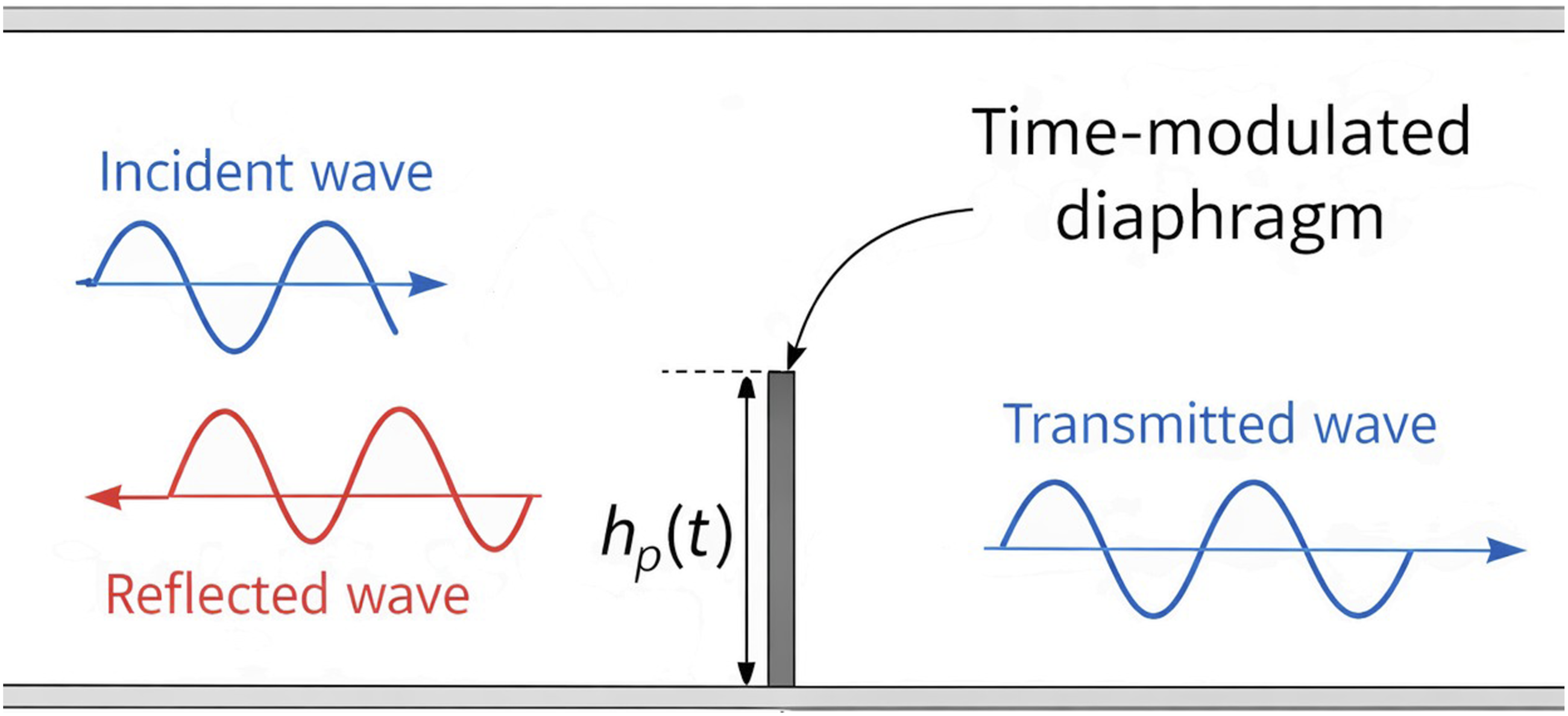
An infinitesimally thin rigid vertical plate is located at x = 0 and mounted on the lower wall. At time t it penetrates the fluid over a height h
p
(t) with 0 < h
p
(t) < h. The blocked plate segment is therefore Γ
p
(t) = {(0, y): − h < y < − (h − h
p
(t))}, while the open region above the plate is Γ
o
(t) = {(0, y): − (h − h
p
(t)) < y < 0}. Accordingly, the time-dependent acoustic domain is



2.1. Plane-wave acoustic model with jump conditions
In the long-wavelength regime, the acoustic wavelength is large compared with the channel height h, so only the fundamental (plane) duct mode propagates and the field is approximately uniform in y. For a monochromatic incident wave of angular frequency ω, the acoustic wavenumber is k = ω/c, and the plane-wave regime corresponds to kh ≪ π (i.e. below the first transverse cut-off). We therefore introduce the one-dimensional velocity potential ϕ(x, t) representing the dominant mode amplitude.
For concreteness, ‘low frequency’ here refers to this long-wavelength regime kh ≪ π. For airborne sound this corresponds to frequencies up to a few hundred hertz for typical duct heights. The same long-wavelength window is the operating range of recent low-frequency acoustic metamaterials and inerter-based bandgap devices (Cai et al., 2020; Chen et al., 2026; Jamil et al., 2022; Mei et al., 2012).
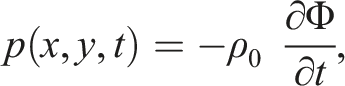
The thin plate is modelled as a compact element at x = 0 that produces jump conditions for ϕ. Using the plane-wave pressure relation p(x, t) = −ρ0 ∂
t
ϕ(x, t), the jump in potential implies the pressure jump






3. Static diaphragm
As a preliminary validation step, and to assess the range of applicability of the plane-wave jump description from Section 2.1, we first consider scattering by a stationary infinitesimally thin rigid diaphragm of constant penetration height h
p
, mounted at x = 0. In this static configuration, the opening is fixed, so the blockage ratio μ = h
p
/h is constant and the effective blockage coefficient
3.1. Mode-matching formulation for arbitrary frequency regime
We assume time-harmonic dependence at angular frequency ω > 0 with the convention e−iωt. Accordingly,


where ∂
y
denotes differentiation with respect to y. On the diaphragm segment, that is, the blocked part of the cross-section, the no-penetration condition gives



To impose the radiation condition and the interface constraints, we expand the solution in the rigid-wall transverse eigenfunctions

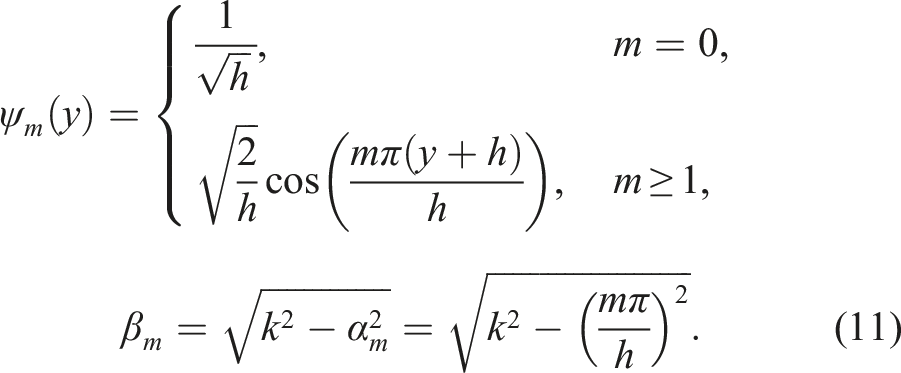
The branch is chosen such that
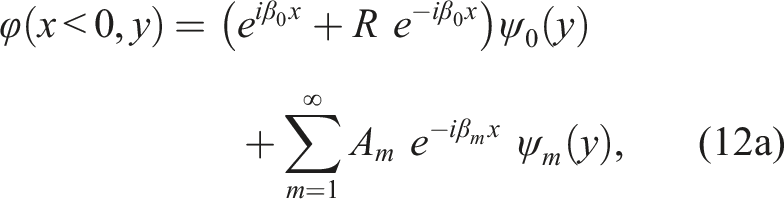

where R and T are the reflection and transmission coefficients of the incident plane mode, and
Because the upstream and downstream ducts are identical, it is convenient to decompose the solution into symmetric and antisymmetric parts with respect to x = 0,

This decomposition converts the original two-sided scattering problem into two one-sided problems. On the opening S
o
, symmetry implies


Let R
s
and R
a
denote the plane-mode reflection factors associated with the symmetric and antisymmetric subproblems, respectively. Then, the physical reflection and transmission coefficients are recovered from

For the antisymmetric subproblem in the upstream half-duct x ≤ 0, we expand


The opening condition φ
a
(0, y) = 0 on S
o
is imposed weakly by projection onto an orthonormal basis
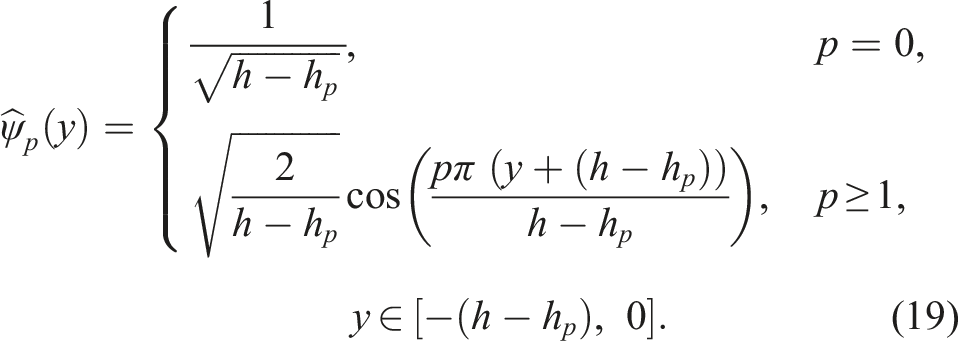


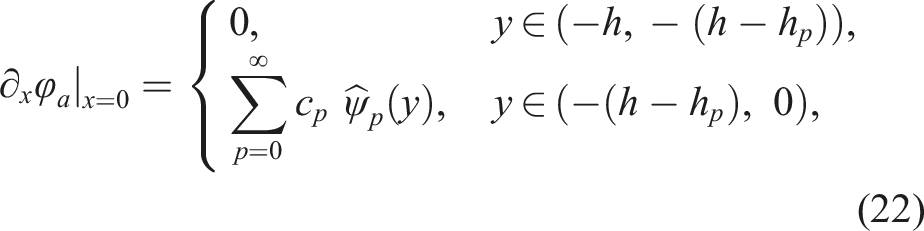




Combining (23)–(25) gives an explicit expression for the reflected modal vector at the interface,


After truncating the modal system to a finite size,
3.2. Low-frequency approximation: The plane-wave regime
For sufficiently low frequencies, that is, below the first transverse cut-off, the acoustic field is nearly uniform across y ∈ [−h, 0] and can be represented accurately by the one-dimensional jump model (3a) and (3b). We now derive the plane-wave reflection and transmission factors for the static jump model and relate them to the general periodic representation adopted later.
Assuming time-harmonic dependence at angular frequency ω > 0 with the convention e−iωt, we write

We seek the plane-wave solution on the two half-lines in the form
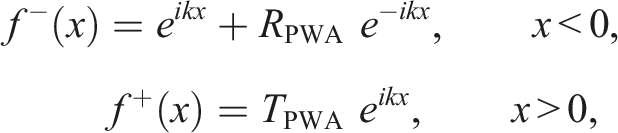

The potential jump condition in (3b) gives



Figure 2 illustrates the reconstructed two-dimensional acoustic field for the representative blockage ratio μ = 0.5 at two nondimensional frequencies Ω = ωh/c = kh. At Ω = 1, the scattered field exhibits noticeable transverse structure near the diaphragm, indicating the role of higher-order, primarily evanescent, duct modes in satisfying the mixed conditions at x = 0. By contrast, at Ω = 0.2 the solution is nearly uniform across the channel height, with transverse variations confined to a small neighbourhood of the diaphragm. This is consistent with the plane-wave regime, where the fundamental mode dominates and the diaphragm is well represented by the compact jump relation. Two-dimensional profiles of the time-harmonic acoustic velocity potential reconstructed by the mode-matching solution for a static diaphragm of blockage ratio μ = h
p
/h: (a) μ = 0.5 with nondimensional frequency Ω = ωh/c = 1 and (b) μ = 0.5 with nondimensional frequency Ω = ωh/c = 0.2.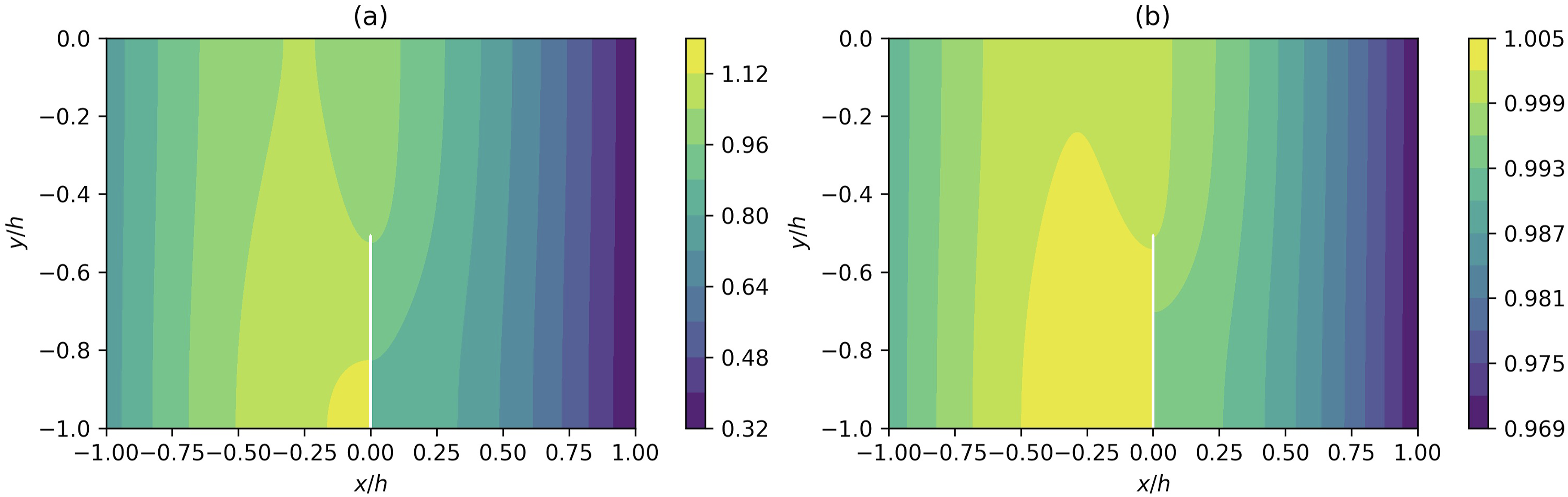
Figure 3 shows the magnitudes of the plane-mode reflection and transmission coefficients, |R| and |T|, as functions of the nondimensional frequency Ω = ωh/c for μ = 0.75 and μ = 0.85. As Ω → 0, the diaphragm behaves as a compact obstruction, so that |T| → 1 and |R| → 0. In this long-wavelength limit, the PWA agrees closely with the multimodal results, confirming the validity of the effective jump description when transverse variations are weak. Magnitudes of the plane-mode reflection and transmission coefficients (vertical axis, ‘magnitudes |R|, |T|’), computed from the mode-matching formulation for blockage ratios μ = 0.75 and μ = 0.85 as functions of the nondimensional frequency Ω = ωh/c (horizontal axis). The plane-wave approximation (PWA) is given by equation (28) and is plotted only over its formal validity range Ω ≤ 1.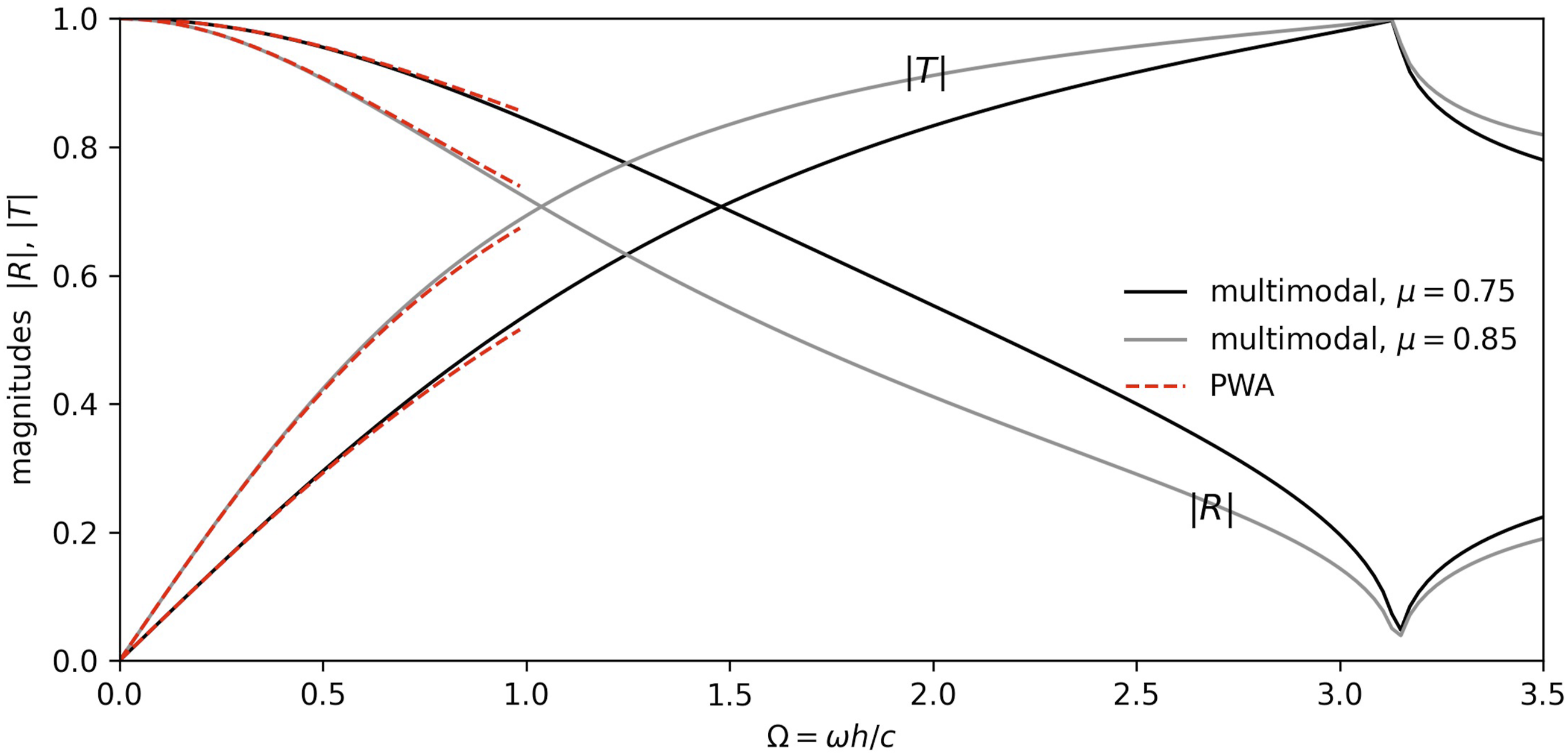
As Ω increases, the multimodal curves depart from the PWA because higher-order duct modes become increasingly important in satisfying the mixed boundary and interface conditions. The blockage ratio controls the strength of the effective discontinuity: larger μ produces stronger reflection and lower transmission over a wider frequency range. A marked change occurs as Ω approaches the first transverse cut-off, Ω ≃ π, where the first higher duct mode changes from evanescent to propagating. Near this threshold, the scattered field becomes highly sensitive to the diaphragm geometry, and the PWA is no longer sufficient; the full multimodal formulation is then required.
4. Periodically modulated diaphragm
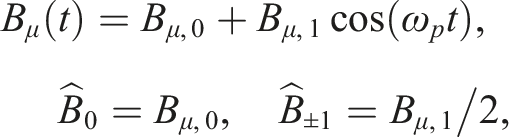
We now consider scattering of plane acoustic waves by an infinitesimally thin diaphragm whose effective blockage varies periodically in time. In the long-wavelength regime discussed in Section 2.1, the diaphragm is represented by the reduced plane-wave jump model (3a) and (3b). The actuation enters this model through the time-periodic blockage coefficient B
μ
(t), which is itself determined by the prescribed motion of the penetration height h
p
(t) via the thin-obstruction closure (5). Throughout this work we adopt the single-harmonic prescription Effect of modulation depth and pumping ratio on the time-domain blockage and the reflected Floquet spectrum. Panels (a), (c), (e) show the blockage ratio μ(t) = h
p
(t)/h over one, two, and three pumping periods, respectively, for three modulation depths Bμ,1/Bmax ∈ {0.10, 0.25, 0.50} (legend in panel (e)). Panels (b), (d), (f) show the corresponding magnitudes of the reflected Floquet coefficients |r
n
| versus the nondimensional sideband frequencies Ω
n
= Ω + nΩ
p
for the pumping ratios Ω
p
/Ω ∈ {1/8, 1/4, 1/2} (legend in panel (f)); the vertical dotted line marks the carrier frequency Ω. The frequency window is widened from (b) to (d) to (f) to display additional positive sidebands. Reflected Floquet amplitudes |r
n
| versus the pumping-to-incident frequency ratio ω
p
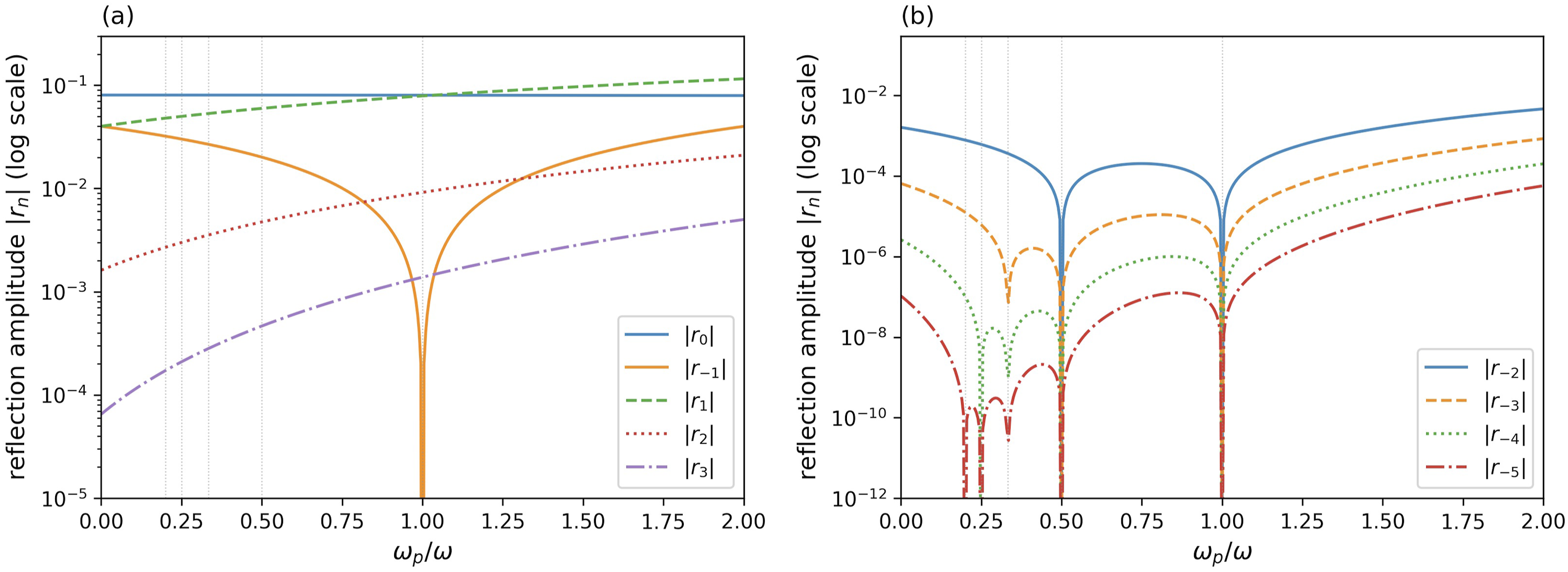
/ω for the plane-wave acoustic jump model. The incident frequency is fixed at Ω = ωh/c = 0.1, and the modulation parameters are chosen so that the inferred blockage ratio spans μ(t) ∈ [0, μmax] with μmax = 0.95. Panel (a) shows −1 ≤ n ≤ 3, while panel (b) isolates the negative indices −5 ≤ n ≤ −2. In both panels, the vertical axis (“reflection amplitude |r
n
| (log scale)”) uses a logarithmic scale. Vertical dotted lines mark the commensurate pumping ratios ω
p
/ω = 1/|n| at which ω
n
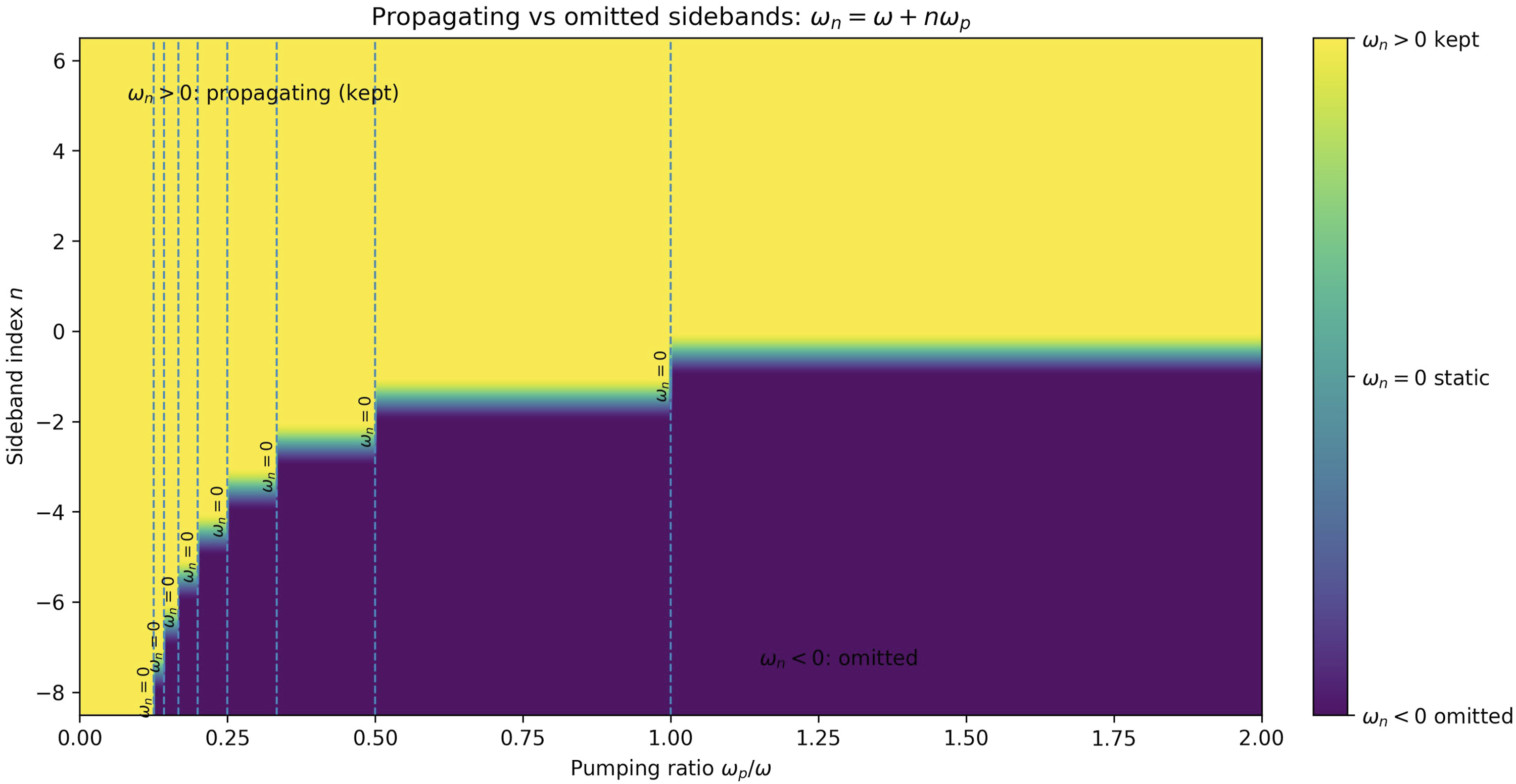
= 0 for the negative indices. Classification of Floquet sidebands for the modulated diaphragm. For each index n, the frequency ω
n
= ω + nω
p
determines whether the harmonic is propagating (ω
n
> 0, retained), static (ω
n
= 0, excluded from power sums), or omitted (ω
n
< 0). Dashed lines indicate the thresholds ω
n
= 0 at ω
p
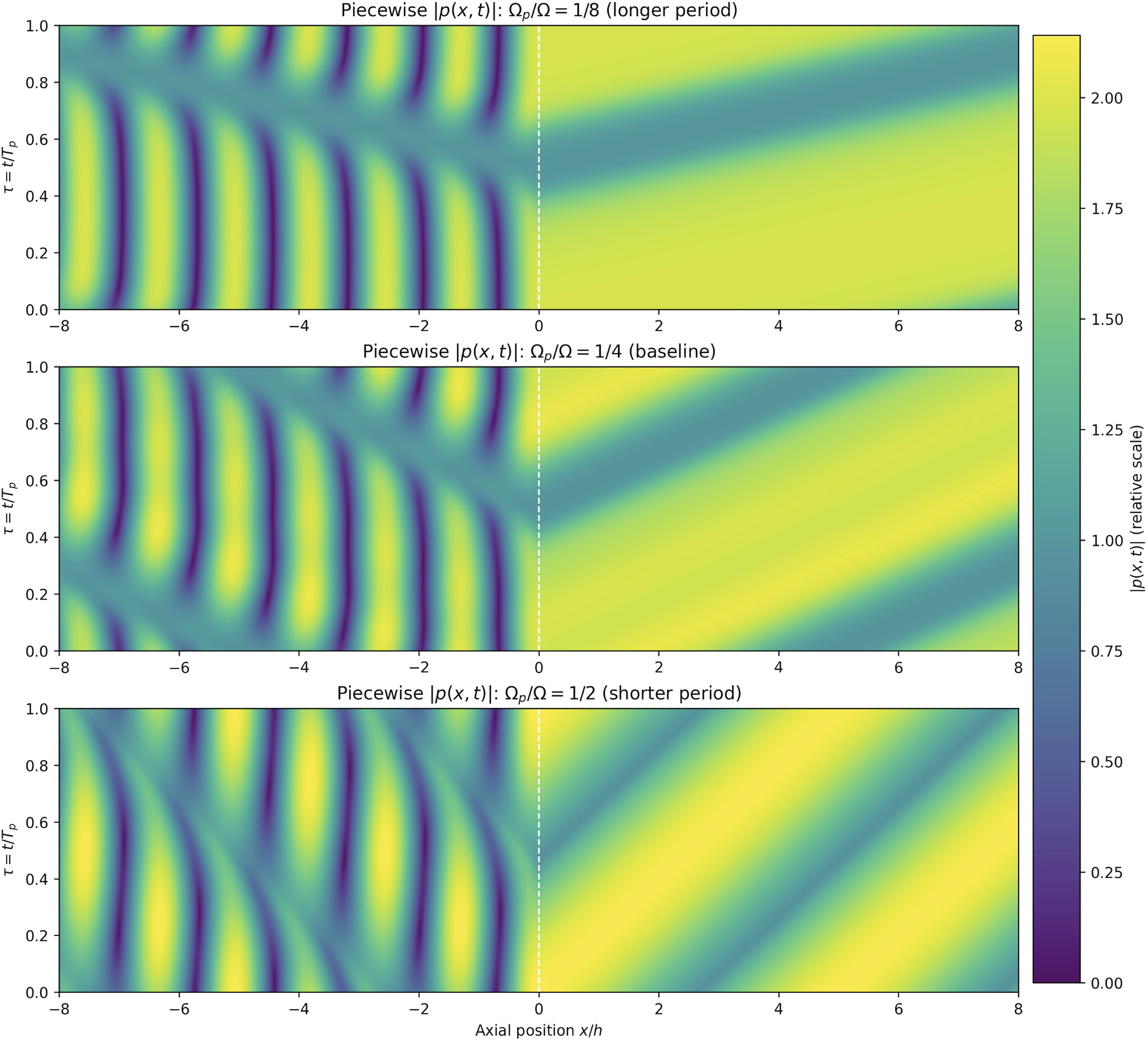
/ω = 1/|n| for n < 0. Spatio-temporal magnitude of the acoustic pressure field |p(x, t)| reconstructed from the truncated Floquet solution in the plane-wave regime. Panels correspond to different pumping ratios: (a) Ω
p
/Ω = 1/8 (slow modulation), (b) Ω
p
/Ω = 1/4 (baseline), and (c) Ω
p
/Ω = 1/2 (faster modulation). The dashed vertical line indicates the diaphragm location x = 0. Increasing Ω
p
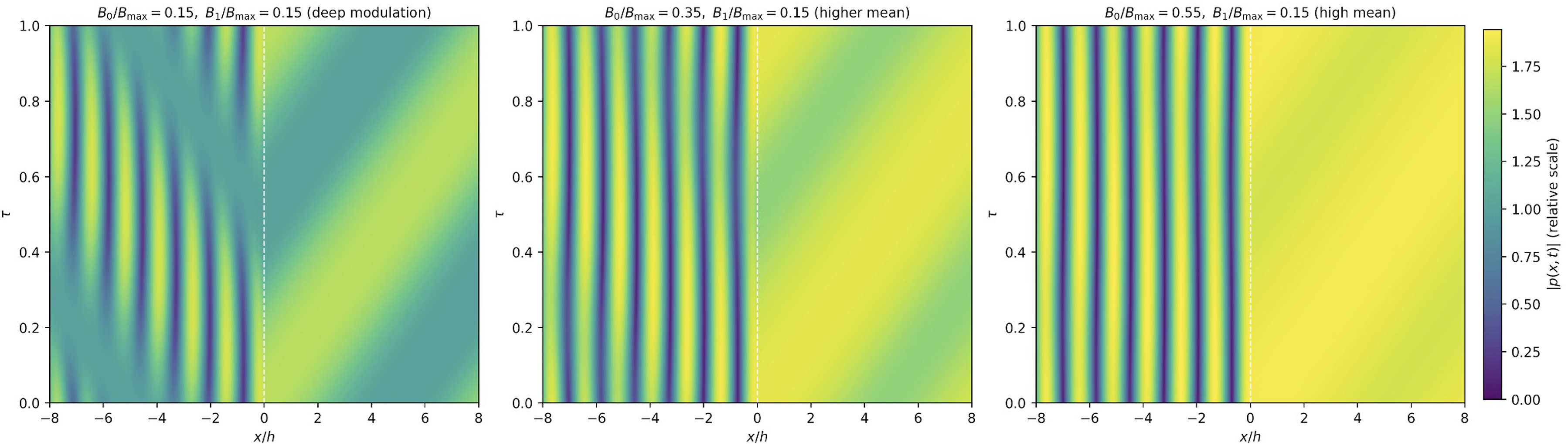
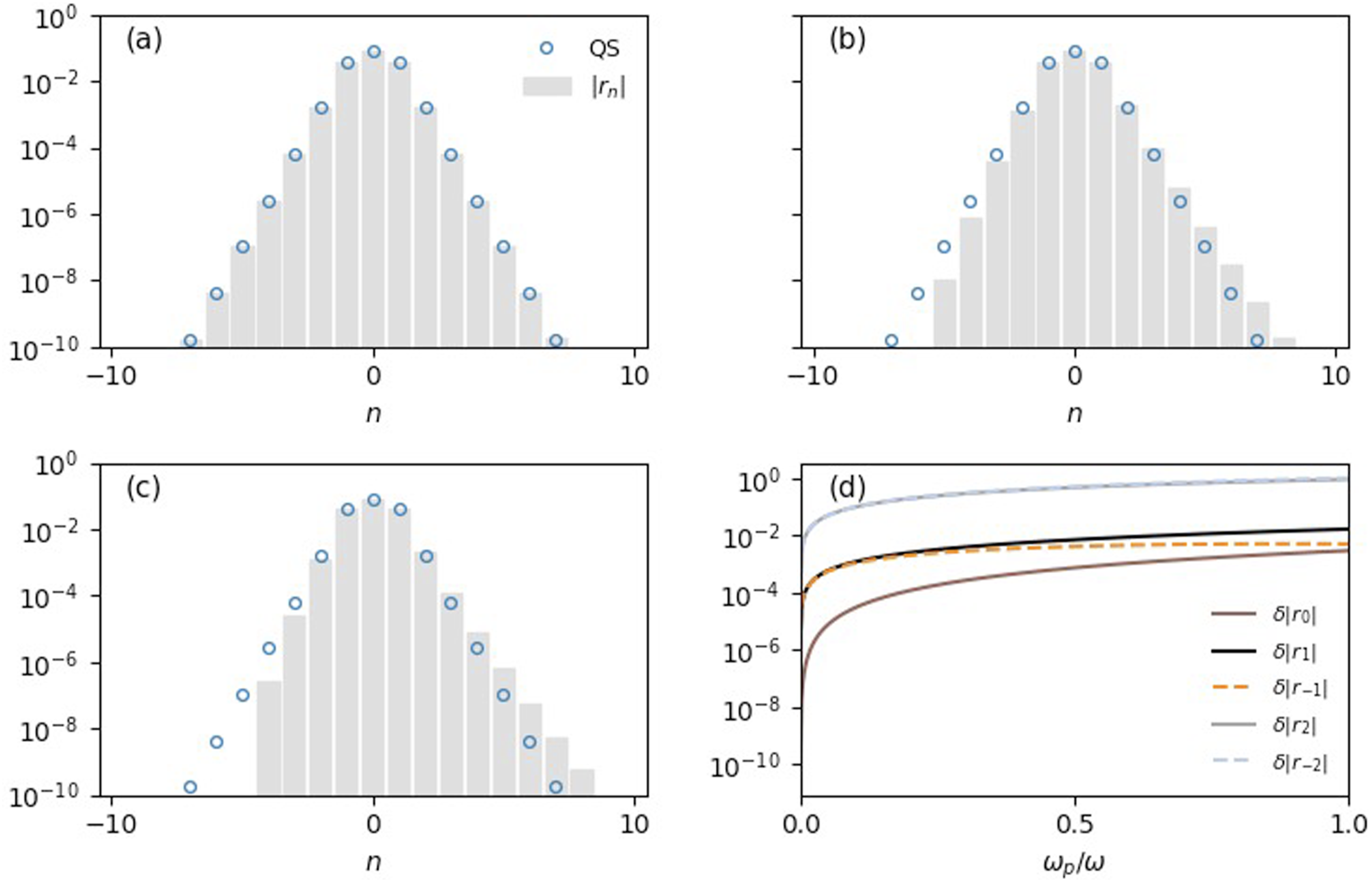
/Ω enhances temporal mixing and produces stronger modulation of the transmitted wave field downstream, consistent with redistribution of energy among Floquet sidebands. Spatio-temporal magnitude of the acoustic pressure field |p(x, t)| reconstructed from the Floquet solution for different mean blockage levels. The modulation depth is fixed at B1/Bmax = 0.15, while the mean component is varied: (a) B0/Bmax = 0.15 (deep modulation about a low mean), (b) B0/Bmax = 0.35, and (c) B0/Bmax = 0.55. The dashed vertical line indicates the diaphragm location x = 0. Increasing the mean blockage enhances the effective compact strength of the diaphragm, leading to stronger reflection and a progressively more uniform transmitted field downstream. Comparison between the full Floquet solution and the quasistatic (QS) approximation for the time-modulated acoustic diaphragm in the plane-wave regime, with fixed incident nondimensional frequency Ω = ωh/c = 0.1. Panels (a)–(c) show the reflection amplitudes |r
n
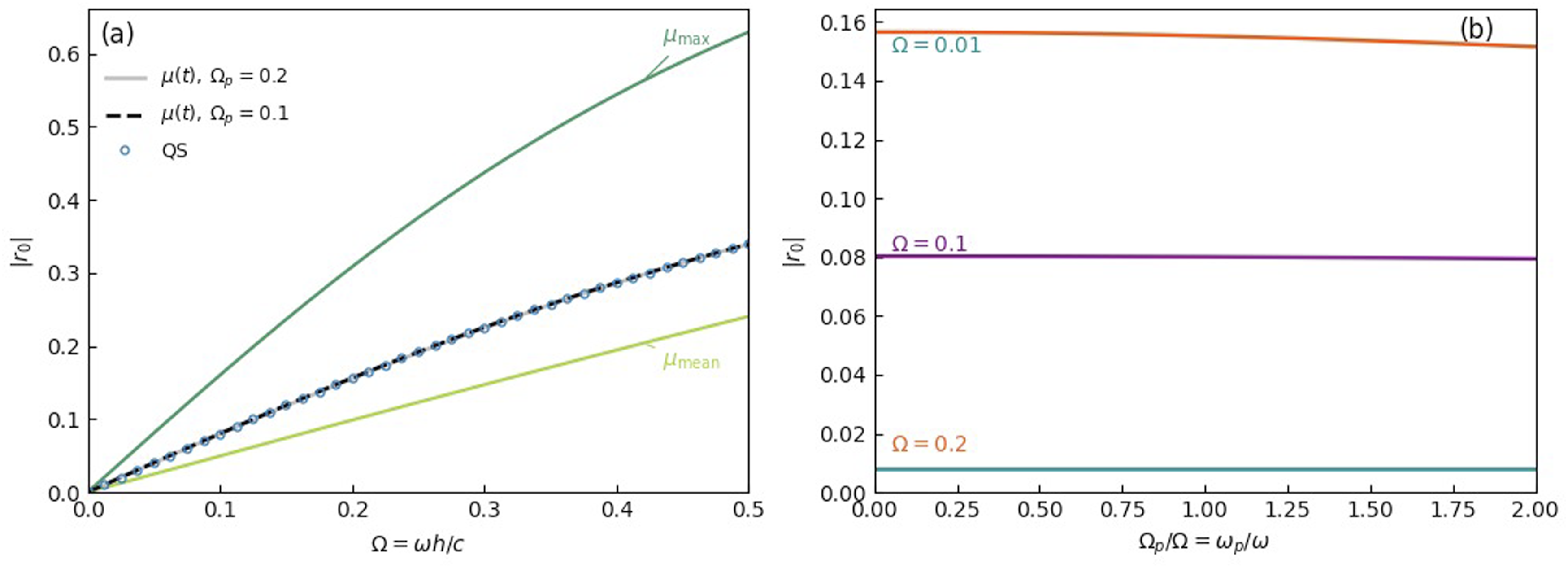
| (grey bars) obtained from the truncated Floquet system and the QS predictions (a) Magnitude of the fundamental reflected Floquet coefficient |r0| versus the nondimensional incident frequency Ω = ωh/c for a static diaphragm at μmax = 0.95 and at the mean blockage μmean ≈ 0.698, together with the periodically modulated diaphragm for two pumping frequencies Ω
p
= ω
p
h/c. The QS prediction for the fundamental is indicated by open circles. (b) Dependence of |r0| on the normalised pumping rate Ω
p
/Ω = ω
p
/ω for three fixed incident frequencies Ω.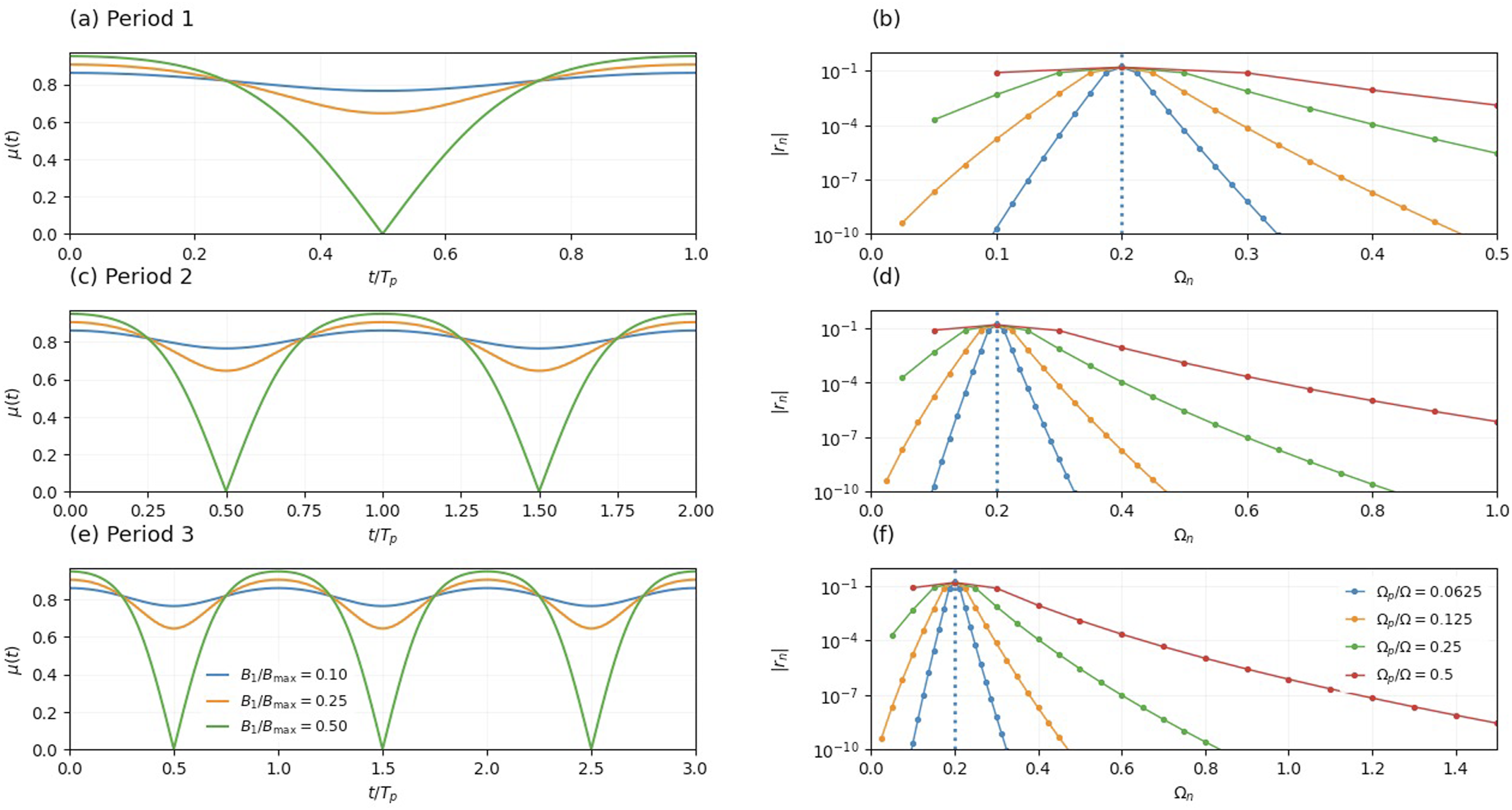
4.1. Floquet formulation
We assume that the blockage coefficient B
μ
(t) is T
p
-periodic, where T
p
= 2π/ω
p
and ω
p
> 0 is the pumping angular frequency, and adopt the Fourier representation (6). For the commonly used single-harmonic choice


We consider a right-going incident plane wave of angular frequency ω > 0 impinging on the modulated diaphragm from x = −∞. Guided by Floquet theory, we seek the plane-wave potential in the form




Substituting (30) and (31) into (3a) for x ≠ 0 and projecting onto

The jump model (3b) implies continuity of flux,






Substituting (37a), (37b) and (38) into (36) yields a linear coupled system for the reflection coefficients {r
n
}, with the coupling range determined by the harmonic content of B
μ
(t). We truncate to the finite retained index set




For single-harmonic modulation,
For each sideband, (34) admits the conserved flux

The retained-harmonic set

The Floquet system (40) and (41) is built on the reduced plane-wave jump model (3a) and (3b), and therefore inherits the long-wavelength restriction Ω < π identified in Section 2.1. A natural extension is to combine the multimodal mode-matching analysis of Section 3.1 with the time-periodic interface conditions, so that each Floquet sideband carries its own multimodal trace at the diaphragm. This couples the two infinite indices, the modal index m and the Floquet index n, through a doubly indexed overlap matrix and removes the cut-off restriction, albeit at substantially higher algebraic cost. The diagnostics already indicated that the plane-wave reduction is accurate within the parameter window of interest, and the structure of the corresponding fully multimodal Floquet system follows transparently from the present formulation; a detailed treatment is therefore deferred to future work.
4.1.1. Generation of harmonics
Using the Floquet solution (41) together with the power-balance diagnostic (42), we examine how periodic actuation redistributes reflected energy among Floquet sidebands. To obtain a pronounced sideband response in the long-wavelength regime, we consider a strong modulation of the blockage ratio μ(t) = h
p
(t)/h such that μ(t) ∈ [0, μmax] with μmax = 0.95. We adopt a single-harmonic waveform


For later reference, we denote by
Figure 4 summarises the influence of the actuation parameters on the instantaneous blockage and, through Floquet coupling, on the reflected sideband spectrum. The left column shows μ(t) over one, two, and three pumping periods. Increasing the modulation depth Bμ,1/Bmax increases the excursion of μ(t) within each cycle; for the single-harmonic waveform this corresponds to increasing
The right column reports the reflected sideband magnitudes |r n | at the discrete frequencies Ω n = Ω + nΩ p . For all pumping ratios shown, the reflected content remains concentrated near the carrier, and the amplitudes decay as |n| increases. Varying Ω p /Ω primarily changes the spacing of the sidebands on the frequency axis: smaller Ω p /Ω gives more closely spaced sidebands, whereas larger Ω p /Ω produces fewer, more widely separated ones. Even in the enlarged frequency windows of panels (b), (d), and (f), the higher positive sidebands remain weak, again supporting harmonic truncation in the long-wavelength regime.
Figure 5 fixes the incident frequency at Ω = ωh/c = 0.1 and varies the pumping-to-incident frequency ratio ω p /ω ∈ [0, 2] (equivalently, Ω p /Ω ∈ [0, 2]). Panel (a) shows the components −1 ≤ n ≤ 3, while panel (b) isolates the higher negative indices −5 ≤ n ≤ −2 on a logarithmic scale. Over the full range, the reflected spectrum is dominated by the carrier and its nearest neighbours (n = 0, ±1), whereas higher positive orders remain weaker. For n ≥−1, the dependence on ω p /ω is smooth; in the adiabatic limit ω p /ω → 0, the first sidebands become nearly symmetric, |r−1|≃|r1|, consistent with the quasistatic approximation in Section 4.2.
For negative indices, the sideband frequency ω n = ω + nω p decreases as ω p increases, so panel (b) exhibits sharp variations near the thresholds ω n ≈ 0, namely, ω p /ω ≈ 1/|n|. This behaviour reflects the retained-harmonic convention: indices with ω n < 0 are omitted, whereas the borderline case ω n = 0 corresponds to a static potential component, which carries no time-harmonic pressure and no power flux and is therefore excluded from power sums. Figure 6 summarises this classification in the (n, ω p /ω) plane and clarifies why k n = ω n /c → 0 as ω p /ω → 1/|n| for n < 0.
In particular, if the incident and pumping frequencies are commensurate, ω = mω
p
with

For the single-harmonic pumping law, that is, when only



Equation (46) depends on the chosen truncation; the full Floquet solution is still given by (41).
Having established the sideband structure and the retained/omitted classification, we now reconstruct the spatio–temporal acoustic field to provide a direct time-domain interpretation of the Floquet spectra. Using the truncated solution (41), we evaluate the pressure magnitude |p(x, t)| over one pumping period, with the diaphragm location marked by the dashed line at x = 0.
Figure 7 shows |p(x, t)| for three pumping ratios Ω p /Ω ∈ {1/8, 1/4, 1/2}. For slow modulation, the downstream field (x > 0) remains close to a monochromatic travelling wave in magnitude, while weak temporal beating is visible upstream because of the small reflected sidebands. At the baseline ratio, the modulation generates a clear space–time beating pattern on both sides of the interface, indicating stronger transfer of energy from the carrier (n = 0) into the nearest harmonics (n = ±1). For faster modulation, the pattern exhibits more rapid temporal variation and stronger interference, consistent with enhanced harmonic coupling and broader redistribution of reflected and transmitted energy among the retained Floquet components.
These reconstructions complement the spectral results: increasing the pumping ratio mainly changes the temporal beating rate through the sideband spacing Ω n = Ω + nΩ p and amplifies the observable modulation of the transmitted field, while the diaphragm at x = 0 remains the sole source of harmonic generation in the reduced jump description (3a) and (3b).
We next isolate the influence of the mean blockage at fixed modulation depth in order to separate the baseline scattering strength from the time-dependent mixing.
Figure 8 presents |p(x, t)| for fixed B1/Bmax = 0.15 while varying the mean component B0/Bmax ∈ {0.15, 0.35, 0.55}. For low mean blockage, the diaphragm oscillates about a relatively weak obstruction and the downstream field exhibits pronounced temporal modulation and interference. As the mean blockage increases, the transmitted field becomes more coherent in space–time magnitude and its temporal variability decreases, indicating increasing dominance of the carrier component. For sufficiently high mean blockage, the diaphragm behaves as a strong compact scatterer throughout the cycle: the upstream field shows pronounced standing-wave structure associated with enhanced reflection, while the downstream magnitude becomes comparatively uniform in time. This behaviour is consistent with the plane-wave jump model, in which the mean value of the compact parameter primarily controls the overall scattering strength, whereas the oscillatory component drives redistribution among Floquet harmonics.
The space–time diagnostics in Figures 7 and 8 also motivate the quasistatic (adiabatic) limit considered next: as Ω p /Ω → 0, the beating becomes slow and the response is well approximated by an instantaneous static scattering problem evaluated at the current blockage level.
4.2. Quasistatic approximation
Floquet theory quantifies sideband generation and its dependence on the pumping frequency ω p . Numerically, for sufficiently slow pumping, the dominant coefficients (n = −1, 0, 1) depend only weakly on ω p , suggesting the onset of an adiabatic, or quasistatic (QS), regime as ω p → 0.
Assuming ω
p
≪ ω, we approximate the scattering as instantaneously static: at each time t, the static plane-wave reflection and transmission factors are evaluated at the instantaneous blockage B
μ
(t), neglecting
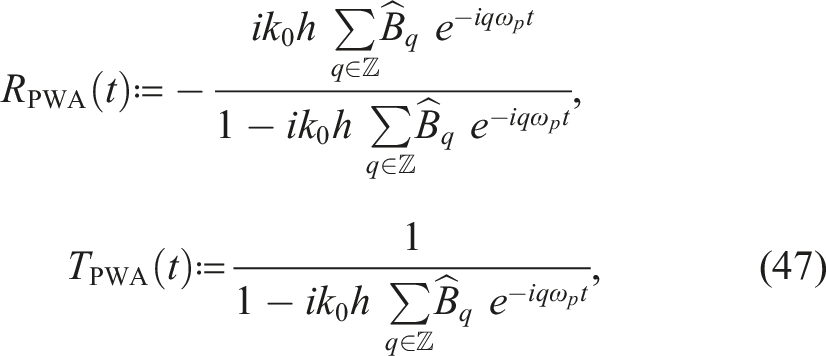


For a general periodic waveform,
Closed-form expressions are available when the modulation contains only the 0 and ± 1 Fourier components, that is,

Substituting (50) into (47) shows that TPWA(t) has the rational form

Introducing the phase variable φ = ω
p
t and using T
p
= 2π/ω
p
, the definition (49) becomes

Define



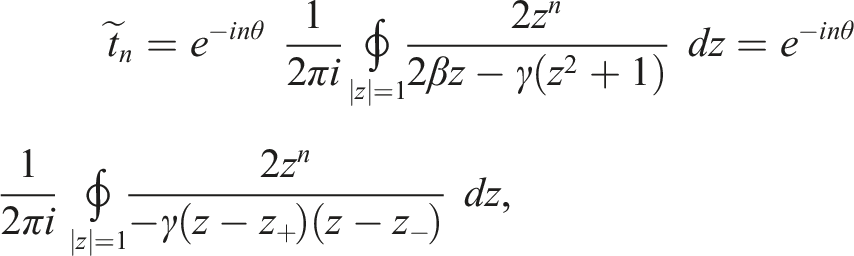
To evaluate (53), we apply the unit-circle substitution z = e
iψ
, for which dψ = dz/(iz) and cos ψ = (z + z−1)/2. This converts (53) into the contour integral over |z| = 1
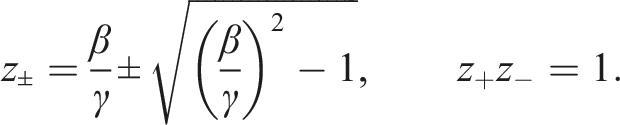


A few practical considerations are in order regarding the numerical evaluation of (54) and (55). The quantities
To quantify the range of validity of the QS approximation relative to the full Floquet solution (41), we fix the incident frequency and vary the pumping rate. Throughout Figure 9, we take Ω = ωh/c = 0.1 and compare |r
n
| with
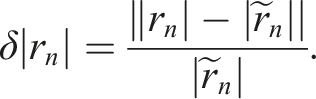
Figure 9 shows that the QS approximation is highly accurate for very slow modulation. In panel (a), the Floquet spectrum is essentially symmetric in n, and the QS prediction is almost indistinguishable from the full solution over the displayed harmonics. As the pumping rate increases, as seen in panels (b) and (c), small but systematic deviations first appear in higher-order sidebands, whereas the dominant components near n = 0 remain well captured. The error curves in panel (d) confirm that δ|r
n
| is smallest in the adiabatic limit ω
p
/ω → 0 and increases as ω
p
/ω grows, with higher-order harmonics showing the greatest sensitivity to faster modulation. Now for the fundamental component n = 0, we compare a static diaphragm with a time-modulated diaphragm. For the actuation used in Figure 10, the maximum blockage is μmax = 0.95, while the corresponding mean blockage implied by the periodic law is μmean ≈ 0.698 (time average over one pumping period). Figure 10(a) shows that, over the long-wavelength range considered, the modulated fundamental reflection satisfies

Figure 10(b) further confirms that the sensitivity of the fundamental component to pumping increases with incident frequency. For smaller Ω, the curve is nearly flat in Ω p /Ω, whereas for larger Ω noticeable departures from the QS prediction appear as Ω p /Ω increases. This is consistent with the adiabatic interpretation: the QS reduction is most accurate when ω p ≪ ω and the incident frequency remains well within the plane-wave validity range.
5. Conclusions
We have presented a systematic analysis of linear acoustic scattering in a rigid duct containing an infinitesimally thin vertical rigid baffle whose penetration height varies in time. The study combines multimodal mode-matching analysis, long-wavelength reduction, and Floquet theory in order to capture both the static scattering behaviour and the harmonic generation produced by periodic actuation of the baffle.
For the reference configuration with a static baffle, a two-dimensional boundary-value problem was formulated and solved using a truncated modal expansion. This provided quantitative reflection and transmission characteristics across the full frequency range and established a benchmark for assessing reduced descriptions. In the low-frequency regime, the baffle was shown to admit an effective compact representation through axial jump conditions, yielding a reduced model that accurately reproduces the plane-wave scattering response within its validity range. This confirms that the dominant physical effect of a shallow rigid insert at long wavelengths is governed primarily by local continuity and flux-balance constraints rather than detailed transverse structure.
When the baffle penetration is periodically modulated in time, the scattering process becomes intrinsically multi-frequency. A Floquet formulation was therefore developed to compute the coupled harmonic reflection and transmission coefficients. The results demonstrate clear redistribution of acoustic energy among temporal sidebands, with the strength of harmonic generation controlled by the modulation amplitude, frequency, and the underlying static scattering properties. In the limit of slow modulation, a quasistatic (adiabatic) approximation was derived and shown to provide an accurate and computationally efficient alternative to the full Floquet system, thereby clarifying the transition between dynamic and effectively steady scattering regimes.
Moreover, the analysis highlights the central role of accurate interface modelling and multimodal coupling in predicting scattering from time-varying internal elements in duct acoustics. The framework developed here is general and can be extended to more complex configurations, including compliant or elastic inserts, dissipative linings, branched or multi-duct geometries, and coupled fluid–structure interaction systems. It also provides a foundation for studying active or space–time modulated acoustic devices aimed at frequency conversion, non-reciprocal transport, or adaptive noise control. Future work may therefore focus on nonlinear effects, broadband optimisation, and experimental validation of time-modulated duct elements.
From an engineering standpoint, the time-modulated diaphragm analysed here serves as a deliberately simple, yet practically realisable, building block for a number of vibration- and acoustics-control technologies. In active noise-control devices for HVAC and exhaust ducts, a motorised or piezoelectrically driven blade whose immersion depth is modulated at ω
p
behaves, in the long-wavelength regime, as a tunable compact element: the mean blockage
Footnotes

Funding
The authors disclosed receipt of the following financial support for the research, authorship, and/or publication of this article: This work was supported by Princess Nourah bint Abdulrahman University Researchers Supporting Project number (PNURSP2026R764), Princess Nourah bint Abdulrahman University, Riyadh, Saudi Arabia.
Declaration of conflicting interests
The authors declared no potential conflicts of interest with respect to the research, authorship, and/or publication of this article.