






Abstract
An optimum fractional order calculus–based sliding mode control (OFOSMC) is proposed to suppress earthquake-induced vibrations on structures equipped with active tuned mass damper (ATMD). The proposed method features a novel integration of fractional-order sliding mode control with Linear Quadratic Regulator (LQR)–based optimization. Unlike conventional integer-order sliding mode control (SMC), the approach employs a fractional-order sliding surface, introducing an additional degree of freedom that enhances control flexibility and robustness. Furthermore, the LQR-based optimization scheme is utilized to systematically obtain optimal control parameters by minimizing a cost function that balances structural response reduction and control effort, thereby eliminating the need for heuristic tuning commonly used in existing fractional-order SMC methods. For the first time, the proposed OFOSMC strategy is applied to the control of building structures equipped with an ATMD system, offering a novel and robust method for mitigating seismic responses of structures. For this end, the design of the proposed OFOSMC strategy is implemented for a benchmark 11-story shear frame equipped with an ATMD system under an artificial earthquake record. Finally, the performance of the designed OFOSMC strategy is assessed through analyzing its ability in the reduction of the building structure’s seismic responses subjected to both near-fault and far-fault earthquake excitations. A comparative study is conducted against several existing control strategies. Comparative results demonstrate that the OFOSMC strategy exhibits superior effectiveness in mitigating the structural responses during real earthquake excitations.
Keywords
1. Introduction
The earthquake phenomenon, as one of the most highly destructive natural disasters, causes substantial damage to human lives and property due to various direct and indirect effects, including intense ground shaking, structural collapse, landslides, tsunamis, fires, and disruptions to essential services (Jarrahi et al., 2022; Khatibinia et al., 2019). Earthquake intensity affects damage to structures by reducing their resistance and stability. Therefore, ensuring adequate resistance and stability through proper design and construction is crucial to prevent both local and global damage. This involves various engineering strategies such as strengthening connections, improving building codes, and implementing innovative seismic-resistant designs, materials, and control devices. Seismic control devices can mitigate vibrations and protect buildings and bridges from earthquake damage by absorbing or dissipating seismic energy and reducing structural response during seismic events.
Tuned Mass Damper (TMD) is a common strategy for controlling structural vibrations particularly induced by wind and earthquakes (Shi et al., 2018). The system is composed of a mass, spring, and damper, which is tuned to resonate with the natural frequency of the structure, thereby dissipating vibrational energy and reducing oscillations. While the effectiveness of TMD generally increases with large mass ratios, its practical use in buildings and bridges is hindered by the inconvenience of accommodating and supporting a significant mass. Further, its effective damping is only provided within a narrow frequency band (Elias and Matsagar, 2017; Ozturk et al., 2022). To overcome the limitations of the TMD system, various types of TMD have been proposed such as multiple TMD (Lu et al., 2017b), nonlinear viscous damping (Chung et al., 2009), semi-active TMD (Rafieipour et al., 2014), hybrid TMD (Salvi et al., 2015), eddy-current TMD (Lu et al., 2017a; Zhou et al., 2018), electromagnetic TMD (Lin and Lin, 2023), bidirectional pendulum TMD (Matta, 2019), particle TMD (Lu et al., 2017c, 2017d, 2018), and TMD inerter (TMDI), (Giaralis and Marian, 2016; Patsialis et al., 2023). However, despite these passive and semi-active improvements, active TMD (ATMD) systems have been proposed as a highly effective control strategy and offer distinct advantages over passive control methods (Ricciardelli et al., 2003; Zhan et al., 2013). ATMD systems can adapt to varying frequencies and handle uncertainties, unlike passive control systems. In an ATMD system, a control force is generated by an actuator and is applied to the ATMD. The reaction force is transmitted to the main structure. The control force is provided by a control algorithm (or control law), which is the core of the ATMD system and is crucial for the successful operation of ATMD (Eliasi et al., 2022).
Numerous control methods have been developed and utilized for the design of active control systems in structural engineering. Several popular control methods include linear quadratic regulator (LQR) (Alavinasab et al., 2006; Chang and Soong, 1980; Li et al., 2004), linear quadratic Gaussian (LQG) (Chen et al., 2011; Samali et al., 2004), proportional-integral-derivative (PID) controller (Etedali and Tavakoli, 2017; Guclu, 2006; Guclu and Yazici, 2009), robust saturation control (Lim, 2008), bang–bang control (Collins et al., 2006), H2 and H∞ (Huo et al., 2007; Palazzo and Petti, 1999; Park et al., 2009), fuzzy logic controller (FLC) (Pourzeynali et al., 2007; Shariatmadar et al., 2014; Wang and Lin, 2007), sliding mode control (SMC) (Khatibinia et al., 2020; Monajemi-Nezhad and Rofooei, 2007; Yakut and Alli, 2011), sliding sector control (SSC) (Saadatfar et al., 2023, 2024b, 2025). Further, the intelligent and metaheuristic techniques have been used to enhance seismic control of structures. Yang et al. (2006) explored the application of neural networks for the system identification and vibration control in structures equipped with an ATMD system. Eliasi et al. (2022) presented the optimum design of a SMC strategy for simultaneously mitigating the control force and the structural seismic response in of an 11-story shear building equipped with ATMD. Lavasani and Shangapour (2022) investigated the capability of the interval type-2 fuzzy logic controller (IT2FLC) for improving the seismic performance of structures under near-field and far-field earthquake excitations. Hosseini Lavasani et al. (2022) presented a hybrid control method including the IT2FLC and fractional-order PID strategies. This hybrid control method was used to control the TMD system with a magnetorheological (MR) damper-equipped a 15-story shear building and tune the voltage of the MR damper. Saadatfar et al. (2024a) developed the optimal design of the SSC strategy for improving the seismic performance of an 11-story shear building structure equipped with an ATMD system. Recent studies have increasingly applied artificial intelligence (AI)–based controllers to ATMD systems, demonstrating that methods such as neural networks, fuzzy logic, and reinforcement learning can significantly enhance adaptability and vibration mitigation performance under nonlinear behavior and external uncertainties (Chen and Chien, 2020; Ghanemi et al., 2024; Yao et al., 2024). These AI-driven approaches learn complex dynamic patterns and thus offer improved efficiency and robustness compared with conventional control strategies. However, conventional ATMD controllers suffer from robustness limitations in the presence of nonlinearities and uncertainties. This motivates the use of fractional-order sliding mode control, as will be discussed in the following sections.
SMC based on the variable structure control is known as a powerful and robust control scheme and handles uncertainties and disturbances (Gambhire et al., 2021; Yu et al., 2021). The design process of SMC involves two key steps: (1) designing a sliding surface that defines the desired dynamics and specifications; (2) developing a control law to drive the system towards and maintain it on this surface, ensuring stable operation. The sliding surface is a crucial design element that dictates the system’s desired behavior and can guarantee the global stability of a dynamical system (Banks et al., 2000). However, the classical SMC suffers from significant practical challenges such as the singularity problem and chattering phenomenon. In recent years, the integration of fractional-order control (FOC) with the classical SMC has received extensive attention in order to eliminate its drawbacks (Duc et al., 2018). In fact, the FOC strategy can enhance system performance compared to integer-order control by leveraging additional parameters from fractional-order operators, leading to more flexible and superior controller designs in terms of steady-state error, disturbance immunity, and response time (Wang et al., 2022). Fractional-order SMC strategies generally offer superior performance compared to the classical SMC by providing faster tracking, higher control accuracy, and improved robustness against uncertainties and disturbances. Several studies demonstrate the benefits of the fractional-order SMC strategies with in comparison with those of classical SMC. Sun et al. (2018) developed a discrete-time fractional-order SMC scheme which ensured the desired tracking performance of a linear motor control system. Aghababa (2017) proposed a fractional-order switching sliding surface for a type of fractional-order chaotic systems to guarantee the existence of the sliding motion in finite time. Fei and Lu (2018) introduced an adaptive fractional order SMC with neural estimator which could improve the tracking performance for a class of systems with nonlinear disturbances. Nguyen et al. (2020) presented a fractional-order derivative-based SMC for semi-active vehicle suspensions and confirmed its ability to achieve robust and high-performance control with finite-time convergence. Eray and Tokat (2020) investigated the effectiveness of a fractional-order SMC with a time-varying sliding surface for the control of nonlinear models subject to parameter variations and external disturbances. Zheng et al. (2022) developed an enhanced fractional order sliding mode control (FOSMC) method for improving the control performance of the fractional order uncertain systems with multiple mismatched disturbances. Recently, Bingol (2025) has proposed a hybrid of fractional-order SMC and neural network–based estimation in order to enhance robustness and adaptability in stabilizing complex systems. Additionally, the successful application of fractional calculus has been demonstrated in improving the performance of traditional SMCs (Chen et al., 2023; Xu et al., 2023).
To the best of the authors’ knowledge, the studies mentioned above indicate that the effectiveness of the SMC strategies with fractional-order calculus concept has not been investigated in the design of ATMD systems. Hence, this study proposes an optimum fractional-order sliding mode control (OFOSMC) for the seismic control of structures equipped with an ATMD system. The proposed OFOSMC strategy is designed by integrating the fractional-order calculus concept into the SMC. In the proposed strategy, the Linear Quadratic Regulator (LQR) method utilizes a cost function to design a control law that optimizes system performance. By minimizing this cost function, the LQR ensures the system’s states and control inputs converge to desired values, leading to improved overall system behavior. Further, the OFOSMC strategy enhances control system performance by improving accuracy and energy efficiency, and increasing adaptability to unexpected events like earthquakes. To investigate the effectiveness of the proposed controller, a benchmark 11-story building frame is considered and controlled by an ATMD system installed on the top floor. The design of the proposed OFOSMC is first conducted for the reduction of the structural responses under an artificial earthquake ground motion. Finally, a comparative simulation study is performed to demonstrate the superiority of the designed OFOSMC in mitigating structural responses compared to other control techniques under four real ground excitations.
2. Motion equations of controlled building structure
2.1. Building structure equipped with a TMD
An N-story shear structure subjected to an earthquake excitation,


Assume that lumped mass is considered for the stories of the structure and for the TMD system. Hence, the mass matrix,

The stiffness matrix,
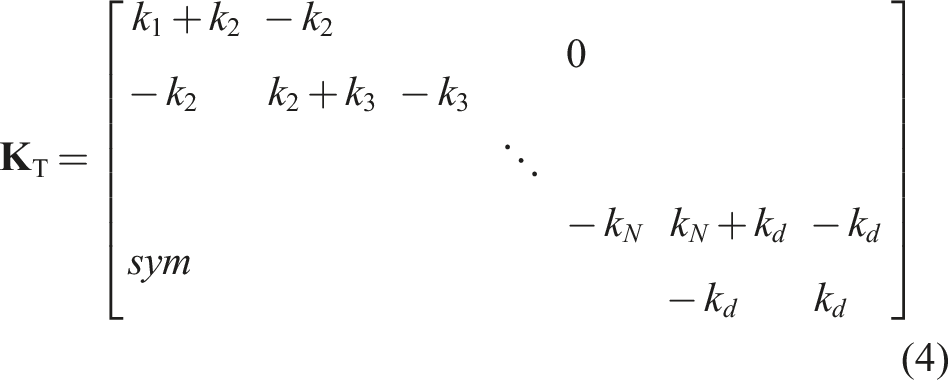
The damping matrix,
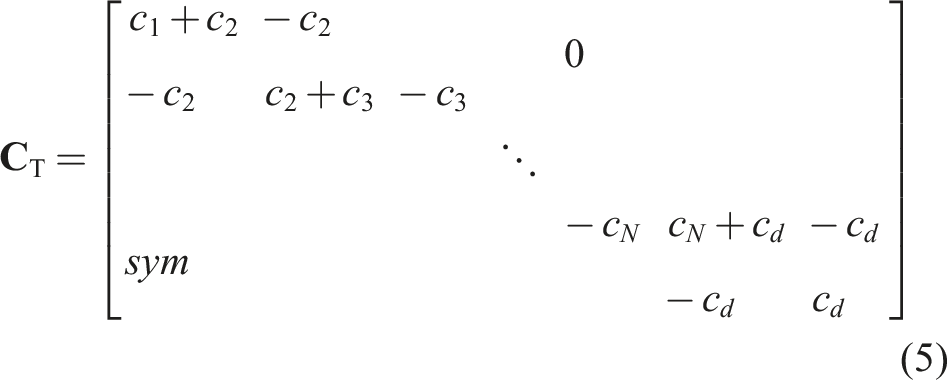
The damping matrix of the structure,


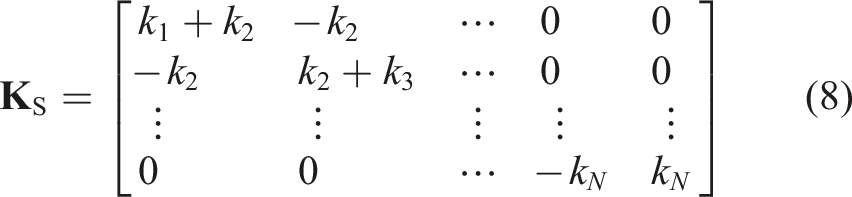
2.2. Building structure equipped with an ATMD
The motion equations of the N-story shear frame equipped with an ATMD system installed on the top floor (shown in Figure 1) are represented as N-story shear frame equipped with an ATMD system.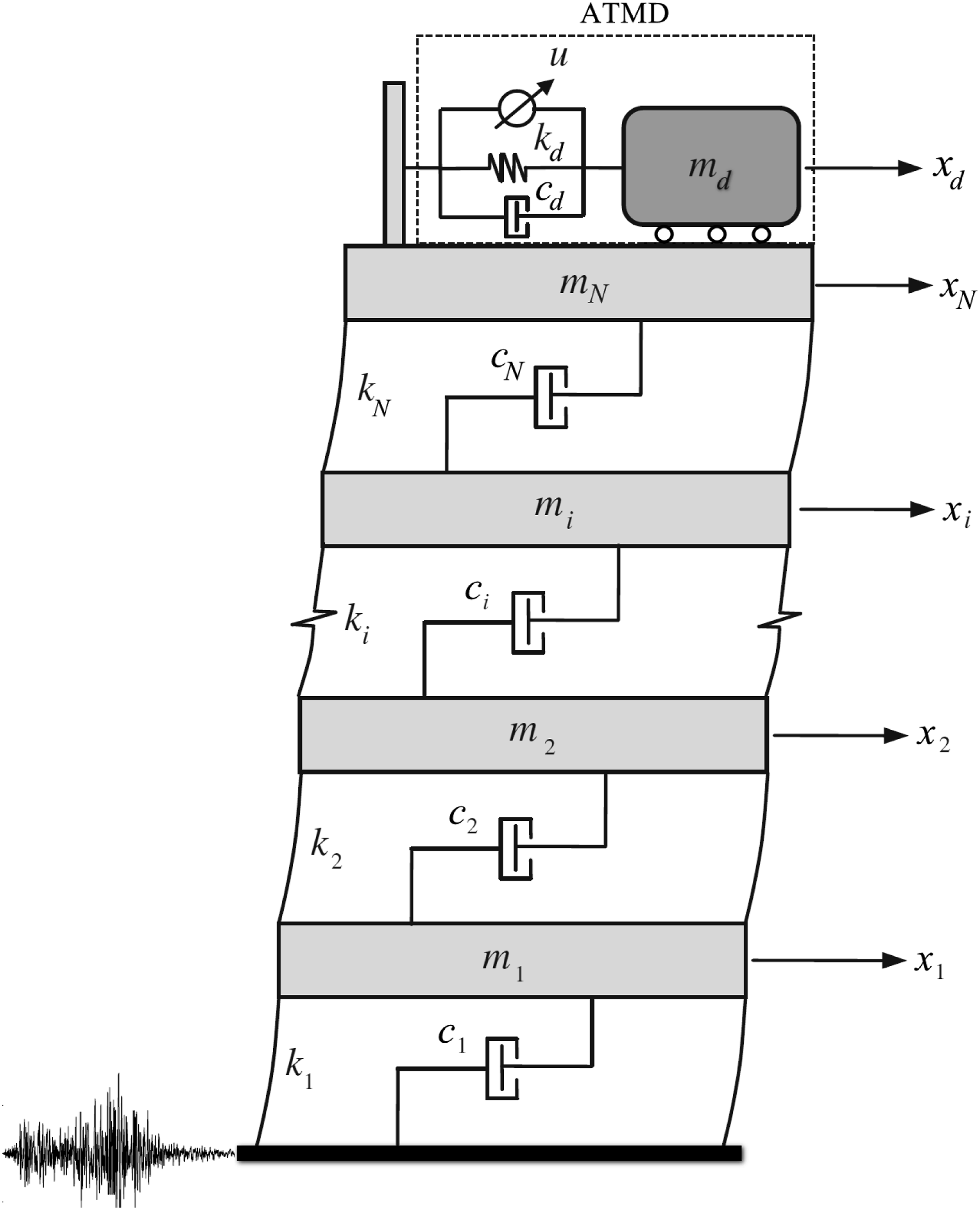

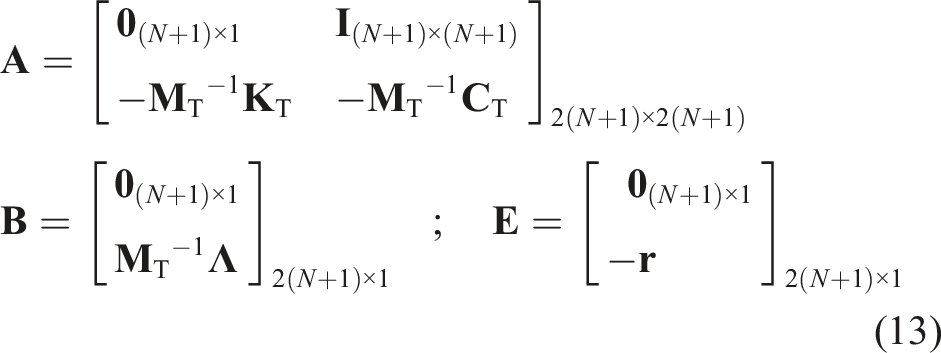
For the controlled building structure equipped with the ATMD system, the control force is provided by an actuator in real time and is applied to the ATMD system. The equations of the ATMD-equipped structure defined in equation (6) can be transformed into the state-space form and written as



The state matrix

3. A brief introduction on fractional calculus
Fractional calculus is introduced as a generalization of classical calculus, which deals with the integration and differentiation of non-integer orders (Oldham and Spanier, 1974; Podlubny, 1998). The fractional integral,
For general fractional-order operator, Grunwald–Letnikov (GL), Riemann–Letnikov (RL), and Caputo definitions are most commonly used (Podlubny, 1998). Hence, these definitions are expressed in the following section.
The αth order GL fractional derivative of function

The αth order RL fractional derivative of function


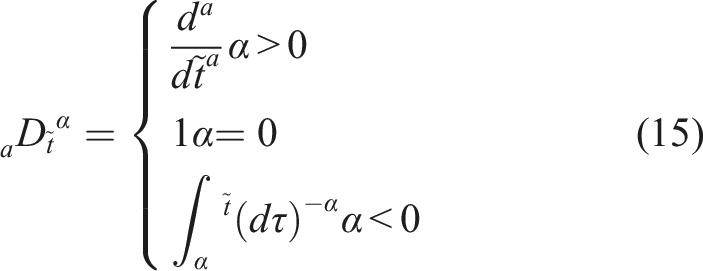
The αth order Caputo fractional derivative of function Contrary to the integral and derivatives of integer order, the numerical simulation of fractional integrals and derivatives is not simple. The Laplace transform method as a suitable and conformable tool is widely developed for solving fractional-order differential equations (Oldham and Spanier, 1974). The Laplace transform of equation (15) can be represented as (Oldham and Spanier, 1974):


Fractional-order type TypeMittag–Leffler Stability (Jiang et al., 2020): Let

Let In this study, the fractional-order element


4. Design of control strategy
In this section, the fractional-order calculus-based sliding mode surface and the design of the proposed OFOSMC strategy are expressed.
4.1. Fractional-order calculus-based sliding mode surface
For the system defined in equation (11), the fractional order–based sliding mode surface can be defined as follows:

By taking the (1–α)th derivative on both sides of equation (11), it gives:

Substituting

For calculating the matrix

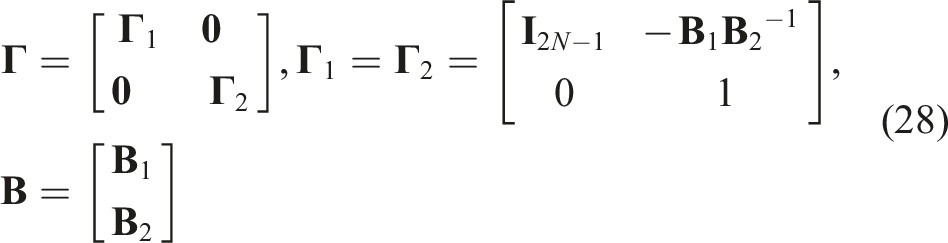
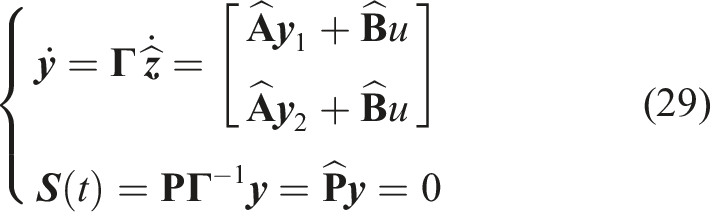
The decomposition of equation (29) leads to
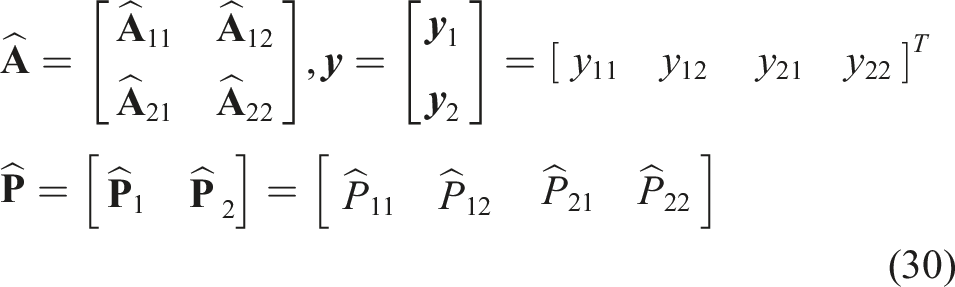
From equations (29) and (30), it yields:
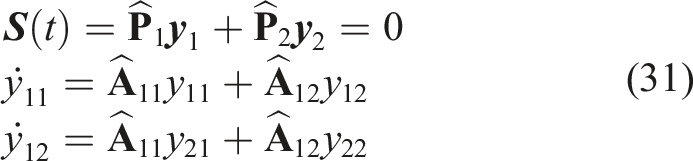
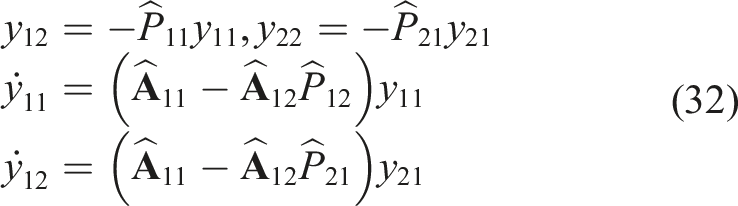
The LQR method as a systematic method can be employed for obtaining the matrix


According to the LQR method, minimizing equation (33) is the function of the constraint of motion on the slip surface (equation (31)), so:



By comparing equations (32) and (35), it yields:

Therefore, the matrices

4.2. Design of the OFOSMC strategy
For the suppression of the seismic vibration defined in equation (11), the fractional-order derivative of the sliding surface,


Then, the equivalent controller is solved as

For the suppression of the seismic vibration, the switching control law can be obtained as

Thus, the comprehensive controller of the proposed OFOSMC strategy is designed as

From equations (42) to (44), the control law of the proposed OFOSMC strategy is

The proposed OFOSMC strategy for the seismic control of the N-story shear frame equipped with the ATMD is shown in Figure 2. The proposed OFOSMC strategy for the seismic control of the N-story shear frame equipped with an ATMD system.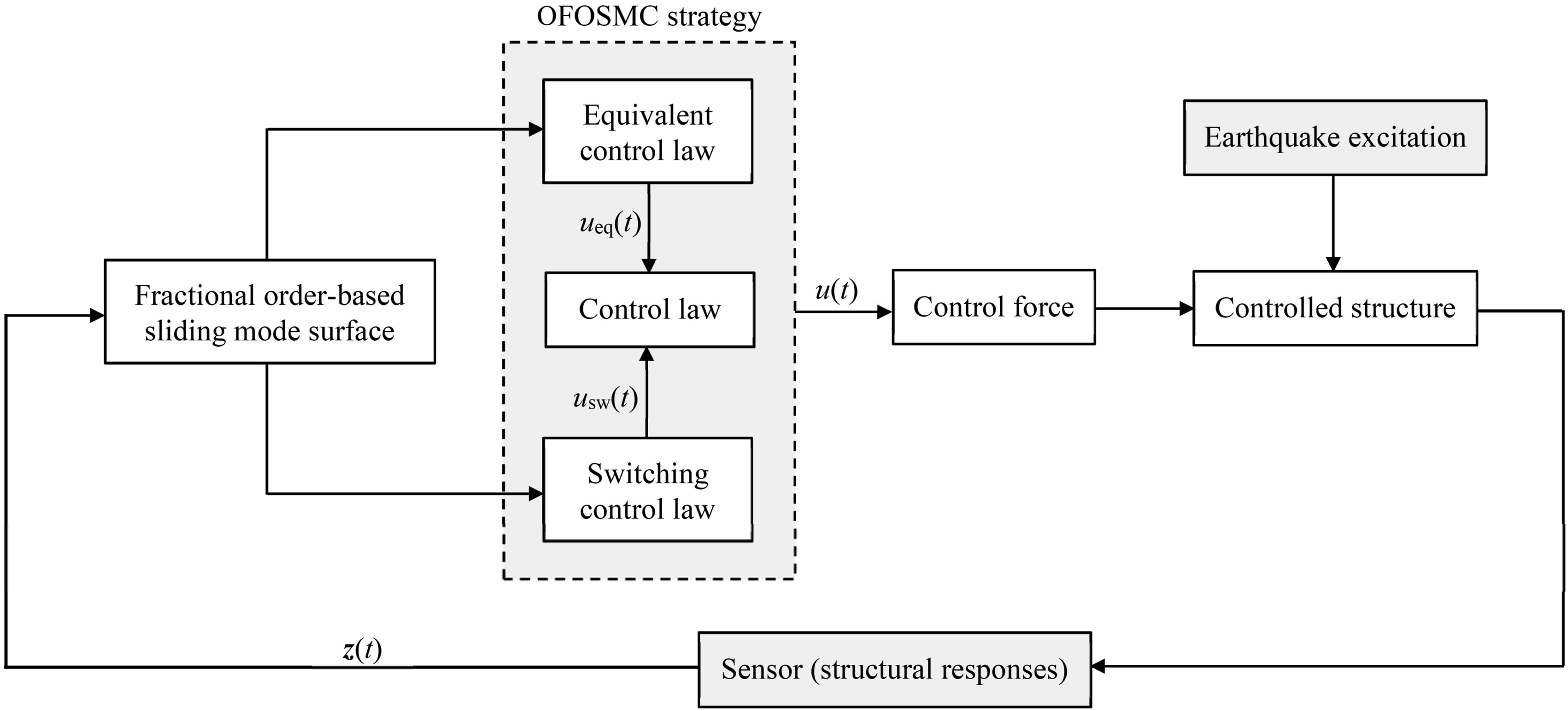
4.3. Stability analysis of closed-loop system
Let us consider the Lyapunov function:

According to Lemma 1, it yields:

Using equation (Equation 40) in equation (Equation 47) results in:

Substituting the control law (45) into equation (48) leads to
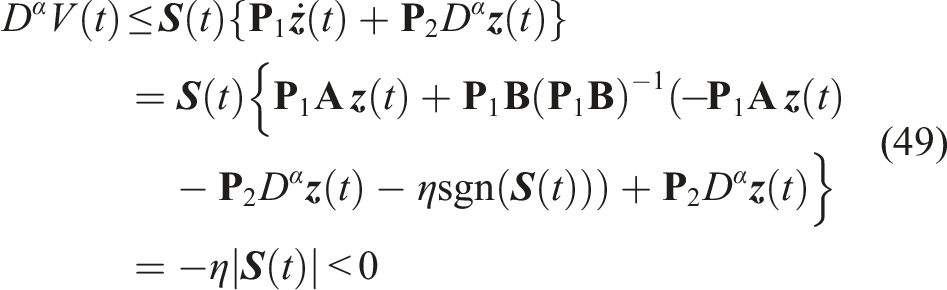
According to Lemma 2, the building structure under OFOSMC is stable.
4.4. Chattering attenuation
Chattering as an undesirable phenomenon is a finite-amplitude oscillate with finite frequency that occurs near the desired equilibrium surface. Due to the discontinuous sign function in the control law (equation (45)), the OFOSMC strategy suffers from the chattering phenomena. The phenomena lead to damage in actuators and system itself. In this study, a smooth hyperbolic tangent function, tanh(·/φ), was utilized to replace the discontinuous sign function and attenuate chattering in the OFOSMC strategy. The hyperbolic tangent function is defined as follows: Sign and hyperbolic tangent functions (Eliasi et al., 2022).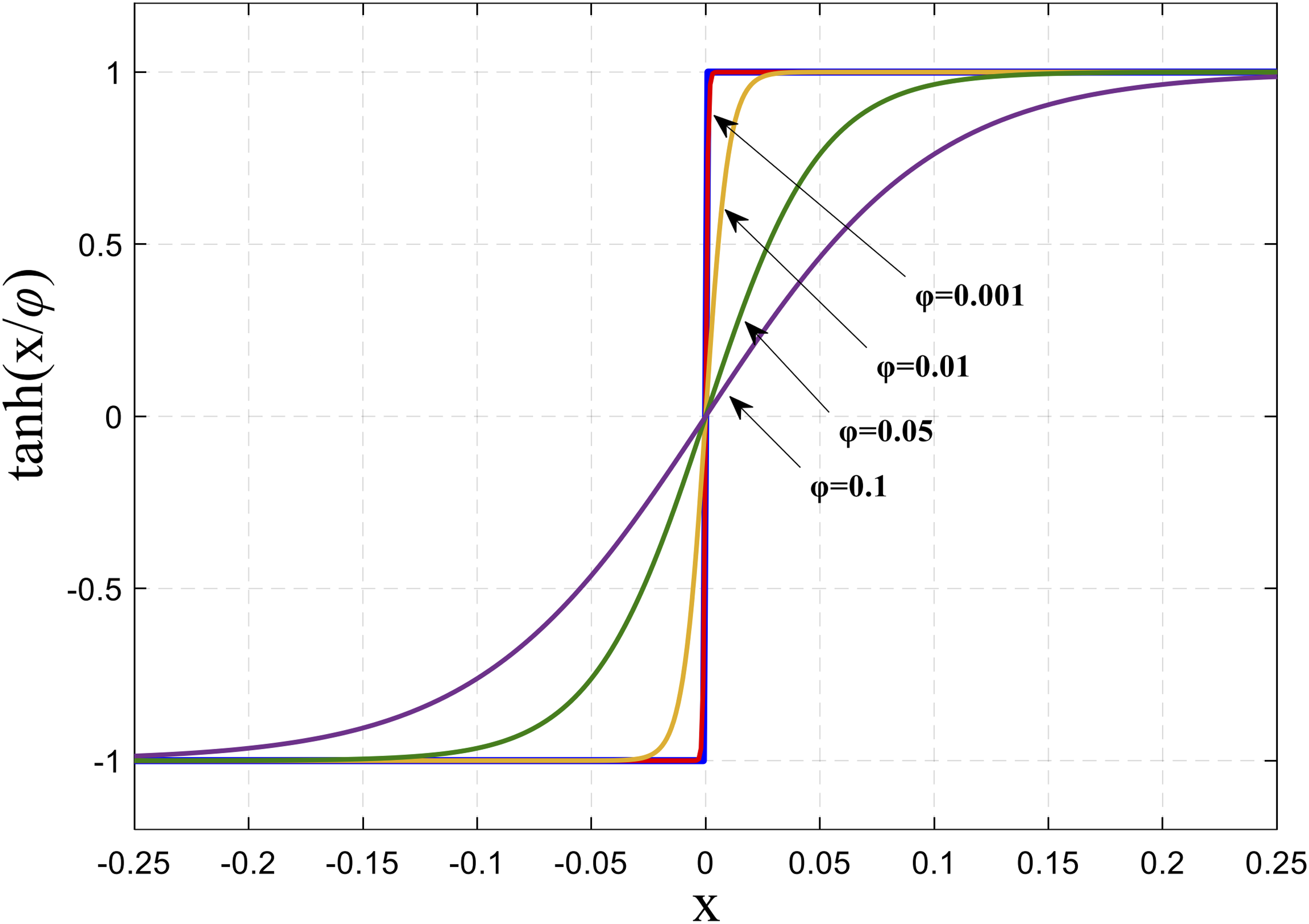

4.5. Practical implementation considerations
The proposed OFOSMC, like any full-state feedback controller, relies on accurate and timely measurement of the state vector. In practical implementation, however, imperfections such as sensor failures, measurement noise, and time delays are unavoidable. These issues can degrade control performance or even cause instability if not properly addressed. The following remarks discuss these practical limitations and suggest possible remedies.
4.5.1. Remark 1 (Sensor failures)
It is important to emphasize that the proposed OFOSMC, like any state-feedback controller, is vulnerable to sensor failures. If the measured state vector,
4.5.2. Remark 2 (Measurement noise)
In the presence of measurement noise, ideal sliding mode convergence to
4.5.3. Remark 3 (Time delays)
The proposed OFOSMC, like all state-feedback sliding mode controllers, is sensitive to state measurement delays. When the controller operates on delayed state information,
4.6. Rationale for the proposed controller
To justify the selection of the proposed OFOSMC over adaptive data-driven methods such as ANN-based fuzzy logic control (ANN-FLC), several key advantages are highlighted: (1) (2) (3) (4) (5)
Consequently, despite the adaptivity of ANN-FLC, the deterministic safety, computational simplicity, and parameter clarity of OFOSMC make it a more suitable choice for seismic protection of building structures.
5. Simulation studies
Properties of the benchmark structure.

The natural frequencies of the first two modes of the structure are ωs,1 = 6.5727 and ωs,2 = 19.355 rad/s, respectively. The damping ratio of 5% (i.e. ξ = 0.05) was assumed for the first two modes. Therefore, the Rayleigh damping approach expressed in equation (6) was employed for the damping matrix of the structure. For the seismic control of the structure, the TMD and ATMD systems were located on the top story (i.e. roof). The properties of the TMD system consist of the frequency ratio (f
d
), damping ratio 


The optimal values of
5.1. Design process of the proposed OFOSMC
As described in Section (4), the design of the OFOSMC strategy for the seismic control of structures essentially depends on the tuning parameters (i.e. 


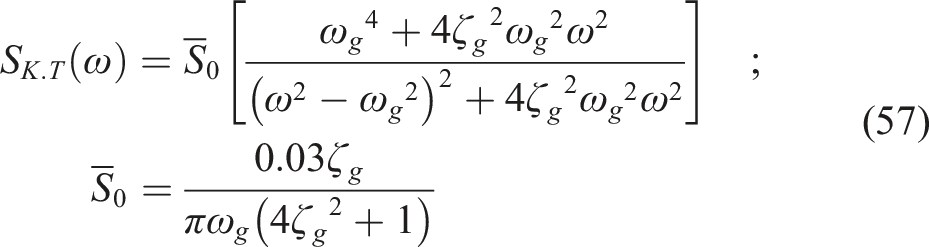
In the present study, the ground damping and frequency were assumed to be 0.3 and 37.3 rad/s, respectively. The values were selected based on literature (Eliasi et al., 2022; Etedali et al., 2018; Khatibinia et al., 2020). Based on the values of the parameters, the PGA of the artificial earthquake record is equal to 1.5 g. It should be noted that the characteristics and graphical representations of this artificial record have been previously presented by Saadatfar et al. (Saadatfar et al., 2023, 2024a). To perform the analysis of the structures under the artificial earthquake record, MATLAB and Simulink tools were used. Figure 4 shows the time history of the displacements of the top floor for the cases of the uncontrolled structure (Unctrl’d) and the controlled structure using the TMD and ATMD systems. Results show that the OFOSMC strategy–featured ATMD can efficiently mitigate the maximum displacement of the top story in compared with that of the uncontrolled structure and the TMD-equipped structure. In fact, the comparison of the uncontrolled and controlled structure indicates that the OFOSMC strategy–featured ATMD considerably reduces the peak displacement of the top story (0.114 m) by 61.6%. In addition, a reduction of 44.4% and 51% was obtained by the OSSC (0.165 m) and ASSC (0.145 m) strategies (Saadatfar et al., 2024a, 2024b), respectively. Comparison of the displacement time history of the top story during artificial earthquake.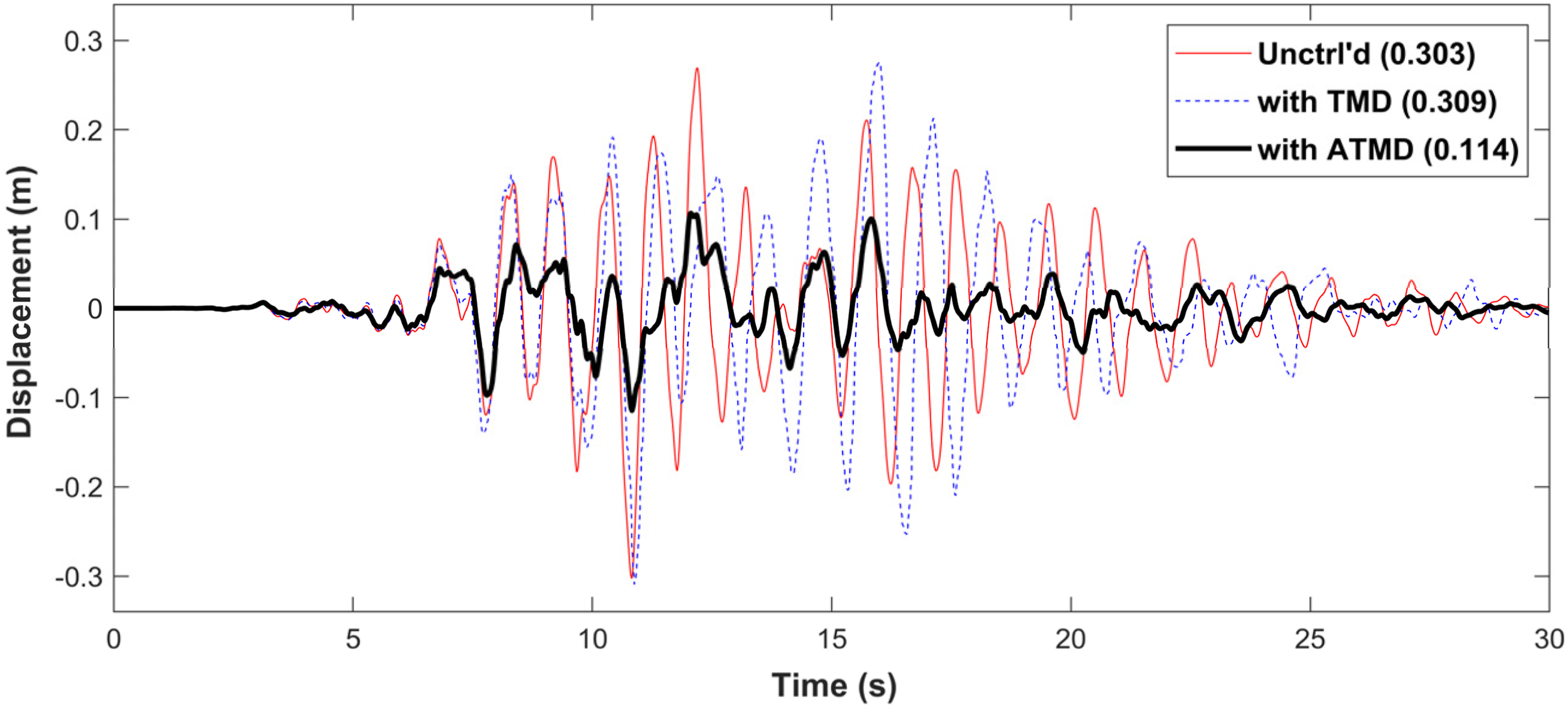
The time history of the acceleration of the top floor was also depicted in Figure 5. As can be seen from Figure 5, the maximum acceleration of the top floor is 25.33, 25.25, and 15.51 m/s2 for the cases of the uncontrolled structure and the controlled structure equipped with the TMD and ATMD systems, respectively. Hence, the maximum acceleration of the top floor for the structure equipped with the ATMD in comparison with the uncontrolled one was reduced by 38.8%. Using the OSSC and ASSC controllers, the maximum acceleration of the top floor was reported by 21.47 and 23.15 m/s2 (Saadatfar et al., 2024a, 2024b), which represented a reduction of 15.2% and 8.6% relative to the uncontrolled structure. Therefore, the results demonstrate that the OFOSMC strategy outperformed the OSSC and ASSC controllers in the reduction of the maximum displacement and acceleration of the top story. Comparison of the acceleration time history of the top story during artificial earthquake.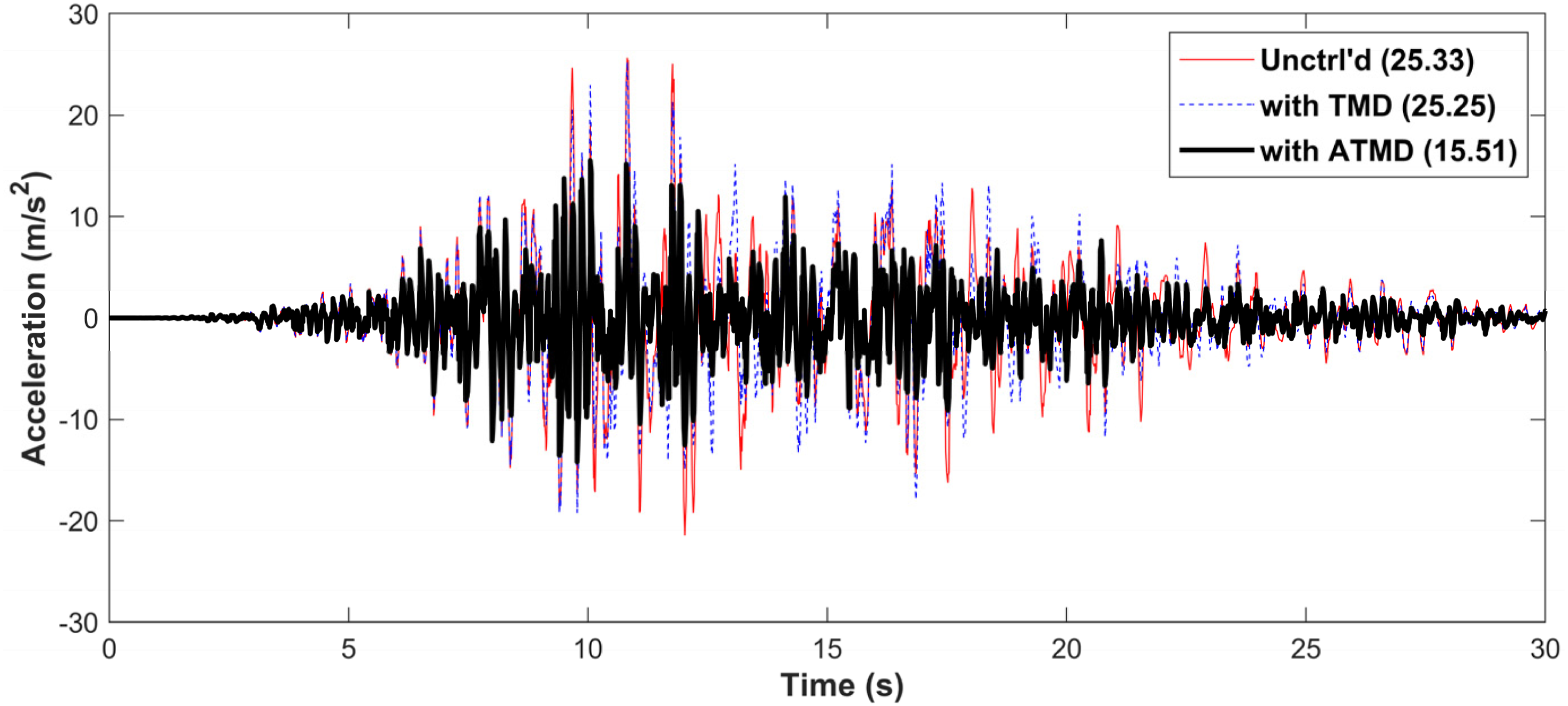
The time history of the control force obtained by the OFOSMC strategy was depicted in Figure 6. It can be seen from Figure 6 that the maximum control force is 8230 kN. Further, the maximum control force obtained using the OSSC and ASSC controllers was reported by 8000 kN (Saadatfar et al., 2023, 2024a), so the difference between the maximum control force of the FOSMC and that of the OSSC and ASSC controllers is less than about 3%. Time history of the control force during the artificial excitation.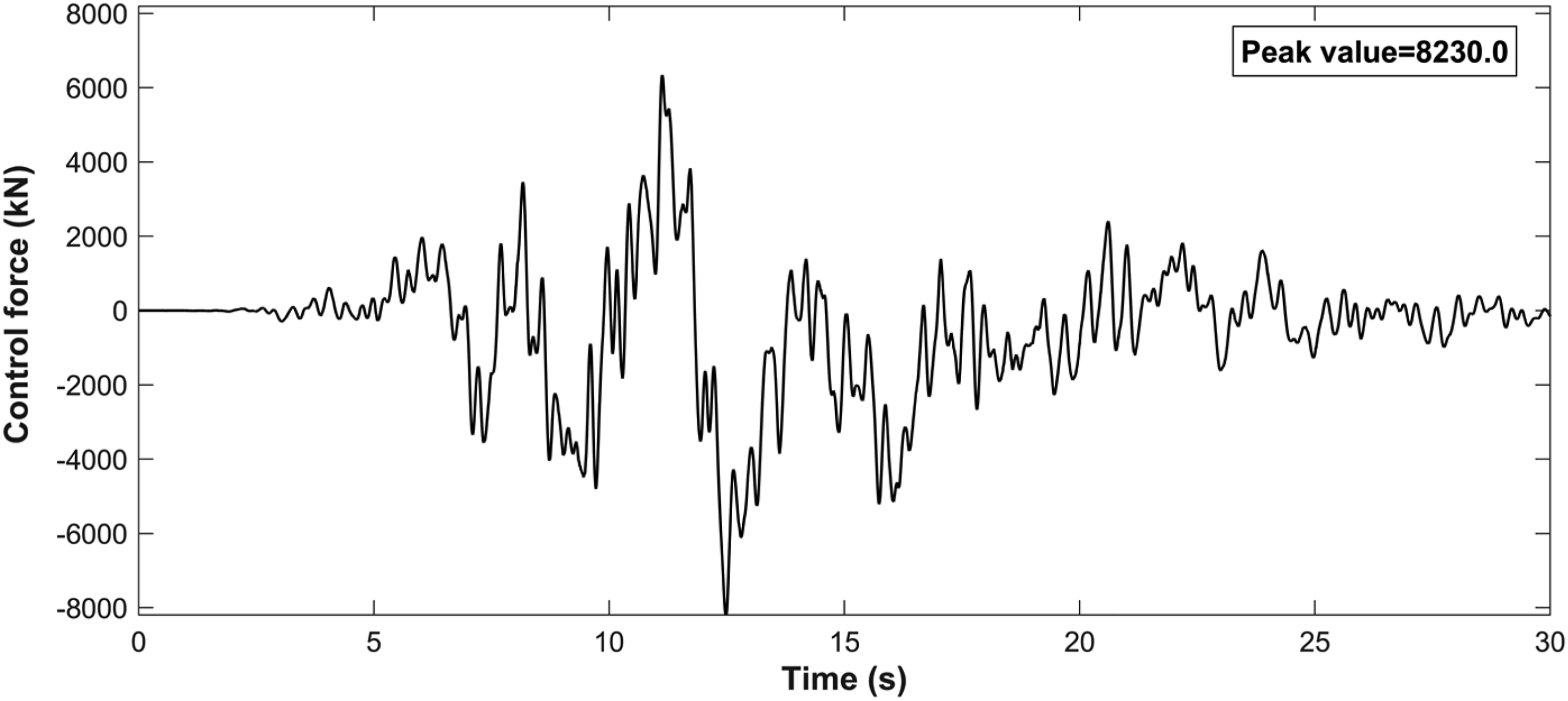
Figure 7 shows the performance assessment of the OFOSMC strategy in terms of the time history of the input, damping, and strain energies for the uncontrolled structure and the structure equipped with the TMD and ATMD systems. For the ATMD-equipped structure, the maximum value of the input, damping, and strain energies is achieved by 1287.32, 2115.56, and 399 kJ, respectively. In addition, the ATMD system can mitigate the maximum value of the input, damping, and strain energies by 46%, 70%, and 82%, respectively, relative to the uncontrolled structure. Comparison of the time history of different energies of the structure during artificial earthquake.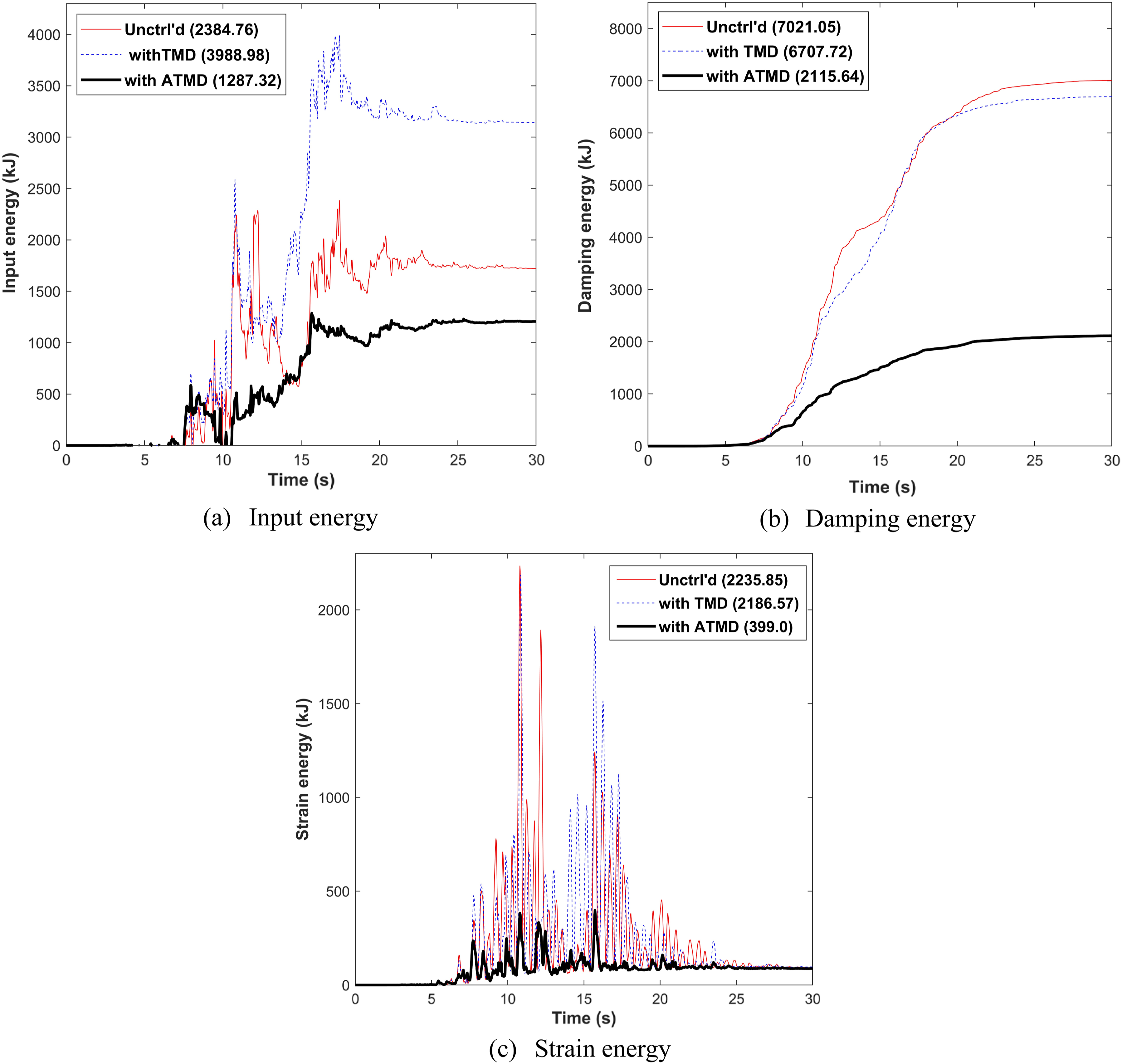
5.2. Comparative simulation studies
In this section, the performance of the designed OFOSMC strategy is investigated under a number of real earthquake excitations. The real earthquake excitations include El Centro (California, USA–1940), Hachinohe (Tokachi–Oki, Japan–1968), Northridge (California, USA–1994), and Kobe (Hyōgo, Japan–1995). The peak ground acceleration (PGA) of the El Centro, Hachinohe, Northridge and Kobe earthquakes are 0.342, 0.225, 0.827, and 0.818 g, respectively (Etedali et al., 2018). Further, the performance of the designed FOSMC was compared with that of the LQR (Pourzeynali et al., 2007), FLC (Pourzeynali et al., 2007), PID (Etedali et al., 2018), OSMC (Eliasi et al., 2022), OSSC (Saadatfar et al., 2024a), and ASSC (Saadatfar et al., 2024b) controllers. To ensure a fair and practically relevant comparison, the other controllers (LQR, FLC, PID, OSMC, OSSC, and ASSC) were implemented using their standard tuning approaches as documented in the literature. Unlike the proposed OFOSMC, these benchmark controllers do not possess a built-in optimization mechanism; therefore, applying any external optimization method to them would alter their fundamental nature and would not represent their conventional implementation. A key novelty of the proposed OFOSMC lies precisely in the integration of optimal tuning (via LQR) into the fractional-order sliding mode control framework. Consequently, comparing the optimally tuned proposed controller against these conventionally tuned benchmark controllers fairly demonstrates the added value of this novel feature and accurately reflects real-world engineering practice.
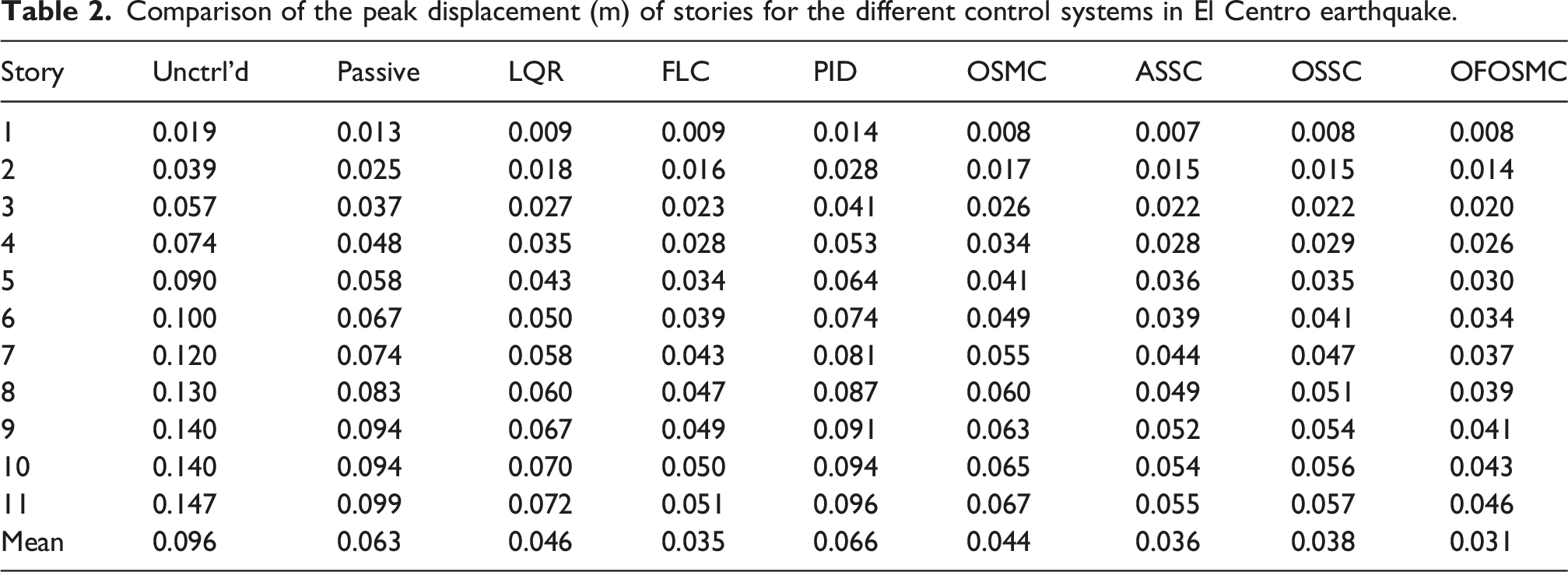
Comparison of the peak displacement (m) of stories for the different control systems in El Centro earthquake.
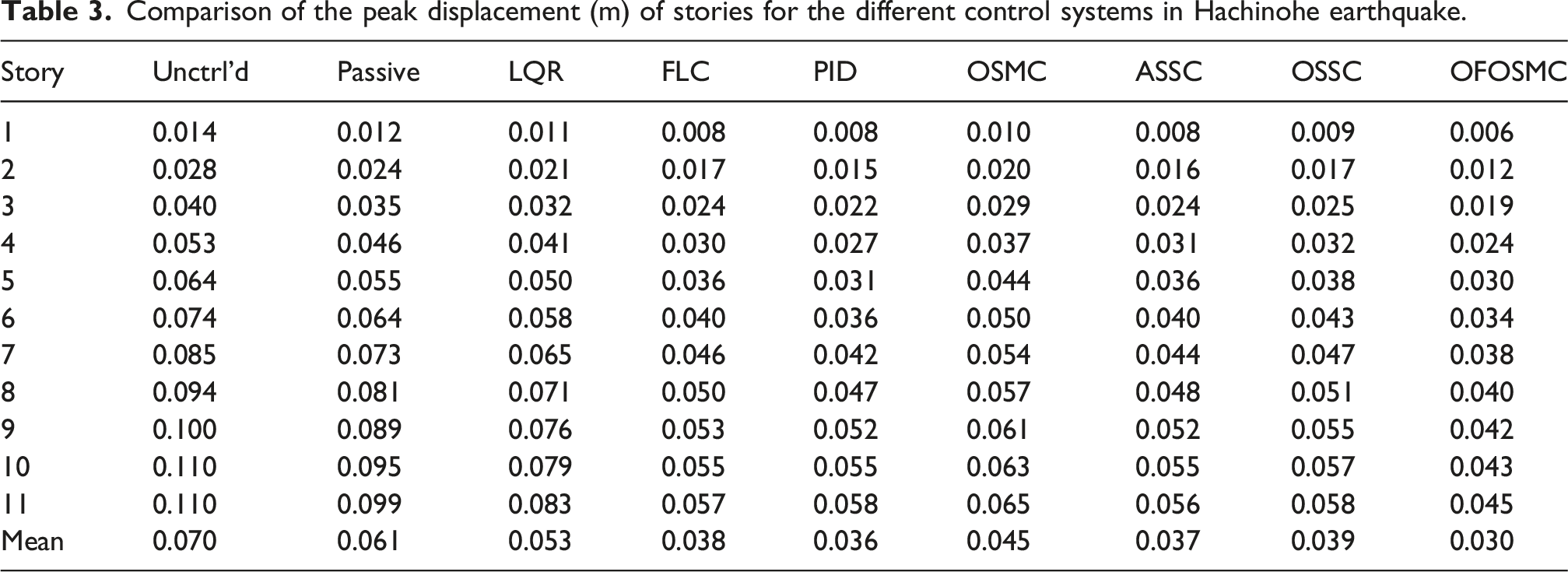
Comparison of the peak displacement (m) of stories for the different control systems in Hachinohe earthquake.
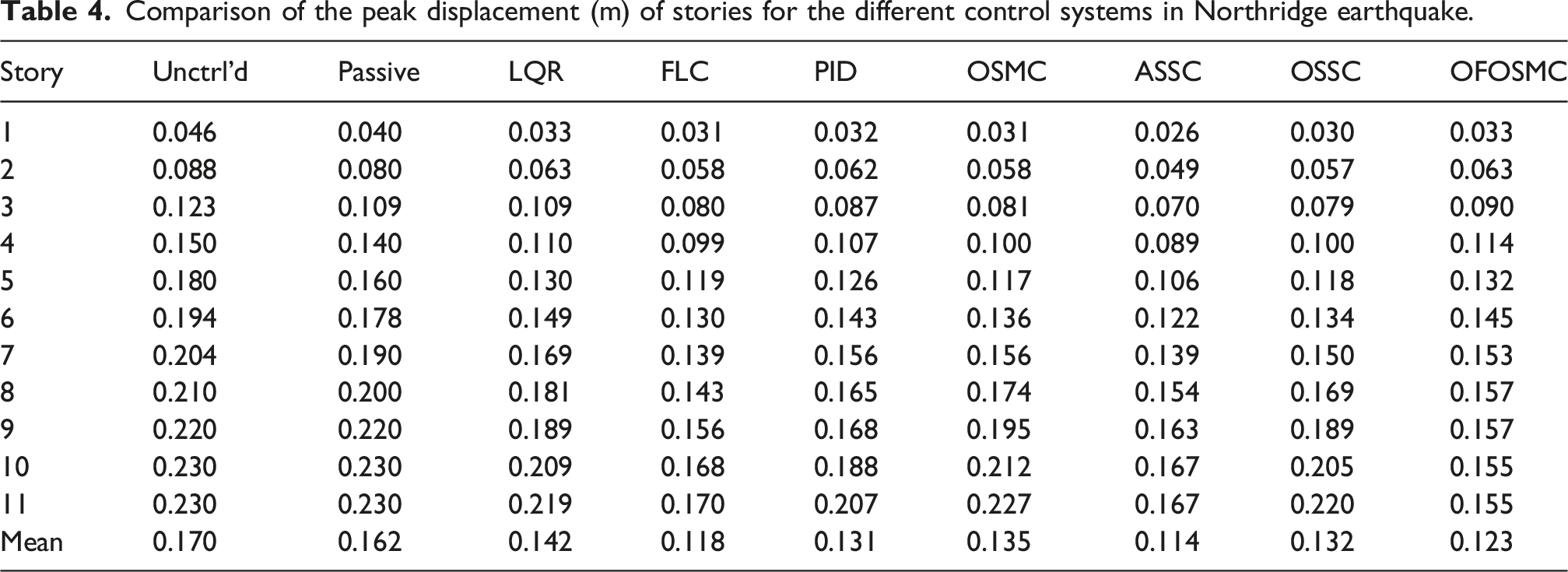
Comparison of the peak displacement (m) of stories for the different control systems in Northridge earthquake.
Comparison of the peak displacement (m) of stories for the different control systems in Kobe earthquake.
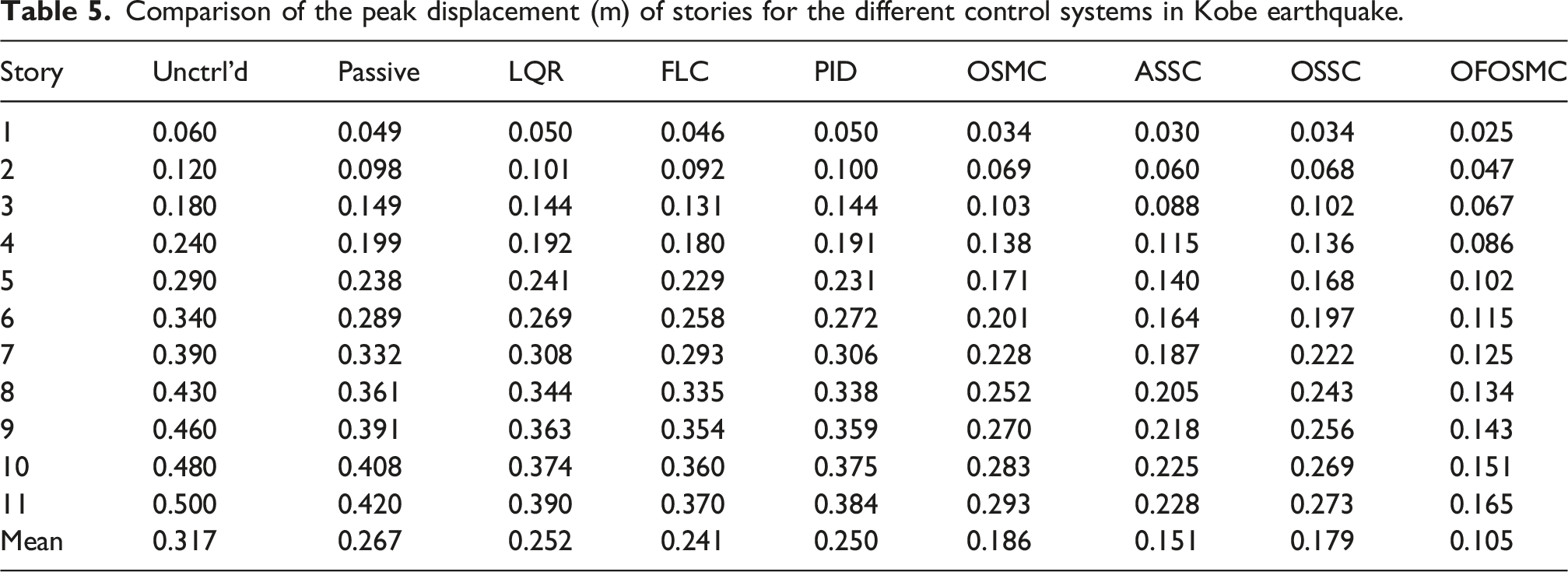
Figure 8 compares the performance of all controllers in terms of the average value of the reduction percentages obtained for the peak displacement of all stories subjected to the earthquake excitations. Figure 8 shows that for the various controllers, the highest average values of the reduction percentage are achieved using the OFOSMC-featured ATMD, with values of 66%, 56%, and 65.4% under El Centro, Hachinohe, and Kobe earthquakes, respectively. Under the Northridge earthquake, the ASSC-controlled ATMD leads to the highest average value of the reduction percentage by 35.4, while the OFOSMC controller achieves an average reduction percentage of 27.6%. It can be observed from Figure 8 that the total average of the reduction percentage for the passive, LQR, FLC, PID, OSMC, ASSC, and OSSC controllers are obtained by 17.6%, 28.5%, 40.6%, 31%, 38.6%, 48.7%, and 42.9%, respectively. In contrast, the total reduction average for the OFOSMC-controlled ATMD is yielded by 53.8%. Average of the reduction percentages for the maximum displacement for all stories.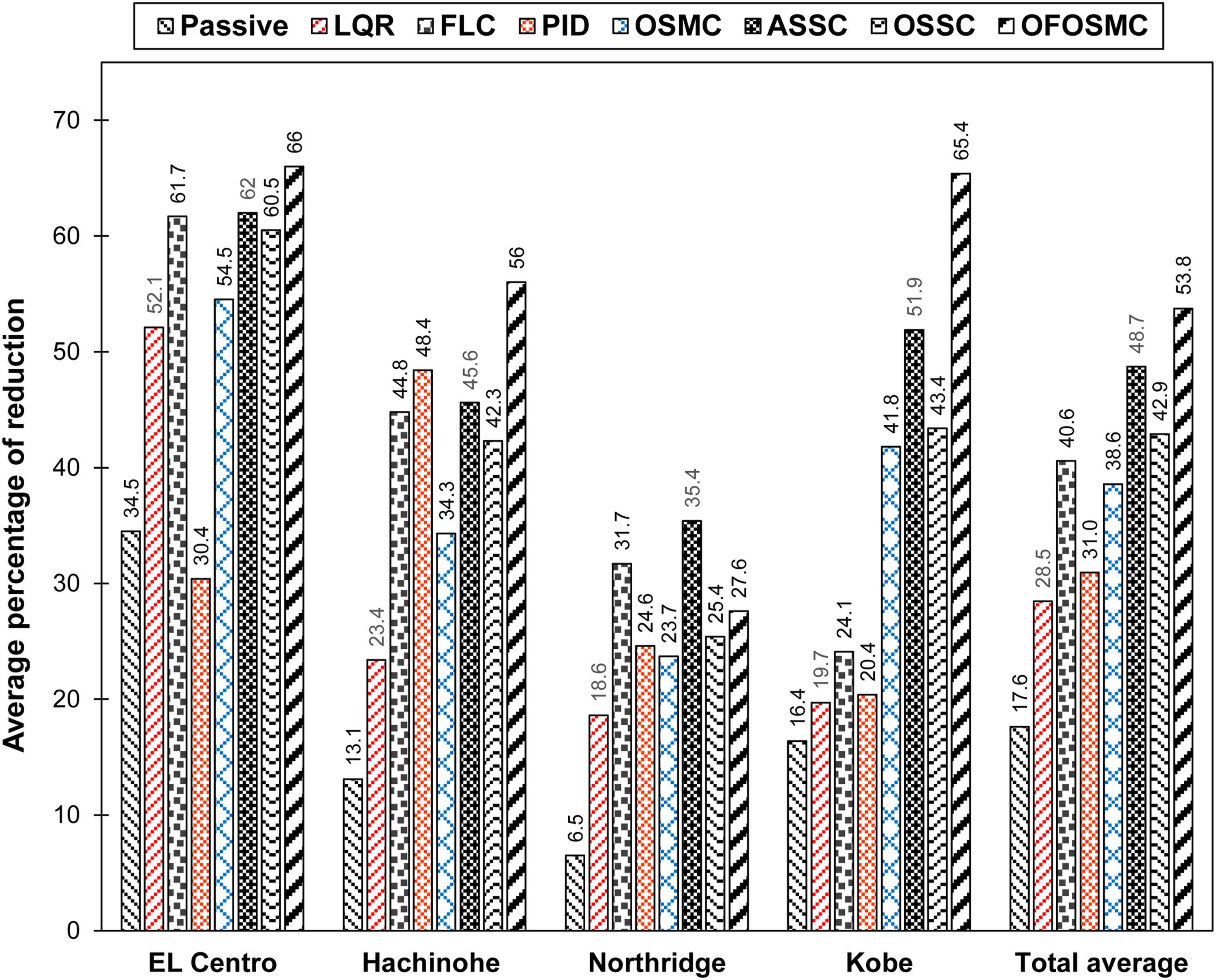
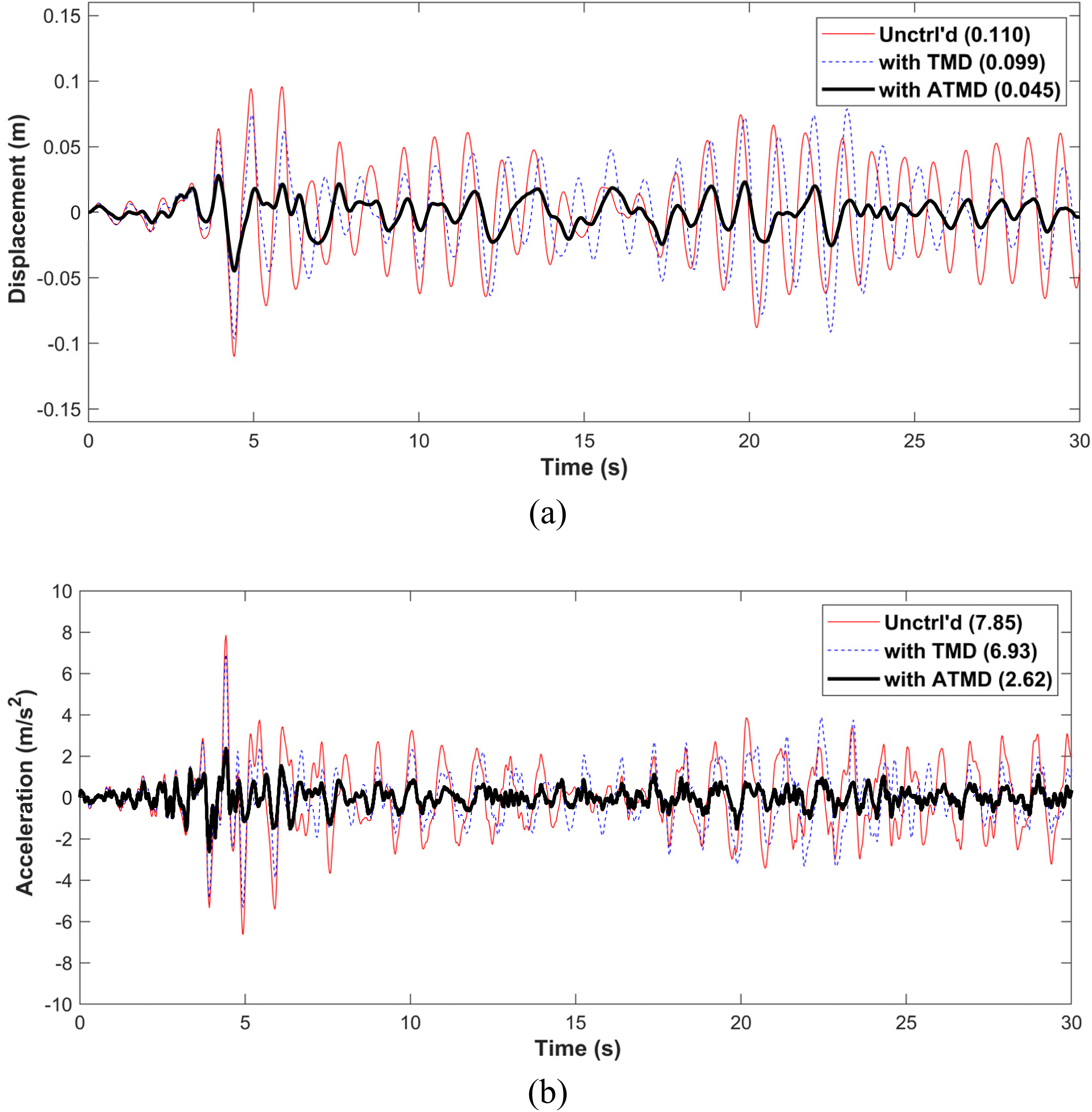
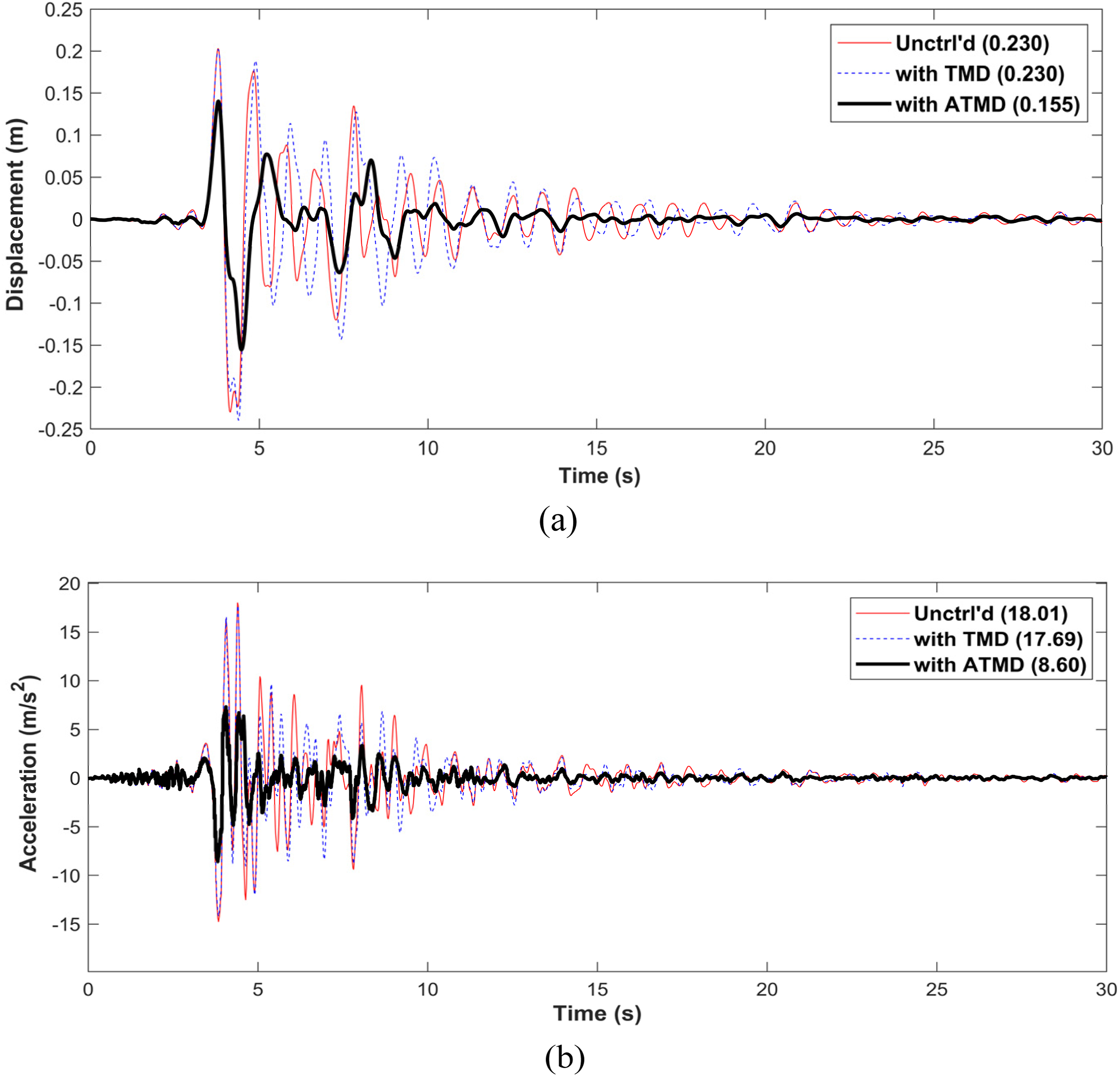
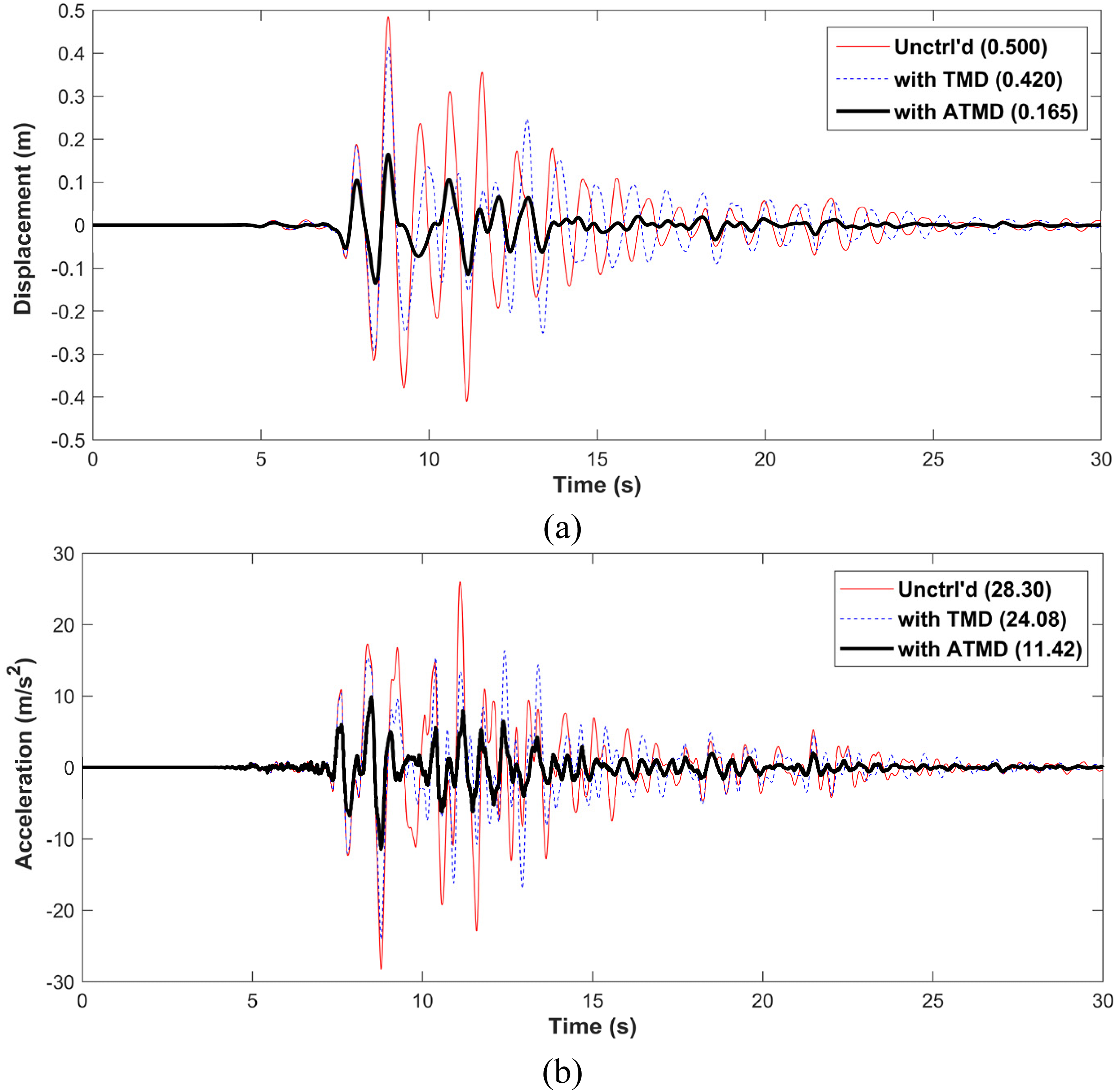
To show the performance of the OFOSMC strategy, Figures 9–12 present the time history of the top story displacement and acceleration of the ATMD-equipped structure and compare this displacement for the uncontrolled and TMD-controlled structures. As observed from Figures 9-12, the OFOSMC controller considerably mitigated the peak displacement and acceleration of the controlled structure subjected to the real earthquake excitations. Comparison of (a) displacement and (b) acceleration time history of the top story during El Centro earthquake. Comparison of (a) displacement and (b) acceleration time history of the top story during Hachinohe earthquake. Comparison of (a) displacement and (b) acceleration time history of the top story during Northridge earthquake. Comparison of (a) displacement and (b) acceleration time history of the top story during Kobe earthquake.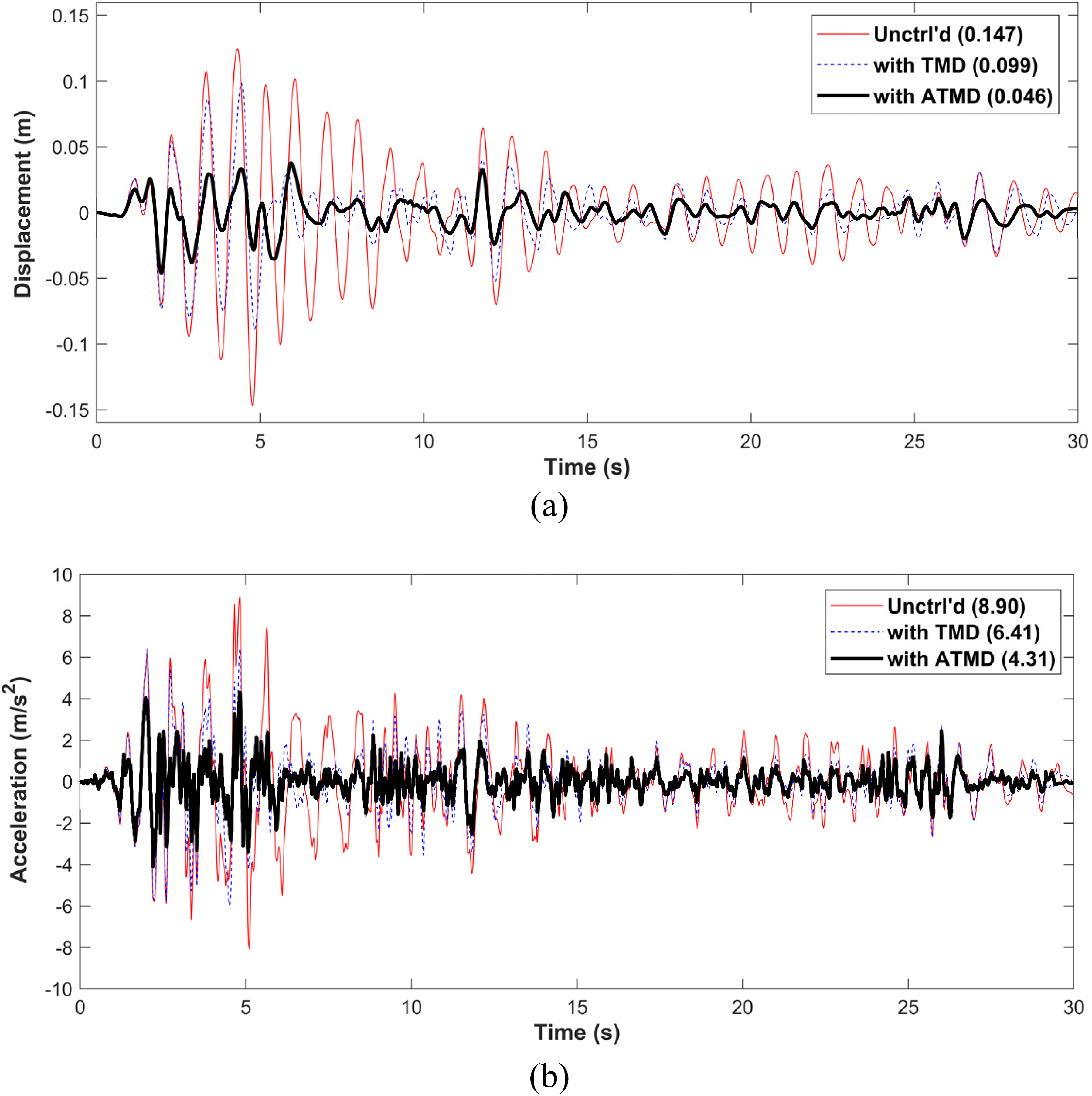
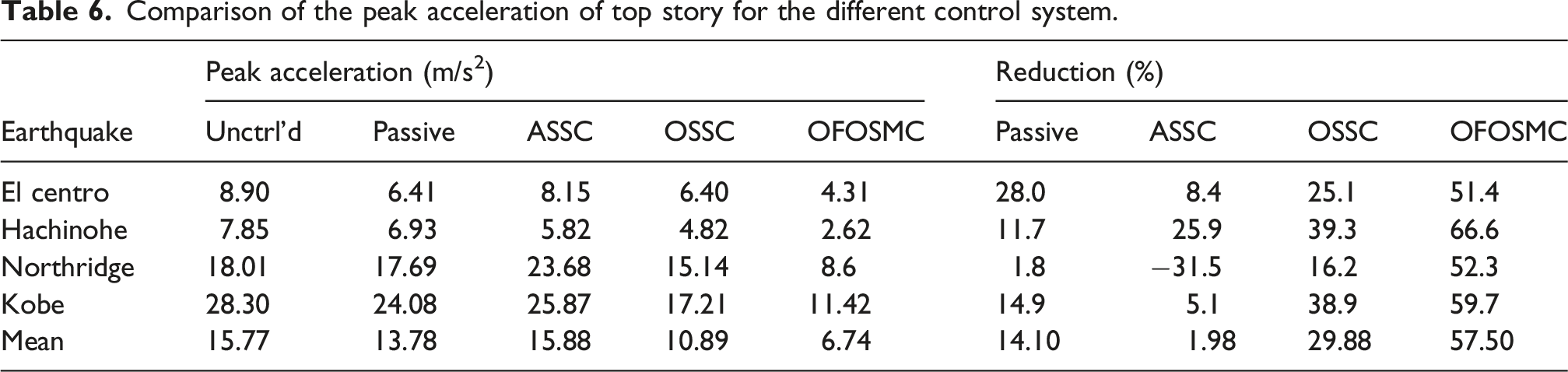
Comparison of the peak acceleration of top story for the different control system.
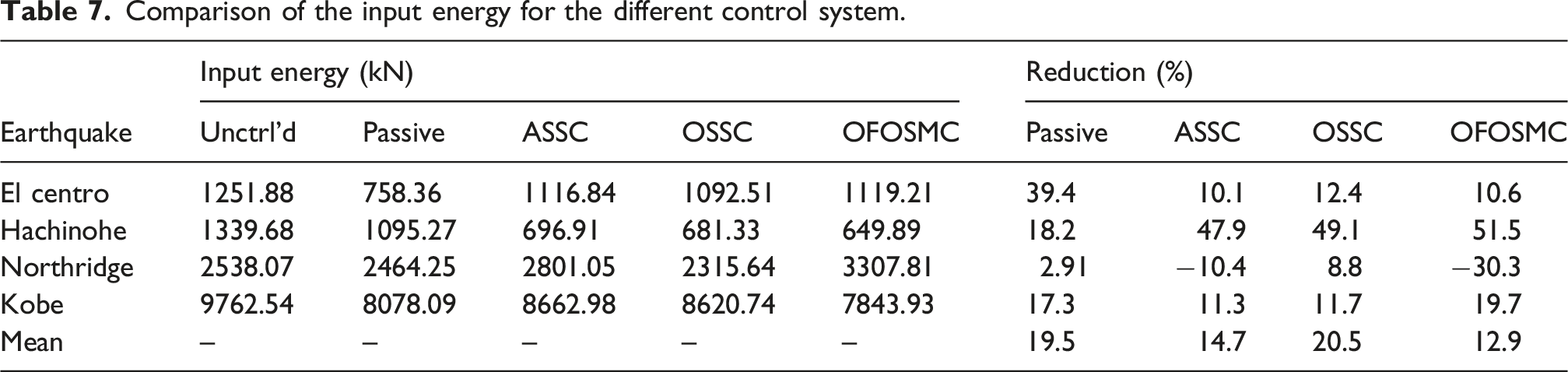
Comparison of the input energy for the different control system.
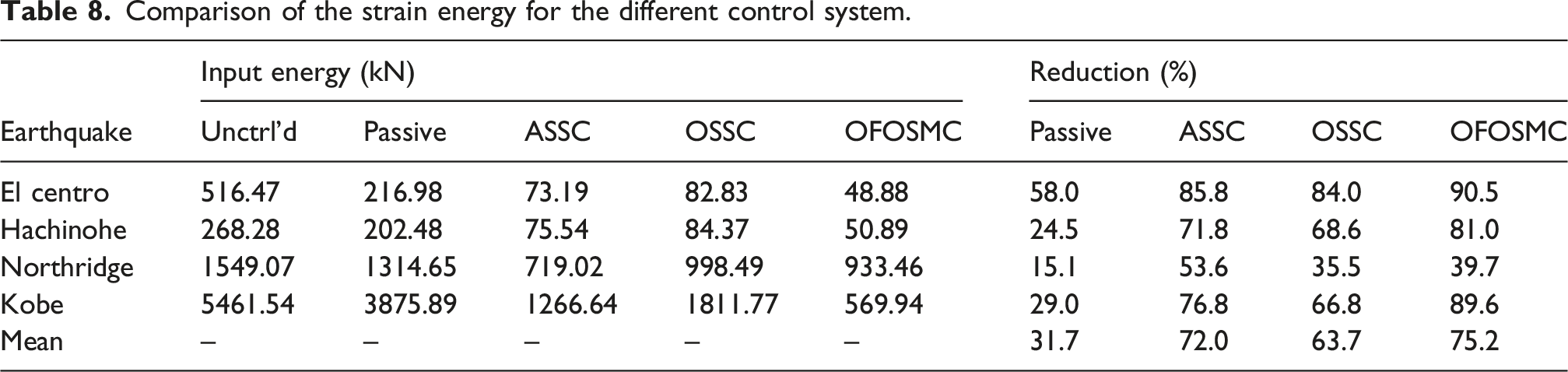
Comparison of the strain energy for the different control system.
Finally, Figure 13 indicates the time histories of the control force applied by the OFOSMC strategy under the real earthquake excitations. Results show that the maximum control force provided using the OFOSMC strategy is 2212, 1928, 7150, and 5567 kN under the El Centro, Hachinohe, Northridge and Kobe earthquakes, respectively. However, the maximum control force obtained using ASSC strategy is 1989, 1686, 8012, and 6517 kN, respectively (Saadatfar et al., 2023). Hence, the maximum force of the OFOSMC controller under the El Centro and Hachinohe earthquakes is almost 11% and 14% more than that of the ASSC controller, respectively. Furthermore, the corresponding value for the OFOSMC controller under Northridge and Kobe earthquakes is almost 11% and 15% less than that of the ASSC controller, respectively. Time history of the control force during the real earthquake records.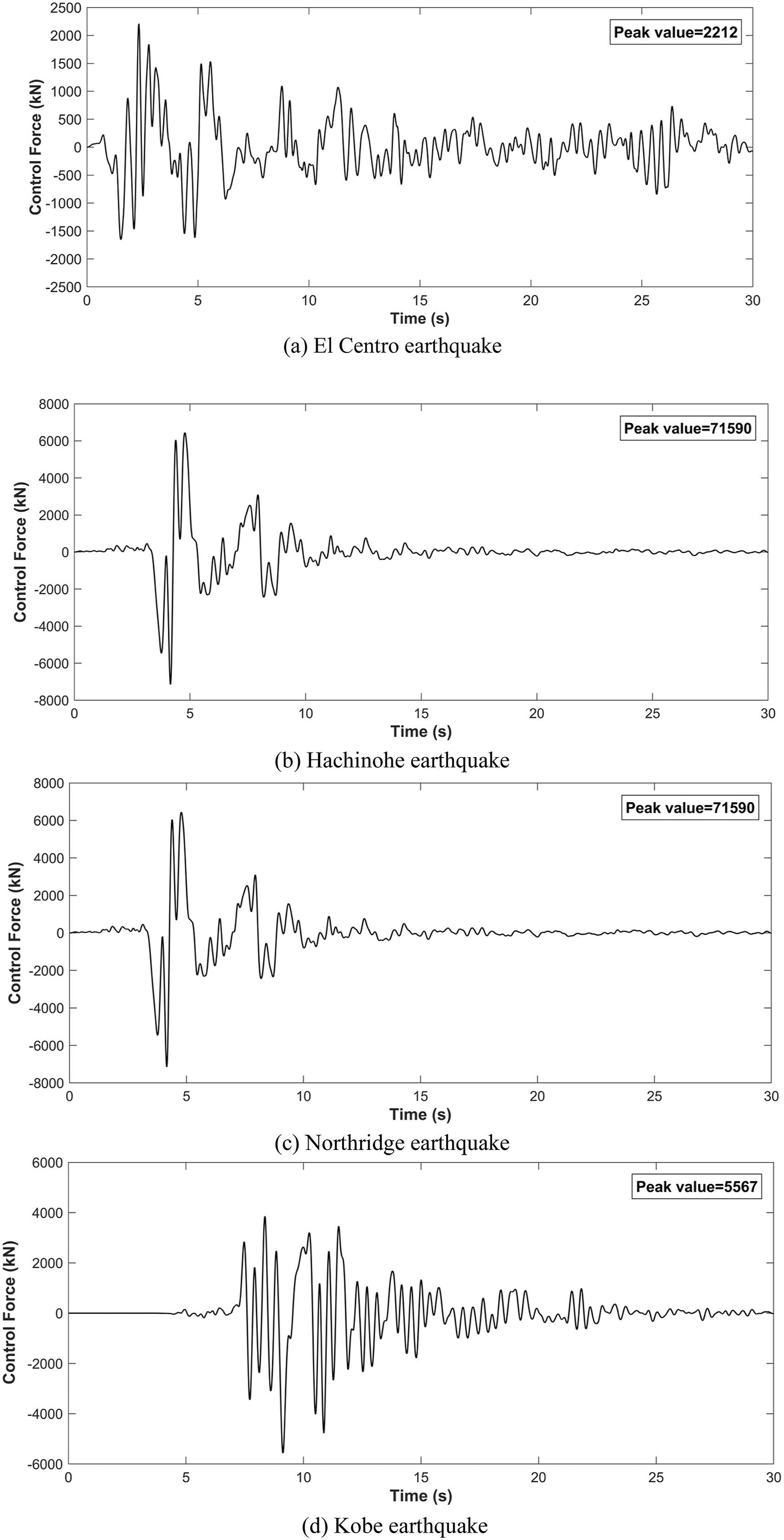
6. Conclusion
This study proposed the OFOSMC strategy for the seismic control of building structures equipped with ATMD. To this end, the design of the OFOSMC strategy was conducted by incorporating the concept of the fractional-order calculus into the SMC. Then, the LQR was adopted to obtain an optimal control strategy, where the minimization of a cost function was considered in this procedure. In this study, the effectiveness of the proposed OFOSMC strategy was investigated in two stages. In the first stage, the design of the proposed OFOSMC controller was performed for the seismic control of an ATMD-equipped 11-story shear frame structure subjected to an artificial earthquake record. In the second stage, the capability of the designed OFOSMC strategy was assessed under four real earthquake records and was compared with that of other controller techniques including LQR, PID, FLC, OSMC, ASSC, and OSSC. On the basis of the results obtained in this study, the following conclusions can be drawn: • Results indicated that the OFOSMC strategy–featured ATMD subjected to an artificial earthquake record reduced the peak displacement and acceleration of the top story by almost 62 and 39% in comparison with those of the uncontrolled structure. • The ATMD system subjected to an artificial earthquake record could mitigate the maximum value of the input, damping, and strain energies by 46%, 70%, and 82%, respectively, relative to the uncontrolled structure. • By comparison of the structural responses in the first stage, it was concluded that the control performance of the proposed OFOSMC was superior to that obtained with the OSSC and ASSC strategies. However, a comparison of the three control strategies shows that the values of their peak control forces are very similar. • Results indicated that using the LQR, FLC, PID, OSMC, ASSC, and OSSC controllers the total average values of the reduction percentage of the peak displacement for all stories were obtained by 28.5%, 40.6%, 31%, 38.6%, 48.7%, and 42.9%, respectively. In contrast, the total average value of this reduction percentage using the FOSMC-controlled ATMD was yielded by 53.8%. • The average value of the reduction percentage in the peak acceleration of the top story was yielded by approximately 58%, 2%, and 30% for the OFOSMC, ASSC, and OSSC strategies, respectively. • According to the average values of the reduction percentage for the strain energy of the controlled structure, the OFOSMC strategy (75.2%) outperformed the ASSC (72.0%) and OSSC (63.7%) controllers. • Therefore, comparative simulation results verified the robustness and effectiveness of the proposed OFOSMC strategy for the seismic control of building structures equipped with an ATMD system.
Despite the promising results, the present study involves certain limitations. Practical implementation challenges such as sensor failures, measurement noise, and time delays have been discussed in Section 4.5. However, the control performance was evaluated under idealized modeling assumptions without considering parametric uncertainties, or varying seismic intensity levels. Furthermore, experimental validation on physical ATMD systems remains unexplored. Addressing these limitations-along with robust stability analysis under real-world conditions-constitutes the main direction for future research.
