Fourth-order axially moving systems are common dynamic models, typically represented by axially moving beams. This paper derives closed-form forced vibration solutions for damped fourth-order axially moving systems. Three types of models are considered, including axially moving single-span fourth-order system, axially moving multi-span fourth-order system and axially moving coupled system composed of two fourth-order models. The Green’s function method is used to obtain the steady-state solutions. The Green’s functions of single-span system are obtained by the traditional Laplace transform technique, while those for multi-span and coupled systems are expressed by the Green’s functions of single-span systems and superposition principle. That is, the transverse vibration responses of the axially moving single-span, multi-span and coupled systems can be unified derived from the Green’s function of the single-span system via the superposition principle. This unified analytical framework avoids the complex continuity conditions in multi-span systems required by conventional Green’s function methods, and yields more accurate closed-form solutions than general numerical approaches. The reliability and convenience of the results are verified by several examples. The proposed method is characterized by its clarity, convenience for programming, and valuable for dynamic studies of axially moving systems.
Axially moving systems are widely applied in fields such as textiles, civil engineering, and aerospace (Ding et al., 2019; Hong and Pham, 2019; Pham and Hong, 2020). During transverse vibration, these systems experience Coriolis forces, making them typical gyroscopic systems (He et al., 2023). Engineering components including power transmission belts, band saws, elevator ropes in high-rise buildings, aerial cableways, and engine tension belts can be modeled as axially moving beams or strings. When bending stiffness cannot be neglected, these systems are more accurately described as axially moving fourth-order systems (Wickert and Mote, 1990).
Research on the dynamics of axially moving fourth-order systems primarily focuses on free vibration, forced vibration, and stability analysis. Jaksic (2009) incorporated viscous damping effects and presented a numerical method for computing natural frequencies. Yang et al. (2010) examined free vibration of axially moving beams on elastic foundations, identifying divergence and flutter beyond critical velocities. Yang et al. (2013) employed an artificial parameter method to derive closed-form approximate natural frequencies applicable to various boundary conditions. Ni et al. (2014) studied cantilever beams in fluid, introducing “axial additional mass coefficient” and analyzing natural frequencies using the Galerkin method. Due to axial velocity effects, modal functions in such systems exhibit complex rather than real modes (Tang et al., 2018). Forced vibration studies are also extensive. An and Su (2014) obtained semi-analytical solutions for axially moving Timoshenko beams under fixed and simply supported conditions via the generalized integral transform technique (GITT). Zhang et al. (2017) applied complex modal analysis to beams on viscoelastic foundations under arbitrary excitations and initial conditions. Zhao et al. (2021) derived analytical solutions for thermoelastic coupled forced vibration in micro-/nanobeams using Green’s function, with results validated. Ali et al. (2021) investigated the transverse dynamic response of an axially moving beam with an intermediate viscoelastic support using Hamilton’s principle and the finite difference-state space method, where the beam is treated as a single-span structure with continuity constraints imposed at the support location. Liu and Yao (2024) proposed a dynamic model of two beams with free internal hinges under axial motion, explored their vibration characteristics, and found that the presence of axial velocity strengthens the coupling between modes. Feng et al. (2025) proposed a novel generalized finite difference method (GFDM) to study the transverse vibration of an axially moving beam and proved that the method is applicable to arbitrary boundary conditions. Additional research covers composite laminated beams (Ghayesh, 2011), systems with pulsating axial velocity (Chen and Yang, 2006), and geometrically nonlinear systems (Ali and Hawwa, 2023; Han et al., 2025; Wu et al., 2025).
The existing research primarily focuses on traditional axially moving single-span fourth-order systems, with additional studies addressing multi-span systems and coupled systems. Al-Jawi et al. (1995) derived transverse vibration equations for two-span axially moving beams via Hamilton’s principle, and numerically examined axial velocity and support position impacts on natural frequencies. Tan and Riedel (1999) adopted the transfer function method to investigate free vibration of multi-span beams with transverse and rotational elastic supports, revealing that higher constraints improve critical axial velocity. Ghayesh and Amabili (2013) numerically analyzed nonlinear forced vibration and stability of spring-supported axially moving Timoshenko beams using Galerkin and pseudo-arc continuation methods. Xue et al. (2024) employed the transfer matrix method to investigate the vibration characteristics and stability of an axially moving beam with multiple intermediate elastic supports. In this approach, it is essential to impose strict continuity conditions at each support location, including the continuity of displacement, slope, bending moment, and shear force. Recently, Wang et al. (2025) proposed a reduced complex transfer matrix method for multi-span axially moving beams with elastic supports, which effectively alleviates numerical ill-conditioning with increasing span numbers and maintains high computational accuracy. Zinati et al. (2020) divided the axially moving viscoelastic Rayleigh beam into two segments at the intermediate support, derived two governing equations via Hamilton’s principle, and solved the system under junction continuity conditions. Similar methods apply to coupled systems. Li et al. (2018) established nonlinear governing equations for axially moving viscoelastic sandwich beams, and compared their amplitude-frequency responses, stability and primary resonant dynamics. Marynowski (2018) analyzed thermal-induced dynamics of axially moving nanotube-reinforced sandwich beams with viscoelastic cores, considering axial velocity and parameter influences.
In summary, conventional analytical treatments for axially moving systems often involve cumbersome derivations and complicated implementations, especially when enforcing continuity and force-balance conditions at intermediate supports. To simplify such analysis, a promising approach was proposed in Štimac Rončević et al. (2019) for frequency equation analysis, in which support reactions are treated as equivalent external excitations, and Green’s functions are introduced to render the formulation concise and straightforward. Motivated by this advantage, this work extends and generalizes the Green’s function–based framework to the dynamic analysis of fourth-order axially moving systems. Specifically, the Green’s functions of single-span systems are utilized to derive the analytical solutions for multi-span systems and coupled systems with intermediate discontinuous supports, aiming to avoid tedious continuity-handling procedures and provide a clear, unified, and easily implementable solution for both free and forced vibrations.
The paper is structured as follows: Section 2 presents the closed-form Green’s functions and response solutions for a single-span system. Sections 3 and 4 extend this to derive analytical solutions for multi-span and coupled systems, respectively. Section 5 summarizes the proposed method and highlights its innovations. Section 6 verifies the method and discusses representative examples. Finally, conclusions are drawn in Section 7.
2. Axially moving single-span fourth-order system
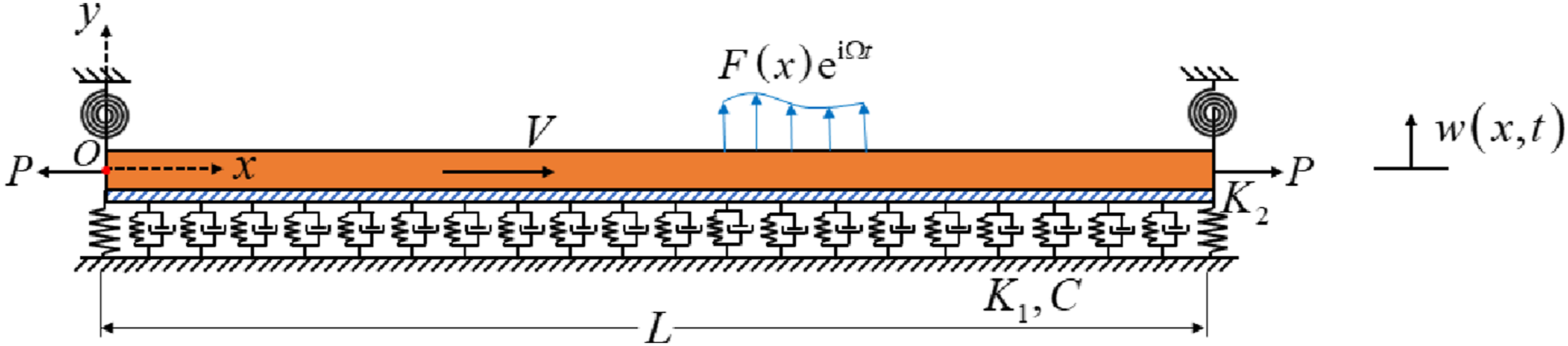
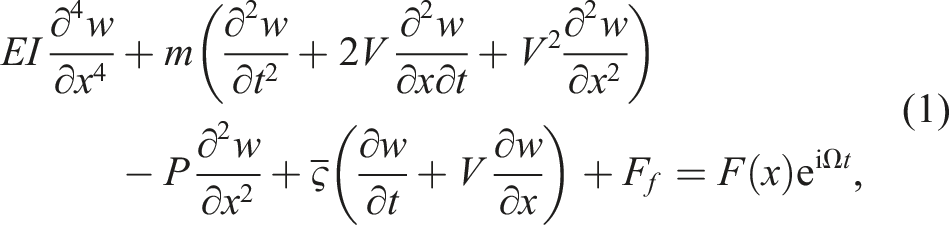
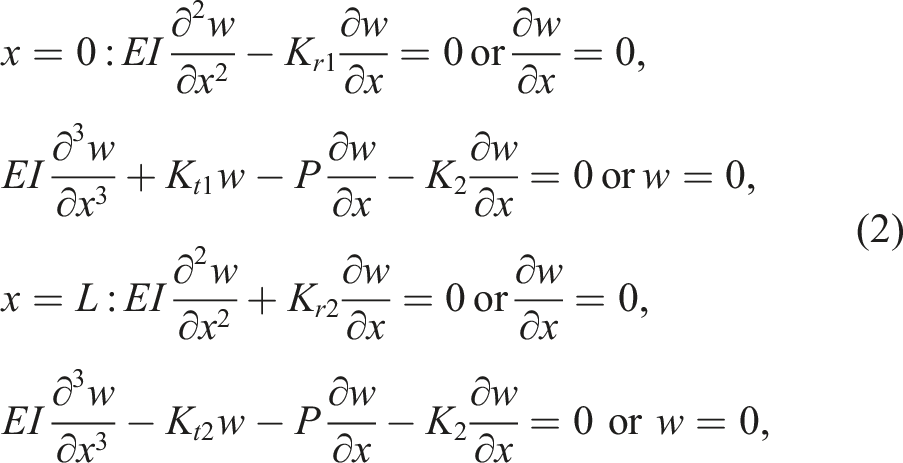
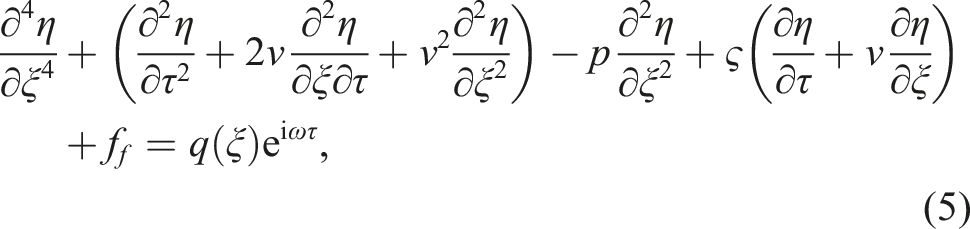
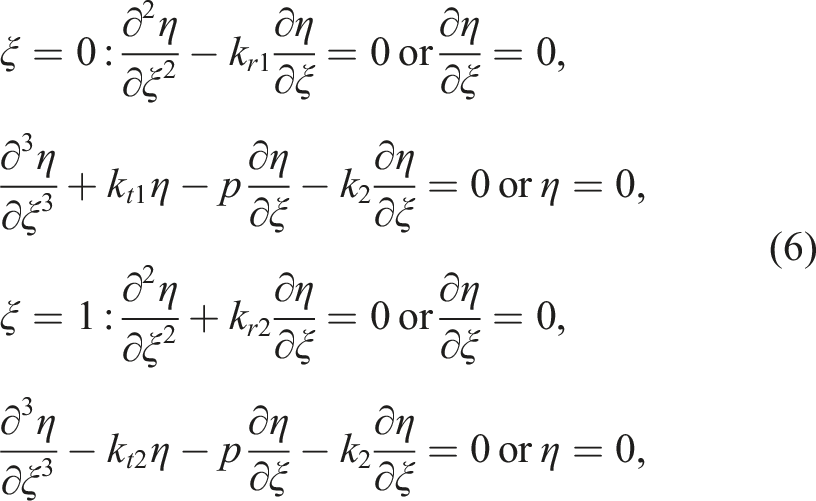
This section analyzes the transverse forced vibration of a fourth-order axially moving single-span beam system. Figure 1 illustrates the beam on a viscoelastic Pasternak foundation, representing a high-speed conveyor belt. The system has length L, bending stiffness EI, mass per unit length m, and structural damping , moving axially at velocity V under axial tension P and harmonic excitation with frequency . , , and C represent foundation stiffness, shear stiffness, and damping, respectively. Generalized boundary conditions involve translational and rotational springs , (left) and and (right). The governing equation and boundary conditions are (Wickert and Mote, 1990; Yang et al., 2010)
Where represents the foundation force, expressed as
Schematic diagrams of the axially moving single-span beam systems on viscoelastic Pasternak foundation.
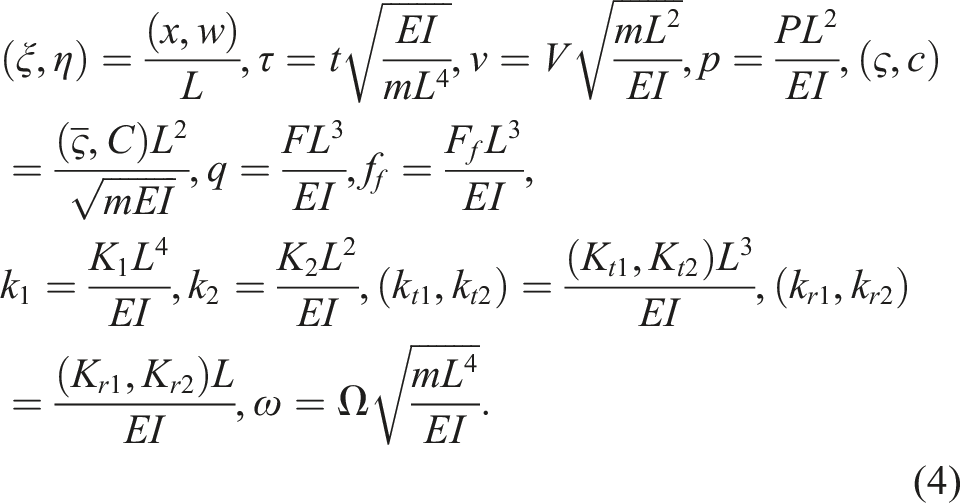
For simplicity, dimensionless parameters are introduced as
The dimensionless governing equations and boundary conditions are
Where 0 is the zero matrix, E denotes the unit matrix, and there are
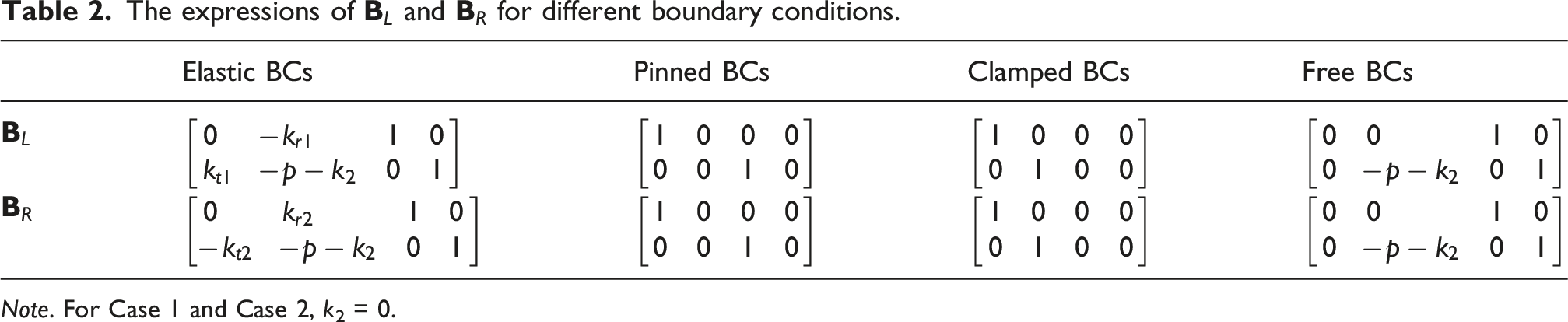
and , are the coefficient matrices related to left boundary and right boundary, respectively. Their expressions for common boundaries are listed in Table 2.
The expressions of and for different boundary conditions.
Elastic BCs
Pinned BCs
Clamped BCs
Free BCs
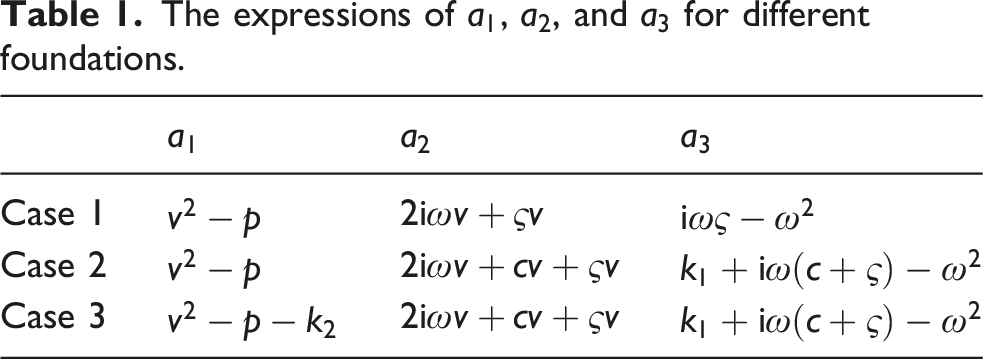
Note. For Case 1 and Case 2, k2 = 0.
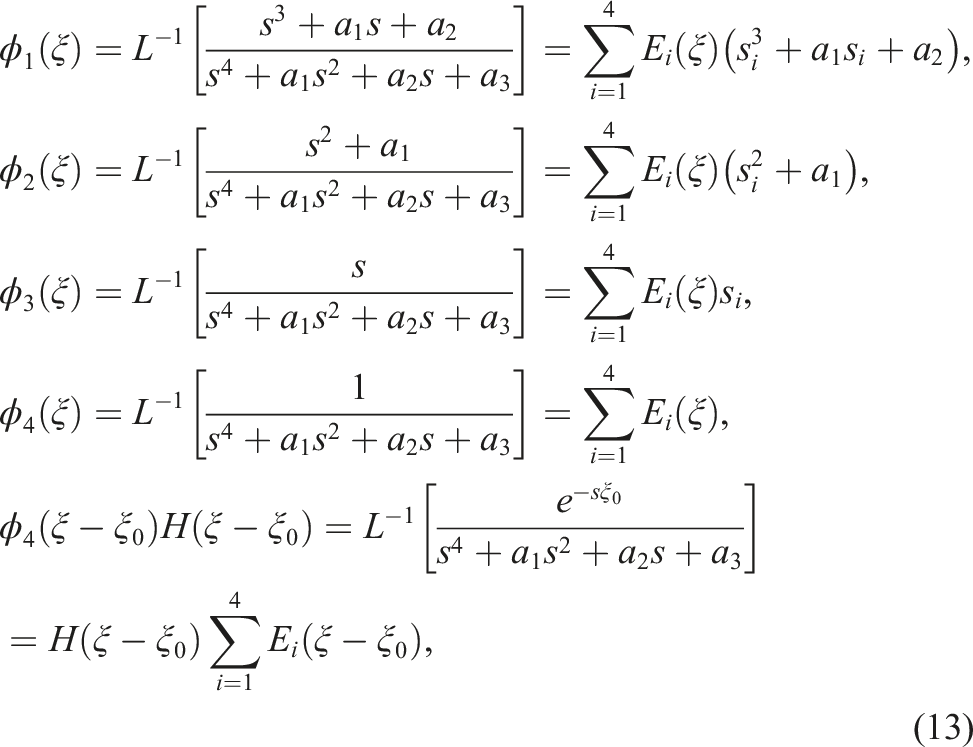
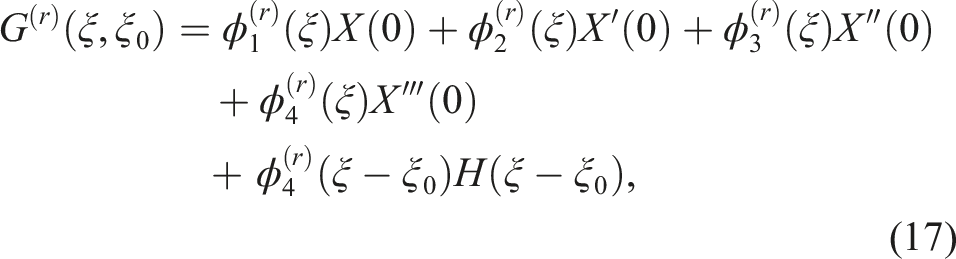
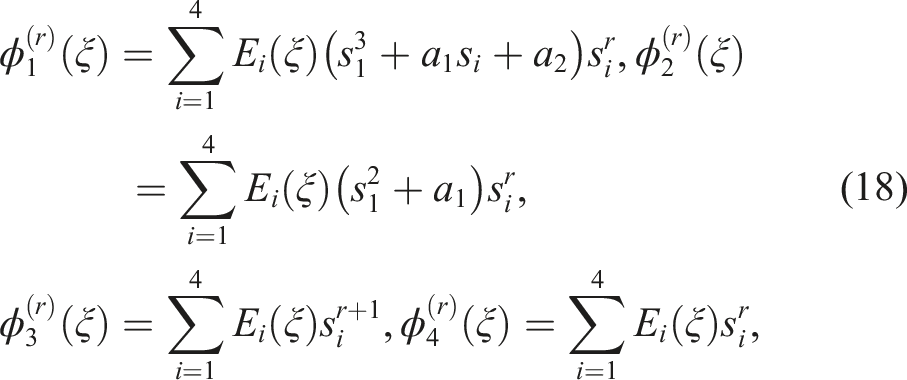
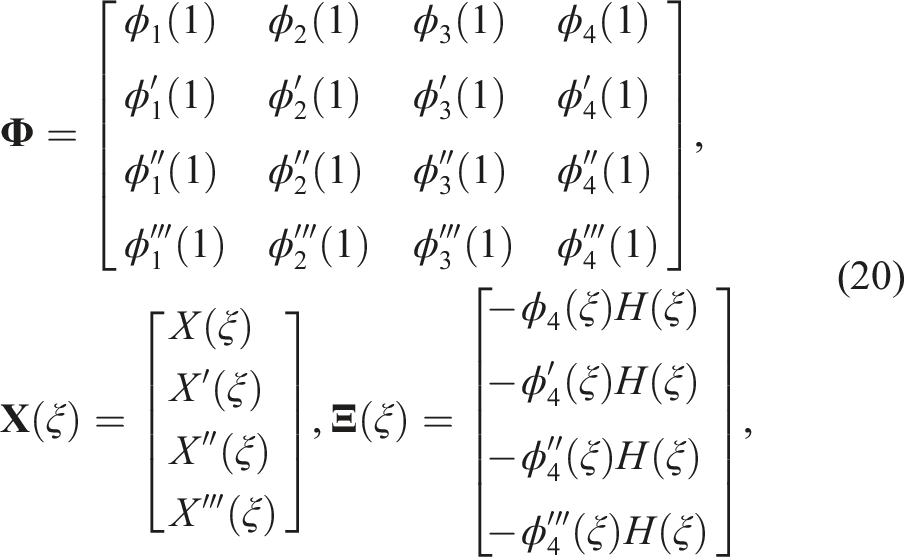
Solving equation (19) yields the unknown coefficients and , and substituting the results into equation (16) yields the complete form of the Green’s function . Moreover, it can be seen that the unit step function term in is associated with the external excitation. For the free vibration problem without external excitation, this term can be eliminated, and the remaining solution corresponds to the modal function of the system, which can be given as
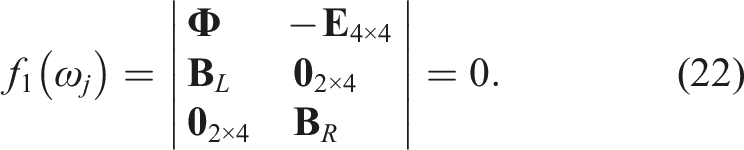
Where represents the jth order frequency of the axially moving single-beam system. The natural frequency can be determined by two approaches, namely the frequency response curve method and the frequency equation method. Substituting the modal function into the boundary conditions leads to a system of linear homogeneous equations, which corresponds to the case where the external excitation in equation (19) is zero. To ensure the existence of non-trivial solutions for the modal function, the determinant of the coefficient matrix must be zero, which yields the frequency equation as
3. Axially moving multi-span fourth-order system
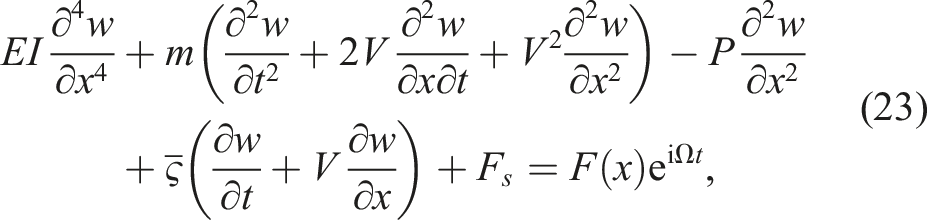
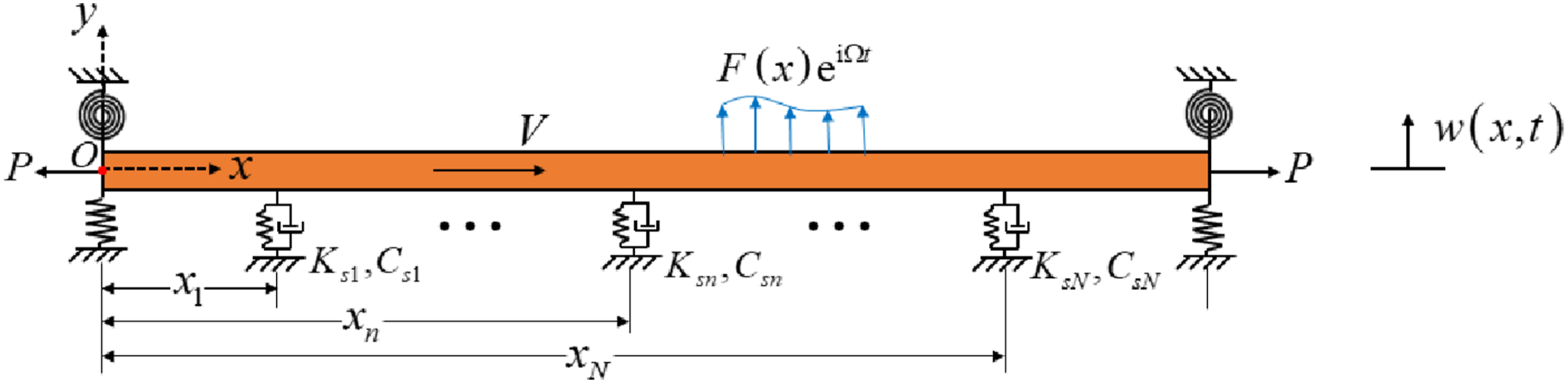
Figure 2 shows the schematic of the axially moving multi-span beam system, which corresponds to a long-distance conveyor belt with intermediate supports. Its model parameters, loading, and boundary conditions are identical to the single-beam model in Section 2. The intermediate supports are considered as the spring-damping systems, and the number of supports is denoted by N. The stiffness coefficient, damping coefficient and position of the nth support are represented by , and respectively. The governing equation is (Xue et al., 2024)
Where Fs denotes the intermediate support force, given by
Schematic diagram of the axially moving multi-span beam system.
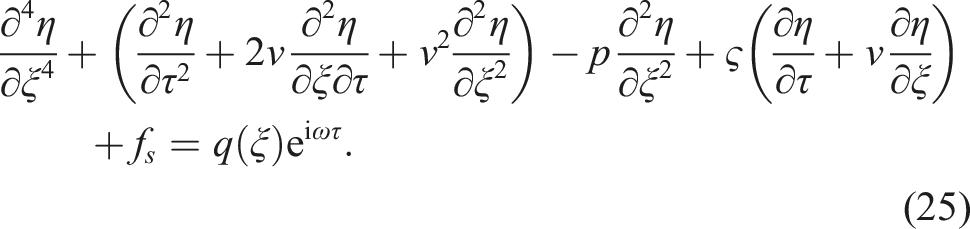
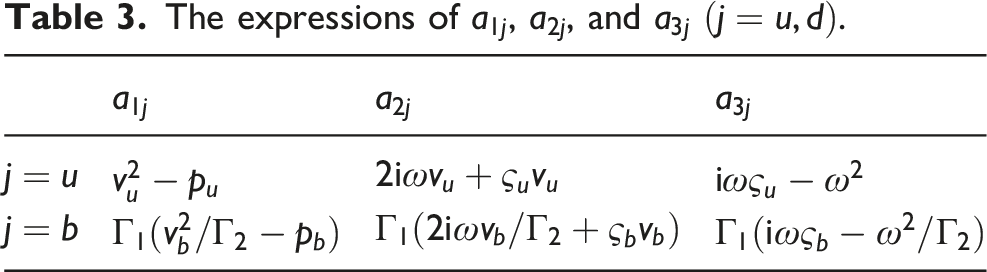
According to equation (4), the dimensionless governing equation is
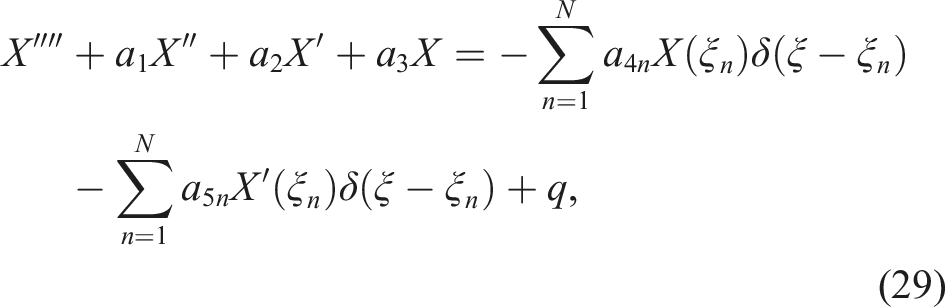
Substituting this equation into equation (25) and simplifying, we get the following expression
Where and are
By the superposition principle, the solution to equation (29) is given by a convolution integral
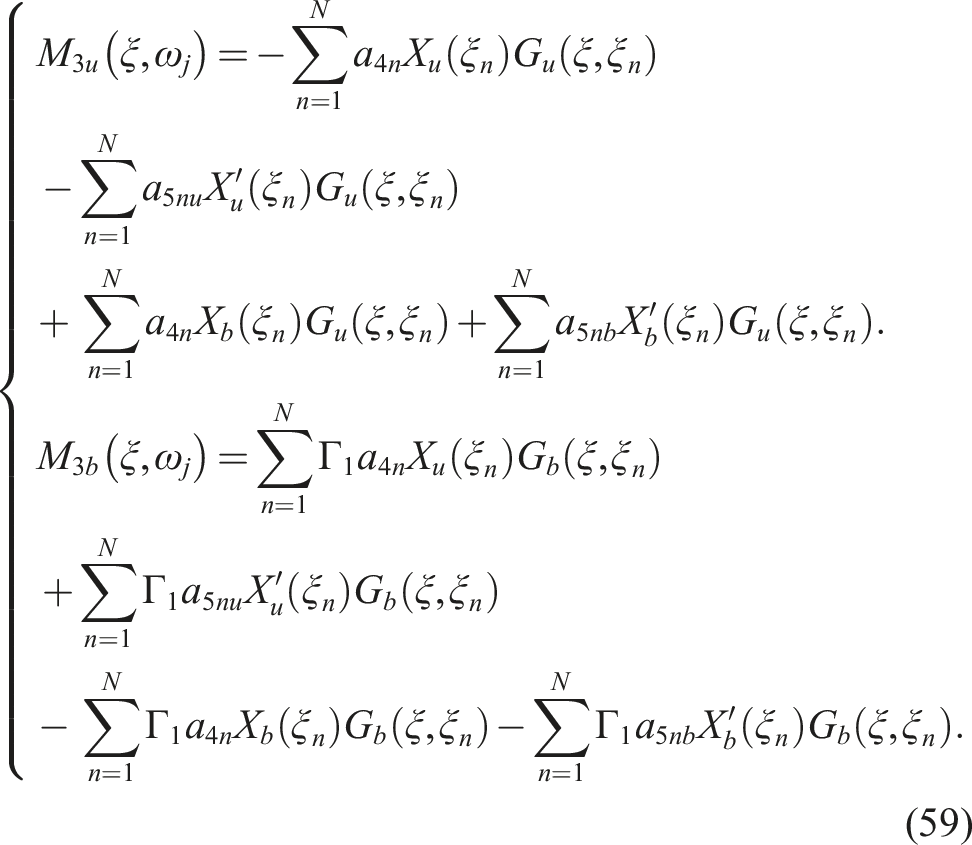
Where is the Green’s function of axially moving multi-span system, obtained by
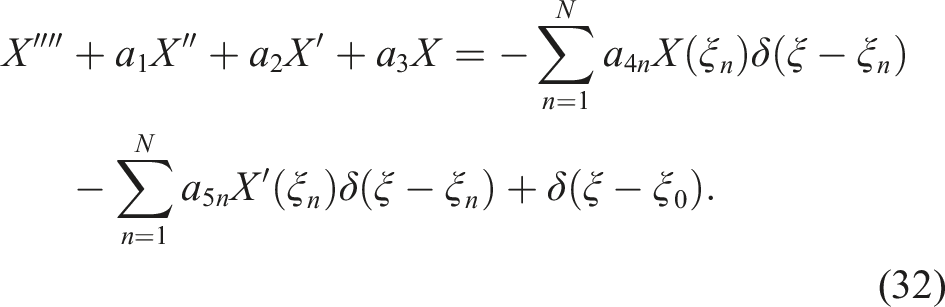
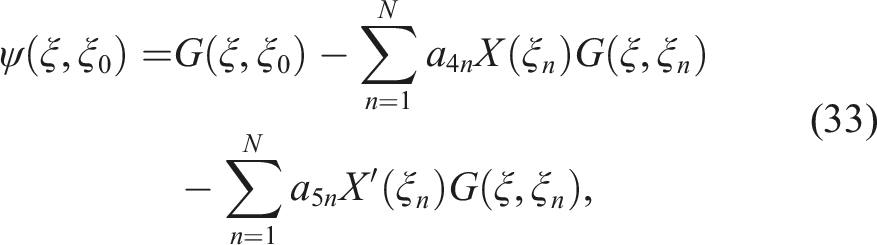
By superposition principle, is expressed as
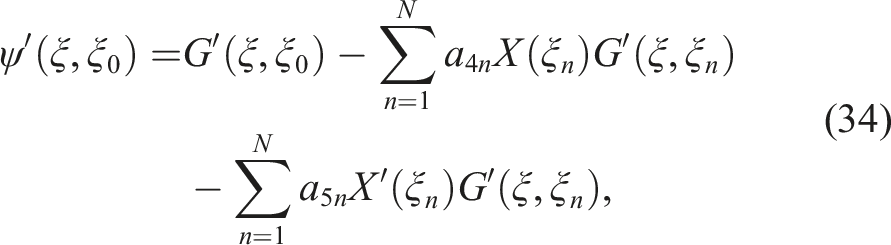
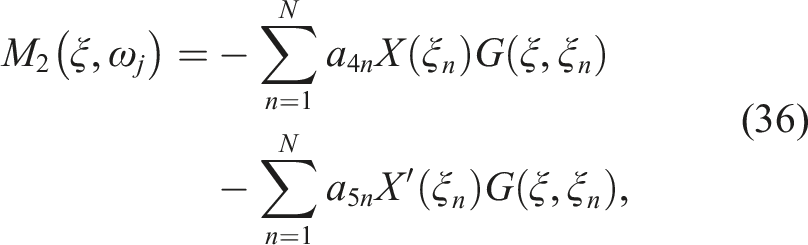
contains 2N unknown parameters and associated with intermediate support positions. To obtain these parameters, its first-order derivative with respect to is given as
Substituting into equations (33) and (34), the following equation can be obtained
Where , , , , , , , and are given in Appendix A. Solving this inhomogeneous equation yields all unknown parameters in . In , the effect of external excitation is reflected in . For free vibration without external excitation, the external excitation term is neglected, and the modal function of the axially moving single-beam system with intermediate supports can be obtained as
Following the same derivation as that in Section 2, the frequency equation obtained from the zero-determinant condition for non-trivial modal solutions is given by
4. Axially moving coupled fourth-order system
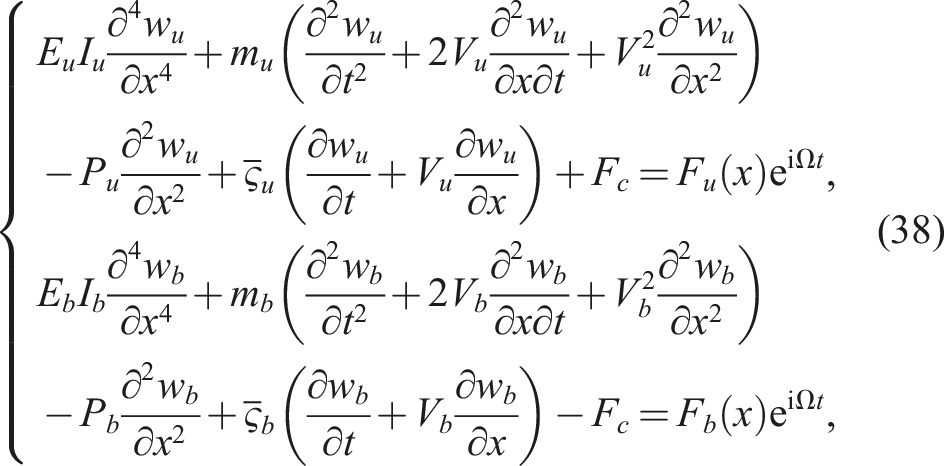
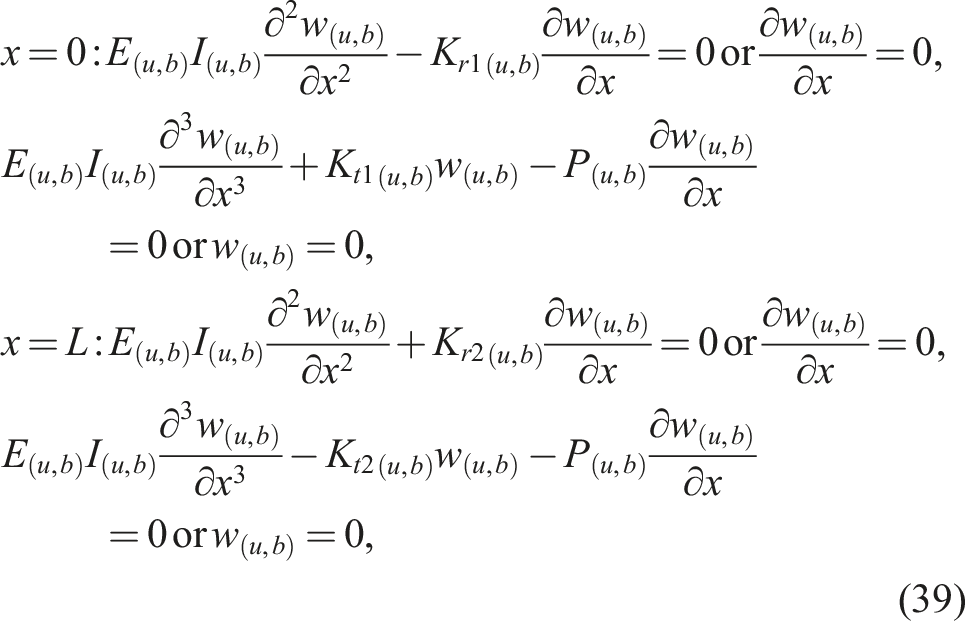
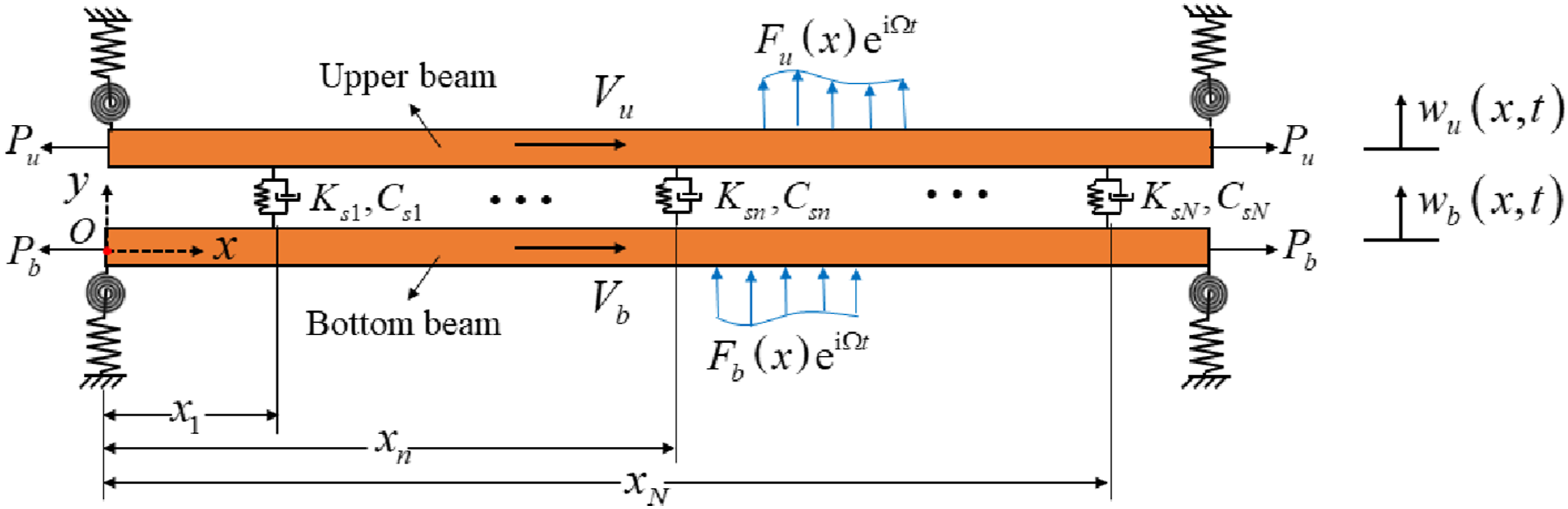
This section considers the forced vibration problem of the axially moving coupled fourth-order systems. Figure 3 schematically shows an axially moving double-beam system with intermediate supports, equivalent to a coupled double-layer conveyor belt, comprising an upper beam, a bottom beam, and N intermediate spring-damping supports. For the nth support, , and denote its stiffness, damping coefficient, and position, respectively. Subscripts u and b distinguish upper- and bottom-beam parameters, with axial velocities and . The system is under axial tension and transverse harmonic excitation: upper-beam tension and force ; bottom-beam tension and force . Transverse displacements are and . Governing equations and boundary conditions are as follows
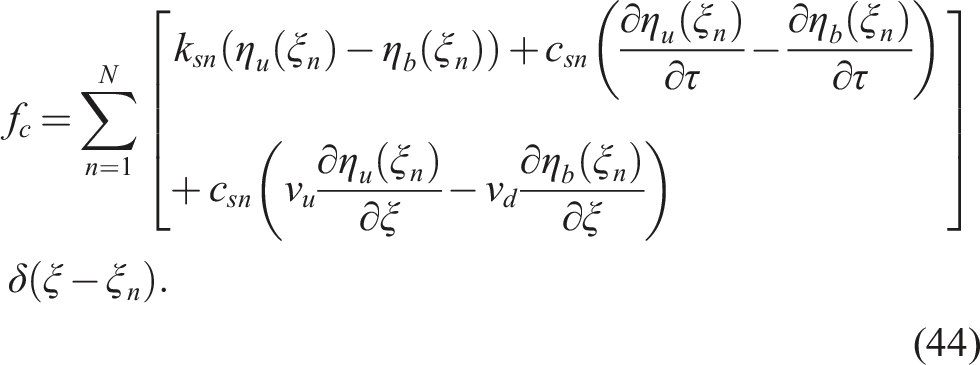
Where , are the flexural rigidities of the two beams; and their mass per unit length; and their structural damping. , , , and , , , are the tension spring stiffness coefficients for the left/right boundaries of the upper and bottom beams, respectively. denotes the intermediate support force, given by
Schematic diagram of the axially moving double-beam with intermediate supports.
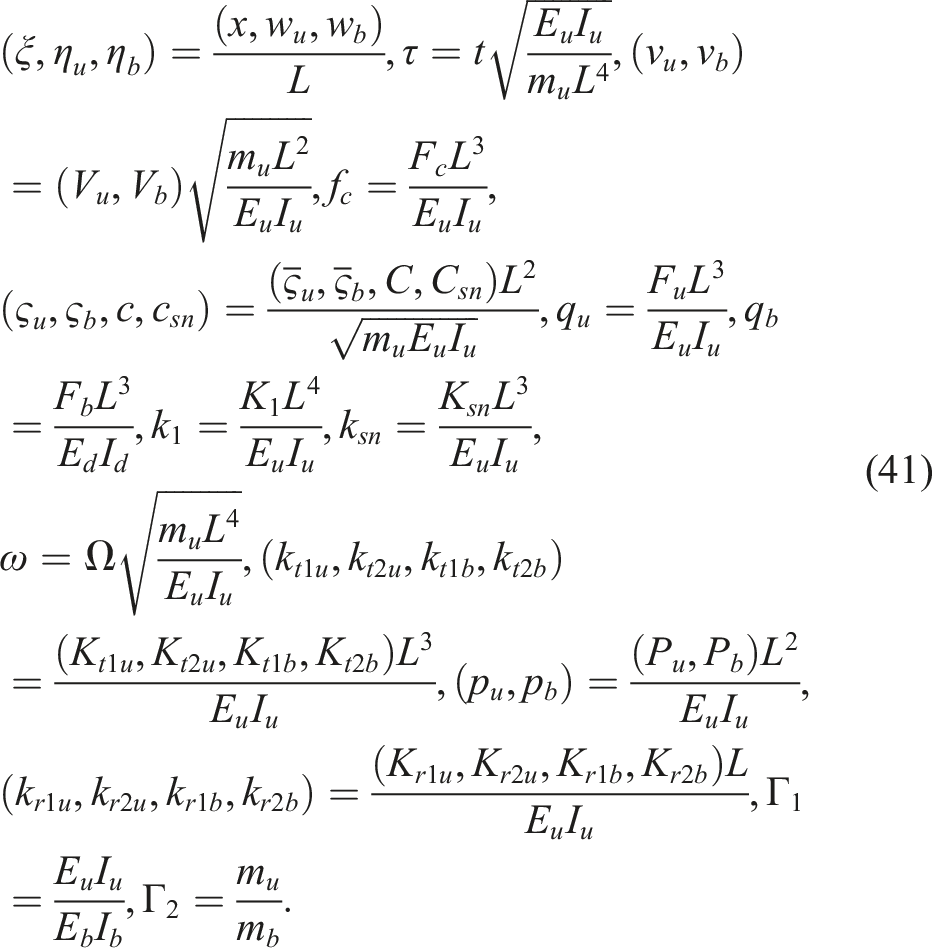
The following dimensionless parameters are introduced
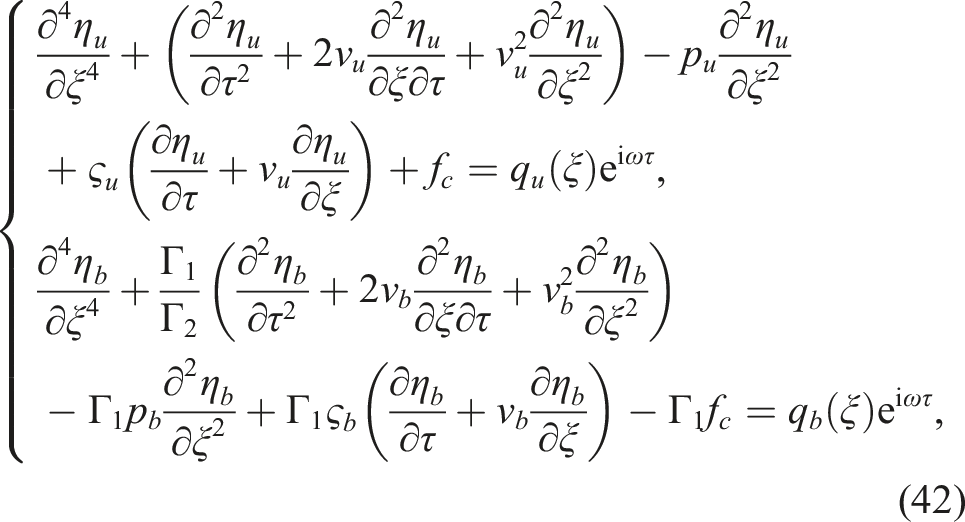
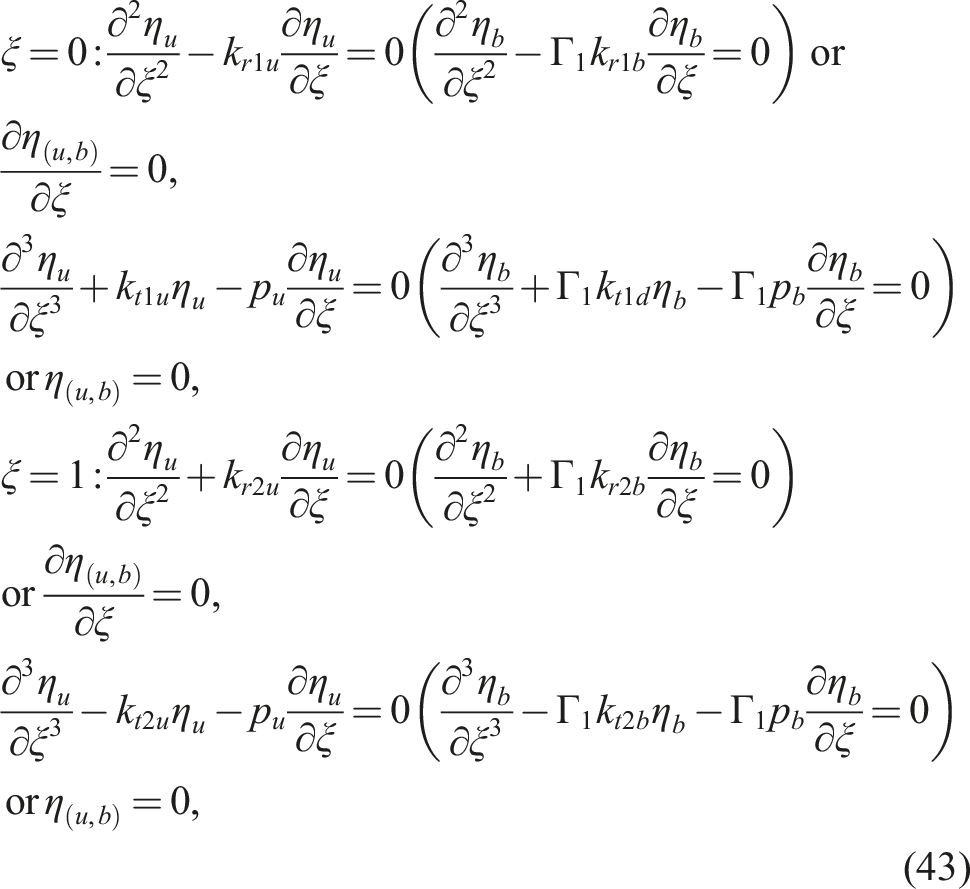
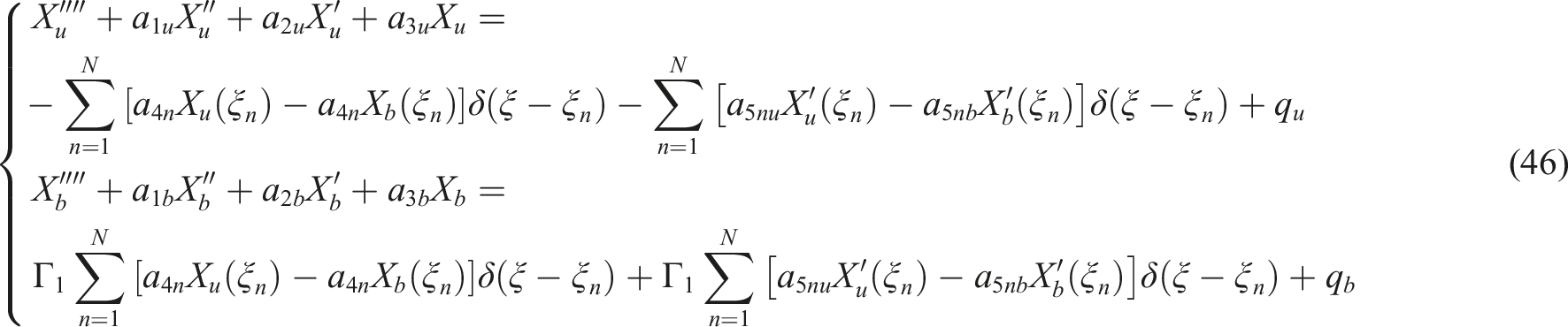
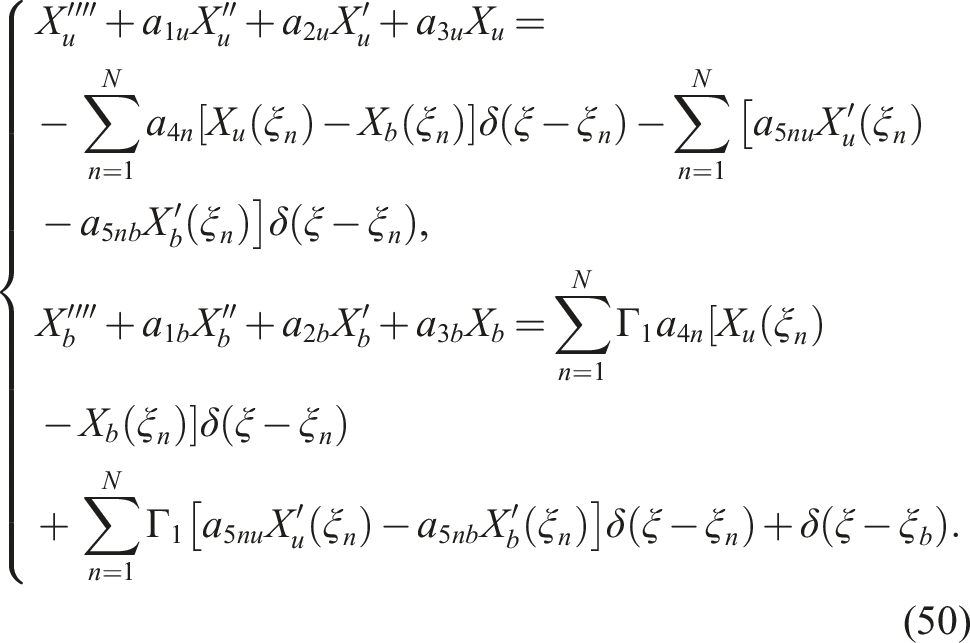
Dimensionless equations and boundary conditions are written as:
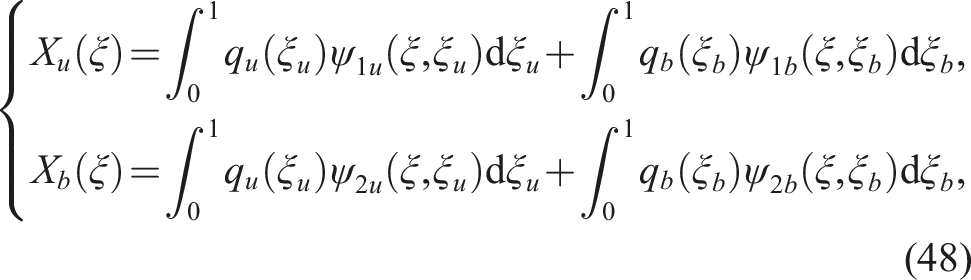
By linear superposition, the solutions to equation (46) are expressed as
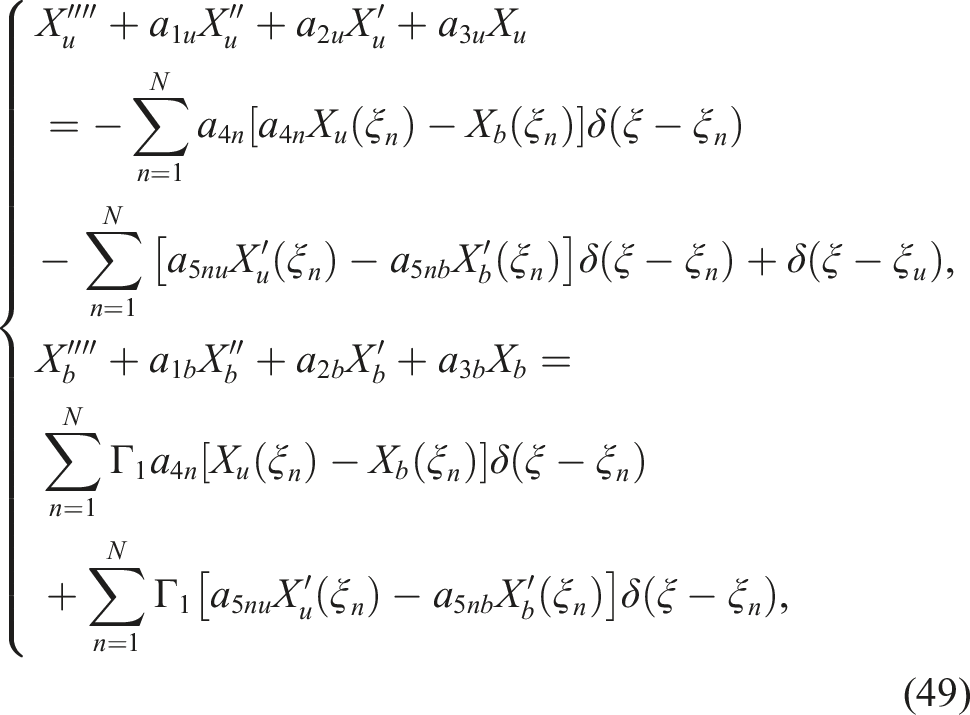
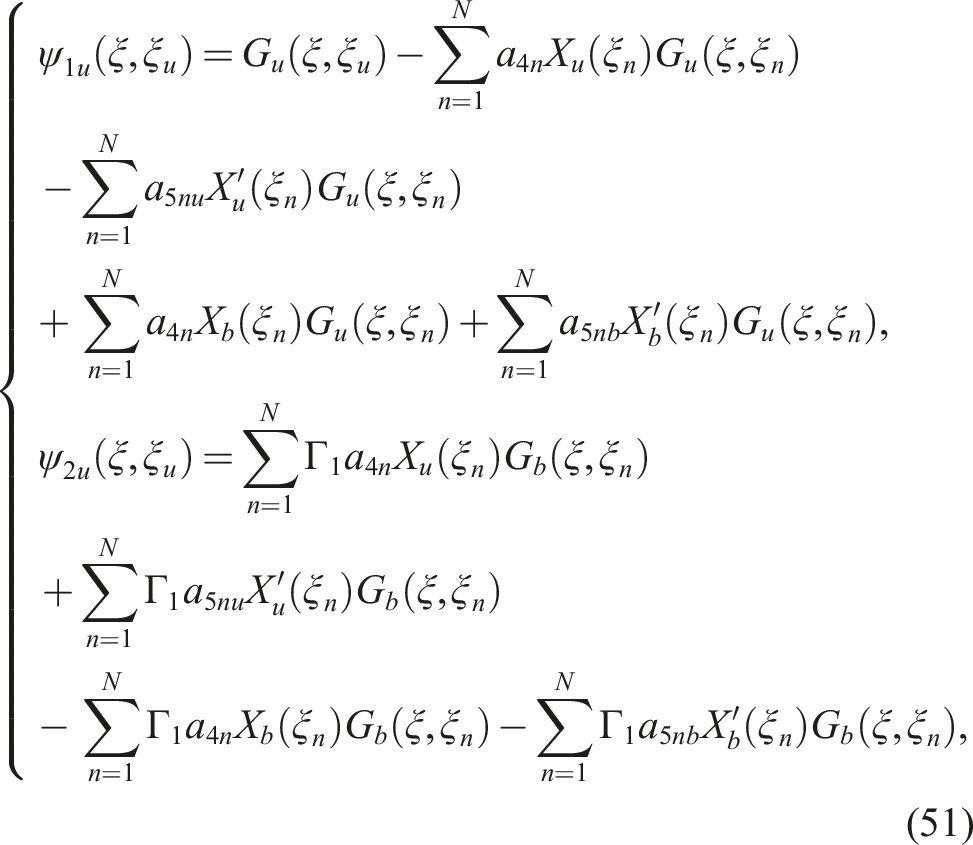
Where and are Green’s functions of the double-system under a unit force on the upper beam, and and correspond to a unit force on the bottom beam. and denote the respective loading positions. By physical meaning, the upper-beam functions satisfy equation (49) and the bottom-beam functions satisfy equation (50)
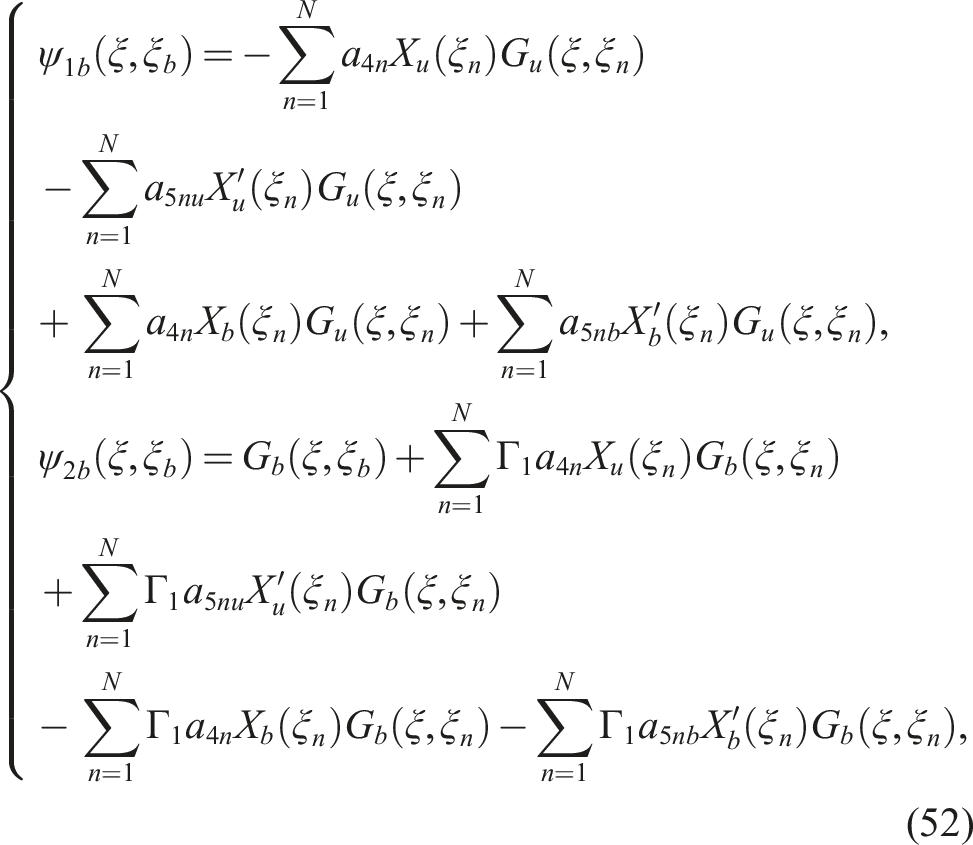
By superposition principle, the solutions of equation (50) are expressed as
Where and are Green’s functions of decoupled upper and bottom beams, respectively, which are solutions to equations (53) and (54).
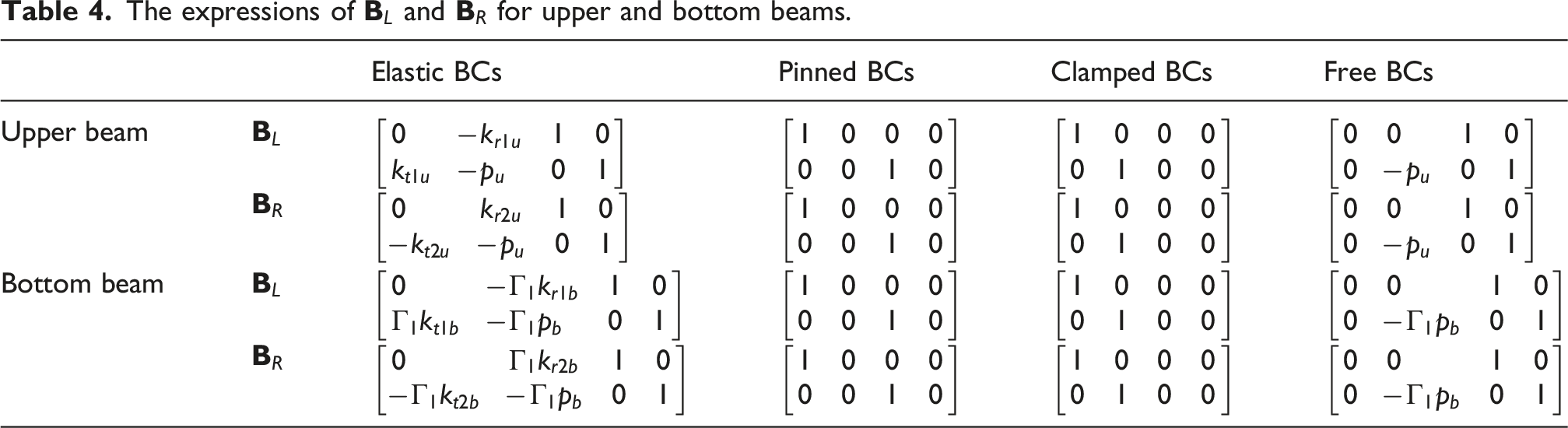
The solving process of equations (53) and (54) is presented in Section 2, and matrices and are listed in Table 4.
The expressions of and for upper and bottom beams.
Elastic BCs
Pinned BCs
Clamped BCs
Free BCs
Upper beam
Bottom beam
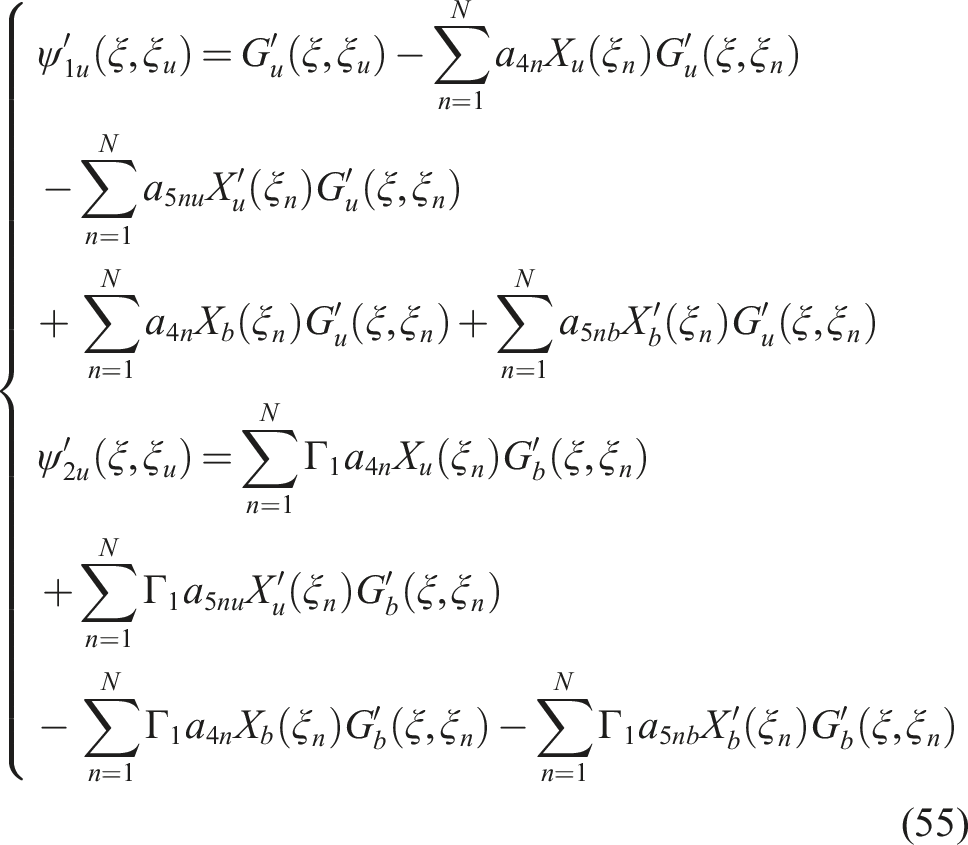
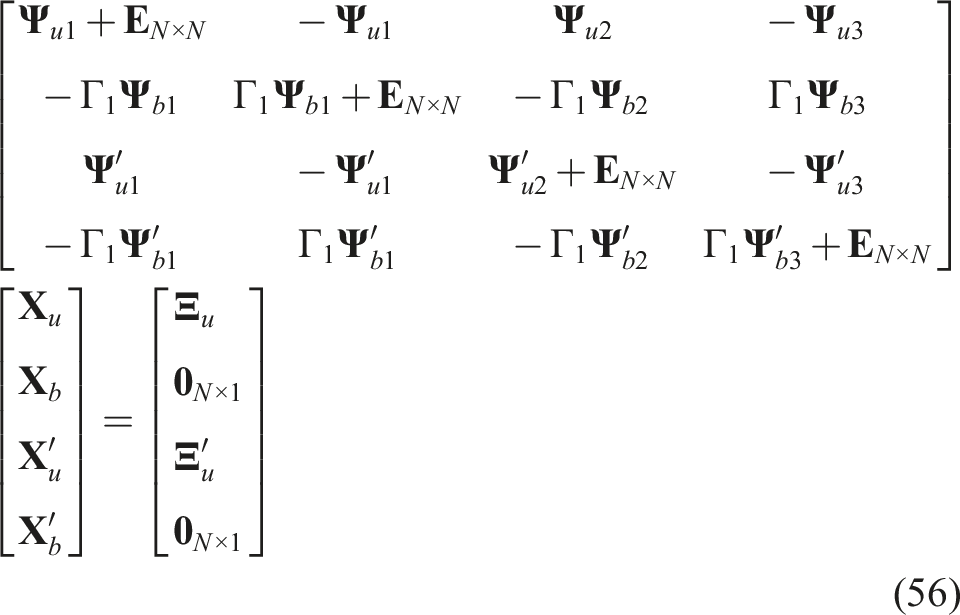
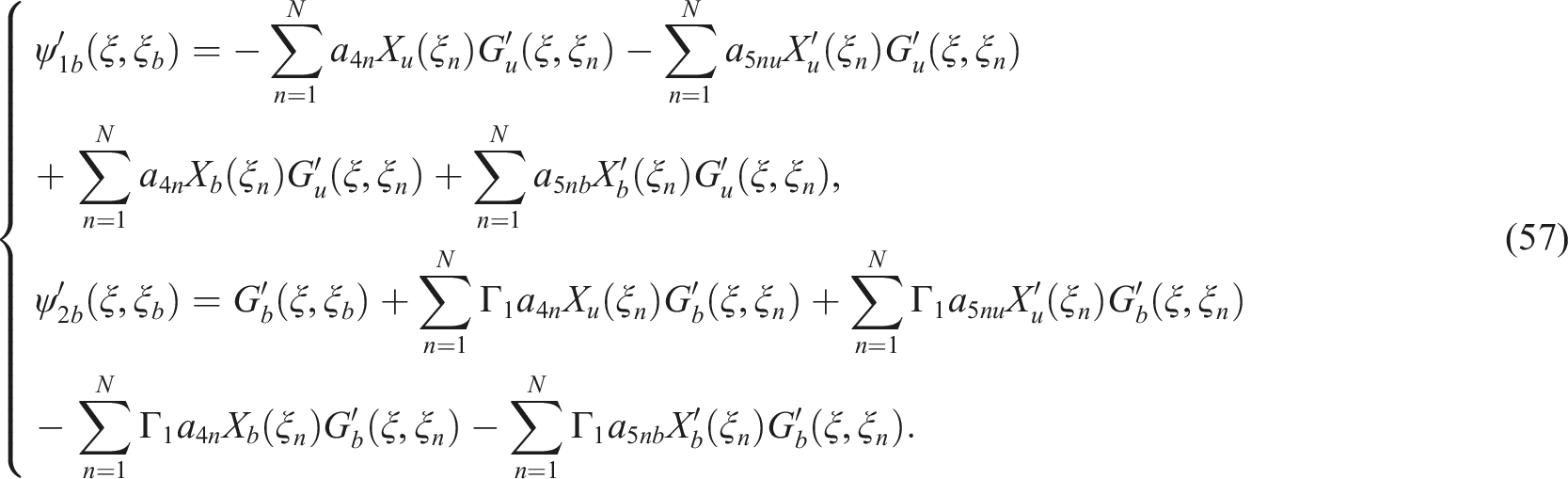
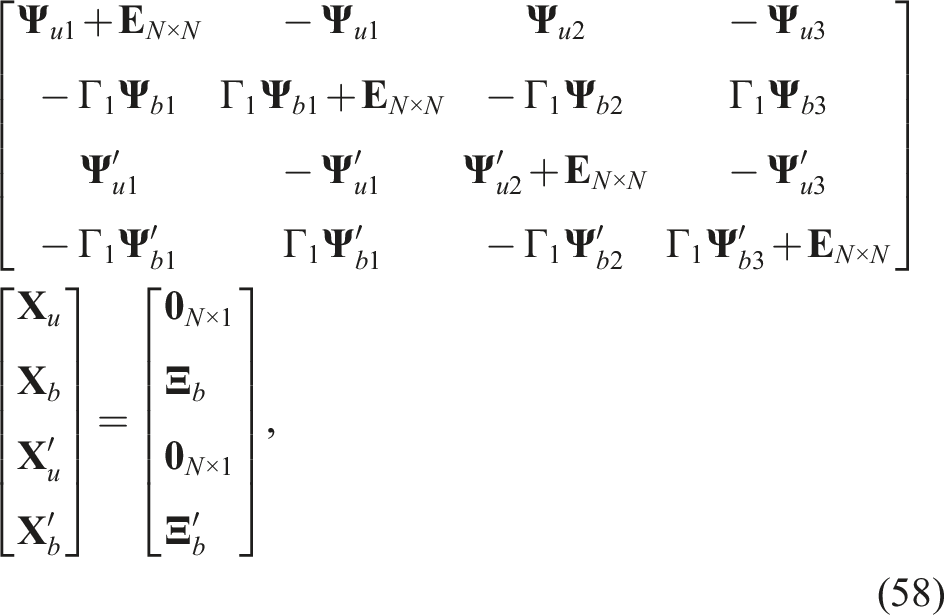
The Green’s functions in equations (51) and (52) involve unknown parameters related to intermediate support positions. Taking equation (51) as an example, the Green’s functions and contain 4N unknown parameters, namely , , , and . To determine these parameters, their first-order derivatives with respect to are given by
Where and are in Appendix B. This equation yields the unknown parameters in equation (52).
In equations (51) and (52), the terms related to the external excitation are and . For the free vibration problem without external excitation, these terms can be removed, and the corresponding solution yields the modal functions
Where the frequency of the double-beam system is obtained from the following equation
5. Methodology summary
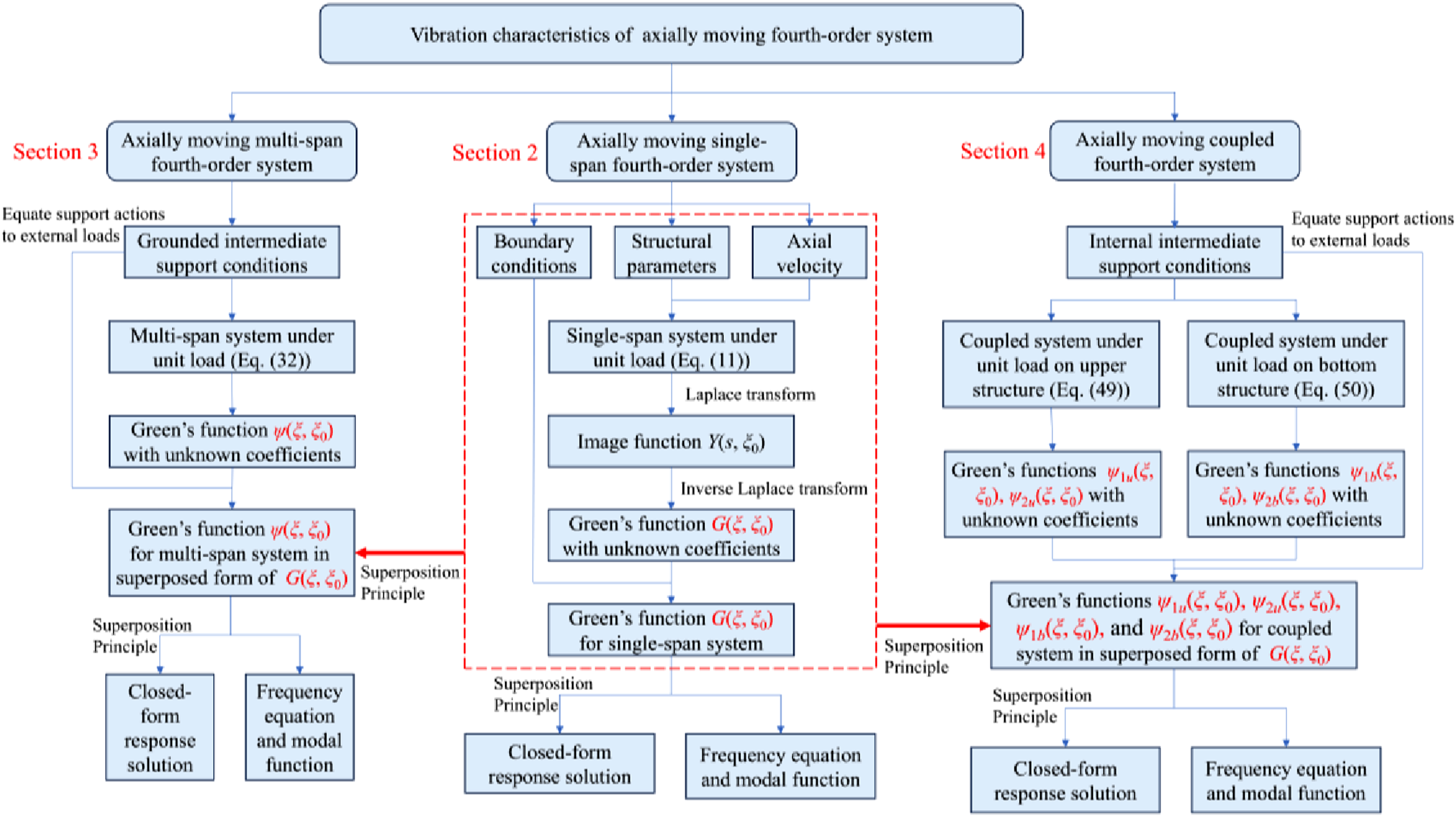
This section summarizes the core content of Sections 2–4 and systematically illustrates the entire analytical framework of the proposed method via the flowchart in Figure 4. It aims to more intuitively demonstrate the novelty, analytical characteristics and advantages of the work presented in this paper. The innovation and core work of this paper revolves around the Green’s function of the axially moving single-span system. Based on the superposition principle, using the Green’s function , we can derive not only closed-form response solutions for single-span systems but also Green’s functions for multi-span and coupled systems, and further obtain closed-form response solutions for these two systems. Compared with the conventional Green’s function method (Li et al., 2024), the present work exhibits significant advantages in dealing with multi-span and coupled systems. Instead of considering the influence of attachments (springs and dampers) on the continuity conditions of the system, the effect of these attachments is equivalently treated as external excitation, and all subsequent results can be obtained directly using the Green’s function of the single-span system. In addition, all the derived frequency equations take the form of complex transcendental equations and must be solved numerically, yielding numerical frequency solutions. Although the modal functions are given analytical expressions, they require the use of the frequency solutions in the form of numerical solutions, thus making them semi-analytical solutions.
Flowchart of vibration analysis for fourth-order axially moving systems.
6. Accuracy verification and numerical discussion
This section presents three typical examples to discuss the dynamic characteristics of fourth-order axially moving systems, and validates the accuracy of the closed-form solutions.
6.1. Single-span system
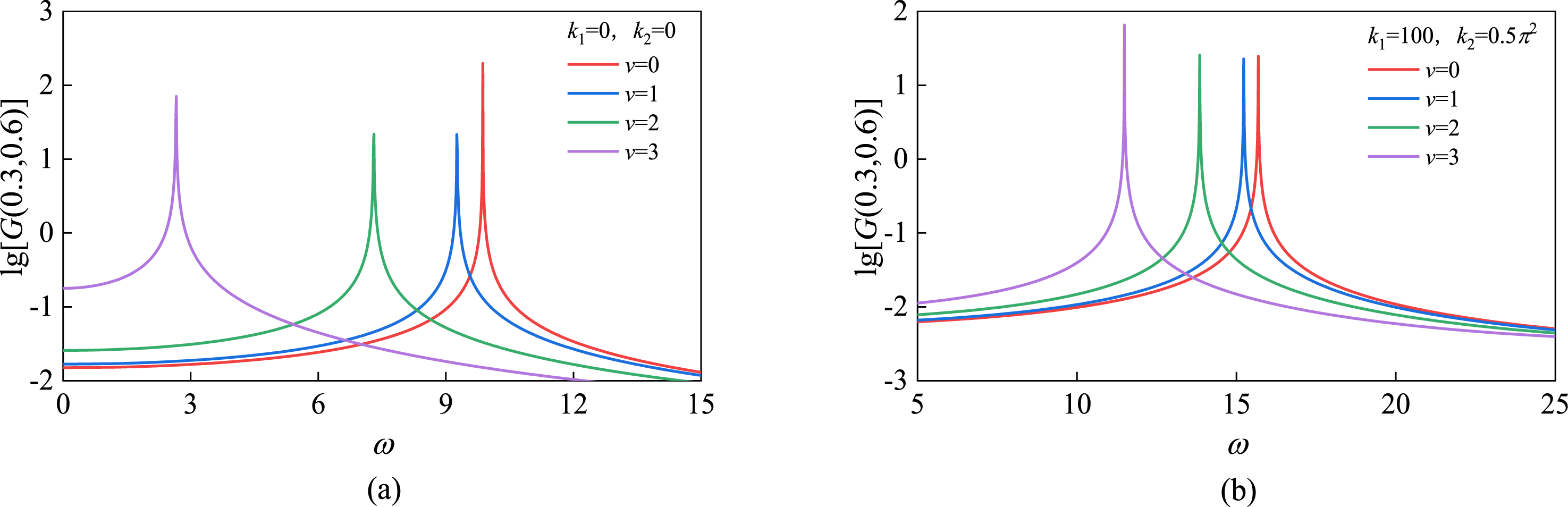
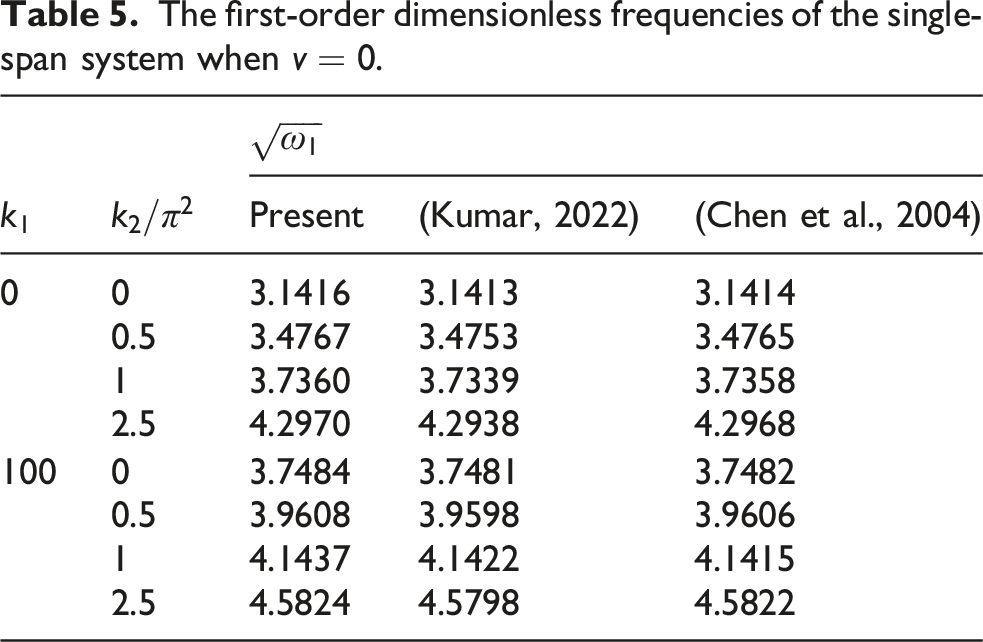
The axially moving single-span beam system with Pinned-Pinned BCs is taken as the research object, and the foundation type of the system is viscoelastic Pasternak foundation. The Green’s functions and response solutions of the axially moving single-span beam system have been given in Section 2. Using the obtained analytical expressions, we can directly plot the amplitude-frequency characteristic curves of Green’s functions under different conditions. Figure 5 shows the amplitude-frequency characteristic curves near the fundamental frequency when the unit force acts on , and considers different axial velocity v. It can be seen that the first-order frequency of the system increases with the increase of and , and when the axial velocity increases, the first-order frequency decreases gradually. From the amplitude-frequency curves, the first-order frequency of the single-span system under different conditions can be obtained and summarized in Table 5. The Green’s function results agree well with the differential quadrature method (Kumar, 2022) and Rayleigh–Ritz method (Chen et al., 2004). The above results prove the accuracy of the results in Section 2 of this paper.
Amplitude-frequency characteristic curves of the single-span system with Pinned-Pinned BCs. (a) , ; (b) , .
The first-order dimensionless frequencies of the single-span system when .
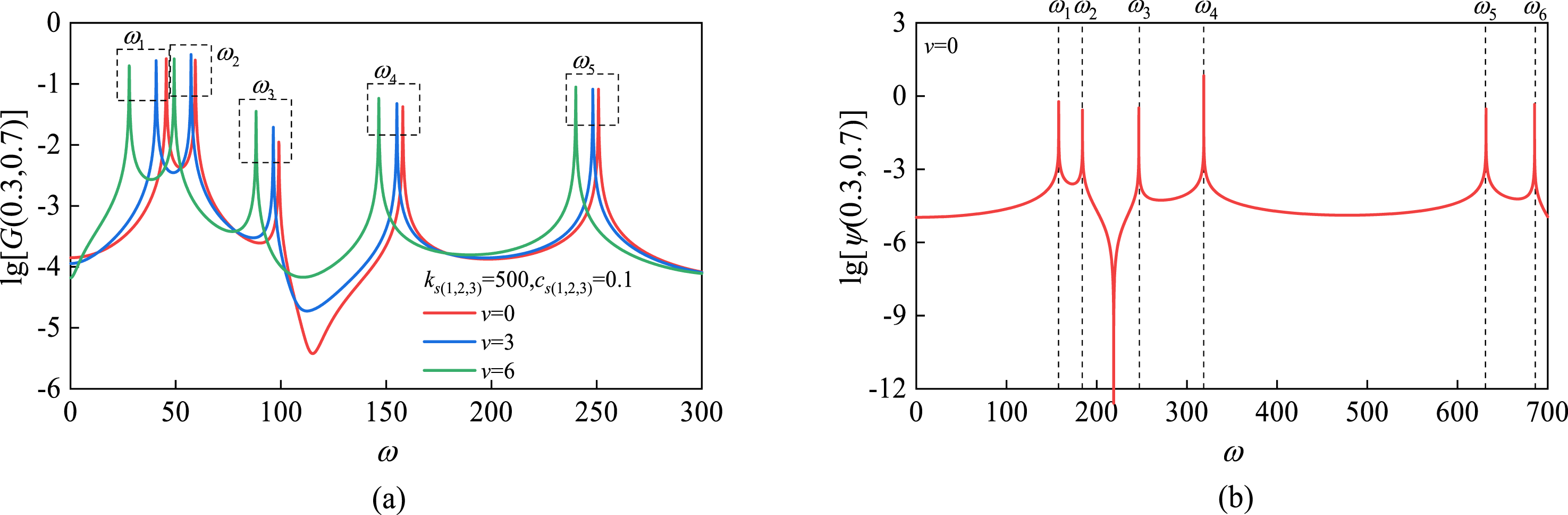
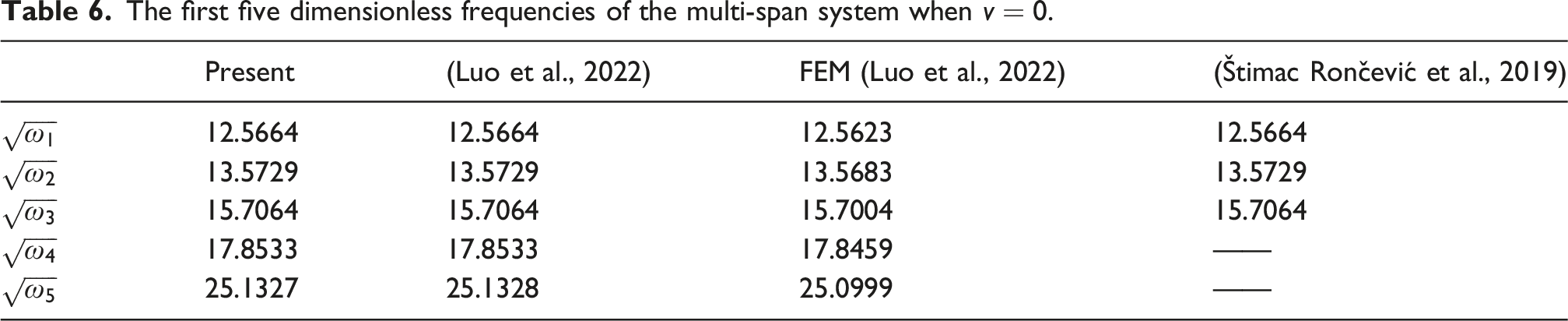
This study investigates a simply supported axially moving beam with three intermediate supports at , and , respectively. The Green’s function of the four-span beam structure can be directly obtained by equation (33). It should be noted that the three intermediate supports are the same, that is, the stiffness coefficients , and are the same, and the damping coefficients , and are also the same. Figure 6 shows the amplitude-frequency characteristic curves of Green’s functions of the system when the harmonic excitation is applied to . Considering that the support stiffness coefficients and damping coefficients are 500 and 0.1, respectively, it can be seen from the figure that when the axial velocity increases from 0 to 6, the first five frequencies all decrease accordingly. And when the stiffnesses of the supports are taken as infinite, the intermediate supports can be regarded as simply supported supports. Figure 6(b) shows the results when and , and the obtained first five dimensionless frequencies are given in Table 6. The reliability of the multi-span system results in Section 3 is demonstrated by comparison with the results of Luo et al. (2022) and Štimac Rončević et al. (2019).
Amplitude-frequency characteristic curves of Green’s functions of the four-span system with Pinned-Pinned BCs. (a) , ; (b) , , .
The first five dimensionless frequencies of the multi-span system when .
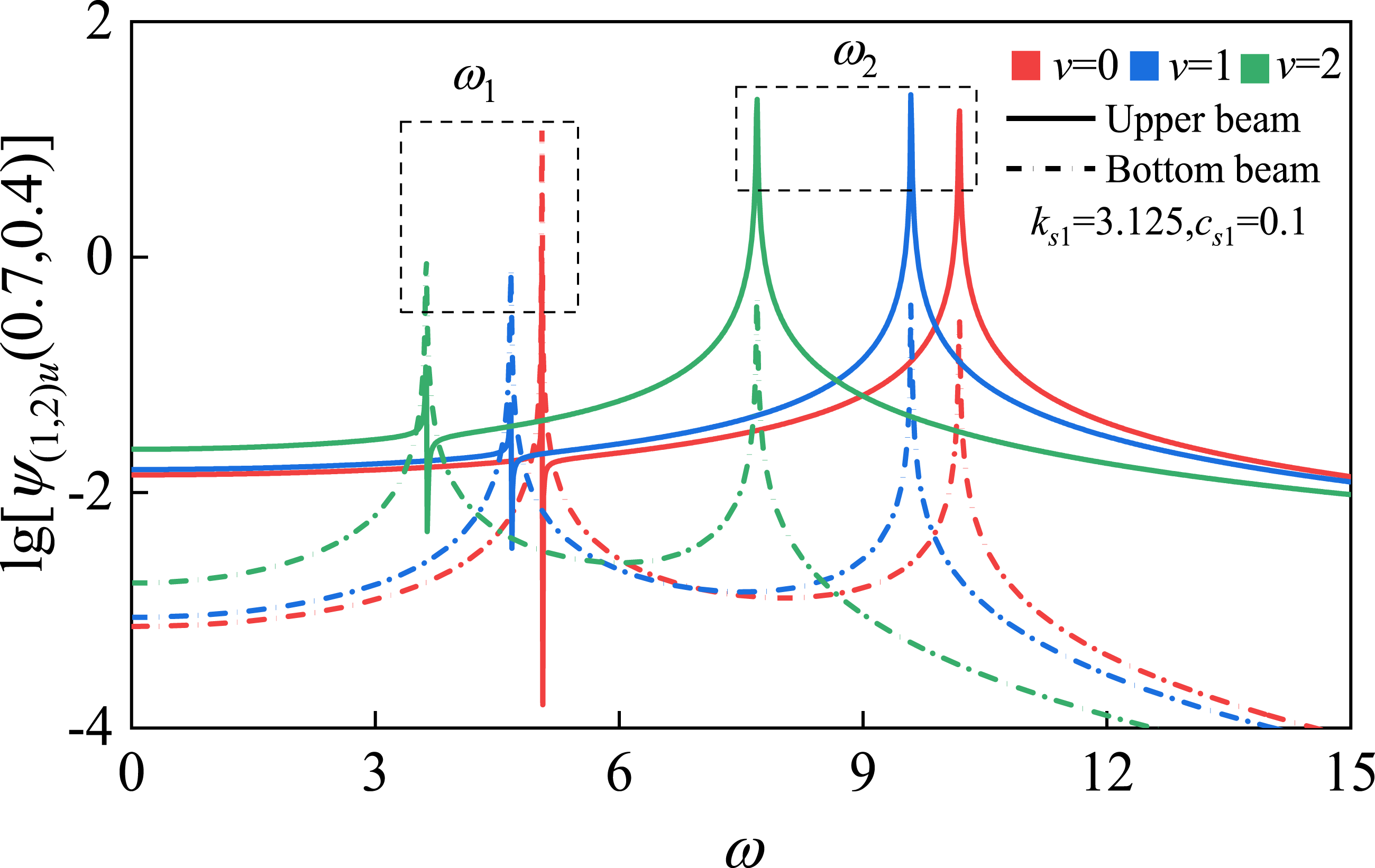
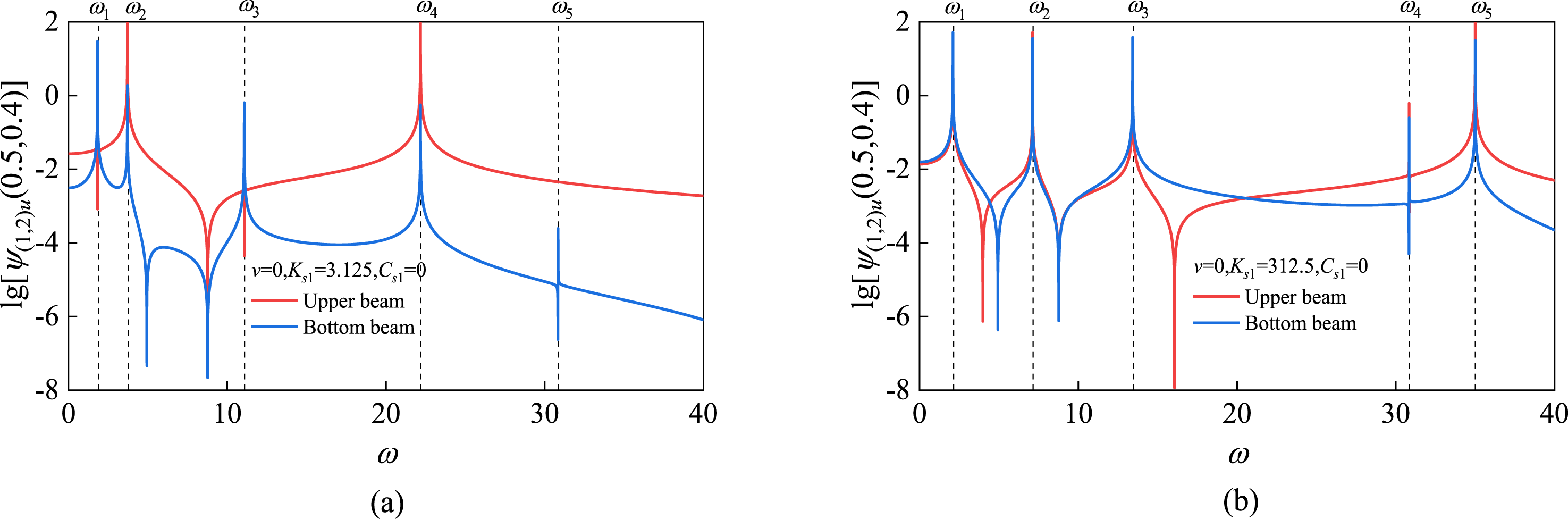
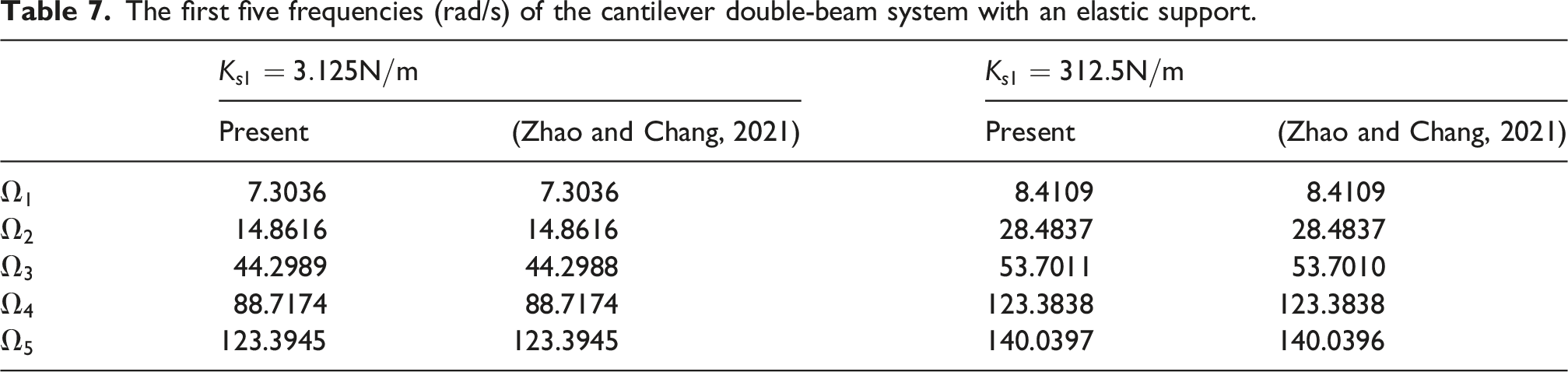
An axially moving double-beam system with elastic boundary conditions is adopted, where the two beams are coupled by an intermediate support at . In the current work, the upper and lower beams have different material properties. The relevant physical parameters of the system are given in (Zhao and Chang, 2021), which are , , , , and , respectively. Different boundary conditions can be easily simulated by changing the stiffness coefficients of the boundary tension springs and torsion springs. When the stiffness of all the torsion springs in the system is taken as 0, and the stiffness of the extension springs is taken as infinity such as N/m, the system can be regarded as a simply supported double-beam system. Figure 7 plots the amplitude-frequency curves of Green’s functions under this condition, and the values of and are 3.125 N/m and 0.1 N·s/m, respectively. It can be seen from the figure that, similar to the single-beam model, the first two frequencies of the double-beam system decrease as the axial velocity increases. When the tension and torsion springs at the left end of the system are taken to be infinite, and all boundary springs on the right are ignored, the model can be regarded as a cantilevered double-beam system with one intermediate support. Figure 8 shows the frequency response curves of the system when the axial velocity is 0, and two cases of = 3.125 N/m and = 312.5 N/m are considered. The obtained first five frequencies are given in Table 7, the reliability of the method and conclusion in Section 4 is proved.
Amplitude-frequency characteristic curves of a simply supported double-beam system , .
Amplitude-frequency characteristic curves of a cantilever double-beam system , .
The first five frequencies (rad/s) of the cantilever double-beam system with an elastic support.
This paper presents closed-form steady-state solutions for the forced vibration of fourth-order axially moving systems, considering combined damping and gyroscopic effects. Using the Greens functions of single-span systems, analytical solutions are systematically derived for single-span, multi-span, and coupled systems. Two methods are introduced to obtain these Green’s functions: the Laplace transform technique for single-span systems, and an approach based on single-span Green’s functions for multi-span and coupled systems. The Green’s functions also enable the derivation of modal functions and frequency equations for axially moving systems. Three numerical examples are investigated to discuss the influence of axial speed on the transverse vibration of the system and to validate the accuracy of the proposed method. The proposed approach is precise, logically clear, and directly applicable to the analysis of various axially moving fourth-order systems, with positive implications for studying higher-order system vibrations.
The authors disclosed receipt of the following financial support for the research, authorship and publication of this article: This work was funded by the National Natural Science Foundation of China (Grant No. 12272323).
Declaration of conflicting interests
The authors declared no potential conflicts of interest with respect to the research, authorship, and/or publication of this article.
Appendix
References
1.
Al-JawiAANPierreCUlsoyAG (1995) Vibration localization in dual-span, axially moving beams: part I: formulation and results. Journal of Sound and Vibration179: 243–266. Available at: https://doi.org/10.1006/jsvi.1995.0016
AliSKhanSJamalA, et al. (2021) Transverse response of an axially moving beam with intermediate viscoelastic support. Mathematical Problems in Engineering2021: 1–14. https://doi.org/10.1155/2021/2218832
4.
AnCSuJ (2014) Dynamic response of axially moving Timoshenko beams: integral transform solution. Applied Mathematics and Mechanics35: 1421–1436. https://doi.org/10.1007/s10483-014-1879-7
5.
ChenLQYangXD (2006) Vibration and stability of an axially moving viscoelastic beam with hybrid supports. European Journal of Mechanics - A: Solids25: 996–1008. https://doi.org/10.1016/j.euromechsol.2005.11.010
6.
ChenWQLüCFBianZG (2004) A mixed method for bending and free vibration of beams resting on a Pasternak elastic foundation. Applied Mathematical Modelling28: 877–890. https://doi.org/10.1016/j.apm.2004.04.001
7.
DingHZhuMChenL (2019) Dynamic stiffness method for free vibration of an axially moving beam with generalized boundary conditions. Applied Mathematics and Mechanics40: 911–924. https://doi.org/10.1007/s10483-019-2493-8
8.
FengCXieCJiangM (2025) Generalized finite difference method for dynamics analysis of axially moving beams and plates. Applied Mathematics Letters166: 109526. https://doi.org/10.1016/j.aml.2025.109526
9.
GhayeshMH (2011) On the natural frequencies,complex mode functions,and critical speeds of axially traveling laminated beams:parametric study. Acta Mechanica Solida Sinica24: 373–382. https://doi.org/10.1016/s0894-9166(11)60038-4
10.
GhayeshMHAmabiliM (2013) Nonlinear vibrations and stability of an axially moving Timoshenko beam with an intermediate spring support. Mechanism and Machine Theory67: 1–16. https://doi.org/10.1016/j.mechmachtheory.2013.03.007
11.
HanGWuYHouG, et al. (2025) Investigation on parametric excitation vibration and piezoelectric active control of axially moving viscoelastic beams. Journal of Vibration and Control31: 2513–2524. https://doi.org/10.1177/10775463241260560
12.
HeYChenEFergusonNS, et al. (2023) Wave solutions and vibration control for the coupled vibration of a moving string system subjected to periodic excitations. Mechanical Systems and Signal Processing189: 110057. https://doi.org/10.1016/j.ymssp.2022.110057
13.
HongKSPhamPT (2019) Control of axially moving systems: a review. International Journal of Control, Automation, and Systems17: 2983–3008. https://doi.org/10.1007/s12555-019-0592-5
14.
JaksicN (2009) Numerical algorithm for natural frequencies computation of an axially moving beam model. Meccanica44: 687–695. https://doi.org/10.1007/s11012-009-9203-5
15.
KumarS (2022) Vibration analysis of Non-uniform axially functionally graded beam resting on Pasternak foundation. Materials Today Proceedings62: 619–623. https://doi.org/10.1016/j.matpr.2022.03.622
16.
LiYHDongYHQinY, et al. (2018) Nonlinear forced vibration and stability of an axially moving viscoelastic sandwich beam. International Journal of Mechanical Sciences138-139: 131–145. https://doi.org/10.1016/j.ijmecsci.2018.01.041
17.
LiJJChenBMaoHN (2024) Exact closed-form solution for vibration characteristics of multi-span beams on an elastic foundation subjected to axial force. Structures60: 105884. https://doi.org/10.1016/j.istruc.2024.105884
18.
LiuMYYaoG (2024) Nonlinear forced vibration and stability of an axially moving beam with a free internal Hinge. Nonlinear Dynamics112: 6877–6896. https://doi.org/10.1007/s11071-024-09447-5
19.
LuoJZhuSYZhaiWM (2022) Exact closed-form solution for free vibration of Euler-Bernoulli and Timoshenko beams with intermediate elastic supports. International Journal of Mechanical Sciences213: 106842. https://doi.org/10.1016/j.ijmecsci.2021.106842
20.
MarynowskiK (2018) Vibration analysis of an axially moving sandwich beam with multiscale composite facings in thermal environment. International Journal of Mechanical Sciences146-147: 116–124. https://doi.org/10.1016/j.ijmecsci.2018.07.041
21.
NiQLiMTangM, et al. (2014) Free vibration and stability of a cantilever beam attached to an axially moving base immersed in fluid. Journal of Sound and Vibration333: 2543–2555. https://doi.org/10.1016/j.jsv.2013.11.049
Štimac RončevićGRončevićBSkoblarA, et al. (2019) Closed form solutions for frequency equation and mode shapes of elastically supported Euler-Bernoulli beams. Journal of Sound and Vibration457: 118–138. https://doi.org/10.1016/j.jsv.2019.04.036
24.
TanCARiedelCH (1999) Wave analysis of mode localization and delocalization in elastically constrained strings and beams. Journal of Vibration and Acoustics121: 169–173. https://doi.org/10.1115/1.2893960
25.
TangYLuoEYangX (2018) Complex modes and traveling waves in axially moving Timoshenko beams. Applied Mathematics and Mechanics39: 597–608. https://doi.org/10.1007/s10483-018-2312-8
26.
WangPRuiXWangG, et al. (2025) Complex modal analysis of a resilient supported conveyor belt: enhancement of numerical stability by reduced complex transfer matrix method. Journal of Vibration Engineering & Technologies13: 192. https://doi.org/10.1007/s42417-024-01611-w
27.
WickertJAMoteCD (1990) Classical vibration analysis of axially moving continua. Journal of Applied Mechanics57: 738–744. https://doi.org/10.1115/1.2897085
28.
WuYHanGHouG, et al. (2025) Forced vibration of an axially moving free-free beam with internal resonance. Journal of Vibration and Control31: 2100–2110. Available at: https://doi.org/10.1177/10775463241251539
29.
XueNLuSFXieKZ, et al. (2024) Vibration and stability of axially moving beam on multiple intermediate elastic supports with transfer matrix method. Structures66: 106840. https://doi.org/10.1016/j.istruc.2024.106840
30.
YangXDLimCWLiewKM (2010) Vibration and stability of an axially moving beam on elastic foundation. Advances in Structural Engineering13: 241–247. https://doi.org/10.1260/1369-4332.13.2.241
31.
YangTFangBYangX, et al. (2013) Closed-form approximate solution for natural frequency of axially moving beams. International Journal of Mechanical Sciences74: 154–160. https://doi.org/10.1016/j.ijmecsci.2013.05.010
32.
ZhangHMaJDingH, et al. (2017) Vibration of axially moving beam supported by viscoelastic foundation. Applied Mathematics and Mechanics38: 161–172. https://doi.org/10.1007/s10483-017-2170-9
33.
ZhaoXZChangP (2021) Free and forced vibration of double beam with arbitrary end conditions connected with a viscoelastic layer and discrete points. International Journal of Mechanical Sciences209: 106707. https://doi.org/10.1016/j.ijmecsci.2021.106707
34.
ZhaoXWangCFZhuWD, et al. (2021) Coupled thermoelastic nonlocal forced vibration of an axially moving micro/nano-beam. International Journal of Mechanical Sciences206: 106600. https://doi.org/10.1016/j.ijmecsci.2021.106600
35.
ZinatiRFRezaeeMLotfanS (2020) Nonlinear vibration and stability analysis of viscoelastic Rayleigh beams axially moving on a flexible intermediate support. Iranian journal of science and technology, Transactions of mechanical engineering44: 865–879. https://doi.org/10.1007/s40997-019-00305-z