






Abstract
Diagnosing multiple faults that are simultaneously occurring in a rotating machinery is theoretically a domain adaptation problem where different defect sizes cause systematic spectral changes which make the standard classifiers assumption of identically distributed data invalid. Current unsupervised domain adaptation methods make use of marginal alignment through multi-kernel Maximum Mean Discrepancy (MK-MMD) or adversarial training. They are not explicitly imposing a physical constraint on the variability of defect scale which suggests that they are likely to fail in negative transfer and harmonic decoupling. This work introduces a physics-informed adaptive spectral transformation (PGAST) method that consists of three main elements. A severity-aware spectral transformation unit that first separates the signal into frequency bands and then a signal-dependent warping coefficient is applied with the help of time-domain and spectral regularization. A Lipschitz-stabilized 1D-CNN encoder that obtains domain-invariant features at a controlled sensitivity and a spectral-aware class-conditional MMD objective that aligns feature distributions separately across low, mid, and high-frequency regimes which help avoid inter-class mode mixing. When tested on the publicly available bearing datasets with different defect diameters, PGAST leads to 95.96% cross-domain recognition accuracy showing the capability to generalize to unseen compound couplings. This suggests that the use of structured physics-informed alignment is an improvement over the purely statistical baselines.
Keywords
1. Introduction
Rotating machines such as ball-bearings, gearboxes, and multi-stage impellers constitute the main components of most industrial plants. Real-time condition monitoring of these sensitive components is essential to help avoid unplanned downtime, reduce maintenance costs, and keep the operation safe (Khan et al., 2024; Umer et al., 2025). It has been found that the major non-destructive technique to detect rotating machinery faults is through vibrations. Because changes in vibration spectra are very reflective of structural changes and accelerometer based data acquisition is quite simple (Khan et al., 2024). Although machine learning methods that have been trained with labeled vibration datasets perform with very high diagnostic accuracy in the lab environment, they have not yet been widely adopted in the real industrial environment due to distributional differences between labeled training data and unlabeled operating conditions (Wilson and Cook, 2020). These distributional differences include Normal variations in shaft speeds, fluctuations in load, changes in sensor mountings, and most notably the progressive growth of faults which changes signal characteristics. These characteristics variations can include fault frequencies, impulse amplitudes, and harmonic sideband structures which cannot be reliably handled by traditional domain-agnostic classifiers.
The difficulties of vibration-based diagnostics are not limited to bearing fault classification alone. More general diagnostic methodologies for mechatronic systems, for example, have resorted to neural networks combined with high-performance data acquisition (Szymański et al., 2023). Whereas state-space identification criteria have been utilized in the diagnostics of actuators in machine tool drives (Urban et al., 2022). Industrial robots are facing similar transfer problems, as vision-based systems for human upper-limb motion trajectory (Nowak et al., 2022) and vibration-based detection of structural defects such as base unfastening (Konieczny et al., 2023) reveal that cross-condition generalization is a widespread challenge in mechatronic diagnostics. The development of robotic manipulators for automotive handling (Paprocki et al., 2021) also points to the industrial significance of diagnostic frameworks that are easily transferable. The combination of these findings suggests that domain adaptation in vibration diagnostics is a challenge at system level which involves sensors, structures, and operating conditions, rather than a single bearing fault problem.
Compound faults represent the most difficult case of fault diagnosis (Li et al., 2025). A bearing with simultaneous inner-race and outer-race defects produces fault frequencies that overlap, modulate each other and generate nonlinear inter-modulation sidebands (Nejjar et al., 2026). The resulting feature distributions become mixed and class-specific, so aligning source and target marginals can be insufficient and may even induce negative transfer when domains differ in defect size or severity (Wang et al., 2024). Standard MK-MMD and adversarial alignment operate on entire marginal feature distributions without accounting for the physical cause of domain shifts and thereby risk violating the harmonic couplings that distinguish compound-fault classes (Ganin et al., 2016; Long et al., 2015).
Unsupervised domain adaptation (UDA) for rotating machinery began with shallow subspace methods such as Transfer Component Analysis (Pan et al., 2011) and has progressed to deep adversarial networks which include Domain-Adversarial Neural Networks (Ganin et al., 2016) and joint adversarial alignment (Zhao et al., 2021). More recent source-free UDA (Liu et al., 2024b), subdomain-enhanced alignment (Liu et al., 2024a), and continual test-time adaptation (Tian et al., 2026) address privacy constraints and non-stationary data streams. For compound faults specifically, multi-output alignment networks (Yi et al., 2026) and collaborative multi-domain frameworks (Chen et al., 2023) have been proposed to handle multi-label class structure. But these methods include no explicit physical prior that describe how defect size influences spectral energy and leave harmonic integrity unguarded during alignment.
Physics-guided neural networks partially address this gap by incorporating fault mechanics into the learning objective. Wavelet-initialized convolutions for cross-machine bearing diagnostics (Jia et al., 2024), prototype-guided adversarial alignment (Kuang et al., 2022), physics-informed subdomain moment-enhanced adaptation (Liu et al., 2025a), and energy-density self-supervised regularization (Lee et al., 2026) all show that domain-specific inductive biases improve generalization. Hybrid entropy-regularized wavelet methods for gearboxes (Ge et al., 2024) and interpretable loss functions based on characteristic fault frequencies (He et al., 2024) further show that physical knowledge can reduce sample complexity. Despite these advances, four gaps remain unresolved. First, to our knowledge no existing method enforces band-specific spectral invariances calibrated to the range of defect diameters that are encountered in heterogeneous industrial deployments. Existing warping strategies apply a fixed global scalar that cannot self-adjust to per-sample severity. This motivates a severity-aware adaptive spectral transformation with signal-dependent warping coefficient α(
This paper addresses all four gaps through a physics-guided adaptive spectral transformation (PGAST) framework. The central idea is to physically condition each input signal so that its spectral energy distribution reflects the estimated defect severity before feature learning begins. A signal-dependent warping coefficient scales each frequency band in proportion to severity inferred from compact vibration statistics which replaces the fixed-magnitude transforms of prior work. The conditioned signal is then encoded by a Lipschitz-stabilized convolutional network that bounds feature sensitivity to amplitude fluctuations. Cross-domain alignment is enforced separately within low, mid, and high-frequency regimes so that harmonics from distinct fault mechanisms are not conflated during adaptation. The specific contributions of this work are: • A severity-aware adaptive spectral transformation (AST) module that replaces fixed-magnitude spectral warping with a trainable, signal-conditioned coefficient. The coefficient is computed from compact vibration statistics which allows the system to self-calibrate to heterogeneous defect diameters without target labels. • A composite spectral consistency regularization that preserves harmonic amplitudes and inter-modulation sideband features central to compound fault discrimination. By penalizing adaptation-induced distortions in both the time and frequency domains. • A spectral-aware class-conditional MMD alignment module that partitions the feature embeddings into low, mid, and high-frequency groups corresponding to cage, ball-pass, and rolling-element resonance regimes. This prevents inter-class mode mixing under defect-scale-induced distribution shift. • Extensive experiments on publicly available compound bearing vibration data with computationally simulated defect depths under heterogeneous, semi-homogeneous, and homogeneous regimes.
The remainder of the paper is organized as follows. Section 2 formalizes the UDA problem, analyzes compound fault domain shifts, and details the proposed framework. Section 3 presents experimental results, ablations, and cross-dataset validation. Section 4 concludes and outlines future work.
2. Methodology
This section describes the proposed framework for compound fault diagnosis under variable defect depth, where depth-induced distribution shifts are treated as a domain adaptation problem. Because compound fault diagnosis is more difficult than the single-fault case, the architecture in Figure 1 incorporates several modular extensions for feature alignment and generalization which are detailed theoretically and mathematically below. Architectural overview of the proposed PGAST model. 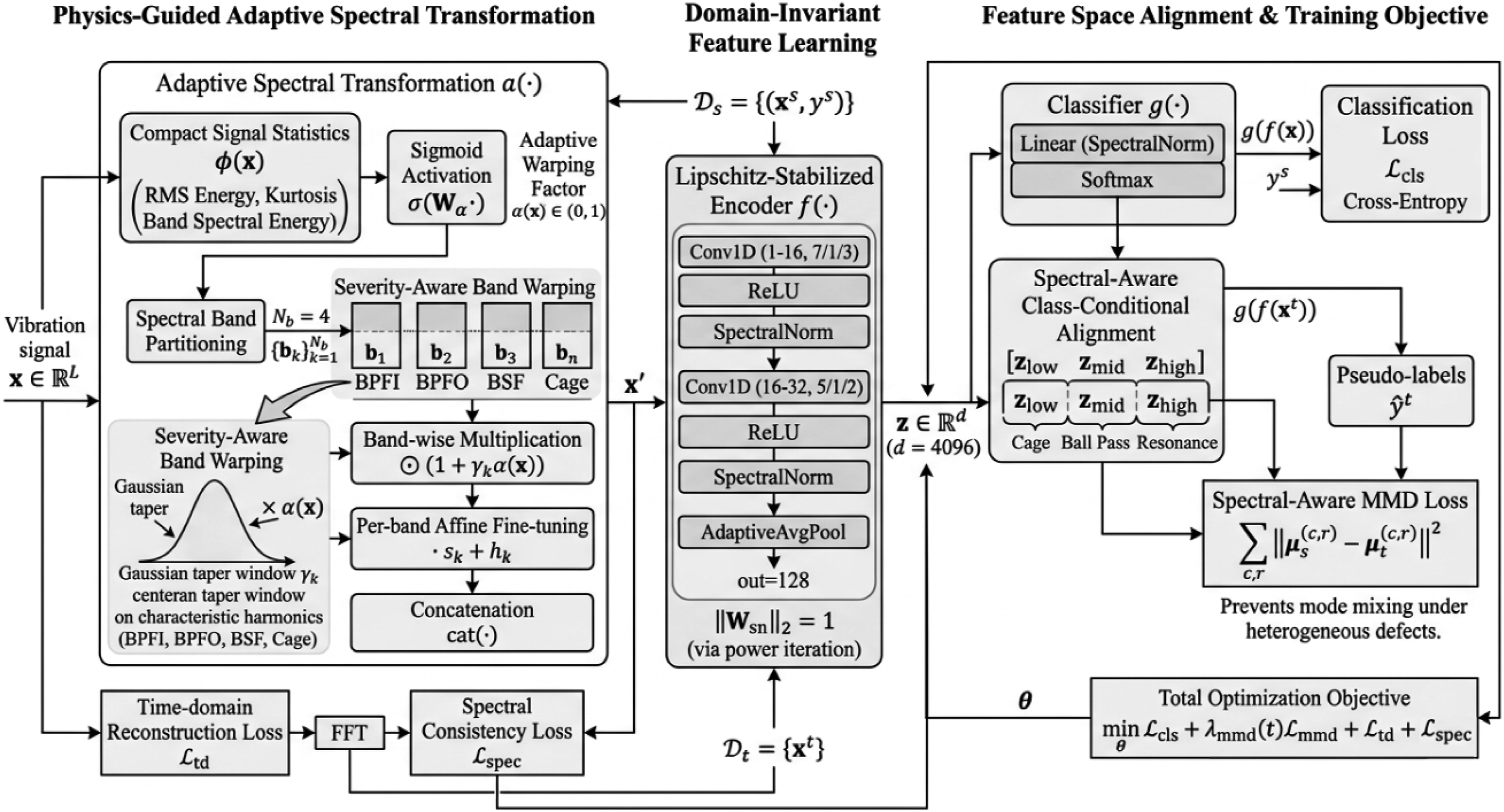
2.1. Problem formulation
2.1.1. Domain shift characteristics of compound faults
The shifts of the Single-fault domain are relatively structured as a change in the diameter of the defect d produces a nearly uniform amplitude scaling across the harmonic series BPFI (Jia et al., 2024), which marginal alignment can partially compensate for. Compound faults introduce two further mechanisms that make this insufficient. Simultaneous defects generate inter-modulation sidebands at k ⋅BPFI ± m ⋅BPFO (Nejjar et al., 2026) whose amplitudes scale nonlinearly with the product of individual defect amplitudes. This produces class-specific energy redistributions that no global scalar can capture. The modulation index is itself severity-dependent at small defect sizes the dominant harmonics are class-distinguishing, whereas at large sizes inter-modulation sidebands become energetically dominant which shifts class boundaries in feature space. This is the root cause of negative transfer under standard marginal alignment.
Formally, let
The problem is formalized as unsupervised domain adaptation (UDA). Key notation:
Domain adaptation theory bounds the target risk by the sum of source error and a distribution divergence term which requires joint reduction of both. Under compound faults, statistical alignment alone is insufficient because arbitrary feature transformations can disrupt the harmonic relationships that distinguish compound from single-defect faults. While class-specific spectral variations make marginal alignment ineffective. The proposed framework addresses both problems through physics-based signal conditioning combined with structured distribution matching.
2.2. Physics-guided adaptive spectral transformation
In rotating machinery, the energy of a bearing fault signal is distributed across characteristic frequency bands corresponding to specific mechanical components which can be cage frequency, ball-pass frequencies of the inner and outer races (BPFI, BPFO), ball spin frequency (BSF), and their harmonics. As defect size grows, fault impulses strengthen and energy concentrates more heavily in the mid-frequency compound-harmonic bands. A fixed spectral transformation cannot accommodate this severity-dependent redistribution. The adaptive spectral transformation module instead estimates how severe the current signal is by using simple aggregate statistics. It then applies a proportionally stronger warping to the bands that are most sensitive to defect growth. A regularization term simultaneously prevents this warping from distorting the harmonic ratios that carry fault class information.
The core contribution is an adaptive spectral transformation (AST) module (Figure 2) Spectral band-wise adaptive processing module. Input 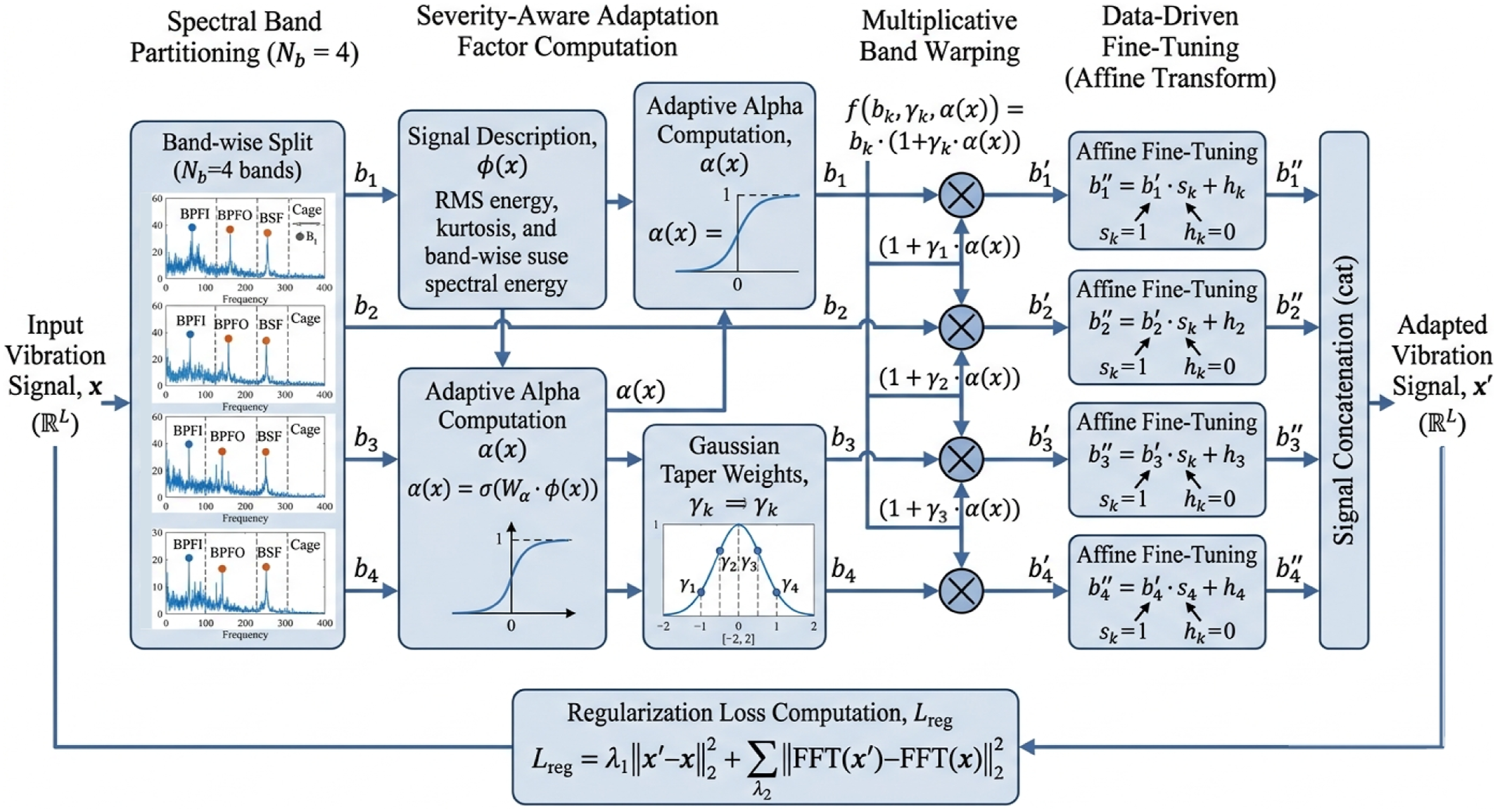

This coefficient encodes compact signal statistics
Each band is warped multiplicatively as

2.2.1. Step-by-step procedure for reproducibility
The complete forward pass of the AST module is: 1. 2. 3. 4. 5. 6. 7. 8.
All operations are differentiable in PyTorch;
To prevent over-adaptation from erasing fault-discriminative harmonics, a composite regularization loss constrains the signal change:

The time-domain term bounds the overall adaptation magnitude. The spectral term directly penalizes distortion of harmonic amplitudes and inter-modulation sidebands. This dual constraint is necessary because an adapter optimized solely with an ℓ2 time-domain norm can introduce large frequency-domain distortions that remain invisible to that norm. This erases the harmonic structure on which compound fault discrimination depends. The FFT-domain term explicitly constrains the module to preserve the relative amplitudes of characteristic fault frequencies which is the physical signature of each compound fault class. The preserved harmonic ratios correspond to known mechanical fault signatures. The BPFI/2×BPFI ratio indicates inner-race severity while the inter-modulation sideband spacing k ⋅BPFI ± m ⋅BPFO characterizes compound bearing–gear interactions. The BSF/cage ratio distinguishes ball from cage defects. Any transformation that keeps
2.3. Domain-invariant feature learning and training objective
2.3.1. Encoder and alignment
The adapted signal
Pseudo-labels for unlabeled target samples are generated as

Different compound fault classes have their most discriminative energy in different frequency regimes. Cage and low-frequency sidebands indicate outer-race defects, mid-frequency ball-pass harmonics characterize inner-race and gear faults and rolling-element resonances are most sensitive to ball defects. By aligning source and target distributions independently per regime, the loss prevents harmonics belonging to different faults from being conflated merely because they share an overall frequency range. This substantially reduces negative transfer under heterogeneous defect conditions.
2.3.2. Training objective

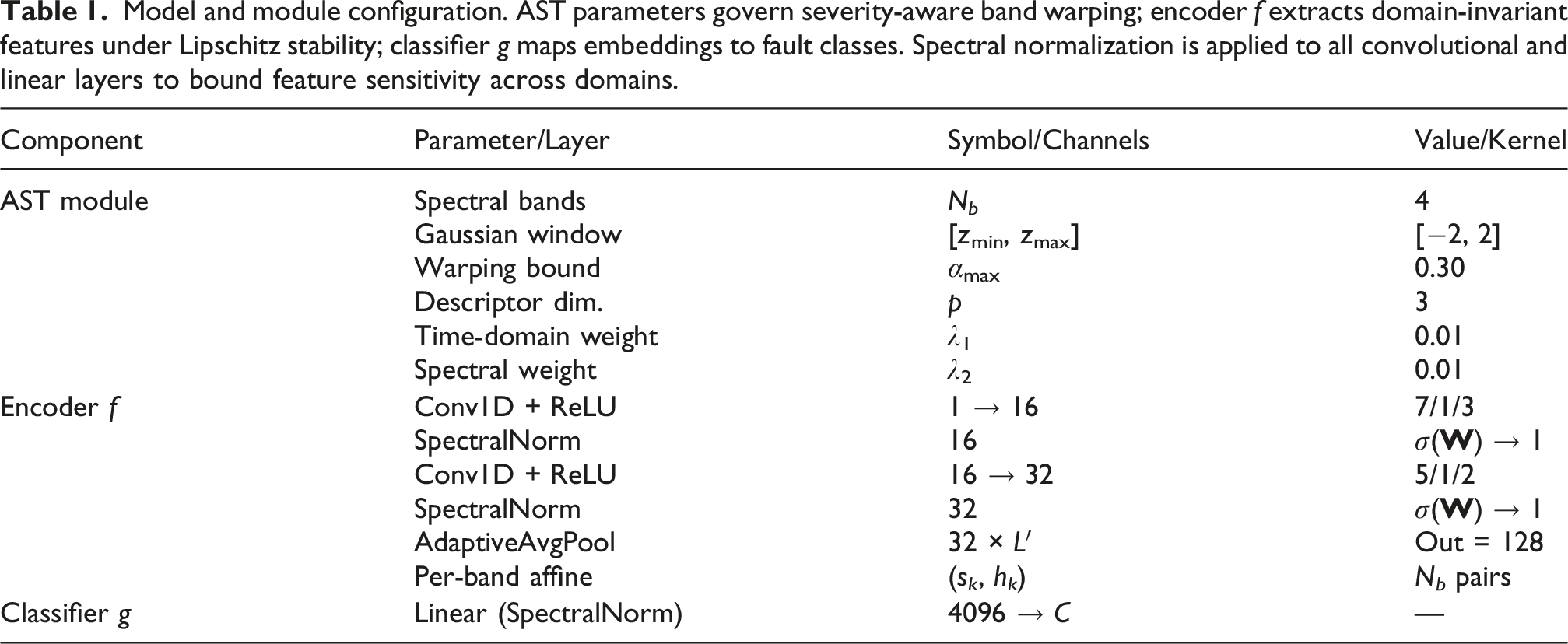
Model and module configuration. AST parameters govern severity-aware band warping; encoder f extracts domain-invariant features under Lipschitz stability; classifier g maps embeddings to fault classes. Spectral normalization is applied to all convolutional and linear layers to bound feature sensitivity across domains.
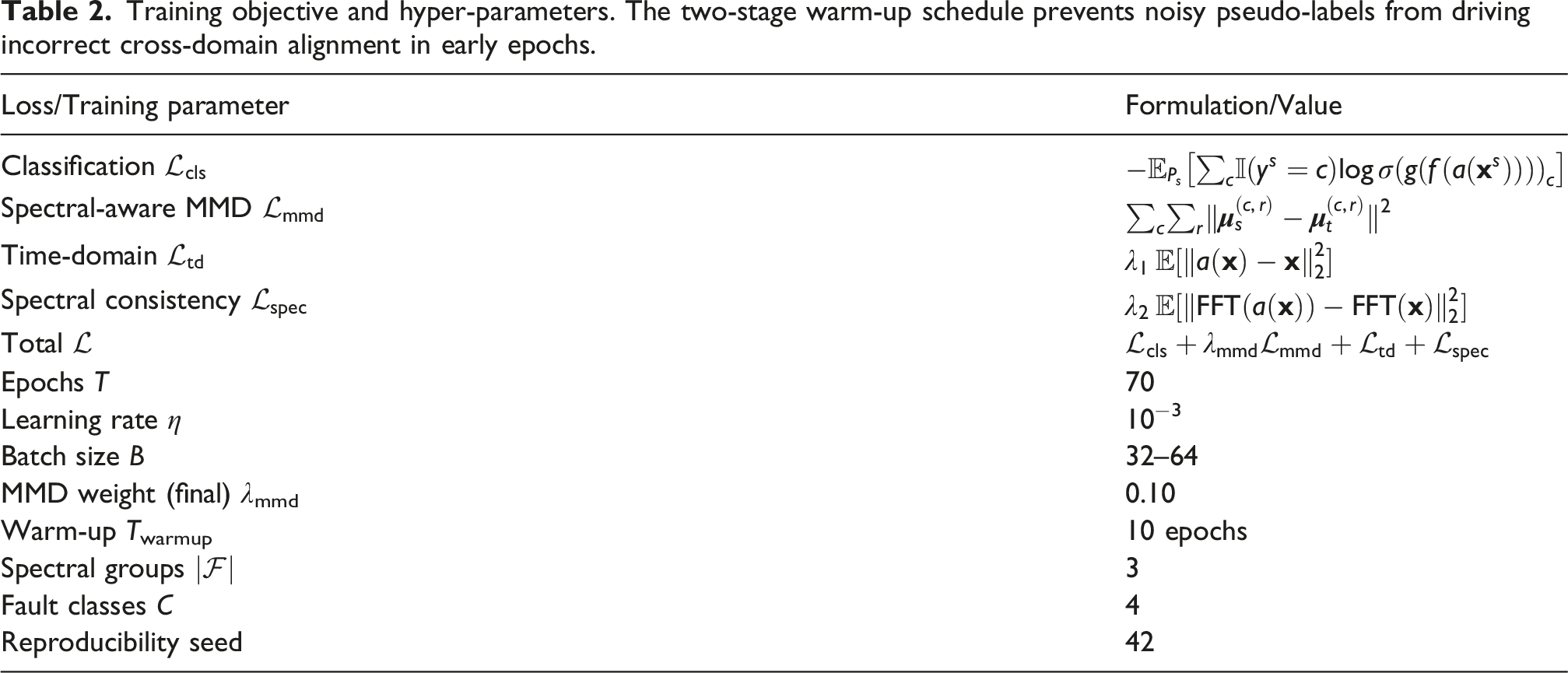
Training objective and hyper-parameters. The two-stage warm-up schedule prevents noisy pseudo-labels from driving incorrect cross-domain alignment in early epochs.
3. Results and discussion
3.1. Experimental setup
Domain adaptation protocol: per-class amplitude scaling and relative signal energy. The scaling operator y(n) = S ⋅ x(n) with
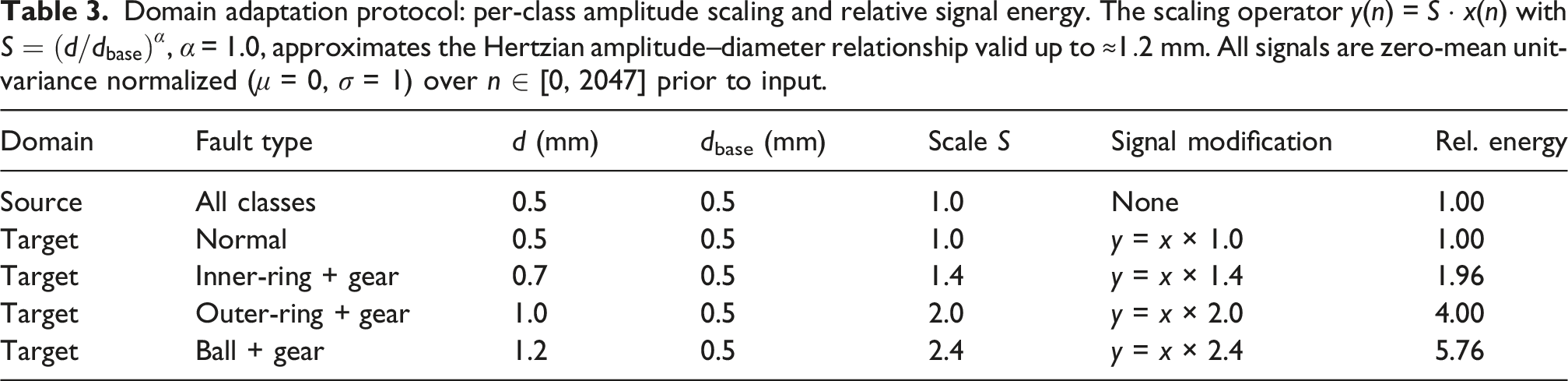
The CWRU experiment was a true cross-device validation as the source model was trained on the Guangdong Key Laboratory platform (motor–gearbox–bearing rig, CTC accelerometer) and then tested with no further training on the CWRU dataset. The CWRU was collected on a completely different test stand (Rexnord bearings, PCB Piezotronics accelerometers, shaft speeds 1730–1797 r/min). The two datasets vary in sampling rate (50 kHz for CWRU vs 25.6 kHz for the source), bearing geometry (SKF vs Rexnord) and loading conditions (0–3 HP on CWRU vs fixed load on the source). On the other hand, the leave-one-compound-out experiment is a cross-condition transfer test. The model is trained with no access to the Ball + Gear fault (F7) signals and it has to recognize this unknown combination of faults at the time of testing.
PGAST works well with small labeled datasets (500 source samples per class, 2000 total and target domain fully unlabeled). A few of the main factors contributing to fewer training samples needed are the physics-constrained AST (acoustic simulation and transformation) module which limits the hypothesis space to only physically plausible spectral transformations and therefore rules out spurious correlations. The Lipschitz-stabilized encoder functions as an implicit regularizer and the warm-up schedule avoids the accumulation of pseudo-label noise. This noise is the main failure mode of domain adaptation on small datasets. Five-fold cross-validation (σ = 0.42%) demonstrates generalization as opposed to split-specific memorization and thus is consistent with recent papers reporting that physics-constrained and transfer-learning approaches deliver reliable fault diagnosis even under limited labels (Sun et al., 2025; Zhao et al., 2025).
3.2. Training dynamics and classification performance
The training curves (Figure 3) indicate steady convergence over 70 epochs with total loss decreases from 1.5 to less than 0.5. Per-regime MMD is stable around 1.0, and both domain accuracies are around 96%. The fast initial drop is due to the warm-up phase in which the method gets the reliable pseudo-labels. The plateau after that is the convergence of the spectral alignment. Five-fold cross-validation (Table 4(a)) yields 95.96% (σ = 0.42%, Kappa = 0.946) under heterogeneous conditions, 93.10% under semi-homogeneous conditions and 94.82% under homogeneous conditions with the intervals that do not overlap each other. The heterogeneous condition gives the greatest accuracy which is explained by the fact that larger inter-class amplitude separations produce stronger gradient signals for the adaptive coefficient α( Training dynamics over 70 epochs. Classification performance. (a) Five-fold cross-validation summary across domain-shift conditions. (b) Class-wise precision, recall, and F1 under the heterogeneous condition. Kappa values Confusion matrices under heterogeneous (left), semi-homogeneous (center), and homogeneous (right) target conditions. Heterogeneous conditions yield the strongest diagonal dominance, consistent with larger inter-class spectral contrast activating the adaptive warping coefficient more strongly. Off-diagonal errors increase under semi-homogeneous conditions, where per-class amplitude differences are smaller. The dominant error in all conditions is Class 2–3 confusion, reflecting the physical proximity of compound harmonics in the mid-frequency regime.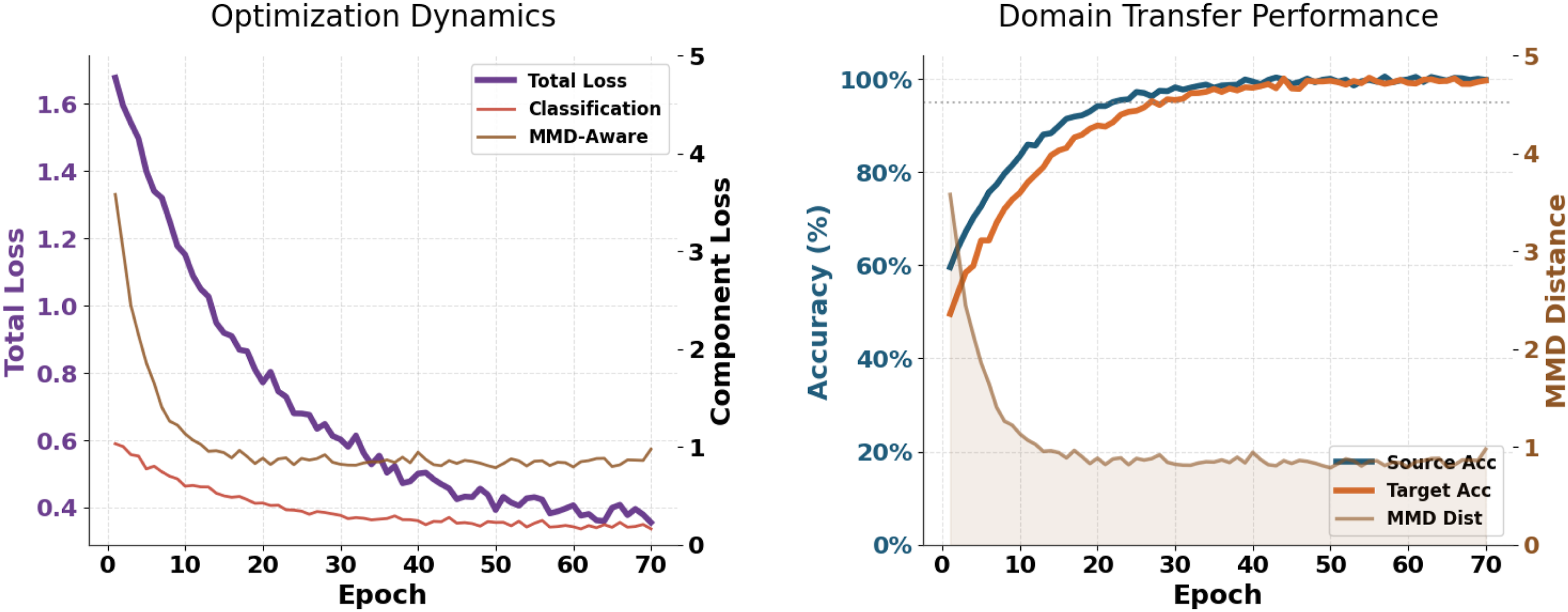
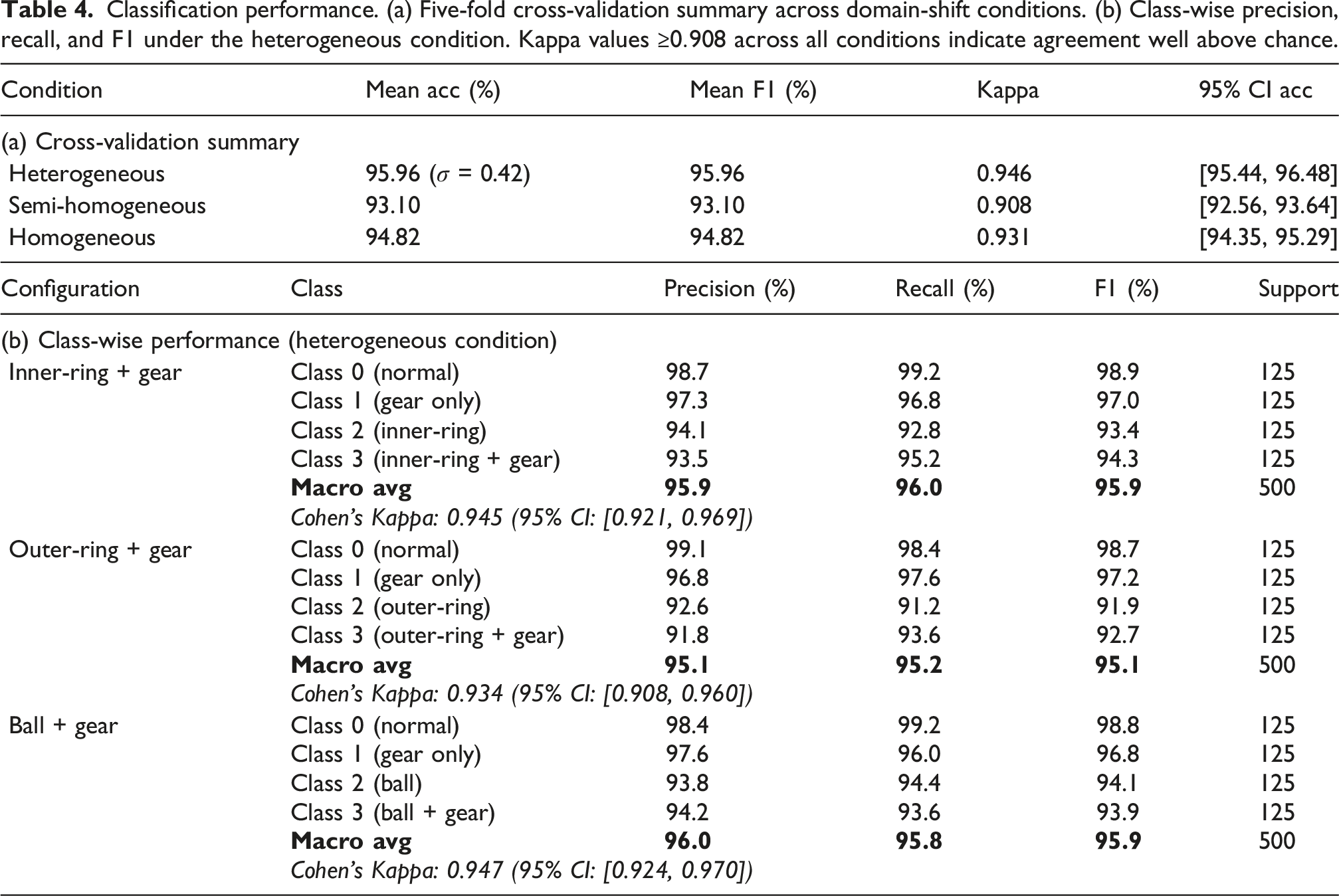
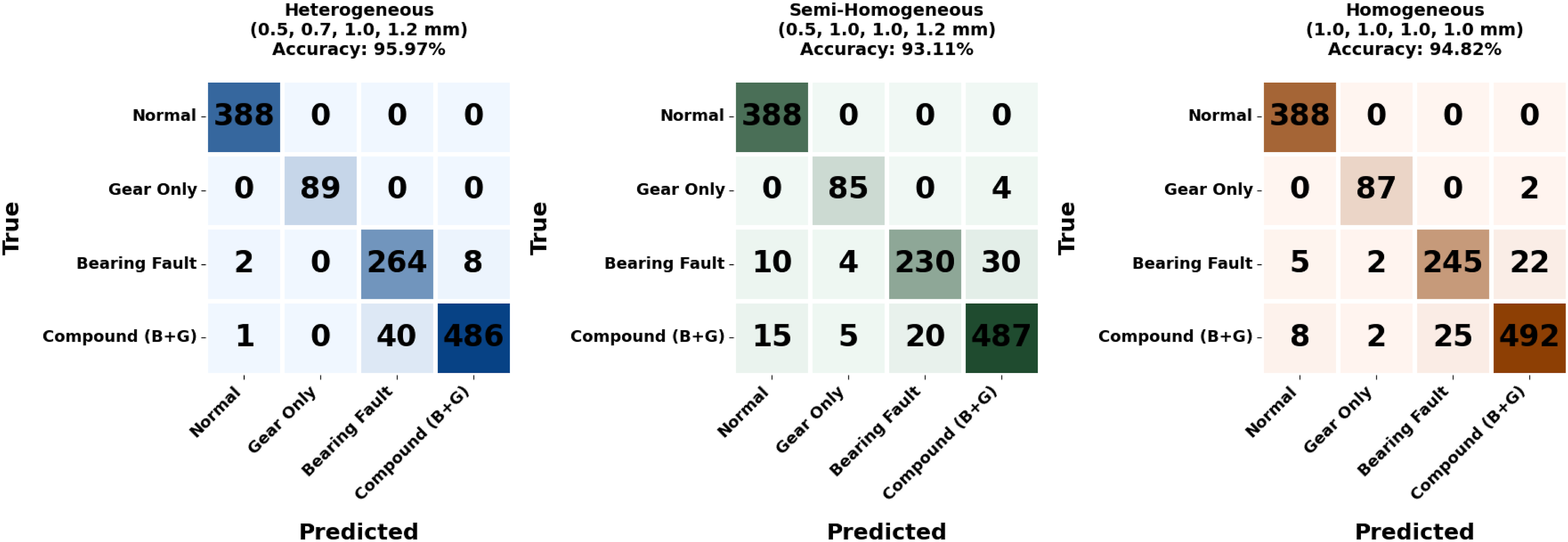
Class-wise metrics (Table 4(b)) give macro F1-scores of 95.9%, 95.1%, and 95.9% across the three compound configurations. Normal and gear-only classes reach near-perfect scores. Compound bearing–gear classes maintain F1 above 90% in the most demanding configurations. Under heterogeneous conditions the dominant off-diagonal entry is Class 3 → 2 at 7.6%, with Class 2 → 3 at 2.9% all remaining cells fall below 1%. Under semi-homogeneous conditions Class 2 → 3 confusion rises to 10.9% and Class 3 → 2 to 3.8%, consistent with narrowing inter-modulation sideband contrast reducing mid-frequency discriminability. Under homogeneous conditions the largest off-diagonal cell is Class 2 → 3 at 8.0%, with all other off-diagonal entries below 5%. LDA and PCA projections (Figure 5) show tight Class 0/1 separation which is consistent with spectral consistency regularization. Residual Class 2–3 overlap reflects inherent compound inter-modulation complexity rather than an alignment failure. The average inter-cluster distance (Euclidean, LDA space) between Classes 0 and 1 is 4.7 units, versus 1.2 units between Classes 2 and 3 which indicates that the spectral overlap between compound bearing–gear fault pairs is an intrinsic data property rather than a framework failure. LDA (top) and PCA (bottom) feature projections for the heterogeneous condition. Tight Class 0/1 separation is consistent with spectral consistency regularization preserving the harmonic amplitudes that distinguish normal and single-fault signals. Residual Class 2/3 overlap reflects the physical coupling of inter-modulation sidebands between compound faults. Average inter-cluster distances (LDA space): Class 0–1: 4.7 units, Class 2–3: 1.2 units. The six-fold gap quantifies the inherent separability difference.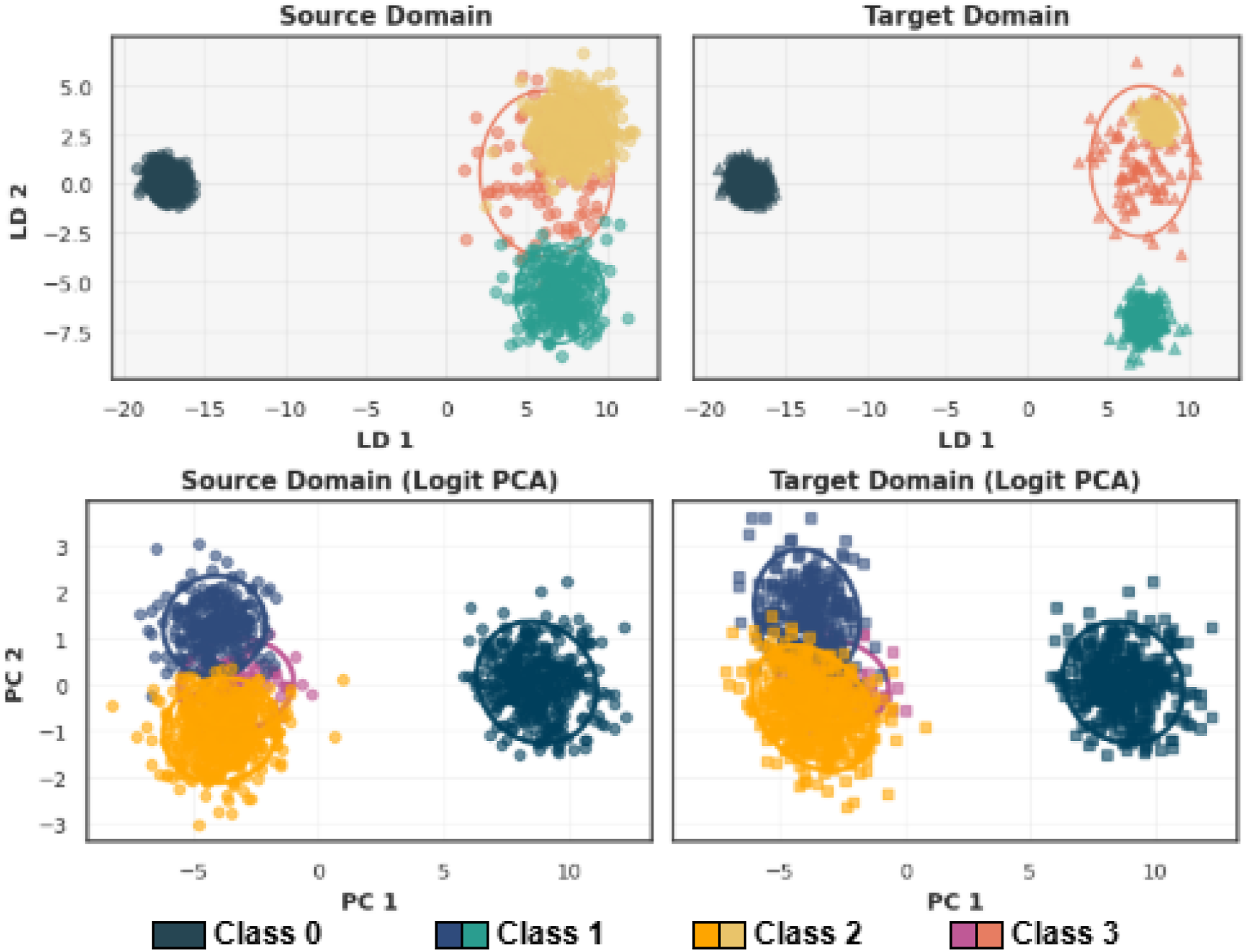
3.3. Generalizability assessment
3.3.1. Cross-dataset validation on CWRU
The framework was applied with CWRU bearing signals (Case Western Reserve University Bearing Data Center, nd) as the unlabeled target, with compatible source classes aligned and gear-coupled classes excluded. This is a cross-device and cross-condition validation as the two platforms differ in bearing type (Rexnord vs SKF), accelerometer (PCB Piezotronics vs CTC), shaft speed (1730–1797 r/min vs fixed), sampling rate (50 kHz vs 25.6 kHz), and load conditions (0–3 HP vs fixed) which makes it a harder generalization test than within-dataset domain shift.
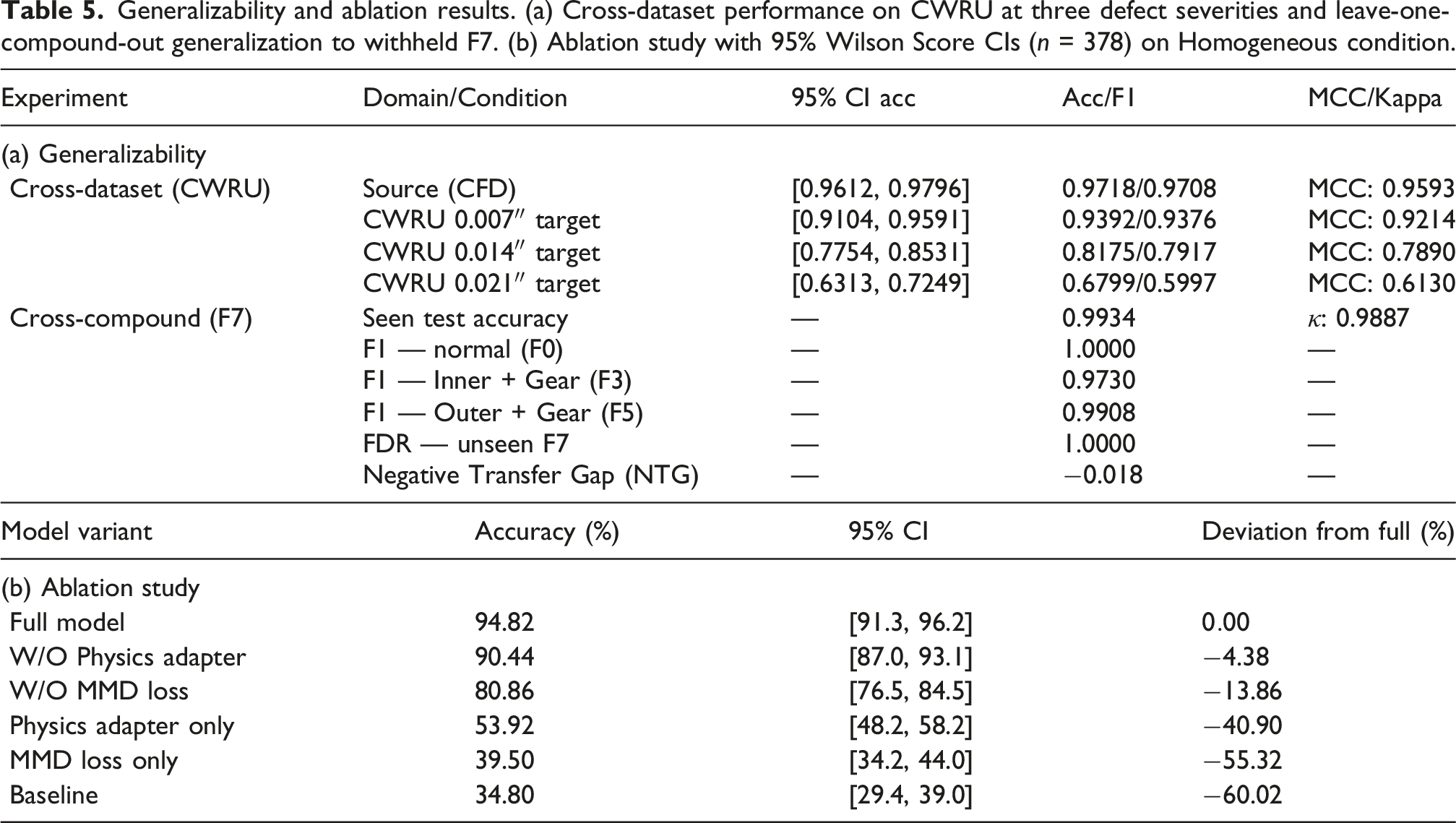
Generalizability and ablation results. (a) Cross-dataset performance on CWRU at three defect severities and leave-one-compound-out generalization to withheld F7. (b) Ablation study with 95% Wilson Score CIs (n = 378) on Homogeneous condition.
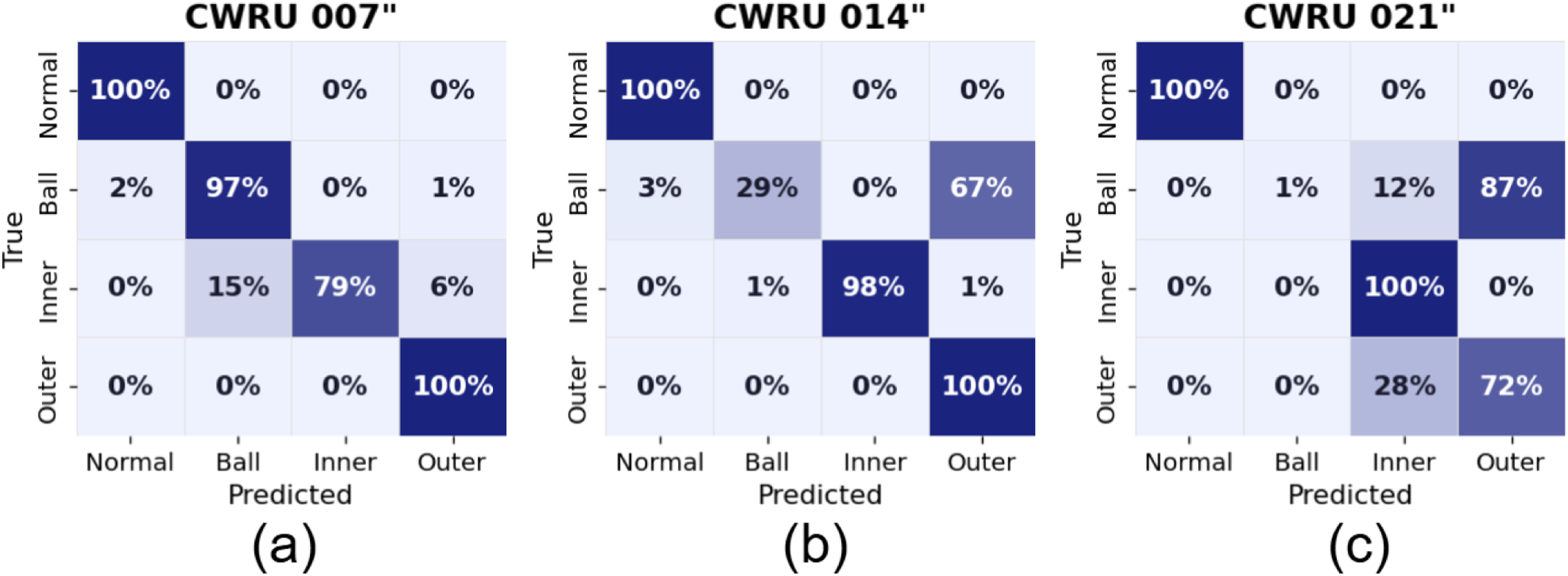
Confusion matrices for CWRU cross-dataset adaptation at (a) 0.007″, (b) 0.014″, and (c) 0.021″ defect diameters. Normal, inner-race, and outer-race classes transfer reliably; ball fault recognition degrades at extreme severities, where spectral broadening exceeds the adaptive warping range. Ball fault precision: 91.2% at 0.007″, 74.3% at 0.014″, 48.6% at 0.021″; inner-race and outer-race precisions remain above 88% at all severities.
This deterioration has a physical meaning. At around 1.2 mm and less fault impulses are in line with the linear Hertzian regime. After this point, contact deformation becomes nonlinear and spectral energy escapes to low-frequency bands outside the Gaussian taper range most detrimentally for ball faults, whose harmonics are naturally low-amplitude. So this system can very well work for defect monitoring at early and mid-stages which is the most safety-critical time for preventive maintenance. But it is worth considering a nonlinear scaling operator for late-stage severe defects.
3.3.2. Robustness analysis
The features
3.3.3. Cross-compound generalization
Training on F0, F3, F5 and evaluating on the fully withheld Ball + Gear compound F7 gives F1 of 0.973–1.000 on the seen classes with Kappa 0.9887, and FDR 1.000 with NTG −0.018 on the unseen F7 (Figure 7, Table 5(a)). NTG = Accseen-only − Accfull-model = −0.018 means that including the unseen F7 during adaptation marginally improves seen-class accuracy by 1.8 percentage points which indicates no negative transfer. Detection of a fully unseen compound class is consistent with the banded spectral warping encoding compositional fault-interaction structure rather than memorized class templates. Cross-compound generalization. (a) Row-normalized confusion matrix: seen classes (blue), unseen Ball + Gear F7 (red). (b) Per-class F1 scores and fault detection rates, annotated with NTG and Cohen’s Kappa. FDR 1.000 on the withheld F7, together with NTG = −0.018, is consistent with the PGAST framework encoding compositional fault-interaction structure rather than memorized templates.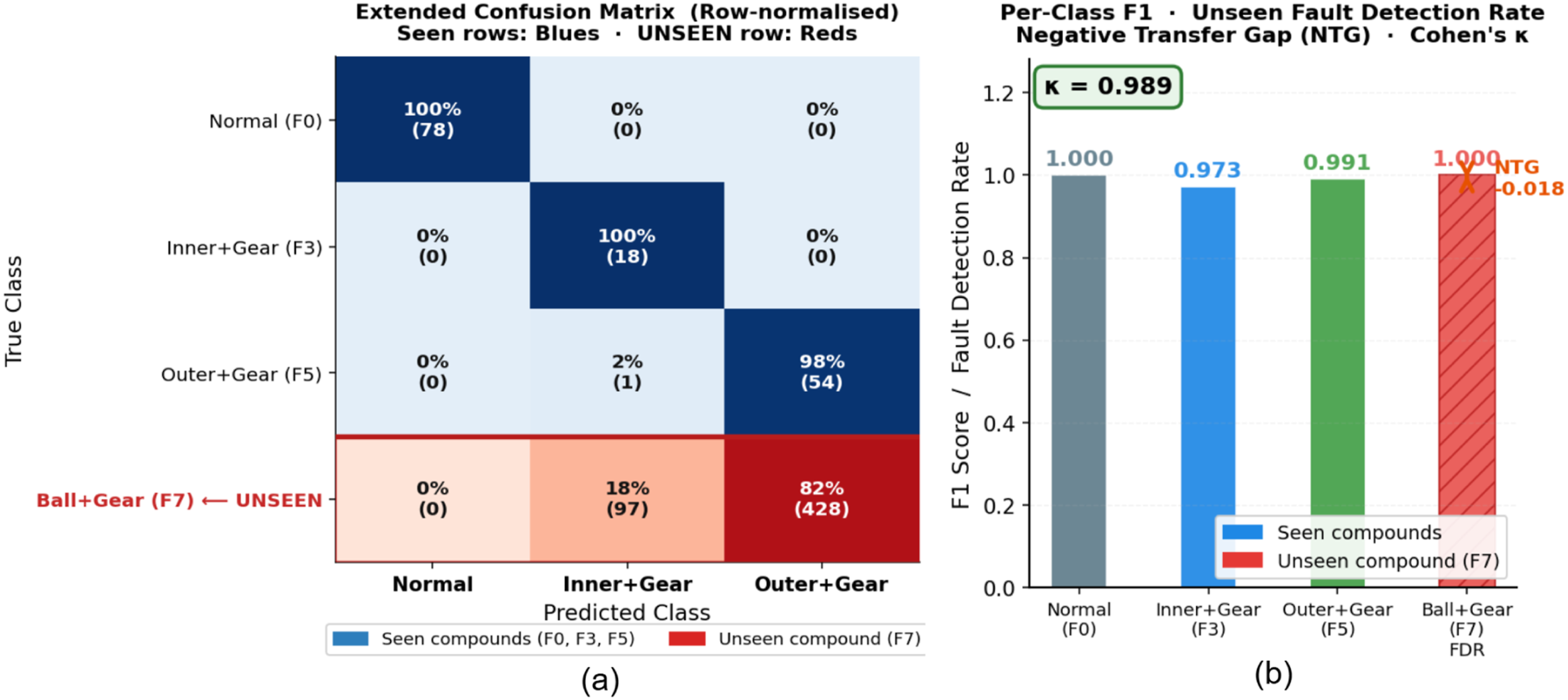
3.4. Ablation and comparative analysis
Figure 8 and Table 5(b) summarize component contributions. Dropping the spectral-aware MMD causes the largest single drop (−13.86 pp, to 80.86%); dropping only the physics adapter causes a smaller drop (−4.38 pp). Both single-component variants fall below 55%, indicating strong module synergy. The adaptive coefficient α( Ablation results. Left: waterfall chart of cumulative accuracy contributions from baseline (34.80%) to full model (94.82%). Right: violin plots with 95% Wilson Score CIs (n = 378). Non-overlapping intervals indicate that both the physics adapter and spectral-aware MMD contribute independently, and that they are jointly sufficient.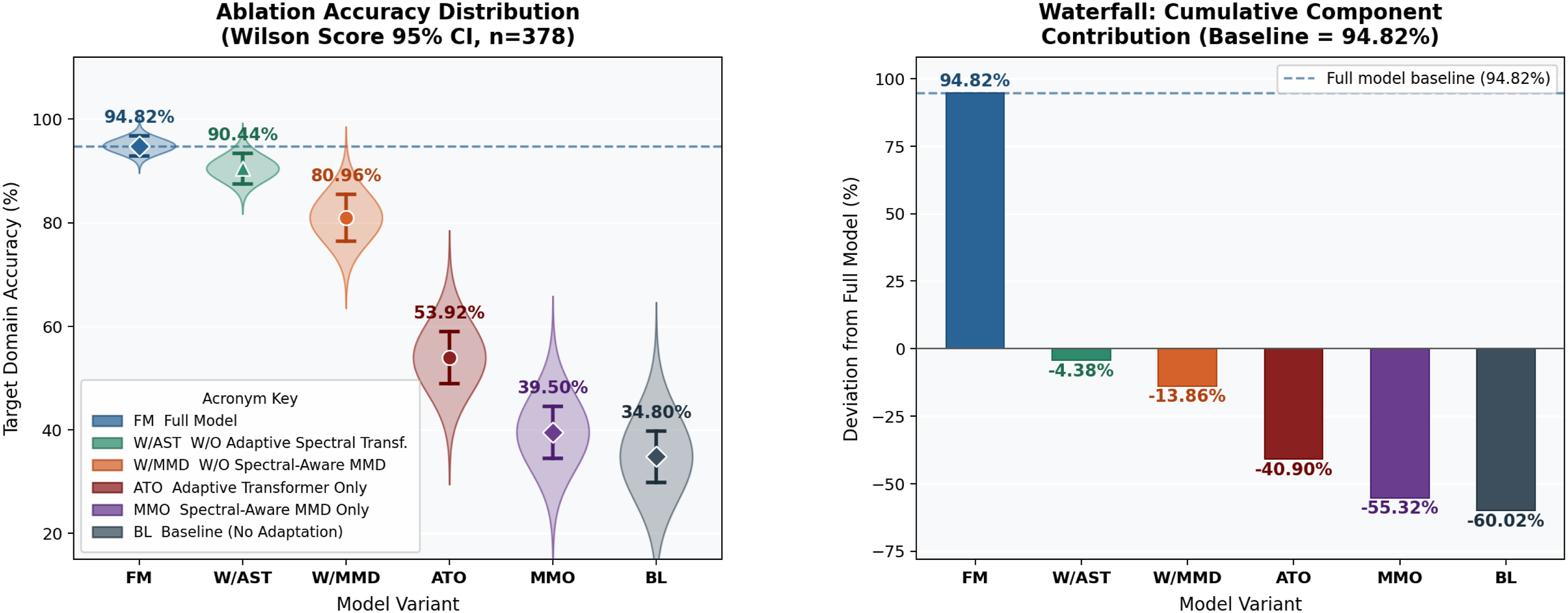
3.4.1. Primary contributor to performance
The spectral-aware class-conditional MMD is the single most important component (+13.86 pp). The physics adapter is the second most important (+4.38 pp). This ordering matches the domain-shift analysis which suggests severity normalization makes alignment tractable, but per-regime class-conditional alignment drives the major accuracy gain by reducing inter-class mode mixing. Neither component alone suffices (both fall below 55%), while their combination reaches 94.82%.
3.4.2. Transformer-based alternatives
Transformers with spectral embeddings (patch-wise FFT tokenization, frequency-domain self-attention) could capture long-range harmonic dependencies beyond the 1D-CNN’s local receptive field. They typically require more training data and are more overfitting-prone in small-dataset regimes (Zhao et al., 2025). Whereas the 1D-CNN’s translation equivariance is well matched to periodic fault signatures. Transformer encoder variants are a planned direction for variable-speed scenarios.
3.4.3. Known failure modes
The primary failure mode is spectral energy migration at extreme defect sizes (
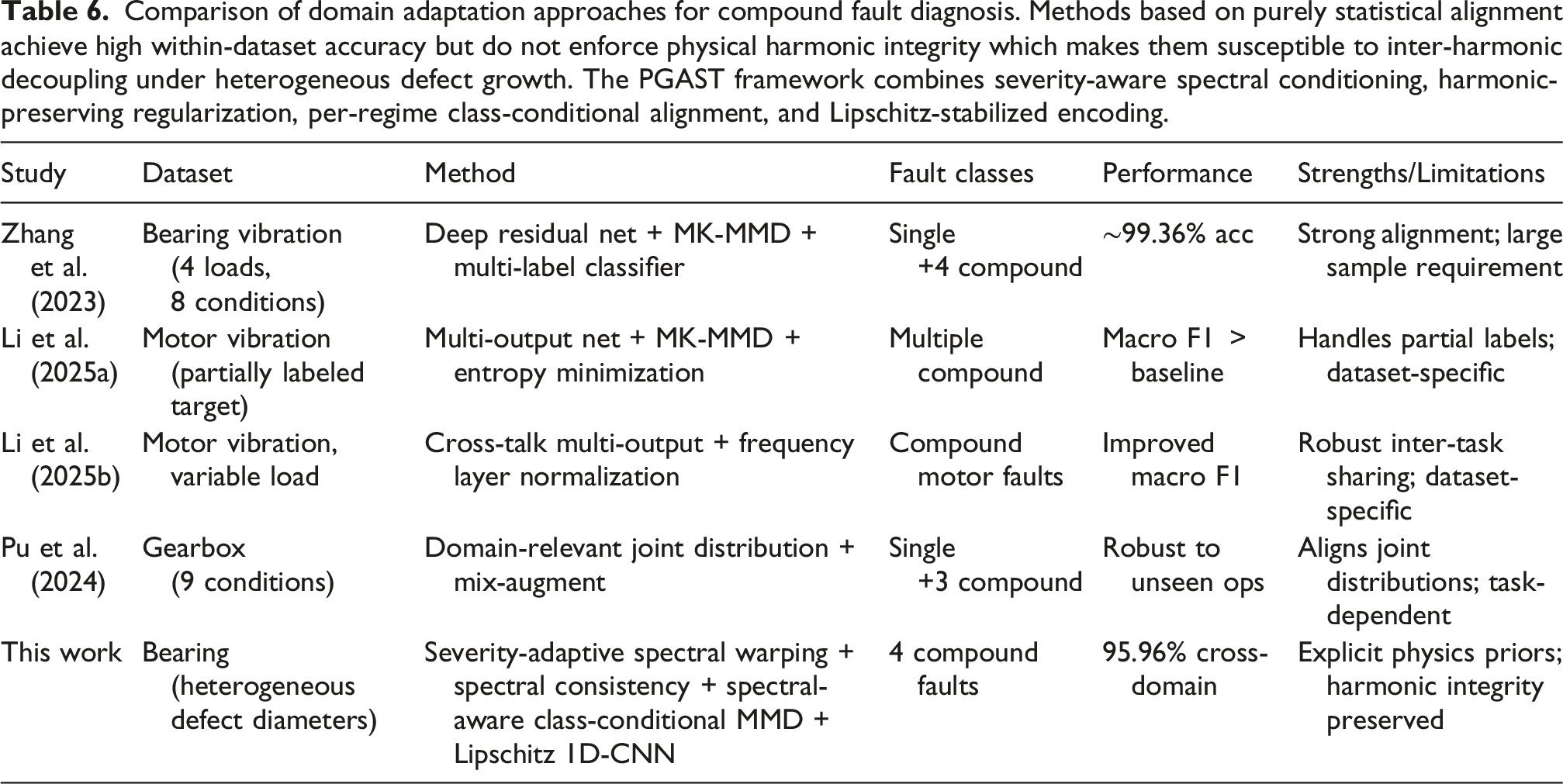
Comparison of domain adaptation approaches for compound fault diagnosis. Methods based on purely statistical alignment achieve high within-dataset accuracy but do not enforce physical harmonic integrity which makes them susceptible to inter-harmonic decoupling under heterogeneous defect growth. The PGAST framework combines severity-aware spectral conditioning, harmonic-preserving regularization, per-regime class-conditional alignment, and Lipschitz-stabilized encoding.
3.5. Discussion and future work
The results show that severity-aware spectral transformation combined with spectral-regime distribution alignment is an effective strategy for cross-domain compound fault diagnosis. The adaptive coefficient α(
The cross-compound results (FDR 1.000) on the withheld F7, NTG −0.018 are consistent with the learned alignment which captures compositional fault-interaction structure rather than statistical correlation. This is in line with the principle that domain-relevant inductive biases improve generalization on heterogeneous data.
3.5.1. Limitations and practical implications
One prominent limitation of this work is that the ball fault recognition accuracy is seriously compromised at very high fault severities (>1.2 mm). Where nonlinear Hertzian contact dynamics result in energy at frequencies moving outside of the Gaussian taper range. Hence, the reliable operating envelope is essentially limited to early- and mid-stage fault progression. In addition, the linear amplitude scaling operator (α = 1.0) is not able to depict the nonlinear dynamics and stochastic impact sequences of real industrial environments. Therefore, the implementation of a variable shaft speed or fluctuating loads in the scenario might make a nonlinear severity estimator necessary. The fixed four-band partitioning is needed to be redefined for machinery with substantially different characteristic frequencies. In the future, we will work on meta-learned band partitioning, adversarial discriminators for sharper domain boundaries, transformer encoders for long-range harmonic dependencies, and network quantization for edge deployment.
4. Conclusion
When diagnosing compound faults which involve different types of defect growth, one cannot solely rely on the statistical alignment of fault-induced vibration spectra. This is because harmonic relationships may be disrupted and negative transfer may also occur. Therefore, the alignment strategies must preserve the physical structure of the spectra. The PGAST framework brought a solution to the problem of severity-sensitive banded spectral warping through α(
The modules are physically explainable as α(
PGAST is applicable wherever labeled data is collected at a single-defect severity but machinery must be monitored as conditions evolve. Deployment contexts include Predictive maintenance, Multi-platform deployment, Novel fault early warning robots, machine tool spindles, and the edge-based lightweight architecture for real-time embedded monitoring.
Future work will address meta-learned band partitioning, source-free and multi-source adaptation, and validation across broader machinery types under realistic variable-load and continuous-noise conditions.
Footnotes

Funding
The authors disclosed receipt of the following financial support for the research, authorship, and/or publication of this article: This research has been supported by Princess Nourah Bint Abdulrahman University Researchers Supporting Project number (PNURSP2025R161), Princess Nourah Bint Abdulrahman University, Riyadh, Saudi Arabia.
Declaration of conflicting interests
The authors declared no potential conflicts of interest with respect to the research, authorship, and/or publication of this article.