






Abstract
In high-speed train active suspensions, unmodeled dynamics, wheel-rail wear, and track disturbances can cause dynamic mismatches that degrade the performance of model-dependent predictive control. This study proposes a composite model predictive control approach that integrates neural network residual compensation and equivalent track disturbance feedforward (NNRC-ETDF-MPC) to address this issue. The method firstly estimates the unknown equivalent track disturbances online using an augmented Kalman filter (AKF) and incorporated into the control framework as a physical feedforward compensation term. The nonlinear dynamic residuals are predicted and compensated online using a history-aware physical residual neural network (HA-PRNN), which uses a sliding window to extract multivariate coupling features. Based on these components, a dual feedforward composite control system is developed, along with a constraint-tightening mechanism to prevent actuator saturation. Finally, the performance of the proposed control strategy is evaluated using a co-simulation platform that includes two track spectra, a wide speed range, and cross-service wear conditions. Comparative tests show that the composite control strategy enhances the dynamic vibration suppression capabilities of high-speed trains working in complex, time-varying environments and enhancing robustness against model mismatch. Specifically, under worn wheel conditions, the proposed NNRC-ETDF-MPC achieves average Sperling index improvements of 22.81% and 23.48% across different track excitations.
Keywords
1. Introduction
The increasing speed of trains inevitably aggravates lateral vibrations caused by track irregularities. As a result, developing active suspension technology has become an effective way to overcome the limitations of traditional passive suspensions while improving vehicle ride comfort.
Early research on active suspension control for automobiles and railway vehicles primarily focused on methods such as skyhook control (Karnopp et al., 1974; Liu and Zuo, 2016; Shi et al., 2025),
However, traditional MPC highly relies on an accurate mathematical model of the controlled plant. When system parameters vary over time or unmodeled dynamics exist, prediction model mismatch often limits control performance (Moradi et al., 2019). For example, in intelligent vehicle trajectory tracking, complex external disturbances, model simplifications, and parameter variations can degrade the tracking accuracy and robustness of MPC (He et al., 2025).
To address this issue, Yang et al. (2021) proposed a dual-loop tube-based robust MPC (DTRMPC) to maintain robustness under parameter uncertainty. However, preserving the uncertainty set may lead to excessive conservatism and reduced suspension performance (Kang et al., 2020). To further mitigate external disturbances, several anti-disturbance control methods have been developed. For example, Shen et al. (2022) proposed an extended disturbance-observer-based data-driven control method to reject unknown inputs. Gu et al. (2024) investigated a dynamic guaranteed-cost event-triggered anti-disturbance control strategy for systems with external uncertainties, while Shen et al. (2020) studied an output anti-disturbance control strategy for stochastic Markov jump systems with multiple disturbances. Alternatively, Meng et al. (2024) proposed a fast iterative MPC (FI-MPC) that iteratively compensates for the error between linear and nonlinear models, achieving performance comparable to NMPC.
With the development of machine learning, learning-based MPC has provided a promising solution to the modeling accuracy limitations of traditional physical models. Rather than constructing highly accurate mathematical models, recent studies increasingly employ frameworks that combine nominal models with residual compensation. In these frameworks, a nominal physical model ensures basic control performance, while residual prediction compensates for complex unmodeled nonlinear dynamics (Amine et al., 2026; Fu et al., 2025; Meng et al., 2025; Xiong et al., 2026). Hancioğlu and Efe (2026) used a neural network to capture nonlinear dynamic residuals from multiple factors and added them to the MPC prediction as a feedforward term. Zhang et al. (2025) developed a temporal residual neural network for vehicles’ complex time-varying nonlinear dynamics in order to learn offline and predict the dynamic residual between the physical mechanism and the actual system, thus overcoming the deviation caused by a single nominal model. Current research shows that, when compared to fully end-to-end control strategies, using a neural network as a residual compensator not only takes advantage of the neural network’s generalization ability, but also preserves the stability of the basic physical model controller (Aswani et al., 2013; Hancioğlu and Efe, 2026; Hewing et al., 2020; Meng et al., 2025; Zhang et al., 2025).
To address the model mismatch in the secondary lateral active suspension of high-speed trains, this paper proposes a mechanism-and-data dual-driven control strategy (NNRC-ETDF-MPC). The architecture first employs a nominal model predictive controller with disturbance feedforward (ETDF-MPC) to manage actuator constraints and ensure baseline stability. A history-aware physical residual neural network (HA-PRNN) is then introduced to estimate unmodeled dynamic residuals online. By incorporating the residual predictions into the MPC framework together with a constraint-tightening mechanism, the proposed strategy enhances control robustness under model mismatch.
The proposed NNRC-ETDF-MPC strategy addresses the limitations of conventional predictive control under model mismatch by enabling online adaptive compensation of unmodeled nonlinear dynamics. Unlike conventional disturbance feedforward MPC architectures, it introduces a dedicated data-driven compensation path to account for structural perturbations. Furthermore, while existing residual-based MPC schemes often rely on single-step feedback, the proposed framework incorporates a History-Aware Physical Residual Neural Network (HA-PRNN) to extract deep spatiotemporal features from historical states and disturbances, thereby improving the representation of long-term dynamic dependencies.
The remainder of this paper is organized as follows. Section 2 presents the lateral dynamic model of the high-speed train, the model decoupling strategy, and an AKF-based method for online estimation of equivalent track irregularities. Section 3 describes the design of the ETDF-MPC controller based on the nominal model. Section 4 introduces the residual compensation network and establishes the NNRC-ETDF-MPC framework. Section 5 presents the co-simulation platform, simulation parameters, and validation of the network prediction performance. Finally, the effectiveness and robustness of the proposed strategy are evaluated under two typical track spectra and different wheel-wear conditions.
2. Lateral dynamics model
To balance estimation accuracy and the real-time requirements of MPC in multibody high-speed train systems (Bruni et al., 2011), this paper proposes a framework integrating full-order state observation with reduced-order decoupled control. A high-order observer estimates multivariable states, while modal decoupling provides a reduced-order representation for MPC, thereby lowering computational complexity.
2.1. Lateral dynamics equations
Neglecting the higher-order degrees of freedom of the bogies, a dynamics model is established that includes the carbody lateral displacement, roll, yaw, and the lateral displacements of the front and rear bogies. Figure 1 shows a schematic diagram of the model. The corresponding dynamic equations are given as follows: Lateral dynamics model of the high-speed train. Main parameters of the vehicle.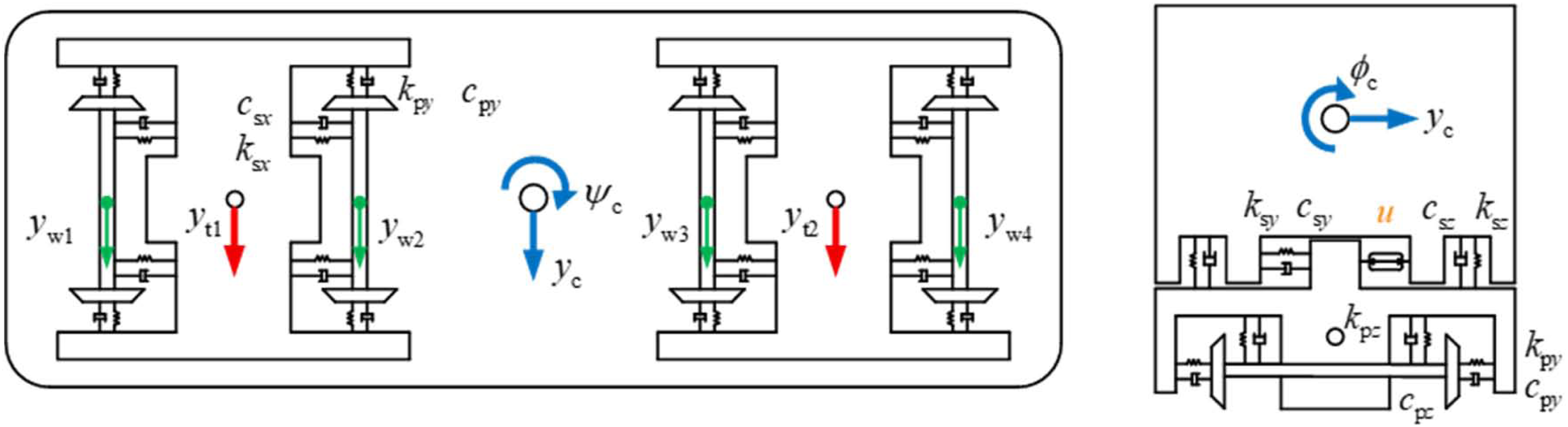


2.2. Augmented Kalman filter
Based on the dynamic equations established in Section 2.1, a continuous-time state-space model is constructed to facilitate the subsequent state estimation and controller design. By defining the state vector 
To estimate the equivalent track irregularities without prior knowledge of their exact time-varying spectra, their temporal dynamics are modeled as a stochastic process, where the irregularities’ accelerations are driven by zero-mean Gaussian white noise 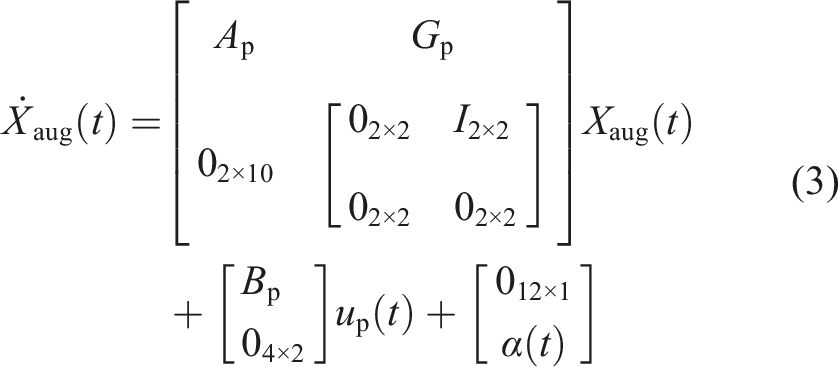
To ensure the system’s observability, the measurement vector is selected as follows:
The discrete Kalman filter (KF) form is obtained by discretizing the continuous model described above:
2.3. Lateral model decoupling
Although the high-order KF can provide accurate state information, solving it directly in a high-dimensional state space is computationally costly. As a result, by ignoring the roll mode, this paper applies the concept of modal decoupling and introduces a homogeneous coordinate transformation to decompose the system into two independent motion modes (Foo and Goodall, 2000; Fu et al., 2020; Orvnäs et al., 2011), as illustrated in Figure 2. Decomposition of lateral motion: (a) pure lateral motion mode (b) pure yaw motion mode.
The motions of the bogies are decomposed into common-mode lateral motion and differential-mode yaw motion:
The lateral subsystem dominates the lateral motion of the train. Defining the state vector 
The corresponding equivalent lateral disturbance is extracted from the augmented states of the KF as follows:
The yaw subsystem dominates the yaw motion of the train. Defining the state vector 
The corresponding equivalent differential-mode disturbance is extracted as follows:
In terms of the arrangement of active dampers, only one secondary lateral passive damper at the front and rear ends of the carbody is replaced by an active damper. The front and rear active dampers provide the active control forces
Defining the output control forces of the lateral and yaw controllers as 
Considering the saturation limit of the maximum thrust 
The above distribution mechanism successfully decouples the lateral and yaw controllers and calculates the actuator thrusts.
3. Nominal equivalent track disturbance feedforward MPC
To achieve effective control under complex track conditions, this section develops a feedforward incremental MPC (FI-MPC) based on the nominal linear dynamics model. By incorporating the online estimated equivalent track irregularities as feedforward compensation, the system’s ability to suppress external disturbances is enhanced (Gu et al., 2026).
3.1. Incremental predictive model and disturbance augmentation
Since the pure lateral and pure yaw subsystems decoupled in Section 2 share the same structure, a unified state variable is adopted to represent the discretized physical states of either subsystem (
Due to the bandwidth limitations of practical actuators, an incremental state-space formulation is employed to penalize actuator force increments (Meng et al., 2024, 2025). The physical state at the current time step 
The corresponding augmented matrices are defined as:
The system output is defined by the physical variables to be optimized. In this study, the carbody displacement, velocity, and acceleration are selected as optimization variables,
3.2. Prediction equations and constraints
Designate the prediction horizon of the system as 
Under the assumption of meeting physical constraints, the controller’s optimization goal is to minimize the carbody’s dynamic response while limiting control energy consumption. The cost function 
Defining the full-horizon weighting matrices as 
In practical engineering, the active damper thrust is constrained by absolute thrust limits and slew rate restrictions (Sun et al., 2012). To prevent actuator saturation and reserve control authority for nonlinear compensation, constraint tightening margins (
The increment constraint matrices 
While the nominal MPC effectively suppresses track-induced vibrations under ideal conditions, inevitable parameter perturbations cause model mismatches and dynamic residuals (Meng et al., 2024, 2025). These unmodeled dynamics cause deviations between the predicted trajectory and the actual vehicle response, degrading control performance (He et al., 2025; Sun et al., 2014). To overcome these uncertainties, Section 4 introduces a residual compensation neural network to enhance the controller’s adaptive capacity (Aswani et al., 2013; Hewing et al., 2020).
4. Neural network residual compensation and composite control
4.1. History-aware physical residual neural network design
To overcome the nominal model’s limitations, this section proposes a history-aware physical residual neural network (HA-PRNN). Rather than predicting absolute states, HA-PRNN estimates unmodeled nonlinear residuals using independent parallel networks tailored to the distinct decoupled lateral and yaw subsystems.
To enable the network to fully extract the true mapping relationships under varying conditions, a training dataset with different speeds, track spectrum excitations, and wheel profile wear states is constructed. For a single decoupled mode, the single-step base feature vector 
The network label is defined as the single-step dynamic residual 
Due to the strong temporal memory effects inherent in the vehicle’s dynamic responses, single-step features are insufficient for accurate residual estimation. Therefore, a sliding window of length 
To process the 2D spatiotemporal tensor, a multi-scale convolutional neural network (CNN) is developed, leveraging its proven capability in handling multivariate time series (Bai et al., 2018; Zheng et al., 2014). The network comprises modules for local temporal extraction, cross-physical channel fusion, deep dynamic feature extraction, and fully connected mapping. This architecture outputs a single-step prediction vector representing the unmodeled nonlinear physical residual Multi-scale convolutional neural network architecture. Network structure parameters. Training loss curve: (a) lateral modal (b) yaw modal.


The network’s core computational layers operate as follows: (1) Intra-channel local temporal convolution: Uses [1 × 3] 1D kernels to extract independent temporal features from each state and disturbance, yielding an (2) Cross-channel physical fusion: Utilizes [8 × 5] kernels across all eight spatial channels to capture multivariate coupling effects, raising the dimension to (3) Deep global dynamic extraction: Employs [1 × 3] kernels to capture long-range dependencies of the nonlinear residual evolution, outputting an (4) Max pooling and flattening: A [1 × 2] pooling kernel halves the time axis to mitigate overfitting (5) Fully-connected mapping: Sequentially maps the 1D vector into a (4 × 1) output, generating the final prediction for the unmodeled physical residual
4.2. Residual feedforward integration and control framework
While the nominal state space (Section 3) relies solely on the current state, control increments and track irregularities, nonlinear compensation is achieved by incorporating the predicted residual vector into the augmented state equation as an independent external input:

To achieve real-time feedforward compensation within the prediction horizon 

Because the network introduces additional nonlinear compensation control efforts, the actual output of the actuator may approach its physical limits. However, the constraint tightening margins
As shown in Figure 5, the closed-loop NNRC-ETDF-MPC architecture first employs the AKF to estimate vehicle states and track excitations using SIMPACK feedback. The augmented states are then decoupled into independent lateral and yaw subsystems, where parallel neural networks perform forward propagation to predict unmodeled dynamic residuals. The estimated disturbances and residuals are incorporated as dual feedforward inputs into the MPC, which performs receding-horizon optimization to generate constrained optimal control sequences. Finally, the optimized control forces are transformed through the corresponding transfer functions (TF) and applied to the vehicle dynamic model. Operation framework of NNRC-ETDF-MPC.
5. Co-simulation verification and result analysis
5.1. Co-simulation setup and test conditions
To validate the proposed control algorithm, a SIMPACK-MATLAB/Simulink co-simulation platform was established. The multibody train model operates in SIMPACK, while the controllers and neural network are executed in Simulink, enabling real-time closed-loop interaction between system states and control forces.
To account for long-term wheel-rail degradation (Gao et al., 2025a; Polach, 2006), new and worn wheel profiles are defined for comparison, yielding equivalent conicities of 0.04 and 0.34, respectively (Figure 6(a)). Additionally, a TF model implemented in Simulink characterizes the active damper’s step response (Figure 6(b)). Simulation settings: (a) comparison of new and worn wheel profiles (b) step force response of the TF.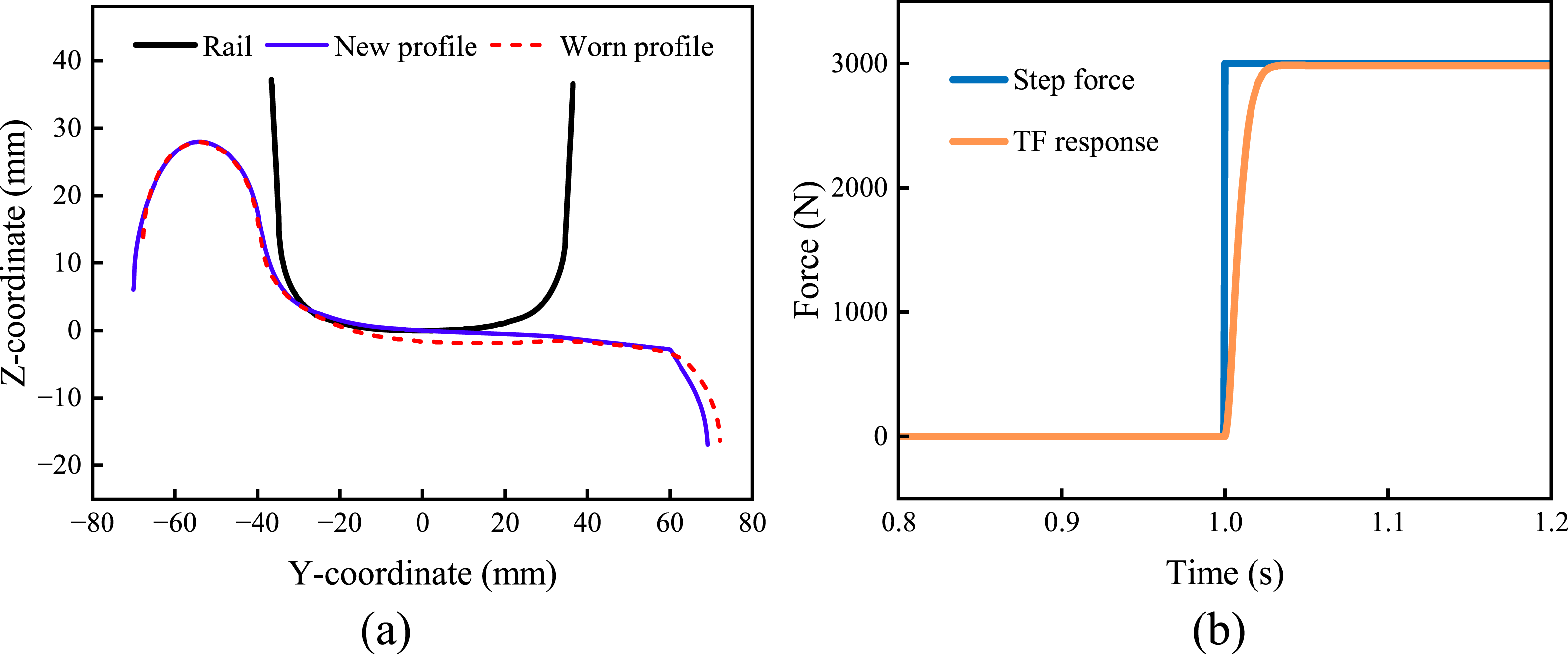
The simulations are conducted using the WG and JJ track spectra. The proposed controller is benchmarked against a passive suspension, a classical skyhook control (damping coefficient set to 40,000 N·s/m), and the nominal ETDF-MPC (constructed in Section 3). For a fair comparison, both MPC strategies use identical prediction, control, and penalty matrices. All controllers operate with a 0.01 s sampling period, and the neural network utilizes a history-aware window length of 50. The baseline ETDF-MPC employs the same tightened constraints as the NNRC-ETDF-MPC. Although this setup inevitably restricts the maximum output capacity of the baseline controller, it ensures that both control strategies operate under identical physical execution boundaries. This design isolates and evaluates the contribution of the neural network to compensating for unmodeled dynamics.
5.2. Verification of residual network prediction
To evaluate the residual prediction capability of the network, tests were conducted using the WG spectrum at 100 and 350 km/h for both new and worn wheel profiles. Figure 7(a) and (b) compare the true and predicted residuals (Dim 2 and Dim 4) for new wheels, demonstrating fundamental consistency. As speed increases, the nonlinear residuals become more pronounced, with the peak lateral velocity residual (Dim 4) increasing by approximately 0.03 m/s. Nevertheless, the network accurately captures these dynamic variations. Comparison between predicted and true values: (a) WG new wheel, 100 km/h (b) WG new wheel, 350 km/h (c) WG worn wheel, 100 km/h (d) WG worn wheel, 350 km/h.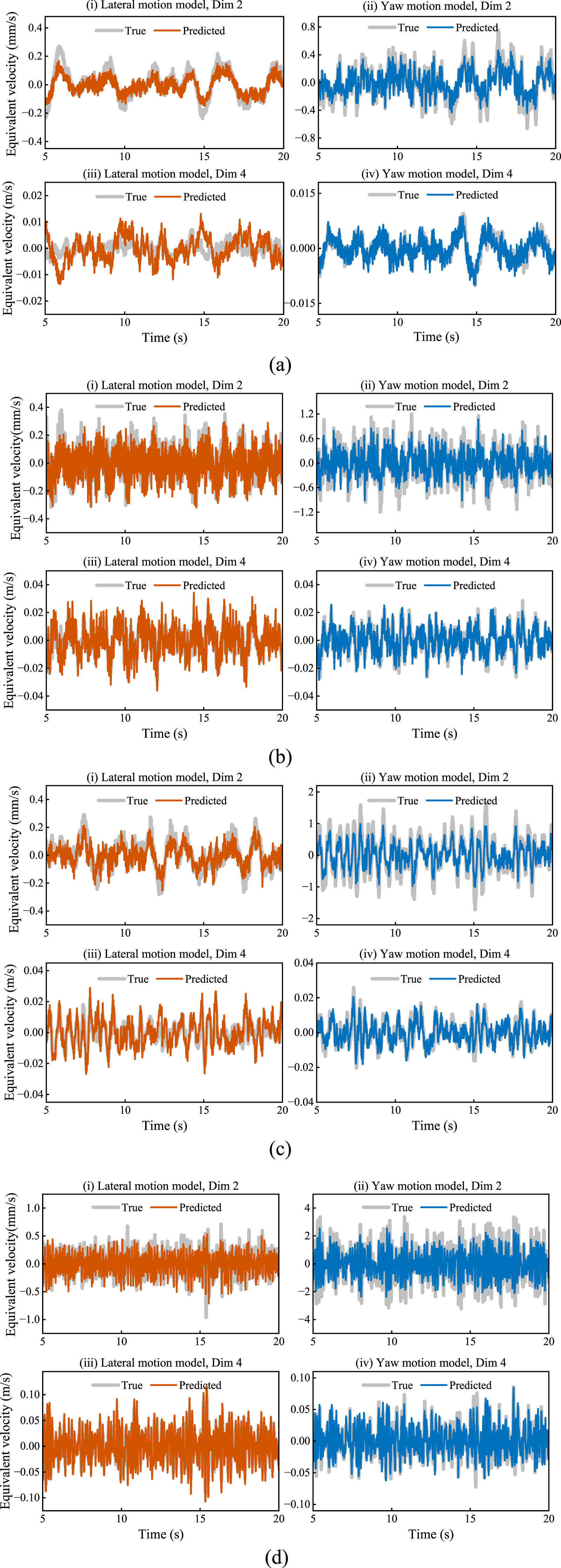
Figure 7(c) and (d) present the prediction results under worn-wheel conditions, where the contact geometry between the wheel and rail exacerbate nonlinear dynamics (Gao et al., 2025b; Li et al., 2024; Zeng et al., 2025). At 350 km/h, wheel wear amplifies the residual amplitudes, with the peak yaw velocity residual (Dim 2) increasing from 1.2 mm/s to nearly 4.0 mm/s. Despite slight deviations near extreme peaks, the network accurately reconstructs the overall trajectories. These results demonstrate that the network effectively captures time-varying dynamics, providing reliable nonlinear feedforward compensation for the composite MPC.
5.3. Dynamic responses under typical conditions
To evaluate the vibration suppression performance, four suspension configurations are compared on the WG track spectrum at 350 km/h under both new and worn wheel conditions. Figures 8 and 9, alongside Table 3, illustrate the dynamic responses and acceleration RMS values of the vehicle under various control strategies for both new and worn wheel profiles. Dynamic responses under the Wu-Guang spectrum at 350 km/h: (a) New wheel – Carbody lateral acceleration (b) New wheel – Yaw angular acceleration (c) New wheel – Carbody lateral acceleration PSD (d) New wheel – Yaw angular acceleration PSD. Dynamic responses under the Wu-Guang spectrum at 350 km/h: (a) Worn wheel – Carbody lateral acceleration (b) Worn wheel – Yaw angular acceleration (c) Worn wheel – Carbody lateral acceleration PSD (d) Worn wheel – Yaw angular acceleration PSD. Acceleration RMS under WG spectrum at 350 km/h.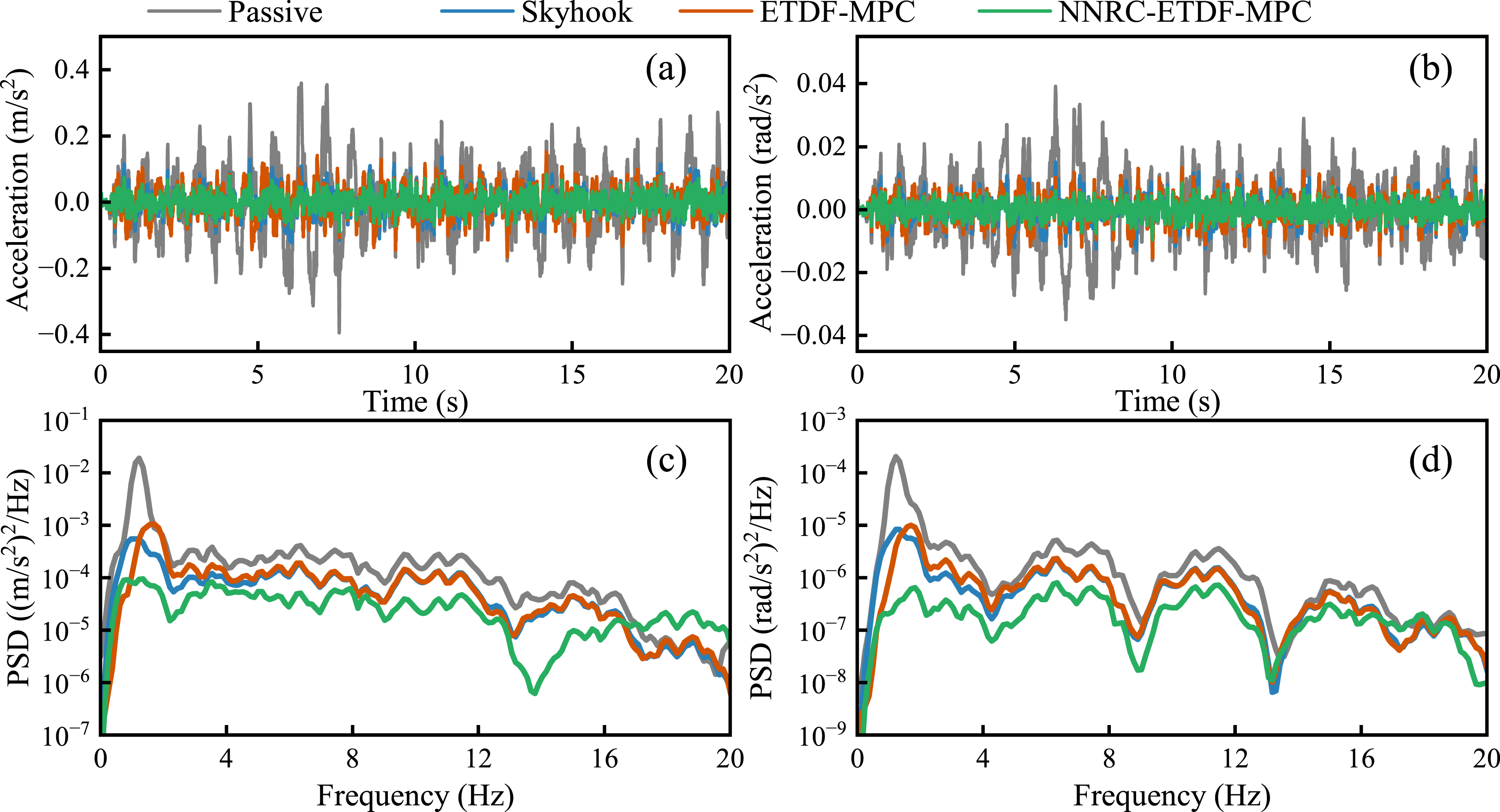
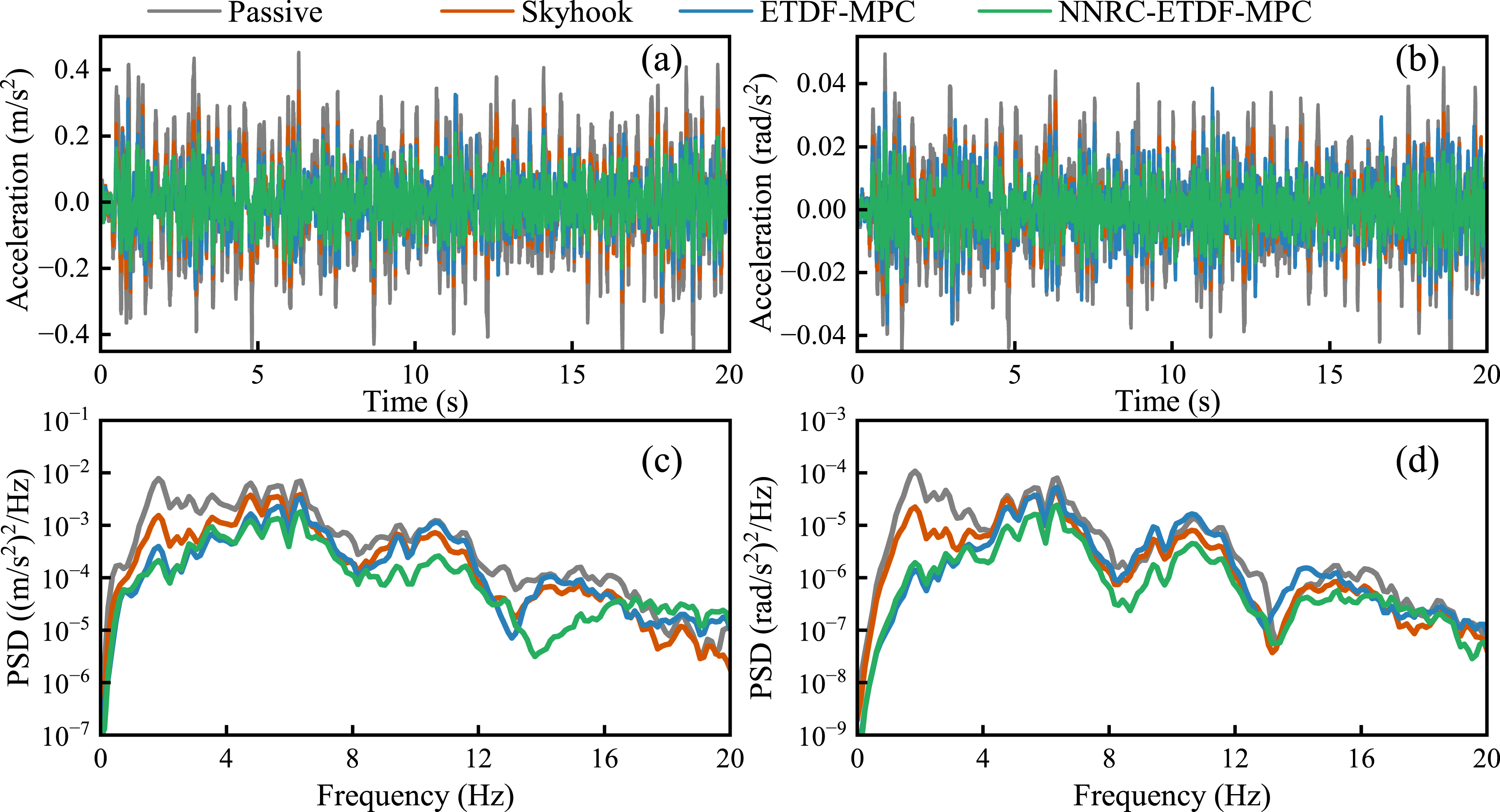

Figure 8(a)–(d) show the lateral acceleration of the front carbody center and the carbody yaw acceleration under the new wheel condition. Owing to the absence of active control, the passive suspension exhibits the largest vibration amplitudes, with lateral and yaw acceleration RMS values of 0.102 m/s2 and 0.0107 rad/s2, respectively. Compared with the passive suspension, Skyhook control and ETDF-MPC reduce the RMS values by 55%-59%. In contrast, NNRC-ETDF-MPC provides the best control performance, reducing the RMS values to 0.026 m/s2 and 0.0024 rad/s2, corresponding to improvements of 74.51% and 77.57%, respectively.
Figure 8(c) and (d) show power spectral density (PSD) curves that demonstrate the frequency-domain effects of various controllers. The lateral and yaw resonance peaks are mainly concentrated in the low-frequency range of 1-2 Hz. Within this range, NNRC-ETDF-MPC provides the greatest attenuation, particularly at the 1.22 Hz resonance peak. In contrast, the performance of ETDF-MPC deteriorates above 1.2 Hz, where its PSD curve approaches that of Skyhook control. Nevertheless, NNRC-ETDF-MPC maintains effective vibration suppression in the 4-12 Hz frequency band.
Figure 9(a)–(d) show the time-frequency domain comparison results under the worn wheel condition. Wheel wear increases the vibration levels of the passive suspension and degrades the performance of both Skyhook control and ETDF-MPC. As shown in Table 3, the lateral and yaw RMS improvement rates of Skyhook control decrease to 32.50% and 31.21%, respectively, while the yaw improvement rate of ETDF-MPC drops to 32.48%. In the frequency domain, the vibration suppression capability of Skyhook control below 2 Hz is weakened. Meanwhile, ETDF-MPC exhibits limited attenuation of lateral vibrations in the 8-12 Hz range and yaw vibrations in the 4-12 Hz range. In contrast, NNRC-ETDF-MPC compensates for model mismatch through neural network-based residual correction while maintaining strong low-frequency vibration suppression. Consequently, its lateral and yaw improvement rates remain above 54% under worn-wheel conditions. Figure 9(c) and (d) demonstrate that NNRC-ETDF-MPC maintains a lower vibration energy density across the dominant frequency bands.
5.4. Ride quality across speed and wear conditions
To evaluate the controllers’ robustness against dynamic mismatches under various operational severities, co-simulations were conducted over a wide speed range (100-400 km/h with a step of 20 km/h). The test scenarios include two typical track excitations and two wheel-rail contact states. Figure 10 shows the variation trends of the vehicle lateral Sperling index under these conditions. In the low-speed range, where the discrepancy between the nonlinear vehicle dynamics and the nominal reduced-order model is limited, both ETDF-MPC and NNRC-ETDF-MPC outperform the Skyhook controller in vibration suppression. As speed increases and wheel wear becomes more severe, model mismatch becomes more pronounced. This is evident in Figure 10(b) and (d), where the difference between the Sperling index curves of the nominal ETDF-MPC and the NNRC-ETDF-MPC becomes more prominent. Under 400 km/h worn wheel conditions (Figure 10(b) and (d)), the mismatch causes the lateral Sperling index of ETDF-MPC to increase, resulting in hunting instability of the vehicle. In contrast, NNRC-ETDF-MPC, with residual feedforward compensation, maintains a smooth and stable trend. Sperling index under different track spectra and wheel profiles: (a) WG spectrum new wheel (b) WG spectrum worn wheel (c) JJ spectrum new wheel (d) JJ spectrum worn wheel.
Average improvement of Sperling index (100-380 km/h).

To investigate the instability mechanism under extreme operating conditions, time-domain and time-frequency responses are analyzed for the WG and JJ spectra at 400 km/h (Figures 11 and 12). As shown in Figure 11(a), when the simulation time exceeds 13.5 s, the peak lateral carbody acceleration under the ETDF-MPC strategy increases to 0.6 m/s2. Combined with the time-frequency energy distribution in Figure 12(a), the hunting motion energy is mainly concentrated in the 4-6 Hz band. For the JJ spectrum (Figure 11(b)), both Skyhook control and ETDF-MPC exhibit high-frequency vibrations, with acceleration peaks of approximately 0.4 m/s2. The corresponding time-frequency results in Figure 12(b) further confirm the presence of high-frequency hunting instability. In particular, ETDF-MPC shows a pronounced energy concentration in the 4-6 Hz band after 12 s under JJ excitation. In contrast, NNRC-ETDF-MPC achieves effective suppression of hunting oscillations. The proposed composite controller consistently attenuates energy in the 4-6 Hz band for both track spectra, maintaining carbody acceleration within safe limits. Time-domain responses with worn wheels at 400 km/h: (a) WG (b) JJ. Time-frequency responses with worn wheels at 400 km/h: (a) WG (b) JJ.

The instability of the vehicle dynamic response is also reflected in abnormal actuator force outputs. Figure 13(a) and (b) compare the actual output forces of the front bogie active damper under the ETDF-MPC and the NNRC-ETDF-MPC strategies at 400 km/h with worn wheels. During high-frequency hunting instability, the force commands generated by ETDF-MPC cause actuator saturation. In contrast, NNRC-ETDF-MPC employs physical residual feedforward to provide early corrective action during disturbance evolution, thereby effectively suppressing energy accumulation associated with hunting motion. Active forces of the front active damper with worn wheels at 400 km/h. (a) WG (b) JJ.
6. Conclusions
This paper proposes a composite model predictive control strategy (NNRC-ETDF-MPC) to address the nominal model mismatch and control performance degradation in high-speed trains. The proposed method is evaluated through co-simulations over a speed range of 100-400 km/h under two wheel-rail contact conditions. The main conclusions are as follows: (1) The residual neural network effectively approximates transient dynamic residuals that cannot be captured by the nominal linear model, using local states and temporal disturbance features within a sliding window. Multi-condition tests demonstrate good generalization and prediction capability, enabling reliable residual feedforward compensation. (2) Both ETDF-MPC and NNRC-ETDF-MPC effectively reduce vibrations under new wheel conditions. NNRC-ETDF-MPC achieves superior vibration attenuation in both the 1-2 Hz and 4-12 Hz frequency bands, thereby improving the Sperling index. Under worn-wheel conditions, it maintains robust broadband vibration suppression and improves ride comfort. (3) When operating at 400 km/h with wheel-rail wear, the ETDF-MPC’s performance degrades significantly, leading to high-frequency hunting instability. Using neural network residual feedforward compensation, NNRC-ETDF-MPC provides early corrective control through neural-network-based residual feedforward compensation, effectively suppressing the growth of unstable energy.
Footnotes

Ethical considerations
This article does not contain any studies with human or animal participants.
Funding
The authors disclosed receipt of the following financial support for the research, authorship, and/or publication of this article: This work was supported by the National Key R&D Program of China [grant numbers 2022YFB4301303, 2025YFB4304002].
Declaration of conflicting interests
The authors declared no potential conflicts of interest with respect to the research, authorship, and/or publication of this article.
Data Availability Statement
The datasets generated during and/or analyzed during the current study are available from the corresponding author on request.