






Abstract
Multiprofessional primary care models promise to deliver better care and reduce waste. This study evaluates the impact of such a model, the primary care unit (PCU), on three outcomes. A multilevel analysis within a “pre- and post-PCU” study design and a cross-sectional analysis were conducted on 215 PCUs located in the Emilia-Romagna region in Italy. Seven dimensions captured a set of processes and services characterizing a well-functioning PCU, or its degree of vitality. The impact of each dimension on outcomes was evaluated. The analyses show that certain dimensions of PCU vitality (i.e., the possibility for general practitioners to meet and share patients) can lead to better outcomes. However, dimensions related to the interaction and the joint works of general practitioners with other professionals tend not to have a significant or positive impact. This suggests that more effort needs to be invested to realize all the potential benefits of the PCU’s multiprofessional approach to care.
Introduction
How to best organize primary care services to guarantee high-quality care has been the topic of a long-standing international debate among health care policymakers and managers, as well as among scholars in health services research and management. One of the most common organizational solutions, which has been adopted both in Europe and in the USA, has been the creation of group practices in which general practitioners (GPs) work in close contact with colleagues, exchange information and knowledge, and exploit certain economies of scale (Baron & Cassel, 2008). In addition, despite the fact that organizational solutions might vary according to the context, all of them tend to have GPs working in collaboration with other health care professionals (e.g., nurses, specialists) with the aim of organizing processes of care that are patient centered, generate a prompt and appropriate response to most common problems, avoid inappropriate and inefficient admissions to the hospital, and improve clinical outcomes (Berenson et al., 2008).
The current discussions in the United States about patient-centered medical homes clearly testify to the relevance of the topic and the widespread experimentation and evaluation that is being performed with these organizational arrangements (e.g., Crabtree et al., 2011; Jaén et al. 2010; Rittenhouse & Shortell, 2009). Numerous indicators and indexes have been devised to measure the extent of implementation of the medical home model in primary care practices (Cooley, McAllister, Sherrieb, & Clark, 2003; Gilfillan et al., 2010; Jaén et al., 2010; Reid et al., 2009; Rittenhouse, Casalino, Gillies, Shortell, & Lau, 2008; Rittenhouse et al., 2011). Organizational capacity, enhanced access, chronic-condition management, and care coordination are just some of the dimensions that have been considered characteristics of well-functioning medical homes. Some studies have shown that the implementation of these processes and services is actually correlated with better quality of care and decreased utilization of the emergency room (ER) and of the hospital (for reviews, see Alexander & Bae, 2012; Hoff, Weller, & DePuccio, 2012). Still, the evidence that these organizational solutions are effective in improving primary care is far from definitive. More important, because it is not always easy to pinpoint the interventions that actually lead to better care, it is often cumbersome for policymakers and managers to know which solutions are most likely to steer the system in the right direction and on which solutions it is worth investing the effort and resources.
The Primary Care Unit Organizational Model
The present study aims to advance this line of research by using the example of the primary care system in an Italian region and of the multiprofessional organizational model that has been adopted in this setting: the primary care unit (PCU). The PCU model has been introduced by regional policymakers in 2007, and on average 16 GPs have been compulsorily assigned to each PCU based on their geographical proximity. The PCU was designed with specific features: GPs could maintain their own individual or group practices but were asked to conduct at least part of their weekly clinical activity in a shared ambulatory facility; GPs were strongly encouraged to involve nurses and other professionals in the activities of the PCU and to jointly employ a secretary; GPs had to organize internal meetings (but they could choose their frequency) and were asked to share patients, so that those accessing services at the shared PCU ambulatory facility could be served by any GP working in that unit. The region has granted support for the implementation of the PCU model by providing resources to hire secretaries and nurses as well as to rent ambulatory facilities. Still, it is the GPs who autonomously decide which processes and services to implement among those indicated by policymakers, and to what extent. Two years after its introduction (the time of our observation), in fact, the implementation of the PCU model is still incomplete and extremely variable from one PCU to another. While all PCUs, for instance, have created a shared ambulatory facility, 46% of them have a nursing team, and only 18% of GPs actively share patients.
By choosing to introduce the PCU organizational model policy makers hoped to achieve three main objectives. The first aim was to foster among GPs a culture of working together and sharing patients and of collaborating with other health care professionals, especially nurses. Traditionally in Italy GPs had been used to work alone or at best in groups of three to four doctors, sometimes supported by a nurse (Fattore, Frosini, Salvatore, & Tozzi, 2009). The second aim was to facilitate communication and knowledge sharing both among GPs as well as with other professionals. This could, on the one hand, decrease the relevant degree of variation observed in GPs’ clinical practice, more specifically in the ordering of exams and in the referrals to specialists. On the other hand, collaboration with nurses for chronic care had the potential to improve the quality of care provided by GPs by letting them focus on their own specific tasks and leaving follow-up activities and the monitoring of compliance to therapy to nurses. Finally, the PCU was designed to provide a broader set of primary care services all conveniently located in one facility and an extended access to these same services, potentially reducing the need for patients to refer to the hospital or the ER for common problems. GPs working on their own or in small group practices had had little possibility to invest in such additional services and in new technologies and could not easily arrange to offer services after the normal ambulatory hours.
To assess the impact of the PCU model on GPs’ performance, in the present study we focus on the extent to which the series of processes and services, which according to policy makers could produce a well-functioning PCU, are implemented. We call this construct the degree of vitality of a PCU and take into consideration (a) the opportunities for communication and knowledge sharing among the primary care professionals working in the PCU, (b) the opportunities for collaboration in patients’ care among the PCU primary care professionals, and (c) the scope of the primary care services offered by the PCU. We test, then, three hypotheses asking whether the degree of vitality reached by the PCUs and its functional dimensions had an impact on different outcomes or aspects of the performance of GPs.
New Contribution
The article provides several new insights. First, it focuses on a model (i.e., the PCU) that has not been explored in the literature before and adds, therefore, to the international debate on multiprofessional primary care models. Second, the study tries to disentangle the processes and services implemented in the PCU that actually influence the performance of GPs. As such, instead of aggregating dimensions characterizing a well-functioning PCU in a single index, as it has been done in several studies on the medical home, our analyses keep them distinct and assess their impact on outcomes. This allows, in our view, for the possibility to isolate those PCU processes on which more effort needs to be invested in order for the PCU to work for the benefits of patients. Third, the dimensions of vitality we considered capture also soft issues, for example, opportunities for communication among PCU professionals and not only the more infrastructural dimensions, as often done for the medical home. Finally, our study considers at the same time different outcomes with the assumption that not all processes and services in the PCU are bound to affect all aspects of GPs’ performance to the same extent (if at all) and necessarily in the same direction.
Conceptual Framework and Hypotheses
In the following paragraphs, we provide greater detail about the conceptual framework that led us to formulate the three hypotheses on the relationship between the dimensions of PCU vitality and GPs’ performance.
Hypothesis 1: Homogeneity of General Practitioners’ Clinical Behavior
Theories of social influence and control explain how individuals working in close contact will ultimately homogenize their behavior and choices (Di Maggio & Powell 1983). In the case of primary care, several scholars assume that GPs working in the same practice might exchange information and knowledge more easily about diagnoses and treatments, thereby partially reducing the inherent uncertainty in medical choices and the variability that is often observed in clinical practice (de Jong, Groenewegen, & Westert, 2003; Fattore et al., 2009). In addition, GPs might greatly value the opinions of their peers and tend to converge on common medical behavior to gain or maintain their reputation and legitimacy within their group (Fattore et al., 2009). Variations in clinical practice have always been considered a potential source of inappropriate actions in health care, and thus, policymakers have often supported initiatives aimed at reducing this variability (Roos & Roos, 1994). Based on the literature, we hypothesize that
In particular, we suggest that opportunities for communication and knowledge sharing among GPs in PCU meetings will be the most relevant mechanism that leads to the homogenization of the GPs’ clinical decisions.
Hypothesis 2: Avoidance of Inappropriate Emergency Room Admissions
The idea that multiprofessional primary care units can offer a larger repertoire of services, be more prompt in responding to patients’ needs and consequently avoid inappropriate admissions to the hospital pervades the debate about these organizational solutions. Some studies have, in fact, shown that single-handed GP practices are associated (albeit weakly) with greater utilization of hospital emergency rooms (Gulliford, Jack, Adams, & Ukoumunne, 2004). More recently, evaluations of the medical home model have suggested that well-functioning medical homes reduce the number of visits to the ER by child and adult patients (Cooley, McAllister, Sherrieb, & Kuhlthau, 2009; Gilfillan et al 2010; O’Malley, 2013; Reid et al. 2010; Roby et al., 2010). In our study, therefore, we hypothesize the following:
Of all the processes and services characterizing a well-functioning PCU, we hypothesize that extended access to primary care services will be the most relevant factor leading to the reduction in inappropriate admissions to the ER.
Hypothesis 3: Adherence to Evidence-Based Clinical Guidelines for Diabetes
Some studies indicate that GP group practices provide better quality care over multiple indicators (Ashworth & Armstrong, 2006; Campbell et al., 2001). Group practices might, for instance, be better at managing chronic conditions (Russell et al., 2009; Solberg et al., 2009), although these results appear controversial (Fantini, Compagni, Rucci, Mimmi, & Longo, 2012; Fattore & Salvatore, 2010). Most of these studies support the idea that working with other GPs might not be enough. It is possible that to improve the quality of care, GPs must also involve and collaborate with other health care professionals in the same care setting. In the United States, for instance, integrated medical groups that include both GPs and specialists have been shown to provide better primary care than individual practices (Mehrotra, Epstein, & Rosenthal, 2006). Preliminary work on the medical home has confirmed that better clinical outcomes can be obtained for diabetic patients when primary care is provided when GPs coordinate a multiprofessional team that offers an integrated approach to diabetes (Bojadzievski & Gabbay, 2011; Jaén et al., 2010). Similar results have been obtained for analogous models adopted in Europe (e.g., Mousquès, Bourgueil, Le Fura, & Yilmaz, 2010).
In the present study, we considered diabetes management to test the impact of the PCU model. Diabetes is a very common disease for primary care providers and is often used in studies as a testing ground for the effectiveness of new initiatives in primary care (e.g., Bojadzievski & Gabbay, 2011; Jaén et al., 2010). Diabetes treatment has been standardized in evidence-based guidelines at the international level, and in our study setting these guidelines have been elaborated and disseminated among GPs since the early 2000s. To assess the impact of the PCU model we measured the level of adherence of the GPs to evidence-based guidelines for diabetes as a measure of the quality of care (Crombie & Davies, 1998). Therefore, we hypothesize the following:
As suggested by the literature, we supposed that the ability of GPs to exchange knowledge with each other during PCU internal meetings would improve their adherence to guidelines. In addition, the fact that in the PCU, GPs have the opportunity to involve other professionals, such as nurses and specialists, in patients’ care and rely on their skills and services could be an important aspect in facilitating better management of chronic diseases.
Method
Research Setting
The Emilia-Romagna region is located in the northern part of Italy and has approximately 4.5 million inhabitants (about 8% of the Italian population). Primary care lies at the heart of the national, universalistic Italian health care system and GPs, who are independent contracted professionals operating under the control of local health authorities (LHAs), play a pivotal role (Lo Scalzo et al., 2009). On average, LHAs are responsible for the overall health of a target population of 350,000 inhabitants and the services offered to them. GPs are the first point of contact for most common health problems and act as gatekeepers for prescription drugs as well as access to specialty and hospital care. All Italian citizens need to register with a GP in order to access primary care services.
In the Emilia-Romagna region, 11 LHAs are responsible for the activities of 3,085 GPs (as of December 2009). In 2007, when the region introduced by law the PCU model GPs were allocated by the respective LHA to a total of 215 PCUs. On average, 16 GPs belong to the same PCU and serve about 20,000 patients.
Data Sources
The data about the dependent variables: (a) the diagnostic tests ordered by GPs; (b) the number referrals to specialists; (c) the tests for diabetes care; and (d) the standardized number of admissions to the ER (for matters classified as nonurgent), in the years 2006 and 2009, were all derived for each GP from regional administrative databases. Despite the limitations of administrative databases, they have been recognized as valid sources for reconstructing and assessing clinical processes and the quality of care (Katz, Soodeen, Bogdanovic, De Coster, & Chateau, 2006).
The data about the PCUs (i.e., independent variables) were collected using an ad hoc survey for the year 2009. The questionnaire was constructed and validated with heads of the departments of primary care, who work closely with the PCUs, of the 11 LHAs. The questionnaire was then administered online to these LHA representatives and aimed to collect information about the processes, both clinical and organizational, and the services of each of the 215 PCUs. These variables were then combined to derive a concise number of dimensions of PCU vitality as explained in the following section about independent variables.
This kind of data source is unlike what is employed in most U.S. studies assessing the medical home model that rely on patient, family, individual clinician or practice self-reporting to describe the extent to which the principles of the medical home have been implemented (Hoff et al., 2012). Our approach has clear limitations as it does not allow capturing the richness of the dynamics and processes at play in the PCU and the perceptions of its functioning by internal and external stakeholders. At the same time we believe that the survey has generated a reasonably granular and not too biased description of the PCUs. Unlike professionals working in the PCU, in fact, LHA representatives might be less prone to bias as they do not need to show that the PCUs are actually well-functioning.
The validity of our approach to data collection about PCUs can be attributed to two main factors: first, LHA representatives have at their disposal comprehensive administrative information on several of the processes at play in PCUs (e.g., number of PCU meetings, rate of participation by GPs, working hours of nurses and specialists). This is due to the fact that the LHAs have created financial incentives to GPs for some of these activities, pay for primary care professionals, such as PCU nurses, and are involved in the acquisition of technologies by the PCUs. In most cases, therefore, LHA respondents just retrieved data from administrative data sets and, by completing the questionnaire, simply pooled together the information in a common format. Second, the representatives of the LHAs, for aspects that were not recorded in administrative datasets, had the opportunity to provide their answers after discussion with each of the PCU coordinators. In fact, each PCU has nominated a coordinator among its GP members, and coordinators work as liaison between GPs and the respective LHA. Still we cannot exclude that they have a partial knowledge of each PCU and that their answers, therefore, might have been imprecise.
Finally, the control variables (i.e., individual GP’s age, gender, number of patients, distribution of patients by age and gender, diabetic patients, membership in group practice) were derived from regional administrative datasets or from the National Bureau of Statistics for the categorization of each PCU location (i.e., mountain, hill, countryside, town), on the basis of the number of inhabitants of the municipality in which the PCU shared facility is.
Description of Variables
Independent Variables
To describe the processes and services conducted in the PCUs by GPs and other professionals in a more concise manner, we tentatively grouped the variables collected through the ad hoc survey into larger concepts (Table 1). This consolidation was performed partially based on the literature related to the medical home and partially on our understanding of the features of the PCU model as it was designed in policy documents. In addition, we considered the opinions of the representatives of the 11 LHAs and of regional policymakers about the most relevant characteristics that make a well-functioning PCU. Through this process, we identified seven dimensions of PCU vitality (Table 1) that worked as independent variables in the following analyses: (a) frequency of PCU meetings and GP participation, (b) involvement of health care professionals other than GPs in PCU meetings, (c) patient sharing and collaboration among GPs, (d) involvement of health care professionals other than GPs in PCU patients’ care, (e) extra primary care services/technologies offered by the PCU, (f) extra logistic services offered by the PCU, and (g) extended access to PCU services.
Dimensions of PCU Vitality and Their Descriptions.
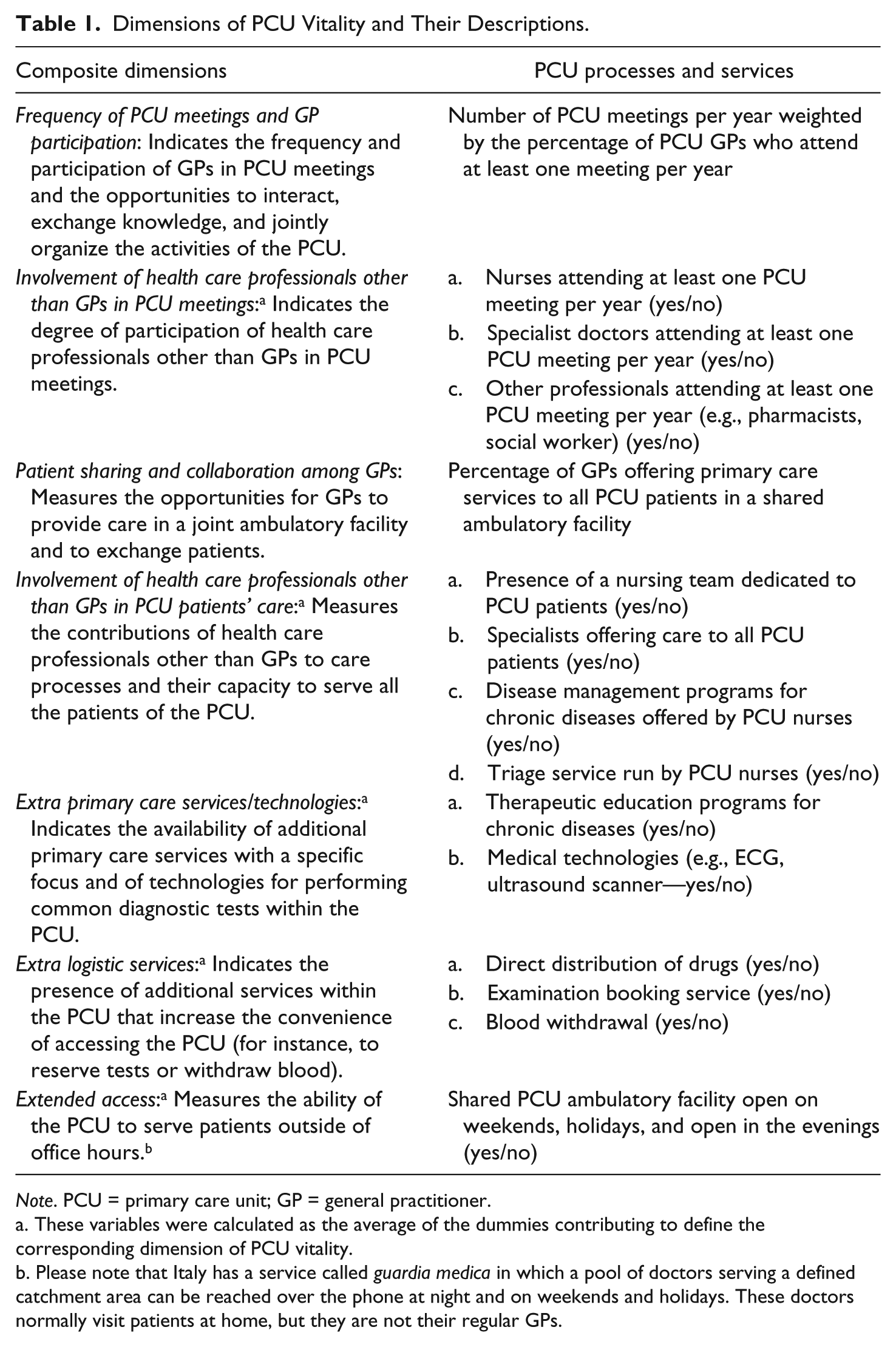
Note. PCU = primary care unit; GP = general practitioner.
These variables were calculated as the average of the dummies contributing to define the corresponding dimension of PCU vitality.
Please note that Italy has a service called guardia medica in which a pool of doctors serving a defined catchment area can be reached over the phone at night and on weekends and holidays. These doctors normally visit patients at home, but they are not their regular GPs.
While three of these variables were unique, four were composite and calculated as averages of different indicators (see Table 1). To further validate the latter dimensions and avoid excessive multicollinearity in the independent variables, we performed a confirmatory factor analysis with positive results (data available from the authors on request). In addition we calculated the Cronbach’s alpha. The resulting Cronbach’s alphas ranged from .66 to .84 and reassured us of the reliability of our measures (the detailed analysis is available from the authors on request).
Dependent Variables
We used five dependent variables. For our first hypothesis we used the variation coefficients (standard deviation/mean) of three sets of orders made by the GPs in 2006 (pre-PCU) and 2009 (post-PCU). The variation coefficient is an indicator of variability, and it measures how much GPs in the same PCU differ in their ordering decisions. The three sets of orders, standardized by 1,000 patients per GP, were (a) diagnostic tests (i.e., x-rays, computed axial tomography, nuclear medicine, echography, eco-color-Doppler, electromyography, endoscopy, and magnetic resonance), (b) referrals to specialists for consultations, and (c) tests for monitoring diabetes. For diagnostic tests, an overall consumption index including all types of examinations was calculated for every GP and the relative variation coefficient for each PCU. For diabetes tests, we calculated the variation coefficient at the PCU level of the weighted average number of tests prescribed per patient. The tests we considered are those recommended by the regional clinical guidelines for diabetes care: glycated hemoglobin, microalbuminuria, creatinine clearance, a lipid profile, and an electrocardiogram (ECG). An additional test, fundus oculi, which is included in the clinical guidelines, was not considered in our analyses as administrative data in this empirical setting tend to underestimate the number of eye tests ordered by GPs. The weighted average number of exams per patient was calculated as the ratio of the number of diabetic patients who were ordered tests times the number of exams ordered (range: 0-5) to the total number of diabetic patients. This indicator represents the average number of tests that each GP orders to his/her own diabetic patients in the corresponding year and can be considered a measure of adherence to the guidelines for diabetes care (where 5 indicates full adherence and 0 indicates no adherence; Fantini et al., 2012).
The second hypothesis was tested using the total number of nonurgent admissions to the ER as a dependent variable, standardized by 1,000 patients per GP. We estimated models on the log of this variable to interpret the coefficients as percent changes. Finally, the third hypothesis was tested using the weighted average of diabetes tests, described above, ordered per patient by each GP.
Control Variables
We controlled for several factors at the PCU and at the GP level. At the PCU level, we included dummies for the location of the PCU. We deemed that the location of the PCU could have an impact on some of the dependent variables. For example, Fantini et al. (2012) showed that adherence to clinical guidelines for diabetes care is higher in PCUs located in nonurban settings. At the GP level, we controlled for the age and gender of the doctor because these factors have been shown to affect the quality of care provided (e.g., Fantini et al., 2012). We also controlled for the number of patients in the GP’s roster, the proportion of female patients, the share of patients older than 65 years, and the number of diabetic patients (only in the models for Hypotheses 1 and 3). Finally, for Hypotheses 2 and 3, we took into consideration whether the GP was already working in a group practice with other three to four GPs (group).
Model Construction and Statistical Analyses
For Hypothesis 1, the unit of analysis is the PCU, while for Hypotheses 2 and 3 it is the individual GP. To test our hypotheses, we used a multilevel, mixed-effects regression analysis (Albright & Marinova, 2010). Our data are hierarchically structured in four levels, with time periods (Years 2006 and 2009) nested in GPs, GPs in PCUs, and PCUs in LHAs. To test our first hypothesis, the individual GP variables were aggregated at the PCU level to calculate the variation coefficients of clinical behaviors. In this case, therefore, we used only three levels. The hierarchical structure of the model allowed us to explicitly consider the level at which specific portions of the variance in the dependent variable were generated. In our case, even if the dependent variables were measured at the level of the individual GP, the variance at the PCU level was substantial. As such, it was worth introducing PCU-level regressors. More specifically, the PCU level accounts in the respective models for 14.9% of the variance in the exams for diabetes care and 20% of the variance in visits to the ER. We also controlled for unexplained heterogeneity at the LHA level by introducing specific fixed effects. In addition, the use of mixed effects allowed us to model possible heterogeneity in the effects of selected regressors. In particular, after controlling for the LHA to which the PCUs belonged, we checked whether the impacts of certain GP characteristics were stable (or not) across the PCUs. In addition, we included some PCU-level controls that summarize the average characteristics of the PCUs’ members and the location of the PCU, as well as between-levels (GP-PCU) interaction terms. Between-levels interactions, however, were excluded from the models presented in this article because they were not statistically significant (the analytical derivation of the model is available on request). All the models proved superior to the ones containing only control variables (log-likelihood test for nested models).
The independent variables of interest (i.e., the seven dimensions of PCU vitality) were applied at the PCU level and set to 0 in 2006, when PCUs did not exist. The data from 2006 were used to eliminate the endogeneity issues of simultaneity and self-selection that would have existed had we used only cross-sectional data. In fact, the impact of PCU vitality on GPs’ performance could be spurious, and GPs who performed well in the past could also be more prone to implement the processes and services that contribute to a well-functioning PCU to maintain their already high performance. Instead, by observing the same individuals before and after the introduction of the PCU model, we are able to isolate the effect of time within individuals and the effect of individuals within PCUs. Still, to check the robustness of our findings we conducted two additional analyses. First, a sensitivity analysis attributing to GPs in group practices in 2006 the 2009 values of two vitality dimensions (“patient sharing and collaboration among GPs” and “involvement of other health care professionals in patients’ care”); our findings were largely confirmed. For sake of brevity, we do not report the results of the sensitivity analysis, but they are available from the authors on request. The second was a cross-sectional analysis strictly on 2009 data.
Results
From the survey it became apparent that in 2009 the PCU model was yet to be fully implemented across a number of dimensions. Table 2 summarizes the main findings and the descriptive statistics relative to both dependent and independent variables.
Descriptive Statistics (Mean and Standard Deviation) Related to Independent, Dependent, and Control Variables.
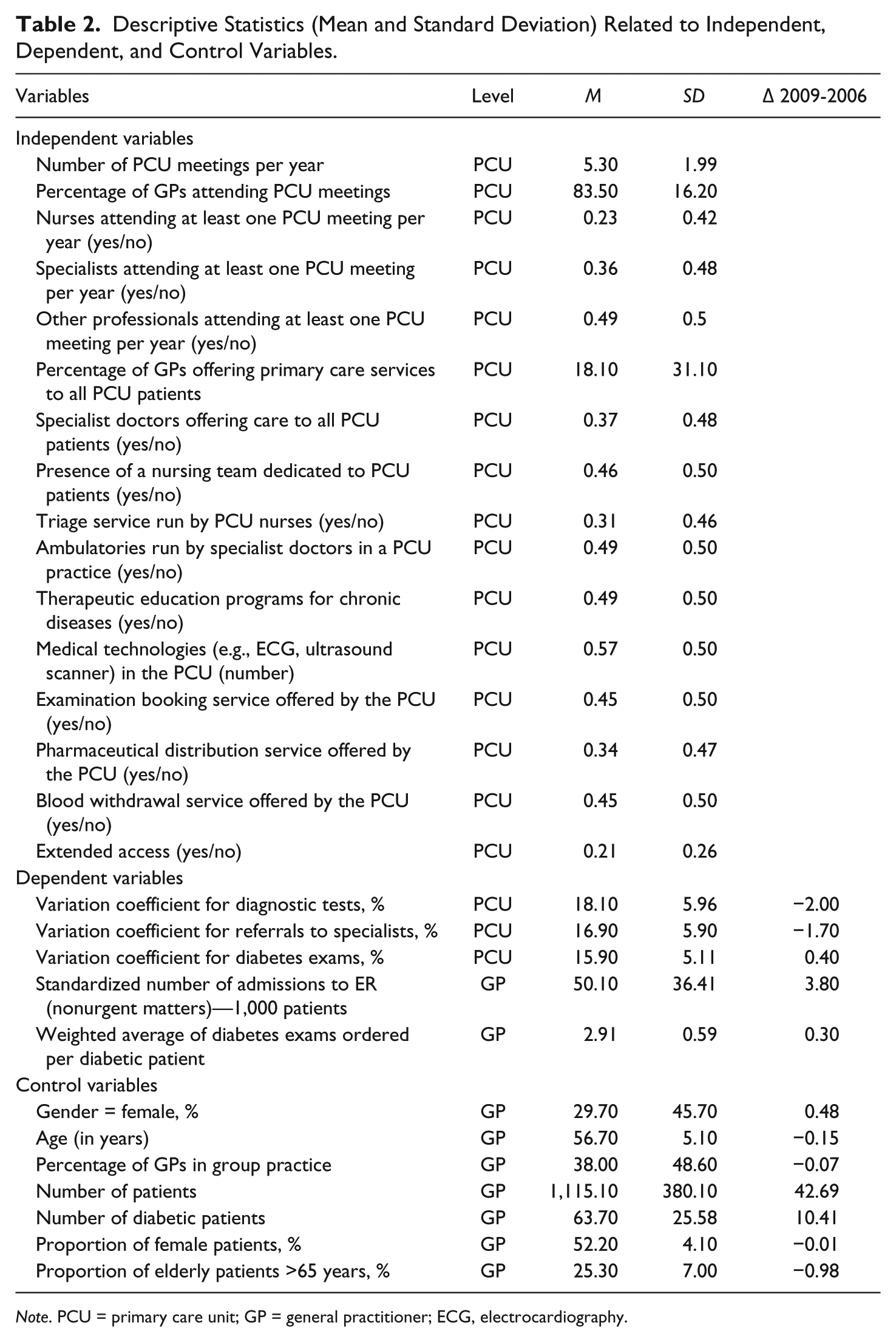
Note. PCU = primary care unit; GP = general practitioner; ECG, electrocardiography.
Hypothesis 1: Homogeneity of General Practitioners’ Clinical Behavior
Table 3 (Models 1, 2, and 3) presents the results related to our first hypothesis about the link between the dimensions of PCU vitality and the homogeneity of GPs’ clinical choices.
Impact of the Dimensions of PCU Vitality on the (a) Variability (Variation Coefficient) of GPs’ Ordering of Diagnostic Tests (Model 1), of Referrals to Specialty Care (Model 2), of Exams to Monitor Diabetes (Model 3) for Hypothesis 1; (b) the Log of the Standardized Number of Admissions to the ER (Model 4) for Hypothesis 2; and (c) the Average Number of Exams to Monitor Diabetes (Model 5) for Hypothesis 3.

Note. PCU = primary care unit; GP = general practitioner; ER = emergency room; LHA = local health authority.
Variation coefficients were calculated as the standard deviation/mean by PCU and time for Models 1, 2, and 3.
Variation coefficients by PCU and time.
“Town” is the baseline for these variables.
p < .1. **p < .05. ***p < .01.
Table 3 shows that our hypothesis is partially supported. Interaction and especially the possibility for GPs to exchange information with specialists and nurses in PCU meetings tend to reduce (even if only slightly) the variability in diagnostic tests ordered and referrals to specialty care, activities that are often linked to each other and that normally connect GPs to specialists, although not necessarily directly. Ordering evidence-based tests for monitoring diabetic patients, instead, is less variable when the GPs have a higher chance to interact with each other in PCU meetings and, interestingly, when they have the option to attend to other GPs’ diabetic patients (patient sharing and collaboration among GPs). It is possible that by accessing the clinical data for colleagues’ patients and having to maintain a certain “style” of chronic care, GPs might ultimately transfer that type of clinical behavior to their own patients.
Finally, two dimensions of PCU vitality, the provision of extra primary care services (mainly aimed at chronic condition management) and extended access to primary care services, both strongly increase the variability in diabetes tests ordered. The presence of additional services for chronic care management provided by nurses and specialists might create variable interpretations among the GPs about the division of tasks. Some GPs might think that certain monitoring activities are their responsibility, and others might think that specialists or nurses will handle those aspects of care. At the same time, extending access to primary care services might simply create more work for GPs and induce variation in the consistency of the adherence to evidence-based guidelines.
Hypothesis 2: Avoidance of Inappropriate Emergency Room Admissions
The results related to Hypothesis 2 are presented in Table 3 (Model 4). The findings show that extending access to primary care services does not necessarily translate into a reduction in patients’ visits to the ER for nonurgent matters. Instead, other dimensions of PCU vitality appear to have the effects predicted by our hypothesis. First, the presence of extra primary care services and technologies within the PCU has an impact, albeit a limited impact (9.5% reduction in ER admissions; p < .1). Patients might be able to meet their needs using these services/technologies or simply feel more reassured that their needs can be met quickly in the primary care setting without needing to see a hospital specialist. More important, Table 3 shows that ER admissions are reduced by 18.3% (p < .05) when GPs have the opportunity to serve the patients of colleagues working in the same PCU (patient sharing and collaboration among GPs). The PCU model gives patients the benefit of being listened to by a doctor, even if it is not the patient’s usual doctor; this practice is likely perceived as a guarantee of a prompt response and might dissuade patients from visiting the ER frequently.
It should be noted that the most significant effect on the number of avoidable admissions to the ER is actually positive (25.6% increase in ER admissions; p < .01) and induced by the dimension of PCU vitality labeled involvement of health care professionals other than GPs in PCU patients’ care. The choice of the ER over primary care services for nonurgent matters has a number of reasons (Lega & Mengoni, 2008). The level of trust in the care provided and in the competence of the GP, and the degree of familiarity with the GP practice are just some of the most relevant factors influencing this choice (Lega & Mengoni, 2008). One of the possible explanations for our result, therefore, is that the presence of nurses and other professionals in the PCU might be perceived as confusing and disorganized by the patients, especially if the different health professionals’ contributions to care are not yet well integrated with one another, leading to a decreased trust in primary care services.
Hypothesis 3: Quality of Diabetes Management and Adherence to Evidence-Based Clinical Guidelines
Table 3 (Model 5) presents the results related to the last of our hypotheses, which proposed a link between PCU vitality and the adherence of GPs to evidence-based guidelines for monitoring diabetes. The results strongly support the hypothesis that a higher level of interaction among the GPs through internal meetings (frequency of PCU meetings and GP participation) correlates with a higher degree of diabetes monitoring, and GPs who experience a high frequency of contacts order an average of 1.37 more exams (out of five) than GPs who do not interact at all (p < .01). Contrary to what we expected, having other health care professionals, such as nurses and specialists, contribute to the care of PCU patients (especially in managing chronic conditions) does not appear to have a significant effect.
However, extra logistic services increase adherence to evidence-based diabetes care, most likely because GPs are aware that the patients will be able to receive the drugs they need and to book and receive the tests they need to monitor their condition quickly and with ease within the PCU, potentially with only one visit to the primary care facility.
Cross-Sectional Analysis
We performed a cross-sectional analysis on the 2009 data. As Table 4 shows, our findings are largely confirmed. For Hypothesis 1 the impacts of the interaction among GPs, of patient sharing among GPs, and of the interaction between GPs and other professionals in PCU meetings remain significant and reduce the variability of GPs’ ordering choices. The effect of the extended access to primary care services granted by the PCU is still significant and contributes, instead, to increase the variability of GPs’ clinical practice, in particular of ordering the exams to monitor diabetes. For Hypothesis 2, the variable “involvement of health care professionals other than GPs in PCU patients’ care” still increases the admissions to the ER for nonurgent matters (even to a larger extent), while “patient sharing and collaboration among GPs” and “extra primary care services/technologies” remain significant and both decrease admissions to the ER. Finally, for Hypothesis 3 the average number of diabetes exams performed by GPs per patient is still mainly influenced by the “frequency of PCU meetings and GP participation” whose coefficient remains almost unchanged and significant. The presence of extra logistic services, instead, is not anymore significant.
Cross-Sectional Analysis on 2009 Data for Hypothesis 1 (Models 1a-3a), Hypothesis 2 (Model 4a), and Hypothesis 3 (Model 5a).

Note. PCU = primary care unit; GP = general practitioner; LHA = local health authority.
Variation coefficients were calculated as the standard deviation/mean by PCU and time for Models 1, 2 and 3.
Variation coefficients by PCU and time.
Town” is the baseline for these variables.
p < .1. **p < .05. ***p < .01.
Discussion
Multiprofessional primary care organizational models, such as the medical home in the United States or the PCU in Emilia-Romagna in Italy, have been adopted, but there have been few evaluations of the impacts on GPs’ performance. In this study, we performed a multilevel analysis using data from 3,085 GPs and 215 PCUs and a pre- and post-intervention design. We further compared these results with a cross-sectional analysis in 2009. We provide evidence that certain processes and services in the PCU have the potential to improve the care offered while others have small or negative effects.
First, the opportunities offered by the PCUs for GPs to interact in meetings appear to play an important role in promoting not only homogeneity of clinical behavior with respect to evidence-based clinical guidelines but also a higher degree of adherence by the GPs to the same guidelines. Increasing the opportunities for meetings and the quality of the exchange among GPs working in the PCU might be, therefore, a viable measure to improve their clinical performance. Sharing an ambulatory facility with colleagues and having the ability to exchange patients is equally important both for homogenizing certain aspects of the care delivered by GPs and for reducing the number of inappropriate visits by the patients to the ER. While the debate over United States medical homes is currently focused on assuring that a patient sees only the specific GP with whom he/she is registered (e.g., Faber et al., 2013), these results show that exchanging patients might offer some advantages. As long as having a more certain and prompt response does not appear to compromise the quality of the relationship with the family doctor, this arrangement might be well accepted by patients. Thus, the experiences of other primary care systems, such as the system in the United Kingdom, which allows patients to choose whether to wait and see their own GP or see another GP in the practice more rapidly, might be very instructive in furthering the debate on this issue.
Another subject of debate is the need for multiprofessional primary care models to extend access to services by prolonging the operating hours of ambulatory facilities (Faber et al., 2013; O’Malley, 2013; Rittenhouse et al., 2008; Rittenhouse et al., 2011). Our study indicates that extended access to the PCU does not necessarily reduce the number of inappropriate visits to the ER. It could be argued that in the Italian context, the existing services that are available outside of office hours are already rather effective in meeting the demand. Alternatively, extended access to primary care services through the GP might not be among the expectations of the average PCU patient, who is an elderly person with chronic conditions in need of routine rather than episodic contact with the GP.
The study reveals that some aspects of the collaboration among primary care professionals in the PCU remain to be improved. For instance, the possibility to meet with other professionals in internal PCU meetings has a positive impact only by reducing mildly the variability of certain GPs’ clinical choices. How much GPs should do on their own and how much they should delegate to specialists is known to be a matter of variable interpretation among GPs. The opportunity to talk directly with specialists in PCU meetings might help homogenize these interpretations, at least partially. Encouraging direct exchanges with specialists within PCU-like models appears to have potential beneficial effects.
Most important, the PCU model offers the opportunity for nurses, specialists, and other professionals to contribute to the care of PCU patients, especially by managing chronic conditions, but, based on our results, this does not bring—at least to this point—a clear improvement in adherence by GPs to evidence-based guidelines for monitoring diabetes. Furthermore, in our study the presence of multiple professionals in the PCU is shown to have also certain negative effects, for example, by contributing to increasing the rate of inappropriate admissions to the ER. These results suggest that communication and collaboration processes among different primary care professionals might be still difficult or slow to implement in the PCU model and that their potential benefits are yet to be reaped. This is therefore the dimension of PCU vitality on which most attention and managerial efforts should be focused in the future.
The present work is not spared from limitations. The dimensions of PCU vitality and the data on which our study is built only partially uncover the mechanisms that translate PCU processes and services into better care. A second important limitation is that we have considered only some aspects of GPs’ clinical practice, and therefore, our evaluation of the impact of the PCU model on their performance can only be partial. Finally, our assessment considered only GPs and neglected to explore the performance of other PCU health care professionals, such as nurses and specialists.
Multiprofessional primary care models, such as the PCU in the Italian context, promise to deliver better care and reduce waste of resources. With this study we started unpacking the processes and services in the PCU that make the difference for final outcomes.
Footnotes
Acknowledgements
The authors would like to thank Drs. A. Brambilla, A. Donatini from the Department of Primary Care Services, Emilia-Romagna Regional Health Authority, for their support and guidance in this research project; Drs. S. Sforza and N. Verdini from the Department of Health Information Systems, Emilia-Romagna Regional Health Authority for data elaboration, and all the LHA representatives for their enthusiasm and collaboration in providing data and discussing findings. The authors would like to thank S. Ghislandi and S. Tasselli for critically reviewing the manuscript.
Authors’ Note
Patrizio Armeni and Amelia Compagni contributed equally to this work.
Declaration of Conflicting Interests
The author(s) declared no potential conflicts of interest with respect to the research, authorship, and/or publication of this article.
Funding
The author(s) disclosed receipt of the following financial support for the research, authorship, and/or publication of this article: The project was funded by the Emilia-Romagna Region, Department of Primary Care Services.