







Abstract
This study sought to enhance knowledge of the link between child sexual abuse (CSA) and long-term criminality by investigating gender-specific effects and the role of index sexual abuse characteristics, revictimization, and serious mental health problems. An Australian sample of 2,759 documented cases of sexual abuse and 2,677 community controls were linked to statewide police records and public mental health service databases, with a follow-up period of 13–44 years. Four key findings emerged from the analysis: (1) CSA victims were more likely than controls to engage in all types of criminal behaviors including violent, sexual, and other offending; (2) gender moderated the relationship between CSA and criminal offending, with stronger associations found among females for general and violent offending, and among males for sexual offending; (3) certain features of the index sexual abuse (i.e., developmental period, number of perpetrators, relation to perpetrator), further victimization experiences, and the development of serious mental health problems were all associated with an increased likelihood of criminal behavior among CSA victims; (4) CSA victims who engaged in criminal offending were more likely to present with cumulative risks than victims not engaging in criminal offending. Implications for future research and clinical practice are discussed.
Keywords
The sexual abuse of children continues to be a major social and public health concern. A recent meta-analysis of studies published between 2002 and 2009 from 24 countries estimated that the lifetime prevalence of child sexual abuse (CSA) of any kind is 15% for girls and 8% for boys (see Barth, Bermetz, Heim, Trelle, & Tonia, 2013). Numerous studies have found linkages between reports of CSA and adverse psychiatric, social, behavioral, and physical health outcomes (for reviews, see Cashmore & Shackel, 2013; Gilbert et al., 2009; Putnam, 2003). Among the potential negative effects of CSA, it has long been assumed that sexually abused children are at increased risk of engaging in crime and violence later in life and, in particular, are more likely to perpetrate sexual crimes (see Curtis, 1963; Ryan, 1989). Providing some empirical support for this, retrospective research has documented consistently high rates of self-reported CSA in the backgrounds of adolescent and adult criminal offender populations (Jespersen, Lalumière, & Seto, 2009; Johnson et al., 2006; McGrath, Nilsen, & Kerley, 2011; Seto & Lalumière, 2010). Retrospective methodologies are, however, problematic to the extent that they (a) depend upon the reliability of informants, with some literature suggesting a possible overreporting of CSA by offenders in an attempt to explain their criminal behavior, elicit sympathy from treating staff, or receive more lenient sentences (Hindman & Peters, 2001; Widom, 1989b); (b) introduce ambiguity concerning the temporal sequencing of events (Hardt & Rutter, 2004; Widom, Raphael, & DuMont, 2004); and (c) preclude inferences as to the prospective risk of criminal behavior engendered by CSA. In addition, most studies have exclusively examined the “sexually abused–sexual abuser” hypothesis (Glasser et al., 2001; Levenson & Socia, 2016; Seto & Lalumière, 2010), which, although an important line of inquiry, fails to account for the range of criminal outcomes that might be associated with a history of CSA.
In this study, we prospectively tracked a large cohort of male and female CSA victims referred for forensic medical examination and compared their official criminal histories to a matched cohort of individuals without a known history of CSA (see Ogloff, Cutajar, Mann, & Mullen, 2012). We considered 14 different criminal offense categories ranging from relatively minor offenses, such as theft, through to homicide. The size of the sample and the length of the follow-up period, together with detailed information on the index sexual abuse and subsequent criminal offending, enabled one of the most extensive examinations to date of the nature of the association between CSA and criminal behavior. In addition, we advance existing literature by investigating gender-specific effects on offending outcomes and by considering whether sexual abuse characteristics (such as the nature and timing of the sexual abuse) and other adverse outcomes (i.e., revictimization, serious mental health problems) are associated with the likelihood of criminal consequences in CSA survivors. Examining the factors that might increase risk for later criminal outcomes among sexual abuse victims is important, given the potential to identify which children might be at greater risk of criminal behavior. These children may require more intensive early supports, intervention, and monitoring.
Prospective Research Testing the CSA—Criminal Offending Association
There exists a small number of prospective studies that have followed CSA victims into adolescence or adulthood to examine their criminal histories (Burgess, Hartman, & McCormack, 1987; Leach, Stewart, & Smallbone, 2016; Malvaso, Delfabbro, & Day, 2017; Ogloff et al., 2012; Salter et al., 2003; Siegel & Williams, 2003; Swanston et al., 2003; Widom & Ames, 1994; Widom & Massey, 2015; Widom & Maxfield, 2001). Several earlier follow-up studies with modest cohorts of between 17 and 224 CSA victims provide support for an association between sexual abuse and increased rates of violent and sexual offending, and other types of criminal behaviors (Burgess et al., 1987; Salter et al., 2003; Siegel & Williams, 2003; Swanston et al., 2003). However, these studies have been limited by inadequate sample size, an absence of a suitable comparison group, the use of mostly female victims, or an exclusive focus on juvenile offending. There are, however, a number of larger scale studies examining the prospective risk of criminal offending among CSA victims (Leach et al., 2016; Malvaso et al., 2017; Ogloff et al., 2012; Widom & Ames, 1994; Widom & Massey, 2015; Widom & Maxfield, 2001). For example, Malvaso, Delfabbro, and Day (2017) found that, after controlling for the effects of demographic factors (gender, ethnicity, socioeconomic disadvantage) and other forms of maltreatment (physical abuse, emotional abuse, neglect), young people with substantiated sexual abuse had a 61% increased likelihood of being convicted of a crime as a youth. However, when several maltreatment-related risk factors (e.g., recurrence, multiple type, age, and persistence) and placement in out-of-home care were added to statistical models, exposure to sexual abuse was no longer a significant predictor of juvenile convictions. The authors did not examine whether associations between sexual abuse and juvenile offending varied for different subtypes of offenses.
Widom and colleagues’ seminal work (Widom & Ames, 1994; Widom & Massey, 2015; Widom & Maxfield, 2001) followed up 908 children, mostly girls, with histories of physical and sexual abuse or neglect prior to age 12 years. They reported that, relative to matched nonmaltreated controls, children who experienced abuse or neglect were more likely to be arrested as a juvenile and adult for any type of crime. However, being sexually abused specifically did not place children at further increased risk for arrest compared to children who experienced other kinds of maltreatment (Widom & Ames, 1994; Widom & Maxfield, 2001). Further, although males (but not females) exposed to physical abuse or neglect were at increased risk for arrests for sex offenses relative to controls, effects for sexual abuse were nonsignificant in both male and female subgroups (Widom & Massey, 2015). The authors advised caution when interpreting such results due to the small number of sexual abuse victims included in the sample (24 males) and the low base rate observed for sexual crimes. Compared to nonabused controls and other maltreatment groups, sexual abuse victims were, however, uniquely at risk for an arrest for prostitution (Widom & Ames, 1994).
Leach, Stewart, and Smallbone (2016) tested the association between CSA and sexual offending among an Australian birth cohort of males. They reported that 3% of sexually abused boys in the cohort went on to become sexual offenders compared to 0.78% of the wider birth cohort population. However, when compared to other forms of maltreatment, there was no specific association between exposure to sexual abuse and subsequent sexual offending nor between sexual abuse and other types of criminal behavior. Rather, multiple-type maltreatment, compared to any single type, was associated with sexual, violent, and general offending. The total number of sexual abuse notifications 1 was, however, a significant predictor of both any offending and sexual offending. These effects persisted after controlling for the effects of other maltreatment types and age at maltreatment. A final Australian study (Ogloff et al., 2012), which the current research extends, broadly supported an association between CSA and several officially recorded criminal outcomes including sexual, violent, and other criminal offending. In this study, CSA victims had almost 5 times the odds of being charged with any offense relative to a control group without a known history of sexual abuse.
From a longitudinal perspective, very few studies have examined whether the effect of CSA on subsequent criminal offending differs by gender. This is partly owing to the fact that studies often employ entirely male or female samples or use mixed gender samples but with too few boys to allow for detailed gender comparisons. For example, Swanston et al. (2003) in their analysis of 38 sexually abused children found that the association between CSA and criminal behavior was not influenced by gender; however, only 10 boys were included in the abused sample. Other studies (primarily retrospective in design) have found conflicting results as to the role of gender. Some studies have found the relationship between sexual abuse and criminality to be stronger in boys than in girls, especially for sexual crimes (Asscher, Van der Put, & Stams, 2015; Glasser et al., 2001; Krahé & Berger, 2017; Misheva, Webbink, & Martin, 2017), with other researchers suggesting that CSA plays a more critical role in the development of violent and criminal behavior among females (Cernkovic, Lanctôt, & Giordano, 2008; Cohen, Smailes, & Brown, 2004; Foy, Ritchie, & Conway, 2012; Herrera & McCloskey, 2003; Trabold, Swogger, Walsh, & Cerulli, 2015). Understanding whether sexual abuse differentially impacts the likelihood and nature of criminal behavior for males and females has implications for assessing risk for offending and for the delivery of gender-responsive interventions (Trabold et al., 2015).
Conceptual Framework
Despite some studies supporting an association between CSA and criminal behavior, there are few theoretical frameworks explaining the mechanisms underpinning this relationship, with many conceptual models focusing on the broader link between childhood maltreatment and criminality. This is somewhat surprising, given longitudinal research indicating that sexual victimization is a type of maltreatment with distinctive and particularly harmful effects on a child’s development (Fergusson, Boden, & Horwood, 2008; Grasso et al., 2013; Trickett, Noll, & Putnam, 2011; Walsh, Galea, & Koenen, 2012). There are at least two plausible (theoretical and empirical) reasons why CSA, above other forms of maltreatment, might be independently associated with criminal behavior. First, CSA is marked by violations of sexual, physical, psychological, and social relationship boundaries. Such violations, which are not shared to the same extent by other forms of maltreatment, may lead to a sense of shame, self-blame, powerlessness, disturbances in sense of self and internal models of interpersonal relationships, and confusion about issues concerning sexual arousal and intimacy (Cossins & Plummer, 2016; Noll, 2008; Putnam & Trickett, 1993). Many researchers suspect that it is these transgressions inherent to CSA, coupled with the stigma surrounding sexual victimization and associated delays in disclosure (and often nondisclosure), that make it a particularly salient childhood risk factor for later maldevelopment (Finkelhor & Browne, 1985; Lewis, McElroy, Harlaar, & Runyan, 2016; Putnam & Trickett, 1993). Second, several studies have shown that, compared to other forms of maltreatment, CSA is a stronger (or the only) predictor of particular negative outcomes that are themselves known correlates of criminal behavior, for example, psychopathology, conduct disorder/antisocial personality disorder, substance abuse, externalizing behaviors, and revictimization experiences (e.g., Boney-McCoy & Finkelhor, 1996; Fergusson et al., 2008; Lewis et al., 2016; Widom, Czaja, & Dutton, 2008).
Nonetheless, when speculating about the possible processes by which CSA might translate into criminal outcomes, it is helpful to consider how researchers have conceptualized the more established link between childhood maltreatment and criminal offending. The “cycle of violence” framework, which draws extensively from social learning theories (Bandura, 1971, 1973), posits that children who have been abused learn through modeling that violence is an acceptable and effective way to achieve a goal (Burton, 2003; Thornberry & Henry, 2013; Widom, 1989a, 1989b). A set of proviolence norms is established that increase the likelihood that abused children will engage in violent behavior in the future. The cycle of violence perspective has also been applied to the “sexually abused–sexual abuser” hypothesis. For example, Felson and Lane (2009) argue that sexually abused children learn abusive behaviors and the corresponding antisocial attitudes, which can lead to the replication of sexually abusive behaviors later in life.
Although social learning perspectives provide insight into how violent and other criminal behaviors might develop among maltreated children, they are unable to specifically illustrate why some children exhibit these behaviors and others do not, nor to elucidate what factors moderate particular presentations among victims (Yancey & Hansen, 2010). An alternative set of perspectives, drawn from cumulative risk and transactional models, suggests that it is the accumulation and interaction of risks over time (in the absence of adequate protective factors) that contributes to poor developmental outcomes (Appleyard, Egeland, van Dulmen, & Sroufe, 2005; Cicchetti & Toth, 1995; MacKenzie, Kotch, Lee, Augsberger, & Hutto, 2011; Sameroff, 2009). According to a cumulative risk perspective, whether sexually abused children go on to engage in crime and violence later in life will be influenced by the presence of other accumulating risk factors. These risk factors might relate to the nature and context of the abuse, the child’s developmental level, the quality of caregiving, the child’s internal coping resources, and their support and experiences subsequent to the abuse (Tabone et al., 2011; Van Wert, Mishna, & Malti, 2016). Regarding the nature of the abuse, for example, researchers have argued that CSA may have a dose–response relationship with negative outcomes, whereby more severe sexual abuse (e.g., involving penetration, physical force, multiple episodes, increased chronicity, and/or multiple perpetrators) is associated with an increased likelihood of subsequent problems. Although this hypothesis has been supported by some studies examining criminal outcomes (Aebi et al., 2015; Burgess et al., 1987; Hershkowitz, 2014; Leach et al., 2016), others have failed to find such effects (Misheva et al., 2017; Salter et al., 2003; Swanston et al., 2003; Widom & Ames, 1994). Further, several studies have demonstrated that criminal consequences may vary as a function of the developmental period in which a child experiences abuse. In particular, whereas childhood-limited maltreatment has been more specifically associated with internalizing symptoms later in the life course, abuse that begins or extends into the adolescent period has been shown to exert a stronger and more pervasive effect on later psychological and behavioral adjustment, including an increased risk for externalizing problems and criminal behavior (Ogloff et al., 2012; Hurren, Stewart, & Dennison, 2017; Malvaso et al., 2017; Thornberry, Henry, Ireland, & Smith, 2010).
Cumulative risk theories would also assert that multiply victimized children may be especially at risk for subsequent behavioral problems. Indeed, research is increasingly demonstrating the importance of polyvictimization during childhood (i.e., the co-occurrence of multiple forms of abuse) in predicting a range of negative developmental outcomes including criminal behavior (Finkelhor, Ormrod, & Turner, 2007a, 2007b; Fox, Perez, Cass, Baglivio, & Epps, 2015; Leach et al., 2016; Steine et al., 2017). The role of revictimization—namely, the experience of further victimization(s) during childhood, adolescence, or adulthood, following an identified initial (or index) episode of abuse—in influencing offending outcomes among CSA survivors has received scant research attention. This is somewhat surprising, given the consistently documented associations between CSA and further victimization experiences (Arata, 2002; Widom et al., 2008) and between criminal offending and victimization outcomes irrespective of whether childhood abuse has occurred (Jennings, Piquero, & Reingle, 2012). Consistent with the notion of a trauma-induced offense cycle (Greenwald, 2002), it is possible that early victimization, and particularly repeat- or revictimization experiences, promotes cognitive and affective response patterns including hypervigilance to danger, emotional dysregulation, feelings of hopelessness and helplessness, and a tendency to misinterpret social cues as hostile. This, in turn, can evoke defense, aggression, and antisocial behavior, thus increasing the likelihood of criminal consequences (Hosser, Raddatz, & Windzio, 2007; Logan-Greene, Nurius, Hooven, & Thompson, 2015). Even in the absence of revictimization experiences, the immediate and long-term mental health sequelae frequently seen in victims of CSA (e.g., substance abuse, affective and behavioral dysregulation, trauma symptomology, and personality pathology) may serve to exacerbate victims’ susceptibility toward criminal involvement (Amado, Arce, & Herraiz, 2015; Fergusson, McLeod, & Horwood, 2013). Yet, little is known empirically about whether the development of serious mental health problems following sexual abuse is associated with the likelihood of engaging in crime.
The Present Study
For researchers as well as practitioners, there is relatively widespread acceptance of some association between CSA and later delinquent and criminal consequences. However, little is known about the strength of this association across a wide range of criminal offending behaviors and whether this varies as a function of victim gender. Further, although research has consistently demonstrated that not all victims of CSA will go onto become perpetrators of crime and violence, few prospective studies have sought to examine which factors might be associated with an increased likelihood of subsequent criminality. Thus, the purpose of this study is to extend our existing research (Ogloff et al., 2012) by providing a more detailed analysis of the association between CSA and long-term criminal offending. Using a prospective approach, we aimed to examine (a) whether gender interacts with CSA to influence the likelihood of criminal behaviors; (b) whether features of the index sexual abuse, including age, physical intrusiveness, frequency of abuse, relationship to the perpetrator, and number of perpetrators, influence risk for criminal outcomes; (c) whether exposure to revictimization and the development of serious mental health problems are associated with the likelihood of criminal offending among CSA victims; and (d) consistent with cumulative risk models, whether the total number of risk factors identified in (b) and (c), that is, “cumulative risk,” is related to criminal offending outcomes among survivors of sexual abuse. The factors chosen in (b) and (c) were selected because of their theoretical relevance according to cumulative risk models and because of their availability from the administrative data used in this research.
Method
This prospective cohort study employed a data-linkage methodology, which involves combining information about the same individual from two or more different data sources using unique identifying information such as name, sex, and birth date (Brownell & Jutte, 2013). This research involved linking officially documented contemporaneous accounts of CSA to population-wide administrative databases related to our variables of interest. The follow-up period between the index sexual abuse and data linkage was up to 44 years in some cases. CSA victims were compared to matched individuals from the general population, who were also linked to administrative databases using identical methods. This research was conducted in the Australian state of Victoria. This state has a population of approximately 6 million, of whom almost 5 million live in the capital city, Melbourne.
Data Sources
CSA sample
The Office of Forensic Medicine (OFM) collated the available evidence and performed examinations on children (0–16 years) at the request of police and child protection following allegations of sexual abuse. The records contained information about the abuse and the abuser from interviews with informants and the child in addition to medical examination data. The CSA cohort comprised all 2,759 children ascertained 2 as having been victims of contact sexual abuse between 1964 and 1995. Cases involving noncontact sex offenses (e.g., exhibitionism) were excluded. In addition to sexual abuse perpetrated by an adult, cases where it was determined that either the child was sexually assaulted by another child or the (adolescent) child reported assenting sexual relations with an individual who was 5 or more years their senior were included in the cohort.
The records enabled a range of abuse variables to be examined, though such data were not available in every instance. Given existing research demonstrating that abuse which begins or extends into the adolescent period is associated with greater subsequent psychological and behavioral disturbance, the age at which abuse occurred was dichotomized by approximate age of puberty onset (before age 12 years and ages 12–16 years); other authors have used similar age demarcations (Leach et al., 2016; Malvaso et al., 2017; Smith, Ireland, & Thornberry, 2005; Thornberry et al., 2010). The nature of the abuse was coded as penetrative or nonpenetrative, intra- or extrafamilial, single occurrence or multiple episodes, and a single abuser or multiple perpetrators.
Controls
A comparison group was established using the electoral rolls. This group will be referred to as controls. In 2008, the Australian Electoral Commission drew a random sample of 5,000 individuals from Victoria’s electoral roll aged 16–61 years. A subsample of 2,677 was matched to the sexual abuse sample on gender and age; no exact matches could be identified for 82 sexual abuse cases. Voting and voter registration is compulsory in Australia for those aged 18 years and older. As a result, 94% of the voting eligible population appears on the electoral rolls (Victorian Electoral Commission, 2015).
Criminal offending and revictimization
The Victoria Police maintains a database (Law Enforcement Assistance Program [LEAP]), which records all contacts between the police and the public in Victoria, including official cautions, arrests, charges, convictions, and witnesses or victims of crime. Transport and traffic infringements are not included in the database. This study employed criminal charges as the measure of offending rather than the more conservative measure of criminal convictions. Convictions often do not capture the true extent of the offending behavior that has occurred because, at court, charges are often combined or dropped during progress toward a guilty plea.
The LEAP categorization and definitions of offenses were employed in the analyses (Victoria Police, 2014). Both juvenile and adult offenses were considered collectively. We compared CSA victims and controls on the following criminal history variables: proportion charged with any offense and each subtype of offense, total mean number of charges, proportion receiving at least one conviction, proportion receiving a prison sentence, and total mean length (in months) of prison sentence imposed. We assessed the temporal order of the index sexual abuse relative to any charges laid. Due to some missing charge dates, the temporal sequencing of the index sexual abuse relative to offending could not be definitively determined in 44.6% of victims with a criminal history. However, among the remaining 55.4% of abuse victims with a criminal history, the date of forensic medical examination always clearly preceded the date of first criminal charge. 3
To examine whether the experience of revictimization was associated with the likelihood of offending outcomes among CSA victims, we extracted crime victimization data for the abuse sample as recorded in LEAP. We compared abuse victims with particular types of criminal behavior to abuse victims without such types of criminal behavior on the proportion revictimized for any type of offense and the proportion revictimized for a violent or sexual offense (using LEAP offense categorizations; Victoria Police, 2014). Any crime victimizations occurring prior to the index CSA were excluded from analyses, and any sexual victimizations that accorded with the time of the index CSA that led to medical examination were also removed.
Mental health
To examine whether the presence of mental health problems was associated with the likelihood of criminal behaviors among CSA victims, we extracted victims’ mental health data from the Victorian public mental health service database Victorian Psychiatric Case Register/Redevelopment of the Acute and Psychiatric Information Directions (VPCR/RAPID). This database includes information pertaining to public psychiatric inpatient admissions and contacts with community mental health and emergency room services, as well as diagnostic information. Contacts with mental health services via the private sector are not included in the database. For the purposes of this study, we compared abuse victims with particular types of criminal behavior to abuse victims without such types of criminal behavior on the proportion with serious mental health problems (as indicated by lifetime contact with public mental health services), the proportion with an Axis I clinical disorder (e.g., psychosis, mood disorders, anxiety, eating disorder, and post-traumatic stress disorder [PTSD]), the proportion with a substance use disorder, and proportion with a personality disorder. Lifetime psychiatric diagnoses were coded according to the International Classification of Diseases–9th/10th Revision (ICD–9/10).
Data Linkage
A data analyst from the Victoria Police performed the linkage of the study samples to the LEAP database in 2009. Data matching first employed a deterministic approach, which involved the identification of exact matches on the basis of complete name (first, middle, and surname), gender, and birth date. A probabilistic matching procedure was then employed, using the SOUNDEX search code to maximize matching (Sayers, Ben-Shlomo, Blom, & Steele, 2016). The SOUNDEX code is based on a phonetic algorithm that identifies matching names by their pronunciation, thereby minimizing the likelihood of missing true matches owing to spelling errors or alternative spellings of names (e.g., Smith, Smyth, and Smythe would all have the same SOUNDEX code). For individuals without an identified match following the deterministic and probabilistic matching procedures, a final procedure was employed. The individual’s driving license number and whether they had an endorsement for a driving offense were identified electronically using the name, date of birth, and gender. The endorsement was then linked back to the LEAP database on which the issuing of a summons was also recorded. Linkage and extraction of mental health data occurred in 2008 and were undertaken by a data analyst employed by the Department of Human Services. The approach similarly employed both deterministic and probabilistic matching procedures (for more detailed information, see Cutajar et al., 2010). All extracted data were returned to the researchers in a deidentified encrypted format to ensure anonymity.
Ethical Approval
Ethics approval, including a consent waiver, was granted by five independent human research ethics committees: Monash University, the Victoria Police, the Victorian Institute of Forensic Medicine, the Victorian Department of Human Services, and Swinburne University of Technology.
Statistical Analyses
Statistical analyses were conducted using IBM SPSS statistics (Version 21.0). The samples were described using frequencies and percentages for categorical variables and measures of central tendency and dispersion for continuous variables. Where continuous variables were significantly skewed, the median (Mdn) was reported alongside the mean (M). Descriptive analysis indicated missing values for the following dichotomous variables: frequency of abuse (n = 1,809, 65.6%), number of perpetrators (n = 819, 29.7%), and relation to perpetrator (n = 1,218, 44.1%). These data are primarily missing among the more historical abuse cases (i.e., pre–1989), as standard medical forms requesting this contextual information from the examining OFM physicians were not introduced until 1989. Analyses of the cause of missingness were conducted through use of missing values charts (i.e., graphical depictions of patterns of missingness across variables) and logistic regression. As expected, the only study variable which significantly predicted the missing values was the year of sexual abuse examination, so the mechanism of missingness was assumed to be missing at random (MAR). We proceeded to use multiple imputation (MI) involving chained equations to impute missing values using all analysis variables. A conservative choice of 40 imputed data sets was generated using 10 iterations (Graham, Olchowski, & Gilreath, 2007). Analyses run on each data set were pooled according to Rubin’s (1987) rules. Imputed values compared reasonably to observed values, and results using listwise deletion were similar to MI, so imputed results are presented.
CSA victims and controls were compared on criminal offense variables (entire samples and then stratified by gender) using t tests for continuous variables and Pearson χ2 tests for categorical variables (Fisher’s exact test reported when one or more cells had an expected count <5). To examine whether associations between CSA and criminal outcomes varied with gender, a series of binary logistic regression analyses were undertaken that included the main effects of gender, abuse status (CSA victim vs. control), and the Gender × Abuse Status interaction term. Within-group comparisons were then conducted (separately for male and female CSA victims) to determine whether index abuse variables and other adverse outcomes (i.e., revictimization and psychopathology) were associated with offending outcomes. Finally, the total number of index sexual abuse risk factors (penetration, age, frequency, number of perpetrators, relation to perpetrator) and adverse outcome risk factors (violent revictimization, sexual revictimization, Axis I clinical disorder, substance use disorder, personality disorder) was summed to create a cumulative risk score (possible range: 0–10) for each CSA victim; we then compared victims with and without particular types of criminal behavior on their mean cumulative risk score (see Van Wert, Mishna, Trocmé, & Fallon, 2017). In this analysis, only risk factors identified as statistically significant for each offense type were included in the calculation of cumulative risk scores (see Atkinson et al., 2015).
Results
CSA Cohort
There were 2,759 children aged 16 years or under (2,201, 79.8% female) between 1964 and 1995 who had been ascertained as sexually abused. Mean age at examination was 10.22 years (standard deviation [SD] = 4.44, range: 0.27–16.99); male victims were, on average, 1 year younger than female victims (M = 9.40, SD = 4.22 vs. M = 10.43, SD = 4.48; t = 5.08, p < .001). In 1,737 (63.0%) cases, the abuse involved penetration, with higher rates of penetration documented among girls than boys (64.9% vs. 55.2%; χ2 = 18.06, p < .001). A relative was the perpetrator in 51.9% (614; valid n = 1,184; pooled prevalence following MI 4 = 49.7%) of cases involving female victims and 36.4% (130; valid n = 357; pooled prevalence following MI = 36.0%) of cases involving male victims (χ2 = 26.20, p < .001). The majority (94.4%) were abused by a single perpetrator (1,832; valid n = 1,940; pooled prevalence following MI = 94.6%) and on multiple occasions (589 [62%]; valid n = 950; pooled prevalence following MI = 61.7%); these variables did not significantly differ by victim gender. At follow-up, the abuse cohort had a mean age of 35.58 years (SD = 11.05, range: 16.29–59.58), with a mean follow-up time of 25.36 years (SD = 8.17, range: 13.97–44.77).
Controls
The 2,677 controls did not differ from CSA victims on age (M = 35.53, SD = 10.81, range: 15.34–62.25), and there were only small differences between the groups on gender (79.8% CSA females vs. 76.8% control females; χ2 = 7.24, p = .007).
CSA—Criminal Offending Association
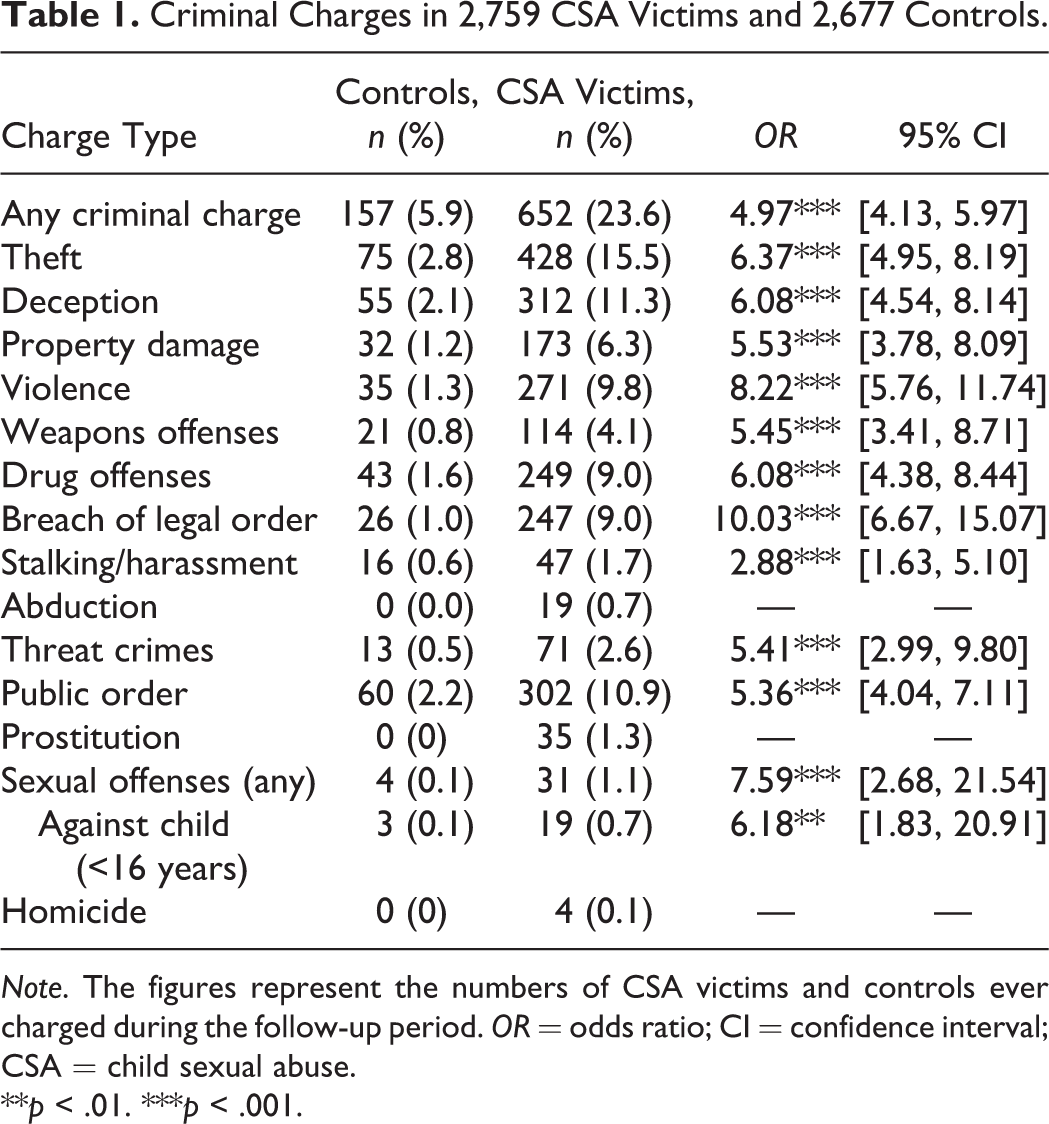
A criminal charge had been laid on at least one occasion against 652 (23.6%) abuse victims compared to 157 (5.9%) controls (Table 1). Among those with charges, victims had acquired significantly more charges, on average, that controls (M = 31.64, SD = 70.02, Mdn = 9.00 vs. M = 19.18, SD = 47.85, Mdn = 5.00; t = 2.65, p = .008). The proportion of those that were known to have been convicted on one or more of the charges did not differ significantly between CSA victims and controls (73.2% vs. 68.7%). As a result of conviction, 114 (17.5%) abuse victims were given a prison sentence compared to only 14 (8.9%) controls (χ2 = 6.97, p = .008). There was, however, no significant difference between victims and controls in the average length (in months) of prison sentence imposed (M = 13.19, SD = 22.09, Mdn = 6.00 vs. M = 14.19, SD = 18.06, Mdn = 10.00).
Criminal Charges in 2,759 CSA Victims and 2,677 Controls.
Note. The figures represent the numbers of CSA victims and controls ever charged during the follow-up period. OR = odds ratio; CI = confidence interval; CSA = child sexual abuse.
**p < .01. ***p < .001.
In the sexual abuse group, every form of criminal offending for which enough cases existed so that odds ratios (ORs) could be calculated was found to be significantly elevated over controls (Table 1). The most marked increase in odds was for breach of legal order offenses (e.g., fail to answer bail, breach conditions of a community or custodial order, and escape lawful custody), followed by violent offenses and sexual offenses. Although there was a strong relationship between CSA and sexual offending (OR = 7.59), it is important to note that sexual offending was still a rare occurrence among abuse victims (1.1%).
Does gender influence the CSA—criminal offending association?
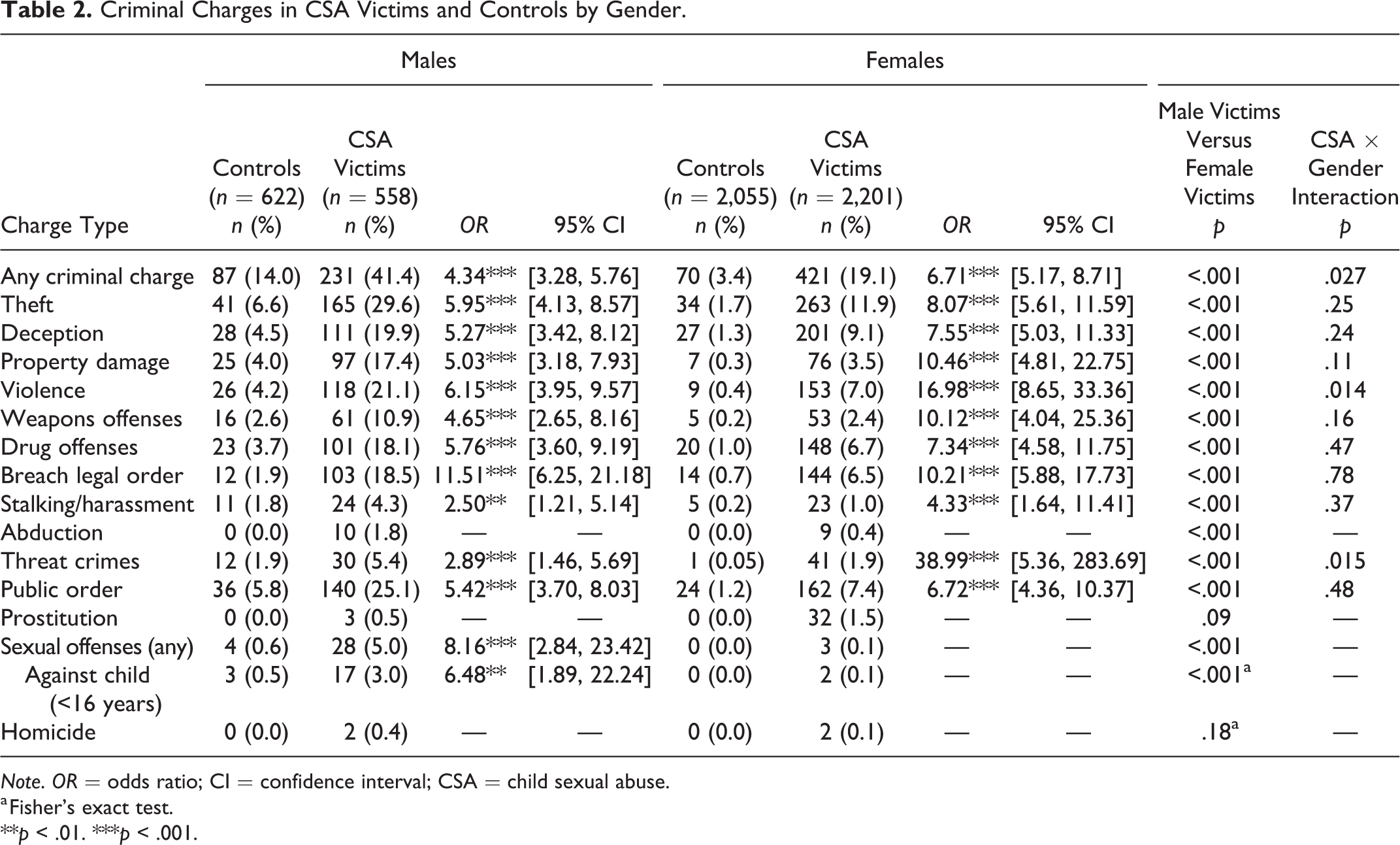
Table 2 shows that, with the exception of prostitution, all forms of criminal offending were more common in male CSA victims relative to female victims. However, relative to controls, female victims had rates elevated to a similar degree to males and often to an even greater extent, except for sexual offenses, which were virtually confined to males. Interaction analyses examining whether associations between CSA and offending outcomes varied with gender indicate significant Gender × Abuse Status (CSA victim vs. control) interaction terms for any criminal charge (B = −0.43, standard error [SE] = 0.20), violence (B = −1.02, SE = 0.41), and threat crimes (B = −2.60, SE = 1.07). Therefore, exposure to CSA has a more pronounced negative effect for females relative to males, for these types of offending behaviors.
Criminal Charges in CSA Victims and Controls by Gender.
Note. OR = odds ratio; CI = confidence interval; CSA = child sexual abuse.
a Fisher’s exact test.
**p < .01. ***p < .001.
Are abuse variables and other adverse outcomes associated with risk for criminal offending among CSA victims?
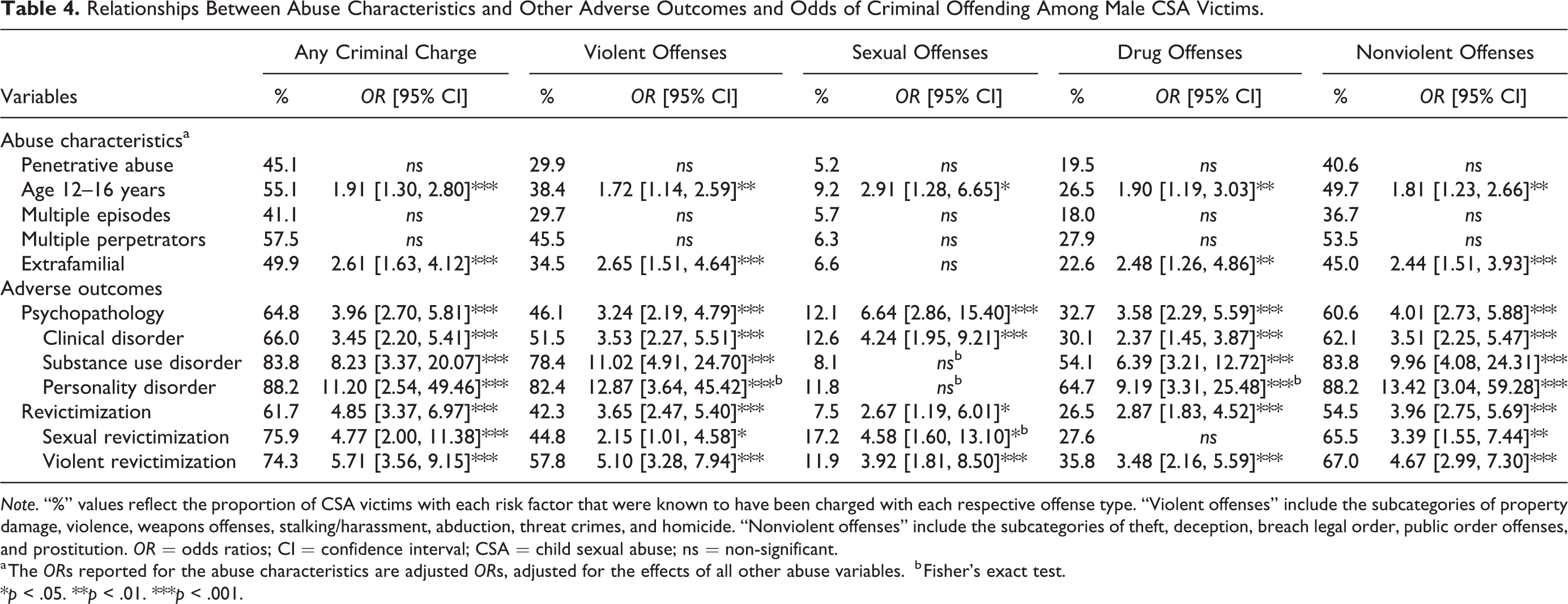
Tables 3 and 4 present the associations between various risk factors (i.e., characteristics of the index sexual abuse, serious mental health problems, and revictimization experiences) and likelihood of criminal offending among female and male CSA victims, respectively. For females, the odds of acquiring a criminal record (for any offense, and for drug offenses and other nonviolent offenses, specifically) were significantly higher among victims abused between ages 12 and 16 years compared to victims abused prior to age 12 years. Sexual abuse that involved multiple perpetrators was also found to be a significant risk factor for any offending and nonviolent offending for females. For males, an older age at index sexual abuse (12–16 years) was associated with an increased likelihood of all forms of offending. This association was strongest for sexual crimes, where 9.2% of boys abused between 12 and 16 years were charged with a sexual offense compared to 2.9% of boys abused prior to age 12 years. The odds of engaging in offending (for all types, except sexual offending) were also significantly higher among boys abused by an extrafamiliar perpetrator compared to boys abused by a relative.
Relationships Between Abuse Characteristics and Other Adverse Outcomes and Odds of Criminal Offending Among Female CSA Victims.

Note. “%” values reflect the proportion of CSA victims with each risk factor that were known to have been charged with each respective offense type. “Violent offenses” include the subcategories of property damage, violence, weapons offenses, stalking/harassment, abduction, threat crimes, and homicide. “Nonviolent offenses” include the subcategories of theft, deception, breach legal order, public order offenses, and prostitution. Sex offenses are not included in this table due to the low base rate of sexual offending among female victims (n = 3). OR = odds ratios; CI = confidence interval; CSA = child sexual abuse; ns = non-significant.
a The ORs reported for the abuse characteristics are adjusted ORs, adjusted for the effects of all other abuse variables.
*p < .05. **p < .01. ***p < .001.
Relationships Between Abuse Characteristics and Other Adverse Outcomes and Odds of Criminal Offending Among Male CSA Victims.
Note. “%” values reflect the proportion of CSA victims with each risk factor that were known to have been charged with each respective offense type. “Violent offenses” include the subcategories of property damage, violence, weapons offenses, stalking/harassment, abduction, threat crimes, and homicide. “Nonviolent offenses” include the subcategories of theft, deception, breach legal order, public order offenses, and prostitution. OR = odds ratios; CI = confidence interval; CSA = child sexual abuse; ns = non-significant.
a The ORs reported for the abuse characteristics are adjusted ORs, adjusted for the effects of all other abuse variables.
b Fisher’s exact test.
*p < .05. **p < .01. ***p < .001.
As shown in Tables 3 and 4, likelihood of offending varied significantly depending on whether the victim developed various kinds of psychopathology and experienced revictimization subsequent to their index sexual abuse. For females, all types of mental disorder and revictimization were strongly associated with an increased likelihood of all offense types. The presence of a substance use disorder was a particularly prominent risk factor for offending in females (ORs of up to 14), as was personality disorder for violent offending in particular (OR = 8.21). Similarly, girls who experienced violent revictimization demonstrated remarkably increased odds for offending behavior relative to girls who did not experience violent revictimization. A similar pattern was observed for girls who were sexually revictimized, although the ORs were not as large. For boys, a similar profile of adverse outcome risk factors emerged. Substance use disorders and personality disorders were strongly associated with the likelihood of all kinds of offending, except for sexual offending (this might partly reflect reduced statistical power to detect differences owing to the low base rates for sexual crimes and these kinds of disorders among men). Similarly, boys who experienced sexual or violent revictimization were significantly more likely to have engaged in a range of offense types.
Is there a relationship between cumulative risk and criminal offending among CSA victims?
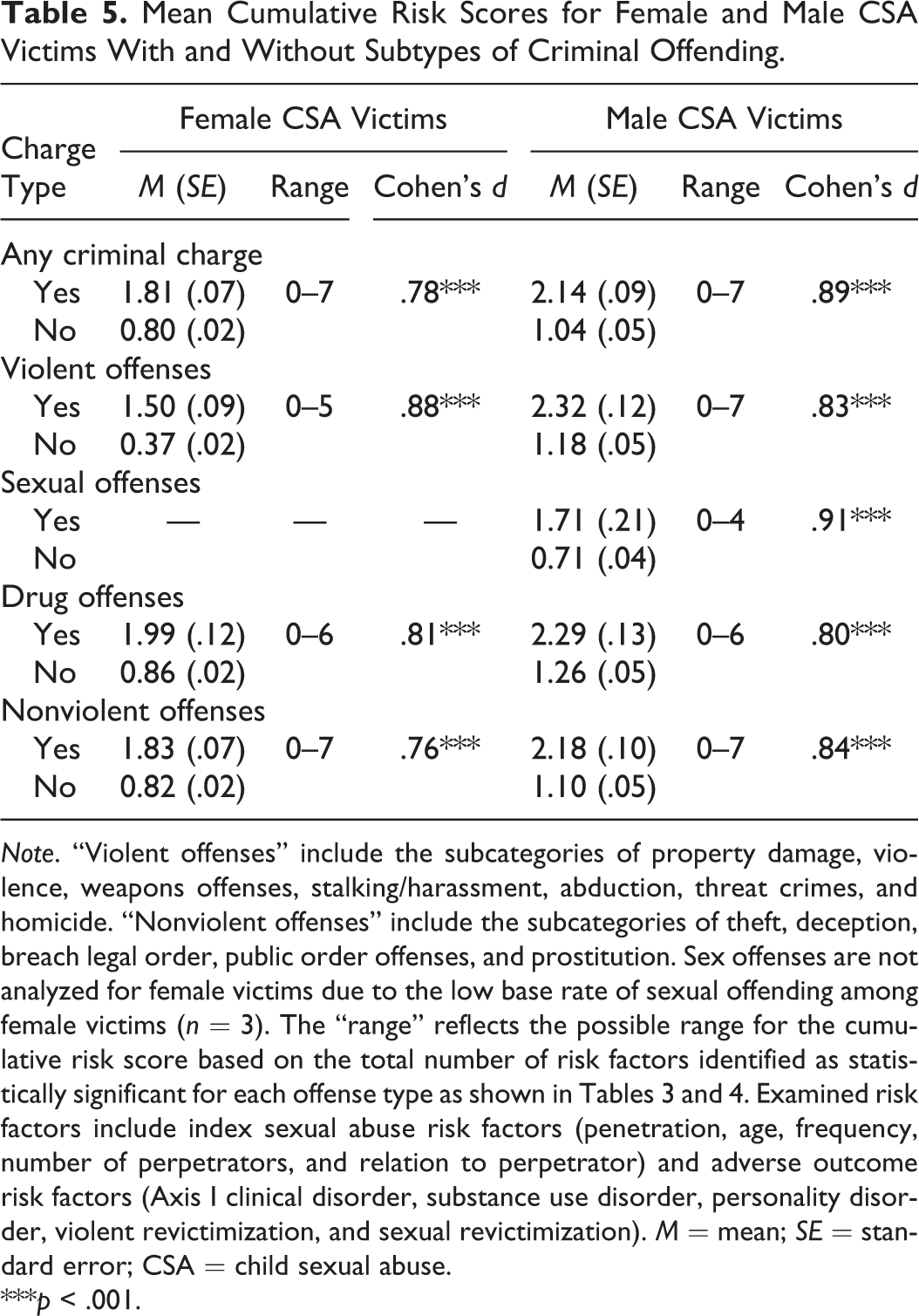
Table 5 demonstrates the mean cumulative risk scores for female and male CSA victims with and without each subtype of criminal offending. For both female and male CSA victims, and for all kinds of criminal offending, victims engaging in offending behavior had a significantly higher mean cumulative risk score compared to victims not displaying the offending behavior. In all cases, Cohen’s d effect sizes were considered large by conventional standards.
Mean Cumulative Risk Scores for Female and Male CSA Victims With and Without Subtypes of Criminal Offending.
Note. “Violent offenses” include the subcategories of property damage, violence, weapons offenses, stalking/harassment, abduction, threat crimes, and homicide. “Nonviolent offenses” include the subcategories of theft, deception, breach legal order, public order offenses, and prostitution. Sex offenses are not analyzed for female victims due to the low base rate of sexual offending among female victims (n = 3). The “range” reflects the possible range for the cumulative risk score based on the total number of risk factors identified as statistically significant for each offense type as shown in Tables 3 and 4. Examined risk factors include index sexual abuse risk factors (penetration, age, frequency, number of perpetrators, and relation to perpetrator) and adverse outcome risk factors (Axis I clinical disorder, substance use disorder, personality disorder, violent revictimization, and sexual revictimization). M = mean; SE = standard error; CSA = child sexual abuse.
***p < .001.
Discussion
This study provided a detailed prospective analysis of the association between CSA and long-term criminality among a large cohort of male and female sexual abuse victims. The study advances existing literature by examining gender-specific effects in relation to criminal offending and by exploring whether sexual abuse characteristics (such as the nature and timing of the sexual abuse) and other adverse outcomes (i.e., revictimization, serious mental health problems) are associated with the likelihood of criminal consequences in CSA survivors. Four key findings emerged from the analysis: (1) CSA victims were more likely than comparisons with no known history of abuse to engage in all types of criminal behaviors; (2) gender moderated the association between CSA and criminal offending, with stronger associations found among females for general and violent offending and among males for sexual offending; (3) certain features of the index sexual abuse as well as particular negative outcomes following the abuse were associated with an increased likelihood of criminal behavior; and (4) CSA victims who engaged in criminal offending were more likely to present with cumulative risks than victims not engaging in crime.
CSA and Criminal Offending Behavior
CSA was associated with an increased risk for all measured crimes, not just violent and sexual; these findings accord with existing research demonstrating an association between CSA and criminality (e.g., Siegel & Williams, 2003; Smith et al., 2005; Swanston et al., 2003; Widom & Ames, 1994). Because of the large sample, we were able to examine several infrequently occurring crimes generally not reported by existing research. Stalking/harassment and threat crimes, for example, emerged as a problem behavior among both male and female sexual abuse victims. This could reflect the difficulties that victims can sometimes experience in establishing and maintaining close relationships and in managing social interactions (DiLillo, 2001). Homicide is a rare event in Victoria (2–3 per 100,000 per year), so finding four cases in the abuse cohort is unexpected. This could be a chance finding of no significance but might relate to the higher levels of substance abuse, other forms of violence, and mental disorders, including personality disorders, which have been shown to affect this sexual abuse cohort (Cutajar et al., 2010; Papalia, Luebbers, Ogloff, Cutajar, & Mullen, 2017). Thus, it is possible that there may be indirect effects of CSA on criminal offending operating through more proximal factors such as substance abuse, anger dysregulation, psychological distress, interpersonal and situational stressors, isolation, low self-esteem, and poor coping skills. Future research should seek to examine how proximal factors might interact with CSA to influence criminal behavior or whether proximal factors alone are more important.
The Impact of Gender
The findings revealed that the association between sexual abuse and criminality was not uniform across gender. Indeed, that males are more likely than females to engage in criminal offending (i.e., irrespective of abuse history) is a widely acknowledged fact within the criminal justice literature (Broidy et al., 2015; Moffitt, Caspi, Rutter, & Silva, 2001). Therefore, it is not surprising that we too found that male CSA victims were more likely than female CSA victims to engage in all forms of crime (except for prostitution). However, we also found that gender significantly moderated the association between CSA and criminal offending, whereby the relationship between CSA exposure and subsequent general offending and violent offending was stronger among females. In other words, if a female is exposed to CSA, the relative increase in her risk for engaging in general and violent crime is larger than the increased risk experienced by a male exposed to CSA. These findings are noteworthy within the context of existing research indicating that females tend to deal with the consequences of abuse primarily by internalizing, rather than engaging in externalizing and acting-out behaviors, which are believed to characterize the pathway followed by abused boys (Asscher et al., 2015). Some studies have found that abused females are at a significantly higher risk for substance abuse/dependence diagnoses, arrests for alcohol and drug offenses, and severe emotional dysregulation (e.g., borderline personality disorders, affective disorders, and PTSD) than abused males (Widom & White, 1997). This may partly explain the stronger relationship found between CSA and general and violent offending among females. Theorists have also suggested that girls who experience abuse within the family may be more likely to cope with their victimization by running away, which increases their likelihood of early contact with the justice system (Chesney-Lind & Sheldon, 1998).
One major exception to this pattern of gender differences was for sexual offending. Although being the victim of sexual abuse was associated with an increased risk for sexual crimes in boys, there was no such relationship for girls. There are at least three possible explanations for this. The first is that, although girls are victims of sexual abuse more often than boys, the notion of a “cycle of abuse” exists exclusively for males. It has been suggested that this might be due to the unique ways in which boys interpret their abuse experiences and the effects of these experiences on boys’ psychosexual development (Plummer & Cossins, 2016). Alternatively, within the context of existing research reporting a higher prevalence of sex crimes among female sexual abuse victims than reported here and/or a significant association between sexual abuse and sexual offending for girls (Aebi et al., 2015; Widom & Massey, 2015), it is possible that female-perpetrated sexual offenses are significantly underreported among this sample. A third potential explanation is that the association between sexual abuse and sexual offending is not uniquely causal. Rather, the elevated rates of sexual offending observed among abused boys, but not girls, reflect a general association between sexual abuse and an assortment of criminal behaviors, including sexual offenses. Thus, that we do not see an association between sexual abuse and sexual offending among females simply reflects the fact that perpetrators of sexual crimes are overwhelmingly male (Smallbone, Marshall, & Wortley, 2008).
Factors Associated With Increased Risk of Criminal Offending
Consistent with cumulative risk models, we found that certain characteristics of the index sexual abuse and adverse outcomes subsequent to the abuse were associated with an increased likelihood of criminal offending. An older age at abuse was associated with an increased risk for all subtypes of crime among males and several subtypes of crime among females. This is consistent with theoretical perspectives suggesting that abuse occurring during the preteen and teenage years is associated with poorer outcomes (Adams-Tucker, 1982; Ruggiero, McLeer, & Dixon, 2000; Sedney & Brooks, 1984; Sirles, Smith, & Kusama, 1989; Thornberry, Ireland, & Smith, 2001). Indeed, exposure to sexual victimization during the critical transition from childhood to adolescence (i.e., puberty) has the potential to interfere with a range of developmental tasks including the development of a sexual identity, sexual norms and boundaries, attainment of a new and positive self-image, the ability to establish trusting and intimate relationships, and burgeoning processes of developing independence and a sense of agency (Cicchetti & Toth, 1995; Mullen & Fleming, 1998; Putnam & Trickett, 1993). With their growing cognitive sophistication, adolescents may also appraise victimization in a manner that could prompt negative emotional and cognitive reactions, such as shame, anger, and self-blame, and foster a sense of powerlessness and confusion (Feiring & Cleland, 2007; Hunter, Goodwin, & Wilson, 1992). Further, any stress-induced hormonal or biological responses caused by CSA during adolescence would occur within the context of newly developing hormonal and regulatory systems. Exposure to trauma can have far-reaching effects on the maturation, activation, and sensitivity/reactivity thresholds of such systems, which can manifest in a range of physiological, emotional, and behavioral problems including hyperarousal, mood disturbance, poor impulse control, aberrant sexual behavior and sexual dysfunction, aggression, and other oppositional behaviors (Fairbank, Putnam, & Harris, 2014; Jedd et al., 2015; Putnam & Trickett, 1993; Trickett et al., 2011). All of this could increase the use of illegitimate and maladaptive coping strategies (e.g., substance abuse, antisocial and oppositional behavior, and risk-taking behavior) and lead to poorer long-term adjustment among those abused during adolescence relative to younger children (Thornberry et al., 2010).
Although these age-related findings are consistent with existing research (Hurren et al., 2017; Leach et al., 2016; Malvaso et al., 2017), it is important to note that the temporal order between the index abuse and criminal offending was unclear for a portion of the abuse sample with missing offense dates. Thus, it is possible that for some victims aged 12–16 years, their criminal behavior in fact preceded the sexual abuse, thus potentially leading to an upward bias in estimates of association between sexual abuse and offending among this group. The finding that extrafamilial abuse and multiple abusers were associated with an increased likelihood of engaging in crime among boys and girls, respectively, is novel and requires further research to understand gender-specific pathways to criminal offending following abuse. Extrafamilial abuse has been found to involve more violence and physical force than intrafamilial abuse, which might partly contribute to these findings (Fischer & McDonald, 1998). Alternatively, exposure to supervisory neglect (i.e., reduced quantity and quality of supervision and protection afforded to the child) might have contributed to both an increased likelihood of sexual abuse from extrafamilial perpetrators and delinquent and criminal behaviors among boys in this sample (Bromfield, Lamont, Parker, & Horsfall, 2010). For girls, the fact that multiple perpetrators was associated with increased risk for offending reflects prior research demonstrating an association between multiple-perpetrator maltreatment and higher rates of criminal behavior (Hamilton, Falshaw, & Browne, 2002; Verrecchia, Fetzer, Lemmon, & Austin, 2010). It has been suggested that children who have been abused by more than one perpetrator might associate with delinquent peers as a means of obtaining protection from further victimization or compensating for an abusive family environment; this, in turn, might encourage young people to engage in criminal behavior themselves (Fagan, Piper, & Cheng, 1987). The experience of penetrative abuse or more frequent abuse was unrelated to criminal outcomes in this sample, thus casting doubt over “dose–response” presumptions that more severe sexual abuse is associated with more severe criminal consequences (Burgess et al., 1987; Fergusson & Mullen, 1999).
Among both males and females, we found that sexual and violent revictimization subsequent to the index sexual abuse was strongly associated with an increased likelihood of most forms of offending behavior including violence and sexual offending. Indeed, the overlap between victimization and criminal offending is well-documented in the criminal justice literature (Jennings et al., 2012). Further, researchers have suggested that the experience of revictimization is likely to exert a cumulative negative impact on the individual’s functioning, such that the effects of ensuing victimizations may compound the negative effects of earlier victimizations (Boney-McCoy & Finkelhor, 1995; Walsh, DiLillo, & Scalora, 2011). Similarly, male and female CSA victims with criminal histories were significantly more likely to have had a formal diagnosis of a clinical disorder, substance use disorder, or personality disorder. Again, this supports existing research demonstrating a relationship between psychopathology and criminality (Ogloff, 2009; Tye & Mullen, 2006). There are some plausible explanations that might explain the linkages observed between revictimization, mental health problems, and criminal behaviors among CSA victims, two of which are proposed here. The first explanation is that CSA creates vulnerabilities across multiple domains of functioning and that early patterns of maladaptation within one domain serve to influence risk for maladaptation in another domain (Widom, 2000). For example, CSA might interfere with early neurodevelopmental, hormonal, and biological processes, creating disruptions in physiological, affective, and behavioral regulatory capacities. Such impairments can manifest in a range of psychological, emotional, and behavioral consequences (e.g., low self-esteem, anxiety and depression, post-traumatic stress, personality pathology, problems with interpersonal relatedness, impulsivity, and risk-taking behaviors), which may serve to increase CSA victims’ susceptibility to mental health disorders, revictimization, and criminal offending (Greenwald, 2002; Hosser et al., 2007; Logan-Greene et al., 2015). Consistent with cumulative risk and transactional models, these problems in turn are likely to reciprocally influence one another over time in what may become patterns sustained well into adulthood (Appleyard et al., 2005; Cicchetti & Toth, 1995). This explanation garners some support from our findings that CSA victims engaging in particular criminal behaviors were more likely to demonstrate cumulative risks across sexual abuse, revictimization, and mental health domains, relative to victims not engaging in such criminal behaviors.
The above explanation emphasizes a change that is triggered by the sexual abuse. An alternative explanation, however, is that the linkages between revictimization, mental health problems, and criminal offending among CSA victims reflect a number of spurious relationships. That is, the outcomes may not be causally related to each other or to CSA, but, rather, may be explained by a common set of etiological risk factors. For example, it may be that preexisting or covarying individual, social, and family factors (e.g., disability, temperamental difficulties, early behavioral and emotional problems, social skills deficits and isolation, educational problems, parental unemployment, poverty, unstable family structure, parental maladjustment, domestic violence, concurrent physical abuse, emotional abuse, or neglect) could have increased both the risk of being sexually abused (or being detected as sexually abused) and the risk of subsequent revictimization, psychopathology, and criminality. For instance, impaired parent–child attachments and low caregiver warmth are not only risk factors for CSA exposure (Boney-McCoy & Finkelhor, 1995; D. M. Fergusson et al., 2008) but can also lead to other negative outcomes, including those examined in this study (Keijsers, Loeber, Branje, & Meeus, 2012; Miller-Graff, Cater, Howell, & Graham-Bermann, 2016; Morgan, Brugha, Fryers, & Stewart-Brown, 2012).
Limitations
The findings need to be considered in light of several methodological limitations. Rates of crime based on charges or convictions seriously underestimate the total burden of criminal offending, except possibly in homicide. In this study, the control group had their criminal histories established in an identical manner to the abuse victims. Therefore, although absolute rates of criminal offending will be underestimated, this methodological limitation is unlikely to substantially alter the association between CSA and criminal consequences found in this study.
The nature of the sexual abuse sample almost certainly introduces biases that could partly account for differences observed between the abuse and comparison cohorts. Specifically, officially reported cases of CSA disproportionately reflect children who experience more severe abuse and who are from lower socioeconomic classes (Australian Institute of Family Studies, 2016). This is, in part, because sexual abuse is reported more often in these social strata, but also, in part, because poorer families attract more intrusive and critical attention from social, educational, and justice agencies (Beckett, 2003). As such, many of those in the abuse cohort will have been exposed to additional adversities such as poverty, family disruption, poor parental adjustment, physical abuse, emotional deprivation, and poor educational opportunities, which are unlikely to be as common in the comparison sample (Doidge, Higgins, Delfabbro, & Segal, 2017). Given crime rates are higher among persons with such kinds of disadvantaged backgrounds (Fergusson, Swain-Campbell, & Horwood, 2004), it is likely that associations between sexual abuse and criminal offending reported in this study are inflated. However, we would cautiously suggest that, in light of existing research showing that sexual abuse is associated with increased rates of criminal offending and other externalizing behaviors after controlling for the effects of social class and other types of abuse, neglect, and adversity, it is unlikely that the increase in rates of offending found among the present abuse cohort is wholly explained by the family and social context within which sexual abuse often occurs (Currie & Tekin, 2012; Fergusson et al., 2008; Lewis et al., 2016; Malvaso et al., 2017; Milaniak & Widom, 2015; Siegel & Williams, 2003; Swanston et al., 2003; Thornberry et al., 2001). Further, Australia is far less socioeconomically diverse that other countries, such as the United States, meaning that the range in socioeconomic status indicators within the present samples will be much narrower than samples drawn from other developed countries. Nonetheless, future research is required to examine the unique contributions of sexual abuse and other childhood characteristics and family adversities to subsequent criminal outcomes and whether there are interactive and cumulative effects among these factors.
Conversely, there are at least three sources of potential bias that would have reduced the likelihood that differences between the abuse and comparison samples would be detected. First, a number of individuals in the comparison sample were likely exposed to sexual abuse themselves but were unable to be excluded from this research. Second, given we used sexual abuse cases coming to official attention, many children likely received some form of treatment to counter the effects of the abuse. Third, there will be a loss of criminal history data for CSA victims who either moved interstate or changed their name through their own marriage or their mother’s. This does not apply to the same extent for controls, whose names were obtained very close to the time of data linkage. We would emphasize that we observed sizable differences between the abuse and comparison cohorts despite these biases that serve to attenuate any true differences.
The abovementioned issues also have implications for the generalizability of the findings. Specifically, the results may not be generalizable to unreported, unascertained, and less severe cases of sexual abuse and cases of sexual abuse among middle and upper socioeconomic families. Further, we recommend caution in attempting to apply our findings to countries with substantially different rates (and correlates) of crime.
Implications and Conclusions
The results of this study establish a prospective association, not a causal nexus, between officially reported sexual abuse and a wide range of criminal outcomes among both male and female survivors. This analysis also suggests that CSA appears to have a more pronounced negative effect on criminal offending among females, particularly for violent crimes, and provides insight into some of the factors associated with increased likelihood of offending for abuse victims. For example, although we found that only 1% of the CSA cohort went onto commit a sexual offense, this rate increased to almost 10% for sexually abused boys between 12 and 16 years, 12% for sexually abused boys who developed serious mental illness, and 17% for sexually abused boys who experienced sexual revictimization. Similarly, for girls, just 7% of female CSA victims committed a violent offense. However, this rate increased to 20% for female victims who developed serious mental illness and 35% for female victims who experienced violent victimization subsequent to their index sexual abuse.
Therefore, children who come to official attention for sexual victimization should be viewed as potential candidates for immediate support, monitoring, and/or intervention to reduce their risks of subsequent victimization, psychopathology, and criminality and to foster resilience. In our view, the nature and level of any intervention required in the immediate aftermath of abuse would depend upon a careful and informed assessment of the child’s current risks and needs in areas of social, family, behavioral, interpersonal, and psychological functioning and would be sensitive to the stage-salient developmental issues and challenges faced by the child or adolescent. In addition, this study suggests that characteristics of the index abuse, such as the developmental period within which the abuse occurs, relationship to perpetrator, and number of perpetrators, might assist in identifying which victims could be at greater risk of criminal behavior and thus potentially in need of more intensive support and monitoring.
Our finding that gender moderated the likelihood of particular offending outcomes, and that several abuse variables demonstrated unique effects for males and females, indicates the need for future research to examine gender-specific mechanisms underpinning the CSA–criminal offending association. Such research could identify treatment targets for male and female CSA victims that could ultimately inform the development of gender-responsive interventions. For example, adolescent boys who have been sexually abused may benefit from interventions aimed at reducing the confusion that often exists regarding sexuality and boundaries. Females may benefit from interventions that target trauma sequelae associated with (violent) offending, such as impulsivity, aggressive behaviors, risk-taking, emotion dysregulation, relationship problems, and a hostile attribution bias.
This study found that CSA victims engaging in particular criminal behaviors were more likely to demonstrate cumulative risks across sexual abuse, revictimization, and mental health domains relative to victims not engaging in such criminal behaviors. This underscores the need for practitioners who assess and work with young people or adults with a CSA history to be cognizant of such linkages and to assess for comorbid problems across these domains. For example, clinicians providing crime reduction interventions to offenders with a known history of abuse should evaluate the presence and risk of further victimization experiences and mental health problems, ideally incorporating these issues into the focus of intervention or making appropriate service referrals where necessary.
Criminality is the product of complex interactions between multiple vulnerabilities. This article demonstrates only that CSA has the potential to be one of a range of factors that elevate risk of criminal offending. Importantly, we found that over 75% of this sexual abuse cohort was not charged with a criminal offense during the follow-up period. Thus, abuse is not destiny.
Footnotes
Authors’ Note
The primary data utilized in this research along with further details concerning the methodology and multiple imputation procedures can be provided to readers upon request.
Acknowledgment
The authors wish to thank Associate Professor David Wells, Victorian Institute of Forensic Medicine, for his guidance and assistance with the overall program of research.
Declaration of Conflicting Interests
The author(s) declared no potential conflicts of interest with respect to the research, authorship, and/or publication of this article.
Funding
The author(s) disclosed receipt of the following financial support for the research, authorship, and/or publication of this article: The research was funded in part by a grant from the Criminology Research Council of Australia (grant: 13/09–10).