






Abstract
We examine population-level associations between birth spacing and child maltreatment using birth records and child welfare records for 1,099,230 second or higher parity children born in North Carolina between 1997 and 2013. Building upon previous research, administrative data linkages were used to address out-of-state migration and family-level heterogeneity in birth spacing and child maltreatment risk factors. Findings provide the strongest evidence to date that very short birth spacing of zero through 6 months from last birth to the index child's conception is a prenatal predictor of child maltreatment (indexed as child welfare involvement) throughout early childhood. Consequently, information about optimal family planning during the postpartum period should become a standard component of universal and targeted child maltreatment prevention programs. However, challenging previous empirical evidence, this study reports inconsistent results for benefits of additional spacing delay beyond 6 months with regard to child maltreatment risk reduction, especially for children of racial and ethnic minorities. These findings call for further inquiry about the mechanisms driving the connections between birth spacing and Child Protective Services assessments.
Introduction
Researchers estimate that 23.6% of children will be investigated for maltreatment and 12.5% will have a maltreatment claim substantiated before they reach adulthood (Putnam-Hornstein et al., 2021; Wildeman et al., 2014). In addition, child maltreatment incidence and its documentation are socially patterned with marked differences in Child Protective Services (CPS) assessments and child maltreatment victimization across racial, ethnic, and social class lines (Dettlaff et al., 2011; Drake et al., 2009; Edwards et al., 2021). Consequently, understanding the antecedents of maltreatment is a pressing research topic (Gilbert et al., 2009).
One of the earliest moments at which risk of maltreatment can be identified is in prenatal stages. Among prevention efforts, family planning has been recognized for its potential to prevent maltreatment (Bitler & Zavodny, 2002; Child Welfare Monitor, 2018; 2019; Light, 1973; Olds et al., 2019; Zuravin, 1987). For instance, Olds and colleagues found that 15 years after participating in a home-visiting intervention which included child maltreatment and family planning components, women who were visited by the nurse had longer birth spacing intervals and had lower rates of child abuse and neglect perpetration compared to the control group (Olds et al., 1997). This finding has been replicated in two additional trials (Kitzman et al., 1997; Olds et al., 2002). Accordingly, present day maltreatment prevention programs often include components that educate the family about the benefits of family planning (Dodge et al., 2021; Olds et al., 2019; Sadler et al., 2013).
Yet, short birth spacing, defined by the World Health Organization as a birth-to-conception interval of under 18 months (World Health Organization, 2005), has been overlooked in studies of child maltreatment, in comparison to other aspects of parental family planning behavior, such as the mother’s age at first birth and total family size (Stith et al., 2009). At the same time, a marked proportion of children in the United States is born following short birth spacing, with 35% of all second or higher order children conceived under 18 months after the birth of their next-older sibling (Gemmill & Lindberg, 2013). Although national birth statistics do not provide systematic public data on birth-to-conception intervals, in 2019 alone, half a million infants were born within 23 months from the birth of the previous child (U.S. Department of Health and Human Services, 2021). Understanding the relationship between short birth spacing and child maltreatment risk can bring improvements to the well-being of a large proportion of children and their families.
In this study, short birth spacing is viewed as family-level factor contributing to the risk of abuse and neglect following the ecological perspective on child maltreatment proposed by Belsky (1980). Several possible mechanisms might explain this connection. For example, in line with the parental resource dilution theory (Blake, 1989), an arrival of a new infant into a family that already cares for one (or more) recently born children stretches parental resources (both material and intangible). The dilution of parental resources can in turn lead to an increased risk of child abuse and neglect. In addition, short birth spacing might predict child maltreatment because of health risks tied to shortly spaced pregnancies including higher incidence of maternal morbidity and postpartum depression (Conde-Agudelo et al., 2012) which are also important predictors of child maltreatment (Ayers et al., 2019).
Empirically, short birth spacing has been linked to an increased prevalence of child maltreatment in families. Benedict and colleagues (Benedict et al., 1985) selected families with children under the age of four with reported instances of physical abuse and upon matching each family with a non-abusive counterpart from the Maryland birth records reported retrospectively that abusive mothers had a shorter mean birth interval compared to non-abusive mothers. Another study from Maryland used a sample of families receiving Aid to Families of Dependent Children with children up to 12 years of age to compare family patterns of families reported to child protective services due to physical abuse or neglect to establish that abusive mothers had shorter birth spacing between the first and the second child (Zuravin, 1988). A further study of this sample also indicated that among teenage mothers, abusive mothers were more likely to have had two children by the time they reached 18, indicating shorter birth spacing (Zuravin & DiBlasio, 1996). A study of 658 women at risk of child maltreatment in Oahu, Hawaii, showed that older children with siblings born within 23 months from their own birth had 1.8 times higher risk of a substantiated CPS report within 6 years compared to children with siblings born after 24 months from their birth or later (Crowne et al., 2012).
Finally, using population-level data for Florida, Wu and colleagues (Wu et al., 2004) demonstrated that children conceived fewer than 15 months since the birth of their sibling had 1.2 times higher risk of infant maltreatment (compared to children conceived 15 or more months from prior birth) and Thompson and colleagues (Thompson et al., 2013) found that short birth spacing was associated with 18% higher odds of child abuse and/or neglect in the first 5 year of the child’s life compared to the recommended birth spacing for second born children born in Florida between 2005 and 2007.
Despite this considerable amount of prior research, several gaps remain with regards to the linkages between child maltreatment and short birth spacing. Existing research on population-level associations between short birth spacing and child maltreatment is constrained to geographically specific studies of Florida, necessitating replications across different settings to corroborate these findings. In addition, the age of the child at risk of maltreatment varies across previous studies, spanning from infancy (Wu et al., 2004) to 12 years of age (Zuravin, 1988). To address the higher risk of child maltreatment among families with shortly spaced births, more information is thus needed to identify the most vulnerable periods in the family’s life following narrow birth spacing.
Further, existing findings vary with respect to the measure of birth spacing. Although the World Health Organization (WHO) recommends that families wait at least 18 months after one birth before another conception (World Health Organization, 2005), relatively little is known about whether a shorter interval is associated with higher risk for adverse outcomes including maltreatment. Recent epidemiological studies offer evidence that including shorter, 6-month intervals in studies of the impact of short birth spacing on child well-being can offer more accurate recommendations for family planning with regards to infant health risk reduction (Hutcheon et al., 2019). Consequently, research on birth spacing thresholds linked to child maltreatment risk will provide families and institutions that support them accurate information for guidelines to prevent child maltreatment.
Lastly, prior research has documented markedly higher prevalence of CPS involvement among minority families (compared to non-Hispanic white families) due to higher poverty rates in minority communities and prejudice towards non-white families in the child welfare systems (Edwards et al., 2021; Putnam-Hornstein et al., 2013; Sedlak et al., 2010). The connection between birth spacing and child maltreatment thus ought to be carefully analyzed from the perspective of racial and ethnic differences in family experiences with child welfare services.
In this paper, we address these gaps in existing research by using population-level administrative records from the state of North Carolina and estimating the association between birth spacing and child welfare investigations. We analyze the risk of child maltreatment across two developmental stages: in infancy as well as throughout early childhood (until the age of 5). We further identify thresholds of birth spacing relevant for child maltreatment risk assessment and examine the relation between race/ethnicity, birth spacing, and child maltreatment risk.
Taking advantage of data linkages across multiple state administrative sources we also address two outstanding questions in studies of child maltreatment. First, we examine mother-level effects by linking information about children born in the state to the same mother. State administrative records enable population-level analysis and offer a large sample size but often lack more discrete measures of family context which might be pertinent to the underlying risk of child abuse and neglect. Using mother-level effects in the analyses offers an opportunity to address the heterogeneity in family environment and family characteristics in addition to the set of cross-sectional socio-demographic variables which are included in administrative data.
Second, we introduce a check for out-of-state migration. Population-level studies of child maltreatment examine cumulative experience of child welfare involvement under the assumption that children remain in the state where they were born (Thompson et al., 2013; Putnam-Hornstein and Needell, 2011). However, because children might move out of state and because inter-state moves might not be randomly distributed among the population, the estimates are biased because of false negative counts for movers. In this study, we use data about enrollment in state public schools to verify which children are still present in the state several years after birth.
Data and Methods
The protocol of this study was approved by Duke University IRB (Protocol #2020-0127). We used birth records data for second or higher parity children born between the first of January 1997 and the 31st of December 2013 in North Carolina (N = 1,181,374; 24.6% born to non-Hispanic Black mothers, 15.6% born to Hispanic mothers; 21.2% born to mothers without high school education) to acquire information about birth spacing and socio-demographic correlates. Birth records data were sourced from the North Carolina Department of Health and Human Services, Division of Public Health. The choice of the analytical sample was directed by the availability of data on child maltreatment investigations throughout the full 5 years of the child’s life at the moment of data access request. The state of North Carolina’s electronic Child Protective Services records system was launched in 1997 and the data access was requested in 2018.
Birth spacing was operationalized as a birth-to-conception interval and calculated using the date of birth of the index child, the index child’s gestational age at birth, and the date of the last preceding live birth to the same woman. The operationalization was chosen to report on the behavioral factors predicting child maltreatment (birth-to-conception intervals can be modified by parental behavior while birth-to-birth intervals are a product of conception delay as well as the gestational period). We first categorized birth spacing using three aggregate categories following the WHO medical recommendations (World Health Organization, 2005): short spacing (under 18 months birth-to-conception), recommended spacing (18 to 59 months birth-to-conception), and long birth spacing (60+ months birth-to-conception). Following previous studies, we designate the recommended birth spacing of 18 to 59 months as the reference category for this variable. Further, we also categorized birth spacing into 6-month intervals until 59 months following recommendations from Hutcheon et al. (2019): <6 months, 6–11 months, 12–17 months, 18–23 months, 24–29 months, 30–35 months, 36–41 months, 42–47 months, 48–53 months, 54–59 months, 60 or more months. For this variable, the recommended reference category is 18–23 months and we adapt this approach as well.
Data from the birth records were linked to the North Carolina Child Protective Services (CPS) database from the North Carolina Department of Health and Human Services, Division of Social Services. To this end, all CPS records between 1997 and 2018 were analyzed and matched to the birth records data using the child’s full name, date of birth, and gender. Details of the match between the birth records and the CPS data are available in Appendix A. Our strategy in matching birth records and Child Protective Services records resembled established procedures previously applied for matching birth records and CPS reports for California (Putnam-Hornstein & Needell, 2011) and Florida (Thompson et al., 2013). Using the CPS data, we created an indicator of whether the index child was a subject of at least one CPS assessment in infancy (before their first birthday) and in early childhood (before their fifth birthday). A CPS assessment is a report that was screened into an investigation because enough evidence for suspected child abuse or neglect was present in the initial report to justify further inquiry. CPS assessment were previously linked with negative outcomes for children later in life in a similar way that CPS substantiations were (Hussey et al., 2005).
We coded race and ethnicity using the mother’s race and ethnicity indicators from the birth records file: non-Hispanic white (hereafter: white), non-Hispanic Black (hereafter Black), Hispanic, non-Hispanic American Indian (hereafter: American Indian), non-Hispanic Asian (hereafter: Asian), and non-Hispanic other race (hereafter: other race). This distinction was created based on the codes used in the birth records files and permitted harmonization of race and ethnicity categories over the multiple versions of the birth records certificates used in the state across the 17 years of data which we used. We have no knowledge whether maternal race and ethnicity was self-reported or ascribed by the attending physician because the mode of data collection differed markedly across hospitals.
In addition, we included an array of factors that correlate with child maltreatment risk in the model, guided by the ecological perspective of the etiology of child maltreatment proposed by Belsky (1980) and previous empirical findings on the correlates of short birth spacing (Cheslack Postava & Winter, 2015). These factors were measures of parent characteristics in form of maternal age, partnership status, educational attainment, and place of origin. Maternal partnership status was coded using maternal marital status information and information about the father from the birth record. Maternal education measure distinguished women with less than 12 year of education versus women with 12 or more years of education. We acknowledge that the educational attainment measure was a broad indicator that included women with medium and high educational attainment in one category. This choice of the indicator was guided by the availability of educational data in the birth records files for years 1997–2009. To address this need for harmonization, we further conducted sensitivity analyses for a subsample of the data set (children born 2011–2013), for which an additional measure of maternal socio-economic status was available: a measure of source of payment for the delivery. We also used an indicator of whether the mother was born in the United States or abroad.
Child characteristics in the model included child’s gender, birth order and twin birth indicator, and being born with low birth weight or prematurely. We used information from the birth records to ascertain the child’s birth order based on the number of previous live births to the same mother. Importantly, twin births were categorized using the birth order of the first born twin. For instance, if the mother had one live birth prior to the twin delivery, both newborns were categorized as second born children. Twins that were born to primiparous women were classified as first born children and therefore excluded from the analyses together with singleton first births.
Descriptive Statistics of the Analytical Sample.
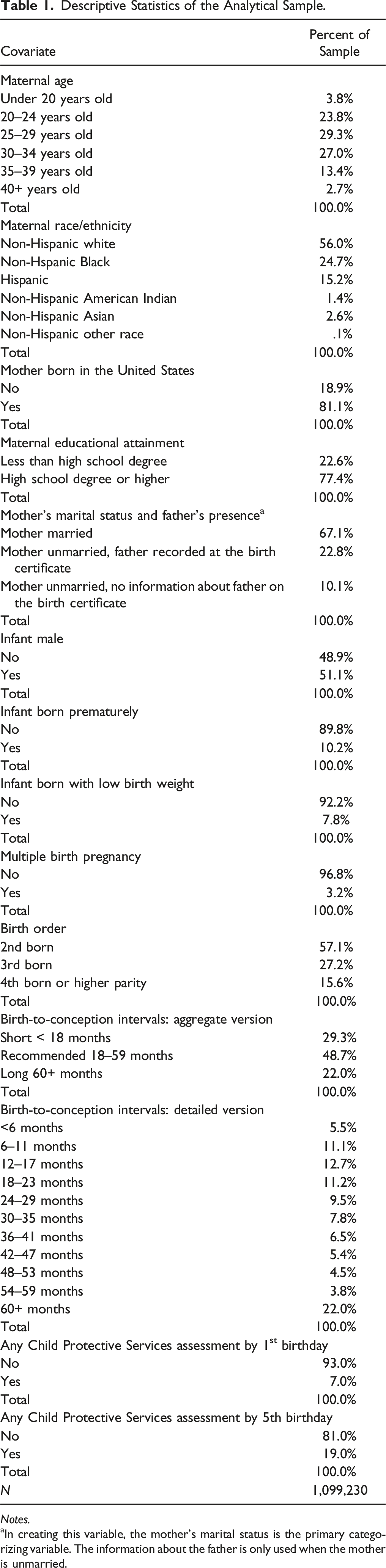
Notes.
aIn creating this variable, the mother’s marital status is the primary categorizing variable. The information about the father is only used when the mother is unmarried.
Throughout the child’s early life, some families might move out of the state. Consequently, any CPS assessments for the children born in the state but no longer residing in the state will not be recorded in the CPS registry data which we use. This situation might bias our results. To address out-of-state migration, we introduced a sensitivity check by accounting for the children’s presence in the state public elementary school system at ages 5 through 10. To this aim, birth records were sent to the North Carolina Education Research Data Center, where they were matched to the public school records using the child’s name, date of birth, and gender and provided to the researchers. The non-matches could indicate out-of-state migration or enrollment in a private school. We regard the first data set with all births as over-inclusion and the second data set with public-school students only as under-inclusion, and we report analyses for each data set.
In the current study, 67.9% of birth records were matched to elementary school records which approximates previous findings (Muschkin et al., 2018). The subsample of children identified as enrolled in state public schools amounts to 746,918. Overall, socio-demographic profiles of infants in the full analytical sample and the restricted sample are very similar (see Appendix B). Notable exceptions are the proportion of infants born to non-Hispanic Black women (56.0% vs. 53.5%) and infants born to married women (67.1% vs. 63.8%).
Finally, we linked information about children born to the same mother. In order to do so, we constructed a mother identification, using the mother’s full name and date of birth. We also used supporting information (race/ethnicity, place of origin, birth order) to verify the accuracy of the match. 836,354 unique mothers were identified.
We fit multiple variable logistic regression models of child maltreatment outcomes, introducing birth spacing as a main predictor of the outcomes. The aim of this paper is to examine whether birth spacing is a predictor of child maltreatment for the index child born soon after their older siblings. To this end, data about birth spacing were collected at the moment of the infant’s birth and data about child maltreatment were collected by the child’s first and fifth birthday, creating a clear temporal precedence, following recommendations from Hutcheon et al. (2019). Nonetheless, this is an observational study and we cannot establish causality. To examine mother-level heterogeneity, the final sets of models include a random effect in the form of a unique mother identification. Analyses were conducted using Stata 17.1.
Results
Socio-Demographics
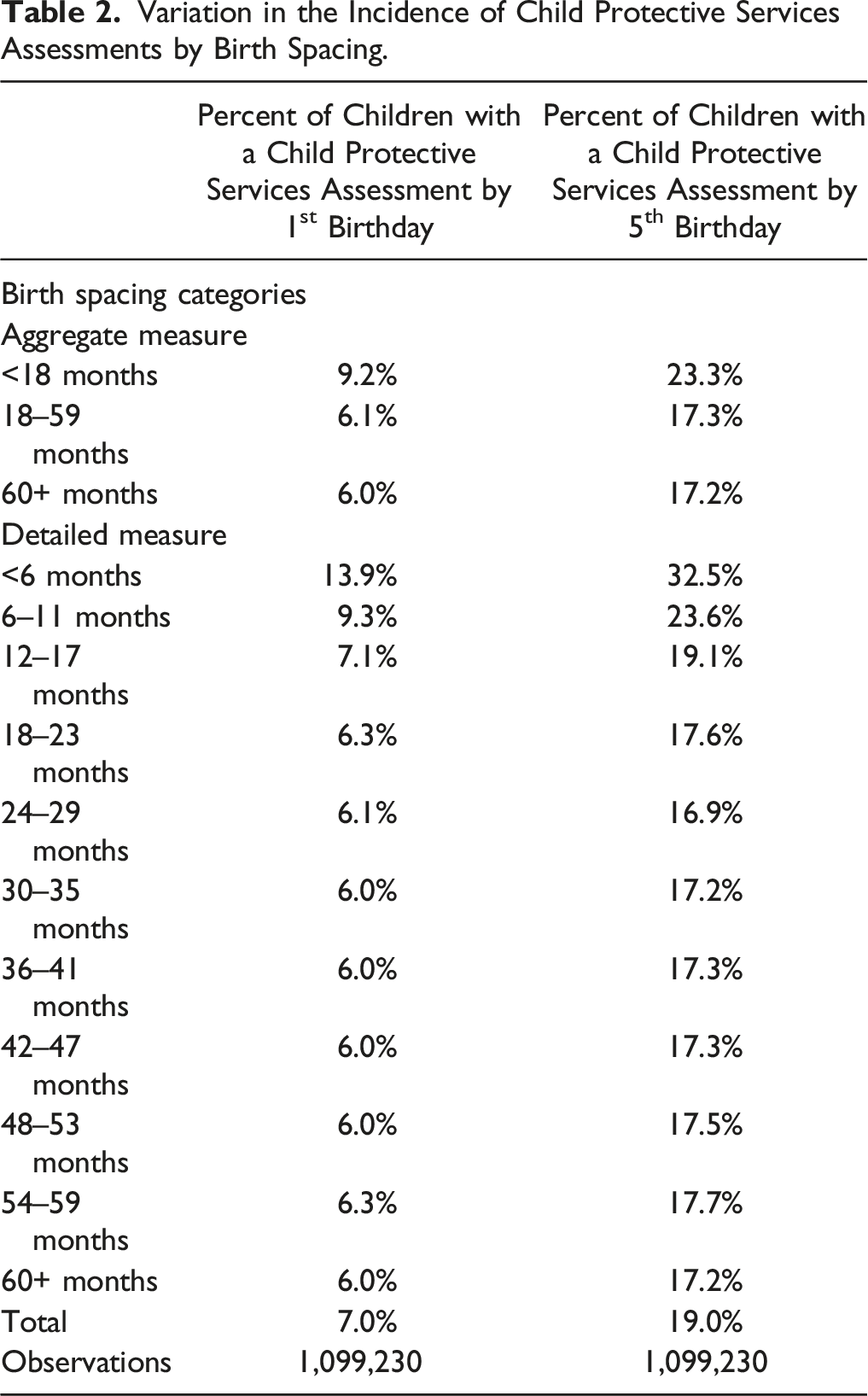
In the full analytical sample, 29.3% of children were conceived under 18 months from the birth of their older sibling, 48.7% were conceived within the recommended period of 18 to 59 months from the previous delivery, and 22.0% were conceived following long birth spacing of 60 or more months post-birth (see Table 1). The more detailed categorization of short spacing group indicated that in the full analytical sample, 5.5% of children were conceived under 6 months from the prior birth, 11.1% were conceived within the period of 6 to 11 months from the prior birth and finally 12.7% were conceived within 12 to 17 months from the prior birth. In addition, 7.0% of children experienced at least one CPS assessment for suspected child maltreatment within the first year of life and 19.0% of children experienced at least one CPS assessment for suspected child maltreatment in the first 5 years of life (Table 1).
Variation in the Incidence of Child Protective Services Assessments by Birth Spacing.
Multivariate Associations and Predicted Probabilities
Associations Between Aggregate Measures of Birth Spacing and the Likelihood of a Child Being a Subject of a Child Protective Services Assessment by rheir First and Fifth Birthday, Presented as Odds Ratios and Predicted Probabilities.
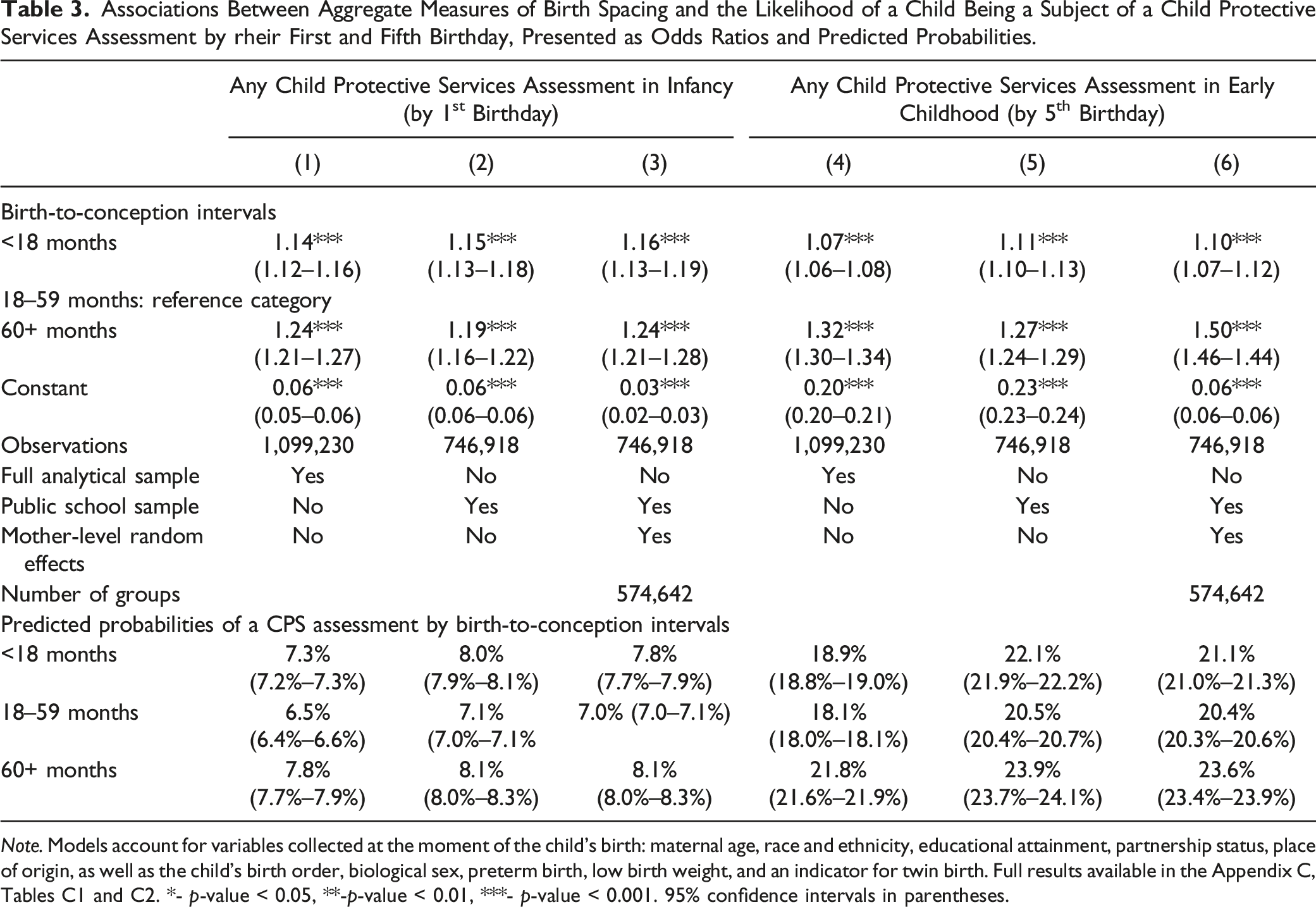
Note. Models account for variables collected at the moment of the child’s birth: maternal age, race and ethnicity, educational attainment, partnership status, place of origin, as well as the child’s birth order, biological sex, preterm birth, low birth weight, and an indicator for twin birth. Full results available in the Appendix C, Tables C1 and C2. *- p-value < 0.05, **-p-value < 0.01, ***- p-value < 0.001. 95% confidence intervals in parentheses.
The associations between short birth spacing and the likelihood of being a subject to a CPS assessment were also replicated in models restricting the sample to children enrolled in public schools as well as the models with mother-level random effects (Table 3, models 2, 3, 5, and 6). Across all these specifications, short birth spacing consistently predicted higher likelihood of the child being subjected to a CPS assessment in infancy and early childhood. Because the estimates using a sample of children enrolled in state public schools and mother-level random effects can be considered as the most conservative estimates of the associations between short birth spacing and CPS assessments for this data set, we use this specification to further examine relations between CPS assessments and the detailed 6-month intervals of birth spacing in the next section.
Associations Between Detailed Measures of Birth Spacing and the Likelihood of a Child Being a Subject of a Child Protective Services Assessment by their First and Fifth Birthday, Presented as Odds Ratios.
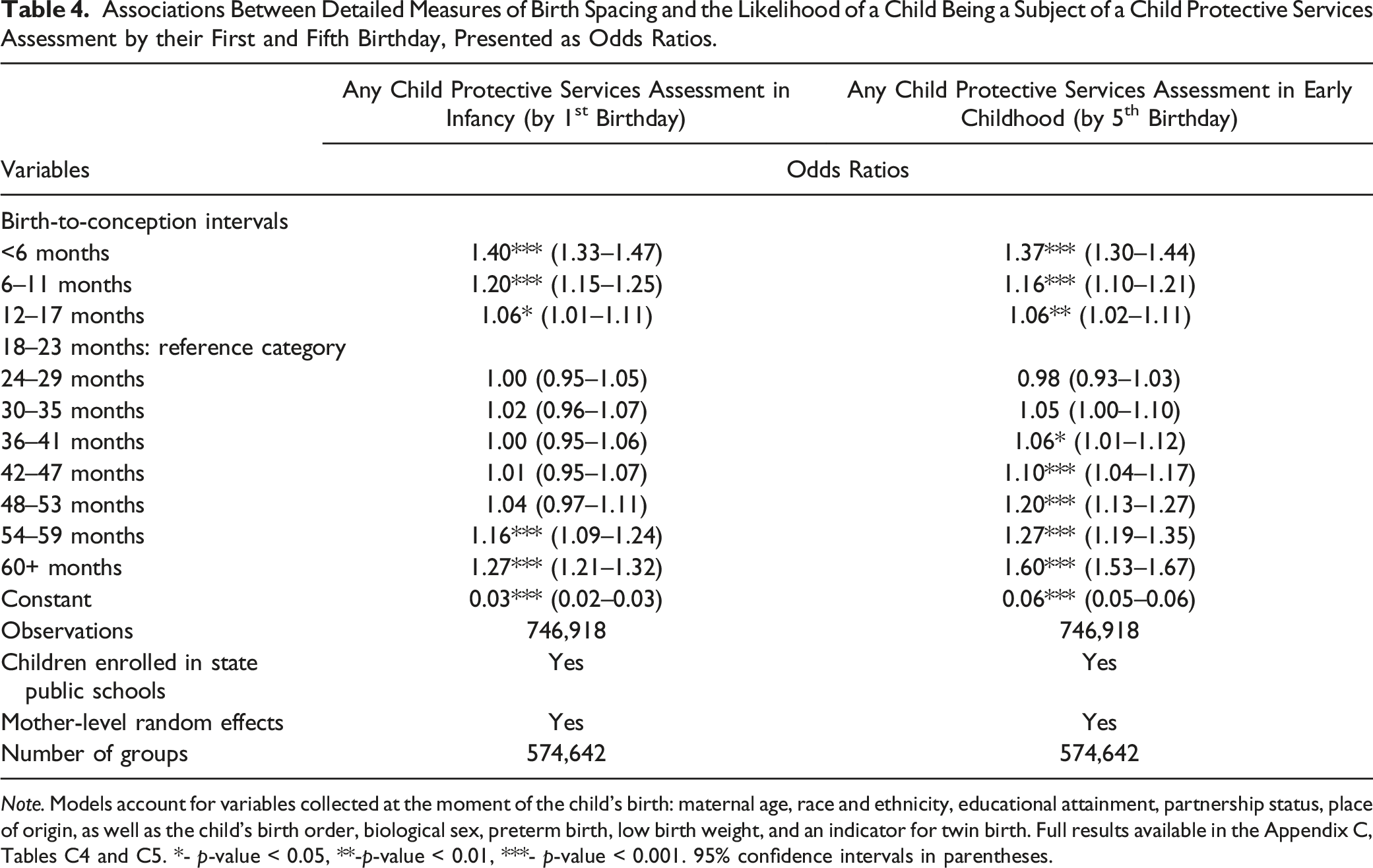
Note. Models account for variables collected at the moment of the child’s birth: maternal age, race and ethnicity, educational attainment, partnership status, place of origin, as well as the child’s birth order, biological sex, preterm birth, low birth weight, and an indicator for twin birth. Full results available in the Appendix C, Tables C4 and C5. *- p-value < 0.05, **-p-value < 0.01, ***- p-value < 0.001. 95% confidence intervals in parentheses.

Predicted probabilities of Child Protective Services assessments for a child by birth spacing. Note. Vertical bars represent 95% confidence intervals. Regression results available in Appendix C Tables C4 and C5.
Moderation by Maternal Race and Ethnicity
Next, associations between birth spacing and CPS assessments were analyzed for children enrolled in state public schools and born to mothers from the three largest racial and ethnic subpopulations in the state: Black, Hispanic, and white mothers (n = 717,547). Among children born in the state and enrolled in public schools, these children represent 96.1% of the entire population. Bivariate tabulations demonstrated higher incidence of CPS assessments among children of Black mothers compared to children of white mothers (11.3% compared to 6.1% for CPS assessments by first birthday and 29.4% compared to 16.7% for CPS assessments by fifth birthday). However, regression models with socio-demographic correlates indicated that children of Black mothers had lower odds of CPS assessments in infancy and early childhood (see Appendix C). Children of Hispanic mothers had lower odds of CPS assessments in infancy and early childhood in both bivariate tabulations (3.2% for CPS assessments by first birthday and 11.3% for CPS assessments by fifth birthday) and multiple variable regression models (Appendix C).
There were significant differences in the associations between birth spacing and CPS assessments in infancy and early childhood between infants born to white mothers and Black mothers (see Appendix D, Table D1). Specifically, we detected negative interactions between being born to a Black mother and the birth spacing variable in regressions for CPS assessments by first and fifth birthday indicating that the associations between short birth spacing and CPS assessments were weaker for children of Black mothers compared to children of white mothers. This negative interaction was strong enough so that only very short birth spacing of under 6 months was a significant predictor for CPS assessments for children of Black mothers; with short spacing of 6–11 months and 12–17 months no longer predicting CPS assessment (see Figures 2 and 3). Predicted probability of a child being a subject of a Child Protective Services assessment for children of white mothers. Note. Vertical bars represent 95% confidence intervals. Regression results available in Appendix D Table D1 and probabilities available in Appendix D Table D2. Predicted probability of a child being a subject of a Child Protective Services assessment for children of Black mothers. Note. Vertical bars represent 95% confidence intervals. Regression results available in Appendix D Table D1 and probabilities available in Appendix D Table D2.

We also detected a negative interaction between being born to a Hispanic mother and the birth spacing variable in the regression for CPS assessments by fifth birthday (see Appendix D, Table D1). This findings indicated that associations between short birth spacing and CPS assessments in early childhood were weaker for children born to Hispanic mothers compared to children born to white mothers. This negative interaction was strong enough so that only very short birth spacing of under 6 months is a significant predictor for CPS assessments by fifth birthday for children of Hispanic mothers (with short spacing of 6–11 months and 12–17 months no longer predicting CPS assessment, compare Figures 3 and 4). We detected no interaction between being born to a Hispanic mother and birth spacing variable in the regression for CPS assessments by first birthday. Predicted probability of a child being a subject of a Child Protective Services assessment for children of Hispanic mothers. Note. Vertical bars represent 95% confidence intervals. Regression results available in Appendix D Table D1 and probabilities available in Appendix D Table D2.
Long Birth Spacing
While the majority of research on birth spacing focuses on the associations between short birth spacing and detrimental health and child development outcomes, in this paper, we found new relations between long birth spacing and child maltreatment risk. In the models using the aggregate measure of birth spacing, we observed that conception falling 60 or more months since the prior birth is linked to a higher likelihood of a CPS assessment in infancy (Table 3, model 3, OR = 1.24, 95% CI = 1.21, 1.28) and in early childhood (Table 3, model 6, OR = 1.50, 95% CI = 1.46, 1.55). In addition, in models using detailed 6-months spacing intervals, it was revealed that conception delay beyond 3 years (that is, 36 months) might also be associated with a higher likelihood of CPS involvement. For instance, in Table 4, the odds of a CPS assessment in early childhood are already higher by a factor of 1.06 (95% CI = 1.01, 1.12) for children conceived 36–41 months since the last birth compared to children conceived 18–23 months since the last birth. The U-shaped pattern (with both shorter and longer intervals being linked to higher odds of CPS involvement for a child) in the probability of a CPS assessments was also revealed in Figure 1. However, adjusting for maternal race/ethnicity and birth spacing interactions revealed that the U-shaped pattern observed with regards to birth spacing was present for children born to white mothers but was much subdued or nonexistent for children born to Black and Hispanic mothers (Figures 2–4).
Discussion
In this paper we used population-level data for a Southeastern state in the United States to revisit previously documented associations between short birth spacing and risk of child maltreatment in infancy and throughout early childhood. We expanded on previous findings by accounting for important sources of attrition(out-of-state migration) and selection (family-level heterogeneity). We also examined whether the associations between birth spacing and child maltreatment risk hold for children from three largest racial and ethnic populations in the state: those born to white, Black, and Hispanic mothers.
Our findings carry important new information for research and implications for families with small children and institutions that support them. First, findings from conservative models accounting for family-level heterogeneity show that short birth spacing (under 18 months birth-to-conception) constitutes an early life course risk factor for child abuse and neglect. Further, the highest risk of child maltreatment was identified for very short spacing of under 6 months birth-to-conception. Associations between very short birth spacing and child maltreatment risk were observed at the population-level, highlighting the relevance of this information for social work and public health programs aiming at child maltreatment prevention.
Consequently, avoiding very short birth spacing has the strongest potential for reducing child maltreatment risk. We recommend that universal and targeted child maltreatment prevention programs incorporate aspects of family planning and share information about short birth spacing widely in efforts to promote conception delay and reduce incidence of very short birth spacing. Because very short spacing happens so soon after birth, prenatal and postpartum contact with families is especially important. Postpartum home-visiting interventions and prenatal-postnatal navigation programs are public health interventions uniquely positioned to offer education and resources to support the family’s conception delay efforts in early months post-birth.
Policy efforts to reduce very short birth spacing should be coupled with further studies of the mechanisms linking very short birth spacing with later child maltreatment. Conceptual models suggest mechanisms through which short birth spacing might act to increase risk. First, it might dilute parental financial and material resources available to offspring. Second, short birth spacing might reduce the amount of attention available to each offspring and increase parental stress (as parents now need to take care of multiple very small children requiring round-the-clock attention). Third, very short birth spacing might also trigger other biological or psychosocial processes that in turn increase risk of child maltreatment, such as low birth weight, prematurity, or maternal anxiety and depression. Finally, it remains plausible that short birth spacing does not have a causal influence but instead is a marker for a number of other prior factors that may be associated with later child maltreatment, including parental stress, lack of planning skills that lead to both short birth spacing and maltreatment, or other financial needs. Cross-sectional data from this manuscript cannot uncover these mediating mechanisms but further research into antecedents and ramifications of very short birth spacing using longitudinal studies can supply information to better address the origins of very short birth spacing and the needs of families experiencing very short birth spacing.
Second, we demonstrated that an additional delay in spacing beyond 6 months since last birth is beneficial for children of white mothers but less so for children of Black and Hispanic mothers. These are new findings in the field, suggesting marked variation in the connections between reproductive behavior and child maltreatment across maternal race and ethnicity. We interpret these findings within the context of existing findings about racial and ethnic disparities in child maltreatment incidence and child welfare investigations.
Disparities in the prevalence of child maltreatment and child welfare contact by the child’s race and ethnicity are well-documented and largely attributed to selection of specific minority children, especially Black and Native American children, into higher exposure to child maltreatment risk factors such as poverty and to protective factors shielding children from other minority groups, especially Asian and Hispanic children, from negative effects of child maltreatment risk factors (Detlaff et al., 2011; Drake et al., 2009; Putnam-Hornstein et al., 2013). Racial bias among reporters and the child welfare system is further cited as an important source of disparities in child welfare contact across race and ethnicity (Fluke et al., 2011). Within this context, our findings suggest that very short birth spacing of under 6 months contributes in a similar way to child welfare contact across race and ethnicity, potentially indicating a similar association with child maltreatment risk, or in prejudice, across these subpopulations.
However, short spacing of 6–17 months birth-to-conception is a relevant child maltreatment risk factor for white children but not for Black children. Potentially, a specific mechanism behind selection into 6–17 months birth spacing operates in a way that increases the risk of maltreatment for white children but not Black children. One hypothetical mechanism could be unintended childbearing. Shortly spaced births are often unintended (Huber et al., 2018; Gemmill and Lindberg, 2013). Because unintended childbearing is more prevalent among Black mothers (Sweeney and Raley, 2014), the risks of maltreatment associated with unintended childbearing might be already present for all Black children, irrespective of short birth spacing but might manifest itself for white children only among the subpopulation of shortly spaced children, for whom the proportion of unintended births is much higher than in the general population of white children. Perhaps short birth spacing indicates unintended childbearing only among white families. It is also plausible that the child welfare system workers are inherently biased against families with short birth spacing since the recommended family planning guidance is to wait at least 18 months to try for another pregnancy. In this case, because existing findings already indicate an amount of bias in child welfare system against Black families, possibly the bias due to short birth spacing beyond very short birth spacing is only relevant for white families.
Finally, short birth spacing of 6–17 months birth-to-conception also does not predict child maltreatment among Hispanic children. We note our finding that the odds of child maltreatment are lower among children of Hispanic mothers than among children of white mothers. The Hispanic paradox might explain both the lower odds and the lack of relation between spacing and child maltreatment among Hispanic families. According to the Hispanic paradox, physiological, social, and cultural factors, such as better health status, familism, and strong social networks protect Hispanic children from child maltreatment due to higher exposure to child maltreatment risk (Putnam-Hornstein et al., 2013). Potentially, these protective factors offer a strong buffer from child maltreatment risk or from bias that is connected to short birth spacing of 6–17 months birth-to-conception. Future research with careful attention to family poverty, differences between actual maltreatment and child welfare reporting, and bias against specific family forms should test these hypotheses and further explain the source of race/ethnicity disparities in the connections between short birth spacing and child maltreatment documented in this manuscript. Even with these differences across race and ethnic groups with regard to the effect of birth spacing, we wish to highlight the universal finding that among all groups studied (white, Black, and Hispanic), very short birth spacing under 6 months increases the risk of later child maltreatment.
We mark limitations of our study that can direct future research in the linkages between birth spacing and child maltreatment risk. Although the sample is larger and more population-representative than that of any other known study to date, we acknowledge the difficulty of being confident that children who are not found in the Child Protective Services database are, indeed, not maltreated. They might be excluded because they move out of state, change names, or change families. They might be maltreated but not brought to the attention of the CPS system. It is also plausible that short birth spacing biases entry into the CPS system. Mitigating against this possibility is the array of findings that short birth spacing increases risk in infancy, when child mobility is somewhat lower, and robustness analyses in form of out-of-state migration check and the randomeffects models. Our study also suffered from the lack of information about childbearing intentions. Previous work has indicated that the majority of shortly spaced birth are in fact unplanned births (Brunner Huber et al., 2018; Gemmill & Lindberg, 2013) and that an unplanned birth is associated with higher risk of child maltreatment (Guterman, 2015). Accordingly, future studies need to account for both birth spacing and birth intendedness and consider their independent as well as interactive association with child abuse and neglect.
Conclusion
This study employs the largest and most representative sample and the most rigorous data-analytic controls to date to show that very short birth spacing of under 6 months from the sibling’s birth to the index child’s conception increases the risk that a child will be investigated for child abuse or neglect. Although a causal link cannot be established with the data observed here, the large magnitude and robustness of the relation suggests that public health interventions should be directed to informing parents about the risks that accrue with very short birth spacing and to encouraging parents to engage in family planning. Finally, because the linkages between short birth spacing and child welfare involvement emerge during infancy and because the highest risk of child welfare assessments was recorded for infants conceived under 6 months since the birth of their sibling, early post-birth child maltreatment prevention programs such as home visiting services offer a promising opportunity of both addressing vulnerabilities among families with shortly spaced infants and encouraging family planning to delay future births.
The study also identifies important differences in the associations between short birth spacing of 6–17 months birth-to-conception and child maltreatment for minority and white children. While conception delay past 6 months from the prior birth benefits white children in terms of the likelihood of child welfare contact, the same benefits are not present for Black and Hispanic children. Racial and ethnic differences in selection into short birth spacing, existence of protective cultural factors as well as inherent biases in the child welfare system might all contribute to the findings reported in this manuscript. Future studies are necessary to explain this variation in the impact of family characteristics on child maltreatment.
Supplemental Material
Supplemental Material - Birth Spacing and Child Maltreatment: Population-Level Estimates for North Carolina
Supplemental Material for Birth Spacing and Child Maltreatment: Population-Level Estimates for North Carolina by Anna Rybińska, Yu Bai, W. Benjamin Goodman, and Kenneth A. Dodge in Child Maltreatment.
Footnotes
Acknowledgments
The authors thank Matthew R. Edwards for his help with data management and anonymous reviewers for their helpful comments on previous versions of the manuscript.
Declaration of Conflicting Interests
The author(s) declared no potential conflicts of interest with respect to the research, authorship, and/or publication of this article.
Funding
The author(s) disclosed receipt of the following financial support for the research, authorship, and/or publication of this article: Funding for this research was provided by the R01HD069981 grant from the Eunice Kennedy Shiver National Institute for Child Health and Human Development.
Data Availability
Birth records data used in this research are sourced from the North Carolina Department of Health and Human Services, Division of Public Health. The findings and conclusions in this publication are those of the author(s) and do not necessarily represent the views of the North Carolina Department of Health and Human Services, Division of Public Health. Child abuse and neglect investigations data are sourced from the North Carolina Central Registry of Child Abuse and Neglect and the North Carolina Families Accessing Services through Technology systems from the North Carolina Department of Health and Human Services, Division of Social Services. The NC Division of Social Services does not take responsibility for the scientific validity or accuracy of methodology, results, statistical analyses, or conclusions presented. Data are not publicly available.

Supplemental Material
Supplemental material for this article is available online.
References
Supplementary Material
Please find the following supplemental material available below.
For Open Access articles published under a Creative Commons License, all supplemental material carries the same license as the article it is associated with.
For non-Open Access articles published, all supplemental material carries a non-exclusive license, and permission requests for re-use of supplemental material or any part of supplemental material shall be sent directly to the copyright owner as specified in the copyright notice associated with the article.
