






Abstract
Regardless of compliance to coercion by an alleged perpetrator, child maltreatment is abuse in any form. However, the extent to which coercion is described as an obligation (mandatory compliance) or permission (optional compliance) is legally relevant. The present investigation examined how attorneys question children about coercion and how children describe coercion in courtroom investigations of alleged child sexual abuse, and whether such language influences jurors’ perceptions of children’s testimony. Study 1 assessed 64 transcripts of children’s testimonies and revealed that both attorneys and children use coercive language. Problematically, terms of permission were used when describing sexual abuse, potentially implying compliance was optional. Study 2 presented 160 adults with transcript excerpts, varied by coercive language (obligation or permission) and maltreatment type (sexual abuse or punishment). Coercive language influenced perceptions of coercion and whether the adult was to blame. Maltreatment type influenced perceptions of severity, credibility, and verdict. Overall, coercive language and maltreatment type influence perceptions of how the event unfolded.
Introduction
In cases of alleged child maltreatment, a child’s testimony is central in evaluating the case. An often-overlooked factor is whether and to what extent children’s actions are described, whether by the attorney when asking about the abuse or by the child when describing their experiences, as being the product of coercion by the alleged perpetrator. Regardless of compliance to coercion, child maltreatment (e.g., child sexual abuse (CSA)) is abuse in any form. However, a relevant distinction when describing coercion is whether the child was obligated to comply (e.g., “He forced me to lay down”) or merely given permission for which compliance was optional (e.g., “He allowed me to lay down”), differing in the deontic term used. An obligation socially constrains the actions of an actor, where the action is forced/required and compliance is not optional. Permission implies that the actor is allowed to engage in an action, depending on their desire, choice, or preference, and compliance is optional (Wellman & Miller, 2008). Of course, in cases of child maltreatment, and more specifically CSA, authority and power enable the perpetrator, implicitly or directly, to coerce the child into sexual compliance (Sgroi, 1982). Yet, the degree to which coercion was used is legally relevant and may influence jurors’ perceptions of the child’s report. In legal cases force accentuates punishment (Cal. Pena Code, 2017). The degree of coercion used affects the severity of the offense and how coercion is described helps form a narrative of how the events unfolded (Stolzenberg et al., 2017). The present investigation included two studies, establishing whether language indicating coercion (hereafter termed coercive language) is used in the wording of attorneys’ questions or by child witnesses in their reports in court transcripts of child testimonies, and then whether such language and maltreatment type influence jurors’ perceptions of coercion and evaluations of the child’s report. Together, these studies provide an initial assessment of the use and impact of coercive language, in contexts where such language might be particularly relevant.
It is important to note that although abuse can involve a spectrum of experiences where evidence of coercion can be aggravating and influence juror decision making, regardless of compliance to coercion, it is abuse in any form. As noted by Stark and Hester (2019), researching children’s resistance to coercive control raises ethical concerns if this work implies children’s compliance diminishes the significance of their victimization. This is not the case we are seeking to make. However, understanding the influence of language and maltreatment type on perceptions of child testimony can prove invaluable in building a knowledge base on which policy and practice depend. If jurors perceive children to have consented to sexual acts or failed to resist, there is reason to anticipate jurors will be less sympathetic. Whether children are perceived to have consented may be affected by the language used to describe the abuse.
Coercive Language
Coercive language has been largely examined within the linguistic study of force-dynamics, where modals (e.g., have to/want to) can be used to instill psychological pressure on an individual (see Talmy, 1988). For example, terms like have to (e.g., “You have to come with me”) or want to (e.g., “I want you to come with me”) can be conceived as psychological ‘pressure’ towards the realization of an act. These modals used to describe coercion, can be categorized by their deontic uses, distinguishing between modals that express obligation when compliance is obligatory (e.g., have to), and permission when coercion still exists but compliance is voluntary (e.g., want to). The comparison of deontic modals distinguishing between obligation and permission has been well explored by researchers when assessing children’s production and understanding of the verbs (must and may, Kratzer, 1977; tell and ask, Stolzenberg et al., 2017; make and let, Bowerman, 1978). For example, when considering the deontic use of tell and ask, one tells when the recipient’s compliance is obligatory, and asks when the recipient’s compliance is voluntary (Stephany, 1995). Researchers find that whereas children begin to use deontic modals by 2–3 years (Bliss, 1988; Kuczaj & Maratsos, 1975; Perkins, 1983; Shepherd, 1982; Wells, 1985), their understanding develops with age around 6 years old (e.g., Byrnes & Duff, 1989; Hirst & Weil, 1982; Stolzenberg et al., 2017; Wylie et al., 2022). Furthermore, there is reason to believe that differentiating between obligation and permission is relevant in juror decision making.
Jurors use what is said when making evaluations of a child’s report (e.g., children’s responses to age-inappropriate questions, Wylie et al., 2019) and sometimes make incorrect or improper assumptions about how a child should behave (e.g., emotional victim effect, Rowsell & Colloff, 2022). Understanding areas where jurors make incorrect assumptions is important for legal decision-making. For example, jurors have an expectation of coercion, and more specifically a high degree of force (e.g., describing the action as an obligation), in cases involving alleged child sexual abuse. St George and colleagues (2020) found that 30% of jurors’ admissible questions in cases of CSA were about the defendant’s use of force or threats and the child’s resistance. The authors note that jurors seemed confused when children’s narratives lacked descriptions of force, threats, or resistance. Furthermore, Stolzenberg and Lyon (2014) found that only 23% of prosecuted CSA cases included charges of force, suggesting the abuse was most often non-forceful, yet jury members were 9 times more likely to convict when force was alleged. Clearly, adults hold expectations of force in cases of abuse, and as such describing the child’s actions as an obligation can influence jurors’ decision making at trial. Given that children may also describe abusive actions with permissive terms, it is important to understand whether permissive language influences jurors’ perceptions of whether coercion occurred as well as their overall perceptions of the trial.
Maltreatment Type
The type of maltreatment reported may also influence jurors’ perceptions of coercion. Children experience coercion within cases of sexual abuse (Stolzenberg et al., 2017) as well as other non-violent contexts of maltreatment (Callaghan et al., 2018; Katz, 2016). Though no known research to date has examined the influence of maltreatment type on jurors’ perceptions of coercion, it is reasonable to believe that jurors would affirm coercion, and more specifically conclude that children were obligated to comply, in cases of sexual abuse. Authority can be leveraged by adults to coerce children into sexual compliance (Sgroi, 1982), and young children are less likely to be seen as responsible for their actions compared to adolescents and adults (Duggan, 1987). In non-sexual cases of maltreatment (e.g., punitive actions, sometimes referred to as “emotional abuse”, such as locking a child in a room all day), though adults remain in a place of authority, it is possible that adults view children as less obligated to comply as the form of abuse is perceived as less severe (Lev-Wiesel et al., 2020) and children may be expected to resist. Indeed, in response to non-violent coercion children devise strategic and adaptive agency including forms of resistance (Callaghan et al., 2018; Katz, 2016). This ability to resist coercion may lead adults to perceive the child as being at greater fault for their actions, regardless of the reality that children are not to blame.
Although it remains unknown about how maltreatment type influences perceptions of coercion, there is some literature examining how maltreatment type influences perceptions of child credibility and case severity/impact. For example, in cases of sexual abuse young children are often perceived to be trustworthy and credible, given that they are viewed as sexually naive and incapable of lying about sexual events (e.g., Davies & Rogers, 2009; Ross et al., 2003). Additionally, jurors have viewed cases where sexual abuse was not present (e.g., physical abuse, emotional abuse, neglect) to be less severe and traumatic (Bornstein et al., 2007; Lev-Wiesel et al., 2020). For example, Lev-Wiesel and colleagues (2020) found parents viewed emotional abuse (e.g., punitive actions, such as locking child in room) to be less severe compared to sexual abuse. The authors explain that even when parents recognize that harsh punishments may result in feelings of insult or humiliation for their child, they justify this by necessary means of teaching or punishment. These findings indicate that maltreatment type can have a significant impact on how jurors perceive children’s reports and the case overall.
Responsibility and Blame
Although no study to date has examined jurors’ perceptions of coercion, researchers have examined jurors’ perceptions of responsibility and blame, which are likely related to coercion. Whereas responsibility is a judgment about accountability, blame is an attribution made towards an individual that has intentionally committed harm without adequate excuse or justification (Shaver, 1985). Researchers examining jurors’ perceptions of responsibility and blame have assessed the influence of victim age and gender (Back & Lips, 1998; Davies & Rogers, 2009; Duggan, 1987; Waterman & Foss-Goodman, 1984). For example, Back and Lips (1998) found that older victims were assigned greater responsibility compared to children, female victims received more blame compared to males, and male jurors assigned more responsibility to the victim compared to female jurors. Similarly, Davies and Rogers (2009) found that male jurors rated the perpetrator as less culpable (i.e., responsible) compared to female jurors, though they did not find victim age differences. Waterman and Foss-Goodman (1984) found that the greatest reason for blaming victims was that they “should have resisted.” Given that obligation implies the adult used force and the child did not have a choice, the child is likely perceived as not responsible and the adult to blame for the interaction. In contrast, permission suggests the child had a choice and so one might perceive that the child is more responsible for their decisions.
Current Studies
The present investigation included two studies. Study 1 was used as a preliminary search for coercive language, to establish the extent to which terms of obligation (e.g., have to) as well as permission (e.g., want to) are used in attorneys’ questions or children’s responses in courtroom investigations of alleged child sexual abuse. Once established, Study 2 sought to examine how coercive language and maltreatment influenced jurors’ perceptions of children’s reports.
Study 1
In Study 1, we identified common uses of coercive language (frequency and type for obligation and permission) in 64 transcripts of children (5- to 12-year-olds) testifying in cases of alleged child sexual abuse. We also examined child age, speaker (defense, prosecution, child), and topic of conversation differences (given that topics, such as other forms of maltreatment, were discussed in children’s testimonies beyond the alleged abuse). We explored whether children’s use of coercive terms was self-generated, or a reflection of the attorney’s language.
We expected children’s testimony to include a higher frequency of obligatory compared to permissive language, given that the transcripts involved cases of alleged child sexual abuse where power differentials are at play and adults are able to assert control (Sgroi, 1982). We also expected rates of coercive language to increase with age, and attorneys to use more language indicating coercion than children given children’s increased vocabulary, attorneys’ expectations that older children can understand more complex language (Saywitz et al., 2018), and attorneys’ use of suggestive rather than open questions. Prosecutors were expected to use terms of obligation (implying the child did not have a choice) more often than defense attorneys, in line with the attorneys’ motives for conviction and acquittal, respectively (Stolzenberg & Lyon, 2014). Finally, we expected that coercive terms would most often be used when discussing the acts of sexual abuse, given that sexual compliance is likely the product of coercion, although we explored all possible topics of conversation in which coercive language was used (e.g., other forms of maltreatment, daily activities, sleeping arrangements).
Methods
Sample
Sixty-four transcripts of 5- to 12-year-olds’ (Mage = 9.45, SD = 1.95, 89% female) testimonies alleging sexual abuse were examined. The transcripts include all sexual abuse cases involving children 12 years of age and under filed in Maricopa County, Arizona (2005–2015). See Sullivan and colleagues (2021) for more complete details about data collection.
Defendants (100% male), were the biological father (17%), stepfather/boyfriend to the mother (13%), biological sibling (5%), grandparent (5%), an other family member (19%), neighbor (6%), stranger (8%), and ‘other’ (28%; e.g., friend of parent, boyfriend of aunt). Children alleged penetration or attempted intercourse in 9% of the cases, oral copulation or genital contact in an additional 10% of cases, and less severe abuse in 50% of cases (fondling, exhibitionism, etc.). Half of the sample (50%) alleged repeated abuse. Of these cases, 91% were convicted (n = 58), 5% acquitted (n = 3), 3% hung jury (n = 2), and 1% mistrial (n = 1).
Coding
We coded all question-answer pairs (turns in conversation between attorney and child) within the transcripts. Two research assistants completed an initial search for common occurrences of coercive language, separately for deontic terms that describe obligation and permission, used by the child or attorney. Ultimately, the agreed upon list included the terms make, have, tell, force (obligation) and let, want, ask, allow (permission). We then machine coded the transcripts for these terms and their derivatives (e.g., have and had). Two research assistants independently reviewed the machine coded terms, excluding any terms that did not refer to coercion (e.g., “Let me ask you a question”); there was 100% agreement on these exclusions. We then coded for the speaker (defense, prosecution, child), the age of the child, and topic of conversation. Within each question-answer pair, we also coded for whether children used the coercive terms spontaneously or simply reflected the terms used by the attorney.
For topic of conversation, two independent coders identified and categorized the question-answer pairs as sexual abuse (e.g., touching, clothing displacement, penetration), punitive actions (e.g., locking in a closet, holding heavy objects above head, forms of emotional abuse; see Lev-Wiesel et al., 2020), testifying/disclosing abuse (e.g., attending court to testify, disclosing to a parent), location (e.g., coming from or going to another house), sleeping arrangements (e.g., where the child slept, who slept in the same bed), or activities (e.g., games, chores, homework), or other (any topics that did not fall within the aforementioned categories). If the topic of conversations was not clear from the question-answer pair, three pairs before/after were used to provided further contextual information. We reached K = .95 reliability and discussed and resolved all discrepancies to achieve 100% agreement.
Results
Across the 64 transcripts examined, 3.2% question-answer pairs contained coercive language (n = 707 out of 22,010; note that 36 Q/A pairs had both terms of obligation and permission, n = 743 terms used). When examining the rate of coercive language used at the child level, we found that, 91% (n = 58 out of 64) of children had at least one question-answer pair containing coercive language, with an average of 12 (SD = 11.20) coercive question-answer pairs per child. Of these occurrences (n = 743), coercive language was more often used by attorneys in their questions (61%, n = 452) compared to children in their responses (39%, n = 291) (22% different, 95 CIs: 14.56, 28.56, McNemar χ2 = 34.89, p < .001).
Frequency (Percent) of Terms, Split on Terms of Obligation and Permission, and Attorney and Child.
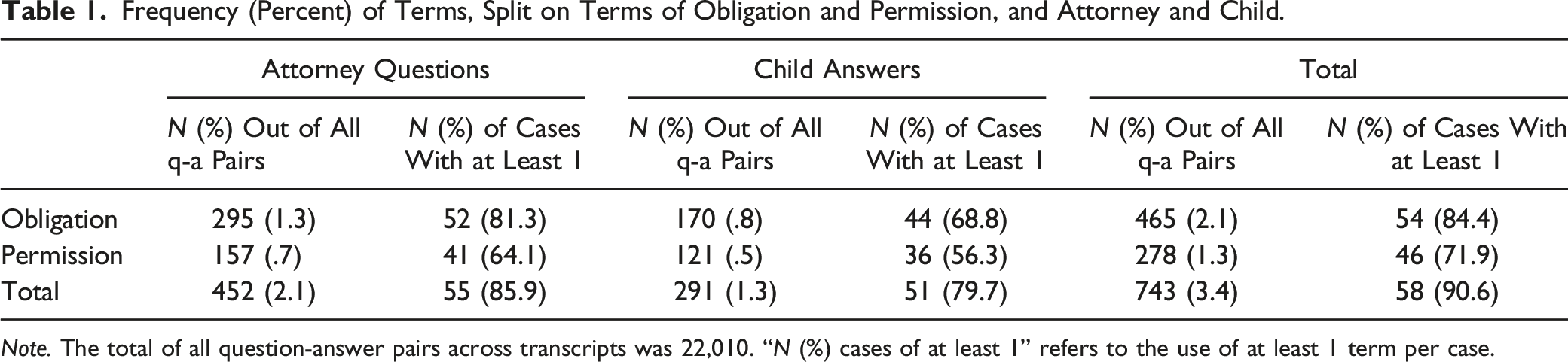
Note. The total of all question-answer pairs across transcripts was 22,010. “N (%) cases of at least 1” refers to the use of at least 1 term per case.
Attorneys’ Use of Language Indicating Coercion
We examined attorneys’ use of coercive language (see Attorney Questions columns of Table 1). Of the attorneys’ questions that contained coercive language (n = 452), terms of obligation (65%, n = 295) were used more often than permission (35%, n = 157) (30% different, 95 CIs: 21.53, 39.02, McNemar χ2 = 42.13, p < .001). Attorneys asked 81% (n = 52 out of 64 children) of children at least one question referring to obligation (M = 4.61, SD = 6.02; range 0–33), and 64% (n = 41 out of 64 children) of children at least one question referring to permission (M = 2.45, SD = 2.98; range: 0 to 15 questions), suggesting that attorneys are both emphasizing force through terms of obligation and minimizing force through terms of permission.
Given that the prosecution may be motivated to emphasize force to gain a conviction, whereas the defense may be motivated to minimize force to gain an acquittal, we compared prosecutors and defense attorneys on the frequency with which their questions indicated coercion. On average prosecutors (M = 258, SD = 109.96) asked more questions than the defense (M = 170, SD = 99.27), so proportion scores (rather than frequencies) were used. Contrary to our predictions, there were only marginal differences. Whereas 2% (range: 0%–18%) of prosecutors’ questions used terms of obligation, 1% (range: 0%–5%) used terms of permission. Similarly, 4% (range: 0%–38%) of the defense’s questions used terms of obligation, 2% (range: 0%–9%) used terms of permission.
Children’s Use of Language Indicating Coercion
Next, we examined child witness’ use of coercive language (see Child Answers columns of Table 1). Of children’s responses that used coercive language (n = 291), terms of obligation (58%, n = 170) were used more often the terms of permission (42%, n = 121) (16% different, 95 CIs 5.37, 27.87, McNemar χ2 = 8.25, p = .004). Sixty nine percent (n = 44 out of 64 children) of children provided at least one response referring to obligation (M = 2.66, SD = 3.55; range: 0–15) while 56% (n = 36 out of 64 children) of children provided at least one response referring to permission (M = 2.03, SD = 2.88; range 0–12), suggesting that children are both emphasizing and minimizing force depending on the terms used. The majority of children’s use of coercive language was spontaneous (obligation, 87%, n = 148 out of 170; permission, 95%, n = 115 out of 121), rather than prompted by the attorney’s use of coercive language.
We also examined whether children’s use of coercive language increased with age. Given that the length of children’s testimony increases with age (Lamb et al., 2018), proportion scores were calculated with the number of question-answer pairs containing coercive language divided by the total number of question-answer pairs in each testimony. Coercive language was found to increase with age (r = .320, p = .010).
Topic of Conversation
Description, Examples, and Frequency (Percent out of 707 Q-A Pairs) of Coercive Terms for Each Context.
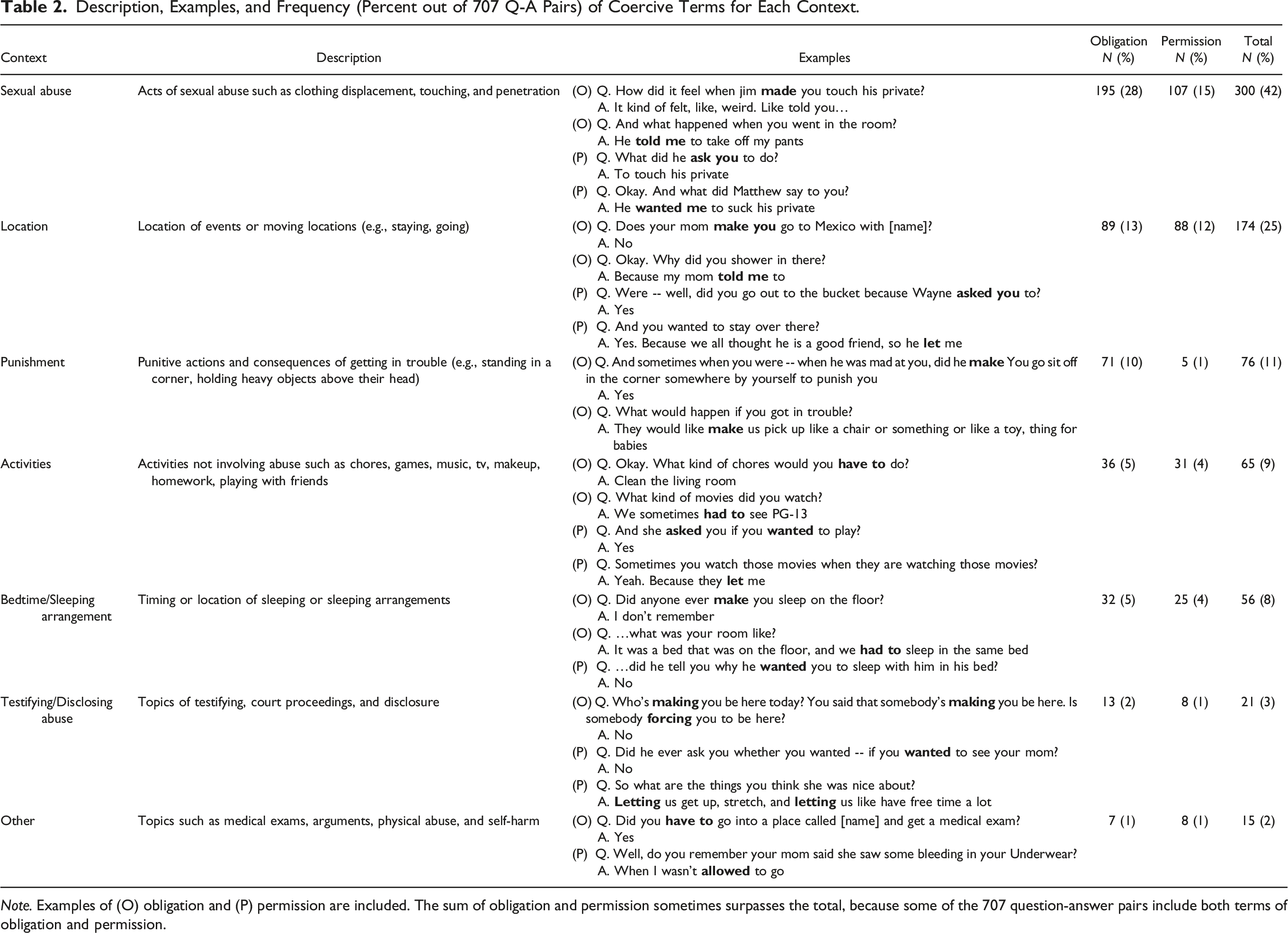
Note. Examples of (O) obligation and (P) permission are included. The sum of obligation and permission sometimes surpasses the total, because some of the 707 question-answer pairs include both terms of obligation and permission.
Discussion
The primary purpose of Study 1 was to establish that coercive language is indeed used in court by attorneys and children in cases of alleged CSA. The majority of children (91%) were asked questions with language indicating coercion, with terms of obligation being used more often than terms of permission by both children and attorneys. Though terms of obligation were more common, terms of permission were still quite frequent (37%, n = 278 out of 743 question-answer pairs using coercive language), which could imply the child had a choice to comply.
We also gained information about coercive language differences across speakers, age, and topic of conversation. Although attorneys used language indicating coercion more often than children, children were still using this language (80% of children using at least once). In fact, children use both terms of obligation (69% of children using at least once) and permission (56% of children using at least once), and this language was most often used spontaneously.
Furthermore, contrary to our prediction that prosecutors would more often use terms of obligation (implying the child did not have a choice) compared to defense attorneys, the proportion of question-answer pairs containing terms of obligation and permission did not differ between the prosecution (2% and 1%, respectively) and defense (4% and 2%, respectively). These findings suggest that prosecutors’ motives for a conviction and defense motives for an acquittal may not influence the coercive terms used to question the child. It is possible that attorneys themselves are not aware of the subtle differences between terms of obligation and permission, and as such are not using these terms to influence perceptions of how the event unfolded. Researchers may want to examine attorneys’ understanding and awareness of the differences between terms of obligation and permission.
When examining age differences, the use of coercive language in children’s testimony significantly increased with age. Though production of deontic modals develops much earlier in the toddler years (e.g., Bliss, 1988), children’s understanding of these terms does not develop until later childhood (e.g., Byrnes & Duff, 1989; Hirst & Weil, 1982). Given that we know jurors likely expect coercion to be described in child witness testimonies (St George et al., 2020; Stolzenberg & Lyon, 2014), this could be particularly problematic for younger children who displayed lower rates of coercive language. However, it is also possible that jurors do not expect younger children to be able to consent, and as such they may only hold expectations for older children to resist coercion. Study 2 assesses whether descriptions of coercion, specifically when using terms of permission, influence jurors’ perceptions of young children’s reports.
Finally, we explored differences in the topic of conversation when coercive language was used. Coercion was described most often in conversations about sexual abuse, followed by moving in location, punitive actions, activities, sleeping arrangements, and the requirement to testify. Importantly, when discussing acts of sexual abuse, children use both terms of obligation (which may emphasize force) and permission (which may minimize force). It is possible that young children are misusing the terms of permission, given that acts of sexual abuse are likely highly coercive in nature. Conversely, young children may lack an understanding that sexual abuse is wrong, and in turn minimize force used in these scenarios. In any case, the ground truth of the level of coercion used in these events remains unknown, warranting further examination of children’s accuracy in describing coercive experiences. It is also important to consider whether the (mis)use of this language influences perceptions of coercion. In instances of sexual abuse, it is possible that differentiating between terms of obligation (A. He told me to take off my pants.) and permission (A. He wanted me to suck his private) does not alter perceptions of whether children were obligated to comply, and so misuse of these terms has minimal impact on perceptions of the event. However, in lower-stake contexts, language differences may alter perceptions of the event. For example, consider this 9-year-old’s response to an attorney: Q. What kind of movies did you watch? A. We sometimes had to see PG-13 [later described as scary movies]). This example suggests the young child was required to watch the age-inappropriate movie. If the deontic term used was permissive (e.g., We sometimes were allowed to watch), a more positive perception may be formed suggesting that the child had the opportunity to watch an age-inappropriate movie, though the child could choose not to comply.
Altogether Study 1 provides a preliminary assessment of the extent to which coercive language is used in cases of child sextual abuse. However, how coercive language influences perceptions of child witnesses and more broadly, cases of child abuse, remains unknown. If coercive language does not influence adults’ perceptions of the child and case then there is little concern in varying (and potentially misusing) coercive terms, however if permissive language minimizes perceptions of credibility, severity, or the extent to which the child was coerced, then the type of coercive term used (obligation or permission) may be cause for concern.
Study 2
Study 2 examined whether coercive language (obligation vs. permission) and maltreatment type (sexual abuse vs. punitive actions) influenced mock jurors’ perceptions of the case (e.g., whether coercion occurred) and child. The context involving punitive actions was selected because it was the only other context identified in Study 1 that involved maltreatment where terms of obligation and permission were used (this makes sense, given that coercion is less relevant to other forms of maltreatment, such as physical abuse). Also, the context of punitive actions (described as emotional abuse by Lev-Wiesel et al., 2020) provides an interesting comparison group, because though it is a form of maltreatment, it is less severe. As such, in the punitive actions context children may be expected to resist coercion and seen as being at greater fault for their actions when they comply. The varying severity of sexual abuse and punitive actions allowed us to assess whether coercive language influences adults’ perceptions in a context where children are rarely seen as at fault (i.e., when describing sexual abuse) compared to when they might be more responsible (i.e., when describing punitive actions). All participants read four excerpts of modified court transcripts of child witness testimonies, manipulated between-subjects to include terms of obligation (make, have, and tell) or permission (let, want, and ask), under contexts of sexual abuse or punitive actions, resulting in a 2 (Language: Obligation, Permission) x 2 (Maltreatment: Sexual Abuse, Punitive Actions) between-subjects design. Participants were asked to evaluate eight factors, including (1–3) degree of coercion, (4) responsibility of the child, (5) whether the adult was to blame, (6) severity of maltreatment, (7) credibility of the child, and (8–9) determine whether the act was a crime and a verdict. Both language and maltreatment were predicted to influence evaluations.
Language Difference
Given that for an obligation the action is forced/required, whereas for permission compliance is optional (Wellman & Miller, 2008), we expected participants in the obligation conditions to perceive child witnesses as having (1) less opportunity to say no, (2) less choice to comply, and (3) more obligation to comply, compared to the permission conditions. Furthermore, given the potential relationship between coercion and responsibility/blame, we expected that when terms of obligation were used (implying the child did not have a choice), participants would perceive the (4) child as less responsible and (5) adult as more to blame, compared to when terms of permission were used. Moreover, we expected participants to perceive (6) obligation as more severe, compared to terms of permission.
Given that jurors expect descriptions of force in children’s testimony (St George et al., 2020; Stolzenberg & Lyon, 2014), we expected participants to perceive children using terms of obligation (i.e., describing the action as forced) as (7) more credible, compared to terms of permission. Moreover, researchers have found that jury members were nine times more likely to convict when force was alleged (Stolzenberg & Lyon, 2014); as such we expected that when children used terms of obligation, participants would (8) more likely evaluate the adults' actions as a crime and to assign a guilty verdict, compared to terms of permission.
Maltreatment Differences
Given that authority can be leveraged by adults to coerce children into sexual compliance (Sgroi, 1982) and children may have greater ability to resist coercion in contexts involving punitive actions (see Callaghan et al., 2018; Katz, 2016), we expected participants in the sexual abuse conditions to perceive children as having (1) less opportunity to say no, (2) less choice to comply, and (3) more obligation to comply, compared to participants in the punitive actions conditions. Furthermore, we expected that in cases of sexual abuse, participants would perceive (4) the child as less responsible and (5) the adult as more to blame, compared to cases involving punitive actions where children may be seen more at fault for their actions (i.e., complying).
For severity, Lev-Wiesel and colleagues (2020) found parents viewed emotional abuse (e.g., punitive actions, such as locking child in room) to be less severe compared to sexual abuse. As such we expected participants to perceive cases of sexual abuse as more (6) severe and would be (8) more likely to consider the adults actions a crime and (9) assign a more guilty verdict, compared to cases involving punitive actions. Finally, in line with past research finding that, in cases of sexual abuse, young children are often perceived to be trustworthy and credible because they are viewed as sexually naive and incapable of lying about sexual events (e.g., Davies & Rogers, 2009; Ross et al., 2003), we expected participants to perceive children testifying about sexual abuse as (7) more credible, compared to children testifying about punitive actions.
Methods
Participants
One-hundred and sixty adult participants ages 19–73 years (Mage = 29.80 years, SD = 9.37, 45% male) were recruited from an online participant pool. A-priori sample size was calculated using GPower 3.0.10 for a Repeated Measures ANOVA (α = .05, Power = .80) and determined a sample of 176 was sufficient to detect a moderate effect (.20). A community representative sample of American citizens of jury eligible age (18 years or older) was recruited via Prolific. The majority, 74% (N = 118) were born in the USA, with a minority born in other countries; China (n = 4), Mexico (n = 4), Philippines (n = 4), and ‘other’ (n = 30). Participants were randomly assigned to one of four conditions (Obligation or Permission, and Sexual Abuse or Punitive Actions; n = 40 per combination).
Measures
Transcript Excerpts
Excerpts of four transcripts were selected from the larger database of transcripts used in Study 1. The excerpts were selected because they involved descriptions of sexual abuse or punitive actions (see supplemental materials for excerpts). These excerpts included six to seven question-answer pairs that were manipulated to create four conditions, between-subjects, based on language (Obligation, Permission) and maltreatment (Sexual Abuse, Punitive Actions). Specifically, each excerpt was manipulated so that the child witness used three to four verbs for obligation (make, “he made me”; tell, “he told me to”; have to, “he said I had to”) or permission (let, “he let me”; ask, “he asked me to”; want to, “he wanted me to”), removing any extraneous and distracting information. This concentrated use of coercive terms allowed for the assessment of whether, with a strong manipulation, language would influence jurors’ perceptions. Without this groundwork, more subtle uses of coercive language would not warrant further examination. The child witness was described as 7–8 years of age, in line with prior research examining jurors’ perceptions of children’s reports (Bornstein et al., 2007). Bornstein and colleagues explain that an 8-year-old victim has been found to be more believable than younger (age 3) or older (age 13) victims (Key et al., 1996), removing the confound of potential age and credibility biases in our study.
Questionnaire
To ensure participants had a clear understanding of the coercion distinctions, they began by reading a definition of coercion, which explained that coercion (i.e., compelling someone to do something against their will) can range from being given permission to being obligated to comply. Participants were told to assess whether permission (having a choice to comply) or obligation (being forced to comply) was involved in the adult-child interaction. After reading each excerpt participants completed the 12-item questionnaire.
(Q1–3) Questions About Coercion
First, to assess adults’ perceptions of coercion, participants were asked a forced-choice (yes/somewhat/no) question about whether the child had a reasonable opportunity to say no (Do you think the child had a reasonable opportunity to say no?). Next, they were asked to rate the child’s testimony using a 7-point Likert scale (1 = not at all, to 7 = a lot) for choice (How much did the child have a choice for whether to comply?) and obligation (How obligated was the child to comply?).
(Q4–7) Responsibility, Blame, Severity, and Credibility
Next, participants used a 7-point Likert scale (1 = not at all, to 7 = a lot) to rate responsibility (How much responsibility did the child take for their actions in the interaction?), blame (How much did the child blame the adult for their actions in the interaction?), severity (How severe was the maltreatment in the interaction between the adult and the child?), and four credibility dimensions (How believable/confident/accurate/honest was the child?).
(Q8–9) Crime and Verdict
Finally, to assess jurors’ decision making, participants were asked a yes/no question about whether the adult committed a crime (Did the adult commit a crime?). If participants said yes, they were asked to provide a verdict for the accused adult, based on the information they were given, on a 100-point Likert scale (1 = acquit, to 100 = convict).
Scoring
For the forced-choice question assessing reasonable opportunity to say no, proportion scores were calculated for ‘yes’, ‘somewhat’, and ‘no’ responses by summing the frequency of each response and dividing by the total number of scenarios (n = 4). For the questions using a 7-point Likert scale (assessing choice, blame, responsibility, blame, severity, and credibility), mean scores were calculated by summing the scores and dividing by the total number of scenarios (n = 4). For the yes/no question assessing crime, proportion scores were calculated for ‘yes’ and ‘no’ responses by summing the frequency of each response and dividing by the total number of scenarios (n = 4). Finally, for the question using a 100-point Likert scale assessing verdict mean scores were calculated by summing the scores and dividing by the total number of scenarios (n = 4).
Procedure
Participants completed the consent form and Qualtrics survey via Prolific. A CAPTCHA was included to ensure only human participants could participate. Participants were randomly assigned to one of four conditions: 2 (Language: Obligation, Permission) x 2 (Maltreatment: Sexual Abuse, Punitive Actions). Participants were told that they would read four transcript excerpts from cases of child maltreatment. The four transcript excerpts were manipulated according to their assigned condition, with order of transcript presentation counterbalanced across participants. After each transcript, participants completed the questionnaire. Upon completion of the survey participants were provided with an online debriefing form and compensated $3.68 USD for their time.
Results
Preliminary Analyses
Participant gender was not a significant predictor in any of the below analyses, ps < .05, so was excluded to present the most parsimonious models.
Reasonable Opportunity to Say No
To assess participants perceptions of whether the child had a reasonable opportunity to say no, a 2 (Language: Obligation, Permission) x 2 (Maltreatment: Sexual Abuse, Punitive Actions) repeated-measures ANOVA was conducted, with response (Yes, Somewhat, No) as the within-subjects variable, and proportion of participants’ responses as the dependent variable. Mauchly’s Test of Sphericity indicated that the assumption of sphericity had been violated for response, χ2(2) = 20.01, p < .001, thus Greenhouse-Geisser correction was applied to the repeated measures effect of response (ε = .89). There was a significant main effect of response, F (1.78, 278.30) = 33.49, p < .001, η2 = .18, qualified by a language by response interaction, F (1.78, 278.30) = 8.49, p < .001, η2 = .05. There were no other significant effects.
Mean Proportion (SD) of Yes, Somewhat, and No Responses When Answering Whether the Child had a Reasonable Opportunity to Say No, Split by Language Conditions.
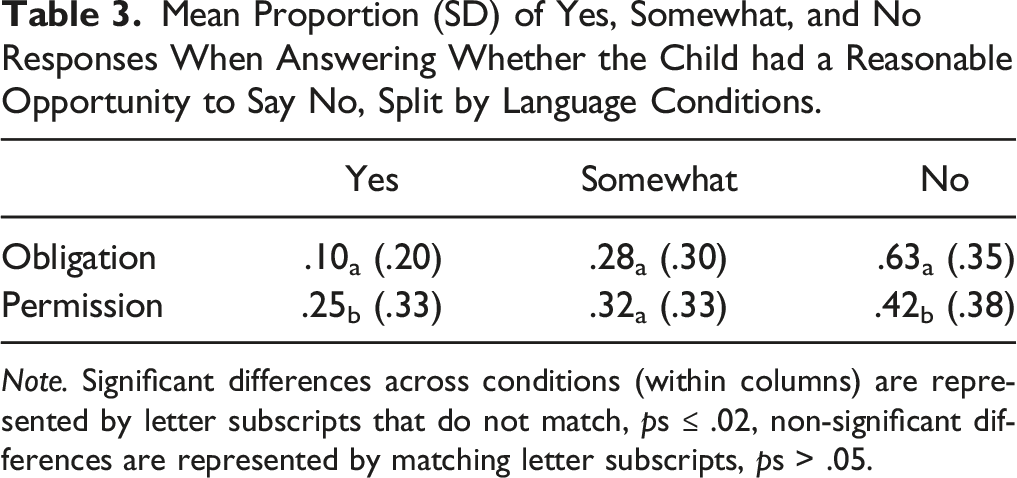
Note. Significant differences across conditions (within columns) are represented by letter subscripts that do not match, ps ≤ .02, non-significant differences are represented by matching letter subscripts, ps > .05.
Evaluation of Choice, Obligation, Adult Blame, and Child Responsibility
Mean (SDs) for Each Condition, Split by Question (Choice, Obligation, Child Responsibility, and Adult Blame).
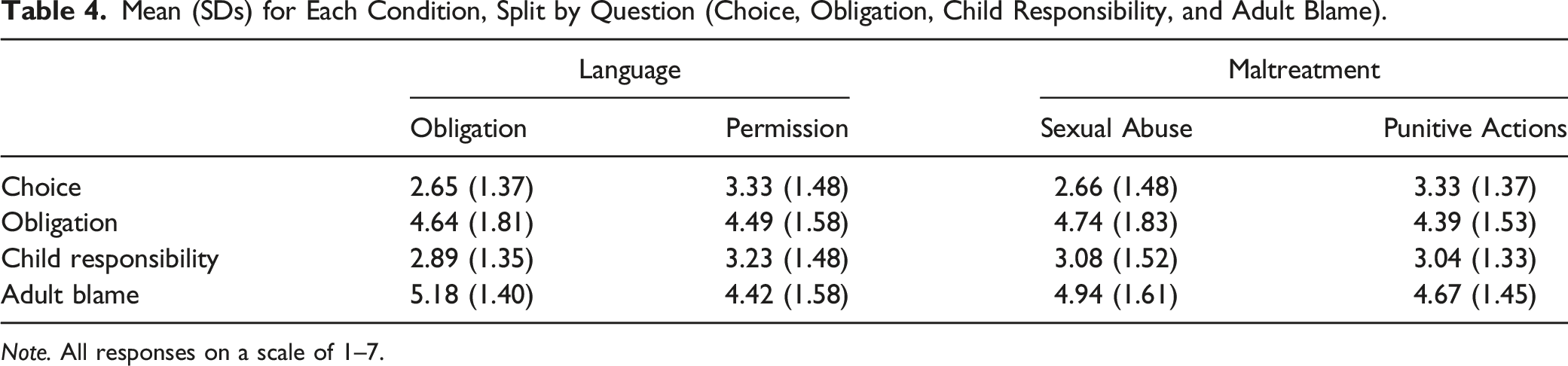
Note. All responses on a scale of 1–7.
Specifically, perceptions of choice varied by language, F (1.156) = 9.56, p = .002, η2 = .06, where although overall participants viewed children to have little choice, participants perceived the child to have more choice to comply when terms of Permission were used (M = 3.33, SD = 1.48) compared to Obligation (M = 2.65, SD = 1.37). Perceptions of choice also varied by maltreatment, F (1.156) = 9.22, p = .003, η2 = .06, where participants perceived the child to have more choice in cases of Punishment (M = 3.33, SD = 1.37) compared to Sexual Abuse (M = 2.66, SD = 1.48).
Also, perceptions of adult blame varied by language, F (1.156) = 10.33, p = .002, η2 = .06, where although overall participants viewed the adult as being to blame, participants perceived the adult as to blame less when terms of Permission were used (M = 4.42, SD = 1.58) compared Obligation (M = 5.18, SD = 1.40). Perceptions of blame did not vary by maltreatment, p = .263.
Severity
To examine participants perceptions of the severity of the maltreatment, a 2 (Language: Obligation, Permission) x 2 (Maltreatment: Sexual Abuse, Punitive Actions) between-subjects Univariate ANOVA was conducted, on perceptions of severity. Perceptions of severity varied by language, F (1.156) = 4.52, p = .035, η2 = .03, where although overall participants viewed the case as severe, participants perceived transcripts using terms of Obligation (M = 5.64, SD = 1.39) as more severe than Permission (M = 5.26, SD = 1.62). Perceptions of severity also varied by maltreatment, F (1.156) = 123.54, p < .001, η2 = .44, where participants perceived Sexual Abuse (M = 6.45, SD = .94) as more severe than Punitive Actions (M = 4.45, SD = 1.32). There was no significant interaction, p = .445.
Credibility
All four credibility measures (believability, confidence, accuracy, honesty) were significantly positively correlated, ranging in value from .71 to .89, ps < .001. A principal components factor analysis with a varimax rotation revealed that all four measures loaded onto one factor (eigenvalue = 85.509, % variance = 3.42), with factor loadings ranging from .869 to .953. Therefore, all further credibility assessments collapse across credibility measures.
To assess participants’ perceptions child credibility, a 2 (Language: Obligation, Permission) x 2 (Maltreatment: Sexual Abuse, Punitive Actions) between-subjects Univariate ANOVA was conducted, on perceptions of overall credibility. Credibility evaluations varied by maltreatment, F (1.156) = 4.88, p = .029, η2 = .03, where although overall participants viewed the child as credible, participants perceived children reporting on Sexual Abuse (M = 5.65, SD = 1.07) more credible compared to Punitive Actions (M = 5.28, SD = 1.04). Credibility evaluations did not differ by language, p = .503, and there was no significant interaction p = .860.
Crime and Verdict
Next, we examined participants’ perceptions of whether the accused adult committed a crime, and if so, the verdict they would give to the adult. A 2 (Language: Obligation, Permission) x 2 (Maltreatment: Sexual Abuse, Punitive Actions) between-subjects Univariate ANOVA was conducted, on adults’ perceptions of whether the adult committed a crime. Perceptions of crime varied as a function of maltreatment, F (1.156) = 261.24, p < .001, η2 = .63, where participants more often perceived Sexual Abuse (M = .99, SD = .05) to be a crime, compared to Punitive Actions (M = .34, SD = .36). Perceptions of crime did not differ by language, p = .144, and there was no significant interaction, p = .191.
Of the trials where participants perceived the adult to have committed a crime, we examined participants’ verdict judgements. A 2 (Language: Obligation, Permission) x 2 (Maltreatment: Sexual Abuse, Punitive Actions) between-subjects Univariate ANOVA was conducted, on adults’ verdict judgements from acquit (0) to convict (100). Perceptions of verdict varied as a function of maltreatment, F (1.156) = 46.87, p < .001, η2 = .28, where participants were more likely to convict in cases of Sexual Abuse (M = 93.72, SD = 9.81), compared to Punitive Actions (M = 78.18, SD = 15.06). Perceptions of verdict did not differ by language, p = .738, and there was no significant interaction, p = .964.
General Discussion
The goal of the current investigation was to establish whether coercive language is used in courtroom transcripts of cases involving child sexual abuse, and whether this language influences jurors’ perceptions of children’s reports. In Study 1 we found that although coercive language was often expressed with terms of obligation (e.g., He made me), which implies compliance to coercion was required, terms of permission were also used (e.g., He let me), which implies force was lacking and compliance was optional (Wellman & Miller, 2008). In Study 2 we found that language indeed influenced adults' perceptions of coercion and adult blame, whereas maltreatment type influenced juror decision making.
Perceptions of Coercion
First, we were interested in adults’ perceptions of coercion, and more specifically the extent to which children had choice in whether to comply, or whether their actions were required. Overall, participants viewed the children in our study to have little choice and opportunity to say no. However, consistent with predictions, participants evaluated children using terms of permission as having greater opportunity to say no and greater choice, whereas participants evaluated children using terms of obligation as having less opportunity. Participants are demonstrating a sensitivity to the linguistic differences of coercive language, with permissive language implying the child had greater choice and obligatory language implying the child did not have choice to comply. These findings suggest that in cases of maltreatment, minor differences in language may alter adults’ perceptions of children’s role in the interaction and the extent to which children were required to comply. Moreover, our findings provide some evidence that maltreatment type influences perceptions of coercion, as children were evaluated as having more choice in the context of punitive actions, compared to sexual abuse.
Perceptions of Responsibility and Blame
Given the potential relationship between coercion and responsibility/blame, we explored the influence of coercive language on jurors’ perceptions of child responsibility and adult blame. Overall, participants largely blamed the adult. However, in line with our predictions, participants more often perceived children using terms of obligation as blaming the adult, compared to children using terms of permission. Given that obligation implies the adult used force and the child did not have a choice, the child is likely perceived as blaming the adult for the interaction. Contrary to our predictions, we did not find a difference in adults’ perceptions of child responsibility, perhaps because adults are unwilling to place responsibility on a child within the context of maltreatment, regardless of the language used – a positive finding in the context of child abuse. These findings align with past research that suggests that young children are less likely to be seen as responsible for their actions in cases of sexual abuse (Duggan, 1987, but see Davies & Rogers, 2009), and extends these findings to the context of punitive actions.
Notably, the transcript excerpts used in this study involved an adult coercing a child, which induces a power dynamic within the interaction. Though this dynamic is most representative of real-world legal cases where the alleged perpetrator is an adult, the power dynamic may exaggerate perceptions of coercion and minimize jurors’ ability to attribute responsibility to the child. Researchers should examine the influence of coercive language and maltreatment in cases where the individual coercing the child is of similar age (e.g., a peer), reducing the power imbalance between adults and children and providing a context where children may have greater expectations to resist coercive tactics.
Severity, Credibility, and Jury Decision Making
Whereas coercive language most often influenced perceptions of coercion and blame, maltreatment type largely influenced perceptions of severity, credibility, and jury decision making. That is, in line with our predictions and past research (Lev-Wiesel et al., 2020), adults evaluated testimonies about sexual abuse as more severe, compared to cases involving punitive actions. Our results also revealed that adults evaluated testimonies using terms of obligation as more severe compared to permission, demonstrating again a sensitivity to the linguistic distinctions in coercive language.
Adults’ perceptions of the child’s credibility were also influenced by maltreatment type. Past research suggests that children are viewed as credible and trustworthy in more severe cases of maltreatment (e.g., sexual abuse) given that they are viewed as sexually naive and incapable of lying about these severe events (e.g., Davies & Rogers, 2009; Ross et al., 2003). In line with these findings, though all children were viewed as relatively credible witnesses (mean of approximately 5.5 out of 7), children in cases of sexual abuse were perceived to be more credible compared to children in cases involving punitive actions.
Most notably, maltreatment type largely influenced participants judicial decision making, where in cases of sexual abuse adults were more likely to consider the act a crime, compared to testimonies about punitive actions, regardless of language differences. For participants that perceived the adult to have committed a crime, they were more likely to convict in testimonies about sexual abuse compared to testimonies about punitive actions. This is not surprising, given that past researchers have found that jurors view cases where sexual abuse is not present (e.g., physical abuse, emotional abuse, neglect) to be less severe and traumatic (Bornstein et al., 2007; Lev-Wiesel et al., 2020), and punishment alone is not necessarily a criminal offense. However, the lack of language findings suggests that although adults are sensitive to linguistic differences, they are not using this information to inform their legal decision making.
What may be important in juror decision-making is whether children are using coercive language at all, regardless of whether it is a term of obligation or permission. Past researchers have found jurors hold a clear expectation of coercion in cases alleging child sexual abuse. For example, St George and colleagues (2020) found that jurors appeared confused when children’s narratives lacked descriptions of force, threats, or resistance, and Stolzenberg and Lyon (2014) found that jurors were 9 times more likely to convict when force was alleged. In the future, researchers might also explore whether jurors’ perceptions differ when terms of obligation or permission are used, compared to no coercive terms at all. This no coercive terms condition would help inform whether jurors default to assuming coercion occurred, and their perceptions only shift when permissive language is used.
Altogether the current study found that both coercive language and maltreatment type play a role in forming perceptions about a child’s testimony, contributing to a vast line of research examining factors that influence jurors perceptions and decision-making. Although the excerpts used in this study allowed us to narrow in on these factors without the influence of other conflating information, this is not reflective of a complete trial where perceptions are formed holistically and across time. Our findings suggest that coercive language can play a role in jurors’ perceptions and decision making, though a comprehensive study is needed to examine the individual and compounding effects of all factors found to play a role in jury deliberations (e.g., demographics, specific details, context, severity, source of information etc.) using complete trial information (e.g., direct and cross-examination).
Supplemental Material
Supplemental Material - Describing Coercion in the Courtroom: The Influence of Language and Maltreatment Severity on Jurors’ Perceptions of Child Witnesses
Supplemental Material for Describing Coercion in the Courtroom: The Influence of Language and Maltreatment Severity on Jurors’ Perceptions of Child Witnesses by Breanne E. Wylie, Stacia N. Stolzenberg, and Angela D. Evans in Child Maltreatment.
Footnotes
Declaration of Conflicting Interests
The author(s) declared no potential conflicts of interest with respect to the research, authorship, and/or publication of this article.
Funding
The author(s) disclosed receipt of the following financial support for the research, authorship, and/or publication of this article: This research was supported by the Distinguished Researcher and Creative Activity award granted to the last author; and Eunice Kennedy Shriver National Institute of Child Health and Human Development Grant [HD087685] awarded to the second author.

Supplemental Material
Supplemental material for this article is available online.
References
Supplementary Material
Please find the following supplemental material available below.
For Open Access articles published under a Creative Commons License, all supplemental material carries the same license as the article it is associated with.
For non-Open Access articles published, all supplemental material carries a non-exclusive license, and permission requests for re-use of supplemental material or any part of supplemental material shall be sent directly to the copyright owner as specified in the copyright notice associated with the article.
