






Abstract
Many educational programs aimed at addressing child maltreatment focus on teaching people how to recognize only one type of child maltreatment, most commonly child sexual abuse, rather than all types of abuse and neglect children might experience. Limited empirical evidence exists on the effectiveness of educational programs that teach adults how to identify all types of child maltreatment, as well as what reporting responsibilities are and how to properly make a report of maltreatment once it is suspected. The goal of the present study was to fill that gap by examining whether an educational program called KNOW and TELL® increased participants’ knowledge on how to identify various types of child maltreatment, what the state’s mandated reporting laws are, and how to make a report in the event maltreatment is suspected. A comparison of pre-training and post-training assessment results suggests that participants demonstrated improved knowledge on the signs of child maltreatment, reporting responsibilities, and intervention procedures after completing the training. The findings of this research support the development and implementation of state-specific educational programs that raise awareness on child maltreatment and teach adults what their statutorily mandated responsibilities are and how to report child maltreatment when it is suspected.
Introduction
Over the past 30 years, the rate of substantiated cases of child maltreatment (CMT) reported by child protective service agencies across the United States declined significantly, from a rate of 15 victims per 1000 children in 1993 to 8.1 victims per 1000 children in 2021 (National Center on Child Abuse and Neglect, 1995; Child Welfare Information Gateway, 2023; Finkelhor et al., 2023). These declines mirror the declining rate of violent victimizations reported to police during the same time period, from 33.8 victimizations per 1000 individuals in 1993 to 7.5 victimizations per 1000 individuals in 2021 (Thompson & Tapp, 2022). While no single factor can explain the decline in CMT and violent victimizations, a number of social conditions and policies are believed to have contributed to the overall declines, including an increase in the total number of child protection personnel and law enforcement officers, an increase in availability of psychopharmaceuticals, and nation-wide economic improvements (Finkelhor et al., 2023; Finkelhor & Jones, 2006). The decline in rates of CMT is also attributed to improved public awareness of child victimization and increased education, identification, reporting, and prevention efforts (Finkelhor et al., 2023; Finkelhor & Jones, 2006; West et al., 2020). For example, evidence-based home visiting programs provide education, training, and support for at-risk families through the prenatal and early childhood stages of development and have been associated with significantly reduced levels of CMT (Kim et al., 2022; West et al., 2020). Other evidence-based modalities for the administration of CMT-focused education, identification, reporting, and prevention efforts include school-based curricula for children (Topping & Barron, 2009; Walsh et al., 2018; White et al., 2019), bystander intervention programs (Daro & Dodge, 2009; Taylor et al., 2023), and professional development trainings for practitioners (Self-Brown et al., 2012; Shapiro et al., 2012).
Many programs aimed at addressing child victimization focus specifically on recognizing and reporting child sexual abuse (CSA) rather than all types of victimization children might experience (Walsh et al., 2018), which fails to account for the multi-type maltreatment many children who are victimized experience (Higgins & McCabe, 1998, 2001). Failing to educate both children and adults on the various types of victimization children might experience, the risk of co-occurring types of maltreatment, and how risks change with each developmental stage, leaves a critical gap in identification, reporting, and prevention efforts (Finkelhor, 2011; Finkelhor et al., 2013; Higgins & McCabe, 2001). One school-based educational program that includes curriculum focused on multiple types of child victimization is Child Safety Matters®, which teaches children about different forms of abuse, neglect, and bullying, as well as how to disclose victimization if it occurs. An evaluation of Child Safety Matters® suggests increased knowledge of the various forms of CMT and their warning signs among children who participated in the training, particularly for children who received repeated lessons (Bright et al., 2023). Although improving individuals’ knowledge on the risks and signs of CMT is not the only means by which CMT can be addressed, it is an important strategy and one that has been shown to lead to more effective reporting (Baker et al., 2021).
Despite the rarity of programs aimed at addressing all facets of child victimization, programs aimed at teaching adults about specific kinds of abuse and/or neglect show promise in increasing knowledge on victimization. The Stewards of Children® program educates adults on how to recognize and intervene in CSA cases, yielding a statistically significant increase in knowledge on how to identify and respond to suspected CSA (Taylor & Harris, 2018). Further, counties in South Carolina where Stewards of Children® program dissemination efforts had been implemented observed increased CSA allegation rates over time when compared with non-targeted counties (Letourneau et al., 2016). Taken together, these findings suggest the Stewards of Children® program was beneficial in teaching adults the specific signs of CSA and armed participants with the knowledge of how to report CSA once it was suspected (Letourneau et al., 2016; Taylor & Harris, 2018).
The focus of the present research is understanding the effectiveness of a training program aimed at increasing participants’ knowledge on CMT, reporting responsibilities, and the reporting process, which is only one part of a much larger agenda to address CMT. Comparisons of survey data and CMT reports made to child protective service agencies suggest a significant portion of CMT goes unreported (Gilbert et al., 2009; Sedlak et al., 2010). Further, the issue of underreporting worsened during the COVID-19 pandemic, when stay-at-home orders limited contact children had with mandated reporters and other adults who may have been able to identify indicators of CMT (Metcalf et al., 2022). Research suggests underreporting is substantially driven by a lack of understanding of the signs of CMT, failure to understand statutory reporting responsibilities, insufficient knowledge on the reporting process, and concerns that reporting may lead to negative consequences (Alvarez et al., 2004, 2005; Baker et al., 2021; Lynne et al., 2015; Pietrantonio et al., 2013). For example, Lynne and colleagues (2015) surveyed emergency medical services professionals to assess their understanding of reporting responsibilities and reasons they may fail to report suspected CMT. Their research found that the most common reasons respondents may fail to report suspected CMT was because they were unaware of the process of reporting, they believed someone with more authority would report it, and they were unsure what constituted CMT (Lynne et al., 2015). It is important to note that increased reporting of CMT has the potential to be problematic. For example, it could lead to an increase in unnecessary reports or burden child protective service agencies. Research suggests that training and educational programs that help individuals better understand CMT and reporting protocols can not only address the major barriers to reporting and increase compliance with mandated reporting laws, but also prevent reports from being made when they are unnecessary or unwarranted (Alvarez et al., 2004; Baker et al., 2021).
The present research adds to the limited existing literature on educational programs aimed at teaching adults about multiple forms of CMT, reporting responsibilities, and how to report when CMT is suspected. “CMT” is used throughout to refer to the various methods of victimization children might experience, including physical, sexual, and emotional abuse, as well as neglect. More specifically, this research examines the effectiveness of KNOW and TELL®, a state-specific educational program designed to increase adults’ understanding of how to identify and report CMT, by evaluating archival data from pre-training and post-training assessments completed by participants.
Know and Tell®
The goal of KNOW and TELL® is to educate adults living and working in New Hampshire on the risks and signs of CMT, as well as to teach participants about the state’s mandated reporting law and what to do in the event CMT is suspected. New Hampshire is one of eighteen states with universal mandatory reporting laws, which statutorily require every adult over the age of 18 to report suspected child abuse and/or neglect, regardless of their occupation (Child Welfare Information Gateway, 2019), however, many people are unaware of the state’s mandatory reporting law, including many educators, youth serving professionals, healthcare providers, and community members. KNOW and TELL® provides education to adults who may encounter children in their personal and/or professional lives to teach them the signs of all types of abuse and neglect, as well as state-specific steps to report suspected CMT to child protective services or law enforcement.
First developed in 2015 under the Granite State Children’s Alliance, KNOW and TELL® began as a 1-h in-person informational training initiative. In 2018, as the initiative grew, the program was expanded into a full 3-h in-person educational program, as well as a 2-h self-paced, online eCourse. The eCourse consisted of three online modules that provided participants a comprehensive overview of the state’s statutorily mandated reporting responsibilities, the legal definitions of neglect and physical, sexual, and psychological abuse, the signs of each type of CMT, research on adverse childhood experiences and the risk of co-occurring forms of CMT, ways to minimize opportunities for CMT, potential barriers to reporting, steps for how to make a state-specific report to the appropriate agencies, such as child protective services and law enforcement, what happens when a report is made, and how child advocacy centers and other stakeholders work together to reduce CMT. Each module included a warning about the difficult content contained in the lesson, an introductory video, an overview of the learning objectives, a trainer narrated review of the content, an interview with a survivor of CMT about their personal experiences, and real-world examples of CMT. The training utilized a transformative pedagogical approach for online instruction by creating a safe learning environment for participants, encouraging reflection and critical questioning, engaging students with varied teaching strategies, and posing real world problems (Meyers, 2008). Due to the asynchronous and at-will format of the eCourse, students were not able to engage with others, a limitation to the application of the transformative pedagogical approach. Pre-training and post-training assessments were used to evaluate participants’ learning in the eCourse.
Method
Design and Sample
While KNOW and TELL® offers both in-person and online training, the present research evaluated archival data captured from the training provided in the eCourse, which asked participants to complete a survey on demographic characteristics, a pre-training assessment, and a post-training assessment. Data included all eCourse participant responses from June 1, 2020 through May 31, 2021. Approval to review the archival data to examine the effectiveness of KNOW and TELL® was provided by the Institutional Review Board of the author’s university.
At the time of this study, the KNOW and TELL® eCourse was available for free to any individual interested in completing the training. Participants who successfully completed all components of the training received a certification of completion. No recruitment efforts were undertaken by KNOW and TELL® specifically for the purposes of this study. Due to restrictions on in-person meetings during the COVID-19 pandemic, the eCourse was available to individuals, groups, and organizations who might have otherwise been interested in completing the in-person training. While participants likely included individuals who completed the training on their own, a number of organizations required it for their employees, including some departments and school districts within the state of New Hampshire, as well as college students who completed the training as part of their course work.
Matched Questions on Pre- and Post-Training Assessments (correct answers in bold).
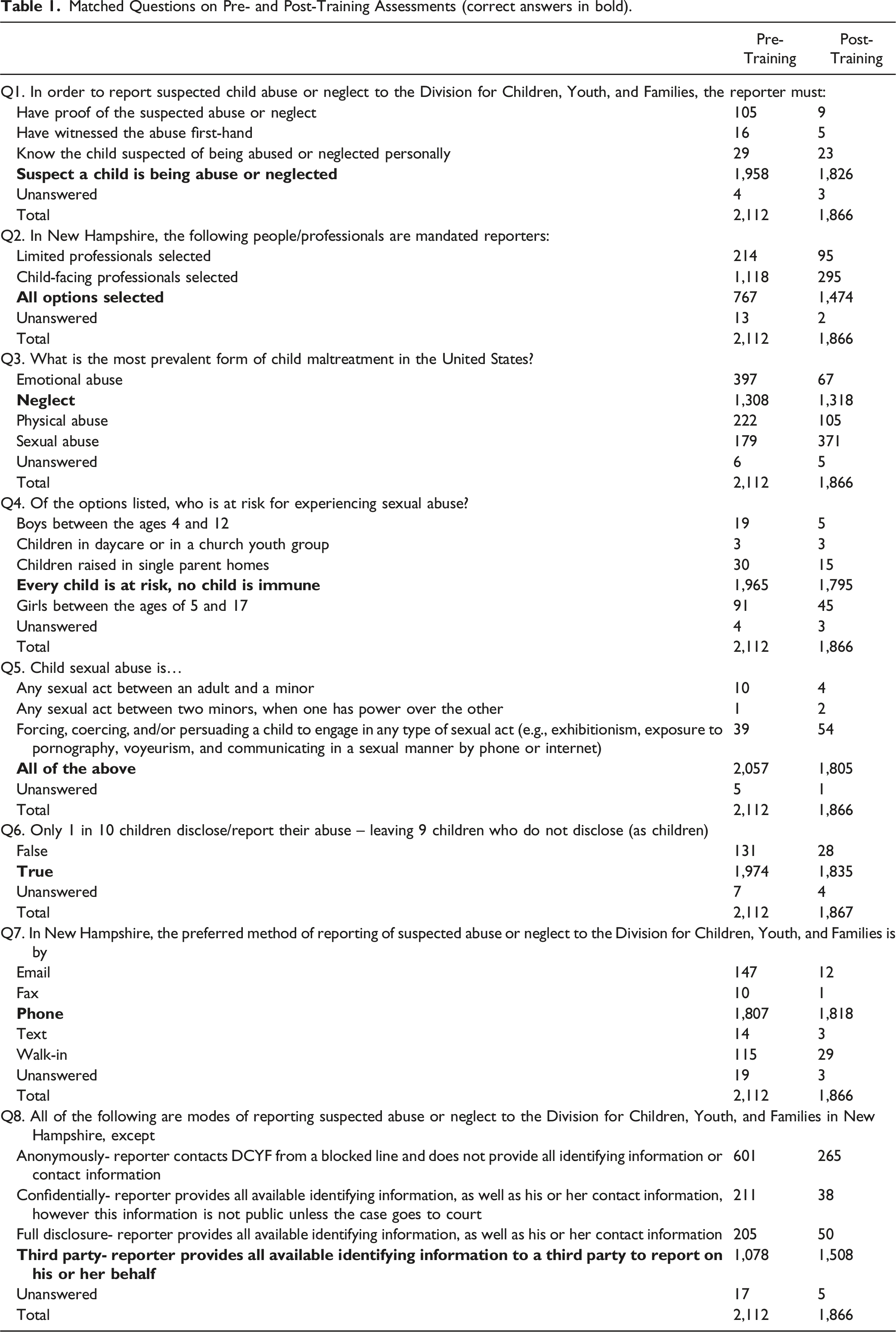
Paired sample t-tests for each of the eight matched questions were conducted to compare the means of participants’ responses before and after the training. Assessments with missing values were removed from the analyses, leaving 1836 matched cases for each of the eight questions for comparison. Data were analyzed for duplicate respondents, and none were identified. Each participant received a unique identifying number, allowing for within participant comparisons to be made between the two time points. The host of the eCourse was unable to link the demographic survey responses with the unique identifying information assigned to participants in the pre-training and post-training assessments. As a result, an evaluation of differences in training assessment responses by demographic variables was not possible. As the goal of KNOW and TELL® is to increase participants’ knowledge of CMT and reporting responsibilities, as well as to train participants on how to report CMT when it is suspected, it was hypothesized that the mean scores of each of the eight matched questions would yield a statistically significant increase on the post-training assessment when compared with the pre-training assessment.
Sample Characteristics
The demographic survey was completed by 2140 participants; of those, 2112 completed the pre-training assessment and 1866 completed the post-training assessment. Attrition between time points was expected. Of the participants who completed the self-report demographic survey, 53.3% were residents of New Hampshire, another 9.8% were from neighboring Maine, Massachusetts, and Vermont, and the remaining participants included individuals from all other states. Most participants were female (80.5% female compared to 17.3% male) and Caucasian (80% Caucasian compared to 3.7% Black or African American and 5.4% Latino or Hispanic). Approximately one-third of participants completed a bachelor’s degree (32.9%) while 27.4% completed a high school diploma or GED and 27.2% had completed a graduate degree. The overwhelming majority of participants were educators (48.04%), followed by college students (19.25%) and law enforcement/rescue agency personnel (14.67%). Of the sample, 46.4% of participants had not completed a formal training on mandated reporting in the three years prior to completing the KNOW and TELL® eCourse, while 53.3% indicated they had completed a formal training, although the type of training was unspecified.
Results
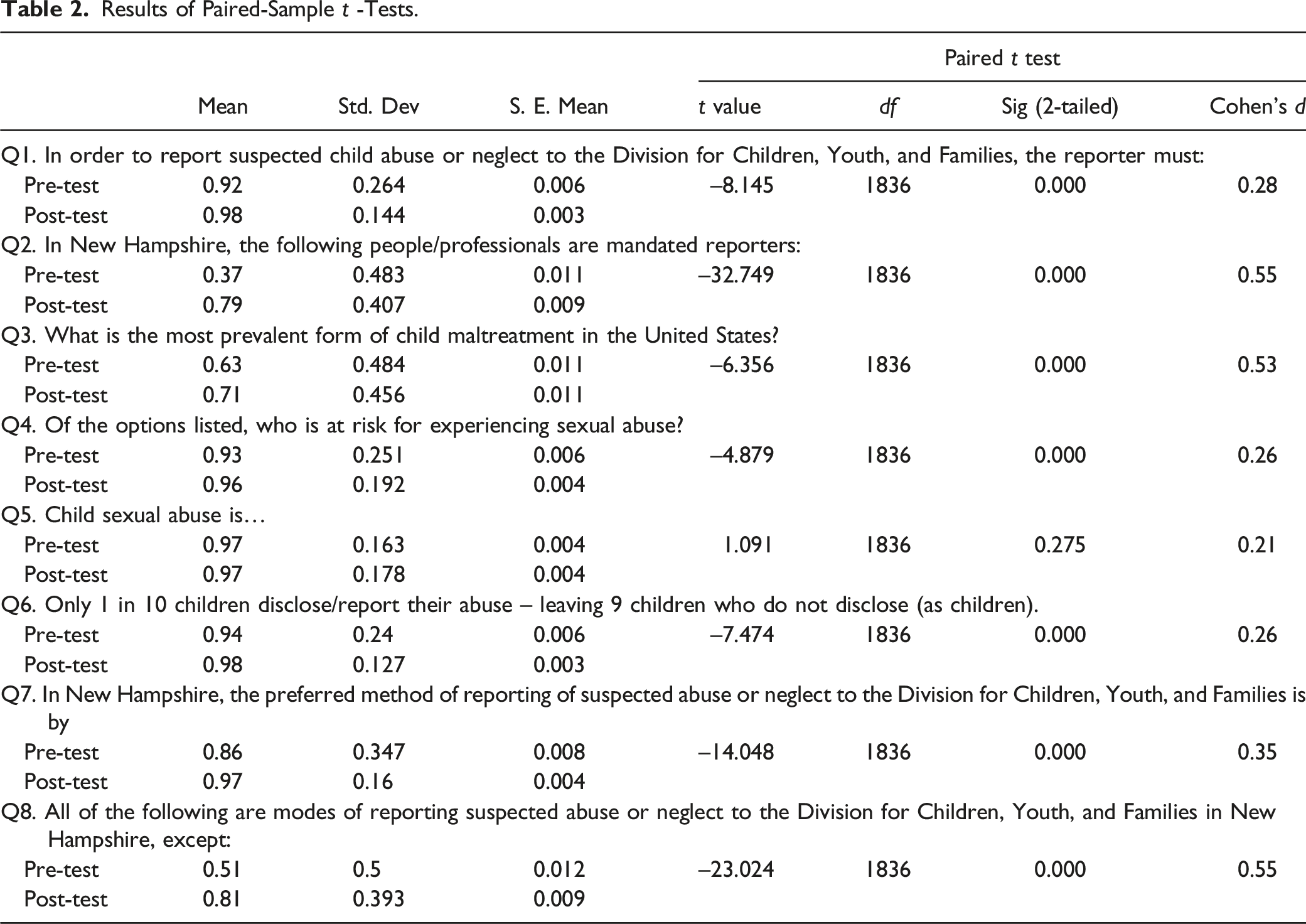
Results of Paired-Sample t -Tests.
Discussion
Overall, the results of the KNOW and TELL® program evaluation are positive, with seven of the eight matched assessment questions demonstrating statistically significant differences between the means of the pre-training and post-training question responses. These findings suggest that participants learned more about the risks and signs of CMT, reporting responsibilities, and how to make a report when CMT is suspected. The results of this study contribute to the limited existing literature on the effectiveness of training programs aimed at educating adults on the multiple forms of CMT, reporting responsibilities, and the process for making a report.
This research is not without limitations. The primary limitation to the data is the inability to connect participants’ demographic characteristics to their responses on the pre-training and post-training assessments. It would be valuable to examine how responses vary by age, race, gender, level of educational attainment, occupation, years of experience in the field, etc. However, the host of the eCourse was unable to link the demographic survey with the unique identifying information assigned to participants in the pre-training and post-training assessments. Additionally, an inherent limitation to pre-test and post-test research is its quasi-experimental design, where all participants experience the intervention (KNOW and TELL® training) rather than being randomly assigned to either a control group or an experimental group (Stratton, 2019). However, the benefit of this design is the ability to compare responses at two time points (before and after the training) and establish a correlation between the intervention and the outcomes. In addition, this study analyzed archival data which could contribute to sampling bias, as the sample consisted of individuals who either elected to complete the eCourse on their own or who were asked to complete the eCourse as part of their education or employment. Another limitation to consider is that only 63% of participants who disclosed the state in which they reside were from New Hampshire or neighboring states. As KNOW and TELL® is a New Hampshire specific training, it would have been valuable to ask participants the state in which they work. Lastly, the post-training assessment was completed by participants immediately after completing the eCourse. It would be beneficial to collect data six to twelve months after completion of the training to determine how well participants retained the material covered in the training.
While the results of this research suggest value in implementing state specific CMT identification and reporting training for adults, the findings do not speak to the actual prevention of CMT. With one in four children experiencing CMT in their lifetime (Finkelhor et al., 2013), evaluating the impact training programs have on actual rates of victimization is key. Future research should consider comparing the number of substantiated and unsubstantiated reports made to child protective service agencies for suspected CMT and whether reporters received KNOW and TELL® training. Further evaluating the impact of educational programs aimed at increasing knowledge on CMT, reporting responsibilities, and the process of reporting on rates of CMT is a critical next step.
Footnotes
Declaration of Conflicting Interests
The author(s) declared no potential conflicts of interest with respect to the research, authorship, and/or publication of this article.
Funding
The author(s) received no financial support for the research, authorship, and/or publication of this article.
