







Abstract
This study examined racial and ethnic disparities in child maltreatment reporting, Child Protective Services (CPS) decision-making, re-involvement, and foster care experiences in Illinois. Using tract-level regressions for all 2021 census tracts and individual-level logistic regressions for 153,850 reported children and 6,736 foster care entrants, we assessed key decision points. The Black-White disparity in report rates—nearly twofold unadjusted—was fully explained by neighborhood poverty and single-parent family rates, providing no empirical support for racially biased reporting. Latino children had consistently lower report rates than White children despite higher socioeconomic disadvantage, replicating the “Latino paradox.” Among reported children, Black and other-race children generally had equal or lower odds than White children of substantiation, Intact Family Services (IFS), foster care placement, or re-involvement; Latino children showed slightly higher odds for substantiation and IFS. In foster care, non-White children were more likely to experience frequent placement disruptions and, for Black children, non-kin placements, but had no worse outcomes for distant placement, termination of parental rights, or permanency. Findings indicate disparities are front-loaded at the reporting stage, largely reflecting structural socioeconomic inequities rather than differential CPS treatment, underscoring the need for upstream poverty reduction and family support to advance child welfare equity.
Introduction
According to the United Nations Convention on the Rights of the Child, every child has the right to live free from harm, and governments are responsible for protecting children from violence, abuse, and neglect—without discrimination based on race, ethnicity, language, background, or social status (UNICEF, nd; United Nations, nd). Although the United States has signed but not ratified the Convention, its legal and policy frameworks largely reflect and uphold these principles (Lichtsinn & Goldhagen, 2023). In the domain of child welfare, there is broad consensus that addressing racial and ethnic disparities in child maltreatment and related services is both necessary and urgent.
However, stark racial and ethnic disparities persist in child maltreatment risks and Child Protective Services (CPS) involvement in the United States, including Illinois. For example, the most recent National Incidence Study of Child Abuse and Neglect (NIS) found that Black children were roughly twice as likely as White children to experience maltreatment harm or endangerment (Sedlak et al., 2010). Correspondingly, administrative records consistently show that rates of maltreatment reports, substantiations, and foster care placements are also nearly twice as high for Black children compared to White children (Kim et al., 2017; Yi et al., 2020).
This study examines racial and ethnic disparities in child maltreatment reports and subsequent CPS involvement across multiple decision points in Illinois, with the aim of identifying where inequities are most pronounced and what may be driving them. Rather than relying solely on population-level comparisons, we disaggregate disparities into four distinct stages of the CPS process: (1) report rates among the general child population; (2) CPS decisions following a report, including substantiation, Intact Family Services (IFS) opening, and foster care entry; (3) CPS re-involvement after a report, including re-reporting, substantiated re-reports, future IFS openings, and future foster care entries; and (4) foster care services and outcomes for children who entered care, including initial placement type and distance, placement disruptions, termination of parental rights (TPR), and permanency. This stage-specific approach helps clarify whether disparities arise primarily during the reporting process or are further compounded by differential CPS decision-making and service delivery.
Child Maltreatment Risk by Race/Ethnicity
The NIS provides a rare opportunity to estimate child maltreatment risk based on independent assessments of harm or endangerment, including cases not reported to CPS (Sedlak et al., 2010). The most recent cycle, NIS-4 (2006), found that the rate of maltreatment endangerment among Black children (49.55 per 1,000) was nearly twice that of White children (28.58 per 1,000) (Sedlak et al., 2010). Notably, this magnitude of disparity between Black and White children was highly consistent with earlier NIS cycles conducted in 1986 and 1993, even though those earlier differences did not reach statistical significance due to smaller sample sizes (Drake & Jonson-Reid, 2011). These patterns suggest that observed disparities in CPS involvement may, at least in part, reflect real differences in underlying exposure to maltreatment risk.
In contrast, Latino children tend to show maltreatment risks similar to, or slightly lower than, those of White children (Sedlak et al., 2010). This aligns with the concept of the “Latino paradox,” a phenomenon observed in domains such as health and child maltreatment, where Latino populations—particularly recent immigrants—exhibit lower-than-expected rates of CPS involvement and better health outcomes despite high levels of socioeconomic disadvantage (Acevedo-Garcia & Bates, 2007; Kim & Kim, 2023; Mendoza, 2009; Millett, 2016; Tejeda et al., 2024).
Child Maltreatment Report Risks by Race/Ethnicity
Although CPS administrative data are limited to known (i.e., reported) cases, they offer strong, population-level evidence on racial and ethnic disparities in maltreatment reporting. Across the United States, and in most states including Illinois, Black children are reported to CPS for alleged maltreatment at roughly twice the rate of White children (Kim et al., 2017; Yi et al., 2023). This figure is robust and widely accepted, given the generally high reliability of race/ethnicity data and comprehensive event-level records maintained in state child welfare administrative systems, which routinely include accurate demographic identifiers, report dates, and maltreatment-related incident records (Urban Institute, 2022; U.S. DHHS, 2024; U.S. GAO, 2003).
The reasons for this disparity, however, remain debated. One explanation emphasizes differential risk, positing that Black children are reported more often because they are disproportionately exposed to poverty and other maltreatment risk factors (Drake et al., 2021). The alternative explanation points to reporting bias, arguing that mandated or voluntary reporters may be more likely to suspect and report maltreatment among Black children, even when the risk is not higher (Harris, 2021). Such bias may reflect implicit or explicit racial stereotypes, subjective interpretations of family behavior, and structurally unequal surveillance and institutional contact, which together can shape reporters’ judgments and referral decisions.
Empirical evidence, including several national and state-level studies, largely supports the differential risk explanation (e.g., Drake et al., 2023; Kim & Drake, 2018; Maloney et al., 2017; Putnam-Hornstein et al., 2013). When Black and White children are compared within similar socioeconomic strata—particularly in low-income groups—racial differences in report rates typically diminish or even reverse. These findings suggest that, at the population level, the Black-White disparity in maltreatment reports is largely attributable to structural disadvantage, leaving little empirical room for reporting bias as the primary explanation. Notably, Latino children often show lower report rates than White children despite slightly higher poverty levels—further supporting the Latino paradox in CPS involvement (Kim & Drake, 2018; Putnam-Hornstein et al., 2013; Yi et al., 2023).
Nonetheless, these patterns can vary across states, and it remains important to examine them within specific jurisdictions.
CPS Decisions and Re-Involvement by Race/Ethnicity
Unlike reporting, which occurs largely outside of CPS—typically initiated by mandated or voluntary reporters such as teachers, medical professionals, law enforcement, family members, friends, and neighbors—agency decisions such as whether to substantiate a reported allegation, open a service case, or place a child in foster care fall within CPS control. Conceptually and analytically, it is important to distinguish these internal CPS decisions from earlier, external actions such as reporting. Measuring disparities based on prior decision points (e.g., substantiations among reported children) rather than total population rates allows us to more precisely locate whether inequities are arising within CPS itself or earlier in the process (Morton et al., 2011).
Recent national studies suggest that among reported children, Black children are not more likely than White children to experience substantiation, service opening, or foster care placement (Drake et al., 2023; Kim et al., 2025). In fact, they often experience these outcomes at slightly lower rates. Similar findings have emerged regarding CPS re-involvement: among children who have already been reported, Black children tend to have lower risks of re-report, substantiated re-report, future service cases, and future foster care placements in national data (Kim et al., 2025). These findings suggest that CPS decision-making, once a report is made, is not skewed toward more intensive intervention for Black children. Rather, the overall disproportionality in CPS involvement is primarily a function of the initial report disparities (Drake et al., 2023; Kim et al., 2025; Morton et al., 2011).
Foster Care Services and Outcomes by Race/Ethnicity
The key goal of foster care is to achieve safe and stable permanent outcomes for children—ideally through reunification with their families or alternatively through adoption or guardianship when reunification is not possible. In the 2017 national foster care census of children aged 0-5, reunification rates were similar for Black (18%) and White children (18%), with slightly higher rates for Latino children (20%) (LaBrenz et al., 2021).
However, an analysis of 2015–2017 national foster care entry cohorts tracked over five years found lower overall permanency rates for Black (84%) and Latino (87%) children compared to White children (90%) (Children’s Bureau, 2024a), suggesting longer stays and higher rates of aging out among Black and Latino children. Another report using the same data attributed the Black-White gap mainly to longer time to adoption and guardianship for Black children, while time to reunification was similar. It also noted a concerning trend of more frequent short-term stays (7 days or less) among Black children (Children’s Bureau, 2024b).
Placement stability is another critical service outcome. Studies generally find higher instability among Black and Latino children. For example, in Allegheny County, Pennsylvania (2015–2019), the risk of placement instability was 26% higher for Black and 62% higher for Latino children than for White children (Font & Kim, 2022). Similarly, in Texas (2008–2009 entry cohorts tracked through 2016), placement disruptions due to caregiver-child mismatch or violation of state standard were 24%–29% more common among Black children, while disruptions due to running away or refusal were 72% more common among Latino children compared to White peers (Sattler et al., 2018).
Some foster care practices show little or no racial/ethnic disparity—or even reverse patterns. Kinship placement rates were similar across racial and ethnic groups in both Wisconsin (Font, 2015) and national data (NCJFCJ, 2017). Notably, among foster care children, the lifetime TPR rate was higher for White children (20%) than for Black children (16%) nationwide (Wildeman et al., 2020). In California, the TPR rate was also highest among foster care children who were White (32%), followed by Black (26%) and Latino (20%) children (Putnam-Hornstein et al., 2021).
Current Study
We addressed four key research questions: Research question 1. Given that the child maltreatment report rate among Black children in Illinois is approximately twice that of White children, we investigated whether this disparity is primarily driven by racial bias in reporting or by differential exposure to risk factors such as socioeconomic disadvantage. To explore this, we conducted tract-level linear regressions comparing Black and White child maltreatment report rates across Illinois census tracts, controlling for poverty and single-parent family rates. If racial bias were the primary driver, race would remain a significant predictor after adjusting for socioeconomic conditions—though any residual racial effect would not confirm bias, as scientific inference relies on falsification rather than verification. Conversely, if socioeconomic disadvantage explains the disparity, the racial difference should largely diminish after adjustment, thereby empirically falsifying the racial bias hypothesis (i.e., leaving no empirical room for it). We also compared Latino and White report rates to examine whether the “Latino paradox” in child maltreatment—lower maltreatment risk despite higher poverty—is evident in Illinois. Research question 2. We examined racial and ethnic disparities in CPS decisions among reported children. Using individual-level logistic regression, we assessed whether the likelihood of substantiation, IFS opening, or foster care entry varied by race/ethnicity. This analysis helps determine whether CPS is more likely to make severe intervention decisions for children from certain racial or ethnic minority groups. Research question 3. We assessed disparities in CPS re-involvement among reported children. Using individual-level logistic regression, we examined whether the likelihood of a re-report, substantiated re-report, future IFS opening, or future foster care entry differed by race/ethnicity. This analysis informs whether certain groups may be at higher risk of re-involvement and might benefit from stronger prevention efforts following a report. Research question 4. We analyzed disparities in foster care services and experiences among children who entered care. We used individual-level logistic regression to examine five outcomes: (1) initial placement with non-kin, (2) initial placement more than 20 miles from the child’s family, (3) more than three placement disruptions per year, (4) TPR, and (5) failure to achieve permanency within two years. This analysis assessed whether foster care experiences and outcomes varied by race/ethnicity, providing insight into the equity of CPS service delivery once children enter care.
Method
Sample and Data
To examine racial and ethnic disparities in child maltreatment report rates (Research Question 1), we constructed tract-level datasets for all Illinois census tracts in 2021. Illinois has 3,265 tracts, of which 2,893 had at least one White child, 2,109 had at least one Black child, and 2,812 had at least one Latino child.
For the main analysis, we restricted the race/ethnicity-specific samples to tracts with more than 200 children from the relevant racial or ethnic group to ensure stable, comparable estimates of race/ethnicity-specific maltreatment report rates and to minimize bias from small population denominators. The final sample included 2,125 tracts with at least 200 White children (covering 94.8% of the total White child population in Illinois and 73.5% of tracts with at least one White child), 642 tracts with at least 200 Black children (covering 78.1% of the Black child population and 30.4% of relevant tracts), and 1,062 tracts with at least 200 Latino children (covering 81.6% of the Latino child population and 37.8% of relevant tracts). Tract-level data were not constructed for other racial or ethnic groups due to insufficient population size for meaningful analysis.
For sensitivity analysis, we applied a stricter threshold of 300 children per racial or ethnic group. Under this criterion, 1,799 tracts included at least 300 White children (covering 88.9% of the White child population and 62.2% of relevant tracts), 455 tracts including at least 300 Black children (covering 67.0% of the Black child population and 21.6% of relevant tracts), and 748 tracts included at least 300 Latino children (covering 70.9% of the Latino child population and 26.6% of relevant tracts).
Tract-level maltreatment report rates by race/ethnicity were calculated using administrative records from the Illinois Department of Children and Family Services (DCFS), combined with population data from the U.S. Census Bureau’s American Community Survey (ACS). Tract-level poverty and single-parent family rates were also obtained from the ACS.
To examine disparities in CPS investigation decisions and CPS re-involvement among reported children (Research Questions 2 and 3), we constructed individual-level records for all children reported to CPS in Illinois in 2021 (N = 153,850). For Research Question 4, which focused on foster care services and experiences, we constructed individual-level records of all children who entered foster care in Illinois during 2021 (N = 6,736).
Measures
Tract-Level Maltreatment Report Rates by Race/Ethnicity, Illinois, 2021
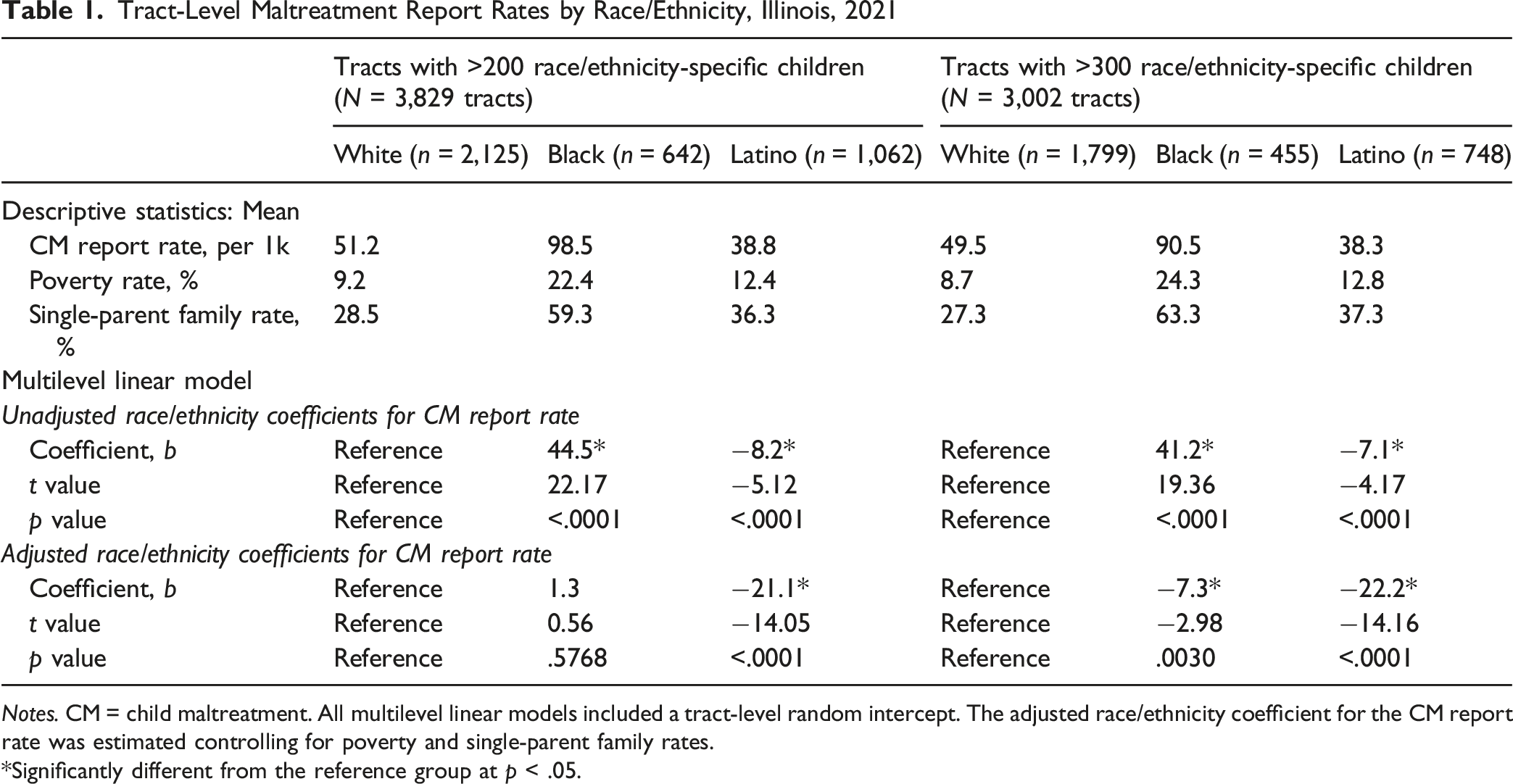
Notes. CM = child maltreatment. All multilevel linear models included a tract-level random intercept. The adjusted race/ethnicity coefficient for the CM report rate was estimated controlling for poverty and single-parent family rates.
*Significantly different from the reference group at p < .05.
We included two tract-level control variables: the poverty rate (percentage of persons below the federal poverty level) and the single-parent family rate (percentage of households with children under age 18 headed by a single parent) (Table 1). We used total tract-level rates for these controls rather than race/ethnicity-specific rates, as the latter were unreliable in tracts with small minority populations. Census tracts are generally small enough that socioeconomic conditions are relatively homogeneous across racial and ethnic groups within the same tract (Aron et al., 2010).
Descriptive Statistics by Race/Ethnicity for Children Reported to CPS, Illinois, 2021 (N = 153,850)
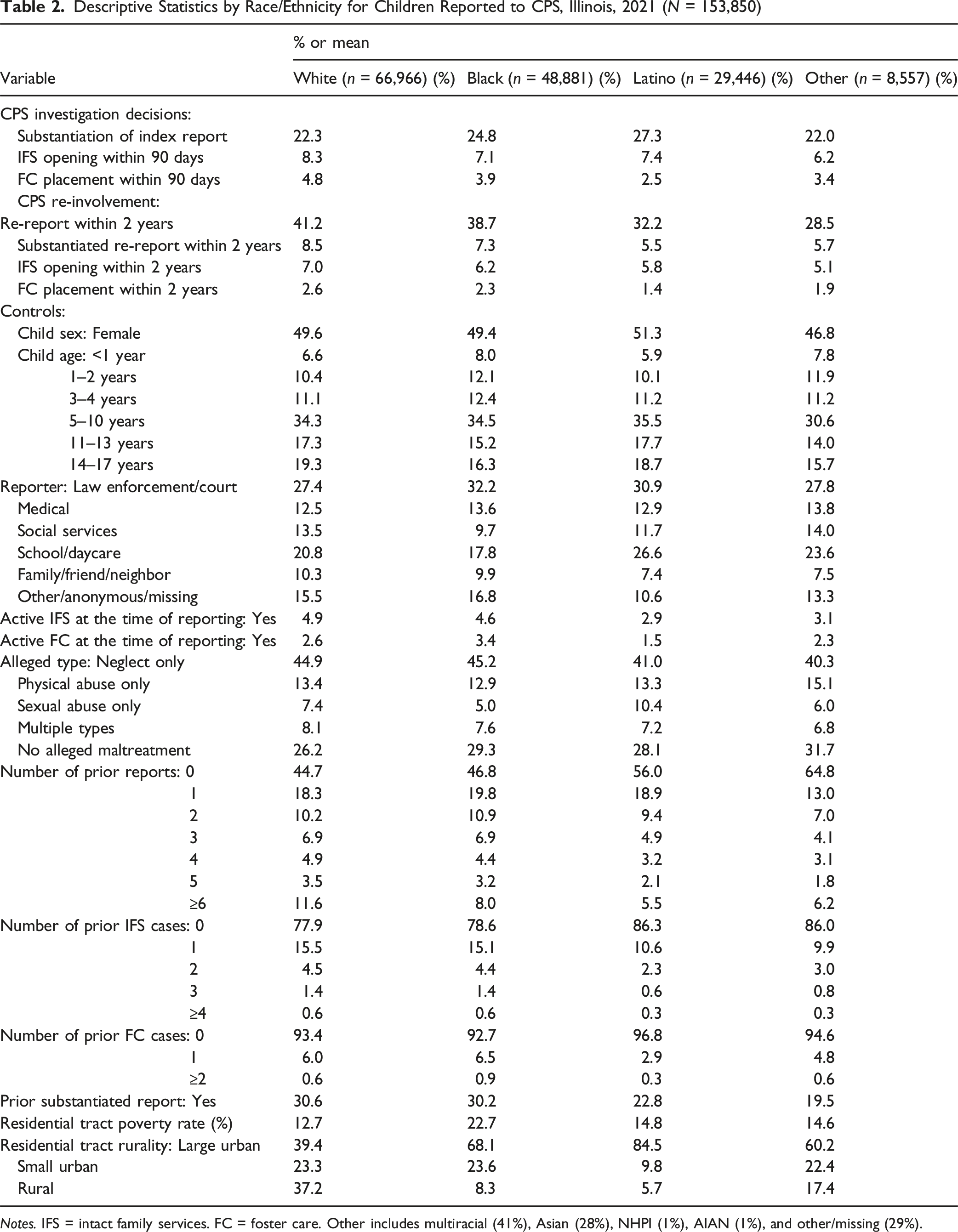
Notes. IFS = intact family services. FC = foster care. Other includes multiracial (41%), Asian (28%), NHPI (1%), AIAN (1%), and other/missing (29%).
Descriptive Statistics by Race/Ethnicity for Children Placed in Foster Care, Illinois, 2021 (N = 6,736)
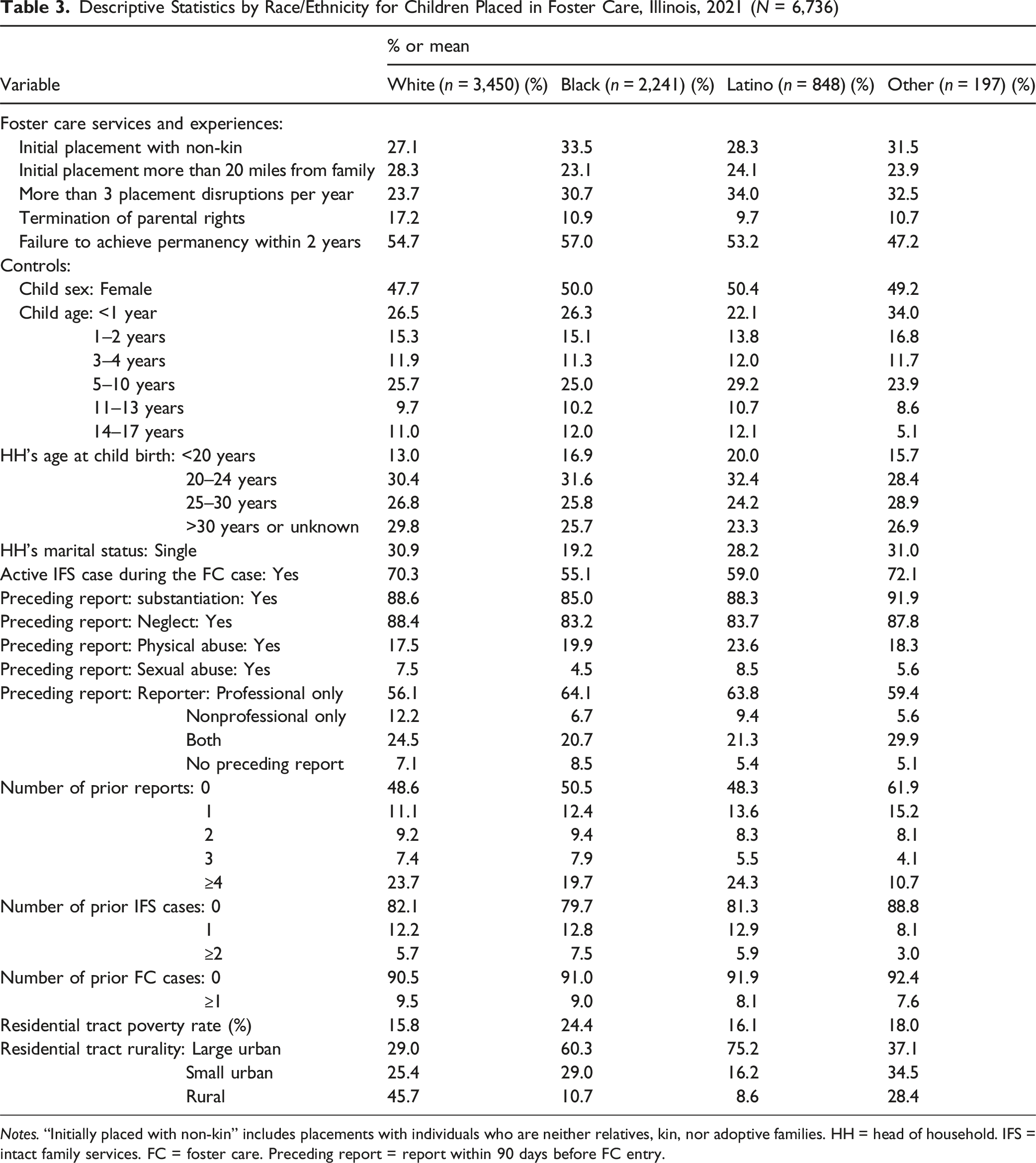
Notes. “Initially placed with non-kin” includes placements with individuals who are neither relatives, kin, nor adoptive families. HH = head of household. IFS = intact family services. FC = foster care. Preceding report = report within 90 days before FC entry.
For Research Questions 2–4, we included a range of control variables, such as demographic characteristics of the child and caregiver, characteristics of the index or preceding CPS report, history of prior CPS involvement, and residential tract conditions at the time of the baseline event (i.e., the index report for Research Questions 2–3 and foster care entry for Research Question 4) (see Tables 2 and 3 for details).
Race/ethnicity categories differed slightly between Research Question 1 and Research Questions 2–4 due to differences in data availability. For Research Question 1, race/ethnicity was defined as non-Latino White alone, Black alone (regardless of Latino ethnicity), and Latino or Hispanic of any race. These definitions were based on ACS population counts, which do not separately report non-Latino Black children. As a result, there is some overlap between the Black and Latino categories, though this overlap is minimal; only 2.6% of reported Black children in Illinois in 2021 were also identified as Latino. For Research Questions 2–4, race/ethnicity was defined as non-Latino White alone, non-Latino Black alone, and Latino or Hispanic of any race. These categories are mutually exclusive, with no overlap.
Analysis
For Research Question 1, we transformed the data into long format, with each census tract contributing up to three observations—one per each racial/ethnic group: White, Black, and Latino. Each tract-group combination (i.e., each row) included a categorical variable indicating the racial/ethnic group and a corresponding dependent variable representing the group-specific maltreatment report rate. We conducted linear regression to examine the association between race/ethnicity and report rates, controlling for tract-level socioeconomic conditions. This analysis formally tested whether report rates significantly differed by race/ethnicity across Illinois tracts. To account for the nested data structure—race/ethnicity-specific observations nested within tracts—we used multilevel linear modeling with tract-level random intercepts. This approach adjusts for non-independence of observations within tracts and enables valid comparisons across racial/ethnic groups while accounting for shared contextual factors at the tract level. All models were weighted by the race/ethnicity-specific child population in each tract.
For Research Questions 2–4, we conducted logistic regression to estimate the individual-level association between race/ethnicity and each of the 12 binary outcome variables, adjusting for relevant control variables. We estimated separate models for each outcome.
Results
Table 1 presents descriptive statistics and multilevel linear model results for Research Question 1 (disparities in report rates), based on tracts with over 200 race/ethnicity-specific children (main analysis) and a sensitivity analysis (tracts with over 300). In the main sample, the maltreatment report rate for Black children (98.5 per 1,000) was 1.92 times that of White children (51.2), with disparities also evident and larger in poverty (22.4% vs. 9.2%, or 2.43 times higher) and single-parent family rates (59.3% vs. 28.5%, or 2.08 times higher). In contrast, Latino children had a 24% lower report rate than White children (38.8 vs. 51.2), despite modestly higher poverty (12.4% vs. 9.2%, or 1.35 times) and single-parent family rates (36.3% vs. 28.5%, or 1.27 times).
Multilevel linear models showed that the unadjusted Black-White gap in report rates was 44.5 per 1,000 (b = 44.5, t = 22.17, p < .0001), but this gap dropped to 1.3 per 1,000 and became nonsignificant after adjusting for poverty and single-parent family rates (b = 1.3, t = 0.56, p = .5768). In the sensitivity analysis, the unadjusted Black-White gap (41.2) also reversed after adjustment, with Black children showing a significantly lower report rate than White children by 7.3 per 1,000. Latino children consistently had lower report rates than White children, with Latino-White differences of −8.2 and −21.1 per 1,000 in the main analysis (unadjusted and adjusted, respectively) and −7.1 and −22.2 in the sensitivity analysis.
To assess whether these adjusted results might reflect modeling artifacts (e.g., driven by outliers or poor model fit), we plotted observed report rates (y-axis) against model-predicted report rates (x-axis) from the main analysis (Figure 1). For Black children, observed rates closely tracked those of White children across predicted rates. For Latino children, observed rates were generally lower than those for White children—especially at higher predicted rates. Observed vs. predicted maltreatment report rates by Race/Ethnicity, Illinois Tracts, 2021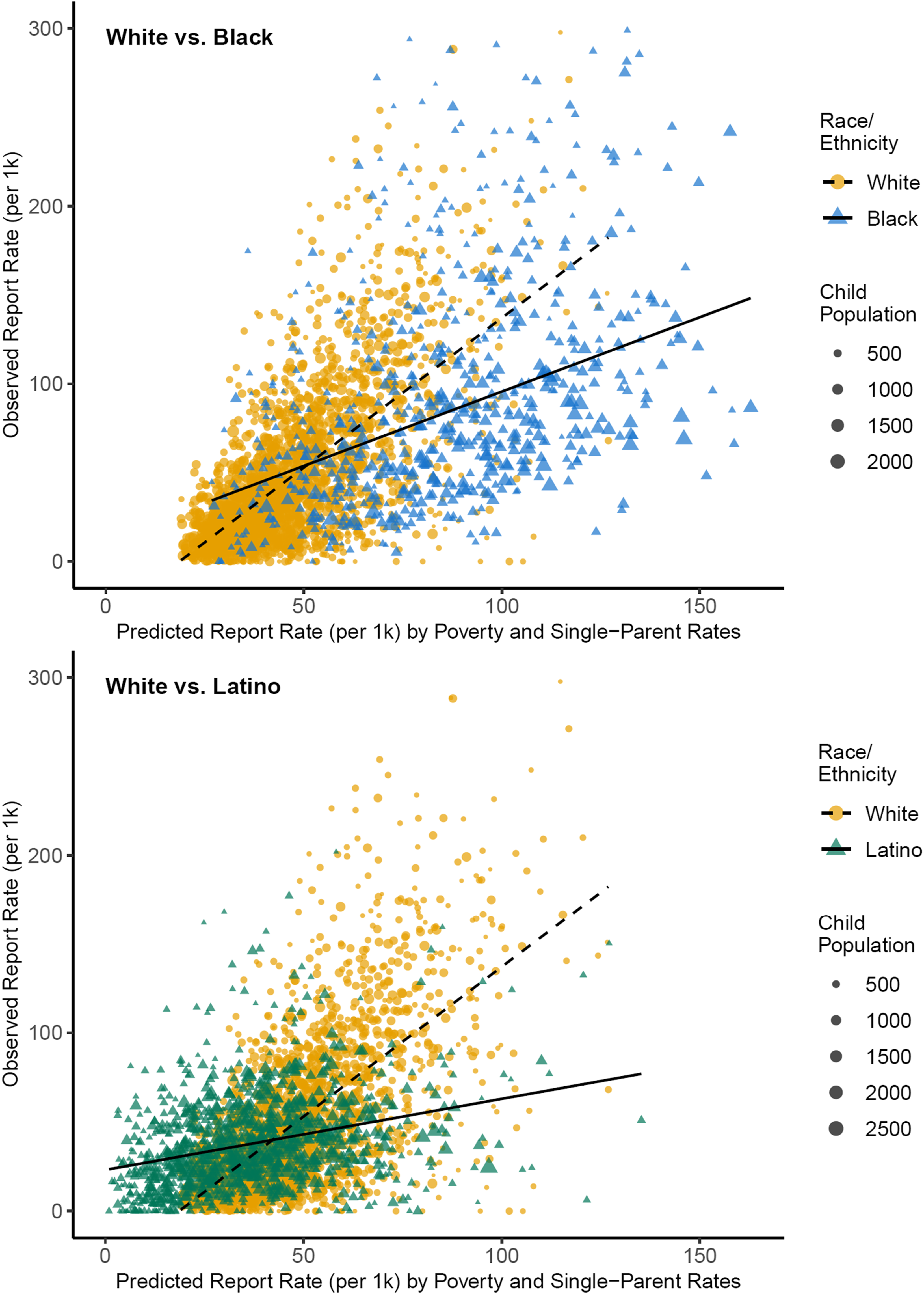
Table 2 shows descriptive statistics for Research Questions 2 and 3, which examined disparities in CPS decisions and re-involvement among reported children. Substantiation rates were moderately higher for Black (24.8%) and Latino (27.3%) children compared to White children (22.3%), but these differences were much smaller than the reporting disparities. For all other outcomes—including IFS opening, foster care placement, re-reporting, substantiated re-reporting, future IFS opening, and future foster care placement—White children had the highest rates. Control variables were generally similar across groups, especially between Black and White children, except for residential context: Black children lived in higher-poverty tracts, while White children were more likely to reside in rural areas.
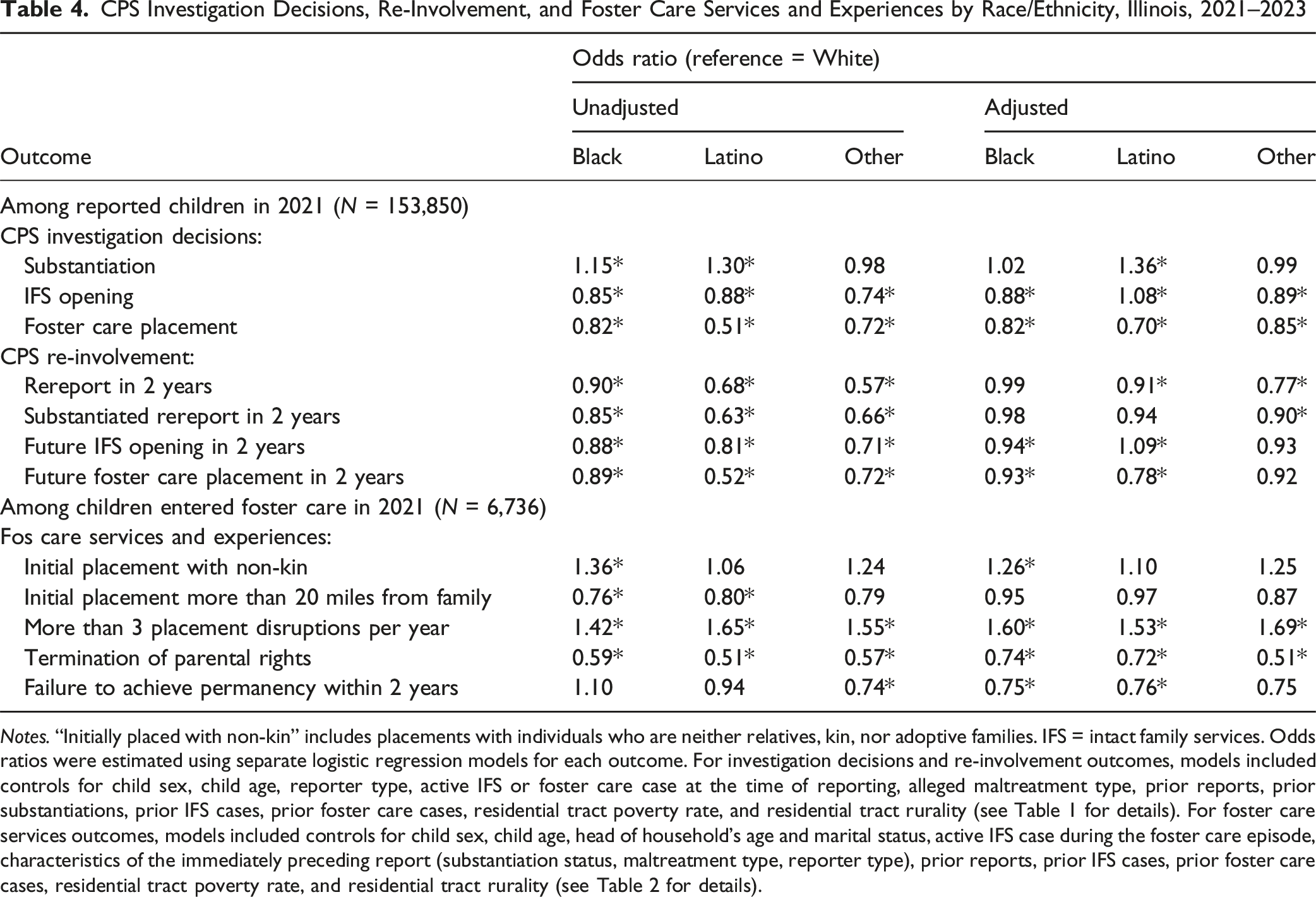
CPS Investigation Decisions, Re-Involvement, and Foster Care Services and Experiences by Race/Ethnicity, Illinois, 2021–2023
Notes. “Initially placed with non-kin” includes placements with individuals who are neither relatives, kin, nor adoptive families. IFS = intact family services. Odds ratios were estimated using separate logistic regression models for each outcome. For investigation decisions and re-involvement outcomes, models included controls for child sex, child age, reporter type, active IFS or foster care case at the time of reporting, alleged maltreatment type, prior reports, prior substantiations, prior IFS cases, prior foster care cases, residential tract poverty rate, and residential tract rurality (see Table 1 for details). For foster care services outcomes, models included controls for child sex, child age, head of household’s age and marital status, active IFS case during the foster care episode, characteristics of the immediately preceding report (substantiation status, maltreatment type, reporter type), prior reports, prior IFS cases, prior foster care cases, residential tract poverty rate, and residential tract rurality (see Table 2 for details).
Table 3 presents descriptive statistics for Research Question 4, focused on foster care experiences. Black (33.5%), Latino (28.3%), and other-race (31.5%) children were more likely than White children (27.1%) to be initially placed with non-kin. They were also more likely to experience frequent placement disruptions (Black 30.7%, Latino 34.0%, other-race 32.5% vs. White 23.7%). In contrast, distant placement and TPR were most common among White children. Failure to achieve permanency within two years was most frequent among Black children (57.0%), followed by White (54.7%), Latino (53.2%), and other-race (47.2%) children. While differences existed, they were far smaller than those in report rates.
Table 4 also presents logistic regression results for Research Question 4. Black children had significantly higher odds of non-kin placement than White children—by 36% unadjusted (OR = 1.36) and 26% adjusted (OR = 1.26). Latino and other-race children did not differ significantly from White children on this outcome. Odds of frequent placement disruptions were significantly higher for all non-White groups compared to White children: for Black (42% unadjusted, 60% adjusted), Latino (65%, 53%), and other-race (55%, 69%) children. For the remaining outcomes, non-White children did not have significantly higher odds and, in most cases, had significantly lower odds than White children.
Discussion
This study examined racial and ethnic disparities in child maltreatment reporting, CPS decision-making, re-involvement, and foster care experiences in Illinois. First, the elevated maltreatment report rate for Black children was almost entirely explained by socioeconomic disadvantage at the tract level, providing no empirical support for racially biased reporting; meanwhile, Latino children consistently had lower report rates than White children despite higher poverty. Second, CPS decision-making (i.e., substantiation, IFS opening, and foster care placement) did not systematically disadvantage non-White children. Black and other-race children had comparable or lower odds than White children across all outcomes, and Latino children had slightly to moderately higher odds for substantiation and IFS. Third, disparities in re-involvement outcomes (i.e., re-report, substantiated re-report, future IFS, and future foster care) were also minimal or favored non-White children, with Black and other-race children showing lower odds of future system contact and Latino children showing slightly higher odds for future IFS opening. Fourth, among children who entered foster care, Black children were moderately more likely to be placed with non-kin, and all non-White groups faced noticeably higher odds of frequent placement disruptions, but they did not experience worse outcomes on other placement measures (i.e., distant placement, TPR, and failure to achieve permanency) and in many cases fared better than White children.
The findings from this study offer several critical insights. Most notably, the large Black-White disparities in child maltreatment report rates in Illinois appear to stem almost entirely from differential exposure to socioeconomic disadvantage—not from racial bias in the reporting process. Although Black children were nearly twice as likely as White children to be reported to CPS, this disparity was fully accounted for by differences in neighborhood poverty and single-parent family rates. After adjusting for these structural factors, the racial gap in reporting essentially disappeared and, in some cases, even reversed. This pattern supports the “differential risk” explanation: racial disparities in CPS reporting reflect broader social and economic inequities that place Black children at higher objective risk of maltreatment, rather than unequal or discriminatory treatment in the reporting process (Drake et al., 2021).
Importantly, these results leave virtually no empirical room for the racial bias hypothesis and thereby strongly challenge it. The data are inconsistent with claims that mandated reporters or CPS workers systematically target Black families in the absence of objective risk. While isolated incidents of individual bias may occur, systemic racial bias in reporting—as the primary driver of racial disparities in report rates—is not supported. These findings are consistent with prior statewide evidence from Missouri (Drake et al., 2009) and California (Maloney et al., 2017; Putnam-Hornstein et al., 2013), as well as nationwide county-level analyses (Kim & Drake, 2018), collectively reinforcing the interpretation that socioeconomic disadvantage—rather than racially biased reporting—is the predominant factor underlying disparities in child maltreatment reports.
It is important to note that the persistent and substantial Black-White socioeconomic disparity is consistent with extensive evidence of structural racism (Groos et al., 2018). Accordingly, the Black-White disparity in maltreatment reports—fully explained by this socioeconomic gap—is ultimately rooted in structural racism and is fundamentally a racial issue. Without addressing this structural racism, and the socioeconomic inequities that elevate maltreatment risk, the disparity will almost certainly persist. Targeting racial bias (or other forms of racism) in reporting alone is unlikely to help: if such bias were a major driver, a Black-White gap in report rates would remain after adjusting for socioeconomic factors. Instead, its disappearance after adjustment strongly suggests that racial bias in reporting is not the primary cause. Put simply, when poor Black children and poor White children are reported at nearly the same rate, it is difficult to attribute the disparity to biased reporting. Efforts that overlook the structural racism embedded in socioeconomic inequality are unlikely to meaningfully reduce the disparity in maltreatment reports.
This study also found little evidence of racial or ethnic disparities in CPS decision-making or re-involvement after children are reported. Black children were not more likely—and were often less likely—than White children to experience substantiation, receive IFS, or enter foster care following a report. For re-involvement outcomes (i.e., re-report, substantiated re-report, future IFS, and future foster care), Black children consistently had lower odds than their White peers. Latino and other-race children also generally had lower odds, with the exception of Latino children facing a moderately higher risk of substantiation (36%) and a slightly higher risk of current or future IFS (8%–9%). These findings counter the perception that CPS systematically treats racial and ethnic minority families more harshly. Instead, they suggest that racial disparities are front-loaded—concentrated at the point of reporting—and are not amplified through subsequent CPS actions, consistent with prior statewide and national research (Drake et al., 2023; Kim et al., 2025; Morton et al., 2011). While individual instances of bias cannot be ruled out, the results challenge the claim that systemic racism within CPS is the primary driver of observed disparities. Rather, CPS appears to make decisions in a relatively consistent manner across racial and ethnic groups, once children are under its purview. Therefore, efforts to reduce the Black-White disparity in CPS involvement are unlikely to succeed by targeting systemic racism within CPS—a factor whose existence, nature, and influence remain uncertain—since disparities largely originate before CPS decision-making.
A particularly noteworthy finding from this study relates to Latino children, who had lower report rates than White children despite higher rates of poverty and single-parent families. This replicates what some researchers refer to as the “Latino paradox”—a pattern in which Latino families, despite experiencing socioeconomic disadvantage, exhibit lower risks of CPS involvement (Johnson-Motoyama et al., 2015; Kim & Kim, 2023; Putnam-Hornstein et al., 2013). The persistence of this pattern across adjusted and unadjusted models suggests that further research is needed to unpack the mechanisms behind it. Understanding the drivers of this paradox could offer valuable insights into protective factors that might be leveraged to prevent maltreatment more broadly.
Although disparities in foster care services and experiences were smaller than disparities in maltreatment reports, some patterns still warrant concern. Black, Latino, and other-race children were noticeably more likely than White children—by 53% to 69%—to experience frequent placement disruptions, an outcome associated with adverse developmental, emotional, behavioral, educational, and occupational consequences (Fisher et al., 2013; Goyette et al., 2021; Maguire et al., 2024). In addition, Black children were moderately more likely (26%) to be initially placed with non-kin caregivers. While these differences were relatively modest, they point to continued inequities in the quality and stability of services that children receive once they enter care. Notably, however, for outcomes such as placement distance, TPR, and permanency within two years, non-White children were no more likely—and often less likely—than White children to experience negative outcomes. These findings suggest that, while the front end of the CPS system contributes most to racial disparity, ongoing attention to service equity remains important for improving foster care experiences for all children.
Finally, this study highlights the value of a stage-specific analytic approach in understanding racial disparities in the child welfare system (Morton et al., 2011). Rather than examining disparities at the population level alone, this study disaggregated outcomes at four key decision points: reports, CPS decisions, CPS re-involvement, and foster care experiences. This approach allows for more precise identification of where disparities emerge and where they do not, providing clearer guidance for policy and practice. By tracing disparities across stages, this study reveals that inequities are not uniformly distributed across the CPS process but are concentrated at the point of system entry. Such methodological clarity is essential for directing reforms toward the most impactful intervention points—namely, reducing child poverty and structural disadvantage to prevent child maltreatment and subsequent system involvement in the first place.
Strengths and Limitations
This study has several notable strengths. It used a stage-specific analytic framework to disaggregate racial and ethnic disparities across key CPS decision points, avoiding conflation of different sources of disparity and clarifying when and where disparities arise. Additionally, the use of Illinois statewide administrative records enabled analysis of comprehensive, population-level data rather than a sample and ensured reliable, valid measures of CPS involvement with minimal measurement bias (e.g., recall bias).
Nonetheless, this study also has limitations that should be acknowledged. One limitation is that the analysis of report rates was limited to only three racial and ethnic groups—White, Black, and Latino children. Children of other racial or ethnic backgrounds, such as Asian, Native American, and multiracial children, were excluded from the tract-level analysis because their population sizes were too small to yield stable estimates across census tracts.
Second, while our findings strongly challenge the notion that racial bias in reporting drives disparities in report rates—and instead support the differential risk explanation—they do not offer experimental-level causal evidence that socioeconomic disparities are the root cause of racial disparities in reports. Although socioeconomic disadvantage fully accounted for racial disparities in report rates, deeper upstream factors—such as historic or structural inequities—may underlie those socioeconomic differences and, in turn, drive disparities in reporting. Further research is needed to clarify whether the root causes lie in current socioeconomic conditions or in the origins of those conditions. Regardless, these causes are not located within CPS itself but are more likely rooted in broader societal structures.
Third, while this study focused on population-level patterns, it does not rule out the existence of individual or local instances of bias or discriminatory practices within CPS. Even if these instances are not substantial enough to drive system-wide disparities, they remain important and warrant continued attention. Future research should explore these localized dynamics and identify areas where interventions may be necessary.
Fourth, to ensure stable tract-level maltreatment report rate estimates, analyses were restricted to census tracts with at least 200 children per racial/ethnic group. While this approach strengthens the reliability of tract-level comparisons, it necessarily excludes some tracts with smaller Black or Latino child populations, which may disproportionately include rural or small urban contexts. Consequently, our findings may not fully capture the experiences of Black and Latino children residing in areas where they represent a very small share of the local child population. At the same time, however, most large urban tracts in Illinois were included in the analyses, along with substantial numbers of small urban and rural tracts that met the population threshold for Black and Latino children. Because the large majority of Black (over 80%) and Latino (nearly 90%) children in Illinois reside in large urban tracts, the excluded tracts represent a relatively small proportion of these populations, and their omission is unlikely to substantially alter estimates of overall racial disparities at the state level. Future research should explore complementary methods to examine racial disparities in child welfare involvement in low-density and rural settings, where mechanisms of risk and surveillance may differ.
Fifth, although census tracts are widely regarded as small enough to capture relatively homogeneous socioeconomic conditions among residents (Aron et al., 2010), meaningful socioeconomic differences may still exist between racial and ethnic groups within the same tract. Ideally, analyses would incorporate race/ethnicity-specific neighborhood indicators (e.g., Black or Latino poverty rates). However, such measures derived from the ACS are often unstable and unreliable, particularly for racial/ethnic minority populations in tracts where their numbers are small. Given these data limitations, we relied on overall tract-level indicators as a more reliable representation of neighborhood socioeconomic context. Importantly, because Black children typically experience greater socioeconomic disadvantage than White children even within the same neighborhoods, our use of overall tract-level measures likely produces conservative estimates of the extent to which structural socioeconomic conditions account for observed Black-White disparities in maltreatment report rates. Future research leveraging improved small-area estimation methods or alternative data sources could further illuminate within-tract racial and ethnic inequities.
Sixth, although this study examined a broad range of CPS decisions, re-involvement outcomes, and select aspects of foster care services, it did not capture the full scope of CPS involvement. For example, long-term outcomes such as extended time in care, re-involvement over longer time horizons, or aging out of the foster care system were not assessed.
Finally, caution is warranted when generalizing these findings beyond Illinois. Differences in policy, practice, and demographics across states may lead to different patterns of disparities and system responses.
Implications
The findings from this study carry several important implications. First, efforts to reduce racial disparities in child welfare must move upstream. Our results suggest that such disparities originate primarily from broader structural inequities that disproportionately expose Black children to social conditions associated with higher maltreatment risk—rather than from differential treatment within CPS itself. Addressing these disparities will require upstream, structural interventions aimed at root causes such as poverty and family instability. Emerging evidence suggests that universal or broadly targeted anti-poverty policies may be particularly effective in this regard. For example, using microsimulation methods, Pac et al. (2023) show that policy packages expanding income supports—such as a child allowance, enhancements to the Earned Income Tax Credit and Supplemental Nutrition Assistance Program, and increases in the federal minimum wage—could substantially reduce CPS investigations overall while also narrowing racial disparities in child welfare involvement. Importantly, these policies are not race-specific but operate through general reductions in child poverty; nevertheless, the projected declines in CPS investigations are larger for Black children than for White children, reflecting Black children’s disproportionate exposure to economic disadvantage. That even universal or broadly targeted anti-poverty interventions yield disproportionate benefits for Black children suggests that policies more explicitly designed to narrow Black-White socioeconomic disparities may represent an especially effective upstream strategy for addressing racial inequities in child welfare involvement.
Second, relying solely on downstream reforms within CPS is unlikely to achieve equity. As a residual system, CPS generally intervenes only after maltreatment is reported—by which point racial disparities have often already taken shape. In the longer term, policymakers should consider building a more structural child welfare system that promotes child and family well-being through broad-based supports in areas such as income, health, education, and housing. At a minimum, CPS should partner more closely with poverty reduction and family support initiatives to mitigate the upstream conditions that lead to CPS contact.
Third, equity efforts within CPS should continue to focus on transparency and fairness in decision-making, but must be grounded in the empirical reality that, among reported children, Black families are not disproportionately subject to substantiation or deeper intervention. This finding underscores the importance of pairing internal equity reviews with external structural reforms. CPS agencies should monitor disparities using decision-point data while avoiding misattribution of disproportionality solely to frontline practice, independent of its broader context.
Fourth, child welfare systems should continue working to improve placement stability, reduce unnecessary separations from kin, and promote timely permanency—ensuring that these services are equitably accessible across racial and ethnic groups. Although disparities in these outcomes were smaller than at the reporting stage, some differences remain and warrant attention through practice improvement, workforce training, and investment in culturally responsive services and kinship care supports.
Finally, researchers and policymakers should avoid attributing racial disparities in child welfare solely to bias without examining structural causes beyond CPS. While the role of individual or institutional bias should not be dismissed, this study’s findings align with a growing body of evidence indicating that disparities are more structurally rooted than procedurally manufactured. This insight encourages a reorientation of equity efforts—from focusing narrowly on internal CPS procedures to embracing a broader public investment agenda that centers economic justice and community wellbeing as essential elements of child protection.
Footnotes
Acknowledgements
The analyses presented in this publication were based on the administrative records of the Illinois Department of Children and Family Services (DCFS). These records were provided by the Children and Family Research Center (CFRC) and have been used with permission of the University of Illinois at Urbana-Champaign IRB and the DCFS IRB. The DCFS, CFRC, and the agents or employees of these institutions bear no responsibility for the analyses or interpretations presented here. The information and opinions expressed reflect solely the opinions of the authors.

Funding
The authors received no financial support for the research, authorship, and/or publication of this article.
Declaration of Conflicting Interests
The authors declared no potential conflicts of interest with respect to the research, authorship, and/or publication of this article.