







Abstract
Teaching fundamental public relations courses to students from diverse backgrounds poses additional complexities in learning effectiveness. This exploratory study evaluated the effectiveness and identified the challenges of using films to teach public relations among nonmajor students. Results from an online survey and two focus groups found that the use of films to teach public relations concepts to nonmajors is an effective means of developing greater understanding and appreciation of concepts. A heuristic model was developed to help public relations educators to use this pedagogical technique on deciding how to teach public relations courses and concepts.
Introduction
The changing business environment has created new challenges and opportunities for teaching emerging topics in public relations such as crisis communication, corporate social responsibility, sustainability, issues management, and promotion through social media. The Commission on Public Relations Education has responded by increasing its undergraduate education focus on interdisciplinary principles by integrating public relations with business, behavioral science, technology, and other disciplines. 1 Some journalism and communication schools have responded proactively by introducing courses with broad appeal to students from many other majors, as well as their own majors, sometimes turning those general-interest courses into “cash cows” for their colleges.
Teaching students from diverse majors and backgrounds, many of whom are taking public relations courses for personal reasons as well as professional interest, poses additional complexities. For instance, students majoring in journalism and marketing believe that taking a couple public relations courses will provide them another career option. Students are often confused by the broad array of terms and definitions that are commonly used to define the field. In addition, Argenti argued that popular images of public relations or public relations as spin doctoring or image making often leave students with inaccurate perceptions. 2 In addition, there has been an increasing demand from accreditation agencies for many universities to look into the perspective of “assessment of learning.”
Thus, the focus on studying nonmajors is important from practical and professional, as well as scholarly perspectives. From a scholarly perspective, nonmajors are likely to have somewhat different levels of knowledge, interest, and motivation, raising questions about which pedagogical methods might be most effective. From a practical perspective, nonmajors represent a significant opportunity for schools of journalism and communication to attract new students needing a broad view of public relations. From a professional perspective, public relations courses focusing on nonmajors represent a major opportunity for public relations educators to help dispel common myths and misperceptions about the field.
For purposes of this paper, we will use “public relations” as an umbrella term to cover relevant disciplines including “corporate communication” and similar concepts that cover both corporate and social contexts. According to Broom’s definition, public relations is “the management function that identifies, establishes, and maintains mutually beneficial relationships between an organization and the various publics on whom its success or failure depends.” 3 One rather similar definition of public relations suggested by Hutton is “managing strategic relationships” with key stakeholders, both internal and external. 4
Literature Review
Teachers of such courses, especially with students from diverse majors who may have little relevant background and even inaccurate perceptions of the field, might do well to consider using feature films as a teaching method. In general, Eaton and Uskul’s study found that showing popular films during class can increase students’ interests, attention, and perception of abstract theories. 5 Films can expose students to organizational environments beyond their experience, 6 enabling them to connect theoretical processes with a greater sense of reality. 7 For instance, the effective use of films has been tested in psychology classes. 8 In addition, it has been demonstrated that video can replace some live demonstrations in science classes. 9
The educational value of using films or videos depends on the mode of presentation. Compared with conventional and passive methods for viewing videos, Kreiner’s study indicated that guided notes and interactive viewing methods could lead to better performance. 10 However, research on interactive methods of showing films and videos in class is still relatively limited, especially within the public relations field among nonmajor students, who are likely to face more difficulties understanding abstract theories/processes and unfamiliar concepts in other discipline areas as compared with their counterparts majoring in these disciplines.
Specific Aims
Using films (or movies) has been widely used in different disciplines in teaching classes, such as business, accounting, psychology, history, and journalism. Most of these studies used experimental design among major students or shared their teaching journeys as anecdotes using this learning technique. To date, none of the existing studies in the journalism and communication field focuses on nonmajor students. Also, such studies in the PR field have focused almost exclusively on how PR professionals are portrayed in films, 11 rather than on the PR lessons to be learned. 12 Hence, using a case study approach, this exploratory study aims to evaluate the effectiveness and identify the challenges on using films to teach public relations among nonmajor students, from the students’ perspective.
Study Framework and Course Design
Previous studies on using films to teach business-related courses have been conducted mainly with business major students, 13 and the same limitation applies to journalism courses, which focus on their own majors. 14 McAdams and Duclose’s study showed that feature movies help bridge the gap between general education and business courses, 15 and Gaiacalone and Jurkiewicz commented that movies can integrate ethics into strategic decision making. 16 In particular, Bay and Felton 17 used Bloom’s taxonomy 18 to foster accounting students’ cognitive development and emotional commitment to ethical decision making. 19 The six cognitive process dimensions of the taxonomy include remember, understand, apply, analyze, evaluate, and create. Bay and Felton suggested that accounting ethics education includes affective goals and recommended using real-life case studies, films, literature, and role-playing to foster the student’s emotional commitment to ethical behavior. 20
Based on the above literature review, we develop a study framework to design the public relations course and evaluate students’ learning effectiveness toward using films in teaching (see Figure 1).
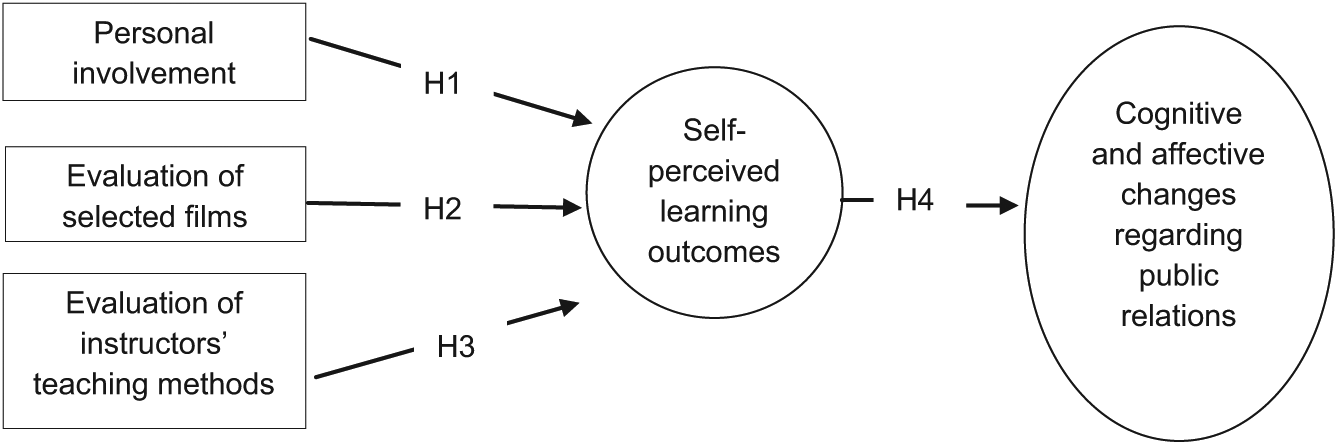
Study framework on using films to teach public relations with nonmajor students.
The framework proposes that there will be a positive correlation between learning impact in class (e.g., understanding of decision processes) and each of the following: (1) a student’s personal involvement with the films (e.g., whether the films evoked emotions), (2) the student’s evaluation of the films (e.g., whether the films were memorable and thought provoking), and (3) the student’s evaluation of the instructors’ methods (e.g., the quality of instructors’ comments and guided questions about the films). In turn, it is expected that self-perceived learning outcomes will be positively correlated with cognitive and affective changes, such as greater awareness and appreciation of public relations issues.
Hypotheses
Based on the literature review, the study proposes the following hypotheses:
Method
Course Design
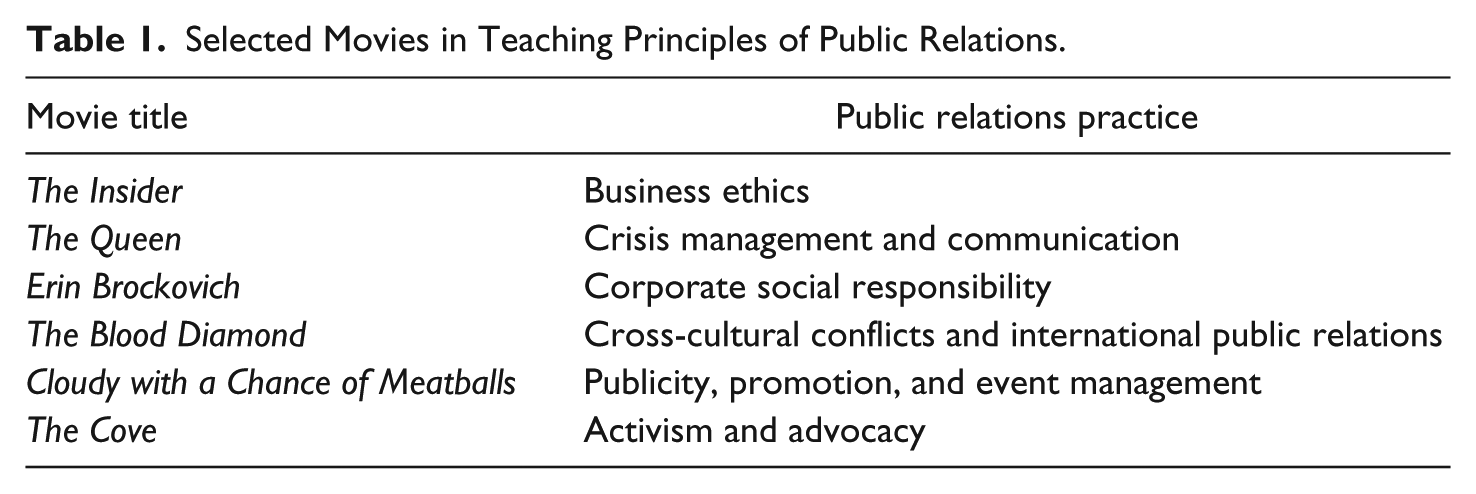
Public relations was offered as a general elective to nonmajor students in spring 2013 in a top university in Southeast Asia. It was a thirteen-week course with 163 students from various disciplines, such as humanities, engineering, and computer science. Six feature films were screened throughout the semester. Each film was carefully chosen to highlight a specific public relations practice as shown in Table 1. For instance, the movie trailers and relevant public relations concepts were shown to students in an advanced public relations course as a pretest and feedback session.
Selected Movies in Teaching Principles of Public Relations.
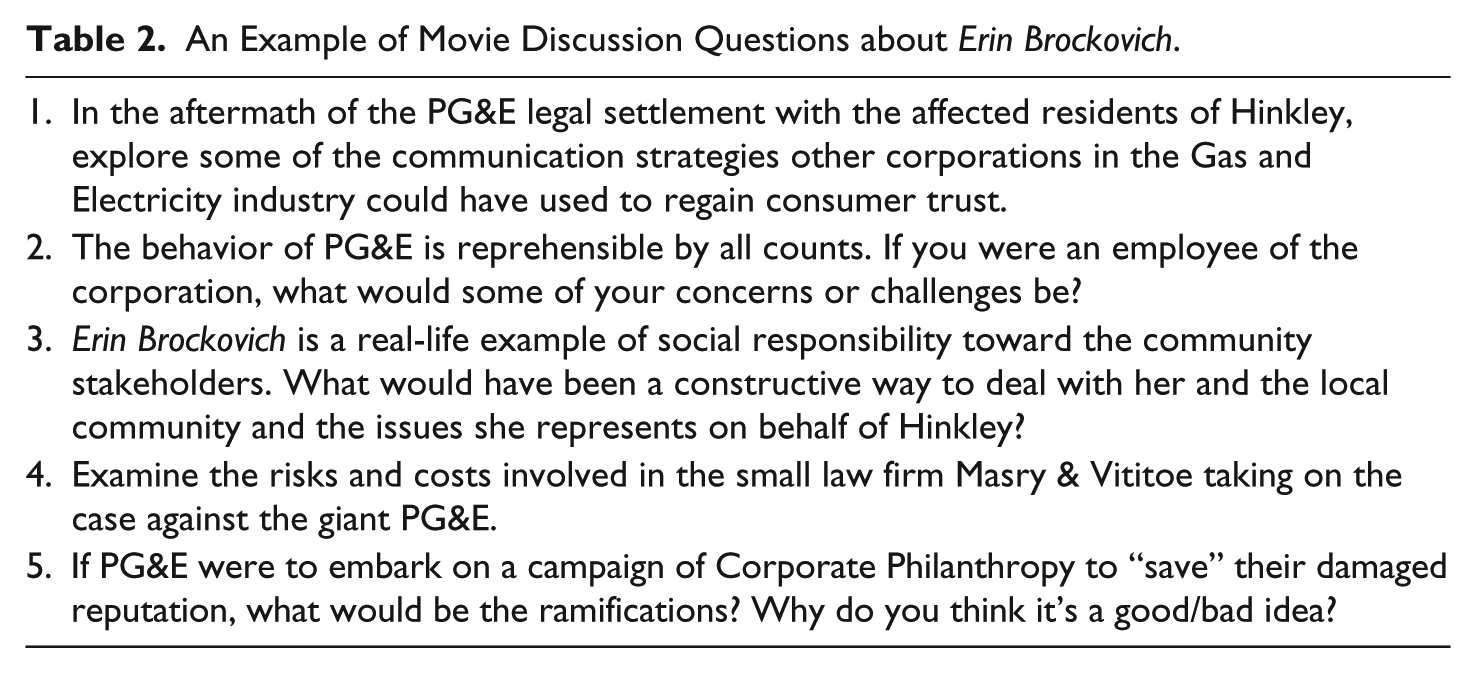
Throughout the semester, students were required to write movie reviews to apply the concepts of public relations in answering the discussion questions for the six featured movies. They were also asked to comment on the movie reviews from other students in terms of relevance and critical analysis. After each movie screening, a discussion was conducted by the lecturer to highlight the lessons learned from the movie in relation to public relations, followed by showing a couple of real-life case studies. For the online activity, students formed groups to submit their proposals for nominating the best movies to help them learn the above public relations practices. Bloom’s taxonomy 21 was used in drafting the discussion questions (see Table 2 as an example).
An Example of Movie Discussion Questions about Erin Brockovich.
Survey Data Collection Procedure
A Web survey was conducted via the school online learning management system, to be available to students who agreed and registered to participate in the survey. The survey took approximately ten minutes during the last two weeks of class. The questionnaire was partially adapted from Bay and Felton’s study on using films as teaching resources in accounting classes. 22 We used the textbook definition from Wilcox et al. to operationalize the term public relations as “strategic management of competition and conflict for the benefit of the organization and its stakeholders or publics.” 23 This definition has been widely adopted across the PR discipline. The concepts addressed by the films were standard public relations topics that would be universally acknowledged as being within the purview of PR (ethics, issue and crisis management, media relations, etc.). Other construct variables in Figure 1 were also included, and a pretest was done to ensure the questionnaire statements were clear to the students. Statistical analyses such as factor analysis and simple regression analysis were performed via SPSS.
Focus Groups
Nonmajor students who viewed four out of six screened movies in class were eligible to participate in two focus groups scheduled on the last day of class. A well-trained moderator asked the interview questions during lunch and afternoon tea sessions and two teaching assistants audited the whole process as observers, ensuring that all questions or topics were covered. The interview questions centered around students’ opinions about (1) learning public relations by viewing the six selected movies (e.g., benefits of watching movies to understand public relations and relevance to the textbook content or the field), (2) teaching methods and interactivity (e.g., usefulness in terms of understanding and knowledge), and (3) attitude and behavioral changes regarding public relations (e.g., dealing with public relations issues and professionals in the future job), to corroborate the student survey responses. Each focus group interview lasted approximately ninety minutes with eighteen participants in total. Thematic analysis was employed and insightful quotes were teased out to corroborate the survey findings.
Results
Insights from Focus Group Participants
Strengths and weaknesses of watching films as a teaching technique
Students said they were more attentive and remembered more from watching film in class. One participant commented, “The whole lesson across the week was about four hours long, the movie actually kept me there and I was physically and mentally there.” Another participant echoed, “The movies helped us remember the topics we learned. For example, if you ask me what business ethics is, I can’t remember. But I can remember the movie (The Insider), which helps me to link back to the topic.” Students also noted that the films gave them the exact explicit scenarios because “the concepts are very abstract and the films helped visualize the concepts much clearer.”
In addition, films helped student to have an affective education outcome in learning public relations practice. A participant explained in great detail,
One good thing is that it brings in the emotion through film, because usually when you just learn from books and text, it is analytical but you don’t know how hard it is to choose or how it can affect you personally until you watch the movie and then you know the obvious emotional conflict and ethical decisions to be made. You don’t know how detrimental the wrong decisions can affect someone’s life until you watch the movie.
Besides classroom learning, some students felt that “watching the movies spurred their interest and helped them go deeper into the topics.” One participant said, “After watching The Blood Diamond, I went to research about it and I also went to watch some National Geographic documentaries about it (the conflict-diamond issue), so I think it’s quite an enlightenment.” Another student responded, “For The Insider, the tobacco industry movie, I went to Google and got a summary and the exact quote Dr. Jeffrey Wigand said on 60 Minutes.”
The weaknesses of using films to teach public relations are that they are time consuming and inflexible compared with other techniques such as case studies and guest lecture, where the mode of delivery “can tell the students what the lesson it wants them to learn specifically.” One participant criticized, “It takes too long for a movie to develop a point, where else if you take a case example, at least you can emphasize and bring out the point precisely.” Another participant commented, “With film, it’s shown at different perspectives and we have to force ourselves to look at it from a public relations angle. I think that’s the less flexibility part of it.”
Evaluation of instructor’s teaching techniques
Participants found the guiding questions for the movie review assignments helpful as “those questions pinpointed certain areas that students needed to look into and directly relate to the subject topics.” One participant observed, “The movie review was quite good, to go back and think about how it relates to each other. It locks in the concepts in my mind.” Others saw the online activity of nominating a movie in learning public relations a rewarding experience. A participant illustrated,
For this assignment, we have to realize the theories on our own, and it leaves a deeper impression on me because I actually found those theories on my own (not pre-assigned in the lecture week). It’s actually a better learning process for me.
There was a debate over whether the summary of the public relations concepts of the textbook chapter should be reviewed before versus after the movie screening. For those who preferred to have an overview before watching the movie, they were more aware of the things to look out for, rather than “looking out for them while watching the movie and they would be watching more intently and thinking about the concepts instead of just getting sucked in the movie.” Some participants, however, preferred to conduct the lesson chapter after the movie so they could “refer back along the way.”
Relevance of the selected films in class and real-life practice
All participants shared the movie scene examples that helped them understand the textbook content. For example, Erin Brockovich “specifically showcased how companies do not abide by corporate social responsibility and some potential consequences” and “CSR has to consider a lot of factors such as what they have to do to pacify the public, etc.” The Queen “portrayed the conflict management theories” and
the PR part was Tony Blair because he recognized that it’s important to meet the public interest and was trying very hard to ask the Queen to fly over to London to give a speech in front of the camera.
However, some students had a hard time in seeing the relevance of an animated movie to the studied topics. One participant iterated, “It may not be able to show, for example the Meatball movie (Cloudy with a Chance of Meatballs), the PR aspect as best.” In general, students preferred the films that were based on true stories to help them link back to the real life.
All participants agreed that the public relations concepts they learned from the films are applicable in their daily lives. For example, in The Insider, the thing about personal values, it “tells us that when we go out to work and see some issues or problems we know it’s not correct but are under some restriction.” In terms of application, students see public relations in a different perspective. One participant elaborated, “If a crisis happens, I’ll tend to be more attentive to how they solve the issue, like the recent Boston marathon.” The concepts they learned from the films are also practical for their future career. One participant applauded, “I’m planning to start a business, and this has been a very practical module for me. I realized that just going into marketing is not enough to get up there.”
Dealing with public relations and professionals in the future
All participants agreed that watching films help them understand public relations practice and appreciate the PR job. And the movies they learned in class are “beneficial for many industries.” They also showed confidence and willingness in working with communication professionals in their future jobs. One participant stated,
From this course I have more respect for public relations professionals, so in future in a company I will try to get them on my side and avoid any bad press. If I had a company, I will definitely set up a whole department to do public relations for us.
Another participant concluded, “No matter how small the budget is, someone has to be there to do public relations; otherwise the company cannot survive.”
Results of the Quantitative Analysis
A total of 115 students participated in the online survey, resulting in a 71 percent response rate. Student responses to a quantitative survey largely parallel the qualitative findings. Results suggest that the films shown in class were interesting and involving, provided meaningful and relevant lessons or stories about public relations, and helped students develop greater awareness (M = 4.30, SD = .49), appreciation (M = 4.26, SD = .73), and understanding (M = 4.40, SD = .56) of public relations (see Table 3, where 1 = strongly disagree and 5 = strongly agree). To a somewhat lesser extent, use of the films helped students relate to the textbook (M = 3.90, SD = .75), focus more in class (M = 4.17, SD = .74), and better understand implementation strategies (M = 4.05, SD = .58). The instructor’s teaching methods, especially the guided questions, aided student learning (M = 4.32, SD = .64).
Student Responses to Statements Regarding Films and Self-Perceived Learning Outcomes.
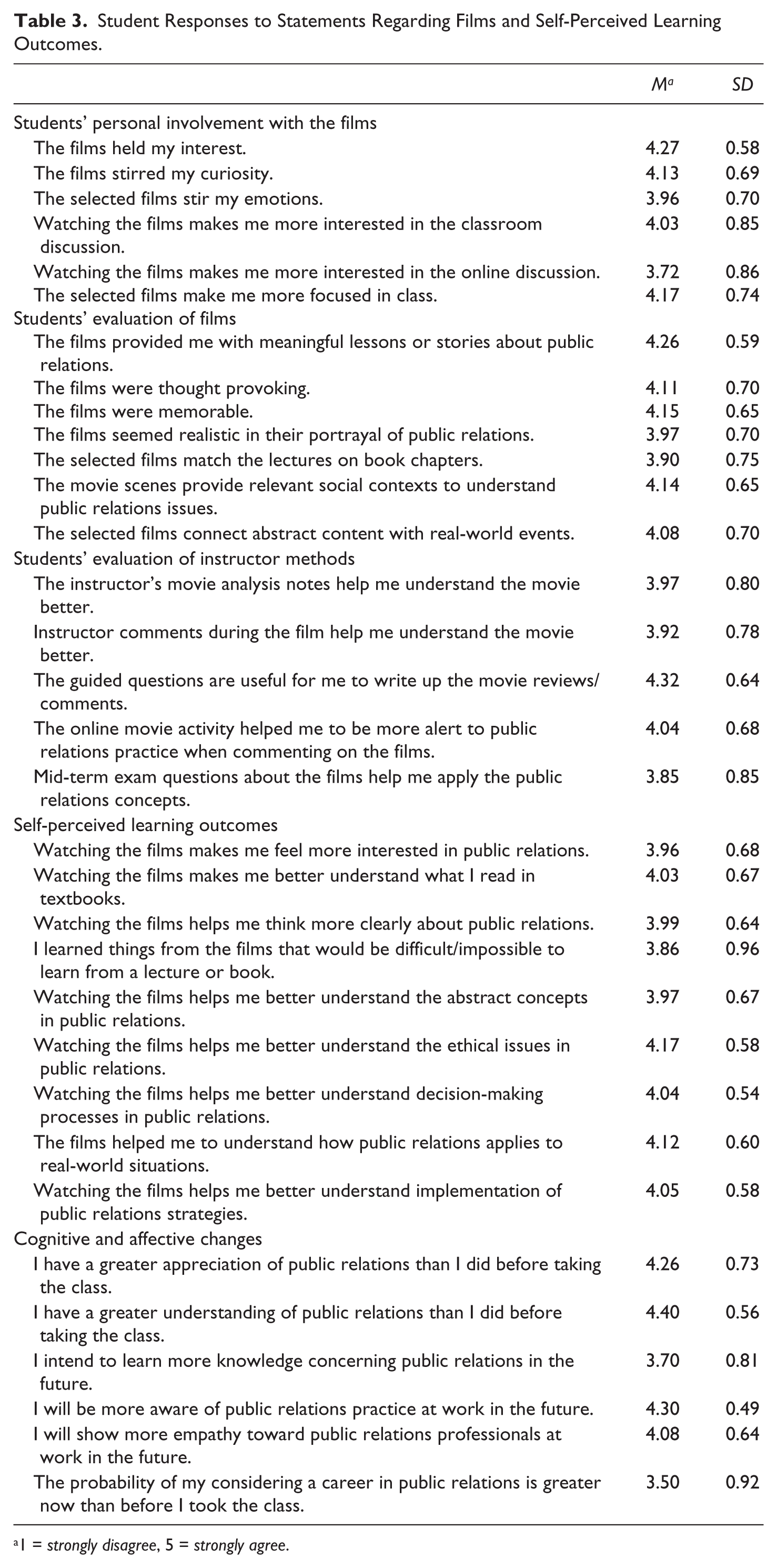
1 = strongly disagree, 5 = strongly agree.
A factor analysis was conducted to determine whether there might be an underlying structure/relationship among various groups of variables, which might allow the researchers to combine or eliminate certain variables to create a more parsimonious model. As shown in Table 4, factor analysis suggested that the five sets of variables might possibly be reduced into the following factors:
A. Students’ personal involvement with the films
Factor 1: “resonation” (i.e., the films resonated with the student)
Factor 2: “motivation” (i.e., the films motivated students in various ways)
B. Students’ evaluation of the films
Factor 1: “credibility” of the films
Factor 2: “vividness” of the films
C. Students’ evaluation of instructor methods
Factor 1: “instructor guidance”
Factor 2: “instructor hints”
D. Measures of learning
Factor 1: “interest and clarity” of subject matter
Factor 2: “understanding of strategy execution”
E. Cognitive and behavioral change
Factor 1: “appreciation and understanding” of public relations
Factor 2: “sensitivity” to public relations
Factor Analysis of Underlying Structure/Relationship in the Study Framework.
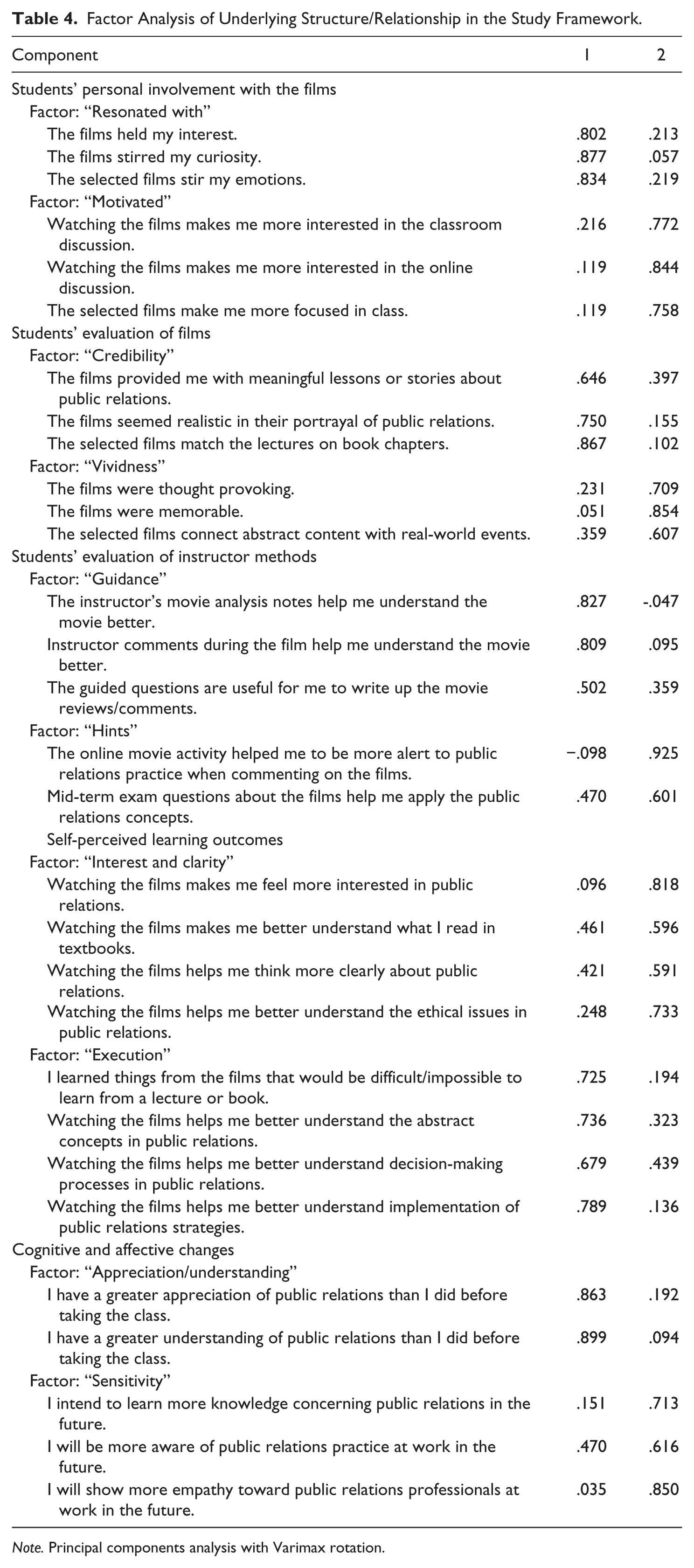
Note. Principal components analysis with Varimax rotation.
While there did seem to be something of an underlying factor structure to the data, the structure was not strong enough to add substantial clarity or parsimony to the basic model, so the researchers chose to work with the original variables.
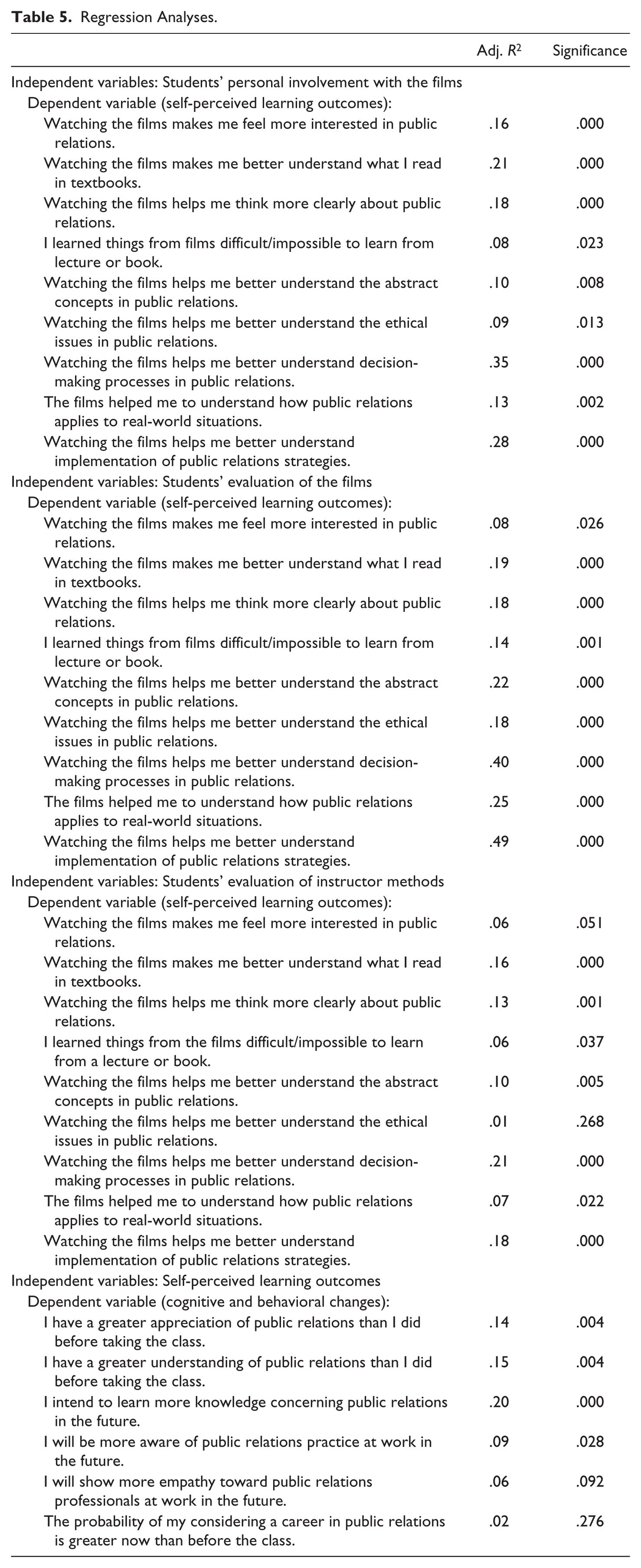
To evaluate the relationship between self-perceived learning outcomes and (1) personal involvement with the films, (2) evaluation of the films, and (3) evaluation of instructors’ teaching methods, a series of multiple regressions was performed.
Regression Analyses.
Discussion
While still rather exploratory in nature, the study’s quantitative and qualitative findings both suggest rather strongly that the use of films to teach public relations concepts to nonmajors is an effective means of developing greater understanding and appreciation of such concepts. In particular, results show that nonmajor students not only cognitively processed the public relations information from the selected movies 24 but also showed personal involvement and affective commitment 25 in the decision making and implementing of public relations strategies. In addition to its specific findings, the study is noteworthy to the extent that it represents the first research in the field to link self-perceived learning outcomes with the use of films as a pedagogical tool.
Implications
The study’s findings have direct implications for instructors in deciding how to teach similar courses, insofar as the study suggests that the use of films can be an effective teaching method. The heuristic model provides some useful statements for instructors to evaluate their use of films. This is beneficial to showcase the choice of pedagogy and learning effectiveness in their teaching portfolio. From an administrator’s viewpoint, it provides insight into developing general-interest courses that accommodate the interests and needs of nonmajor students. To apply this study’s results to other situations, one needs to carefully consider the sample characteristics and research setting.
Limitations and Future Directions
The choice of feature films in this study reflect American values in teaching Asian students whose own cultural assumption on the use of public relations techniques might differ somewhat from those that the film makers intended. Singapore is a multicultural city and an Asian hub for global company head offices. Also, its film industry is very small and the box office relies on imported films from other countries where Hollywood movies are the mainstream. Future studies can incorporate local films as teaching material in other countries to better reflect the students’ background.
The evaluations of the teaching outcomes are based on one group of students (nonmajors). One obvious future research project is to replicate this research with students who are majoring in public relations, to determine whether their responses to the use of feature films are similar or dissimilar to the responses of non-PR majors. This may show that the heuristic model is equally suited to both groups. While the study is exploratory in nature, experimental studies can be conducted to compare the impact of learning from watching films in terms of putting the review discussion before versus after the movie screening. This would be a potential moderating factor to impact on learning as well as the cognitive and affective changes. Other future studies might address the effectiveness of specific films to be used.
Footnotes
Acknowledgements
We would like to thank Melina Chua for her contribution to implementation of the teaching tool, as well as Yumeng Wang, Yang Hu, and Eunice Chew for their research assistance.
Declaration of Conflicting Interests
The author(s) declared no potential conflicts of interest with respect to the research, authorship, and/or publication of this article.
Funding
The author(s) received no financial support for the research, authorship, and/or publication of this article.