







Abstract
Current curriculum trends in tertiary journalism and communication education in the People’s Republic of China are investigated using information from the websites of the 2,198 Chinese universities that published course lists in December 2013. Of those, 439 offered journalism majors and this article samples 274 of those universities (12.5% of the national total). They fall into four groups: Research-oriented, Research and Teaching, Teaching only, and Specialized. A content analysis is conducted of subject synopses published on each university’s website. While international research suggests that subject offerings are likely to reflect a combination of internal institutional policies regarding journalism education and domestic student demand, with some external influence from government, educational institutions, and employer requirements, only in China is there evidence that journalism courses include compulsory study of a major global foreign language specifically for journalists (in this case, English). This study suggests further investigation into whether Chinese journalism graduates will have more capacity to be globally mobile and thus more employable than contemporary graduates from Europe, the United States, the United Kingdom, and Australia.
Introduction and Purpose of This Study
Since at least the 1990s, China and Australia have been investigating “linkages between publicly funded research activities and industry for the purpose of advancing economic and other national objectives” (Turpin, Garrett-Jone, & Rankin, 1996, p. 267) and over the past decade interest and activity has increased among Chinese universities and those in the United Kingdom (Chan & Dimmock, 2008) as well as Australia. Regarding the present study, Chongqing University in southwestern China, and Swinburne University of Technology, in southern Australia, proposed a relationship in 2013 and decided to compare the university-level journalism curriculum in the two nations before deciding on directions for cooperation.
Potential Preconceptions
For academic staff at both universities, this would be the first opportunity to work at the interface of Chinese and Australian journalism formation, so a set of relatively wideranging research questions was suggested to explore the unknown territory of each other’s environment. A lateral thinking technique called “provocation” (De Bono, 2009) was employed to devise the research questions. Provocation involves upending taken-for-granted concepts, taking normal relationships and reversing them. De Bono explains the rationale and need for provocation: “there is a mathematical need for provocation in any self-organizing system, otherwise the system gets stuck in a local equilibrium” (p. 57): If one maintains the same “traditional” thought methods and processes, it is likely that one will become stuck in those same methods and processes and this leads to circular reasoning.
The “taken-for-granted” concepts were that government restrictions placed upon Chinese students would impede their ability to engage with Western journalism, that ideological differences would prevent Marxist and non-Marxist journalists from working together effectively, and that the language barrier between Chinese and English (or any of the major European languages) would make any university interaction very difficult, if not impossible. Another “taken-for-granted” concept is that journalism education is “culture free” in much the same way that it was previously accepted that news values were (Galtung & Ruge, 1965). There is room to critique that idea during discussions in this article.
Research Considerations and the Research Question
From a non-Chinese perspective, it might be posited that journalism graduates from China would be less internationally mobile and employable than their Western counterparts because the Chinese system of government imposes restrictions on the operations of journalists, which do not exist in many European countries, the United States, the United Kingdom, and Australia, and so Chinese graduates and even experienced journalists would be less well-equipped to move to, and operate in, such unrestricted environments.
Another non-Chinese position might be that the pervasive teaching and influence of Marxist philosophy tends to impede Chinese journalists from working in many other countries that teach and operate in a non-Marxist, nonpropagandist, capitalist environment. Elements of these two positions are addressed after the literature review section; however, earlier research suggests that more elements of the US model have been incorporated into China’s journalism education and more US professors have been invited to teach in Chinese programs in recent years (and this) reflects China’s desire to fill in inadequacies in its journalism education rather than an attempt to replace the Soviet model with the American model. (Xiaoming & Xiaoge, 1997, p. 44)
A third possible non-Chinese position is that language barriers are likely to impede Chinese graduates from operating in other countries where Chinese is not lingua franca.
A possible non-Western, or Chinese position, however, is that many Chinese in other disciplines have historically (a) learned to operate effectively in the less governmentally restricted West; (b) learned to operate productively in non-Marxist, nonpropagandist, capitalist markets; and (c) experienced no more language barriers than their counterparts who have been trained in Spanish, French, German, Japanese, or any other language under comparable circumstances.
There is another position: A direct comparison of curriculum content between a large sample of Chinese university journalism programs and the journalism education regimes of Europe, the United Kingdom, the United States, and Australia might suggest whether Chinese graduates have more or less capacity for international mobility than Western graduates. This has formed the basis of our single research question.
This study principally restricts itself to the task of comparing the curriculum content, and thus to RQ1. However, while the questions posed earlier in this section are principally dealt with elsewhere or could be the subject of further research, some observations are made in this article where appropriate.
Literature and Prior Research
A longitudinal study of a large sample of employment advertisements by journalism businesses in the United States (Wenger & Owens, 2012) was mapped against government and educational institution expectations and curricula in a large sample of European countries (Drok, 2012) and a significant conceptual as well as practical gap was identified (Cokley, Wenger, Wenger, & McBride, 2013). The authors of that study concluded that these gaps were likely to seriously impede movement and international employment of journalists between these two major information markets. Further comparison of those results with current courses in the United Kingdom 1 and an earlier study of curricula in 25 Australian university journalism programs (Adams & Duffield, 2005) supports this conclusion and suggests that students trained in the current U.K. and Australian environments are also likely to have less capacity to be globally mobile and thus less internationally employable outside the U.S. and U.K. markets and their derivatives.
European journalism education curricula are largely derived from the Tartu Declaration of 2006 (Drok, 2012) while U.S. professional journalism expectations are visible in ongoing research into editorial job advertisements placed by a wide range of major U.S. publishers and broadcasters (Wenger & Owens, 2012). British, Australian, New Zealand, and other major cultures have derived their journalism traditions from one of these two major source traditions (Cokley et al., 2013).
Europe
The Tartu Declaration includes a list of 50 competencies that are expected of European journalists, clumped into 10 categories. (a) The competence to reflect on journalism’s role in society: have a commitment to democratic society, know the legal and ethical framework of journalism, be able to develop a grounded personal view of journalism, understand the values that underlie professional choices, and be able to link the local with the national and the global. (b) The competence to find relevant issues and angles: know current events and their context, know the characteristics of different media, be able to determine the relevance of a subject for different audiences, be able to stimulate broad participation in debate, and be able to discover newsworthy issues on the basis of in-depth research. (c) The competence to organize journalistic work: be able to make a realistic work plan, be able to work under time pressure, be able to adjust to unforeseen situations, be able to organize contributions from the public, and be able to work within budget limits. (d) The competence to gather information swiftly: have a wide general knowledge, have a more specialized knowledge in a field, be able to find multiple perspectives on an issue, be able to evaluate sources, and be able to interact with the public. (e) The competence to select the essential information: be able to distinguish between main and side issues, be able to select information on the basis of reliability, be able to select information on the basis of relevance, be able to select information in accordance with the media platform, and be able to interpret the selected information. (f) The competence to present information in an effective journalistic form: have an outstanding linguistic competence, have a good visual competence, be able to use different types of storytelling techniques, present content in effective combinations of words, sounds, and visuals, and be able to make journalistic use of technology. (g) The competence to account for journalistic work: have a clear idea of the required quality of journalistic products, be able to evaluate own work, be willing to take criticism constructively, be able to take responsibility for the choices made during the process, and be able to take responsibility for the impact of the product. (h) The competence to cooperate in a team: have good social skills, be reliable, be able to present ideas convincingly, be able to find solutions, and show insight into roles and relations within a team. (i) The competence to act as an entrepreneurial journalist: show initiative, understand the economic conditions underlying the profession, be able to recognize market opportunities, be able to develop new products/formats, and know the practical aspects of being a freelancer. (j) The competence to contribute to the renewal of the profession: be able to reflect on the future of journalism, be able to define a complex practical/professional problem, be able to adopt scholarly methods of data collection, be able to adopt trustworthy methods of analyzing and processing data, and be able to provide workable solutions for complex practical issues.
United States
Wenger and Owens (2012) identified a list of 22 skills and attributes in high demand among journalism employers in order of importance: previous professional experience, strong writing, web/multimedia skills, working under pressure/tight deadlines, team player, multitasking, enterprising, communication skills, news judgment, proofreading, leadership, accuracy, software/computer skills, shooting/photography, creativity, nonlinear editing, develop sources, Associated Press (AP) style knowledge, willingness to work long hours, storytelling, aggressive, and production/field production. When these were mapped against the Tartu Declaration imperatives, a “significant disconnection was observed between the expectations of journalists and educators in Europe and what journalism hiring managers in the US state as their required job competencies and professional qualifications” (Cokley et al., 2013). That study concluded this suggested “significant impediments to the international transferability of journalism education across the Atlantic, and between those many countries and cultures that have aligned themselves with either of these two dominant paradigms of journalism education and professional operation” (Cokley et al., 2013).
United Kingdom
In the United Kingdom, the National Council for the Training of Journalists (NCTJ) awards a Diploma in Journalism and accredits university courses in journalism, which it accepts as meeting its standards (see Note 1). The Diploma in Journalism includes a set of mandatory subjects and a set of specialist options (electives). Mandatory subjects are Reporting, Essential Public Affairs, Essential Media Law and Regulation, Shorthand, and an E-portfolio. The NCTJ notes, “These are the skills that the journalists require and therefore keep doors open to developing a career in all media and any journalism jobs.” Specialist options are Media Law, Court Reporting, Video Journalism for Online, Production Journalism, Sports Journalism, Business of Magazines, Broadcast Journalism, and Business and Finance Journalism.
Australia
In Australia, subjects identified as “core” at the 25 universities examined were News Writing, Online Journalism, Feature Writing, Print Editing and Publishing, Industry Placement, Contemporary Journalism, Law and Ethics, Journalism Research Methods, Writing, Mass Communication, Media Studies, Cultural Studies, Communication Skills, Digital audiovisual (AV) Production, Politics, Justice Studies, Speech Communications, English, International Relations, General Humanities, Information Technology, and Entrepreneurial Management (Adams & Duffield, 2005). Among these, Mass Communication, Media Studies, and General Humanities were most common, followed by Cultural Studies and Digital AV Production.
Subjects listed as “compulsory units” in journalism programs were News Gathering, News Writing, Radio Journalism, Television (TV) Journalism, Broadcast journalism, Online Journalism, Print Journalism, Feature Writing, Print Editing and Publishing, Photo Journalism, Professional Practice, Specialist Reporting, Industry Placement, History of Journalism, Contemporary Journalism, Law and Ethics, Law, Ethics, International Journalism, Investigative Journalism, Journalism Research Methods, Writing, Mass Communication, Public Relations, Media Studies, Cultural Studies, Communication Skills, Digital AV Production, Politics, Economics, Indigenous Studies, English, and Advertising. Among these, News Writing, Radio journalism, Online Journalism, Feature Writing, Print Editing and Production, Industry Placement, Contemporary journalism, Law, and Media Studies were most common.
Subjects listed as “journalism electives” were News Gathering, News Writing, Radio Journalism, TV Journalism, Broadcast journalism, Online Journalism, Print Journalism, Feature Writing, Print Edit Publish, Photo Journalism, Professional Practice, Specialist Reporting, Industry Placement, Literary Journalism, Freelance Journalism, History of Journalism, Law and Ethics, Law, Ethics, International Journalism, Investigative Journalism, Journalism Research Methods, Writing, Mass Communication, Media Studies, Cultural Studies, Digital AV Production, Shorthand, Public Relations, Politics, English, Creative Writing, and International Relations. Among these, Radio Journalism, TV Journalism Broadcast journalism, Print Editing and Publishing, and Industry Placement were most common.
In Australia and the South Pacific, employment for journalists has continued to grow and diversify in Australia to 2013 (Cokley, Edström, McBride, & Ranke, 2011; Cokley, Gilbert, Jovic, & Hanrick, 2016), despite some predictions to the contrary, and an earlier study suggested strong employment growth potential for journalists in India (Cokley & Das, 2005). But the single market with the greatest potential for employment growth for journalists around the world is the People’s Republic of China (PRC) based on present GDP growth. Another important indicator is the number of universities in the PRC (as universities are an indicator of future economic growth) and the prevalence of journalism programs at those universities. The present study is the first attempt to compare the above conclusions with journalism curricula in the PRC as they existed in 2013 and to draw conclusions from such a comparison. Our research seeks to examine how competitive internationally PRC journalism graduates will be, and thus the future trade balance for journalism jobs between the PRC and the rest of the world. Clearly, the results of this research will be an important employment indicator for journalists and prospective journalists in Australia, the United States, the United Kingdom, and European countries, and thus for those who offer journalism education programs in those countries.
China
A review of curriculum and practices published in this journal in 1997 found that journalism students (in China are) . . . taught the basic skills in identifying news, gathering information and packaging news in a concise, easy to understand and interesting format. In addition, truth-telling, accuracy, timeliness, and separating facts from opinion are among the basic requirements for journalism, which cannot be sacrificed for political concerns. (Xiaoming & Xiaoge, 1997, p. 44)
The Worlds of Journalism study 2 notes that 99.5% of journalists employed in China hold a university or college degree, compared with 96% in France, 76% in Germany, 60% in Sweden, 86% in the United Kingdom, 82% in Australia, and 94% in the United States.
Summary
The literature reviewed suggests that the frame “journalism education” remains contested and far from settled. Earlier research cited above strongly suggests that the output requirements of journalism in Europe only marginally match those in the United States, and are so “taken-for-granted” in the United Kingdom and Australia as to make a critique of them too broad a task for the scope of this article. Some journalism educators might take the view that so-called Western journalism is dedicated to the pursuit of “truth and facts” and that Chinese journalism is subject to government control and thus produces only “propaganda.” However, an earlier researcher in this journal noted that “we should not be surprised that neither the Soviet model nor the U.S. model fits China’s current journalism education” and “as far as professional values and skills are concerned, China’s journalism educators find no problem in matching their programs with those overseas” (Xiaoming & Xiaoge, 1997, p. 44). We note for future researchers that this is an area worthy of thorough independent investigation and one which is likely to expand the outcomes of this current article.
Theoretical Framework
Preceding sections of this article refer to different approaches to journalism and journalism education in different countries and cultures. This begs the question about whether the current article should use the media systems of the countries it considers as a basis of comparison for its university curriculum and graduate mobility study. Specifically, should we engage with the debate launched in mid-20th century about authoritarian, libertarian, social responsibility, and Soviet communist models of the “press?” (Siebert, Peterson, & Schramm, 1956). The research team has decided in the negative for two reasons. The first and most pressing reason is that the scope of the current research has been to concentrate on investigating the nomenclature and overall content descriptions of journalism curricula in China in 2013 and then comparing it with curricula evidence from European nations, the United States, United Kingdom, and Australia. The second is that the debate about “the Four Theories of the Press” has matured into a literature all its own and the multitude of authors (Hallin & Mancini, 2004; Nerone, 1995; Nordenstreng, 2006; Ostini & Ostini, 2002; Yin, 2008) suggests that the concepts remain fluid.
Method
Data were collected using information from the websites of the 2,198 Chinese universities that published course lists in December 2013.
The research team used available online and printed materials that are or were publicly available in China and research from previously published research covered by other research review processes where applicable. No human subjects were interviewed, observed, or involved in any way for this article and therefore no ethical review was deemed necessary.
Primary filtering suggested that of the 2,198 Chinese universities, 439 (20%) offered journalism majors at that time and so this group formed the primary archive for this research. Secondary filtering for the most substantial information produced a sample of 274 universities (12.5% of the national total), which are then manually coded into four groups and analyzed in detail: Research-oriented (24 universities), Research and Teaching (29), Teaching only (169), and Specialized (52). The differentiation into “research,” “research-and-teaching,” “teaching only,” and “specialized” was made on the basis of each university’s position in a list arranged by the Ministry of Education.
Coding
Subject names were manually coded into 14 categories based on analysis of subject-naming conventions and a content analysis of subject synopses published on each university’s website. Results are tabulated and trends are displayed visually.
The Team
The data collection, coding, and content analysis were conducted in Mandarin Chinese. Two Chinese researchers were employed for data collection, coding, translation, and tabulation, and a third English-language researcher moderated the coding to minimize potential coder bias.
Coded categories and rationale for each:
Compulsory Courses of Journalism: Introduction to Journalism, Introduction to Broadcasting and TV, News Commentary, Media Criticism, History of media communication, and so forth.
Compulsory Courses of Communication: Introduction to Communication, Mass Communication, Studies of Public opinions, and so forth.
Practical Courses of Journalism: News Gathering and Writing, Newspaper Editing, News Photography, and so forth.
Courses for Arts of Broadcasting and TV: TV Program Executing, TV Program Planning, TV Program Editing, Audiovisual Language, Broadcasting and Hosting, and so forth.
Philology Courses: Ancient Chinese, Modern Chinese, grammar rhetoric, Mandarin, and so forth.
Literature Courses: Chinese Ancient Literature, Modern and Contemporary Chinese Literature, Foreign Literature, Introduction to Literature, Chinese and foreign literary history, and so forth.
Advertising Courses.
Publication Courses.
Courses for Management and Administration of Media.
Courses for Specialized English for Journalism.
Ethics and Law of Media.
Courses for Public Relations.
Transdisciplinary Relevant Courses: Psychology of Mass Communication, Marxism on Journalism, and so forth.
Courses for Relevant Skills.
Findings
Samples Illustration
For the 274 universities’ samples, we have sampled each of the four types of universities:
Research-intensive universities (Type 1): 24
Research and teaching universities (Type 2): 29
Teaching only (Type 3): 169
Specialized (Type 4): 52
1. Research-oriented universities (Type 1):
100% have compulsory courses of journalism;
100% have compulsory courses of communication;
100% have practical courses of journalism;
91.67% have courses for arts of broadcasting and TV;
33.33% have philology courses;
50% have literature courses;
62.5% have advertising courses;
25% have publication courses;
75% have courses for management and administration of media;
58.33% have courses for specialized English for journalism;
83.33% have ethics and media law courses;
33.33% have courses for public relations;
75% have transdisciplinary relevant courses;
29.17% have courses for relevant skills.
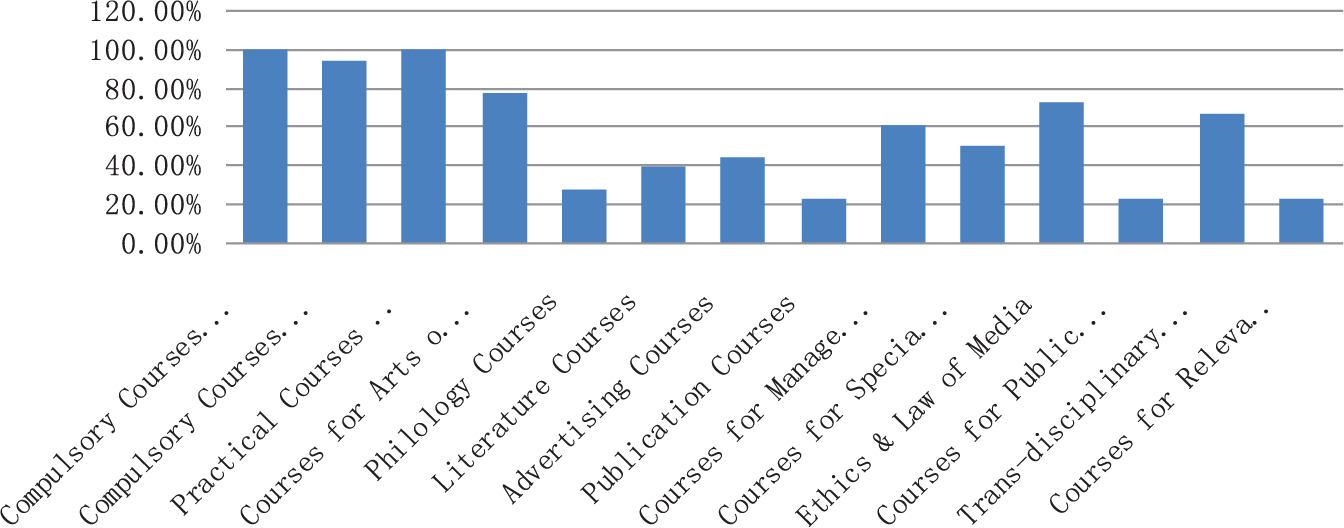
Research-oriented universities (Type 1) by subject distribution.
2. Research-teaching-oriented universities (Type 2):
100% have compulsory courses of journalism;
100% have compulsory courses of communication;
100% have practical courses of journalism;
86.21% have courses for arts of broadcasting and TV;
34.38% have philology courses;
51.72% have literature courses;
55.17% have advertising courses;
75.86% have publication courses;
75% have courses for management and administration of media;
41.38% have courses for specialized English for journalism;
82.76% have ethics and media law;
51.72% have courses for public relations;
96.55% have transdisciplinary relevant courses;
27.59% have courses for relevant skills.
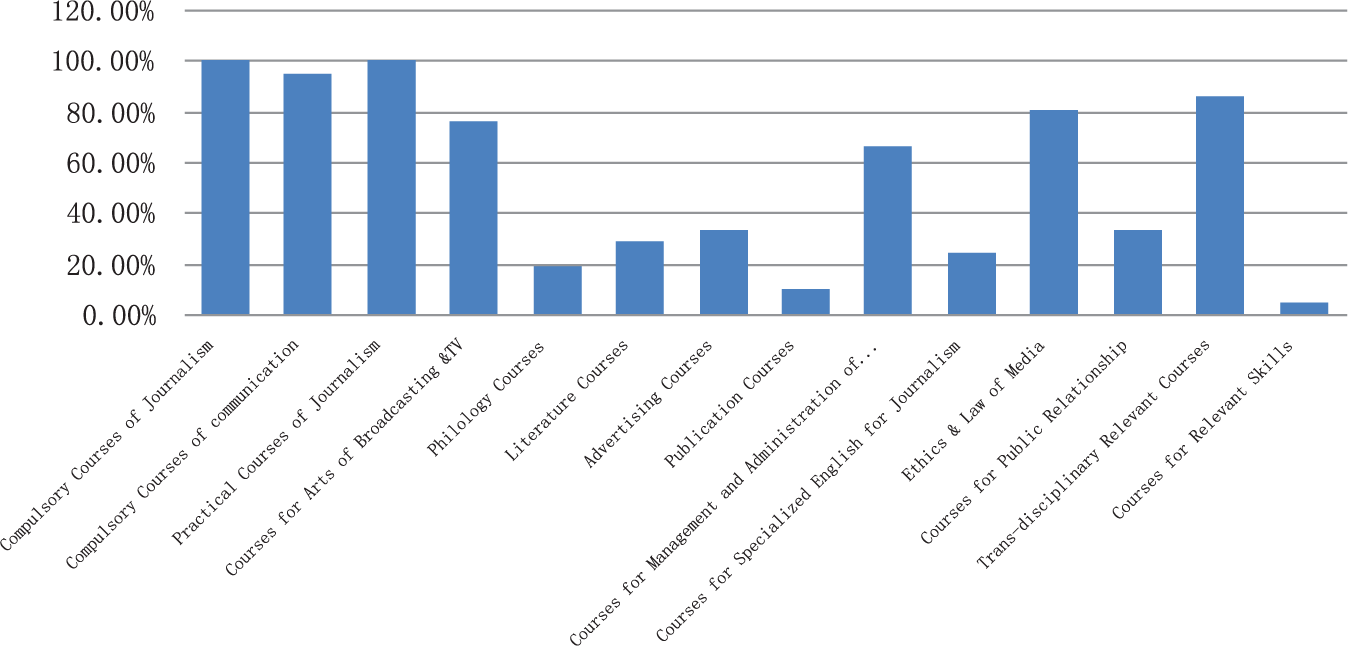
Research-teaching-oriented universities (Type 2) by subject distribution
3. Teaching only (Type 3):
100% have compulsory courses of journalism;
87.57% have compulsory courses of communication;
100% have practical courses of journalism;
84.62% have courses for arts of broadcasting and TV;
35.50% have philology courses;
44.38% have literature courses;
49.11% have advertising courses;
5.33% have publication courses;
43.79% have courses for management and administration of media;
14.20% have courses for specialized English for journalism;
58.58% have ethics and media law courses;
44.38% have courses for public relations;
72.78% have transdisciplinary relevant courses;
15.98% have courses for relevant skills.
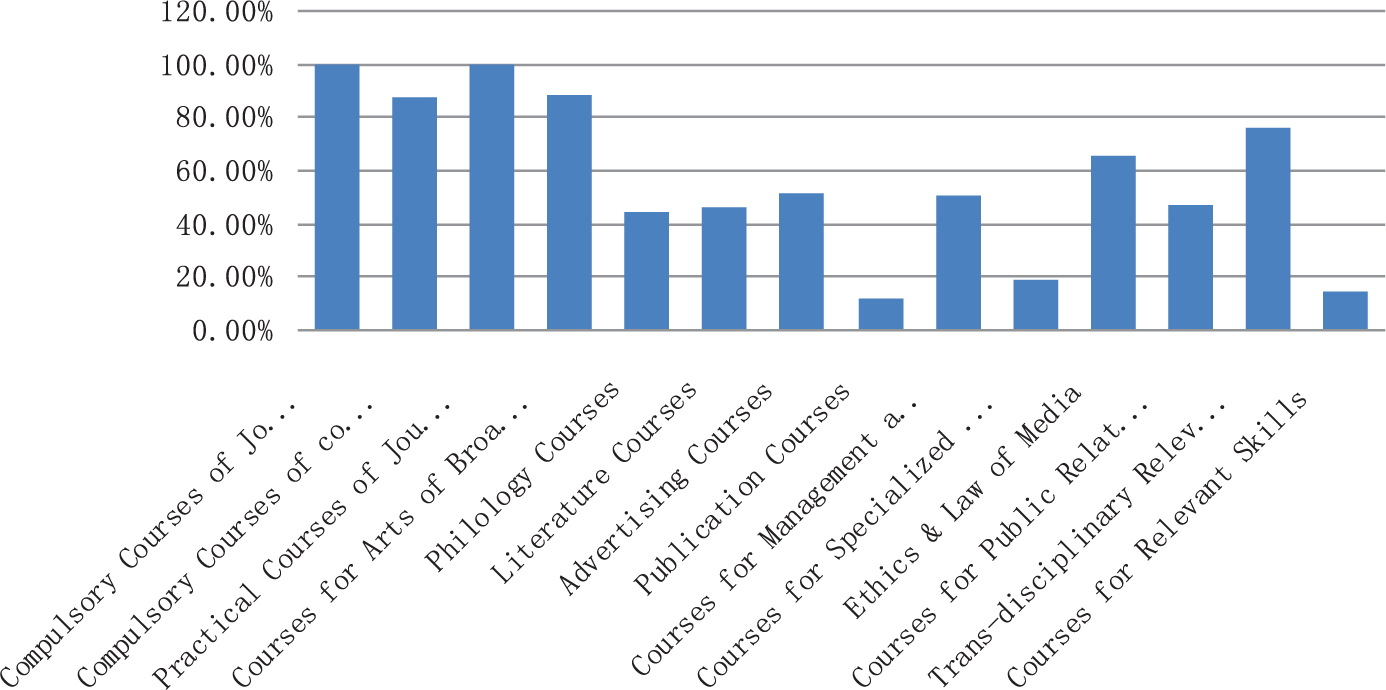
Teaching only (Type 3) universities by subject distribution.
4. For specialized (Type 4):
100% have compulsory courses of journalism;
90.38% have compulsory courses of communication;
100% have practical courses of journalism;
71.15% have courses for arts of broadcasting and TV;
26.92% have philology courses;
46.15% have literature courses;
48.08% have advertising courses;
11.54% have publication courses;
59.62% have courses for management and administration of media;
23.08% have courses for specialized English for journalism;
63.46% have ethics and media law courses;
30.77% have courses for public relations;
94.23% have transdisciplinary relevant courses;
13.46% have courses for relevant skills.
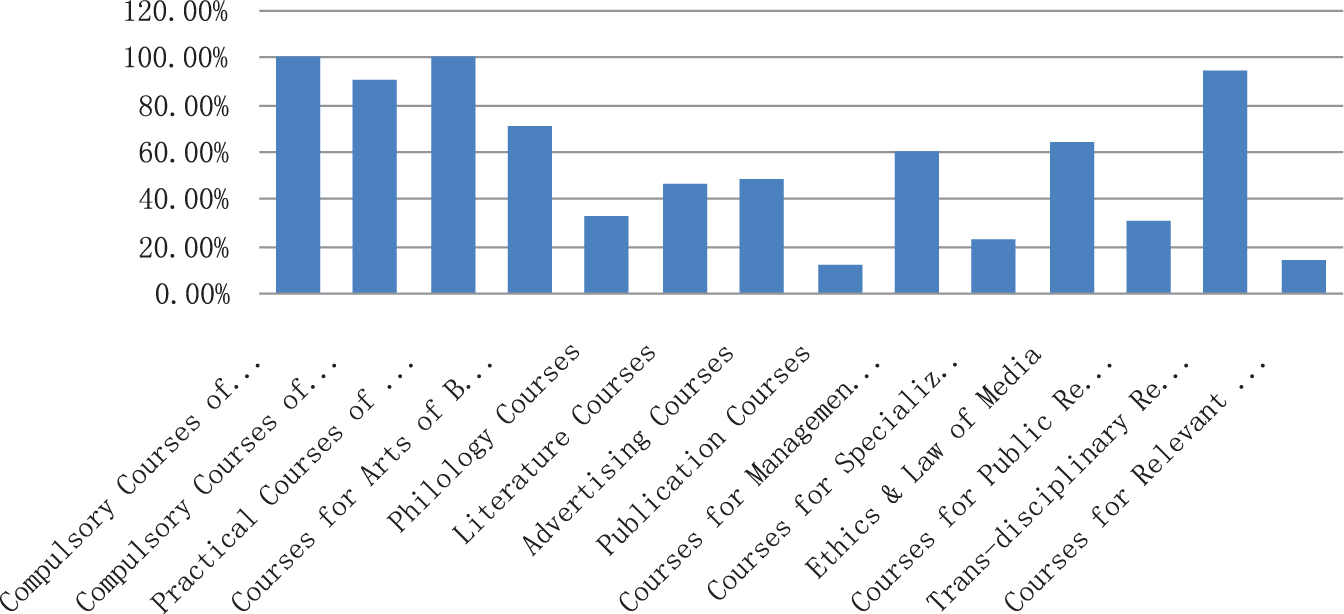
Teaching only (Type 3) universities by subject distribution.
Analyzing According to the 14 Categories
Compulsory Courses of Journalism
All the four types of universities have compulsory courses of journalism.
2. Practical Courses of Journalism
All the four types of universities have practical courses of journalism.
3. Compulsory Courses of Communication
All research-oriented and research-teaching-oriented universities have compulsory courses of communication. Most of the Type 3 and Type 4 universities have compulsory courses of communication, some of the two types don’t have them: Type 3 accounts for 87.57% and Type 4 accounts for 90.38%; it shows some imperfection of the curriculum designation of these two types.
4. Courses for Arts of Broadcasting and TV
Type 1 and Type 2 have a higher proportion than Type 3 and Type 4: Type 1 accounts for the highest proportion, 91.67%, and Type 4 accounts for the lowest proportion, 71.15%. It shows some of the disparity of the different types. From Type 1 to Type 4, the proportion dwindles steadily. Some Type 4 universities do not offer courses for arts of broadcasting and TV.
5. Philology Courses
Generally, all the four types account for a low proportion of philology courses. Type 1, Type 2, and Type 3 account for a close proportion of philology courses; all of them are above 30%. Type 4 accounts for the lowest one at just 26.92%. The range between types is quite small. It demonstrates that the philology courses, similar to grammar rhetoric, don’t play an important role in the curriculum system.
6. Literature Courses
The proportion of literature courses is higher than the philology courses. The average is around 46%. It shows that literature theories play a more important role than the philology theories. Type 1 and Type 2 are close and higher than Type 3 and 4; the later two types are also close. The range between types is quite small.
7. Advertising Courses
The four types are on a declining trend, Type 1 accounts for the highest proportion at 62.5% with Type 4 accounting for the lowest at 48.08%. The range between types is not large.
8. Publication Courses
The proportion of publication courses accounts for the lowest among all the 14 curriculum categories. Even the highest, Type 1, only has 25% proportion with the lowest Type 3 at just 5.33%. It indicates Chinese journalism education does not take publication as a necessary part of the curriculum system. The major reason is probably that most of the graduates will not choose a job in the publication industry or the publication industry does not need fresh graduates; they prefer to employ some experienced staff.
9. Courses for Management and Administration of Media
All the four types account for 52.92% of the courses for management and administration of media among which Type 2 accounts for the highest level at 75.86%. Type 1 is close to Type 2 at 75%, comparatively higher than Type 3 and 4. It may show a closer tie between research-/research-teaching-oriented universities and the media industry. In other words, the graduates from these two types are more likely to work in the media than those from Types 3 and 4.
10. Courses for Specialized English for Journalism
The four types show great difference on courses for specialized English for journalism. Type 1 is the highest accounting for 58.33%, leading type 2 on 41.38% and Type 4 on 23.08%, while Type 3 is the lowest proportion at only 14.20%. It reflects the extent of internationalization. Obviously, Type 1 and Type 2 show much better international inclusion than Type 3 and Type 4. In addition, the average level is just 22.63%; it suggests the weakness of the internationalization of journalism in major universities of China.
11. Courses for Ethics and Law of Media
The proportion of Type 1 and Type 2 are higher than Type 3 and Type 4. The average is 64.23%, which indicates most universities think highly of the influence of ethics and law.
12. Courses for Public Relations
In this section, Type 2 is the highest at 51.72%. Furthermore, Type 1 is close to Type 4, the two types being around 30%. It may suggest that Type 1 universities view public relations as of low relevance to journalism.
13. Transdisciplinary Relevant Courses
Also in this section, Type 1 ranks third, while Type 4 is close to Type 2, both of them accounting for 95% or so. It may show Type 2 and Type 4 have more relevant courses to choose from or we can say the two types show more integrity and correlativity than Type 1 and Type 3.
14. Courses for Relevant Skills
In this section, Type 1 and Type 2 are higher than Type 3 and Type 4, but the range between types is quite small. The average of this section is at a low level.
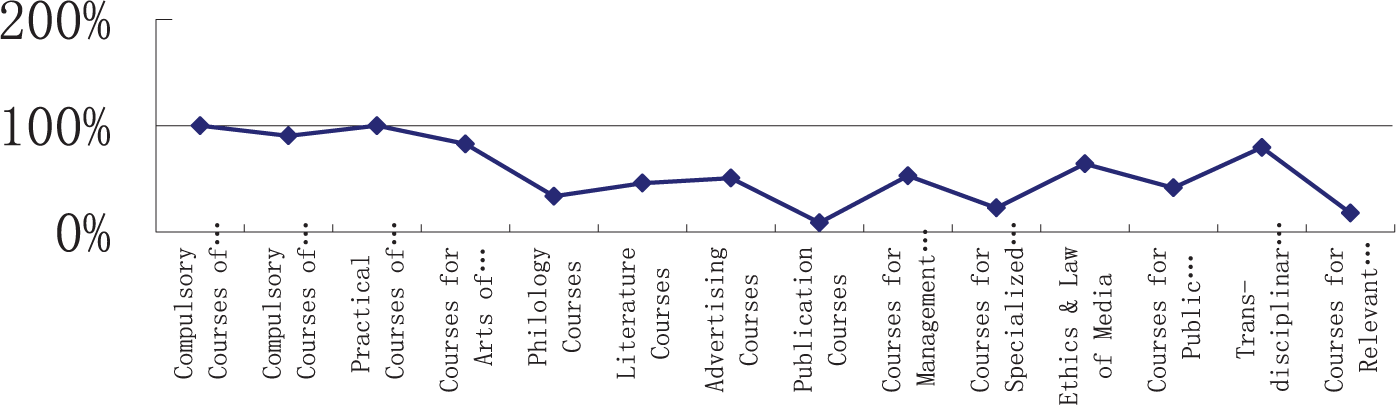
Average level.
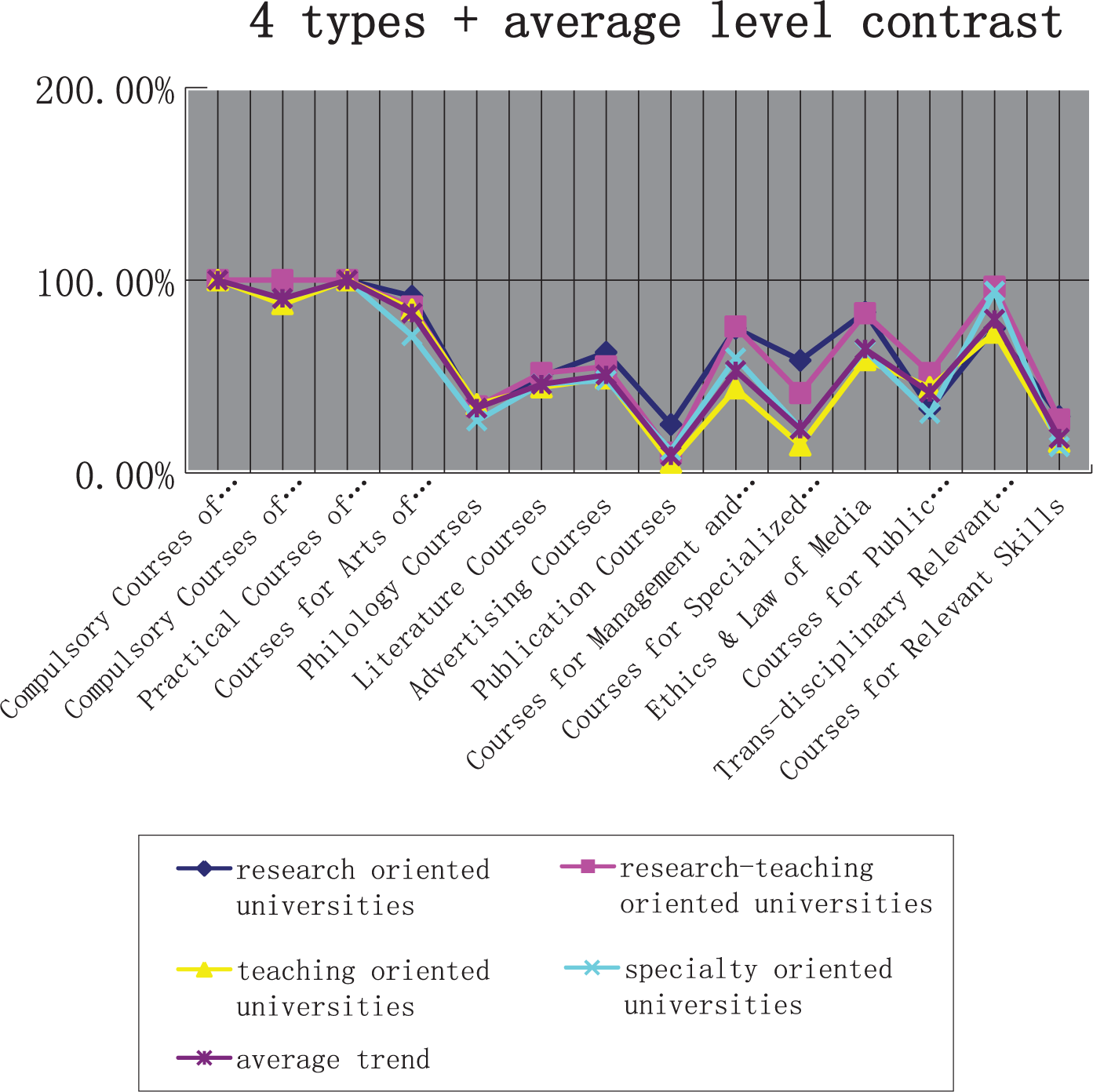
How the different categories of PRC universities (teaching journalism) compare across subjects.
Discussion
Overall, the journalism programs across the 274 PRC universities analyzed look quite similar to those in Australia of 2005, the United Kingdom of 2014, and the outcomes and expectations in Europe and the United States of 2010, except for the presence of instruction in a major foreign language, namely, English. On average, more than a fifth, 22%, of programs at PRC universities offered specialized subjects in “specialized English for journalism” but the figure is much higher at Type 1 (research-intensive) universities at 58.33% than research teaching universities at 41.38%, 23.08% at specialized universities, and the large number of teaching only universities that show only 14.20%. This reflects the current extent of internationalization within the PRC. Competency for journalists in any foreign language was not a requirement anywhere in Europe, the United States, the United Kingdom, or Australia. While the figure in China is much higher than elsewhere, the average is still regarded by Chinese academics as low and weak, and deserving more attention.
Summary of PRC University Programs in Descending Order of Frequency.
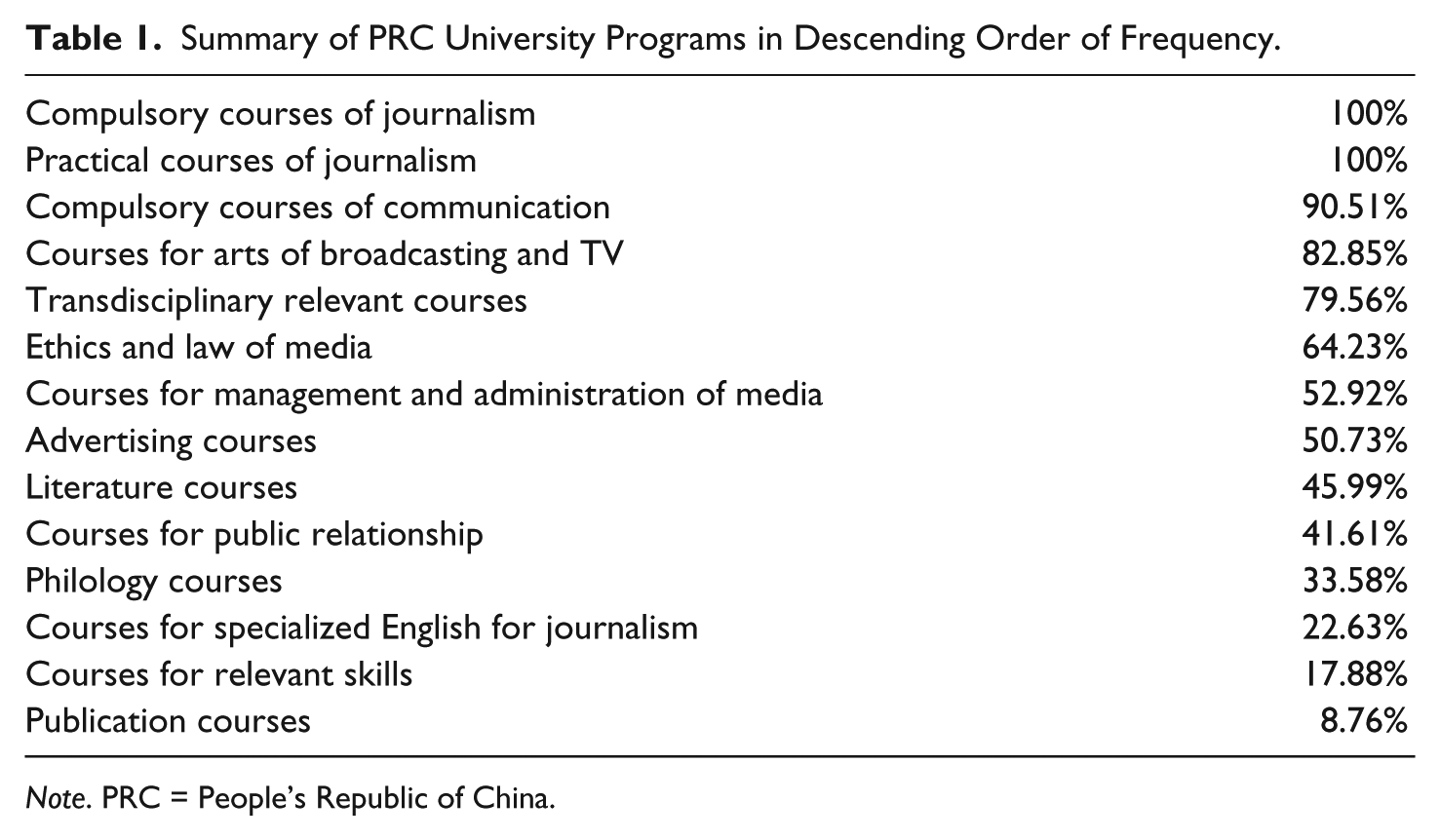
Note. PRC = People’s Republic of China.
More generally, research-intensive (Type 1) universities appear to have sought a balance between disciplinary integrity (theory) and the requirements of the overall employment market (practice). The presence of practical subjects such as publication and public relations, and the internationalizing effect of practical teaching of specialist English for journalism, enhances graduate employability both domestically and internationally while graduates also exit with strong theoretical backgrounds in mass communication theory and studies in society. Research teaching (Type 2) universities pay more attention to the employment market; their courses are more practical and fewer focus on theoretical integrity of the journalism discipline. At the same time, Type 2 universities appear to integrate journalism studies with interdisciplinary resources across the whole university. Teaching only (Type 3) and specialist (Type 4) universities are comparatively newer to journalism and face shortages of interdisciplinary resources, which often lead to the use of transdisciplinary courses or very tight specializing such as the teaching of “Sports News Reporting” at the Sport University. Both Type 3 and Type 4 universities display a low level of teaching English for journalism, which suggests lower internationalization and graduate mobility.
Conclusion and Recommendations
The first conclusion is that data collected in this study strongly suggests that Chinese journalism curricula in general contain both sets of major ingredients, which are present in one of the European, the U.K., or the U.S. professional model but not all, and the gap identified by earlier researchers (Cokley et al., 2013) is not as evident in the PRC.
Our cross-cultural team, mostly based in the PRC, is in a position to suggest that, unlike the past, PRC government policies and the political ideology of the 21st century do not play an important role in Chinese journalism education. On the contrary, with the continuing of opening up and economic reform, Chinese journalism educators show evidence of thinking more along European lines—emphasizing the social function of the media, and how the media contribute to the construction and the development of society as a whole. But they also show evidence of U.S.-style thinking—such as journalism as monitor of the government, journalism as a tool to ensure social equity and justice, and journalism as a weapon to combat corruption. Evidence for this is drawn from the high frequency (52.92%) of courses for Management and Administration of Media, and the emergence of public relations courses.
The second conclusion is that external language learning—studies of specialist English for journalists—are moderately to highly prevalent in the PRC but external language learning, especially of Chinese, was not detected at all in the European, U.S., U.K., or Australian models. There was no evidence that the European, U.S., U.K., or Australian models emphasized any external language learning, despite ample evidence that Spanish, Hindi, and Arabic, for instance, now challenge English for prevalence and influence in major world growth markets for journalism.
Even outside journalism, all Chinese universities offer English as a compulsory subject, no matter what the major, and thus learning specialized English for Journalism appears to students to be at best logical and natural, at worst not a burden. This is especially the case in research-intensive (Type 1) universities, where programs provide international English-speaking teachers. In most Chinese universities, however, specialized English for Journalism subjects are taught by Chinese staff rather than native English speakers.
The general conclusion is that the lack of the conceptual gap in PRC journalism graduates, coupled with the accent on learning specialized English for journalism, suggests further that PRC journalism graduates will be more internationally employable and thus exhibit greater capacity for international mobility than their Western counterparts. This suggests that the future trade balance for journalism services will be weighted in favor of the PRC and that, if these features go unaddressed in the West, this will restrict international opportunities for graduates from Australia, the United States, the United Kingdom, and European countries.
Limitations and Suggestions for Further Study
Further attention needs to be paid to the graduates of each journalism program to establish whether or not mobility takes place or is even sought after.
Footnotes
Declaration of Conflicting Interests
The author(s) declared no potential conflicts of interest with respect to the research, authorship, and/or publication of this article.
Funding
The author(s) received no financial support for the research, authorship, and/or publication of this article.
