







Abstract
This study examines the effectiveness of a race and reporting course–based student journalism project, a partnership between a university and a national media outlet, which aimed to center the concerns of young voters during the 2020 presidential election and expand training of student journalists. This qualitative study explains how student journalists’ training in intersectional reporting helped them to produce complex stories about diverse young voters’ presidential election concerns during one of the most unique presidential elections in American history—one held during a global health pandemic and on the heels of a racial justice uprising.
George Floyd’s lynching by a White police officer ignited a global reckoning on race and pushed young people onto the streets to protest in summer 2020. In the fall, some young people carried their rage to the polls and voted to create change during the 2020 presidential election. The issues that pushed young voters to the polls included the more than 232,000 people who died of COVID-19 by Election Day because of an uncoordinated government response. Four years of Islamophobic and xenophobic policies that put kids in cages and separated them from their families propelled others to vote. Every 4 years, pundits declare the presidential election as the election of a lifetime. The 2020 presidential election truly was historic. It was on the heels of a racial justice movement and during a deadly pandemic that caused an extreme economic recession.
Nothing about the 2020 presidential election was typical but one thing was familiar—the obligatory youth vote story. At every presidential election, seasoned reporters interview younger people about issues that concern them, their motivation for voting, and why their demographic has traditionally low voter turnout. Stories often frame young voters as shallow and apathetic. The young voters who are interviewed are typically White, middle class, and heterosexual—making young White people the default voice for all young voters. Most reporters are White and they tend to use White sources at a higher rate than journalists of color (Owens, 2008).
Monolithic reporting systems that operated during the Trump years meant that even more context was needed during an era when truth was stigmatized and racism was normalized. Journalism failed to provide context in news reports during the Trump presidential years (Gutsche, 2022). With the Vision 2020: Election Stories from the Next Generation project, we aimed to center and contextualize the concerns of diverse young voters and use student journalists enrolled in an advanced race and reporting class to produce the stories. The stories were published by The Nation magazine in fall 2020, before the election (Table 1). During this semester-long project in an advanced-level journalism course in spring 2020, students and the director produced 10 bylined stories about young diverse voters’ concerns. The stories were published on The Nation’s website alongside others written by professional journalists. The project earned almost 42,000 views. This is a qualitative study that examines the effectiveness of this newsroom and classroom collaboration. Students were required to produce a long-form narrative journalism story about young people’s 2020 election concerns as a requirement for the course and that story was later published by The Nation. This study can serve as a blueprint for how such a collaboration was formed and can be replicated. Moreover, this study informs journalism educators and the industry of the importance of decentering whiteness in journalism practices and decolonizing journalism education as the nation becomes more diverse. Journalism practitioners can learn the benefits of newsroom and classroom journalism collaborations and how they can utilize the expertise and labor of student journalists while newsrooms struggle with decreasing staffs.
“Vision 2020: Election Stories From the Next Generation” Project in Partnership With The Nation Magazine—10 Bylined Stories About Young Diverse Voters’ Concerns.
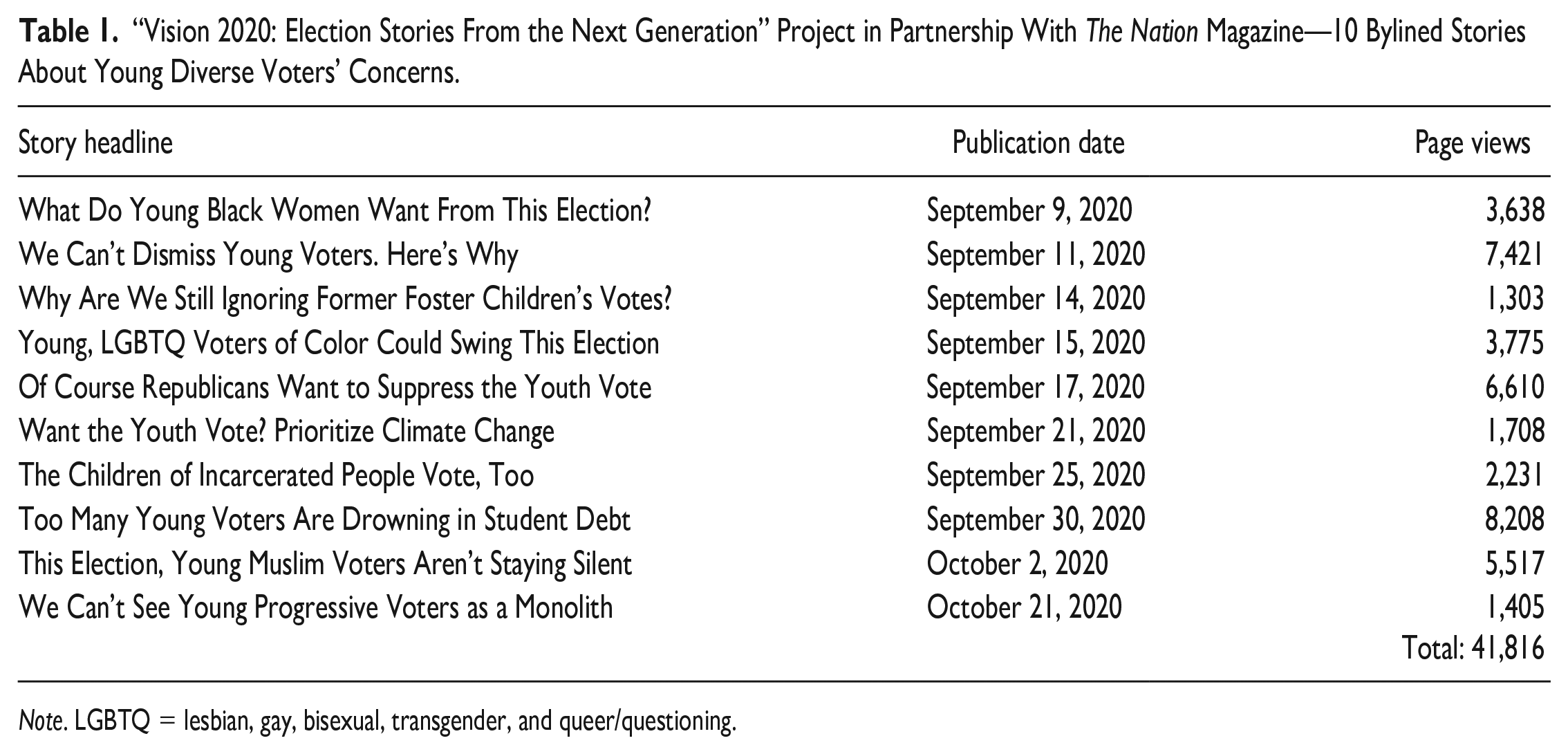
Note. LGBTQ = lesbian, gay, bisexual, transgender, and queer/questioning.
Literature Review
This literature review will explore three areas: younger voters, practice-based learning, and whiteness in journalism and journalism education. This project explores a student journalism project partnership that focused on diverse young voters’ election concerns during the 2020 presidential election. Therefore, it is necessary to review how younger voters are typically represented in journalism. Moreover, this research article examines a college classroom and professional newsroom partnership, so literature on practice-based learning is reviewed. Finally, understanding whiteness as the default in journalism and journalism education is essential to understand why decolonizing journalism education is imperative.
Young Voters
Younger voters’ concerns are often overlooked in presidential debates, campaign ads, and television news (Bystrom & Dimitrova, 2007). Researchers found that one core reason why young people do not vote at higher rates is because they do not have information that educates them as voters (Kaid et al., 2007). That research team developed the concept of political information efficacy—how voters interpret information about politics differently depending on the source of information and processing political information has an impact on young people’s belief in their ability to participate in elections (Kaid et al., 2007). Political journalism that connects with young voters is important because they are news consumers. The majority of young Americans aged 16 to 40 years, 79%, receive the news every day and 71% do so through social media; moreover, a mere 32% of them “enjoyed following the news” (Bauder, 2022). Younger voters played an important role in the 2020 presidential election. Generation Z, people born after 1996, comprised 1 in 10 eligible voters in 2020 (Parker & Igielnik, 2020). Young voters’ participation increased historically during the 2020 presidential election. About 50% of people aged 18 to 29 years voted in 2020, up from 39% during the 2016 election; moreover, that is the highest youth voter rate since the voting age was decreased to 18 years in 1971, according to the Center for Information and Research on Civic Learning & Engagement at Tufts University (CIRCLE, 2020). Young voters of color aged 18 to 29 years fueled Biden’s 2020 presidential win. The majority of young Black voters, 87%, voted for Biden; 83% of Asians, 73% of Latinos, and 51% of young White voters cast a ballot for Biden (CIRCLE, 2020). Generation Z is the most racially diverse American generation (Parker & Igielnik, 2020). The nation’s youngest voting generation also believes that the government should play a greater role in addressing social issues; 70% of Generation Zers said that the government should do more to solve Americans’ problems (Parker & Igielnik, 2020). The demographic characteristics of Generation Z make it crucial to have political journalism that appeals to them. Moreover, political journalism that explores generational angles and concerns is necessary for future generations of young voters. Broadcast news stories that concentrate on political issues and not political candidates resonate with young voters more (Bystrom & Dimitrova, 2007). The type of political coverage and the tenor of it may affect young voters (Meuller & Reichert, 2009). The Vision 2020 project aimed to move youth-oriented election stories beyond individuals and parties and emphasize the issues that young voters prioritized during the 2020 presidential election.
Practice-Based Learning
Courses that focus on community reporting, including marginalized racial groups, can help students learn to prioritize everyday people and their perspectives into journalism. When students participate in journalism projects that center marginalized racial identities, they learn the pedagogy of counter-news-story and produce news stories that counter and avoid typical mainstream news media stereotyping and framing of racial groups (Alemán, 2014b; Alemán & Alemán, 2016b). Community reporting and public affairs journalism require the voices of community members and officials (Mourão et al., 2021). However, in traditional American journalism, mainstream sources monopolize news and most of those sources are men who are officials; moreover, Asian and Black Americans are rarely used as expert news sources (Berkowitz, 2009). In a study about the effectiveness of an issue-focused college journalism course, researchers found that, when students interacted with communities, their stories had more nuance and substance (Mourão et al., 2021). Moreover, when students were instructed to focus their reporting on a single issue, the stories had more depth and context (Mourão et al., 2021).
When college students are enrolled in courses that require them to critically examine journalism, they become more conscientious about journalism content. Critical media literacy projects help students learn about stereotypes and political economy issues in journalism; moreover, this type of teaching enables professors to reveal economic and power dynamics in stories that students must be aware of besides standard fact checking (Friesem, 2019). When college students can participate in a class-based news fellowship with a professional newsroom, they gain a way to advance their careers. Such collaborations between universities and newsrooms can produce more chances for students of color to gain professional reporting experience from national newsrooms (Williams, 2021a). Journalism projects involving students can teach the news industry and education the benefits of collaborative journalism (Gutsche et al., 2017). Moreover, college and newsroom partnerships can be leveraged to highlight generational angles in stories (Williams, 2021a). A 2018 university and newsroom partnership with The Nation used Black journalism students to produce news stories about Black college students’ experiences; Black on Campus, helped students get solid journalism experience early in their careers and helped them get internships and jobs at national media outlets including CNN, The Washington Post, and The Wall Street Journal (Williams, 2021a).
Whiteness in Journalism
Whiteness dominates journalism because it is erected on a system that assumes that whiteness is neutral (Budarick, 2022). Whiteness is embedded in journalism through an abundance of White practitioners, the outlook they have, and how news is gathered and presented (Alemán, 2014a). Journalists’ analysis of information, worldview, and how they present facts to the audience can make the omission of racial minorities in the news normal (Aujla-Sidhu, 2022). Even journalism’s core tenet, objectivity, consistently mirrors “the racial hierarchy of society” (Budarick, 2022). The idea of objectivity in journalism purports that reporters operate external to the world of systemic racism, and that blocks the news media from acknowledging the racism that it upholds and perpetuates; moreover, journalism rarely acknowledges that it is rooted in racist structures and a social racial hierarchy (Budarick, 2022). Journalists of color also reflect whiteness (Alemán, 2014a). The writing of Black American reporters who worked at a large mainstream daily newspaper sometimes mirrored the “hegemony of whiteness” in coverage of people of color (Pritchard & Stonbely, 2007). However, the journalism industry knows that racial diversity in its ranks and coverage is an issue. The Society of Professional Journalists (SPJ) Code of Ethics says that journalists should “Boldly tell the story of the diversity and magnitude of the human experience. Seek sources whose voices we seldom hear”; and “Avoid stereotyping. Journalists should examine the ways their values and experiences may shape their reporting” (SPJ, 2014). Journalism plays a powerful role in helping the public comprehend racism and inequity (Aujla-Sidhu, 2022). Therefore, recognizing and rectifying how whiteness is centered in journalism and journalism education is necessary.
Decolonizing Journalism Education
Journalism education fails to adequately teach students about racism in the industry in the ranks and news coverage; moreover, journalism schools do not sufficiently teach students to report on marginalized communities. There is a “hegemonic maintenance of white supremacy in journalism classrooms” (Gutsche, 2022). Journalism education can unwittingly uphold stereotypes and racist ideas by mirroring journalism industry practices (Aujla-Sidhu, 2022). Journalism schools perpetuate whiteness and a view that invisibilizes the perspectives of people of color (Alemán, 2014a). Journalism education must be decolonized. That means to “decenter white identity and systems of knowledge production” (Aujla-Sidhu, 2022). Most journalism educators are White, they were trained by mostly White professors and they train mostly White students who will become journalists who will not have the skills to adequately report on communities of color because they have not been properly trained to do so (Alemán, 2014a). Just as there are concerns about the lack of racial diversity in journalism, the academy knows that journalism education needs to be diverse. The inclusion of diversity in journalism curriculums for academic accreditation became a requirement in the early 1990s (Wilkinson et al., 2020). However, 30 years later, substantive diversity is still lacking in news pedagogy. Journalism education does not interrogate White identity or whiteness, the power that it possesses and how that lack of understanding impedes journalists’ ability to reflect the reality of racial minorities (Alemán, 2014a). Journalism curricula must analyze “structural and systemic racism”; moreover, journalism education must teach how oppression works in society and how journalism upholds it (Aujla-Sidhu, 2022). A journalism pedagogy that analyzes whiteness and incorporates ethnic studies can improve journalism students’ education and eventually reform journalism’s representations of marginalized people (Aujla-Sidhu, 2022).
Journalism education is critical because it lays a foundation for the issues that journalists cover, how they cover them, and the priority they place on issues. Journalism education is the primary way that entry-level reporters learn about the field (Broersma & Singer, 2021). Journalism education is important because it shapes the disposition and expertise of future journalists (Josephi, 2009). Scholar Jean Chalaby asserts that journalism is “an Anglo American invention” and White American and British journalists were empowered to create modern journalism because of the global dominance of the English language and Anglo-Saxons (Chalaby, 1996). The whiteness embedded in journalism and journalism education is ripe for examination. Because of journalism’s White Anglo-Saxon roots, it is crucial to interrogate its practices and its ability to produce stories about racial inequality with the time, focus, care, and consistency they deserve. The historic Kerner Commission report published in 1968 found that “The world that television and newspapers offer to their Black audiences is almost totally white, in both appearance and attitude” and that hiring more Black reporters could ensure fairness in news coverage of all of America (Zelizer, 2016). During the 50th anniversary of the Kerner Commission report, researchers found that many of the journalism industry goals to diversify newsrooms failed and journalists of color who covered racial issues did not always have the autonomy to incorporate community perspectives into their reports (Lamb & Byerly, 2019). Most newsroom employees are White, 77%, seven out of 10 journalists, are younger than age 50 years and there is more racial and gender diversity among them (Grieco, 2018). The fact that young journalists are the majority in newsrooms underscores the importance of journalism education. It is critical for journalism students to have an education that equips them to write about race through a systems deficit lens and not a people deficit lens that often upholds racial stereotypes through journalism. Journalism students need to learn to become critical thinkers who can produce intersectional stories that acknowledge how systemic discrimination, race, gender, class, religion, region, sexual identity, ability, and other identity categories affect Americans’ lives. Journalism education must evolve and make racial equality a priority (Williams, 2021a). Journalism is “intrinsically tied to democracy” (Wahl-Jorgensen & Hanitzsch, 2009). If that is the case, then journalism education must prioritize writing about race as race continues to shape every facet of 21st-century life. Journalism also has a gender problem. Globally, journalism is dominated by men and, despite the increase of women in the profession, women still do not occupy leadership positions or the ranks at the same level as men; moreover, journalism has a professional culture that is patriarchal and patriarchy is reflected in news media representations (Lobo et al., 2017).
Journalism education should interrogate power structures in society and the profession. Mainstream journalism is corporate and upholds the structure and power of capitalism (Barnhurst & Nerone, 2009). Moreover, corporate ownership of news media in the United States contributes to polarization in journalism (Trevisan et al., 2018). Teaching journalism students to connect politics with their lived experience and understand the potential impact of their work can help students better comprehend how to advance and reimagine political reporting (Mourão et al., 2021). As entry-level reporters enter newsrooms, they can challenge traditional practices and ideologies and attempt to substitute them for other methods, but they will face resistance and become marginalized in the newsroom (Broersma & Singer, 2021). The exclusion of diverse sources is a consistent and systemic problem in journalism and journalism schools bear some of that responsibility because their curricula stress relying on traditional official sources to bolster the credibility of their stories (Wahl-Jorgensen & Hanitzsch, 2009). Journalism is perceived as an extremely influential force that affects Americans’ identity and their relationship to politicians and government (Wahl-Jorgensen & Hanitzsch, 2009). Therefore, it is crucial for journalism education to instruct students to report accurately on all Americans. The importance of journalism’s influence in politics, the need for diversity and inclusion in journalism education, and the lack of reporting on race leads to the following research question to investigate the Vision 2020: Election Stories from the Next Generation project:
Method
This qualitative study utilizes in-depth interviews as its core research method. Student journalists who were enrolled in the graduate-level race and reporting class and participated in the Vision 2020 journalism project and two fellows chosen by The Nation from other universities were interviewed, a total of eight, by the researcher to gain insight into the project. However, 10 students participated in the project: four Black women, one nonbinary student who is Black, one woman of Middle Eastern North African descent, one Latina, one Latino, one White woman, and one White man. Five were graduate students and five were undergraduate students. Students were asked about the effectiveness of training on race and reporting and the news partnership. In-depth interviews were chosen as the method for this study because they seek “a deep understanding of what people are doing and thinking, and why” (Roller & Lavrakas, 2015). In-depth interviews also “obtain intricate knowledge from a small number of members in a target population” (Roller & Lavrakas, 2015). In-depth interviews help researchers interrogate the “how” and “why” behind the interviewees’ experiences (Guest et al., 2017). In-depth interviews position researchers to comprehend the “lived experience” of interviewees and they force the researcher to focus on and listen to the interviewee whose answers are the primary data (Hesse-Biber, 2007). All of the interviews were transcribed and coded into major themes. I also administered a seven-question Likert-type scale survey about the partnership and the course (Figure 1). The eight interviews were conducted by phone and Zoom. This research project was approved by the institutional review board at my university. I, the author of this study and the professor for the class, conducted the interviews. There were no concerns that respondents offered favorable responses. Participants’ involvement was voluntary. Two students who were enrolled in the class and earned bylines did not respond to requests for an interview. I acknowledge my position as the professor for the class, the director of the project, and the chief collaborator with the magazine. I believe that my experience doing other collaborations with national media partners, teaching journalism courses, and working as a full-time reporter helped me design a study that could critically examine this multicultural political student journalism project.
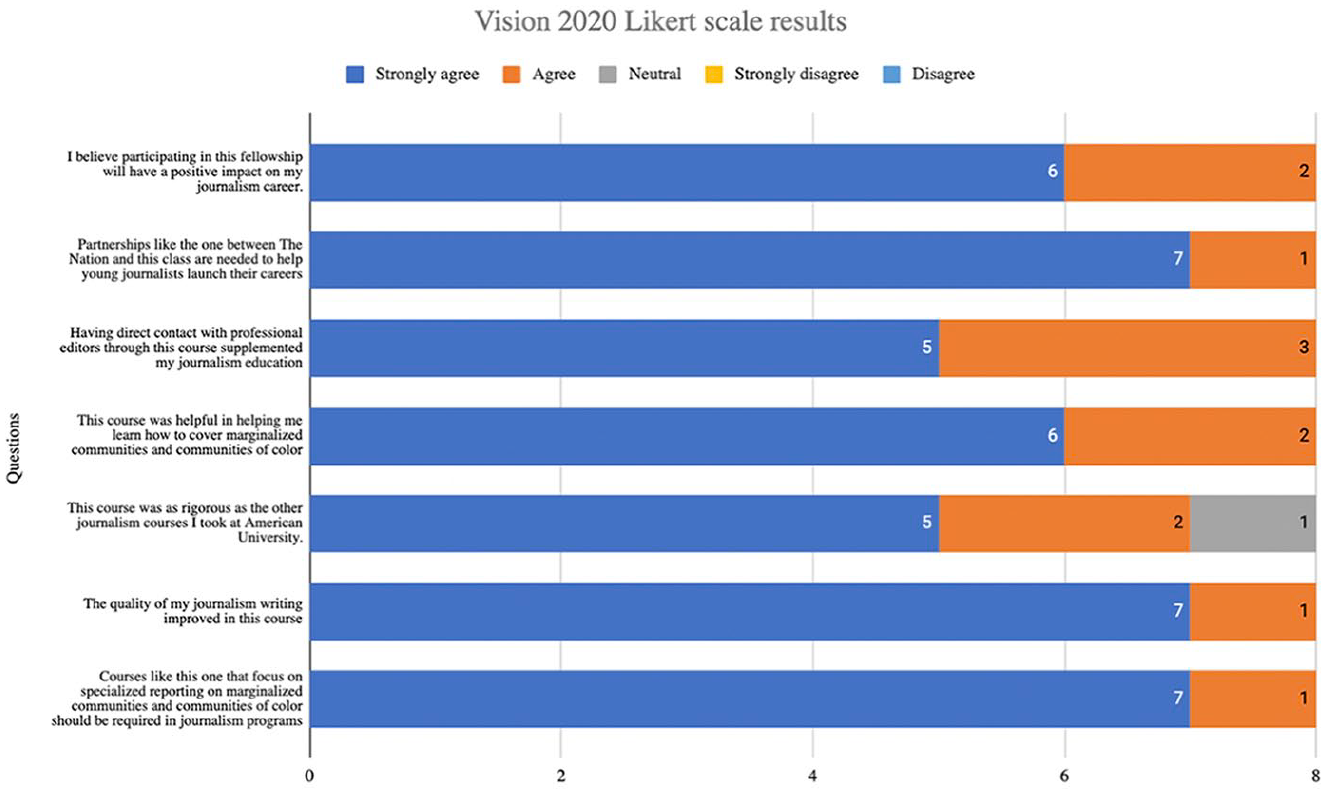
Vision 2020 Likert-Type Scale Results.
Results/Themes
This research explored the core question of how this project trained students in race and reporting and offered them professional development through a news partnership with a magazine. As part of the course, students who met deadlines and requirements for the course had their final story edited and published by the magazine. For this study, student journalists were asked whether their classroom training properly prepared them to produce stories about race and inequity; moreover, they were asked about the importance of training on race and reporting. I also asked how The Nation magazine partnership enriched students’ professional development. Finally, the COVID-19 pandemic erupted during this course. Students were asked how virtual learning and reporting affected their ability to learn. The data show that undergraduate and graduate journalism students believed the class trained them to write about race and learn about inequities in journalism and it should be required. Moreover, students thought that the collaboration between their class and the magazine bolstered their training. Moreover, they believed news industry and education collaborations are beneficial for students.
The Course
The spring 2020 semester was the second time that I taught COMM 588 Race, Ethnic, and Community Reporting. The Vision 2020 project was the first time such a newsroom partnership operated in this course. This unique partnership with The Nation is built on a relationship I had with the magazine after doing a similar project, Black on Campus, with The Nation in 2018. After that successful project, an editor from the magazine approached me to do another project together. I agreed only under the condition that I could operate it out of the class that I already teach because these projects are labor intensive. This classroom and newsroom partnership with The Nation was a one-time collaboration that I incorporated into the curriculum for that semester only. However, I extended my experience and expertise with classroom and newsroom partnerships and entered into a similar collaboration with Teen Vogue in the next year for the project, Racial Reckoning: A Year After a Movement Rocked the Nation. Teen Vogue published five stories by students enrolled in the spring 2021 class at the end of May, coinciding with the 1-year anniversary of George Floyd’s killing that sparked the summer 2020 racial justice uprising.
The spring 2020 course operated as a class and a news fellowship. There were 13 students in the class. The Nation, which already has a commitment to developing young journalists, wanted more students than those in my class to benefit from the partnership, so they put out a national call for fellows from other schools to participate. The Nation chose four fellows based on students’ experience, interest, and a written essay. Some students in the class and two fellows did not get stories published for various reasons, including missing deadlines and classes. Seven students from the class and two students chosen by The Nation, one from the University of Kansas and one from Syracuse University, produced stories for the Vision 2020 project. I met with all students weekly. My class was initially held in person on Mondays (before the pandemic erupted) and I met virtually with fellows chosen by The Nation on Fridays.
The advanced race and reporting course has two primary goals. One is to equip students with the skills to become more ethical and inclusive journalists by learning techniques and strategies to cover marginalized communities. The other is to provide students with theories, concepts, and terms that enhance understanding of how power operates and how that is reflected in news media portrayals. One of students’ first required reading assignments was Mapping the Margins: Intersectionality, Identity Politics and Violence Against Women of Color, by Kimbele Crenshaw; Heteropatriarchy and the Three Pillars of White Supremacy, by Andrea Smith, and Race and Gender Aren’t a 2020 Story—They’re the Story, by Errin Haines. That was to ensure that students clearly understood intersectionality, White supremacy, global systems of oppression, and how they are related to journalism representations. Throughout the semester, students were assigned readings about race and reporting, including A Journalist’s Guide to Culture & Context, by Sue Ellen Christian, and the Kerner Commission Report chapter, The Media and Disorders, to understand the failures of the news industry to properly cover marginalized communities. Moreover, students were required to read and analyze stories that embodied the best and worst practices on race and reporting. Most importantly, the class was structured to help students understand that they can produce substantive stories about race and inequality on any beat.
The students’ first assignment was a beat proposal where they explained the beat about a marginalized community that they wanted to cover, whether it was geographical or demographical. The beat must encompass people and issues that are in the margins of society and rarely given coverage in mainstream media and worthy of news coverage. Students were required to produce the following stories throughout the semester: news, business/economic policy, personality profile, and enterprise story. The enterprise story is one that students worked on throughout the semester and was included in the Vision 2020 project. Their second assignment was the enterprise story memo assignment that required them to develop their story for the Vision 2020 project, including the story idea, its significance, and potential sources. I helped students develop their stories throughout the semester and I approved their ideas. The professional partner virtually visited the class once at the beginning of the semester and discussed producing journalism through an intersectional and political lens. Moreover, he explained the magazine’s writing and reporting styles and expectations for writers. During the semester, the students enrolled in the class had a story due every other week for the class. The other week, students were required to submit a summary of an interview that they conducted for the enterprise story. Students were required to complete five interviews for the enterprise story for The Nation by early April. The course was designed for students to use the entire month of April to write the enterprise story. They wrote three drafts and improved on each one. The final version of the story was sent to The Nation. During the summer, the Student Nation editor worked closely with each student on a one-on-one basis and walked them through the magazine’s fact-checking process. After that process was completed, students’ stories were published on The Nation’s website alongside professional journalists’ stories.
Training on Race Reporting and Writing
Students in the advanced race and reporting class said that learning to report on race and improve their writing were among the major benefits of the class. All of them said that such a class should be required. Assignments that analyzed the worst examples of reporting about race produced by professionals were among some of the most helpful, said Emily, a graduate student: “I thought that was often very useful to see how that was done in practice . . . I thought one thing that was really interesting was some of the projects that tried to report on whiteness and often fell short.” Those assignments helped students learn to avoid mistakes that professionals made. Michelle, a graduate student, said readings on whiteness, White supremacy, and how both are embedded into journalism helped her understand to not center whiteness in storytelling: “The way that colonialism affects writing, and the ways that like white supremacy affects traditional media . . . That really challenged me to consider the ways that even like white supremacy affects advocacy in truth telling and telling people’s stories.” Readings about race and reporting, including the media section of the 1968 Kerner Commission Report and the New York Times’s 1619 Project, helped students understand the role race plays in journalism, Emily said.
In-person learning experiences that students had before the pandemic also enriched their learning, they said. Students attended the Racial Justice Summit and Congressional Briefing: Addressing the Intersects of Gender, Health, Economics, Violence, and Race at the Rayburn House Office Building in Washington, D.C., in February 2020, where they learned about legislation that addressed institutional discrimination. The following week, Breanna Edwards, former Essence magazine editor of news, politics, and issues, visited the class to discuss journalism, politics, gender, and race. Peter Rothberg, The Nation’s associate publisher and editor of special projects, visited the class virtually to discuss the project. Nina, an undergraduate student, said the summit introduced her to experts who she later used as sources. Michelle, a graduate student, said she gained the most from the Essence editor’s class visit and attending the summit because she was able to “apply in real time” class lessons and ask experts and stakeholders questions.
The newsroom-style operation of the class was especially beneficial, students said. Students said the course was as rigorous as their other journalism courses and the quality of their writing improved in this class. Terry said the course emulated “real-world experience,” with the professor serving as a constant editor along with later interaction with editors from The Nation. Kesha, a graduate student and Vision 2020 fellow chosen by The Nation who attended a top journalism school on the East Coast, said the training that she received during the weekly virtual meetings with the professor/director was the first honest, professional critique she received: “I think the standards for my journalism courses were kind of based on where we were . . . Vision 2020, I think it was more about where we could go.” Courtney said the course included essential lessons for contemporary reporters and it should be required, “It shouldn’t be an option writing about race . . . Some of the people in our program needed to be in that class.”
Students learned to report on marginalized communities through a systems-deficit lens instead of a people-deficit lens. Students were taught to see the resources and value in marginalized communities, starting with the people. I stressed lived experience as a legitimate source of knowledge that was essential and required for every story. I challenged students to view people as experts on their own experience and shift their thinking to see real people who are directly affected by an issue as a lived experience expert. Emily, a graduate student, said, “It (the class) impacted who I looked to for sources and encouraged me to look for more diverse sources among experts, but also have a broader understanding of what counted as expertise.” Learning about the role of race in journalism affirmed Black students’ commitment to journalism. Kesha said what she learned underscored the importance of being a Black journalist and producing stories that amplify narratives and perspectives that are rare in journalism. Courtney said learning about institutional racism in news shifted her career goals:
I think I want to climb higher—go into a managerial position, maybe, so that I can be in a position to really bring more reporters like me on. . . because we’re the ones that tell these stories the best.
Media Partnerships Develop Students
All students said that news partnerships similar to this one can help young journalists launch their careers and the partnership elevated the course. All students said that being published by The Nation positively affected their careers. “Being able to have that kind of byline really does just grab people’s attention and it kind of speaks for itself. It definitely helped with imposter syndrome,” Michelle said. Courtney agreed that being published by The Nation gave her more faith in her skills, especially when she applied for jobs, “It just gave me a different sense of confidence that I don’t know if I would have had otherwise.” Amira said she sometimes felt coddled in other journalism classes but the news partnership gave her a boost, “When we were able to work on something beyond the classroom that kind of showed me that I can do this.” Emily said the news partnership was “confidence-boosting” and having her work published by The Nation gave her credibility as a writer. Kesha said the story that she produced for The Nation helped her get a job as a television news producer after graduation; moreover, the fellowship gave her skills and courage to be a competitive journalist. “I can write anything if I really, really want to. . . To this date, I still think it’s my best work.” All of the students said that interacting with professional editors supplemented their education. Terry said going through The Nation’s fact-checking process proved how important it is “for me to do my own fact check” and not just rely on editors. Moreover, Terry said the news partnership gave them the confidence to pitch to other newsrooms. After the course, Terry pitched a related story to a national media outlet that was nominated for a GLAAD award. Courtney’s interaction with The Nation editors led to more work with the magazine. She was invited to contribute to a package about what president-elect Joe Biden should prioritize during his first 100 days in office. Students said the class and news partnership were beneficial; however, both were rigorous and required a heavy time investment. Some students said they wanted more time, perhaps two semesters, to learn about race and reporting and participate in an in-class news partnership. “I always felt like I still didn’t have enough time,” Kesha said. However, students carried the lessons learned in the class into newsrooms. After graduation, Courtney got a newspaper reporting job covering a rural, Southern, racially diverse community: “People in my newsroom have been kind of impressed because you have extra training that they don’t have. . . So, I already came with skills I needed to cover these communities.”
Pandemic-Era Learning
When I planned the news partnership component of the class, keeping up with a contentious and complex election was perhaps the biggest anticipated challenge. However, the global COVID-19 pandemic was declared a national emergency in the United States in March 2020 during the middle of the semester and thrust the world into lockdown. Two months later, a racial justice uprising sparked by a widely circulated video of a White police officer fatally choking an unarmed Black man, Floyd, forced the world to reckon with race. The unpredictable racial reckoning and pandemic presented challenges for the class, especially learning during the COVID-19 pandemic that eventually killed 6.8 million people worldwide and more than 1 million in the United States. The university sent students a notice during spring break notifying them that classes would be held virtually and dormitories would close. Our journalism department strongly suggested that students follow CDC and local health protocols, which often meant reporting virtually, by phone, or maintaining social distance and wearing personal protective gear during in-person reporting. We wanted our students to be safe.
The class was structured for students to have most of the interviews and reporting for the story completed in March, so that they would have the entire month of April to write the story. Emily said that front-loading the first half of the semester with assignments related to the final story was an advantage. “I had already met a number of sources in person who I then called and talked about how the pandemic was affecting them. . . But I think it (the pandemic) made some of the community reporting aspects harder.” Some of the curve balls that come with journalism, sources missing interviews or being completely ghosted by sources, were exacerbated during the pandemic, Kesha said. It was especially difficult to schedule interviews with lived experience experts who prioritized adjusting to pandemic life and not talking to reporters, Nina said. The immediate shift to virtual reporting and learning was challenging for some. “I struggled with the online format it was very easy to get distracted, especially since I was living at home with my three other sisters,” Amira said. Virtual learning was difficult and made it harder to “prioritize the class,” Courtney said. Some students said having more screen time was challenging. However, transferring the class online and being on lockdown gave Terry more time to work: “I was able to research more, and to learn more. . . I had more time to do this.” Some students also felt the impact of the pandemic personally. Kesha said people in her household were dramatically affected by COVID and she, as a Black woman, felt intense racial trauma during the summer 2020 racial uprisings and that made it difficult to work: “There was the actual pandemic. And then there was a lot of death. A lot of racial injustice. Just a lot of layers, a lot of weight that I was feeling . . . it was a dark space for me.”
Although the class ended in early May and students’ stories were completed, the project was not set to publish until September before election day. The pandemic and racial reckoning forced some students to update their stories after the class ended. Courtney, who wrote about young Black women voters, had to update her story after Kamala Harris became the first Black and South Asian woman to become a vice presidential nominee. Michelle, who wrote about criminal justice, reshifted her story because the genesis of the racial reckoning was fatal police brutality. Learning and writing during a pandemic presented challenges for students that they rose above to create solid, intersectional journalism.
Discussion and Conclusion
Journalism’s reporting ranks are dominated by young people and many of them do not remain in the profession long (Josephi & Alonso, 2021). Many newsrooms have high reporter turnover rates and newsrooms have a small number of experienced reporters who are outnumbered by younger inexperienced reporters (Josephi & Alonso, 2021). This makes journalism education crucial. If younger journalists eclipse older journalists in newsrooms, it is imperative that they receive training in journalism school that prepares them to cover a demographically shifting nation with a complex history of institutional White supremacy, heteropatriarchy, and classism. Political journalism training in particular must train reporters to produce journalism that goes beyond reporting on the two dominant political parties and interrogate issues that affect all citizens in different ways. Researchers found that presidential political news coverage is dangerously monolithic because of the “Trumpification of election reporting,” partisan media, and the corporatization of news, which all challenge journalism standards and journalists’ ability to hold the powerful accountable (Cushion & Thomas, 2018). Political and news reporting are influential. Legislators often use news representations of incarcerated Black people to stir racial fears (Williams, 2021b). Therefore, it is imperative for journalism educators to shift lessons on political journalism reporting to be inclusive and intersectional.
Most of the students who enroll in the advanced race and reporting class are students of color, working class students, queer students, or others who possess marginalized identities. The news fellowship in the class gave them professional development and publication opportunities without facing systemic barriers. Racial diversity among journalists in mainstream American newsrooms is still low today and the lived experience of diverse reporters is extremely crucial now to help contextualize the world for readers (Williams, 2021a). Moreover, such collaborations diversify media outlets’ journalism. Many national newsrooms struggle with staffing shortages and partnerships such as this can help fill content gaps. Journalism that is inclusive and collaborative can help infuse diversity into news and develop and maintain trust with the public (Ford et al., 2020). Classroom and newsroom collaborations such as this one do that and should be adopted by more universities and media outlets.
Footnotes
Declaration of Conflicting Interests
The author(s) declared no potential conflicts of interest with respect to the research, authorship, and/or publication of this article.
Funding
The author(s) received no financial support for the research, authorship, and/or publication of this article.