







Abstract
The use of professional internships has long been a defining feature of journalism and mass communication programs, but the practice is also increasingly controversial for the financial burdens it places on marginalized students. This study examined accreditation reports for 120 institutions to gain a better understanding of current practices. Findings showed that almost all universities offer internships for credit, and about two fifths of the programs require them. Most programs use internship data to assess student learning outcomes.
Introduction
Internships are a defining feature of many journalism and mass communication programs. They are lauded as a source of “real-world” professional experience for students, a bridge to workplace socialization, and a feedback loop to measure program effectiveness (e.g., Basow & Byrne, 1992). Internship programs are also seen as a valuable source of program assessment, allowing programs to benchmark their curricula against industry trends and practices (Bugeja & Garrett, 2019).
However, internship practices have come under increasing scrutiny and criticism for being exploitative as they expect students to provide (often unpaid) labor while paying tuition for the privilege (e.g., Perlin, 2012). As college costs rise in the United States, these economic arrangements are the source of controversy because they may be burdensome for students from marginalized groups, students from low socioeconomic status backgrounds, or those who attend community colleges or less-prestigious schools. These students are sometimes shut out of the most desirable internships in favor of students from the most selective universities (Amiri et al., 2019; Rashad, 2020). Some students send out dozens or even more than 100 applications just to receive a few offers, many of which are for unpaid positions at small organizations (see Rodino-Colocino & Berberick, 2015). “Whatever benefit comes from those opportunities is only available to those who can afford to pay rent for the summer while working full-time for zero income,” wrote Yang (2021, para. 8).
As conversations about internship programs continue in academic units, it is important that they are informed by the current trends. The Accrediting Council on Education in Journalism and Mass Communications (ACEJMC) is the accrediting agency for programs in the United States, as well as a limited number of international programs. The goal for the organization is to reach and maintain rigorous quality levels in journalism and mass communication education, although the value of participation in the accreditation system has been debated extensively. As of May 1, 2023, there are 119 fully accredited units and six others have provisional status (ACEJMC, n.d.). By examining accreditation site team reports, this study intends to provide a picture of current practices in internship arrangements within journalism and mass communication education.
Literature Review
Internships have become an “expected rite of passage” for students in higher education and even recent graduates (Yamada, 2016, p. 937). Students pursue internships for a variety of reasons. These experiences provide an opportunity to receive mentoring in an environment that combines professional expectations with the room to learn and make mistakes (Conway & Groshek, 2009; Kramer-Simpson, 2018). This literature review discusses the purposes of internship programs and their benefits for students. It also examines the use of internships as a direct measure of student learning outcomes. Finally, it considers some of the major critiques of internship programs as currently constructed.
Purpose and Benefits of Internships for Students
The major benefits of internships for journalism and mass communication for students are threefold: (a) providing students practical experience in a professional setting, (b) socializing students to workplace norms, and (c) helping students build their professional networks.
Providing Students With Practical Experience
The ongoing debate between theory versus praxis in journalism education has raged since the establishment of the first journalism departments. Much journalism training takes place using classroom exercises, and many current programs value experiential education, or “learning by doing,” through external and on-campus media opportunities to complement their educational instructions and materials (Deuze, 2006). Internships are intended to reinforce the skills and concepts learned via classroom simulations in “real word” settings (Basow & Byrne, 1992).
Such hands-on experiences allow the students to apply professional ethical principles while interacting with real stakeholders, giving them experience using tools and technologies appropriate for the professional workplace, practicing time management and problem-solving, and helping them better understand the digital world with many news outlets serving audiences on different platforms simultaneously (e.g., Zheng & Bluestein, 2021). All these elements relate to ACEJMC’s list of professional competencies and values, which are meant to guide units in curricular decisions (Christ & Henderson, 2014). Because of economic hardship among media organizations and consequent staff reductions, interns may have the opportunity to gain experiences that would not have been attainable a few years ago (Wenger & Owens, 2013).
Socializing Students to Workplace Norms
Another of the main benefits of student internships is providing students the opportunity to engage in workplace socialization (Dailey, 2016; Mensing, 2010). As relative novices in newsrooms or agencies, they are slowly introduced within their community of practice to become familiar with the written and unwritten rules within professional organizations. For example, by having to pitch stories at a morning editorial meeting, the students take part in a time-honored tradition at many news organizations (Rimestad & Gravengaard, 2016).
Performing these tasks allows them to “build the craft ethos that comes from being recognized as having the communicative competencies of a practitioner within the broad field of journalism and communication” (Sparre & Færgemann, 2016, p. 275). Thus, interns learn about the routines and practices in news or strategic communication production and can further develop their self-conception as a professional within the rapidly changing digital world (see McDonough et al., 2009; Ryfe, 2011). Previous research found that students who had internship experiences had a greater understanding of the professional consequences of plagiarism and fabrication than did students who had not completed internships (Conway & Groshek, 2009).
Helping Students Build Their Professional Networks
Internships have also been touted as helping students make contacts and develop their professional networks. In fact, internships in general have been shown to increase employment opportunities, though unpaid internships do so to a lesser extent than paid ones (National Association of Colleges and Employers [NACE], 2016). It is not uncommon for job ads to include information that an internship or previous professional experience is preferred (Wenger et al., 2018). Sometimes, internships can lead directly to employment opportunities. For instance, about a quarter of surveyed sports broadcasters found employment at an organization where they interned (Hull & Romney, 2021).
The ability of interns to network with powerful players in the industry has raised the stakes for internships. Nowadays, students fret so much about finding the right internship spot (let alone a paid position within a prestigious organization) that it leads to increasing anxiety. Ross Perlin (2012), author of the book Intern Nation, in which he heavily criticizes uncompensated student labor, explained that “the subtle, relentless pressure to do an internship is now simply part of being young” (p. x). Or, in the words of one public relations student, “I feel like I was more worried about not getting an internship than I am about getting a job” (Rodino-Colocino & Berberick, 2015, p. 491).
Internships as an Assessment Measure
While the previous section spoke of the benefits to students of pursuing an internship, academic programs benefit as well. Along with general workplace skills like reliability and punctuality, journalism and mass communication internships measure a variety of discipline-specific learning outcomes and competencies (Williams, 2010). The skills that students apply during internships cover a variety of ACEJMC professional competencies and values, which allows accredited programs to leverage external internships to achieve student learning objectives (Christ & Henderson, 2014). Subsequently, programs learn about the strengths and weaknesses of their curriculum (Criscoe & Land, 2020) and some use internships as an assessment measure of student learning outcomes. As Graham et al. (1997) argued, The internship is a crucial step in bridging the gap between the academic and the applied worlds of communication for students as well as faculty, and provides a significant opportunity to identify the distance, if any, between the academic program and the practical world. (p. 198)
Internship supervisor evaluations are listed by ACEJMC as an acceptable direct measure of student learning for accreditation purposes (ACEJMC, 2012), though the organization previously classified it as an indirect measure. Aggregated internship supervisor reports provide employer data to curriculum committees and other decision-makers as they strive to react to the rapid developments in the profession (Bugeja & Garrett, 2019; Graham et al., 1997). By including curriculum-related items on the student evaluation forms internship supervisors fill out, these reports can help diagnose issues related to the effectiveness of the curriculum and its compliance with ACEJMC’s values and competencies (Bugeja & Garrett, 2019). Data are collected from employers or students themselves via surveys or reflections (Williams, 2010). In a case study of one program, Williams (2010) described how insights gained from internship data were used to strengthen ties with supervisors to better place students, to discuss curricular changes, and to develop specific assignments to address gaps uncovered by the experiences of interns.
Critiques of Internship Programs
Journalism and mass communication educators highly value internships as a means of developing journalism skills, sometimes even more so than industry professionals (Lepre & Bleske, 2005), and many students have reported successful internship experiences (Beard & Morton, 1998). However, for almost as long as programs have offered professional internships, there have been criticisms of the practice. Long-standing issues include the uneasiness about granting academic credit for activities over which the faculty do not have direct oversight (Ciofalo, 1989), and the disconnect between educators and sponsoring organizations about an internship’s purpose (Abelman, 1986). In addition, there may be legal limitations for colleges to help students in situations of harassment or discrimination during unpaid internships (Bugeja, 2020). U.S. programs may especially have obligations under a pair of federal laws. Title VII prohibits employment discrimination on the basis of race, color, religion, sex, or national origin, while Title IX outlaws sex- or gender-based discrimination in federally funded educational settings (Bugeja, 2020).
A more pressing issue is the financial burden of internship programs, which is borne by students who must pay for their academic credits, essentially paying for the privilege of working —frequently without monetary compensation (Gollmitzer, 2021; Zheng & Bluestein, 2021). This arrangement is a good deal for higher education institutions, which receive the same tuition payments even though internship coordination requires much fewer resources and less oversight than does formal coursework within programs. This has led to ethical and legal concerns in many countries (e.g., Stewart & Owens, 2013). The legality of these unpaid internship arrangements has been challenged in the United States under minimum wage laws in dozens of lawsuits, but mostly to no avail, especially in situations when students pay college tuition for their otherwise uncompensated efforts (Yamada, 2016).
One analysis of 50 internship listings found that most either explicitly said internships would be unpaid or were silent on the issue, with only one explicitly stating a monetary wage (Discenna, 2016). Research by the University of Wisconsin’s Center for Research on College-Workforce Transitions found that more than a third of all internships by college students are unpaid (Hora et al., 2021) and a study at the University of Georgia found that in particular journalism and mass communication students ended up with unpaid internships more frequently, compared with other fields and disciplines (Crain, 2016). According to Mensing and Ryfe (2013), the most promising students are siphoned off to prestigious organizations and many others make do with free internships, poorly supervised jobs, and limited opportunity to improve on-the-job skills. As newsrooms shrink, the supply of rewarding and useful internships is significantly reduced. (p. 39)
Interns have long reported poor working conditions including heavy workloads and systemic overtime expectations, while only receiving limited feedback on their performance. Some 35 years ago, Abelman (1986) noted that, for interns, “proving oneself entails working hours beyond that required for academic credit, engaging in activities that may not be educational, or doing work that is not within the specified and agreed upon scope of the internship” (p. 74). According to Rodino-Colocino and Berberick (2015), in today’s contradictory and exploitative capitalist labor force, interns have reasons to feel “lucky” to work for free (or little, or at cost to them) in positions that may not guarantee future work and instead train them to expect low wage, precarious employment. (p. 492).
Nonetheless, students find a silver lining in even the most disappointing experiences when they were more occupied with menial tasks (i.e., fetching coffee) rather than activities pertinent for their future occupational field. These experiences represent “braggable investments” on their resume regardless of whether the work was meaningful or they received a paycheck for their efforts (Corrigan, 2015; Hora et al., 2021). While interns tend to report high job satisfaction despite these conditions, their satisfaction declines as they gain more experience and better understand the value of their labor (García-Borrego et al., 2017).
Educational programs often feel beholden to the internship providers, believing that the benefits of helping students gain professional experience outweigh these burdens (Senat et al., 2020) and, therefore, have a vested interest in positively portraying the internship system. These arrangements are not merely allowed by academic programs; they are actively promoted through program materials and, in some cases, required outright. As Discenna (2016) argued, “when unpaid labor is discursively legitimated through the institutional and, indeed, moral authority of the university, then the university itself becomes complicit in the ongoing exploitation of young workers” (p. 449).
The unpaid internship structure also leads to equity issues as some students do not have financial means to pay for everyday costs and even transportation, lodging, and other costs associated with temporary cross-country living arrangements. Even unpaid online internships could present hardships for students without many resources. Such internships require specific technology, internet access, and privacy. They may also pose work–life boundary issues—struggles that were shown in sharp relief during the COVID-19 pandemic. Whereas the availability of student internships plummeted in the past couple years because of the contagion, the percentage of online internships increased in comparison with in-person internships. Hora et al. (2021) noted that online interns were predominantly from upper- and middle-income backgrounds and that there were more unpaid online than in-person internships during the period of 2020 to early 2021.
Research Questions
To get a better idea of recent and current internship arrangements in journalism and mass communication programs, this research poses the following research questions (RQs):
Method
This study is based on an analysis of ACEJMC accreditation site team reports (N = 120) produced between the 2012 to 2013 and 2019 to 2020 academic years. These reports are created as part of the accreditation or reaccreditation process that occurs every 6 years and contains dozens of pages with information provided by the unit and observations by the site visit team that consists of three to six people. Most of the team members are academics, but some are industry professionals. The sample covers 116 universities. There were multiple reports from several institutions because they were visited twice as part of the regular 6-year cycle or were revisited after the unit did not pass all standards as part of the initial site visit report. The data below focus on the institution as the unit to avoid double counting programs with multiple reports.
Information about internships can be found in several places among the reports. First, units are asked in the general information section of the report about the number of credit hours students can obtain (“Give the number of credit hours students may earn for internship experience. Specify semester-hour or quarter-hour credit.”). Later on, there is another section about the site team’s observations about internships: “The unit advocates and encourages opportunities for internship and other professional experiences outside the classroom and supervises and evaluates them when it awards credit.” In addition, internships are often brought up as part of site team evaluations whether a program provides a balance between theoretical courses and professional skills courses that are offered to achieve competencies set by ACEJMC. This may include information about the designation and role of internship advisors, and whether students are obligated to set up internships themselves or whether programs play a role in placing them in a professional workplace. Programs often also indicate the minimum number of work hours required for academic credit. Site teams may also observe the extent to which faculty, in addition to internship advisers or coordinators, mentor students in obtaining internships and thriving in those positions. Finally, the report may also discuss to what extent internship programs are used to evaluate the performance by the students in relation to student learning outcomes.
NVivo is a software program used for qualitative and mixed methods research. For this research, NVivo was used to analyze and organize the data regarding the amount of internship credit hours for each school and which schools required internships and which did not. The coding process started with the act of going through each site visit report to find the relative information. Once the appropriate information was found, it was highlighted and moved to two folders (Nodes) within NVivo to create two centralized areas which allowed for a more in-depth analysis.
Findings
RQ1: To What Extent Do Journalism and Mass Communication Programs Offer Professional Internships?
Almost all ACEJMC-accredited universities in the sample recommended students to pursue internships and noted that they can earn credit toward graduation based on their accreditation self-report. One of the notable exception was Pontificia Universidad Católica de Chile, which did not allow students to earn academic credit or grade for internships, yet still required an internship for graduation because they were seen as a vital part of the student learning process. In addition, the Columbia University Journalism School, which exclusively offers journalism programs at the graduate level, allowed internships (although discouraged them in general) in their 2012 to 2013 site visit report; however, it had scrapped that requirement by the next accreditation cycle in 2018 to 2019. Students could not earn any internship credit during the program, but the school encouraged students to do internships after graduation. Some institutions generally required an internship, but not for all programs. For instance, at the University of Tennessee at Martin, internships were required for media design and public relations students, but not for news editorial and broadcasting students. Similar, at Central Michigan University, internships were only required for advertising students.
RQ2: What Are the Credit Policies for Journalism and Mass Communication Programs Allowing Internship Credit to Count Toward Graduation?
The universities have different policies when it comes to the required or allowed number of credits that students can earn toward graduation. Whereas many of these programs allowed variable credits (e.g., 1–3 credit hours), others had fixed credit hour requirements (i.e., a student needs x amount of credit hours to graduate). For instance, Abilene Christian University, which required an internship, only counted one semester hour toward graduation at first, but students have since been given the option to repeat the one-credit internship once. In addition, students were required to work two semesters in a student media lab or organization for which they do not earn credit toward graduation. Several other schools allowed up to six credits toward graduation (e.g., University of Florida, University of Idaho, Murray State University, and San Francisco State University). The University of Oregon allowed up to nine credits, but did not require an internship to complete the program. Table 1 shows that almost half the programs allowed students to take up to three credits and count them to the degree. About one third of the programs allow six credits, but in a few cases, students were only allowed to count three credits toward their major.
Number of Maximum Credits Allowed per Accredited Program.
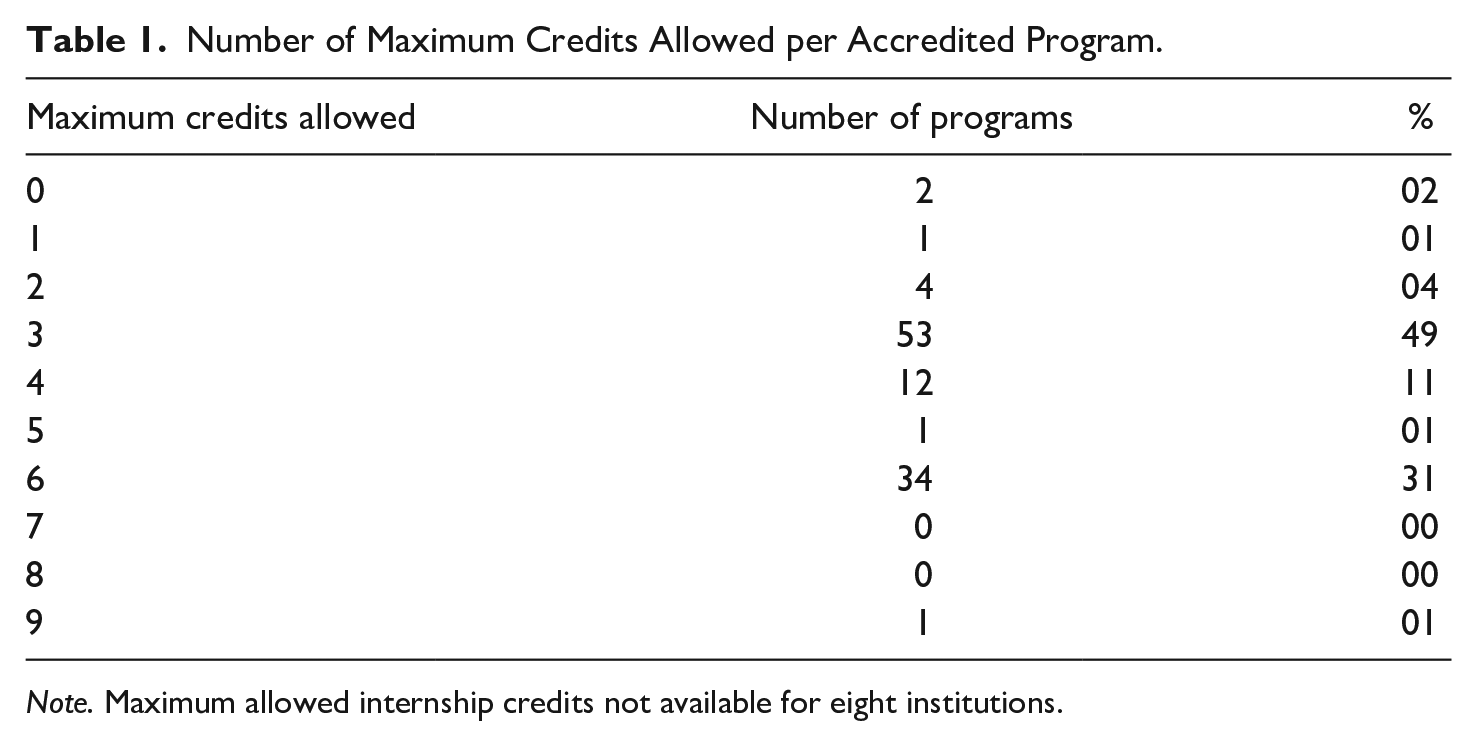
Note. Maximum allowed internship credits not available for eight institutions.
RQ3: To What Extent Do Journalism and Mass Communication Programs Require Professional Internships?
A variety of programs in this sample required an internship for students to graduate, including, Middle Tennessee State University, Florida A&M University, and the University of Maryland. In some cases, for instance at Ohio University, students were not required to earn academic credit for the internship (they could earn up to two credits), but an adviser-approved internship was required for graduation. Overall, about two fifths of all universities in this sample required an internship to graduate.
RQ4: To What Extent Do Programs Use Journalism Supervisor Comments as a Measure of Student Learning Outcomes?
ACEJMC recommends aggregated internship supervisor comments as one acceptable direct measure of student learning outcomes. The analysis showed that an overwhelming majority of accredited programs used internship performance data to assess program effectiveness (72%).
Discussion
This analysis demonstrated that internships are deeply embedded within journalism education and a key component of journalism program assessment. A well-designed internship program can provide students with a realistic interdisciplinary experience and important networking experiences, while at the same time providing the department with valuable feedback about the quality of its classes (Bugeja & Garrett, 2019; Ciofalo, 1989). However, programs have an ethical duty to make sure internship providers—particularly for-profit companies—that offer unpaid internships are not only complying with the relevant labor laws but also providing meaningful educational experiences with defined learning outcomes (Senat et al., 2020). While there is a sense that academic units are beholden to the organizations that provide internships, in fact, many programs underestimate their leverage to negotiate (Abelman, 1986).
Part of the discourse about internships depends on where one falls on the philosophical continuum of considering journalism education vocational training or part of liberal arts education. Some programs place greater emphasis on providing industry-based “experiential” learning versus traditional “classroom” learning. Given the disproportionate financial burden that unpaid internships place on marginalized students, it is important that departments approach the topic through a diversity, equity, and inclusion lens. About two fifths of all schools in the sample required an internship for graduation. At almost all other institutions, internships are highly recommended, but there are limits placed on the number of credits that count toward graduation. Only a few schools allowed students to take internship credits as the equivalent of two semester courses or more. As more and more institutions are transitioning to decentralized budget models—in which departments and colleges become increasingly responsible for generating revenue and budget cutting—it may be that units will be tempted to allow more internship credits to count toward graduation to collect tuition income while reducing costs by hiring an internship coordinator in a nonteaching, service role as compared with regular courses in a curriculum.
This study’s results showed that there is an entrenched internship format for journalism and mass communication programs, based on practices that may be governed more by habit and tradition than consistency in quality. Given the quickly evolving nature of the profession, there is room for experimentation with a variety of work-integrated learning experiences beyond the traditional internship, as described by Valencia-Forrester (2020). However, such innovation is best when faculty and administrators are clear-eyed about the specific goals of an internship program. As long as an internship program articulates clear student learning outcomes, it can be a powerful tool for student development, industry engagement, and program assessment.
This study contained several limitations. Because the vast majority of ACEJMC accreditation programs are based in the United States, this study cannot speak to the situation globally, where labor laws and professional practices may differ significantly. There are also many more unaccredited programs than accredited programs in the United States. Several high-profile journalism and mass communication programs have let their ACEJMC accreditation lapse over the years or have not bothered to apply (e.g., University of Wisconsin, University of Miami, University of Utah, Northwestern University, and Texas Tech University).
It was also beyond the scope of this study to evaluate the performances of students and, by extension, the programs they represented in professional internships. That is an area of potential future research. It would be important to get a better understanding of the quantity and quality of internship positions in journalism and mass communication, in particular to examine the extent to which interns practice skills associated with their (future) occupational field. It also would be important to investigate potential differences in internship experiences for paid and unpaid positions, as well as whether there are differences in hiring practices after graduation based on those experiences. Future research could also focus on best practices to utilize internship experiences as a means to assess student learning objectives for academic units and to what degree the findings of internship assessment correspond with assessments of regular skills courses offered within a curriculum to explore means to increase the quality of all course offerings. Therefore, it would also be of interest to further explore how programs educate students to get the most out of their internship “to ensure that the experience is not a suboptimal one” (Hull & Romney, 2021, p. 146). Better internship experiences could lead to more valuable assessment data for academic programs.
Footnotes
Declaration of Conflicting Interests
The author(s) declared no potential conflicts of interest with respect to the research, authorship, and/or publication of this article.
Funding
The author(s) received no financial support for the research, authorship, and/or publication of this article.
