







Abstract
This study updates the current state of Accrediting Council on Education in Journalism and Mass Communication (ACEJMC)-accredited journalism and mass communication broadcast capstone programs, building on the foundational 2012 study by Tanner, Forde, Besley, and Weir. It examines significant practices and adaptations to major media technologies within broadcast journalism capstone courses. Through a survey of capstone faculty in 70 U.S. ACEJMC-accredited programs, the findings reveal notable changes within broadcast and journalism capstones, including a reduction in the number of programs offering a broadcast capstone course and a theory-practice divide in capstone education. The study also offers actionable insights to inform pedagogical practices in broadcast journalism and mass communication capstone education.
Keywords
Introduction
Numerous educators widely recognize the journalism capstone project as an essential evaluation of students’ success in a journalism program. Most journalism and mass communication programs offer the capstone experience to prepare seniors for employment after their undergraduate studies (Cullen, 2016; Tanner et al., 2012). The fundamental purpose of the capstone project is to integrate and reinforce past knowledge from the curriculum (Rosenberry & Vicker, 2006), while ensuring that students are equipped with the essential skills and experience needed in the dynamic media industry.
Often, the broadcast capstone experience is designed to create a simulation of a newsroom run by students with the guidance of an instructor, provide an internship experience, or be a course where students learn hands-on media skills to prepare them for jobs post-graduation. Overall, the capstone course has been acclaimed by many as useful in improving students’ employability (Shine, 2023). This is particularly noteworthy, given earlier findings from researchers like Duhe and Zukowski (1997), who highlight a preference among TV news directors for curriculums offering hands-on training.
Recognizing the importance of capstone experience for journalism majors, researchers like Tanner et al. (2012) examined the current state of television and news capstone courses in Accrediting Council on Education in Journalism and Mass Communication (ACEJMC)-accredited journalism and mass communication programs over a decade ago. They found that television newscast capstone courses were the most prominent capstone courses offered, and capstone instructors had concerns about adapting to changes in media technology.
While Tanner et al.’s (2012) study remains relevant, the past decade has brought substantial changes in journalism and mass communication curricula. Rapid advancement in technology has also created fresh concerns among capstone instructors. The impact of artificial intelligence (AI) on capstone projects and assessments has yet to be studied. This study, therefore, seeks to update Tanner et al.’s (2012) research by exploring the state of broadcast journalism capstones and examining some adaptations to major media technology changes within broadcast journalism capstone programs since 2012. The study aims to provide a comprehensive perspective on the current state of the capstone experience and uncover fresh insights on how faculty adapt theoretical best practices for teaching journalism and mass communication capstone courses.
Literature Review
The ACEJMC outlined the capstone project as a direct measure of students’ learning outcomes in a program. According to ACEJMC, the capstone project synthesizes the competencies obtained by graduating seniors of a sequence. After completion of the capstone project, an instructor may give a grade on a research or skills-based project, which the student can include in their portfolio for job applications after graduation (ACEJMC, 2012). The goal of the capstone project is for graduating seniors to apply the knowledge they have gained throughout the program (Rosenberry & Vicker, 2006; Tanner et al., 2012), as well as to equip and solidify their industry-specific skills to increase their employability after their education (Cullen, 2016).
While many U.S. institutions have integrated the capstone project as a program assessment tool, its execution and design have remained largely non-identical. Across many U.S. institutions, the capstone project can manifest as research projects, internships, policy development workshops, experimental media production labs, traditional college classes, etc. (Bowe et al., 2019; Cullen, 2016; Tanner et al., 2012); their focus also differs across institutions. For example, while some programs emphasize specialized tracks in print, broadcast, or social media, others offer a convergent capstone experience that allows students to focus on more than one area of journalism and mass communication (Tanner et al., 2012). These differences notwithstanding, students have reported successes with the capstone project, and it has consistently been proven to deliver the desired outcome of practical skill acquisition (Shine, 2023).
Experiential Learning Model
The capstone project falls under experiential learning. Experiential learning is a model of education that sees knowledge as something obtained through experience, that is, students learn by “doing.” The theory, published by Kolb in 1984, was built upon earlier models by John Dewey and Kurt Lewin (Royal, 2015). The experiential learning theory posits that some people grasp new information through immersion in concrete reality (Kolb et al., 2014). The experiential learning theory also addresses learning styles encompassing diverging, assimilation, convergence, and accommodating styles. However, for this study, we refer to Kolb’s (1984) learning models, which consist of four circular stages for effective learning: concrete experience, reflective observation, abstract conceptualization, and active experimentation (McCarthy, 2010).
During the concrete experience stage, the learner engages their senses and perceives new information through direct interaction with tangible qualities of the world. The reflective observation stage involves the passive observation of others immersed in their experiences or activities. In the abstract conceptualization stage, the learner systematically analyzes information and develops theories on how to approach tasks. Finally, the active experimentation stage involves the practical application of acquired information and the utilization of theories to solve problems. Although the learning cycle can start at any point, it typically begins with concrete experience (Kolb, 1984; McCarthy, 2016; McLeod, 2023). All four stages ensure that the learner acquires well-rounded knowledge that can be applied in future work settings.
Several researchers have tested the efficacy of the experiential learning model across diverse fields, including agriculture (Baker et al., 2012), engineering (Abdulwahed & Nagy, 2009), auditing (Siegel et al., 1997), life sciences (Pherson-Geyser et al., 2020), among others. The findings signify that the experiential learning model can foster mastery of a subject matter. The experiential learning model has also gained prominence in mass communication and journalism programs. For instance, Kim (2015) explored the role of a student-run PR agency (a form of experiential learning) in the pre-professional preparation of students. Interestingly, student-run agencies are a common experiential learning practice in journalism and mass communication programs. Swanson (2017) noted that there are more than 150 student-run agencies across U.S. colleges and universities. In addition, Royal (2015), by analyzing a course-level experiential activity, found enormous benefits for students’ internships, job placements, and immersion into relevant communities.
A specific application of Kolb’s experiential learning model was demonstrated by Jenkins and Clarke (2017) in their engaged journalism course. Students progressed through each stage of the learning cycle. In Stage 1, students gained concrete experience through the creation of social media artifacts. In Stage 2, reflective observation, students were asked to make connections between the course content and their lived experience. In Stage 3, abstract conceptualization, students had to visualize concepts in creative ways. In Stage 4, active experimentation, which requires implementing new knowledge, students were asked to demonstrate their learning through writing, performing, or presenting. The overall outcome indicated increased engagement, improved comprehension, and enhanced discussions and cross-interactions.
The Teaching Hospital
Doubtless, the implementation of the experiential learning model by instructors of journalism and mass communication has proven to have advantages. Yet, its implementation has not been without limitations. Hence, scholars have suggested a framework that works specifically for teaching journalism courses: the Teaching Hospital Model. This model was first suggested by Nicholas Lemann in 2009 but was elaborated on by Eric Newton in 2012 (Grant et al., 2019). The teaching hospital model, like the experiential learning theory, also suggests that people learn by doing. It also posits that the teaching hospital is a perfect analogy for journalism education (Grant et al., 2019). Newton (2012) noted that journalism education should have the same real-world experience existent in medical training. He stressed that to duplicate a teaching hospital in journalism, there must be six key elements: (a) students doing journalism, (b) professionals mentoring students, (c) professors who bring topic knowledge and raise issues, (d) innovators pioneering new tools and techniques, (e) academics doing major research, and (g) informing and engaging the community. All these will work to ensure innovation in journalism and mass communication education. At the heart of the teaching hospital are the students whose energy and inquisitive drive can lead to innovative change (Grant et al., 2019; Newton, 2012).
Although the teaching hospital model was a more recent proposition, experiential learning has been a practice in most communication programs as early as 1997. A study by Duhe and Zukowski (1997) showed that most journalism programs offered experience in the broadcast news laboratory that allowed students to produce a scheduled television news program regularly. Yet, the teaching hospital model brings into perspective how other aspects of journalism and mass communication studies can firmly tie into the capstone experience.
The State of Research in Journalism and Mass Communication Capstone
Researchers like Tanner et al. (2012) have explored the current state of television and news capstone in journalism and mass communication programs in the United States. Specifically, they looked at ACEJMC-accredited programs, which at the time numbered 113. They found that television newscast capstone courses (run by students and supervised by faculty) were most prominent among larger institutions, mid-size institutions had more internship capstones, while small-sized institutions offered a traditional college course in lieu. Their interviews with capstone faculty revealed that most faculty were highly involved and had frequent contact with students in the capstone experience, a dynamic that was different from other faculty members who did not teach a capstone course. Capstone faculty also expressed some challenges, including inadequate time to teach all aspects of the course, a limited number of credit hours, difficulty in tracking students’ placement post-graduation, and many more.
Since Tanner et al.’s (2012) study, researchers like Henry and Van Wyke (2016) and Bowe et al. (2019) have studied the focus and content of capstone projects. Henry and Van Wyke (2016) explored the outcomes of a pilot converged journalism capstone established at Drake University. Their findings suggest that implementing the converged capstone helped students acquire new skills, although challenges related to infrastructure and differing visions across disciplines remained. Bowe et al. (2019), in seeking to update Rosenberry and Vicker’s (2006) study, found that capstone content areas ranged from career exploration to societal issues, workplace issues, media, ethics, research methods, etc. They also found that capstone courses are now heavily focused on individual coaching, production and student projects, and consideration of issues related to careers and media in society.
The above research, including that of Tanner et al. (2012), has proven that the curriculum in journalism capstone courses is evolving, and there is a need to investigate these changes and explore how students are reacting and adapting to them. It is also crucial to examine how journalism and mass communication faculty are adjusting to the rapid advancement of technology, especially the use of AI.
Therefore, we put forward the following research questions:
Method
A list of all U.S. ACEJMC-accredited programs was compiled. Websites for each program were scanned to ascertain (a) whether the program offered a capstone experience in broadcast journalism, (b) descriptions of each capstone program, and (c) the name and contact information of the faculty member leading the capstone experience. During the initial review, we sought to determine whether each program included a broadcast capstone. However, most programs did not provide this information on their websites. Consequently, we employed a survey to gather additional data by contacting the designated capstone faculty member or other relevant individuals identified through the program’s website.
Following the initial wave of observations, 98 U.S. ACEJMC-accredited journalism and mass communications programs were identified. Two programs were removed (City University of New York and Columbia University) because they were graduate school programs, bringing the list to 96 U.S. ACEJMC-accredited programs. The next phase of data collection involved a personalized email invitation to capstone faculty containing a link to an online survey. The survey questionnaire took about 4 min to complete. Survey responses were collected between February 29, 2024, and June 2024.
Non-respondents were contacted via telephone to request participation following the method used by Tanner et al. (2012), which yielded a high response rate. Data collection commenced in November 2023 and continued until June 2024. Of the 96 faculty contacted, 70 responded, yielding a response rate of 72.9%.
Data Analysis
The result of the survey was descriptively analyzed using the Statistical Package for Social Sciences (SPSS). To answer RQ1, we examined those programs with a capstone program versus those with other forms of journalism. Of the 70 schools that responded to our survey, 80% (n = 56) offer a capstone in TV news, broadcast journalism, or telecommunications, while 20% (n = 14) do not. Among the 56 schools with such a capstone, 72.7% (n = 40) specifically identified it as a broadcast journalism capstone, while 27.3% (n = 15) did not. Of the 14 schools without a broadcast journalism capstone, 80% (n = 12) offer other types of capstones, primarily focused on online journalism (91.7%, n = 11) and experimental journalism (8.3%, n = 1). None reported having a capstone focused on print journalism.
To answer RQ2, we asked programs to report the number of credit hours assigned to their capstone experience. Credit hour requirements varied across programs, with an average of 4.4 credit hours (SD = 4.6). The majority of broadcast journalism capstones were 3 credit hours (74.5%, n = 38), followed by 4 credit hours (9.8%, n = 5) and 6 credit hours (5.8%, n = 3). A few outliers reported 1 (1.4%, n = 1), 9 (1.4%, n = 1), 12 (1.4%, n = 1), 20 (1.4%, n = 1), and up to 30 credit hours (1.4%, n = 1).
RQ3 focuses on the form of output that the capstone experiences take. As shown in Table 1, the most common output is portfolio creation (57.7%, n = 30), followed by publishing on websites or other online news platforms (51.9%, n = 27) and posting on social media feeds (28.8%, n = 15). Other formats include weekly newscasts (26.9%, n = 14) and daily newscasts (17.3%, n = 9). In addition, 46.2% (n = 24) of programs reported other types of outputs such as feature shows, multimedia news packages, podcasts, research papers, and job preparation activities.
Frequencies of Output Forms for Capstone Experience.
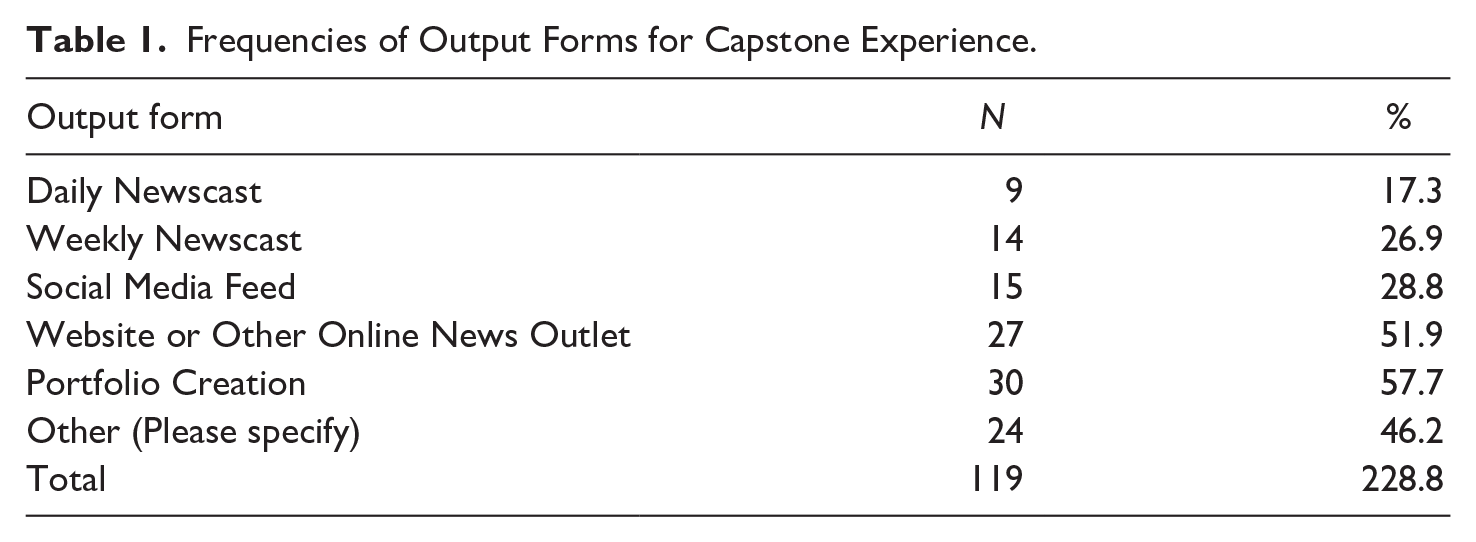
The results indicate that most program’s capstone output is in the form of portfolio creation. However, most programs also indicated having multimedia outputs, such as combining articles, podcasts, and videos in their capstone and some special projects that can include enterprise stories across multiple platforms.
For RQ4, respondents were also asked if they made the output of their capstone visible to the public; 84.6% (n = 44) indicated that they did, while only 15.4% (n = 8) did not. To ascertain social media use across broadcast journalism capstone, respondents were asked to indicate if they used social media and what platforms were used the most. The results showed that social media use was quite prominent among programs, with 78.8% (n = 41) indicating they use social media to promote students’ work, and only 21.2% (n = 11) did not. Instagram (92.7%, n = 38) was the most used social media by programs, followed by YouTube (80.5%, n = 33), X (70.7%, n = 29), Facebook (68.3%, n = 28), LinkedIn (34.1%, n = 14), TikTok (24.4%, n = 10), and Snapchat (12.2%, n = 5), as illustrated in Figure 1.
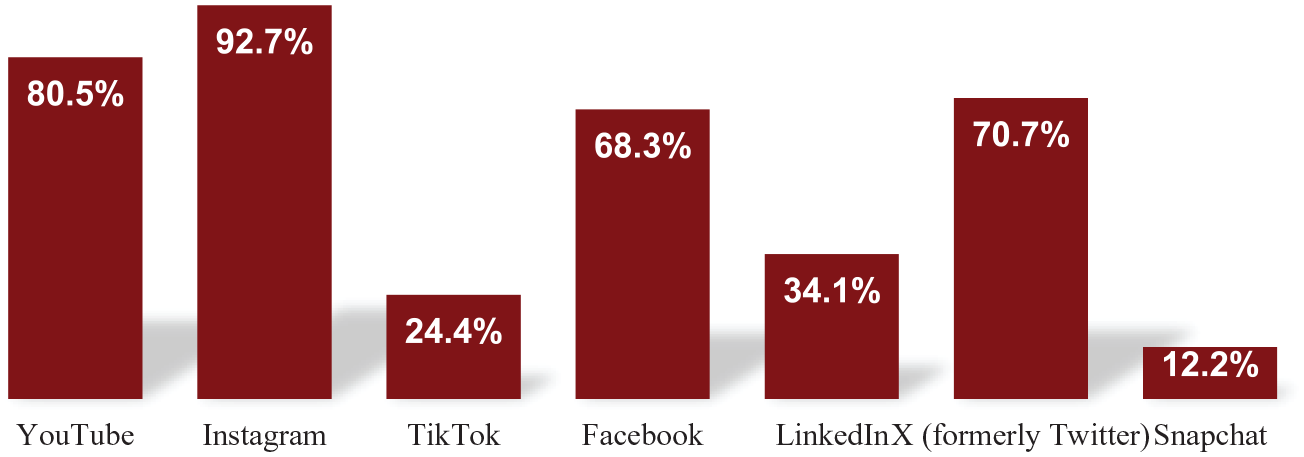
Social Media Platforms Used.
To answer RQ5, we asked programs to indicate if they have a system that tracks students’ placement after graduation to ascertain the success of the capstone experience. Most programs (63.5%, n = 33) have a system in place to track students’ placement after graduation, while 36.5% (n = 19) do not. Of those that track students’ placements after the capstone, 81.8% (n = 27) use a departmental survey of alumni, 75.8% (n = 25) do so via faculty reports from contacts with alumni, 54.5% (n = 18) do so using alumni association surveys or reports, and 18.2% (n = 6) use other methods.
Next, we asked respondents questions related to the four stages of experiential learning to answer RQ6. Regarding abstract conceptualization, we asked respondents if students were required to generate larger observations about journalism news production and/or social issues as part of their capstone project, paper, or assignment; only 37.5% (n = 18) indicated that they have such requirements from their students, while 62.5% (n = 30) did not.
For reflective observation, we asked programs how viewing and analysis of content is conducted. For most programs, viewing and analyzing content produced in the capstone by the students is done by their peers in a peer review format (65.2%, n = 30). 52.2% (n = 24) of programs have students present their output to an external faculty or alumni, 43.5% (n = 20) have students orally present their content to a faculty/committee, while 28.3% (n = 13) of programs, viewing and analysis of the output are performed by the sequence head.
Active experimentation is measured by asking programs if they allow students to experiment with content formats and how mistakes are handled. Most programs, 64% (n = 32), indicate that they have a format that allows for experimentation so long as it follows best practices in journalism. In total, 24% (n = 12) say they encourage students to experiment with format and new content delivery methods in their broadcast journalism capstone; 12% (n = 6) follow a strict format that precludes experimentation with formats or delivery channels.
Regarding the use of AI (RQ7), we asked capstone faculty if they allowed the use of AI in their capstone courses. In total, 46.9% (n = 23) of programs do not allow the use of AI in their capstone experience and have no plan to do so, 26.5% (n = 13) noted that they are experimenting with AI, and 26.5% (n = 13) have plans to use it in the future, although they are not using it currently. When asked about their concerns about students’ use of AI in the capstone, 30.8% (n = 16) said they are concerned, 53.8% (n = 28) are unsure or have mixed feelings about students’ use of AI for capstone projects, and 15.4% (n = 8) expressed no concern about the use of AI for capstone projects.
In an open-ended question, respondents were asked if and how the use of AI has influenced the students’ output and performance in the capstone experience. Although some faculty believe AI may help with activities like fact-checking and idea generation, there is a general concern that students may become overly dependent on AI at the expense of their unique skills and reporting abilities, possibly influencing their creative confidence. There is no universal agreement on how to integrate AI into capstone courses, and the majority of schools are still in the early phases of investigating the ethical and practical ramifications of AI in their journalism programs. Some educators are investigating the use of AI for pre- and post-production tasks, like proposing interview questions or pointing out areas where written work needs to be improved, despite the uncertainties. Some select responses are included as follows:
Potential benefits of AI in journalism education:
We have primarily used it in a pre-and-post-production capacity. For example, we will use it to suggest interview questions or story ideas. We have also submitted published text stories to a chatbot with a prompt that asks about ways to improve the story, e.g., adding context, what’s missing or confusing, etc. It has improved some procedural steps like coming up with story ideas, what experts to talk to or interrogating facts, and writing.
Fear and uncertainty surrounding AI:
It’s too soon to tell. For now, students seem to be almost as afraid of it as faculty are—they fear getting in trouble. It has not impacted student output as of yet, but it is a concern moving forward. Currently, students most often use AI for social media posts to promote original reporting. Apps like Grammarly can help students eliminate a lot of mistakes or unnecessary words. My students are required to write a very concise script that connects to soundbites from interviewees and an engaging, creative standup, so I think it’s harder for AI to write an entire script that makes sense for the story. However, eventually, technology will make it more doable. I’m a bit torn on the topic because I don’t want AI to do all of the work, but I do see some benefits in helping students tell a better story. There still needs to be research and prompting done by students. They need to learn to fact-check AI to make sure it is accurate and contextual.
Limited impact of AI on student output:
Limited, thus far. We are transitioning from a research paper-based capstone to an investigative reporting and data research course. We expect to incorporate AI for routine data collection and other tasks.
Ongoing discussions and exploration:
We aren’t using AI at the time, but our journalism area is discussing ways to use it ethically and practically to help students with some parts of their reporting projects. The use of AI by students was detected occasionally. Currently, our program does not have a set policy on how to handle it. It is currently left to instructors how to handle each case.
Discussion
This study aimed to update Tanner et al.’s (2012) research by exploring the state of broadcast journalism capstones and examining some changes and adaptations to major media technologies by faculty in the decade since the study was published. We have noted some changes across programs and highlighted key technologies impacting broadcast journalism practice across the United States.
At the time of Tanner et al. (2012), there were 113 ACEJMC-accredited programs. Since then, the number has decreased to 98 (96 after removing two graduate-only programs) at the time of our study. In addition, Tanner et al. (2012) reported over a decade ago that 92% (n = 85) of programs teach a television, broadcast news, or telecommunications capstone course. That number has also decreased to 80% (n = 56) at the time of this study. However, similar to Tanner et al. (2012), broadcast journalism capstones were still the most prominent compared to other types of capstone experiences across programs.
In our study, we found that online journalism capstones are becoming more prominent among programs compared to print journalism capstones. It would seem like the former was replacing the latter within different programs. The number of credit hours (3–12) dedicated to broadcast journalism capstones has remained consistent over the years since Tanner et al. (2012).
One of the concerns expressed by faculty interviewed by Tanner et al. (2012) was difficulty in tracking student placement after graduation from the program. Suggestions were made for capstone instructors to make greater efforts to track job placement. In our study, most programs indicated having an established system to track students’ progress, although some programs still do not have such systems in place. Since a key goal of a capstone project is to help students develop job-related skills, tracking students’ job placements is essential for evaluating the capstone’s effectiveness. By monitoring placement outcomes, programs can determine whether the capstone is successfully preparing students for the job market. Therefore, tracking student placement is paramount to assess the program’s success.
In addition, Tanner et al. (2012) highlighted the concerns of capstone instructors about adapting to changes in media technology. We explored this concern further by asking about social media adaptation and the use of AI in capstone courses. The results show that more programs are actively using social media to promote students’ work. However, a trend in the inadequate use of LinkedIn, which is considered a professional hub, needs to be reconsidered by most programs. LinkedIn can be leveraged by programs to showcase their students’ expertise, increase their professional visibility to potential employers, and boost their chances of securing job placements.
The use of generative AI tools in the capstone course is still in an explorative stage. Most faculty have not yet integrated AI tools into the capstone program and have no plans to do so in the future. Some instructors acknowledge its potential benefits, especially in generating story ideas or interview questions, but there are still concerns about its ethical implications, as most programs do not yet have policies surrounding its use. Yet support for the use of AI is growing among stakeholders since it is becoming essential in today’s business world (Schofield & Zhou, 2024). Therefore, educators need to consider the best ways to incorporate AI into capstone experiences to allow students to become familiar with it as a tool and increase their competitiveness in the job market. A guided approach to integrating AI into capstone programs is offered by Stenard et al. (2024), where students use AI to solve problems just as they would in the real world. Although the approach was offered for business education, it can be adopted by broadcast journalism capstones as a guide to successfully integrate AI in capstone experiences.
Furthermore, the experiential learning model has been shown to improve student engagement and comprehension as well as enhance job placement post-capstone experience (Jenkins & Clarke, 2017; Swanson, 2017). While the core of the journalism capstone satisfies the concrete experience stage of the experiential learning model, most journalism and mass communications programs do not implement or partially implement its other basic stages. For instance, a large number of broadcast journalism capstones do not require their students to generate external observations from their environment or social issues. This raises issues about the much-discussed tension between practice and theory in journalism (Greenberg, 2007). Kolb’s experiential learning theory was put forward by Greenberg (2007) as a solution to the theory-practice divide in journalism and mass communications. If students can use observations from their environment to create stories that will impact their societies, it will do a lot of good for journalism practice.
Students’ capstone output can be greatly enhanced through feedback from peers, faculty members, and alumni. Capstone instructors should consider organizing a student’s output showcase for this purpose. These reflective observations help students to refine their skills and better prepare for the demands of a competitive job market. Students can also benefit from active experimentation, especially when encouraged to explore new formats and content delivery styles. This approach helps them embrace mistakes as learning opportunities, fostering a “fail forward” mind-set. As a result, students gain confidence, develop resilience, and are empowered to drive innovation in journalistic practice.
Since the goal of the capstone is to prepare students for future practice, journalism educators should consider applying all four stages of the experiential learning model and the key elements of the teaching hospital to capstone experiences to boost students’ preparedness.
Accrediting systems may also need to update capstone expectations and requirements to bridge the academia-industry gap. Establishing clear standards for experiential learning can help ensure that capstone programs effectively prepare students for real-world professional environments.
Limitations and Directions for Future Studies
There are some major differences in our approach to studying the state of broadcast journalism capstones compared to Tanner et al. (2012). For instance, while Tanner et al. (2012) relied on data from program websites and interviews with faculty, we primarily used the survey method to obtain information about broadcast journalism capstones. Recognizing the shortcomings in Tanners et al.’s (2012) approach to using website data, such as lack of or inadequate information about capstones and the overall inconsistency in reporting capstone experiences on some journalism and mass communications program websites, we adopted the survey method to give us more information about the capstone experience. We also included open-ended questions within our survey for an in-depth perspective on an issue related to the capstone. However, we recognize that our reliance on survey methods might also limit the kind of information obtained for this study. Thus, future research can explore the use of a mixed-methods approach (surveys as well as interviews or focus groups) to provide further information about the capstone, especially related to resources available to capstone instructors.
It is important to note that our research captured a moment in time. The number of ACEJMC-accredited programs changes ever so often; therefore, it is important to continually conduct studies on journalism and mass communication capstone programs to have an updated perspective on how these programs change over time.
Furthermore, AI is changing the educational landscape rapidly. It is possible that while at the time of this study, most faculty are not actively incorporating AI in the capstone experience, they might be doing so now. Therefore, it is also important for future researchers to conduct follow-up studies to track how AI technologies are being adapted over time in capstone programs.
In addition, while compiling the list of capstone instructors across ACEJMC-accredited universities, we experienced difficulties with getting contact information for some faculty-led capstone experiences, as some program websites do not contain such information. We overcame this challenge by sending out email surveys to the program coordinator, who was asked to forward them to the faculty in charge of capstone experiences. This approach resulted in a good response rate for the study. Future research looking to identify and contact capstone instructors may also adopt this measure to enhance program representation and improve response rates. ACEJMC can also develop a comprehensive and up-to-date database that tracks the number of ACEJMC programs over the years, along with a database of capstone programs and their faculty members, including accurate contact details to support research like this one.
Conclusion
Overall, this study updated Tanner et al.’s (2012) research by exploring the state of broadcast journalism capstones and examining how media technologies, particularly social media and artificial intelligence, are impacting the capstone experience. We have established that the broadcast journalism capstone is still one of the prominent forms of capstone in most journalism programs, with 3–12 credit hours dedicated to it, and most of its output taking the form of portfolio creation. We noted that more capstone experiences are using social media to promote students’ work, most notably Instagram. We also highlighted that the use of AI is still novel in most capstone experiences, although some programs are already experimenting with it, and others are concerned about its ethical implications. We observed that more capstone experiences need to adopt the experiential learning model to enhance students’ outcomes in their capstone projects. Finally, we provide recommendations for improving the capstone experience and for research efforts related to the capstone experience.
Overall, this study provides fresh and updated insights into the state of broadcast journalism capstones and offers information that can inform future research and pedagogical practices as journalism education continues to adapt to the evolving technological landscape.
Footnotes
Declaration of Conflicting Interests
The author(s) declared no potential conflicts of interest with respect to the research, authorship, and/or publication of this article.
Funding
The author(s) received no financial support for the research, authorship, and/or publication of this article.
