







Abstract
This study examines how journalism educators can integrate generative artificial intelligence (AI) into curricula while preserving the human capacities that define the craft. Drawing on 15 interviews with international scholars and practitioners, this research employs a human–computer interaction framework to analyze where AI effectively augments journalistic work and where it undermines creativity, ethics, and judgment. Findings suggest that AI is best positioned as a catalyst for efficiency, background research, and templated work, not as a creative substitute. The study proposes practical pedagogical tools, including a specific rubric that assesses four irreplaceable characteristics: curiosity, emotion, cultural perspective, and originality.
Keywords
Introduction
The invention and development of generative artificial intelligence (GenAI) is transforming journalism’s creative, ethical, and operational landscape. In contemporary newsrooms, artificial intelligence (AI) systems automate structured reporting, scale outputs, and embed computational logic into editorial workflows, reinforcing the view of journalism as increasingly software-like (Beckett, 2019; Cokley, 2024). These capabilities promise greater efficiency and new forms of storytelling, yet they also raise concerns about originality, ethical accountability, and the preservation of human creativity in an algorithmically assisted profession. The core challenge now is not whether AI can produce products people recognize as “journalism,” but whether its integration enhances or erodes the human judgment, empathy, and improvisational capabilities that give journalism its societal significance.
Human–computer interaction (HCI) theory offers a critical framework for examining this challenge. HCI emphasizes the “fit” between technological systems and human use (Hewett et al., 1992; Rogers, 1995), underscoring that adoption depends on customization, compatibility with professional norms, ease of learning, and effective user support. In journalism, these factors determine whether AI tools merely accelerate routine tasks or meaningfully expand journalistic capacity while preserving editorial integrity. HCI also warns of risks, including over-reliance on the technology and the erosion of professional responsibility when the technology–practice fit is poorly designed.
Although research on AI in journalism has expanded rapidly in recent years, much of the existing scholarship focuses on technological capabilities, newsroom adoption patterns, or ethical frameworks for responsible use. Far less is known about how journalism scholars, particularly those with direct professional experience, perceive AI’s creative potential and its limitations. Even less attention has been paid to how these expert perspectives can inform journalism education for future generations in a way that addresses both the efficiencies AI offers and the uniquely human capacities it might not be able to replicate.
Guided by HCI theory, this study investigates two intertwined questions: how framing journalism as software clarifies the role of GenAI and where GenAI tools reinforce or challenge that framework; how journalism education can balance automation with human creativity and adapt to GenAI’s opportunities and limits by prioritizing the skills needed to sustain the profession’s creative, ethical, and societal relevance.
Literature Review
Human–Computer Interaction Theory
Hewett et al. (1992) describe HCI as being: . . . concerned with the joint performance of tasks by humans and machines; the structure of communication between human and machine; human capabilities to use machines (including the learnability of interfaces); algorithms and programming of the interface itself; engineering concerns that arise in designing and building interfaces; the process of specification, design, and implementation of interfaces; and design trade-offs.
In addition to understanding “the structure of communication between human and machine,” a study of “how communication between humans can be enhanced by machines” is relevant in the current context. This is called the “fit” and Hewett et al. (1992) observe that “part of the purpose of design is to arrange a fit between the designed object and its use” and that it is possible to change “some component of a sociotechnical system so as to improve its fit.” This concept is a crucial one in the diffusion–adoption equation, such that a better fit results in faster and more effective adoption.
In the context of GenAI, the diffusion–adoption problem in journalism involves two interdependent user groups: (a) newsroom professionals (reporters, editors, and producers) who integrate GenAI into editorial workflows and (b) news audiences who have themselves become “computer users” and secondary/tertiary content creators across smartphones, laptops, smart TVs, and other devices. Early HCI frameworks (Booth, 1989; Hewett et al., 1992) predated this dual-user, co-creative ecology, but their core design principles remain directly applicable.
In contemporary GenAI adoption, formal training is often minimal; organizations frequently assume interfaces are “intuitive” and rely on informal learning (e.g., ad hoc tutorials). For journalism, this assumption has measurable consequences: it can amplify over-reliance on model outputs, weaken verification practices, and increase the risk of privacy breaches or biased content when safeguards and guidance are unclear.
Foundational HCI research (Booth, 1989, p. 142) identifies a list of six items which characterize system design and development and translate cleanly to GenAI-enabled news work: the correct interactional device is chosen for any particular task; the most useful dialogue style is chosen for any particular task; an appropriate conceptual model is chosen so that a system can be easily learned and understood; users are allowed to perform a task in the way that they choose; the information that users require is provided in the form that is acceptable; and the system fits easily into the working practices of an organization.
Effects of HCI can be negative or positive. Negative effects of technologies installed within the news communication environment can include personal anxiety among journalists, alienation from other people, information-poor minorities, feelings of impotence as the individual begins to matter less and the organization becomes more important, complexity that bewilders all types of users, organizational fragility as system failures halt many users, invasions of privacy, unemployment and displacement, lack of professional responsibility and a deteriorating image of people, as machines are seen to be more important than the people within the organization (Booth, 1989, p. 182).
Accordingly, HCI’s aim should extend beyond reducing resistance to new tools to improve the quality of work and public life (cf. Booth, 1989). For GenAI in journalism, this implies design and policy criteria that can be operationalized in research: availability and quality of training; clarity of user guidance and error-handling, transparency/provenance features, degree of user control and override, perceived workflow fit, trust calibration, and perceived risks (bias, privacy, displacement, and outage fragility). Measuring these constructs for both journalists and audiences enables a rigorous assessment of GenAI’s impact on newsroom performance, ethical accountability, and audience trust.
AI-Driven Transformation of Journalism
Research and industry observation suggest “the future of journalism is undergoing a fundamental transformation driven by developments in AI technology, changing audience behavior, and economic pressures” (Sonni, 2025), such as “journalists are no longer just news writers but have evolved into “digital curators” who manage various information sources and AI tools” (n.p.). In Brazil, researchers and news producers have invented a system called IDEIA (Intelligent Engine for Editorial Ideation and Assistance), described as “a Generative AI-powered system designed to optimize the journalistic ideation process by combining real-time trend analysis with automated content suggestion system” (Santos et al., 2025). The system integrates the Google Trends API for data-driven topic monitoring and the Google Gemini API for the generation of context-aware headlines and summaries, and claims to improve editorial idea creation by 70 per cent (p. 1). Another new tool, called AudienceView, claims to help journalists interpret audience feedback with large language models (LLMs) and sentiment visualization (Brannon et al., 2024) helping to sort comments and identify “themes and topics,” “visualize the sentiment and distribution of the comments,” and thus help editorial staffers develop ideas for subsequent reporting projects (p. 1). These and other developments support the contention that the process and products of journalism itself are software-like, and as such, can be designed, tested, and iteratively improved (Cokley, 2024). The concept “journalism is software,” that is, the process is a network of executable systems of rules, routines, and algorithms, enables systematization and professionalization of journalistic norms, and is already happening because of the explosive spread of AI. For example, the Associated Press (AP) reports automatically generating more than 3,000 stories about U.S. corporate earnings each quarter, a tenfold increase over what AP reporters and editors created previously (Meir, 2024).
Researchers have found that AI and algorithmic tools can shape nearly every step of the news gathering and publishing supply chain: content generation, including efficiency, originality, and customization . . . strategy and planning, production, review and editing, publication, promotion, analysis and feedback and consumer engagement, as well as research and ideation . . . legal, ethical, and societal ramifications (and) human–AI collaboration. (Boateng et al., 2025; Mehmood, 2025; Seneadza et al., 2025)
One large study (Sonni et al., 2024) suggests “a significant increase in the use of AI for news writing automation (73% of news organizations) data analysis (68%) (p. 1)” and another investigates automation of fact-checking (Nakov et al., 2021).
Some industry observers challenge whether AI tools are up to the journalistic task 1 while a recent systematic literature review finds that “while most studies reflect cautious optimism, concerns over bias, transparency, and accountability remain persistent” (Al Masum Molla & Manjurul Ahsan, 2025). Pavlik (2023) suggests “AI has emerged as a significant and impactful technology for journalism and media and therefore of growing relevance for journalism and media education” (p. 91) and “the potential for AI to generate content that is pertinent to the journalism and media domain is apparent and of potentially high-quality written expression (e.g., its grammar is correct with no typographical errors and generally factually accurate).” But relevant here is his advice that educators “develop courses or programs that train human students in the effective use of generative AI, as well as the threats it poses, including matters of ethics and potential bias” (p. 92).
So-called “hallucinated” citations remain a major concern, other studies suggest that human editorial oversight remains essential, resisting full automation (Londoño-Proaño & Buele, 2025), and still others reflect on “the enhancements in efficiency, personalization and data reporting, as well as the challenges posed by ethical concerns, potential job displacement, and the risks of misinformation” (Amponsah & Atianashie, 2024). Sundar and Liao (2023) are less equivocal, suggesting that “ChatGPT is simply stringing words together based on their co-occurrence in the vast corpus of human-produced text that it is trained upon” (p. 174).
Interviews with media professionals (Amponsah & Atianashie, 2024; Gutiérrez-Caneda et al., 2024) reveal concerns over so-called “Blackbox-algorithms” (proprietary software), and these require further investigation. Additional studies examine the AI-journalist collaborative model, including the revelation that AI intervention in story creation (joint bylines) undermines audience confidence in news reports (Jia et al., 2024). Counter to those findings, additional research indicates “AI techniques can be applied to all aspects of news, at all stages of its production cycle, to increase trust” (Opdahl et al., 2023).
Others suggest AI tools serve as creative springboards, but humans remain essential to edit, critique, and guide outputs (Wang et al., 2025). Philosophical and cognitive research explores “the limitations of large language models (LLMs) in replicating human thought and creativity, emphasizing the importance of embodied cognition, emotional depth, and ethical considerations surrounding AI-generated content” (Lockhart, 2025) and “underscore(s) the deeply personal and relational dimensions of creativity that AI cannot replicate, including concepts such as courage, performativity, intersectionality and emotional intelligence, illuminating the complexities of human identity and expression” (p. 1).
The Journalism Education Response
The question of how journalism educators should respond to this complicated research environment is appropriate. Some (Hollanek et al., 2025) have advised journalism educators to create “an authoritative online compendium on AI and journalism and a database of diverse expert voices.” A separate teaching framework has been devised and suggested (Zhang & Long, 2025): The application of AI in journalism education focuses on four key areas: content generation, scenario simulation, data analysis, and intelligent feedback. AI tools efficiently create news texts, videos, and multimodal content, providing diverse practice opportunities. Scenario simulations with VR/AR enable immersive activities like press conferences and crisis communication. Data analysis supports communication tracking and impact evaluation, while NLP-powered feedback offers automated grading and optimization suggestions. (p. 122)
Demmar and Neff (2023) found that, while journalism educators are deeply concerned about ethics, cheating, bias, and skill gaps associated with GenAI, they also increasingly view AI as a valuable tool for improving efficiency, idea generation, data analysis, personalization of learning, and critical thinking when used with human oversight. Another study uncovered challenges related to a lack of faculty expertise, developing AI usage policies, creating interdisciplinary partnerships, updating curriculum, and defining ethical guidelines (Wenger et al., 2025).
In the classroom, an increasing amount of time is now devoted to prompt design, iteration, and verification (Iqbal et al., 2025), and instead of banning AI outright, some instructors are integrating it as a part of workflow instruction (headlines, AP style checks, summarization), then grading students on how well they audit and improve AI output (Guha, 2025). Veenstra et al. (2024) found that students tend to see LLMs (e.g., ChatGPT) as future workplace tools but frequently lack a foundational understanding of how outputs are generated, strengthening the case for explicit “tech literacy” instruction in journalism curricula.
Another study found that artificial intelligence is reshaping journalism education by elevating the importance of technical “hard” skills, such as data literacy and AI tool proficiency, while simultaneously increasing the value of “soft” skills like ethical judgment, emotional intelligence, creativity, and critical thinking that machines cannot replicate (Dinger et al., 2026).
Taken together, the literature indicates that GenAI is reshaping newsroom work and journalism education in ways that create new coordination problems and new competencies. HCI research frames these dynamics as issues of “fit” between users and systems, and this study seeks to identify where AI fits into journalism education.
Research Design
Grounded in the problem statement that GenAI is reshaping newsroom workflows while raising questions about the role of creativity, ethics, and HCI “fit,” as well as the literature’s identified gaps on expert perceptions and curricular responses, we distilled two research gaps, on (a) the utility and limits of the “journalism-as-software” lens and (b) how journalism curricula can adapt to balance automation with human creativity. We developed 10 interview questions (Appendix A), six of which allowed us to focus on two research questions: Questions 1 to 3 map to RQ1 (current AI use; whether journalism is software; where AI supports or challenges that view), Questions 4 to 5 map to RQ1 and RQ2 (balancing automation and creativity; AI’s creative affordances and limits), and Question 9 maps to RQ2 (educational responses). The remaining questions will be analyzed as part of a second research project.
Method
To answer the research questions, this study included 15 in-depth, semi-structured interviews with researchers and journalism practitioners with demonstrated expertise in digital journalism and/or AI technologies. The researchers applied for institutional review board approval and received the approval letter on December 20, 2024. Recruitment involved contacting 30 individuals, with a 50% participation rate. The authors selected participants based on scholarly impact (as indicated by Google Scholar metrics) and/or professional networks with the study’s authors.
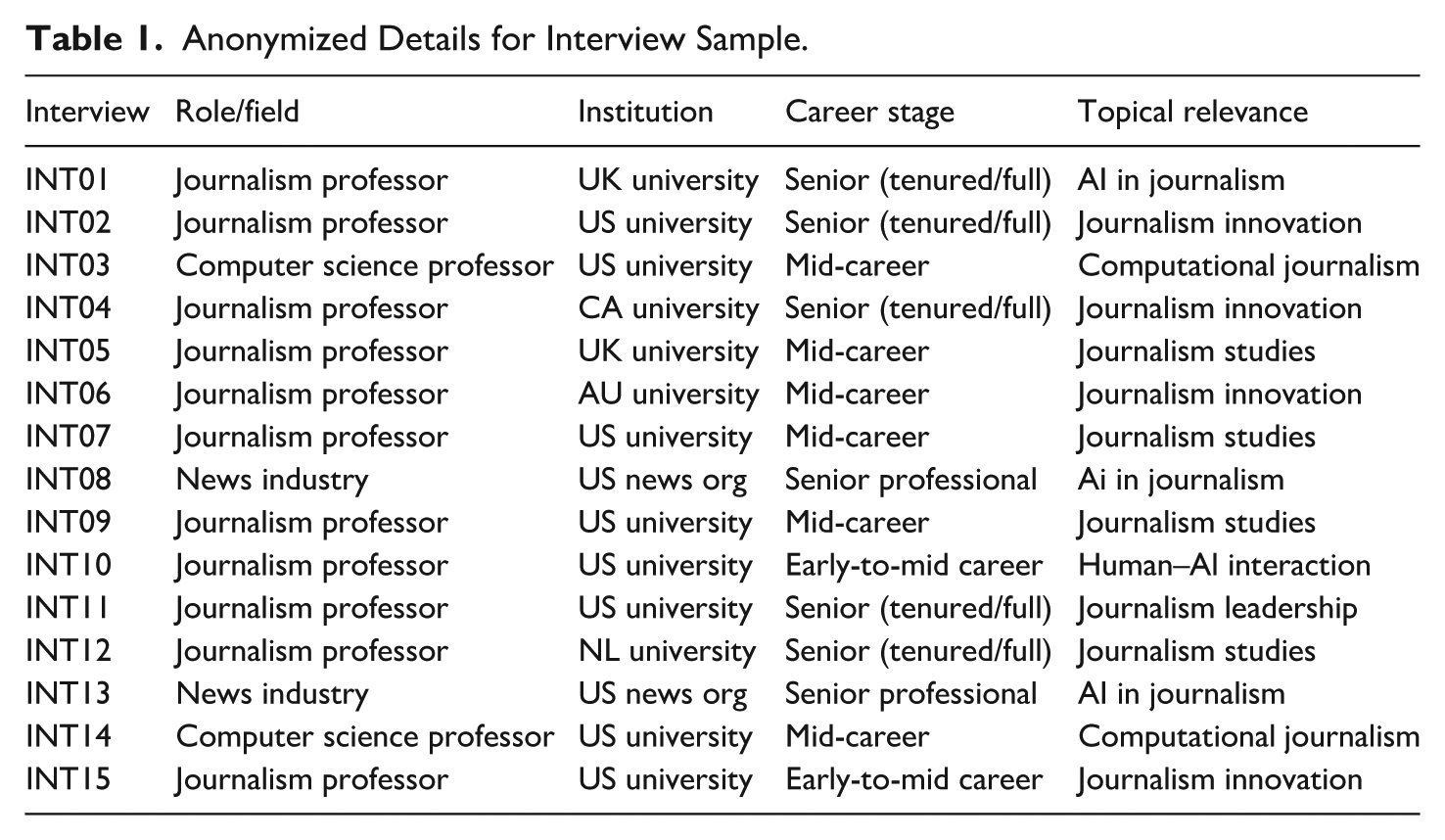
Table 1 provides an anonymized summary of participants, outlining each interviewee’s role, institutional context, career stage, approximate years of experience, and methodological or topical relevance. Although the study includes a relatively small sample (n = 15), the participants were purposefully selected to capture a wide range of expertise at the intersection of journalism, media studies, and artificial intelligence. The sample includes scholars and practitioners from multiple regions (the United States, Europe, Canada, and Australia), spanning early- to senior-career stages (approximately 5–30+ years of experience), and representing both academic and industry perspectives. Participants’ expertise covers key domains central to the research questions, including AI and computational journalism, audience research, media sociology, journalism education, leadership, and investigative and broadcast practice. This diversity enhances the analytical depth of the findings by incorporating varied epistemological and professional perspectives, even as the study does not aim for statistical generalizability. Instead, consistent with qualitative research traditions, the goal is to generate theoretically informed insights grounded in expert experience, with Table 1 providing transparency about the breadth and composition of the sample.
Anonymized Details for Interview Sample.
The researchers opted for a small research sample because the goal of this study was to reach depth rather than the breadth of the phenomenon (Patton, 2014). Recruitment ceased once the point of redundancy was reached and no new information was emerging.
The semi-structured interviews were conducted between February and June 2025 via Zoom and recorded with participant consent. The 13 academics represented the United States, the United Kingdom, the Netherlands, Canada, and Australia; the two practitioners have key roles in developing AI policies and practices in two different US news organizations with national reach.
The interview protocol (Appendix A) of 10 core, open-ended questions expanding on those in another recent panel study (Gutiérrez-Caneda et al., 2024), which included qualitative interviews with media professionals and researchers to explore perspectives on the ethical implications of AI integration in newsrooms. The 2024 study included interviews with 10 subjects (five academics, five industry professionals) from the United Kingdom, Spain, the Netherlands, and Norway. For this study, a single author conducted all the interviews using the interview guide to ensure that all the relevant research areas were covered (McCracken & McCracken, 1988). Each interview lasted from 35 min to 1.5 h.
To ensure analytic rigor, the research team employed reflexive thematic analysis, moving beyond simple code counting to examine the latent meaning within expert narratives. Data saturation was determined through codebook stability; by the 12th interview, no new primary codes emerged, suggesting the 15-interview sample reached the point of redundancy for the core constructs of HCI “fit” and “journalism as software.” These strategies align with Rolfe’s trustworthiness criteria for qualitative inquiry (Rolfe, 2006).
Data Analysis
A well-established method (Braun & Clarke, 2006) was used for identifying, analyzing, and reporting themes within data. Data analysis followed three approaches. We read the interview transcripts searching for meanings and patterns to generate initial codes, and then used the codes to develop themes that captured important aspects about the data related to the research questions, and that symbolized a patterned response throughout all the interview transcripts. We considered whether the theme was found only within some individual interviews or across all of them, whether enough data supported the themes, and whether themes had internal homogeneity (within the theme data correspondence) and external heterogeneity (clear distinctions between themes), which resulted in combining similar themes into one. Finally, we named the themes and wrote the analysis (Braun & Clarke, 2006).
Findings
For RQ1, the responses centered on three key themes: (a) an acknowledgment of software/AI’s capabilities for automated, templated tasks; (b) the importance of creativity, curiosity, empathy, and ethical judgment in the journalistic process; and (c) AI is a powerful support tool but not a substitute for human creativity or responsibility.
Twelve respondents largely agreed that the tasks performed to create highly structured types of journalism, such as earnings reports, sports scores, or weather updates, can function like software through repeatable, automated processes. These respondents noted that AI is streamlining production workflows, repurposing stories across platforms, analyzing large datasets, and enabling new forms of audience interactivity and personalization. They acknowledged that GenAI is augmenting journalists’ capacity by producing draft content, summarizing material, and enhancing data visualization, much like software modules within a given product. However, the AI product manager for a global news agency said there are limits to the argument that journalism is software: There are types of journalism that can be very much software-based, very finite roles, and the software adapts as needed. But then there’s really the unexpected, and I would say a good portion of the journalism that [we do] is reporting on things that are so different, and the techniques used to report them are so perhaps novel, that they’re often not repeatable. Most of the effort, the process we go to report a specific story is often not repeatable from story to story, and being able to repeat things, of course, is a necessary component of software.
Every respondent expressed some resistance to the concept that journalism is software, asserting that journalism depends on human creativity, judgment, and responsiveness to the unexpected. One researcher who studies technology and disinformation also noted that journalism is shaped not only by data and templates but also by ethical, social, political, and emotional factors: It’s something organized as a social and creative activity by human beings. It depends very much on not just the social norms, the cultural norms, but also the creativity of individual journalists.
Unlike software’s deterministic nature, all 15 respondents noted that journalists interpret facts, choose angles, assess evidence, and convey meaning in ways influenced by their experiences and values. One journalism innovation researcher stressed that AI lacks the ability to identify truly novel or diverse story angles, as it must rely on the patterns in its training data: Diverse points of view are implicitly embedded in truth-telling, but I don’t think AI can provide us with diverse points of view that are not already in the corpus. Generative AI is basically a tool that produces content from old content, and this is not without value, but the true weirdness of the world and of the things that could happen and are happening may be too unpredictable for AI systems.
This respondent went on to articulate an idea expressed by others interviewed, that while technology can enhance journalism, particularly in digital formats, human-led reporting, interpretation, and empathy remain central to producing meaningful and impactful journalism: Humans are capable of judgment, and computers are capable of prediction. But that’s kind of where the separation lies. Humans have values. Computers don’t have values, and values are really what separates humans from computers, and values are what are needed to have judgment.
The interview subjects suggest that, while AI may excel at predictable, templated tasks, deciding what constitutes a story, gathering and verifying facts, applying specific cultural context, and exercising ethical and creative judgment remain fundamentally human characteristics that resist full software-like automation.
Addressing RQ2, the themes identified in RQ1 were reinforced repeatedly, but two new themes emerged: (a) the critical importance of human oversight in the use of AI, especially in the mitigation of bias and the promotion of accuracy and (b) the need to foster a culture of collaboration between humans and technology within journalism education.
There was broad agreement among all 15 respondents involved in the study that balancing automation and human creativity necessitates keeping humans in control of decision-making and ethical judgment. One scholar with deep expertise in LLMs said that this layer of human oversight for any AI-generated content is crucial because AI can make mistakes, leading to significant risks if incorrect information is disseminated: Ideally speaking, I would like to have humans behind every automation. Whatever you are generating, humans should check that before it goes to the public, right? But my fear is that won’t be possible.
Six respondents specifically noted that the critical-thinking capabilities of humans are essential to avoid passing on some of AI’s inherent biases to the audience. One researcher who is studying the impact of AI in journalism indicated that journalists need to be wary of the training data used to create AI tools: What it knows, how it knows – those are really important questions, because those shape the ideological biases that AI has, and those are very opaque. Those are very non-transparent.
Another academic noted that AI reproduces the biases and blind spots of journalism itself, suggesting that parroting all sides to achieve objectivity is actually a “bug in the system” rather than a feature. This subject argued that grading should not just reward “objective” output, but rather the ability to critique the “ideological biases” built into AI defaults.
All 15 respondents agreed that AI must work alongside humans, not replace them. The chief innovation officer for one of the largest television news groups in the United States saw the value in leveraging AI in the training of less experienced journalists. Why not as a first layer an AI editor that really helps teach them in tweaking scripts, and then you have the human layer after that looking at it. So, there’s a lot of different things that I think can help workflows and can help teach, but we just have to remember that human layer needs to be in there.
This quote provides a concrete example of human–AI collaboration in workflow and training. One respondent who has been researching product management in journalism said integrating AI literacy into journalism training is imperative: Curiosity, experimentation, critique, I think maybe that has to be the model to some extent and then make it iterative. Critique and go back, critique and go back – iteration is a key element of the product management process when you talk about agile methodology. So maybe just an agile mindset needs to be something that we need to embrace in journalism.
Journalism educators face a multifaceted challenge in responding to the rapid development and use of AI tools. Responses to RQ2 were consistent with those generated from the other research questions, with two new areas of focus for educators emerging: (a) refocusing journalism education on fundamentals, including human skills and core values and (b) integrating AI tools critically and practically into the curriculum to prepare students for AI’s impact on jobs.
Our 15 interview subjects broadly support the distinction between using AI for “mechanical” tasks and reserving “human” evaluation for high-level judgment. Instructors are encouraged to show students how to “offload” routine labor to focus on value-driven journalism: Get rid of all the mechanical things that are really taking up the time for you to do the human aspect of it. Use that energy that you’re saving to really hold on to your journalistic values, journalistic integrity, and even things that we don’t do, which is questioning our journalistic role, questioning objectivity, questioning, like, is this the best way to get to the truth?
One practitioner notes that AI can “streamline operations,” such as repurposing a broadcast story for digital platforms, but emphasizes that “the gathering of the news is what differentiates a human being, what the machine really cannot do.”
Four of the educator experts suggested that assignments should not just allow AI use but require students to understand how the tools are built and help them effectively critique the output, thereby embedding literacy and verification into the grading rubric: We have a certain set of AI tools publicly available to everybody right now. Do journalists have a proper understanding of what those tools are capable of doing? Do journalists understand the capacity of the tool to provide you the right answer, and also the capacity of the tool to provide you with the wrong answer? As a journalist, the final responsibility needs to be up to you. You’re the user of the tool. Are you in the position to be able to tell what’s right from what’s wrong?
To assess human judgment, educators must require students to make their decision-making visible. One expert argued that transparency regarding how tools are used is as important as the output itself, and journalism processes are “as transparent as we permit them to be,” suggesting that revealing the “iterative process” of reporting is a key pedagogical opportunity.
The findings suggest that grading rubrics should reward the specific elements of journalism that the respondents identify as beyond the current reach of software, including curiosity, empathy, and cultural nuance. One of the key recommendations is to reward the novelty of a student’s approach to a story: We can teach machines a lot of patterns and formats by looking at a lot of works, but that is picking from multiple set solutions or thinking processes. It is not generating a new thought process, which the journalists or other humans or other content creators are good at, finding a new angle to tell a story.
As another educator put it, AI is “quite limited in its ability to give us new insights” because it largely recycles existing material. Therefore, assessment should reward the creation of “new primary source material.” Rubrics should also reward work that captures local nuance, which AI often misses due to training bias: We can rely on AI to give some questions for interviews or what are some good follow up stories for this, but I don’t think that is the best use of AI, or that we should rely on that for a number of reasons, because each local community is different, and what people want in each local community is very different, and I don’t think these LLMs can react in that way.
Though potentially more difficult to assess, instruction should also emphasize the “art of making viewers feel the story” as empathy is a key human differentiator: Software isn’t going to respond to an event as a human being. And I think that being a human being and responding in a human way should inform good journalism. It’s not just about being observational.
While a broad consensus was reached regarding AI’s utility for efficiency, two participants argued that framing journalism as software devalues the art and social purpose of the craft. Furthermore, whereas the manuscript emphasizes human oversight, two more voiced skepticism regarding the feasibility of such an approach under intense business pressure.
The interviewees’ positionality, shaped by professional background, experience, and proximity to technological change, influences how they view AI in journalism education. Veteran practitioners, often grounded in traditional newsroom experience, approach AI from a preservationist standpoint. They emphasize journalism as a human craft requiring ethical judgment, curiosity, and narrative skill. From this perspective, AI is useful for routine tasks but risks diminishing writing quality, critical thinking, and the “art” of journalism if overused. Their skepticism reflects a concern that automation could erode the human elements central to meaningful reporting.
In contrast, interviewees with backgrounds in media innovation or product development view AI as an inevitable part of journalism’s evolution. They frame it as an infrastructural shift, creating a new kind of operating system for knowledge production, and emphasize efficiency, adaptability, and integration into workflows. Rather than resisting AI, they advocate teaching students to critically engage with it, understanding both its capabilities and its biases.
A third group, with interdisciplinary or academic backgrounds and less direct newsroom experience, emphasizes foundational knowledge, such as how AI systems work, their limitations, and how users interpret outputs. While recognizing AI’s ability to lower technical barriers, they warn against overreliance and stress the importance of critical thinking to avoid superficial or misleading results.
Despite these differences, there is broad agreement that AI can effectively handle routine tasks, freeing journalists to focus on higher-order work. At the same time, all groups stress the need to maintain human agency and guard against automation bias.
Discussion
Across 15 in-depth interviews, a consistent pattern emerged: participants endorsed AI as a catalyst and efficiency tool, noting its use in accelerating background research, proposing alternative angles, scaffolding novice learning, and streamlining templated or data-heavy tasks. However, they mostly rejected it as a creative substitute. While AI expedites tasks related to search, summarization, and iteration, they said it cannot reliably generate four critical qualities that make journalism resonate: curiosity, emotion, cultural perspective, and originality.
Framed through HCI, the findings align with a sociotechnical view of journalism in which tools must be designed around and be accountable to human needs, values, and practices. In other words, “fit” matters: adoption improves when systems augment rather than replace human judgment, and when newsroom routines, training, and assessment intentionally reinforce the human capacities AI cannot replicate. While “fit” is the goal, three of our respondents noted that the economic reality of newsrooms may prioritize “labor-saving” over “accuracy and oversight,” creating a “misfit” between journalistic values and business models.
In responding to RQ1, interviewees widely agreed that highly structured outputs, including automated alerts, standardized updates, and templated explainers, can function like software, and that AI can add speed and scale to these tasks. Yet, they uniformly resisted the stronger claim that journalism as a whole is software. Participants emphasized that story selection, field reporting, verification, ethical reasoning, and meaning-making are contingent, culturally situated, and value-laden, and therefore resistant to full automation.
We propose a typology of journalistic work categorized by software alignment. Tier 1 (software-amenable) includes regimented, data-heavy tasks such as weather alerts or corporate earnings. Tier 2 (hybrid/augmented) includes iterative processes like beat reporting and copy editing, where AI serves as a “helping hand” for efficiency. Tier 3 (irreducibly human) encompasses novel enterprise reporting and ethical judgment, tasks defined by unexpectedness and “positionality” that resist algorithmic scripting.
Participants underscored human oversight to mitigate bias, calibrate accuracy, and determine when not to defer to machine outputs in their responses to RQ2. They also pointed to concrete sites of productive human–AI collaboration, particularly in the training of early-career reporters, for example, using AI to model structures or generate variations that students and early-career practitioners might critique, verify, and improve. However, at least one respondent argues that “human in the loop” is too passive; the profession requires “human in the center” to ensure journalists do not relinquish “political agency.” Another expresses a “fear” that having humans behind every automation “won’t be possible” due to the high business pressure to publish quickly.
For educators, responses to RQ2 suggest that, if AI is strongest as a catalyst and weakest at producing curiosity, emotion, cultural perspective, and originality, journalism curricula should invert the usual logic: teach students to leverage AI for efficiency while grading them on the human outputs AI cannot deliver. The interviews point to three design principles: (a) embed AI literacy and verification regularly in assignments; (b) center assessment on curiosity (question quality and novelty of angle), emotional intelligence (audience empathy and appropriate tone), cultural perspective (situated sourcing and community voices), and originality (distinct framing and narrative craft); and (c) require reflective process notes that make human judgment visible. Rubrics should translate these aims into observable criteria, so that programs can reward the very capacities that sustain journalism’s civic and ethical purpose. As a starting point, the researchers have developed a sample rubric, based on our findings, that could be modified based on the type of assignment or activities instructors create (see Appendix B).
Overall, the pedagogical recommendations advanced in this study should be understood as an expert-informed, normative framework rather than a direct reflection of observed institutional practices. While participants discussed current teaching approaches and challenges, the recommendations synthesize their perspectives with the study’s HCI framework to propose forward-looking strategies for journalism education. As such, these recommendations are interpretive and aspirational, designed to guide curriculum development rather than document widespread or validated classroom implementation.
Future Study
Several gaps surfaced worthy of further research emerged in the expert responses. First, few interviewees imagined journalists taking AI programming and configuration in-house at scale. A minority echoed Booth’s (1989) expectation that “local experts” will emerge and that journalists can “learn a little more about coding” (Gutiérrez-Caneda et al., 2024), but there was little appetite for asserting technical agency over tool development. Areas for future study regarding AI in instruction focus on pedagogical efficacy, psychological impacts on students, and structural curriculum changes.
Future research is needed to establish the most effective method for teaching the underlying mechanisms of AI without getting lost in the rapid turnover of specific apps. Additional studies could examine specific pedagogical strategies for explicitly emphasizing and assessing human-centered journalistic competencies, while requiring reflective process documentation that makes students’ human judgment visible. Notably, existing literature reveals significant disagreement over whether AI enhances or degrades journalistic quality, presenting a ripe opportunity for longitudinal study.
Limitations
This study’s qualitative design (15 interviews) supports analytical, not statistical, generalization. Participants may over-represent educators and organizations already experimenting with AI, which could introduce a bias toward more tech-forward perspectives, potentially missing insights from those less engaged with AI. Recruitment via Google Scholar metrics and authors’ networks risks selection bias and homogeneity of viewpoints, and the rapid evolution of tools limits temporal durability; therefore, perceptions and practices could change quickly as AI technology advances.
The authors’ professional backgrounds in journalism and journalism education may shape the interpretation of findings. Both authors have experience as practitioners and researchers. One is a tenured full professor with prior work in television news and more than 20 years in academia, and the other is an associate professor with nearly four decades of experience across higher education and the media industries, including work as a reporter, editor, trainer, and journalism educator in international contexts. While this expertise strengthens the study’s grounding in journalistic practice, it may also orient the analysis toward traditional newsroom norms and values, potentially limiting consideration of alternative or emerging perspectives.
Conclusion
This study contributes conceptual clarity and practical guidance at a pivotal moment. Empirically, it shows that practitioners see AI as an accelerator and amplifier, not a creative replacement, thereby reaffirming journalism’s dependence on human curiosity, ethical judgment, cultural understanding, and narrative craft. Theoretically, the findings advance an HCI-informed account of augmentation with accountability: systems should be designed around human needs and assessed by how they strengthen journalism’s creative, ethical, and civic purposes.
For educators, the imperative is to integrate AI tools for efficiency and verification but teach and grade the human capacities AI cannot supply. The goal is to embed AI literacy and verification in routine assignments; grade for curiosity, emotional intelligence, cultural perspective, and originality with explicit rubrics; and require reflective process notes that surface judgment and sourcing.
Footnotes
Appendix A
Questions for 2025 interviews:
Appendix B

Funding
The authors received no financial support for the research, authorship, and/or publication of this article.
Declaration of Conflicting Interests
The authors declared no potential conflicts of interest with respect to the research, authorship, and/or publication of this article.