






Abstract
This study examines alignments and divergences between public relations practitioners’ and educators’ perceptions of curriculum needs and the value of a master’s degree in public relations. Guided by a coorientation framework, survey data reveal substantial agreement on core knowledge domains and skill sets, including strategic, theoretical, business, and analytical competencies, with a few exceptions. For example, educators emphasize theoretical knowledge more, while practitioners value applied courses on visual communication and media production, as well as organizational and political communication more. Nuances also exist in the perceived value of a master’s degree. Implications for graduate curriculum design and positioning are discussed.
Keywords
Introduction
The academic-practitioner gap, a perceived divide between what universities and researchers value compared to public relations practitioners, has been a recurrent topic (e.g., Aldoory & Toth, 2000; Shen & Toth, 2008; Van Ruler, 2005). This gap has often been discussed in relation to curriculum relevance and alignment of educational outcomes with industry expectations (Briones et al., 2017; Shen & Toth, 2008). At the graduate level, these discussions typically position master’s programs as responsible for both cultivating advanced competencies and preparing graduates for more strategic jobs that enhance program reputation and viability within competitive higher education environments (Briones et al., 2017; Commission on Public Relations Education [CPRE], 2012, 2025). Recent research examining U.S. doctoral programs also demonstrated the pipeline challenge resulting from practical enrollment needs and the expectation of public relations faculty to have professional knowledge and the ability to conduct research, with only about 25 PhD programs in the United States being public relations-focused (Capizzo et al., 2022). These studies highlight the diverging objectives and expectations of master’s and doctoral education.
In response to these concerns about alignment between education and practice, the CPRE played a central role in articulating standards for graduate public relations education. For example, the CPRE published a report on master’s level education in 2012, recommending core courses in five areas: strategic public relations management, business principles, theory and research methods, global influences, and ethics (CPRE, 2012). These recommendations adopted a “fork in the (curriculum) road” approach, with different paths for students moving toward a professional job or further academic work in doctoral studies.
Since then, additional evidence has revealed a growing shift toward interdisciplinary approaches, reflecting a trend toward a more integrated discipline (Briones et al., 2017; Weissman et al., 2019). This pattern was indeed confirmed by the 2025 CPRE report on master’s education, in which a website analysis of 92 graduate programs in the United States highlighted continued diversification in coursework (Woods et al., 2025). At the same time, the most recent CPRE (2025) report on master’s education also continued to highlight the importance of foundational competencies, including strategic planning, communication, crisis and issues management, and ethics.
Despite these developments, it remains unclear whether educators and practitioners share common expectations regarding the objectives and deliverables of master’s public relations education. If public relations master’s degree programs are to be successful for all the stakeholders involved, it is important to investigate the perceptions and expectations of public relations educators and practitioners.
The study presented here, therefore, intends to accomplish two goals: (a) to examine the extent of alignment between educators’ and practitioners’ perceptions of desired competencies and curriculum at the master’s level; and (b) to present updated empirical evidence that demonstrates convergence and divergence between these two key stakeholder groups. To address these goals, this study adopts a coorientation perspective (McLeod & Chaffee, 1973) to examine both alignment, that is, the degree of shared expectations, and divergence, that is, role-based differences, between two key stakeholder groups. We draw on data from two separate online surveys administered to public relations practitioners and educators between late 2024 and early 2025. This study contributes to the graduate public relations education scholarship by moving beyond curricular description to illuminate areas of alignment and tension among educators and practitioners, and to provide guidance regarding curriculum design, program positioning, and the evolving role of the master’s degree in public relations.
Literature Review
Coorientation Between Practitioners and Educators in Public Relations Education
Research on public relations education has frequently examined practitioner and educator positions, yet few studies have conceptually framed these approaches from a coorientation perspective. The coorientation model (McLeod & Chaffee, 1973) provides a useful theoretical framework for examining the degree of alignment among stakeholder groups on shared topics. Within the context of graduate public relations education, this framework allows for examination of whether public relations practitioners and educators share common orientations toward desired competencies, related coursework, and the value of a master’s degree, as well as identification of their diverging perspectives that may inform curriculum design.
From a coorientation perspective, agreements between stakeholder groups indicate convergence around educational expectations, whereas divergences may reflect role-based priorities rather than fundamental conflict. Recent findings from the 2025 CPRE report further underscore increasing diversification in graduate curricula and the growing emphasis on interdisciplinary and applied competencies, reinforcing the need to reassess alignment between educators and practitioners. Given the call for alignment between academic deliverables and practitioner expectations (e.g., CPRE, 2018, 2025; Shen & Toth, 2008), the coorientation lens is well-suited to examine the similarities and differences between such stakeholder groups.
The following sections review scholarship related to each of these areas, providing the foundation for examining educators’ and practitioners’ perceptions.
Desired Competencies
Research conducted to address differences between education and practice previously focused on identifying a standard graduate public relations curriculum (e.g., Capizzo et al., 2022; CPRE, 1999, 2006, 2012, 2025; Shen & Toth, 2013). For example, the CPRE 2012 report recommended that a core curriculum should focus on the areas of strategic public relations management, basic business principles, communication/public relations theory and research methods, global influences, and ethics. Capizzo et al. (2022) presented seven competencies for doctoral programs, ranging from knowledge of public relations theory and research, advanced methodological training, pedagogical training, and mentoring and networking support, to professionalization and preparation for faculty positions.
Other studies have provided insights into the core competencies needed for public relations practitioners in general and for public relations leaders. The 2024 Practice Analysis for the Universal Accreditation Board identified the top competencies expected for practitioners with five or more years of experience as leading the public relations function (e.g., business literacy, leadership, problem solving, cross-departmental relations), the public relations planning process (i.e., RPIE – Research, Planning, Implementation, & Evaluation), issues and crisis communication, and managing relationships (Neill, Qiang, et al., 2025).
Finally, another study focused on emerging leaders revealed the essential competencies necessary for them to develop include strong communication skills, strategic planning, ethics, listening and confidence (Neill, Davidson, et al., 2025). Collectively, these studies provide some insights regarding employers’ expectations for graduates of professional graduate degree programs who plan to work in industry. However, there is still limited research on the desired competencies, or knowledge and skills that practitioners and educators expect master’s students to have mastered.
Courses
Over the past 25 years, research on graduate public relations education has examined curriculum design to understand how programs structure their degrees and adapt to industry shifts and guidelines from organizations such as the CPRE (2006, 2012) and the Foundation for Public Relations Research and Education (National Commission on Graduate Study in Public Relations, 1985), now the Institute for Public Relations (IPR). Findings consistently revealed substantial variation across curricula. Early studies documented differences in program structure, including the number and type of public relations courses, electives, and capstone experiences (Aldoory & Toth, 2000; Briones & Toth, 2013). In response to this diversification, CPRE’s 2006 report outlined three models of graduate education. Model A emphasized preparation for doctoral studies, Model B focused on advanced professional development, and Model C concentrated on specialized public relations coursework, “bringing in content from other disciplines into public relations courses and through collateral electives” (p. 54).
Six years later, CPRE dedicated its 2012 report to graduate education and recommended core courses in five areas: strategic public relations management, business principles, theory and research methods, global influences, and ethics. The report advised programs to integrate these areas flexibly and tailor experiences for doctoral preparation (additional research and thesis) or professional advancement (specialized courses and applied capstone projects). Subsequent research highlighted a shift away from public relations-specific programs toward broader, interdisciplinary communication degrees, reflecting industry demand for integrated skill sets (Briones et al., 2017; Weissman et al., 2019)
Most recently, a website analysis of 92 graduate programs included in the 2025 CPRE report on graduate public relations education confirmed this continued diversification in coursework (Woods et al., 2025). Research methods remained the most consistent requirement, appearing in over 90% of core curricula. Other common requirements included theory, capstone experiences, public relations topics, law and ethics, and writing/content creation. Another recent study reported that the most prevalent elective offerings were writing and content creation; social and digital media; global, international, and intercultural communication; business principles and practices; and crisis communication (Madden et al., 2026). Most programs also offered a capstone experience, typically theses or professional projects, with some including capstone courses, comprehensive exams, and internships.
Although graduate public relations education research has consistently demonstrated an interdisciplinary shift in program titles and course offerings, the extent to which programs require or encourage coursework in related disciplines remains unclear. While undergraduate studies have noted credit hour requirements outside the public relations major (e.g., Del Rosso et al., 2020), comparable research at the graduate level has not examined this component in detail. In line with previous recommendations (e.g., CPRE, 2006, 2012; Shen & Toth, 2008), website analyses suggest that business-related coursework is becoming more common. Nearly 60% of programs analyzed in the 2025 CPRE graduate education report listed at least one course in a business area, such as business fundamentals, finance, leadership, management, or marketing (Woods et al., 2025), although these courses were more frequently offered as electives than required credits. Beyond business, prior research has also called for integration of other disciplines, such as behavioral science (e.g., Shen & Toth, 2008). Still, no known studies have systematically documented the extent of graduate coursework in such areas.
Value of a Master’s Degree in Public Relations
The value of a master’s degree in public relations has been a long-standing topic of inquiry, particularly as the profession has evolved alongside increasing organizational complexity, technological change, and heightened societal expectations for ethical and strategic communication. While undergraduate education traditionally has served as the primary entry point into the profession, graduate education has been positioned as a means of cultivating advanced competencies, leadership capacity, and strategic decision-making skills (Aldoory & Toth, 2000; Shen & Toth, 2008). Nevertheless, questions persist about how both practitioners and educators perceive the value of a master’s degree in public relations, particularly in terms of employability and career advancement.
Early research on graduate public relations education revealed considerable ambiguity regarding the purpose and payoff of the master’s degree. Aldoory and Toth (2000) documented wide variation in program objectives, ranging from theory-driven academic preparation to applied professional training, raising concerns about whether graduate education communicated a clear value proposition to employers. Van Ruler (2005) further argued that misalignment between educational outcomes and professional expectations could weaken the perceived utility of graduate credentials, particularly in a field where experience has long been viewed as a primary indicator of competence.
The CPRE has consistently framed the master’s degree as preparation for advanced professional practice. The 2006 CPRE report emphasized research-based strategic planning, analytical reasoning, and ethical decision-making as distinguishing features of graduate education. Building on this foundation, CPRE’s 2012 report explicitly positioned the master’s degree as “educating for complexity,” arguing that graduate programs should prepare students to navigate multifaceted organizational, social, and global environments. Importantly, CPRE acknowledged that the value of a master’s degree cannot be assessed solely through immediate employment outcomes, but should also be understood in terms of long-term professional growth and leadership development.
Empirical studies examining perceptions of graduate education’s value have produced mixed findings. On one hand, research suggests that practitioners recognize the master’s degree as beneficial for roles involving research, planning, and management, particularly early- to mid-career positions (Briones & Toth, 2013; Shen & Toth, 2008). On the other hand, studies also indicate that employers frequently prioritize professional experience, applied skills, and demonstrated competencies over advanced academic credentials (Knight & Sweetser, 2021). This emphasis reflects broader trends across communication-related professions, where experiential learning and portfolios are often treated as proxies for job readiness.
Recent scholarship further complicates perceptions of value by highlighting increasing diversification in graduate public relations education. Content analyses reveal a shift toward interdisciplinary degree structures, with programs integrating public relations, strategic communication, business, analytics, and digital media (Briones et al., 2017; Weissman et al., 2019; Woods et al., 2025). While such diversification may enhance curricular relevance, it may also blur distinctions between public relations degrees and related fields, potentially contributing to inconsistent employer expectations. Recent research (Madden et al., 2026) suggested that this lack of clarity may undermine the perceived value of graduate education when hiring managers struggle to differentiate among communication-oriented master’s programs.
Educators, by contrast, tend to conceptualize the value of a master’s degree more holistically. From this perspective, graduate education is not merely a credential for immediate employment but a formative experience that fosters critical thinking, theoretical grounding, and ethical judgment—capacities essential for sustained effectiveness and leadership in public relations (Shen & Toth, 2008). Such outcomes, while less visible in short-term hiring decisions, are increasingly important in a profession characterized by strategic complexity.
Taken together, existing literature suggests that perceptions of the value of a master’s degree in public relations are shaped by multiple, sometimes competing, considerations: expectations for career acceleration, alignment with industry needs, differentiation from related degrees, and beliefs about the role of education in professional identity formation. While prior research has examined curricula and competencies extensively, fewer studies have directly compared practitioners’ and educators’ perceptions of the degree’s value. Addressing this gap is particularly important given ongoing transformations in both higher education and the public relations profession.
Based on the above-reviewed literature, the following research questions were posed:
Method
As part of a larger research project, two separate online surveys were distributed to public relations practitioners and educators between late 2024 and early 2025. Most of the questions were adopted from the 2012 CPRE study of master’s education in public relations. The instruments were shared with the CPRE membership organizations and the research team’s professional contacts. The study received Institutional Review Board (IRB) approval and was classified as exempt due to minimal risk, as it involved anonymous survey responses from adult participants. The final sample consisted of 119 practitioners and 111 educators.
Participant Profile
The mean age of the 230 participants was 49.54 (SD = 12.26), with an average of 7.11 years of professional experience (SD = 8.27). The majority of the participants were female (67.2%), followed by male (23.5%), and people who prefer not to disclose (6.4%), prefer to self-describe (2.5%), and non-binary (0.5%). Most of the participants lived in the U.S. (83%). Participants reported primarily working in person (48.5%), in a hybrid format (36.4%), or exclusively online (15.0%). Among the practitioners, 44.5% reported working in top management roles. Most educators held doctoral degrees (92.5%).
Measures and Data Analysis
Given that the two surveys were part of a larger research project, a five-point Likert-type scale was used for the practitioner survey and a seven-point Likert-type scale was used for the educator surveys, with 1 indicating “not at all” or “strongly disagree,” and 5 or 7 “very much” or “strongly agree.” To combine the two data sets for data analysis, a transformation formula, Y = 1 + (X − 1) × 1.5, was used, where X is the original score on the 5-point scale. This approach preserved proportional spacing between response categories and allowed valid pooling of the two 2025 datasets. All rescaling procedures were conducted prior to merging the datasets.
On both surveys, participants rated their agreement with a list of knowledge areas, ranging from persuasion concepts to social media/digital analytics. Another list of skills and courses in related disciplines was presented as well, such as research (skills) and advertising (courses). For perceptions of the value of a master’s degree, an example question included “please indicate how much you agree that a master’s program in public relations/communication management should qualify students for” among choices from “entry-level positions in public relations” to “positions in public relations research departments or firms.”
To examine RQ1 and RQ2, we first conducted descriptive analyses, that is, means and standard deviations. To identify the underlying dimensions of desired competencies and related courses (RQ1), we conducted exploratory factor analyses (EFA) using principal axis factoring with oblimin rotation. Factor retention decisions were based on multiple criteria: eigenvalues greater than 1.0, inspection of scree plots, and conceptual interpretability. Items with loadings of .50 or higher and without cross-loadings greater than .30 were retained. Sampling adequacy was assessed using the Kaiser–Meyer–Olkin (KMO) measure and Bartlett’s test of sphericity. For each retained factor, composite scores were computed by averaging the items with acceptable loadings, and internal consistency reliability (Cronbach’s α) was evaluated. To address RQ3, we conducted hierarchical regression analyses to examine whether educators and practitioners differed in their perceptions, controlling for background characteristics. Demographic controls were entered in the regression analyses.
Results
RQ1: What Are the Perceptions of Public Relations Practitioners and Educators Regarding (a) Desired Competencies and (b) Related Courses of a Master’s Degree in Public Relations?
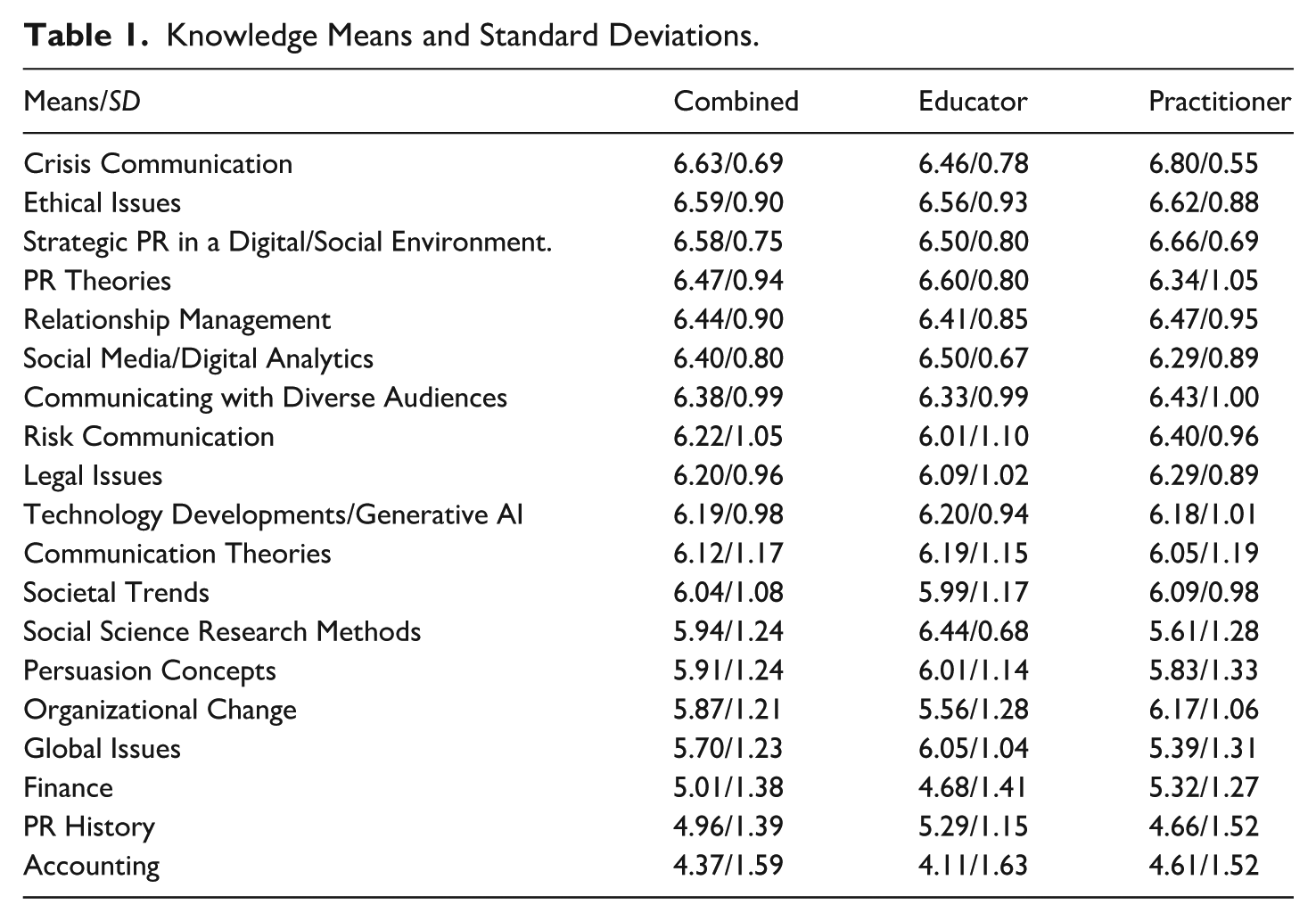
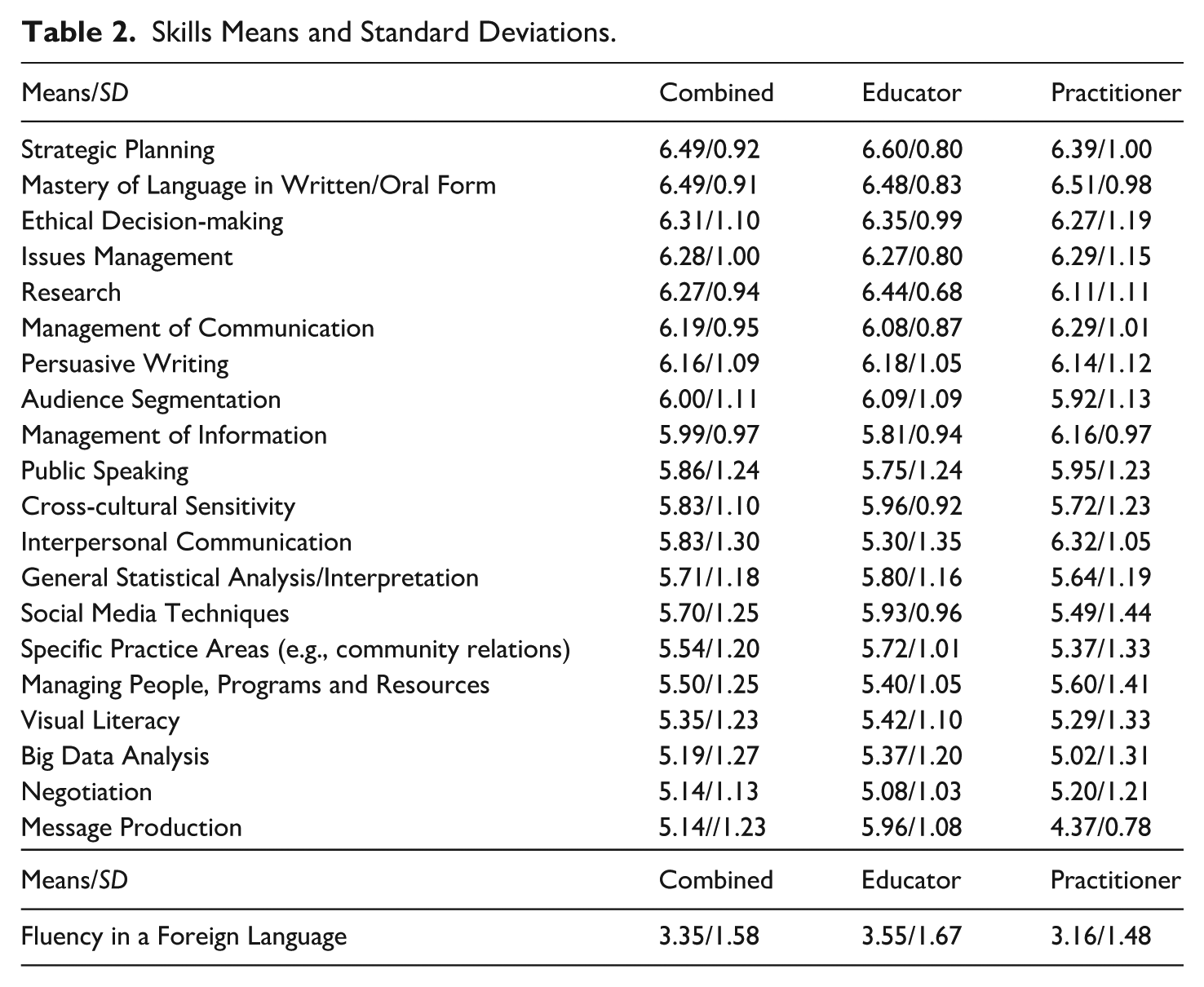
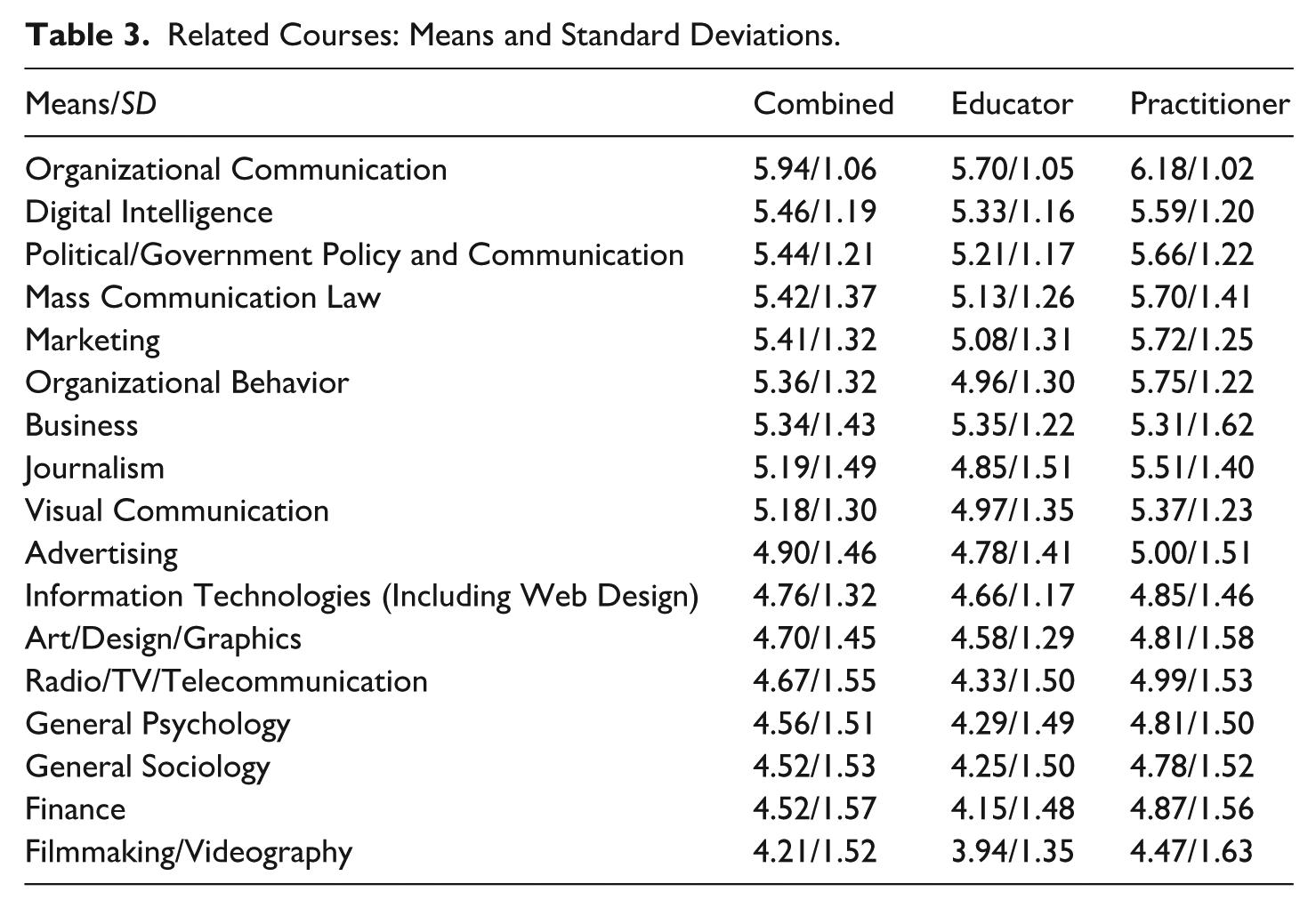
Desired competencies were operationalized as knowledge areas and skills that a master’s program in public relations should include. Descriptive statistics (item means and standard deviations) for all knowledge, skills, and related courses items are presented in Tables 1 to 3. These values provide an overview of participants’ perceptions prior to factor extraction, whereas Tables 4 to 6 present the retained items and factor loadings for the final EFA structures.
Knowledge Means and Standard Deviations.
Skills Means and Standard Deviations.
Related Courses: Means and Standard Deviations.
Knowledge Factor Loadings.
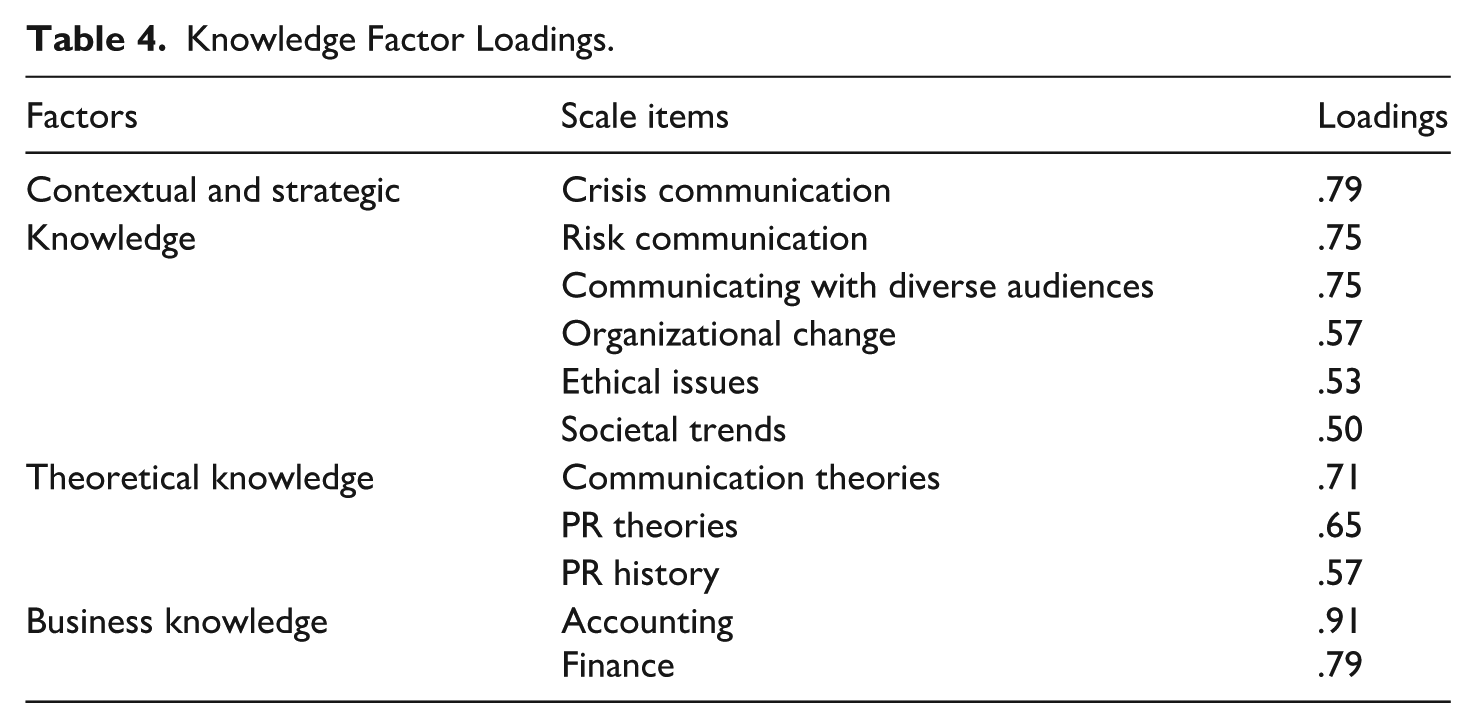
The EFA yielded a three-factor structure for knowledge (see Table 4). Although an initial EFA identified a six-factor solution, several factors contained only one or two items, with cross-loadings. After removing items with cross-loading problems and low loadings (<.40), a clearer three-factor pattern emerged, consisting of (a) contextual and strategic knowledge, (b) theoretical knowledge, and (c) business knowledge. Sampling adequacy was acceptable (KMO = .76), and Bartlett’s test indicated sufficient intercorrelations (χ²(171) = 1331.37, p < .001). The total amount of variance explained was 36.78%. Contextual and strategic knowledge comprises crisis communication, risk communication, communicating with diverse audiences, organizational change, ethical issues, and societal trends (loadings = .50 to .79). Theoretical knowledge includes communication theories, public relations theories, and public relations history (loadings = .57 to .71). Business knowledge consists of accounting and finance (loadings = .79 to .91).
Internal consistency was assessed for each knowledge subscale via Cronbach’s α. The analysis revealed acceptable reliability for the contextual and strategic knowledge subscale (α = .79) and adequate reliability for the theoretical knowledge subscale (α = .66). The two-item business knowledge subscale demonstrated strong internal consistency, as indicated by a high inter-item correlation (r = .82).
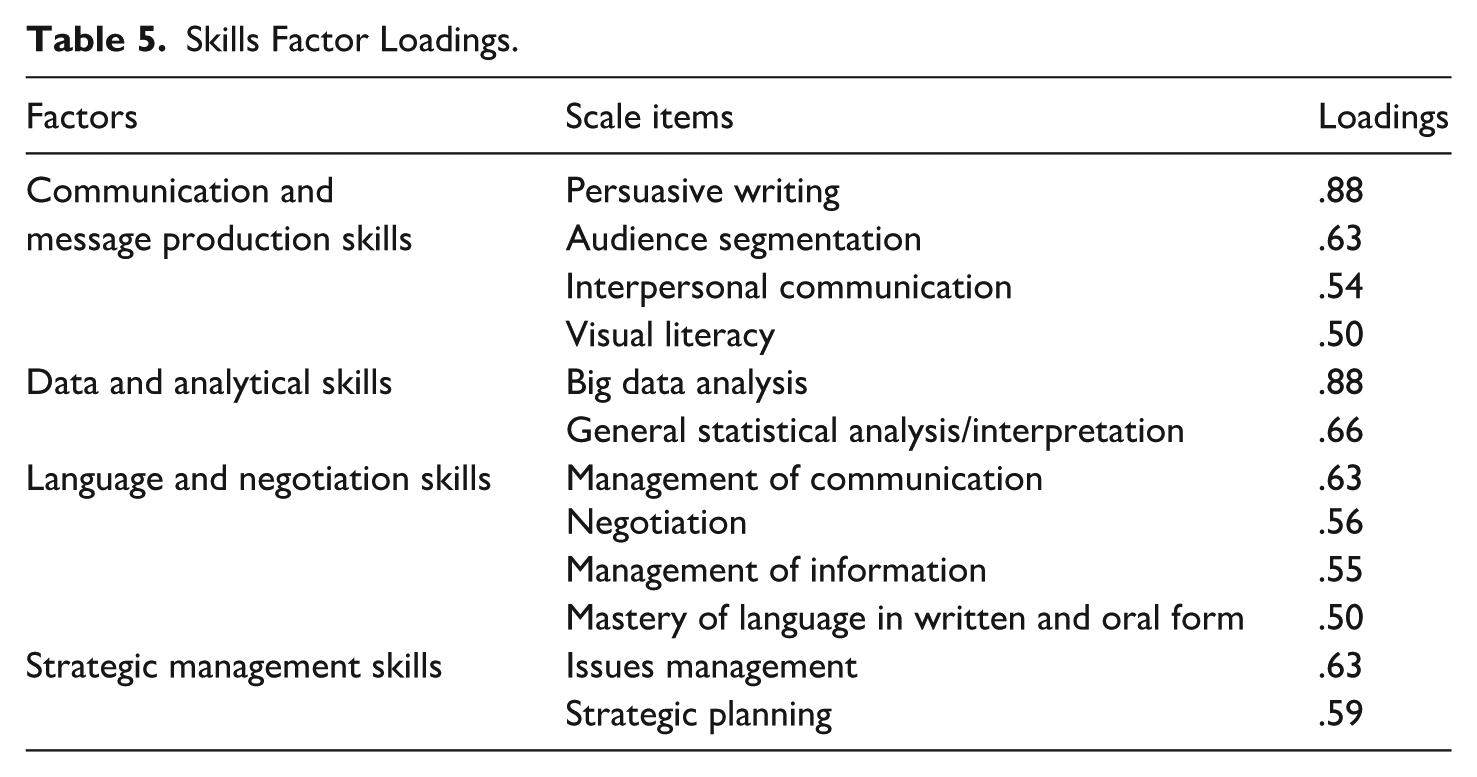
The EFA results for the skills expected of a master’s degree in public relations indicated a four-factor structure (see Table 5), accounting for 45.33% of the variance. Sampling adequacy was acceptable (KMO = .78), and Bartlett’s test indicated sufficient intercorrelations (χ²(105) = 937.22, p < .001). Factor 1 consists of communication and message production skills, including persuasive writing, audience segmentation, interpersonal communication, and visual literacy, with loadings ranging from .50 to .88. Factor 2 touches on data and analytical skills, including big data analysis and general statistical analysis and interpretation, with loadings from .66 to .88. Factor 3 deals with language and negotiation skills, including management of communication, negotiation, management of information, and mastery of language in written and oral form, with loadings from .50 to .63. Factor 4, on strategic management skills, comprises issues management and strategic planning, with loadings of .63 and .59. Follow-up reliability analysis showed good reliability: α factor1 = .75, α factor3 = .72, while the two-item subscales for data and analytical skills and strategic management skills both had moderately high inter-item correlations (rfactor2 = .72, rfactor4 = .63).
Skills Factor Loadings.
Regarding the related courses of a master’s degree in public relations, the EFA revealed a four-factor structure (see Table 6), accounting for 56.33% of the variance. Sampling adequacy was acceptable (KMO = .86), and Bartlett’s test indicated sufficient intercorrelations (χ²(136) = 2009.46, p < .001). The four clusters contained courses on 1) visual communication and media production courses, with loadings between .54 and .81; 2) organizational and political communication courses, with loadings of .58 and .62; 3) business and financial literacy courses, with loadings of .84 and .86; and 4) social science foundations courses, with loading of both items being .76. Visual communication and media production courses include art/design/graphics, filmmaking/videography, visual communication, radio/TV/telecommunication, and information technologies (including web design). Organizational and political communication courses consist of organizational communication and political/government policy and communication. Business and financial literacy courses comprise business and finance. Social science foundations courses encompass general sociology and general psychology. Follow-up reliability and inter-item correlations indicated high or moderately high results (αfactor1 = .86, rfactor2 = .64, rfactor3 = .83, rfactor4 = .92). The high inter-item correlations showed that the subscales with two items were still conceptually narrow and appropriate for use as composite indicators.
Related Courses Factor Loadings.
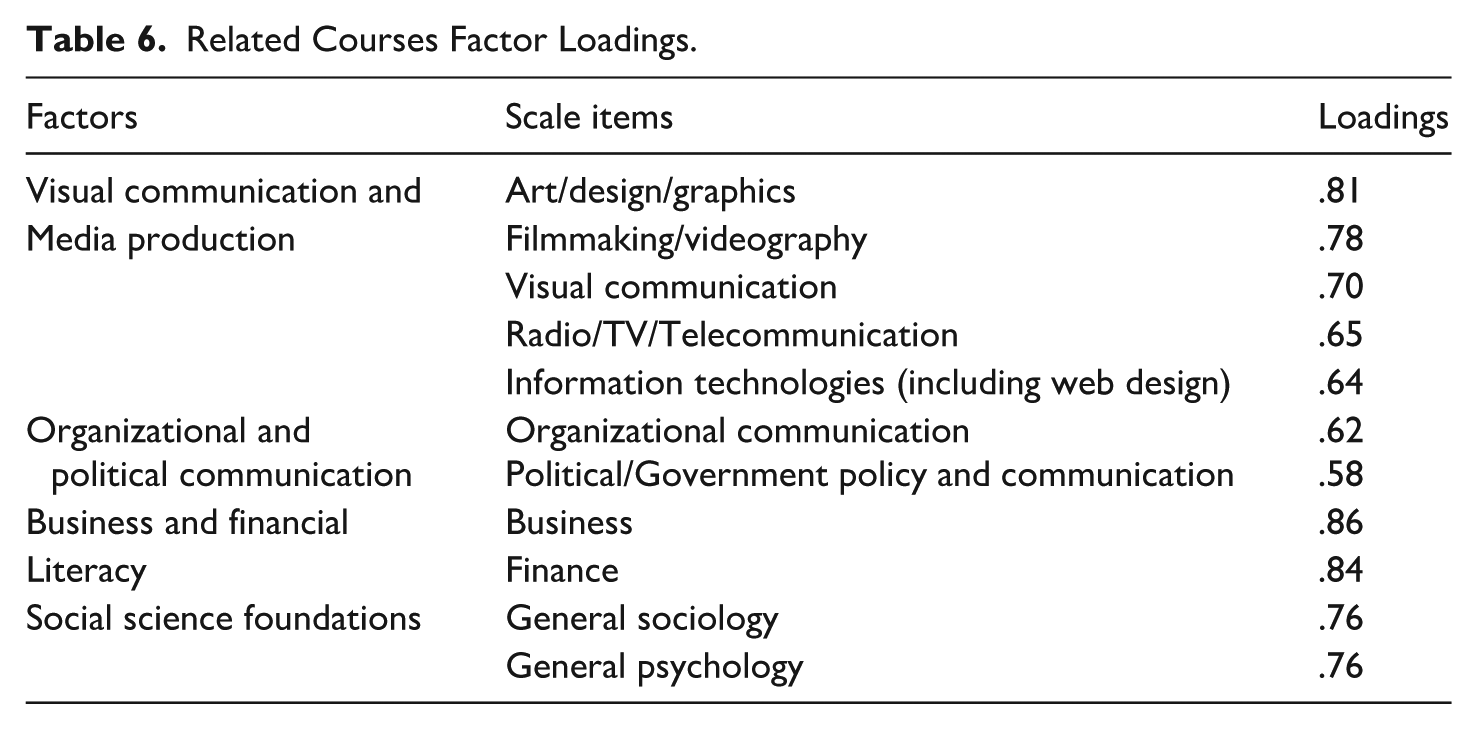
In summary, the public relations educators and practitioners identified three core knowledge areas (i.e., contextual and strategic knowledge, theoretical knowledge, and business knowledge) and four main skill sets (communication and message production skills, data and analytical skills, language and negotiation skills, and strategic management skills) as vital to a master’s degree in public relations. They also suggested four key sets of related courses, that is, visual communication and media production, organizational and political communication, business and financial literacy, and social science foundations.
RQ2: What Are the Perceptions of Public Relations Practitioners and Educators Regarding the Value of a Master’s Degree in Public Relations?
To answer this question, we asked the specific job levels that a master’s degree in public relations may qualify graduates for and the value of different master’s degree programs in enhancing graduates’ hiring prospects for public relations management jobs. Participants generally believed that a master’s degree in public relations should qualify students for higher-level professional roles. The highest-rated qualification areas were preparation for research firms or departments (M = 5.91, SD = 1.19) and advanced positions requiring approximately three years of experience (M = 5.86, SD = 1.37). Entry-level job preparation also received relatively high endorsement (M = 5.65, SD = 1.92). In contrast, teaching positions in colleges and universities (M = 4.91, SD = 1.59) and advanced positions equivalent to five years of experience (M = 4.85, SD = 1.79) were rated somewhat lower. Overall, these results suggest that participants expect a master’s program to enable graduates to qualify for a range of professional roles, especially those involving research and responsibilities requiring 3 years of experience.
Regarding perceptions of the value of different master’s degree programs for enhancing graduates’ hiring prospects for public relations management jobs, participants placed the highest value on a master’s degree in public relations (M = 6.26, SD = 1.12). Communication studies (M = 5.34, SD = 1.36) and journalism programs (M = 5.25, SD = 1.39) were also rated favorably. Business administration degrees received moderate value ratings (M = 4.73, SD = 1.65), whereas programs in organizational studies (M = 4.15, SD = 1.55), social sciences (M = 4.13, SD = 1.63), and human resources (M = 3.68, SD = 1.62) were rated lower. Fine arts (M = 3.22, SD = 1.43) and natural or physical sciences programs (M = 2.79, SD = 1.54) received the lowest value ratings. Overall, when considering hiring for public relations management jobs, participants favored graduate programs directly connected to communication practice, particularly public relations.
RQ3: Do Public Relations Practitioners and Educators Differ in Their Perceptions of a Master’s Degree in Public Relations?
To examine the differences and similarities between the practitioners and educators, a hierarchical regression analysis was conducted. Demographic control variables (i.e., modality, gender, age, years of experience, and geographic location) were entered as control variables. After adjusting for demographics, no significant group differences emerged for contextual and strategic knowledge (β = –.17, p = .09) or business knowledge (β = –.15, p = .14). However, educators rated theoretical knowledge significantly higher than practitioners (β = .27, p = .007; ΔR² = .04).
For skills, none of the four skill composites showed significant differences between practitioners and educators (p > .05). For related course recommendations, practitioners rated visual communication and media production courses (β = –.22, p < .05) and organizational and political communication courses (β = –.28, p < .001) as significantly more important than educators, controlling for demographics. No significant differences emerged for business and financial literacy courses (β = –.07, p = .46) or social science foundations courses (β = –.16, p = .10).
Discussion
Our study presents an important update on curriculum research on master’s education in public relations in the U.S., with a close look at what public relations educators and practitioners perceive as key deliverables and coursework in related disciplines that define a master’s program’s curriculum in public relations. Taken together, the findings reveal substantial alignment between practitioners and educators regarding the essential competencies for graduate education in public relations, with a few exceptions. For example, educators emphasize theoretical knowledge more while practitioners value applied courses.
Through a coorientation lens (McLeod & Chaffee, 1973), this pattern of broad agreement alongside role-based divergence suggests convergence around shared professional norms rather than fundamental disagreement between public relations educators and practitioners.
Alignment on Core Competencies and Coursework
Our exploratory study uncovered similar expectations about graduate public relations education among public relations practitioners and educators. Across both stakeholder groups, a master’s program graduate is perceived as a strategic and business-savvy professional who understands the organizational environment. Specifically, public relations graduates are expected to demonstrate mastery of three knowledge domains: contextual and strategic, theoretical, and business knowledge. These domains cover knowledge ranging from crisis and risk communication to navigating organizational changes and societal trends, as well as communicating with diverse audiences, layered on foundations of theories and business acumen. These knowledge domains highlight the multifaceted expertise required for advanced public relations roles in today’s changing social, political, and cultural environments.
Despite the overall alignment, differences emerge when looking at the individual items assessed (See Table 1). It becomes clear that practitioners placed a higher priority than educators on KSAs (knowledge, skills & abilities) specifically related to crisis communication, risk communication, legal issues, and organizational change, which is likely due to the turbulent environment practitioners are facing (Neill, Davidson, et al., 2025). In addition, interpersonal communication was more highly prioritized by practitioners than by educators. This finding is consistent with a recent study focused on essential competencies for emerging leaders, which found that interpersonal skills were both perceived as essential and lacking (Neill, Davidson, et al., 2025).
Interestingly, a content analysis of websites for 92 graduate programs revealed that these knowledge areas are not part of the required courses for the majority, as slightly over one-third of the programs listed ethics and law as a course requirement (Woods et al., 2025). Although master’s students may take elective courses that address these competencies, this gap raises questions about the extent to which core curricula align with practitioner expectations. A content analysis of course syllabi may reveal whether these areas are addressed in the core curriculum, a finding that merits additional research.
In contrast to prior CPRE findings, global issues, a previously highly ranked knowledge component (Shen & Toth, 2013) based on the 2012 CPRE data, is evaluated as less prioritized in our study. Global issues failed to load meaningfully onto any of the knowledge factors, and their mean score was among the lowest rated knowledge areas. This shift may reflect changing practitioner perceptions of what constitutes relevant expertise, particularly as employers increasingly evaluate competence holistically rather than individual knowledge areas. As Knight and Sweetser (2021) noted, professional competence in public relations is evaluated based on a number of factors, including knowledge, skills, and abilities, as well as education and experience. From this perspective, global issues may be subsumed under broader strategic competencies rather than viewed as a distinct curricular priority.
Consistent with these expectations, master’s graduates are also expected to develop four distinct sets of skills: communication and message development, data and analytical skills, language and negotiation skills, and strategic management skills. These domains closely align with the expectations of master’s graduates to be strategic communicators.
These findings closely mirror the competency areas outlined in the 2012 and 2025 CPRE master’s curriculum report, including strategic thinking, ethical and contextual awareness, and advanced communication and analytical skills. The emphasis on visual communication and media production, as well as big data analytics, reflects the digital and technological transformations in recent years. Together, these areas represent enduring hallmarks of a rigorous master’s program curriculum as well as evolving expectations that graduate education must adapt to changing environments.
These findings also suggest that future curriculum development should consider moving toward more intentional differentiation of program models. Programs may benefit from explicitly positioning themselves along a continuum between theoretically oriented and practice-driven approaches, thereby clarifying their value proposition to prospective students and employers. In particular, stronger integration of applied components such as visual communication, media production, and organizational communication may help address practitioner expectations while preserving the theoretical foundations emphasized by educators.
Perceived Value of a Master’s Degree
Findings related to RQ2 indicate that both public relations practitioners and educators perceive the master’s degree as valuable, particularly as preparation for advanced professional roles requiring research expertise and strategic responsibility. Participants most strongly endorsed the degree’s relevance for positions associated with research functions and roles equivalent to approximately 3 years of professional experience. These perceptions suggest that the master’s degree is viewed as a mechanism for accelerating professional readiness and strategic capacity. At the same time, comparatively lower ratings for positions associated with 5 years of experience or academic teaching roles reflect a realistic understanding of the boundaries of professional master’s education. Collectively, these findings align with CPRE’s (2012) framing of graduate education as preparation for complexity rather than immediate senior leadership.
Participants also made clear distinctions among graduate degree types when evaluating hiring prospects for public relations management positions. A master’s degree specifically in public relations was rated as most valuable, followed by degrees in communication studies and journalism, while programs more distant from communication practice were perceived as offering less value. This pattern underscores the continued importance of disciplinary relevance, even as graduate education becomes increasingly interdisciplinary. While experience remains central to professional advancement, the findings suggest that a master’s degree in public relations functions as a meaningful signal of advanced, practice-relevant preparation—particularly when programs clearly articulate their strategic, research-driven, and professional focus. These results reinforce the need for graduate programs to communicate their distinct value proposition to both students and employers in an increasingly crowded graduate education landscape.
Alternative credentialing pathways, such as professional certifications (e.g., APR (Accreditation in Public Relations), digital marketing certifications), may increasingly compete with graduate education in perceived value, particularly for early-career professionals seeking applied skill development. Future research should examine how these credentials interact with or substitute for graduate degrees in shaping employability.
Limitations and Further Research
Although this study directly answered a call for much-needed research, insightful for practitioners and educators alike, several shortcomings must be noted. First, despite attempts to reach a large sample, the conclusions presented here are eventually dependent on a rather small convenience sample, which consequently warrants a more nuanced approach regarding recommendations.
Second, at a time when technology is rapidly influencing public relations, one must acknowledge that perceptions of artificial intelligence and its challenges to public relations practices may not have been fully captured, as data collection took place in late 2024 to early 2025. A longitudinal approach would allow a more precise understanding of the evolution of such perceptions.
In addition, this study did not differentiate between program types (e.g., professionally oriented, theoretically oriented, or hybrid programs), nor did it examine the role of alternative credentials such as professional certifications. These factors may influence perceptions of curriculum relevance and degree value.
Moreover, although this study focuses on master’s education, it is important to recognize the value of doctoral training (e.g., Capizzo et al., 2022). Unlike master’s programs, which are primarily oriented toward professional practice, Ph.D. programs tend to emphasize research and academic career preparation. However, relatively few doctoral programs focus exclusively on public relations, with most embedded within broader communication or mass communication studies. This structural reality complicates educational pathways, as students may transition from professionally oriented master’s programs into theoretically driven doctoral environments, reflecting differing educational objectives and expectations. Future research could continue to delve into the pipeline challenge posed by the unique practical focus of our field.
Finally, this study zoomed in on perceptual differences within the United States. It could be enriching to examine whether similar patterns emerge across European, Asian, African, and even Latin American countries, where practitioners and educators operate under different political and educational regimes and systems. Cross-national comparisons would be encouraged.
Footnotes

Funding
The authors received no financial support for the research, authorship, and/or publication of this article.
Declaration of Conflicting Interests
The authors declared no potential conflicts of interest with respect to the research, authorship, and/or publication of this article.