







Abstract
This study of the 2014 U.S. midterm congressional elections examined whether connections across sources within newspaper coverage predicted framing outcomes. Conceptualized as an aspect of frame building, symbolic source networks within articles were examined using social network analysis and multilevel modeling. Results suggest network density within a given article predicted the likelihood that a source was linked to the strategic game frame and issue frame in election coverage. By nesting sources within networks, this study extends our understanding of frame building and collective sense-making in politics. It also demonstrates the utility of social network concepts and measures for research on news production.
Communication is seldom a one-way process or the product of independent actors. Consequently, capturing the flow of communication means acknowledging its reciprocal and interdependent nature (Rogers & Kincaid, 1981). This is directly applicable to sourcing in news coverage of politics. Communication interdependence is exemplified through interactions between journalists and sources and connections among multiple sources voicing competing and/or complementary perspectives that are translated into frames within coverage.
Framing has been described as arising “from networks of professional communicators” (Entman, Matthes, & Pelicano, 2009, p. 176), yet research examining the formative role of networks in frame construction is largely absent. The correspondence between political propaganda and news coverage has been investigated to connect the narratives espoused within information subsidies to those of news practitioners (Hänggli, 2012; Hänggli & Kriesi, 2010). Research has also examined the frequency of certain sources in news and, in rare cases, linked such frequencies to news outcomes (see Strömbäck et al., 2013). But the limited research on frame sponsorship is overwhelmingly evident (Borah, 2011), and researchers have called for greater emphasis on this understudied aspect of framing (de Vreese, 2005; Ferree, Gamson, Gerhards, & Rucht, 2002; Hänggli, 2012). Beyond a lack of understanding on how frames are constructed, such neglect is inherently problematic as it fails to consider the “distribution of political and social power” in the creation of news frames (Carragee & Roefs, 2004).
The present study contributes to this conversation. It argues that studying source networks offers further insight into source use and frame building in news coverage of politics. This is theoretically pertinent as it extends our understanding of frame building and collective sense-making in politics. Furthermore, this analysis diverges from common methodological approaches. Using social network analysis and multilevel modeling, I examine the appearance of sources, networks, and frames in newspaper coverage of U.S. congressional races classified as toss-ups in 2014. By mapping networks based on connections across sources within a given news article—what Bro (2010) labeled symbolic networks—this research shows that the network in which a source is embedded is consequential for strategy- and issue-framed coverage.
The Role of Sources in Frame Building
Frames organize events and issues, stressing certain aspects of a given topic and affecting audience interpretation (Druckman, 2001; Gitlin, 1980; Pan & Kosicki, 1993; Tuchman, 1972). Matthes (2012) describes frames as “a part of culture, they guide how the elite construct information, they affect journalists’ information selection, they are manifest in media texts, and they influence cognitions and attitudes of audience members” (pp. 248-249). Not only is this reality rooted in culture but also “collective sense-making” (Brüggemann, 2014, p. 65). By acquiring information from sources and organizing it into a cohesive narrative, journalists promote various interpretations or frames of reality (Entman, 1993; Tuchman, 1978).
It is imperative to note that framing “has proved to be an elusive concept to measure” (Maher, 2001, p. 84), and scholars define and operationalize frames in various ways (D’Angelo, 2002; Matthes, 2009a, 2009b; Scheufele & Iyengar, 2017). Presumably, frames extend beyond topics (Brüggemann, 2014; Carragee & Roefs, 2004), move from cognitive accessibility into applicability (Scheufele & Iyengar, 2017), and are repeatedly and reliably used (Entman et al., 2009). Semetko and Valkenburg’s (2000) assertion that we lack “a standard set of content analytic indicators that can be used to reliably measure the prevalence of common frames in the news” rings true today (p. 94). The unit of analysis in framing studies ranges from the paragraph to the entire article (Matthes, 2009b). Although the lack of theoretical and methodological consensus has been characterized as a weakness (Entman, 1993), D’Angelo (2002) argues that such multiplicity “has led to a comprehensive view of the framing process,” with frame construction, framing effects, and frame defining representing three subprocesses in the flow of framing research (p. 871).
Those processes through which journalists acquire, create, and apply frames (frame construction) fall under the banner of frame building (Scheufele, 1999; Shoemaker & Reese, 1996). While researchers have studied frame building, more research is needed regarding how sources contribute to this process (Borah, 2011; Carragee & Roefs, 2004; de Vreese, 2014; Entman et al., 2009; Reese, 2007; Strömbäck et al., 2013). Indeed, in a meta-analysis of framing, Borah (2011) found that out of 379 articles on framing, only 2.3% studied the contribution of sources and journalists to the framing process. Whether politicians, government officials, interest groups, experts, or citizens, sources are those people and organizations journalists turn to for authoritative representations of the world (Ericson, Baranek, & Chan, 1989; Pan & Kosicki, 1993). Journalistic framing “does not develop in a political vacuum” but rather emerges through an antagonistic contest that often serves the goals of political elites (Carragee & Roefs, 2004).
Still, within frame building, journalistic influence works on a continuum from frame sending (journalists acting as stenographers) to frame setting (journalists imposing their own interpretations on an object or issue; Brüggemann, 2014). A reporter’s “political company” is influential (Ross, 2010, p. 273); however, this is counteracted by journalistic interpretation, ultimately resulting in a negotiation process (Lewis & Reese, 2009). One avenue for this negotiation is in the organization of sources within news coverage, where various perspectives are connected to form a fluid narrative. After journalists gather diverse viewpoints (Reich, 2006; Ross, 2010; Van Aelst & Walgrave, 2011) and politicians (among others) offer up their preferred frames (Hänggli, 2012; Hänggli & Kriesi, 2010), journalists engaged in subsequent message construction, making strategic decisions about what information to include and how to organize it (Bartholomé, Lecheler, & de Vreese, 2015; Bedingfield & Anshari, 2014; de Vreese, 2014; Strömbäck & Esser, 2009). The sequential use of sources within a given article, in turn, results in connections across sources, creating symbolic source structures within news.
Thus far, symbolic source structures have been explored in only one published study (Bro, 2010). According to Bro (2010), “networks are situated within the news media whenever news reporters connect two or more people within the framework of a simple story” (Bro, 2010, p. 19). As journalists organize viewpoints to create cohesive narratives, sources (the objects) are linked to one another (the connections) across a given piece of media, building symbolic networks and dialogue within coverage, “at times even without the knowledge of the news sources” (Bro, 2010, p. 21). Thus, this does not necessarily reflect real-world interaction but rather journalistic decision making, which is a meaningful aspect of frame building. In terms of visual network representations (see Wasserman & Faust, 1994), if the sequential use of sources in a news article takes the form of a list (one source is mentioned, followed by a second, followed by a third, and so on), the symbolic structure would take on the form of a line. On the contrary, in a news article where sources are continually revisited, and thus connected to multiple others, the complexity would increase, and the structure might take on the form of a star or polygon. The question is, “Do certain source structures reliably predict certain frames?”
While this conceptualization departs from the study of networks within the sociological literature (see Freeman, 2004), at their most basic level, networks are composed of objects and connections (Newman, Barabási, & Watts, 2006, p. 3). Furthermore, “[t]he concept of network is extremely general and broad, one that can be applied to many phenomena in the world” (Monge & Contractor, 2003, p. 30). For example, Newman (2001) established network connections based on citation practices within academia. In the convergence media environment, where our conceptualization of networks has changed drastically in the last decade, Monge and Contractor’s (2003) argument for an expansive conceptualization of networks gains validity. Symbolic networks also “form a particular type of social network, where anyone from private citizens to authoritative decision-makers in political parties, companies and organizations can be connected within the framework of a single news story or a series of coherent news stories” (Bro, 2010, p. 18), informing the debate on power in the framing process (Carragee & Roefs, 2004).
A Multilevel Approach to Framing Elections
This study focuses on how symbolic source networks contribute to the strategic game frame, a prevalent frame in coverage of politics. In the broadest sense, the strategic game frame focuses on “who is winning and losing, the performances of politicians and parties, and on campaign strategies and tactics” (Aalberg, Strömbäck, & de Vreese, 2012, p. 163). Under this umbrella, game frames focus on opinion polls and language characterized as “war” oriented, while strategy frames focus on the actions of political candidates. This contrasts starkly with issue frames, which are characterized by substantive policy information (Aalberg et al., 2012; Entman, 1993). Other authors similarly label issue frames as describing, interpreting, and advocating for policy positions/consequences (Pedersen, 2012; Rhee, 1997). The strategic game frame (hereafter labeled the strategy frame) suggests political news, rather than informing voters on issues, deals with little substantive information (Cappella & Jamieson, 1997; Patterson, 1996). Given that this study examined whether the source and the symbolic structure in which a source was embedded predicted framing outcomes, it first presents a series of hypotheses/research questions related to the source, followed by questions related to the symbolic network.
Source Predictions Based on Past Research
This study first builds on previous, though limited, work investigating how source attributes, including source category (e.g., politician, government official, interest group, experts, member of the media, or citizens) and political affiliation, influence framing outcomes. Beginning with source category, in an analysis of health care reform, Adams and Cozma (2011) found that political officials, from the president to members of Congress, were cited more often in articles focusing on strategy frames than issue frames. In an analysis of televised election coverage in Canada, Cross (2010) also found that politicians appeared 82% of the time when the focus was on campaign strategies. Thus, I predicted,
Little is known about the prevalence of other sources in strategy- and issue-framed coverage. Cross (2010) found that experts were mainly used for campaign-related rather than issue-related stories. Overall, the list of experts was “dominated by political pundits and marketing professors talking about party strategies, party advertisements, poll results, and campaign activities” (p. 425). Yet Albæk, Elmelund-Praesteker, and Klemmensen (2011) found that experts were used equally across the two frames in election coverage by Danish newspapers. The role of government officials, interest groups, and ordinary citizens in news framing is also in need of further exploration. Cross (2010) found that government officials/interest groups dominated issue-framed stories; however, in the present study, these sources are analyzed separately. Hopmann and Shehata (2011) found that ordinary citizens supplied exemplars in coverage of welfare, education, and unemployment; however, during elections, they could be used to provide information on election outcomes or polling data. This study asked,
An individual covariate was also entered to determine whether political affiliation was a significant predictor of the amount of strategy- or issue-framed coverage. No previous research has investigated the impact of political affiliation on framing, so this study questioned,
How the Network Matters
This analysis examined three network-related measures—one ego-centric measure focused on the individual source (actor degree centrality), and two focused on the network in which a source was embedded (network centralization and network density). Actor degree centrality (CD (n1)) indicates the number of ties a source has to other sources within a symbolic network. In other words, it tells us the number of sources to which a given source was connected in that the source came either before or after another source within a given article. Higher degree centrality can also indicate the level of power a given source has, in that higher degree centrality indicates that a source may have driven a symbolic conversation. It is possible that higher centrality increases the chances of a source speaking in-depth on election issues. At the same time, sources with more ties may be commenting on aspects of an election that relate to strategy. Given the paucity of research, I asked,
While degree centrality focuses on the individual, my goal was to discover whether attributes of the network impact framing outcomes. Network centralization (CD) measures the variability of actor degree centrality measures across a network. This measure indicates the extent to which symbolic dialogue within a given article was organized around one source or, on the contrary, the majority of sources shared a similar number of connections (i.e., equal representation of actors within a network). Higher numbers indicate “that a single actor is quite central, with the remaining actors considerably less central” (Wasserman & Faust, 1994, p. 176). Although lower centralization scores could mean more diverse representation of actors, resulting in greater opportunities for informed debate on the issues, the opposite could also happen, where lower centralization scores are due to debate on strategic aspects of an election. Thus, I asked,
The final network measure, density, gives the average strength of ties between actors (i.e., the average strength of the tie between any two sources). Within a given article, any two sources can be connected sequentially multiple times, resulting in what are labeled valued ties in social network analyses. Thus, here density is based on the sum of valued ties within a network divided by the number of possible ties. 1 It determined the extent to which there was symbolic dialogue between any two actors in a given network, with higher numbers indicating greater symbolic communication, or back and forth, within one or more dyads. Once again, because higher density could relate to dialogue on strategy- or issue-related content, I asked,
Method
This research examined the 2014 U.S. midterm congressional elections. Congressional elections were targeted because they are “local,” in that congresspersons serve local districts and constituents. These elections garner limited coverage by national news outlets, so politicians rely on local news outlets to disseminate their message (Kaniss, 1991), establishing a strong and fluid relationship among candidates, local journalists, and interest groups in each district. Furthermore, local elections also constitute a neglected area of political communication research (Shea, 1999), and research is needed on strategy coverage outside national politics (Aalberg et al., 2012).
Sample and Time Frame
The time frame for the content analysis was September 1, 2014 through Election Day. September 1 marked two months before Election Day, just after the primary elections concluded—a timeframe used in previous studies (Dunaway & Lawrence, 2015; Kahn & Kenney, 2002). Thirty-five congressional races identified as toss-ups in 2014 by www.realclearpolitics.com, a polling data aggregator, were targeted for the present study. Toss-ups were targeted in hopes they would garner ample coverage.
For each congressional race, the main paper serving a given congressional district was identified. In some cases, it was also the largest in a given state. For example, the Arizona Republic was chosen for Arizona District 1—both the local and the largest in the state. For Arizona District 2 the Arizona Daily Star, the largest in the district, was analyzed. Most newspaper content was gathered through ProQuest or NewsBank Access World News databases. Newspapers that did not make content available on accessible databases (San Diego Union Tribune, Des Moines Register, Press Herald, and Newsday) were gathered manually through each newspaper’s online archive. Races garnering 10 or more articles about the congressional election were included in the analysis. Six races did not reach this benchmark, resulting in a total of 29 races/newspapers (see Table 1). For each newspaper, 10 articles were randomly selected for coding (unless only 10 articles were produced, in which case all 10 were coded).
Newspapers Included in Content Analysis Based on Coverage of Toss-Up Congressional Races.
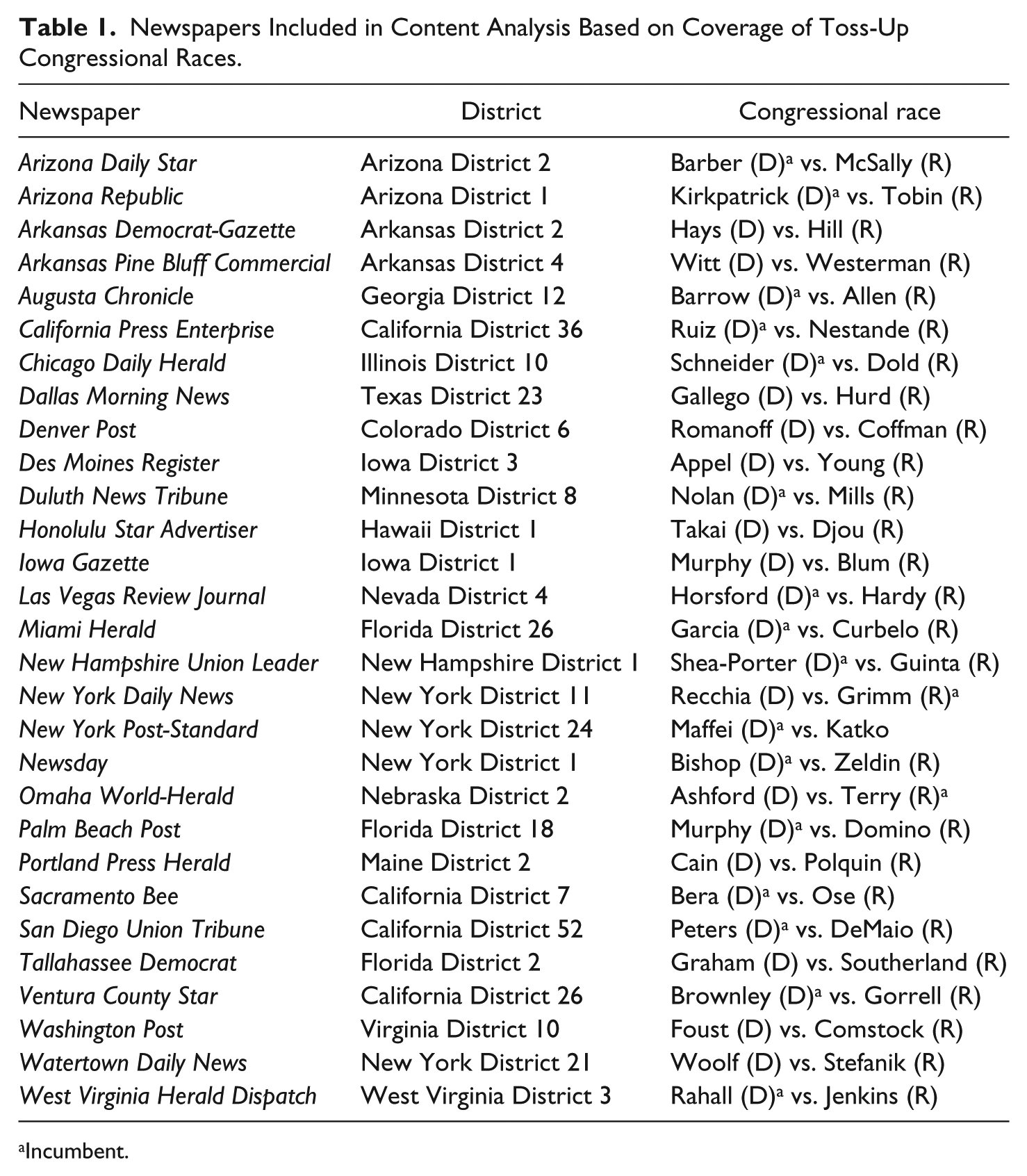
Incumbent.
Coding of Sources and Networks
To code for sources and networks in coverage, this project used three trained, undergraduate coders. Across two practice rounds and a final round of coding, discrepancies were discussed and consensus was reached. Any person or organization that was mentioned, paraphrased, or directly quoted constituted a source. In other words, one did not need to be directly quoted. While being quoted is a good indicator of a source’s successful infiltration of news media (Trumbo, 1996), overlooking sources that are not directly quoted would paint an incomplete picture of sourcing. The possible different level of influence was accounted for by a dummy code indicating whether a source “quoted/paraphrased” or “mentioned.”
When sources were identified in coverage, their category and political affiliation (if applicable) were identified. Categories included politicians, appointed government officials, experts, interest groups (think tanks, nonprofits, and corporations), other journalists/media outlets, ordinary citizens, and other. Political affiliation was only coded if it was blatantly mentioned or support for a given candidate was voiced. Coders were assigned an equal number of articles from the sample. Using Krippendorf’s alpha, reliability was reached using 10% of news articles on quoted versus mentioned (α = .80), source category (α = .86), and source political affiliation (α = .89). Reliability statistics are based on all sources that appeared across the 10% subsample (n = 276). If a coder failed to identify a source, she or he was purposefully given the wrong code on that source, dragging down the overall reliability score.
Bro (2010) is the only scholar to quantitatively explore source networks within coverage, charting changes in source appearance over a century by examining the extent to which eight groups were brought together within news articles. While our goals differed, in both cases, appearance was used to establish connections across sources. As is common practice, connections across actors were translated into a matrix, which was then used to calculate all network-related measures (Wasserman & Faust, 1994). This study yielded as many networks as articles analyzed. All network matrices were created within Excel.
As stated previously, within individual articles, sources were considered connected through their sequential use within news coverage, with multiple links used to create valued ties. Thus, two sources were considered connected when one source was quoted or mentioned and then a second source was subsequently quoted or mentioned (and so on). These successive connections were established regardless of distance or word count. If two sources were linked sequentially multiple times within a given article, this resulted in a higher value of the tie (i.e., if two sources were connected to one another on four separate occasions through direct quote or mention, the value at the intersection of those two sources within a given matrix was four). Network measures were then computed for each matrix using UCINET, an open-source, comprehensive social network analysis software developed by scholar Stephen Borgatti.
Coding of Frames
The attributes of the network and those of individual sources were then used to predict the likelihood that a source was linked to strategy-framed or issue-framed coverage. This study incorporated the coding rules offered by Aalberg and colleagues (2012). Their coding scheme, based on analysis of past literature, is meant to maintain uniformity in the coding of strategy frames. Strategy coverage referenced poll standings and election-related outcomes, winners/losers of various election-related events, political motives, tactics, or performances, or used language classified as “sports or war.” Due to the exploratory nature of this study and complexity of the coding scheme, coders did not differentiate between strategy and game frames. Issue coverage included discussion of actual issues, the effects of those issues, or a source’s sincere belief on the issues (Pedersen, 2012; Rhee, 1997).
This research focused on the contribution of both sources and source networks to the framing process; therefore, frames were operationalized as made up of their constituent parts, with sources contributing their own pieces to the larger narrative. In other words, a focus on actors and networks sharpens our attention to micro-level (actor) contributions, which underwrite macro-level (network) frames. To establish source contributions to frames, coding followed a three-step process.
First, each paragraph within a given article was assigned a dominant frame (strategy [2], issue [1], or neither [0]). Such examinations fit with the study of frames in competition (Chong & Druckman, 2007; Sniderman & Theriault, 2004). It is also reminiscent of Gamson and Modigliani’s (1987) conceptualization of narratives as packages made up of individual items with the frame constituting the “core.” To accomplish this, each sentence within a given paragraph was highlighted in red if it focused on strategy or blue if it focused on issue. The amount of strategy- or issue-framed content within a given paragraph was then evaluated. If the majority of the paragraph focused on strategy-framed coverage, the paragraph was assigned a 2. If the majority focused on issue-framed coverage, it was given a 1. If the paragraph had neither issue nor strategy coverage or had an equal amount of strategy and issue (a rare occurance), it was assigned a 0. The total count of strategy- and issue-framed paragraphs per article was then used to establish reliability. The same three trained coders were used to establish such frames, and acceptable levels of reliability using Krippendorf’s alpha were achieved on 10% of news articles (n = 30) for the number of strategy- (α = .88) and issue-framed paragraphs (α =.86).
Second, based on the amount of strategy-framed and issue-framed paragraphs a source was embedded in/linked to, each source was assigned one of three codes: strategy (2), issue (1), or neither (0). The same three coders were used to establish individual source codes. Using Krippendorf’s alpha, an acceptable level of reliability was reached on 10% of news articles (n = 30, α = .74).
Third and finally, this three-level variable was transformed into two separate dichotomous variables, one indicating whether a source was linked to issue-framed coverage (yes =1, no = 0) and one indicating whether a source was linked to strategy-framed coverage (yes =1, no = 0). These two dichotomous variables were then used as outcome variables in two hierarchical generalized linear models (HGLMs).
Analyses
This study’s goal was to determine whether connections among sources within a given article (the network) accounted for the likelihood that a source was linked to strategy- and issue-framed coverage. To accomplish this, the data were compiled into long form, with sources (n = 1,899) nested within articles (n = 179). 2 Two HGLMs were computed using the dichotomous variables discussed earlier. 3
To carry out a multilevel model, researchers must first establish whether a multilevel model is needed (Luke, 2004). Thus, analyses began with an unconditional model, containing no predictors, and a random effect for the Level 2 (article/network) intercept (Ene, Leighton, Blue, & Bell, 2014; Singer & Willet, 2003). 4 The variance accounted for at the different levels of analysis was then established through calculation of the intraclass correlation coefficient (ICC). Model complexity was gradually increased by introducing Level 1 (source) covariates and then Level 2 (article/network) covariates.
Source-level covariates included six dichotomous, dummy-coded variables representing the various source categories; two dichotomous dummy-coded variables representing source political affiliation, one for Republicans (n = 634) and one for Democrats (n = 665); the individual-level network measure of actor degree centrality (M = 2.92, SD = 3.14, min. = 0, max = 39); and a dummy variable indicating whether a source was quoted/paraphrased (n = 788) or mentioned in passing (n = 1,110). In terms of the appearance of source categories across articles, 1,165 were politicians, 113 were government officials, 344 were interest groups, 56 were experts, 129 were members of media, 71 were ordinary citizens, and 21 were classified as other.
Article covariates included network centralization (M = 0.49, SD = 0.26, min. = 0, max = 3) and density (M = 0.66, SD = 0.58, min. = .08, max = 4.67). To give more insight into the networks studied here, articles averaged 13 sources (SD = 6), with a minimum of six sources and a maximum of 34 within a given article. Other covariates based on newspaper and election characteristics were also added to serve as controls. These included circulation size, ownership type, a dichotomous dummy-coded variable indicating the type of race (incumbent vs. open), and an indicator of the number of days until the election. Newspaper circulation size was dummy coded from 0 to 5: less than 100,000 (n = 12); 100,000 to 199,999 (n = 6); 200,000 to 299,999 (n = 4); 300,000 to 399,999 (n = 2); 400,000 to 499,999 (n = 2); and 500,000 or more (n = 3). Circulation numbers were gathered from the Audit Bureau of Circulation’s 2012 database. In the event that the circulation was not listed, a newspaper was contacted directly. Ownership type was also dummy coded from 0 to 3, with privately owned single-holding ownership (n = 4) compared with small local chains (n = 3), large geographically diffuse chains (n = 5), and publicly traded corporations (n = 17). Ownership was determined by visiting the website of each newspaper. If not readily apparent, follow-up searches were used to determine the holdings of each company or the newspaper was contacted directly. Along with the reported significance level for these variables, these nested models were compared using −2 log likelihood (LL) scores. All models were estimated in SAS using PROC GLIMMIX with Laplace estimation.
Results
Model 1: Modeling the Likelihood of Strategy-Framed Coverage
Table 2 contains results for the HGLM predicting the likelihood that a source was linked to strategy-framed coverage. Within the unconditional model, the covariance parameter representing the random intercept at Level 2 was significant (β = 1.47, Z = 5.69, p < .001, df = 178), indicating that the probability of a source being linked to strategy coverage varied at the article level. Using 3.29 as the Level 1 error variance (Ene et al., 2014) 5 and the estimate for the random effects intercept, an ICC was then computed. Results of the ICC indicated that approximately 31% of the total variance in strategy coverage was accounted for at the article level, leaving 69% accounted for by the source and other unknown factors. Thus, variation at the article level accounted for a significant amount of variability in a source being linked to strategy-framed coverage.
Estimates From a Two-Level Hierarchical Generalized Linear Model Predicting Strategy-Framed Coverage.
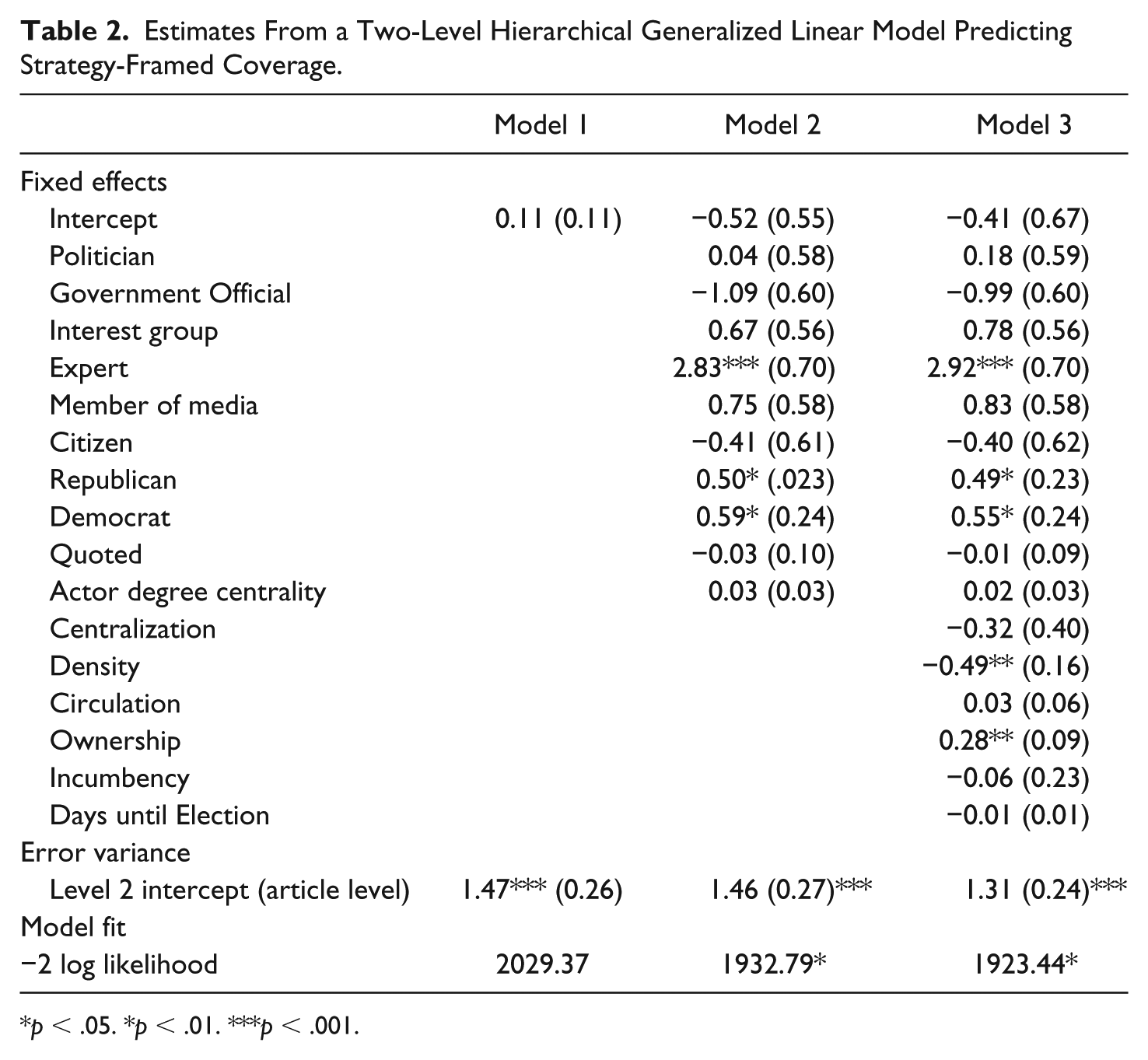
p < .05. *p < .01. ***p < .001.
Next, individual-level covariates were added to the model. Politicians were not linked to strategy coverage.
Finally, those variables related to the network/newspaper were entered in the model. Results continue to suggest that experts were more likely to produce strategy coverage than other sources. Being a Republican was still a significant predictor of strategy coverage, as was being a Democrat. There was no relationship between centralization and the likelihood of being linked to strategy coverage (
Model 2: Modeling the Likelihood of Issue-Framed Coverage
Next, an HGLM was tested predicting the likelihood that a source was linked to issue-framed coverage (see Table 3). Within the unconditional model, the covariance parameter representing the random intercept at Level 2 was significant (β = 1.84, Z = 5.48, p < .0001), indicating that the probability of a source being linked to issue-framed coverage does vary across the article level. Using 3.29 as the Level 1 error variance (Ene et al., 2014) and the estimate for the random effects intercept, the ICC indicated that 36% of the variability in issue-framed coverage is accounted for at the article level, leaving 64% accounted for by the source and other unknown factors. Thus, variation at the article level accounted for a significant amount of variability in a source being linked to issue-framed coverage.
Estimates From a Two-Level Hierarchical Generalized Linear Model Predicting Issue-Framed Coverage.
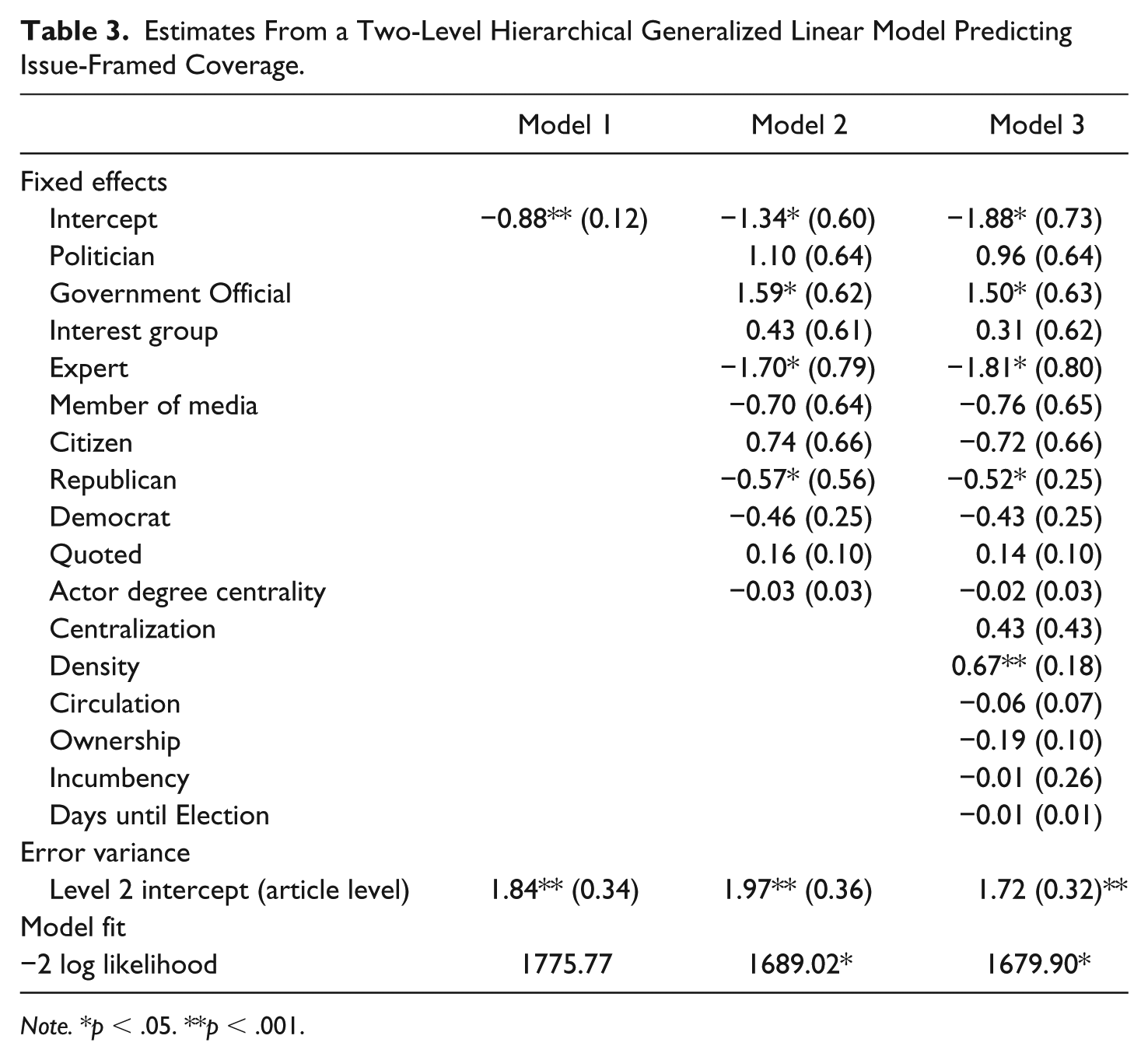
Note. *p < .05. **p < .001.
Next, individual-level covariates were added to the model. Politicians were not linked to issue coverage.
Finally, those variables related to the network/newspaper were entered into the model. Results continue to suggest experts are less likely to be linked to issue coverage than other sources. Furthermore, government officials remained more likely to be linked to issue coverage than other sources. Centralization was not a significant predictor of issue coverage (
Discussion
This study is one of the first to examine sources as interdependent actors and the first to test whether symbolic source structures within newspaper coverage relate to framing outcomes. In terms of frame building, it broadens our understanding of frame production and collective sense-making in politics and extends methodological and statistical application. The key takeaway is that symbolic connections among sources contribute to news outcomes. Density was a negative predictor of strategy-framed coverage and a positive predictor of issue-framed coverage. Thus, studying news production is more complex than previous research suggests. Moreover, frame building can be conceptualized as the outcome of multiple connected actors, supporting those who argue for a system-level approach to political communication (Rogers & Kincaid, 1981; Wolfe, Jones, & Baumgartner, 2013). It was already apparent that research on frame sponsorship was lacking (Borah, 2011; Carragee & Roefs, 2004; de Vreese, 2005; Ferree et al., 2002; Hänggli, 2012). Moving forward, examining sources in isolation also may not fully capture frame production.
This is not to say that individual source attributes do not carry weight. Experts, government officials, and sources with a blatant political affiliation were linked to specific content, offering insight into frame sponsorship. Surprisingly, politicians were not significantly linked to strategy-framed coverage, departing from previous research. This suggests that journalists, at least at the local level, do not apply a consistent approach when using politicians, and there is likely a negotiation process (Lewis & Reese, 2009; Reich, 2006; Ross, 2010; Van Aelst & Walgrave, 2011). It could also be the case that polling data and strategic performances (e.g., rallies) are not as prevalent in local elections (Aalberg et al., 2012). Yet the strategy frame was predominant in this study (54% of the 1,899 sources that appeared were given a strategy code compared with 31% assigned an issue code and 15% neutral), undermining the assertion that strategy frames are mainly found in national, rather than local, coverage of politics (Aalberg et al., 2012). Thus, this study adds not only to our understanding of frame production but also to frame diversity at the local level (de Vreese, 2014).
The present findings indicate that party affiliates and experts either used the pulpit to focus on campaign and conflict or journalists strategically sought out such quotes. The finding concerning political affiliation could be due to the context of the election in question (midterms at the time of an outgoing Democratic administration). With regard to experts, the findings are somewhat easier to interpret. Compared with other sources who consistently supply information to news outlets, such as government officials and politicians, journalists initiate interactions with experts (Albæk, 2011). Thus, journalists use these sources for specific information. As experts represent an elite group of (mainly) academic sources, it is apparent that this powerful source is often linked to information unhelpful, and even detrimental, to news consumers. Perhaps, academics should reflect on and be weary of how they are being used during election time.
Most important is the finding that symbolic source networks relate to the substantive nature of newspaper coverage. The news creation process is a dance not between source and journalist but between journalist and network. Connecting sources symbolically within coverage is an aspect of frame building over which journalists have a great deal of control (Bedingfield & Anshari, 2014; Hänggli & Kriesi, 2010). By creating networks in a way that allows for the development of deeper symbolic dialogue across sources—allowing sources to symbolically respond to one another—they increase the probability of producing coverage that is issue-laden and gets to the what and why of governmental policy (describing, interpreting, and advocating for policy positions/consequences). In hindsight, it is not surprising that while density mattered, centrality and centralization did not. Whether it is a higher level of dialogue between two actors or between many, it is the level of dialogue that matters, not that all actors are included in the debate. What constitutes “enough” dialogue is an open question. Such nuances in network structures need further investigation. This area is rich in terms of its possibilities not only to study such nuances but also to study how they might result in different audience effects.
Caution should be exercised in offering normative implications; however, journalists have substantial autonomy when it comes to framing issues (Bartholomé et al., 2015; Brüggemann, 2014; Hänggli & Kriesi, 2010) and should reflect on their power in determining what coverage is offered to voters (de Vreese, 2014). As de Vreese (2014) asserts, “what journalists do matters” (p. 149). Cappella and Jamieson (1997) are right that “it is impossible to know which came first—the conflict-driven sound-bite-oriented discourse of politicians or the conflict-saturated strategy-oriented structure of press coverage” (p. 9). The present findings cannot support a causal argument, but this study supports assertions of journalistic power as well as a process of negotiation in determining the themes present in election coverage. Bennett’s (2017) recent suggestions on indexing resonate; rather than seeing things in black and white, it is adequate to assume a combination of indexing and narrative licensing by journalists. One’s evaluation of whether such findings might be used to direct more substantive coverage by journalists also depends on perceived implications of strategy frames for the public (Cappella & Jamieson, 1997; Graber, 1994; Valentino, Beckmann, & Buhr, 2001; Zaller, 1999; Zhao & Bleske, 1998). It is through dialogue among sources that we move toward solutions to real-world problems. Concepts of interdependence and the analysis of networks have bright futures in our ever-changing and developing field of political communication.
Finally, this study is unique in its use of social network analysis and multi-level modeling, two important analytical approaches that account for interdependence in data collection. Accounting for interdependence among sources and the nested nature of the data also influenced frame measurement. Using the paragraph as the unit of analysis was necessary because the conceptualization and measurement of frames should be based on the antecedents investigated. In the debate over the operationalization and measurement of frames, our answer should not be a one size fits all. As D’Angelo (2002) proposes, “framing researchers are encouraged to use all available unitizing techniques found in content analysis . . . in order to defend the existence of different framing devices and provide the means to detect frames in news” (p. 881).
There are many avenues for future research. We should test whether these findings persist across elections. Given the lack of studies on congressional elections, more research is needed on such contests, generally and in relation to networks, to build greater understanding of such coverage. This study is the first to examine the role of networks in election coverage. More research is needed to establish the importance of networks in frame production, as well as the extent to which journalists or sources are driving their construction. The latter, a neglected area of research (Bartholomé et al., 2015; Borah, 2011; Ferree et al., 2002), could be accomplished through surveys or qualitative interviews with journalists, as well as observational work (Borah, 2011). The influence of networks on framing outcomes also needs to be addressed in multiple arenas. The roles of network density and centralization in the development of public policy, for example, is a promising topic for future research. Finally, we need to examine the role of symbolic networks in framing effects to get at the entirety of the framing process.
This study has limitations. It is possible the story content and not the network influenced the frame (i.e., some stories call for greater issue-laden coverage, which may influence the way a network is structured). At the same time journalists can construct networks in a way that produces more substantive coverage. Being that this study is the first to examine the role of networks in election coverage, another major limitation is that it cannot speak to past or future elections, especially those beyond the local level. A greater sample size for newspapers may also be needed to find effects for some of the newspaper variables included. It also did not examine the extent to which various actors determined the range of debate. More research is needed to determine whether network construction relates to support for/against majority views.
Footnotes
Acknowledgements
The author would like to thank Kate Kenski, Steve Rains, Jay Hmielowski, and Ronald Breiger for their valuable insight on this project. The author would also like to thank Joe Bonito for his statistical advice. Thanks to Rachel Beaty, Jennnifer Ervin, and Robin Stryker for their continued support.
Authors’ Note
A previous version of this article was presented at the annual meeting of the International Communication Association (Fukuoka, Japan, June 15-19, 2016).
Declaration of Conflicting Interests
The author(s) declared no potential conflicts of interest with respect to the research, authorship, and/or publication of this article.
Funding
The author(s) declared receipt of the following financial support for the research, authorship, and/or publication of this article: Undergraduate coding for this article was funded by a University of Arizona Department of Communication dissertation award.