







Abstract
This study explores the effects and influence of presumed influence of consuming recent lesbian, gay, bisexual, and transgender (LGBT)-inclusive TV on attitudes toward lesbians and gays (ATLG) and perceived attitudes toward lesbians and gays (PATLG) among peers. Adding to previous research, this study testifies to the modest yet positive effects of current entertainment narratives on viewers’ ATLG. The results demonstrate dynamics of “the rippled perceptions”: people’s own attitudes are the “origin of peer perceptions”; media consumption and interpersonal contact predict participants’ own attitudes; the influence of presumed influence attenuates as the analysis moves from self, to close friends, and those of the same age.
If you strongly oppose gay marriage, chances are high that you don’t know anyone who supports it and the sort of media you consume tends to rarely cover the rapidly increasing support for gay marriage.
This is what journalist Chris Cillizza (2014) took away from the results of polls conducted by the Public Religion Research Institution in February 2014. Consistent with other contemporary polls, these results indicated that over 50% of Americans held favorable attitudes toward gay and lesbian individuals. Meanwhile, this particular poll also indicated that there was a gap between most Americans’ views and their perceptions of other people’s views of gays and lesbians. 1
Building on this observation, this study further investigates the dynamics between media exposure, viewers’ own attitudes, and viewers’ perceptions of peer attitudes toward lesbians and gays (ATLG). Investigating effects of certain TV shows on ATLG and perceived attitudes toward lesbians and gays (PATLG) of others among non–lesbian, gay, bisexual, and transgender (LGBT) Americans is examining the role that entertainment media play in the public opinion formation process. First, this study follows a sizable body of research and examines the unobtrusive but direct effects of entertainment narratives on attitude change in general (e.g., Moyer-Gusé & Nabi, 2010) and in the context of how it affects viewers’ judgments of marginalized groups (Ward, Reed, Trinh, & Foust, 2013). More importantly, the current investigation additionally emphasizes the indirect media effects on perceptions of peers’ attitudes (i.e., PATLG).
While perceptions of peers’ attitudes contribute to the formation and expression of one’s own ATLG and behaviors toward LGBT individuals (Calzo & Ward, 2009a; Hall & LaFrance, 2012), such perceptions have been shown to be susceptible to the effects of media (Hetzel, 2011). While scholarly attention focused more on news media (e.g., Liebler, Schwartz, & Harper, 2009), it is unclear if and how entertainment media and different characteristics of peers can shape the PATLG and its interactions with ones’ own attitudes.
This study adopts the “influence of presumed influence” (IPI) model (Gunther, 1998; Gunther & Storey, 2003; Paek & Gunther, 2007) to investigate how consumption of “LGBT-inclusive” TV predicts the presumed influence of these TV shows on one’s own and one’s perceived attitudes, and whether this leads to more united or polarized ATLG. The selection of this model is based on its ability to capture both direct media effects, that is, cultivation effects (Chia & Gunther, 2006), and indirect media effects, that is, presumed media influence (Paek & Gunther, 2007). The current application further aims to advance the model in three directions. First, it incorporates interpersonal contacts (Huge & Glynn, 2015) and psychological distance of targeted referents as explanatory factors (Paek & Gunther, 2007). Second, this research looks at the model’s validity in a controversial or arguably prosocial context. Finally, adopting a within- and between-subjects design, this study examines a recent argument (Chock, 2011; David, Liu, & Myser, 2004; Shen, Palmer, Mercer Kollar, & Comer, 2015) regarding whether the self–other differentiation of presumed media influence as well as attitudes are extant cognitions or methodological artifacts.
Media activism groups have long recognized the persuasive nature of including LGBT characters in TV narratives. For example, Gays and Lesbians Alliance Against Defamation (GLAAD) has tracked all of the shows featuring regular and recurring LGBT characters since 1996. As discerned from the Network Responsibility Index (NRI) reports of the last decade, the 2014-2015 viewing season included 101 characters, of which 83 regular and 18 recurring were clearly identified and recognized as gay, lesbian, bisexual, or transgender, whereas the number was only 41 in the 2005-2006 season (GLAAD, 2015b).
Practically speaking, examinations of both direct and indirect effects contribute to the evaluation of the decades-long media campaigns, which rely on changing media visibility to change attitudes toward homosexuality in society. This study provides additional evidence of the effectiveness of the changing visibility of LGBT representations on TV. Moreover, the results shed new light on how TV shows collectively serve as indicators of public opinion, and on the robustness of changing attitudes and perceptions of public opinion with regard to homosexuality. Accordingly, the difficulties in advancing the attitudes change as well as recommendations for media campaigns and LGBT-related activisms are discussed.
Literature Review
ATLG, PATLG, and LGBT-Inclusive TV
Many demographic and related psychological factors have been studied that are closely related to ATLG: gender and gender role, ethnicity, religion and religiosity, and political ideology (Herek & Capitanio, 1996; Lee & Hicks, 2011). Media exposure is no exception. However, the results have been mixed from previous research. Many laboratory studies empirically supported positive persuasive effects of viewing recent LGBT storylines on ATLG. Studies that focused on individual programs, such as the movie Milk (Riggle, Ellis, & Crawford, 1996), TV comedies and dramas, for example, Will & Grace, Queer as Folk, and Six Feet Under (Ortiz & Harwood, 2007; Schiappa, Gregg, & Hewes, 2006) have positive effects in changing ATLG. As a review, Ward and colleagues (2013) concluded, Media exposure [i.e., recent gay and lesbian stories in TV episodes and films] leads to an attitude shift in which individuals with positive attitudes and those with negative attitudes move toward a moderate acceptance of homosexuality. (p. 396)
Audiences establish relations with characters, which potentially function as substitutes for interpersonal contacts with LGBT individuals that they either lack or do not have clear knowledge of (Schiappa et al., 2006). These positive results revalidated the interpersonal contact hypothesis, which presumes people who have LGBT individuals in their social circles will have more positive attitudes toward homosexuality than people who do not (Herek & Capitanio, 1996).
Nonexperimental studies, however, have generated mixed results. Nisbet and Myers’ (2012) analysis of General Social Survey (GSS) data from 1972 to 2008 supported the cultivation hypothesis that heavy exposure to TV shows which included gay and lesbian characters predicts higher tolerance of homosexuals. In contrast, Calzo and Ward (2009b)’s cross-sectional research demonstrated no significant positive association between favorable attitudes toward homosexuals with overall media exposure, which included TV, music videos, movies, and magazines. They attributed it to the complex nature of media content.
Perceptions of others’ attitudes toward lesbians and gays (PATLG), have received relatively scarce attention from the academics in the past, but show more potential in recent years. Research demonstrated that observations of peers’ attitudes and social norms, as one of the major sources of information, contribute to the formation of people’s own attitudes toward homosexuality (Calzo & Ward, 2009a), especially when the chances of establishing interpersonal contacts with gays and lesbians are low (Crandall & Eshleman, 2003). Other explorations of related concepts like “perceived homophobia” demonstrated that overt gay slurs, such as “fag” or “faggot,” conveyed messages which associate homosexuality with negativity and subsequently influenced individual attitudes (Hall & LaFrance, 2012). Providing fake polling results to respondents, Hetzel (2011) showed that perceptions of public opinion strongly affect their intentions to support gay and lesbian advocacy organizations.
The current research, following Nisbet and Myers’ (2012) practice, targets LGBT-inclusive TV. In this study, it is formally defined as popular TV drama or comedy series where LGBT characters, along with majority of characters being non-LGBT, served as either regular or recurring roles in narratives. The theoretical support for the concentration on LGBT storylines is the content homogeneity assumption from the cultivation hypothesis: no matter which channels and medium types, if it follows the similar narrative mechanism (e.g., similar characters), overall media consumption tends to instill audiences with similar ideological patterns of belief (Morgan & Shanahan, 2010). In other words, focusing on certain scripted TV series that include regular and recurring LGBT characters presumes a moderately higher level of homogeneity of the content than general TV entertainment viewing. This definition of LGBT-inclusive TV also excludes shows that are primarily catering to LGBT audiences, but shows like Walking Dead, a post-apocalyptic zombie story, are included. In programs such as this, it is more likely for non-LGBT audiences to “be accidentally exposed to” LGBT storylines without preexisting expectations.
While it is clear that people’s own ATLG are interrelated with their social contexts such as personal connections with LGBT individuals and their PATLG in friends and peers, how media messages shape the self-other differential perceptions in this context is unclear. Following developing academic interests on this topic, the current study applies the IPI model, a theory that addresses the trilateral relationships between self, others, and media, to explore the interrelationships between ATLG, PATLG, and LGBT-inclusive TV.
The IPI Model
Gunther and Storey (2003) proposed the IPI model, which incorporates both direct media effects (i.e., second-order cultivation; Chia & Gunther, 2006) on one’s own attitudes, and indirect media effects as consequences of perceived media influence (PMI) on others (Gunther, 1998). Therefore, it is an integration of “the relationship between perceptions of both media content and media influence, and resultant perceptions of public opinion” (Gunther, 1998, p. 487). Paek and Gunther (2007) noted that the explanatory power of this model resides in testing “media as the origin of peer perceptions . . . and outlines an entire process through which perceptions of peers could mediate the association between media messages and individual’s attitude and behavior change (p.411).”
They further developed the IPI model and demonstrated how different referents (i.e., “close friends” vs. “people of your age group”) moderated the presumed media influence. By summarizing various theories that explain the social perceptions of others (e.g., Festinger, 1954; Tajfel & Turner, 1986), an underlying presumption can be extracted: others at a closer psychological distance show more perceived similarities with self and play more important roles in the formation of one’s own attitudes. Therefore, direct effects proposed by the IPI model are divided into two layers—perceived attitudes among proximal peers (i.e., close friends) and the distal peers (i.e., people of the same age), and so are indirect effects.
Gunther (1998) stressed that the model shares the heavy-viewer assumption from the classic cultivation hypothesis and hypothesized the effects of TV viewing on both one’s own attitudes or values and estimates of public opinion (other similar schematic models see Diefenbach & West, 2007; Shanahan & Scheufele, 2012). The hypothesized direct effects within the IPI model, therefore, speak for effects on both one’s own attitudes and perceived reality, including perceived attitudes among proximal and distal peers:
The hypothesized indirect effects in the model suggest that two potential mediating variables sequentially lead to perceived attitudes among peers: perceived exposure and presumed media influence on peers. The first step of the persuasive media inference (PMI) sequence hypothesizes that the more people are consuming certain media messages, the more similar media content they think their (proximal/distal) peers are consuming as well (Gunther, 1998). The phenomenon is rooted in the “law of small-number bias”: people are willing to make strong inferences based on very limited amount of data (Tversky & Kahneman, 1971). In the case of TV entertainment, the bias may be further amplified by its ability to reach a broad audience (Gunther, 1998). Therefore, the following hypothesis is proposed:
Gunther and Storey (2003) bridged assumptions about perceived exposure with the third-person effect (TPE), which stated a person would presume that certain media content will have a greater impact on others than on self (Davison, 1983). Sun et al.’s (2008) meta-analysis showed consistency and robustness of the perceptual component of TPE. Although not as decisive, a few studies (e.g., McLeod, Eveland, & Nathanson, 1997; Paek & Gunther, 2007) confirmed that presumed higher exposure among peers is one of the necessary conditions for the inference of the stronger media effects on others. Therefore, the following hypothesis is proposed:
The last assumption is simply a logical extension of how presumed media influence affects people’s perceptions of peers’ attitudes (Gunther, 1998). The hypothesis would be that the more the audience thinks media content affects their peers, the affected attitude or opinions in a greater degree they would infer:
While perceptions of social norms or social reality are more likely to be influenced by media messages (Hawkins & Pingree, 1982), having direct interpersonal contacts with LGBT individuals in personal experiences has been tested as the most effective way of changing people’s own ATLG (Herek & Capitanio, 1996). Huge and Glynn (2015) also demonstrated that interpersonal conversations moderate the evaluations of presumed media influence and its consequences. The current research aims to examine the validity of the interpersonal contact hypothesis on one’s own attitudes and extend it to perceptions of peers’ attitudes.
The hypothetical model is presented in Figure 1.
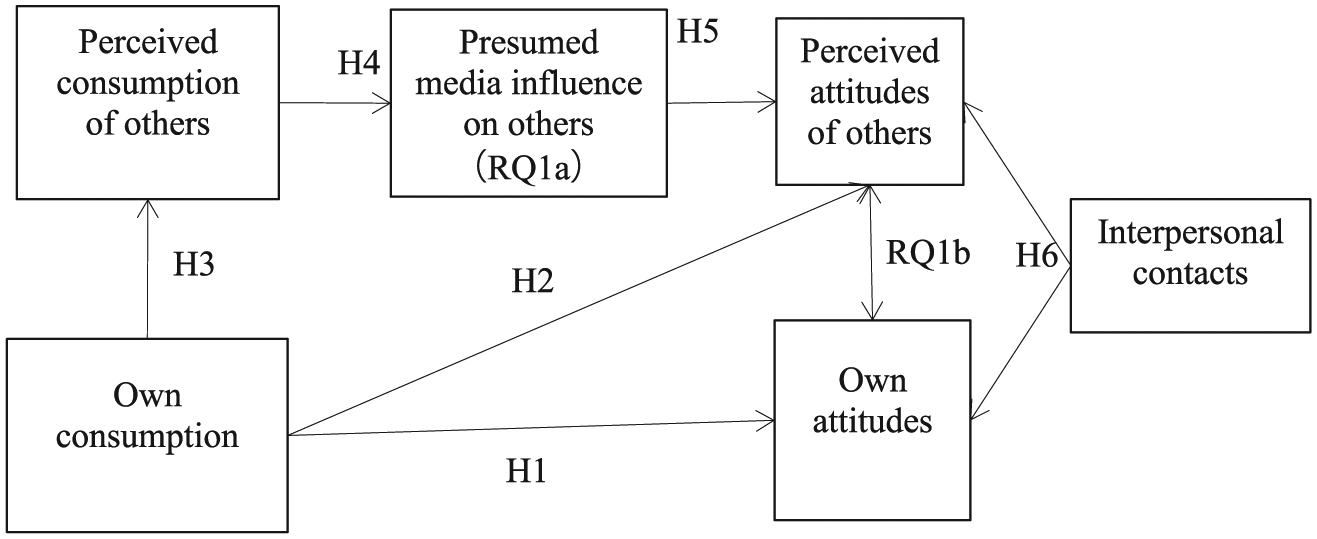
The hypothetical model.
Self-Other Differential Perceptions of Media Influence and Attitudes
The IPI model concerns differential perceptions of media exposure, then media influence, and consequentially peers’ attitudes in regard to self and others. Perceptions of media influences are documented in the TPE literature as one of the well-studied topics in the communication field (Davison, 1983; Sun, Pan, & Shen, 2008). The optimism bias mechanism has also been frequently applied to explain third-person perceptions (TPP; Gunther & Mundy, 1993), which focused on the perceptual gap of presumed media influence (Sun et al., 2008). It postulates that people are motivated naturally to maintain positive self-concept through presuming stronger media influence on others than on self. Sun’s et al. (2008) meta-analysis supported this argument and examined the two critical factors that affect the directionality (i.e., stronger on self vs. stronger on others) and magnitude of the perceptual gap (i.e., the discrepancy between presumed media on self and on others): desirability of the media content (i.e., anti-social vs. pro-social) and the characteristics of others (e.g., social distance).
Content desirability in the current study refers to whether seeing LGBT storylines in entertainment TV is deemed as a “good” or “bad” thing. The current study, however, does not preestablish or assume the social desirability of the LGBT-inclusive TV: Although the visibility and representations of LGBT characters on TV have “improved” over the years (Hilton-Morrow & Battles, 2015), the issue and its evaluation remains ideologically polemic (Liebler et al., 2009).
According to TPE literature, when judging socially desirable media content, people tend to report “reversed” TPPs, otherwise known as “first-person perceptions” (FPPs), which assume that media content has stronger effects on themselves than on others (Golan & Day, 2008). As with TPPs, FPPs are also constrained by the two factors—the “message attributes (anti-social vs. pro-social)” and “the traits of others” (Wei, Lo, & Lu, 2007). Nevertheless, scholars have demonstrated the asymmetry of the magnitudes (i.e., the discrepancy between presumed media influence on self and other) between TPPs and FPPs: the latter are often smaller (e.g., Gunther & Mundy, 1993). The asymmetry of the magnitudes denotes one overarching factor: “individuals’ perceptions of media effects (e.g., powerful media vs. limited effect)” (Wei et al., 2007, pp. 680-681). In other words, the audience usually “assumes [that] oneself being influenced by media is a bad thing” (Shen et al., 2015, p. 264). The default self-immunity from media effects functions in line with TPP but in opposite to FPP.
In this case, although arguably LGBT-inclusive TV could be seen as being in favor of changing people’s ATLG, to what degree the influence of LGBT-inclusive TV can change other people’s attitudes is affected by the social distance of the referents and moderated by how people perceive media influence in general. How people perceive media influence in general often accords with how people perceive media influence on self. Therefore, the first research question is presented as follow:
People’s self-other differentiation regarding attitudes shares a similar mechanism with perceptions of media influence (Brewer, 2007). One possibility is that people might directly project their personal experiences and attitudes on their peers directly, which is the so-called “projection” or “looking-glass effect” (Fields & Schuman, 1976). Then it could be hypothesized that people’s own ATLG are consistent with their PATLG. Alternatively, social identity (Tajfel & Turner, 1986) and social categorization theory (Festinger, 1954) propose rationales for differential perceptions between self and others. Led by a similar optimism bias mechanism, people tend to engage in social comparisons that favor their own self-concepts or their in-group identities (Tajfel & Turner, 1986). Similarly, there are also two factors predicting the self–other differential perceptions with regard to attitudes toward certain judged matter: social desirability of the issues and social distance of the referents. To further explore the relationship between people’s ATLG and PATLG, the open-ended research question is raised:
In recent theoretical developments, scholars (e.g., Chock, 2011; David et al., 2004; Shen et al., 2015) have suggested that self–other perceptual gaps of media influence and attitudes might not be the mere result of motivated processing. In other words, three variables in the PMI sequence predicted within the IPI model (i.e., perceived exposure, presumed media influence, and perceived attitudes) are rooted in participants’ extant cognitions. Scholars have already found people’s mental representations of themselves and their close friends are inseparable, especially in socially desirable contexts (Otten & Epstude, 2006). Shen et al. (2015) concurred that perceptual gaps of media influence are actual presentations of cognitions. However, they also demonstrated how the magnitude of TPP could be susceptible to anchoring effects, such as being primed with either similarity or disparity between referents and participants. Thus, the research question is raised:
Method
Participants (N = 856) were recruited via convenience sampling on Amazon Mechanical Turk (MTurk). Each participant was paid 50 cents as an incentive. For data collection, both heterosexual and nonheterosexual individuals were recruited, and only participants who identified as heterosexual or straight were included for data analysis. 2
To test if the comparison between self and others are results of methodological artifacts (R2), a within- and between-subjects design (see similar designs in e.g., Chock, 2011; David et al., 2004) was embedded in this survey, described as follows. All the participants (N = 856) answered questions with regard to demographics, interpersonal contacts, and consumption of the selected LGBT-inclusive TV shows, as well as general TV watching habits. Half of the participants (n = 434) were assigned to the within-subjects condition, the other half (n = 422) into the between-subjects conditions. In the within-subjects condition, they answered questions regarding perceived media consumption of both proximal and distal peers, presumed media influence on self, proximal, and distal peers, and own attitudes and perceived attitudes among proximal and distal peers. Participants in the between-subjects conditions were further randomly assigned into three conditions: the self, the friend, and the peer condition. Participants in the self condition (n = 143) only answered questions pertaining to presumed media influence on self and ATLG. Participants in the friend (n = 140) or the peer condition (n = 139) only responded to the questions in regard to perceived consumption of, presumed media influence on, and perceived attitudes of close friends or people of the same age in America respectively. All the questions within each condition were randomized to reduce the anchoring effects caused by the different order of how the questions are asked (i.e., self first vs. others first; Shen et al., 2015).
Demographics
Compared to convenient student samples that are usually predominantly young and white, and yet frequently used to study relevant topics (Ward et al., 2013), the participants in this research showed considerable variance in their demographic profiles. Among all the participants, age ranged from 18 to 83 (M = 37.41, SD = 12.94) and a majority fell into the 18 to 49 age group (78.7%, n = 674). Female participants (56.3%, n = 482) were slightly more numerous than male. Nevertheless, this sample indeed overly represented White (78.8%), liberal/Democrats (41.4%), young, well-educated (51.9% have bachelor or higher degrees), and less religious (42.5% never go to church/temple/mosque) people. Chi-square and one-way analysis of variance (ANOVA) were performed to test the homogeneity of demographics and general TV viewing habits across the four conditions, and no significant differences were found (all p > .05).
Consumption and Perceived Consumption of LGBT-Inclusive TV
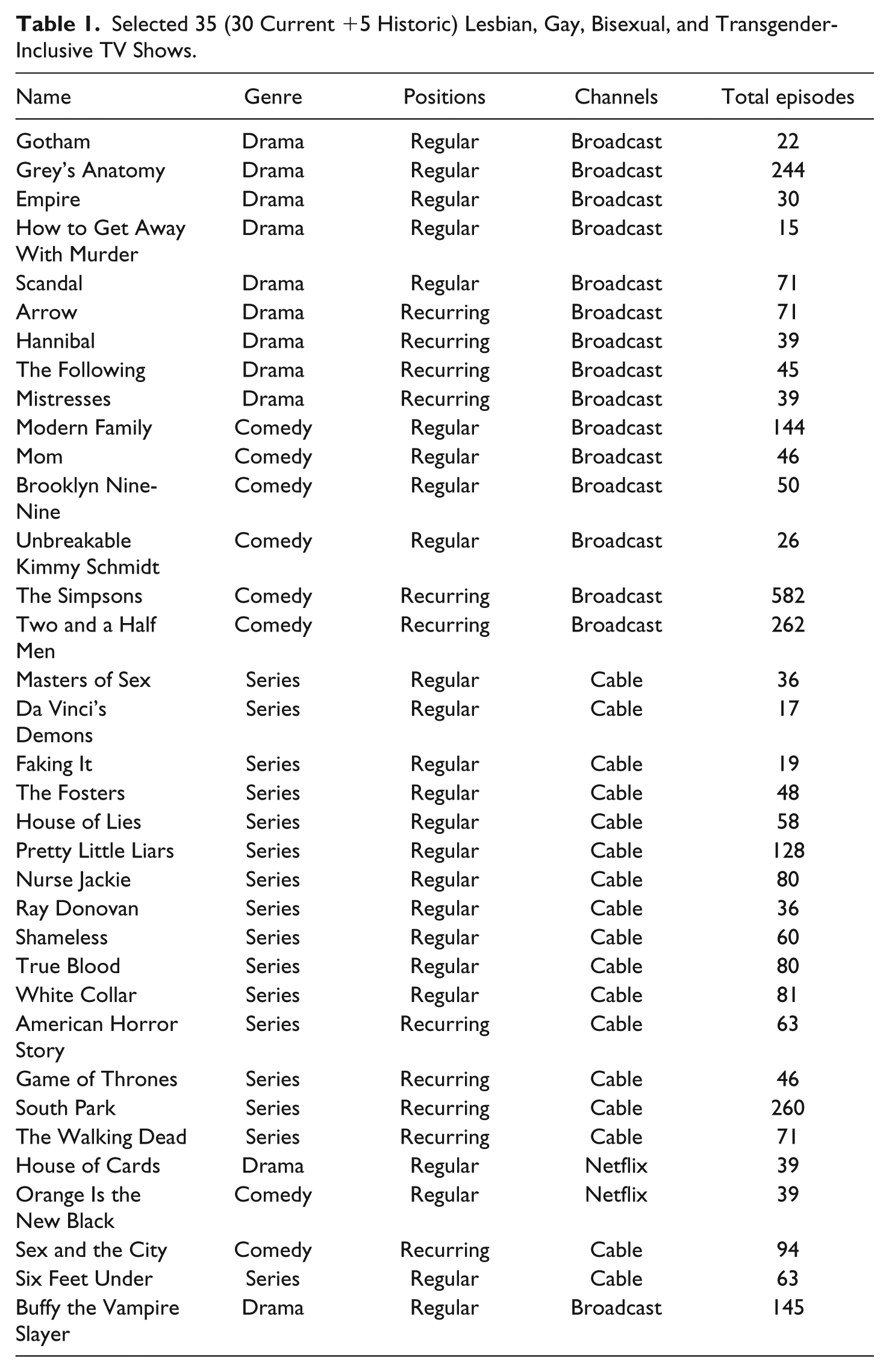
Participants were asked how many episodes they have watched of each of the selected 35 LGBT-inclusive TV shows, with a seven-point scale representing “none” to “all.” The sum (M = 32.18, SD = 19.87) of each participant’s viewing was calculated as the total consumption. First, 30 TV series were purposely sampled, per the aforementioned definition, 3 from 101 shows that included LGBT recurring or regular characters in the 2014-2015 season (GLAAD, 2015). To shorten the time of completing each questionnaire, only 30% of the shows were selected. The sample of shows proportionally represented across channels (broadcasting/cable), genres (comedy/drama), and LGBT characters’ positions (regular/recurring). The shows with the highest ratings among total viewers in each category are selected. In addition to the 30 currently on-air series, two Netflix originals, which were not indexed by GLAAD (2015b) at the time, and three finished shows in the past were also included (see Table 1). The 35 shows in total were randomized into five groups of seven and displayed on each web page.
Selected 35 (30 Current +5 Historic) Lesbian, Gay, Bisexual, and Transgender-Inclusive TV Shows.
Perceived consumption among close friends (Mwithin = 4.41, SD = 1.60; Mfriend = 4.17, SD = 1.72) and people of the same age (Mwithin = 4.64, SD = 1.53; Mpeer = 4.59, SD = 1.47) was measured separately after participants had finished answering all the selected 35 shows, with two single-item 7-point scales. From “not at all” to “very,” they were asked to estimate “how popular these shows are among your close friends/people of your same age in America.”
ATLG and PATLG Measures
This study used the scale developed by Herek (1984, 1998) to measure the attitudes of audiences toward lesbians and gays. The original version (1984) had 20 items and tested explicit attitudes toward gays (ATG) and lesbians (ATL) separately. To shorten the length of the questionnaire, 4 a five-item revision was then selected from the original scale to measure attitudes toward both gays and lesbians (ATLG) in one scale. Two items were selected to cover the generic and religious attitudes toward homosexuality, and the rest of the three covers attitudes toward the civil rights for people of homosexuality. Wordings are modified according to the ongoing discussions: (a) “Homosexuality is disgusting.” (b) “Homosexual couples should be allowed to adopt children the same as heterosexual couples.” (c) “Homosexuality is a sin.” (d) “Laws approving same-sex marriage should be repealed.” (e) “A person’s homosexuality should not be a cause for job discrimination in any situation.” The revised measurement (Within-subjects Cronbach’s α = .87, Mwithin = 5.50, SD = 1.64, n = 456; Self-condition Cronbach’s α = .88, Mself = 5.61, SD = 1.54, n = 143) took the form of a 1 to 7 numeric scale, where a greater number means a higher level agreement with the statements.
After ATLG, PATLG were measured using the same items. Following Paek and Gunther (2007), proximal peers are defined as “your close friends” (Within-subjects Cronbach’s α = .87, Mwithin = 5.31, SD = 1.50, n = 456; Friend-condition Cronbach’s α = .89, Mfriend = 5.35, SD = 1.63, n =140;) and distal peers (Within-subjects Cronbach’s α = .87, Mwithin = 5.22, SD = 1.31, n = 456; Peer-condition Cronbach’s α = .87, Mpeer = 5.25, SD = 1.41, n =139) are defined as “people of your age in America.”
Presumed Media Influence
The same five items from the ATLG scale were used to measure presumed media influence. They were asked, “to what extent do you think gay or lesbian stories in TV shows have changed your perspective in the following statements?” and “ . . . have changed the perspective . . . among YOUR CLOSE FRIENDS/PEOPLE OF THE SAME AGE IN AMERICA?” It took the form of a 7-point bipolar scale: –3 meant watching LGBT-inclusive TV makes themselves or peers “strongly” disagree more with the item, +3 means “strongly” agree more, and 0 means no influence. Therefore, the absolute values captured the magnitude of the change, while the plus and minus signs indicated the directionality. Similarly, presumed media influence on self (Cronbach’s α = .78, Mwithin = .42, SD = 1.06), on close friends (Cronbach’s α = .79, Mwithin = .59, SD = 1.08) and people of the same age (Cronbach’s α =.75, Mwithin = .86, SD = 1.12) were also measured in the within-subjects condition (n = 456), and respectively in each concerned condition—perceived influence on self in the self condition (Cronbach’s α = .77, Mself = .69, SD = 1.13, n = 143), on friends in the friend condition (Cronbach’s α = .67, Mfriend = .50, SD = 1.05, n = 140), and on the people of the same age in peer condition (Cronbach’s α = .88, Mpeer = 1.05, SD = 1.31, n = 139).
For each of six continuous variables, exploratory factor analysis (EFA) with maximum likelihood (ML) estimation method was used to revalidate the construct hierarchy. The K-1 rule (i.e., Eigenvalue > 1) and scree plot were used as factor extraction methods. Every scale of interest was shown in a stable construct hierarchy that measured a single factor. 5
Interpersonal Contacts
Participants’ connections with gay and lesbian individuals both in real life and in social media were taken into consideration (M = 3.74, SD = 1.09). They were directed by “How do you characterize your closest personal connections with gay and lesbian individuals?” and asked to pick one out of five following choices: (a) “I don’t know any gays or lesbians in my life or on social media (e.g., Facebook)”; (b) “I know some gays and lesbians on social media, but I don’t know them in real life”; (c) “I do know some gays and lesbians in real life, but they are not my friends”; (d) “I have some gay and lesbian friends”; (e) “Some of gays and lesbians I know are my best friends (or family members).”
Results
Analytical Framework
As a cross-sectional and theory-testing survey, the current study is unable to establish actual causality or temporal order. Therefore, the hypotheses concerning correlations between variables were analyzed by partial Pearson’s correlations while demographics and general media use were controlled.
Testing Hypotheses
Exploring Research Questions
As seen in Figure 2, the absolute values of the presumed media influence are minimal. People who experienced positive media effects on themselves reported first-person comparisons (i.e., FPP), whereas people reported neutral and negative media influence on themselves reported third-person comparisons (i.e., TPP). The magnitude (i.e., the discrepancy between self and others) is much larger in the negative group than (MD = −1.04) than in the positive group (MD = .17).
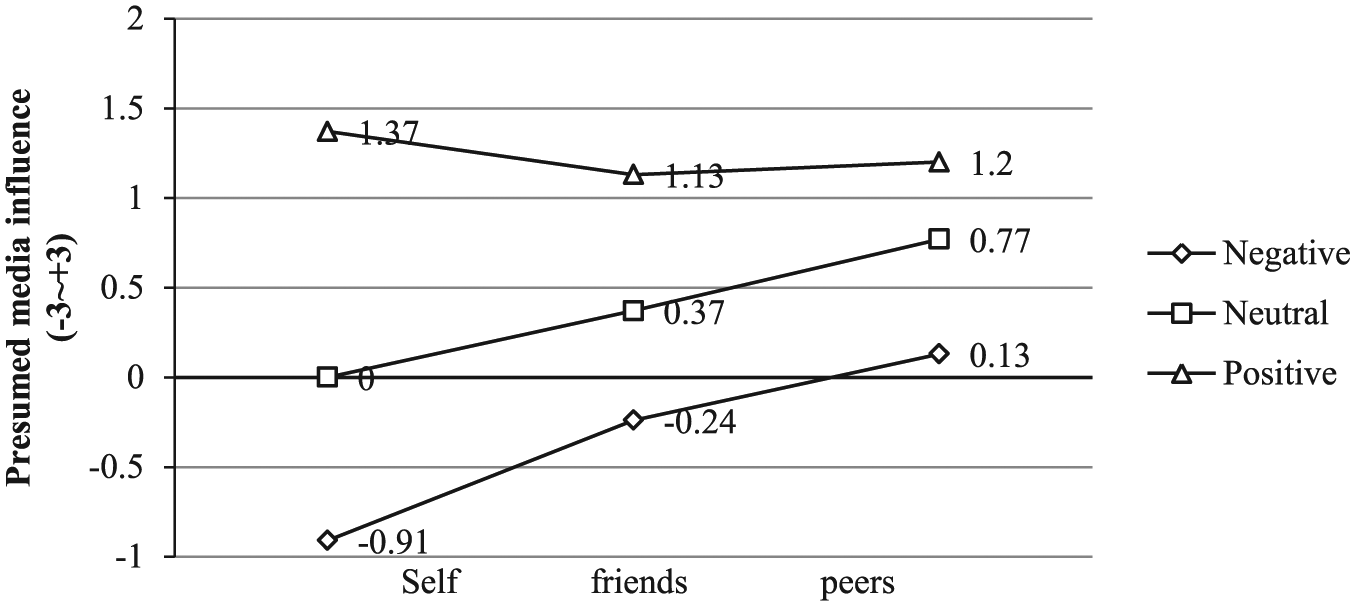
Intergroup differences of presumed media influence in the within-subjects condition (n = 434).
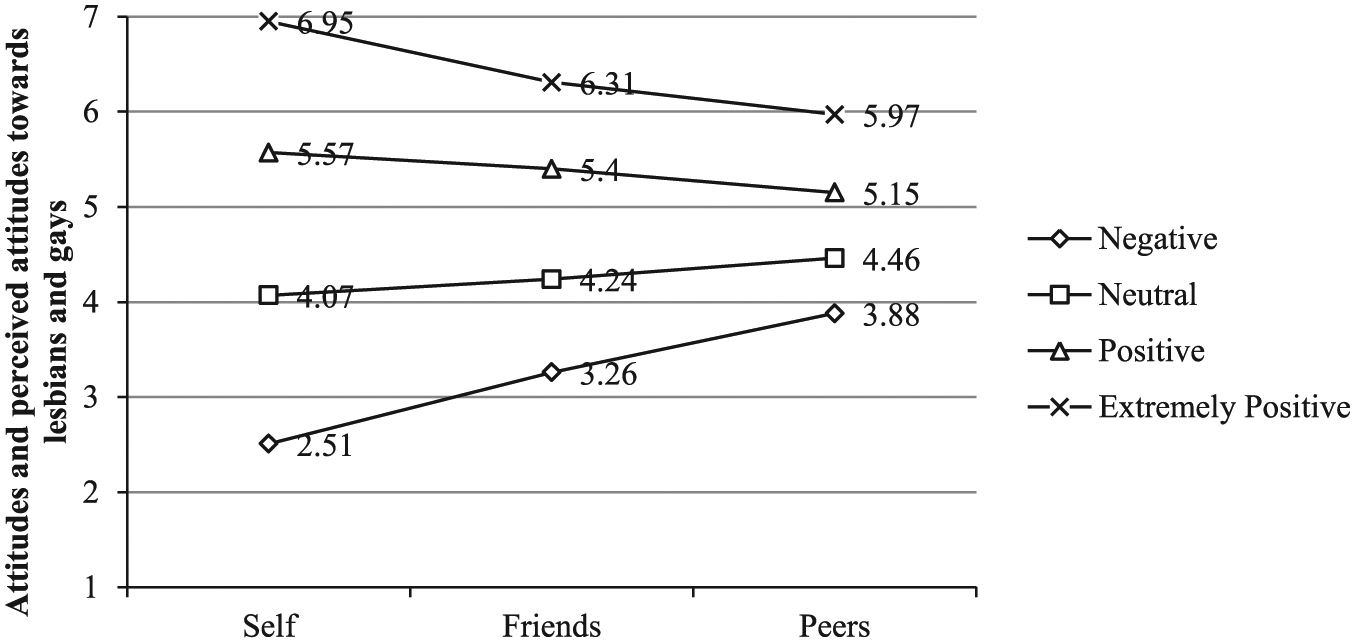
Intergroup differences of perceived attitudes in the within-subjects condition (n = 434).
In both negative and neutral groups, the level of attitude positivity showed an increase with social distance (i.e., Mpeer > Mfriend > Mself); in the positive and extremely positive group, the level of the positivity decreases along with the social distance increased (i.e., Mpeer < Mfriend < Mself) (see in Figure 3.) Mean differences between own attitudes and perceived attitudes of people of the same age are greater among people with extreme attitudes in both ends (i.e., negative and extremely positive attitudes) than people with moderate attitudes (i.e., neutral and positive attitudes).
The actual inter-condition mean differences with regard to both attitudes and presumed media influence were minimal numerically. Although the results of a series of independent t test were significant (p < .05), the statistical differences might be inflated only by the sample size discrepancy. The comparison between presumed media influence on self, friend, and peers followed a trend that positivity of the presumed influence increased along with the increase of social distance (i.e., Mpeer > Mfriend > Mself) in the within-subjects condition. Meanwhile, this trend was not strictly followed in the between-subjects condition. Specifically, participants in the within-subjects condition (n = 434) rated slightly stronger presumed media influence on close friends (M = .59, SD = 1.08) than on self (M = .42, SD = 1.06), whereas participants rated slightly weaker effects on close friends by comparing the friend (M = .50, SD = 1.05, n = 140) and the self (M = .69, SD = 1.13, n = 143) conditions. As for ATLG and PATLG, both within- and between-subjects condition showed an inverse trend that decrease of positivity of attitudes along with the increase of the social distance (i.e., Mpeer < Mfriend < Mself). In a nutshell, the differences between within- and between-subjects conditions existed but were very small.
Model Testing
As a result of testing the original IPI model, the estimated parameters as well as goodness-of-fit indices, χ2/df = 147.53/20, p < .001; root mean square error approximation (RMSEA) = .12; comparative fit index (CFI) = .91, standardized root mean square residual (SRMR) = .12, Tucker–Lewis index (TLI) =. 84., showed a poor fit. See the estimated path coefficients in Figure 4. Consumption of LGBT-inclusive TV had no significant direct effect on people’s ATLG (p > .1), and very minimal effects (β < .1) on perceptions of friends’ and peers’ attitudes as well as consumption.
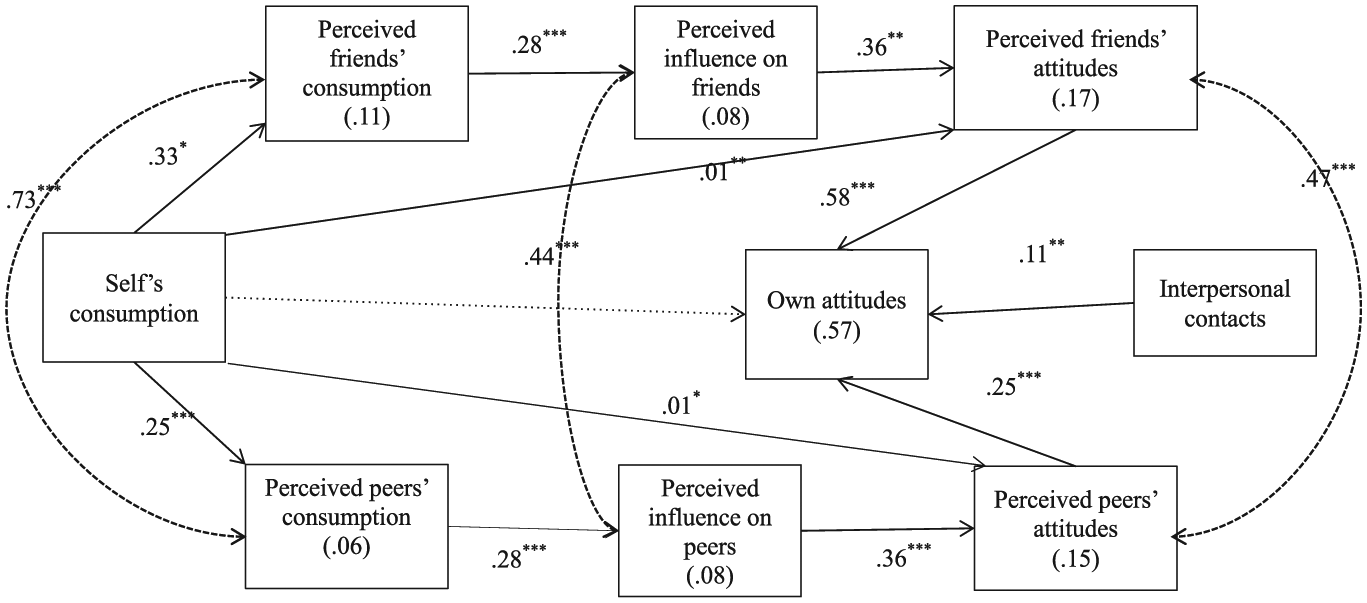
The influence of presumed influence (IPI) model.
Led by alternative theoretical frameworks, the original IPI model was modified into one where one’s own ATLG was conceptualized as the “causes,” which means people choose these shows based on existing ATLG (i.e., selective exposure or use and gratification), and one’s own attitudes also predicted PMI as well as the perceived attitudes among friends and peers (i.e., projections). All hypotheses (all p <.05) are supported in this model. Nevertheless, the model fit indices despite of the improvement still did not match the rules of thumb (χ2/df = 96.77/21, p < .001; RMSEA = .09; CFI = .95; SRMR = .11, TLI = .91). The same as the IPI model, the projection model also incorporated the PMI sequences in the model. However, the hypothetical effects of LGBT-inclusive TV consumption on perceived consumption among friends and peers were rather minimal. Therefore, the revision was made as following: Two variables concerning perceived consumption were eliminated, and according to the literature (e.g., Wei et al., 2007), adding PMI on self as a moderator in the revised projection model. The overall model fit further improved (χ2/df = 43.35/15, p < .001; RMSEA = .07, CFI = .98; SRMR = .07, TLI = .96).
The final model was further specified based on the revised projection model and named the “Rippled Perceptions (RP)” model. Conceptually, the model incorporated the direct inferences from perceptions regarding friends to people of the same age rather than covariates. Instead of conceptualizing the relationships between perceptions pertaining to proximal and distal peers as covariates, this model proposed that perceptions about proximal peers are mediators in the process of forming perceptions of distal peers. For details of modeling and path coefficients, see Figure 5. More importantly, the goodness-of-fit indices showed an excellent fit of the model in a very high standard (χ2/df =11.37/12, p > .05; RMSEA = .00; CFI = 1.00; SRMR = .02, TLI = 1.01).
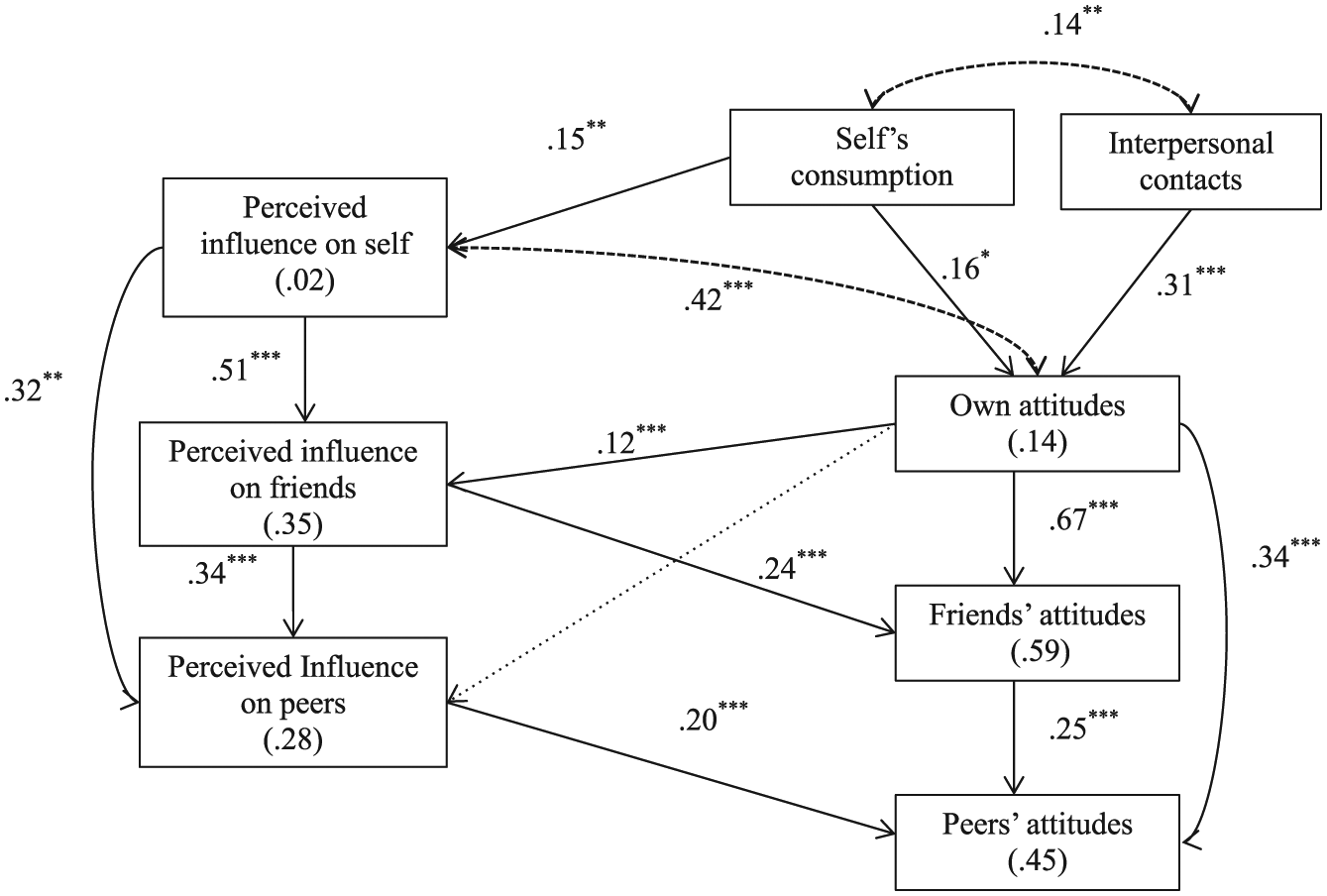
The rippled perception model.
Discussion
The results of this research have several theoretical implications for understandings of mediated self–other differential perceptions and practical implications for media campaigns that are related to LGBT equality rights movement. First, results of
In addition, the results of
These results should boost the confidence of media campaigns that rely on the collective effectiveness of narrative persuasions (Moyer-Gusé & Nabi, 2010) in LGBT-equal rights movement. Nevertheless, what is also supported by the effect size discrepancy between the results of
The second major contribution from testing
The results for
What the results of
Results of
Limitations and Future Research
First, the current cross-sectional research alone cannot demonstrate actual causal relationship. Second, measurements used in this research provided only one angle to explore limited dimensions of targeted concepts. Measuring audiences’ consumption of the LGBT-inclusive TV with self-reported estimation is subject to memory bias and the use of Likert-type scale lacks precision. Both ATLG and PATLG were measured by items that were modified from the ATLG scale (Herek, 1984, 1998). This adaptation, although allowed the examination of variables of interest in a comparative fashion with limited change in the statements, might have prompted habitual answers and potentially weakened the content validity. Moreover, this study was designed to examine the effects of collective media content on attitudes and perceived attitudes toward the sexual minority community as a whole. Therefore, the nuances and distinctiveness between attitudes toward gays, lesbians, bisexuals, and transgender people and between their different media portrayals are neglected and need further study.
Based on these limitations, proposed here are some research ideas for the future: collecting national representative samples or targeting people who have strong aversive ATLG; measuring own ATLG with other methods such as implicit association test (IAT); developing unique measurements for perceived influence on changing attitudes and PATLG; or using longitudinal/growth modeling to test the measurement invariance.
Conclusion
Traditional LGBT-related campaigns such as the “It Gets Better” project are typically targeted directly to LGBT individuals. Certain media and LGBT activism groups (e.g., PFLAG, GLAAD) have also acknowledged that “[b]roadening acceptance of LGBT Americans will require the help of allies—everyday non-LGBT Americans who feel strongly that their LGBT friends and family must be fully accepted members of society” (GLAAD, 2015a, p. 2).
Responding to this call, this research provided a theoretical framework for understanding how TV entertainment narratives possibly facilitate non-LGBT Americans’ attitudes formation and their perceived reality. First, consumption of LGBT-inclusive TV can predict people’s positive attitudes as well as their PATLG among close friends. Second, people project their own ATLG and experiences of being influenced by LGBT-inclusive TV on their peers. Third, the projection process is mediated by the social distance of the referents and extremity of own attitudes or media experience.
Nevertheless, to take a critical stance at last, as much as media can facilitate the attitude change, the evaluation of the media’s role in the media–self–other trilateral relationships should be proceeded with caution. While the RP model shows superior fit in this context, it by no means suggests that the interactions and perceived interactions between media, self, and other are a stable and linear process. In fact, it is often dynamic, and examinations in different contexts are constantly needed. Including this research and many previous studies demonstrated that interpersonal contacts with LGBT individuals were a much stronger predictor of positive attitudes toward gays and lesbians. In other words, while media might be able to cultivate a different public opinion climate, the power of changing individuals’ attitudes toward gays, lesbians, bisexual, or transgender ultimately resides in “the ordinary queer lives.” Therefore, relying solely on mediated communications in attitudes change is technocratic and unrealistic, and evidence showed that it may have come to a standstill for further changes. Maintaining proper communication channels, with the facilitation of communication and technologies, between communities of minorities and majorities should always be the future pursuit.
Footnotes
Acknowledgements
The author extends special gratitude to Prof. Carol Liebler for her guidance and support, and Prof. James Shanahan for his help in writing and publication. The author also thanks Prof. Makana Chock and Prof. Frank Biocca for their constructive critiques. Finally, the author thanks three anonymous reviewers and the editor for their valuable suggestions.
Declaration of Conflicting Interests
The author(s) declared no potential conflicts of interest with respect to the research, authorship, and/or publication of this article.
Funding
The author(s) declared receipt of the following financial support for the research, authorship, and/or publication of this article: This project received financial support from the Media Studies program, S. I. Newhouse School of Public Communications, Syracuse University.