







Abstract
Despite the importance of companies’ corporate social responsibility (CSR) efforts to support the issue of empowering women, little is known about which communication strategies are effective for a successful CSR initiative. This research investigated how CSR messages influences consumer evaluations of a CSR activity supporting women’s empowerment via consumers’ cause involvement by conducting two experimental studies. In Study 1, a 2 (CSR message type: in-group vs. out-group) × 2 (gender: female vs. male) online factorial experiment (n = 140) was employed. The results indicate that consumers evaluated the CSR activity more positively when they were exposed to an in-group message than an out-group message. To increase the validity and explain the process by which CSR message types influence consumer evaluations of a CSR activity, Study 2 was conducted. Psychological distance manipulated by CSR campaign messages increased an individual’s level of cause involvement, which in turn influenced the individuals’ response to the CSR activities. Implications are discussed.
Corporate social responsibility (CSR) has become an essential business practice in accordance with the public’s increasing demand and expectations (Yoo & Lee, 2018). One area that has specifically gained attention through CSR activities is women’s empowerment. Several companies, such as Coca-Cola, Walmart, General Mills, and many more, have highlighted their focus on women’s empowerment and related company initiatives to support equity in fairness (ICRW, 2016). While scholarship has begun to examine the role of CSR in empowering women, most research has focused on the goal of a CSR activity, such as how companies are ensuring financial and social inclusiveness for women (Pimpa & Phouxay, 2017) or how they are making efforts to include women in decision-making processes (Atker, 2015; Larrieta-Rubín de Celis et al., 2015). Given that empowering women could enable companies to obtain sustainable competitive advantages (Davidson, 2015), more investigations are needed to understand the effectiveness of CSR activities focused on women’s empowerment, as well as the impacts of CSR messages on individuals’ attitudes and behavioral intentions toward the CSR activities.
Specifically, when a company supports a social cause such as women’s empowerment, the degree to which individuals are involved with a cause (i.e., cause involvement; Grau & Folse, 2007) might influence the CSR effects such as CSR activity evaluation and participation intention (Barone et al., 2007; Koschate-Fischer et al., 2012; J. Park et al., 2016). Individuals who are more involved with a cause tend to feel more compelled to like and participate in campaigns relative to those who are less involved (Grau & Folse, 2007).
One notable point is that most previous studies have regarded the individuals’ cause involvement as a predetermined factor (Barone et al., 2007; Beise-Zee, 2011; C. W. Choi, 2020; Gupta & Pirsch, 2006) before individuals were exposed to CSR campaign messages from companies. This approach might help explain the positive relationship between the individuals’ preexisting engagement with a cause and their attitudes or behavioral intentions toward CSR initiatives (Grau & Folse, 2007). However, from a strategic viewpoint, an important question remains unanswered: for individuals who initially perceive the cause as less relevant to themselves, is it even possible to raise their level of involvement? Considering that there has been little attention paid to the message strategies for increasing individuals’ cause involvement, answering this question will expand the scope of CSR communication research.
Thus, the primary purpose of this study is to identify CSR message factors that can increase individuals’ cause involvement, particularly regarding support for women’s empowerment. Using the Construal Level Theory (CLT; Liberman & Trope, 1998) as a theoretical foundation, we especially focus on social distance, which refers to perceived psychological distance between what is either similar or dissimilar to the observer (Trope & Liberman, 2010), that plays an important role in forming the message viewers’ attitudinal and behavioral responses to messages (Zhao et al., 2020).
We first examined if the CSR message types (i.e., in-group vs. out-group messages) could impact an individual’s social distance to beneficiaries of CSR activities, in turn affecting the level of individuals’ involvement with the cause. We also investigated whether the impact of the CSR message types on individuals varies depending on gender, considering that women’s empowerment is a gender-specific topic. This study advances CSR communication research about the topic of women’s empowerment by investigating the condition and process by which in-group messages influence consumers’ attitudinal and behavioral outcomes.
Literature Review
CSR Messaging and Women’s Empowerment
Strategies based on CSR have become increasingly commonplace, especially as companies aim to demonstrate goodwill through supporting social causes. Extant research has long demonstrated that effective CSR communication can generate positive outcomes for companies (Y. E. Park & Dodd, 2016), such as individuals’ increased positive attitude toward the company or brand (S. Chung & Lee, 2019; Y. E. Park & Kang, 2020; Wu & Wang, 2014), higher purchase intentions (David et al., 2005), positive word-of-mouth (WOM) intentions (A. Chung & Jiang, 2017; Du et al., 2007; Kim et al., 2020; Vo et al., 2019), or even more positive publicity (Porter & Kramer, 2002). However, as companies’ CSR efforts continuously evolve and take new forms, especially in the context of supporting social causes and movements, more research is necessary to understand the many contributing factors that impact outcomes and how these factors interact.
One example of how CSR has extended beyond some traditional forms is through its enhanced focus on raising awareness of social issues such as diversity, women’s empowerment, climate change, and other prominent issues. While some companies’ efforts have extended beyond social responsibility and taken the form of activism or advocacy, companies are also taking notable efforts from a social responsibility standpoint. Some scholars differentiate CSR from advocacy, or more specifically, Corporate Social Advocacy (CSA), by noting that CSA involves a company taking a stance on a controversial social–political issue (Dodd & Supa, 2014, 2015) while CSR more broadly contributes to societal good. This study examines women’s empowerment as an issue through a CSR communication lens by focusing on a company’s efforts to support women’s empowerment through donations to a nonprofit organization.
Scholars have recently argued that “messages about women’s empowerment have been employed in strategic communication campaigns for almost a century” (Abitbol & Sternadori, 2019, p. 24) and that women’s empowerment messages continue to be widely used as a strategy. Some examples of women’s empowerment messaging from companies include Nike’s “Dream Crazier” campaign or other companies’ several hashtag campaigns such as #RealBeauty, #LikeaGirl, or #BetterForIt. These examples illustrate how some companies have centralized women’s empowerment in their efforts to contribute to social good. While scholars have found that CSR messages of this nature can lead to positive outcomes, factors such as the importance of the social issue and the demonstrated benefit to the public should be highlighted to generate more favorable outcomes (Du et al., 2010).
Against this backdrop, this study aims to further contribute to developing scholarship about women’s empowerment and how CSR message factors impact brand attitudes and positive WOM through its examination of in-group versus out-group messages, the role of consumers’ cause involvement, and how these factors might impact men and women differently.
Consumers’ Cause Involvement and Behavioral Outcomes
Research has shown that the impact of persuasive messages on individuals’ attitudes toward messages is greater among those who are highly involved with the cause than who are lowly involved with the cause (Browning et al., 2018). Especially in the CSR communication sector, individuals’ cause involvement is defined as “the degree to which consumers find the cause to be personally relevant to them” (Grau & Folse, 2007, p. 20). Researchers have investigated the relationship between individuals’ cause involvement and their attitudinal and behavioral responses to CSR messages (Hajjat, 2003; Joireman et al., 2015; Robinson et al., 2012). For example, increased cause involvement leads to the central route processing of CSR messages (Bigné-Alcañiz et al., 2010; Joireman et al., 2015). Moreover, when individuals are more involved with a CSR cause, they are more likely to respond positively to the organization (Bigné-Alcañiz et al., 2010; Broniarczyk & Alba, 1994; Grau & Folse, 2007). Based on the positive association between individuals’ cause involvement and their responses to CSR messages, researchers have emphasized that organizations should choose a cause that is meaningful and relevant to target audiences to enhance the effectiveness of their CSR messages (Hoeffler & Keller, 2002).
When individuals are involved in a particular cause and perceive a company to be similarly involved, they, in turn, identify closely with that company (Kent & Taylor, 2016; Sen & Bhattacharya, 2001). Consequently, individuals view the company in a positive light and do what they can to ensure the success of the company. For example, individuals who are more involved with a cause tend to have favorable attitudes toward a CSR activity (C. W. Choi, 2020) and brand (Beise-Zee, 2011), even if the cause is not a strong fit for the company (Barone et al., 2007; Gupta & Pirsch, 2006). Also, individuals’ high involvement with a cause might lead to active and participatory behaviors. Researchers noted that highly involved individuals are more likely to participate in CSR campaigns than those who are less involved (Grau & Folse, 2007; Koschate-Fischer et al., 2012; J. Park et al., 2016). Thus, it can be anticipated that individuals who are highly involved with women’s empowerment issues would be more likely to show a positive attitude toward the company and positive WOM.
The Role of Social Distance
Researchers have noted that cause involvement plays an important role in shaping individuals’ attitudes toward CSR and intentions to participate in CSR activities, such as donation (Grau & Folse, 2007). Previous studies have typically regarded cause involvement as a predetermined factor that already had been formed even before an individual was exposed to CSR messages (Barone et al., 2007; Beise-Zee, 2011; C. W. Choi, 2020; Koschate-Fischer et al., 2012; J. Park et al., 2016). Based on this assumption, existing research has largely focused on individuals’ preexisting cause involvement and its relationship to their behavioral and attitudinal responses to CSR activities. However, it remains unclear how CSR messages affect individuals with low cause involvement, and it is largely unknown how certain message attributes might increase individuals’ cause involvement. To fill the gap in the existing literature, we investigated message strategies that would increase individuals’ cause involvement levels and elicit positive attitudes and behaviors regarding CSR activities not only from individuals with initially high cause involvement levels but also from those with initially low levels.
We hypothesized the persuasiveness of CSR messages to increase individuals’ cause involvement levels contingent upon the individuals’ self-perception, called self-construal. CLT posits individuals construct the same event differently based on subjective perceptions of the psychological distance between themselves and the event (Liberman & Trope, 1998; Trope et al., 2007). CLT argues that when individuals perceive an object or event is psychologically distant from them, they adopt a high-level construal and interpret the object or event abstractly. Whereas, when an object or event is perceived to be close, individuals employ low-level construal and interpret the activity in more action-oriented and concrete terms (Trope et al., 2007). The four dimensions of psychological distance (Bornemann & Homburg, 2011; Trope et al., 2007) are spatial (i.e., geographically close vs. geographically remote), temporal (i.e., near future vs. distant future), hypothetical (i.e., certain vs. uncertain), and social (i.e., in-group vs. out-group).
Particularly, social distance explains the subjective perceptions that similar others (in-group members) are considered as socially closer to oneself than dissimilar ones (out-group members; Trope & Liberman, 2010). In the CSR sector, researchers have often employed social distance to reveal its relevance to consumers’ perceptions of CSR initiatives such as consumer–CSR activity closeness or consumer–company closeness (Lii et al., 2013; Lim & Yang, 2016; Trope et al., 2007). For example, Lii et al. (2013) found that the relationship between CSR activities and consumer evaluations is significantly stronger when consumers perceive the company as socially closer to themselves across CSR messages depicting different CSR activities such as philanthropy and cause-related marketing. Sung et al. (2020) found that the perceptions of concrete (vs. abstract) CSR messages on social media positively affect customers’ social distance and the brand’s credibility. In addition, previous studies (W. J. Choi & Winterich, 2013; Escalas & Bettman, 2005) showed that close consumer–brand social distance leads to more positive consumer attitudes and behaviors.
Even though social distance has been discussed in the contexts of an effective CSR strategy, to our best knowledge, there has been relatively less attention given to the CSR message strategies to reduce an individual’s perceived social distance and increase their cause involvement. With specific application to this study’s focus on women’s empowerment, individuals exposed to CSR messages that support women in their communities (in-group messages) will more positively evaluate the intention of the CSR activity compared to consumers exposed to CSR messages that support women in general (out-group messages). Since in-group messages might cause a low construal level where group identity becomes salient, individuals exposed to in-group messages might be more likely to put extra cognitive or behavioral efforts toward maintaining, protecting, or enhancing their group identities (Tajfel et al., 1979). As a result, they might be more likely to engage with the cause, support the company’s CSR activity, and view the company in a more positive light. Accordingly, increased involvement with a cause might yield favorable consequences (Ashforth & Mael, 1989; Hamilton, 1981), such as positive brand attitudes and positive WOM.
Gender Differences as a Moderating Factor
Because of the specific CSR message topics on women’s empowerment, gender differences may moderate the impact of closely related messages on individuals’ attitudes toward a CSR activity. Researchers have found that, compared to women, men exhibit a stronger tendency to favor in-groups over out-groups (Rudman & Goodwin, 2004; Yamagishi & Mifune, 2009) whereas women are generally socialized to be more concerned about others’ well-being and to emphasize communal issues (Block, 1984). Thus, we expect the effect of in-group messages to be greater for men than for women.
In addition, Bosson and Michniewicz’s (2013) study showed that men tended to distance masculinity from femininity than women (i.e., gender dichotomization). Men are more likely to perceive the opposite gender as an out-group than women. They found that this tendency got stronger when they perceived their gender status was precarious. Therefore, it is plausible that men are more likely to distance themselves from a CSR for women empowerment but less likely when they perceive the CSR activities are for women within their family members. However, women might consider both in-group messages and out-group messages are self-relevant and close to themselves. We, therefore, predict that in-group messages will elicit greater involvement among men than among women.
Study 1
Hypotheses
Based on the argument above, this study applied CLT to examine the judgment of the women’s CSR message strategy. We argue that the closer individuals perceive the social distance between themselves and the targets of the CSR activity, the more likely they are to become involved with the cause (i.e., a women-empowering CSR activity). This tendency will be greater among men than among women. In addition, cause involvement will consecutively mediate the effects of social distance on positive WOM intentions, and individuals’ brand attitudes. Finally, we will assess the moderated-mediation effect by considering all the above-mentioned variables together. Our overall research model is depicted in Figure 1.
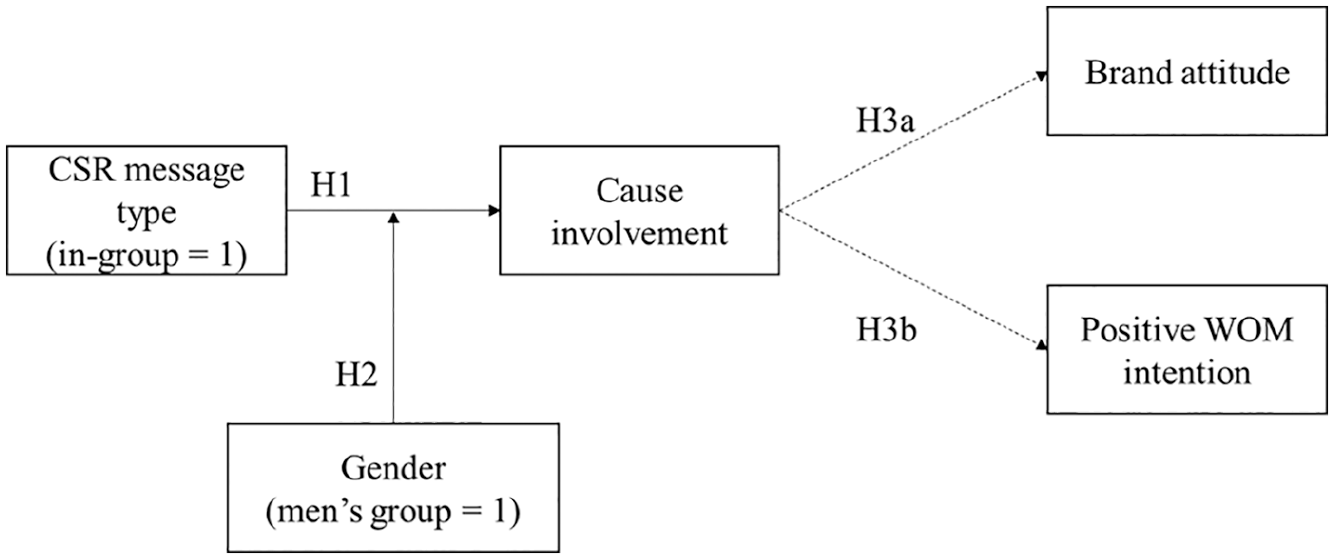
Proposed model of Study 2. Dotted lines represent the moderated mediation effects.
Our detailed hypotheses are as follows:
Method
To test the proposed hypotheses, this study employed a 2 (CSR message type: in-group vs. out-group) × 2 (gender: women vs. men) factorial online experimental design. Measured dependent variables included brand attitude and positive WOM intention. Cause involvement was measured as a mediating variable. Prior company attitudes and prior involvement with the cause (women’s empowerment) were measured as covariates.
Participants
A priori power analysis was conducted using G* Power 3 to determine the sample size. α was set to 0.05 and power to 0.8. The effect size f was set to .25, which is the medium level. The results showed that the required sample size for an ANCOVA with one covariate was 128. When power was set to 0.85, the sample size was 146. That is, a sample size between 128 and 146 was judged to be reasonable. Accordingly, a total of 140 participants were recruited for this study.
Participants were U.S. residents recruited by Qualtrics. One quota was included for gender to ensure that the sample included an equal number of participants who identified as male and female. Among a total of 140 participants, 50.0% (n = 70) were male and 50.0% (n = 70) were female. The mean age was 43.94 years (SD = 15.05 years). As for race, 72.1% (n = 101) were White, 16.4% (n = 23) were African American, 5.0% (n = 7) were Hispanic, 3.6% (n = 5) were Asian, and 2.9% (n = 4) reported “Other.” As for education, 35.0% (n = 49) had a college degree, 31.4% (n = 44) had some college credit, 20.0% (n = 28) graduated from high school or had a GED, 11.4% (n = 16) had a graduate degree, and 2.1% (n = 3) had less than a high school degree.
Stimulus material
Although gender equality has been progressing, women are still under-represented in science, technology, engineering, and mathematics (STEM) fields (Pew Research Center, 2021). Accordingly, several companies, such as Comcast, Microsoft, and L’Oréal, have participated in CSR initiatives to increase gender equality in STEM. More recently, Olay launched a CSR initiative to support young women in STEM.
Considering most CSR campaigns are executed by existing brands, it might be more desirable to use a real brand than a hypothetical one for observing the realistic responses of participants (Vargas et al., 2017). Thus, the stimuli were created by designing a mockup based on a real Twitter post published by an existing company (Olay) about its recent CSR initiative that involved donating money to support young women seeking careers in science. Social distance was manipulated as in-group versus out-group. In the out-group condition, the text included the following statements: “Help us make space for young women all around the world. We will donate money for every retweet to support all young women who dream to be future female scientists. #EmpowerYoungWomen #SupportGirlsAroundTheWorld.” In the in-group condition, the text included the following statements: “Help us make space for the young women in your community. We will donate money for every retweet to support young women who dream to be future female scientists. #EmpowerYoungWomen #SupportGirlsInYourCommunity.” Besides the above messages, the designs were consistent across the two versions of the Twitter post. Another factor, gender, was manipulated in the way of assigning an equal number of both male and female participants to each social-distance condition.
Procedure
The main experiment was conducted online through Qualtrics. One attention-check item was added to the questionnaire for quality control. Qualtrics managed data quality by automatically removing participants who did not pass the attention-check question or spent less than half of the median time. A Qualtrics link was sent to participants, which directed them to the questionnaire. Overall involvement with women’s empowerment and pre-attitude toward the brand might influence involvement with a cause and post-attitude toward the brand (Browning et al., 2019; S. Chung & Lee, 2020). Thus, upon their indicated consent, participants in each condition were asked to answer questions as part of a pre-condition questionnaire that measured their pre-attitudes toward the company (Olay) and overall involvement with women empowerment. Participants were presented with a list of four different companies to avoid priming effects.
Participants were then randomly assigned into one of the two versions of the manipulated tweet example that varied by social distance to ensure an equal number of respondents for each condition. Also, each condition had an equal number of both male and female participants. After reading the tweet, participants in all conditions completed the same questionnaire, including manipulation checks for social distance and gender and questions that measured their involvement with the cause, brand attitudes, and positive WOM intentions. Participants then answered some additional demographic questions (i.e., age, gender, race, and education).
Measures
Involvement
Grau and Folse’s (2007) five items were used to measure participants’ level of involvement with the cause on a 7-point semantic differential scale. Items included “is unimportant/important,” “means nothing to me/means a lot to me,” “is personally irrelevant/ personally relevant,” “doesn’t matter a great deal to me/does matter a great deal to me,” and “is of no/great concern to me.” Using these items, participants’ overall involvement with women empowerment was measured before exposing a stimulus (M = 5.41, SD = 1.66, α = .97). After exposing the stimulus, participants’ involvement with the cause (i.e., to support young women in STEM) was measured using the same measurement items (M = 5.24, SD = 1.67, α = .96).
Positive WOM
Positive WOM intention was measured on a 7-point scale (1 = strongly disagree and 7 = strongly agree) using three items from a prior work (Romani et al., 2013). Items included the following: “I intend to say positive things about the CSR activity of this company to other people,” “I intend to mention favorable things about the company’s CSR activity with other people,” and “I intend to recommend other people to retweet this” (M = 4.69, SD = 1.58, α = .94).
Attitude toward a brand
Brand attitude was measured using five items from Spears and Singh (2004) on a 7-point scale (1 = strongly disagree and 7 = strongly agree). Items were “unappealing / appealing,” “bad / good,” “unpleasant / pleasant,” “unfavorable / favorable,” and “unlikable / likable.” Pre-attitude toward the brand was measured before exposing a stimulus (M = 5.73, SD = 1.22, α = .95). After exposing the stimulus, post attitude was measured using the same measurement items (M = 5.67, SD = 1.45, α = .97).
Results
Manipulation checks
To ensure the manipulation was successful, the respondents were asked to answer the question about their social distance from a women group on a 7-point scale (1 = strongly disagree and 7 = strongly agree). The item was “Women and I belong to the same group” (Hernández-Ortega, 2018). The result of a two-way ANOVA (message type × gender) showed that only the main effect of gender on the social distance was significant (F(1, 136) = 27.36, p < .001,
They were also asked to indicate which one the tweet emphasizes more between “women in my community” and “women all around the world” on a 7-point semantic differential scale. Only the main effect of the message type was significant, F(1, 136) = 18.30, p < .001,
Hypothesis tests
To test H1 and H2 while controlling for the effect of overall involvement with women empowerment, a two-way analysis of covariance (ANCOVA) was conducted. A main effect of message type on cause involvement was significant, F(1, 135) = 4.13, p < .05,
The interaction effect of message type and gender on cause involvement was significant, F(1, 135) = 10.65, p < .01,
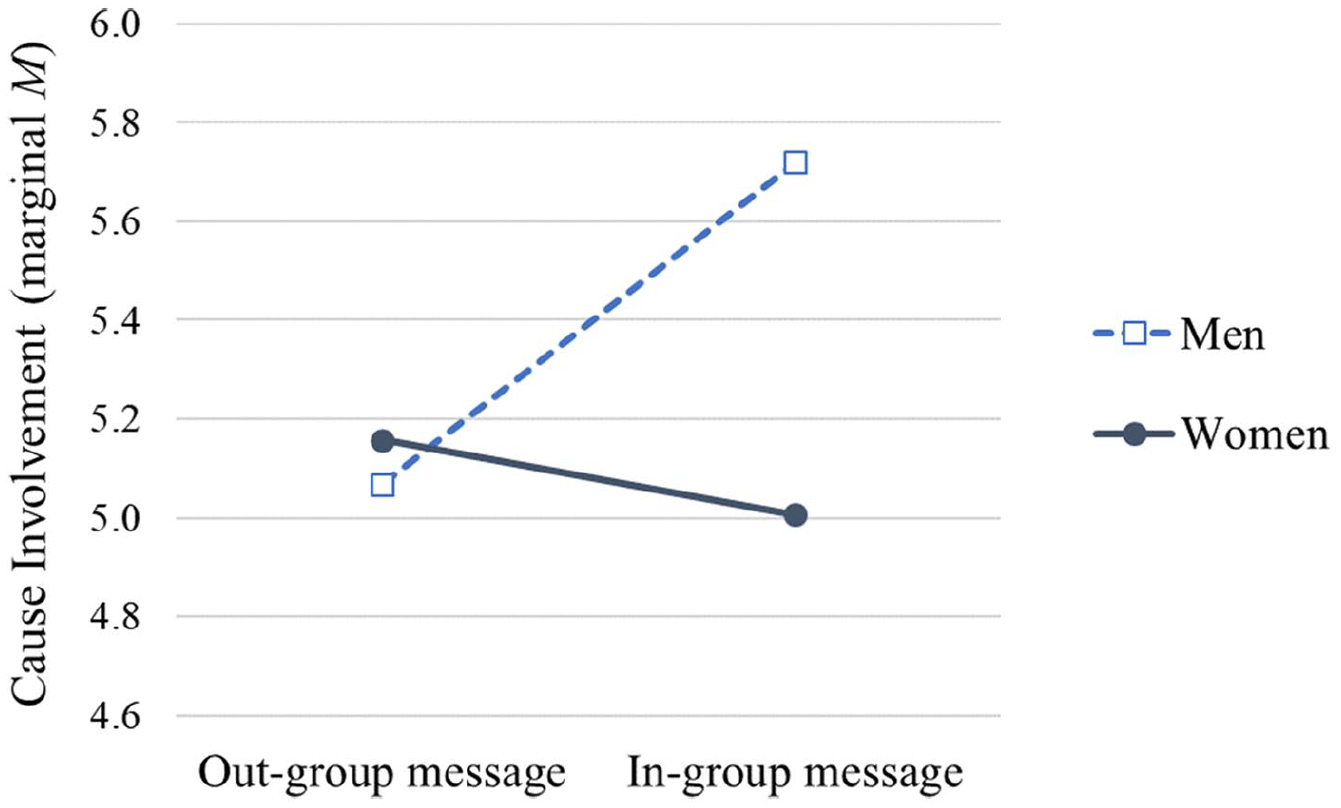
Interaction effect between message type and gender.
To test H3, a moderated mediation analysis was conducted using Hayes’ (2018) PROCESS model 7. An in-group CSR message and a men’s group were coded as 1. Overall involvement with women empowerment and prior attitude toward the brand were statistically controlled. As shown in Table 1, the indirect effect of message type on positive WOM intentions through cause involvement was significantly moderated by gender (index of moderated mediation = 0.34, SE = 0.15, 95% CI = [0.05, 0.65]). More specifically, for men, the effect of an CSR message type on positive WOM intentions through cause involvement was significant (b = 0.28, SE = 0.14, 95% CI = [0.04, 0.57]). However, the indirect effect of message type on positive WOM intentions through cause involvement was insignificant for women (b = −0.06, SE = 0.10, 95% CI = [−0.23, 0.17]).
The Coefficients of Moderated Mediation Model (Study 1).
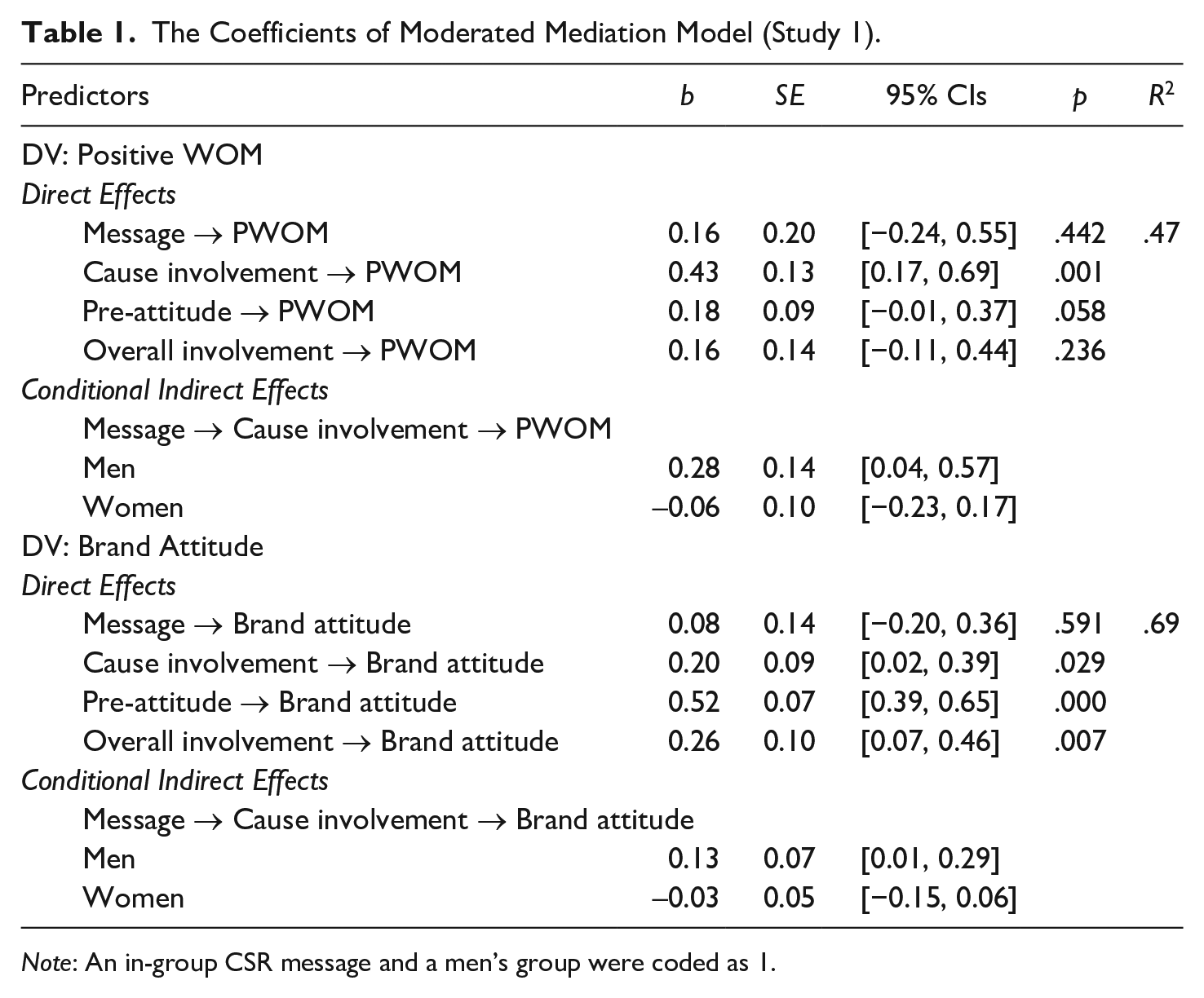
Note: An in-group CSR message and a men’s group were coded as 1.
Also, the indirect effect of message type on brand attitude through cause involvement was significantly moderated by gender (index of moderated mediation = 0.16, SE = 0.10, 95% CI = [0.01, 0.38]). Specifically, for men, the effect of CSR message type on attitudes toward the brand through cause involvement was significant (b = 0.13, SE = 0.07, 95% CI = [0.01, 0.29]). However, for women, the indirect effect of message type on brand attitude was not significant (b = −0.03, SE = 0.05, 95% CI = [−0.15, 0.06]). H3a and H3b were supported.
Study 2
The results of Study 1 lend tentative support to how social distance influences consumer evaluations of a CSR activity supporting women’s empowerment via individuals’ cause involvement. However, several aspects of the study raise questions about the validity and generalizability of the results. Although we intended to manipulate social distance by operationalizing in-group versus out-group messages regarding female empowerment as helping women “in your community” versus helping women “all around the world,” there is room for doubt that it represents manipulation of spatial (geographically close vs. geographically remote) distance rather than social distance (in-group vs. out-group). In addition, only the effect of the level of social distance between individuals and the targets of the CSR activity on its outcome was empirically tested, without attempting to establish the hypothetical link between the manipulation of message closeness and individuals’ perception of social distance. To address these limitations and reduce theoretical ambiguity, Study 2 was conducted.
Hypotheses
The primary aims of Study 2 were threefold. First, to rule out a unique stimulus effect and to assess the robustness and generalizability of the findings (Reeves & Geiger, 1994; Thorson et al., 2012), we replicated Study 1 with a different topic (i.e., fostering women leaders in society) and retested H1, H2, and H3. In this process, unlike in Study 1, we used a fake company to control for the potentially contaminating effects of participants’ predispositions toward a specific real company. Second, to minimize the potential confound (Thorson et al., 2012) in manipulating social distance in Study 1 (i.e., support women in your community vs. support women all around the world), we focused on the personal relationship between individuals and targets of the CSR activity (i.e., support your mom, daughters, sisters, and friends vs. support women). Third, we added the social distance variable as an additional mediator to look at the underlying process in more detail and see if the message indeed led to a decrease in the social distance, thereby increasing cause involvement.
Finally, we validated the moderated-mediation model in its entirety, connecting message type (in-group CSR message vs. out-group CSR message), social distance, gender, cause involvement, and behavioral outcomes (brand attitude and positive WOM intention) that resulted from the message effect on CSR initiative.
Figure 3 describes the entire model of Study 2.
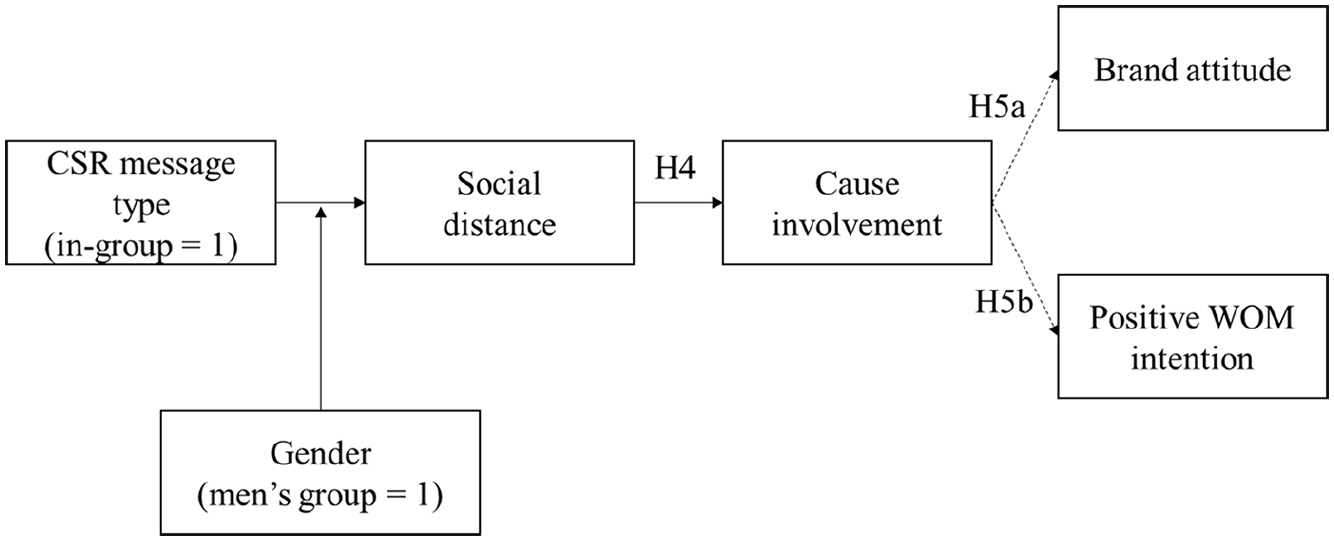
Proposed model of Study 2. Dotted lines represent the moderated serial mediation effects.
Method
Participants
A total of 140 participants were recruited in Study 2. Participants were U.S. residents recruited by Qualtrics. In the same way as Study 1, 50.0% (n = 70) were men and 50.0% (n = 70) were women. The mean age was 54.85 (SD = 14.74). As for race, 92.9% (n = 130) were white. As for education, 35.0% (n = 49) had a college degree, 27.9% (n = 39) had some college credit, and 21.4% (n = 30) had a graduate degree.
Stimulus material
A pilot survey was conducted to select a CSR initiative that is considered the most important for women’s empowerment. 38 undergraduate students at an eastern university participated in the survey. They were asked to choose the most important activity among the four for empowering women: equipping women entrepreneurs, fostering women leaders in society, supporting career centers to offer employment assistance for women job seekers, and supporting women in STEM. Respondents considered “fostering women leaders in society” (n = 20, 52.6%) as the most important.
For an in-group message, the interpersonal relationship was highlighted. The tweet included the following statements: “Support your mother, wife, daughter(s), sister(s), and female friends. We will donate money for every retweet to foster female leadership in our society. #EmpowerWomen.” For an out-group message, the tweet was “Support women. We will donate money for every retweet to foster female leadership in our society. #EmpowerWomen.” All other elements remained the same for both tweets. Unlike Study 1 aiming to observe the realistic responses, a fictitious brand, Natural Care, was used to control the potential confounding effects in Study 2. The image was obtained from Pexels (www.pexels.com).
To test the manipulation of the in-group message and out-group message, a pretest was conducted. In this pretest, 80 adults (i.e., 40 males and 40 females) residing in the United States were recruited from Amazon’s Mechanical Turk. To maintain the number of male and female participants in each condition the same, random assignment to tweets was conducted for each gender. Respondents were asked to answer the question about the perceived personal relevance of the women group mentioned in the tweet on a 7-point scale (1 = strongly disagree and 7 = strongly agree). The items were “This tweet highlights women who are personally related to me” and “This tweet highlights my personal relationships” (M = 4.77, SD = 1.50, Spearman–Brown α = .87). A two-way ANOVA (message type × gender) was conducted to check the manipulation. Only the main effect of message type was significant, F(1, 76) = 8.23, p < .01,
Procedure
The procedure of Study 2 was essentially the same as Study 1. Qualtrics handled data collection and quality. An equal number of males and females were randomly assigned to one of the two message conditions. After viewing the tweet, participants were asked to complete the questionnaire measuring the same constructs and demographics used in Study 1.
Measures
The same items in Study 1 were used to measure overall involvement with women empowerment (M = 5.20, SD = 1.67, Cronbach’s α = .96), a cause involvement (i.e., to foster female leadership; M = 5.16, SD = 1.80, α = .97), positive WOM intentions (M = 4.67, SD = 1.60, α = .94), and attitude toward a brand (M = 5.51, SD = 1.51, α = .98). In addition, social distance from a women group was measured using three seven-point items from a previous study (Hernández-Ortega, 2018). The items were “Women are psychologically close to me,” “Women and I belong to the same group,” and “I am a similar person to women” (M = 4.88, SD = 1.50, α = .86).
Results
The result of a two-way ANOVA (message type × gender) showed that only the main effect of message type on the perceived personal relevance of the tweet was significant, F(1, 136) = 84.00, p < .001,
A two-way ANCOVA with a covariate (i.e., overall involvement with women empowerment) revealed that a main effect of message type on cause involvement was significant, F(1, 135) = 7.02, p < .01,
The results of PROCESS model 7 showed that the indirect effect of message type on brand attitude through cause involvement was significantly moderated by gender (index of moderated mediation = 0.37, SE = 0.17, 95% CI = [0.04, 0.73]). Only for men, the effect of an CSR message type on brand attitude via cause involvement was significant (b = 0.42, SE = 0.17, 95% CI = [0.15, 0.71]). In addition, the indirect effect of message type on positive WOM intentions through cause involvement was significantly moderated by gender (index of moderated mediation = 0.25, SE = 0.13, 95% CI = [0.02, 0.52]). Only for men, the effect of CSR message type on positive WOM intentions through cause involvement was significant (b = 0.28, SE = 0.11, 95% CI = [0.08, 0.51]). Thus, H3a and H3b were supported.
To test H4, a mediation analysis was conducted using PROCESS model 4. An in-group message was coded as 1. Overall involvement with women empowerment was statistically controlled. The indirect effect of message type on involvement with the cause through social distance was significant (b = 0.13, SE = 0.07, 95% CI = [0.02, 0.29]). Therefore, H4 was supported.
To test H5, a moderated serial mediation analysis was conducted using the PROCESS model 83. As shown in Table 2, the indirect effect of message type on positive WOM intentions through a serial mediation from social distance to cause involvement was significantly moderated by gender (index of moderated mediation = 0.11, SE = 0.05, 95% CI = [0.03, 0.22]). More specifically, for men, the effect of CSR message type on positive WOM intentions through a serial mediation from social distance to cause involvement was significant (b = 0.10, SE = 0.04, 95% CI = [0.03, 0.21]). However, the indirect effect of message type on positive WOM intentions was insignificant for women.
The Coefficients of Moderated Serial Mediation Model (Study 2).
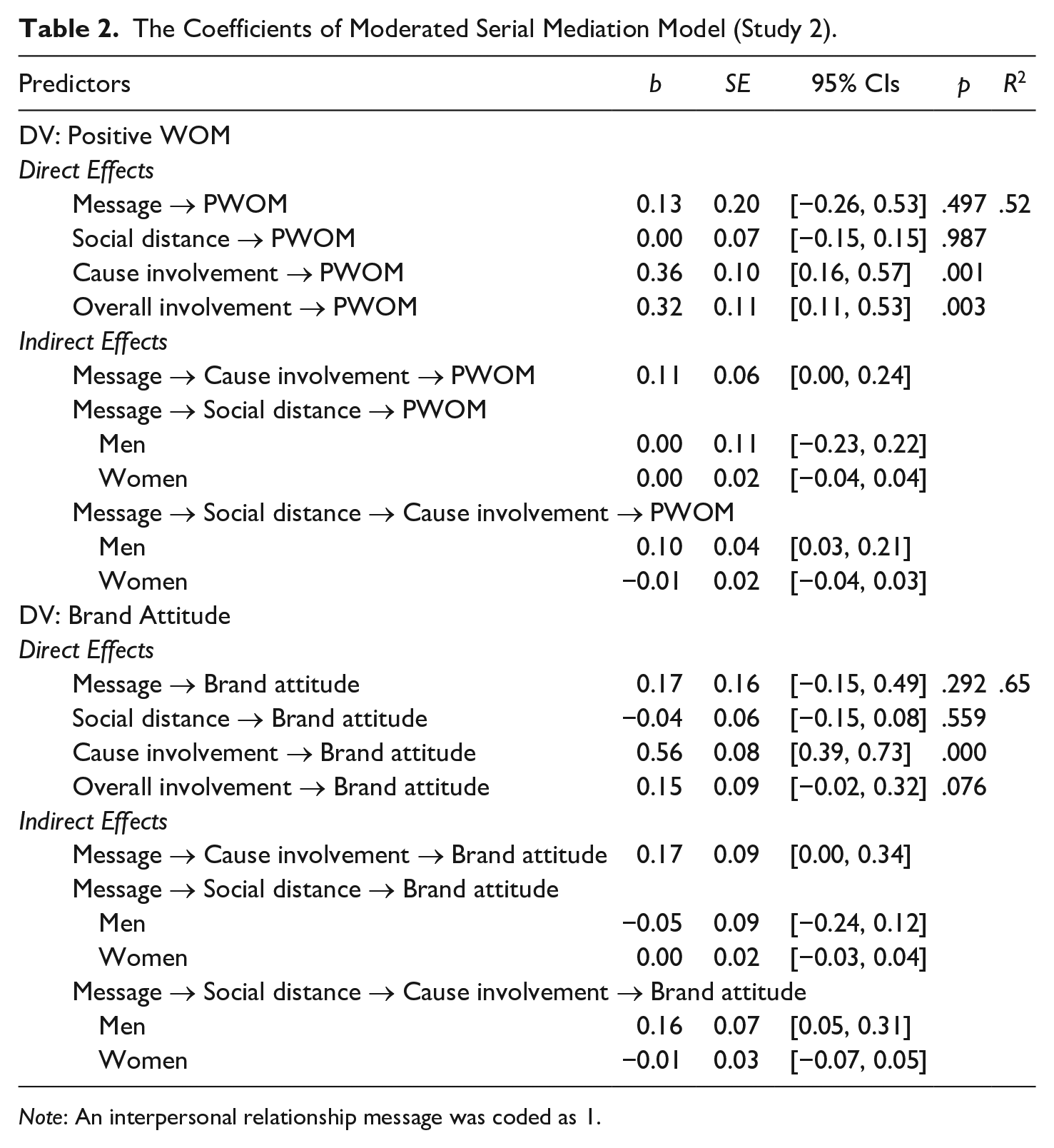
Note: An interpersonal relationship message was coded as 1.
The indirect effect of message type on brand attitude through cause involvement was significantly moderated by gender (index of moderated mediation = 0.17, SE = 0.07, 95% CI = [0.05, 0.34]). For men, the effect of CSR message type on attitudes toward the brand through a serial mediation from social distance to cause involvement was significant (b = 0.16, SE = 0.07, 95% CI = [0.05, 0.31]). However, for women, the indirect effect of message type on brand attitude was not significant. H5a and H5b were supported.
Discussion
Drawing on arguments from CLT, we propose that individuals’ attitudes toward CSR in women’s empowerment depend on the level of psychological distance between individuals and the targets of the CSR activity. In two experiments, we examined whether CSR messages decreasing social distance would increase individuals’ cause involvement and their positive attitudinal and behavioral outcomes. The findings of both Study 1 and Study 2 suggested that CSR message types (i.e., in-group message vs. out-group message) influenced individuals’ cause involvement. This tendency was more pronounced for men, indicating that gender differences exist in CSR message effects. Specifically, while the type of CSR message had little impact on women’s attitudes toward cause involvement, men tended to become more involved in the cause when they perceived the target group of the CSR activity was socially close to themselves. In addition, the analyses for H4 and H5 (Study2) provided a clear explanatory link between individuals’ perceptions of social distance, their cause involvement, and their behavioral outcomes. As predicted, CSR messages decreasing social distance increased individuals’ cause involvement. Consecutively, the increased cause involvement positively influenced individuals’ positive WOM intentions and brand attitudes. Our findings corroborate previous studies that showed increasing intrinsic interest in a cause is critical to generating positive consumer responses from CSR messages (Mohr & Webb, 2005; Sen & Bhattacharya, 2001). The implications of these findings are described in the following.
Theoretical Implications
First, this study demonstrated that the message types could alter audiences’ level of cause involvement. Although many studies have shown the positive relationship between individuals’ cause involvement and their responses to CSR activities (Becker-Olsen et al., 2006; Bergkvist & Zhou, 2019), those findings were generally based on the assumption that individuals’ cause involvement preexists before exposure to CSR messages. Thus, the role of cause involvement in CSR campaigns has mainly been examined either as a predictor that directly influences individuals’ CSR participation intention (Barone et al., 2007; Beise-Zee, 2011; Koschate-Fischer et al., 2012; J. Park et al., 2016) or as a factor that might moderate the impact of CSR messages on individuals’ attitudes toward CSR activities (C. W. Choi, 2020). Unlike previous studies, we focused on the potential for communication strategies to increase individuals’ degree of cause involvement. We suggest that scholars need to investigate the impact of other CSR message strategies on individuals’ cause involvement.
Second, our study confirmed the findings of previous research that showed how individuals’ perceived social distance from the target of CSR campaigns influences the effectiveness of the CSR activity (Chaiken, 1980; Grau & Folse, 2007; Lii et al., 2013). Specifically, our results indicate that psychological distance manipulated by CSR campaign messages can increase an individual’s level of cause involvement, which in turn influences the individuals’ responses to the CSR activities, such as brand attitude and positive WOM intention. Furthermore, unlike previous studies focused on spatial distance (Chaiken, 1980; Grau & Folse, 2007; Lii et al., 2013), this study shows social distance can also increase or decrease individuals’ cause involvement. Thus, this study expands the research on CLT on the evaluations of CSR activities. The effects of other psychological distance dimensions such as temporal and hypothetical distances (Bornemann & Homburg, 2011; Trope et al., 2007) should also be examined in the future.
Third, we contribute to the CSR research by presenting gender differences as a boundary condition of the effect of the in-group message on attitudes toward CSR activity through a serial mediation from social distance to cause involvement. For men, exposure to an in-group message decreases the social distance to the women group. The perception of such closeness increases men’s cause involvement, and consequently, the increased cause involvement positively impacts their positive WOM intentions and brand attitude. However, we found no significant impact of in-group messages on women’s level of involvement with the cause. This finding may result from the fact that women can relate themselves to other women based on their gender regardless of the social distance message attribute.
Practical Implications
This study also serves as an example of how companies can contribute to social issues while also creating societal good. With specific regard to the issue of women’s empowerment, it adds to previous literature that primarily focuses on what steps companies are taking to facilitate inclusiveness in the workplace through its examination of the impacts of CSR messages about the issue on individuals’ attitudes and positive WOM intentions. The results of this study offer companies guidance for effective message construction and targeting key audiences. Specifically, results reinforce the notion that brands are likely to receive more positive reception among men and women audiences when they tailor message content accordingly.
There are also notable differences between how men and women develop brand attitudes and their likelihood to speak positively about that brand based on whether the message is about women they know or women in general. Women are more likely to support both in-group women and out-group women whereas men are more inclined to respond favorably to messages that support in-group women. Therefore, companies should consider gender-based differences when developing campaign messages. Specifically, companies should tailor messages regarding gender equality that target men to focus on their relationships with female family members and those women with whom they are close, not women in general.
Gillette’s (n.d.) recent “The Best Men Can Be” (https://www.youtube.com/watch?v=koPmuEyP3a0) social responsibility ad is just one real-life example of a company’s attempt to raise awareness about women’s empowerment as a social issue that received mixed reception among male and female audiences. While the Gillette ad is an example of a company’s effort that received a more polarized response, other companies such as Coca-Cola are raising awareness by routinely highlighting the voices of women in its CSR initiatives to inspire opportunities for dialogue between the company and its stakeholders (The Coca-Cola Company, 2021). This offers implications for companies and strategic communicators, particularly public relations professionals, whose focus is on building mutual, symbiotic, relationships between companies and stakeholders. While some companies’ involvement in various social issues may extend beyond raising awareness and inspiring discussion to taking a formal stance on social issues, thus engaging in CSA, there is still a space for companies to take important steps to support these issues by demonstrating a commitment to socially responsible business practices and encouraging dialogue and engagement about social issues.
Limitations and Directions for Future Research
Despite these contributions, this study has several limitations. First, because of our narrow scope of interest, we only investigated social distance among the four dimensions of psychological distance. However, further exploration of other dimensions would not only strengthen the generalizability of our findings, but also yield additional practical implications. Second, while this study advances research about topics like women’s empowerment in the context of CSR communication, we did not measure how companies are actually engaging stakeholders in the process. That is, we simply examined messages, which are an important component of CSR communication, but not the only aspect of a CSR activity. Third, we did not measure other important factors that may contribute to attitudes and positive WOM intentions. For example, in addition to measuring cause involvement, future studies may opt to measure the role of reputation, trust, and/or perceived company motivations.
In the present study, we investigated how social distance affects individuals’ attitudes toward CSR in women’s empowerment. Overall, the investigation revealed that in-group messages enhance cause involvement, especially among men. Furthermore, cause involvement functions as a mediator that links social distance and individuals’ positive attitudes toward a company’s CSR activity. Given that little is known about successful CSR message strategies for empowering women, our findings are particularly meaningful. This investigation provides insight for communication practitioners and scholars in the new CSR realm. In addition, the findings of the current study can serve as a foundation from which researchers can build future investigations.
Supplemental Material
sj-docx-1-jmq-10.1177_10776990211041546 – Supplemental material for Feeling Connected to the Cause: The Role of Perceived Social Distance on Cause Involvement and Consumer Response to CSR Communication
Supplemental material, sj-docx-1-jmq-10.1177_10776990211041546 for Feeling Connected to the Cause: The Role of Perceived Social Distance on Cause Involvement and Consumer Response to CSR Communication by Yujin Heo, Chang-Won Choi, Holly Overton, Joon K. Kim and Nanlan Zhang in Journalism & Mass Communication Quarterly
Footnotes
Declaration of Conflicting Interests
The author(s) declared no potential conflicts of interest with respect to the research, authorship, and/or publication of this article.
Funding
The author(s) received no financial support for the research, authorship, and/or publication of this article.

Supplemental Material
Supplemental material for this article is available online.
Author Biographies
References
Supplementary Material
Please find the following supplemental material available below.
For Open Access articles published under a Creative Commons License, all supplemental material carries the same license as the article it is associated with.
For non-Open Access articles published, all supplemental material carries a non-exclusive license, and permission requests for re-use of supplemental material or any part of supplemental material shall be sent directly to the copyright owner as specified in the copyright notice associated with the article.
