







Abstract
Women reporters are underrepresented in newsrooms and assigned to gender-stereotypic roles, but to what effect? To better understand the role of gender in news making, this article utilizes three survey experiments to investigate the effects of journalists’ gender on reader perceptions toward reporter credibility, outlet credibility, and the relevance of news to them. We find little evidence that readers doubt the credibility of a reporter or a news outlet based on the gender of a reporter, the gender of the source, or the gendered nature of the issue. Our findings have implications for media credibility and newsroom diversity.
Gender 1 diversity in the newsroom improves news coverage and builds viewership (Li & Thorson, 2015). Recently, the number of women in the newsroom has increased, whereas the number of women in management positions continues to lag (Kitch, 2015). The effects of gender imbalance in the newsroom are unclear, in part because research is mixed on whether men and women journalists behave differently (Meeks, 2013, 2018) and whether readers perceive them differently (Armstrong & McAdams, 2009).
Without a clear signal, it is difficult to disentangle the effects of gender on news making. The issue is further complicated by reliance on observational data: control being absent, we cannot be sure whether null results are a confirmation that gender has no effect on reporting or whether it is a result of endogeneity bias. To better understand the effects of gender imbalance in the newsroom, we use an experimental design using manipulated news stories varied by gender of the reporter, issue, and sources to isolate the effects of journalists’ gender on readers’ perceptions of outlet credibility, news relevance, and reporter credibility. Our results indicate that gender colors perceptions of reporter credibility and the relevance readers attach to issues through an interplay with audience gender. Our findings extend the application of gender affinity theory, commonly used in the political domain, to the newsroom and have implications for our understanding of women’s role in the newsroom and the costs associated with changing newsgathering routines.
Literature Review
Sourcing by Gender
Source selection shapes readers’ understanding of a story and affects perceptions of balance (Freedman & Fico, 2005). In addition to credibility, accessibility, and deadline pressures (Powers & Fico, 1994), source selection can be affected by the gender of a reporter. Broadly, newspapers tend to use more male sources in their coverage (Zoch & Turk, 1998). This could be because more men than women occupy positions of power in various organizations (Shor et al., 2015), and because journalistic norms dictate that people occupying higher positions are credible, journalists tend to quote men in their stories.
Women as journalists, however, tend to give more prominence to female sources and quote them more frequently than male reporters (Craft & Wanta, 2004). Freedman and Fico (2005) also found that women were most likely to use female sources when covering an election with a female candidate. In their analysis of news coverage on the major networks during the first 100 days of the Clinton administration, Liebler and Smith (1997) found that female reporters were more likely to “allocate first source position in a story to a woman” than male reporters (p. 61).
According to Armstrong (2004), these differences in sourcing could be the result of female journalists attempting to correct the source gender imbalance, or it could be related to their network source make-up. Female journalists could also be more likely to seek out female sources due to the nature of the stories they cover or because they feel comfortable speaking to other women, whereas the reverse is true for men. However, in making evaluations about credibility, readers rely not only on who is speaking, but also on what is being said, which is related to perceptions of issue expertise.
Gendered Issues, Owned Issues
Men and women have historically occupied certain roles in society—women have played roles in the private sphere as caregivers, whereas men have occupied public roles as providers. Consequentially, women are associated with traits such as empathy and are perceived as experts in family issues, whereas men are associated with toughness and are considered experts in topics such as the economy and foreign policy (Huddy & Terkildsen, 1993).
These gendered expectations manifest in the beats that women and men reporters are assigned (Craft & Wanta, 2004; Harp, 2007). Women tend to write about so-called “Pink Topics,” such as food, family, and fashion, whereas men’s bylines appear mostly on hard news topics (Byline Survey Report, 2012). Moreover, newspapers privilege these hard news beats while relegating topics typically associated with women (Ross & Carter, 2011). In her analysis of the New York Times front-page over 11 years, Boydstun (2013) found that international affairs, defense, and government operations make up nearly half of the front page, and stories on these topics are either covered as horse race or as “detached, analytical,” stories typical of hard news coverage (Sjovaag, 2015, p. 104). Soft news stories are perceived as human-interest, lacking timeliness (North, 2016; Sjovaag, 2015), and thus not assigned prominence. Because women cover more soft issues, their bylines are largely absent from the front page as a result.
The “ownership” of issues extends beyond beats to the sources quoted such that male sources are more likely to be quoted related to men’s issues and women are more likely to be quoted in articles about women’s issues (Liebler & Smith, 1997). Men, experts and nonexperts alike, get cited more frequently in political stories and appear in the first few paragraphs of a story (Freedman & Fico, 2005), whereas female sources are less likely to be quoted at length or appear as sources on the front pages of newspapers (Zoch & Turk, 1998).
In sum, the literature demonstrates that reporter gender affects news making via sourcing and perceived issue expertise, but do these effects extend to the readers?
Gender, Reporter Credibility, and Outlet Credibility
Evidence of gender effects on reporter credibility is mixed. Some studies find that male newscasters are perceived as more credible (Armstrong & McAdams, 2009), competent, and composed than women (Brann & Himes, 2010). These evaluations also include male bloggers whom readers see as more credible (Armstrong & McAdams, 2009). Other studies find no difference between the genders (Burkhart & Sigelman, 1990) or differences that are conditional on reader gender (Flanagin & Metzger, 2003), age (Carocci, 1988), and news consumption habits (Andsager & Mastin, 2003).
These conflicting results signal the need for more research. Armstrong and McAdams (2009) theorize, in the absence of in-depth information, gender cues act as heuristics that help readers draw conclusions about the world. Authoritative sources, often men, are considered credible, and by extension, the information they provide is perceived as important (Armstrong & Nelson, 2005). Because the news media tend to favor masculine norms, as evidenced through their selection and placement of stories and sources, readers are likely to attach more credibility to male sources and reporters than their women counterparts. Any instance of gender incongruence on behalf of the source or the reporter could lead to a negative evaluation of the reporter. But does this credibility penalty extend to readers’ evaluation of the news outlet? Moreover, to what extent does the gender of the issue affect credibility? Such questions are important as they suggest there may be inadvertent consequences of newsroom diversity.
Audience Perceptions of News Relevance
In addition to perceptions of credibility are perceptions of whether news coverage is balanced (American Press Institute, 2016) and relevant (Knight Foundation, 2018). We refer to this perception of news as balanced and relevant as “news-is-for-me.” This concept captures three dimensions of balance and relevance: news covers diverse points of view, news shares the audience’s point of view, and news includes input from the audience’s community (American Press Institute, 2016). The importance of such perceptions was evident in a media trust survey of 1,218 U.S. adults conducted by Gallup in 2018 where 79% of respondents said reporters need to understand the challenges faced by people like them (Knight Foundation, 2018). When reporters understand their audiences, they are more likely to choose topics that will be relevant.
Similarly, audiences are likely to trust the news when it includes people like themselves as sources. Using diverse sources is important from a business perspective and helps fulfill journalism’s role of representing the public (American Press Institute, n.d.). When journalists quote sources who are similar to their audiences in terms of life experiences and characteristics such as gender, ethnicity, and class, they are more likely to produce stories that reflect the audience, increasing media credibility. Thus, we argue that issue and source gender likely affect audience perceptions of news relevance, particularly for women. Some evidence of this relationship is demonstrated in studies on news consumption and gender. For example, Toff and Palmer (2019) found that “news-is-for-men” perceptions drive news avoidance among women. This means that the lack of representation of women in news content causes gendered perceptions that news is for men and about men. The masculine norms of American journalism cause news to focus on issues dominated mostly by men, and there is a lack of coverage on issues related to daily life such as weather and health, which tend to interest women. As a result, women avoid news, which leaves them disengaged from politics.
In the same way, we argue that when the news does not cover diverse viewpoints, does not reflect issues of importance to the audience, and does not include input from the community, audiences are less likely to find the news relevant or credible. In making this assertion, we draw from Steele’s (1988) Temporarily Expanding Boundaries of the Self (TEBOTS) model, which explains how people engage with mediated narratives. This line of research argues that the consumption of any form of media causes audiences to feel transported into the world described by the narrative and develop a sense of identification with the characters. However, identification tends to be stronger when the characters share similarities in terms of race, gender, occupation, and attitudes (Kaufman & Libby, 2012). Thus, we expect that when audiences do not perceive the news to be reflective, they are less likely to consider it credible.
Theory and Hypotheses
Affinity for Sources of the Same Gender
We draw on gender affinity theory to explain readers’ attitudes toward male and female sources. According to this theory, as a result of sharing similar life experiences and socialization, women develop feelings of group solidarity and shared gender identity. Gender affinity includes the idea of gender consciousness which implies that women display a baseline preference for other women. For example, women voters are more attentive to the campaigns of women candidates (Dolan, 2004; Sanbonmatsu, 2002). These positive intragroup feelings stem from a feeling of linked fate—that women’s fortunes are closely linked with other members of their group. Groups based on social identity also tend to perceive group solidarity on the basis of shared concern for a common set of “group-salient issues” (Dolan, 2004, p. 93) that impact the group. For women, these issues would include sexual harassment, abortion, or childcare (Dolan, 2008).
When applied to journalism, group affinity theory would imply that readers would expect female journalists, who are aware of the disproportionate representation of male sources and issues in the media, to attempt to correct the imbalance by quoting more female sources in their reports. Unlike a story’s prominence, which is determined by a senior editor, copyeditor, or a news producer, journalists have relative autonomy in selecting sources for their stories, and readers would expect female journalists to use this opportunity to source women. Because female journalists tend to report more on issues related to women, they would be keen to include the viewpoints of female experts, based on shared understanding that fellow women consider these issues important. By the same reasoning, readers would expect male journalists to source more males.
Implicit Stereotypes and Social Role Theory
Gender stereotypes and social roles also condition people’s attitudes and beliefs. As a result of the roles men and women play in society, people ascribe certain qualities to both genders. These attributes are consensual and normative because they describe qualities perceived to be desirable for each gender (Eagly, 1987). Sex roles thus include two dimensions: descriptive and normative. The first includes “consensual expectations about what members of a group actually do” (Eagly & Karau, 2002, p. 574), and the other includes norms, “which are consensual expectations about what a group of people ought to do or ideally would do” (p. 574). According to social role theory, people perceive a congruency between the roles men and women play in society and their “inner dispositions” (p. 574). As a consequence of these roles, people expect men to be confident and decisive, whereas women are perceived as emotional and caring. These gender expectations are pervasive and are used along with other factors such as race and age to categorize people (Blair & Banaji, 1996).
Expectations about gender roles also unintentionally activate implicit stereotypes about men and women. These stereotypes color people’s expectations such that they prefer information that matches gender-stereotypic expectations (Kray et al., 2001) or subconsciously fill in information gaps to match their stereotypes. It is important to point out that this process is not intentional nor should it be confused with media malpractice; rather, it is a cognitive bias that typically operates outside of awareness (Trumbo et al., 1998). When men and women’s actual behaviors are inconsistent with these implicit stereotypic expectations, there could be a backlash effect (Eagly & Karau, 2002) resulting in negative evaluations (Rudman & Glick, 2001).
We argue that female journalists who write about women’s issues quote female sources based on the assumption that their source’s credibility (and by extension, their own) is less likely to be challenged when they selected for stories assigned to women’s areas of expertise. For readers, this gender congruence among author, issue, and source may translate into positive evaluations of the news outlet. Male reporters, especially those writing for beats such as politics and international affairs, are likely to quote male sources for the same reasons.
Thus, we propose the following hypotheses:
Reader Gender and Effects on Perceptions of Credibility and Relevance
We argue that readers’ gender could affect their perceptions of news credibility and relevance. Our argument is derived from the prism model, which states that identity acts as a mediator and moderator in communication effects (Comello, 2013). A person’s identity influences how they perceive and evaluate media messages, and in turn, their identity is influenced by media messages they consume. Communication that is fitting or relevant to the social identity of the reader is more persuasive than others. An example of this is political ads that strategically highlight identity cues related to race, gender, socioeconomic status, or political ideology to persuade specific groups. The expectation is that audiences will identify with the social category highlighted in the ad, which will make the message more relevant and effective. In the same way, we argue that readers’ gender could affect their evaluation of news. The theory of gender affinity—which posits that as a result of shared experiences, we develop positive attitudes toward group members who share our gender identity—should extend to audience members. Thus, female audience members consuming information from female sources on women’s issues will consider the information more important and credible relative to information from a male source. Male audience members should display similar affinity for male sources and male issues in the news.
Readers may also report higher levels of perceived credibility and belief in the news-is-for-me perception when they perceive gender congruence in the author, issue, and source quoted in the story. Although journalists are bound by professional codes which aim to mitigate the effects of bias on their work, they are susceptible to stressful work conditions and deadline pressures, which could impede their decision-making abilities and allow these unconscious biases to creep in Kalra and Boukes (2021). Thus, we propose the following hypotheses:
Overview of Studies
These four sets of hypotheses examine the extent to which the gender of reporters, sources, issues, and readers affects perceptions of media credibility and belief that the news is for me.
To test them, we conducted three web-based survey experiments. In each of the three studies, participants completed a pretest questionnaire measuring issue attention and demographics. 2 Participants were then randomly assigned to an experimental condition featuring a manipulated news article. Afterward, participants were asked close-ended questions regarding reporter credibility, news outlet credibility, and news-is-for-me perceptions.
Study 1 tested gender effects on reporter/outlet credibility (
Stimuli
We developed stimuli using actual news articles. To isolate the effects of the three experimental factors, we kept message structure characteristics such as message length and layout the same across conditions and within studies (Supplemental Appendix A for stimuli details).
For the first factor, reporter gender, we varied whether the byline and image featured a woman or a man. The addition of the image facilitates delivery of the treatment by ensuring the primacy of reporter gender (McDermott, 2011). Although the insertion of a journalist’s picture is not typical for all articles, this practice is more common on online news sites. 3 The images were pretested to ensure there were no significant differences on key dimensions (Supplemental Appendix B).
For the second factor, source gender, we varied quote attribution. Similar to the use of reporter image, we used pull-quotes to ensure primacy of source gender and facilitate delivery of treatment.
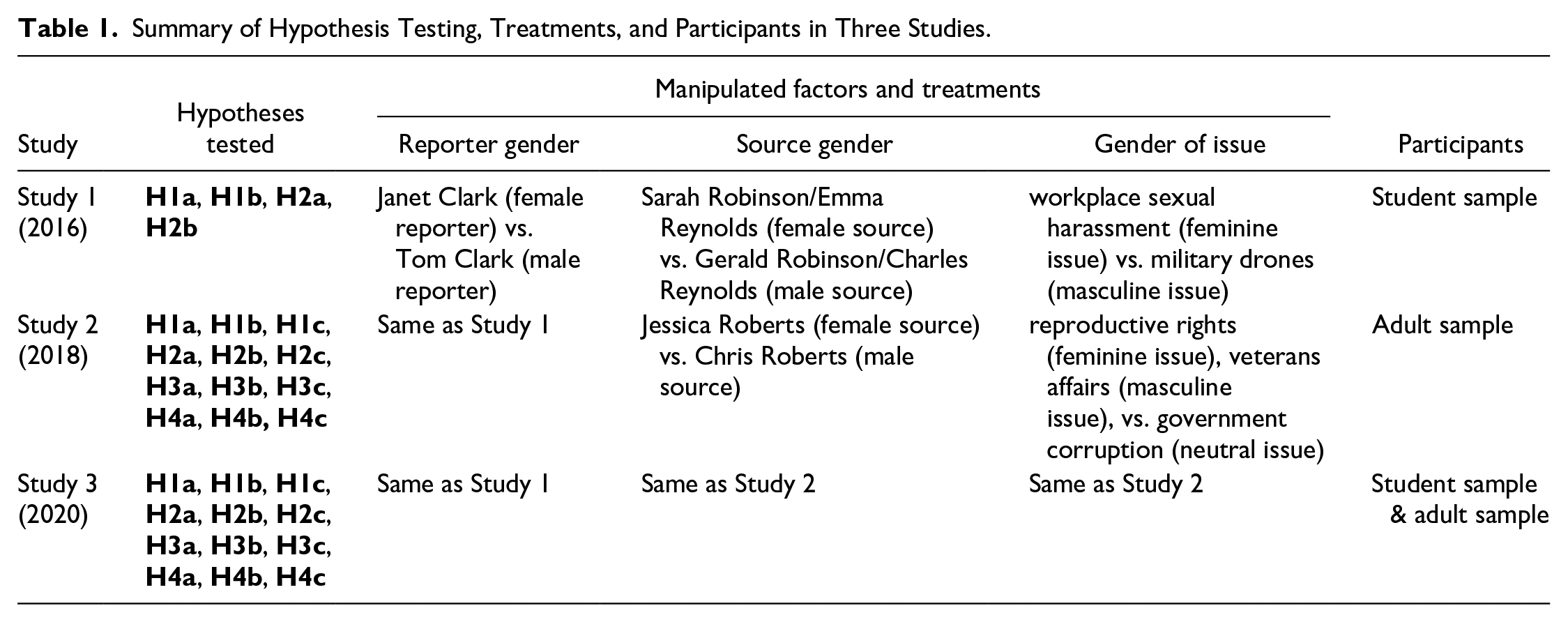
For the final factor, gender of issue, we varied whether the issue was feminine or masculine. For Studies 2 and 3, we also included a neutral issue. To select a set of issues, we first looked to the literature to draw a set of 20 exemplars traditionally categorized as masculine and feminine (Dittmar, 2015; Dolan, 2010). Extant research categorizes issues such as abortion, education, domestic violence, and equal rights as feminine (Carroll & Fox, 2006); issues such as crime, war, and national security as masculine (Hayes & Lawless, 2015); and issues such as government reform/transparency or campaign finance reform as gender-neutral (Hayes & Lawless, 2015). We next conducted pilot testing to narrow our selection of issues to those that significantly varied on dimensions of perceived femininity but not masculinity, and vice versa (Supplemental Appendix C test details). Accordingly, this study employed “workplace sexual harassment” (Study 1) and “reproductive rights” (Studies 2 and 3) as feminine issues, “military drones” (Study 1) and “veteran affairs” as masculine issues (Studies 2 and 3), and “government corruption” as a neutral issue (Studies 2 and 3). 4
Table 1 summarizes the experimental design for each study.
Summary of Hypothesis Testing, Treatments, and Participants in Three Studies.
Measures
For all outcome variables, close-ended items were measured on a 7-point scale where 1 = strongly disagree and 7 = strongly agree.
Previous research (Bucy, 2003; Kiousis, 2001) defines reporter credibility as the extent to which a journalist is considered trustworthy and accurate. Similarly, outlet credibility can be defined as audience perception of a news outlet’s expertise. This study adopts Gaziano and McGrath’s (1986) credibility index and measures news outlet credibility as an average of five items: “This news outlet is trustworthy/accurate/unfair (reversely coded)/tells the whole story/biased (reversed).” We take a similar approach to measure reporter credibility, averaging five items: “This news reporter is trustworthy/accurate/unfair (reversely coded)/tells the whole story/biased (reversed).” As the inter-item correlation for reporter credibility was slightly low in Study 1 (Cronbach’s α = .66), we draw an additional item from the literature to construct a more reliable index: “this reporter does a good job showing what’s going on” (Duyn et al., 2018). 5 Thus, in Studies 2 and 3, reporter credibility is measured using an average of six items.
Studies 2 and 3 also tested the effect of gender on news-is-for-me perceptions, which is described as the process of a news story becoming important to an individual because they also view it as relevant to themselves (Boninger et al., 1995). It is operationalized using an index of three items: “This news story includes rich information for people like me,” “This news story is relevant for people like me,” and “This news story interviews people like me.”
See Table 2 for a summary of the variables, measures, and descriptive statistics used in each study.
Summary of Variables, Measurement, and Descriptive Statistics in Three Studies.
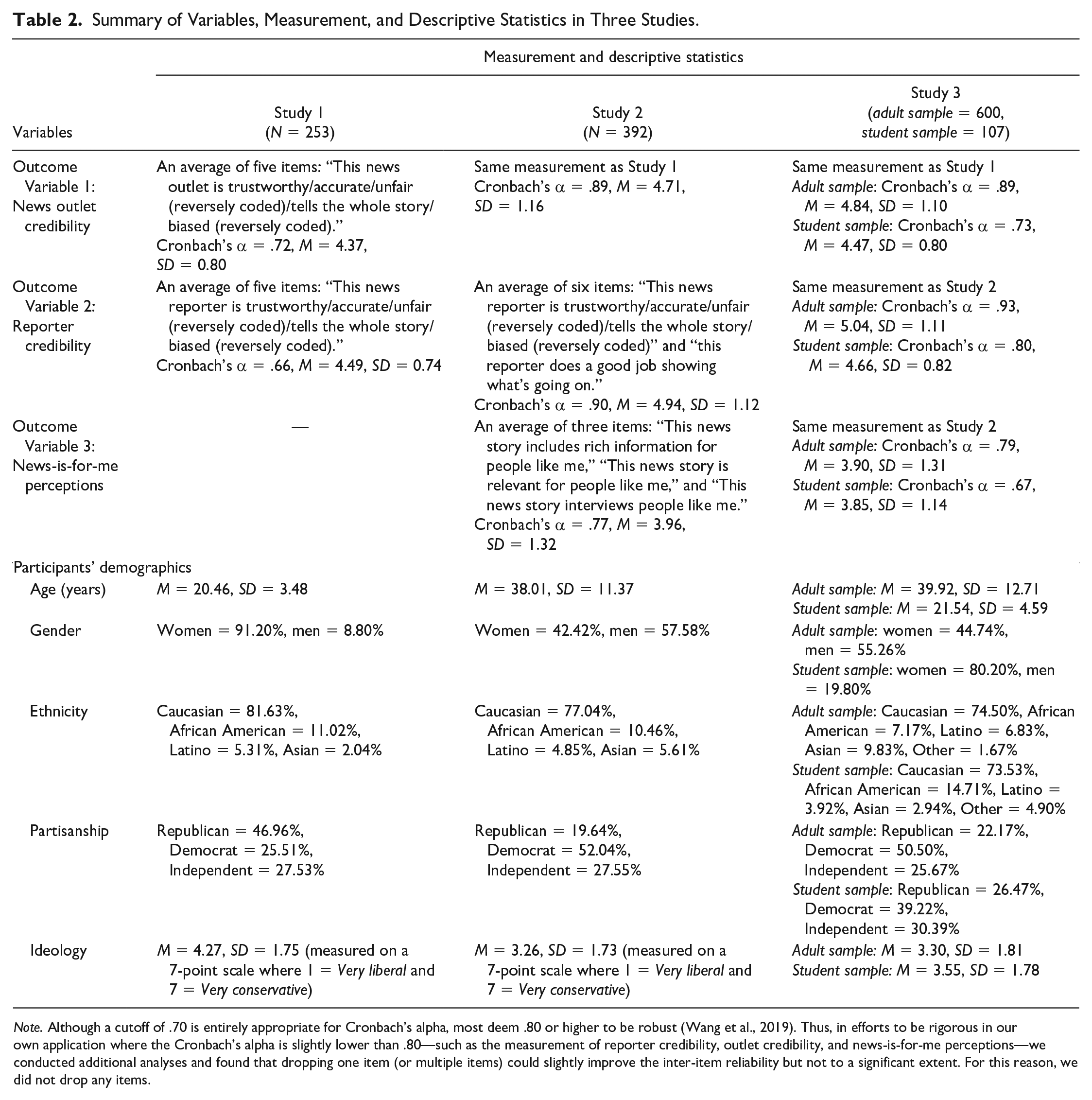
Note. Although a cutoff of .70 is entirely appropriate for Cronbach’s alpha, most deem .80 or higher to be robust (Wang et al., 2019). Thus, in efforts to be rigorous in our own application where the Cronbach’s alpha is slightly lower than .80—such as the measurement of reporter credibility, outlet credibility, and news-is-for-me perceptions—we conducted additional analyses and found that dropping one item (or multiple items) could slightly improve the inter-item reliability but not to a significant extent. For this reason, we did not drop any items.
Randomization Checks
To ensure randomization was effective, we conduct randomization checks for each study. We estimate a series of binary logistic and multinomial logistic regression models as appropriate. The results indicate successful randomization (Supplemental Appendix D).
Manipulation Checks
Next, we assess whether the treatments were successfully delivered. First, to lend support to the generalizability of our stimuli, we ask participants whether the article they read resembles news they encounter in real life. Results suggest participants perceived the stories favorably (Study 3: M = 5.36, SD = 0.89, range = 6), and found our stories resemble news stories encountered everyday (Study 2: M = 4.82, SD = 1.38, range = 6). In Study 1, participants were asked to name the specific issue of the story they read, and to select the reporter and source names from a set of choices. Results show that most participants named the issue correctly, although their recall of reporter (44.96%) and source names (24.48%) was poor. Failure to recall bylines and source names in news articles is well documented (Culbertson & Somerick, 1976) and exacerbated in this case because these reporters and sources are not known. Accordingly, in Studies 2 and 3, we ask participants to identify the gender of reporters (80.10% in Study 2; 73.39% for student sample and 82.67% for adult sample in Study 3) and sources (63.78% in Study 2; 55.96% for student sample and 69.83% for adult sample in Study 3). These recall rates mirror what we would expect; in a similar study by Burkhart and Sigelman (1990), 78% of the participants accurately recalled reporter’s gender. As such, our manipulation checks suggest successful delivery of treatment. All participants were used in the analyses reported below (Supplemental Appendix D for full analyses). 6
Study 1
Participants for Study 1 (N = 253) were undergraduates recruited from a large Southern university from January 27 to February 27, 2016, with a majority of women participants (91.20%) (Table 2 for details). 7 Given the gender make-up of this sample, we reserved tests of reader gender to Studies 2 and 3. To shore up the robustness of these results, we also estimated a second model for each outcome variable with only women respondents: Columns 2 and 4 of Table 3.
ANOVA Models Predicting Reporter Credibility and News Outlet Credibility (Study 1).
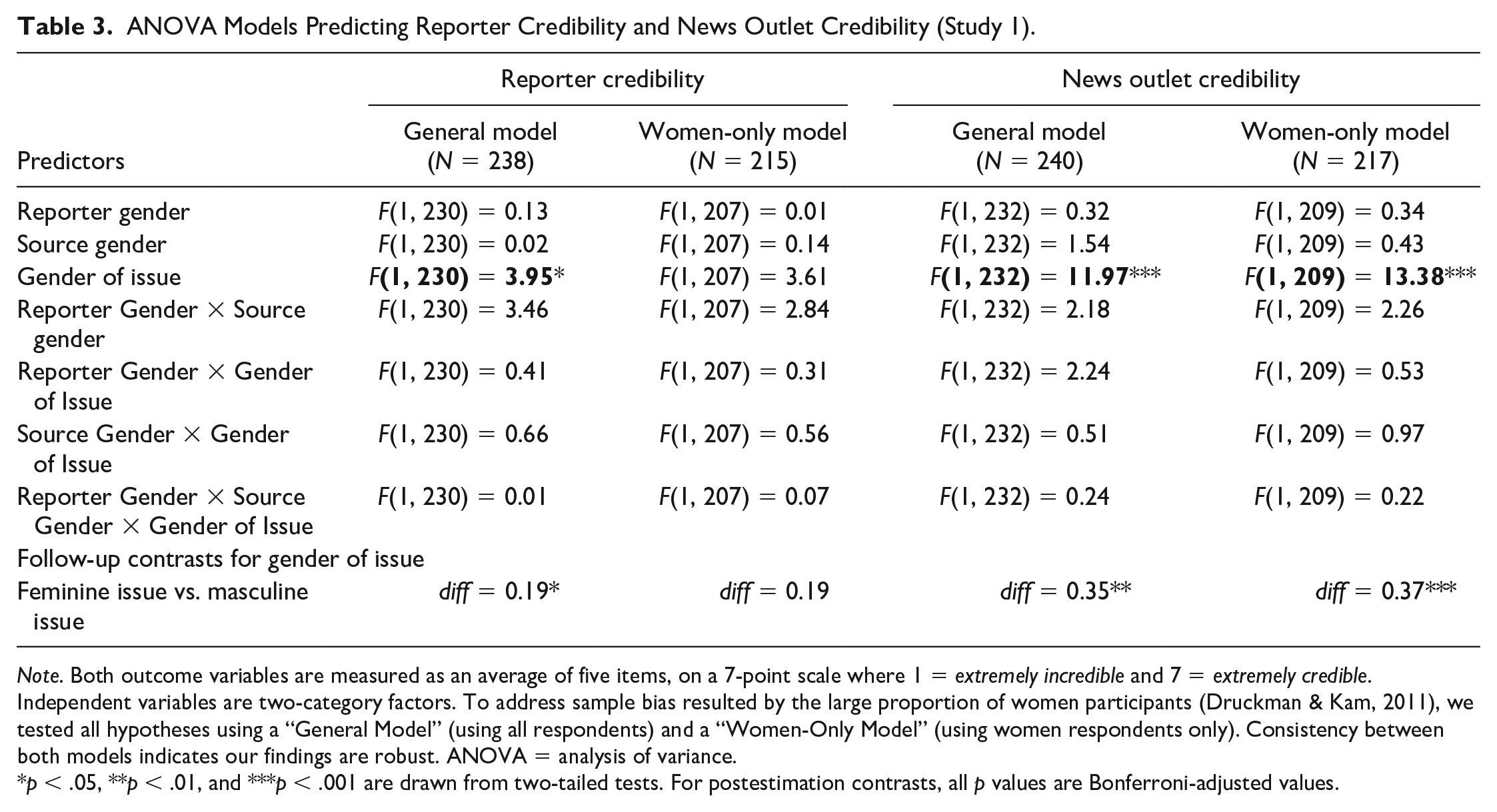
Note. Both outcome variables are measured as an average of five items, on a 7-point scale where 1 = extremely incredible and 7 = extremely credible. Independent variables are two-category factors. To address sample bias resulted by the large proportion of women participants (Druckman & Kam, 2011), we tested all hypotheses using a “General Model” (using all respondents) and a “Women-Only Model” (using women respondents only). Consistency between both models indicates our findings are robust. ANOVA = analysis of variance.
p < .05, **p < .01, and ***p < .001 are drawn from two-tailed tests. For postestimation contrasts, all p values are Bonferroni-adjusted values.
Results
Study 1 tested
We first estimated an analysis of variance (ANOVA) model to examine reporter credibility as a function of the interaction between the gender of reporter, gender of source, and gender of issue (Column 1 of Table 3). As neither the “Reporter Gender × Source Gender” interaction nor the “Reporter Gender × Gender of Issue” interaction effect was significant on the conventional 0.05 level, both
In a second ANOVA model predicting outlet credibility, the interaction effects between reporter gender and source gender, as well as reporter gender and gender of issue were not statistically significant (Column 3 of Table 3). Thus, neither
Although we do not hypothesize about the main effects of gender of the issue, it was a significant factor in both models. For reporter credibility, F(1, 230) = 3.95, p < .05 (general model), pairwise contrasts showed that reporter credibility was higher when stories covered a feminine issue (M = 4.58, SD = 0.74) than a masculine issue (M = 4.39, SD = 0.73), t = 1.99, p < .05. We found similar patterns for news outlet credibility, F(1, 232) = 11.97, p < .001 (general model). Again, pairwise contrasts showed that media credibility was higher when stories covered feminine issues (M = 4.54, SD = 0.76) compared with masculine issues (M = 4.19, SD = 0.80), t = 3.46, p < .01.
Discussion
Study 1 results neither support
Study 2
Study 1 found that readers’ perceptions about reporter and news outlet credibility are affected by whether an issue is masculine or feminine, but not by reporter or source gender. In this study, we improve upon Study 1 using an adult convenience sample which permits tests of respondent gender, by adding a neutral issue to our gender of issue factor and with the addition of the news-is-for-me perceptions as a third outcome. Study 2 deploys a 2 (reporter gender) × 2 (source gender) × 3 (feminine issue, masculine issue, neutral issue) factorial design. Participants were adults (N = 392) recruited from Amazon’s Mechanical Turk (MTurk) in August 2018. 8
Results
Study 2 tested
We again estimated a three-factor ANOVA model to examine reporter and outlet credibility as a function of the interplay between the gender of reporter, gender of source, and gender of issue: Columns 1 and 2 of Table 4. Akin to Study 1, the interaction effects between reporter gender and source gender, as well as reporter gender and gender of issue were not significant for either reporter or outlet credibility. Again,
ANOVA Models Predicting Reporter Credibility, News Outlet Credibility, and News-Is-for-Me Perceptions by Treatment Factors (Study 2, N = 392).
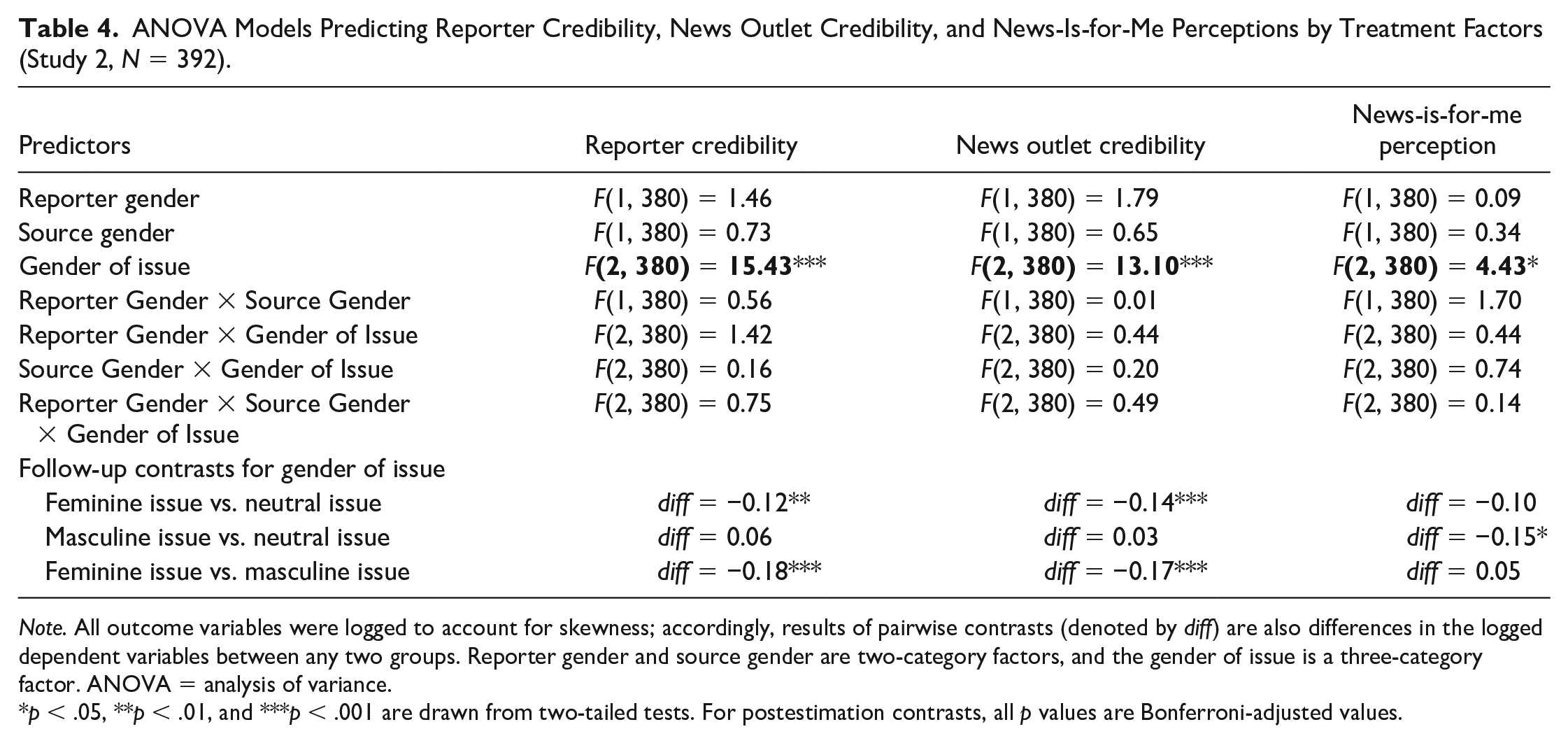
Note. All outcome variables were logged to account for skewness; accordingly, results of pairwise contrasts (denoted by diff) are also differences in the logged dependent variables between any two groups. Reporter gender and source gender are two-category factors, and the gender of issue is a three-category factor. ANOVA = analysis of variance.
p < .05, **p < .01, and ***p < .001 are drawn from two-tailed tests. For postestimation contrasts, all p values are Bonferroni-adjusted values.
Study 2 additionally includes news-is-for-me perceptions; however, null effects persist: The interaction between reporter gender and source gender, and the interaction between reporter gender and gender of issue were not significant (Column 3 of Table 4).
Consistent with Study 1, however, Study 2 found the gender of issue yielded a statistically significant main effect on reporter credibility, F(2, 380) = 15.43, p < .001, news outlet credibility, F(2, 380) = 13.10, p < .001, and news-is-for-me perceptions, F(2, 380) = 4.43, p < .05. Pairwise contrasts showed that, in contrast to Study 1, audiences tend to perceive both reporters and their media outlets as more credible if the news story covers a masculine or neutral issue than a feminine issue.
Next, we estimated another three sets of ANOVA models to examine the interplay among reporter gender, source gender, and reader gender (
ANOVA Models Predicting Reporter Credibility, News Outlet Credibility, and “News-Is-for-Me” Perception by Treatment Factors × Reader Gender (Study 2, N = 389).
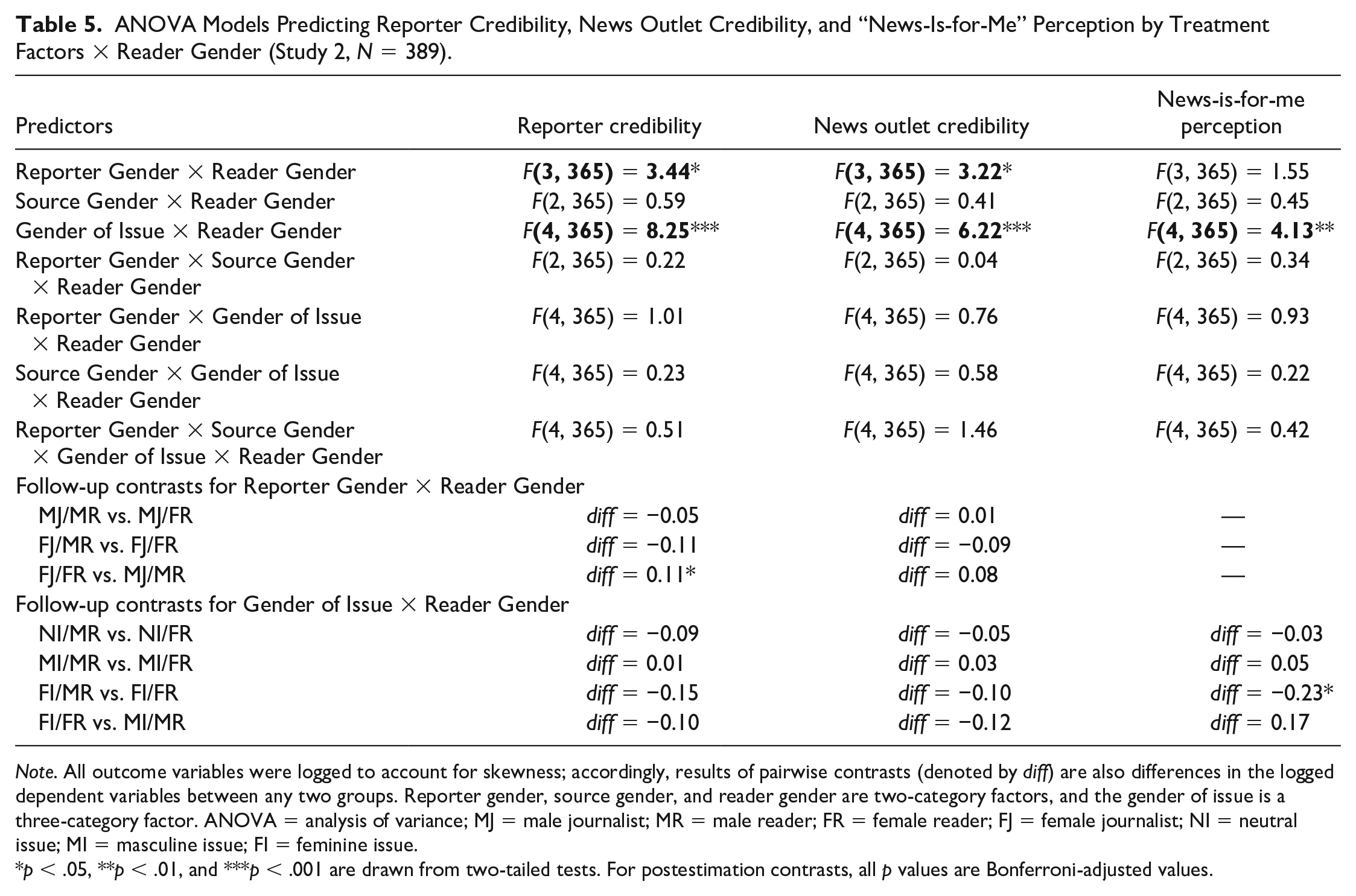
Note. All outcome variables were logged to account for skewness; accordingly, results of pairwise contrasts (denoted by diff) are also differences in the logged dependent variables between any two groups. Reporter gender, source gender, and reader gender are two-category factors, and the gender of issue is a three-category factor. ANOVA = analysis of variance; MJ = male journalist; MR = male reader; FR = female reader; FJ = female journalist; NI = neutral issue; MI = masculine issue; FI = feminine issue.
p < .05, **p < .01, and ***p < .001 are drawn from two-tailed tests. For postestimation contrasts, all p values are Bonferroni-adjusted values.
The ANOVAs uncovered a noteworthy two-way interaction effect between reporter gender and reader gender on reporter credibility, F(3, 365) = 3.44, p < .05, and news outlet credibility, F(3, 365) = 3.22, p < .05. Pairwise contrasts showed that relative to the perceived credibility of male journalists reported by male readers (M = 4.79, SD = 1.16), female reporters were rated significantly higher by female readers (M = 5.19, SD = 0.88), t = 2.67, p < .05. These relationships were not replicated in the results of pairwise comparisons for news outlet credibility.
A significant two-way interaction effect was also found between the gender of issue and gender of reader, as indicated in ANOVA models for reporter credibility, F(4, 365) = 8.25, p < .001, news outlet credibility, F(4, 365) = 6.22, p < .001, and news-is-for-me perceptions, F(4, 365) = 4.13, p < .01. Pairwise comparisons yielded one noteworthy finding: Male readers (M = 3.57, SD = 1.45) exhibited a significantly lower attachment to feminine issues than female readers (M = 4.30, SD = 1.14), t = −2.98, p < .05.
Discussion
A few findings stand out. First, like Study 1, Study 2 yielded no support for the interaction effects among the gender of reporter, gender of source, and gender of issue that were formulated in
Finally, the gender of issue was found to have a significant effect on all three outcome variables in Study 2, consistent with Study 1. However, pairwise comparisons yielded contradictory patterns: In direct contrast to Study 1, the masculine issue—not the feminine issue—positively affected perceptions of reporter and outlet credibility. To better understand these differences and ensure the null results of our hypothesized two-way and three-way interactions are robust to replication, we conduct a third study, including an adult and student sample.
Study 3
We replicated the design of Study 2, recruiting both a student sample and an adult sample using MTurk. Thus, Study 3 also deploys a 2 (reporter gender) × 2 (source gender) × 3 (feminine issue, masculine issue, neutral issue) factorial design.
Study 3 was first launched on September 25, 2020, via Amazon’s MTurk, with a total of 600 completed responses collected. The second sample was collected from November to December 2020, including 107 students from a large Southern university. The student sample again included a large number of female participants (80.20%); however, the convenience adult sample was more balanced, with 55.26% men and 44.74% of women (Table 2 for a summary of participants’ demographics).
Results
In this study, we focus first on replicating the null results for the hypothesized two-way and three-way interactions found in Studies 1 and 2. Second, we look to extend the two noteworthy relationships that stood out in the previous studies: (a) the main effect of issue gender and (b) two-way interaction between reporter gender and reader gender, as well as gender of issue and reader gender. Recall that the former was significant in both studies, but reversed and that we were only able to test the latter in Study 2, not Study 1. To facilitate comparison across all three studies, we summarize findings in Table 9.
Turning to our hypotheses first, Study 3 lends additional robustness to our findings. Again, the results for both the student and adult sample yielded little support for all hypotheses (Tables 6–8). For students, the two-way interaction between reporter gender and issue gender was significant for outlet credibility and news-is-for-me perceptions; however, follow-up pairwise comparisons uncovered no significant differences. The one exception was for feminine-issue stories written by female reporters (M = 4.35, SD = 0.95), which were rated significantly higher on news-is-for-me perceptions than the masculine-issue stories written by male reporters (M = 2.94, SD = 1.15), t = 3.89, p < .01.
ANOVA Models Predicting Reporter Credibility, News Outlet Credibility, and News-Is-for-Me Perception by Treatment Factors (Study 3, Adult Sample).
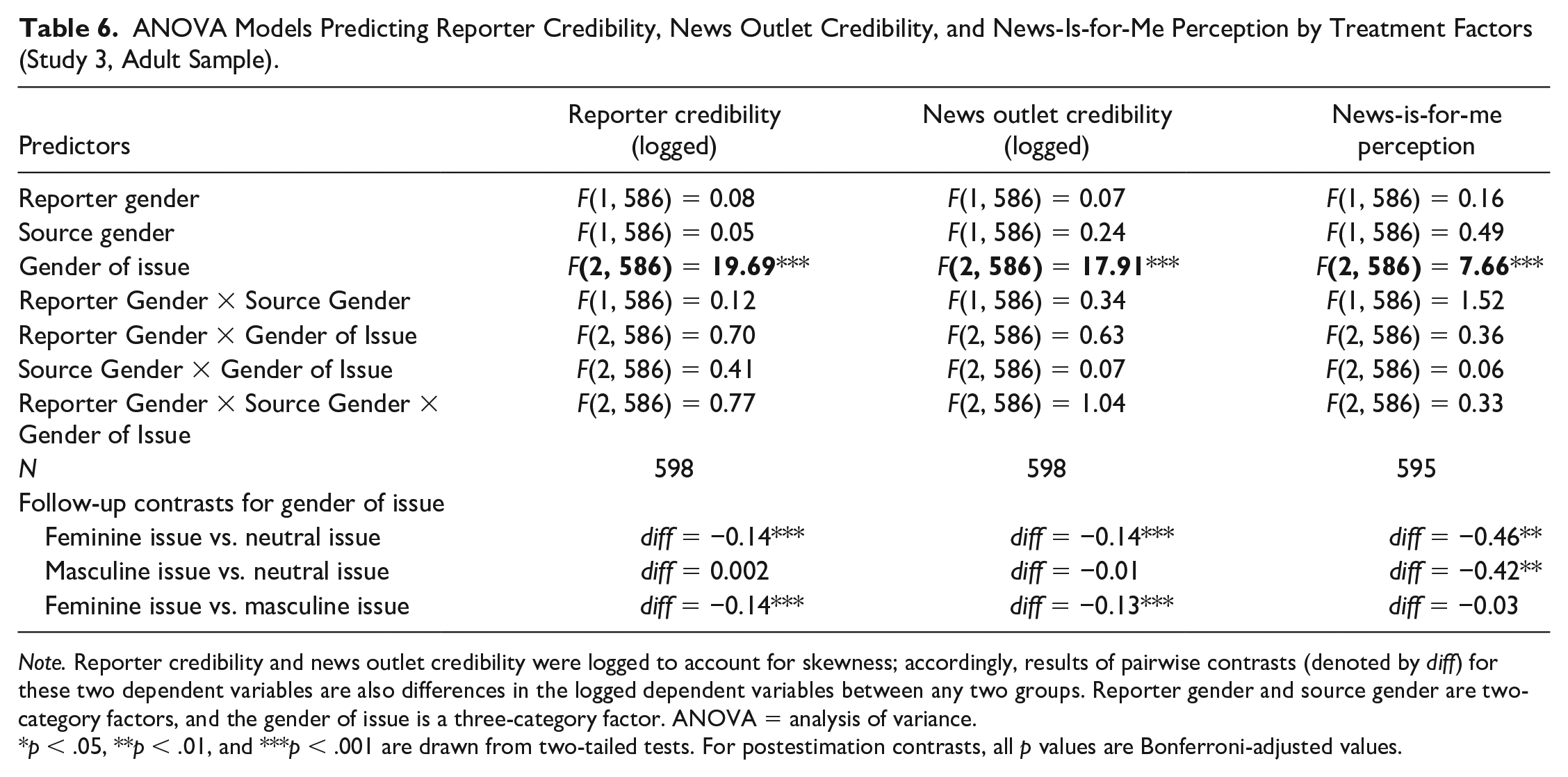
Note. Reporter credibility and news outlet credibility were logged to account for skewness; accordingly, results of pairwise contrasts (denoted by diff) for these two dependent variables are also differences in the logged dependent variables between any two groups. Reporter gender and source gender are two-category factors, and the gender of issue is a three-category factor. ANOVA = analysis of variance.
p < .05, **p < .01, and ***p < .001 are drawn from two-tailed tests. For postestimation contrasts, all p values are Bonferroni-adjusted values.
ANOVA Models Predicting Reporter Credibility, News Outlet Credibility, and News-Is-for-Me Perception by Treatment Factors × Reader Gender (Study 3, Adult Sample).
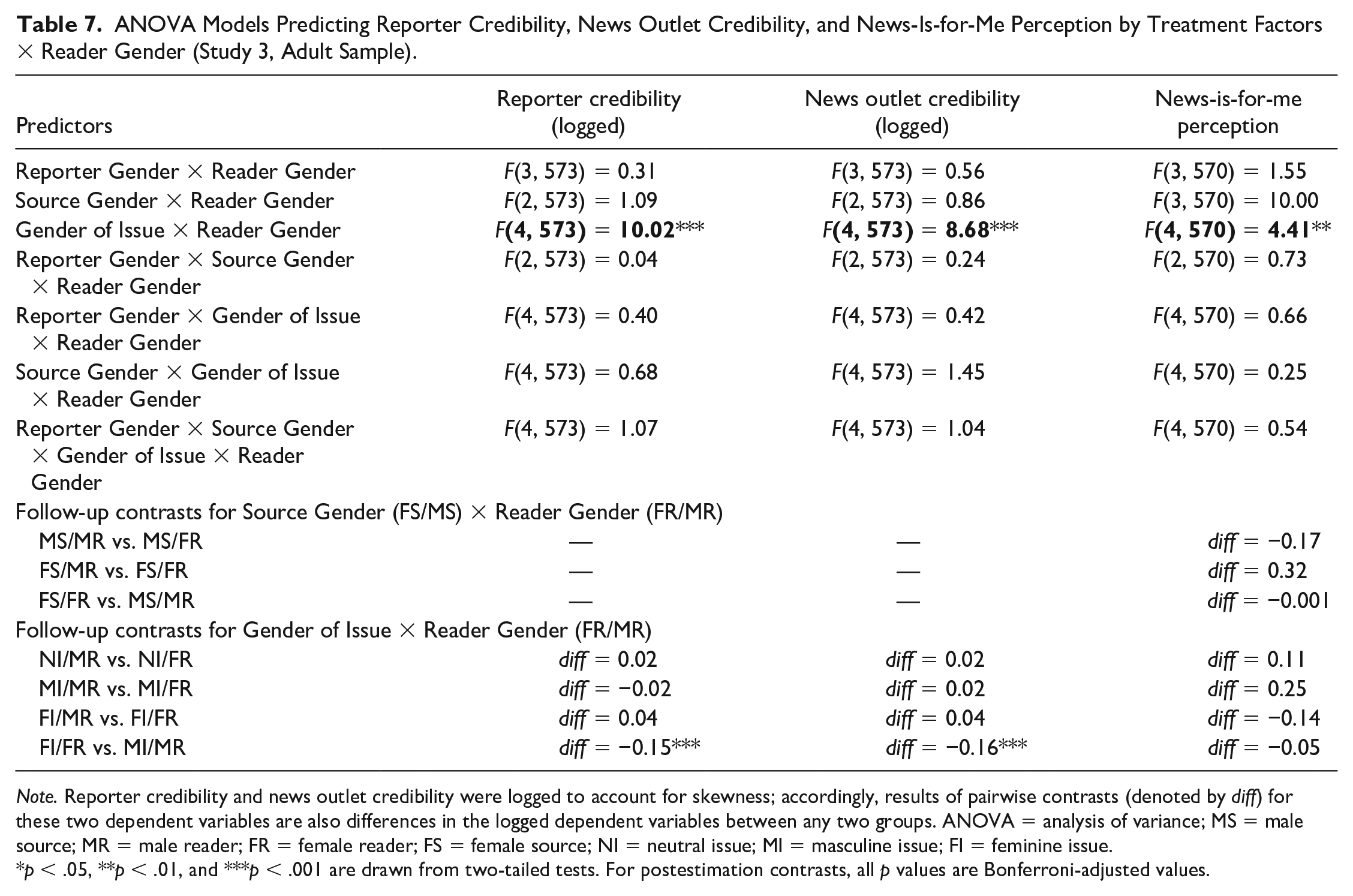
Note. Reporter credibility and news outlet credibility were logged to account for skewness; accordingly, results of pairwise contrasts (denoted by diff) for these two dependent variables are also differences in the logged dependent variables between any two groups. ANOVA = analysis of variance; MS = male source; MR = male reader; FR = female reader; FS = female source; NI = neutral issue; MI = masculine issue; FI = feminine issue.
p < .05, **p < .01, and ***p < .001 are drawn from two-tailed tests. For postestimation contrasts, all p values are Bonferroni-adjusted values.
ANOVA Models Predicting Reporter Credibility, News Outlet Credibility, and News-Is-for-Me Perceptions by Treatment Factors (Study 3, Student Sample).
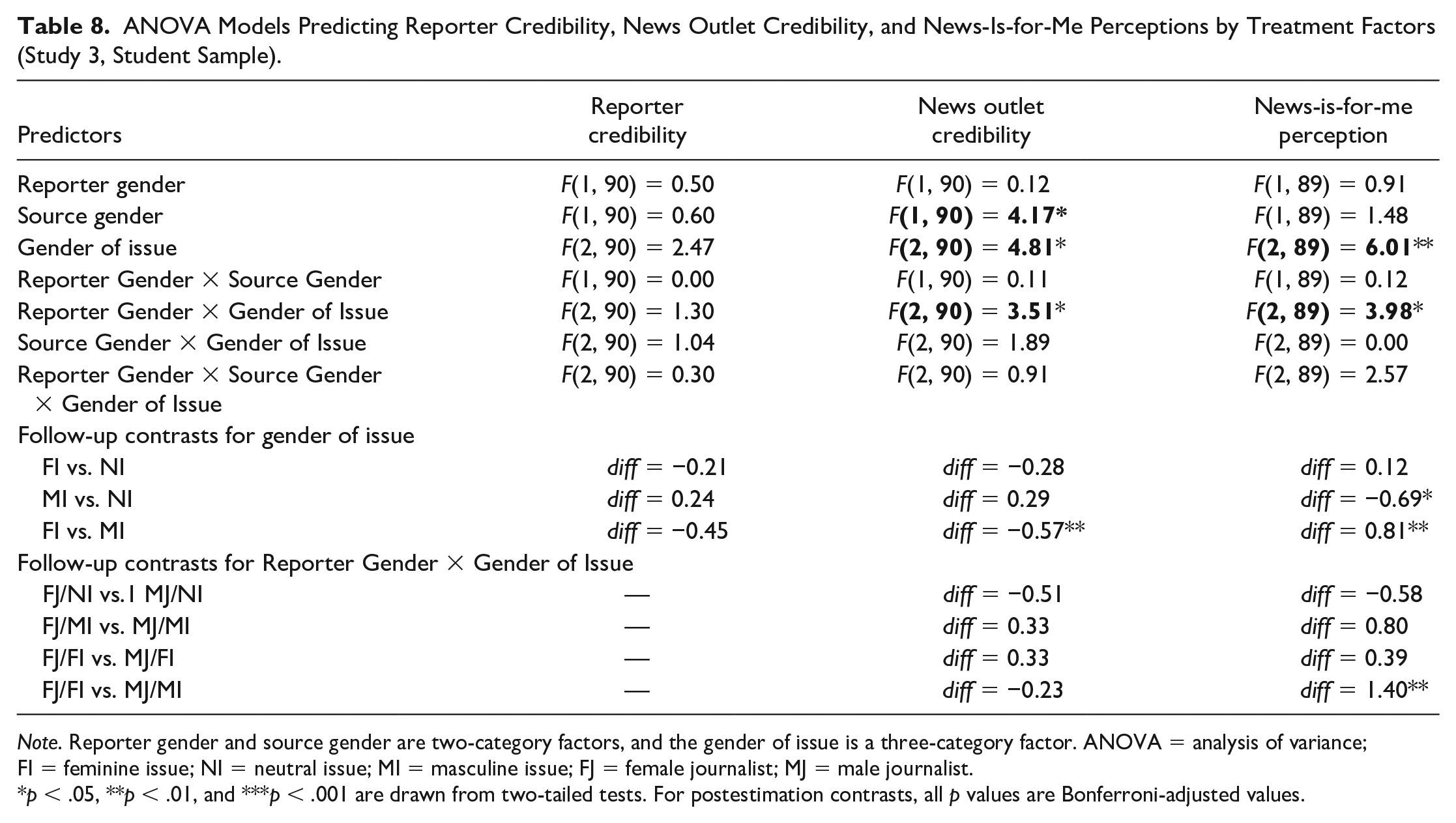
Note. Reporter gender and source gender are two-category factors, and the gender of issue is a three-category factor. ANOVA = analysis of variance; FI = feminine issue; NI = neutral issue; MI = masculine issue; FJ = female journalist; MJ = male journalist.
p < .05, **p < .01, and ***p < .001 are drawn from two-tailed tests. For postestimation contrasts, all p values are Bonferroni-adjusted values.
Also, consistent with Studies 1 and 2, Study 3 yielded evidence that the gender of the issue had a statistically significant main effect on three outcome variables. Pairwise comparisons further showed that both the students and adult respondents tended to perceive reporters and news outlets as more credible if the news story covers a masculine or neutral issue than a feminine issue, which is consistent with Study 2.
Looking at the interaction effects between the three treatments and readers’ gender, the results in Table 7 showed that the effect of the gender of the issue on reporter credibility, F(4, 573) = 10.02, p < .001, outlet credibility, F(4, 573) = 8.68, p < .001, and the news-is-for-me perceptions, F(4, 570) = 4.41, p < .01, varied by reader gender. These significant relationships are consistent with Study 2. Pairwise comparisons in Table 7 displayed that the only significant differences were between female readers of the feminine-issue article (M = 4.53, SD = 1.16) and male readers of the masculine-issue article (M = 5.21, SD = 1.05) with respect to reporter credibility, t = −4.19, p < .001. Similarly, female readers of the feminine-issue article (M = 4.37, SD = 1.16) tended to perceive news outlets significantly less credible than male readers of the masculine-issue article (M = 5.02, SD = 1.02), t = −4.26, two-tailed p < .001.
Discussion
Study 3 results again yielded little support for our hypotheses and further corroborate two important findings uncovered in Studies 1 and 2, as summarized in Table 9: (a) the main effect of the gender of issue on reporter credibility, news outlet credibility, and news-is-for-me perceptions; and (b) the effect of gender of issue on these three outcome variables is conditional on reader gender.
Summary of Statistically Significant Results in Three Studies.
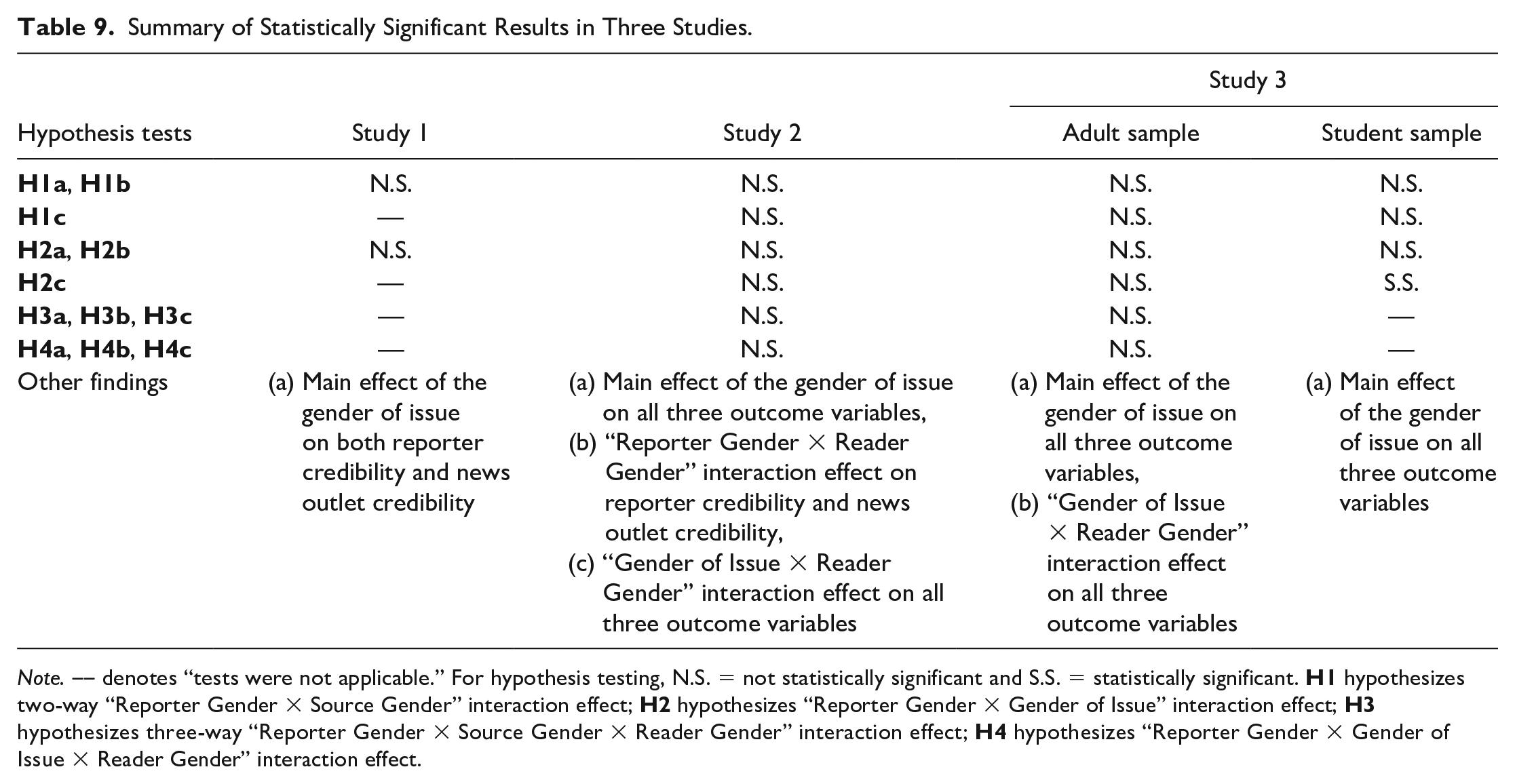
Note. ‒‒ denotes “tests were not applicable.” For hypothesis testing, N.S. = not statistically significant and S.S. = statistically significant.
Discussion
This study adds to the literature on the impact of gender in the newsroom. Using three survey experiments, we examined the ways in which reporter credibility, outlet credibility, and perceptions of news relevance are affected by the interplay of reporter gender, source gender, issue gender, and reader gender. Although our results do not paint a rosy picture of gender in the newsroom, they do suggest there are opportunities for change.
Across three studies and four samples, we consistently find little evidence to support the idea that readers doubt the credibility of a reporter or a news outlet based on the gender of a reporter, the gender of the source, or the gendered nature of the issue. When we further parse these results by reader gender, the null relationships persist. That reporter gender consistently did not exert influence on perceptions of credibility and relevance despite varying source gender, issue gender, and reader gender across student and adult samples offers a compelling industry-side argument for byline gender diversity. Not only are there normatively desirable reasons for newsrooms to consider diversity and inclusivity in their newsroom make-up, there also appear to be little-to-no reason to fear audience repercussions.
One reason for these consistent null results could be that respondents were already familiar with the issues they read in the stimulus, such that the gender of the reporter and source and issue did not act as cues. Indeed, studies in women and politics (e.g., Brooks, 2013) find that voters use partisanship and incumbency information rather than gender stereotypes to evaluate women candidates. Perhaps this explains readers’ globally positive evaluation of the reporter and outlet across all three studies. Additional research with known reporters or outlets might add additional insights.
Apart from reporter gender, we uncover some interesting effects for issue gender. Specifically, we find that masculine issues tend to raise perceptions of credibility among readers for both the reporter and media outlet. However, when this relationship is further parsed by reader gender, the story becomes complicated. In Studies 2 and 3, we found that female readers considered coverage of women’s issues to be more relevant, relative to male readers. If we had stopped at Study 1, we might have walked away thinking there is a preference for masculine issue coverage. This would resonate with extant literature that finds female journalists hesitant to shake up the male-dominant newsroom culture (Meeks, 2013). Yet, when we dig deeper, we find there are gender differences in the topics that men and women consider relevant. In particular, in Studies 2 and 3 we find that men exhibit stronger preferences for male journalists and masculine issues than women do for feminine issues and female journalists. That these findings manifest in slightly different patterns between Study 2 and Study 3 suggests more work needs to be done to clarify the potential for two-way interactions between reader gender and reporter gender, and reader gender and gender of issue. Conspicuously absent across studies and samples is the effect of source gender, which is also deserving of more scholarly attention, particularly given the stark and persistent gender imbalance of sources.
One limitation of this study is our selection of issues. Although the use of realistic issues increases our external validity by reflecting the news agenda, 9 they are well-established in public discourse and could attenuate the power of gender cues. In addition, this is a single-shot design: Our findings may not generalize to the real world where people are exposed to gender cues in news repeatedly (see Searles, Spencer, & Duru, 2020). Indeed, with repeated, long-term exposure, the effects of gender cues are likely to change. Also worthy of note is the systematic differences we find in reliability for our reporter and outlet credibility indices by sample type. In particular, the credibility indices for the adult sample demonstrated more reliability. Such a difference may be attributed to sample characteristics such as age (about 18 years difference on average) and survey taking experience (Rand et al., 2014).
The study design could also be improved upon in future studies. We opted for a robust manipulation check in Studies 2 and 3, asking respondents to recall reporter gender immediately following exposure to the stimulus. While this choice was informed by what we learned from Study 1, future studies should consider a different question order to be sure there is no prime effect. Another limitation is with reference to the choice of issues in the study. We did a pilot test to determine readers’ perceptions of the gender of issues, and this helped us determine the classification of issues as feminine and masculine; however, it would be helpful to be able to analyze differences in results by partisan identity. Other design choices such as the use of hypothetical reporter names, though appropriate here, may warrant additional scrutiny, preferably in a multi-message design. Hopefully the extensive work we have done here to replicate our findings across studies and samples assists future researchers. Finally, it is possible that gender bias did not manifest in reported perceptions of media credibility and news relevance but that it does manifest as gender bias. Although we believe these results, implicit bias notwithstanding, remain an important contribution, future work may consider the addition of an Implicit Attitude Test (IAT) battery.
Supplemental Material
sj-docx-1-jmq-10.1177_10776990211042595 – Supplemental material for Look Who’s Writing: How Gender Affects News Credibility and Perceptions of News Relevance
Supplemental material, sj-docx-1-jmq-10.1177_10776990211042595 for Look Who’s Writing: How Gender Affects News Credibility and Perceptions of News Relevance by Newly Paul, Mingxiao Sui and Kathleen Searles in Journalism & Mass Communication Quarterly
Footnotes
Declaration of Conflicting Interests
The author(s) declared no potential conflicts of interest with respect to the research, authorship, and/or publication of this article.
Funding
The author(s) received no financial support for the research, authorship, and/or publication of this article.

Supplemental Material
Supplemental material for this article is available online.
Notes
Author Biographies
References
Supplementary Material
Please find the following supplemental material available below.
For Open Access articles published under a Creative Commons License, all supplemental material carries the same license as the article it is associated with.
For non-Open Access articles published, all supplemental material carries a non-exclusive license, and permission requests for re-use of supplemental material or any part of supplemental material shall be sent directly to the copyright owner as specified in the copyright notice associated with the article.
