







Abstract
The present research examines two aspects of newspaper coverage of devolution during a 4-year period between March 27, 2013, and May 28, 2017: first, through the lens of attribution of responsibility, who the news media most blamed for problems facing devolution; second, whether reliance on official sources in reporting of devolution mirrors the indexing hypothesis. Findings show that the most-blamed actor and dominant news source on devolution is the county executive. Journalists continue to rely on the elite as their main news source and as a result they shape the discourse on devolution.
In 2010, Kenya introduced a new system of governance called “devolution,” which decentralized political power and resources from the national administration to 47 county governments. The main goals of devolution are to promote socioeconomic development, ensure equitable sharing of national and local resources, promote democratic and accountable exercise of power, give the power of self-governance to the people and enhance public participation, and enhance checks and balances and the separation of layers of power (Republic of Kenya, 2010). Thus, following the promulgation of the new constitution in 2010, the 2013 watershed general election ushered into office the first set of county governments, which were tasked with setting up the structures responsible for the implementation of devolution as well as reorienting Kenyans to the functioning of the new political order.
As can be expected, the introduction of a new political structure faced challenges. Among them were the following: Transfer of bad behaviors related to the abuse of public office to the devolved units of government; attempts to impeach governors on unfounded claims; turf wars between the various levels of governments; non-responsiveness of devolved units to the needs of local communities; reluctance of the national government to cede real power and authority to the counties; and, infighting between the county executive and the county assembly (see Nzau, 2021).
As a result, the political actors at the two levels of government blamed each other for the myriad of challenges that threatened to derail the realization of the fruits of devolution. The national executive blamed the county executive for incompetence in taking up the devolved functions. In return, the county executive blamed the national executive for derailing the transfer of power and authority and for interfering in the management of county affairs. In addition, parliament and county legislatures were pulled into the conflict between national and county executives. There were also turf wars between the two houses of parliament—senate and the national assembly—over the distribution of resources and functions of the national and county executives. Senators and governors were locked into battles over how to run county governments, with many senators eyeing the subsequent gubernatorial election while members of the county assemblies (MCAs) clashed over the allocation of resources and distribution of perks at the ward level (see Nzau, 2021).
The transition from a centralized to a decentralized system of governance raises important questions about the participatory potential of the devolved structure, which was expected to give voice to more stakeholders in the governance process. In a centralized structure, a national government dominates news cycles, while it is not clear whether this scenario would change in a transition to a decentralized governance architecture. Therefore, it is imperative to interrogate whether the transition to a decentralized system resulted in a significant shift in which county governments became major sources of news at the expense of national leadership. In addition, attribution of responsibility is reported to impact public opinion.
Therefore, this research examines two aspects of coverage of devolution during a 4-year period between March 27, 2013, and May 28, 2017, by two prominent Kenyan newspapers—Daily Nation and The Standard. Through the lens of attribution of responsibility as framed by the news, the study examined (a) who the news media blamed for problems facing devolution and (b) identified the dominant sources of news in the coverage of devolution in Kenya.
The study is significant because, since devolution is a new governance dispensation in Kenya, it is important to understand how the news media sourced information following the transition from a centralized system of governance to devolved leadership which opens the gates for more news sources. Relatedly, newspapers play an important role in defining and framing devolution, including offering possible causes and solution for new challenges (Kim et al., 2010). Framing will help explain how the news media attributed blame for the problems facing devolution. In addition, the research adds knowledge in two significant areas: news sourcing and media framing of responsibility. Importantly, there is a dearth of research on news sources and framing of responsibility outside of the United States (Lawrence, 2010) and Europe (Gerhards et al., 2007; Greuter, 2014; Hasler et al., 2016), though the majority of these studies focus on government as a single entity as opposed to a multiplicity of distinct and autonomous actors (Hobolt et al., 2013).
In this regard, a devolved system of governance provides multiple opportunities for attributing responsibility. As such, the present inquiry will contribute to bridging existing research gaps. Several studies have shown that news media is central in influencing public opinion on who is to blame for social issues (Iyengar, 1991). The central role played by the news media in apportioning blame on matters of national interest such as devolution thus underscores the importance of this study, which adds to the literature on framing of responsibility in governance, and contributes to the growing literature on framing, especially in developing nations such as Kenya. Last, the research will help in assessing whether the most-blamed actors are also the main sources of news on devolution and, as such, identify the forces that drive discourses on devolution.
Background: Devolution in Kenya
Centralized systems of governance are characterized by a hierarchical structure of authority. Units and levels as may exist are responsible to one center of power (Wanyande, 2021). Decentralization is the antithesis to centralization (Landau & Eagle, 1981), ceding power to subnational political units which are given formal power to decide on a range of public matters (Oyugi, 2005). Forms of decentralization include deconcentration, delegation, privatization, and devolution (Rondinelli, 1981). Devolution is the more comprehensive variant as it represents genuine power-sharing between central and subnational governments. A well-known form of devolution is federalism, a good example of which is practiced in the United States (Wanyande, 2021).
Kenyans voted for a new constitution in August 2010 to introduce a new governance architecture, embodied by a presidential system of government in which power is shared between national and county administrations, which are distinct and interdependent. The president and the governors are the heads of the national administration and county governments, respectively. Both are elected for two terms of 5 years each.
The national government is composed of the national executive, parliament, the judiciary, commissions, and independent offices. Parliament consists of the national assembly and the senate. The national assembly determines the allocation of national revenue between the two levels of government, whereas the senate distributes and exercises oversight of resources at the county government level. The county government consists of an executive and assembly. The county executive implements county legislation and manages and coordinates administration whereas the assembly makes county laws and provides oversight of the executive (Republic of Kenya, 2010).
The national government functions that are now devolved and will be undertaken by county governments include county planning and development, trade development and regulation, agriculture, county health services, pre-primary education and village polytechnics, county public works and services, control of pollution and outdoor advertising, and county transport (Republic of Kenya, 2010). The constitution allocated at least 15% of national revenue to the country governments to execute their mandate.
The two main coalitions—the Jubilee Alliance and the Coalition for Reforms and Democracy (CORD)—won most of the seats in parliament. Jubilee won 40.4% of the gubernatorial seats, whereas CORD won 46.8%. In the national assembly, Jubilee controlled 47% of the seats and CORD 40%. In the senate, Jubilee controlled 45% of the seats and CORD 43%.
Theoretical Framework and Literature Review
Framing analysis has been a productive approach to understanding the role of the news media in political processes. News content framing patterns align with pre-existing schemas in the minds of the electorate that make seemingly unrelated pieces of information coalesce into a coherent message (Scheufele, 1999; Scheufele & Iyengar, 2017). From a researcher’s perspective, frame analysis provides the tools by which to deduce the subtle ways in which news media shape the population’s thinking about a given subject through how the information is packaged (Chong & Druckman, 2007; Scheufele & Tewksbury, 2007).
Various scholars (Borah, 2011; Entman, 1993; Gamson & Modigliani, 1989; Goffman, 1974; Scheufele & Iyengar, 2017; Segvic, 2005; Tewksbury & Scheufele, 2009) contend that through frames the news media give salience to a certain idea, issue, or personality at the expense of other news features that ultimately influences public perceptions and opinions. Nelson et al. (1997) argued that framing places an emphasis on “the perceived importance of specific frames” (p. 569).
The consideration here is not what is covered, but rather how the news media covers a topic and how it suggests we should think about it (Dimitrova & Stromback, 2005; McCombs & Ghanem, 2001). The concept of framing has been used extensively to explore the ways in which the news media present problems to the public. Tewksbury et al. (2000) argue that “frames can imply policy options or implicit answers to questions of what should be done about issues” (p. 804).
Typology-wise, two central frames are issue-specific and generic (De Vreese, 2005). Issue-specific frames make it possible to exhaustively study the issue whereas generic frames can be applied with greater flexibility to diverse topics, events, fields, and to a lesser extent, different physical, temporal, and cultural context (De Vreese, 2005). Generic frames include conflict, economic consequences, human interest, morality, and attribution of responsibility. Generic frames can also be investigated for episodic versus thematic and positive versus negative dimensions. Episodic frames cast an event or problem in a specific situation. Conversely, thematic frames tend to include broader context, that is, they relate individual circumstances to larger contextual issues (Iyengar, 1996). Positive frames emphasize favorable dimensions of an issue or personality, whereas negative frames focus on unfavorable elements.
It has been argued that news sources impact framing. For example, the indexing hypothesis proposes that news media rely on the political elite as sources of news which mirrors the ongoing consensus or conflict among government officials who manage policy and decision-making process (Bennett, 1990; Zaller & Chiu, 1996). Bennett et al. (2006) note that the press corps has a calibration process based on official consensus and conflict that determines “what gets into the news, what prominence it receives, how long it gets covered, and who gets the voice in these stories” (p. 49). This leads to news being “a representation of conversations between the powerful in society, while the general public are relegated to a position of mere observers” (Cross, 2010, p. 414). The political elite’s dominance of the political discourse silences voices of other actors—ordinary citizens, researchers, experts, business people, community leaders, and NGOs.
Attribution of Responsibility Frame
Seminal studies by Iyengar (1991, 1996) demonstrated that framing plays a key role in shaping the attribution of responsibility for political issues, leading audiences to determine important causes of social problems and their attendant solutions. Semetko and Valkenburg (2000) observed that the responsibility frame “presents an issue or problem in such a way as to attribute responsibility for its cause or solution to either the government or an individual or group” (p. 95).
Responsibility for political problems is a salient issue in the public sphere and dominates political communication (Hasler & Greuter, 2010). The idea of responsibility denotes accountability to voters who put politicians in office and compel them to care about societal problems. Through attribution of responsibility, the news media influence public opinion about governments, because citizens with limited access to politics evaluate political actors through the news media (Hasler & Greuter, 2010).
Studies on framing have shown that the attribution of responsibility often surfaces during political or economic events and in the context of social problems (Iyengar, 1991; Semetko & Valkenburg, 2000). Negative, uncertain, and unexpected events trigger the tendency to consciously consider who is responsible for the situation (Iyengar, 1991). Print media decisions on aspects of an issue to prioritize and which ones to exclude tend to compel people to assign responsibility to the most conspicuously featured actor in newspapers (Gamson, 1992). Scholars studying attribution of responsibility (Iyengar, 1991; Kim et al., 2010) generally criticize news media for ignoring societal-level causes for problems by reducing it to more tangible individual-level origins.
Through the lens of attribution of responsibility, Hasler and Greuter (2010) conducted a comparison of the most-blamed actor for governance problems in four countries (Germany, Israel, Switzerland, and the United States) and reported that politicians (57.3%) and the military (12.3%) were the most often blamed. A study assessing responsibility for rising health cost in the United States reported that the most-blamed actors were patients (43.7%), followed by health care providers (35.0%), insurance companies (27.3%), and the government (23.2%; Kim et al., 2015).
A similar study comparing which of the two levels of government in Canada was most blamed for health care deficiencies placed more responsibility on the provincial (29.7%) than federal government (10.1%; Cutler, 2004). Studies on the framing of HIV/AIDS have shown that print media place responsibility on individuals instead of governments, churches, or hospitals, which are expected to lead the fight against HIV/AIDS by providing affordable education and affordable access to health care (J. Brown et al., 1996; Clarke et al., 2006). In Kenya, through the lens of attribution of responsibility, Ireri (2013) examined whom newspaper columnists blamed for the problems facing the country in the post-2007 election violence. The president was blamed more than the prime minister. In addition, Ireri (2018) found that in their coverage, four national newspapers blamed the national police for two deadly terror attacks on Kenyan soil in 2013 and 2015.
Following decentralization reforms across the globe, there is limited political knowledge at the grassroots level about the distribution of power between national and subnational units of government (Delli Carpini & Keeter, 1996; Fournier, 2002). This leads to uncertainty about which level of government is responsible for societal problems (Johns, 2011). Oates (1999) and Cutler (2004) observed that even the most informed citizens struggle to assign responsibilities between the two levels of government (see also Johns, 2011; Leon, 2018; Rodden, 2006). This blurring of responsibility leads to tension between levels of government for taking responsibility for success and blame (Rodden, 2006).
Given the intricacies of a new government architecture, the Kenyan devolution offers a particularly productive case for studying the news media’s assignment of blame for governance problems. A 2015 national opinion poll on devolution in Kenya reported that awareness of the local functions of MCAs increased from 57.0% (2014) to 70.0% (2015). The public’s awareness of senators—the vanguards of devolution at the national level—declined from 57.0% (2014) to 35.0% (2015), and the duties of women representatives declined from 52.0% (2014) to 45.0% (2015; Transparency International-Kenya, 2015). The Commission for the Implementation of the Constitution, charged with oversight repeatedly highlighted supremacy battles between various arms of government hurt the implementation of devolution (Kariuki, 2014). To examine if this reality aligns with the news media’s reportage, the following hypothesis was formulated to identify the most-blamed actor for problems in the devolution of Kenya:
Use of News Sources in Governance-Related Events
The norms and routines of professional journalism dictate that news stories must have sources. In fact, the use of sources is the backbone of news reporting as it gives credence to the story. Earlier studies noted that reporters must “rely on external suppliers of raw material, whether speeches, interviews, corporate reports, or government hearings” (Shoemaker & Reese, 1996, p. 122). It is therefore not surprising that framing research treats source selection as a key component of the final news product that determines which frames dominate in coverage (Cozma & Kozman, 2015).
Scheufele (1999) observes that while the news media enjoys the ability to actively set frames, the information they most commonly use comes from the political elite (see also Entman, 2010). Sigal (1987) observes that news is “not what journalists think but what their sources say” (p. 29). Similarly, Gans (1979) states that “news is information that is transmitted from sources to audiences, with journalists summarizing, refining, and altering what becomes available to them from sources” (p. 80). The use of news sources shape what the news is about and how the news frames various events, issues, processes, or other objects (Cappella & Jamieson, 1997; Price et al., 1997; Schuck & De Vreese, 2006).
While the study reported here centrally pursues the question of who was the most-blamed actor for the problems facing devolution, it also seeks to understand the actors who impacted the frames of news coverage (Dimitrova & Strömbäck, 2011; Djeerf-Pierre et al., 2016).
Through using citizens as news sources, the news media can integrate a participatory strategy of coverage in decentralized governance (Kelleher, 2014; McKay, 1993). However, coverage of governance-related topics such as devolution predominantly relies on official sources (Kelleher, 2014; Ogan & Fair, 1984; Tshabangu, 2013). In fact, Cross (2010) and Hall et al. (1978) observe that the news media give disproportionate attention to the elite with the general public relegated to the role of observers. Ogan and Fair’s (1984) nine-country study of development news found that government sources dominated over any other. McDaniel’s (1986) study of development news in Malaysia and Pakistan showed that the government and the political elite were the most frequently featured sources. Even in the case of Depthnews, a newspaper started to focus on development issues, citizens made up 9% of main sources, indicating a weak participatory strategy for coverage (McKay, 1993).
For the African context, the results are similar. In Tshabangu’s (2013) study of Zimbabwe, 50% of sources were government officials while an analysis of Rwanda delivered a similar (50.0%) threshold of government source dominance (Kelleher’s 2014).
With regard to provincial elections, Cross (2010) noted that political actors were the most commonly (58.6%) used sources in Canada. Falasca’s (2014) study of Swedish print media during the 2018 financial crisis found that politicians were used as sources 35% of the time. Research on terrorism reportage in Kenya revealed that government officials (31.2%) were the most prominent news sources (Ireri, 2018). In a TV news framing study, Porto (2002) concluded that official sources enjoy a privileged position in Brazil. Collectively, these studies suggest that the political elite are at a strategic advantage to participate in journalistic framing of news (Schlesinger, 1990). In the Kenyan context, the study reported here investigated whether official sources dominated news media coverage of devolution. This leads to the second hypothesis:
Method
The present research employs a quantitative content analysis to investigate two national newspapers’ coverage of devolution in Kenya. Scholars conducting research using content analysis (Berelson, 1952; Kerlinger, 1986; Krippendorff, 2004) define it as a systematic, replicable technique for condensing large amounts of text into a few categories based on explicit rules of coding to improve the understanding of particular phenomena. Content analysis is used for its systematic way of analyzing news media content (Stempel, 1952), to examine the prevalence of frames as well as news sources connected to particular news events (Berelson, 1952; Haile, 2011; Ireri, 2014, 2018; Semetko & Valkenburg, 2000).
The population comprised 4 years of coverage during the first term of the devolved system of governance in two national English-language newspapers, Daily Nation and The Standard. The sampling period stretched from March 27, 2013 (when the governors were sworn into office), to May 28, 2017 (the start of the official campaign period for the 2017 general election), signaling the end of the first term. The study covered the entire first 4-year term to enable the research team to comprehensively assess the teething challenges from the onset of devolution, through the struggles of national and county governments to lay the infrastructure for governance, and the political maneuvers during later stages of implementation.
The choice of the two newspapers was informed by a number of criteria. Both dominate in terms of circulation and agenda setting on key policy issues in the country. Daily Nation is the most influential newspaper, arguably the Kenyan equivalent of The New York Times (Onyebadi, 2008), commanding more than 55% of newspaper readership (Media Policy Research Center, 2015). The Standard is the oldest newspaper in Kenya, and the second most popular after Daily Nation. Second, both have high circulation and popularity in Kenya across all 47 counties. As Kahn and Goldenberg (1991) noted, newspapers with the largest circulation have the greatest potential to impact audiences. Third, both newspapers introduced a section on news about the county governments in their editions 2 years after the passage of the 2010 constitution. The newspapers published devolution stories every day in coverage that ranged from four to eight pages. These sections are dedicated to news that touches specifically on devolution and other issues that impact on governance at the county level.
The newspapers were accessed at the Kenya National Library Service. A six-constructed week sampling technique was used. This type of stratified random sampling assumes cyclic variation of content for all the days of the week (Riffe et al., 1993; Stempel, 1952). The value of six-constructed week sampling was affirmed by Luke et al. (2011) who found it to be the most efficient for both 1- and 5-year populations. Six weeks were constructed for the sample. This involved identifying Mondays and randomly selecting one Monday per week then identifying all Tuesdays, and randomly selecting one Tuesday per week, and so on. Each constructed week allowed for cyclic variation in news while each day of the week was represented equally (Lacy et al., 2001). Six-constructed weeks advance the external validity of results by controlling for cyclic biases and at the same time facilitates sampling efficiency (Luke et al., 2011).
The six-constructed week sample resulted in a population of 84 newspaper issues: 50% from Daily Nation and 50% from The Standard. The 84 editions yielded a total of 565 news stories: 272 (48%) from Daily Nation and 293 (52%) from The Standard. The 565 news stories resulted in 5,832 paragraphs that were coded for attribution of responsibility (462) and news sources (3,319).
The paragraph was the unit of analysis used to capture the occurrence of the most-blamed actor through the attribution of responsibility frame as well as the sources of news. The actor was counted once in a paragraph even if that person appeared more than once. For example, if the county executive appeared in a paragraph more than once, then the actor was counted once. In addition, in circumstances in which more than one actor appeared in a paragraph, each was counted once. For example, if the county executive, county assembly and national executive appeared in the same paragraph, then each was coded separately. The same process applied to identifying the mention frequency for each news source. The focus of the study was on news stories, and, as a result, editorials, opinion editorials, advertorials, letters to the editor, features, and pictures were excluded.
The most common actors and sources of news on county governance include the following 12 categories: (a) National executive officer, which is an official of the Jubilee administration of and includes the president, deputy president, the attorney general, secretary to the cabinet, director of public prosecution, cabinet secretaries, principal secretaries, and an employee of the Public Service Commission; (b) officer of parliament, which means members of parliament (MPs), senators, and an employee of the Parliamentary Service Commission; (c) officer of independent institutions and commissions, which means officials from institutions established by the Constitution of Kenya include the Auditor General, the Controller of Budget, the Kenya National Human Rights and Equality Commission, the National Land Commission, the Independent Electoral and Boundaries Commission, the Judicial Service Commission, the Commission on Revenue Allocation, the Salaries and Remuneration Commission, the Teachers Service Commission, and the National Police Service Commission; (d) county executive officer, which means officials of the county executive and includes the governor, the deputy governor, executive committee members, county secretary, chief officers, an employee of the county public service board, and sub-county, ward, and village administrators; (e) county assembly officer, which means officials of the county assemblies and includes the elected members of the respective wards, and an employee of the county assembly service board; (f) nongovernmental officer, which means officials who work for institutions which are not part of the government and nonprofit making; (g) researchers and researches, which means individuals who have conducted studies on devolution as well as the reports on devolution; (h) religious leaders, which means individuals who are recognized by religious institutions as having some authority within that body; (i) community leaders, which means individuals who are perceived to represent the ward/constituency/district/subcounty/county but are not members of the national or county government; (j) experts, which means those with specialized knowledge on different subjects that touch on devolution; (k) community members, which means ordinary citizens; and, (l) businesspeople: individuals who engage in for profit business in different parts of the country (Callaghan & Schnell, 2001; Stack, 2013).
The attribution of responsibility frame presents an issue or problem in such a manner that blame is assigned to a specific individual, group, or institution for causing or solving a problem related to devolution. Blame can be assigned to any of the actors involved in the implementation of devolution. The following categories, adopted from Semetko and Valkenburg (2000), were used to assess attribution of responsibility: Does the story suggest that some level of government has the ability to implement devolution? Does the story suggest that some level of government is responsible for the issue/problem? Does the story suggest that the general community is responsible for the issue? Does the story suggest solution(s) to the problem/issue?
Using 10% of the Daily Nation articles (n = 27), two coders with a background in communication and political science conducted a pilot study. They were trained in the coding procedures and the definitions of the categories examined. An inter-coder reliability test was then conducted, which yielded a mean kappa’s reliability coefficients of 1.0 and 0.89 for news sources and attribution of responsibility, respectively. A paired sample t test was conducted to establish statistical significance between the mentions of the Top 2 most-blamed actors, and also between the official and nonofficial news sources. Thus, the 12 news sources were collapsed into two categories of “official sources” and “nonofficial sources.” The former category includes county executives, county assemblies, national parliaments, independent institutions and commissions, and the national executive. However, nonofficial sources comprise community members, experts, businesspeople, nongovernmental officers, community leaders, researchers and research, and religious leaders.
Findings
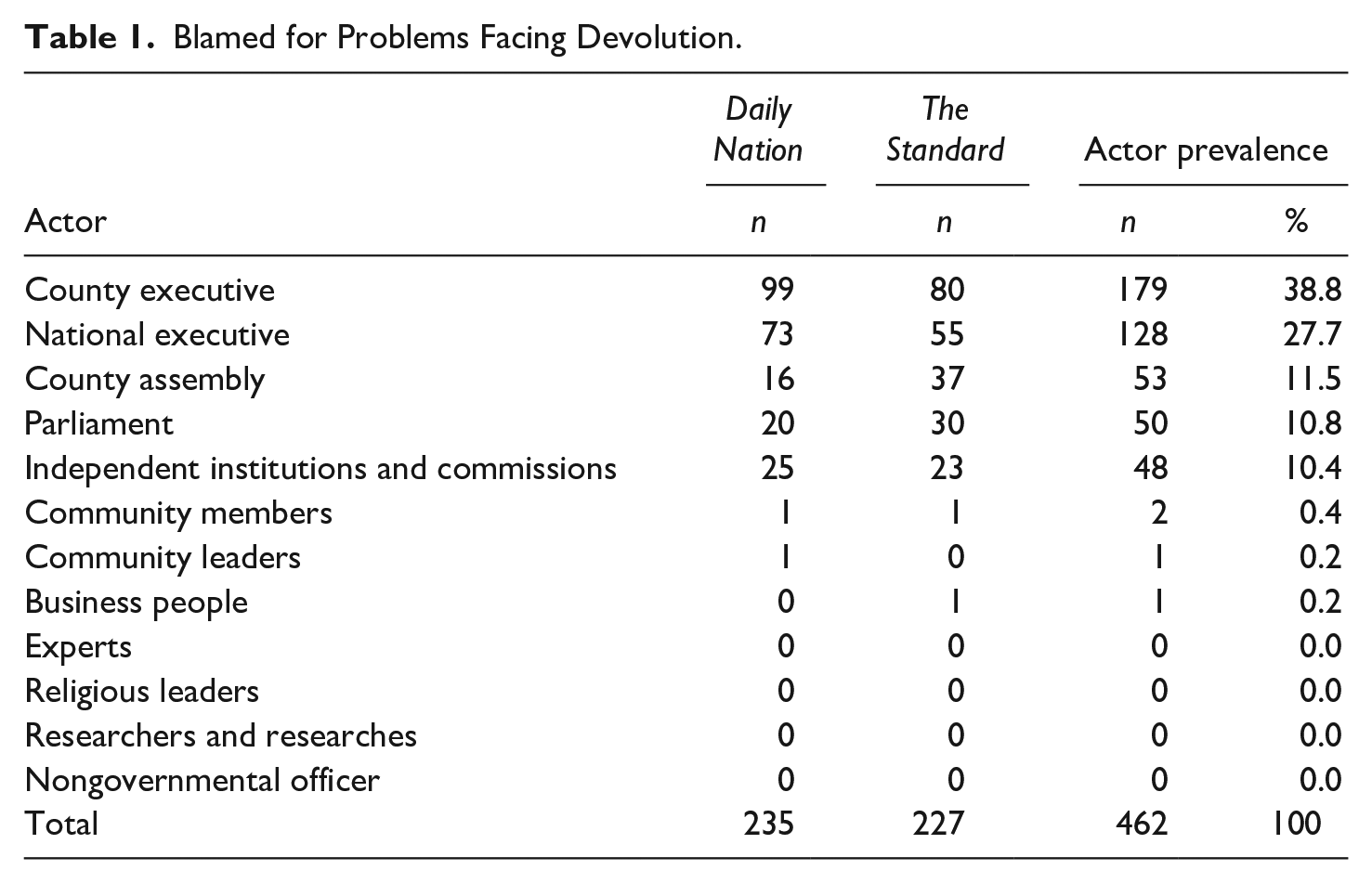
From the 5,832 paragraphs analyzed, 202 (3.5%) carried the attribution of responsibility frame, which resulted in 462 mentions of blame in reference to eight of the 12 actors. This result means the average blame mention for the actors was 2.3 per paragraph. Of the 202 paragraphs that contained the attribution of responsibility frame, 142 (70.3%) were in the Daily Nation and 60 (29.7%) were in The Standard. Of the 5,832 paragraphs, 2,490 (42.7%) contained mentions of the 12 news sources. These 2,490 paragraphs made a total of 3,319 mentions of news sources. Thus, the mean mention of news sources per paragraph was 1.3. Of the 2,490 paragraphs containing news sources, 1,329 (53.4%) were in The Standard, whereas 1,161 (46.6%) were in Daily Nation.
Blamed for Problems Facing Devolution.
News Sources in the Coverage of Devolution.
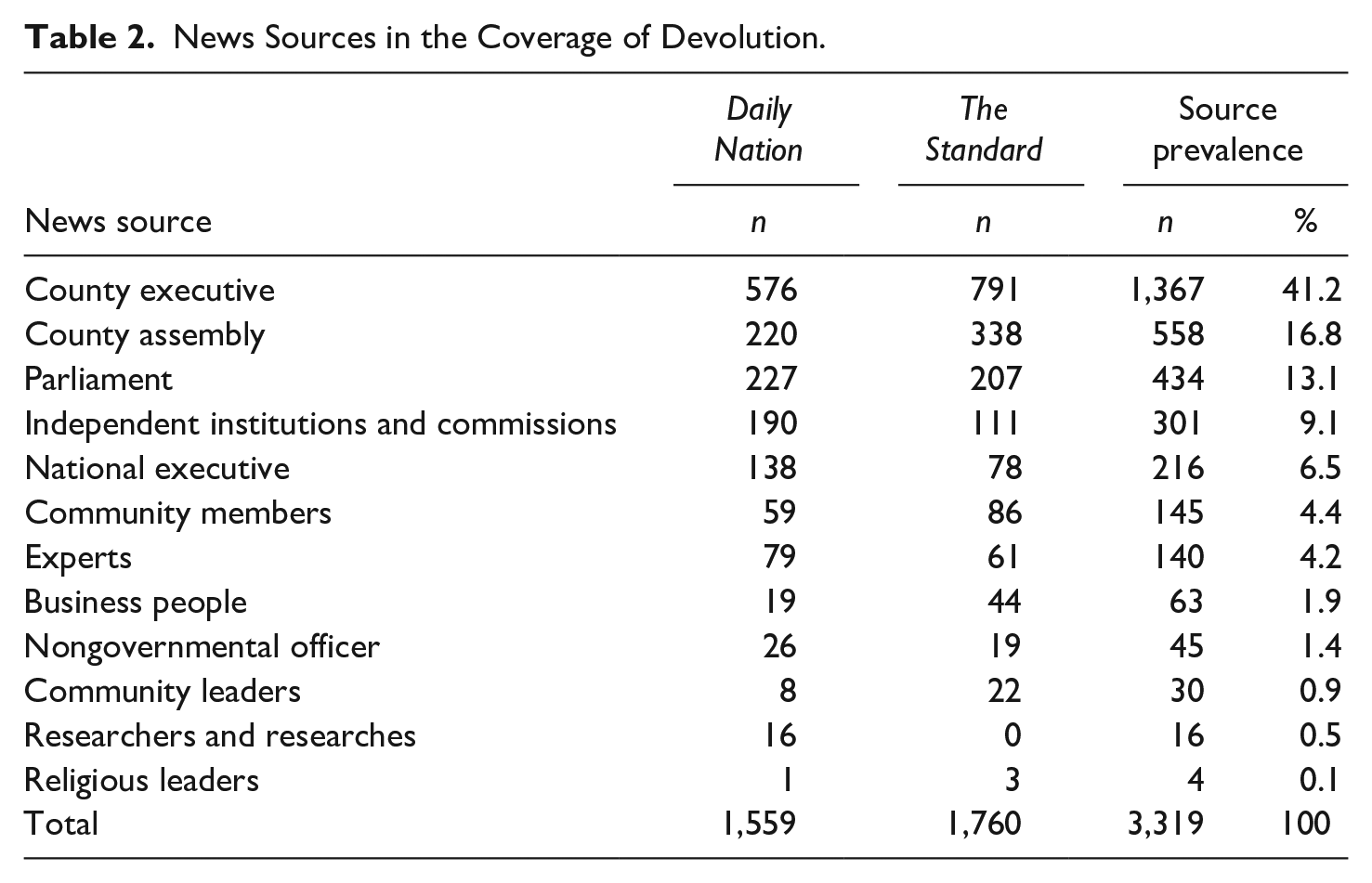
Therefore, the findings demonstrate that county executives were both the most dominant news sources and the most-blamed actors for the challenges facing devolution. With an important role in the implementation of devolution, the county executives were on the front lines of news coverage as they competed with other actors in carving a niche for themselves in the newly created governance architecture. As such, news sources seem to influence news content, shape the frames that journalists use, and impact the narratives that media users consume.
Discussion
From the study findings, it is apparent that news sources influence the attribution of responsibility in the coverage of devolution in Kenya. Even though news media takes part in constructing the public sphere, the process of attributing responsibility is driven by political rather than media logic. The central role that governors play in the new governance dispensation demonstrates that they have become the main actors in devolved politics. As a result of the devolution of power from the national to county government, the governors are not only the main news sources on devolution but also the most-blamed actors for the challenges facing devolution.
The county executive’s role as the main news source on devolution and as the main actor most blamed for the problems facing devolution is influenced by a number of factors. First, the transformation of Kenya’s political system from a centralized to decentralized governance means that the national government ceded significant political and economic powers to the county governments. This change resulted in 47 new county executives with the power, resources, and authority to plan and manage public functions in the country. From their positions of prestige, the governors were pushed into the limelight at the front line of news coverage. The news media simply followed the flow of power and resources in their coverage of governance of the county. The shift of resources from the center to the devolved units prompted the news media to focus more on the main political actors in the devolved units than on any other political elite or on other actors. This is a reversal of the widely held notion that political logic follows media logic and that politicians are more dependent on the news media than vice versa (Mazzoleni & Schulz, 1999).
The outcome of the 2017 gubernatorial elections strengthens the argument that the public perceived the most-blamed actor as the most responsible for the problems facing devolution. More than half (53.2%) of the governors (the political head of the county executive) who were elected in 2013 were not re-elected in 2017 (Reuters, 2017). This outcome challenges the findings by Anderson (2006) and Cutler (2004, 2008) that decentralization weakens or blurs attribution of responsibility. A number of scholars have observed that the extent to which a political system disperses clarity of responsibility does predict the degree to which politicians are held electorally accountable (Bisgaard, 2015; De Vreese, 2010; Larse, 2019; Powell & Whitten, 1993). Thus, Kenya demonstrates that despite the buck passing between the different political actors at different levels of government, the constitution’s clarity in the delineation of responsibilities between the national and county governments enables the public to attribute responsibility where it belongs. Possibly, the county executives were preoccupied with learning the ropes of governing to pay attention to the mechanics of media logic to secure favorable coverage in the news. The national executive, which also received a lot of blame, fared better on this front.
Second, the county executives were the most dominant sources of news because of the significant role they play in devolved governance. They set up the new structures of devolved governance, manage and coordinate county functions, prepare legislations for consideration by the county assembly, and implement county legislations. In retrospect, the debates on constitutional reform in Kenya have revolved around devolution of power since the return to multiparty politics in 1992. With a media exposed to previous debate on devolution over the years, it became easy for them to redirect their focus to governors. As a result, devolution became a topical issue in discussions on governance in Kenya. As such, the county executives were prominent in news about devolution (Hänggli, 2012).
Attributing responsibility is fundamental in a representative political system, and the news media play an important role as a transmitter. Aware of this fact, political actors have an incentive to control the portrayal of political issues in the news. The county executive (38.7%) dominated and controlled the narrative of the implementation of devolution at the expense of the national government (16.8%). Journalistic reliance on county executives in the coverage of devolution supports past research, which demonstrates that government officials are the most sought after actors in news related to development and governance (Cross, 2010; Kelleher, 2014; Ogan & Fair, 1984; Semetko & Valkenburg, 2000; Tshabangu, 2013). The significance of devolution is evident in the fact that the two major newspapers in the country introduced specific sections in their dailies that focused on coverage of news on devolution.
Research demonstrates that official and high-ranking sources fulfill journalists’ source considerations because they provide easily accessible information high in news value; are available, reliable, and authoritative; help in analyzing and interpreting events and processes; grant legitimacy to the news; and can express themselves in a way that suits the medium (Berkowitz, 2009; Manning, 2001; Strömbäck et al., 2013; Tuchman, 1978).
Considering devolution is about bringing services closer to the people, indeed, the expectation was that community members (the beneficiaries) would be a critical source of stories on devolution as they interact with the county government on a daily basis. However, the omnipresence of the political elite ensured that they set boundaries for the discourse on devolution that excluded views that fell outside the bounds. Importantly, the reliance on the county executives can be seen through Bennett’s (1990) indexing theory which hypothesizes that news coverage overwhelmingly depends on cues by prominent officials, and, as noted by Ireri’s (2018) study on coverage of terrorism in Kenya, the news media restricts itself to the framework of institutional debate. The narrative on devolution in Kenya was essentially a conversation between the political elite at the expense of the general public (Cross, 2010).
Conclusion
This research examined two aspects of newspaper coverage of Kenya’s devolution system of governance during a 4-year period between March 27, 2013, and May 28, 2017: first, through the lens of attribution of responsibility, who the news media most blamed for problems facing devolution; second, whether reliance on official sources in reporting of devolution mirrors the indexing hypothesis. Findings show that the most-blamed actor and the dominant news source on devolution is the county executive. The media focus on the political elite shows that journalists continue to rely on them as their main source of news, and as a result, they shape the public discourse on devolution. This power gives them undue advantage over competing actors in controlling the devolution narrative, which shows that Kenyan journalists are yet to fully embrace a participatory approach in reporting on development discourses.
Two important ramifications exist for further research and theory building. First, the dominance of the county executive as the most-blamed actor shows that, in line with framing theory, the media continues to be influential in determining what people or issues are salient and what gets in and excluded. The actors most blamed for problems related to governance are largely determined through the manner in which the media frames political issues. More importantly, the fact that the Top 5 most-blamed actors were county or national government officials reveals that the public holds the government responsible for the governance problems they encounter. This demonstrates that journalists tend to attribute responsibility to political elites as opposed to societal groups whom they consider powerless within the governance realm. Second, the dominance of the county executive as the main official news source reveals that the media remains instrumental in determining the narrative that influences debates around policy issues such as devolution. More notably, the widespread use of official sources exhibits that the reproduction of official discourse on devolution is systematically entrenched and that Kenyan journalists simply reinforce elite voices in public discourse. This indicates that the culture of creating credibility and legitimacy for news by framing events based on official news sources, is a news reporting culture not only in the West but also in Kenya, and that elite perspectives will continue to dominate narratives on governance issues.
Although this study provides useful data on news sources and framing of responsibility in Kenya, it suffers from two key limitations. First, it focuses on Kenya’s two lead newspapers, Daily Nation and The Standard, at the expense of two other important national publications, The Star and The People Daily. Second, the study omitted broadcast news, especially radio and television. Radio is the most popular medium in Kenya which makes it even more central to devolution coverage because of the increase over the last 20 years in the number of ethnic radio stations that target specific regions in the country. Similarly, television viewership in Kenya has increased significantly in the last few years (Mwita, 2021), and thus, TV news would be an important addition in future work in this area. Therefore, future framing research should consider broadcast, radio, and community newspapers coverage of devolution news in Kenya as well as social media platforms, which have become robust arenas for development and political debates among Kenyans.
The findings of the study reported here can be a basis for comparative studies between Kenya and other countries experimenting with devolved systems of governance, perhaps shedding light on the patterns of new sources and framing of responsibility so as to generalize the findings to other African countries.
Footnotes
Acknowledgements
I am grateful to Professor Kioko Ireri who competently supervised the MA thesis from which the present article was developed from—and for his continuous guidance and insightful suggestions throughout the writing process; Professor Sei-Hill Kim for providing meticulous feedback and guidance; Professor Elizabeth Grabe for her exceptional copy editing which tightened the article; and the anonymous journal reviewers for their thought-provoking questions and suggestions.
Declaration of Conflicting Interests
The author(s) declared no potential conflicts of interest with respect to the research, authorship, and/or publication of this article.
Funding
The author(s) received no financial support for the research, authorship, and/or publication of this article.
