







Abstract
Starting with a public relations pioneer’s maxim to “listen to stakeholders,” many contemporary scholars have emphasized listening as the key to the inclusion of marginalized communities. Based on 25 in-depth interviews including 19 Black residents of Fort Worth, this study amplifies the voices of Black community members after the killing of Atatiana Jefferson in her home by a White police officer. Their perceptions of systemic racism within the city’s listening processes and their recognition of pseudo-listening and non-action provide an understanding of and suggestions for how the city government can facilitate equitable engagement.
Introduction
Arthur W. Page, one of public relations pioneers, emphasized listening to stakeholders, which meant an organization should “engage a diverse range of stakeholders through inclusive dialogue” (Arthur W. Page Center, n.d.). Couldry (2010), Dobson (2014), and Dreher (2009) all advocate for giving voice to and listening to marginalized communities, which is especially important for municipal government. In fact, Dobson focuses especially on the oppressive ways that governments and other organizations hold stakeholders at arm’s length. He states that “democracy’s promise will only be fulfilled when the right to speak and the right to be heard are regarded as two sides of the same coin . . . and when this understanding is embedded in institutional practice” (p. 25). Macnamara’s (2015) research on organizational listening also underscores the centrality of listening to modern democracy. While listening is crucial to many public relations processes and concepts, scant research has examined and developed public relations theory about listening. Much listening research focuses either on interpersonal listening or on organizational listening, the latter of which is Page’s focus. However, organizational listening certainly demands that elements of interpersonal listening come into play, which may be diminished by the mediation of websites, social media channels, and large public meetings with municipal stakeholders (Lambiase, 2018; Naguib et al., 2020; National League of Cities, 2020; Seattle Office for Civil Rights, 2012). This mediated reality raises the stakes for organizations, especially ones serving broad publics, to meet Page’s demand of diverse stakeholders and inclusive dialogue that involves interpersonal relationship-building, cross-cultural competency, and sensitivity.
A national tragedy involving the killing of a Black woman in her home by a White Fort Worth police officer represents a meaningful opportunity to examine the results and perceptions of listening processes, with the added dimensions of race and a municipal setting, rather than a corporate setting. Instead of focusing on listening from an organization’s perspective, this research focuses on a minoritized community’s experiences of speaking and its “right to be heard” from Dobson’s theoretical work. In this article, minoritized refers to the exclusionary practices racial-ethnic groups experience by more dominant groups as a result of historical and systemic racism (Chase et al., 2014; Gillborn, 2005). Based on 25 in-depth interviews, the voices of Fort Worth stakeholders involved in fighting racism and police brutality against Black people are amplified for analysis and learning in this study. Their voices, perceptions, and suggestions contribute to academic and professional understandings of how a large city government and its leaders can tackle systemic racism within its listening processes and facilitate better engagement to ensure resident participation in democratic decisions.
Literature Review
Listening is a multidimensional phenomenon that includes cognitive (attending to, understanding, receiving, and interpreting), affective (willingness to listen), and behavioral dimensions (including verbal and nonverbal; Bodie, 2016). The focus of this project is on the communicative processes of listening, with emphasis on communicative competency (Bodie et al., 2012) and relationships (Floyd, 2010; Johannesen, 2002). The International Listening Association defines listening as “the process of receiving, constructing meaning from, and responding to spoken and/or nonverbal messages” (International Listening Association, 1995, p. 4). Communication scholars (Bodie et al., 2012; Burnside-Lawry, 2012; Cooper, 1997; Wolvin & Coakley, 1994) have examined listening competency, including both verbal and nonverbal responsiveness, for individuals and organizations. Listening competency primarily relates to how the organization responds to its publics (Maben & Gearhart, 2018). According to research by Bodie et al. (2012), the most important behaviors associated with listening competency include providing relevant responses and answers, elaboration on pertinent topics through advice, opinions, and perspectives, and asking follow-up questions.
A dialogic approach to listening assumes that all communication contexts, including listening, involve a relational or interpersonal dimension, which is affected by the attitude or stance of the people (or organizations) involved (Floyd, 2010). Characteristics of dialogic listening include authenticity, inclusion, presentness, a spirit of mutual equality, and a supportive climate (Johannesen, 2002, pp. 58–60). Dialogic listening is more ethical, inclusive, and productive than monolithic listening (Floyd, 2010). Inclusivity relates to an effort to put oneself in another’s position and an effort to try and understand where the speaker is coming from (Floyd, 2010; Johannesen, 2002). Floyd argues that the “dialogic listener should accept the speaker (the other) as a person of worth simply because he or she is a human being” (p. 131). This affective domain is joined by cognitive and behavioral components to support overall communicative competence—which includes listening—and is defined as the skills, context, and connection in and from communication that works in combination to help people or organizations reach their goals of understanding and successful information transmission (Bodie, 2016; Bodie et al., 2012; Hargie, 2019).
Listening in Public Relations
Although listening is paramount to public relationship processes (i.e., two-way symmetrical communication, relationships, engagement, and dialogic communication), scant public relations research has systematically examined listening, according to Macnamara (2016a, 2016b, 2018) Yet some scholars have made connections between listening and concepts central to public relations: relationships, ethics, empathy, and trust. For example, some have argued that listening cultivates relationships (Botan, 2018; Botan & Taylor, 2004; Brunner, 2008; Place, 2019b) and trust (Brunner, 2008; Place, 2019b). Bowen et al. (2016) and Kim and Freberg (2019) explain that listening is an ethical responsibility for public relations practitioners. Other scholars discuss the relationship between empathy and listening. Although not directly about listening, Kent and Taylor’s (2002) dialogic theory of public relations consists of five tenets, including empathy, manifested by supportiveness, communal orientation, and confirmation. In Place’s (2019a) research about how to serve low-income publics, public relations practitioners emphasize the importance of empathy, respect, and humility when engaging with publics. Maben and Gearhart (2018) researched how organizations can empathetically listen to publics via social media. In Place’s (2019b, 2021) research, agency employees explained the centrality of empathy to listening and a “commitment to physically “put yourself in the shoes” of your client, vendors, or colleagues” (p. 13).
In Macnamara’s (2016a, 2016b, 2018) Organizational Listening Project—which uses case studies and interviews with public relations practitioners working in the United Kingdom, the United States, and Australia—the balance of speaking and listening efforts is analyzed among corporate, government, and nongovernmental/nonprofit organizations. His research demonstrates that much of organizational listening is asymmetrical, with organizations listening only to gain knowledge to better persuade or inform their publics. To help organizations focus efforts and time on listening and not speaking, Macnamara (2018) defines listening as consisting of seven listening actions (pp. 6–7): a) giving recognition and respect to others; (b paying attention; (c) interpreting what others say in a fair and receptive manner; (d) understanding others’ views; (e) trying to understand others’ perspectives and feelings; (f) giving consideration to what others say; and (g) offering a response after consideration has been given, even if it does not equate with agreement with what was said or requested. Through these listening actions, organizations create an architecture of listening comprising eight elements: culture, policies, politics, structures/processes, technologies, resources, skills, and articulation of listening (Macnamara, 2015).
Four elements developed by Macnamara—culture, politics, structures/processes, and articulation of listening—are of particular relevance to this study because they can be more readily assessed by external stakeholders. Culture “pre-determines the extent and effectiveness of listening” (Macnamara, 2015, p. 470), and organizations must institutionalize listening policies that delineate who is listened to and how listening will occur across all channels. The politics of listening directly correlates to Macnamara’s first canon of listening—giving recognition to others. Establishing listening as fundamental skills in job descriptions and establishing criteria for whose voices are given consideration inform the structures and processes for listening. Finally, articulation of listening relates to accountability and ensuring that the organization responds to speakers in an appropriate way.
Listening as Part of a City’s Democratic Processes
Other researchers and municipal organizations join these scholars in building theory and recommendations for listening in public-sector and democratic contexts. This knowledge-building supports cities seeking justice, inclusion, and change, with both the National League of Cities and the International City/County Management Association emphasizing racial justice and better engagement in 2020 (National League of Cities, 2020; Ott, 2020). Both organizations acknowledge that managers and elected officials for American cities must work harder on inclusion and listening, especially related to law enforcement (Ott, 2020). For communicators within the public sector, they must de-emphasize the creation of outbound messages and instead focus on collaborative problem-solving and strategy-building through more effective listening (Grunig & Kim, 2017; Lee, 2019; Place, 2019a). In the past decade, many cities have increasingly relied on digital methods as a “new frontier of civic engagement” (Fiorenza, 2014, p. 2), yet these digital efforts may fall short in several ways. Municipal digital platforms may neglect the input of underserved residents (Naguib et al., 2020), and many platforms allow no input from anyone. In a recent content analysis, only 8 of 200 U.S. city websites offered links for residents to engage in digital discussion platforms, and only 16 cities out of 200 showcased photos on their homepages that featured elected officials engaging in dialogue with residents (Lambiase, 2018). Another study of digital municipal communication revealed most messaging is one-way, lacking any real engagement or commitment to participatory culture (Lambiase & Bright, 2016). Recognizing these shortcomings, the National League of Cities (2020) has urged communities to rely more on “street-based” (p. 18) and “on the ground” encounters (p. 26) with residents for co-development of ideas and solutions.
To address needed improvements in municipal engagement and listening, Chon et al. (2020) recommend redistribution of communicative action because an “organization is better rewarded by using it as a listening tool (vs. speaking tool)” (p. 1113). Arnstein (1969) calls for a ladder of citizen participation, with steps provided for decision makers to partner with citizens “to be deliberately included in the future” (p. 216). For Dobson (2014), listening must serve as a normative part of the body politic as “listening is related to power . . . and the withholding of listening is an expression of power” (p. 41). Those in elected office and public service, Dobson asserts, have obligations to use their listening power effectively, as most stakeholders “judge good political listening in terms of outcomes” (p. 172). When related to city services, empathetic listening “relieves a lot of pressure, especially in the context of municipal management, to be the sole problem-solver” (Brown, 2019, para. 10). This type of listening, however, may not be as useful in contexts related to justice and equity issues. Dobson offers caution about mere “compassionate listening” in a sociopolitical context when listening may appease those who have been unheard while failing to influence change in conditions or policies (pp. 64–65).
Public officials should also avoid “cataphatic listening,” which when applied to political settings means that listeners hear ideas and quickly place these within predetermined categories of their own (Dobson, 2014, p. 67; Waks, 2007). Other scholars have compared cataphatic listening to colonial domination, as power relations remain static during the appearance of listening (Garrison, 2010). Finding better ways to listen becomes imperative, then, for democratic entities to be considered legitimate (Dobson, 2014; Dowling & Pfeffer, 1975; Fidan & Balci, 2018; Forrester, 1989; Garriga & Mele, 2004; Massey, 2001; Sung & Kim, 2018). To counter the problems of cataphatic or “stonewall” listening, public-sector listeners should embrace apophatic listening (Dobson, 2014; Waks, 2007) or an inclusive kind of listening. Apophatic listening involves the suspension of any agenda by the listener, making room for “the speaker’s voice and to help it arrive in its ‘authentic’ form” (Dobson, 2014, p. 68). Dobson takes this interpersonal listening framework and enlarges it for the public-sector context, with an emphasis on “maximizing inclusiveness ahead of deliberation” (p. 129); his work echoes the concepts of presentness and inclusion in dialogic listening (Floyd, 2010; Johannesen, 2002). To illustrate his work, Dobson uses principles of the Restorative Listening Project: “Only when those most impacted are heard, acknowledged, and efforts have been made to repair the harm can the community be made whole again” (p. 137). Dobson’s research about listening suggests that public communicators and leaders must avoid cataphatic (or stonewall) listening and instead embrace apophatic (or inclusive) listening approaches to best build and sustain communities.
Some parts of listening processes are mandated or guided by local and state laws, such as the Open Meetings Act and Uniform Budget Law (Texas Municipal League, 2019). Most large cities use an array of channels for sharing information and for listening:
City council meetings (viewed by residents in person or online);
Public comment and citizen participation at council meetings;
Public townhalls for neighborhoods, civic groups, and task forces;
Public statements to news media; and
The city’s website, social media channels, and publicity efforts.
This study examines stakeholder experiences within a large city’s listening system, with a special focus on the perceptions of Black stakeholders and with the purpose of seeking what can be done to improve the listening experiences for this community moving forward.
Background and the Killing of Atatiana Jefferson
While it is beyond the scope of this project to make the case that police brutality exists, is widespread and long-standing, and traumatizes those in minoritized communities, these realities have been well documented by scholars in Black studies, criminal justice, law, social work, political science, and other fields (for review, see Graham et al., 2020; Newman, 2015; Santiago & Ivery, 2020; Schroedel & Chin, 2020; Schwartz, 2020). As the 13th largest city in the United States, Fort Worth and its residents have been part of national trends related to police brutality and calls for racial justice by Black Lives Matter and other organizations, especially after the murder of George Floyd by a White police officer in May 2020 in Minneapolis. Using a council-manager form of municipal government, Fort Worth is considered a “majority-minority” city, with 35% of its residents identifying as Hispanic or Latino, nearly 19% as Black, and 39% as non-Hispanic White (U.S. Census, 2019). However, 62% of the city’s police force is White, with 21% Hispanic/Latinx and 12% Black; civilian workers for the police department included 52% White, 22% Hispanic, and 20% Black (City of Fort Worth, 2019). In the year Atatiana Jefferson was killed, whole departments within the police force included no Black officers, sergeants, or corporals, including the Major Case Unit, Robbery Unit, Fraud Unit, Crime Scene Unit, and Special Weapons and Tactics (SWAT) Section (City of Fort Worth, 2019). In 2019, the mayor, city manager, majority of the city council (five of eight people), and police chief were White. While Black residents comprise fewer than 20% of the population, they account for 40% of arrests (Fernandez et al., 2019; Ranker, 2019a).
The city’s police department has a history of high-profile incidents related to police violence and excessive use of force toward Black people (Lockhart, 2019). One high-profile Fort Worth incident involved Jacqueline Craig. After calling the police to report a White neighbor for choking her son, it was Craig who was arrested by the responding officer; even her two daughters were detained (Lockhart, 2019). In response to this incident, Fort Worth City Council members created a Task Force on Race and Culture in 2017 to address equity issues related to criminal justice, economic development, education, health, housing, and transportation (Simon, 2019). The group’s mission statement makes listening one of the main goals of the task force itself: “To listen, build, and bridge to create an inclusive Fort Worth for all residents” (Biggins et al., 2018). In other words, city council members explicitly set up this group to listen to residents. At the end of 2018, the task force presented 22 recommendations, including more civilian oversight of the police department through an independent monitor and increasing the diversity of the force. In September 2019, the city council started to enact a few of the recommendations (Lockhart, 2019); most action on recommendations for reforming policing came after the killing of 28-year-old Atatiana Jefferson the next month. A brief timeline captures events surrounding Jefferson’s death:
Two months later, Aaron Dean was indicted by a grand jury; after three delays and more than 2 years later, he still awaits a trial scheduled for summer 2022.
The killing of Jefferson and calls for racial justice in Fort Worth and across the country, as well as actions of the city and its police force, prompted this research study and these three research questions:
Method
Researchers used a qualitative interview method, capturing participants’ own words to describe the meanings they ascribe to the phenomenon (Lindlof & Taylor, 2019). Interviewers were guided by institutional research protocols, focused on perceptions of Black stakeholders in Fort Worth as well as a few of their allies. Participants become co-creators of meaning with researchers, revealing a range of views analyzed and sorted to yield a thick description (Geertz, 1973) and a triangulation of perspectives about an incident (Bauer & Gaskell, 2000). Participants met these criteria: They had knowledge of the city’s responses to Jefferson’s killing and issues important to the Black community; and/or they were activists working in Fort Worth, identified during outreach to local organizations, neighborhood leaders, and other activists.
The 25 participants included 14 men and 11 women ranging in ages from 18 to 72, with 19 people who identified as Black and 6 who identified as White. Two white participants were activists with organizations that advocated for people of color. About one-third of the group was under the age of 40, with six participants aged 60 or older. Participants worked as community activists, pastors, educators, business owners, lawyers, nonprofit managers, and municipal employees. Many served as elected officials, community organizers, activists, and/or volunteers. More than 10 participants called themselves community activists. Seven others worked for local governments, including two county employees, three school district employees, and two city employees (one of whom was a police officer). Eighteen had earned at least a bachelor’s degree.
Researchers used a semi-structured interview guide with 10 broad questions related to listening, communication, trust, and relationship building. Overall, interview questions sought participant insights on the city’s communication efforts following Atatiana Jefferson’s death and its efforts to engage in dialogue with stakeholders of color since the shooting. Interviewers added follow-up questions, when necessary, to develop an understanding of perceptions and recommendations more fully. This context of a police officer’s use of deadly force was based on a fully developed case study, related briefly in the background section.
Researchers conducted interviews via video (Zoom) during spring and summer of 2020. Interviews ranged from 20 to 70 min, with most lasting about an hour. After the 25 interviews were transcribed, participant names were removed from transcripts to protect identities and were replaced with numbers. These numbers appear with responses in the findings section. In a few examples, a participant’s role is mentioned in the findings if that role is essential to understanding a response.
Researchers read transcripts line-by-line to inductively identify themes and patterns, and then created a codebook based upon the grounded theory that included open codes and examples of participants’ words (Glaser & Strauss, 1967; Lindlof & Taylor, 2019). Researchers then independently reread the transcripts using the codebook, with each interview analyzed by at least two researchers. Throughout these processes, researchers met to share and clarify interpretations and analyses as well as to ensure meaning saturation (Bauer & Gaskell, 2000).
Findings
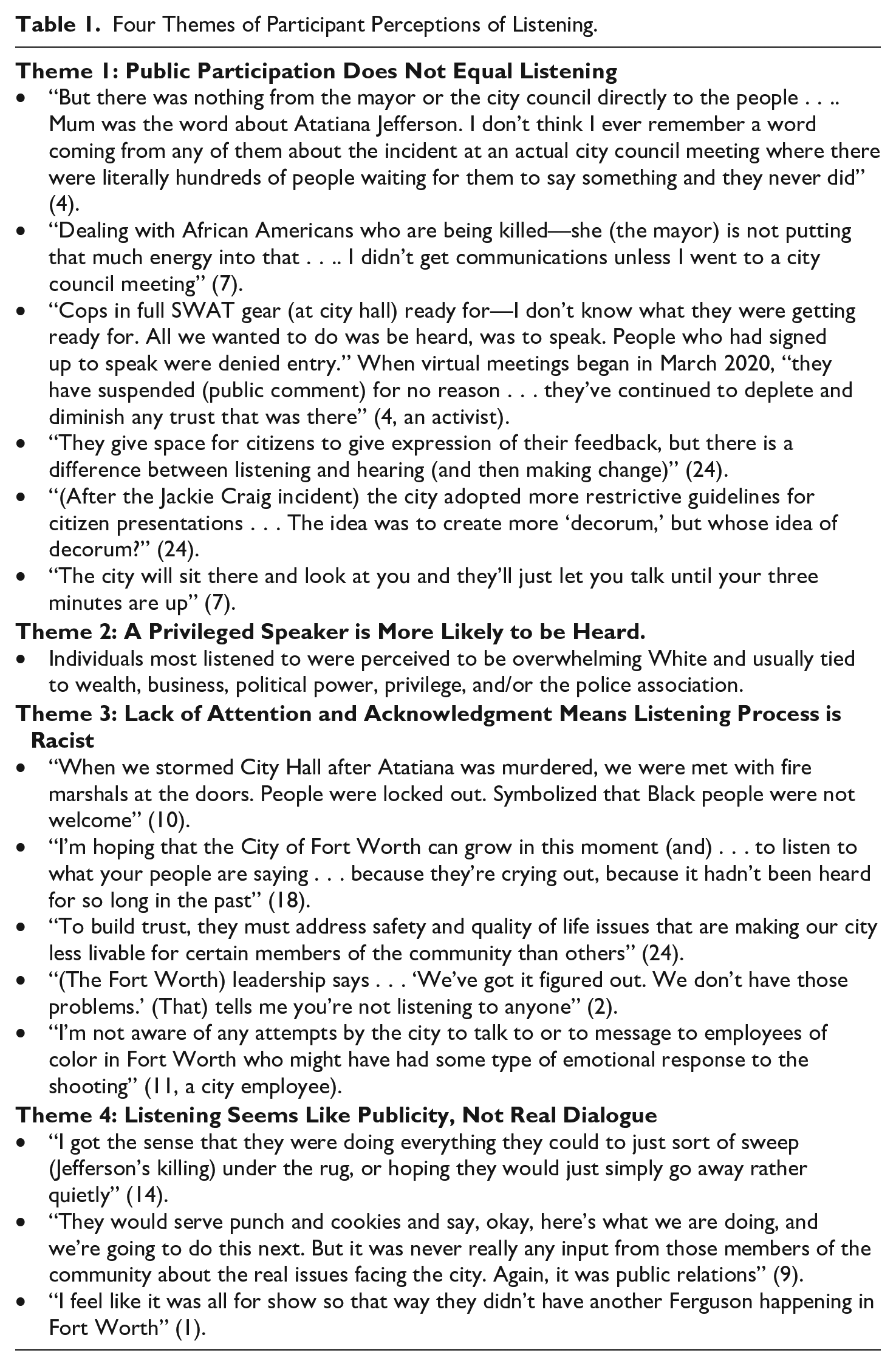
Across their responses, participants shared strong feelings and perceptions about their general experience as stakeholders when speaking to those in authority in Fort Worth, with specific criticisms about the city’s formal listening processes and their place within those processes, relative to non-Black stakeholders. One main theme of responses analyzed for this study, shared first in this findings section, shows participants’ negative perceptions about listening by city council members during meetings. These perceptions connect to Macnamara’s canon for giving recognition and responding appropriately. Black participants’ responses show the downside of a structural “architecture” or organizational-only approach, which may lack interpersonal connections needed for authentic listening as advocated by Dobson or may be compromised by systemic racism. Four prominent themes emerged related to their experiences as stakeholders and their perceptions of formal listening structures:
Public participation does not equal listening (
A privileged speaker is more likely to be heard (
A lack of attention and acknowledgment means the listening process is racist (
Listening seems like publicity, not real dialogue, especially if changes do not follow (
Participants also offered recommendations for improving listening processes (
Four Themes of Participant Perceptions of Listening.
Public Participation in Council Meetings Does Not Equal Listening
Participants directed the most criticism at two main conduits for city listening: (a) city council members who are elected to represent residents but who often offered inappropriate responses to resident concerns and (b) the formal public participation time during meetings, which is the most prominent form of public listening by the city council but also the most reviled. More than one-half of participants had specific complaints about recognition, acknowledgment, attention, and consideration when addressing the city council and mayor during these sessions, related to the perceptions and experiences from
Two participants spoke about the difference between hearing and listening: “Listening requires evaluation based upon response. How well you respond to what you heard?” (17). Participant 4 said, “To be a listener means to be an active listener, to demonstrate that you understand what’s being said and you model that back.” Relatedly, Participant 8’s comment hinted at the inauthenticity of the listening posture of city leaders: “I don’t think they listen at all. I don’t. I think that it’s defensive first. If they are listening, they’re tone deaf. It’s one of the two.” One participant described the systematic nature of the city’s so-called listening “disingenuous,” saying “if they’re going to systematically ignore you over and over and over again every time you come in then there’s no reason to have a forum” (10).
The context and limited time related to public participation at city council meetings also received condemnation from many people in the study, neither matching Macnamara’s canon for giving recognition nor Dobson’s ideal of being present, open, and inclusive. One participant remarked that public comments often are scheduled at the end of meetings “in the middle of the night and everybody can’t get there” (4).
A Privileged Speaker is More Likely to be Heard
Participants clearly recognized the politics of listening, saying the individuals most listened to were overwhelming White and usually tied to wealth, business, or political power and privilege (
Lack of Attention and Acknowledgment Means Listening Process is Racist
Some participants lamented a lack of attention or acknowledgment of the Black community as able partners for governance, policies, and problem-solving, describing experiences that provide answers to
Participants also wanted the city to communicate more official acknowledgment of past and current racism and civil rights problems, which had been described by residents to these leaders but had led to no recognition of these issues. The lack of this recognition, therefore, was seen as evidence of nonlistening. Another participant wanted the city to issue an official apology for past racism, lynching, other violence, red-lining, and discriminatory practices in housing (10). Participant 9 mentioned the apology the city had offered during a church service in the wake of Atatiana Jefferson’s killing.
Listening Seems Like Publicity, Not Real Dialogue
Some participants expressed their perceptions about and experiences during the city’s communication that they classified as publicity and “damage control,” as opposed to real dialogue ( They would serve punch and cookies and say, okay, here’s what we are doing, and we’re going to do this next. But it was never really any input from those members of the community about the real issues facing the city. Again, it was public relations (9).
Participant 1 noted, “I feel like it was all for show so that way they didn’t have another Ferguson happening in Fort Worth.”
More skepticism was aimed by participants at the city’s Race and Culture Task Force, which had been part of the city’s listening architecture before Jefferson’s killing and had elicited feedback from underrepresented residents and neighborhoods. Yet participants, some who served on or testified for this task force, had mixed and negative feelings about whether the effort had been effective and expressed frustration that recommendations had been ignored (Participants 7, 10, 11, 14, and 20), showing the problems of an appropriate response from Macnamara’s canon. One said the city council “has since ignored (recommendations) and very little has changed” (10), and another called the process “too tightly controlled” (14). A participant who served on the task force said, “We got word back that several things we were proposing would be dead on arrival.” Others wanted the city to revisit the task force’s recommendations, especially after Atatiana Jefferson’s murder by a police officer. One said the “task force should communicate all the ideas they got from the year-long sessions with citizens. You just can’t put that information on a website. People who are most affected might not have access to a website” (17).
One of the task force’s recommendations—for a new and independent citizen oversight board for the police—was mentioned by several participants as a process that would improve connections between the community, the city, and its police department (Participants 5, 7, 8, 9, 17, 20, 21, and 24). This task force recommendation, echoed by many participants in this study, has not been implemented by the city. Since the killing of George Floyd, states across the country have enacted more than 140 bills related to more oversight of policing (Eder et al., 2021). Particularly related to civil rights and policing, participants wanted more transparency (Participants 2, 17, 22, and 25); better handling of protests (Participants 2 and 10); and less authoritarian presence at council meetings with large crowds (Participants 10 and 24). Several participants expressed appreciation for a new police chief’s authenticity and listening (Participants 4, 13, and 20); one participant wanted more official communication from the city manager, rather than simply the mayor (8).
Discussion
Black participants in the study described their experiences of trying to be heard by elected city officials and other leaders as “restrictive,” “disingenuous,” “defensive,” “tone deaf,” “slick” but not substantive, “systematically” ignoring Black resident concerns, not leading to real change, and racist. Participants’ complaints closely mirror the theoretical concepts related to authentic and effective listening, including recognition, respect, attention, interpretation and understanding, consideration, and prompt and relevant responses. These complaints connect to ethical concerns about the responsibilities of listening well, especially in democratic and public-sector contexts. Residents and stakeholders deserve being included by the government and seen as worthy, simply for being human (Dobson, 2014; Floyd, 2010; Johannesen, 2002; Place, 2021).
Most perceptions of the city’s listening (or lack of listening) were gained by participants during observation of city council meetings, of the Race and Culture Task Force, and of other official public participation opportunities. These were often and generally seen as too tightly controlled and artificial. This section will be guided by Macnamara’s concepts of culture, politics, processes and structure, and the articulation of listening, which underpin many of the processes of listening by organizations. In addition, terms from interpersonal listening theory will be used within these four categories to reflect the importance of relationship-building within the broader enterprise of a city’s public relations and engagement efforts. From the gaps identified by participants, a better listening system for Fort Worth (and possibly other municipal governments), particularly related to Black communities, will be proposed.
Culture
Public participation culture in Fort Worth, determined by the attitude and control of leadership, was described by participants as exclusive to the most privileged (usually Whites), making this culture inauthentic, disingenuous, and one-sided (
To create a more ethical and inclusive culture of listening, respondents explained that city leadership and communicators show care, compassion, and empathy followed by action. Participants explained that city leaders should use affirming postures and body language when listening. They noticed when city leaders were “twiddling their thumbs and doing the countdown with the timer,” (7) perusing their cell phones, or using non-affirming body language during City Hall meetings.
A healthy listening culture includes acknowledgment of past and current racism and of civil rights problems from city leadership, explained participants. Participants repeatedly highlighted the ways leaders failed to acknowledge the Black community’s burden or to empathize with their experiences. To improve culture, the city’s listening structures must take into account the so-called “decorum” and empty rituals of current practices; these should be reformed to fit broader community norms that are not racist. In Dobson’s (2014) work, this means a primarily white audience being only listeners, and not speakers, in a dialogue driven by Black speakers in part of a “restorative process” (p. 137). Instead of a restorative process, in Fort Worth participants found themselves speaking from a place of oppression and commented on the power of the council, city, and invisible leaders behind the scenes.
City leadership grappling with issues such as over-policing and police-involved shootings of Black people must verbally acknowledge the role of systemic racism, participants said. While city leadership cannot repair systemic racism on their own, the Black community wants to hear this reality acknowledged as the city works to address such complex issues. Black residents are aware that city leadership will make mistakes along the way, but they want leadership to acknowledge the issue and missteps rather than act as if they didn’t exist. Finally, to create a healthy listening culture, city leaders must use proactive and open problem-solving approaches. It cannot be in the usual sequence as perceived by participants: (a) solution decided; (b) notification; (c) public session as required; and (d) predetermined solution implemented despite contrary input.
Politics
The politics of listening relates to power and the right to be heard, as Dobson (2014) asserts. According to participants, both city leaders and public communicators need to listen to a wider circle of residents, not just the usual suspects. Participants in this study explained that the city overwhelmingly listens most to people of privilege. Cities must intentionally and authentically listen to the working poor, people of color, those with a history of being overpoliced, residents from underrepresented neighborhoods and groups, young people, dissenting voices, and city employees—to learn about how to access valuable local knowledge and needs that could be leveraged to improve the city. More work is needed to intentionally include these stakeholders within formal listening structures, which also means the process for listening must adjust to encapsulate their voices.
Relying on traditional proxies for listening to the Black community, including the Black church, has limitations. Even Black pastors who participated in the study acknowledge this reality. Participants also noted the importance of listening to younger and dissenting voices. By inviting in young people, participants believed the city could generate innovative solutions to community problems and engage people with more optimism about the future. Finally, participants noted a lack of communication and listening with city employees beyond the police force. More concerted efforts are needed, specifically on the part of the mayor and city manager, to listen to employees. Failure to listen to and engage employees can result in employee antipathy toward the city rather than employee effort to address community issues (Weber Shandwick, 2020). By prioritizing the voice of the police association, the City of Fort Worth failed to effectively listen to other internal stakeholders.
Processes and Structure
Processes and structures for listening must be “fair and reasonable” and attuned to social equity and ethics when an idea’s popularity, merit, and power are in play (Macnamara, 2015, p. 50). Transparency by the government may be weakened by too much information sharing or if open or digital government becomes superficial, with no two-way engagement involved, participants stated. Zavattaro (2013) calls this lack of engagement “auto communication” by cities, which impedes dialogue and stunts organizational learning (p. 114). Considering the context of Atatiana Jefferson’s killing and the task force that preceded it, organizational learning in Fort Worth was low and risk assessment was ignored at the highest cost of another Black life. The structure and processes of police training, implicit bias education, and culture-building and oversight should have received more attention, based on community input that was ignored.
Participants described formal processes, such as city council meetings and public comment periods, which did not facilitate the two-way communication essential for listening. These formal processes frustrated participants and exacerbated pseudo-listening, with city leaders perceived as passively letting residents “talk until (their) three minutes are up” (7).
Participants shared recommendations about cities’ need to innovate new structures, channels, and outreach that involved: in-person listening, mostly in small settings; more outreach outside of the Black church to young residents of color; multilanguage translations; less reliance on mainstream digital outreach through the city website or social media posts; more city employees working for racial and diversity improvement; more neighborhood action councils; more intimate “rolling” townhalls; budgeting meetings with planned public participation; bottom-up visioning meetings; and the use of data and trend analysis about residents. As part of the latter recommendation, public communicators could develop performance listening indicators to document progress.
Notably, participants rarely mentioned social media when asked about the listening efforts and processes of the City of Fort Worth. Given the tragic nature of the events of this case study, social media was no substitute for in-person listening efforts and dialogue. However, public communicators have the ethical responsibility to routinely listen to their city’s most marginalized public via social media by emphasizing compassion and respect, listening with sensitivity, maintaining publics’ privacy and anonymity, upholding transparency and accuracy of messaging, and building trust (Place, 2021, p. 141). Moreover, following a crisis, such as the police-involved shooting of an innocent Black woman described in this case study, public communicators should employ a combination of online and offline attempts to dialogue and listen.
Articulation of Listening
Articulation of listening (Macnamara, 2015) connects with accountability. Overall, participants were discouraged by the city’s lack of response to prior police brutality and the killing of Atatiana Jefferson. Participants said listening should produce results from city leaders but instead fell short in the aftermath of work completed by the city’s formal Race and Culture Task Force. After the task force’s lengthy listening process, its recommendations were either ignored or not implemented by the city’s leaders, and “very little has changed” (10). Speaking about Atatiana Jefferson’s killing, Participant 4 said, “I don’t think I ever remember a word coming from any of them about the incident at an actual city council meeting where there were literally hundreds of people waiting for them to say something and they never did” (4). Cities must uphold their listening accountabilities by admitting their past mistakes and acknowledging racism. Listening must be transparent, completed by not only the public-facing elected officials but also the city staff members who set policies, control daily operations, and oversee reform. Listening must be articulated by leaders not through empathy alone, but through action, not through empty compassion or calls for a display of trauma, but through follow-up, an articulation of response.
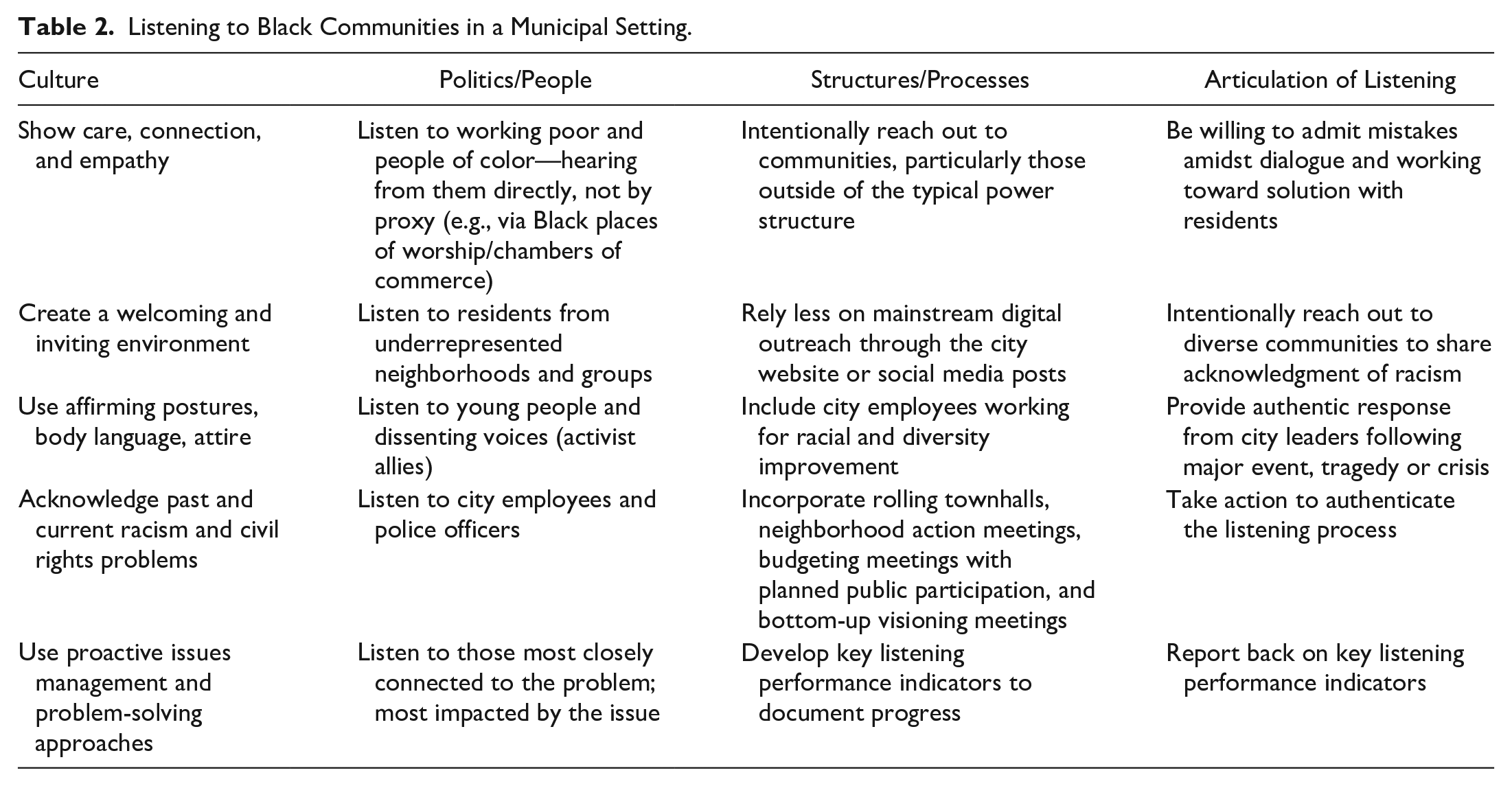
Table 2 combines the participants’ recommendations, based on theories for organizational and interpersonal listening.
Listening to Black Communities in a Municipal Setting.
Implications for Theory and Practice
This research contributes to public relations listening theory through its identification of the experiences and recommendations of Black stakeholders, inside the listening processes of a city during and after the killing of an innocent Black woman by a White police officer. These participants’ words and ideas helped to develop alternate processes, structures, and cultural possibilities for listening by a municipal government, as summarized in Table 2 while revealing that existing official architectures of listening are perceived as racist, ineffective, and disingenuous (Table 1). While researchers interviewed only 25 participants living in a city comprising more than 850,000 residents, those participants emerged from that population due to their involvement in issues important to the Black community. Of significance is knowledge generation based on perceptions and experiences of Black participants, and it serves as one of the first scholarly interventions that link listening, public-sector communication, and social justice for Black residents. The results of this project may be useful to other city leaders and public communicators facing similar challenges in developing cultural competence, outreach, and public engagement with marginalized, minoritized, and underrepresented communities.
Future research could include the perceptions and recommendations of other minoritized communities related to municipal listening and in other contexts, too. Researchers should also continue to enlarge the scope of work to consideration of the “stakeholder experience” of speaking to city or organizational leaders, to complement numerous studies from organizational standpoints. Results reinforce ethical listening (Bowen et al., 2016; Kim & Freberg, 2019) and the centrality of empathy to dialogic theory (Kent & Taylor, 2002) and relationship theory (Brunner, 2008), for which listening is paramount. When city governments and organizations broaden the circle of people to whom they listen, they may cultivate perceptions of inclusivity, positive relationships, and feelings of trust (Botan & Taylor, 2004). Large organizations should also avoid the subtle actions of “pretend listening” (Bussie, 2011, p. 31) or “pseudo-listening” (Adler & Rodman, 2011, p. 136) that undermines and even harms stakeholder groups. And Brunner (2008) has recommended amending the organization-public relationship scale (see Hon & Grunig, 1999) to include listening, more specifically including “sensitivity, tolerance, attention, empathy, and morale” (p. 80). The results of this study suggest that the scale might include connection and responsiveness, too.
For public sector communication practitioners, more issues management at national and local levels is needed, as Black Lives Matter was in the pipeline of the conversations around police brutality prior to the shooting of Atatiana Jefferson. Practitioners should focus less on output and messaging and more on authentic engagement and listening (Grunig & Kim, 2017; Lee, 2019; Place, 2019a). They should retire terms such as customer or citizen, and instead adopt the term partner as one way to make dialogue more symmetrical and deferential to residents (Denhardt & Denhardt, 2002). Finally, there should be less council-driven public participation formalities as well as more personal engagement by paid city staffers that relates to input, sharing, and synthesizing key listening performance indicators that are shared regularly with the community at large, both in person and via social media.
In the year following Atatiana Jefferson’s killing, both her parents died from health-related issues and the home where her life ended was still not repaired. A lack of listening, after hours of work by a city-appointed task force that in part was to improve policing, preceded this tragic event. Participants observed that those in power did not truly open themselves to listening to those outside their circle of privilege and to acting in those stakeholders’ interests (Arnstein, 1969; Dobson, 2014). During work on this study, researchers began to share knowledge of transforming listening structures with public-sector communicators, a promise made to the study’s participants. After publication, researchers plan more outreach to study participants, city leaders, and city communicators to continue discussions about listening systems that have fallen short and have caused immeasurable harm to Black and other community members.
Footnotes
Declaration of Conflicting Interests
The author(s) declared no potential conflicts of interest with respect to the research, authorship, and/or publication of this article.
Funding
The author(s) disclosed receipt of the following financial support for the research, authorship, and/or publication of this article: Each author contributed equally to this research, which was funded by the Arthur W. Page Center for Integrity in Public Communication at Penn State University for projects about organizational listening. The authors express appreciation to TCU master’s graduates Makenna Covington, Kinser Crutchfield, Olivia Koscik, and Kay Barkin for assistance with this project.
