







Abstract
Credibility is an ancient, well-studied, complicated construct. Most credibility measurements consider messenger (ethos) and/or message (logos). Aristotle’s definition includes pathos—the speaker’s emotion, important in visual journalism but rarely applied to visual mediums. This experimental research seeks to fill that gap. It analyzed 45 variables representing ethos, logos, and pathos. High correlations among Aristotle’s three concepts suggest the need to consider each when measuring visual journalism credibility. Factor analysis yielded a three-pronged credibility measure for visual journalists, with 15 variables representing the three concepts. The scale can be used with studies of visual reporting, adding the nuance of pathos-derived credibility.
Credibility is a long-studied communication construct, with Aristotelian roots that consider the ethos, logos, and pathos of messages and messengers. In the decades since Self (1996) called credibility scholarship “plentiful, contradictory, and confused” (p. 421), researchers still seek to define and measure credibility with the understanding that “[c]redibility ultimately lies in the mind of the message beholder” (Self & Roberts, 2019, p. 438). Scales are commonly used to measure audience members’ perceptions of credibility because well-developed scales “are useful tools to attribute scores in some numerical dimension to phenomena that cannot be measured directly” (Morgado et al., 2017, para. 1).
Despite the plethora of literature, gaps remain in the theoretical understanding of the construct of credibility. And despite many scales to measure perceived credibility and meta-analyses of those many scales (e.g., Appelman & Sundar, 2016; Hellmueller & Trilling, 2012; Mangold, 2023; Pornpitakpan, 2004), gaps remain in those measures even as new scales are developed to encompass emerging communication channels (e.g., Castano & Escandon-Barbosa, 2022; Mortensen et al., 2023; Saleh, 2016). Many scales focus on one or two aspects of ethos, logos, and pathos, not all three (e.g., Appelman & Sundar, 2016). As journalistic message emotionality and nonverbal communication by visually presenting journalists become increasingly studied and accepted as journalistic norms (Deavours, 2023; Wahl-Jorgensen, 2020), scales focusing on pathos are needed. Few scales specifically measure the perceived credibility of journalistic messages and messengers presented on visually focused communication channels (such as television journalists, reporters, or presenters on the web or social media) in the context of the unique characteristics of visual media, a gap this study fills. As Wissmath et al. (2010) noted, modality influences perceptions of credibility. Whether on traditional television or in its myriad of online forms, visual journalism has many affordances in presenting messages—verbal and textural words, visual cues, and nonverbal communication whether planned or extemporaneous by the message presenter—that can affect credibility perceptions. While some credibility scales focus on still photography (Mortensen et al., 2023), little research and few scales have measured video-based visual journalism’s additional affordances’ effects on credibility.
This study seeks to contribute to the existing literature by focusing on credibility for visual journalism in the context of the Aristotelian credibility concepts of ethos, logos, and pathos of journalists visually presenting information. It argues that pathos receives less consideration than it should in current credibility measures. This study introduces a new instrument for measuring perceived credibility, with individual measures for each of the three Aristotelian concepts that could prove helpful for researchers in continuing the study of credibility, and for media organizations and practicing journalists in pinpointing specific ways to boost credibility perceptions.
Literature Review
Rhetorical Credibility: Ethos, Logos, and Pathos
Aristotle’s (350 B.C.E./1954) Rhetoric defined credibility in rhetoric with three interrelated elements as the key elements in the perceived trust and believability of a speaker and message. Using Aristotle’s three characteristics is helpful in studies of mediated credibility, as they speak to appeals to ethics with the messenger, appeals to logic with the message, and appeals to affect the emotionality of presentation. These are also key characteristics of journalism, with ethics, logic, and emotionality acting as key storytelling structures upon which the messenger, message, and presentation rely. Defined more specifically, the three Aristotelian concepts are:
Ethos, or the ethical appeal, which describes the character of the messenger. This article uses the term “messenger” to describe a journalism communicator or journalist, instead of the more traditional rhetorical term “source,” which is journalistic nomenclature for a person, group or content providing information for a news message. Messengers use ethos to show their audiences that they are credible and worth listening to. “Ethos” is Greek for “character” (Liddell & Scott, 1882), which is why ethos is a common measurement of messenger credibility.
Messenger credibility, or “ethos,” suggests that some messengers are more reliable than others in transmitting believable, persuasive information. In journalism, the credibility of journalists and the sources of information included in news messages are critical factors of success. Trust generates social capital for media that audiences perceive as credible; individual journalists or news organizations perceived as less credible often fail to garner serious audiences and respect from within the industry (Nah & Chung, 2012). This emphasis on the need to be credible leads media organizations, as well as individual journalists, to emphasize ethical and credible reporting practices and routines, such as using reliable sources, multiple and independent verification of information, and objectivity (Deavours, 2023).
A meta-analysis of messenger credibility scales noted the use of terms such as attractiveness, authoritativeness, character, dynamism, expertise, qualification, sincerity, and role model (Eisend, 2006).
Logos, or the appeal to logic, which describes the logic or reasoning of the message, in this case a journalistic report. Logos is Greek for “word”; however, Liddell and Scott (1882) more closely described as “the word or that by which the inward thought is expressed” (pp. 476–477) and “the inward thought itself” (p. 477). Common features of logos in journalism include balance of message arguments, use of sources, and overall message quality (e.g., Eisend, 2006; Hellmueller & Trilling, 2012).
Some attributes of credibility are also medium-specific, which affects message or “logos” credibility concepts. Differentiations between print and television mediums were argued early in mass communication research; newspapers were judged as institutions because individual journalists are rarely known to news consumers. Broadcasting, however, may be judged more by the individual broadcaster whose face, personality, and nonverbal communication patterns may be more well-known (Newhagen & Nass, 1989) and leading to a parasocial interaction that can boost credibility (Atad & Cohen, 2023). This suggests a visual journalism-specific scale is critical to account for the additional affordances of journalists who appear on camera, and a reason message or “logos” concepts are also included in the broadcast credibility scale.
Common logos characteristics include terms such as comprehensive, clear, complete, professional, not biased, fair (Appelman & Sundar, 2016), informative, factual, believable, trustworthy, images clear, storytelling strong, useful, balanced, represents reality, and objective.
Pathos, which is Greek for both suffering and experience (Liddell & Scott, 1882), is defined by Aristotle as “putting the audience into a certain frame of mind” (Rhetoric Book One, Chapter Two, Bekker No. 1356a). Pathos can be developed by using meaningful language, emotion-evoking examples, emotional storytelling, implied meanings, and nonverbal communication devices, including emotional tone, facial expressions, gestures, and more (Deavours, 2023).
Perhaps the least-studied aspect of Aristotelian credibility, pathos includes factors influenced by both the journalist and journalism story. It is commonly measured in journalism as the emotionality of the news messenger or sources included in news messages, affective sentiment of topic or features, empathy, and presence of discrete emotions such as sadness, anger, or joy (e.g., Andsager, 2000; Eisend, 2006; Voci, 2022).
While many journalists continue to maintain the importance of neutrality in their reporting work (Deavours, 2023), nonverbal researchers find journalists often deviate from nonverbal neutrality in their work, in both crisis situations and in everyday reporting (Deavours, 2020; Zimmerman, 2013). Visual journalists should recognize the impact of nonverbal communication on pathos—the emotionality of their delivery and overall message (Deavours, 2023). Some visual journalists report being critiqued by newsroom managers or consultants for “inappropriate” nonverbal displays of emotionality, showing that newsrooms have standards of emotionality in reporting, which is related to the “pathos” concept (Deavours, 2023). Thus, it is important to measure both the linguistic characteristics of a message and the nonverbal characteristics of the visual presentation.
Common pathos characteristics include expressive, dramatic, emotional, sentiment, sensitive, even tone, calm, neutral, chaotic, rational, caring, not judgmental, frank, sincere, and concerned (e.g., Daniel et al., 2022; Gasser et al., 2019; McCroskey & Teven, 1999).
The Need to Measure Credibility for Visual Journalism
Beyond the definition of visual journalism as photography and graphics/design in print, visual journalism is typically defined within the mediums of television and radio, the same concepts apply to all journalists seen by audiences when delivering a news report, including digitally or on social media posts. While 31% of American adults still view news from traditional broadcast television, digital devices have become the highest consumed news platform (Forman-Katz & Matsa, 2023). Journalists are often present on those channels, including TikTok, where 43% of users say they regularly get their news, and roughly a third each for Instagram and Youtube (Liedke & Wang, 2023). The convergence of media types means more journalists are literally visible to audiences (Huang et al., 2006). Many journalists have not been trained, or choose not, to present information nonverbally without expressing bias. They often do not actively consider how emotionality through nonverbal displays such as gestures, facial expressions, and tone could affect pathos and, by extension, credibility (Deavours, 2023). This study seeks to better consider the least-studied factor of pathos in credibility scales to provide a more robust instrument for measuring perceptions of credibility in visual journalism.
Visually presenting journalists must navigate additional affordances of an audiovisual medium when considering how they seek to be perceived as credible. This is pathos, or presentation aspects, that affect the emotionality of the story. While print journalists must consider factors such as source selection, word choice, written tone, and layout choices, journalists using any visual medium must consider those affordances—and also navigate how to present the audiovisual elements of the story as well, from video choice, audio selection (including natural sounds and added sound, such as music), nonverbal displays, and more (Grabe & Zhou, 2003). Professional norms regarding neutrality of presentation become important, as many media systems have norms of “objectivity” that typically prevent news messengers from revealing their personal emotions when delivering news messages, either linguistically or nonverbally (Deavours, 2023; Maras, 2013; Schudson, 1990). Visual journalists are traditionally trained to primarily attribute emotional elements in news messages to sources cited in the messages (Andsager, 2000).
Growing research about normative boundaries around journalistic bias and emotionality, known as the emotional turn of journalism studies, (e.g., Deavours, 2023; Wahl-Jorgensen, 2020) makes pathos an important consideration for journalistic credibility as well. Wahl-Jorgensen (2020) described emotionality in journalism as a complement to objectivity, suggesting both are key aspects of journalistic credibility. In addition, visual journalists, whose faces and bodies are seen while presenting messages, can also transmit emotionality and other pathos characteristics through their nonverbal presentations (Coleman & Wu, 2006; Deavours, 2020). Nonverbal communication has been linked to credibility and persuasion, key traits upon which journalists rely (Burgoon et al., 1990). “It is likely that the critical component involved in communicating trustworthiness operates on a nonverbal level” (Boone & Buck, 2003, p. 174). Nonverbal communication of broadcasters is less studied, despite nonverbal neutrality being a professional norm for visual mediums (Deavours, 2023). This makes pathos a particularly relevant aspect of journalistic credibility for visual journalists and for inclusion in credibility measures.
In addition, credibility research has received renewed attention with the rise of concerns about “fake news” (Tandoc et al., 2021), deepfakes, and images created by artificial intelligence. Because these mediated misinformation tactics are based on visual presentations, it is increasingly important to understand the construct of credibility visually, as the landscape of media and political partisanship in some news organizations changes, and as public distrust of media grows (Knight Foundation, 2023). Moreover, as technological developments let everyday citizens act (or pretend to act) as journalists online, understanding how journalists continue to negotiate and perform their credibility norms is critical to assisting researchers explore distinctions between citizens and professional journalists. The fracturing of the traditional media landscape has led researchers to consider how audiences may perceive credibility differently for various mediums (Lowrey, 2004; Metzger et al., 2003), suggesting that different platforms and technologies provide certain affordances that affect credibility perceptions. This study recognizes the differences between television and digital mediums, but it suggests they share a similarity (Pew Research Center, 2008): visual presentation by a journalist messenger.
Interplay of the Three Concepts of Rhetorical Credibility
Aristotle (350 B.C.E./1954) suggested that logos, pathos, and ethos are not easily differentiated because they overlap and are interrelated when creating an overall perception of credibility. Credibility researchers often pick only one or two areas on which to focus their studies (Hellmueller & Trilling, 2012), and less-rigorous measures rate credibility with a single trust-to-mistrust bipolar scale (Liedke & Gottfried, 2022). Research shows the difficulty of separating these concepts, as the characteristics of messenger and message are intertwined (Metzger et al., 2003). This study seeks to contribute to the credibility literature, which has previously underrepresented pathos in rhetoric credibility measurement, as well as explore how these three Aristotelian concepts can be combined into one instrument to provide an overall measure of the construct of credibility while also recognizing differences among the concepts. This is particularly important for visual journalists who must manipulate more aspects of the messenger, message, and presentation than print-focused journalists. As one of the first studies to explore all three Aristotelian factors for visual journalism, this scale can add nuance to the study of credibility.
Defining Factors and Methods
This section discusses how the scale was developed through further definitions of credibility factors in an Aristotelian context. It also describes the experimental design and sample.
Scale Development
Scale development, when achieved with theoretical and methodological rigor, provides valid and reliable tools for researchers to operationalize constructs and to assess indirect phenomena such as credibility. The researchers followed Carpenter’s (2018) ten steps to scale development. After researching the intended meaning and theoretical concept, the team selected conceptual labels and definitions while identifying dimensions and items. The item generation process for this study was deductive, taking items from previous literature into a large list tentatively divided by each of the three Aristotelian concepts. Items that were more pathos or presentation-driven were sorted appropriately according to theory and intended meaning, as previous literature notes a lack of pathos categories in previous scales. Researchers then assessed the content validity of the scale, which was done through experts, a panel of 12 visual journalists in television, social media, and web reporting, to determine whether the scale met the external validity of credibility professional norms. Psychometric analysis then began to determine the internal validity and reliability of the scale. This was done by collecting data from a large representative sample of the target population through a sampling procedure described below (Carpenter, 2018; Morgado et al., 2017).
Creating Aristotelian Scale Factors
Ethos
Based on literature and advice from a panel of a dozen professionals, the researchers chose 15 of the most widely used or most applicable factors to visual journalism. The bolded term was the top Factor 1 and while the unbolded term was the bottom Factor 7 on the Likert-type scale with some terms reverse coded for scale validity.
Experienced/
Messenger
Fair/
Unbiased/
Caring/
Logos
The ethos or message factors derived from theory and literature were:
Message
Believable/
Storytelling Strong/
Balanced/
Positive/
Agree with/
Pathos
Because pathos is rarely used in journalism credibility scales, the researchers and experts deemed some terms used in previous messenger and message scales to have intended meaning more appropriate for pathos measures (Eisend, 2006). The items chosen:
Not Dramatic/
Even tone/
Not Chaotic/
Rational/
Caring/
Researchers developed a scale based upon these variables, with each Aristotelian concept described with 15 bipolar adjective variables, a common approach in credibility scales (e.g., Metzger et al., 2003). It also differentiated among some of these previously used characteristics that more likely depicted pathos characteristics than the messenger or message characteristics, which was determined by whether the characteristic was more about the presentation or about the individual messenger or message (Eisend, 2006). The current research also used visual journalism and nonverbal communication research to consider other variables that may affect credibility, such as technical quality (Cummins & Chambers, 2011) and speech/vocalics (Deavours, 2020, 2023; Gasser et al., 2019), less considered in journalism credibility scales. Mortensen et al. (2023) took a similar approach in their credibility scales for still photography.
These 45 variables were presented as bipolar descriptives, with a range from 1 to 7, with 17 variables reverse-coded to prevent straight-line selections from participants (McCroskey & Teven, 1999). Messenger characteristics, such as bipolar options of intelligent, experienced, and likable, were preceded by “I think the journalist seems . . .” The message-related characteristics asked specifically about a particular aspect of the message, such as story or images, such as “I think the story seems . . .” or “I think the images seem . . .” The specific attention to the reporter or story in the questions follows Roberts’ (2010) finding that message and messenger characteristics should be differentiated for a more accurate understanding of credibility perceptions.
These factors comprise the 45-variable Visual Journalism Credibility Scale, which was then tested for data quality through an experimental design. This appears to be the first to combine these factors into a single-scale model made specifically for measuring the perceived credibility of visual journalists. Table 1 lists the 45 sets of bipolar factors and the three Aristotelian concepts into which each variable was assigned. Note that some variables, such as accuracy, appear in both message and messenger categories, which is common in previous studies (e.g., Roberts, 2010; Strömbäck et al., 2020.) The survey’s prompts told participants what to focus on when rating.
Visual Journalism Credibility Scale, 45 Variables.
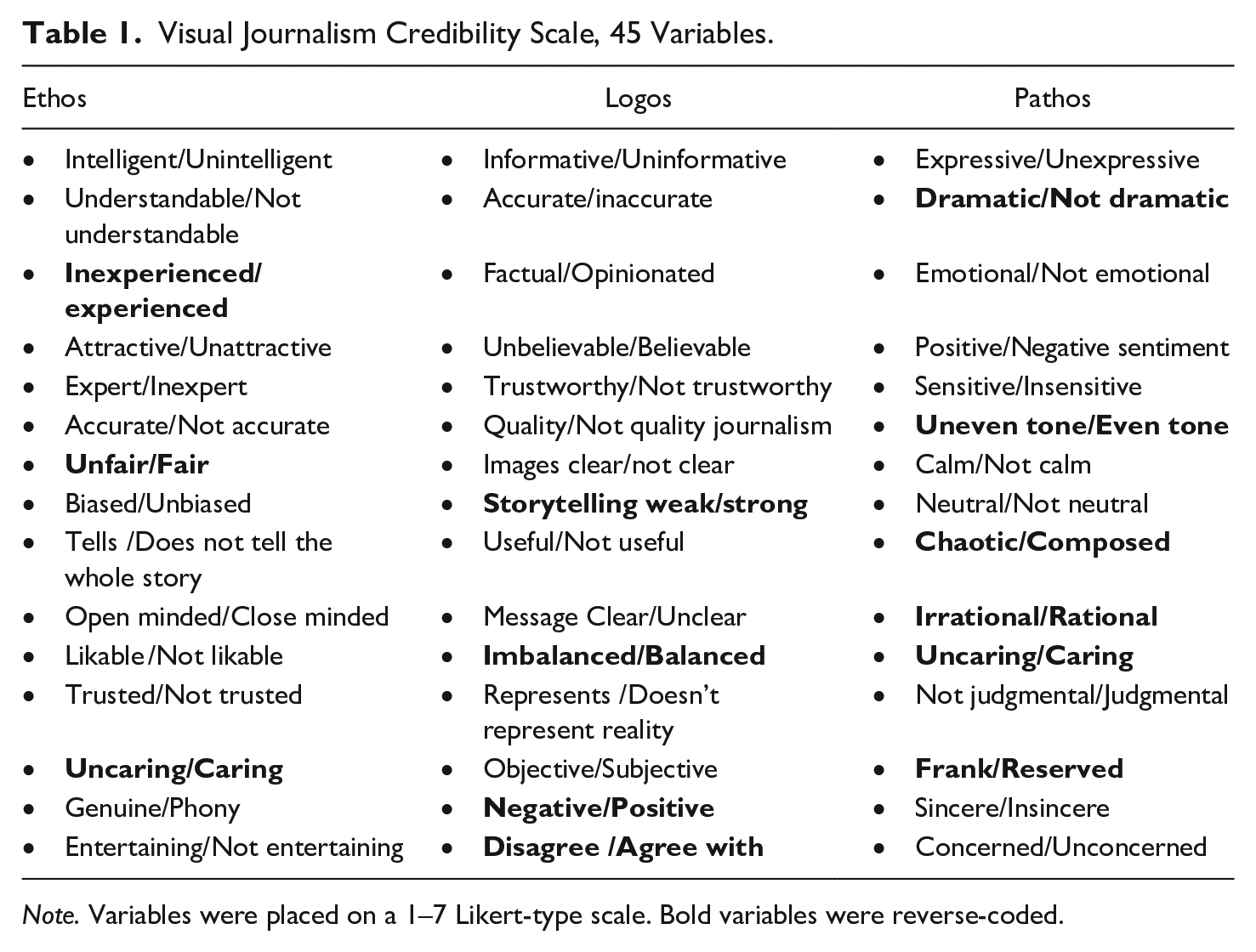
Note. Variables were placed on a 1–7 Likert-type scale. Bold variables were reverse-coded.
To create a more parsimonious and easier-to-use version of the scale, the researchers then used factor analysis, factor extractions, and rotations to create a 15-variable version of the Visual Journalism Credibility Scale; that process is described in the findings section.
Experimental Design
The second step of Carpenter’s (2018) scale development is to determine the sampling procedure. To test the scale’s validity and practical use, researchers conducted an online experiment to understand how credibility factors would change when manipulating messenger, message, and emotionality characteristics when reporting the same story in a visual medium. The experiment used a 3 × 3 design to gauge whether two independent variables: Nonverbal presentations of a broadcaster (high, medium, and low levels of nonverbal presentation) would impact credibility based upon three topics (facts, policy, and human interest). Researchers created nine stimuli simulating a traditional television news broadcast: videos recorded on a local television news set with information presented by a journalist with five decades of experience as a local broadcaster. The topic of school shootings was chosen because it is a coverage type the survey participants would be familiar with seeing on local and national news coverage, and crisis journalism is known to heighten and highlight reporting characteristics, such as credibility (Coleman & Wu, 2006). Prior to stimuli creation, the script was coded by three independent coders trained on a codebook of definitions of linguistic bias to check for perceptions of neutrality; the script was found to be neutral with no linguistic biases present, with Krippendorff α agreement at α =.97 when tested within RECAL3. The details of the script were invented for this experiment, so the information was “new” to participants.
Participants answered pre-test questions about their demographics and news use. They then watched a 90-s video of the fictionalized news coverage. All participants saw the first 45 s, with video and a transition graphic that showed locations of the deadliest shootings in America since Columbine (manipulated to include the location of the fictional shooting mentioned in this experiment). This provided similar formats for all participants to receive the same content. The final 45 s were manipulated between the three topics (facts, policy, and human interest), and the three levels of nonverbal neutrality (high, mid, or low). The three coders also categorized the topics and nonverbal neutrality levels based on definitions provided from research (Deavours, 2020); coder agreement was met, α =1.00 for topics and α =.96 for nonverbal neutrality levels using RECAL3. Stimuli can be viewed at https://bit.ly/3Vpfs99.
Participants were randomly assigned one of the nine groups. After watching the stimuli and passing an attention check, participants answered the 45 variables of bipolar adjectives presented on a 7-point scale, about the journalist (15 ethos variables), the message (15 logos variables), and the emotionality of the report (15 pathos variables). The bipolar adjectives were presented in random order so the scale’s presenting order would not affect outcomes. No responses presented patterns of straight-line selections. The average time to complete the experiment was 28 min.
Sample
The experiment was conducted in 2020 using Qualtrics, an online survey platform. Participants were recruited through Amazon’s Mechanical Turk and paid US$1.50 for completing the experiment. The use of mTurk allowed for a general population like that of typical news viewers from across the United States. Inclusion categories included participants who live in the United States, as different journalism systems internationally have different expectations of credibility and cultural standards of emotionality (Matsumoto, 2013), and consumed at least 5 hr of news a week, allowing them to have a baseline understanding of typical news presentations. While concerns have been raised about mTurk’s data quality, researchers suggest these detrimental effects can be mitigated by using validity indicators and data screening (Chmielewski & Kucker, 2020). This was done through attention checks, identifying straight-line patterns, and testing for inclusion factors within the survey. A total of 250 participants was included, which exceeded the sample estimations provided by G*Power (Faul et al., 2007), which was 225. The researcher excluded 12 participants whose responses did not pass attention check or inclusion questions, reducing the analysis to 238 participants whose data were analyzed using SPSS. Survey respondents reported these demographics:
Age: 16% ages 18–24, 48% ages 25–35, 30% ages 35–44, and 6% older than 45.
Race: 38% White, 28% Asian; 20% Hispanic, 9% Black, 4% Native American/Pacific Islander, and 1% biracial.
Sex: 74% men, 25% women, and 1% nonbinary.
Education: 16% high school diploma, 4% with 2-year degree, 57% with 4-year degree, 23% with a professional degree, and 1% doctorate.
Results
The results and data analysis suggest that this research offers a valid and reliable instrument to measure the credibility of visual journalism through the concepts of ethos, logos, and pathos. Through its creation of both 45- and 15-variable scales that explore the Aristotelian concepts, the result is an overarching measure and nuance into the three individual concepts.
Experimental Results
While this research’s primary focus is the development of the Visual Journalism Credibility Scale, it is important to note that the independent variables of topic and nonverbal neutrality affected how audiences perceived the credibility of the videos, aligning with research on how story topic and nonverbal neutrality impact credibility and bias perceptions (Deavours, 2020; Vettehen et al., 2019). For the results, the 45-variable scale was used for analysis to provide robustness of reported data, although a post hoc analysis using the 15-variable scale provided similar statistical significance. Using a mix of hierarchical regression, analyses of variance (ANOVAs), and t tests as appropriate, findings suggest clips with mid-level neutrality were rated as significantly more credible than the low- or high-level neutrality clips. Clips with facts topics were rated as significantly more credible than those with policy or human-interest topics. The highest-rated clip for credibility across all factors was the clip discussing facts of the event at a mid-nonverbal neutrality range (labeled “Just facts: Mid 3 NNS” in the stimuli list). This suggests the Visual Journalism Credibility Scale at both 45 and 15 variable measures can detect these variations in messenger, message, and emotionality factors within visual journalism, a key for its application to future journalism research and practical use by news practitioners.
Scale Validity and Correlations
This section discusses the third step of validity testing for the 45-variable scale and a factor analysis, factor extraction, and rotation that reduces the number of variables while studying how variables remain in the three Aristotelian concepts of ethos, logos, and pathos. It concludes with a new 15-variable Visual Journalism Credibility Scale that appears to have external and internal validity for the construct of credibility within the three Aristotelian concepts.
A Cronbach’s alpha of .91 for all 45 variables together suggested strong reliability of the original instrument for measuring credibility. Each of the three 15-variable Aristotelian concepts also showed reliability: ethos (α = .83), logos (α = .81), and pathos (α = .72). The research continued with further tests, as each met the accepted minimum alpha levels.
An analysis of the 45 logos, ethos, and pathos variables against themselves showed 89.5% of the correlations were related at a p < .05 level or less. Of ethos variable pairings, four of 105 were not significant. Of logos variable pairings, three of 105 were not significant. Of pathos variable correlations, 22 of 105 were not significant.
The next analysis compared variables among logos, ethos, and pathos variables. Results showed that 92.4% of the 675 pairings (three sets of 225 pairings) were related at a p < .05 level or less. Significance was recorded in 95.6% of ethos versus logos pairings, 82% of ethos versus pathos, and 89.8% of logos versus pathos pairings. Correlation tables are available at https://bit.ly/3Vpfs99
Scale Verification
The use of 45 variables provided an opportunity to further validate this overarching Visual Journalism Credibility Scale and its three components and to create a more parsimonious instrument by reducing the number of variables. A series of factor analyses was conducted on the variables with an oblique promax rotation, chosen because Aristotelian concepts are often correlated.
Further analysis showed significant distinctions among measures of the three Aristotelian concepts. The 45 items of the Visual Journalism Credibility Scale were subjected to exploratory factor analysis (EFA) using principled axis factoring with promax rotation in SPSS. Carpenter’s (2018) fourth step to determine the factorability of data for factor analysis was then assessed. The Kaiser–Meyer–Oklin value was .93, exceeding the recommended value of .60 (Kaiser, 1970, 1974). Bartlett’s test of sphericity (Bartlett, 1954) reached statistical significance (p < .001), supporting the factorability of the correlation matrix.
The structure matrix of the EFA revealed the presence of seven variables with total eigenvalues of more than 1, explaining 65.68% of the variance. A screeplot (see Figure 1) revealed a clear break in Eigenvalues after the third component, with eigenvalues of 35.10, 12.57, and 6.78, respectively, with the fourth and following factors at 3.89 and below. This further confirms the validity of the measure for the three Aristotelian concepts. Using Cattell’s (1966) scree test, the top three components were retained for further investigation.
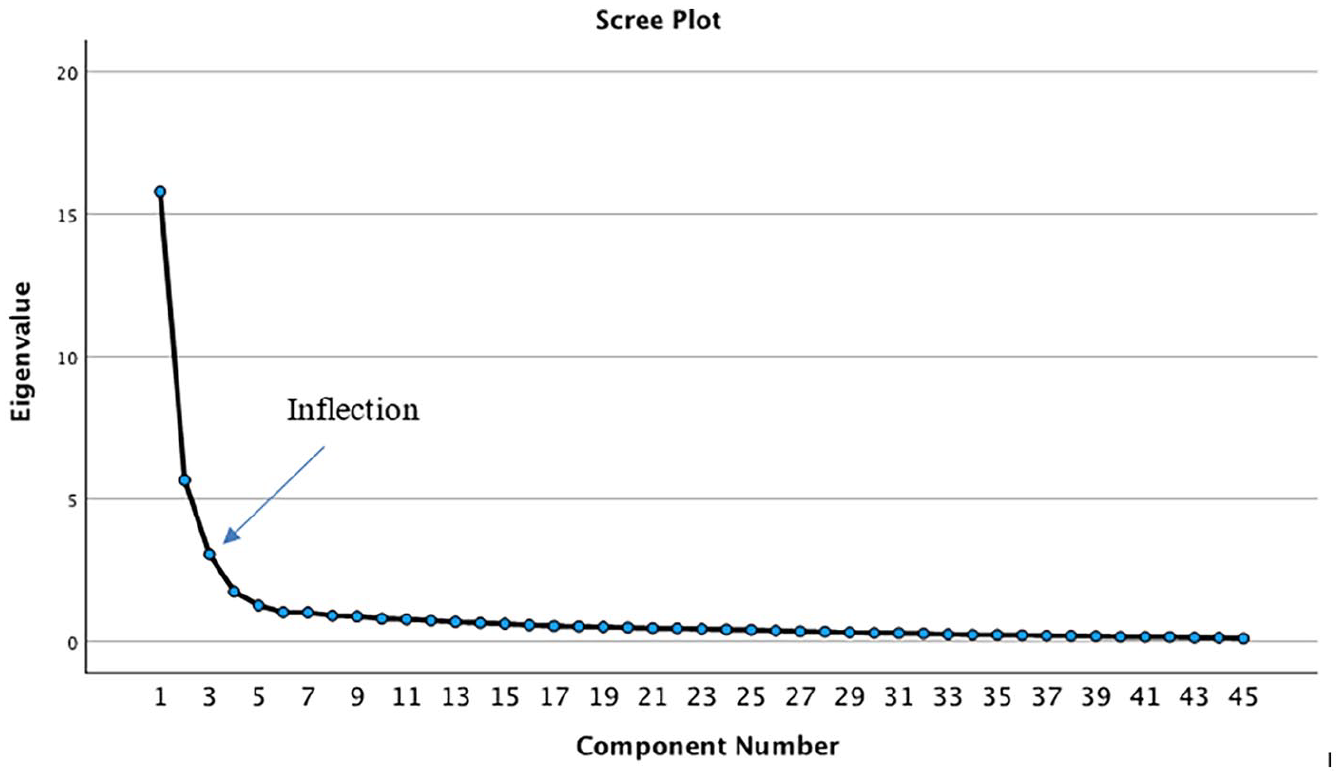
Screeplot of 45-Variable Exploratory Factor Analysis.
The researchers then completed the eighth step of rotating the factors. Using oblique promax rotation, seven variables (attractive, biased, negative story topic, neutral, positive sentiment, not judgmental, and frank) did not load on the three components, suggesting they would have been on a factor beyond the inflection point. The others loaded on one of the three components of the pattern matrix, seen in Table 2. All factors loaded dominantly on one factor except for “chaotic/not chaotic” variable, which loaded on 1 and 3 and was therefore removed.
Pattern Matrix for 45-Variable Scale.
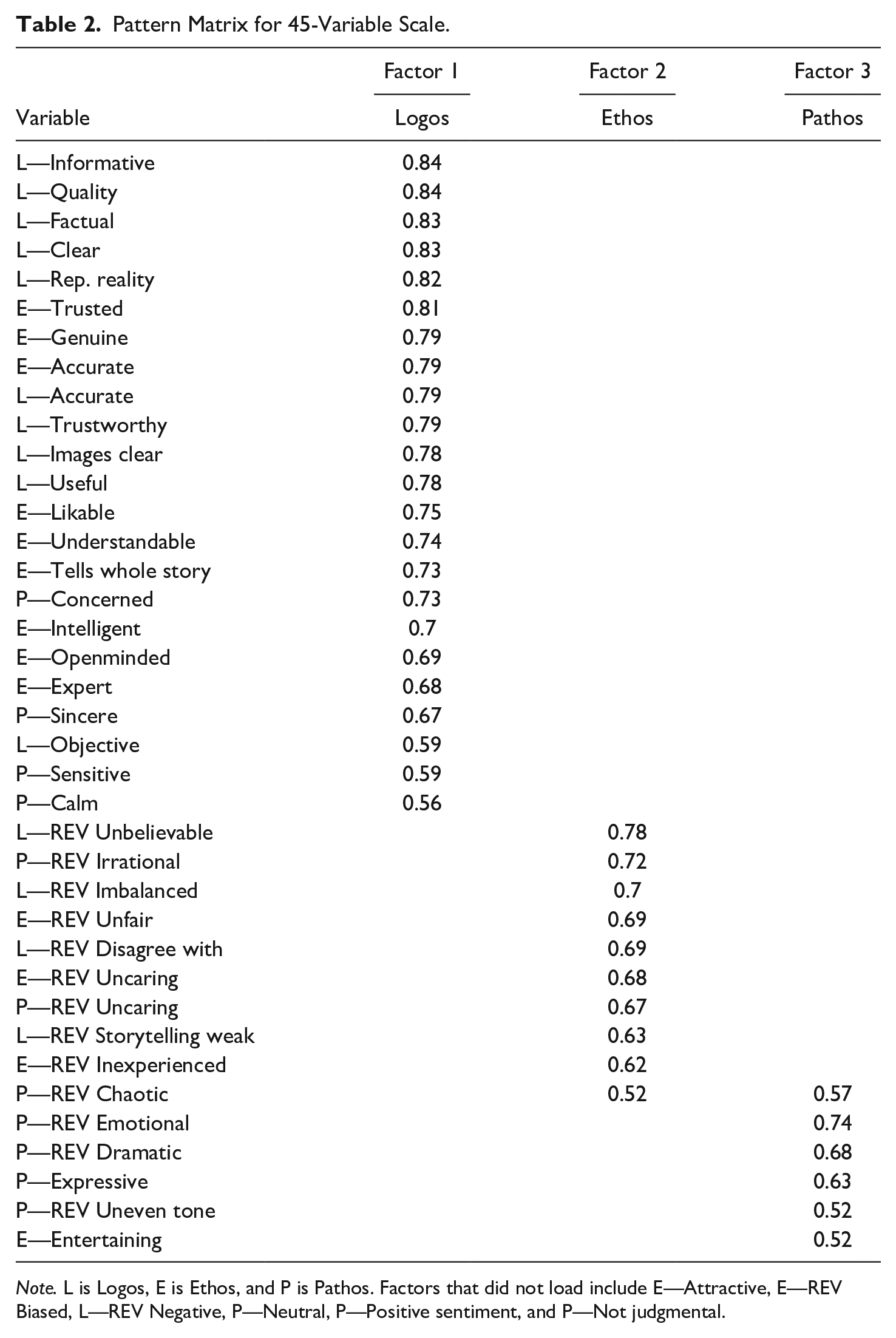
Note. L is Logos, E is Ethos, and P is Pathos. Factors that did not load include E—Attractive, E—REV Biased, L—REV Negative, P—Neutral, P—Positive sentiment, and P—Not judgmental.
Reducing Variables for Parsimony
Researchers then conducted further analysis in hopes of creating a more parsimonious instrument by reducing the number of variables without lessening its validity or distinctiveness within the instrument’s concepts. Researchers considered the quantitative results, as well as qualitative face validity, when deciding what factors to retain, Step 9 in Carpenter’s (2018) methods. The researchers consulted with a factor analysis expert with multiple publications using these methods as well as a panel of six visual journalists. The researchers retained a 15-variable scale, with the top five loading variables for each factor as the third factor only had five loading variables and clear distinctions were available in the other two factors. The 15-variable scale is presented in Table 3.
Visual Journalism Credibility Scale, 15 Variables.

Note. Variables were placed on a 1–7 Likert-type scale. Bold variables were reverse-coded in the research but listed as not reverse-coded in this table. Final loadings in three-factor solution are provided in parentheses.
Factor 1 was dominated by logos variables with informative, quality, factual, clear, and represents reality. Factor 1 included other ethos and pathos variables as well but was dominated by logos factors. Thus, Factor 1 is conceptualized as logos.
Factor 2 did not load as clearly with an Aristotelian concept, with the top five variables being logos-unbelievable, pathos-irrational, logos-imbalanced, ethos-unfair, and ethos-uncaring. However, after discussing the results with the expert panel, many believed that audience members would associate these attributes with speaker characteristics. For instance, while visual journalists originally felt believability was a logos factor because of the believability of the story’s facts, the panelists also felt an audience member might perceive believability more from the speaker because of their relationship with or trust in the journalist, a notion debated in credibility research (Austin & Dong, 1994). They also felt rationality may be perceived as a personality trait of a speaker rather than a presentation characteristic, and balance may be interpreted as whether the speaker is including other viewpoints or allowing other sources to speak, rather than whether the message itself is balanced (Clarke et al., 2014). This movement of rational/irrational into the ethos arena makes heuristic sense in an era where terms such as “the big lie,” “fake news,” and disinformation/misinformation have arrived in common vernacular, and some speakers are judged as rational or irrational regardless of the words used, the accuracy of the message, the communication channel used, or the pathos of the speaker. Moreover, literature suggests that the concept of “rational” has an ethos claim. Garver (2004), for example, wrote that teachers should consider how much time we spend as teachers telling students how to look rational. . . . Open-mindedness, judicious weighing of evidence and alternative hypotheses—these are the marks of rationality our students learn to look rational. Teaching the appearance of rationality is a justified pedagogical tactic, because one often learns to be rational by learning how to seem rational, just as we become courageous by first acting courageously. (p. 101)
It should be further noted that “logos-disagrees with” was originally in the top five variables for Factor 2, but it was removed due to its low communality compared with other variables and a lack of theoretical fit within the second factor. Thus, Factor 2 is conceptualized as ethos.
Factor 3 is loaded with four pathos variables (emotional, dramatic, expressive, and uneven tone) and one ethos characteristic, entertainment. The entertaining variable can be perceived more as a presentation style or emotional characteristic by audiences (Markham, 1968). Thus, factor three is conceptualized as pathos.
After choosing these 15 variables, reliabilities were measured for just these variables. A Cronbach’s alpha of .76 for all 15 variables together suggests the reliability of the parsimonious instrument for measuring credibility. Each Aristotelian concept showed reliability as well: ethos (α = .85), logos (α =.93), and pathos (α =.77). Moreover, the three factors aligning with the Aristotelian concepts for the 15-variable scale showed stronger reliability than the factor reliability of the 45-variable scale. The research continued with further tests, given the high reliability of the measurements. Of the bivariate correlations, 19 (18%) of the 105 correlations were insignificant below the p < .05 level—all pathos variables. The results are in Table 4.
Correlations Among 15 Variables of Visual Credibility Scale.
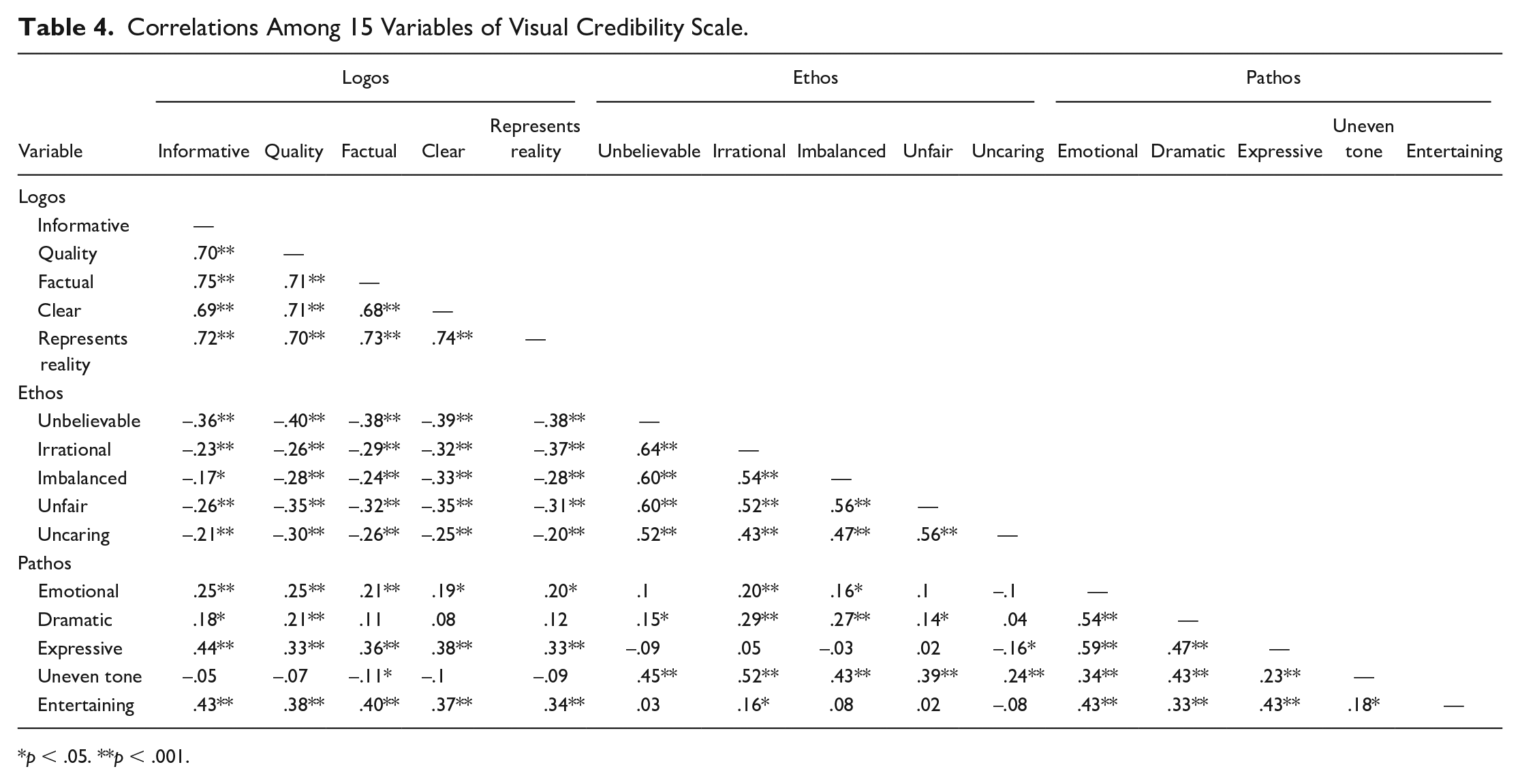
p < .05. **p < .001.
The factor analysis of the 15 variables was then subjected to an EFA using principled axis factoring with Promax rotation. The correlation matrix revealed the presence of many coefficients of at least .30. The Kaiser–Meyer–Oklin value was .89, exceeding the recommended value of .60 (Kaiser, 1970, 1974) and Bartlett’s test of sphericity (Bartlett, 1954) reached statistical significance (p < .001). The EFA revealed the presence of 3 components that had eigenvalues above 1, explaining 67.87% of the variance (36.06, 23.35, and 8.46%, respectively). The three components showed many strong loadings, and each of the 15 variables was loaded on a single factor. The results support the validity of the more parsimonious measure.
Discussion, Limitations, and Conclusion
This study introduces an update to credibility measurements for visual journalism, with inclusion on pathos as it relates to a key difference in visually presenting journalists: emotionality affordances through audiovisual and nonverbal presentations. The Visual Journalism Credibility Scale is among the first to whose measures incorporate written, spoken, nonverbal, and visual communication, making the scale well-suited for measuring credibility across the Aristotelian concepts. As current credibility scales are often created for written journalism such as print and web, this scale is created specifically for visual mediums, such as broadcast television and visual stories on the web and social media. As convergent media practices grow and more journalists in every medium are being asked to present in front of a camera (Huang et al., 2006), this study will help future researchers who need to account for these differences in medium affordance that likely affect messenger, message, and emotionality factors of credibility. This scale can offer a nuanced account for a visually presenting journalist in a video-based message, which can be helpful for future visual journalism studies.
The Visual Journalism Credibility Scale offers parsimonious 15 pairs of bi-polar adjectives that measure the concepts of ethos, logos, and pathos as they relate to the construct of credibility. The analysis confirms correlations between the Aristotelian concepts of pathos, ethos, and logos, which intertwine and cannot be completely parsed out in consideration of the construct of credibility. Because currently utilized credibility scales often do not include measurement of all three Aristotelian concepts, this study improves credibility measurement, allowing for all three concepts to be understood both separately and together. This is especially important as pathos factors, which include the emotionality of the message and messenger, are typically understudied in the journalism field. As researchers such as Wahl-Jorgensen (2020) and others call for a better understanding of the inclusion of emotion in journalism, having a way to measure pathos in journalism may help future journalism studies researchers. The strong pathos variables create reliability in the scale, suggesting that audiences perceive credibility based on visual journalists’ emotional and nonverbal presentations; this has rarely been studied in credibility and journalism studies research, allowing this work to create a foundation from which other scholars interested in nonverbal communication and visual influences on credibility can build. As the pathos variables show, nonverbal and emotional characteristics of the story matter. Areas such as vocalics—the study of nonverbal voice characteristics—could explore the uneven tone variable even further to find what ranges are most acceptable to audiences and help train visual journalists with vocalic presentations. Researchers need to better understand where the presentational boundaries are for emotionality, dramatics, expressiveness, tone, and entertainment so they can provide best practices for journalists. This remains a highly understudied field, and not all journalists are trained in these areas (Deavours, 2023). This study offers a starting point for that work, creating a more comprehensive look at the interplay with factors of messenger, message, and presentation on credibility judgments of visual journalists.
Although the individual scales of the three Aristotelian concepts work together, enough distinction exists among them to suggest that future researchers could use the same scales to measure individual factors of credibility as well, making it a useful tool for many types of research questions. The distinctions between the three factors also suggest that respondents can differentiate among these three elements, perhaps not consciously as they process the presentation but at least when challenged to consider that factor separately. In addition, as the researchers manipulated independent factors in the experiment, such as topic and nonverbal neutrality, the measurement was able to adjust and account for these variations, which suggests its ability to be used in other research designs.
The scale also can be used effectively by current journalists and journalism organizations to measure perceived credibility. In addition to providing an overall measure of credibility, the measure’s individual components can provide specifics that could prove helpful in identifying specific ways that credibility could be boosted. Because visual journalists report receiving little training on nonverbal communication’s influence on credibility and presentation (Deavours, 2023), these findings could provide a basis for this training in the future.
The introduction of the pathos measures is the key feature of the current research. The Hellmueller and Trilling (2012) meta-analysis of credibility measures, which studied 75 scales introduced in communication journals between 1951 and 2011 (including 18 from Journalism and Mass Communication Quarterly), noted that a “wide range of different items is used in very different frequencies” (p. 16). It found that pathos has received little consideration in 60 years of journalism credibility research. The inclusion of pathos is particularly important for visually presenting mediums, such as broadcast television and journalists presenting visually on social media or the web, as their medium affordances include more factors of emotionality, including nonverbal behaviors, vocal tone. Thus, this research provides a measure that accounts for this previously understudied aspect of credibility research while maintaining credibility research’s most prominent factors for ethos and logos into one measurement.
In addition, this study shows what affects audiences’ perceptions of credibility along the three Aristotelian factors. Both journalists and audiences have difficulty articulating how they determine credibility, but this research’s factor analysis shows how different aspects of visual journalism may be perceived by viewers. For instance, Factor 1 in Table 2, which is conceptualized as logos or message characteristics, also includes ethos and pathos variables as well. So, a message may be rated as more or less credible based on presentation characteristics such as sincerity or messenger characteristics like genuineness, even though the message itself does not demonstrate those characteristics. Because of the overlap between these three concepts (Metzger et al., 2003), this research can help more clearly define them, creating more potential to understand influences on message, messenger, and presentation credibility perceptions. This will be particularly important as journalists across communication channels work to boost public perceptions of credibility.
The current research has several limitations, including some shared by many credibility scales. First, it measures the credibility of manipulated stimuli for a single experiment with varying topic and nonverbal neutrality, which could affect its generalizability. The same broadcaster is used in all nine videos, and it is assumed that the participants did not know the local broadcaster given the national representation of the participants. Future scholars should test the scale with messengers well known to the audience, as parasocial relationships are related to trust and as trust is built or lost over time (Cassidy, 2007). In addition, future researchers could test whether the scale can account for changes to individual characteristics of journalists, such as age and gender (Weibel et al., 2008), race (Escobedo, 2015), and homophily (McCroskey et al., 1974), which affect credibility in other journalism studies as well. This experiment could not test for all these variations, but because the factors are based on previous credibility scales used to test these factors, the measure should be able to account for messenger variables.
In addition, the research uses a traditional broadcast report on a news set. Because this research hopes to inform other digital and social media visual presentations, future studies should use this measure for those mediums to assess its validity, such as online or social media reporters, influencers, and so on. Different messages, including those outside of crisis communication topics used in this experimental setting, also should be explored.
Also worthy of additional research is using the scale in video news messages that include more graphics and other audiovisual elements, such as B-roll, that may move credibility attributes beyond a reporter’s performance into other aspects of visual framing. Introducing these considerations into news presentation by non-human avatars (Heiselberg et al., 2022) could be instructive as some organizations consider using computer-generated news presenters, especially in the AI era (Wölker & Powell, 2021). While outside the scope of this particular experiment, the researchers believe the scale could provide a foundation from which these emerging media types could build.
The scale should also be tested internationally, accounting for various journalistic credibility systems around the globe. Understanding how journalists visually present based on cultural standards (Matsumoto, 2013) would need to be an additional consideration, especially for pathos factors.
In addition, the experiment’s population was gained from mTurk, which has been criticized for leading to lower-quality data, unrepresentative populations, and respondent biases (Chmielewski & Kucker, 2020). The population overrepresented 25- to 35-year-olds, Asians, men, and 4-year degree holders compared with average news viewers. However, the researchers hoped to minimize these limitations using attention checks, inclusion categories, and analysis of the data during cleanup. Future studies could gather participants from outside of mTurk to increase validity and generalizability.
Finally, the results of the factor analysis suggest survey participants may not have been able to clearly distinguish between message, messenger, and presentation even when told to focus on a specific aspect of the story. Any time a factor was used for more than one concept, such as “uncaring ethos” and “uncaring pathos,” they loaded on the same factor. This suggests either audiences cannot distinguish between uncaring as an emotional characteristic and uncaring as a speaker characteristic or the participants did not follow instructions. Future researchers may want to limit coupling a variable between two or more concepts.
This also supports the explanation for why factor two did not load with as many ethos variables, as audiences may not be able to perceive exactly what influences their perceptions of message, messenger, and presentation, instead thinking of them in total rather than in parts. This is supported by other research that has found these concepts often intertwine and are hard to parse out (Metzger et al., 2003).
Despite these limitations—many of them common in other news credibility measurements—the instrument introduced in this research adds a nuanced measurement of credibility perceptions for visual journalism by simultaneously providing information about the appeal, words, and emotion of a visually focused news message. It can also be helpful in practical applications for journalists and journalism educators. The scale, built by researchers with decades of journalistic experience and with input from professional journalists, can also inform individual journalists, organizations, and academia of the aspects of reporting that have the greatest ability to influence perceived credibility. For example, pathos measurements, including the inclusion of emotion and nonverbal expressivity of a journalist, are typically not discussed as things to train and focus on industry-wide, despite evidence that they could be influential factors for which to devote more attention and training (Deavours, 2023). This study and the scale findings suggest these characteristics are influential and thus should be incorporated more into training and considerations of credibility factors.
The implications for this new media landscape deserve further exploration. In Roberts’ (2010) study of message and messenger credibility, as researchers study how new forms of digital news dissemination of news “are perceived as credible, the relationship between messenger and message may be more closely tied to a new messenger than to long-known messengers” (p. 54). This study reiterates that finding, as the researchers note the interrelationship between logos, ethos, and pathos in the measurements and outcomes. These factors are important to understand both together as a single factor but also individually, especially in light of convergence media business patterns which encourage journalists, including traditional print reporters, to appear visually on various mediums (Huang et al., 2006) and as the internet brings new (and unknown) messengers to the audience, which can affect credibility perceptions. Researchers should continue exploring the implications of additional visual variables to traditional reporting styles for all journalists, and this scale will assist in that as they explore the more visually focused pathos credibility factors and how they interrelate with logos and ethos factors. As more media practitioners—many without formal broadcast or on-camera training—are disseminating news messages using visual presentation techniques—the instrument could be used to study the relationships, if any, between credibility, messages, and on-screen “performance” by messengers.
Footnotes
Declaration of Conflicting Interests
The author(s) declared no potential conflicts of interest with respect to the research, authorship, and/or publication of this article.
Funding
The author(s) received no financial support for the research, authorship, and/or publication of this article.
