







Abstract
This study examined Disney studios’ portrayals of race as it relates to the physical, mental, and social characteristics of major characters (N = 319) within Disney animated films released from 1937 to 2021 (N = 59). Findings revealed most of the characters featured were portrayed as White (68.3%) whereas BIPOC characters made up 31.7% of the total. Results suggest that BIPOC characters were significantly more likely to be featured in supporting character roles, with White characters featured in both the protagonist and antagonist roles. We further observed a limited integration of characters of varying races in a singular film.
Keywords
With the release of Disney+, Disney’s streaming service in November 2019, children have easier access to classic animated films. Such content ranges from movies showing less-diverse and more stereotypically portrayed animated characters (Towbin et al., 2004), as well as recent films that display greater ethnic diversity such as The Princess and the Frog (2009), Moana (2016), and Encanto (2021). Commencing with Snow White in 1937, Disney animated films are widely popular among young audiences, though several of these early films contain admittedly problematic and inaccurate portrayals of race. In October of 2020, Disney added the following content warning to several animated films such as Dumbo (1941), Peter Pan (1953), and The Aristocats (1970), among others, acknowledging negative depictions and mistreatment of cultures (Countryman & Lee, 2020; Pietsch, 2020). The statement reads,
This program includes negative depictions and/or mistreatment of people or cultures. These stereotypes were wrong then and are wrong now. Rather than remove this content, we want to acknowledge its harmful impact, learn from it and spark conversation to create a more inclusive future together. Disney is committed to creating stories with inspirational and aspirational themes that reflect the rich diversity of the human experience around the globe (The Walt Disney Company, 2022).
At the beginning of 2021, Disney also made these films unavailable to children’s profiles on Disney Plus, although they can still be viewed on adult profiles with a content warning (Kuperinsky, 2021).
With the recent changes to Disney’s streaming platform, the topic of race representation and diversity in Disney animated films has generated many questions as to how race is presented in media. Animated fairy tales, such as the ones told by Disney films, can influence how children perceive the world (Götz et al., 2005). Cultural theorists argue that Disney is more than entertainment; it is a teaching tool that helps children construct their realities (Giroux & Pollock, 2010). Yet, in the field of research concerning race within Disney animated films, many studies are either (a) narrower in scope (Cheu, 2013; Towbin et al., 2004) and/or (b) considered critical cultural pieces (Parasher, 2013; Turner, 2013) that typically analyze a select number of films. Subsequently, commentary regarding Disney’s representation of race is often derived from these studies and may not be representative of the larger population of Disney films wholistically. As such, this study offers a more summative, comprehensive analysis of race and ethnicity portrayals of the entire Disney animated collection through examining the portrayal of race of major characters in animated Disney films from 1937 to 2021. This study provides further analysis and commentary as to how portrayals of race transition over time.
Literature Review
Media Effects of Race Representations
Children as young as three years old develop an awareness of race and can distinguish themselves from other races; by the age of six, children can recognize and are aware of racial stereotypes (Greenberg & Mastro, 2008; McKown & Weinstein, 2003). With exposure to media and racial portrayals at an early age, animated cartoons and films in children’s media are likely to be influential in the development of children’s beliefs and attitudes to race-related groups (Keys, 2016; Klein & Shiffman, 2006). Films provide children with information that highlight racial dynamics, which may inform ethnic characterization and symbols (Lugo-Lugo & Bloodsworth-Lugo, 2009).
Media is an important external source of information outside of the family wherein children first learn about race and ethnicity (Umaña-Taylor et al., 2014). Indeed, film and television can play a major role in shaping children’s racial attitudes (Harris, 1995; Quintana, 1998). Disney animated films, in particular, can be influential as these films are often viewed repeatedly, even to the frequency comparable to the time spent watching a television series (Lin, 2001). Children’s films and television are thus a powerful tool, shaping children’s racial behavior specifically regarding increasing or decreasing negative outgroup behavior (Castelli et al., 2008; Connolly & Hosken, 2006). Negative portrayals of race can be associated with lowered self-image or self-esteem, which may impact children’s development of self-concept. For instance, the research of Martins and Harrison (2012) found that television exposure negatively affected the self-esteem of White and Black girls and Black boys, but not White boys.
Related Media Effects Theory: Cultivation Theory
One central theory that underscores possible effects of repeated media portrayals over time is cultivation theory. Cultivation analysis examines the role of media in shaping or “cultivating” an individual’s perception of social reality (Gerbner et al., 2002). The theory posits that the more an individual is exposed to media content, the greater the likelihood that their perception of reality may align with what they see in media. Consequently, cultivation theory focuses on the cumulative effects of messaging and enduring thematic patterns encountered by viewers over time, rather than the influence of a singular episode or program (Signorielli & Morgan, 2001).
A key element of cultivation analysis is the differentiation between light and heavy media viewers (Gerbner et al., 2002). Buerkel-Rothfuss et al. (1982) examined what children learn from TV families and found that heavy viewers were more likely to form the belief that real-world families exhibit greater support and concern for one another. Even more recently, researchers investigated beliefs about fathers, gendered roles, and television viewing habits among first-time expectant parents (Kuo & Ward, 2016). Results of the study by Kuo and Ward (2016) indicated that an increased attribution of realism to televised content was predictive of stronger beliefs in gendered family roles. In addition, heavy television viewers were more inclined to downplay the role of the father in a child’s development. Researchers argued that first-time expectant fathers might be particularly receptive to media messages regarding their roles.
Cultivation Analysis and Disney Animated Films
Several studies utilize cultivation analysis as a guiding context to explore patterns of representation over time within Disney animated films. For instance, the research of Zurcher et al., (2018) used cultivation analysis to investigate portrayals of families within Disney animated films from 1937 to 2018. Findings suggest that single parent families (41.3%) were the predominate represented family structure over time, followed by nuclear (25%) and guardian (19.2%) family structures. Scholars further observed portrayals of non-Caucasian families in the 1990s that increased over time; nonetheless, minimal interactions between families of varying races were observed.
Another study examined cultivated depictions of older adults within 34 Disney animated films from 1937 to 2004. Findings from the research of Robinson et al. (2007) suggest that although the majority of older characters were portrayed positively (58%), 42% of older characters were coded as negative, with “25% of the characters shown as grumpy, 12% as evil or sinister, 8% as helpless, 3% as senile or crazy, and 2% as the object of ridicule.” Reflecting upon these observations, scholars assert that, “children are receiving a large dose of negative portrayals that may help form or reinforce negative attitudes toward older people” (p. 209).
Although content analyses that explore representation mainly examine patterns within portrayals and not direct effects, children may internalize these media portrayals, which can in turn influence real-life opinions of the self and others (Behm-Morawitz & Ortiz, 2013; Greenfield, 2014). Research suggests that adolescents often search for identifying traits in media portrayals and relate more to characters their own age, sex, and race (Ellithorpe & Bleakley, 2016). Such perceptions may influence children’s beliefs regarding professional aspirations, leadership capabilities and positions, and so on (Breaux, 2010). Considering White individuals have dominated representation in laws, education, and many forms of media (McIntosh, 1997), limited representation onscreen may hold a significant impact on young audiences’ self-perception (Vittrup & Holden, 2011).
Representation of Race in Media
Historically, Black, Indigenous, and People of Color (BIPOC) individuals do not often hold positions of power in media, particularly within the film and advertising industry. BIPOC groups are often under-represented in television—and when depicted, such portrayals are frequently negative and misinformed (Monk-Turner et al., 2010; Tukachinsky, 2015). Content analyses of television have revealed a large underrepresentation of narrow and stereotypical portrayals of Latinx, Asian Americans, and Native Americans (Tukachinsky et al., 2015). BIPOC characters are also typically portrayed with heavy accents and lower intelligence compared to White characters (Monk-Turner et al., 2010). Portrayals of Black characters are especially problematic in television, often featuring portrayals of highly sexualized and aggressive Black females and uneducated servant-class or criminal Black males (Behm-Morawitz & Ortiz, 2013). Furthermore, women of color are generally more likely to be sexualized in television and advertising and are often presented as less professional than White characters (Brooks & Hébert, 2006; Tukachinsky et al., 2015).
There are several critiques and commentaries discussing the representation of race in Disney films throughout the many decades of film research. These discussions frequently start with the longtime representation of racial and ethnic stereotypes within Disney films (Cheu, 2013; Towbin et al., 2004). Disney has been accused of perpetuating many racial stereotypes, ranging from exaggerated orientalism in Asian characters (Cheu, 2013), savage and animalistic Native Americans (Parasher, 2013; Turner, 2013), and pompous white Englishmen (Spector, 1998), among others. Critical cultural articles have examined Oriental descriptions of the Siamese cats in Lady and the Tramp and portrayals of Native Americans in Peter Pan and Brother Bear as being similar to animals (Parasher, 2013; Turner, 2013).
In the 1990s, Disney began introducing more multicultural stories, which appeared to be a progressive step toward racial inclusion (Barker, 2010; Breaux, 2010; Stover, 2013; Zurcher et al., 2018). Yet, criticisms for presented stereotypes persisted, even in the animated films produced during and following the “Disney Renaissance” period in the 1990s (Moore, 2024). Aladdin (1992) and Mulan (1998) received criticism questioning the racial representation of eastern characters as they relate to colonization and White, western traits and characteristics. Large eyes and fairer skin tones, uncharacteristic of the regions depicted in these films, prompted academic criticism from several researchers (Anjirbag, 2018; Breaux, 2010; Lacroix, 2004; Zurcher et al., 2018).
In the 2000s, discussion of racial inclusion in Disney films continued in media research, stirred by the release of The Princess and the Frog in 2009. This film introduced Disney’s first Black princess and protagonist, Tiana. However, she spends the majority of the film as a frog rather than a Black woman, undermining the apparently progressive portrayal of a Black leading character (Barker, 2010; Breaux, 2010; Gregory, 2010). While Disney animated films have included more racial diversity during and following this “renaissance era” (Moore, 2022), many of these portrayals, including Princess Tiana, are discussed as problematic for several reasons. In addition, the criticism of Disney’s portrayals of people of color extends further to the sexualizing and exoticizing of characters of color, including Princess Jasmine, Pocahontas, and so on (Breaux, 2010; Lacroix, 2004). Much of this research is limited to select films and the representation of race and ethnicity therein—thus, further research is needed to better understand patterns of representation over time.
Representation of Stereotypes: Occupational Roles, Social Roles, and Physical Traits
Several studies examining racial stereotypes in film analyze the effect of various qualities ascribed to characters of differing races. The occupational roles, social roles, physical traits, and other important characterizations have been taken into account by researchers to determine the impact of these portrayals (Artz, 2004; Towbin et al., 2004). Although ethnic and racial minorities remain significantly under-represented in television and film, there is a prevalence of perpetuated stereotypes associated with BIPOC groups. Attention toward stereotypes continues to hold focus within the literature, particularly among Black representations (Tukachinsky et al., 2015). Films produced in the mid-1900s displayed obvious racist portrayals of Black characters, providing a narrative of an undereducated, unsavory, and socially inferior race (Jimenez, 2018). However, while more recent depictions in film and television have shifted away from these stereotypes, some films ignore other economic conditions of Black families, displaying a “new racism,” also known as “colorblindness” that strips away unique ethnic characteristics from minority individuals (Towbin et al., 2004).
Media depictions of Asian and Native Americans characters are no less problematic. For example, Asian males have been stereotyped as techno-nerds and/or geeks (Burgess et al., 2011). Native Americans have historically been depicted as “savages” or as “Indians fighting cowboys,” with newer representations displaying stereotypes of alcoholism and casino owners (Sanborn & Harris, 2013). Scholars argue that daily television consumption among a White audience can cultivate anxiety toward other races (Atwell Seate et al., 2018; Mastro et al., 2007), and that such repeated stereotypes and depictions of race can misinform audiences of the true nature of the race depicted (Tukachinsky et al., 2015).
With the limited research of representation of race and occupational roles, BIPOC individuals are often depicted in negative stereotypes in animated films. The research of Towbin et al. (2004) found that Black and Hispanic individuals are often depicted performing hard labor whereas White male characters oversee or manage these positions. Other occupational portrayals in animated films, including Disney films, portray Arabs as thieves and Native Americans as uneducated unemployed characters (Giroux & Pollock, 2010). Moreover, several films that highlight occupational roles feature White men, creating a perceived lack of diversity in television (Eschholz et al., 2002).
Studies that investigate race often illustrate how BIPOC groups are limited in their depictions socially in animated films. Many BIPOC characters are shown as a side character or a best friend (Lacroix, 2004). In children’s media, the characters of a different race or ethnicity can be portrayed and drawn as scary or the villain (Towbin et al., 2004). Minority races are also subject to the hierarchy system and portrayed as lower-class. This occurs in Pocahontas, when Chief Powhatan, a Native American leader, defers to John Smith, a White settler (Artz, 2004).
Asian and Native American cultures are at particular risk of social ostracization in film, resulting from a distinct depiction of “otherness” in their portrayals. For Asian representations, orientalism, the portrayal of Eastern and Asian cultures as mystical, opulent, and distinctly separate from Western culture, creates a distinct boundary between White and Asian characters and narratives in film (Akita & Kenney, 2013; Said, 2016). These negative portrayals can include unintelligent or uncultured ethnic minorities, particularly in the cases of Native American characters, which contrast to more refined portrayals of colonized White characters, heightening that sense of “otherness” (Parasher, 2013).
Racial stereotypes are further displayed by physical traits and depictions of film characters. In reference to gender, White women are shown as delicate, thin, and conservative, whereas women of color are sexualized and exoticized in their physique and dress (Lacroix, 2004). Research indicates that Blacks are shown with larger body weights and types than other races (Robinson et al., 2008). In animation, Asians have been negatively stereotyped and shown with “slant eyes, buck teeth, and heavy accents” (Akita & Kenney, 2013, p. 54). Equally, representation of Native Americans in animated films has been similarly exaggerated, with this population sometimes depicted as red-skinned and featuring body-paint and markings that are misrepresentative of their actual history and culture (Parasher, 2013).
The Present Study
Because children’s media have the power to influence young audiences’ perceptions of self and others, it is imperative to understand how Disney animated films portray various races—especially considering increased accessibility to Disney’s online streaming services. Overlaying cultivation analysis to our examination provides further insight as the theory investigates patterns of depictions over time and integrates variables such as frequency of representation, physical characteristics, plot roles and character relationships, and so on. As such, this study examines the following research questions:
Methodology
This study assessed all major characters (N = 319) within Disney animated films from 1937 to 2021. The sample for this study included all animated films which were produced by Disney animation studios, including Walt Disney Animation Studios and Pixar Animation Studios and similarly titled studios. Films which were distributed by Disney but were produced by external affiliated studios (such as Lucasfilm, Touchstone, or Studio Ghibli) were excluded from the sample. Only films featuring human characters were included (removing films such as The Lion King and Robin Hood) and no hybrid or anthology films involving live-action elements were considered for this study (e.g., Melody Time or Fantasia 2000). If the film was a part of a series, only the first film in the series was included in the sample. The resulting sample of films meeting each of these criteria was a total of 59 films.
Coding Procedures
The unit of analysis was major Disney characters. Each major character was coded once. Major characters consisted of reoccurring human or humanoid characters who had 60 seconds plus of total screentime, delivered plot-important lines and/or demonstrated a significant contribution to the plot (see Robinson et al., 2008). Minor characters that did not contribute to the plot and/or appeared less than 60 seconds within the film were excluded.
Humanoid characters in the sample who demonstrated ample humanistic characteristics to glean representative traits were included in the study. Characters who were portrayed as human for at least a quarter of the film were also included. For example, Kuzco from The Emperor’s New Groove spent about 25% of the film in human form and was therefore included. The Beast from Beauty and the Beast was excluded, however, as he was depicted as a beast for the vast majority of the film. Moreover, coders were encouraged to rewatch movie scenes as necessary to accurately determine character role and related attributes.
A team of graduate students lead by a student with prior experience and expertise studying Disney media engaged in over 15 hours of training using animated children’s films outside of Disney production studios to establish definitions, assess potential reliability, and record coding criteria for each variable listed below. During this training, coders refined and revised the coding procedures detailed in a codebook (see Appendix A). Following these training sessions and coding exercises, two coders who achieved the greatest consensus on coding categories analyzed 15 films, approximately 25% of the sample (N = 59) and recorded the portrayals of 112 characters (n = 112, 35% of total characters in this sample, N = 319). Coders established interrater reliability using Krippendorf’s alpha, achieving 80% reliability on almost all variables: race (.92), gender (.97), age (.86), muscularity (.82), weight (.82), attractiveness (.85), activity level (.78), intelligence (.91), popularity (.83), leadership characteristics (.81), romantic involvement (.91), story role (.81), primary role (.90), family role (.92), and occupation (.92). Having achieved intercoder reliability, the coders further clarified coding procedures and instructions, then divided the remaining films and proceeded with the content analysis.
Variables of Interest
Race, Gender, and Age
Coders first identified a major character’s race, gender, and age. Coders initially classified the characters’ race using the same classifications outlined by the United States Census Bureau (2022) and Hannon (1997): White, Black, Native American, Asian, Polynesian, Other Races, and Hispanic. Researchers identified each character’s race from information provided about each character on the official Disney website, the IMDB film site, and Disney Wiki fan sites. To ensure accuracy, coders also took into account the physical characteristics such as skin tone and dialect (Blanchard, 2022) as well as familial racial background and regional cues in the films. For mixed-race characters and ambiguous ethnic minorities, the external websites confirmed the closest racial identification. While the United States Census Bureau (2022) considers those of Middle Eastern descent to be White, the coders included these characters in the Other Races category with the understanding that young audiences would perceive a noticeable difference in physical attributes between Middle Eastern characters such as Princess Jasmine (Aladdin) and White characters such as Snow White (Snow White). Those of a fantasy race were also included in the Other Races category. Finally, the sole Indeterminate character, Yzma from The Emperor’s New Groove, displayed physical characteristics which were too ambiguous or blended to identify one particular race, aided by lines in the script alluding to this character being almost inhuman and therefore unrecognizable as a representation of any race.
Once the characters were coded for their individual races, they were grouped into two categories: White and BIPOC. The BIPOC category included Black, Asian, Hispanic, Native American, Polynesian, Other, and Indeterminate races, consistent with recent research using this definition to conduct studies on racial groups (Quinn & Andrasik, 2021; Zhang et al., 2022). Because White characters contributed to more than half of the overall character depictions, this grouping was necessary to determine accurate patterns and trends in racial representations of Disney films over time. This organization allowed for researchers to make meaningful observations of character portrayals of the majority White characters and the minority BIPOC characters.
Gender was coded as either male or female and determined based on the visual appearance of the character’s dress, body, and linguistic clues (e.g., pronoun use and name) (Hoerrner, 1996). Age categories were derived from the research of Hannon (1997) and Edström (2018). Categories included the following: infant/toddler (0–5 years old), child (6–10 years old), young teen (11–14 years old), late teen/emerging adult (15–24 years old), adult (25–59 years old), and older adult/elderly (60+ years old). Character ages were determined based on visual clues such as physical appearance and social clues such as vocabulary, behavior, and responsibilities. To accurately record each character’s age, online fan sites such as Disney Wiki and IMDB were consulted to confirm coding decisions.
Physicality
Coders assessed the physical traits of muscularity, body weight, level of activity, and attractiveness. Coders examined muscularity by assessing the entire body and classifying extremely low body weights that do not portray a muscular physique as below average (lean) and body weights that feature hyper muscularity as above average. Average weights were considered neither overly lean nor muscular. Coders classified portrayals of body weight by examining the character’s waistline: below average (thin waistline), above average (protruding waistline), and normal (not overly thin or protruding) (Truby & Paxton, 2002). Coders labeled character’s activity level as inactive, active, or overly active (Robinson et al., 2007). Active characters took part in what was considered an average range of typical activities, which accounted for the majority of the total characters coded. A character who was inactive was immobile and/or limited in activity (e.g., sleeping instead of hanging out with friends, watching TV for hours, etc.). This included the ship’s Captain from Wall-E. Overly active characters, like Hercules from Hercules, illustrated extremely high activity and energy.
Attractiveness was coded as unattractive/ugly, average/ordinary, and attractive (Klein & Shiffman, 2006; Nankervis, 2022). Unattractive/ugly characters were often displayed as unkempt or rejected because of their physical appearance/commented on because of their unattractive appearance (e.g., Quasimodo, The Hunchback of Notre Dame). Attractive characters were coded if there was a direct focus on their appearance or they illustrated Westernized ideas of attractiveness (e.g., Women: large smile, average body weight, small nose and chin, large eyes, good muscle tone and skin complexion, an hourglass figure, prominent cheekbones, lustrous hair; Men: large eyes and chin, big smile, prominent cheekbones, tapering V-shaped physique, good muscle tone, and skin complexion) (Cunningham, 1986; Singh, 1993).
Mental and Social Qualities
Coders observed social and mental traits, ranging from popularity to intelligence to romantic involvement to leadership qualities (Nankervis, 2022; Robinson et al., 2007). Characters were coded as below average, average, or above average for level of intelligence. Below average characters (e.g., Dopey in Snow White, Mr. Smee in Peter Pan, or Fagin in Oliver and Company) lacked intelligence, were made fun of for not being smart, and/or could not answer questions and/or perform simple tasks.
A character’s popularity was tracked as few or no friends, small group of friends, or large group of friends. Characters with a large group of friends were often deemed popular by their peers and/or were depicted as the center of attention. Characters with approximately one to three friends, which composed the majority of characters, were coded as having a small group of friends. Unpopular characters, or characters with few or no friends, were displayed as social outcasts, detached, and/or generally kept to themselves (e.g., Quasimodo from The Hunchback of Notre Dame).
Regarding leadership, characters were coded as either a leader (organized activities, made executive decisions, and had followers), follower (were subordinate to/followed the leader), or neither (the character did not chiefly identify as a leader or follower, or displayed equal traits of both) (Cranmer & Harris, 2015). Leadership had to be clear and central throughout the film. Finally, a character’s romantic involvement was assessed. Characters who were either in a recognized relationship such as a marriage, partnership, engagement, or dating, or the character clearly showed a reciprocated romantic interest in another character were coded as romantically involved.
Character’s Role
Coders identified the overall roles that each character played pertaining to the plot (see the lists in Table 4). These categories included story role (a basic categorization of protagonists, antagonists, supporting characters, and peripheral townspeople), primary role (the more specific role that the characters predominantly portrayed), and family role (relevant to the protagonist when applicable, or just overall if they bore no familial tie to the protagonist). Likewise, coders identified the character’s occupational role and classified it into eight primary responsibilities (e.g., boss, worker, teacher/instructor, etc).
Results
RQ1 aimed to quantify the frequency of race depictions in animated Disney films. Overall, White characters occupied significantly more of the major roles in these films (68.3%; n = 218) than all other races (31.7%; n = 101), χ2 (1, N = 319) = 42.91, p < .001. Table 1 (last row) provides a breakdown of each depiction of each race: White, Black, Native American, Asian, Polynesian, Other Races, and Hispanics.
Depictions of Race From the 1930s to the 2020s and Comparisons to the U.S. Census.
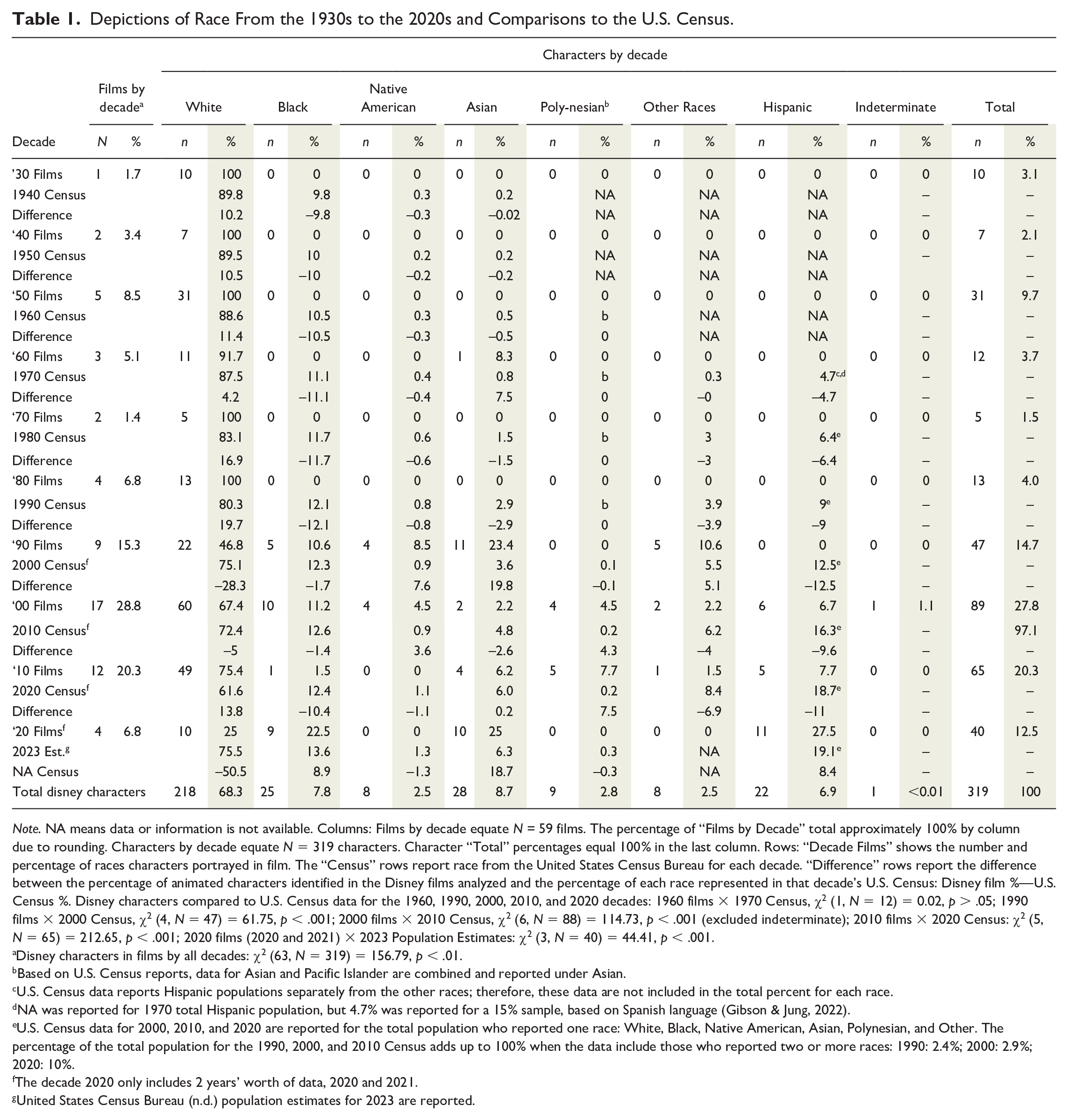
Note. NA means data or information is not available. Columns: Films by decade equate N = 59 films. The percentage of “Films by Decade” total approximately 100% by column due to rounding. Characters by decade equate N = 319 characters. Character “Total” percentages equal 100% in the last column. Rows: “Decade Films” shows the number and percentage of races characters portrayed in film. The “Census” rows report race from the United States Census Bureau for each decade. “Difference” rows report the difference between the percentage of animated characters identified in the Disney films analyzed and the percentage of each race represented in that decade’s U.S. Census: Disney film %—U.S. Census %. Disney characters compared to U.S. Census data for the 1960, 1990, 2000, 2010, and 2020 decades: 1960 films × 1970 Census, χ2 (1, N = 12) = 0.02, p > .05; 1990 films × 2000 Census, χ2 (4, N = 47) = 61.75, p < .001; 2000 films × 2010 Census, χ2 (6, N = 88) = 114.73, p < .001 (excluded indeterminate); 2010 films × 2020 Census: χ2 (5, N = 65) = 212.65, p < .001; 2020 films (2020 and 2021) × 2023 Population Estimates: χ2 (3, N = 40) = 44.41, p < .001.
Disney characters in films by all decades: χ2 (63, N = 319) = 156.79, p < .01.
Based on U.S. Census reports, data for Asian and Pacific Islander are combined and reported under Asian.
U.S. Census data reports Hispanic populations separately from the other races; therefore, these data are not included in the total percent for each race.
NA was reported for 1970 total Hispanic population, but 4.7% was reported for a 15% sample, based on Spanish language (Gibson & Jung, 2022).
U.S. Census data for 2000, 2010, and 2020 are reported for the total population who reported one race: White, Black, Native American, Asian, Polynesian, and Other. The percentage of the total population for the 1990, 2000, and 2010 Census adds up to 100% when the data include those who reported two or more races: 1990: 2.4%; 2000: 2.9%; 2020: 10%.
The decade 2020 only includes 2 years’ worth of data, 2020 and 2021.
United States Census Bureau (n.d.) population estimates for 2023 are reported.
RQ2 explored how depictions of race have changed over time. As shown in Table 1, more than two-thirds of the characters (63%; n = 201) and movies (64.4%; n = 38) in the sample came from the latter three complete decades examined in this study: 1990s (characters: n = 47, 14.7%; movies: n = 9, 15.3%), 2000s (characters: n = 89, 27.9 %; movies: n = 17, 28.8 %), and 2010s (characters: n = 65, 20.4%; movies: n = 12, 20.3%).
When examining the animated films featuring human/humanoid characters during the decade of their release date, a chi-square shows a significant difference in the depicted characters in films by decades, χ2 (63, N = 319) = 156.79, p < .01 (see Table 1: films by decade column). Likewise, there was a significant difference in White and all other racial portrayals by decade: χ2 (9, N = 319) = 79.91, p < .01. With the exception of one depiction in the 1960s (Mowgli from The Jungle Book who is from Southeast Asia), all characters appearing in films from 1930 to 1980 were White (n = 78).
After assessing the representation of race in Disney films since the 1930s, racial portrayals (White, Black, Native American, Asian, Polynesian, Other Races, and Hispanic) were compared to the U.S. Census population data for each decade (see Table 1). For example, movies released in the 1930s were compared to the total population race percentages as reported by the 1940 U.S. Census. Table 1 features the U.S. Census data (Gibson & Jung, 2022; Humes et al., 2011; Jones et al., 2021 U.S. Census Bureau, n.d.) for each decade studied. After reporting the Census data, the researchers identified the differences between the percentage of races represented in Disney films during each decade and the percentage of races identified during the same decade in the United States, per the U.S. Census (Gibson & Jung, 2022; Humes et al., 2011; Jones et al., 2021 U.S. Census Bureau, n.d.). Researchers subtracted the two percentages and reported the difference between the percentages. When a positive difference resulted, there were more representations of the race in animated films; a negative number illustrated fewer representations of the race during that decade. Last, a single-sample chi-square was conducted for each racial group by decade. However, this test could only be conducted when there was more than one racial group represented in film (e.g., more than White characters were featured): 1960, 1990, 2000, 2010, and 2020 films.
The racial representations were then compared to the corresponding representation in the U.S. population (the expected values based upon the percent). The chi-square was not significant for 1960, due to lack of substantial representations for comparison (e.g., other than White characters, one Asian character appeared), but the test was significant for the 1990, 2000, 2010, and 2020 films: 1990 films × 2000 Census: χ2 (4, N = 47) = 61.75, p < .001.; 2000 films × 2010 Census: χ2 (6, N = 88) = 114.73, p < .001 (excluded indeterminate); 2010 films × 2020 Census: χ2 (5, N = 65) = 212.65, p < .001; 2020 films (2020 and 2021) × 2023 Population Estimates: χ2 (3, N = 40) = 44.41, p < .001.
RQ3 examined physical characteristics (e.g., character type, gender, age, muscularity, body weight, attractiveness, and activity level) depicted among the races (white vs. BIPOC) accounted for in this study. As Table 2 shows, there was a significant relationship between the portrayal of race for character type, χ2 (1, N = 319) = 11.15, p < .001, gender, χ2 (1, N = 319) = 7.03, p < .01, body weight, χ2 (2, N = 319) = 6.53, p < .05, attractiveness, χ2 (2, N = 319) = 9.11, p < .05, and activity level, χ2 (2, N = 319) = 6.32, p < .05, in Disney animated films. In all instances, White races were portrayed more than any other race. There was no significant relationship for age and muscularity; the lack of significance for both characteristics occurred because the proportion of White and BIPOC characters represented in each category (age: infant, child, adult, and elderly; muscularity: lean, average, and above average) are so similar within in each classification explored.
Physical Characteristics Comparing White and BIPOC Characters.
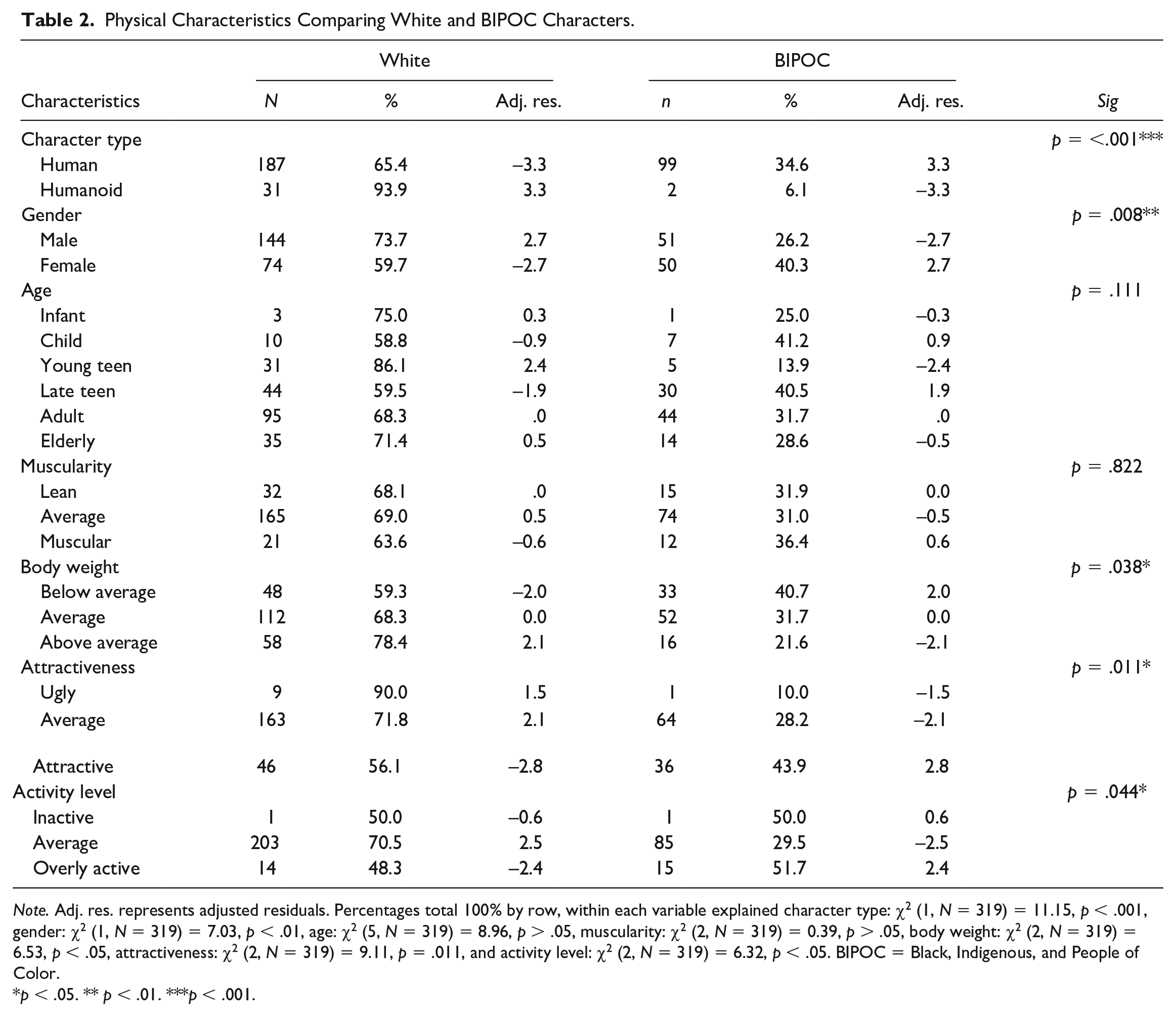
Note. Adj. res. represents adjusted residuals. Percentages total 100% by row, within each variable explained character type: χ2 (1, N = 319) = 11.15, p < .001, gender: χ2 (1, N = 319) = 7.03, p < .01, age: χ2 (5, N = 319) = 8.96, p > .05, muscularity: χ2 (2, N = 319) = 0.39, p > .05, body weight: χ2 (2, N = 319) = 6.53, p < .05, attractiveness: χ2 (2, N = 319) = 9.11, p = .011, and activity level: χ2 (2, N = 319) = 6.32, p < .05. BIPOC = Black, Indigenous, and People of Color.
p < .05. ** p < .01. ***p < .001.
Researchers addressed RQ4 by coding for additional social or mental characteristics, including romantic involvement, intelligence, popularity, and leadership. Table 3 demonstrates a significant relationship in the portrayal of White and BIPOC races for romantic involvement, χ2 (1, N = 319) = 7.99, p <.01. For every variable, White races were portrayed more than all others.
Mental and Social Characteristics Among White and BIPOC Characters.
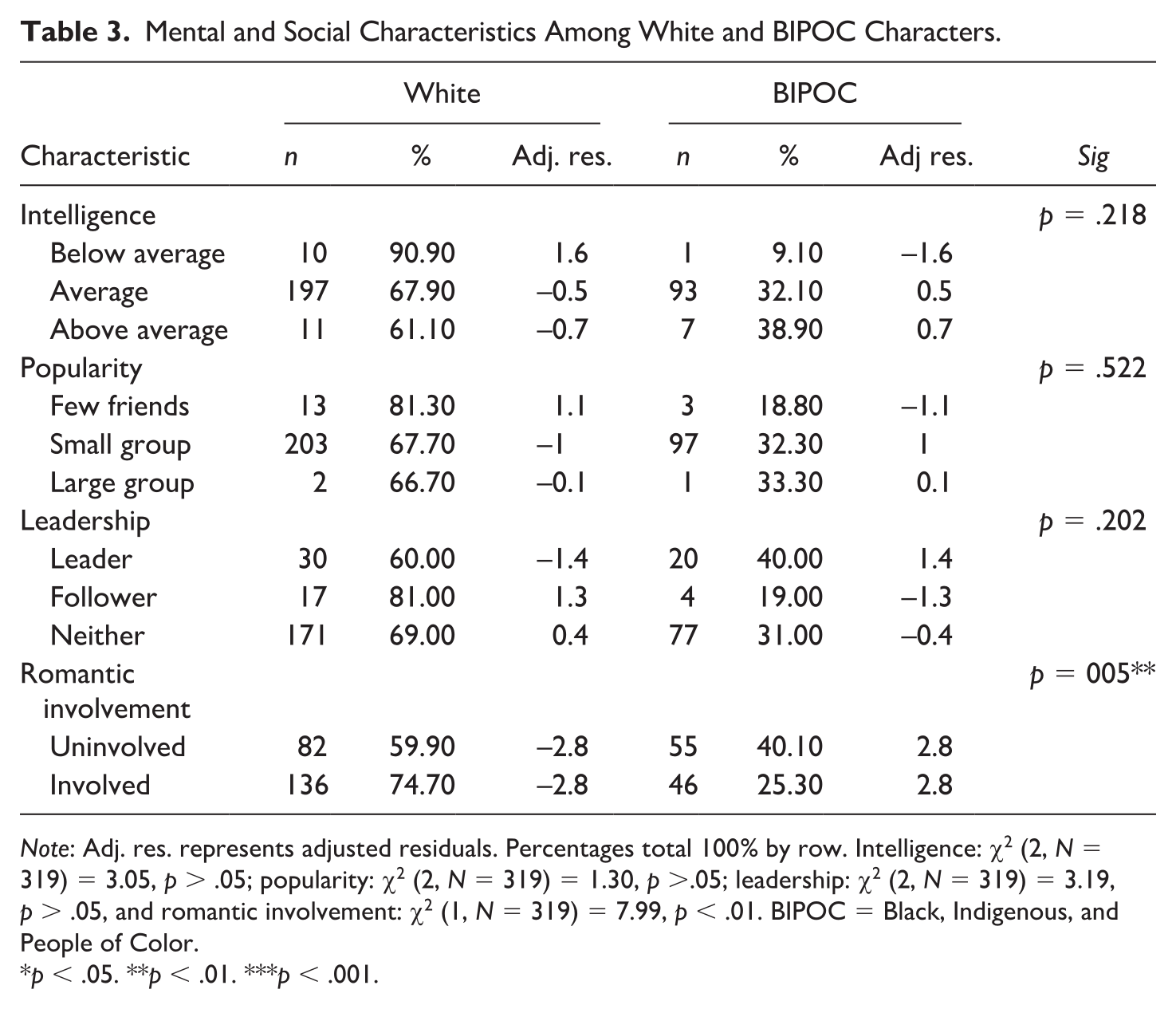
Note: Adj. res. represents adjusted residuals. Percentages total 100% by row. Intelligence: χ2 (2, N = 319) = 3.05, p > .05; popularity: χ2 (2, N = 319) = 1.30, p >.05; leadership: χ2 (2, N = 319) = 3.19, p > .05, and romantic involvement: χ2 (1, N = 319) = 7.99, p < .01. BIPOC = Black, Indigenous, and People of Color.
p < .05. **p < .01. ***p < .001.
RQ5 focused on the overall roles that each character played pertaining to the plot. Results shown in Table 4 reveal a significant difference in White characters and BIPOC characters for all three variables: story role: χ2 (3, N = 319) = 7.89, p < .05, primary role: χ2 (13, N = 319) = 31.71, p < .01, family role: χ2 (14, N = 319) = 29.69, p < .01, and occupation, χ2 (9, N = 319) = 25.16, p < .01. Of the story roles, townspeople were portrayed equally by White and BIPOC characters (n = 11 each). Among the primary roles, grandparent (n = 5) and boss (n = 2) featured more BIPOC characters. For family role and occupations, grandmothers (n = 5), brothers (n = 5), and cousins (n = 3) as well as indeterminate occupations (n = 29) were portrayed by more BIPOC characters.
Character Roles Among White and BIPOC Characters.
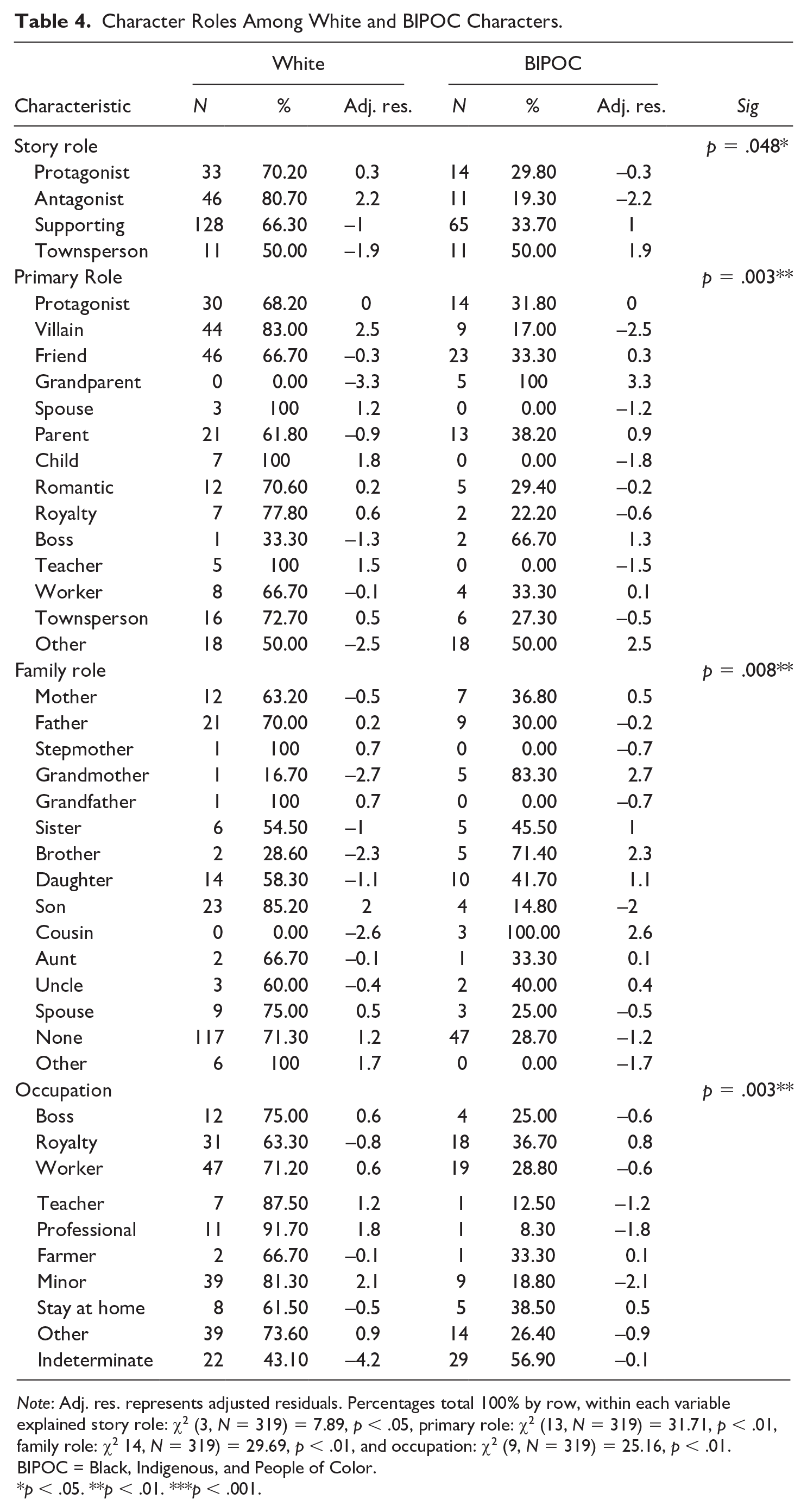
Note: Adj. res. represents adjusted residuals. Percentages total 100% by row, within each variable explained story role: χ2 (3, N = 319) = 7.89, p < .05, primary role: χ2 (13, N = 319) = 31.71, p < .01, family role: χ2 14, N = 319) = 29.69, p < .01, and occupation: χ2 (9, N = 319) = 25.16, p < .01. BIPOC = Black, Indigenous, and People of Color.
p < .05. **p < .01. ***p < .001.
Discussion
As theorized by Giroux and Pollock (2010), children’s movies have the power to help young audiences construct their view of reality. Disney films arguably have one of the largest stakes in the children’s film industry and are highly influential globally. Much of the previous dialogue surrounding the representation of race in Disney films is either limited in scope or focuses on critical cultural pieces (Breaux, 2010; Cheu, 2013; Parasher, 2013; Spector, 1998; Towbin et al., 2004; Turner, 2013). Consequently, this study provides a content analysis of race representations in Disney animated movies as they relate to character roles, social and occupational roles, and physicality to account for transitions in representation and race stereotypes over time.
This research informs future racial and ethnic socialization studies by accounting for emergent themes and patterns in Disney racial portrayals over time. Monk-Turner et al. (2010) established that racial minorities have not traditionally been depicted in positions of authority and/or were often depicted negatively or inaccurately. The criticism of Disney’s portrayals of people of color extended further to the sexualizing and exoticizing of characters of color (Breaux, 2010; Lacroix, 2004). Indeed, it was not within the scope of the present research to assess media effects of Disney film exposure on young audiences; rather, this study offers the following observations regarding general depictions of race and patterns within these representations over time.
To begin, this study observed that, despite one appearance of a BIPOC character in a singular film in the 1960s, all major characters before the 1990s were White. Each decade following the 1980s saw a burst in representation, with Black, Asian, Hispanic, Polynesian, and other races portrayed onscreen. The ushering of the 1990s saw the inclusion of BIPOC characters. However, between the 1990 and 2020 decades, White characters still made up the majority of animated characters portrayed. Beyond that, the 2000s and 2010s brought an influx of characters in general. The combined number of coded characters in 1990s to 2020s was more than the previous six decades combined, with 241 total characters coded in the last four decades and 78 total characters coded from the 1930s to 1980s. This increase in representation from the 1990s onward is possibly a result of technological developments in film as well as Disney, as a corporation, pursuing a significant global expansion in the late 1980s (Robbins & Polite, 2014). This increase in character representation in general, including across all races, yielded more insights into character roles and potential stereotypes for each racial group.
This study also observed the representation of race in varying roles such as occupational, familial, and overall story role. BIPOC characters are more likely to occupy supporting or background roles in Disney animated films, which support previous research findings (Lacroix, 2004; Smith et al., 2017; Tukachinsky, 2015). As such, the nuances of character portrayals for BIPOC races are demonstrated with limited variety and may therefore carry more weight in influencing audience’s perceptions. According to Breaux (2010), perceptions built from media representation can influence what minorities believe they can accomplish professionally and in leadership positions. This study shows White characters held a wider variety of different jobs, particularly in positions of authority such as boss or professional (white-collar) occupations, though this may simply be attributed to the lack of representation in general among the other races. Too few characters outside of the White racial category may contribute to the perpetuation of existing stereotypes (Chung-Herrera & Lankau, 2005).
Race and family roles also revealed compelling findings, with White characters not demonstrating a familial connection far more frequently than BIPOC characters, proportionally (White: n = 117, BIPOC: n = 47). There were several more grandmothers (n = 5), brothers (n = 5), and cousins (n = 3) portrayed among BIPOC characters that were not seen among White characters. This is likely due to more animated films focusing on the stories of families, such as Encanto and Coco in the late 2010s and early 2020s that featured predominantly Hispanic casts. These findings may suggest a shift in Disney animated films that, like Luca (2021), tell stories highlighting family and culture, as opposed to stories featuring orphaned characters such as Snow White. In fact, several of the BIPOC characters represented in films are often depicted among a majority of characters of their own ethnicity, including the aforementioned films and others such as Aladdin, featuring an exclusively Middle Eastern cast, or Soul, featuring a mostly Black cast. This suggests that, while later decades of Disney animated films include more representations of BIPOC characters in general, there remains a limited integration of varying races in these films.
Researchers also observed a high number of White villains (n = 44) compared to BIPOC villains (n = 9). Furthermore, the only BIPOC villains included in this number were found in films that also featured a BIPOC protagonist, such as Jafar and Aladdin (Aladdin), who were both Middle Eastern characters. This finding shows that no Disney animated film sets a White protagonist against a BIPOC villain, potentially as a caution against perpetuating negative stereotypes of negative interactions between White and BIPOC races. In contrast, there were a few films which featured a BIPOC protagonist and a White primary villain, such as Big Hero 6 or Pocahontas, but for most of the animated films, protagonists and villains were of the same race, furthering the observation about limited racial integration in terms of primary story roles.
Representation Through the Decades and Cultivation Analysis
Examining the U.S. population demographics at the time the films aired showcased interesting narratives and provides greater insights to race representations in Disney animated films over time. When looking across decades, the data in Table 1 shows White characters regularly have more representation during each decade, except the 1990s where a substantial shift takes place. During this decade, racially diverse characters were introduced and the U.S. population dropped from almost 90% White, as reported by the 1940s U.S. Census, to three-quarters of the population. In contrast, Black and Native American characters consistently have less representation in film. Specifically, Blacks are represented by almost a margin of 10% less than the population in all but the 1990s and 2000s when viewers see an increase in representation; however, this margin returns in 2010. Animated films featured Polynesians for the first time in the 2000s, with Lilo & Stitch being the first. An Asian character was first featured in the 1960s and reintroduced in the 1990s, with an overcompensation and seemingly over-representation during this decade. Finally, despite the current growing Hispanic population in the United States, Hispanics are not represented until the 2000s, and despite their population growth, Hispanics continue to be featured drastically less than they should. However, if the number of Black, Asian, and Hispanic characters featured during the 2 years studied in the 2020s is any indication, viewers could for the first time see White characters represented less than other characters. Only time will tell.
The aforementioned observations hold intriguing implications when applied to implications related to cultivation theory. Overall, the present analysis observed an increase in portrayal of characters from varying races throughout the decades, with a shift in distancing from storylines centered on orphaned characters to storylines involving larger families and the cultures that impact these families. Although an increase in representation of varying racial groups is noteworthy, we observed that the actual act of diverse races positively engaging with one another in settings that are more relatable for children is primarily absent within the assessed Disney animated films. True, films such as Moana, Cocoa, and Encanto could be viewed as influential portrayals and representations of singular cultures, traditions, rituals, and so on; nonetheless, considering that, for some children, these media instances may be a first-time exposure to a particular represented group, children may not find relatability to these films nor observe positive instances of characters from differing races interacting one with another. Such depictions could influence children’s mental accessibility to illustrations of prosocial behaviors between peoples of varying races, specifically if they hold limited real-life interactions. We recommend that future Disney films consider scripting characters of various racial backgrounds that positively interact with one another in a diverse set of circumstances to allow for greater accessibility and relatability.
Limitations and Future Research
As this study aims to fill a gap in the literature in terms of a quantitative analysis, it is not without limitations that posit ideas for future research. To begin, the present sample exclusively included the analysis of major characters; minor characters (those who were onscreen for a minimal amount of time and/or did not majorly contribute to the plot or script) were not evaluated due to the scope of this study. Considering that many racially diverse characters have historically been minor characters (Lacroix, 2004), future research should examine representations of race among minor characters in Disney animated films. For example, the background Native American characters in Peter Pan’s controversial musical number “What Makes the Red Man Red” were not included in the sample, as they did not fit the criteria for the sample selection. Such an analysis could continue to provide a more complete picture of representation of race in Disney animated films.
The present sample also excluded sequels in an animated film series, which some may consider a limitation. This method accounted for any continuity issues between multiple portrayals of the same character. To eliminate this issue, the coders chose to focus solely on the portrayals of the primary characters in the first film of the series. Future studies may consider including characters which are unique to film sequels to add to the sample for analysis.
One substantial area for future research encompasses the construct of intersectionality, or what Crenshaw (1989) describes as “multiple and overlapping forms of oppressions . . . whose analysis must consider multiple characteristics of identity, including race, ethnicity, class, sexuality, religion, physical ability, and so on” (Byerly et al., 2023, p. 249). Such analyses pivot from commonly used data set comparatives (e.g., males compared to females, BIPOC compared to white, etc.) to more complex, multilayered qualities of identity that may unearth greater nuances. Whereas this study was limited in its scope of conducting a large content analysis, current findings should be used to generate future investigations. Example studies may include the following: (a) an in-depth exploration of the representation of Black female characters within Disney animated films across the decades, (b) an exploration of how children of various races view and interpret specific Disney characters that are similar and different to their own race, and (c) an examination of issue-relevant content or messages within films that appeal to people of differing or similar races. Indeed, the layering of intersectionality to the present work builds upon, deepens, and perhaps even opposes the current findings as the complexity of assessing representation of identities and those who view these characters becomes multifaceted.
In addition, future research can build from this analysis by distinguishing the difference between race and ethnicity to more accurately understand the intricacies of representation in animated films. Using the U.S. Census racial categories, characters of any Latinx affiliation in this study were coded as Hispanic, which is considered to be an ethnic group rather than a racial category. Mixed-race groups and minor ethnic groups, such as Romani gypsies like Esmerelda (The Hunchback of Notre Dame) or Creole people like Naveen (The Princess and the Frog) further introduced the discussion of race and ethnicity to this study. Distinguishing the specifics of these ethnic groups through the overarching lens of race resulted in a more generalized view of race that may not accurately capture the portrayals of BIPOC characters in animated films. Future research may provide additional insights in addressing this distinction.
Conclusion
Reigning as a leader in children’s media for nearly a century, Disney animated films are a media staple in many households, providing audiences with depictions of various races as they tell stories laden with moral messages and meaningful takeaways. These racial representations may have a profound, if not unconscious, impact upon worldwide audiences. While there has been a shift in more recent decades toward showcasing BIPOC characters and stories, the majority of White characters dominate the overall major character count in Disney animated films, especially in prominent roles such as protagonists and primary antagonists. The 1990s marked a notable increase in BIPOC representation, leading to an increasingly more equal division of racial representations between White characters and BIPOC characters into the 2020s. With the substantial increase of BIPOC representation in characters also came more films in the 1990s, 2000s, and 2010s (see Table 1). This allowed Disney to explore a greater range of characters from more diverse backgrounds—though without many instances of positive interactions of characters from varying racial backgrounds. This, combined with conscious efforts of the Disney Corporation to acknowledge potentially harmful depictions of racial messaging in past films as observed by the content warning available on Disney+, suggests that the film giant has attempted to increase overall racial representation. However, it may take many more films yet to equal the numbers of White characters in Disney animated films and get a clearer image of the messages audiences perceive about other races therein. Content analyses such as this continue to shed light on the racial landscape depicted in Disney movies moving forward and quantify what racial representation truly looks like in these beloved films.
Supplemental Material
sj-docx-1-jmq-10.1177_10776990241284795 – Supplemental material for Disney in Black and White: An Analysis of Race Representation Within Disney Animated Films From 1937 to 2021
Supplemental material, sj-docx-1-jmq-10.1177_10776990241284795 for Disney in Black and White: An Analysis of Race Representation Within Disney Animated Films From 1937 to 2021 by Jessica D. Zurcher, Pamela Jo Brubaker, Abbie Speed, Jane Shawcroft, J. Andan Sheppard, Sarah M. Coyne, Chenae Christensen-Duerden and Dallin R. Adams in Journalism & Mass Communication Quarterly
Footnotes
Declaration of Conflicting Interests
The author(s) declared no potential conflicts of interest with respect to the research, authorship, and/or publication of this article.
Funding
The author(s) received no financial support for the research, authorship, and/or publication of this article.

Supplemental Material
Supplemental material for this article is available online.
Author Biographies
References
Supplementary Material
Please find the following supplemental material available below.
For Open Access articles published under a Creative Commons License, all supplemental material carries the same license as the article it is associated with.
For non-Open Access articles published, all supplemental material carries a non-exclusive license, and permission requests for re-use of supplemental material or any part of supplemental material shall be sent directly to the copyright owner as specified in the copyright notice associated with the article.
