







Abstract
Recent research has shown that, under certain circumstances, active news avoidance can be a situational strategy and topical in scope. It does not entail substantial reduction in news consumption. Against this background, this article extends the literature by examining how several factors may moderate the avoidance–consumption relationship under democratic backsliding. Survey data analysis shows that active topical news avoidance relates negatively to mainstream news use mainly among people who see the media as inefficacious, do not adapt well to difficult circumstances, and seldom engage in political communication via social media. Similar conditional relationships do not apply to alternative media exposure.
Keywords
News avoidance has become a prominent phenomenon around the world in recent years (Newman et al., 2019). In democratic societies, news avoidance is a concern linked to the capability of citizens to engage meaningfully in politics. The quality of democratic deliberation may suffer if people do not keep themselves informed about public affairs. Indeed, recent research has shown that news avoidance can be associated with misbeliefs about contested issues (Damstra et al., 2023; Tandoc & Kim, 2023).
The above concern is premised on the equation between news avoidance and nonconsumption of news. This equation, however, is contestable. News avoidance has carried different conceptual meanings in empirical research. While many researchers used the term to refer to very low levels of news consumption (van den Bulck, 2006), others treated the notion of intentional or active news avoidance as a phenomenon worthy of examination on its own. In some cases, active news avoidance can be a situational strategy for the purpose of emotional management. It can be topical in character and does not necessarily rule out attempts to keep oneself reasonably informed (Ohme et al., 2022; Ytre-Arne & Moe, 2021). A negative relationship between active topical news avoidance and overall news consumption cannot be taken for granted.
This study thus aims at examining the conditional relationship between active topical news avoidance and news consumption. It contributes to the literature in three ways. First, while research on news avoidance has been conducted mainly in democratic societies, this study examines active news avoidance in a society undergoing democratic backsliding. As to be explicated below, the weakening of democratic institutions under backsliding has implications on the type of news people may be motivated to avoid and how news avoidance relates to other variables. Second, this study examines three individual-level factors—perceived news efficacy, secondary control, and political communication via social media—that might moderate the relationship between active topical news avoidance and news consumption under such a context. Third, this study explores whether active topical news avoidance relates to exposure to mainstream news media and alternative media outlets differently. Combined together, this study should enrich our understanding of the avoidance–consumption relationship.
The article begins by further explicating the concept of news avoidance and its possible relationships with news consumption. It then explicates the notion of democratic backsliding and the moderators to be examined. Hypotheses are set up. The societal context and survey method are then introduced. Presentation of findings follows. The concluding section discusses the implications of the findings.
News Avoidance and News Consumption
More than a decade ago, news avoidance was a term used intermittently by researchers to refer to very low levels of news consumption (van den Bulck, 2006). With the development of a high-choice media environment (Prior, 2007), declining media trust (Gronke & Cook, 2007), and the emergence of a chaotic information environment due to the proliferation of misinformation (Waisbord, 2018), researchers wondered if news avoidance has become more widespread. Interests in the phenomenon grew.
However, as Skovsgaard and Andersen (2020) pointed out, the concept of news avoidance has been defined and operationalized in different ways. They identified four ways to measure news avoidance, which can be further reduced to a distinction between consumption-based and intention-based measures. They thus differentiated between intentional and unintentional news avoidance. Intentional news avoidance refers to people consciously tuning out because of a dislike of the news (M. Chan, Lee, & Chen, 2022; Goyanes et al., 2023), whereas unintentional news avoidance refers to the absence of news consumption due to preferences for other types of media contents and is not tied to negative attitudes toward the news (Edgerly, 2022; Palmer et al., 2020). Recent scholarship has questioned if a clear distinction between intentional and unintentional avoidance exists in news users’ experience (Palmer et al., 2023). Nevertheless, there are indeed occasions where people actively and consciously avoid the news. Some scholars use the term active (instead of intentional) news avoidance to refer to the phenomenon and treat it as an object worth studying on its own.
Notably, Skovsgaard and Andersen (2020) treated both intentional and unintentional news avoidance as premised on low levels of news consumption. They saw news avoidance as “low news consumption over a continuous period of time caused either by a dislike for news (intentional) or a higher preference for other content (unintentional)” (p. 463, emphasis original). However, once active news avoidance is treated as a distinctive phenomenon, one might question if it is necessarily closely related to news (non)consumption. Palmer et al. (2023), in particular, examined survey data from 46 countries and found only a moderate negative relationship between active news avoidance and news consumption. For many, actively avoiding the news can co-exist with a substantial level of news use.
The nonequivalence between active news avoidance and nonconsumption of news can be understood by acknowledging a distinction between generalized avoidance of news due to negative perceptions of news contents and news avoidance as a topical and/or situational strategy for news diet management (Ohme et al., 2022). That is, some news avoiders reject the consumption of all kinds of news because they hold certain perceptions about the news, such as the news media being self-interested (Palmer et al., 2020), news consumption being costly (Palmer & Toff, 2020), and/or news contents being too negative (Toff & Nielsen, 2022). These perceptions tend to lead people to avoid all kinds of news and should lead to low levels of news consumption.
In contrast, people may find the need to avoid over-consumption of the news, especially under contexts where compulsive news consumption presents challenges to people’s mental wellbeing (Woodstock, 2014). This point is demonstrated by numerous studies about news avoidance during the COVID-19 pandemic (De Bruin et al., 2021; Mannell & Meese, 2022). As Nguyen et al. (2023) stated, during the early months of the pandemic, “people relied heavily on the news as a lifeline,” but people also “found an abundance of repetitive bad news that led them to experiencing, intensively or extensively, many mental and emotional wellbeing problems” (pp. 14–15). In this kind of scenarios, news avoidance can be a situational strategy (Ytre-Arne & Moe, 2021) and topical in character (Ohme et al., 2022). It can be akin to diet control (Aharoni et al., 2021) and does not completely rule out attempts to keep oneself informed. This explains why active news avoidance has been found to relate positively to news curation practices (Lee et al., 2019; Merten, 2021). When news avoidance is topical and situational, it might not relate strongly to overall levels of news consumption.
In sum, active news avoidance can refer to either a generalized tendency to avoid all kinds of news or a strategic attempt to manage one’s news diet. In the former case, active news avoidance is nonselective and should lead to low levels of news consumption; in the latter case, active news avoidance can involve the careful selection of news topics and sources, and its relationship with overall news consumption can be weak. The analytical concern, then, is under what conditions active news avoidance and news consumption would be linked. The following section explicates the notion of democratic backsliding, the type of active news avoidance being prevalent under backsliding, and the individual-level variables that might shape the avoidance–consumption relationship.
Context and Proposed Moderators
Democratic Backsliding as a Context
Most existing studies on news avoidance examined the phenomenon in democratic societies. Nondemocratic societies are included in some cross-national analyses. For instance, Toff and Kalogeropoulos (2020) found that countries with lower levels of press and political freedom exhibit higher levels of active news avoidance. However, research focusing squarely on news avoidance in nondemocracies remains rare.
This study is conducted in a society undergoing democratic backsliding. Bermeo (2016) defined backsliding as “state-led debilitation or elimination of any of the political institutions that sustain an existing democracy” (p. 5). Some authors prefer to restrict the phrase for the decline of existing democracies (Haggard & Haufman, 2021), whereas others use the term to encompass both the decline of existing democracies and the movement of hybrid regimes toward even higher degrees of autocracy. This study uses the term in the broader sense.
It should be meaningful to examine news avoidance in societies undergoing backsliding because a specific form of politically driven, active, and topical news avoidance is likely to emerge in such societies. To elaborate, in societies undergoing backsliding, the demise of liberal democratic institutions—an independent judiciary, a vibrant civil society, the free press, and so on—typically reinforces each other (Croissant & Haynes, 2021; Diamond, 2021). Such developments close down opportunities for institutionalized participation, weaken the role of public opinion in politics, and undermine the media’s ability to monitor power holders and uncover social problems (Over, 2021). People’s interests in the news and public affairs are likely to be dampened. Besides, repression of civil liberties can be prominent features in such societies. Pro-democracy citizens can find the ongoing political changes depressing. Hence, they may develop a tendency to avoid news about social and political changes. In fact, these dynamics could explain the negative relationship between press freedom and active news avoidance at the country level (Toff & Kalogeropoulos, 2020).
This study, however, is interested in whether avoiding news about social and political change entails lower levels of news consumption. On one hand, a tendency to avoid news about social and political changes might develop into a generalized avoidance of all kinds of news. But on the other hand, it remains possible that some people are only managing their news diet and avoiding news about specific topics. Hence, a research question is posed:
Moderators of the Avoidance–Consumption Relationship
While RQ1 asks about the relationship between active topical news avoidance and news consumption, the more important aim of this study is to examine whether a few individual-level factors would moderate the relationship. Specifically, this study focuses on the role of perceived news efficacy, secondary control, and political communication via social media.
Perceived news efficacy refers to a belief in the capability of the news media to serve certain important social roles and functions. This definition of news efficacy differs from the one offered by Park (2022), who was concerned with individuals’ perceptions of their own abilities to receive and understand the news. Park’s conceptualization may be alternatively labeled news self-efficacy (Edgerly, 2022). In contrast, the current conceptualization focuses on people’s perceptions of the efficacy of the news media. As discussed above, under backsliding, the capability of the press to carry out certain normative roles could be undermined. When people no longer see the news as consequential, they might lose interests.
Nonetheless, the present analysis is concerned not with the main effects of perceived news efficacy, but how perceived news efficacy might influence the avoidance–consumption relationship. Palmer and Toff’s (2020) qualitative analysis has shown that news users and nonusers often share similar criticisms against the news media, but some people can be motivated to continue to consume the news due to a sense of civic duty and efficacy. Analogously, among people who find the need to avoid news about social and political changes, some might still be motivated to keep consuming the news if they continue to see the media as efficacious, whereas others might indeed refrain from news consumption in general if they see the media as inefficacious. This leads to H1:
Since democratic backsliding involves the worsening of the political environment (at least for those upholding liberal democratic values), living in such a society can test people’s ability to adapt to a difficult environment. Ability to adapt, of course, varies across individuals. In social psychology, Rothbaum et al. (1982) distinguished between primary and secondary control. Primary control refers to attempts to alter the environment to achieve one’s goals, whereas secondary control refers to attempts to adjust oneself to fit into an unmovable environment. The ability to exercise secondary control is tied to the ability to find meanings in difficult situations. Psychologists have employed the concept to study people with terminal diseases or experiencing natural disasters (Thompson et al., 1994; Wadsworth et al., 2009). Kobayashi and Chan (2022) have recently employed the concept to study people’s adjustment to negative political changes.
Again, the present analysis is interested in whether secondary control moderates the avoidance–consumption relationship. For people with high degrees of secondary control, managing the news diet can be one of the means to adapt to the changing environment, but given their higher levels of resilience, their topical news avoidance is less likely to turn into overall nonconsumption of news. In contrast, people who experience difficulties adjusting to a difficult environment might adopt the more radical option of tuning out the news altogether to maintain their emotional wellbeing. These considerations lead to H2:
Political communication via social media refers to the range of communication activities surrounding politics and public affairs that people can engage in via social media platforms, including sharing political information, discussing public affairs with others, expressing opinions through writing posts, commenting on posts about public affairs, and so on. Such activities signify an interest in and engagement with public affairs, and they have been shown to relate significantly to both institutional and noninstitutional political participation (e.g., Tang & Lee, 2013).
This study expects a weak or even nonexisting avoidance–consumption relationship for people who are active in political communication via social media. These people have retained their communicative engagement. They need to keep themselves informed in order to be able to communicate meaningfully with others about public affairs. Even when they find the need to avoid news about social and political changes occasionally, they are unlikely to seriously curtail their news consumption. On the contrary, people who do not engage in political communication via social media have fewer incentives to keep themselves informed. When they feel the need to avoid news about social and political changes, they are more likely to also reduce news consumption in general. This leads to H3:
Mainstream Media Consumption Versus Alternative Media Exposure
In addition to topical news avoidance, research has shown that news avoidance can be medium-specific (Aharoni et al., 2021; Ytre-Arne & Moe, 2021), that is, people may avoid news mainly from specific outlets or types of media. This study is also interested in whether the relationship between news avoidance and news consumption varies between two types of news media, namely mainstream news outlets and alternative media. Mainstream media refer to the range of dominant and resourceful news outlets in a society. While journalists working in such outlets can have a strong sense of professional purpose, the organizations are typically embedded in the dominant political economic structure and often exhibit a pro-establishment bias (McChesney, 1999). In societies undergoing backsliding, mainstream news media can be particularly influenced by the tightening of political control (Freedman & Shafer, 2011).
Alternative media, in contrast, refers to media outlets that challenge the concentration of symbolic power in the mainstream media and the political establishment (Couldry & Curran, 2003). The prototypical alternative media outlet is financially and structurally independent from established economic and political institutions and more likely to adopt an advocatory approach to news reporting (Meyers, 2008). Alternative media outlets provide audiences with “alternative voices, alternative arguments, alternative sets of ‘facts,’ and alternative ways of seeing” (Harcup, 2013, p. 78). In reality, the boundary separating the mainstream and the alternative is not always clear-cut (Rauch, 2016). There can be individual news outlets that situate in-between the two categories. Nonetheless, the distinction remains meaningful conceptually and is pertinent particularly to nondemocracies (Wu, 2021).
Under democratic backsliding, the continual operation of alternative media can represent the resilience of critical journalism. People may recognize that mainstream and alternative media outlets are providing two distinctive types of contents, one being highly (self-)censored and pro-establishment, the other being critical and independent. As a result, the factors shaping whether people would avoid these two types of news contents might differ. It is therefore meaningful to examine if active news avoidance would relate to alternative media exposure, and whether the various proposed moderators would shape the relationship. For clarity of discussion, RQ1 and H1 to H3 should be understood as addressing the relationship between news avoidance and mainstream news media consumption. Then, an additional research question is posed as follows:
Method and Data
This study is conducted in Hong Kong, a Special Administrative Region of China. Governed under the formula of “one country two systems,” the media used to enjoy a significant degree of freedom (C. K. Chan, Tang, & Lee, 2022). However, the city has experienced a rapid process of democratic backsliding since the establishment of the National Security Law in June 2020: new laws and old colonial laws were evoked to suppress dissent (Lai, 2023), many civil society organizations have disbanded (Hong Kong Free Press, 2022), protests are put under more stringent control (K. Leung, 2023), and electoral reforms have substantially reduced the democratic elements of the legislature (Wellman, 2023). Regarding the news media, Apple Daily—the only explicitly pro-democracy mainstream newspaper in Hong Kong for more than two decades—and Stand News—an online news site often treated as an alternative outlet in past research—were closed down after their senior staff members were arrested. By 2023, the city’s ranking in Reporters without Borders’ press freedom index had dropped to 140 (Lee & Chan, 2023).
Nevertheless, professional journalism does exhibit signs of resilience. In addition to the persistence of a few online alternative media outlets, since 2022, several new online news sites were established. Hong Kong thus provides a suitable case for this study: it is a society undergoing democratic backsliding, yet it still boosts an identifiable alternative media sector.
Survey Method and Sampling
Data analyzed below was derived from a telephone survey conducted by (named of research unit omitted to ensure anonymity) in February and March 2023. Target respondents were Cantonese speaking Hong Kong residents aged 18 or above. (According to government census statistics, in 2021, 90.6% of Hong Kong residents aged 5 or above use Cantonese as their everyday language, while another 5.4% can speak Cantonese. That is, 96% of Hong Kong residents aged 5 or above can speak the language.) For sampling, a telephone number database was created by matching all four-digit prefixes in use (both landlines and mobile) with the full set of 10,000 four-digit suffixes (i.e., from 0000 to 9999). Individual numbers were then randomly drawn by the computer. For landline numbers, the upcoming birthday method was used to select the target respondent from a household. The final sample size is 1,015. The response rate is 33% following American Association of Public Opinion Research response rate formula 3. Compared to the corresponding population, the sample is somewhat younger, much better educated, and financially better off (see online Supplementary Appendix for concrete demographic information). The sample was weighted according to the sex × age × education distribution of the population when conducting the analysis.
Operationalization of Key Variables
Active Topical News Avoidance
As explicated, the type of news avoidance being examined is active and topical, mainly regarding news about social and political changes in Hong Kong. It is measured by the average of respondents’ agreement, expressed through a 5-point Likert-type scale (1 = strongly disagree, 5 = strongly agree), with two statements: (a) sometimes you want to avoid news about the changing social environment in Hong Kong; (b) sometimes you want to avoid news about the changing political environment in Hong Kong (r = 0.81, M = 3.21, SD = 1.09).
Mainstream News Consumption
Respondents were asked about the amount of time they spent on an average day to (a) read newspapers (offline or online) and (b) watch TV news (including watching online). Answers ranged from 1 = not reading/viewing at all to 6 = 61 minutes or more. The two variables are only weakly correlated (r = .25, p < .001). The analysis thus uses the two variables separately (Ms = 3.20 and 3.56, SD = 1.80 and 1.78, respectively, for newspaper reading and TV news watching).
Alternative Media Exposure
Respondents were asked if they had encountered contents from: (a) Inmedia, (b) The Initium, (c) new online outlets established most recently, and (d) overseas online media established by Hong Kong journalists who had moved abroad. Inmedia was established in 2005 during the first wave of online alternative media in Hong Kong (D. K. K. Leung, 2015), whereas The Initium was established in the mid-2010s. Answers range from 1 = not having heard of the outlet to 4 = reading frequently. Answers were averaged to form an index (α = 0.76, M = 1.78, SD = 0.71).
Perceived News Efficacy
Respondents were asked to express, by means of a 5-point Likert-type scale (1 = strongly disagree to 5 = strongly agree), whether they agreed that “news reporting by the Hong Kong media can”: (a) influence the society; (b) influence the government; (c) leave an important historical record for the society; and (d) help dissidents or marginal communities to express their voices. The first two items capture the general idea of media influence, whereas the two latter items were designed based on considerations of the context of backsliding—decline of press freedom is expected to undermine the capability of the media to help dissidents or marginal groups to express their voices, while some people may see the media as remaining capable of keeping a historical record even when critical reporting becomes difficult. The four items thus capture different aspects of the efficacy of the news media. They are all positively related to each other and were averaged to form the index (α = 0.73, M = 3.23, SD = 0.77).
Secondary Control
This study adopts Brandtstädter and Renner’s (1990) Flexible Goal Adjustment scale, which was also used by others (e.g., Kobayashi & Chan, 2022). Owing to constraints on length of questionnaire, the survey included four items from the original scale. Respondents were asked to indicate, using a 5-point Likert-type scale (1 = strongly disagree; 5 = strongly agree), if they agreed that: (a) when everything seems to be going wrong, I can usually find a positive side, (b) faced with a disappointment, I remind myself that other things in life are just as important, (c) I find that even life’s troubles have a bright side, and (d) I adapt quite easily to changes in plans or circumstances. The items signify attempts of adjustment or the ability to find positive meanings in difficulties. They are therefore pertinent to the concept of secondary control. They were averaged to form an index (α = 0.67, M = 3.59, SD = 0.67).
Political Communication via Social Media
Respondents were asked how much time they spent on an average day using social media platforms such as Facebook or Instagram. Social media users were then asked how frequently they would: (a) encounter public affairs information, (b) discuss public affairs with others, and (c) share information about public affairs via social media platforms. These items go beyond merely consuming the contents from news outlets via social media. Answers ranged from 1 = none to 4 = frequently. The answers were averaged to form an index (α = 0.69). Nonsocial media users were given the value of 1, that is, equivalent to social media users who do not engage in any public affairs communication activities (M = 1.92, SD = 0.83).
Control Variables
The multivariate analyses also include four demographics (sex, age, education, and family income), internal and collective efficacy, and political trust. Information about operationalization is available in the online appendix.
Analysis and Findings
Predicting Mainstream News Media Consumption
To examine RQ1 and the hypotheses, multiple regression analysis was conducted by using newspaper reading and TV news watching as the dependent variables in turn. Independent variables include the controls, alternative media exposure, active topical news avoidance, perceived news efficacy, secondary control, and political communication via social media. Although news consumption is treated as the dependent variable, the concern is not the causal relationship between avoidance and consumption, but only association.
The first column of Table 1 shows the predictors of newspaper reading before the interaction effect terms were added. Alternative media users, people with higher levels of political trust, and people more active in social media political communication spent more time reading newspapers. Active topical news avoidance is not significantly related to newspaper reading, though the coefficient is negative in sign. Similarly, the third column shows that, before adding the interaction terms, TV news watching is positively related to age and political trust. Active topical news avoidance is negatively, but not significantly, related to TV news watching. Overall, people motivated to avoid news about social and political changes did not consume the mainstream media less frequently.
Predicting Mainstream Media Consumption.

Note. Entries are standardized regression coefficients. Missing values were replaced by means for family income and deleted pairwise for the others. N = 1,003.
p < .001; ** p < .01; * p < .05.
The second and fourth columns show the results when the interaction terms were added. All interaction terms were centered around means to reduce multicollinearity. All interaction effects are nominally positive in sign, and three of them are statistically significant. When newspaper reading is concerned, the interaction between perceived news efficacy and news avoidance is statistically significant at p < .01. The positive interaction effect means that avoidance–consumption relationship would become more positive when perceived news efficacy is high. The flip side is that the avoidance–consumption relationship would become more negative when perceived news efficacy is low. This is consistent with what H1 predicts.
For TV news watching, two of the three interaction terms—news avoidance × secondary control and news avoidance × political communication via social media—obtain a statistically significant positive coefficient. The positive interaction effects mean that the avoidance–consumption relationship is more positive among people with higher levels of secondary control and among people who engage in social media political communication. The flip side is that the avoidance–consumption relationship would become more negative when level of secondary content or engagement in social media political communication is low. These are consistent with H2 and H3. Besides, the interaction between perceived news efficacy and active news avoidance has a p value of .071, which is close to being statistically significant.
In sum, all three hypotheses (H1–H3) are partially supported: each of the three interaction terms has the expected impact on one of the two dependent variables. To facilitate more accurate interpretations of the interaction effects, the significant effects shown in Table 1 are further examined using PROCESS MACRO. The moderators are examined individually. Figure 1 is a conditional effect plot, based on the Johnson–Neyman output from PROCESS MACRO, which illustrates the relationship between active topical news avoidance and newspaper reading at different levels of perceived news efficacy. The interaction effect is significant at p < .01. As the Figure shows, the confidence interval does not cover the zero point when perceived news efficacy is below 3.09. Hence the negative avoidance–consumption relationship is significant among respondents whose scores on perceived news efficacy is 3.09 or lower. In the sample, 42.8% of the respondents have such scores and thus fall into this condition. The avoidance–consumption relationship becomes positive in sign when perceived news efficacy reaches 3.8, but the positive relationship does not reach the conventional level of statistical significance even at the highest level of perceived news efficacy.
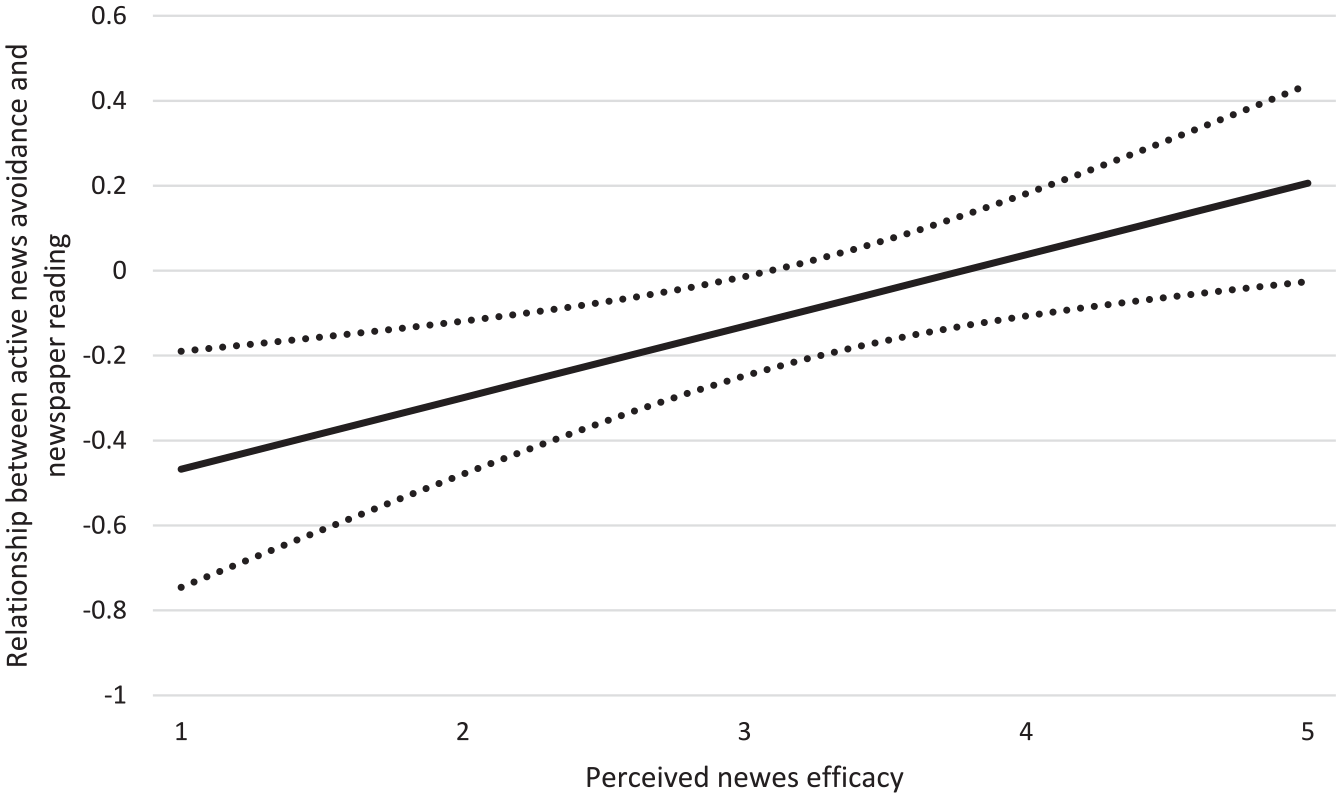
Relationship Between Active News Avoidance and Newspaper Reading at Different Levels of Perceived News Efficacy.
Figure 2 shows the relationship between news avoidance and TV news watching at different levels of secondary control. The interaction effect is significant at p < .01. The negative avoidance–consumption relationship is significant for people scoring 3.08 or lower on secondary control (24.8% of the respondents fall under this condition). The avoidance–consumption relationship becomes positive when secondary control reaches around 4.00, yet it remains insignificant even when secondary control reaches the maximum value.
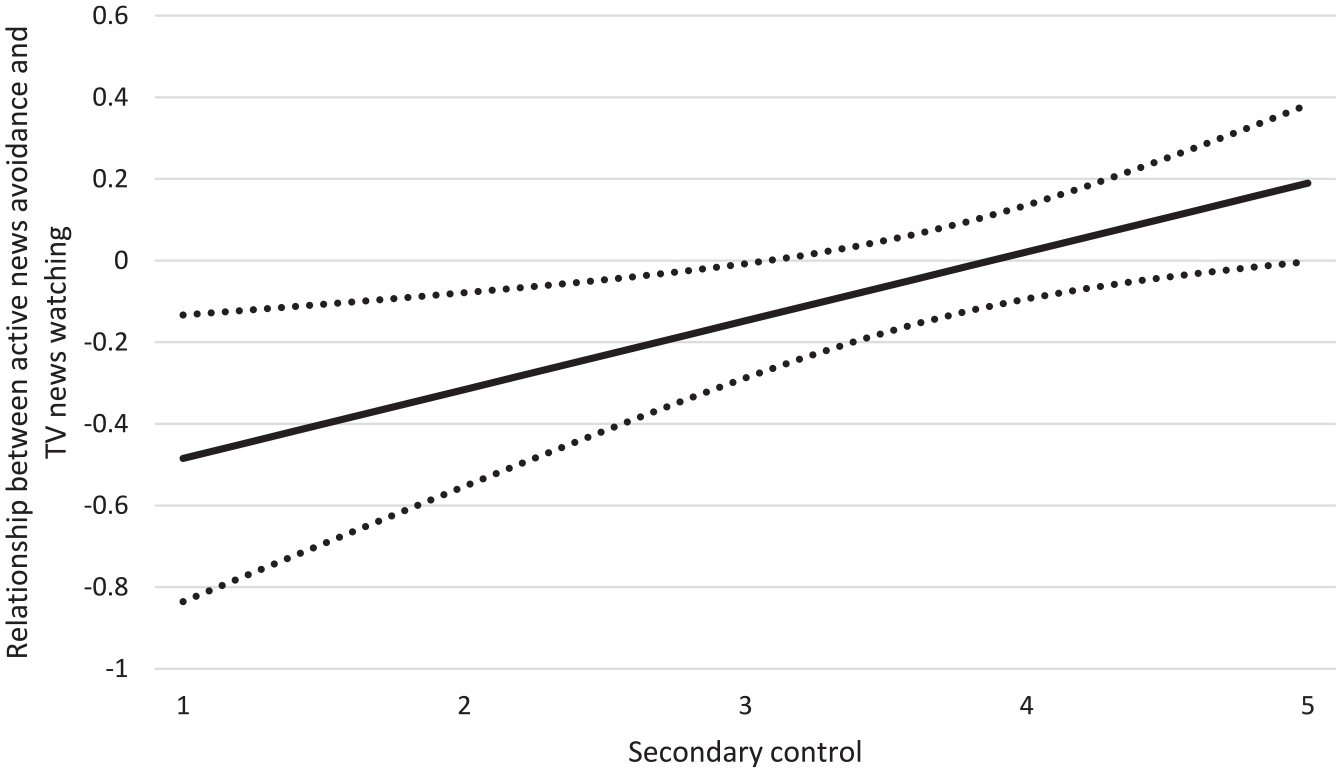
Relationship Between Active News Avoidance and TV News Consumption at Different Levels of Secondary Control.
Figure 3 shows the relationship between news avoidance and TV news watching at different levels of political communication via social media. The interaction effect is significant at p < .001. The negative avoidance–consumption relationship is significant for people whose scores on political communication via social media is 1.64 or lower (37.4% of the respondents falls under this condition). The avoidance–consumption relationship becomes positive when political communication via social media is higher than 2.26, and the positive relationship is even statistically significant when political communication via social media is higher than 2.90 (15.9% of the respondents fall under this condition).
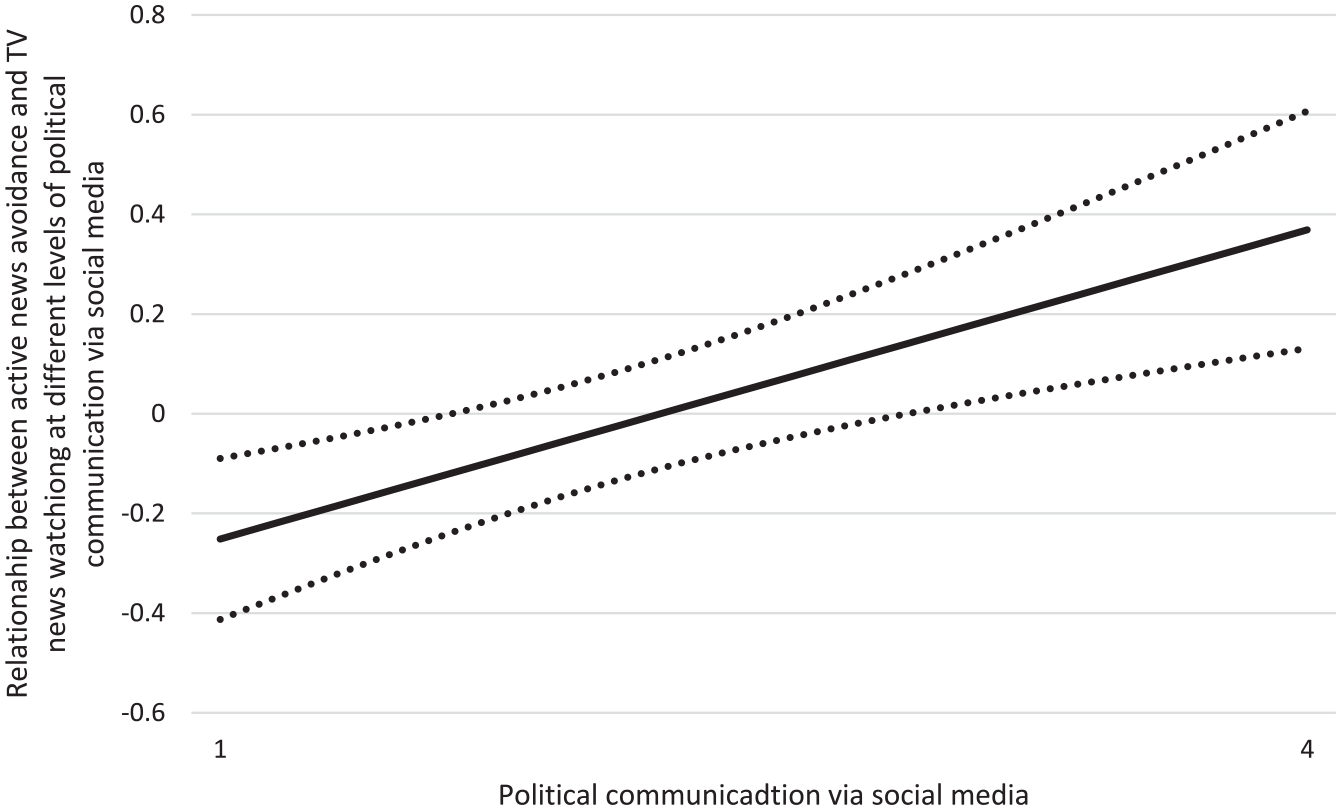
Relationship Between Active News Avoidance and TV News Consumption at Different Levels of Political Communication via Social Media.
Figures 1 to 3 thus confirm Table 1’s support for the hypotheses. Notably, 68.4% of the sample falls under at least one of the three conditions that render the avoidance-–onsumption relationship significant for either newspaper reading or TV news watching (i.e., news efficacy < 3.09, or secondary control < 3.08, or political communication via social media <1.64). Hence, news avoidance does relate negatively to at least one of the two forms of mainstream news consumption for most respondents. But the relationship is non-existent for some, and its strength does depend on several individual-level factors.
Predicting Alternative Media Exposure
The same regression analysis, but with alternative media exposure as a dependent variable, was conducted to examine RQ2. Table 2 summarizes the results. Similar to Table 1, before adding the interaction terms, the overall avoidance–consumption relationship is not significant. When the three interaction terms were added, only the interaction between secondary control and active topical news avoidance obtains a coefficient significant at p < .05, whereas the other are statistically insignificant.
Predicting Alternative Media Use.

Note. Entries are standardized regression coefficients. Missing values were replaced by means for family income and deleted pairwise for the others. N = 1003.
p < .001; ** p < .01; * p < .05.
Further analysis using PROCESS MACRO found that the interactions between active news avoidance and all three proposed moderators fail to reach the conventional level of statistical significance. Overall, the moderating influence of the three factors being examined is much weaker than in the case of mainstream news consumption.
Concluding Discussion
This article aims to understand the relationship between active topical news avoidance and news consumption. Theoretically, while avoiding the news might indeed mean reducing the overall amount of news consumption for some, active news avoidance can also be a situational strategy of news diet management. Under specific contexts, people may find the need to avoid news about specific topics to maintain their sense of efficacy and emotional wellbeing (Mannell & Meese, 2022; Woodstock, 2014). Topical news avoidance may or may not be associated with substantially lower levels of news consumption. Therefore, as a general analytical principle, researchers may interrogate into whether and how contextual and individual-level factors may shape the relationship between active topical news avoidance and news consumption.
Empirically, this study examines active topical news avoidance in a society undergoing democratic backsliding. The weakening of the role of public opinion in the political process can lead people to feel that public affairs have become irrelevant, and citizens can find the decline in civil liberties and democratic institutions frustrating. These can motivate them to avoid news about social and political changes. Indeed, in this survey, the active topical news avoidance index has a mean score of 3.21 on a 5-point scale. Nonetheless, active topical news avoidance does not significantly relate to either newspaper reading or TV news watching in a “main effects only” model. Instead, as Figures 1 to 3 illustrate, the tendency to avoid news about social and political change is linked to lower levels of either newspaper reading or television news watching mainly when people do not see the media as capable of playing important social roles, are not able to adjust themselves to a difficult environment, and do not engage in political communication via social media. For people who see the news media as efficacious, are capable of adapting, and remain active in political communication via social media, there can still be a need to manage one’s news diet, but it does not entail reducing the overall amount of news consumption.
The analysis also finds differences in how active topical news avoidance relates to two types of news consumption. The three proposed moderators do influence the relationships between news avoidance and mainstream news media consumption, but not alternative media exposure. One way to explain the contrasting findings is to acknowledge that, in the online environment and given the character of alternative media, people who are exposed to alternative media contents either do so incidentally or do so deliberately in their quest for like-minded contents. In either case, active news avoidance is unlikely to be pertinent: it is difficult to intentionally avoid contents that come incidentally, and people may not proactively avoid likeminded materials. Hence, the proposed individual-level factors would not moderate how active topical news avoidance relates to alternative media exposure.
Readers might wonder if the weakness of the findings concerning alternative media exposure is related to the extent to which survey respondents would acknowledge their exposure to such outlets given the political situation. This relates to the broader issue of possible preference falsification in surveys in nondemocracies. However, extant research in various autocratic contexts shows that the extent of preference falsification in surveys is not substantial (Shen & Trues, 2020). This survey, in particular, has registered a significant degree of political distrust. The findings are unlikely to be severely distorted by self-censorship and preference falsification.
This article contributes to the study of news avoidance in several ways. First, it extends such research to a different type of political contexts. Current research has largely focused on democracies in which active news avoidance typically results from news overload, perceived negativity of the news, and media distrust (Skovsgaard & Andersen, 2020). This article begins with the premise that there could be other reasons for people to avoid specific types of news under a different type of contexts, and it focuses on intentional avoidance of news about social and political change in particular. Generally speaking, news avoidance research can benefit from greater awareness of contextual differences. Context affects the main reasons for people to avoid the news and the type of news that is being shunned. It also affects what variables could be relevant in explaining avoidance and its implications. The current analysis, for instance, has illustrated the role of perceived news efficacy and second control in moderating the relationship between active topical news avoidance and news consumption.
Second, this article adds to recent studies conducted during the COVID pandemic (e.g., Mannell & Meese, 2022; Ytre-Arne & Moe, 2021) and highlights the possibility that active news avoidance is a situational strategy and topical in character. People in challenging situations might be hooked to the news, but following the news all the time under such circumstances could be emotionally draining. Many people thus “avoid” the news in some ways. Yet it does not entail a complete withdrawal from news consumption. Instead, people can adjust their news repertoire (Vandenplas et al., 2021) and develop practices to keep themselves informed (Ytre-Arne & Moe, 2021). Therefore, active topical news avoidance might only be weakly related to frequencies of news consumption. Democratic backsliding is not the same as pandemic lockdowns, but it presents another scenario in which active news avoidance as news diet management could become prominent. In a broader sense, this study rhymes with a range of media effects research emphasizing audience agency (Oliver & Raney, 2023)—news audience can be exercising their agency even as they are avoiding the news.
Third, this study is among the first to examine the conditional character of the relationship between active news avoidance and news consumption. Palmer et al.’s (2023) cross-national analysis has shown that active news avoidance and news consumption are negatively, but only moderately, related. In this study, active news avoidance is not even significantly related to news consumption before the moderators are considered. This is probably because this study has specified the type of news being avoided. In any case, the more important findings in this study concern the conditional character of the avoidance–consumption relationship. Some types of people, such as those less resilient in face of difficulties or those who take a negative view about the meaningfulness of news, are more likely to turn topical news avoidance into overall nonconsumption of news.
A few limitations and future research directions can be noted. First, there is limitation to the robustness of the support for H1 to H3, as the interaction terms are related significantly to only either newspaper reading or TV news watching. One possible reason is that both newspaper reading and TV news watching were measured by a single item. Better measures may allow researchers to uncover more robust support for the hypotheses. Besides, active news avoidance might indeed relate to newspaper and TV news consumption differently. Perceived news efficacy may indeed tend to moderate mainly the relationship between avoidance and newspaper reading more because newspapers conventionally allow more in-depth coverage when compared to TV news; it is more indicative of what social functions the media can carry out. Secondary control may tend to moderate mainly the relationship between avoidance and TV news watching because audio-visual media can be more emotionally draining, and secondary control is more pertinent to people’s ability to adjust psychologically to a difficult environment. In other words, there might be substantive differences between different media forms so that they would relate to news avoidance differently. This can be subjected to further conceptualization and empirical examination.
Second, this study only examines three potential moderators of the relationship between active (topical) news avoidance and news consumption. Other factors that might moderate the avoidance-consumption relationship could include sense of civic duty and political values—for exmple, a sense of civic duty might lead people who have the incentives to practice active news avoidance to nonetheless retain a certain extent of news consumption due to a perceived duty to be informed. Future research can examine such additional factors. One can also try to theorize more systematically the main conditions under which topical news avoidance would evolve into generalized nonconsumption of news, and conditions under which active news avoidance would be a news diet management strategy.
Third, the above discussion implies that the current findings are not expected to generalize to democracies. Nonetheless, the principle that individual-level factors could moderate the news-avoidance-consumption relationship should remain pertinent. Meanwhile, democratic backsliding can occur at different speeds (Bermeo, 2016), and contemporary Hong Kong can be considered a case of rapid backsliding. This might have aggravated the problem of news avoidance. Whether the findings can be replicated in more “stable” autocracies or societies where backsliding is more gradual can be addressed in the future.
Fourth, while this study examines a cross-sectional survey, future research can attempt to examine over-time changes in news avoidance and news consumption. Individuals may begin with different levels of news consumption, and they might adjust their news consumption to different extents as they engage in news avoidance. Scholars have recently begun to conceptualize the temporal dynamics of news avoidance and consumption (Moe et al., 2024). Relevant theoretical insights can be brought into the empirical analysis of over-time shifts in the avoidance–consumption relationship.
Despite such limitations, this study has illustrated the utility of interrogating into the variations in the relationship between active news avoidance and news consumption. Active news avoidance may or may not be related to levels of news consumption depending on individual-level factors and types of news media concerned. Examining how various factors moderate the avoidance-consumption relationship can allow us to better understand the nature and significance of active news avoidance. This general principle can guide further research on the phenomenon in both democratic and nondemocratic societies.
Supplemental Material
sj-docx-1-jmq-10.1177_10776990241302063 – Supplemental material for The Conditional Relationship Between Active (Topical) News Avoidance and News Consumption Under Democratic Backsliding
Supplemental material, sj-docx-1-jmq-10.1177_10776990241302063 for The Conditional Relationship Between Active (Topical) News Avoidance and News Consumption Under Democratic Backsliding by Francis L. F. Lee in Journalism & Mass Communication Quarterly
Footnotes
Declaration of Conflicting Interests
The author(s) declared no potential conflicts of interest with respect to the research, authorship, and/or publication of this article.
Funding
The author(s) disclosed receipt of the following financial support for the research, authorship, and/or publication of this article: The survey reported in this article was funded internally by the School of Journalism and Communication, Chinese University of Hong Kong.

Supplemental Material
Supplemental material for this article is available online.
Author Biography
References
Supplementary Material
Please find the following supplemental material available below.
For Open Access articles published under a Creative Commons License, all supplemental material carries the same license as the article it is associated with.
For non-Open Access articles published, all supplemental material carries a non-exclusive license, and permission requests for re-use of supplemental material or any part of supplemental material shall be sent directly to the copyright owner as specified in the copyright notice associated with the article.
