







Abstract
This study examines how the term “fake news” is strategically deployed in U.S. alternative media by analyzing Newsmax and Occupy Democrats as right- and left-leaning outlets. Drawing on Hallin’s sphere model and Egelhofer et al.’s coding categories, it uses manual content analysis and latent Dirichlet allocation topic modeling to identify rhetorical functions and patterns. Findings show that the term “fake news” functions mainly as a weaponized label to delegitimize opponents rather than describe misinformation. The results show how alternative media redraw boundaries between consensus, controversy, and deviance, underscoring their role in intensifying partisan discourse and redefining political communication.
Introduction
The term “fake news,” defined as fabricated information presented as legitimate news (Lazer et al., 2018), has frequently surfaced in news media, drawing considerable scholarly attention. Originally referring to falsified stories, the phrase has evolved to encompass a range of falsehoods and has been instrumentalized as a political device to discredit opponents and erode trust in mainstream journalism (Brummette et al., 2018; Egelhofer & Lecheler, 2019). Despite its prevalence, scholars continue to debate the term’s ambiguity and its implications for media credibility (Broda & Strömbäck, 2024). This conceptual instability warrants further investigation into how the term “fake news” functions rhetorically within polarized media environments.
As fake news discourse continues to undermine journalistic legitimacy and influence public decision-making (Chambers, 2021), much research has focused on its content, dissemination, and audience-level effects (Allcott & Gentzkow, 2017; Choi & Lee, 2022; Motta et al., 2020). These studies provide important insights into the consequences of misinformation but tend to treat fake news as an object of analysis rather than a rhetorical tool. Increasingly, the phrase itself has been repurposed as a discursive weapon, not to describe falsity, but to challenge authority, invert credibility hierarchies, and mobilize partisan audiences (Nygaard, 2023; van Duyn & Collier, 2019). This shift calls for closer examination of who uses the term, how it is framed, and to what political ends.
These dynamics are particularly pronounced in alternative media, which often operate outside traditional journalistic boundaries. Such outlets are less constrained by editorial oversight and tend to amplify emotion-driven, identity-based content (Hameleers et al., 2025). Freed from the institutional norms of mainstream journalism, alternative media both reflect and reinforce ideological polarization by redefining truth claims in terms of loyalty rather than verification (Holt et al., 2019; Rae, 2021). This makes them a critical arena for examining the rhetorical construction of legitimacy and deviance in contemporary political communication.
To address this gap, this study analyzes how two ideologically extreme U.S. alternative media outlets, Newsmax (right-leaning) and Occupy Democrats (left-leaning), invoke and frame the term “fake news.” Rather than seeking symmetry, these outlets serve as illustrative cases for understanding the strategic deployment of the term within hyperpartisan ecosystems. By comparing their rhetorical patterns, this study investigates whether the term operates similarly across ideological divides or serves distinct functions, such as reinforcing populist sentiment, targeting political elites, or legitimizing in-group identities.
Guided by Hallin’s (1986) sphere model and Egelhofer et al.’s (2020) coding framework, this study adopts a mixed-methods approach combining content analysis with Latent Dirichlet allocation (LDA) topic modeling. This dual framework allows both interpretive depth and computational breadth in uncovering how the term “fake news” is strategically invoked and framed within hyperpartisan discourse. Through this lens, the study demonstrates how the term “fake news” has evolved from a marker of misinformation into a rhetorical instrument of polarization, revealing how partisan media ecosystems instrumentalize language to construct political reality and erode epistemic authority.
Literature Review
Unraveling the Term “Fake News”
The term “fake news” has become a frequent topic in both public and academic discourse, yet its meaning remains far from clear. It is used to refer to a range of falsehoods, from misinformation, referring to false information shared without intent to deceive, to disinformation, referring to falsehoods spread deliberately with manipulative intent (Egelhofer & Lecheler, 2019). This conceptual ambiguity blurs the boundary between distinct phenomena, fostering indifference or resignation toward falsehoods as individuals become desensitized to their differences.
Egelhofer and Lecheler (2019) highlight this by examining the two-dimensional nature of the term as both a specific news genre and a discursive label. As a genre, fake news involves the deliberate dissemination of intentionally false information through formats that emulate legitimate journalism (Allcott & Gentzkow, 2017). This mimicry strategically employs journalistic conventions, such as headlines, body text, and multimedia elements, to craft persuasive narratives that blend falsehoods, sensationalism, and clickbait to deceive the audience (Robertson & Mourão, 2020).
In addition to being recognized as a genre, the term “fake news” has also become a potent discursive label used to undermine media outlets. Egelhofer et al. (2020) describe this as a “weaponized label” employed by political actors to delegitimize unfavorable news. Political figures, including former U.S. President Trump, have frequently employed this term to dismiss critical reporting that challenges their viewpoints (Coll, 2017; Frischlich et al., 2023). By labeling opposing news sources as “fake news,” these actors aim to erode public trust in the media and shape narratives in their favor (Nielsen & Graves, 2017).
Alternative media often adopt an antagonistic and delegitimizing stance toward mainstream journalism, describing it as outdated and elitist (Holt, 2018). This positioning enhances their perceived credibility as authentic voices of the people, distinct from the alleged biases of mainstream media. Leveraging social media as their primary distribution and amplification channel, these outlets disseminate content through established partisan echo chambers, reinforcing ideological narratives and insulating audiences from dissenting views (Larsson, 2019).
This tactic fosters hostility toward journalism, framing the media as deceitful and undermining journalistic credibility. Denner and Peter (2017) caution that the “trivialization of a term with such negative connotations is problematic and could contribute to the establishment of ‘lying press’ as an unreflective label for the media” (p. 275). Egelhofer et al. (2020) further argue that the weaponization of “fake news” not only diminishes the credibility of specific media outlets but also fuels a broader distrust in journalism, driving audiences toward alternative media sources that reinforce their existing biases.
Beyond its political usage, fake news has increasingly devolved into an overused buzzword in public discourse. Egelhofer et al. (2020) observed that various actors, including journalists, often apply the term indiscriminately to dismiss information they find disagreeable or inconvenient, regardless of its factual accuracy. This casual and imprecise usage further dilutes the meaning of fake news, blurring the line between deliberate misinformation and legitimate critique. As journalists increasingly resort to using the term, it risks being overemphasized or reduced to a trivial buzzword, ultimately undermining its ability to convey the real dangers posed by disinformation (Egelhofer & Lecheler, 2019). As a result, the term has lost much of its original significance, raising concerns about its trivialization and potential to distort public understanding of disinformation.
While existing studies have examined the broader phenomena of misinformation and disinformation, particularly their spread, framing, and influence on public discourse (Guess et al., 2017; Tandoc et al., 2018), they differ in methodological focus and analytic level. On the one hand, a substantial body of research has employed content analysis to explore how political actors and media outlets use the term “fake news” to undermine trust, frame political opponents, and construct ideological boundaries (Egelhofer et al., 2020). These studies have primarily illuminated the rhetorical functions of the term within elite and media discourse. On the other hand, experimental and survey-based studies have addressed the effects of misinformation exposure at the individual level, such as changes in political attitudes, trust in journalism, and belief accuracy (Guess et al., 2020; Pennycook & Rand, 2019).
Despite these contributions, few studies have empirically examined the term “fake news” as a rhetorical label within alternative media spaces, especially how it is invoked and framed to serve partisan objectives. This gap is particularly noteworthy given the growing influence of alternative media in shaping political narratives and amplifying polarization while operating outside traditional journalistic norms. The devolution of the term “fake news” from its original meaning to an overused buzzword complicates the public’s ability to distinguish fact from fiction, deepening political polarization and eroding public trust in traditional media (Egelhofer & Lecheler, 2019). Moreover, the deliberate weaponization of the term by politically motivated actors has far-reaching implications for societal cohesion, shaping public opinion and discrediting opposing viewpoints. Addressing this gap, this study investigates how the term “fake news” is strategically deployed in alternative media content, with attention to its discursive function in contesting journalistic legitimacy and reinforcing ideological division.
Navigating the Fragmented Media Landscape: From Ideal Expectations to the Actual Political Role of Alternative Media
Alternative media, digital platforms that operate outside the professional norms of mainstream journalism (Holt et al., 2019), have, in recent years, reshaped the media landscape. While initially praised for amplifying marginalized and underrepresented voices and offering perspectives beyond corporate-driven narratives, many of these outlets have increasingly embraced ideologically hyperpartisan content (Atkinson et al., 2021). With the growing influence of digital platforms, alternative media have blurred the line between factual reporting and political advocacy, prioritizing partisan content over objective journalism (Holt et al., 2019). As a result, the alternative media ecosystem plays a central role in promoting ideological narratives and contributing to political polarization (Nygaard, 2023).
Building on different historical trajectories, research on alternative media has emerged from both the United States and Europe, revealing distinct origins yet converging contemporary dynamics. In Europe, alternative media have traditionally served as counter-hegemonic platforms, challenging dominant narratives in mainstream media (Fuchs, 2010). In the United States, their rise was marked by the popularity of conservative talk radio, particularly Rush Limbaugh’s syndicated show, which became a defining force in right-wing media (Jamieson & Cappella, 2008). More recently, European scholars have examined alternative media as hyperpartisan platforms contributing to media fragmentation, with social media playing a key role in amplifying these narratives (Larsson, 2019; Mayerhöffer, 2021). Despite their differing origins, alternative media across both regions have converged in their reliance on digital platforms and in their contribution to political polarization.
One of the most significant transformations within alternative media has been the shift toward hyperpartisan content, which deepens ideological divides. Both liberal and conservative alternative media outlets tend to frame political discourse around an “us” versus “them” narrative, attacking opposing ideologies while reinforcing their own agendas (Rae, 2021). For instance, liberal outlets advance anticapitalist and prosocial justice narratives, criticizing conservative policies and figures such as former President Trump (Shammas, 2017). Conversely, conservative media adopt a nationalist and antiestablishment stance, positioning mainstream media and liberal elites as corrupt or disconnected from ordinary citizens (Benkler et al., 2018). This dynamic illustrates the central role of alternative media in shaping public opinion while exacerbating political polarization.
In the United States, Newsmax on the right and Occupy Democrats on the left have become prominent examples of how partisan subjectivity often takes precedence over factual accuracy (Guess et al., 2020; Rae, 2021). These platforms leverage digital media to bypass traditional gatekeepers, reaching broader audiences while promoting sensationalist, ideologically driven content. Despite their opposing ideological stances, pro-Trump, antiestablishment rhetoric on the right and progressive, anticonservative rhetoric on the left, both outlets rely on clickbait and emotional appeals to engage readers, contributing to a polarized media environment (Rae, 2021; Shammas, 2017).
According to MediaBiasFactCheck.com (2025), a platform that evaluates the political leanings of news sources, Newsmax and Occupy Democrats were classified as hyperpartisan right and left outlets with mixed reliability, respectively. These outlets were chosen to represent contrasting sides of the political spectrum in our analysis of partisan media. While both deviate from mainstream journalism, they differ significantly in structure, audience reach, and credibility. Newsmax operates as a cable and online news platform targeting traditional viewers, while Occupy Democrats is a digital-native outlet driven by social media. Furthermore, Newsmax maintains a more formal news structure, whereas Occupy Democrats is often criticized for emotional and ideologically driven content.
The rise of extremist alternative media labeled as “alt-right” and “alt-left” presents an additional threat to democratic processes. Far-right outlets have been shown to disseminate hate speech, xenophobia, and misinformation targeting minority groups (Mayerhöffer, 2021), while far-left outlets use anticapitalist and antiestablishment rhetoric to incite political unrest (Nygaard, 2023). Both extremes exploit social media platforms to spread divisive content, further fragmenting the public sphere and complicating efforts to foster informed public discourse. Such hyperpartisan content has blurred the lines between fact-based journalism and political advocacy, eroding public trust in democratic institutions (Guess et al., 2017; Rae, 2021). This growing trend underscores the urgent need to consider the ethical responsibilities of alternative media and reassess the broader impact they have on public discourse and democratic debate (Frischlich et al., 2023).
As hyperpartisan discourse intensifies, the term “fake news” has emerged as a particularly potent rhetorical device, especially in alternative media spaces. While Egelhofer et al. (2020) explored its weaponized use in Austrian mainstream journalism, less is known about how ideologically extreme outlets in the United States strategically deploy the term to discredit dissenting views. This study addresses this gap by empirically investigating how the term “fake news” is invoked by both left- and right-leaning alternative media, focusing on its discursive function in delegitimizing mainstream narratives and reinforcing partisan worldviews.
We specifically assume that the more assertive use of “fake news” by Occupy Democrats and Newsmax functions as a discursive counterstrategy to contest and reframe rhetoric advanced by their respective political opponents. While partisan outlets often use the term to delegitimize ideological opponents (Farkas & Schou, 2018), Occupy Democrats reappropriate and intensify it, highlighting and condemning figures such as President Trump and right-leaning media who spread fake news or use it as a weaponized label, and deploying it to discredit those actors. This reflects a pattern in which communicators first signal that a held position is under attack, then actively refute opposing arguments to diminish the credibility of challengers. Occupy Democrats reappropriate and critique conservative media’s use of “fake news” in ways that both construct perceived threat and enact counterarguing as a form of refutational preemption. This strategy involves consistently highlighting and condemning the term’s overuse by figures such as President Trump and right-leaning outlets, while simultaneously leveraging it as a rhetorical device to undermine the credibility of those same actors. In contrast, Newsmax uses the term primarily to challenge mainstream narratives perceived as liberal-leaning. By doing this, we aim to examine how alternative media, when positioned on ideologically opposed sides under extreme circumstances, engage in mutual delegitimization to reinforce and justify their own political stances.
Drawing on prior literature, the study proposes the following hypotheses:
Analyzing the Use of the Term “Fake News” in Alternative Media: A Dual Framework Approach Using Hallin’s Three-Sphere Model and Egelhofer et al.’s Categorization
In today’s media ecosystem, alternative media occupies a unique and complex space, positioned between its role as a challenger to mainstream norms and its tendency to exacerbate societal polarization (Rae, 2021). To place this phenomenon within a broader theoretical framework, this study examines how hyperpartisan outlets such as Newsmax and Occupy Democrats strategically deploy the term “fake news,” drawing on Hallin’s (1986) three-sphere model and Egelhofer et al.’s (2020) classification scheme.
Hallin’s (1986) three-sphere model categorizes media discourse into the sphere of consensus, the sphere of legitimate controversy, and the sphere of deviance. Each sphere reflects whether particular issues are widely accepted, openly debated, or marginalized within a society. The sphere of consensus includes topics on which there is broad societal agreement. In this sphere, mainstream and alternative outlets often converge, showing little disagreement over widely accepted norms. For example, fake news is generally treated as misleading or false content, and actors across the political spectrum tend to support corrective strategies. Such efforts include a four-dimensional correction framework involving verification, rejection, and both public and private corrective engagement (Li et al., 2025), as well as calls to reinforce journalistic standards.
The sphere of legitimate controversy includes issues that remain under active public debate. Within this sphere, alternative media often diverge from mainstream outlets by challenging established narratives and questioning the credibility of their opponents (Nygaard, 2023). Rae (2021) further notes that hyperpartisan outlets frequently shift across Hallin’s spheres, recasting issues from consensus to deviance as they redefine what counts as contestable. In this context, competing news sources may frame identical information as either truthful or false, positioning it as a matter for public dispute. Such interpretive divergence facilitates fact contestation and reveals how hyperpartisan platforms strategically deploy the term “fake news” to delegitimize opposing viewpoints. While this usage aligns with Hallin’s notion of legitimate controversy, it simultaneously complicates balanced public discourse by transforming interpretive disagreements into broader challenges to epistemic authority.
Mainstream media, however, approach the term from a different position. Rather than using the term “fake news” to discredit opposing narratives, they have emphasized the risks associated with its misuse, aligning themselves with journalistic standards found in the consensus sphere. For example, Margaret Sullivan (2018), a media columnist for The Washington Post, has advocated for retiring the term, emphasizing that its overuse has distorted public understanding of journalism. This mainstream stance contrasts with the strategic appropriation of the term by alternative media, where it is often used not to promote factual accuracy but to undermine ideological opponents and reframe credibility disputes as partisan conflicts.
Lastly, the sphere of deviance encompasses ideas and perspectives that fall outside the boundaries of acceptable discourse. Within this sphere, alternative media such as Newsmax may label mainstream outlets as “fake,” undermining their authority and pushing them to the margins of the media landscape. Following Rae’s (2021) account of escalating hyperpartisanship, the use of “fake news” increasingly appears to function as a mechanism for enforcing ideological conformity rather than facilitating legitimate debate. This movement from legitimate controversy to deviance illustrates how hyperpartisan platforms deploy the term not merely to challenge opponents but to delegitimize them altogether. By recasting opposing viewpoints as extreme or untrustworthy, alternative media contribute to redefining the boundaries of acceptable discourse and further amplify societal and political divides.
Building on Hallin’s framework, it becomes evident that hyperpartisan environments do not merely reflect the boundaries between legitimate controversy and deviance but actively reshape them. By labeling dissenting or mainstream perspectives as “fake news,” alternative media can reposition widely accepted narratives as deviant, thereby narrowing the space for balanced debate and redefining discourse boundaries along ideological lines. This aligns with Nygaard’s (2023) observation that alternative media may move issues across spheres depending on how they are framed. In this sense, Hallin’s (1986) spheres are fluid rather than fixed, with their boundaries shifting as media norms evolve.
In addition, this study integrates Hallin’s macrolevel model with Egelhofer et al.’s (2020) micro-level typology, which conceptualizes “fake news” not merely as a descriptor of false content but as a rhetorical device with strategic functions. According to Egelhofer et al. (2020), the term may operate as a disinformation genre that mimics journalistic conventions, an empty buzzword used to dismiss criticism, or a weaponized label intended to delegitimize unfavorable coverage. Whereas Hallin’s model maps how discourse is categorized in the public sphere, Egelhofer’s typology highlights how political actors exploit language to shape audience perception and partisan narratives.
To investigate these dynamics, this study advances the following research questions:
Methods
Selection of Media Outlets and Data Collection
We selected Newsmax and Occupy Democrats as emblematic right- and left-leaning cases (MediaBiasFactCheck.com, 2025) for their influence on online political discourse, their relevance to media polarization research (Benkler et al., 2018; Shammas, 2017), and their accessibility for systematic data collection, illustrating how they deploy the term “fake news” to reinforce ideological narratives.
For data collection, we employed a Python-based web crawling program to extract relevant articles from both outlets. Using HTTP requests and the BeautifulSoup library (Abodayeh et al., 2023), we adapted scripts from publicly available templates with minor modifications by the authors (e.g. adjusting parsing logic to handle inconsistent HTML structures and removing extraneous page elements) to retrieve article text containing the term “fake news.” The collection period spanned from April 2015 to October 2023, encompassing two pivotal moments in the “fake news” discourse: the 2016 U.S. presidential election, which served as the foundational moment in shaping the term’s political significance (Allcott & Gentzkow, 2017), and the COVID-19 pandemic, during which the term resurfaced as a prominent term as competing narratives about public health and government response intensified (Nutsugah et al., 2025).
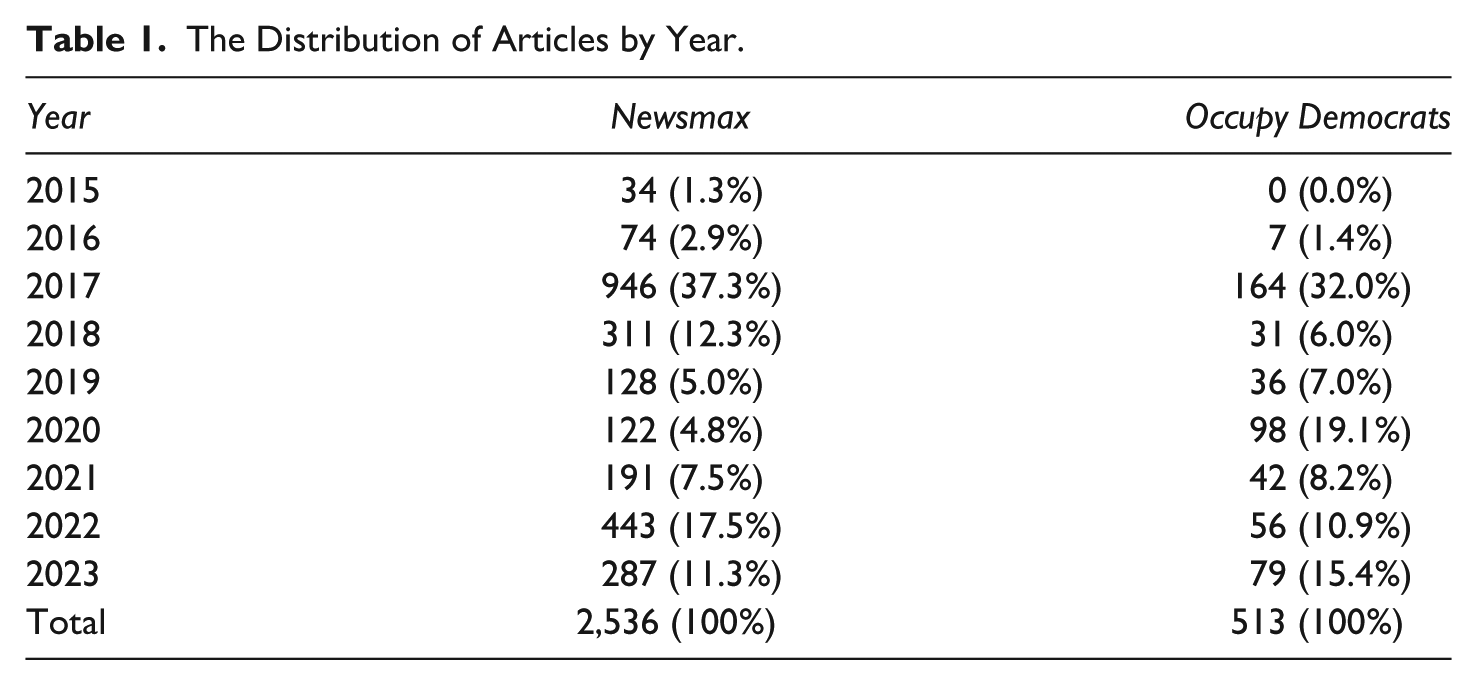
The initial dataset comprised 2,780 articles from Newsmax and 806 from Occupy Democrats. To reduce redundancy and ensure the inclusion of valid articles, we refined the dataset in two stages. First, we removed duplicate articles using Microsoft Excel. Articles with identical titles and URLs were flagged as duplicates. In cases where URLs differed only slightly, such as through appended tracking parameters, we manually reviewed the content to confirm redundancy. Only verified duplicates were excluded. Second, we filtered out content that did not qualify as full-length articles. This included content lacking substantive journalistic text (e.g. placeholders such as “###” or “!!!”), automatically generated promotional prompts (e.g. “Click here for more”), advertisements presented as articles, and malformed or blank entries caused by scraping errors. After this process, the final dataset included 2,536 articles from Newsmax and 513 from Occupy Democrats, all of which substantively engaged with the term “fake news.” Table 1 presents an overall distribution of articles by year.
The Distribution of Articles by Year.
Data Analysis
We employed a theory-driven mixed-methods approach to examine how alternative media strategically deploy the term “fake news,” combining manual content analysis with computational text analysis.
The first stage involved a human-coded content analysis, guided by Egelhofer et al.’s (2020) typology, which conceptualizes the term as a disinformation genre, empty buzzword, or weaponized label. This stage addressed H1 and H2 by identifying explicit rhetorical strategies, attribution patterns, and actor-level dynamics in a random sample of articles from Newsmax and Occupy Democrats. We coded whether the term was used in a weaponized manner to delegitimize political opponents, and whether referenced actors themselves used the term in such a way.
The second stage applied LDA topic modeling to address RQ1 and RQ2, exploring broader thematic patterns and narrative structures in line with Hallin’s (1986) three-sphere model. RQ1 focuses on detecting shifts in alternative media discourse from legitimate controversy toward hyperpartisan framing, while RQ2 examines both norm-consistent uses (as a disinformation genre applied to verifiably false content) and norm-divergent uses of the term (as a weaponized label). This computational approach is particularly suited for detecting latent themes in large-scale corpora (Blei et al., 2003) that may not be evident through manual coding. At the same time, large-scale computational text analysis can be prone to contextual oversimplification and limited validation if machine learning outputs are not carefully interpreted, which may lead to misclassification and biased findings (Linde et al., 2025).
By linking microlevel rhetorical framing from manual coding (H1–H2) with macrolevel structural patterns from topic modeling (RQ1–RQ2), we provide a comprehensive account of how “fake news” operates as both a targeted label and a boundary-setting discourse tool in hyperpartisan media. This methodological integration also strengthens the validity of our findings, as key qualitative frames reappeared in the large-scale unsupervised analysis (Isoaho et al., 2019; Nelson, 2020).
Content Analysis
For the content analysis, we randomly selected 759 articles from Newsmax and 154 from Occupy Democrats, representing 30% of the total articles from each outlet. To ensure temporal representativeness and avoid oversampling years with unusually high coverage of the term “fake news,” we used an Excel-generated random number table to perform stratified random sampling by year.
Development of Coding Scheme
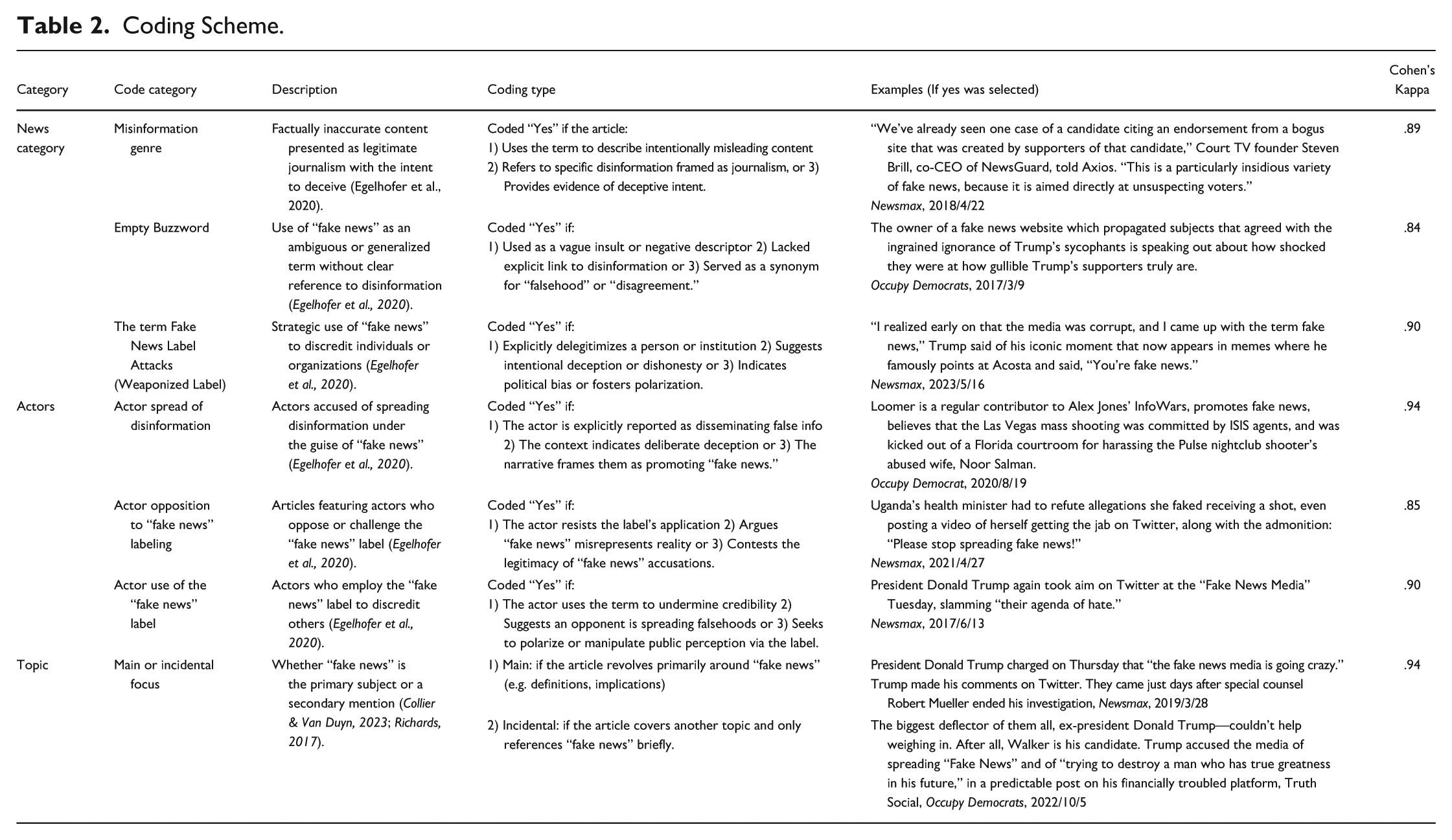
We developed a human-coded scheme grounded in Egelhofer et al.’s (2020) framework to analyze both the rhetorical functions and the actor-based dynamics of the term “fake news” in the collected news articles. Each article was treated as a unit of analysis and coded using binary values (1 = presence, 0 = absence) across predefined categories. The full coding scheme, including category descriptions and examples, is presented in Table 2.
Coding Scheme.
Coding Procedure and Intercoder Reliability
Two graduate students specializing in journalism conducted a thorough review of all content in which the term “fake news” was used. The training process began with initial discussions about the codebook, followed by multiple rounds of coding to resolve disagreements. This process continued until an acceptable level of intercoder reliability was achieved. Prior to the human-coded content analysis, a pretest was conducted to identify and address any potential disagreements between the coders. Approximately 10% (N = 90) of the news articles were randomly selected from the samples for the pretest. Intercoder reliability values for each coding scheme, calculated using Cohen’s kappa, are reported in the coding scheme descriptions. These values ranged from .84 to .94, indicating a high level of agreement between the coders (see Table 2).
Topic Modeling Analysis
LDA topic modeling was conducted separately for each outlet. The step-by-step process of the LDA topic modeling procedure is illustrated in Figure 1.
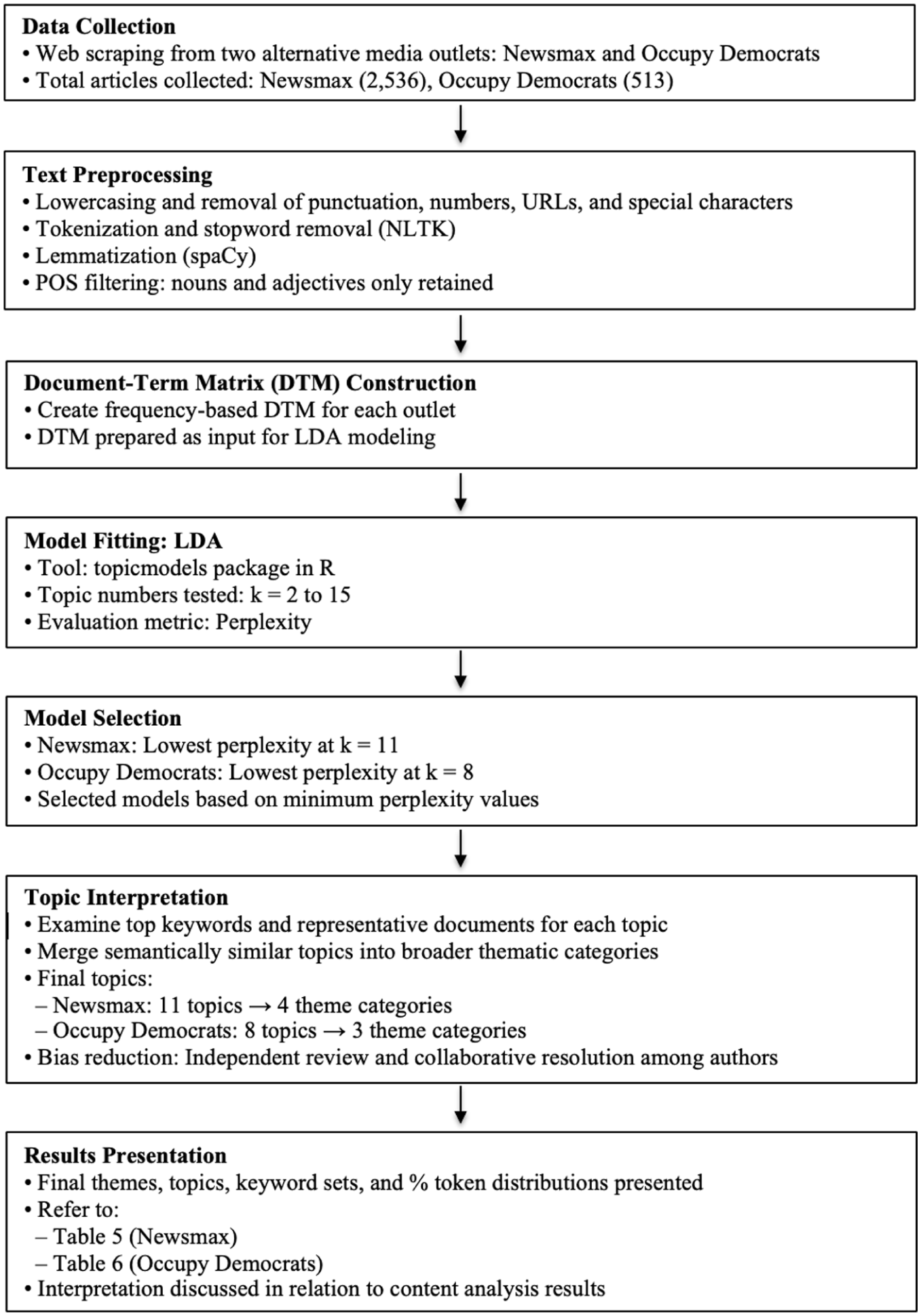
Stepwise Process of LDA Topic Modeling.
Preprocessing
We converted all text to lowercase and removed punctuation, special characters, numbers, and URLs. We then tokenized the text, breaking it down into individual words. Additionally, we removed stop words (e.g. “the,” “is,” & “and”) and lemmatized words to their root forms. This ensured that different word forms of the same word were analyzed as a single term. To further refine the dataset, we extracted nouns and adjectives from the text. All preprocessing steps were executed using the Python libraries Natural Language Toolkit (Bird et al., 2009) and spaCy (Montani et al., 2023).
Topic Number Selection
After preprocessing, we applied LDA, a generative probabilistic model, to uncover latent topics within each outlet’s dataset. LDA assumes that each document is a mixture of topics, with each word probabilistically assigned to one of those topics. The modeling was conducted in R, using the tm package for text preprocessing (Feinerer et al., 2008) and the topicmodels package to implement the LDA algorithm (Grün & Hornik, 2011).
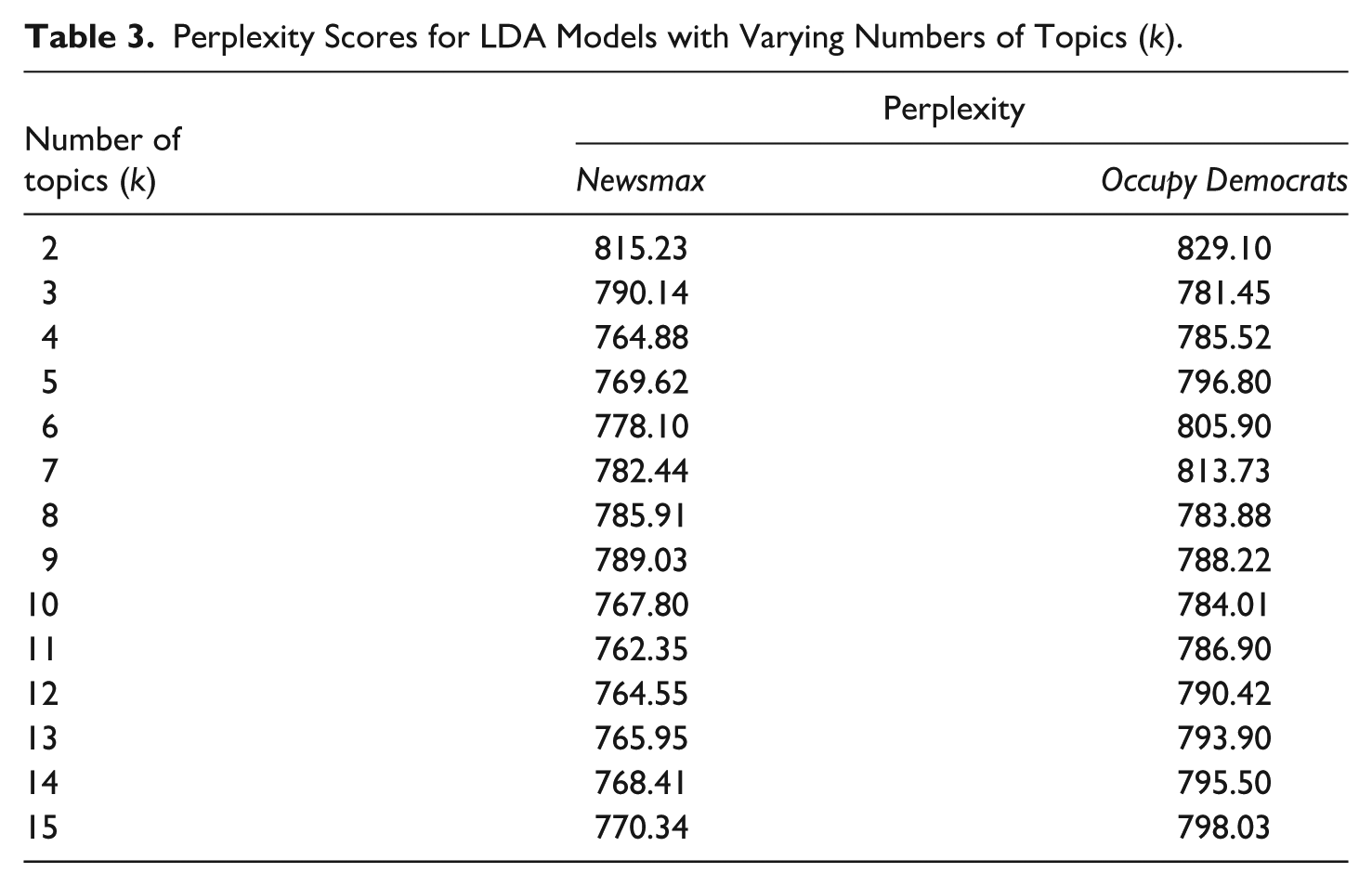
To determine the optimal number of topics (k), we evaluated a range of models from k = 2 to k = 15, relying on perplexity scores to assess model fit. Although coherence scores are commonly used, we prioritized perplexity due to concerns that coherence optimization may produce overly narrow or redundant topic structures, especially in the context of complex political discourse (Fu et al., 2021). Compared to coherence, perplexity offers a more statistically grounded measure of model fit by assessing how well a topic model predicts unseen documents through the log-likelihood of the observed data under the model’s estimated distributions (Wallach et al., 2009). As shown in Table 3, the lowest perplexity was observed at k = 11 for the Newsmax (762.35) and at k = 8 for the Occupy Democrats (783.88). In each topic, we included the “% of Corpus (topic tokens)” values to represent the proportion of tokens belonging to each topic in the entire corpus.
Perplexity Scores for LDA Models with Varying Numbers of Topics (k).
Topic Interpretation
To enhance interpretability, we observed that several of the LDA-generated topics (11 for Newsmax, 8 for Occupy Democrats) shared substantial semantic overlap. We therefore consolidated these into higher-order themes, grouping conceptually related topics together. This process resulted in four themes for Newsmax and three for Occupy Democrats, allowing us to capture broader patterns in the discourse while reducing redundancy.
To consolidate the topics into broader themes, each author independently reviewed the topic–word distributions and representative documents, proposed initial labels, and reached consensus through discussion. Labeling decisions were guided by Hallin’s (1986) model, relevant prior research, and representative article headlines to ensure conceptual and thematic coherence. Following common practice in topic modeling (Nelson, 2020; Roberts et al., 2016), we did not compute intercoder reliability statistics, as theme naming is an inherently interpretive process. This approach aligns with best practices in topic modeling interpretation (Grimmer & Stewart, 2013; Nelson, 2020; Roberts et al., 2016), which involves close examination of top keywords, representative articles, and narrative context.
Using Hallin’s (1986) three-sphere model, we evaluated how each topic aligned with the spheres of consensus, legitimate controversy, or deviance. This mapping enabled us to analyze broader patterns in how the term “fake news” is ideologically positioned across alternative media discourse.
Although Egelhofer et al.’s (2020) framework was not directly applied during the modeling phase, several topics conceptually overlapped with their typology: misinformation-related topics reflected the disinformation genre, vague or generalized uses aligned with the empty buzzword category, and partisan attacks corresponded to the weaponized label. These parallels offered further insight into how the term “fake news” operates as a rhetorical device in hyperpartisan narratives.
Results
Use and Function of the Term “Fake News”
To test H1 and H2, we analyzed how the term “fake news” was employed by Newsmax and Occupy Democrats across different rhetorical functions and actor contexts.
Purpose of the Term “Fake News.”
The analysis shows that both Newsmax and Occupy Democrats frequently used the term “fake news” to describe deliberately misleading content, aligning with the disinformation genre, 67.2% of Newsmax articles and 81.8% of Occupy Democrats articles (χ² = 12.96, p < .001). The term also appeared overwhelmingly as an empty buzzword without clear reference to disinformation, 99.9% in Newsmax and 100% in Occupy Democrats (χ² = .20, p = .831), indicating its broad rhetorical use. Finally, the weaponized label was common, appearing in 89.6% of Newsmax articles and 98.7% of Occupy Democrats articles (χ² = 13.14, p < .001), suggesting stronger adversarial deployment by Occupy Democrats.
Actors Using the Term “Fake News.”
Regarding key actors, both outlets rarely featured individuals or groups opposing the term “fake news,” with no significant difference between Newsmax (99.1%) and Occupy Democrats (98.7%) (χ² = .19, p = .465). Reports of disinformation spread by specific actors appeared more often in Occupy Democrats (96.1%) than in Newsmax (73.5%) (χ² = 37.25, p < .001). Politicians frequently used the term to discredit opponents in both outlets, also with no significant difference (Newsmax: 97.1%; Occupy Democrats: 99.4%) (χ² = 2.64, p = .078).
Main versus Incidental Focus
The term “fake news” was more often mentioned incidentally than as a primary focus in both outlets, with 64.0% in Newsmax and 70.8% in Occupy Democrats (χ² = 2.87, p = .064), suggesting that it typically appeared as a secondary element within broader discussions (Table 4).
Content Analysis Results: Cross-Tabulations.
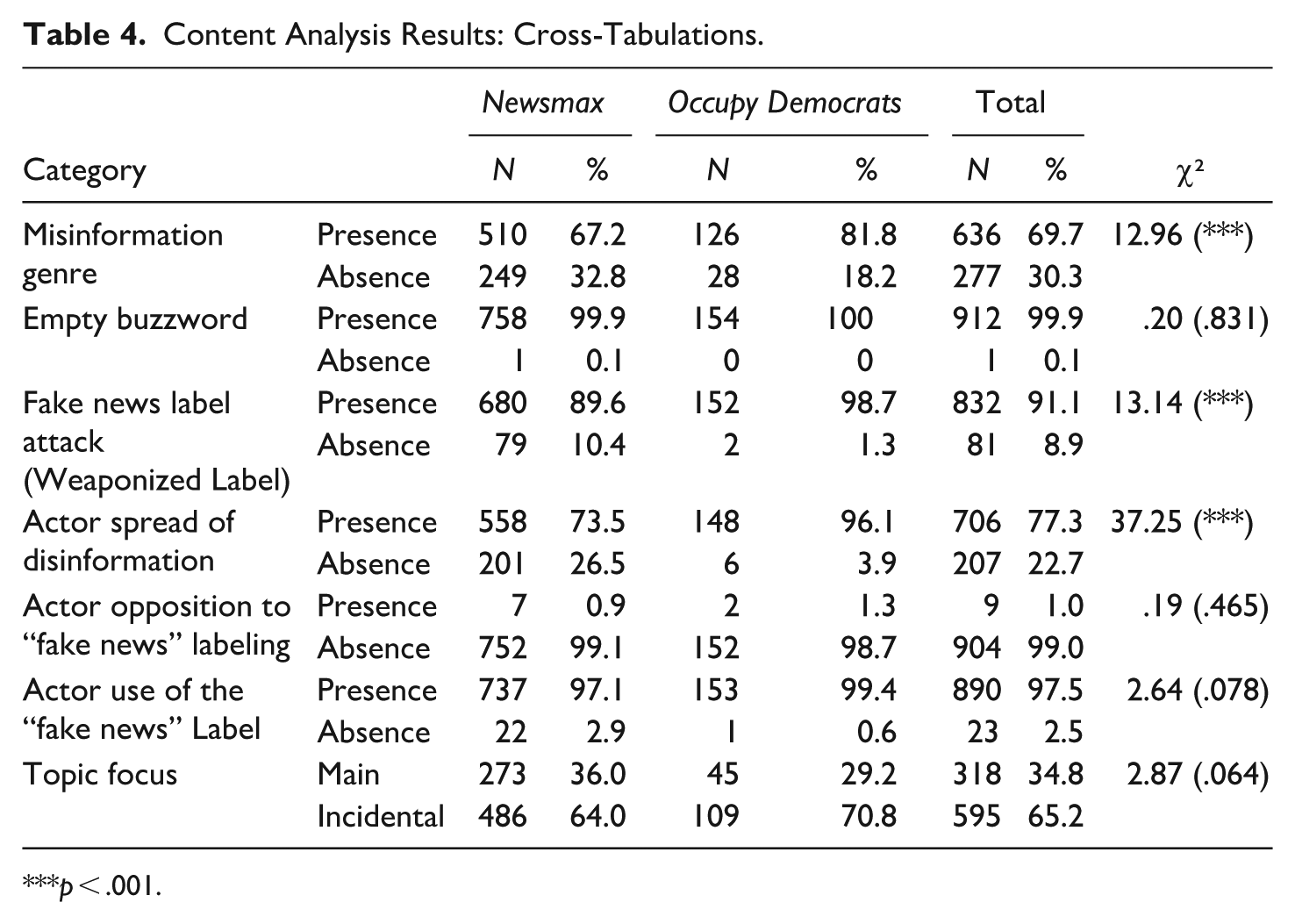
p < .001.
Mapping the term “Fake News” Rhetoric onto Hallin’s Three Spheres
To address RQ1, we applied LDA topic modeling to uncover discursive patterns that align with Hallin’s three-sphere model, focusing on the transition from legitimate controversy to deviance.
Topic Modeling Results in Newsmax
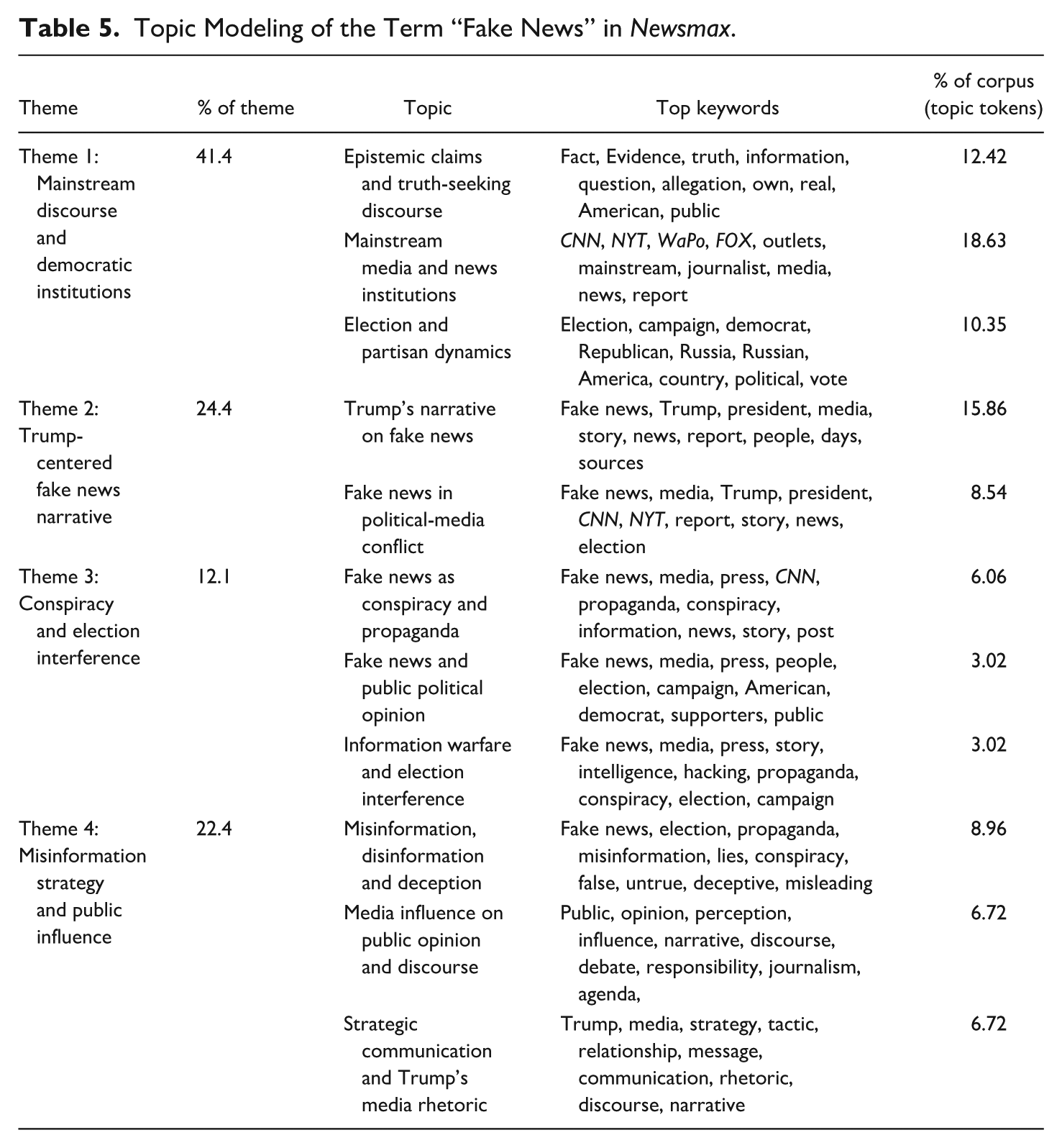
Theme 1: Mainstream Discourse and Democratic Institution (41.1%)
The first theme consists of three topics. The first, “Epistemic claims and truth-seeking discourse,” features terms such as “facts,” “truth,” and “evidence,” reflecting Newsmax’s skeptical stance toward information it deems false, as illustrated by the statement: “fake news was not really an honest effort to seek out facts, but more to determine for other people what truth they should hear.” The second topic, “Mainstream media and news institutions,” targets outlets such as “NYT,” “CNN,” and “WaPo,” highlighting Newsmax’s adversarial posture toward mainstream journalism and alignment with conservative media. The final topic, “Election and partisan dynamics,” embeds “fake news” within U.S. election discourse, including terms such as “election,” “campaign,” “democrats,” and “Russian,” linking it to allegations of Russian interference, as reflected in a statement noting that Russia hacked and leaked documents from U.S. political groups during the presidential campaign.
Theme 2: Trump-Centered Fake News Narrative (24.4%)
The second theme consists of two topics. The first, “Trump’s narrative on fake news,” emphasizes discourse supportive of the Trump administration, including attacks on liberal and mainstream media and references to his speeches, as illustrated by: “Trump continued his slamming of the media, tweeting that the fake news media was a ‘great danger to our country.’” The second topic, “Fake news in political-media conflict,” concerns the use of terms such as “fake news media,” “mainstream media,” and “enemy” to discredit liberal outlets, exemplified by phrases like “Newsmax exposes the bias of mainstream media” and “providing the truth amidst fake news media.”
Theme 3: Conspiracy and Election Interference (12.1%)
The third theme comprises three topics. The first, “Fake news as conspiracy and propaganda,” centers on Newsmax’s portrayal of CNN as promoting conspiracy and propaganda, reflected in terms such as “conspiracy,” “propaganda,” and “lies,” as in the statement: “Trump added that corrupt Media conspiracy at all-time high.” The second topic, “Fake news and public political opinion,” highlights the adversarial relationship between the Trump administration and mainstream media and its supporters, as illustrated by: “Trump has treated the news media as an opposition party.” The third topic, “Information warfare and election interference,” frames alleged election fraud through hacking, intelligence operations, and conspiracy-related themes, exemplified by: “Trump Jr. tweeted that CNN was defending ‘literal fake news’ and derided Bernstein as a ‘leftist hack.’”
Theme 4: Misinformation Strategy and Public Influence (22.4%)
The fourth theme comprises three topics. The first, “Misinformation, disinformation and deception,” centers on discourse about false or misleading information, including terms such as “fake news,” “propaganda,” “untrue,” “deceptive,” and “misleading,” exemplified by: “he (Obama) has been spreading deceptive allegations and outright lies as a political tactic.” The second topic, “Media influence on public opinion and discourse,” concerns how media narratives shape public perception and agenda-setting, as reflected in: “The agenda-driven media reared its ugly head during the Senate confirmation hearings.” The third topic, “Strategic communication and Trump’s media rhetoric,” highlights Trump’s deliberate use of messaging to shape political discourse through terms like “strategy,” “tactic,” and “rhetoric” (Table 5).
Topic Modeling of the Term “Fake News” in Newsmax.
Topic Modeling Results in Occupy Democrats
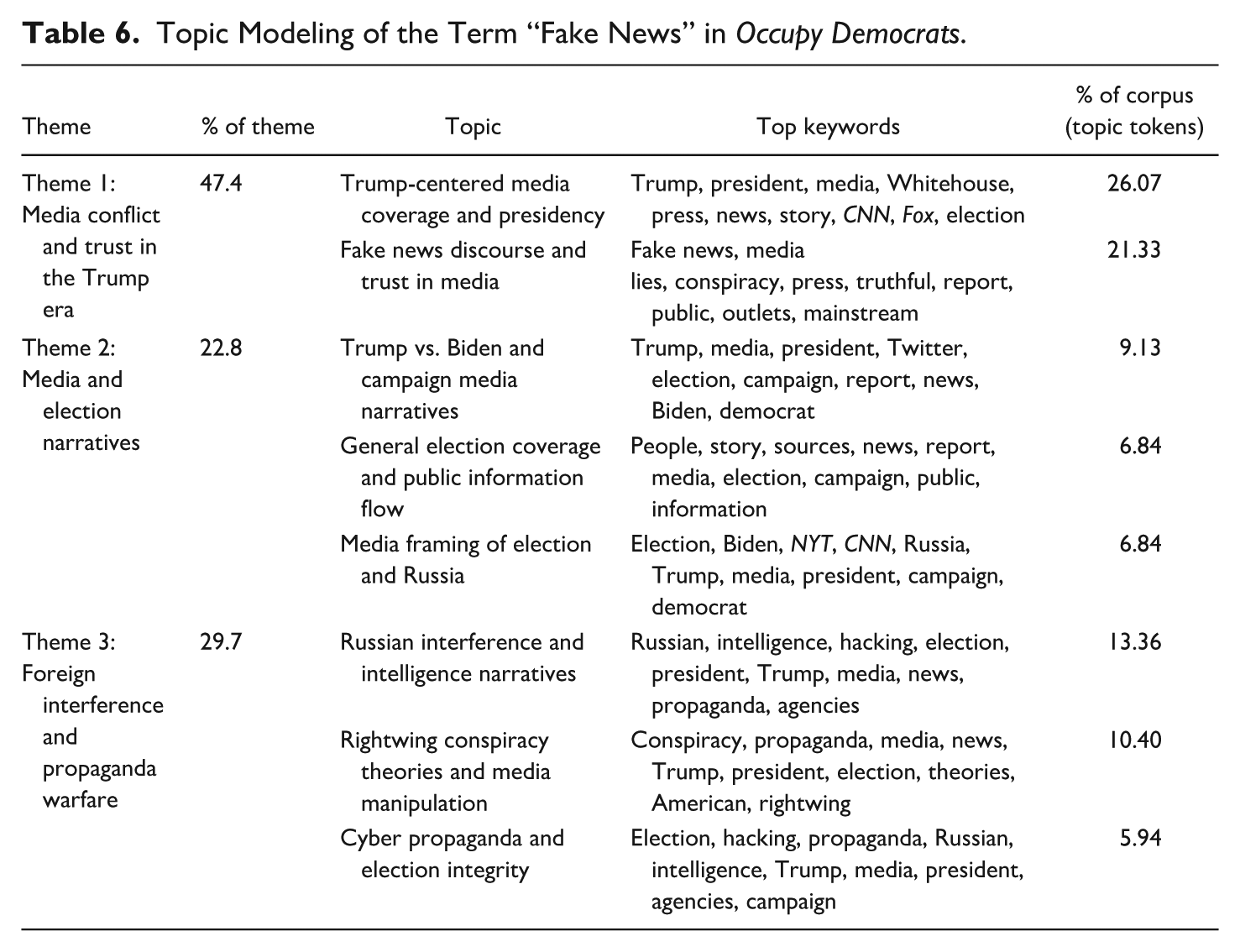
Theme 1: Media Conflict in the Trump Era (47.4%)
Theme 1 highlights the conflict between the Trump administration and mainstream or liberal media, a central focus in Occupy Democrats’ coverage. The first topic, “Trump-centered media coverage and presidency,” reflects critical portrayals of Trump’s administration, media interactions, and election-related controversies, as illustrated by: “President Donald Trump and his administration have, at best, a contentious relationship with the media and particularly with CNN.” The second topic, “Fake news discourse and trust in media,” concerns debates over the legitimacy of mainstream media, with terms such as “lies,” “conspiracy,” and “truthful” indicating concerns about journalistic reliability, exemplified by: “(. . .) defining ‘fake news’ as anything negative reported about himself and his administration, no matter how truthful the accounts may be.”
Theme 2: Mainstream Media and Election Narratives (22.8%)
Theme 2 comprises three topics. The first, “Trump vs. Biden and campaign media narratives,” addresses the contentious relationship between Trump and the media, as well as portrayals of Joe Biden and social media engagement, illustrated by: “Donald Trump (Not ‘President Trump’) is melting down on social media.” The second topic, “General election coverage and public information flow,” concerns how reporting practices and sourcing shape public perceptions of the election, as reflected in: “the one-term President made the usual false claims that he was the true winner of the 2020 election.” The third topic, “Media framing of election and Russia,” highlights media reporting on alleged Russian interference, involving outlets such as NYT and CNN, exemplified by: “(. . .) accusing the newspaper (NYT) of intentionally publishing a false story last year related to the investigation into Russian interference in the 2016 United States election.”
Theme 3: Foreign Interference and Propaganda Warfare (29.7%)
The third theme consists of three topics. The first, “Russian interference and intelligence narrative,” emphasizes Russia’s alleged role in political manipulation through hacking and cyber espionage, as illustrated by: “It is well documented at this point that the Russians were doing everything they could to get Trump elected.” The second topic, “Right-wing conspiracy theories and media manipulation,” reflects Occupy Democrats’ critique of how right-wing figures, including Trump, used conspiracy narratives and propaganda to influence public opinion. The third topic, “Cyber propaganda and election security,” focuses on how information warfare threatens democratic discourse and election integrity, exemplified by: “Trump’s ‘Obama wiretap’ originated with the far-right propaganda outlet Breitbart, which is known for picking up Russian fake news stories” (Table 6).
Topic Modeling of the Term “Fake News” in Occupy Democrats.
Mapping Themes onto Hallin’s Three Spheres
In Newsmax, Theme 1 (Epistemic claims and institutional conflict) and Theme 4 (Misinformation and rhetorical strategy) fall within the sphere of legitimate controversy, as “truth-seeking discourse” and “mainstream media institutions” position Newsmax as a challenger to mainstream and liberal media, and Trump’s strategic messaging is framed as part of broader debates over media influence. In another respect, Theme 2 (Delegitimization of mainstream press) and Theme 3 (Conspiracy and election interference) are located within the sphere of deviance: the former uses labels such as “fake news media” and “enemy” to discredit mainstream journalism, while the latter invokes hacking, intelligence agencies, and conspiracy theories to suggest election manipulation and promote anti-institutional sentiment.
In Occupy Democrats, a similar but ideologically inverted pattern emerges. Theme 1 (Media conflict in the Trump era) aligns with the sphere of legitimate controversy, as critiques of the Trump administration and mainstream media trust fall within accepted norms of political engagement. Theme 2 (Election and media narratives) also occupies this space but selectively casts some right-wing frames, such as Russia-related denialism, into the sphere of deviance by treating them as disinformation, thereby repositioning previously contested narratives outside acceptable discourse. Theme 3 (Foreign interference and propaganda warfare) spans all three spheres: Russian interference can be treated as consensus in liberal circles, critiques of right-wing conspiracy theories as deviant, and debates over election security remain within legitimate controversy.
These classifications illustrate how each outlet positions similar issues within different domains of Hallin’s spheres. Consistent with Hallin (1986) and Nygaard (2023), our findings show that the boundaries between consensus, legitimate controversy, and deviance are fluid and shaped by how media actors strategically frame competing narratives. Accordingly, our mapping reflects both the themes identified through LDA topic modeling and the rhetorical choices through which each outlet anchors particular issues in the broader discursive landscape.
Divergent Rhetorical Strategies Across Ideological Lines (RQ2)
To address RQ2, we examined how ideologically extreme alternative media outlets employed the term “fake news” and how their usage aligned with or departed from consensus-based media norms. Both Newsmax and Occupy Democrats used the term “fake news” not primarily as a factual label but as a rhetorical weapon to attack opposing actors and ideologies. Human-coded content analysis revealed that over 89% of Newsmax articles and more than 98% of Occupy Democrats articles employed the term as a weaponized label, underscoring its strategic use across both ends of the ideological spectrum. Likewise, the term was almost universally used as an empty buzzword in both outlets, applied in ways that lacked clear reference to actual disinformation.
Topic modeling supported these findings, revealing that while the two outlets targeted different rhetorical targets, mainstream media institutions in Newsmax and Trump, and conservative figures in Occupy Democrats, all predominantly operated within Hallin’s deviance sphere. This departure from consensus-based norms illustrates a rhetorical strategy: ideologically polarized media, regardless of political orientation, strategically exploit the term “fake news.”
Discussions
Findings from manual content analysis point to clear ideological contrasts in target selection but functional similarities in rhetorical use. These patterns support the premise that introducing a perceived opposition and then refuting it can justify existing attitudes. By framing the uses of “fake news” by conservative media as illegitimate, Occupy Democrats employed the term as both a partisan weapon and a defensive strategy.
In the consensus sphere, our premise was that news media share an understanding that the label “fake news” should identify inaccurate or deceptive information. Content analysis showed that Occupy Democrats used the term more often than Newsmax to depict narratives promoted by Trump and conservative media as fake news. For example, they framed claims minimizing the severity of COVID-19 or questioning public health guidance as “fake news.” However, LDA topic modeling indicated that most themes fell outside this sphere, supporting the conclusion that both outlets primarily use the term as a partisan tool rather than for factual classification. This finding is consistent with prior work suggesting that the label often signals political alignment rather than objective falsity (Egelhofer et al., 2020).
Within the sphere of legitimate controversy, both outlets used “fake news” primarily as a rhetorical device rather than a verifiable classification. LDA results supported this finding, revealing topic clusters centered on political antagonism rather than fact-checking. In Newsmax, Theme 4 (Misinformation and rhetorical strategy) frames Trump’s media tactics as part of ongoing disputes over mainstream media influence. Likewise, in Occupy Democrats, Theme 1 (Media conflict in the Trump era) treats critiques of the Trump administration and mainstream media trust as routine elements of political debate. This aligns with Egelhofer et al.’s (2020) observation that the label often functions as a symbolic marker of political alignment rather than an indicator of factual inaccuracy.
Most themes surfaced by LDA were situated in the deviance sphere, diverging from the consensus sphere’s normative understanding of “fake news” as a label for objectively false or deceptive information. Guided by Hallin’s (1986) framework, this classification reflects how both outlets framed their rhetorical targets as outside the bounds of legitimate debate. Within the deviance sphere, Occupy Democrats often paired “fake news” with terms such as “lies,” “conspiracy,” and “enemy” to delegitimize Trump-aligned actors and strategies. Newsmax, by contrast, combined the label with words like “propaganda” and “truth” to frame mainstream journalism as biased and to promote narratives aligned with conservative politics.
Our analysis shows that, despite operating from opposite ends of the ideological spectrum, both Newsmax and Occupy Democrats strategically repurpose the term “fake news” to advance partisan agendas, positioning rival narratives within the deviance sphere (Hallin, 1986). Newsmax frequently applies the term to mainstream media, while Occupy Democrats redirects it toward Trump and his allies. These uses reflect confirmation bias (Nickerson, 1998) and align with Coddington and Molyneux’s (2024) observation that alternative media favor ideologically compatible sources, amplifying bias and fragmenting the media ecosystem. Differences in how each outlet responds to mainstream media, Newsmax portraying it as “fake news” and Occupy Democrats largely refraining from direct critique, place the issue within the sphere of legitimate controversy. Together, these patterns reveal how alternative partisan outlets reshape norms of acceptable debate, with broader implications for media legitimacy.
Our findings mirror Nygaard’s (2023) argument that Hallin’s spheres are dynamic and fluid, as the themes were classified based on how each outlet depicted the same issue and where it located it within acceptable public discourse. For example, Newsmax often portrays mainstream media as “fake news,” thereby positioning them within the deviance sphere, while Occupy Democrats generally keeps mainstream outlets within the sphere of legitimate controversy. Likewise, while Occupy Democrats generally situates Russian interference in the consensus sphere as an established fact, Newsmax distributes the issue across legitimate controversy (Theme 1) and deviance (Theme 3), presenting it either as a disputed matter or as an overstated claim. Taken together, these patterns suggest that alternative media participate in renegotiating the boundaries of public discourse.
Theoretical, Methodological, and Practical Implications
This study contributes to the literature on “fake news” by shifting the analytical focus from survey- or experiment-based analyses of disinformation’s effects on the public to the rhetorical use of the term itself. While prior studies often treated “fake news” as a loosely defined element of information disorder or focused on audience perceptions and responses to disinformation, this study investigates how the term is strategically deployed in ideologically extreme alternative media. Extending the work of Egelhofer et al. (2020), which focused on mainstream outlets, our findings reveal that alternative media use “fake news” not to identify fabricated content but as a weaponized label to delegitimize rival actors and institutions. This rhetorical repurposing reflects a broader shift in media discourse, where a term originally intended to flag disinformation is co-opted to erode journalistic authority and fuel antiestablishment sentiment, weakening shared epistemic norms and contributing to a fragmented media landscape. By applying Hallin’s three-sphere model, this study contributes to a deeper theoretical understanding of how “fake news” operates within the deviance sphere, illustrating how alternative media politicize the term and delegitimize journalistic standards by framing them as ideologically compromised rather than normatively grounded.
Methodologically, this study employs a mixed-methods design by integrating content analysis with LDA topic modeling. Guided by Egelhofer et al.’s (2020) framework, content analysis identified explicit rhetorical strategies, whereas LDA surfaced latent themes. Because LDA does not allow direct statistical comparison across outlets, separate models were run and interpreted through shared keywords (e.g. “lies,” “enemy,” “propaganda”). Aligning topic modeling outputs with manual coding enabled theoretically meaningful interpretation of how topics functioned within each outlet’s discourse. Together, this mixed-methods approach improved interpretive clarity and strengthened the robustness of the findings.
On a practical level, the findings advocate for greater caution among media professionals in their use of the term “fake news.” The overuse of the term risks diluting its meaning, making it challenging to address genuine disinformation. Journalists, therefore, bear a significant responsibility to use the term precisely and avoid contributing to its trivialization. In parallel, the study underscores the importance of media literacy initiatives, which help the public critically evaluate news sources and recognize the strategic use of “fake news.” Strengthening media literacy may mitigate misinformation and lessen the influence of polarizing narratives.
Limitations and Future Research
This study has several limitations, each of which presents an avenue for future research. First, the study focused on two ideologically extreme outlets, Newsmax and Occupy Democrats, due to limited access to APIs and structured archives. Although mainstream media were initially intended as comparative references, they were excluded because they rarely used the term “fake news” explicitly, likely due to its pejorative connotations and its potential to undermine journalistic credibility (Beer, 2017; Collier & Van Duyn, 2023; Richards, 2017; Sullivan, 2018). Therefore, the generalizability of the findings may be limited. Future research could incorporate more diverse alternative outlets using structured databases such as Nexis Uni and employ longitudinal approaches. A larger sample would also allow advanced techniques such as structural topic modeling and emerging large language model-based approaches, which can integrate metadata (e.g. source, ideology, publication date) and enhance contextual understanding.
Second, the interpretation of LDA topic modeling results is limited due to shortcomings related to interpretability, topic overlap, limited contextual sensitivity, and difficulty detecting sarcasm, irony, or negation. As an unsupervised machine-learning method, LDA identifies clusters of co-occurring words without accounting for syntactic structure or deeper semantic relationships (Eisele et al., 2023), which may oversimplify complex discursive patterns. Although we implemented a human validation process to enhance thematic clarity, interpretive limitations remain. Likewise, LDA cannot examine causality or infer causal effects.
Third, the uneven distribution of articles across the two outlets raises interpretive challenges, as the substantially smaller Occupy Democrats corpus may not capture the outlet’s full topical diversity. In smaller datasets, topic patterns can appear more prominent than they actually are, meaning that some differences between the two outlets may reflect corpus size rather than systematic discursive variation. For this reason, topic frequencies should be interpreted proportionally rather than in absolute terms. Future research could address this issue by applying weighted topic analyses, normalization procedures, or by constructing more balanced corpora across outlets.
Fourth, although exploratory, this study lays the groundwork for hypothesis-driven research on how “fake news” functions rhetorically, as a strategy of political delegitimization or as an empty buzzword. Future studies could examine rhetorical variables such as populist framing, elite targeting, and emotional tone, and use experimental methods to assess how different uses of the term shape audience responses, media trust, and partisan interpretations. Lastly, while the extended timeframe (April 2015–October 2023) enabled analysis across multiple major events, year-by-year trends showed event-driven spikes (e.g. 2017 post-election; 2020 political–public health crisis; 2022 midterms) rather than a steady semantic shift, suggesting that future work should disentangle event-specific uses to more precisely track semantic change.
Despite these limitations, this study contributes to understanding how the term “fake news” is shaping partisan discourse within alternative media. Continued research engaging broader media sources and methodological tools will be essential for advancing scholarly knowledge and informing news literacy and policy interventions.
Footnotes
Declaration of Conflicting Interests
The authors declared no potential conflicts of interest with respect to the research, authorship, and/or publication of this article.
Funding
The authors disclosed receipt of the following financial support for the research, authorship, and/or publication of this article: This research was supported by the National Research Foundation of Korea [Grant number NRF-2022S1A5A2A01047861].

Data Availability Statement
The data that support the findings of this study are available on request from the corresponding author.