







Abstract
This survey-based study of U.S. journalists (N = 1,579) describes their current epistemological outlooks and explains how the conceptions of their social roles are related to journalistic epistemologies. We argue this is a novel approach to understanding journalistic cultures—not just the sum of journalistic roles and epistemologies, but in the relative coherence of these concepts taken together. We identify three main epistemological orientations among U.S. journalists: intuitionist, standpoint, and naturalist. The findings suggest objectivity is no longer the unquestioned epistemology in U.S. journalism culture, replaced by a combination of naturalist and constructivist orientations.
Journalists are increasingly in a position where they must promote and defend their roles in society and remind their fellow citizens of what is lost when journalism is undervalued and undercut (Koliska et al., 2020). Through periods of digital and economic disruptions, journalism has been gradually displaced as the central feature of the information ecology. Information is abundant and easily accessible, usually from online sources, including social media (Coddington, 2014). Journalists have typically responded to these changes by pointing to their professional pursuit of truth as a necessary corrective to an information environment polluted by partisan narratives and by mis- and disinformation (Jahng et al., 2023). Simply put, journalists contend that their epistemological commitments are central to their social role: “Our job is to tell the truth” (Belkind, 2014).
The practice, however, is more complicated. Journalists vary in how they see their role in society, and they vary in what they see as the basis for their truth claims (Hanitzsch et al., 2011; Willnat et al., 2025). Meanwhile, objectivity, once the epistemological norm guiding journalism practice in the United States—journalism’s “supreme deity” (Mindich, 1998, p. 1)—is increasingly at the heart of a crisis of faith. It’s not just digital and economic disruption. U.S. journalists have debated the merits and demerits of objectivity through coverage of climate change, the candidacy and presidency of Donald Trump, and the Black Lives Matter movement (Carlson et al., 2021; Hiles & Hinnant, 2014; Wallace, 2019). Some journalists have questioned whether components of objectivity—things like balance and disinterest—might too easily be co-opted by unreliable narrators and become an actual barrier to truth-telling (Canella, 2023). Other journalists have advocated for transparency as an alternative to objectivity (Vos & Craft, 2017). While still others have (re)asserted the importance of fact-checking as a central journalistic duty and the best path forward for (re)gaining social legitimacy and authority (Graves, 2016; Mena, 2019).
Meanwhile, the rise of more partisan forms of journalism, solutions journalism, constructive journalism, and other versions of journalism speak to foment about what role journalism should play in society (Bro, 2019; Kuypers, 2014). Journalists seem less willing to accept that journalism’s job is confined to disseminating the facts. Add to this the introduction of new journalistic actors, such as technologists and social media editors, and journalism seems as if it is being pulled in multiple directions (Holton & Belair-Gagnon, 2018).
All of this change raises questions about the state of journalism culture. The notion of journalism culture has been an important feature of theorizing about journalism, but is itself rarely examined in a holistic way in empirical scholarship. We argue that the professional and public debate about objectivity is a timely occasion to revisit journalism culture more broadly and to understand its relative coherence in disrupted times. Specifically, we seek to understand the basis of differences in journalistic epistemologies and how journalistic epistemologies and roles relate to each other.
This study, based on a 2023 survey of U.S. journalists across multiple media platforms (N = 1,579), seeks to examine where journalists’ epistemological outlooks currently stand, while at the same time seeking to understand how these outlooks might be fractured by demographic or situational differences among journalists. Ultimately, we seek to understand the relationship between roles and epistemologies and to better understand whether meaningful patterns appear to be present in U.S. journalism culture.
There is also practical value in describing the state of U.S. journalistic epistemologies during a period of institutional disruption (Reese, 2020), as is occurring now. Importantly, the United States has also been the world’s biggest exporter of journalistic epistemologies, notably objectivity (Lugo-Ocando, 2020). Visible cracks in journalistic objectivity in the U.S. portend changes in how U.S. state-funded media development agents train journalists worldwide (Peters, 2010).
Theory and Literature
Journalism has been defined and understood as a set of practices related to the production and distribution of news and a set of beliefs about why and how those practices are socially significant (Deuze, 2005, 2008; Vos, 2018). When these practices and beliefs cohere in meaningful ways, journalism studies scholars have identified this coherence as a journalistic culture. Similarly, journalism culture has been conceptualized as consisting of beliefs, practices, and artifacts (Hanitzsch, 2007). We focus here on some of the core beliefs that characterize journalism, since beliefs play no small part in setting journalism apart from similar forms and activities, such as branded content, political advocacy, and propaganda.
Hanitzsch (2007) identified beliefs about epistemologies, roles, and ethics as constitutive of “journalism culture.” Journalists have developed these beliefs over time in discourse with other social actors (Schudson, 2001), solidifying them as injunctive norms through processes of discursive “(re)creation, (re)interpretation, appropriation, and contestation” (Hanitzsch & Vos, 2017, p. 121). Thus, journalistic norms themselves—while often enduring—are also subject to change. For example, in the present century, journalists have contested, recreated, and reinterpreted the journalistic role of gatekeeping in the context of technological, economic, and social-political disruptions (Vos & Thomas, 2019).
Norms about journalistic epistemologies and roles are important objects of study because they generally guide journalistic practices and are manifested in journalism’s artifacts. For example, newsrooms have often been physically separated from advertising offices based on journalistic norms about the autonomy of news judgment (Örnebring & Karlsson, 2022). However, research also shows that journalists’ individual beliefs about the role of journalism in society are not always readily discernible in the news stories they produce (Tandoc et al., 2013). Nevertheless, research shows journalists strive to make sense of these “normative failures” as indicators of problems within journalism cultures (Siegelbaum & Thomas, 2016). A better understanding of journalism culture, even with its problems—or perhaps especially because of them—is vital to understanding a host of subsequent issues facing journalism, such as news avoidance, public trust, and journalistic authority. For example, if journalists prize their autonomy, they may intentionally ignore community feedback.
Culture, by some definitions, implies a degree of coherence. Values, attitudes, and ideas align, based on some underlying ideology (Huntington, 1981), such as liberalism, with its commitments to individualism, negative liberty, and rationality (Klosko, 2017). Characterizations of the journalism culture in the United States have largely focused on it as a classic form of a “liberal model,” based on Hallin and Mancini’s (2004) much-cited comparative typology. The liberal model is characterized by features such as information-oriented journalism, journalistic professionalization, and low political parallelism—features conceptually connected to objectivity. In theory, these features of U.S. media shape the orientation and working style of many U.S. journalists, including their epistemologies and their understanding of their roles in society.
However, the coherence of culture is conceptually disputed. Rather than think of culture as a national or “translocal, generalized system of meanings,” Sewell (1999, p. 46) concludes that “culture is not a coherent system of symbols and meanings but a diverse collection of ‘tools’.” Swidler (1986, p. 277) also argues that culture is “not a unified system” and is instead a “toolkit” of “often conflicting symbols, rituals, stories, and guides to action.” But she also allows that cultures might hew toward ideological coherence during unsettled times, as social actors actively try to make sense of social or institutional disruption. In either case, social actors, such as journalists, can be strategic in activating certain cultural ideas as a situation dictates. Indeed, there is evidence journalists see value in different roles in different situations (Raemy & Vos, 2021) and sometimes hold “contradicting desires” about objectivity and their social roles (Zandberg & Neiger, 2005).
Another complication to the notion that culture is coherent is that all sizable cultures have cross-cutting cleavages (Lipset 1990)—a refraction of dominant cultural values based on age, gender, religion, and partisan outlook. We would expect these cultural differences and journalism-specific differences, such as medium, to also leave their mark on journalism culture. Thus, we consider these potential cleavages when examining journalistic culture.
Journalistic Epistemologies
While epistemology is generally understood as a branch of philosophy concerned with the nature of knowledge, it takes on a more focused meaning in the institutional setting of journalism. To study journalistic epistemologies is to study “the rules, routines and institutionalized procedures that operate within a social setting and decide the form of the knowledge produced and the knowledge claims expressed (or implied)” (Ekström, 2002, p. 260). Thus, the focus is on epistemology-in-practice—how journalists arrive at and make claims about the factualness, representativeness, or truth of the news they convey (Godler & Reich, 2013).
Journalism in the United States has long been characterized by a professional commitment to objectivity as a process to arrive at valid truth claims (Mindich, 1998; Schudson & Anderson, 2009). This has meant a strong commitment to factualness, neutrality, balance, and fairness, which in turn has been translated into work routines such as quoting authoritative sources, confirmation of factual claims, and offering competing interpretations (Thomas, 2019; Tuchman, 1978). The United States has been historically characterized by a particular objectivist and empiricist style (or culture) of reporting, in contrast to the style in some countries, where reporting is marked by political parallelism or activism (Brüggemann et al., 2014; Hovden & Kristensen, 2021; Weiss, 2015).
The story of objectivity in the United States is replete with grand claims about truth but equally grand criticisms of objectivity’s deficiencies (Schudson, 1978, 2001). Objectivity has been an imprecise and confusing signifier, noted for its “conceptual fuzziness” (Muñoz-Torres, 2012, p. 568)—a fuzziness that plagues its observers, advocates, and critics alike. It has sometimes been conflated with a principle of balance, sometimes taken as an ontological stance about the knowability of things, and sometimes as an ethic of detachment and autonomy (Maras, 2013; Thomas, 2019). Journalistic dissidents have frequently pushed back against objectivity, finding it deceptive about the weight of evidence, defensive of authority, and devoid of insight (Boykoff & Boykoff, 2007; Lerner, 2019; McMillian, 2011). Others see it as a relic of a pre-digital era. As one critic put it, “Objectivity is a trust mechanism you rely on when your medium can’t do links” (quoted in Hellmueller et al., 2013). Journalism’s epistemology-in-practice has become contested.
Our immediate interest is in the moral ideal that objectivity has represented, that is, in a set of epistemic norms that are a component of journalistic culture. But epistemology is also focused on a range of moral ideals related to truth-telling, not solely on objectivity. Indeed, journalists and scholars alike have considered alternative epistemologies, perhaps most notably offering transparency—where a journalist’s standpoint is made explicit—as an approach better suited to the epistemological and technological currents of the 21st century (Hellmueller et al., 2013; Karlsson, 2010). Thus, journalists, even within the United States, have wrestled with fundamental epistemological questions. These competing and overlapping questions suggest underlying dimensions of journalistic epistemologies.
Hanitzsch (2007) places journalists along two epistemological dimensions—an objectivism scale and an empiricism scale—which reflect the possible positions journalists may take regarding the nature of knowledge and the nature of knowing (Hofer & Pintrich, 1997). These positions may also be referred to as epistemological beliefs, which are the implicit—or, in the case of journalists, often explicit—beliefs people have regarding the nature of knowledge and knowing (Ekström & Westlund, 2020; Fitzgerald & Cunningham, 2004).
The dimension of objectivism within Hanitzsch’s (2007) framework encompasses journalists’ beliefs about the nature of knowledge: beliefs about the certainty of knowledge, such as whether it is possible to attain absolute truths (Hofer & Pintrich, 1997). At one end of the spectrum, there are journalists who may adhere to a correspondence theory of reality, where what is seen is taken to exist (“seeing is believing”). Such journalists do not question what they see and rely on the truth-value of observation. They may also see the world in terms of right or wrong answers and believe there are concrete facts that can be known. It is important to note that in more general epistemological terms, this approach is generally referred to as “naturalistic” (Moses & Knutson, 2019). Scientists often hold naturalist beliefs: There is a real world out there, and scientists have access to it through their senses.
At the other end of the spectrum, there are journalists who may be radically subjective, not believing that any absolute truths are necessarily possible to achieve, since all information and observations are filtered through the prism of one’s standpoint. But within this group may be somewhat less radically subjective journalists who simply acknowledge that observation is fallible and that definitive truths are not necessarily possible when it comes to some subject areas. They may nevertheless believe they are able to get close to a version of the “truth.” There may also be journalists who believe truths are fundamentally controlled and shaped by those in power (Garrett & Weeks, 2017), leaning more activist or interventionist. In a more general philosophical sense, this approach is “constructivist” (Moses & Knutson, 2019). Most constructivists agree that there is a real world, but it is characterized by many layers of conceptual and contextual meaning. Therefore, it is necessary to interpret data about processes. There is no true and false, but only constructions of reality.
The dimension of empiricism, on the other hand, encompasses journalists’ beliefs about the nature of knowing: how they believe truth or facts are attained, such as via empirical observation (Hofer & Pintrich, 1997). At one end of the spectrum are the empiricists who place stock in “observation, measurement, evidence, and experience” (Hanitzsch, 2007, p. 377). But Hanitzsch (2007) and others (Schudson & Anderson, 2009) note that, in reality, many journalists seek to add interpretation, context, explanation, and evaluation to make sense of facts because it is important for the audience to understand what is happening in the world and why. Again, from a general philosophical perspective, this approach is also constructivist or interpretivist.
At the other end of the empiricism spectrum are those journalists who might believe truth claims are justified based on beliefs or intuition. Most journalists may be unlikely to claim a fully rationalist position of a priori insight or claim intuitive knowledge, but may instead argue that they can arrive at truths through reason and analysis. Here, journalists can come to conclusions based on their experience and savviness (Gans, 1980; Schultz, 2007). Again, this can be considered constructivism, rooted in a standpoint approach and a reliance on intuition.
A summary of these theoretical dimensions leaves us with four general belief positions—(a) objective, (b) subjective, (c) empirical, (d) analytical/intuitive—organized under the umbrellas of beliefs regarding the “nature of knowledge” (a and b) and the “nature of knowing” (c and d). These distinctions also lead to the identification of pure naturalists and various constructivist viewpoints. In our study, we develop specific measures to account for each of these dimensions. Still, we are uncertain which of the epistemic belief positions find purchase from U.S. journalists in the 21st century. Thus, we ask:
RQ1: What are the current epistemological orientations of U.S. journalists?
Explaining Journalistic Epistemologies
We must also account for the potential presence of cross-cutting cleavages in journalistic epistemologies. There might be any number of factors that drive different epistemic outlooks. The literature suggests differences might be a matter of the medium in which journalists work, the gender of the journalists, age, religion, and the partisan outlook of journalists, among other factors, such as time spent in the profession. We focus here on a few of those factors that have been most posited or studied.
Effects of Journalists’ Medium
One summary of the literature concludes that journalism doesn’t have a single epistemology: “there are several different epistemologies for different genres and forms of journalism” (Ekström & Westlund, 2019, p. 260). However, we are not aware of empirical studies that have examined epistemological differences or similarities by the main medium in which journalists work. Television journalists, journalistic bloggers, and others seemingly have their own epistemic orientations (Ekström & Westlund, 2019). Indeed, the medium in which journalists work—particularly whether that medium is more verbally or visually oriented—is a plausible difference maker in epistemic orientation. Television journalists and photojournalists, of course, work in more visual media, where images constitute the primary means of portraying the world and “have a highly documentary and evidential character” (Ekström, 2002, p. 279). Journalists whose primary means of communication is words have a more subjective experience—searching for the right words to convey the best version of reality. This suggests that visual journalists, such as TV journalists, might be more empirically oriented (naturalist), whereas journalists whose main tools are verbal might plausibly take a more analytical approach (interpretivist/standpoint). Medium effects on epistemologies are likely about much more than verbal and visual orientations. Journalists in television, print, and digital platforms have different production routines, which are inevitably connected to epistemology (Zamith & Westlund, 2022). For example, Hellmueller et al. (2013) argue that digitally native journalists lean toward transparency and hence a standpoint epistemology. Thus, based on what we do know from the literature, we hypothesize the following:
Effects of Journalists’ Gender
Feminist standpoint epistemology has held that men and women have fundamentally different ways of seeing the world, built on the notion that “the ways that bodies of knowledge are socially situated and embodied limits but also enables what one can know” (Steiner, 2018, p. 1854). In fact, feminist epistemology rejects two tenets of journalistic objectivity: the possibility of detachment and value neutrality (Anderson, 2020; Cabas-Mijares, 2023), which it attaches to a male way of knowing. It also rejects the notion of a “view from nowhere”—sometimes seen as the manifestation of the objectivity norm. Meanwhile, feminist epistemology holds that “each and every truth-claim is to be recognized as a site of dialogic, and thus gendered, interaction” (Allan, 1998, p. 127), making it compatible with notions of journalistic transparency, where truthfulness is left open and subject to dialogue.
In one of only a couple of social scientific studies of epistemology that we could locate, Hellmueller et al. (2013) found some differences between men and women journalists in their beliefs about objectivity and transparency, with women embracing some aspects of transparency more than men. However, this was the case only for women with 12 or more years of experience in journalism. This suggested that journalists enter the profession with traditional notions about journalistic objectivity but may change over time. Based on feminist viewpoint epistemology and feminist notions of embodied knowing, we posit the following:
Effects of Journalists’ Partisanship
There is extensive evidence that personality attributes related to obedience to authority are genetic traits and that these orientations vary consistently with conservative and liberal perspectives. Koenig and Bouchard (2006) provided evidence that authoritarianism, religious fundamentalism, and conservatism are best modeled as related to a single trait of traditionalism, which is dominantly characterized as submitting to authority. The fundamental idea in this work is that beliefs come not just from cognitive analysis, but instead from humans’ efforts to handle uncertainty and threat. Submitting to traditional authorities is a main cause of social, political, and religious attitudes (Bouchard, 2009). Evolutionary psychology provides evidence that fundamental to human survival has been one’s submissive versus dominance relationships with others (Buss, 1999).
As evolutionary psychology was developed and has been increasingly used to explain modern human behavior, there is increasing evidence of differences in how U.S. Republicans (conservatives) and Democrats (liberals) process information. Using a classic scale of authoritarian personality, Sanford et al. (1950) showed that at every level of education, Republican voters had higher authoritarian than egalitarian personalities. Shikiar (1975) replicated the result, as did Ludeke et al. (2018), who reported that authoritarianism positively predicted support for Donald Trump in 2016. For news audiences, evidence has shown that liberals are more likely to support fact-checking efforts (Robertson et al., 2020) and use prior knowledge and cognition when evaluating headlines (Mourão et al., 2023). Conservatives, on the other hand, rely on source credibility and in-group behavior.
Many differences between conservatives and liberals have been identified. Kreiss (2019) argued that partisanship predicted how people understand and agree on political attitudes and facts. Clark and Winegard (2020) provide evidence that liberals are more likely to show a need for cognition, open-mindedness, processing information systematically, and being persuaded by scientific findings. Conservatives show greater consistency between gut and actual feelings, processing information heuristically, such as paying greater attention to sources than to content and assuming attitudinal consistency with similar others (Jost & Krochik, 2014). From this literature, we find it plausible that partisanship in journalists could also be useful for explaining fundamental beliefs about judging what is true. We posit:
Journalistic Roles
While journalistic roles manifest as beliefs, practices, and artifacts, we are focused here on journalists’ beliefs about their roles, that is, “what journalists believe their normative obligations are to the societies in which they’re situated” (Vos, 2023, p. 75). Of all the journalistic norms, beliefs about journalistic roles have perhaps been the most extensively studied and theorized. Roles were first posed as binary, such as neutral and participant roles (Cohen, 1963) and gatekeeper and advocate roles (Janowitz, 1975). Later studies, many of them by Weaver and colleagues (Weaver et al., 2007; Weaver & Wilhoit, 1986, 1996), added different sets of journalistic roles, such as adversarial, interpretative, disseminator, and populist mobilizer roles. In a 2022 study of 1,600 American journalists, Willnat et al. (2025) report the same four self-perceived roles, with the interpretive/investigative (i.e., watchdog) role remaining the most popular. They point out the consistency of this role over the 50 years of their studies of American journalists. This is consistent with an emphasis on independence, information-orientation, professionalization, and commercialism that Schudson (2001) argues has been reflective of an ideal-typical style of American reporting that is rooted in social detachment. Based on a global outlook, Hanitzsch and Vos (2018) outlined a more extensive array of journalistic roles—one set related to democratic functions (with 18 different roles) and another set related to everyday life (with 7 roles). The 18 individual democratic-related roles are thematically grouped into 6 role orientations: informational-instructive, analytical-deliberative (which includes a mobilizer role), critical-monitorial, advocative-radical, developmental-educative, and collaborative-facilitator. Roles related to everyday life include roles such as inspirational, mood manager, and marketer.
The literature has often conceived of roles as types of journalists—they are “interpreters” and “populist mobilizers,” for example (Weaver & Wilhoit, 1996, pp. 144, 146), or are “interpreters,” “traditionalists,” and “activists” (Culbertson, 1983, p. 1). However, empirical research underscores that journalists do not neatly align with a single role. While they may embrace one role more strongly than another, they often see value in different roles for different circumstances (Raemy & Vos, 2021).
Undergirding these roles, then, are some fundamental conceptual dimensions. Hanitzsch (2007) identifies these dimensions as interventionism, power distance, and market orientation. Interventionism maps from passive to interventionist, whereby journalists orient toward detachment and impartiality on the one hand and “socially committed” and “motivated” on the other hand (p. 372). Power distance refers to journalists’ position relative to social authority—loyal to authorities on one pole and adversarial on the other. Market orientation is about how journalists see their relationship with their audiences, such that they see them as consumers on one end of the pole and as citizens on the other end. Relative to any of these three dimensions, journalists might locate at various points along the three normative continua.
Journalistic Epistemologies, Roles, and Journalism Culture
Journalistic epistemologies and perceived roles are major constituents of journalistic culture. While Hanitzsch (2007) includes ethical orientations as a third key dimension of journalistic culture, we exclude it in our study for reasons of parsimony and because ethics have not been found to be a significant factor in other studies of journalistic culture (Hanitzsch et al., 2011). Research has largely focused on roles and epistemologies as distinct sites of investigation rather than on their relationship to each other. Yet, if culture is something coherent (Huntington, 1981), then we should be able to identify patterns in which roles and epistemologies are empirically and conceptually related. Hanusch and Hanitzsch (2019) have posited four distinct journalism cultures around the world (monitorial, advocative, developmental, and collaborative), but base these primarily on roles and do not include measures of epistemologies.
Truth-telling is a constitutive norm central to the definition of journalism and thus fundamental to journalism culture (Ryfe, 2006). However, journalists—like others who seek to make truth claims—have differed over time, space, and social division in how to access truth, how accessible it is, and how it might be able to be communicated. Likewise, a truth-telling norm leaves broad discretion in journalists’ beliefs about the kinds of social obligations they should pursue. In other words, journalists have differed over time, space, and social division in the roles of journalism in society. Thus, while journalists might claim an obligation to educate the public (a role), how they arrive at the knowledge they hope to impart (an epistemology) can take different forms. For example, they might arrive at their knowledge either through journalistic instincts, disciplined fact-checking, or firsthand observation. Indeed, some journalists might have a strong commitment to one of these approaches out of habit or belief.
Some roles are closely tied to the constitutive norm of truth-telling and thus bear a resemblance to an epistemology. The resemblance, we argue, is only cursory. For example, a role of rooting out disinformation is often seen as an important journalistic obligation; however, journalists can take different approaches to this role based on their epistemic outlook. It’s also possible that journalists with a particular epistemology, such as objectivism, might see greater value in the anti-disinformation role, but this does not make them one and the same. Another example is the role of being a detached observer. Journalists generally see detachment as essential to their institutional autonomy. For some journalists, this detachment has additional epistemic benefits since it ostensibly allows them to see facts uncolored by attachment to a social standpoint. Yet, journalists, overall, might believe that facts should speak for themselves, and at the same time see little or modest value, overall, in the role of being a detached observer. Thus, while some roles bear a resemblance to an epistemology, there are conceptually distinct—a role being a kind of social obligation; an epistemology being a means for arriving at knowledge claims.
Still, because journalism cultures are potentially coherent, particularly in times of disruption, we might expect that roles and epistemologies group together in patterns. Journalists who embrace objectivism and believe facts correspond with observations might also embrace a role of being a detached observer or simply a stenographer (Birks, 2022). A similar kind of empiricism that trusts measurement of reality, such as polls, might also hold to a detached observer role. Meanwhile, some journalists do not believe that facts speak for themselves and require interpretation, explanation, and evaluation. This interpretation is often seen as necessary in political journalism and plausibly comports with watchdog and or interpretative roles of the press. Then there are journalists who trust their gut—news instincts honed from experience (Schultz, 2007). This outlook might lend itself to more activist roles, such as influencing public opinion and advocating for social change, or to directive/speculative roles, such as pointing to solutions for problems or guidance about the future implications of events (Møller Hartley & Askanius, 2021).
Put more abstractly, we might see that naturalist epistemologies, which trust empirical observation and eschew interpretation, would align with a monitorial/detached observer role but negatively correlate with more activist/mobilizer roles. Interpretivist/standpoint epistemologies, which acknowledge the complexity of context and positionality, would align with advocative and mobilizer roles and negatively correlate with a monitorial role. Intuition-based epistemologies could also plausibly align with advocative and inspirational/directive roles. Epistemological alignments with collaborative/developmental roles, which are supportive of national development or leadership, are harder to pin to a single epistemology. We believe they will align with multiple epistemic outlooks, since each could be put in the service of developmental aims.
Thus, we pose these relationships between epistemologies and roles:
Granted, any of these epistemologies and any of these relationships could be influenced by cross-cutting cleavages, such as gender, medium, and political differences among journalists. Also, any alignments might be weak or nonexistent if journalism culture is more a matter of a toolkit than a coherent ideological system.
Method
This study uses data from a survey of U.S. journalists (N = 1,579) conducted in 2023. The data was collected using Qualtrics as part of the Worlds of Journalism Study.
Sampling
The sample was drawn using a database obtained from Cision U.S. Inc., which included journalists from 35 media outlet types across all 50 states and the District of Columbia. A total of 72,513 records were initially downloaded from the Cision U.S., Inc. databases, and duplicates and non-journalist entries were removed. The database (sampling frame) from which the random sample for data collection was drawn contained 52,870 records across 24 different media outlet types. The final sampling frame represented all 50 states and the District of Columbia. A random representative sample was randomly divided into three replicates for data collection purposes. Replicate 1 contained 7,805 records; replicate 2 contained 7,645 records; and replicate 3, 7,530 records. The data was collected between June 26, 2023, and November 22, 2023.
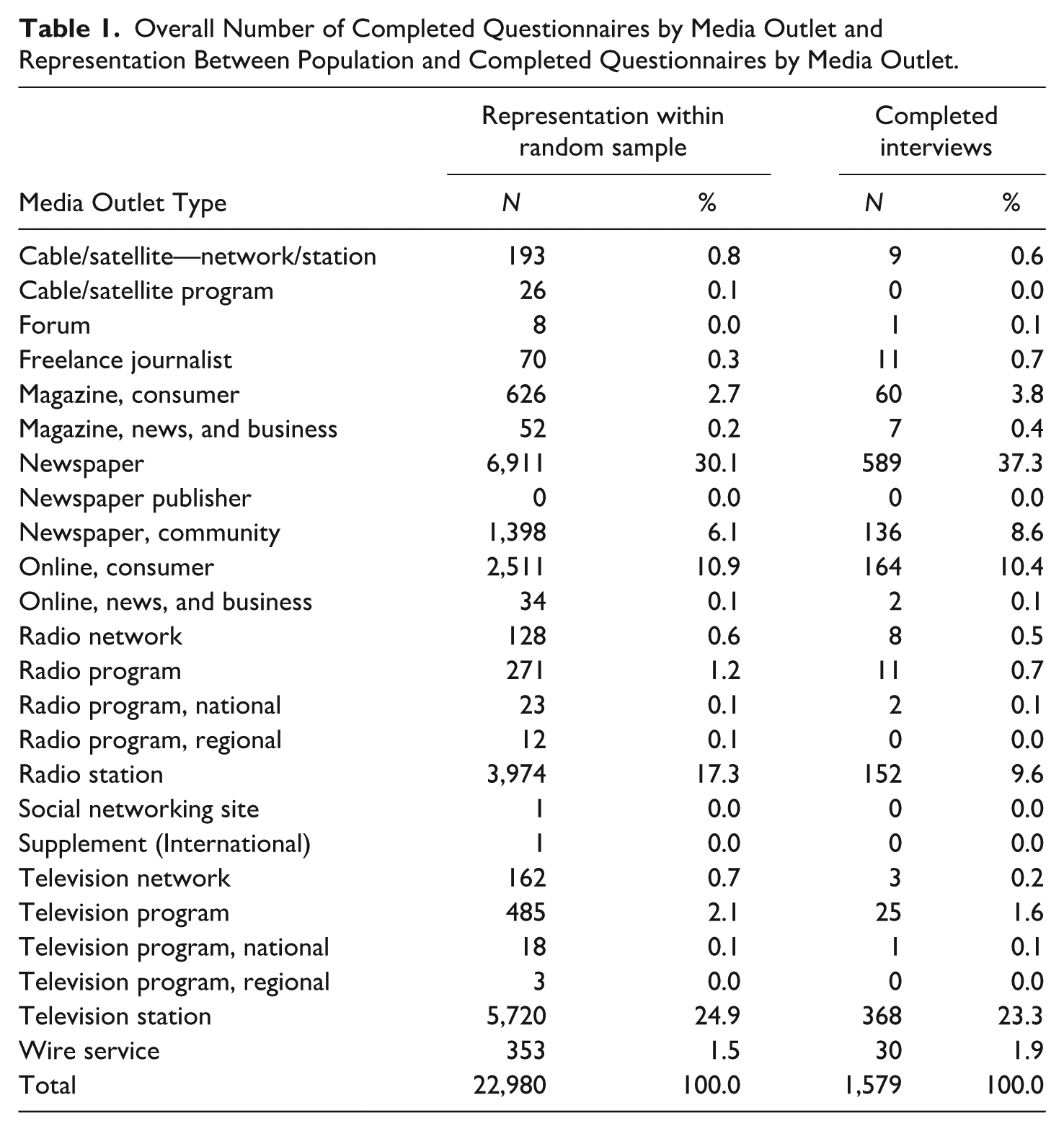
Participants received a prenotification letter in the mail with a link and QR code to answer the survey, informing them they would get a follow-up email and a reminder. According to the American Association of Public Opinion Research’s guidelines (Baker et al., 2013), “response rates” should not be calculated for non-probability samples since they are not based on a known sampling frame with known selection probabilities. Instead, AAPOR recommends using a simple measure of “participation rate,” which is the number of respondents who have provided a usable response divided by the total number of initial personal invitations requesting participation. AAPOR cautions that “using such a rate as an indicator of possible nonresponse error makes little sense” (p.40). The overall participation rate, which takes into account retrieval rates and bounced email invitations, was 10.0%. Table 1 shows the representation by media outlet for the sample frame and completed questionnaires.
Overall Number of Completed Questionnaires by Media Outlet and Representation Between Population and Completed Questionnaires by Media Outlet.
Measures
Epistemologies
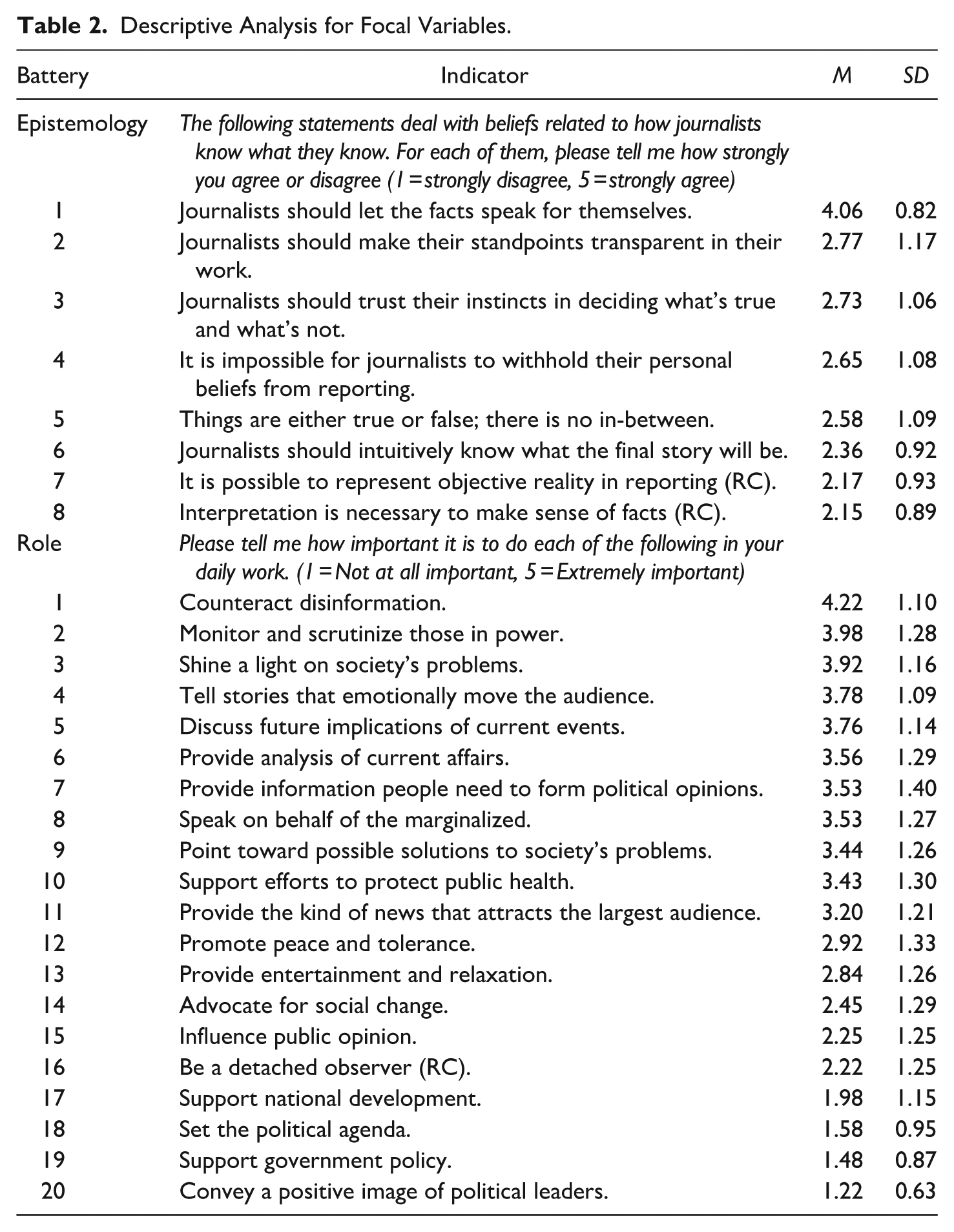
In the absence of existing robust measures of epistemologies, we derived eight statements based on the literature reviewed above—taking into account objective, subjective, empirical, analytical, and intuitive belief positions (Ekström & Westlund, 2019). Some items were slightly reworded versions of measures used by Hanitzsch et al. (2011) (“facts speak for themselves”; “things are either true or false”; “it’s possible to represent objective reality”) and Hellmueller et al. (2013; “standpoint should be transparent”; “can’t withhold beliefs”). We added a question to capture a more robust interpretivist dimension (see Schudson & Anderson, 2009; “interpretation is necessary to make sense of facts”) and an intuitive dimension (see Gans, 1980; Schultz, 2007; “journalists should trust their instincts”; journalists should intuitively know what a story will be). The epistemology battery asked, “The following statements deal with beliefs related to how journalists know what they know. For each of them, please tell me how strongly you agree or disagree (1 = strongly disagree, 5 = strongly agree).” Detailed measures and descriptives are shown in Table 1.
Roles
Using the 24 established measures from previous studies, such as the Worlds of Journalism Study (Hanitzsch et al., 2019) and American Journalists Study (Weaver et al., 2007), we gauged perception of journalistic roles. Journalists were asked to answer “how important it is to do each of the following in your daily work. “(1 = Not at all important, 5 = Extremely important).” The operationalization for each role and descriptives for each item is presented in Table 2.
Descriptive Analysis for Focal Variables.
Demographics
About 37.2% of journalists in our sample identified themselves as women, 55.0% as men, 0.4% as gender fluid/nonconforming, 0.6% as queer, 0.6% as nonbinary, and 1.2% preferred not to self-describe (the remainder didn’t answer). We asked respondents what year they were born, and the average age was 51 years old. Our sample leaned left politically (M = 3.65, SD = 2.30, range 1 = very liberal to 10 = very conservative), and 48.8% had a religious affiliation. On average, respondents had about 2 decades of experience in journalism, with a wide range in the standard deviation (M = 21.36, SD = 13.42). About 36.9% of the sample had an editorial position in the newsroom, 36.8% were reporters, trainees, or producers, and 26.3% identified themselves as “other,” often qualitatively describing their work as a “hybrid” of many positions.
The questionnaire was pretested with journalists not included in the study and items that journalists found confusing were rewritten until the problems were resolved.
Findings
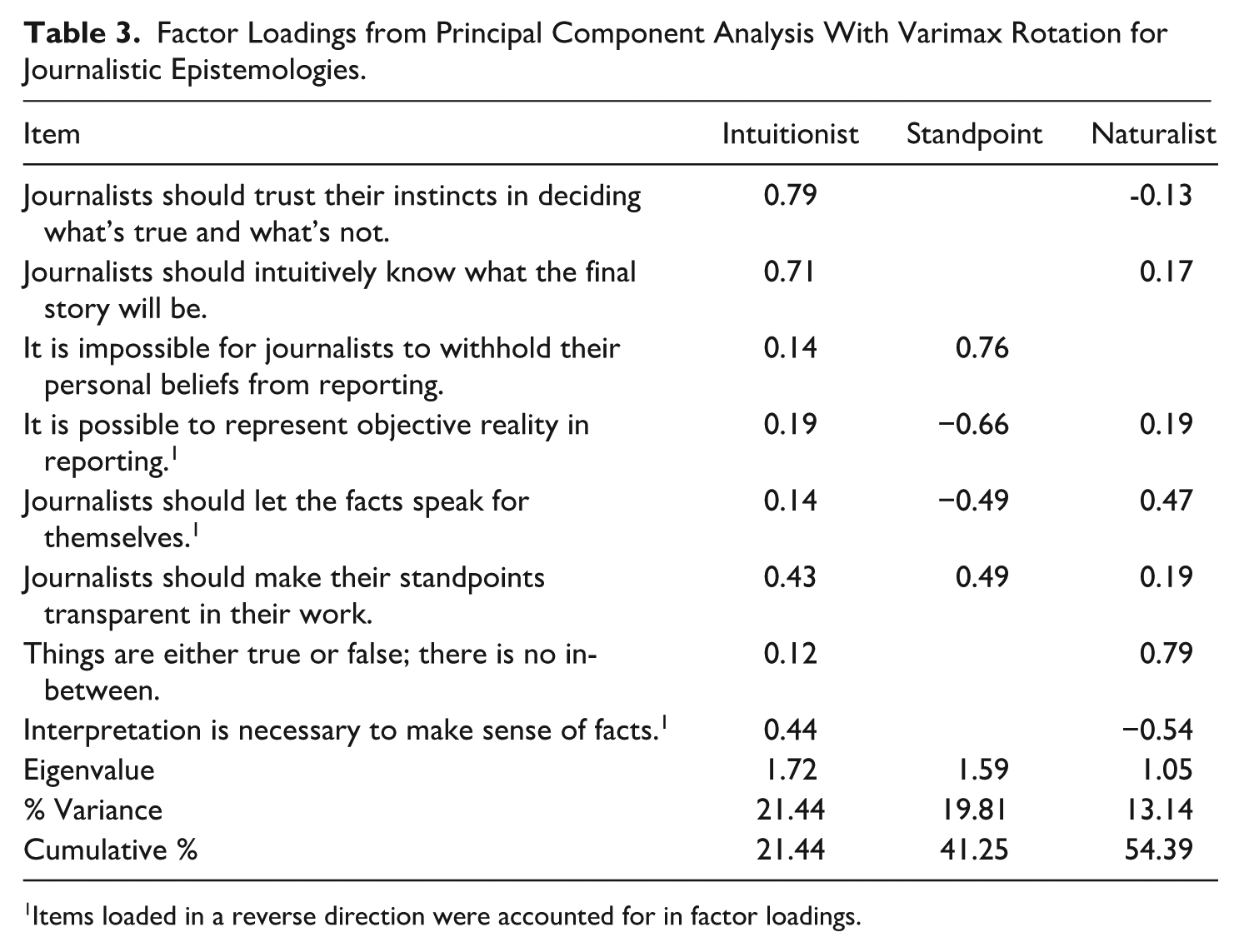
RQ1 asks about the current epistemological orientations of U.S. journalists. A factor analysis yielded three factors (Table 3). The first factor, intuitionist, refers to the importance of trusting instincts, reflecting the idea of a “journalistic gut feeling” or “hunch” when conducting reporting. This constructive perspective is rooted in the assumption that, as a journalist, one is part of what might be called an “in-group,” people who are like oneself and notable experts at constructing reality. Besides sense perceptions and rational reasoning, emotions also play a role in creating reality. Journalists are an example of humans who share contexts/environments. Therefore, they can rely on this multidimensional set of senses to construct a world that they then use language and or images to share with others (audience). One might even call this in-group constructivism, but intuitionist captures this way of knowing more succinctly.
Factor Loadings from Principal Component Analysis With Varimax Rotation for Journalistic Epistemologies.
1Items loaded in a reverse direction were accounted for in factor loadings.
The second factor relates to standpoint epistemology and recognition that it is impossible to represent objectively and, thus, transparency about one’s position is needed. Items reflect the idea that it is impossible to withhold personal beliefs from reporting and that journalists should make their standpoints transparent. Philosophers might identify these views as constructivism or subjectivism; we refer to it as standpoint, that is, journalists look at the world as constructed by themselves and their professional colleagues.
The third factor represents the naturalist epistemology, that is, the belief in an objective reality represented by facts. The third factor is clearly what philosophers define as naturalism (Moses & Knutsen, 2019) or objectivism. This dimension assumes that there is a “real world” out there, and humans have access to it through their senses. For this epistemology, things are true or false, and facts exist independently of journalistic interpretation. Hence, journalistic accounts can correspond to reality.
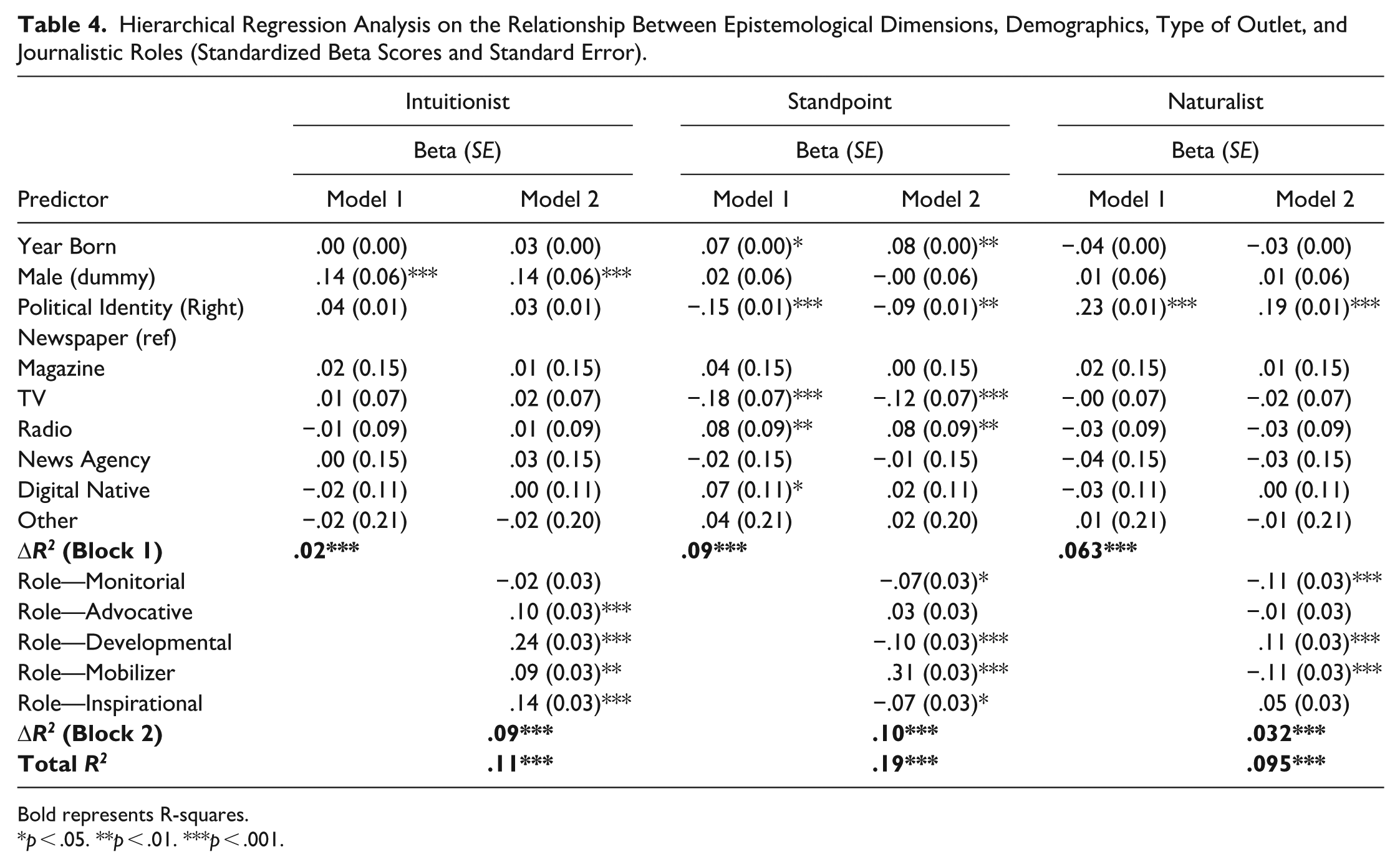
To test the hypotheses about the relationship of (H1) medium type, (H2) gender, and (H3) political partisanship to journalistic epistemologies, we turn to the hierarchical regression analyses presented in Table 4, where Block 1 is demographics and outlet type, and Block 2 is journalistic roles. In the final models, we found that men are more likely to be intuitionists (Beta = .14, SE = .06, p < .01), and other demographics and outlet type are not correlated with this dimension at statistically significant levels, explaining only 2% of the variance. For standpoint epistemology, we found TV reporters are negatively related to this dimension (Beta = −.18, SE = .07, p < .001), while radio journalists (Beta = .08, SE = .09, p < .01) and digital native journalists (Beta = .07, SE = .11, p < .05) are positively related. Political conservatism is negatively related to standpoint epistemology (Beta = −.15, SE = .01, p < .05). Together, demographics, political leaning, and outlet type explain 9% of the variance. For naturalism, results reveal this epistemology is positively related to political conservatism (Beta = .23, SE = .01, p < .001), explaining 6.3% of the variance.
Hierarchical Regression Analysis on the Relationship Between Epistemological Dimensions, Demographics, Type of Outlet, and Journalistic Roles (Standardized Beta Scores and Standard Error).
Bold represents R-squares.
p < .05. **p < .01. ***p < .001.
Thus, H1a is supported—digital journalists do embrace a standpoint epistemology; however, H1b is not supported—TV journalists are less likely to embrace standpoint epistemology, but not more likely to be naturalists as posed by the hypothesis. Meanwhile, H2 is not supported. It is male—not female journalists, who embrace an intuitionist epistemology (H2b). There is no discernible difference between men and women regarding naturalist (H2c) or standpoint epistemologies (H2a). H3a and H3b are not supported. Conservative journalists embrace a naturalist epistemology, although, interestingly, they reject the standpoint epistemology that we presumed would be embraced by more liberal journalists.
Finally, although Hanitzsch (2007) introduced a model that combines roles and epistemologies, we know of no efforts to test their relationship empirically. However, based on the literature, we formed four hypotheses. Following prior work on roles, we used a factor analysis to extract five roles. Four items had low loading (<.50) and were removed from the analysis. We found five roles: monitorial, advocative, developmental, mobilizer, and inspirational (Table 2). These roles have not been identified in quite this way for U.S. journalists in previous studies, but they map onto a number of the global role orientations identified by Hanitzsch and Vos (2018). Four of the role orientations relate to democratic functions; one of the role orientations—inspirational—maps onto what Hanitzsch and Vos characterized as related to everyday life. The roles are also somewhat consistent with those identified by Willnat et al. (2025). Monitorial is largely their interpretive/investigative; mobilizer matches their populist mobilizer; advocative is close to adversarial, developmental, and inspirational, likely result from the addition of different kinds of roles that are seen more internationally. More will be said about this in the “Discussion.”
Table 5 shows the results of a correlation between epistemologies and roles related to H4. We found that intuitionist epistemology is correlated with the advocative, developmental, and inspirational roles. Standpoint epistemology is positively correlated with the advocative and mobilizer roles, and negatively correlated with monitorial, developmental and inspirational roles. Naturalist epistemology is positively correlated with inspirational and developmental roles and negatively correlated with the monitorial and mobilizer roles.
Factor Loadings From Principal Component Analysis with Varimax Rotation for Journalistic Roles.
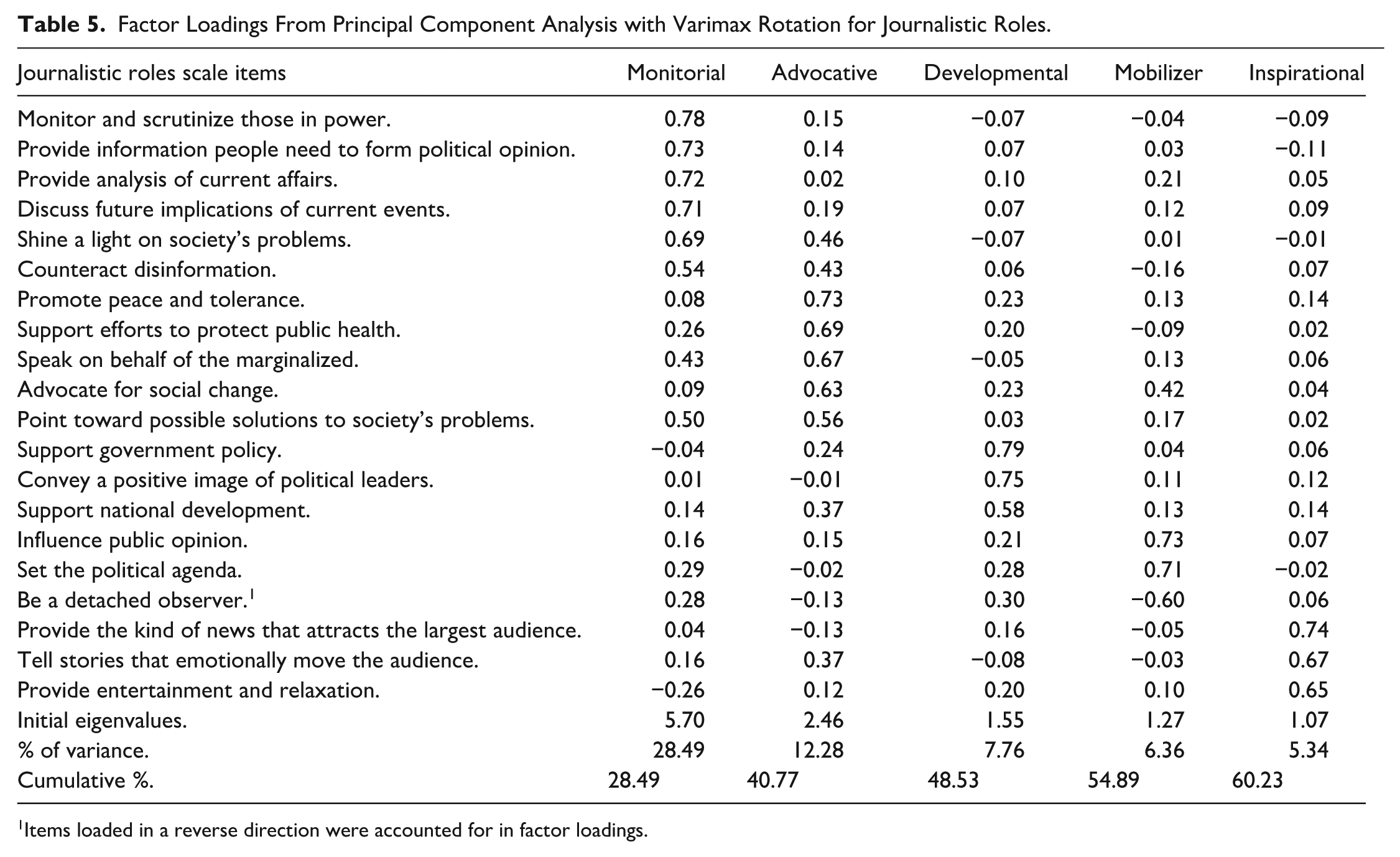
Items loaded in a reverse direction were accounted for in factor loadings.
H4a is partially supported—a naturalist epistemology is negatively aligned with a mobilizer role, as hypothesized, but not with a monitorial role. H4b is partially supported—a standpoint epistemology is aligned with a mobilizer role and negatively correlated with a monitorial role, as predicted, but it is not aligned with an advocative role. H4c is supported—an intuitionist epistemology is aligned with both advocative and inspirational roles. H4d is partially supported. A developmental role is aligned with intuitive and naturalist epistemologies but negatively correlated with a standpoint epistemology.
The last block in Table 4 depicts these relationships, controlling for demographics, political leaning, job experience, and outlet type. We found that the intuitionist epistemology is positively associated with advocative (Beta = .10, SE = .03, p < .01), developmental (Beta = .24, SE = .03, p < .001), mobilizer (Beta = .09, SE = .03, p < .01), and inspirational (Beta = .14, SE = .03, p < .001) roles. On the other hand, the intuitionist epistemology is negatively related to monitorial roles, although not at statistically significant levels. The full model explained 11% of the variance. Standpoint epistemology was positively associated with the mobilizer role (Beta = .31, SE = .03, p < .001) and negatively related to the monitorial (Beta = −.07, SE = .03, p < .05), the inspirational (Beta = −.07, SE = .03, p < .05) and the developmental roles (Beta = −.10, SE = .03, p < .001), explaining 19% of the variance. Naturalist epistemology had positive relationships with the developmental (Beta = .11, SE = .03, p < .01) role and negative relationships with the monitorial (Beta = −.11, SE = .03, p < .001) and mobilizer roles (Beta = −.11, SE = .03, p < .001; Total R2 = .10; Table 6) shows the correlations between journalistic roles and epistemologies and Table 7 depicts these relationships based on the strength of the standardized scores (Betas).
Correlations Between Journalistic Roles and Epistemologies.
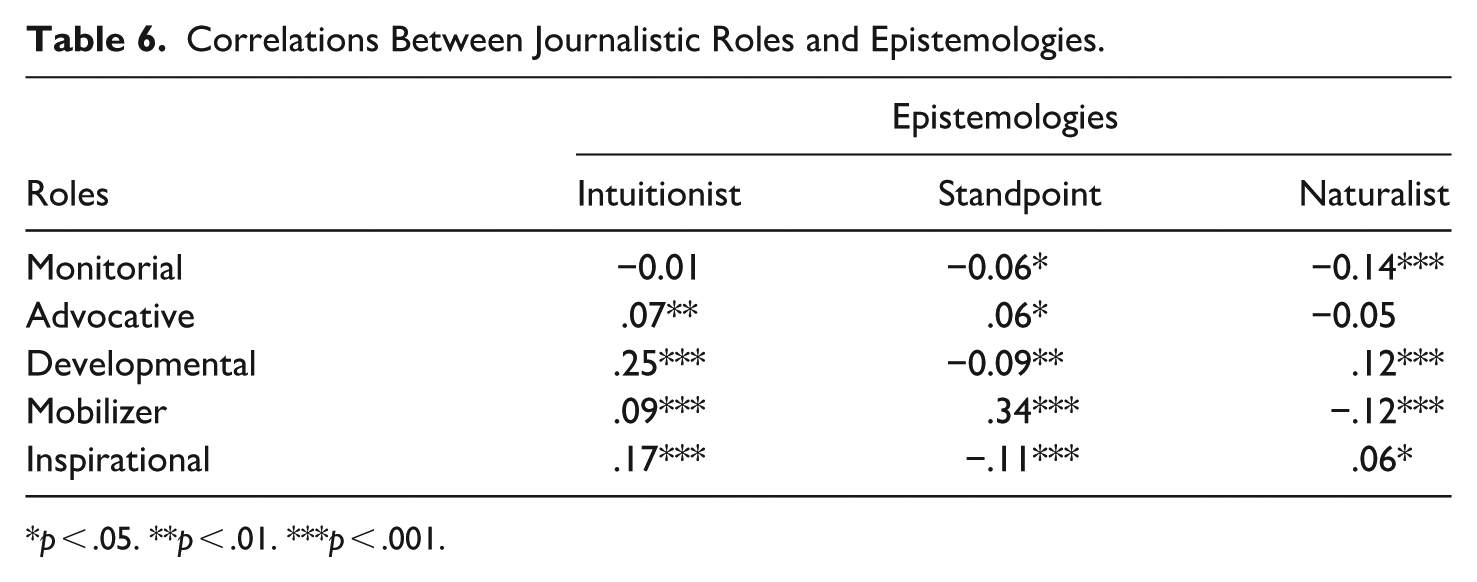
p < .05. **p < .01. ***p < .001.
Significant Relationships Between Epistemologies, Roles, and Ethical Orientations Based on Regression Results.
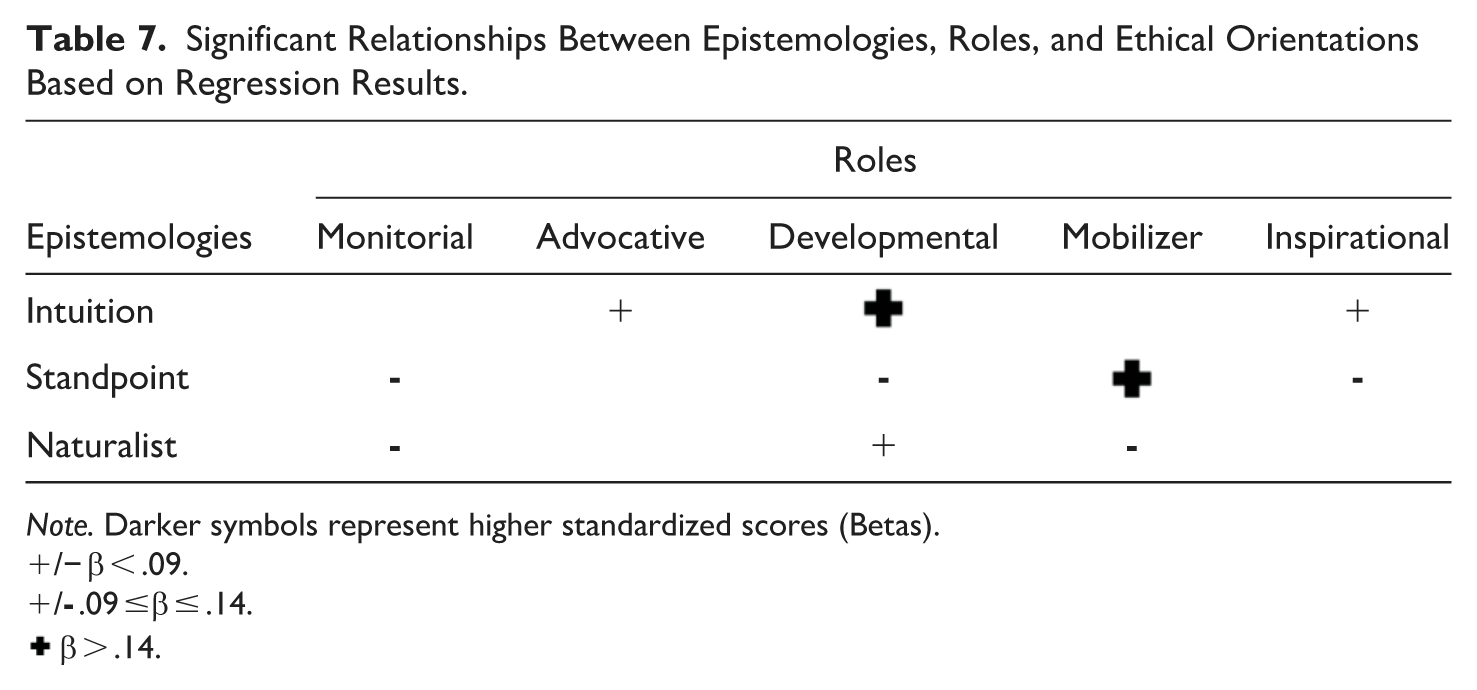
Note. Darker symbols represent higher standardized scores (Betas).
/− β < .09.
 β > .14.
Discussion and Conclusions
This study presents, as far as we can tell, one of the first social scientific measures of U.S. journalists’ epistemologies in over a decade—a period of significant disruption in journalism. The three epistemologies that emerge from our factor analysis point to a more diverse epistemological landscape than in a previous epoch, when objectivity was journalism’s “supreme deity” (Mindich, 1998, p. 1). Our findings show a more even distribution between constructive and naturalist epistemologies among U.S. reporters, with naturalism being correlated with conservatism among the reporters in the sample. The embrace of the constructivist epistemology plausibly also flows from the reckoning around climate change, the Trump presidency, and the Black Lives Matter movement, where journalists acknowledged the shortcomings of a pure naturalist and objective epistemology. Yet, while pure objectivity may have lost its dominance, journalism is far from a turn to relativism, in which there is an acknowledgment that truth is relative and defined by power. Journalism is still seemingly guided by a desire to separate truth from falsehood, and the epistemological shift comes from adding reflection, adjudication, and interpretation to facts.
Regarding predictors of epistemologies, we found relevant relationships between gender, political leaning, and outlet type. First, male journalists were more likely to rely on intuition; that is, trusting their gut and community experience. While constructivist epistemology is largely related to women in the literature (Cabas-Mijares, 2023), our findings suggest that men are more confident regarding their journalistic instincts. While these findings might seem counterintuitive, it seems that relying on intuition is more related to a perception that professional experience can help one envision the outcome of a story than that human experience and subjectivity are the proper way to achieve truth.
Importantly, we found that conservatism is associated with a naturalist epistemology, while liberalism is more aligned with a standpoint epistemology. These findings are consistent with evolutionary psychology, which suggests conservatives rely on absolute truths and authority figures, preferring closure. Liberals, on the other hand, tend to rely on cognition (Mourão et al., 2023). From a professional perspective, we find that outlet type was important for standpoint epistemology. While journalists working for radio and digital native outlets are more open to standpoint epistemology, television reporters are negatively correlated with this orientation.
Regarding journalistic culture and how roles and epistemologies fit—or don’t fit—together, we found that the relationship between constructivist epistemologies and roles is more varied than naturalist orientations. Meanwhile, we see that a naturalist epistemology, where journalists try to be objective, is not closely aligned with monitorial and mobilizer roles, as we once would have expected (see Schudson, 2001). Instead, the naturalist epistemology is associated with low power distance, that is, a developmental role. Thus, it seems that critics who have argued that objectivity is little more than stenographic and, hence, deferential to the powerful, seem to find support here (Birks, 2022). Indeed, Fox News, which has claimed to be fair and balanced while also being collaborative and facilitative with the Republican party (Hoewe et al., 2020), is indicative of an identifiable journalistic culture within the United States. Meanwhile, the naturalist epistemology also aligns with the inspiration role, which involves everyday life, including entertainment—despite it only appearing in correlation, not regression. All of this we take to mean that the objectivity paradigm is indeed shifting, with the older stenographic model losing traction among more liberal journalists (Birks, 2022). As expected, naturalism is negatively correlated with the advocative role, distancing this epistemology from activist media. Future studies should also consider how naturalism might differentially relate to journalistic roles based on the political orientation of reporters.
In the end, journalism culture’s coherence in the United States is limited. Our findings show that journalists indicate modest levels of approval for most epistemological and role items—even those that logically seem contradictory (Table 2). This plausibly supports the notion that journalists treat roles and epistemologies in particular as a cultural toolkit (Sewell, 1999; Swidler, 1986)—activated based on contextual cues. Journalists might trust their gut instincts in some situations (Schultz, 2007), for example, but demand empirical verification in others (Mena, 2019).
As noted, the 2022 findings from the American Journalist study by Willnat et al. (2025) identified a slightly different set of roles from those here. Notably, they did not find the developmental or inspirational roles (although “provide entertainment,” similar to an inspirational role, was classified with the disseminator function). Of course, we asked a broader range of role questions, in part formed by the range of roles posited by Hanitzsch and Vos (2018). It is of note that there was nevertheless considerable agreement with the items in these two scales.
This study has limitations. First, it relies on self-reported data, quantifying a complex concept (epistemology) based on journalists’ articulation about their work. The way epistemologies reflect on practice is a fertile ground for future studies. Second, we only asked about epistemologies as they relate to journalism and, therefore, need to account for how it manifests in other aspects of reporters’ social lives. Finally, there is no comprehensive list of journalists working in the United States. While we made extensive efforts to have a population that is representative of the country’s professional landscape, we cannot guarantee the representativeness of the sample, an issue identified in all surveys of journalists in the United States. Based on average age, our sample likely underrepresented younger journalists.
Nevertheless, we believe this study contributes to our understanding of U.S. journalism epistemologies and U.S. journalism cultures by starting to add precision to measuring journalistic epistemologies. We also explored how epistemologies relate to the well-known dimensions of roles, to compose a complex fabric of journalistic cultures. As journalistic truth claims continue to come under scrutiny (Carlson et al., 2021), we offer our initial map as a framework for those interested in studying journalists’ beliefs about the nature of knowledge and the nature of knowing.
Footnotes
Correction (March 2026):
Article updated to correct “The data was collected using Qualtrics.” to “The data was collected using Qualtrics as part of the Worlds of Journalism Study.”
Declaration of Conflicting Interests
The authors declared no potential conflicts of interest with respect to the research, authorship, and/or publication of this article.
Funding
The authors disclosed receipt of the following financial support for the research, authorship, and/or publication of this article: Funding was provided by Michigan State University’s Center for Journalism Studies.
