







Abstract
As the American news ecosystem continues to evolve, there are ongoing negotiations about credibility and influence. In the wake of Donald Trump’s victory in the 2024 U.S. presidential election, media critics pointed to the growing influence of political alternative media and influencers in conservative news cultures (CNC). Employing a quantitative content analysis, this study examines how Fox News and Newsmax framed news-like outlets (e.g. Breitbart News), influencers, and “mainstream media” 6 months before and after the 2024 elections. Results revealed a hierarchy within CNC, and a simultaneous exalting of influencers, especially Joe Rogan, and denigration of mainstream media.
Keywords
After every U.S. presidential election, a consensus often emerges about which factors drove that election’s results, for example, specific voting blocs or socio-political issues. Often, one of the factors is media-oriented, such as how well John F. Kennedy played to TV cameras in 1960 (Druckman, 2003), Barack Obama being christened the “social media president” in 2008 (Katz et al., 2013), or darker concerns about Russian influence via bots and trolls in 2016 (Almond et al., 2022). In 2024, Bloomberg claimed: “The second Trump presidency, brought to you by the YouTubers” (Alba et al., 2025). More accurately, the influence on the “media diet of a generation” was composed of nine of the most watched/listened to figures on YouTube and/or podcasts, including Joe Rogan, The Nelk Boys, Logan Paul, Theo Von, Patrick Bet-David, Lex Fridman, Andrew Schultz, Adin Ross, Shawn Ryan (Alba et al., 2025). Chief among them, Rogan prompted BBC News to report in 2024, “Republican presidential candidate Donald Trump is about to do one of the biggest interviews of his presidential campaign—with America’s number one podcaster, Joe Rogan” (Cabral, 2024, para. 1). Rogan and his ilk were portrayed as carrying significant influence with their audiences—an overwhelmingly young male audience that helped push Trump toward victory (Alba et al., 2025).
In conservative news cultures (CNC), there has been a transformation of “right-wing media” trying to rival “professional journalism’s. . .cultural authority” (Bauer & Nadler, 2025, p. 625), with “political alternative media” (Strömbäck & Åkerlund, 2025, p. 1) and influencers gaining traction (Alba et al., 2025; Zhang et al., 2023). Given so much change, audiences may not know how to make sense of emerging voices in CNC. Seeking some guidance, audiences may turn to more trusted and well-known news sources, hear how they are characterizing these entities’ credibility, and use those descriptions to form their opinions about whom to trust and consume.
This study examines how two trusted CNC sources—Fox and Newsmax—doled out credibility to three groups of actors surrounding CNC. The first group is what Strömbäck and Åkerlund (2025) refer to as “news-like” entities, including Breitbart News, One America News Network (OANN), The Federalist, and Newsmax. These entities are less established than Fox and may benefit from Fox deeming them worthy. Furthermore, how Newsmax frames peer institutions can reverberate on their own positioning. If Newsmax legitimizes peer outlets, then by association, it can contribute to legitimizing itself. The second group includes the nine influencers—mentioned in the first paragraph—whom Bloomberg credited with aiding Trump’s re-election (Alba et al., 2025). Each has at least one million subscribers, though some, like Rogan, have tens of millions across platforms, and bring in large audiences (Alba et al., 2025). Their audience size provides one metric of their influence; tracking how outlets in CNC framed their credibility provides another metric and illuminates how credibility can flow within CNC in transformational times, for example, during influencers’ rise. The final group is the mainstream media (MSM). Political alternative media openly critique and attack MSM, their practices, and their “‘politically correct’ disinformation” (Strömbäck & Åkerlund, 2025, p. 1). These characterizations can further delegitimate MSM within CNC, which can push individuals toward political alternative media.
This study included Fox News and Newsmax, tracking their framing for 1 year, starting 6 months before the 2024 U.S. elections and going through Trump’s first 100 days in office. Fox was selected because of its superior position within CNC, as demarcated by its long run as the top cable channel and the most watched and trusted news source of Republicans and conservatives (Orth & Bialik, 2024). Newsmax was included because it is one of the most trusted and consumed news-like outlets among Republicans/conservatives (Orth & Bialik, 2024), lending them persuasive ethos. Furthermore, unlike other news-like sources, Newsmax’s coverage is archived in an accessible database, ensuring systematic data collection.
Much of the research on news credibility has focused on comparing MSM sources (see Strömbäck & Åkerlund, 2025), with little focus on political alternative media and influencers within CNC. Yet these entities continue to emerge and amass followers who reject MSM. To contextualize their raise and better understand the implications for our current news environment, it is valuable to assess how trusted CNC outlets (de)legitimize them and work to expand or contract what should be considered credible news. Furthermore, while research has assessed media bias claims by politicians and the public (see Meeks, 2020; Strömbäck & Åkerlund, 2025), little work has examined journalists’ intra-professional bias claims, that is, a journalist claiming another journalist is biased. It is important to systematically assess intra-professional discourse because power dynamics shape whose “bias” is visible and to whom, and public trust is at stake. This study brings together Carlson’s (2016) metajournalistic discourse theory and Carlson and Lewis’s (2019) boundary framework to reveal how source credibility is discursively constructed in CNC, creating hierarchies of authority that shape perceptions of legitimacy and power, which could influence citizens’ information diets and voting decisions.
Constructing Credibility
Similar to O’Keefe (2002) and others, when this study uses the term “credibility,” it is more preciously referring to “perceived credibility,” as it conceives as credibility as being judged by a perceiver and not intrinsic to the source, message, or medium. As such, credibility is subjective and multidimensional (O’Keefe, 2002). Many studies argue over its exact dimensions, and over time it has been thought to include expertness, trustworthiness, dynamism, charism, genuineness, and more (see Delia, 1976). As noted later, many of these dimensions are present in how Fox and Newsmax approach credibility construction. Finally, this study conceives credibility as being malleable (Hovland & Weiss, 1951), constructed, and negotiated, emerging “within a transaction between a perceiver and an influence agent” (Delia, 1976, p. 374). Germane to this study, journalists can act as “influence agents” by discursively constructing credibility about themselves, other journalists/outlets, or the profession and its practices. For example, journalists can emphasize how they engage in ethical reporting practices, such as displaying multiple forms of information verification (Deavours & Roberts, 2025). These construction efforts fit within Carlson’s (2016) metajournalistic discourse, which is defined as “public expressions evaluating news texts, the practices that produce them, or the conditions of their reception” (p. 353), by actors who “publicly engage in processes of establishing definitions, setting boundaries, rendering judgements” (p. 350).
Carlson (2016) situates metajournalistic discourse within a long line of research on journalism professionalization and boundaries, in which journalists have continuously created “insider-outsider narratives intent on re-establishing the terrain of valid news practices” (p. 353). Such re-establishment spans how journalists interact with non-journalists in letters to the editor to online comments to navigating expanded participation with the growth of social media and citizen journalists (Carlson, 2016). Carlson (2016) focuses on a discursive approach because they see discourse “not as mere expression, but as a governing force delimiting how social phenomena are understood” (p. 353), which aligns with Foucault’s (1991) assertion that discourse is the site of power and knowledge, and power/knowledge is embodied, distributed, and negotiated in discourse. By examining how journalists talk about journalism and credibility, we can see how definitions, boundaries, and legitimization are (re)formed and distributed.
Previous work has examined how conservative outlets conceptualize their role and practices. Fitting within a metajournalistic paradigm, Bauer et al. (2022) labeled this a producer-centric approach, which considers how conservative journalists and media workers conceptualize what counts as news, their roles, and norms. Nadler et al. (2020) took this approach when they interviewed journalists and editors working at online conversative news organizations. News workers in these organizations aligned with “traditional nonpartian journalists” in endorsing the need for accuracy and fairness in representing a variety of perspectives, and while some embraced objectivity, others endorsed transparency regarding one’s agenda (Nadler et al., 2020), a divide found in studies of traditional journalists (see Hellmueller et al., 2013). Nadler et al. (2020) uncovered five elements conservative journalists use to make distinctions within CNC: 1) Whether they emphasize original reporting versus analysis and commentary. 2) What professional norms have they adopted. 3) Whether they try to speak to a politically homogeneous or heterogeneous publics. 4) What characteristic style do they uphold. . .a tabloid or more elite orientation. 5) Whether they present a diversity of viewpoints within conservatism (p. 21).
These criteria reveal the potential for stratification within CNC, with news producers characterizing some outlets as more akin to professional journalists delivering “hard news” and meeting traditional normative expectations, which could translate into those entities seeming more credible.
There are concerns with relying on entities’ self-identification, as some may frame themselves or their practices in “self-serving ways” or what others perceive as partisan, they may perceive as “telling-it-like-it-is reporting” (Bauer et al., 2022). Concerns of depending on conservative organizations’ self-identification are not new in journalism. For example, Meeks (2024) cautioned against journalists using conservative group’s self-ascribed labels because it “may obscure their aims or hide their broader connections” (p. 119). Relevant to this study, depending on Rogan’s self-identified label of “comedian” can shield him from critiques levied at others in a similar influential informational role. As discussed in the following section, this study does not examine self-identification or self-credentialing; rather, this study assesses how Fox and Newsmax (de)construct the credibility of other figures within the CNC. As such, this study examines how Fox and Newsmax exert their cultural authority to discursively build or break others’ cultural authority and set professional boundaries.
Source Credibility
Source credibility has traditionally been tied to Aristotle’s notion of ethos and how a speaker’s status or authority can affect their persuasive power on an audience (Dalen, 2019; Delia, 1976). Knowing a speaker’s status can act as a heuristic for individuals looking to reduce the mental effort needed to assess source credibility (Dalen, 2019). Heuristics are cognitive shortcuts that have been learned over time and based on previous experiences that enable individuals to make evaluations and judgments (Dalen, 2019). Dunwoody and Griffin (2001) caution against automatically assuming heuristics are “deficient or irrational” as the quality of the heuristics may enable someone to “produce a respectable outcome” (p. 178), and they emphasize that “journalism is unapologetically a world of heuristic decision making” (p. 180). While their statement was about journalists making heuristic judgments to meet reoccurring deadlines, the sentiment can apply to the modern public as well whose attention economy is stretched across an ever-increasing information environment.
For decades, journalism scholars have studied source credibility across different platforms, such as newspapers versus TV news (Lee, 1978), within platforms, such as Tandoc’s (2019) study comparing a news article’s credibility when shared on Facebook by a friend versus a news organization, with “sharer” functioning as a heuristic, and across news tracking organizations, such as Mensio and Alani’s (2019) comparison of how fact checking organizations assessed different sources’ credibility. Furthermore, research has examined other heuristics, such as Miller and Kurpius’s (2010) experiment in which citizens assessed credibility across source affiliation (official versus citizen), source race, and whether the story was a hard or soft news piece. Taking a different approach, Reich (2011) chronicled a bevy of research examining how journalists judge their sources’ credibility. Finally, Salaudeen (2022) investigated how journalists evaluate the credibility of citizen journalists, who are “blurring boundaries in the news production process” and prompting the need to evaluate the “credibility and legitimacy of alternative media platforms” (p. 2,040). This quote speaks to the premise of the current study as news-like outlets and influencers populate alternative media platforms, and, as noted later, can engage in the co-production of news, spurring social and professional consequences.
What is less represented by this scholarship is how journalists are constructing the credibility of other journalists or media sources. In other words, within the metajournalistic discursive space, we rarely see systematic analysis of how journalists characterize other media sources’ credibility. Many studies assess media bias claims, often finding a connection between conservative or right-wing entities claiming the media is biased in favor of liberals (Eberl, 2019; Meeks, 2020; Strömbäck & Åkerlund, 2025; Watts et al., 1999). Yet those studies found these charges of bias coming from politicians or the public on social media, or discussion of media bias in coverage; their analysis did not reveal accusations coming from fellow journalists. Furthermore, there are several studies examining bias in news coverage, including of Fox (Bard, 2017; Groeling, 2008; Pang, 2025), but those analyses are based on scholars’ assessments, not journalists. Previous work has largely not examined intra- and inter-professional media bias claims. Examining how journalists attempt to delineate another media source’s credibility, be it news-like entities or influencers, and whether they are biased, contributes to metajournalistic discursive research, and illuminates to some extent why some media sources raise and fall in popularity and perceptions of trust. 1
Credibility and Boundary Work
Framing the credibility of another entity can also be seen as a form of boundary work, helping to fortify or expand the profession and its domain. Calling upon decades of research, Väliverronen (2022) explained that boundary work emerged from sociology studies of professions, and within journalism, scholarship tends to focus on external boundary work, that is, how journalism discursively distinguishes itself from other professions, and internal boundary work, that is, discursive work regarding differences between journalists. Carlson and Lewis (2019) proposed a boundary work framework that borrows from Gieryn’s (1999) expansion, expulsion, and protection of autonomy framework, which focused on credibility within science. Carlson and Lewis’s (2019) framework includes participants, practices, and propositions within journalism. Participants can either be accepted as journalists (expansion), rejected as journalists (expulsion), or perceived as threats outside of journalism (protection of autonomy). Practices and propositions follow a similar accepted, rejected, or perceived as threats pattern, but focus on actions and norms, respectively. For example, plagiarizing journalists can be rejected and expulsed for engaging in unaccepted work practices (Carlson, 2018). Logically, if a journalist engages in expansion framing of another entity, it signals they value that media source as credible. Conversely, if journalists reject other sources’ practices (expulsion), it suggests they see them as non-credible.
Such signaling can be connected to normative efforts. Kantola (2013) discussed how “in the public sphere, journalists work as modernity’s national gardeners; they claim to serve the public good through their rationally guided work, and they nurture the public with objective facts and balanced information” (p. 609). They practice their “gardening” via their ethos, their everyday work practices, that enable them to make “normative evaluations of good work” and weed out bad actors (Kantola, 2013, p. 611). An everyday work practice can include how they frame other entities to declare what they think is good journalistic work, which they think helps create a more informed citizenry, thus contributing to a functional democracy. If a journalist classifies another’s work as propaganda or misinformation, they may view this framing as helping the public understand that those entities are harmful to public discourse and knowledge.
Study Expectations
For this study, framing a source’s credibility was assessed via two types of heuristic cues that can affect credibility: visual and audio/textual, which this study collectively calls “presence format.” In keeping with Metzger et al.’s (2003) focus on how factors for assessing credibility vary by medium, this study included multiple credibility indicators for assessing Fox’s transcripts and Newsmax’s articles. Transcripts provide visual indicators as they note who is a guest on a segment and when visual clips are inserted in the segment. Both guest appearances and clips showcase the “visible sources. . .who present the information” (Metzger et al., 2003), and gain credibility by being on screen and creating more presence (Bracken, 2006). Because Fox maligns MSM (see Strömbäck & Åkerlund, 2025), it is unlikely Fox would give MSM more visual credibility than entities in CNC, suggesting:
Other cues indicate audio for TV segments (e.g. text in a transcript indicates what audio was included in the TV segment) or textual cues for news articles, such as mentioning or quoting an entity’s publication/show. Previous research shows that quotes act as a positive heuristic cue for credibility evaluations, especially if the source is named and directly quoted (see Duncan et al., 2019). Alternatively, mentioning an entity in a critique can tarnish credibility. To obtain a baseline of presence, this study asks:
Tonality is another cue, and prior work shows that positive valance increases credibility and negative valance decreases credibility (Dana et al., 2023). Because conservative news outlets do not trust MSM (see Strömbäck & Åkerlund, 2025), they are motivated to cast them more negatively than other entities. Strömbäck and Åkerlund (2025) argue that by discrediting MSM, it can drive people toward political alternative media, like news-like entities and influencers. If Fox and Newsmax see news-like entities and influencers as contributing to a raising CNC and Trump’s re-election, they would be incentivized to champion their efforts.
Additionally, characterizations of entities’ work practices, and valance surrounding those practices, can contribute to credibility. This variable taps into the actions and norms aspects of Carlson and Lewis’s (2019) boundary framework, and Kantola’s (2013) gardening metaphor, and tying ethos to work practices. For example, claiming the MSM is engaging in propaganda indicates a negatively valanced reference that critiques the entity’s work practices as outside the professional norm, creating expulsion. This last example is supported by scholarship as Fox and political alternative media critique MSM’s practices (see Strömbäck & Åkerlund, 2025). In turn, it is likely that Fox and Newsmax would frame MSM’s work practices negatively.
Though we have plenty of scholarship documenting what are considered “good” work practices for traditional journalists, there is less work on political alternative media and little on the work practices of influencers within news spaces, and whether entities like Fox recognize or acknowledge these practices, prompting the question:
Another heuristic cue is labeling. Labels identify entities as either fellow journalists or not, thus creating opportunities for expansive or expulsive boundary work, and aligning with Carlson and Lewis’s (2019) participants component. Stating that an entity engages in news work, for example, labeling them as a “reporter,” signals professional experience and expertise, which are tied to credibility perceptions (Metzger et al., 2003), creating a cue for audiences that this entity is part of the profession. Conversely, labeling a show as “opinion-based” indicates it is non-journalistic based on normative ideals of objectivity (Kantola, 2013) and shows the entity engaging in commentary, which conflicts with conservative journalists’ perceptions of quality journalism (Nadler et al., 2020). Like opinion labels, other descriptors can signal that the entity is not squarely in the journalistic space and create expulsion, such as calling them an “influencer” or “comic.” To explore how labels contribute to boundary work, this study asks:
Method
This study employed a quantitative content analysis, which facilitates systematic analysis of large volumes of communications, enabling the detection of patterns (Krippendorff, 2004). The time frame was May 2024 to May 2025, which encompassed 6 months prior to the 2024 presidential election, the interstitial period where Trump was president-elect, and encapsulating Trump’s first 100 days in office, which enabled tracking coverage of Trump’s decision to expand who took part in the White House press briefings, including emerging CNC entities.
Fox and Newsmax were selected because they are trusted, highly consumed news outlets by Republicans and conservatives (Orth & Bialik, 2024). Fox has long held a dominant position across cable ratings in general and especially within CNC. Newsmax was selected to represent news-like entities because of its trust levels and because unlike Breitbart, OANN, or The Federalist, which are similarly trusted, Newsmax is archived in an accessible database, 2 affording systematic data collection. The other outlets’ coverage is only available via their websites, which have simplistic search functionality and may have unreliable archival processes.
Fox transcripts and Newsmax articles were collected from Newsbank with the timeframe of 11 May, 2024, to 11 May, 2025, and the keywords included the names of the news entities and influencers’ full names and show titles. All applicable Newsmax articles were included. Because Fox includes programming 24/7, the analysis focused on the most-viewed programming to reveal what the dominant Fox discourse included and based on the premise that the most successful shows could prompt agenda-setting effects. Transcripts were pulled for the five top-rated programs, which included: The Five (4.8 million total viewers as of January 2025), Jesse Watters Primetime (4.1 million), Hannity (3.8 million), Special Report with Bret Baier (3.5 million), and The Ingraham Angle (3.5 million) (Mwachiro, 2025).
Any transcript/article that mentioned one of the following sources during the time frame was included. The first group of sources included four news-like outlets: Breitbart News, Newsmax, 3 OANN, 4 and The Federalist. The second group of sources included the nine influencers that Bloomberg and others have identified as some of the most influential YouTubers and podcasters within conservative circles: Adin Ross (host’s name)/Adin Live (channel/show’s name), Andrew Schulz/Flagrant, The Nelk Boys/Full Send Podcast, Logan Paul/Impaulsive, Joe Rogan/The Joe Rogan Experience, Lex Fridman/Lex Fridman Podcast, Patrick Bet-David/PBD Podcast, Shawn Ryan/Shawn Ryan Show, and Theo Von/This Past Weekend (Alba et al., 2025). MSM included references to “mainstream media,” “legacy media,” and similar wording, and specific news entities that are seen as MSM to conservatives, for example, The New York Times, The Washington Post, CNN, MSNBC (rebranded as MS NOW in November 2025), ABC, NBC, and CBS.
Content was screened for errant duplicates, 5 overlap between data pulls (some units mentioned an influencer and a news-like entity), and relevancy. Specifically, The Federalist sometimes triggered content that did not mention the outlet but rather, for example, The Federalist Papers or The Federalist Society. Only content pertaining to the outlet was included. After cleaning, which removed 57 units of observation, Fox had 238 transcripts and Newsmax had 240 articles for N = 478. Because an entire Fox show includes many segments, only the segment in which the search term appeared was analyzed. For Newsmax, the entire article was analyzed.
The variables included: Present Format, encompassing audiovisual dimensions—guest appearances and clips, for example, Fox airing a clip of Rogan’s show—and textual dimensions, including general mentions of the entity (e.g. “Trump went on ‘The Rogan Experience’”), when the publication/show was quoted (e.g. “According to Breitbart, Vance is going to. . .”), and when the individual was quoted (e.g. “On his show, Fridman said, ‘[quote]’”). Valence was coded as neutral, negative, or positive. Neutral mentions included when the entity referenced the outlet without tonal descriptions, such as, “According to CBS News, Trump is ahead in recent polling.” Negative mentions included denigrating the entity for their coverage, influence, audience size, etc., such as saying they are “dead” or “dying.” Positive mentions included lauding the entity for their coverage, influence, audience size, etc., such as saying they are “hugely popular” or a “vanguard.” Work Practices, and tonality surrounding these practices, included standard journalistic work practices, for example, sourcing, information verification, transparent reporting, and how when done ethically, these can contribute to credibility perceptions (Deavours & Roberts, 2025), and when done poorly, such as accusing an entity of bias, can detract from credibility (see Strömbäck & Åkerlund, 2025). This study did not track which work practice was mentioned; rather, it tracked whether any discussion of a work practice was included and if so, the valance of the mention. This absent/presence approach was helpful when coding discussion of influencers’ work practices as those are less well-documented—though, as noted later, many of these aligned with journalistic practices. Coding focused on any discussion of an entity’s work norms or routines, which could include production procedures, interview style, information presentation, etc. Then, these discussions were assessed for tonal qualities.
Labels included news-work and non-news work labels to help establish when expansive and expulsion labeling were present. News work labels included journalism role titles, for example, editor in chief, reporter, correspondent, and journalism-oriented descriptions of the entity, for example, “news show,” “outlet.” Non-news work labels included opinion labels, for example, describing the entity as opinion-based, such as “opinion website,” and thus unaligned with journalistic objectivity. The host label included calling the entity a host of their show or noted that they were a host on previous entertainment-centric shows, such as Rogan on Fear Factor. The influencer label captured direct references like “influencer” and “content creator,” as well as terms to signal their influence and reach, such as “popular podcaster.” The comic label captured that some of the influencers were seen as “comedians-turned-podcasters,” with labels like “comic” and “comedian.” The prankster label included that some influencers characterized their shows as prank shows or were called “pranksters” or “jokesters.” The sports label included that some of the influencers were involved in sports, such as Logan Paul’s wrestling career or Rogan being a commentator for the Ultimate Fighting Championship. The gendered label included gendered descriptors of the influencers, such as “brocasters” or “podcasting bros,” or their show, for example, “testosterone-fueled” or “male-centric,” or locating their show within the “manosphere,” defined as “the vast realm of male-oriented alternative media that has been credited with the rightward drift of the young male vote” (Staley, 2025, para. 2). Such gendered labeling works to distance the entity from being a traditional journalist (i.e. serious journalists are not called “brocasters”) yet aligns with conservatives favoring traditional masculinity (Katz, 2016).
The coding process for these variables was iterative. After the codebook was constructed, 6 it was employed in a round of pilot testing with subsequent updates. Then two coders were trained, engaged in practice coding and reconciliation afterward, before independently coding 50 units for a formal test of intercoder reliability. Descriptives and Cronbach’s alphas are in Table 1. Alphas exceeded acceptable levels of reliability (Krippendorff, 2004).
Key Variable Means, Standard Deviations, and Cronbach’s Alphas.
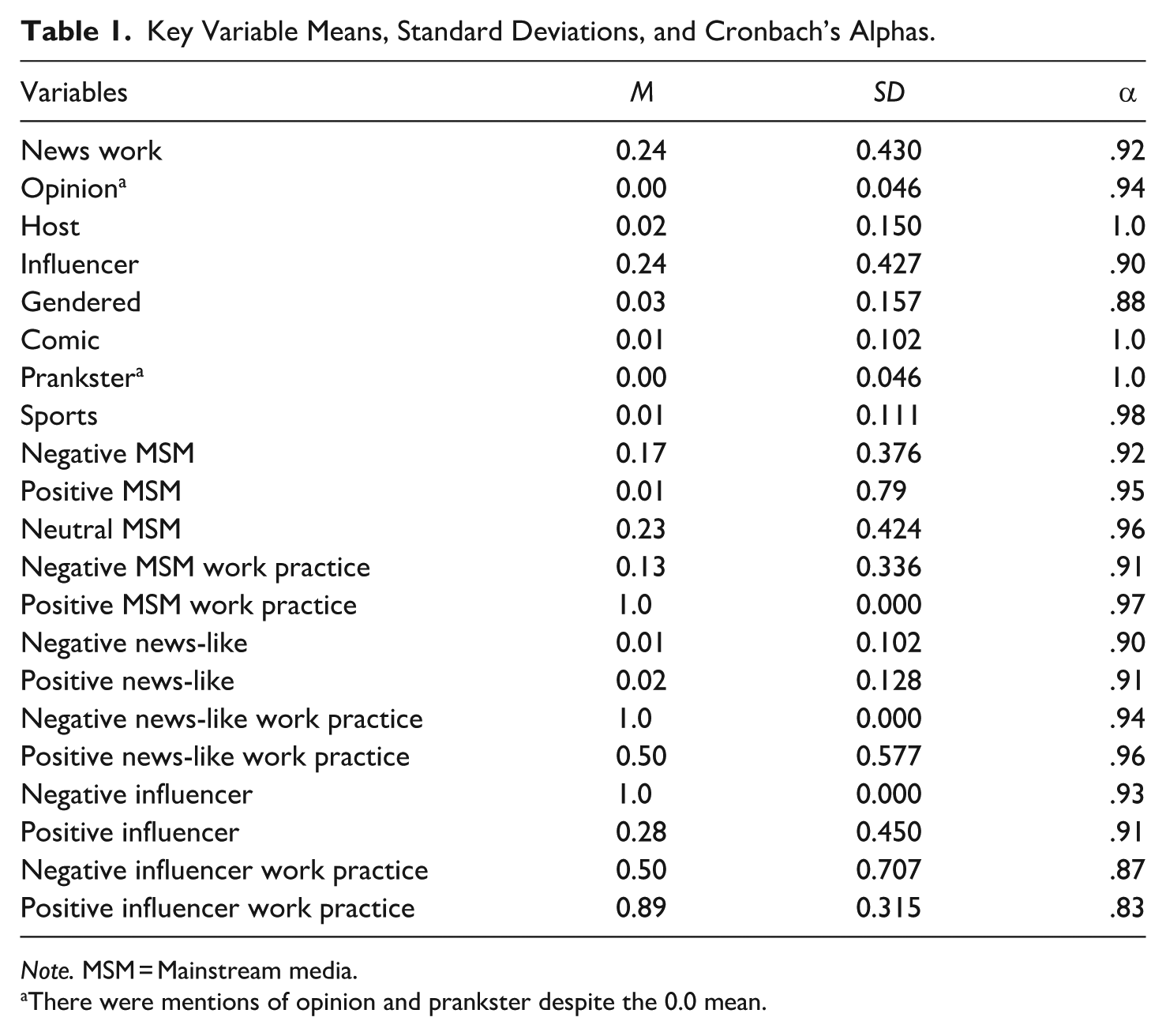
Note. MSM = Mainstream media.
There were mentions of opinion and prankster despite the 0.0 mean.
Results
H1 predicted Fox would feature news-like and influencer entities as guests more than MSM. News-like and influencer entities were combined for initial analysis, and guest appearances were coded as present (1) or absent (0). A paired samples t-test revealed that news-like and influencer entities (M = 0.45, standard deviation [SD] = 0.499) were featured as guests significantly more than MSM (M = 0.02, SD = 0.129), t(237) = −13.447, p < .001. H1 was supported as Fox was more likely to give visual credibility to news-like and influencer entities.
To better understand how each outlet featured each entity (RQ1), Table 2 provides a breakdown of percentages at the aggregate level. Each row includes the number of units including MSM, news-like, or influencer entities and what percent of those units featured mentions, guest appearances, clips, quoted publication/show, or quoted individuals.
Percentages by Entity by Presence Format.
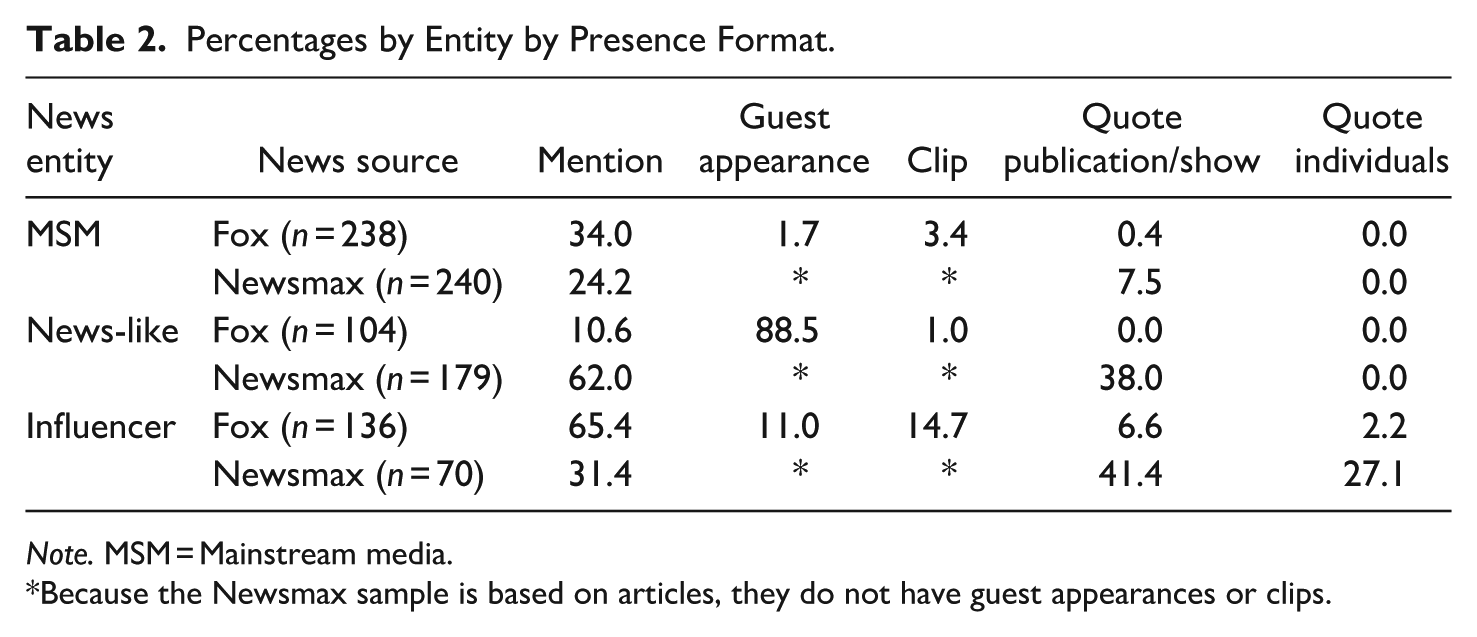
Note. MSM = Mainstream media.
Because the Newsmax sample is based on articles, they do not have guest appearances or clips.
For MSM, Fox (34%) and Newsmax (24.2%) primarily mentioned MSM, bringing them into the conversation via only audio/textual cues. For the other entities, Fox and Newsmax were less similar, partly due to medium differences because news articles cannot have guest segments. Fox was more likely to feature news-like entities as guests (88.5%), and Newsmax heavily favored mentions (62%). For influencers, Fox primarily used mentions (65.4%), and Newsmax favored quoting the influencer’s show (41.4%). Collectively, Fox gave news-like entities more airtime as guests than MSM or influencers.
To better understand differences within news-like and influencer categories, the next level of analysis examined each individually, producing notable findings. First, Fox never mentioned Newsmax or OANN. Second, Fox was substantially more likely to feature The Federalist (66.3%) over Breitbart (37.5%). Taken together, within CNC, Fox indicated who was worthy of inclusion—The Federalist and Breitbart—and who was not—Newsmax and OANN. Third, Newsmax also rarely mentioned OANN (2.8%), but unlike Fox, they favored Breitbart (81%) heavily over The Federalist (12.3%). It was very common for the lede paragraph of a Newsmax article to follow the format of “[News item preview], Breitbart reported”—such as this article from November 27, 2024: “A new hotline invites workers to report diversity and inclusion efforts in corporate America, fueling debates over the role of political activism in the workplace, Breitbart reported.” For Newsmax, Breitbart was a go-to source for reporting.
Working within the subsamples, cross-tabulations with chi square tests were conducted to assess the presence format. Figures 1 and 2 provide the breakdown for Fox and Newsmax, respectively. Because Newsmax and OANN were not mentioned by Fox, they were omitted from Figure 1.
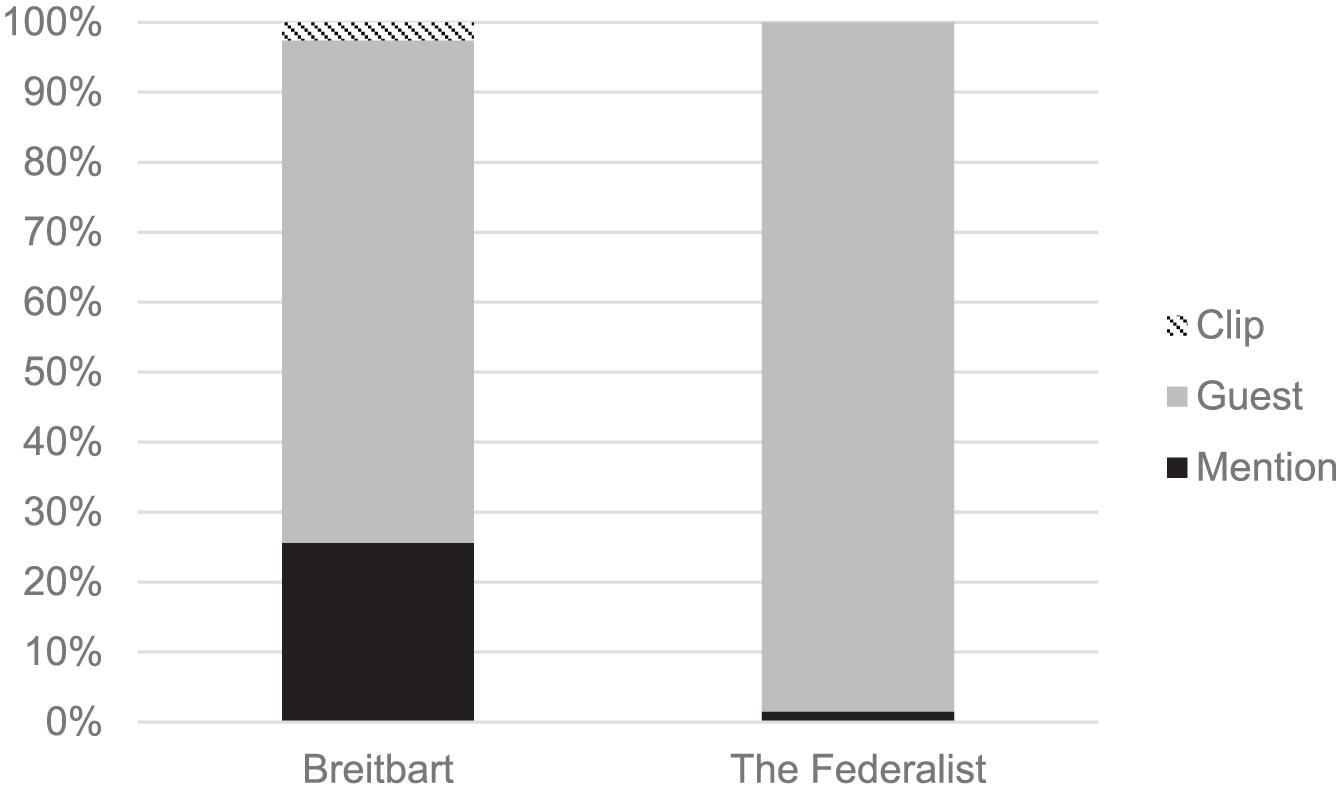
Fox News mentions of news-like entities.
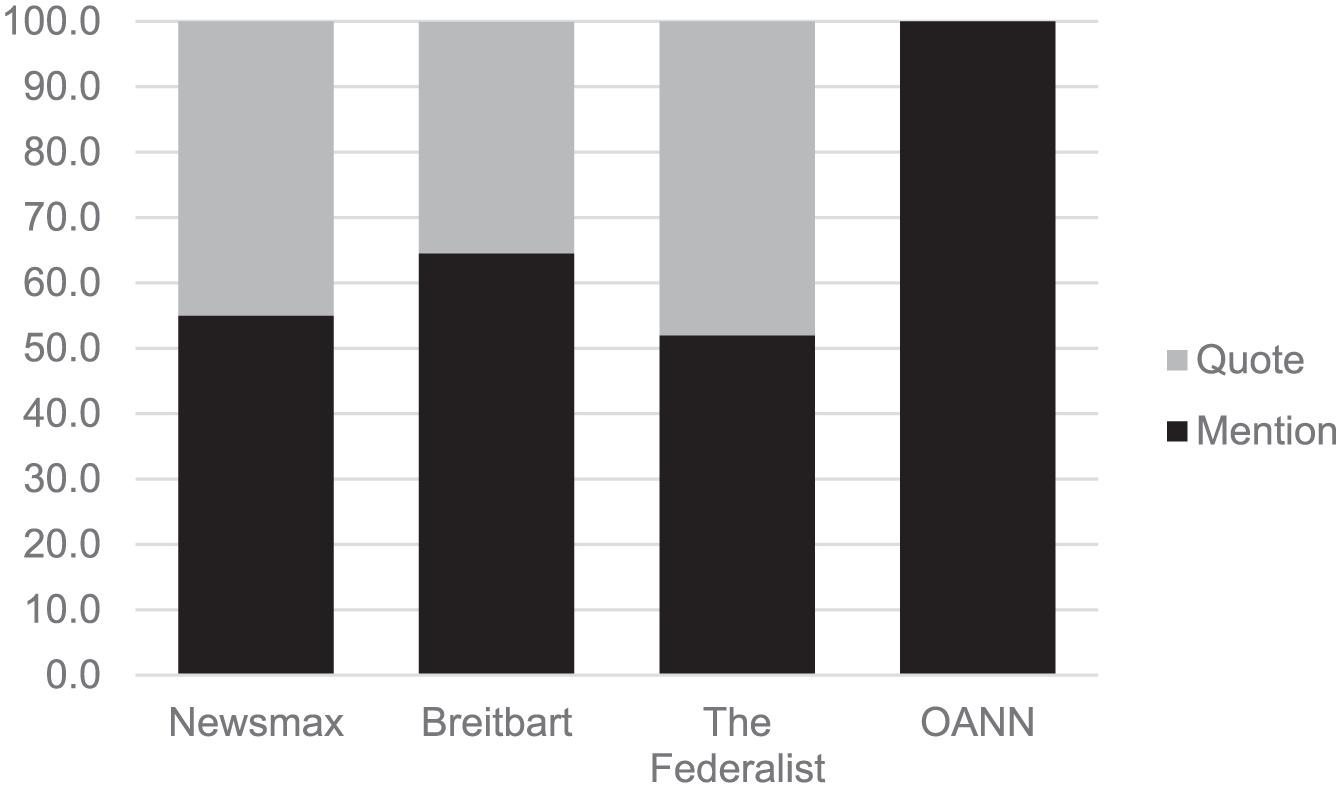
Newsmax mentions of news-like entities.
Mirroring the results in Table 2, Fox primarily featured Breitbart (71.8%) and The Federalist (98.5%) as guests. Most of these guest appearances were by Breitbart Editor-in-Chief Alex Marlow and The Federalist Editor-in-Chief Mollie Hemingway. The chi square tests were significant for Breitbart, X2(2) = 16.744, p < .001, and The Federalist, X2(2) = 20.181, p < .001. Newsmax was more likely to mention than quote news-like entities, but the chi square tests were insignificant.
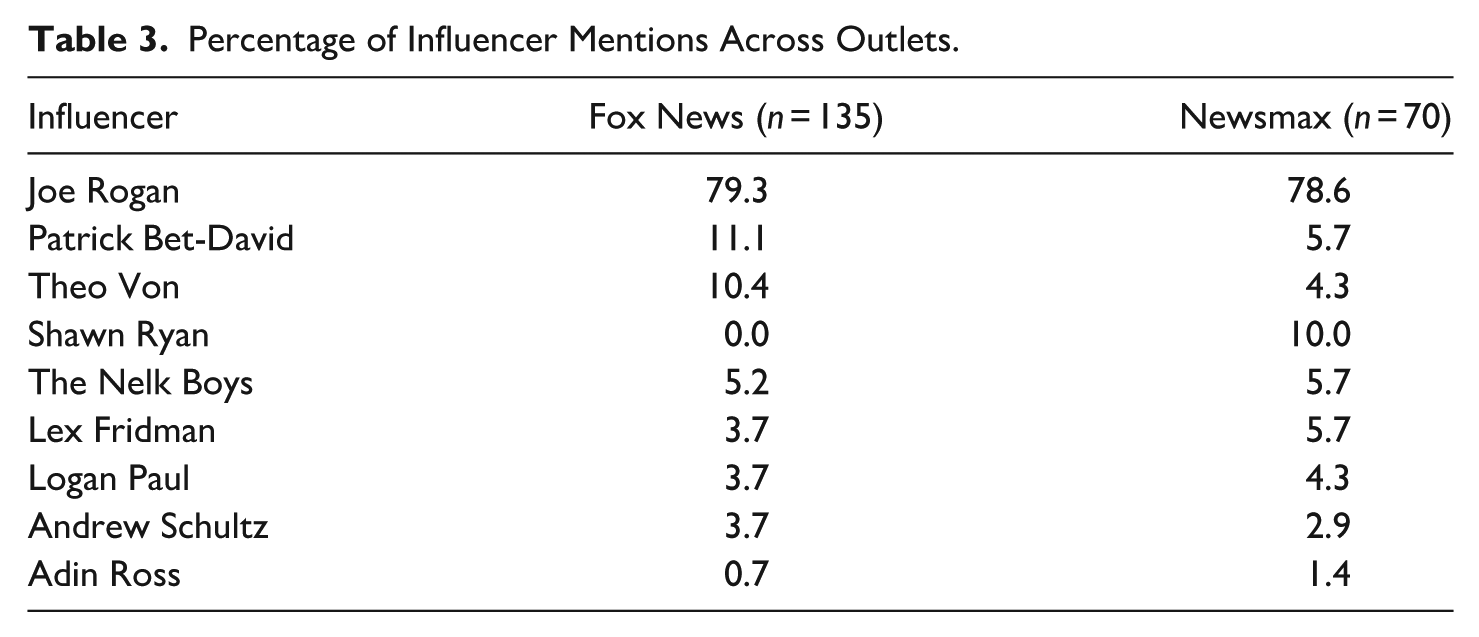
Pivoting to influencers, 135 Fox transcripts and 70 Newsmax articles mentioned at least 1 of the 9 influencers. The top influencer was clear for both outlets: Joe Rogan. He comprised nearly 80% of each outlet’s subsample, with no close rival (see Table 3).
Percentage of Influencer Mentions Across Outlets.
Working within the subsamples, cross-tabulations with chi square tests were conducted. Figures 3 and 4 provide the breakdown for Fox and Newsmax, respectively, regarding the presence format.
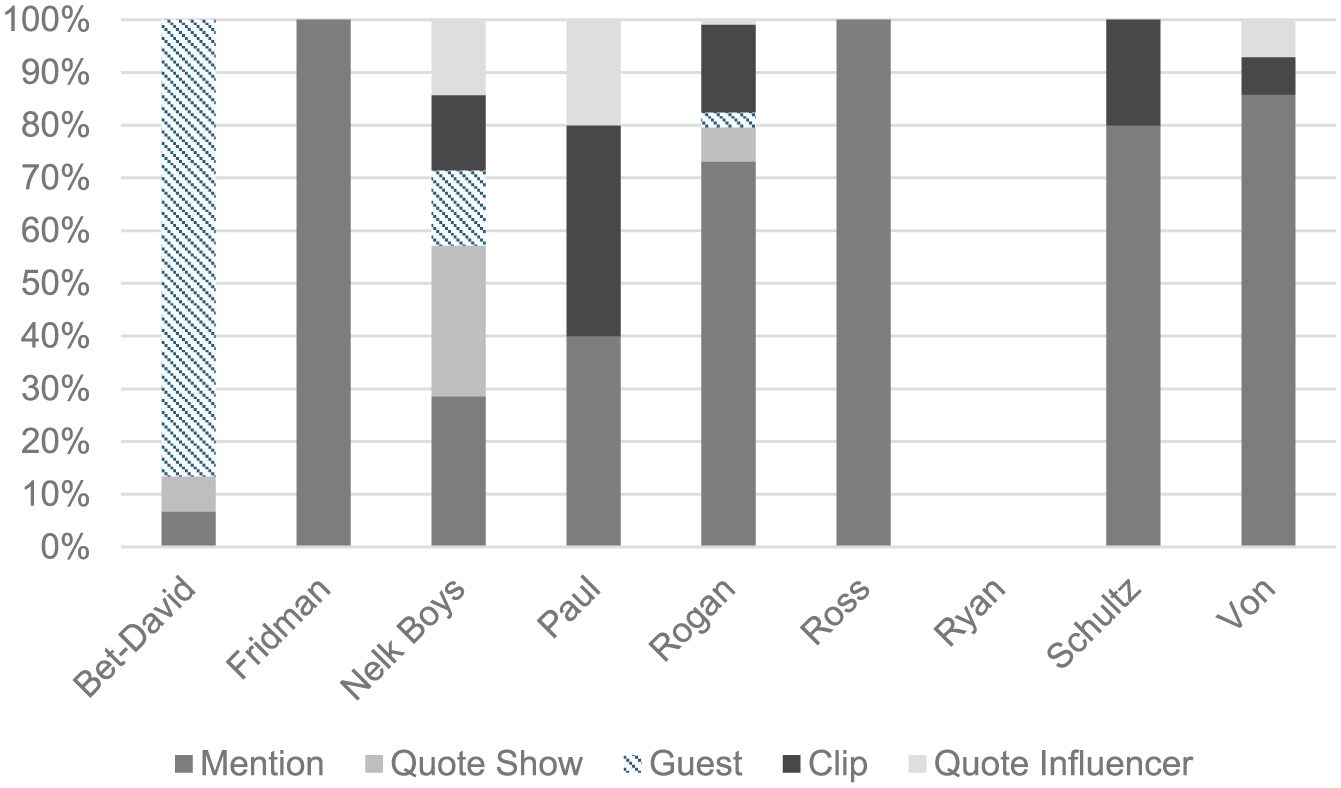
Fox News mentions of influencers.
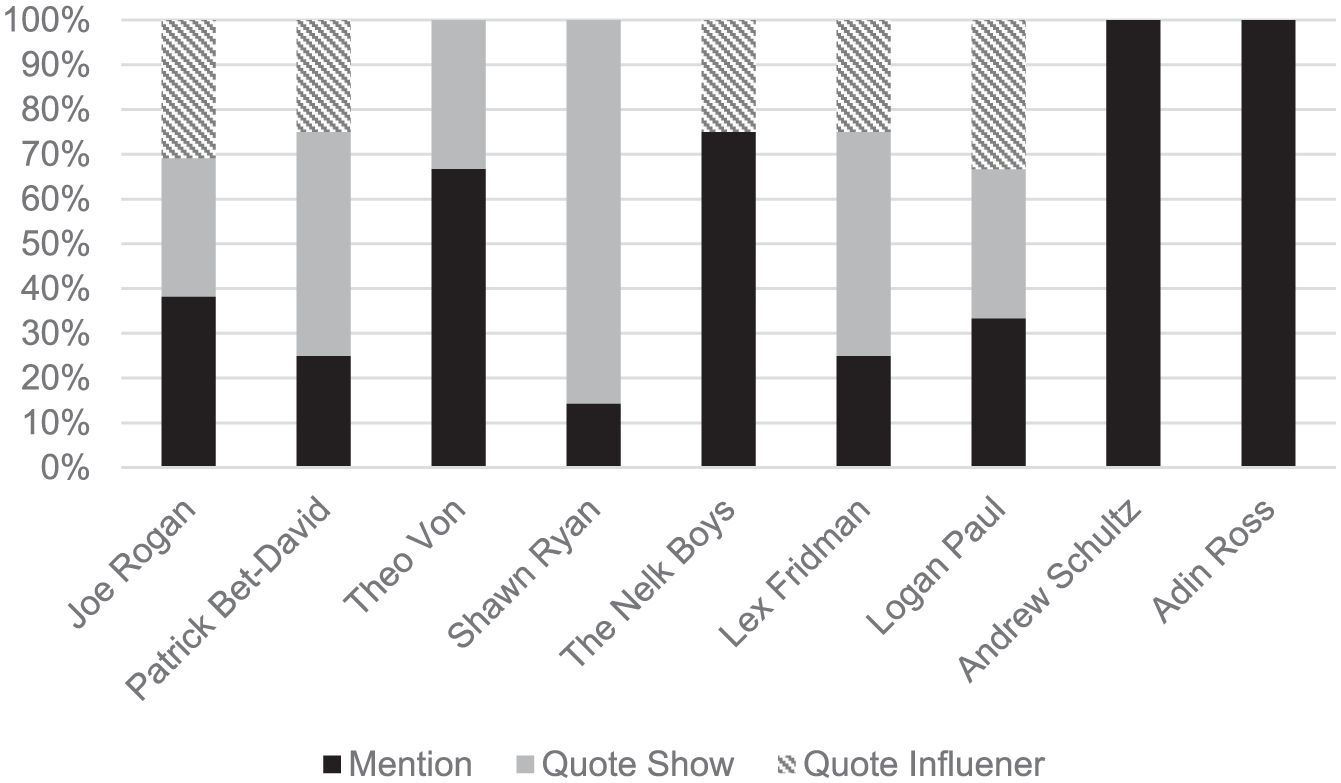
Newsmax mentions of influencers.
Fox was more likely to use mentions for Fridman (100%), Ross (100%), Von (85.7%), Schultz (80%), and Rogan (73.1%). Bet-David was the only influencer who frequently appeared as a guest (86.7%). Paul was most likely to be quoted (20%) of the influencers. Chi squares were significant for Bet-David, X2(4) = 12.791, p = .012, Nelk Boys, X2(4) = 23.459, p < .001, Paul, X2(4) = 22.346, p < .001, Rogan, X2(4) = 145.103, p < .001, and Von, X2(4) = 18.547, p < .001. Collectively, while Rogan had the biggest presence on Fox in various permutations, most of the visual credibility was given to Bet-David as a frequent guest.
For 4 of the 9 influencers, Newsmax was most likely to mention them: Von (66.7%), Nelk Boys (75%), Schultz (100%), and Ross (100%). For Pet-David (50%), Fridman (50%), and Ryan (85.7%), Newsmax was more likely to quote content from their shows. Only the chi squares for Rogan and Ryan were significant, X2(2) = 11.922, p = .003 and X2(2) = 6.520, p = .038, respectively.
H2 predicted Fox and Newsmax would use more positive framing on news-like and influencers than MSM (H2a) and more negative framing on MSM than news-like and influencers (H2b). A series of paired samples t-tests were conducted. Fox never praised MSM, and praised influencers (M = 0.34, SD = 0.476) and news-like entities (M = 0.03, SD = 0.169) significantly more than MSM, t(134) = −8.322, p < .001 and t(237) = −2.689, p = .004, respectively. For negative framing, Fox denigrated the MSM (M = 0.27, SD = 0.444) more than influencers (M = 0.01, SD = 0.091) and news-like entities (M = 0.0, SD = 0.065), t(237) = 8.944, p < .001 and t(237) = 9.237, p < .001, respectively. All negative mentions of influencers were quotes of non-Fox entities, so Fox itself was not casting dispersions. In turn, Fox’s coverage fully supported H2a and H2b. Newsmax praised influencers (M = 0.16, SD = 0.369) more than MSM (M = 0.0, SD = 0.000), t(68) = −3.591, p < .001, but their praise of MSM and news-like entities (M = 0.01, SD = 0.11) was not significantly different and did not support H2a. Newsmax was significantly more negative of MSM (M = 0.07, SD = 0.257) than news-like entities (M = 0.02, SD = 0.128) and influencers (M = 0.01, SD = 0.091), t(239) = 3.033, p = .001 and t(239) = 3.735, p = .001, respectively—thereby supporting H2b.
Comparatively, Fox was more negative of MSM (M = 0.27, SD = 0.444) than Newsmax (M = 0.07, SD = 0.257), t(476) = −5.971, p < .001. Newsmax was more positive and neutral of MSM than Fox, but based on two-tailed t-tests, neither reached p < .05. Most of the neutral mentions occurred when they cited MSM as a source for information. For example, in a broadcast on the Ingraham Angle, Jason Chaffetz said, “I want to get your reaction to this quote from Bill Clinton. . .He was featured in the New York Times and he said. . .” These mentions were brief. Negative mentions, however, persisted when present. Fox entities would call MSM the “state-controlled mainstream media” or “state-run media mob” under President Biden and discuss their many wrongs. A Newsmax article from April 2025 included the following from chief Pentagon spokesman Sean Parnell: The Trump-hating media continues to be obsessed with destroying anyone committed to President Trump’s agenda. This time, The New York Times—and all other fake news that repeat their garbage—are enthusiastically taking the grievances of disgruntled former employees as the sole sources for their article.
Other quotes focused on how MSM is not influential anymore and would call them “corporate media” or “propaganda press,” such as the following quote on Fox from Breitbart Editor-in-Chief Hemingway: . . .the corporate media were willing to play along with nefarious forces inside the government or other Democrat operatives to just tell lies. And they have destroyed their reputation as a result of this, and this last election was where we really saw that the media have lost their power. They’re not dead yet. A lot needs to be done to fully crush the propaganda press, but they are weakened, and people should take advantage of that now.
A key component of the story of the legacy media being “dead” was that influencers and podcasts, members of an “alternate media ecosystem” according to Newsmax, were on the rise in influence and legitimacy. In February 2025, Newsmax stated that in the new “Golden Age of America:” The mainstream media are quietly fading away. . .New media figures that were accurate, informative, and real became more powerful and more influential than their media predecessors. . .podcasters have been afforded seats at the table where they are permitted to ask questions at [White House] press briefings, much to the disdain of the establishment press.
In another segment on Fox, Axios co-founder and CEO James VandeHei said: The way people get information has shattered. . .and so if you just look empirically at the numbers, Joe Rogan is more important than any of us. He just has a much bigger, hyper connected audience that listens to his every word.
On a segment of The Five in October 2024, Gutfeld asserted Rogan was the new gatekeeper: Rogan may actually have to be the barrier for entry if you’re going to run for office. In the future, it’s no longer to be you’re going to have to do five minutes with George Stephanopoulos. . .or Meet the Press. No, you’re going to have to do three hours with Rogan.
On a similar note, The Five featured: Trump, he can sit with Rogan for four hours because his whole life has been nothing but casual and intense interactions which has built up his immune system. [Harris’s] media coddling has afforded her no immune system. . .she hasn’t been pushed.
There were numerous mentions of how Trump’s and Vance’s ability to go on Rogan signaled the “stamina” and “agility” one needs to be in the White House because these shows would push the candidates on their responses in these “open conversations.” There were also mentions of influencers being the moderators for presidential debates, with the candidates going on their shows for debates as a “truly objective” venue. As opposed to looking to the news media for civil adversarial interactions or objectivity, Fox and Newsmax were looking toward influencers.
H3 predicted more negative than positive framing of MSM’s work practices. H3 was supported based on paired samples t-tests. Fox never praised MSM’s work practices, choosing instead to denigrate their work practices (MD = −0.20, SD = 0.402), t(237) = −7.738, p < .001, and while Newsmax offered some praise (M = 0.01, SD = 0.091), they offered more negative framing, (M = 0.06, SD = 0.235), t(239) = −3.271, p < .001. Much of the negative framing focused on MSM’s work practices being biased due to favoritism toward liberals, Democrats, the Biden Administration, as evident in previous quotes, or, as seen in the following quote by Rogan in Newsmax: “They’re still compromised by their sponsors. . .by the advertisers. They're so compromised that I don’t know if they can ever get to where they really need to be to compete with actual objective real journalists that are independent.” Despite this quote appearing in Newsmax, Fox was more negative of MSM’s work practices than Newsmax, t(476) = −4.764, p < .001.
RQ2 explored how Fox and Newsmax framed news-like and influencer entities’ work practices. Generally, discussion of work practices was low. Fox praised influencers’ work practices (M = 0.06, SD = 0.236) more than Newsmax (M = 0.01, SD = 0.111), which was significant based on a two-tailed a t-test, t(476) = −2.750, p = .006. Fox positively framed news-like entities (M = 0.01, SD = 0.091) more than Newsmax because Newsmax never praised their fellow news-like entities, but the t-test was insignificant. In a segment about White House press briefings, Fox’s Hannity said press like Breitbart are the “vanguard of news media in this country” and “driving news in 2025. . .because instead of engaging in propaganda, the new media is asking real questions.” Hannity also talked about podcasts being the place to find the truth because “legacy media so-called journalists” were actively hiding it. Relatedly, Fox never used negative framing of news-like or influencer entities’ work practices, whereas Newsmax levied small amounts of negativity at influencers (M = 0.004, SD = 0.065) and news-like entities, (M = 0.02, SD = 0.129), but the results were only significant for news-like comparisons, t(476) = 2.004, p = .046. For Newsmax, these negative mentions were quotes from others, like hosts from The View or NewsGuard, and not Newsmax directly.
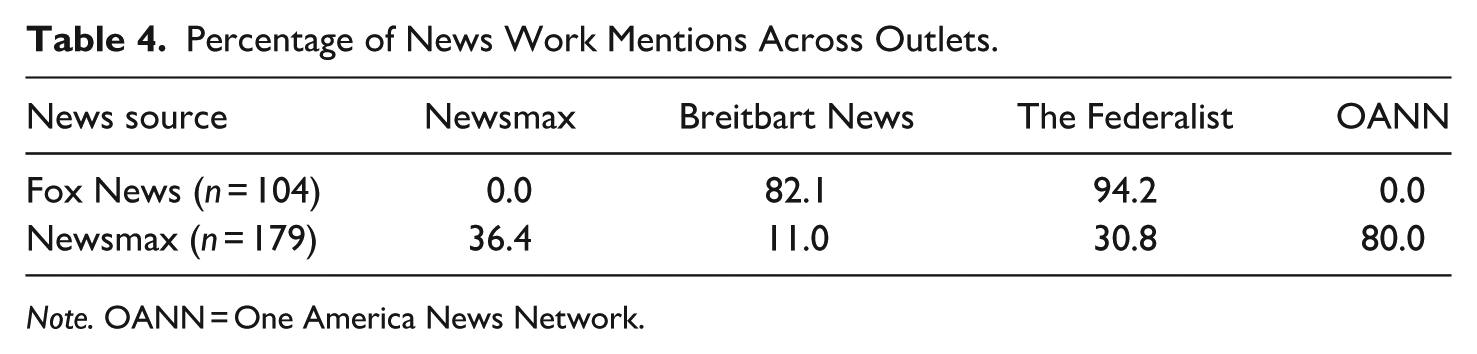
The final research question examined how Fox and Newsmax used news work and non-news work labels for news-like and influencer entities. The opinion label was only used once across both subsamples: In an article from April 2025, Newsmax stated, “The Federalist, a conservative opinion website, has long been a target of groups like NewsGuard and GDI.” While Fox and Newsmax both adhered to labeling the news-like entities as news work, their labeling practices differed, most likely due to medium differences. Table 4 features the percent of mentions that referenced the entity as news work (as opposed to not using any label with the exception noted above for The Federalist).
Percentage of News Work Mentions Across Outlets.
Note. OANN = One America News Network.
Because Breitbart and The Federalist representatives were frequent guests on Fox shows, they were often introduced as, for example, “editor in chief.” Such title introductions are common on cable news. Alternately, because news entities were more likely to be mentioned and not quoted in Newsmax coverage, references to these entities were often simply “Breitbart reported,” with no news work label. When a news work label was applied, it was often by calling these entities “outlets.” For example, in a Newsmax article it stated, “[Senator Ted] Cruz pointed out that NewsGuard claims such outlets as The Federalist, The Daily Wire, and Newsmax are ‘unreliable’, while left-wing outlets such as Jacobin, The Atlantic, and The New Republic are deemed reliable.” Most of Newsmax’s news work label articles were about NewsGuard ratings, suggesting that when Newsmax labeled these entities as news work, it was for boundary defense.
Peering into the descriptives for influencers, we find that Fox used the influencer label in 45.9% of broadcasts, followed by a gendered label in 8.9%, then sports in 3.7%. Newsmax used the influencer label in 71.4% of articles, and comic and host were tied at 7.1%. The news work and opinion labels were never used to characterize influencers. Rather than calling them opinionated, they were more often seen as authentic. For example, Jesse Watters said, “People listen to Rogan because he listens to people and he’s straight with them.”
For both entities, many influencer labels were generic, such as calling them “popular podcasters” or noting their audience size. Other descriptors in this category were more unique, such as Hannity calling Rogan “the GOAT” (greatest of all time), but even more distinct were when they went beyond simple labels to expound on Rogan’s importance. In a January 2025 Fox segment, they said of Mark Zuckerberg of Meta saved face when “he made a pilgrimage to Joe Rogan as part of his reputation rehab tour.” The use of the word “pilgrimage” connotes extra importance and value to Rogan. When Rogan endorsed Trump in 2024, Fox labeled it a “Fox News Alert,” with Watters saying, “The podcast King has spoken, Joe Rogan given a last minute endorsement to Donald Trump.” When Watters asked Dana Perino if this would make an impact, Perino said: I think it already had an impact on the election. . .He really has influence because he built his audience over time and the people that listen to him are just die-hard fans and they trust what he says. . .It’s an incredible amount of influence.
Influencers were seen as growing in significance, especially as the legacy media dwindled, further supporting the outsized role Fox and Newsmax gave to influencers, especially Rogan.
Comparatively, independent samples t-tests revealed three significant differences in labeling by Fox and Newsmax (see Table 5). Newsmax was significantly more likely to use influencer and comic labels, whereas Fox was significantly more likely to use gendered labels.
Means of Labels for Influencers Across Outlets.
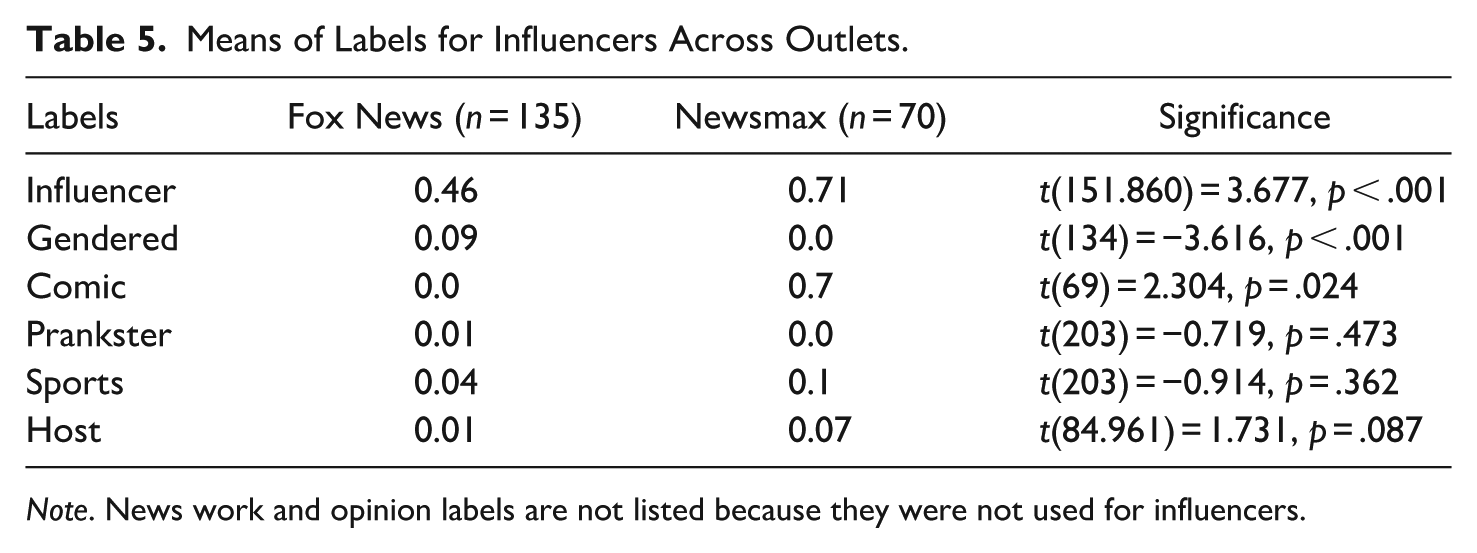
Note. News work and opinion labels are not listed because they were not used for influencers.
Gendered labels included calling the influencers “bros” who could help win the “bro vote” because, for Democrats, “masculinity is toxic,” as well as calling the podcasts “guy-centric” and noting that Rogan is a “real man.” Though not included as a gendered label, it is important to note that Fox and Newsmax talked about how these shows had large male audiences that were coveted by both parties. For example, shortly after the 2024 election, a segment on Fox noted: Trump redefined what it means to campaign. He was going on podcasts, which young men, especially 18 to 29, tend to listen to more. . .You can go on these podcasts and expand your base.
In another Fox broadcast right after the election, Katie Pavlich said: the Liberal media is reeling after Kamala lost in a landslide. . .they’re desperate for their own Democrat version of Joe Rogan. They’re jealous of how President-elect Donald
Trump connected with millions of young men through the popular podcast.
Similarly, Jeanine Pirro said, “And you need men. Go to Joe. . .I don’t care if you have a campaign rally, a dinner, and interview, you cancel them all for Joe Rogan.” These quotes exemplify how Fox painted Rogan as essential in winning male voters and the election.
As an additional test of Rogan’s importance, correlations were conducted between each influencer and the date within the influencer subsample, from 6 months before Election Day till November 12, 2024, 1 week after Election Day, which captured immediate reflections on who was influential in the race. Rogan was the only influencer who had a significant positive correlation, r = .414, p < .001—thus, as the election drew near, mentions of Rogan increased. Further, Rogan was the only influencer to have significant negative correlations with other influencers during this timeframe, including Nelk Boys, r = −.250, p = .019, Paul, r = .430, p < .001, Bet-David, r = −.378, p < .001, and Ryan, r = −.275, p = .01. As Rogan’s authority grew, he eclipsed other influencers on Fox and Newsmax.
Discussion
Carlson’s (2016) metajournalistic discourse examines how actors “publicly engage in processes of establishing definitions, setting boundaries, rendering judgements” (p. 350). In an increasingly complex and crowded media system, judgments of who is credible can influence audience’s perceptions of legitimacy, boost an entity’s visibility, reach, and, consequently, financial viability and longevity. This study examined how two key actors in CNC, Fox News and Newsmax, discursively used their cultural authority to cast judgments on other media within and outside of CNC leading up and following the 2024 U.S. presidential elections, and how they engaged in expansion or expulsive boundary work for the journalism profession and CNC.
Regarding delegitimization, at no point in the sample did Fox mention, quote, or invite as a guest anyone from OANN or Newsmax—preferring instead Breitbart and The Federalist as regular guests and thus co-producers of the news (Salaudeen, 2022). Journalists can engage in repulsion by rejecting actors as journalists (Carlson & Lewis, 2019). By omitting Newsmax and OANN from their coverage, Fox never used news work labels to recognize them as fellow journalists, and with no mentions at all, it also rejects them from CNC. These omissions publicly signal these entities as unworthy of visibility. Newsmax only mentioned OANN in 2.8% of articles, indicating they also view them as less consequential to the news process. Fox’s omission and Newsmax’s subdued inclusion may suggest that OANN is ranked low in the CNC hierarchy, which could be related to credibility. Nadler et al. (2020) found that conservative journalists judge other entities within CNC based on whether they adopt professional norms. As of this writing, OANN is the only publication to publicly say they signed the initial Pentagon press policy—a policy rolled out by Secretary of Defense Pete Hegseth that restricts journalists’ ability to report or gather information on the U.S. military unless it has been authorized for release by the government (Arkin, 2025). Newsmax declined to sign the policy, and notably, Fox, Hegseth’s previous employer, joined MSM to declare they would not sign the policy, citing it threatens their ability to uphold the “principles of a free and independent press” (Arkin, 2025, p. 3). If OANN’s willingness to sign the policy is an indication that they are out-of-step with other media, including other conservative media, and not upholding journalistic norms, it may be why they were judged as unworthy. This pattern aligns with Carlson’s (2016) connection between the repetition of journalistic conventions and legitimacy within metajournalistic discourse.
Fox’s banishment of Newsmax may have less to do with credibility concerns and more to do with competition, which presents a new lens for work on metajournalistic discourse and boundaries. Since the 2020 presidential elections, communications surfaced in which individuals at Fox expressed concern about viewers drifting toward Newsmax, prompting Fox to track Newsmax’s guest bookings and topic coverage (Folkenflik, 2025). In 2025, Newsmax filed an antitrust lawsuit against Fox, claiming Fox has engaged in an “exclusionary scheme to increase and maintain its dominance in the market for U.S. right-leaning pay TV news, resulting in suppression of competition” (Folkenflik, 2025, para. 5). Fox may have eliminated Newsmax from its coverage in this sample because of competition concerns.
In the case of OANN and Newsmax, it is the absence of discourse about them that connotes meaning. According to Carlson (2016), metajournalistic discourse analysis can examine “who is speaking, where they speak, what they say, and how it is disseminated” (p. 362) and treats “talk” as central, “not as ancillary” (p. 363). The theory, however, does not recognize the absence of “talk” and the power it may connote. In the case of OANN, if Fox and Newsmax perceive them as less credible, then they may engage in “strategic silence” (see Donovan & boyd, 2021) as a form of democratic or normative “gardening” (Kantola, 2013). In developing metajournalistic discourse theory, Carlson (2016) pulls upon Foucault when thinking of the power of discourse, and it is important to note that Foucault also recognized that silence is an “integral part of the strategies that underlie and permeate discourses” and silence has been treated as an analytical category by others (Donovan & boyd, 2021, p. 336). Metajournalistic discourse work may also need to consider what is not said, who is not talked about, and what these silences may communicate. Fox’s treatment of Newsmax may be a form of hierarchical boundary work focused on maintaining Fox’s leadership within CNC. As such, boundaries may not be set simply to indicate whether one is a journalist, but also to defend and maintain higher status, and future metajournalistic work could examine whether expansive or expulsive framing is motivated by competition.
There is also power in the volume of present, negative discourse, and Fox used that to delegitimate and expulse MSM. In ~27% of their transcripts, Fox negatively framed MSM and were statistically more negative than Newsmax. Fox was significantly more likely to critique MSM’s work practices, thus engaging in repulsive boundary work of another’s practices (Carlson, 2016). By calling MSM media “compromised” and accusing them as beholden to Democrats and liberals by saying they “hid their scandals, did their dirty work,” instead of upholding “objective reporting” and the “truth,” Fox and Newsmax actively worked to delegitimize MSM and the credibility of their work practices, effectively “othering” them from the journalism profession. While other work has examined conservative claims of liberal media bias (Eberl, 2019; Meeks, 2020; Strömbäck & Åkerlund, 2025; Watts et al., 1999), those studies examined claims from politicians and the public, as well as media coverage of bias; those studies did not examine how journalists claim that other journalists are biased. As such, this study contributes to work on media bias and metajournalistic work by examining these intra-professional claims.
For influencers, Newsmax and Fox were willing to hype their cultural authority within CNC but not use expansive labeling to codify them as fellow journalists, maintaining a professional boundary (Carlson, 2016). Fox and Newsmax never used a news work label on any influencer, yet they cultivated influencers’ importance by praising their reach and work practices, often in opposition to MSM’s practices, emphasizing their authenticity, and showcasing their manliness. Fox praised news-like entities work practices in <1% of transcripts but were willing to laud influencers in 6%. By stating that influencers should be the new moderator for presidential debates, that presidential candidates should sit with Rogan instead of appearing on Meet the Press, and stating influencers’ shows are “truly objective,” Fox and Newsmax were attributing typical journalistic roles and norms to influencers because they believed the MSM could no longer uphold these. In this way, Fox and Newsmax were using expansive framing by deeming influencers’ actions as journalistic or, at least, in alignment with journalistic roles. While Fox noted that multiple influencers were authentic, they heaped much of this praise on Rogan, and how his journey made him more authentic and credible. Fox emphasized how Rogan used to be a Democrat, a “Bernie Bro,” until he was “red pilled,” 7 and endorsed Trump. Numerous Fox segments discussed how Democrats were trying to get their own Rogan, even though they “had him” and “lost him” because they “canceled him.” Even though Rogan has said he is not a Republican or Democrat, that he went from a “darling of the left” to one of Trump’s “buddies” seemed to embolden his bona fides, further legitimizing him within CNC.
Masculinity was also connected to credibility. Through their use of gendered labels, Fox said Rogan was a “real man,” capable of attracting the male vote in a way Kamala Harris and Democrats could not because to them, “masculinity is toxic.” There is a wealth of research showing that conservatives and Republicans are more likely to endorse traditional masculinity, with Katz (2016) positing that masculine hegemony has become a commodity among conservatives. By asserting that influencers are real men who can connect with their male audiences, and mobilize men to vote for Trump, it became another lens into how Fox judged these male influencers as important within CNC. Adding to this gendered lens was that Fox emphasized that Harris was trying to connect with Gen Z women by going on Alex Cooper’s Call Her Daddy podcast, which they characterized as “graphic sex talk and advice for women.” Ingraham said going on this podcast was “probably not the best way to build your credibility,” and Kayleigh McEnany of Fox stated, “if the goal was to inform voters, maybe the Harris campaign should have done a little less ‘Call Her Daddy’ and more Fox News or even Joe Rogan.” Ingraham further demeaned the show, stating, “I get it, podcasts are popular. A lot of things are popular that you probably don’t need to lower yourself to.” Harris went on a woman-hosted show aimed at Gen Z women that talked explicitly about sex and “women’s issues,” which is misaligned with traditional gender roles. Fox made it clear that “real men” mobilizing men translated into credibility, but women attracting women voters did not.
This study has limitations. First, this study can only speak to two news sources across 1 year and cannot generalize its findings to other sources within America’s CNC or other election cycles. Furthermore, the Fox sample was composed of their top five programs and is not representative of all coverage. A more thorough investigation of credibility flows within CNC requires more longitudinal research across more conservative outlets and figures within CNC. For example, given that Fox never mentions OANN and Newsmax during this study’s timeframe on their top five programs prompts the need to look further back, as well as across programming, and assess when this trend started. Additional research could then contextualize if and how “strategic silence” was enacted. Furthermore, as a content analysis, this study cannot make causal claims about whether Fox and Newsmax’s coverage affected their audience’s perceptions of credibility, or whether their expansive or expulsive boundary work resonated with audiences. Additional audience-oriented work is needed to assess media effects.
This study chronicled how Fox and Newsmax exerted their cultural authority to judge other’s cultural authority, contributing to scholarship on metajournalistic discourse, boundary work, and CNC. Fox and Newsmax, based on this study’s sample, deemed Breitbart, The Federalist, and a handful of influencers as credible via visual cues, such as guest appearances, and audio/textual cues, like praising influencers’ large audiences and authentic appeal. They used these same cues, or lack thereof, to signal that OANN, MSM, and in the case of Fox, Newsmax itself, were unworthy of visibility or praise due potentially to concerns of credibility or competition. In a bid to answer Bauer and Nadler’s (2025) call to examine CNC to better understand transformations within them, we can see how Fox and Newsmax simultaneously worked to elevate some voices, especially Rogan’s, while delegitimating others, mainly MSM. Such elevation, however, was not absolute. While Fox trumpeted Rogan’s influence, they kept him and other influencers squarely out of the journalism profession and not on par with Fox. For example, Watters said, “The Democrat media diet is ultra-processed news. . .What they need is a healthy, balanced diet. Little filet of Fox, side of Joe Rogan. . .You’ll feel better and you’ll think better.” In the hierarchy of CNC influence, and news in general, Fox painted itself as central and Rogan as secondary. Future work on metajournalistic discourse and boundary setting needs to assess how strategic silence and competition may affect who and how entities get talked about and how these manifest or silent forms of discourse affect perceptions of cultural authority and hierarchy in CNC and beyond.
Footnotes
Declaration of Conflicting Interests
The author declared no potential conflicts of interest with respect to the research, authorship, and/or publication of this article.
Funding
The author received no financial support for the research, authorship, and/or publication of this article.
