







Abstract
Using surveys/interviews with 142 residents of 10 rural communities and in-depth interviews with 12 editors and publishers, we mapped the community journalism ecosystem in a sparsely populated region of about 40,000 square miles. Rural residents identified social media and word of mouth as primary sources for local news, while community editors/publishers reported lacking the financial and labor resources to provide more coverage and combat audiences’ reliance on sources without verification standards. They also reported (a) increasing self-censorship due to fear of alienating advertisers, sources, and audiences, and (b) rising mis/disinformation not only about national issues but also about local controversies.
Across rural areas of the United States, an untold number of news outlets close their doors each year, leaving behind news deserts with an eroded sense of community (N. Mathews, 2022) that lack quality local journalism (Gulyas et al., 2023) and are prone to dis- and misinformation (Abernathy, 2018, 2023). Meanwhile, surviving local news outlets often have only one or two editorial staff members, limited or no online presence, and limited or no ability to cover local elections and government actions—a phenomenon known as news poverty (Lindgren et al., 2016; Perreault et al., 2024). The COVID-19 pandemic further underscored the vital role of local news at a time when accurate and timely health-related information was urgently needed in many rural communities (Finneman & Thomas, 2021; A. M. R. Hess et al., 2022).
The folding of news outlets often results in a “communication vacuum” filled by fragmented, mostly user-generated information delivered via social media (Smethers et al., 2021, p. 385). Even access to such information is hindered in so-called “broadband deserts,” where many residents have limited or no Internet access (N. Mathews & Ali, 2022). In some cases, the attention of rural residents is hijacked by hyper-partisan outlets masquerading as local news, known as “pink slime,” a food industry term describing a meat by-product serving as a filler (Mihailidis & Foster, 2021). Therefore, the continued vanishing of genuinely local news outlets requires identifying ways to both counteract the spread of emerging news deserts as well as revamp journalism in what Usher (2023) calls “historical news deserts”—areas that have not only lack “professional, geographically specific news” for some time but also “have also been poorly served by healthcare, financial, and tech industries, among others” (p. 246).
Although extensive research about the challenges faced by rural journalists exists (Abernathy, 2014; Finneman et al., 2021; Lowrey et al., 2008; Robinson, 2016; Wenzel & Crittenden, 2021), even recent studies (Finneman et al., 2021; Finneman & Thomas, 2021) do not fully reflect the continuing effects of the COVID-19 pandemic and growing antijournalism sentiments. For example, some small-town reporters have been threatened, harassed, and forced to move (Williams, 2023); others have had their homes and newsrooms raided by police seeking source details and unpublished content (Draper, 2023). These nationally publicized cases of intimidation likely represent only a sliver of the obstacles local journalists face in the postpandemic era.
To fill this gap in the literature and answer Usher’s (2023) call for place-based specificity when considering the news desert phenomenon, in this study, we visited communities with populations ranging from 160 to 19,000 in a historically underserved rural area of about 40,000 square miles in the U.S. Southwest. The region has seen numerous newspaper closures in recent years. We drew on bilingual (English and Spanish) surveys and interviews with residents (n = 142) as well as 12 in-depth interviews with news leaders to present a snapshot of the state of community journalism in this area, where about a fifth of the counties are news deserts (with no local news source), and more than half have a single local news source, often with a staff of 1 and teetering on the brink of fiscal collapse. The analysis is grounded in the social responsibility-of-the-press framework (Siebert et al., 1956), which both audience members and news professionals implicitly referenced.
This study contributes to knowledge in two ways. First, we relied in part on data collected in face-to-face exchanges with residents at community events, which differentiates this analysis from much recent research on local news focusing on journalistic routines and business models (Abernathy, 2014; Finneman et al., 2023; Lowrey et al., 2008; Robinson, 2016; Wenzel & Crittenden, 2021). Notable audience-centric exceptions exist, such as McCollough et al.’s (2016) study based on focus groups with local news consumers, Weber and Mathews’ (2024) analysis of national survey data, and research by Gulyas et al. (2019), who used diary data and interviews to assess audiences’ motivations to consume local news online. Second, we conducted in-depth interviews with not only the journalists running local news outlets but also publishers who sometimes owned multiple local newspapers. The findings raise questions about the future of U.S. community journalism and highlight the epistemological and methodological value of returning to methods reminiscent of “shoe-leather” reporting (Pantic, 2023, p. 3,497), as they have the potential to achieve a more nuanced understanding of community journalism
Literature Review
Defining and Studying Community Journalism
Community journalism (also referred to as local, hyperlocal, rural, and provincial journalism) refers to print or online news outlets, in most cases independently owned, that deliver community-oriented news to a specific area (K. Hess & Walter, 2018; Kurpius et al., 2010; Mathews & Hodgson, 2023; Wahl-Jorgensen, 2022). Therefore, when we refer to “local news outlets” in this study, we mean place-specific publications, in print and/or online, staffed by journalists who work and live in or near communities they cover. It is worth noting that neither scholars nor audiences agree on how to define “local”; for example, in the UK context, Gulyas et al. (2019) found audiences define digital local news in three different wars: (a) personally relevant or interesting facts, (b) content produced by legacy local outlets, and (c) community engagement, including knowledge of local events, celebrations, and campaigns.
In the context of this study, we also used the word “community” (a) as either synonymous with a small town or a rural unincorporated area or (b) as defined by Perreault et al. (2024), who argue that “in the context of rural journalism, community reflects the interactions of news organizations within rural structures and encompasses social relationships” (p. 423). Considering Weber and Mathews’ (2024) finding that audience members (especially older and rural ones, similar to the populations in the area we studied) tend to define “local” in subjective terms or as a cultural boundary, such as “the community I am part of” (p. 39), in this study we chose to view “local,” “rural,” and “community” as broadly overlapping in meaning.
Although not all news sources rural audiences rely on are newspapers (Usher, 2023), radio and TV broadcasts that reach sparsely populated areas typically originate in urban centers and seldom carry any news about rural governance, safety, or community-building. In that sense, most broadcast outlets fail to fill the community news gap, as audiences generally do not view “out-of-market news . . . as a viable substitute for truly local news” (McCollough et al., 2016, p. 110). By contrast, newspapers that still operate in sparsely populated areas act as “unique geographic and cultural connector[s]” by covering area deaths, births, marriages, and businesses (Perreault et al., 2024, p. 424). Hence, local news outlets are defined by their geography, audiences, and associated practices.
Community Journalism and Engagement
Community journalists often step in to fill the void left by consolidating regional news (Harte et al., 2018; Wahl-Jorgensen, 2022), playing a role that “demands putting the public interest ahead of the maximization of profit” (Altschull, 1996, p. 171). Community newspapers account for 85% of U.S. news circulations (Finneman et al., 2023; Hanusch, 2015) and have an outsize importance to their communities, as they create shared meaning and memories (Garfrerick, 2010; Hindman, 1998; Tichenor et al., 1980), facilitate local democratic processes (Ali et al., 2020), serve their audiences’ information needs, often at significant personal cost, during times of crises (Finneman et al., 2023; Finneman & Thomas, 2021), champion and advocate for the community (Hanusch, 2015), and even play the role of “community caretakers,” as illustrated in three weekly newspapers’ coverage of U.S. Immigration and Custom Enforcement (ICE) raids in Central Mississippi (N. Mathews, 2021). However, contradictory perspectives on local journalists’ roles persist. For example, some audiences indicate that they not only expect local news outlets to “tell the truth” but also want journalists to stop enumerating facts and offer solutions to existing problems (Wenzel & Crittenden, 2021, p. 2,025).
Scholars and stakeholders agree that the decline of local news has bleak effects on the well-being of local communities. Weber and Mathews (2024) point out that rural, older, Hispanic, and non-white audiences can especially benefit from news outlets that build a sense of community, and the loss of local news “will continue to weaken that sense of community” (p. 43). More broadly, such losses also affect the well-being of democratic societies, given that citizens must be well informed about both national affairs and news in their immediate communities (Wahl-Jorgensen, 2022). Moreover, Hayes and Lawless (2018) indicate that surviving local newspapers have reduced the frequency and depth of political news coverage, raising concerns about the extent of political engagement in rural areas. Studies have shown that declining local news is linked to lower voter turnout (Shaker, 2014) and lesser accountability in local politics (Darr et al., 2018). Furthermore, residents in politically polarized U.S. counties are more likely to trust local news outlets, despite their limited resources, meaning that local and hyperlocal media can serve as a space for attempts to expand discourse across ideological divides (Wenzel, 2020).
Although the postpandemic milieu of local journalism remains largely unassessed, earlier research speaks to the nuanced, evolving, and sometimes complicated relationship between community stakeholders and local news outlets (Perreault et al., 2023; Smith, 2019). At the base level, local journalists face unique challenges as they walk the line between being community members and professional journalists. This unique positionality enables consensus-oriented, community-focused news creation (Donohue et al., 1995; Hanusch, 2015) and even the co-creation of “news oases” by local elites and journalists (Ferrier, 2023). “Relay brokerages,” in which regional news outlets use content from local correspondents or citizen journalists in news deserts, further illustrate the overlap between being a reporter and being a community member (Nagel & Broersma, 2024). In some cases, community journalists break traditional journalistic norms (e.g. by taking on the role of local politicians or by running only positive stories) to respond to the needs and demands of their local communities (Nagel & Broersma, 2026). The downside of such role balancing is that news professionals in small communities lack the same independence from subjects, sources, and advertisers that their peers at larger news outlets enjoy (Smith, 2019). In the same vein, Freeman (2020) has argued that hyperlocal newsrooms aid in building a sense of community, but outlets operating at some geographical distance are more likely to provide balanced coverage of public interest issues in small towns, such as corruption or controversial local expenditures.
The Social Responsibility of Community Journalists
The almost 80-year-old concept of the social responsibility of the press emerged from the post-WWII report of the Hutchins Commission (informally named after its chair, Robert Hutchins, University of Chicago president), which spent 4 years defining the role of a free press in a democratic society (Christians et al., 2009). The Commission on Freedom of the Press (1947) report concluded that although news outlets were free and independent businesses, they had to meet five critical responsibilities: (a) offer context, avoid “factually correct but substantially untrue accounts” (p. 22), and separate fact from opinion; (b) serve as a public forum for comments and ideas, emphasizing that “the names and characters of participants must not be hidden from view” (p. 25); (c) accurately represent all groups in society without stereotyping; (d) fulfill an educational role “in stating and clarifying the ideals toward which a community should strive” (p. 28); and (e) provide a full and accurate account of daily goings-on to serve the public right to know.
Siebert et al. (1956) explicated the 1947 set of norms as a press theory, which has been elaborated on by multiple scholars. For example, Schudson (1995) proposed two more norms for the press: (a) representing the public interest in holding power to account; and (b) reporting stories that promote empathy, compassion, and understanding of other people around the world. Christians et al. (2009) later suggested four normative roles of journalism: (a) monitorial (i.e. “the collection, processing, and dissemination of information,” p. 125); (b) facilitative (wherein press outlets “widen access and promote active citizenship by way of debate and participation,” p. 126); (c) radical, which “focuses on exposing abuses of power and aims to raise popular consciousness of wrongdoing, inequality, and the potential for change” (p. 126); and (d) collaborative, wherein news outlets work in concert with state officials in a variety of (usually emergent) scenarios (p. 127).
In the context of local news, Lowrey et al. (2008) articulated three sets of norms drawing from a large body of studies on small-town news outlets. The first set of norms concerns “revealing community structure” (Lowrey et al., 2008, p. 290), such as reporting on local institutions and events, explaining to audiences how to access local services, and promoting civic engagement. The second set of norms involves listening to audiences and representing diverse voices and viewpoints. This standard resembles the Hutchins Commission’s guideline about accurately representing society’s constituent groups, but Lowrey et al. (2008) also recommend conducting surveys and focus groups with residents. The third norm is twofold: (a) lead the community and (b) promote its unity by, for example, seeking answers to local problems, clearly articulating the community’s agenda, and providing both local and nonlocal context.
Previous studies applying the social responsibility of the press to local outlets have indicated that small-town news often falls short of fulfilling these norms. For example, Bunton’s (1998) case study analysis of two rural Missouri newspapers’ coverage of corporate hog farming “failed to meet the most basic tenets of social responsibility” (p. 241). In the same vein, Reader (2006) noted that journalists at small newspapers are “uniquely concerned about being manipulated by sources or having to write about misdeeds by well-liked community leaders” (p. 860) and “consider the community standards above journalistic standards” (p. 858). As a result, local journalists often practice “boosterism as banishment” by framing, for example, the removal of unhoused people as a step toward economic growth (Gutsche, 2015), while city magazines offer “sanitized” portrayals of their communities in lieu of “[raising] awareness of community problems that might encourage readers to respond” (J. M. Jenkins, 2014, p. 329).
Despite shortcomings in meeting some social responsibility standards, local journalists have succeeded in meeting others. One example is the principle of providing a public forum for ideas and debate. Lewis et al. (2014) have suggested that local newspapers often encourage public discourse by practicing “reciprocal journalism” and offer the example of a local newspaper’s Facebook page serving as both a “town megaphone” and an online space for “constructive public discussion” (p. 236). Writing on the state of local news in Appalachia, Carey (2020) suggested that journalists “serve as vehicles for individuals in distressed communities to tell their stories and seek collaborative solutions to problems at the local level” (p. 8). Drawing on Tichenor et al. (1980), Finneman and Thomas (2021) have further argued that “the development and cohesiveness of community is a normative goal” of local journalists, “reflecting their embeddedness within their communities” (p. 333).
Methods
We collected data in June and July 2023, using surveys of community residents and in-depth interviews with local newspaper editors or publishers in a predominantly rural area of about 40,000 square miles in the U.S. Southwest. The Institutional Review Board of the researchers’ university approved both parts of the study. The choice to combine two methods reflected an effort to triangulate, an approach that can result in mutually reinforcing and converging findings or, alternatively, inconsistent or contradictory results (Mathison, 1988). Both convergent and divergent data resulting from triangulation can elicit deeper and more insightful analyses than singular datasets resulting from using a single method (Campbell et al., 2020). In the following paragraphs, we outline each method.
Surveys
We conducted pen-and-paper surveys with residents of 10 rural communities. Sometimes, we also read the survey items to the participants and recorded their responses. There were two main reasons for this approach. First, because we sought responses from residents of rural communities, we expected it would be unlikely to reach many of them online, especially in areas without broadband access. Second, considering previous research indicating (a) high and rising nonresponse rates to mail surveys in rural areas (Coon et al., 2019) and (b) phone surveys’ tendency to overrepresent women (Jacobson et al., 2007), we wanted to establish face-to-face rapport with potential participants.
Recruitment
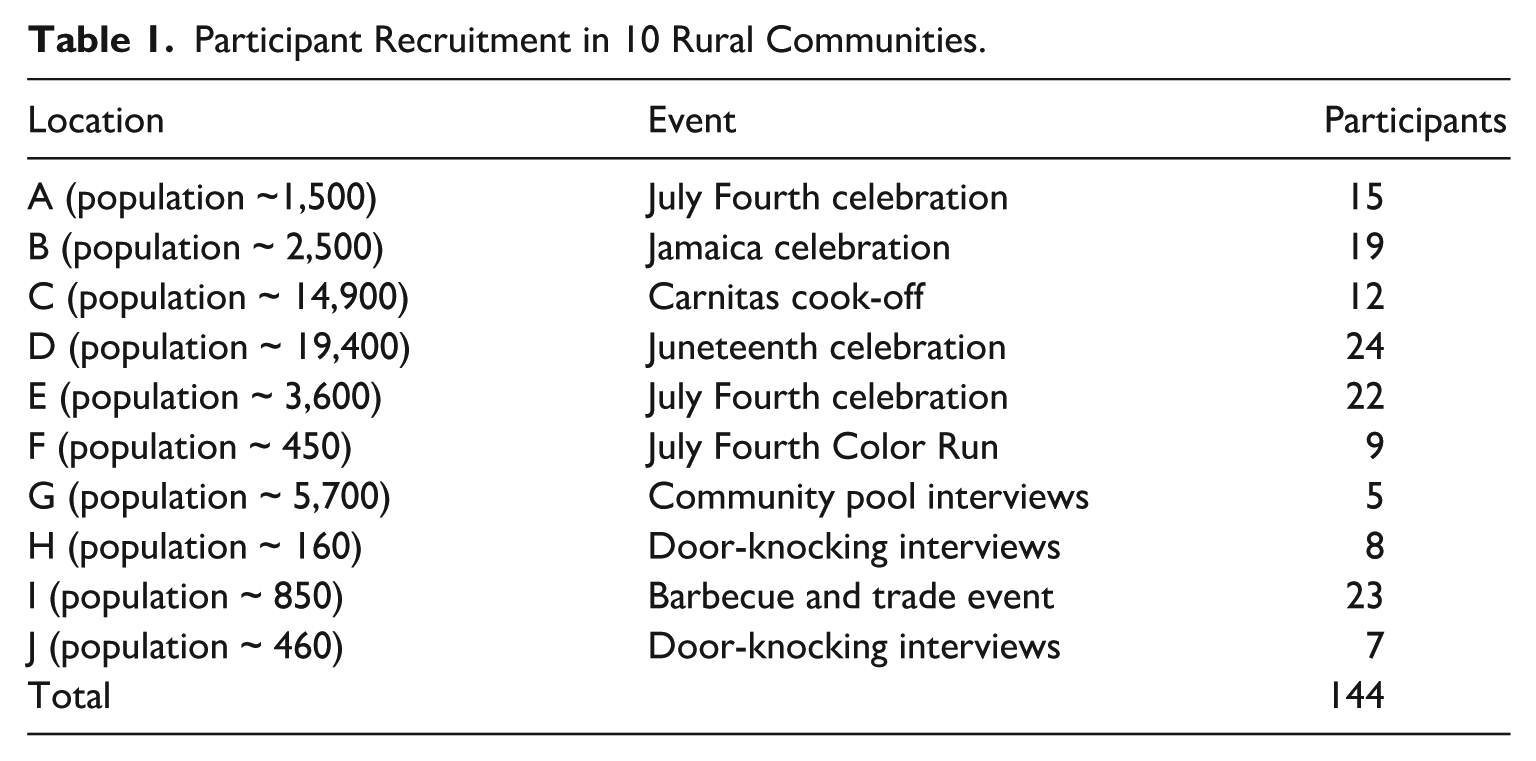
We employed a cluster-sampling approach, most applicable to geographically dispersed populations (Henderson & Sundaresan, 1982). The first three authors collected the data. Each traveled to 1 of 10 communities in the region of study, accompanied by 1 or 2 research assistants. The research assistants included both undergraduate and graduate students. The communities were selected because they had scheduled community gatherings during the period of study, with preference given to locations within a 2-hour drive from the researchers’ university. We collected survey responses during such community gatherings as well as by knocking on doors when an advertised community event had too few attendees or had been canceled. The communities were towns and unincorporated areas with populations ranging from about 160 to over 19,000, as summarized in Table 1. None of the participants received any financial compensation. In each community, a convenience sample across different age groups was recruited. We offered both English and Spanish versions of the survey to the participants, many of whom were proficient in both languages. Most chose to answer in English.
Participant Recruitment in 10 Rural Communities.
Sample
There were 144 community participants; after discarding data from 2 incomplete surveys, the final sample comprised 142 participants: 92 women (65%), and 50 men (35%). To keep the survey items on one page (a strategy meant to increase the response rate) and to avoid the possibility that demographic details might make some participants in small towns potentially identifiable, we chose not to record demographic characteristics such as age, race, education, or income. The only demographic characteristic recorded was the participants’ apparent gender. Because of the rural, isolated nature of the towns where we conducted the research, we encountered no instances of ambiguous gender presentation.
In recruiting participants, we sought representation across age groups and racial and ethnic groups. However, in towns where most residents were middle-aged or elderly, achieving age group representation was difficult. Similarly, identifying participants of different races was nearly impossible in rural areas with exceedingly few African American and Asian American residents.
Measures
The participants completed a six-item survey designed to capture access to and use of local news, sources of such information, and perceptions of unmet informational needs. Based on participants’ response patterns during early data collection (specifically, general unwillingness to answer open-ended questions), we revised the survey by listing the most frequently mentioned topics from the open-ended responses we gathered during the initial fieldwork as specific response options. Participants could choose more than one response option, except for the questions about time spent consuming local news and their degree of access to local news (See Supplemental Appendix A for the complete questionnaire). The final item invited participants to speak with the research team. Those who agreed participated in short follow-up conversations, providing richer qualitative insight into their responses, as described in the following subsection.
Data from the pen-and-paper surveys were manually entered into a spreadsheet. One variable (time spent consuming local news) was ordinal, and the rest were nominal. The data were analyzed using SPSS version 29 (IBM, Armonk, New York).
Interviews
Community Members
Our team conducted face-to-face semistructured interviews with 34 event attendees in 10 towns. These interviews explored residents’ experiences with local news, their concerns about access to local information, and their views of journalists. We also asked the participants to elaborate on their answers on the structured questionnaire, probing for more details or context. These interviews were open-ended, allowing respondents to expound on what seemed most relevant to them in the context of local news, journalistic practices, and their perceived information needs in daily life.
Editors and Publishers
About 40 local newspapers still serve the region we studied, but their survival is threatened by decreasing advertising revenues and increasing production costs. These publications typically have weekly circulations ranging from a few hundred to a few thousand copies. Several have stopped operating in the last 2 years or are seeking new owners, leaving residents in such communities without an immediate source of day-to-day local news. To assess local journalism in the area, we conducted in-depth interviews with 12 current and former editors and publishers (5 women and 7 men). To accommodate publishing deadlines and the schedules of the journalists who agreed to participate, 11 of the 12 interviews were conducted over Zoom. The first and third authors divided the work of interviewing editors and publishers. All interviews were in English, which appeared to be the first language of all participants. Three interviewees owned more than one newspaper.
The interviews with news leaders were semistructured (Kvale & Brinkman, 2008) and lasted between half an hour and several hours. The conversations were informal, and no two interviews were the same; some of the most important information was elicited by asking follow-up and “probing” questions (Kvale & Brinkman, 2008, p. 137). The questions were incorporated organically into each conversation, and topics of interest were rarely, if ever, discussed in the same order across interviews. The questions guiding the conversations included some deliberate redundancies (see Supplemental Appendix B), and depending on the information provided by the interviewees, we sometimes skipped questions that had already been thoroughly answered. In other cases, after noting which responses were brief and lacking in detail, we revisited earlier questions and rephrased them differently. After completing the interviews, we used narrative analysis of the transcripts to group the data into thematic categories (Kvale & Brinkman, 2008).
Survey Results
Most community members indicated they have access to local news (Figure 1), and most said they spend some time each day, even if it was less than an hour (the most common response) consuming local news (Figure 2). The results of chi-squared tests indicated no statistically significant differences between men and women regarding (a) access to local news and (b) time spent reading, watching, or local news.
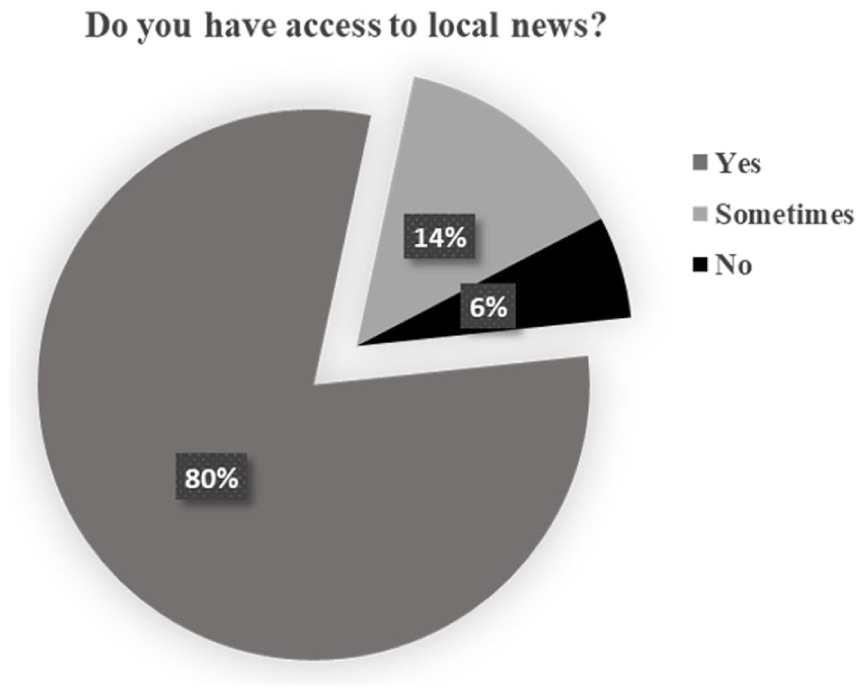
Self-reported access to local news.
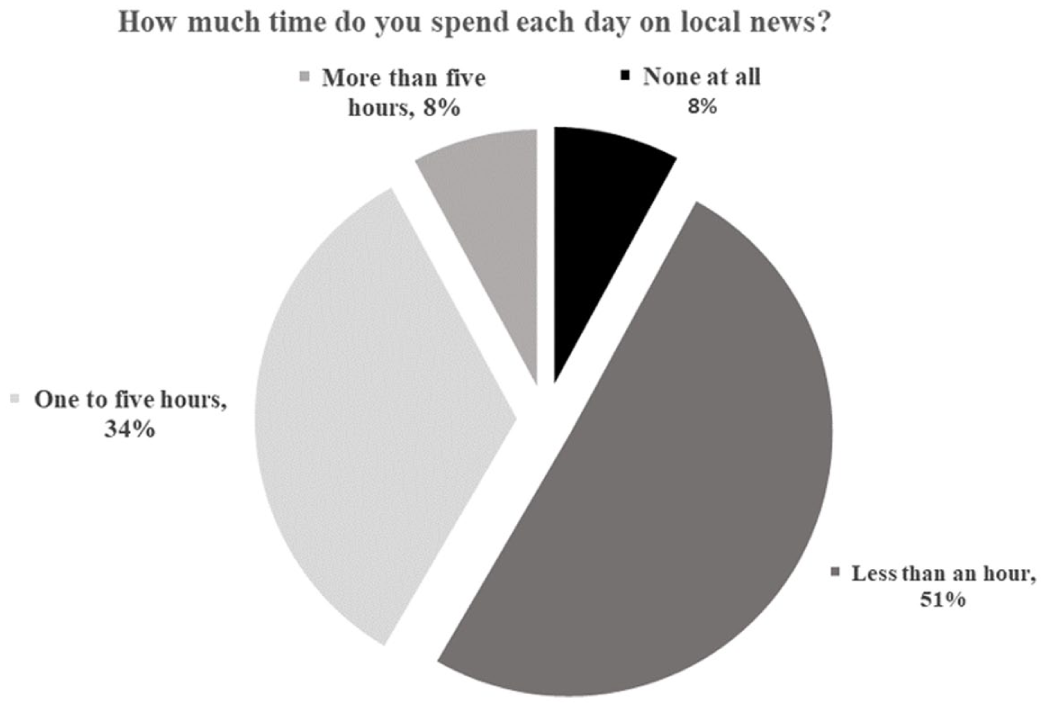
Self-reported amount of time spent on local news daily.
The next research question focused on participants’ main sources of local news. Because the response choices were not mutually exclusive, we submitted the data to a Cochran’s Q test, which tests for equality of proportions within subjects. The results (Figure 3) indicated significant differences in the frequency with which residents used different sources of local information, χ2(5) = 101.42, p < .001. More than half of the participants (52%) identified social media as an essential source. 1 This proportion was significantly higher (p < .001) than the proportion of participants who chose print, TV, radio, and online news sites as essential sources of local information. Word of mouth was the second most popular source, significantly higher than print, radio, and online news sites (p < .001). TV, a local news source for 28% of respondents, was the most frequently used “mass” media form and was identified as a local information source at a significantly higher rate (p < .001) than radio and local news sites. Only one significant gender difference emerged: radio was more often an essential source of news for men (22%) than for women (5%), χ2(1) = 8.89, p = .005.
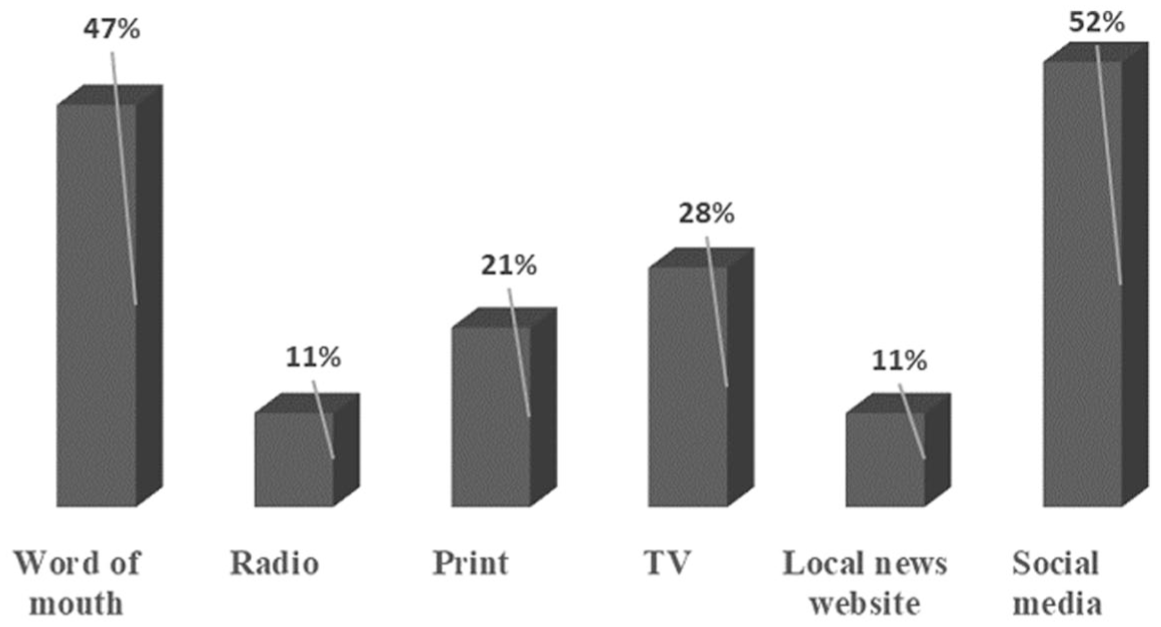
Primary sources of local information.
Regarding which local issues residents perceived as being of the greatest concern (Figure 4), the results of a Cochran’s Q test identified some significant differences between the proportions of the responses, χ2(7) = 35.91, p < .001, but no one issue emerged as more prominent than all others. The four issues of concern mentioned most often were shortage of businesses, schools and education, crime and safety, and financial struggles. Failing health (referring to the prevalence of individual ill health and challenges to well-being in rural areas) was mentioned significantly less often (at the p < .001 or p < .01 level) than all other issues except for “city, county not meeting community needs.” The results of chi-squared tests identified only two statistically significant gender differences: schools were an issue of greater concern to women (37%) than men (20%), χ2(1) = 4.36, p = .03, and more women (30%) than men (12%) were concerned about having “nothing to do” in their areas, χ2(1) = 6.05, p = .01.
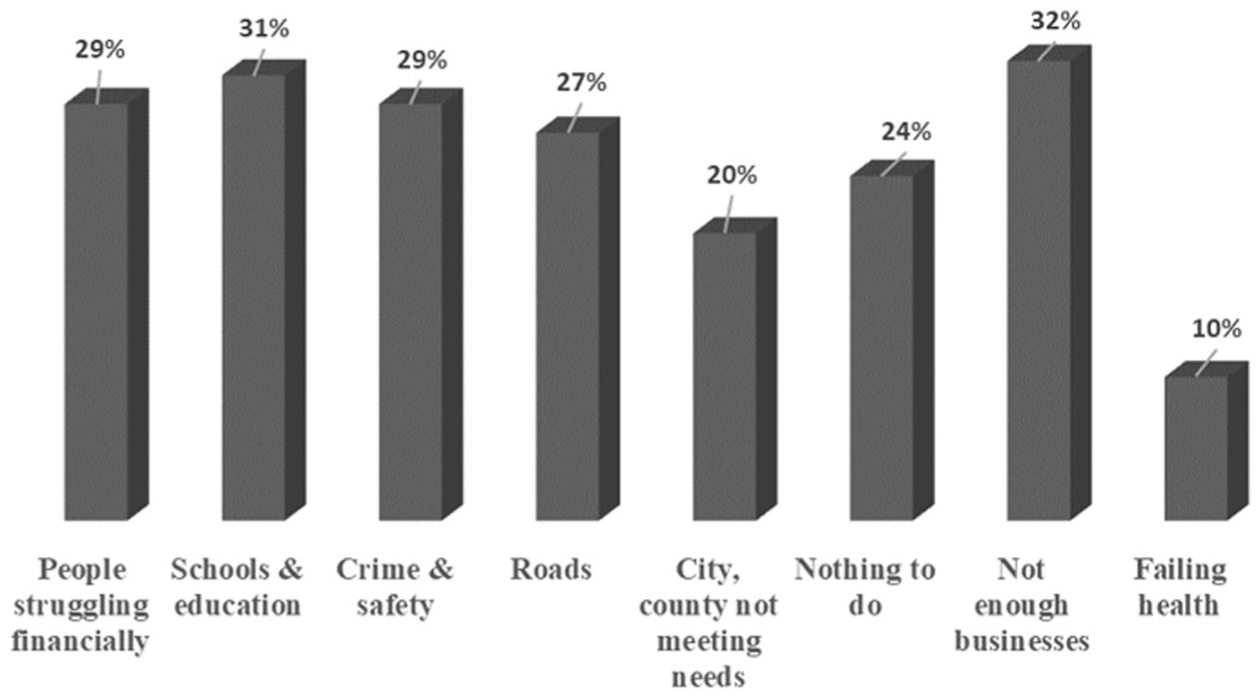
Issues perceived as important by community residents.
The last question concerned what information rural-area residents lacked and would like to see more news about (Figure 5). Submitting the data to a Cochran’s Q test yielded statistically significant differences, χ2(5) = 37.81, p < .001; however, once again, no category emerged as more frequently mentioned than the others at a statistically significant level. Needing election information was mentioned significantly less often than only coverage of local government decisions (p = .03) and event announcements (p = .02). Funeral notices were mentioned significantly less often (at the p < .001 level) than all other categories except for election information. The results of chi-squared tests indicated one statistically significant gender difference: a larger proportion of men (42%) than women (24%) wanted more local government news coverage, χ2(1) = 5.02, p = .02.
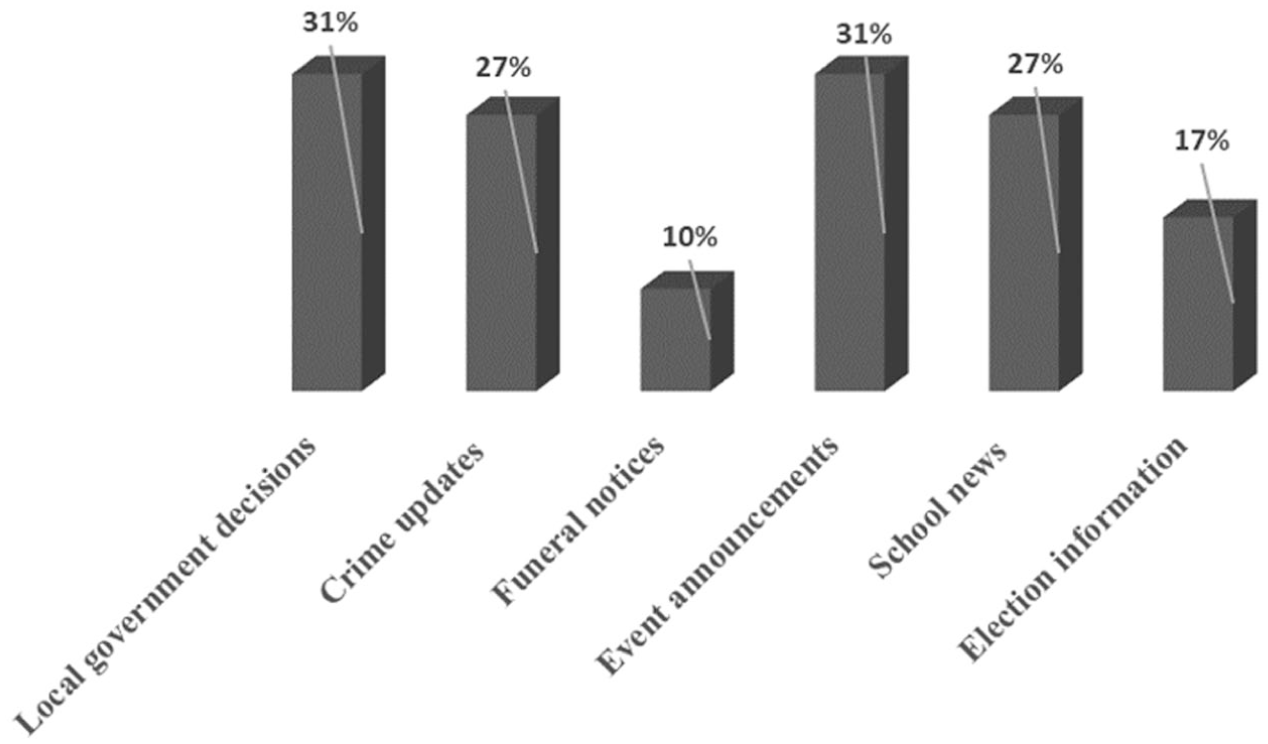
Topics identified as needing more coverage.
Discussion of Survey Results
At first glance, the survey results may not appear particularly alarming because the vast majority of participants indicated that (a) they have access to local news and (b) spend some time reading, watching, or listening to local news each day. What was alarming, however, was that about half of the rural residents we surveyed pointed to word of mouth (47%) and social media (52%) as major sources of local information. Both proportions were statistically significantly higher than the percentage of participants who selected any of the individual “mass communication” choices—such as print, TV, radio, and news sites—that typically strive to provide verified information. We qualify this finding as alarming because relying on word of mouth and social media circumvents professional journalism and has been linked to the spread of misinformation and disinformation (Giannakoulopoulos & Limniati, 2019). Our results align with Avance and Shortle’s (2023) findings that Oklahoma rural county residents also relied mainly on social media and word of mouth for access to local news.
Several survey findings were surprising because they contradicted existing research and/or common sense. For example, compared to men, women in our study indicated less interest in local government news, contradicting earlier findings that men and women are equally interested in this topic (Hollander, 2010). Furthermore, despite the area’s aging population, only 10% of respondents identified failing health as a local concern. We were also surprised by the relatively low proportion of participants who mentioned they needed to know more about elections. These responses may have been more frequent had we conducted the research closer to major local or national elections.
Other survey findings aligned well with existing research. For example, residents’ interest in having more—and more diverse—local news coverage aligns with Hollander’s (2010) observation of a widespread “hunger for local news” (p. 6). Another unsurprising finding was that women identified radio as a primary source of local information less often than men did. This finding aligns with recent research on gender differences in podcast exposure (Tobin & Guadagno, 2022) and radio listening in rural areas (Sakwa, 2012). Another unsurprising finding, given the aging population and lack of broadband access in the area, was that the proportion of participants who identified print as one of their essential sources of local information (21%) was higher than the percentage of those who mentioned local news websites (11%). However, the difference was not statistically significant.
Theoretical and Practical Implications
The findings of the survey of rural residents contribute to audience studies scholarship in the context of local journalism and to the literature on gender differences in news preferences. The findings also have important practical implications for community editors and publishers, especially considering the expectation articulated by Lowrey et al. (2008) that they conduct regular surveys and focus groups with audience members. In the rural area that was the subject of this analysis, such audience research is uncommon and likely impossible due to local news outlets’ limited resources. For this reason, we plan to share our findings with local journalists to provide information that may be useful to their future news decision-making.
Limitations and Directions for Future Research
The results are limited by the relatively small sample size (n = 142) and by the nonrandom selection of participants. While the use of convenience samples is increasingly common due to the high nonresponse rate in approaches involving random sampling, future surveys of rural audiences should aim for larger samples by employing multiple approaches to collecting data, such as (a) posting QR codes linking to a research survey at gas stations and other gathering places in rural areas; (b) distributing QR code flyers at local events; (c) seeking access to preexisting sample frames, such as lists of small-town newspaper subscribers; and (d) working with community partners such as libraries, food banks, and other nonprofits to help recruit participants.
Interview Findings and Analysis
Community Members
Among the most worrisome issues, we found that rural audiences in news deserts and surrounding areas generally have access to local news but prefer to get information via social media and word of mouth. This preference often stems from living in towns without a daily publication, where they can find the information they need on social media first. This finding is particularly troubling in the context of mis/disinformation and increasing political polarization. It was also concerning to find that consolidating ownership trends—including through the entry of major players such as Hearst—are eroding audiences’ trust in their local publications and result in complaints about real or perceived neglect of in-depth local coverage.
Most rural residents we interviewed understood that their local newspapers were doing their best with limited resources and staff. Still, a common negative perception that emerged in many interviews was that local reporters and editors simply do not care. For example, some audience members viewed digital paywalls as proof that local newspapers emphasize profit over public service. “I think they should put out more content, and I think it should be free,” one resident said. “Now that they charge, I think a lot of people don’t subscribe.” Despite understanding the financial struggles and labor shortages at their local publications, interviewees identified several areas in which they hoped their community outlets would enact changes: more local news, more meaningful content, local ownership, and timeliness. We explain each theme below and offer examples to illustrate it.
More Local News
Many residents wished to see more news stories based on factual reporting of events and public meetings, and hoped (unrealistically, perhaps) that their local news outlet would go on a hiring spree. For example, one reader said, “I would like to see two or three young, emphasize on young, community reporters.” Another participant with school-aged children said her community newspaper’s coverage of local government and schools falls short. “Because it’s a small local paper, I feel like it has more opinion than actual news,” the interviewee said, likely implying that the newspaper had resorted to using opinion pieces because its limited editorial staff lacked the resources to fill the pages with original news content. She further indicated she wished for less political content and more news regarding “what’s going on with local government [and] local schools.” This perspective was echoed by one former reporter we encountered at a community event, who described a newspaper in a neighboring area as a “conservative rag,” run by an editor bent on criticizing national-level politics instead of focusing on local news: “Goes off and you know, these people around here, they read that as gospel. And he’s full of shit.”
More Meaningful Content
Many interviewees implied they disliked or distrusted their local news organizations due to the lack of watchdog and enterprise content. Overall, participants wanted more in-depth coverage of local issues, such as housing, education, property taxes. These responses suggest rural audiences understand that journalists have a professional responsibility to provide original and newsworthy but also explanatory content. Examples of trends needing news coverage in the region included closeted drinking among the elderly and bullying of Hispanic children, both in and outside of school. A resident of a town with both a local newspaper and a local news radio station said someone needs to report on the “city corruption,” but declined to elaborate.
Residents of another town with only a newspaper said they have not found it helpful in ensuring local government transparency. One said it is difficult to know what to do or how to reach county commissioners when roads become impassable after rain; another complained that the only way to obtain information not included in the city’s newsletter is to file a public records request. Journalists’ perceived lack of interest in the needs of communities was seen as a reason to distrust them, as one community resident explained:
I’ve seen a lot of YouTube videos of just your everyday ordinary people that see a problem, such as that houseless population, or kids in poverty or whatnot, and they go out, like yourselves, and they are . . . reporting actual real-life things. They just care. They want to bring awareness to it. That matters to me. I trust that 1,000 times over even than I do my own local news stations.
While it is unclear which content creator the participant had in mind, the comment illustrates a preference for influencer-generated content that conveys a sense of immediacy and authenticity, resembling “man-on-the-street” reporting, a sharp contrast to the formal routines of legacy news. The comparison mentioned above also underscores the critical role of trust and perceived proximity in shaping how communities assess the credibility and relevance of news sources.
Local Ownership
As the number of locally owned newspapers in the area has dwindled in the last decade, many have been acquired by corporations and investors. Our interviews with community members suggested many no longer buy or subscribe to such publications because the local content had diminished, or they distrusted the new owners and saw less “boots-on-the-ground” content.
Residents of some communities reported having noticed minimal or no content changes following the sale of their local newspapers. However, outside ownership had upset residents in other communities, especially when they noticed a substantial recent decrease in local coverage (even in cases when a newspaper had had a nonlocal owner for decades). In one such community, an elderly woman attending a Juneteenth event described the decline in coverage as follows: “There used to be a guy who came to every event. Now nobody comes to anything.” The same resident said she no longer subscribes to the newspaper because “it got too hot” (a likely reference to the newspaper’s superficial coverage of a sexual “incident” at a local elementary school).
Even if they lived in counties with a newspaper, a substantial number of interviewees said they saw no local news coverage that pertained to them personally. This complaint was especially mentioned by residents of unincorporated communities and members of politically underrepresented groups—that is, mostly women, working-class people, and Hispanic people. “I just felt like nobody was really touching on things that are important to me [as] a woman,” said one interviewee. In another community, a resident said the local newspaper is full of sports coverage but has no stories about people in the community. “We don’t have human interest stories, really, unless you specifically call and say, ‘My daughter’s going to Harvard’,” one resident said.
Timeliness and Ease of Access
In communities with a nondaily newspaper, residents complained that the news was not sufficiently timely because the newspaper’s social media or website, if any, rarely gets updated. In one community, most residents listen to the radio for local news but wish they had online access. “I will tell you this—I wish you could listen to them live on the internet because you cannot,” one resident said. Many residents have had to rely on social media and word of mouth to learn about school announcements and crimes, such as the discovery of human remains or an inmate’s escape from a local prison. “Everything is Facebook or word of mouth,” said one township resident. People in that community get news primarily from social media posts that are not even written by journalists but rather by members of local volunteer groups or employees of the county and the fire department.
Editors and Publishers
Two common refrains, or meta-themes, emerged in all interviews with local news leaders. The first meta-theme encompassed financial struggles. One publisher, who bought his town’s newspaper from his father in the early 2000s, said: “I make less than my dad did 20 years ago. As of right now, I cannot afford to send my kids to college.”
Local journalists attributed the trend of dwindling resources to the COVID-19 pandemic, rising production costs, and community turnover. First, although local news outlets have long had limited resources, their financial struggles were severely exacerbated during the pandemic, when in-person events were canceled or postponed, and many businesses closed (temporarily or permanently), leading to a loss of advertising revenue. Many regular events, such as local festivals, which tend to be significant revenue generators, were never resurrected, making the loss of advertising revenue permanent. Second, as local newspapers have dwindled, so have printing presses, leading to higher prices for printing and transportation—a vicious cycle explored, in part, by J. Jenkins and Nielsen (2020) in their study of local news outlets as “ambidextrous organizations” embracing established and emerging delivery platforms simultaneously. In this sense, local newspapers are financially affected when publications in nearby areas fold. “If some of the smaller papers go down, the ones that aren’t owned by corporations, that’s going to drive up my cost,” one publisher said. Third, an increasing number of business managers are not from local communities and are unwilling to support local newspapers through ads because they do not see them as effective or say people in town are already familiar with the business. Only over time do they realize supporting the newspaper is good for the entire community and has a positive trickle-down effect on their business, as suggested by K. Hess and Waller’s (2017) “sustainability” model of local journalism. “The community is bigger than their one little business, but it usually takes them about 10 years to get it,” one publisher said.
The meta-theme of failing finances was juxtaposed with the second meta-theme we observed: the heavy burden of social responsibility that editors and publishers feel toward their audiences and a larger cause, such as the state of U.S. democracy. One newspaper owner described local journalism as glue: “(O)nce you lose that glue, that center glue, even if you hate that glue. . .it is how a community—a small community stays together.” Another said that the loss of local journalism is a threat to the country’s political stability: “We are the final cog in the wheel of democracy.”
Against the backdrop of these meta-themes, five specific themes emerged in the interviews with editors and publishers: (a) correcting mis/disinformation; (b) self-censorship; (c) labor shortages; (d) the continued need for print content; and (e) the need for multiplatform content. Each is outlined and illustrated with examples in the subsections that follow.
Correcting Mis/Disinformation
The editors and publishers we interviewed pointed to social media and word-of-mouth as the primary sources of mis/disinformation. According to our interviewees, most discourses containing mis/disinformation tend to be associated with current local government actions (e.g. contentious spending decisions) and reflect a lack of understanding of local government processes or direct access to government officials. For example, one editor said he frequently had to explain to residents how government budgets work and recently wrote a column encouraging audiences to attend local government meetings to get a first-hand look at how money is allocated. Another editor/publisher of a small-town newspaper said residents who spread false rumors clearly do not read his content. “I can tell you that almost everyone who shows up at city council to complain is not a subscriber,” he said. “The rumors would run rampant if the newspaper wasn’t here.”
Because local newspapers typically have only one or two reporters, correcting inaccurate information (e.g. conspiracy theories about local murder cases, especially unresolved ones) sometimes takes longer than it should, news leaders said. One editor put it this way:
We frequently have times, I feel like, in this newsroom where we have conversations about, ‘Well, if there was just one more [reporter] . . . maybe we could have handled this a little bit better, or maybe we could have gotten out there a little bit sooner. Maybe we would have heard this and gotten it straightened out by this specific deadline.
Most news leaders said they address mis/disinformation directly unless doing so is likely to upset readers. “When I am reporting on a city council meeting, even if they say the Nazis caused 9/11, I’m not going to dismiss that because there is a good chance that a whole group believes that,” an editor said. “I take it for what it is. If there is a direct question, direct answer, I put that in the paper. The more rumor or misinformation you allow to burn, the worse it gets.”
Self-Censorship
Local news leaders have limited independence due to financial and political constraints. Nearly all local news leaders we interviewed emphasized “staying away from controversy” in their editorial columns and when choosing topics to cover. “A lot of this type of work is trying to people-please to keep relationships alive,” one news editor said. Another emphasized that he prefers to channel “positive energy” into his content and avoid criticizing local officials, even though his town is about to enter its budget season without a city manager, a finance department head, or a Human Resources department head.
Many interviewees volunteered examples of self-censorship without being asked. One editor mentioned that if the mayor were found doing something illegal (e.g., were charged with a DUI), the newspaper would not report on that for fear of losing access to the local government and/or advertising dollars. In another example, a community editor and publisher said he could not report or run stories about the potential dangers of ivermectin, an antiparasitic veterinary drug and an alleged COVID-19 cure, even though he knew many local residents were taking it, because he feared upsetting them. Instead, he decided that what was already on the national news was sufficient for his readers.
Audience members and local elites in the study area are predominantly conservative, and this lack of political diversity has also frustrated some editors, who feel their audiences expect only content that supports their views. Even publishing paid advertisements representing another point of view is frowned upon. For example, one editor, who described herself as an “independent conservative,” described an incident in which the local Republican committee chairperson called her and scolded her because the newspaper had published a political ad paid for by the local Democrats.
Another reason for self-censorship is that newspapers with minimal staff cannot assign another reporter to a beat where relationships with sources have suffered. A former editor explained the predicament this way: “If you piss off the Chamber of Commerce, that’s it, there is nobody else to take over that beat.” The trickle-down effect of such limited resources is a sense of impunity among some local government officials, editors said. Many have become accustomed to seeing no reporters at public meetings and feeling above the law. Lack of government coverage, in turn, dampens community expectations of accountability. “There is a mistaken idea that local government is closed to the public,” one former editor said. “A lot of people don’t know that they have the right to go to a meeting.”
The prevalence of self-censorship appears to reflect the nature of small rural communities, where local journalists struggle to avoid antagonizing their dwindling readership and/or souring relationships with local officials, who are often critical sources of information. These concerns were likely present before the pandemic but seem to have intensified since.
Labor Shortages
Almost all editors and publishers (several of whom were also the sole reporters for their publications) said they were in desperate need of another writer, but either could not afford another position or could not find anyone to hire. The interviewees offered two explanations for the need to add more staff. First, some publications had difficulty “filling the news hole,” especially if their owners required them to publish a certain number of pages in each issue, regardless of whether it was a “slow” time, such as the summer. Second, some publications—especially those covering multiple entities, such as towns and school districts—lacked enough reporters to attend all relevant local government meetings. Even an editor who worked with another reporter (in addition to herself) said covering time-consuming events, such as court proceedings, is impossible. The newspaper, which is owned by a corporation, recently abandoned much of the coverage it provided when it had multiple reporters under previous ownership. “The greatest disadvantage is some of the decisions that are made from higher up are made from [sic] people who probably haven’t been to this part of [the state],” the newspaper’s editor said. “Or, they don’t know our audience; they don’t know the people we answer to.”
Several editors said the shortage of reporters willing to work for small community newspapers has made it difficult to maintain genuine local coverage, especially for newspapers covering more than one town or county. Many wished they could expand their coverage but saw no way of accomplishing such a goal. “I would love to see us be able to reach out to some of the surrounding communities that have traditionally looked to this paper for their news and to highlight their kids,” one editor said. “I would do more happy news, more positive news, if we had the resources to be able to be out there and be more present in some of those communities.”
The owner of several other newspapers in the region said that most struggle at times with a shortage of local content because of the immense challenges of hiring reporters since the start of the pandemic. In his experience, journalism graduates no longer show interest in working in rural areas. “It would be great to pay folks twice as much as we pay them right now, but the money is just not there,” the owner said. An editor said having local journalism graduates specifically trained in rural areas would greatly benefit the region. He added, “I don’t know quite what it is that makes people not want to do that and prefer to take their talents to a different publication. But it has been a huge barrier for us and definitely a huge stressor.” Several editors and publishers also said the shortage of potential reporters has left the region without watchdog journalism. “Smaller papers just can’t take on a six-month investigative project,” one publisher said.
Continued Need for Print
All local newspapers in the area rely on print to reach their audiences. Print appears likely to remain an essential channel of content distribution in this region, where many residents are elderly or live in areas with either lacking or inconsistent cellular coverage. For example, one man visiting his parents’ home in a location without cell phone coverage said that when a tornado struck a nearby town, he and his father did not receive a warning or a news notification. They learned about what had happened only when they received a landline phone call from his mother, who was in her office. Although a print newspaper could not have provided a timely tornado warning, this example demonstrates the need for maintaining nondigital channels for distributing content.
The owner of several news outlets said at least 90% of their circulation remains print, with digital subscriptions purchased mostly by people who have moved away. He pointed to two signs of a limited print revival: (a) businesses that rarely or never place newspaper ads are more willing to advertise on the full-color pages of magazines that local newspapers sometimes produce, and (b) people in their 20s have begun purchasing print subscriptions more often than people in their 30s. “People want to have a cup of coffee with their newspaper,” this publisher said. “I think [going completely digital] will happen someday, but I think it will be a while.”
Need for Online Content
More than 80% of the news outlets in the area have websites, but some use them only to list advertising rates, sell subscriptions, and provide contact details, without posting any news content online. Others post some or all news content online but place it behind a paywall because there is not enough digital advertising to support online content. Some of our interviewees understood their current distribution model was lacking but saw no way to improve it. “I do not have a website; I do not have a digital version of the newspaper, because that is beyond my capabilities,” one editor said. Many local newspapers are on Facebook, which remains the preferred social media platform in most rural towns, but they struggle with finding the time to post updates and maintain their social media content.
Discussion of Interview Findings
The findings suggest that both rural residents and editors and publishers are cognizant of the spirit (if not necessarily the letter) of the social responsibility principles outlined by the 1947 Hutchins Commission report and the later additions/clarifications by Schudson (1995) and Lowrey et al. (2008). Both audience members and journalists realize that local news outlets fall short of these normative standards by frequently failing to provide timely and full news coverage of their communities due to a lack of resources or, in some cases, direct or indirect intimidation by local elites. Both appear to pass judgment (or self-judgment) on local news outlets’ seeming inability to perfectly meet each and every social responsibility norm.
An especially disturbing observation that emerged from the interviews with editors and publishers was that embracing the concept of social responsibility of the press has been an act of pure altruism and self-sacrifice on the part of many local journalists. Many practice what Perreault et al. (2024) have referred to as rural journalists’ radical resourcefulness: doing more with less and continuing to adapt to increasingly challenging circumstances. This resourcefulness, however, often comes at a price. About a third of our interviewees reported that they have been, and remain, torn between the community’s well-being, which requires regular and thorough news coverage, and their own financial and emotional well-being. This distress stems from (a) the burnout associated with fulfilling multiple roles within their outlets, sometimes even working from a hospital bed, and (b) the knowledge that if they did not persist in their work, the news outlet would fold. Furthermore, pandemic losses and still-limited revenues in the postpandemic era threaten small-town newspapers’ ability to provide any news beyond basic coverage of government meetings and sports events. At least one editor mentioned a desire to do more investigative journalism and lamented not having the time or resources to do so.
The most alarming trend, which directly contradicts the principles of social responsibility, is local journalists’ tendency to self-censor. Some of the news leaders described indirect or direct pressure (through phone calls and in-person visits) by local elites and mentioned concerns that factual reporting may alienate politically polarized local audiences. For these reasons, the editors and publishers we interviewed often reaffirmed their desire to stay away from controversies. This finding comports with K. Hess and Waller’s (2016) observations in the Australian context, where local government “public relations teams were creating obstacles to media as a free-flowing conduit of news and information” (p. 11), and Perreault et al.’s (2023) findings in the U.S. context. Reticence to report, repurposing of PR content, and outright boosterism have often meant avoiding reporting on issues of great public interest—from wrongdoing involving local elites and institutions to possible deaths linked to ivermectin, an ineffective and potentially dangerous (yet extremely popular in rural areas) treatment for COVID-19.
Our finding that self-censorship is prevalent in local news and has been exacerbated by postpandemic financial struggles, does not appear to have emerged in recent studies of local journalism. However, local journalists’ tendency to self-censor is at the center of a study showing that (a) 37% of local news stories mentioning election denial failed to debunk false claims of voter fraud, and (b) most local journalists are keen to avoid adversarial coverage of local candidates, even when they make untrue statements (Peterson et al., 2025).
Theoretical and Practical Implications
The findings from our interviews with 12 local news leaders contribute to the growing literature on the obstacles journalists face in rural areas and offer a snapshot of a grim postpandemic reality. The main theoretical implication is that the concept of the social responsibility of the press is a set of normative standards that, at least in the context of local journalism, no longer appear possible to meet without a broad public involvement (beyond that of journalists themselves) in the news enterprise. None of the audience members we interviewed offered a public-minded perspective on local news; by contrast, many of the editors and publishers we spoke with indicated that they sought and needed broad community support. At least one of the interviewed news leaders had considered transitioning to a nonprofit model, but, with an accountant’s help, determined that such a change is still unlikely to help the newspaper survive in the long term.
In an era in which billion-dollar companies ostentatiously practice corporate social responsibility—an idea about as old as the social responsibility of the press (Bowen, 1953; Donham, 1927)—applying the concept of social responsibility to struggling local newspapers seems out of place. It is impossible to give up nonexistent profits for the sake of public interest. Our findings suggest that the Commission on Freedom of the Press’s 1947 set of principles is at odds with the current postpandemic reality and in dire need of revision. As Vos and Hanusch (2024) have noted in their essay theorizing the concept of journalistic embeddedness, “a less normatively dismissive and more explanatory approach to analyzing journalism” is increasingly needed (p. 39). Furthermore, our findings underscore the need to recognize that not only do news outlets bear a responsibility to society, but the public also bears a responsibility to protect and nurture a free press, which in turn can continue to fulfill its obligations to democracy.
Limitations and Directions for Future Research
The findings from our surveys and short interviews with rural audiences, along with our in-depth interviews with local news leaders, were limited by the size of the sample and the confines of the targeted area. The scope and breadth of the data collected from audience members at outdoor summer community events were also limited because participants were unwilling to provide in-depth, nuanced responses in hot, noisy environments. (This limitation forced us to revise our initial version of the pen-and-paper survey and make all questions multiple-choice, allowing for faster answers.) While the use of pen-and-paper surveys and follow-up interviews with rural residents is crucial for reaching audiences who increasingly lack landlines and are nearly impossible to reach online, future researchers should seek ways to survey/interview community members in relatively quiet, uncrowded indoor settings.
In addition to expanding the number and geographic diversity of interviewees, future research should also identify local outlets that have successfully transitioned to a nonprofit model. In-depth interviews with editors and publishers of such thriving local outlets would allow journalism scholars to identify the factors that have facilitated such successes across different sociocultural contexts. Such local journalism models have already emerged, as illustrated by outlets such as the Harvey County Now (Finneman et al., 2024) and Fort Worth Report and The Baltimore Banner (Houston, 2023). However, the lack of long-term data on such relatively new outlets means research on them remains limited or, at best, speculative.
From the perspective of local editors and publishers, the issue of self-censorship warrants attention in a broader context. Journalists typically resort to self-censorship to avoid personal harm or jail time in countries with inefficient democratic institutions, corrupt elected officials, or organized crime control (Bodrunova et al., 2021). By contrast, the local journalists we interviewed appeared motivated to self-censor to ensure the survival of their newspapers rather than by extensive personal safety fears. Despite these seemingly different reasons for self-censorship, the topic requires further study. It is important to understand how, and to what degree, the mechanisms underlying self-censorship in countries with limited press freedom are like or unlike those underlying self-censorship in rural areas of countries with relatively high press freedom.
Overall Discussion and Conclusion
Triangulating the results of pen-and-paper surveys with rural residents and the findings from interviews with audiences and local news leaders showed substantial convergence across the collected data. Residents and journalists generally agreed that community news coverage is lacking, and that even when local newspapers remain in business, their content does not meet their communities’ information needs. Divergent findings were also present, with some audience members feeling personally slighted by the lack of in-depth coverage and/or attributing it to negligence by the local news leaders or their (sometimes) distant owners. Audience members showed some understanding of the labor shortages in local news, but they did not appear to fully grasp the dire straits their community newspapers found themselves in after the pandemic, due to declining advertising/event revenues and skyrocketing printing costs. Additionally, some residents wanted hard-hitting local news on an issue of specific interest to them while seeming unaware of (a) the full magnitude of news coverage their community was lacking and (b) journalists’ need to avoid angering local stakeholders. Conversely, journalists were upset by their audiences’ lack of civic engagement, blaming local misinformation on audiences’ limited understanding of government processes and widespread nonattendance of local government meetings.
This study is one of many recent and ongoing efforts to evaluate the state of local journalism in the United States and across the world (Avance & Shortle, 2023; Dugmore et al., 2024; Finneman et al., 2024; Gulyas & Hess, 2024; R. Mathews & Hodgson, 2023; Nagel & Broersma, 2026; Wahl-Jorgensen & Boelle, 2023). Such research tends to be context-specific, creating potential for inconsistent and even contradictory results. Thus, the journalism ecosystem in the U.S. Southwest area we studied may bear only limited similarities to the local news ecosystems in rural Pennsylvania or the Nebraska prairie. Transitioning to new business models for local journalism may be at different stages in different parts of the country, as was once the case with the penny press model (Finneman et al., 2024).
Despite the potential for regional differences, studies on local journalism ecosystems, including the present one, reflect some common issues—lack of resources and gaps in serving rural towns being the most widespread and urgent ones. It is worth remembering that for many small-town and rural residents, local outlets remain the only sources of information that employ some process of verification. We therefore urge journalism scholars and educators to consider ways their students could support local journalism outlets through service-learning, class projects that fill gaps in rural coverage, and university-funded journalism internships at local news outlets.
Supplemental Material
sj-docx-1-jmq-10.1177_10776990261438799 – Supplemental material for Original Article“We Are the Final Cog in the Wheel of Democracy”: Disappearing Community Journalism in a Rural Region of the U.S. South
Supplemental material, sj-docx-1-jmq-10.1177_10776990261438799 for Original Article“We Are the Final Cog in the Wheel of Democracy”: Disappearing Community Journalism in a Rural Region of the U.S. South by Miglena Sternadori, Robert Peaslee, Lucinda Holt, Melissa Santillana and Brittany Potter in Journalism & Mass Communication Quarterly
Footnotes
Declaration of Conflicting Interests
The authors declared no potential conflicts of interest with respect to the research, authorship, and/or publication of this article.
Funding
The authors disclosed receipt of the following financial support for the research, authorship, and/or publication of this article: This work was supported by the Scripps Howard Foundation.

Supplemental Material
Supplemental material for this article is available online.
Notes
Author Biographies
References
Supplementary Material
Please find the following supplemental material available below.
For Open Access articles published under a Creative Commons License, all supplemental material carries the same license as the article it is associated with.
For non-Open Access articles published, all supplemental material carries a non-exclusive license, and permission requests for re-use of supplemental material or any part of supplemental material shall be sent directly to the copyright owner as specified in the copyright notice associated with the article.
