






Abstract
This study examines the perceptions and representational practices of women of color (WOC) photojournalists in the U.S. The article is based on interviews with 35 women photojournalists from diverse racialized communities including African American/Black (n = 13), Asian (n = 12), Hispanic/Latina (n = 7), Native American (n = 2), and Arab (n = 1). This study accomplishes two goals. First, it examines how WOC photojournalists perceive dominant photographic representations of their communities. Second, it explores how WOC photojournalists draw from their lived experiences to subvert journalistic norms/practices and reshape photographic representations of racialized minorities in theUnited States.
Introduction
In U.S. photojournalism, women who also occupy a racial minority identity, often described as “Women of Color” (WOC), are effectively “outsiders within” (Collins, 1986). The news photography industry in the U.S. is dominated by white, male professionals (Hadland & Barnett, 2018b; Lough & Mortensen, 2023). A report titled The State of News Photography 2018 found only 1% of surveyed photojournalists identified as Black (Hadland & Barnett, 2018b), while various estimates suggest 80% to 85% of U.S. photojournalists are men (Zalcman, 2018). The updated 2022 version of that report shows 79% of surveyed photographers from racially marginalized communities agree that there is “structural racism” in the industry, while two-thirds of surveyed women stated they have been personally affected by sexism in photography (Pixley et al., 2022, p. 29). These patterns of inequality manifest in other sectors of the U.S. news industry. The 2025 Reuters Institute factsheet shows racial minorities account for just 15% of top editors in the U.S., a decline from 29% in the previous year and 33% in 2023. Meanwhile, journalists of color make up just 9% of the profession (Arguedas et al., 2025), yet 40% of the U.S. population identify as racial or ethnic minorities (Jensen et al., 2021).
Beyond these inequalities in the newsroom, scholarship has evinced representational practices that harm news subjects and audiences from minority groups (Pew Research Center, 2023; Thomson, 2016). News photographs sometimes misrepresent marginalized communities, perpetuating racist, sexist, classed, anti-immigrant, and imperialist tropes (Farris & Silber Mohamed, 2018; Rodgers et al., 2007; Satam, 2018; Thomson, 2016). Diversifying the photographic workforce is a potential solution to harmful representations (Hadland & Barnett, 2018a, 2018b; Zalcman, 2018). Indeed, some women and racially marginalized news professionals say they bring a different perspective to their work because of their lived experiences (Somerstein, 2021). They say they can empathize with news subjects, give voice to traditionally ignored communities, provide nuance when reporting on issues affecting minoritized groups, and find fresh angles and stories that may be invisible to other journalists (Mitra et al., 2021; Somerstein, 2021).
This study examines the perceptions and representational tactics of U.S.-based WOC news photographers. The political phrase “women of color” denotes solidarity among racialized women in North America who experience simultaneous oppressions at the intersection of gender and race (Anzaldúa & Moraga, 1981; Crenshaw, 1991). The phrase emerged in the 1970s among feminists who rejected “a singular emphasis on a woman identity” (Matos et al., 2021, p. 549). It became a widely used phrase after the publication of the edited collection, This Bridge Called My Back: Writing by Radical Women of Color, which featured terms such as “women of color” and “mujeres de color” (Anzaldúa & Moraga, 1981). Not all racially minoritized women in the U.S. self-identify as WOC. Black women are more likely to embrace a WOC identity than Latinas, for instance. However, racial and gender discrimination have a positive influence on a WOC identity for both Black women and Latinas (Matos et al., 2021).
This study is based on interviews with 35 women photojournalists based in the U.S. from diverse communities including African American/Black (n = 13), Asian (n = 12), Hispanic/Latina (n = 7), Native/Indian American (n = 2), and Arab (n = 1). The majority, but not all, are U.S. citizens. I sought to understand how WOC news photographers perceive the dominant “regimes of photographic representations” regarding their communities (Mitra et al., 2021, p. 3). While multiple types of representations co-exist, not all regimes of representations have equal power (Siapera, 2010). Some regimes of representation “exclude, modify, constrain, marginalize, and otherwise control other ideas and discourses” (Siapera, 2010, p. 131). Past studies have documented harmful visual representations of marginalized communities perpetuating racist, sexist, and imperialist ideologies (Rodgers et al., 2007; Satam, 2018; Thomson, 2016). This study extends the literature by examining how a marginalized group of news personnel perceive the dominant visual representations of their communities and the underlying power structures reinforced by these representations. I also wanted to understand the extent to which WOC news photographers subvert journalistic norms to reshape visual representations of racialized minorities in the U.S. I was guided by these questions:
This inquiry is warranted because of the different forms of inequalities within (Hadland & Barnett, 2018b; Zalcman, 2018) and through photojournalism (Satam, 2018; Thomson, 2016). WOC photojournalists are “outsiders” in photojournalism because of their underrepresentation and limited capital in the profession (Pixley, 2020a; Somerstein, 2021), yet they also occupy positions of power when they are the person controlling the camera. They navigate dual positions of power(lessness) depending on the context. While past studies have investigated the marginalization of racially minoritized journalists in the U.S. (Bramlett-Solomon et al., 2025; E. Flores, 2019), it is crucial to also examine how “multiply” marginalized professionals exercise their power to address the inequalities that persist in journalism.
My findings indicate that WOC news photographers, much like minority audiences and news subjects, are deeply frustrated and dissatisfied with how their communities are typically represented in the U.S. news media (Pew Research Center, 2023; Thomson, 2016). They assert that photographic representations of racialized communities are laden with stereotypes, partial truths, and narrow narratives reflecting a “white male gaze,” a “white woman’s lens,” and “white supremacy.” I also find that the standpoints (Collins, 1986; Steiner, 2018) of WOC news professionals can inspire a more liberatory journalism to confront inequalities in mediated representations. I argue that WOC professionals subvert normative practices and draw on counter-hegemonic news principles to “talk back” (Pedri-Spade, 2017) and exercise refusal in being complicit with journalism’s tradition of perpetuating inequality. This is evident in WOC photojournalists’ assessment of news worthiness that legitimizes the voices, bodies, and perspectives of oft-ignored communities, their unapologetic solidarity with oppressed groups, their refusal to participate in the reproduction of harmful images, and their storytelling that confronts various interlocking systems of power (racism, global capitalism, imperialism, and colonialism) and extends the visual framing of marginalized communities beyond “lazy” stereotypes.
While the sentiments shared by WOC participants offer proof that diversifying the photographic workforce can generate a more liberatory journalism, the resistance they encounter from gatekeepers reminds us of the limitations of using the master’s tools to dismantle the master’s house (Lorde, 2023). WOC news photographers stated they are constrained by a “media machine” that is “definitely not in our favor.” I argue that the path to a more emancipatory journalism (Banjac, 2025) demands hiring diverse professionals in positions of power and a collective effort among all news professionals in sharing the “burden” of addressing inequalities in journalism.
This article is organized as follows: In the next section, I synthesize the literature on photographic news coverage of women and racial minorities in the U.S. Since this study entails interviews with news professionals, I also present literature on the status of gender and race in photojournalism to map out existing inequalities in the field. I follow this with a discussion of my theoretical framework, then a detailed account of the methods I employed. I will then present the findings and discuss the implications of this study for journalism theorizing and for practitioners.
Gender and Racial Biases in News Photographs
The photographic medium has historically functioned as a tool to validate and perpetuate inequalities such as colonialism and slavery (Hight & Sampson, 2013; Pedri-Spade, 2017). Historical images of racial minorities in the United States and people living in formerly colonized states evince patterns of dehumanizing, stereotypic, and racist depictions (Hight & Sampson, 2013). There is limited scholarship on news photographic representations of racial minorities in the United States. Still, biases are pervasive in the visual portrayal of women and People of Color (POC). Writing about visual coverage of African Americans, Tara Pixley (2020b, p. 225) argues, “The Western White male gaze has frequently envisioned Blackness through lenses of victimhood, subjection, and criminality.” Racial minorities are also portrayed in newspaper images as “submissive, relative to Caucasians,” and often in ways that align with socially constructed stereotypes regarding various ethnic groups (Rodgers et al., 2007, p. 132). New York Times and Fox News images published between 2000 and 2020 disproportionately overrepresented men and white people, underrepresented women and Hispanics, and portrayed POC in stereotypical ways. Black and Hispanic people were associated with criminality, unskilled labor, and poverty; Asians were associated with science and specialized occupations (Ash et al., 2021). While the portrayals of Asians appeared positive at face value, they invoked the “model minority” myth which erases the racial discrimination experienced by Asians in white-majority societies and advances “the broader project of white supremacy by driving a wedge between racial minorities” (Walton & Truong, 2023, p. 394).
Unsurprisingly, many studies show POC are dissatisfied with how their communities are portrayed in U.S journalism. According to Pew Research Center (2023), 80% of Black adults say they see racist and racially insensitive portrayals of Black people in the news. Thomson’s (2016) research on news photography of race-related events found Black people were disappointed by coverage of the 2015 Black Lives Matter protests in Missouri. Subjects of news photographs complained that photojournalists engaged in “cultural racism,” by repeatedly portraying them as angry, “irrational, unreasonable savages” (p. 227). Participants stated that news photographers rarely interacted with them, overrepresented Black people in photographs even though the protesters were multiracial, and some stated they did not trust white photojournalists. Meanwhile, the seven white photographers Thomson (2016) interviewed, who said they mostly grew up in “segregated, overwhelmingly White areas” (p. 226), stated they cover race-related events “with an outsider’s perspective.” The five female and two male photographers explained that racism is something they “can’t relate to personally” (Thomson, 2016, p. 229). Five decades after the Kerner Commission, which recommended increasing newsroom diversity and improving coverage of minority communities, it is evident that little has changed (Bowman, 2018; Byerly & Wilson, 2009).
Literature on gender and news photographic representations also show unequal representations. Women are underrepresented in press photographs (Ash et al., 2021; Len-Rios et al., 2005) and are sometimes portrayed as “objectified or depoliticised” (Hadland & Barnett, 2018a, p. 2,018). Women are also typically represented in news photographs as submissive, while men are portrayed as dominant (Rodgers et al., 2007). News photographs also misrepresent gendered social issues. Images portraying sexual violence perpetuate false stereotypes regarding victims. The ideal victim aligns with stereotypical Western beauty standards: “thin,” “Caucasian,” “able-bodied,” young women in their 20s or early 30s, with long blonde or brown hair wearing make-up and jewelry (Schwark, 2017, p. 5). News photographs also freeze women in a permanent state of victimhood (Bleiker & Hutchison, 2019; Schwark, 2017) and elide depictions of women’s agency and resilience, which feminists argue deserve space in reportage (Mulupi et al., 2025).
Race and Gender in the Photographic News Industry
Scholarship on the identities of photojournalists has addressed gender imbalances (Hadland and Barnett, 2018a; Somerstein, 2021) but rarely included inquiry of other social identities and power structures. Nonetheless, “single-axis studies” indicate photojournalism and the broader news industry are rife with inequality. A global survey of 1,325 news photographers across 87 countries found nearly two-thirds of participants identified as white while 27.5% self-identified as POC (Pixley et al., 2022). That survey also showed that compared to their white counterparts, POC photographers made significantly lower incomes, were underrepresented in awards, and had fewer opportunities for international assignments (Pixley et al., 2022). Gender, race, class, nationality, and (dis)ability dictate admission into professional photojournalism; they determine who enjoys the credibility and validation of news publishing (Mitra et al., 2022; Pixley, 2020a; Pixley et al., 2022). As past studies have shown, the typical U.S. photojournalist is a white man (Hadland & Barnett, 2018b; Lough & Mortensen, 2023), even though most photojournalism and documentary photography students are women (Palumbo & Walsh, 2019). Some women say they have experienced sabotage from their organizations, colleagues in their own newsrooms, and from competitors working for other publications (Somerstein, 2021).
Women and racial minorities are sidelined from prominent, high-profile photographic assignments. Lough and Mortensen (2023) examined the front-page photographs of U.S. newspapers and found men and white people accounted for the majority of credit lines. WOC had the fewest photographs, while white men had the highest. Lough and Mortensen (2023, p. 2,029) concluded that “not only are women and POC still underrepresented as photojournalists, their work is equally not being used as much as their male and white counterparts.” News organizations and editors are aware of the homogeneity of their visual news workforce. In 2020, at the height of the Black Lives Matter protests, Black women editorial photographers reported receiving an overwhelming interest from news organizations that typically ignore(d) their work (Pixley, 2020b). Editors courted minority photojournalists, praising them for possessing a “fresh take” (Pixley, 2020b). Five years on, data show minority journalists are overrepresented in layoffs (Lewis, 2024), and a backlash against diversity initiatives has taken root in U.S. public discourse (Taylor, 2025).
A diverse workforce of photojournalists can generate more nuanced and comprehensive coverage of issues affecting marginalized groups. Racial minorities are more likely to feature on front-page images when the photographer is also a person of color (Lough & Mortensen, 2023). Women war photojournalists portray marginalized communities in conflict zones in ways that are not “objectified” and “depoliticised” (Westcott Campbell & Critcher, 2018, p. 1,557). Black and Brown women covering the 2020 racial justice protests in the U.S. engaged in a “countervisual politics” by capturing anti-Black violence by police and the state, and presenting a “counternarrative to the kinds of photographs seen in local news outlets following days of protests” (Aushana & Pixley, 2021, p. 409; Pixley, 2020b). Arguably, the lack of diversity in photojournalism influences the visual stories we see (or don’t see) in the press.
Theoretical Framework
This study integrates Feminist Standpoint Epistemology (FSE) and intersectionality to theorize the perspectives and practices of racialized women news professionals. FSE emerged as a feminist critique of the sexist, ethnocentric, and imperialist outcomes of traditional scientific projects by researchers passing off as “objective” (Harding, 1991, 1992). At the heart of FSE are three claims: (a) knowledge is socially situated, (b) society’s most oppressed classes have epistemic advantage, (c) knowledge-seeking projects, be it research or journalism, should “start off” from the perspectives of the oppressed (Harding, 1991, 1992). From an FSE perspective, marginalized groups, such as WOC journalists, have a richer, more nuanced understanding of power and oppression. Hence, research that examines the perspectives of WOC photographers can “generate less partial and distorted accounts. . .of the whole social order” (Harding, 1992, p. 445).
Patricia Hill Collins uses the concept of “outsiders within” to explain the epistemic privilege of racially marginalized women. Collins (1986) argues that Black women sociologists, for example, are insiders as sociologists and outsiders as Black women; from this standpoint, they can see oppressive forces that are often invisible to people who are only outsiders or only insiders. Bringing the perspectives of groups who are outsiders within “into the center of analysis may reveal views of reality obscured by more orthodox approaches” (Collins, 1986, p. s16). The experience of “outsiders within” applies to other marginalized groups including Black men, white women, religious minorities, the working-class, POC, “and all individuals who, while from social strata that provided them with the benefits of white male insiderism, have never felt comfortable with its taken-for-granted assumptions” (Collins, 1986, p. s29).
FSE does not assume there is a singular feminist or woman’s standpoint; it acknowledges the intersectionality of experience (Harding, 1992). As Collins et al. (2021) explain, “the social location of individuals and groups within intersecting power relations shapes their experiences within and perspectives on the social world” (p. 694, emphasis in original). An intersectional approach acknowledges that social categories such as race, gender, and class are “markers of power” (Collins et al., 2021, p. 694), and inequalities based on these social categories intersect to produce distinct forms of marginalization (Crenshaw, 1991). While intersectionality originated from U.S. Black feminism, social justice initiatives championed by Chicanas/Latinas, Asian American women, and Native American women in the 1960s and 1970s also illuminated how everyday experiences were/are shaped by the interconnectedness of various social inequalities (Anzaldúa & Moraga, 1981; Collins, 2015).
Intersectionality and FSE do not seek to romanticize the identities or standpoints of marginalized groups (Ardill, 2013). At the core, they are political frameworks geared toward illuminating and addressing social inequalities. For Collins (2015, p. 3), “intersectionality’s raison d’ˆetre lies in its attentiveness to power relations and social inequalities.” Likewise, Ardill (2013, p. 338) observes that “standpoint theory is about tackling power and oppression.” Journalism scholar Sandra Banjac (2025) takes issue with past research that has examined experiences of gender, class, and race as singular frameworks, resulting in a “fragmented” understanding of how journalists perceive and experience journalism. The integration of standpoint and intersectional analyses can illuminate frameworks toward “a more emancipatory journalism” (Banjac, 2025, p. 31).
Method
This study is based on in-depth interviews with U.S.-based women photojournalists who also belong to a racial and/or ethnic minority community (N = 35). The demographics of participants are as follows: African American/Black (n = 13), Asian (n = 12), Hispanic/Latina (n = 7), Native American (n = 2), and Arab (n = 1). All but one of the participants were freelancers. They had work experience ranging between 3 and 25 years. The participants of this study cover both hard news (e.g. breaking news events related to politics, economics, elections, and immigration) and soft news news (e.g. on culture, arts, entertainment, lifestyle). The majority were in their 30s and had worked for at least a decade. Participants have published in national and international publications including the New York Times, Los Angeles Times, Wall Street Journal, and Washington Post. Some participants also engaged in other activities to supplement their incomes, such as commercial photography, a common practice in the industry due to precarity (Pixley et al., 2022). Table 1 provides some general demographic information. All names attributed to participants are pseudonyms. I deliberately elide excessive specificity to prevent the inadvertent disclosure of participants’ identities. Asian participants included women of Taiwanese, Japanese, Korean, Vietnamese, Indian, and Filipino ancestry. Hispanic/Latina participants included women of Puerto Rican, Cuban, and Mexican heritage as well as immigrants from Latin and Central America. I highlight these categories, not to negate the U.S. citizenship of participants, but to make clear the intra-ethnic variations among Asians and Hispanics/Latinas; groups that are often falsely assumed to be homogenous. Given the political climate at the time of data collection and the heightened fear around immigration, I did not probe participants about their immigration/citizenship status. However, some volunteered this information when discussing their journey to professional photography. While most participants said they were born in the United States or became naturalized citizens, a few stated they were noncitizen immigrants.
Overview of Participants’ Demographics.
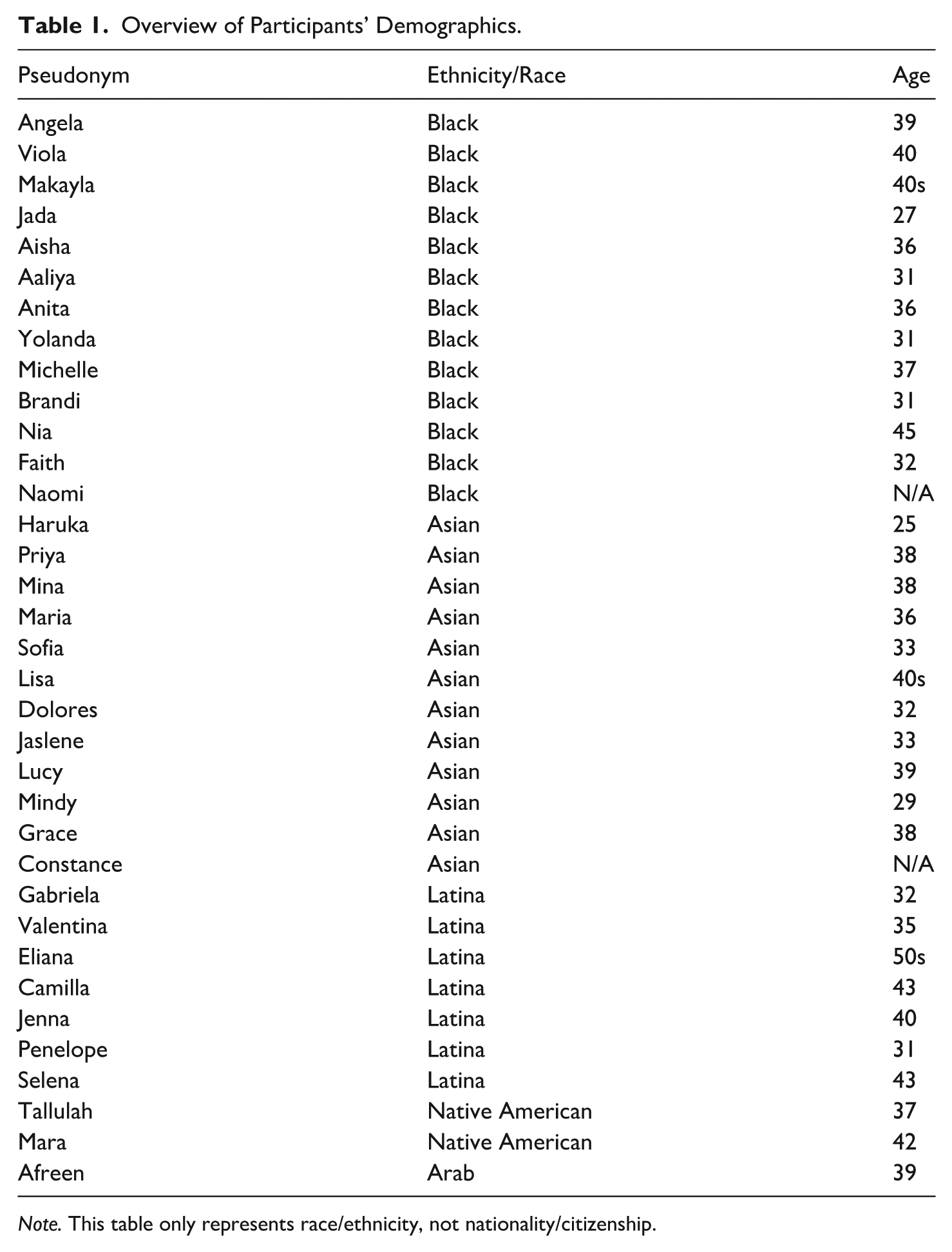
Note. This table only represents race/ethnicity, not nationality/citizenship.
I conducted virtual interviews between January and May 2025. The topics of migration, citizenship, gender, and racial identities/justice dominated U.S. news and public discourse at the time. Interviews lasted between 45 and 75 minutes, although participants discussed other issues beyond the scope of this study. This is part of a broader project on gender and photojournalism in which I interviewed 101 women news photographers in 22 countries. Upon IRB approval, I recruited participants through cold emailing, snowball sampling (Emerson, 2015), and advertisements distributed via collective groups (e.g. Women Photograph, Authority Collective, Black Women Photographers). The current study focuses only on perspectives about coverage of minorities and the representational practices of WOC participants. Thus, issues around WOC photographers’ professional experiences in a (white) male-dominated industry are beyond the scope of this article.
I analyzed the interview data using Reflexive Thematic Analysis (Reflexive TA), which enabled inductive, open, and organic coding for both overt and implied meanings (Braun & Clarke, 2021a, 2021b). A constructivist approach, Reflexive TA acknowledges the centrality of the researcher in the analytic process. Themes are not treated as diamonds in the sand “discovered” by researchers. Instead, researchers play an active (and subjective) role in the creative process of theme generation. They read “data through the lenses of their particular social, cultural, historical, disciplinary, political and ideological positionings” (Braun & Clarke, 2021b, p. 339). I am a mid-30s Black woman from sub-Saharan Africa and a junior tenure-track faculty at a U.S.-based R1 university. I previously worked as a journalist in East Africa, and I have researched the intersection of journalism and gender since 2018 with an emphasis on feminist theorizing (Blumell & Mulupi, 2022; Mulupi, 2025; Mulupi et al., 2025). Reflexive TA conceptualizes researcher subjectivity—my various gendered, classed, racialized, and immigrant standpoints—as a resource, not a contaminating agent to be contained. (Braun & Clarke, 2021a, 2021b).
Findings
RQ1: How do U.S.-Based WOC Photojournalists Perceive the Photographic Representation of their Communities?
All participants expressed frustration and dissatisfaction with how their communities are typically represented in the U.S. news media. A recurring theme in these interviews was the perception that coverage of racial and ethnic minorities in the United States often provides a limited and narrow view reflecting what three participants described as the “white gaze,” “white male gaze,” and “white supremacy.” However, participants’ descriptions differed slightly based on their racial/ethnic identity and/or their immigrant or refugee experiences.
Caught Between Erasure, Partial Truths, and Hypervisibility
Participants complained about patterns of erasure and partial truths in the photographic representations of their communities. The dominant view shared by the 13 Black women photojournalists was the belief that media images of Black/African American people oscillate between two extremes: excellence and opulence on one side, and poverty and suffering on the other. Such narrow, stereotypic coverage results in partial truths that have become solidified over time as universal facts. Ultimately, participants stated news photographs rarely depict the fullness of “Black life” in the United States. I feel like in news photography, there’s this need to make Black people superhuman in both positive and negative ways. There’s so much focus on just like pain and tragedy and violence. And then on the flip side, there’s also focus on Black excellence, and like, everyone’s just perfect. I think there’s a lot more space to show Black people just being and just living everyday lives. There’s more in the Black life than those kinds of polar extremes. (Angela, Black, 39) There are two halves of it. There’s the glamorous Black lifestyle that we see, that most Black people strive to be. I call it the Black 1%. And then there is the low-income communities, who are struggling to be seen and heard. (Anita, Black, 27)
This complaint about stereotypical representations that erase much of everyday lived experiences was shared by participants from other ethnic groups. Afreen (39), the sole Arab American participant in this study, observed that Arabs in the United States are often portrayed as “foreign” and “dangerous,” adding that these representations are “very frustrating” and “minimizes your role in the community.” Lisa (Asian, 40s) noted that while there has been increased media coverage of Asian Americans after COVID-19 and the resulting rise in Anti-Asian hate, there is a need for stories about everyday life. “I don’t want to just be seen speaking up against the way we’re being treated. I want to be seen for our everyday stories” (Lisa).
Participants also critiqued half-truths that emerge from media images that either invisibilize or hypervisibilize certain aspects of marginalized peoples’ lives. Sofia (Asian, 33) noted that “Filipinos are only described by their jobs” as “teachers, nurses, the caregivers.” She added that this image of “Filipinos at work” is only interrupted by the stereotypical images of “a mail order bride.” Black women concurred that certain types of Black women are invisible in press photographs while others are hypervisibilized in stereotypical ways. Discussing the portrayal of Black women in the U.S. and in the diaspora, Viola (Black, 40) stated: We’re still very guilty in objectifying Black women. I think that Black women are relegated to specific spaces. They’re hypersexualized, they’re emotionally irrational, they’re angry. And then, if you’re looking at Black women within the international context, poverty is heightened. And it is poverty without context, or poverty through a very Western lens.
Some non-Black WOC also highlighted “erasure” as a major shortcoming in the mediated representation of their communities. Camilla (43) explained that the news media reproduce images of Puerto Rico as a beautiful vacation destination with sandy beaches and warm weather or a disaster-ridden area with destroyed infrastructure. Camilla added that “my island” is represented as “either paradise or disaster, and both of those ideas are void of people in the images that are being reproduced.” Some Asian women photojournalists expressed criticisms of how their communities are excluded from coverage and rendered invisible within U.S. public discourse: We really are invisible. I think when it comes to race issues, it’s either Black or white in the US and we are just ignored. We are invisible. (Lisa, Asian, 40s) Filipinos have been in the US since the 1500s, and there’s so much hidden history that hasn’t been shared. (Gloria, Asian, 33)
The Enduring Lens of White Supremacy
Some participants stated that racial minorities in the United States are visually portrayed from the vantage of “white supremacy.” They described this as both the dominance of white (often male) photographers in the news industry (Hadland & Barnett, 2018b; Lough & Mortensen, 2023; Zalcman, 2018) and calcified representational patterns that center white people’s experiences in the news. The dominance of masculine whiteness in how knowledge and news are constructed results in partial truths about women and racialized communities (Harding, 1991; Steiner, 2018). As one participant stated, “most of the stories that are told of Black people are from a white gaze” (Aaliya, Black, 31). Another Black participant, Viola (40), noted that Black women in the United States and abroad are subjected to “white, European lens” and “sometimes a white woman’s lens,” which results in representations that are “lazy,” often devoid of nuance or context, and typically laden with ethnocentric cultural judgments, guaranteeing Black women will never measure up. Viola’s comment about a “white woman’s lens” spotlights the influence of intersectionality on photographers’ professional practices (Banjac, 2025; Byerly et al., 2023), distinguishing the representational tactics of racialized women from those of all women. This sentiment that photojournalism continues to perpetuate ethnocentric values was shared by participants from other minority groups: Photos that I see from Puerto Rico specifically are always with the white savior mentality. (Camilla, Latina, 43) It always comes down to usually a white person, with no cultural sensitivity and awareness, who somehow had free rein to make decisions about something. (Maria, Asian, 36)
Overall, participants believe the U.S. press often “miss the mark” in covering racial minorities, and there is “100% need for improvement.” They proposed various solutions. Dolores (Asian, 32) advised news organizations to produce stories that are “holistic in nature.” This would remedy “surface-level representation” and “clickbait” portrayals that reify stereotypes (Jaslene, Asian 32). Camilla (Latina, 43) encouraged photojournalists to engage in “deeper, more empathetic” visual framing. The majority of participants recommended more nuanced storytelling that includes historical, social, and political context to explain the current conditions of minority groups. Participants who either migrated to the United States or are children/grandchildren of immigrants/refugees proposed coverage that transcends dominant narratives of “the doom and gloom of immigrant communities.” As Dolores (Asian, 32) put it, news images should include “nuanced stories” beyond typical narratives “about people being detained, being deported, or when communities are under attack.”
RQ2: How do U.S.-Based WOC Photojournalists Subvert Dominant Journalistic Representational Practices?
How WOC photojournalists described their work suggests that the decision to join the news industry can be seen as an act of resistance. Several were drawn to photography from a young age, inspired by a parent/guardian’s hobby, while others picked up the camera in high school or college when working on student publications. Others switched to photography as a second career after spending years in nursing, healthcare policy, environmentalism, business, the military, etc. Sixteen earned degrees in either photography or journalism and media related studies. The majority of participants stated they were drawn to photojournalism precisely because of the (mis)representation of their communities, and their desire to contribute to reshaping visual storytelling. I got tired of opening magazines and either not seeing us or seeing us represented in a way that felt manufactured. (Black, previously worked in healthcare) I experienced a lot of photojournalists coming into our reservation, and they would take pictures of me and my family and of our relatives, and then they would just be gone, and we would never see them again. Sometimes we wouldn’t see what they even worked on. And so, as I got older, I got more interested in photography. (Native American, switched majors in college).
Acts of resistance are also evident in the representational tactics enacted by WOC photojournalists. They described a preference for visual storytelling that recasts the experiences of racially minoritized communities from the periphery to the center, and coverage that challenges stereotypes and exposes the “hidden” aspects of the lives of oppressed classes.
Enacting Decolonial Countervisual News Values
All participants described a preference and deliberate focus on covering issues affecting marginalized communities. Jada (27), an African American, stated she seeks to “amplify the voices and bodies of Black women” because “there’s a lot of stories that haven’t been told in terms of Black women.” Haruka (25) noted she seeks to “share a different perspective and slice of life of our [Japanese] culture” outside of dominant narratives that typically revolve around “World War II, incarceration, and the atomic bomb.”
Several participants described projects that illuminate historical injustices such as settler colonialism, wars, and Western imperialism. Tallulah (37), a Native American news photographer, stated she feels “this huge weight on my shoulder to teach” audiences about the history and lives of Indigenous peoples. She noted, for instance, that a lot of people in the U.S. “have no idea about the Massacre at Wounded Knee,” the 1890 violent skirmish in which U.S. soldiers murdered about 300 Lakota people. The massacre remains a symbol of oppression inflicted by the U.S. government on Native Americans. Speaking about the 1978 American Indian Religious Freedom Act, Tallulah added: A lot of people have no idea that our religion, our way of life, our spiritual beliefs, was illegal until 1979. And so, I love working on stories that bring that history to the forefront and make people learn about what happened. There’s so much that happened here during colonization. It’s like open wounds that I think still need to be talked about and recognized. I’ve been doing a lot of projects, essentially to answer this question: Why are there so many Filipino nurses in America? And a lot of that is tied to colonial history. . . . I’m really invested in storytelling about the Filipina diaspora around the globe, around labor migration and the impacts of militarism and imperialism on how Filipinas see their identity. (Sofia, 33, Asian)
Overall, participants decentered whiteness in their assessment of news values and news worthiness. Viola (Black, 40) said she is inspired by African American and Black literature “that have a very Black focus first” and where “whiteness exists in the periphery.” She added: “I photograph from that space, where Black people are the center.” WOC news photographers described their deliberate efforts to construct the lived experiences of minority communities as newsworthy. They expressed a commitment to reclaim otherwise ignored, forgotten, and erased histories of racialized communities.
“Talking Back” with the Camera
The participants in this study stated they use their photographic work to challenge harmful dominant narratives and correct stereotypes about racial minorities and other oppressed groups. One key stereotype they identified, and seek to address in their work, is the homogenizing of various communities. An Asian American participant (withholding other demographic information) stated some of her previous projects were inspired by a desire to illuminate the lives and culture of a specific East Asian community in the United States because she got frustrated by the dominant press images of Asians “as a monolith.” This commitment to multiperspectives in reportage was shared by other participants: Just because we are Black women doesn’t mean we all go through the same black experience. And while working [on a project about Black women], I definitely started seeing and photographing different walks of life and different types of groups of Black women that actually exist. (Jada, Black, 27)
Some participants said they address stereotypes by showing the “different aspects of our lives” that are often excluded from the news. They described projects highlighting the “resilience” of immigrants, representing Black women in vulnerable domestic settings to counter the “strong, Black woman social justice warrior” archetype, photographing stories reclaiming the beauty of “African features” and Black hair, and positive stories of marginalized communities working to fix everyday problems in their communities. Participants described projects documenting the stories of midwives, nurses, and other caregivers during the Covid-19 pandemic. Other stories celebrated local heroes from environmental activists influencing climate policies to volunteers addressing hunger in their communities to the small business owners who power local economies. Others celebrated pioneers in various fields from Wall Street to Hollywood. As one participant (Grace, 38 Asian) put it: “There are stories that are worth telling that don’t involve the dead body of a brown person.”
Notably, some participants stated they refuse to take certain photographs because those images would contribute to narrow, one-sided, stereotypical narratives. As Gabriela (Latina) explained: [During Hurricane Maria in Puerto Rico] there are images that I did not make because I was seeing what was being published and it was this visual of helplessness. Of “look at these poor brown people over there. They’re so fucked. Let’s help. Let’s send some money.” Not to minimize the extent of the gravity of the situation because lives of thousands of people were lost, but I think when you use the same visual to represent something, it becomes a stereotype. It becomes the norm of how people think about it.
Echoing similar sentiments, one Black photographer (Makayla, 40) said she decided not to cover the Black Lives Matter Protests in 2020, which were heavily documented in the press. News photographs of the protests often featured violence, fires, destruction, and trauma. White photojournalists prioritized photographing potential clashes between police and protesters, and ignored capturing humanizing moments (Pixley, 2020b). Makayla said she figured Black people would need “respite” from those images. So instead of going to the streets to document the protests, she captured everyday hopeful stories that would inspire joy and hope to Black audiences, because “when the pendulum swings the other way. . .they will need something to look at that brings joy, that is an opposite to the trauma that they are witnessing and that is being rolled out constantly.” Some of the hopeful and joyful stories participants described include projects documenting diverse cultures, food, and music. These included stories on the rites of passage practiced by Latino and Native American communities. Other stories showcased marginalized communities claiming space in areas they have previously been excluded such as Black girls excelling in ballet and the creation of WOC camping and hiking clubs. Other stories celebrated people solving problems from filmmakers telling new stories to children raising funds for local charities. In sum, participants described using their camera as a tool to “talk back” by creating images that counter dominant assumptions about minority communities. Some described refusing to be complicit in the production of harmful images and false accounts. WOC photographers drew on their “outsider” standpoint to reject and resist representational practices that are otherwise normalized in a white male industry.
Confronting the Limitations of Using the “Master’s Tools”
The resistance tactics enacted by WOC news photographers encounter obstruction within the news industry. Since nearly all the participants were freelancers, it is likely that the opposition they face from editors and managers is also influenced by their limited social capital as temporary workers. A Latina photographer (Valentina, 35) stated that going “against the media machine” can be “really hard.” An Asian photographer (Aurora, 36) echoed similar sentiments, observing that pushing “against the status quo” is difficult “because it’s definitely not in our favor.” One participant (Mina, Asian, 38) stated she “can’t depend” on newsrooms and editors to commission nuanced stories about marginalized communities. Instead, she has to pitch the story or work on a personal project and present the images to an editor with the hopes that they will “see the value of my work.” But this method, too, does not guarantee success: I think about the story that I’ve been working on. I don’t know that I would feel comfortable pitching it to the New York Times unless there are people on the other side who either have a background on the Filipino historical experience or who are very sensitive to women’s issues and trauma. So, for me, it’s like, what are the people who are in the institution knowledgeable about and how do I trust them to tell this story? The stories you’re passionate about might be a little bit harder to get through to publications. (Christina, Asian, 33)
Several participants concurred, stating they have been working on personal projects tackling deeply complex social issues around the histories of colonialism and racism, global conflicts, labor migration, the personal lives of racially minoritized women, etc. However, some of this work remains unpublished. Participants speculated that this is partly because nuanced perspectives clash with journalism’s preference to fit things into simple, pre-defined, and often oppositional groups (“pro this” or “anti that”). Valentina, an immigrant from Central America, stated that “in the US, everything is very polarized. Everything is either left or right, liberal or conservative, this or that.” In this context, it is difficult to find interest in stories about the gray areas. Another participant said she has struggled to publish work documenting Asian women in their home countries engaging in grassroots efforts to address climate change. Grace speculated that perhaps editors are uninterested in these types of stories because of stereotypical assumptions about which groups of people are deemed “real climate defenders.” It’s not sexy, it’s not Greta Thunberg [the acclaimed Swedish climate activist]. There’s almost no space for people of color when it’s not a story about our suffering, our dead bodies, or our children mutilated. It’s so hard to find that space. (Grace, Asian, 38) I don’t want to go for the stories that are about just people suffering. For example, about the [migration from Central America], I don’t like to talk about the migrants walking, crossing the borders. I think we’ve seen enough of that, or the migrants crying, the children separated. And these are necessary truths, I think, but I feel like I am not here to talk about that. I’m here to talk about the culture that they brought with them, the music that they do, the success stories that they have. And I feel like sometimes the media doesn’t care about that, because that doesn’t sell as much. (Valentina, Latina, 35)
Some participants stated that they push back when news organizations they work with publish or demand images that advance negative stereotypes about minorities. However, they sometimes self-censor because of fear of backlash. A Puerto Rican (Gabriela, 32) participant stated that she is always “outspoken about” how the island is represented and tries to have “conversations with editors.” But sometimes she deliberately avoids pushing back on editorial choices she considers harmful to her community because of the fear that editors might stop giving her assignments: I don’t want to overstep and then lose a story and work in the future. I’ve always felt like I’m going to get in trouble one day for saying these things. (Gabriela, 32, Latina) I feel like a lot of times, maybe editors are expecting a certain image, and if you don’t give them that they will not hire you again. (Afreen, Arab, 39)
Evidently, WOC news photographers are aware that attempting to dismantle the master’s house using the master’s tool is no easy task (Lorde, 2023). Four participants referenced the history of photography, which they described as steeped in “images that were problematic” (Nia, Black, 45) and rooted in “violence, colonialism, and racism” (Priya, Asian, 38). Maria stated, “photography was used as a tool of oppression,” and as “justification of colonization,” and that this “deeply troubling. . . legacy” continues in modern-day journalism. Indeed, historians share in this critique that the photographic medium discursively produced colonialist ideology in the United States and abroad (Hight & Sampson, 2013). But in the hands of oppressed groups, the camera can be an effective tool for “talking back” and disrupting dominant narratives that perpetuate and legitimize social inequalities (Pedri-Spade, 2017).
Discussion
This study contributes to the literature on gender and racial/ethnic inequalities in journalism by centering the standpoints of WOC photojournalists. As multiply marginalized news workers, encountering intersecting inequalities in their personal and professional lives, WOC photojournalists hold an epistemic advantage. Their perspectives and professional practices can illuminate how inequalities are perpetuated through (photo)journalism and the possibility of rectifying harmful reporting practices (Banjac, 2025). Participants were overwhelmingly critical of news photographic representations of racial groups in U.S. journalism. They stated that POC are typically portrayed through a limited, narrow lens, steeped with negative stereotypes. They identified various shortcomings, including monolithic portrayals that hide intra-ethnic diversity, storytelling devoid of nuance, erasure of people and histories, and overemphasis on pain and tragedy. The sentiments shared by this study’s participants align with past research. Racially minoritized communities are dissatisfied with their portrayal in the U.S. news media (Pew Research Center, 2023; Thomson, 2016). Asians are generally excluded from the news (Ordway, 2020). Latinos are disproportionately underrepresented; they feature in just 6% of news content about racial equity (M. Á. Flores, 2023) even though they are the largest ethnic/racial minority group in the United States, accounting for 19% of the population (Funk & Lopez, 2022).
An intersectional approach illuminated the variations in how WOC participants perceive biased coverage. Black women critiqued the hypervisibility of certain types of Black people, stating that media coverage often oscillates between the ultra-successful “Black 1%” and the extremely poor and suffering Black populations. Participants of Asian (and a few of Latina background) were more likely to complain about the erasure of their communities. They stated that their communities are invisible, even in public discourse regarding race issues. One Asian participant noted that racial discourse in the United States is about “Black and white,” and another pointed out that their community is “forgotten.” Indeed, this nuance in how participants perceive the misrepresentations of their communities aligns with standpoint and intersectional theorizing which acknowledge the multiplicity of lived experiences and perspectives (Banjac, 2025; Harding, 1991). In explaining the enduring inequalities in media representations of POC communities, participants pointed out that men, especially white men, dominate news photography; a few invoked the “white male gaze” and “white supremacy.” However, WOC participants appeared to distinguish their practices from those of white men and white women. One participant observed that even a “white woman’s lens” still generates harmful representations of racialized women rooted in ethnocentric ideals. This implies that WOC photographers have a unique perspective because of their interlocking gendered and raced standpoints (Anzaldúa & Moraga, 1981; Collins et al., 2021; Crenshaw, 1991).
This study shows that a less homogenized news workforce can generate “a more emancipatory journalism” (Banjac, 2025, p. 31). WOC photographers expressed a commitment to correcting biased representations. They described projects depicting the intimate lives of Black women (to subvert the “strong Black woman stereotype”), showing Black joy to counteract images of suffering and trauma, and telling everyday stories of immigrants, instead of images of helplessness or border enforcement and illegality that tend to convey a threat narrative (Farris & Silber Mohamed, 2018). Others described projects probing histories of colonialism, global migration, capitalism, ethnocentrism, racism, and other systems of inequality. They described shifting the photographic gaze to center the perspectives, everyday experiences, voices, and histories of ignored, forgotten, and invisibilized communities. In doing so, WOC news photographers subvert journalistic norms on visual storytelling, in whose stories they deem worthy of telling, in how they visually frame minority communities, and in their deliberate efforts to challenge the “controlling images” applied to (Collins, 2022) women and POC. These findings align with past research on the representational practices of women and racially minoritized photographers (Aushana & Pixley, 2021; Lough & Mortensen, 2023; Westcott Campbell & Critcher, 2018).
I argue that WOC professionals draw on liberatory principles to legitimize the newsworthiness of the everyday lived experiences, histories, and cultures of racialized communities. They seek to expose and confront current and historical systems of power/oppression. They profess a commitment to extending reportage beyond common stereotypes and refusal to participate in the reproduction of harmful images. The resistance mechanisms enacted by WOC photographers cannot be divorced from their own status as marginalized groups. Counter to white photographers who say they cover racial issues “with an outsider’s perspective” (Thomson, 2016, p. 229), WOC photographers unapologetically embrace solidarity with the racialized communities they cover. They expressed a sense of togetherness with oppressed classes by invoking phrases such as “we,” “our dead bodies,” “our lives,” “my island,” “our children mutilated,” “our religion,” “our culture.” They invoked “we” to express the invisibility, homogenizing, and stereotyping of racialized communities. Indeed, WOC news photographers draw from their “insider outsider” status to reshape how they practice visual storytelling.
The emancipatory, subversive practices of WOC news photographers are undermined and suppressed by various factors. They lack social capital; WOC are underrepresented as photographers, editors, and news executives. They face resistance from gatekeepers who uphold journalism’s normative practices. They struggle to find space for visual stories that do not conform to certain journalistic news values (e.g. the preference for conflict or pro and anti-framing of complex issues) or lack commercial value (stories that don’t sell). WOC photographers say they feel pressure to produce certain stereotypic images that they think editors would prefer, and they hit a roadblock when editors exercise their power to choose certain images and narratives over others. While some participants say they sometimes push back and try to engage in conversations with editors, other times they feel compelled to self-censor because they fear losing future work. WOC photographers are justified in not wanting to antagonize an editor who may offer (or deny) a frequent supply of work. After all, news photography is a precarious career (Hadland et al., 2016). In a precarious labor market, newsroom gatekeepers wield immense power to constrict the redemptive, oppositional photographic practices enacted by WOC and other “outsiders” in journalism (Pixley, 2020a).
This study extends knowledge by providing an intersectional understanding of photojournalists’ perceptions and experiences of journalism. The findings illuminate how racially minoritized women, who navigate various domains of power and oppression in U.S. society, “negotiate the norms and values– or rules of the game—that structure their journalistic identity and work” (Banjac, 2025, p. 5). Indeed, the article shows the value of examining journalism from the perspectives of those who are typically ignored, and the utility of intersectionality and standpoint theories for journalism research. The unique situated knowledge of WOC news photographers highlights shortcomings that are taken for granted by other news workers. From their standpoints, WOC photojournalists question and challenge assumptions about the definition of news, the role of journalists, the hierarchies within journalism, and journalism’s obligations to society. As things stand, WOC news photographers feel a burden and responsibility to expend capital, time, and labor to resist and address inequalities within photojournalism. These efforts are unlikely to bear much fruit because of the resistance forged by more powerful gatekeepers. Addressing inequalities in visual coverage of marginalized communities requires a diverse workforce at the top, among editors and news executives who wield institutional power. Furthermore, all news professionals, not just minority journalists, must share in the burden of tackling the ethnocentric, masculinist, and classed biases in journalism.
Limitations and Future Research
The sampling of this study has some limitations. The narrow sample of 35 comprises participants from various racial and ethnic groups which resulted in even smaller numbers for some groups. For example, only one Arab participant and two Native Americans were interviewed. Furthermore, all participants were U.S.-based and mostly discussed their perceptions and practices as it relates to U.S. media and society. While this study offers preliminary insights into intersectional biases in photojournalism and the oppositional practices of marginalized professionals, future studies should include a wider pool of participants and extend beyond the United States. Furthermore, this study does not include the perspectives of newsroom leaders, which might illuminate why (white) male hegemony persists in photographic representations, and how they engage with critiques and oppositional representational practices of minority journalists. Future studies should therefore include interviews with editors and news executives. I did not evaluate the photographic work produced by the interviewed participants. Future scholarship could benefit from comparative analyses of photographs produced by professionals from diverse backgrounds to assess any differences in visual storytelling. Scholars should also examine the perspectives and representational practices of diverse photojournalists in other Global North and Global South settings. Such research would illuminate how professionals outside the United States grapple with photography’s history of complicity in racial and gender inequalities, and how they subvert (dominant Western) conceptions of visual news values.
Conclusion
This study examined how WOC news photographers in the U.S. perceive the visual coverage of their communities. It also assessed how WOC photographers enact power as image makers to subvert ethnocentric and masculinist biases in the portrayal of racial minorities. I interviewed 35 women photojournalists from diverse ethnic backgrounds including African American/Black, Arab, Asian, Hispanic/Latina, and Native American. Participants overwhelmingly expressed dissatisfaction with how their communities are visually portrayed in the U.S. news media. Findings indicate WOC professionals subvert normative practices by drawing on counter-hegemonic news principles to “talk back” and exercise refusal in being complicit with journalistic norms that perpetuate inequality. Deviating from the norm of detached reporting, WOC news photographers conveyed solidarity with the racialized communities they cover by invoking phrases such as “my island,” “our religion,” “our culture,” and “we.” However, participants said they are constrained by a “media machine” that remains committed to upholding the status quo. Diverse professionals in positions of power and a collective effort among all journalists are crucial to confronting the inequalities in photojournalism.
Footnotes

Funding
The author received no financial support for the research, authorship, and/or publication of this article.
Declaration of Conflicting Interests
The author declared no potential conflicts of interest with respect to the research, authorship, and/or publication of this article.
Data Availability Statement
The participants of this study did not give written consent for their data to be shared publicly, so due to the sensitive nature of the research supporting data is not available.