






Abstract
News media often reproduce patterns in coverage that can exacerbate environmental inequality. This study investigates how journalists working for independent environmental news organizations in Brazil perceive and engage with such patterns in legacy media coverage. We conducted 2 complementary studies: first, 10 semi-structured interviews with journalists from independent environmental news organizations, and second, a qualitative content analysis of 85 of their previously published news articles. Our findings suggest that environmental journalists in independent media frequently foreground the voices of marginalized communities, especially Indigenous populations, while the framing of environmental issues in their reporting tends to highlight these perspectives.
Introduction
To what extent do environmental journalists in independent news organizations perceive and challenge environmental inequality within legacy news media coverage? This study investigates how environmental journalists in independent news organizations engage with and potentially challenge patterns of environmental inequality in the coverage of environmental issues in Brazil, particularly regarding voice, visibility, and representation of marginalized groups. Legacy news media coverage of environmental issues like climate change and environmental disasters frequently leans toward negativity, polarization, and dramatization (Brüggemann, 2017; Chinn et al., 2020; Høeg & Tulloch, 2019). In an attempt to balance perspectives, legacy news media amplify nonscientific viewpoints in environmental discussions (Boykoff, 2007; Schmid-Petri et al., 2017), such as those promoted by climate change deniers, which can increase polarization and erode trust in scientific information (Bolsen et al., 2014).
Furthermore, legacy news media often privilege the perspectives of powerful groups and institutions over marginalized ones (Gonçalves, 2024; Masini, 2019; Van Dijk, 2012), perpetuating voices and regional inequalities. Journalists often give voice to perspectives of groups located in geographically and economically privileged regions, silencing the perspectives of local populations that are directly affected by the environmental problems (de Carvalho et al., 2024). This bias is especially harmful to indigenous populations, who are not only neglected but also frequently reduced of agency because of repeated victimization framing (Belfer et al., 2017; McCrackin et al., 2024). They are typically portrayed as passive and in need of assistance, a narrative often perpetuated by journalists quoting political leaders rather than the communities themselves (de Carvalho et al., 2024).
This study explores the role of environmental journalists in challenging these negative trends observed in legacy media. This article aims to expand the scholarship on how journalists can challenge forms of environmental inequality in legacy news media coverage, such as silencing and regional invisibilities, and the role of journalism in promoting more equitable representations. Our study employs a mixed-methods approach, combining semi-structured interviews with 10 environmental journalists in Brazil and qualitative content analysis of 85 of their published news articles to compare role orientations and performance (Hanitzsch & Vos, 2017). Findings suggest that independent news organizations provide conditions under which journalists can challenge patterns commonly associated with legacy news media, promoting a more inclusive and issue-driven environmental discourse. We show that journalists perceive legacy news media coverage as biased, criticizing patterns such as the underrepresentation of marginalized communities and the prioritization of economic interests over environmental and humanitarian issues. The content analysis of their reporting indicates that journalists frequently rely on indigenous populations as primary sources.
By centering the voices of indigenous communities, emphasizing sustainable challenges and solutions, and holding public institutions accountable, these journalists reshape the discourse on pressing environmental issues in Brazil, such as environmental crimes and indigenous land protection. Our study contributes by showing the potential of independent environmental news organizations in contributing to a more inclusive and equitable debate of environmental issues.
Theoretical Framework
Media Patterns in Environmental Journalism
Taking a constructivist perspective, it becomes clear that news media can hardly capture reality. News selection and processing are generally accompanied by the need to select issues, frame information and choose sources (Entman, 1993; Rosengren, 1970; Schulz, 1990), which results in intentional or unintentional news media bias (Lichter, 2017). News bias may take different forms. For instance, prior research has identified ideological biases in news outlets (Baly et al., 2020; D’Alessio & Allen, 2000; Groeling, 2013), the dominance of elite perspectives and resulting inequalities in voice (Gonçalves, 2024; Masini, 2019; Oliver, 1994; Van Dijk, 2012), as well as negativity bias in reporting (Esser et al., 2016; Soroka & McAdams, 2015). We conceptualize news bias as the consistent patterns of reporting that emerge from the day-to-day realities of news production. This bias can be partially explained by the prioritization of powerful groups and institutions over marginalized ones in journalism practice, such as by deeming economic themes and wealthier regions as newsworthy and relying more often on elite sources for more “authoritative” perspectives (Gonçalves, 2024; Van Dijk, 2012). In this study, we assess news bias through two key dimensions of journalistic practice: source selection (who gets to speak) and framing (which perspectives are highlighted).
While numerous studies document the persistence of news bias, evidence suggests that such biases are both context, media and issue-dependent, manifesting differently across media systems, media outlets, and issues covered. Comparative research has shown substantial cross-national variation in news bias (Gurwitt et al., 2017; Hase et al., 2021; Schäfer et al., 2016), as well as systematic differences between types of outlets, such as legacy and independent news media (Andersen et al., 2024). In addition, academic evidence indicates that distinct forms of bias emerge depending on the issue under coverage. For instance, Ness et al. (2023) demonstrate that the coverage provided by the mainstream media varies substantially across topics: some issues are treated relatively fairly, while others display clear ideological leanings to the left or right. Similarly, Covert and Wasburn (2007) demonstrate that news bias varies systematically across issues, with topics such as crime and the environment activating distinct ideological frames depending on the media outlet. In line with this literature, we approach news bias as context-dependent phenomenon, shaped by journalists’ professional experiences and media system characteristics.
Because news bias varies across contexts, it is essential to examine how specific media systems shape the forms such bias takes. In Latin America, and particularly in Brazil, news bias can be deeply explained by the historical development of the regional media system. The Latin American media system is characterized by a hybrid nature according to the models proposed by Hallin and Mancini (2004), operating within a liberal paradigm shaped by fragile democratic contexts following the region’s military dictatorships (Albuquerque, 2012; de-Lima-Santos, 2024; Voltmer, 2012). This historical trajectory has resulted in weak institutions, limited regulatory capacity, and insufficient legal enforcement (Mesquita et al., 2025; Takahashi, 2024). Political parallelism remains high, alongside enduring patterns of clientelism that constrain press freedom (Albuquerque, 2012; Magalhães, 2022; Mellado et al., 2012).
These structural conditions deeply shape journalistic practice in Brazil. Multiple layers structure how journalism operates in Brazil, including profit orientation, dependence on advertising, long-term relationships with elite sources, threats of negative reactions from elite actors, and a pro-market orientation (Vicentini & Hintze, 2017). In Brazil, where media ownership concentration is high and news organizations are strongly dependent on advertising revenue, issue diversity is often limited, and legacy news coverage tends to privilege elite perspectives aligned with the interests of powerful economic and political actors (Magalhães, 2022; Mourão et al., 2022). As a result, sensitive topics such as corruption, environmental crimes, human rights violations, and socio-environmental conflicts may receive limited or selective national coverage (Loose et al., 2017; Mesquita et al., 2025).
News bias also varies according to the issue under coverage. In environmental journalism, biases manifest in specific ways, including ideological polarization (Chinn et al., 2020), source bias reflected in the disproportionate visibility of political actors over other voices (Chinn et al., 2020), false balance driven by performative attempts to signal scientific objectivity, which grant disproportionate visibility to climate-skeptical or denialist scientific voices (Boykoff, 2008), and negativity bias, characterized by crisis-oriented reporting and a lack of sustained coverage over time (Andersen et al., 2024; Brüggemann, 2017; Hase et al., 2021).
Environmental journalism in Brazilian legacy news media is strongly shaped by media-system characteristics. Owing to a funding model heavily dependent on economic lobbying groups, particularly in the energy and agrobusiness sector, legacy news media has consistently reinforced narratives of development and progress that marginalize the perspectives of communities affected by large-scale construction and extractive projects in environmentally protected areas (Mourão et al., 2022). This pattern is particularly prevalent in the coverage of hydropower and construction of dams, with previous findings showing that legacy news media disproportionately privileges government officials, regulatory authorities, financial institutions, and consortium executives, compared to marginalizing the voices of communities affected by dam construction (Mourão et al., 2022; Rossatto, 2010).
Whereas the legacy news media in Brazil presents a series of news biases that limit issue and perspective diversity, newer organizations have emerged as challenge players to the journalistic market. In Latin America, the emergence of independent news organizations is often described as a reaction to legacy news media outlets operating under pressure of political and economic groups (Marino-Jiménez et al., 2025; Mesquita et al., 2025). The high level of political parallelism (Albuquerque, 2012; Hallin & Mancini, 2004) has historically challenged journalistic autonomy, with previous scholars describing it as a phenomenon as media capture that harms the press freedom in the region (Arroyave Cabrera & Garcés-Prettel, 2023). In this context, independent news organizations have aimed to reconfigure the journalism practice by diversifying the journalism production and covering topics often ignored by legacy media. Academic scholarship refers to these organizations using different concepts and definitions, such as independent journalism (Marino-Jiménez et al., 2025), entrepreneurial news (Higgins Joyce, 2018), and even alternative media (Cazzamatta, 2025; Harlow, 2022). Despite this conceptual diversity, independent journalism in Latin America is commonly characterized by alternative funding models (Arroyave Cabrera & Garcés-Prettel, 2023), focus on audience representativeness (de-Lima-Santos & Mesquita, 2023), openness of perspective, and responsible content verification (Marino-Jiménez et al., 2025). In this article, we draw on these defining characteristics to identify relevant news outlets for our sampling process.
Independent news media often perceive themselves as a corrective to mainstream reporting (Andersen et al., 2024; Holt et al., 2019). Accordingly, countering news biases can also be understood as part of their journalistic culture (Hanitzsch, 2007), as evidenced by journalists’ perceptions of their roles and how they perform them. This is particularly plausible for independent news media in Brazil, where smaller news outlets increasingly assume the watchdog role (Mesquita et al., 2025; Requejo-Alemán & Lugo-Ocando, 2014; Waisbord, 2000). Benefiting from greater editorial autonomy and alternative funding models, such organizations are often better positioned to cover corruption scandals, environmental and human rights violations that may conflict the interests of dominant political and economic actors.
In this regard, journalists working for independent news organizations are likely to develop distinct perceptions of legacy news media coverage. Drawing on these theoretical strands, we first ask how these journalists perceive legacy media coverage of environmental issues, and second, how they reflect on and describe their own journalistic practices. We therefore ask the following research questions:
Journalistic Roles and Performances of Environmental Journalists
Journalistic roles are a traditional approach in journalism research, as they are considered to have a profound impact on journalists’ practice (Hellmueller & Mellado, 2015; Mellado, 2019; Skovsgaard et al., 2013; Riedl & Hanitzsch, 2025). Journalistic roles can be defined as “journalists’ perceptions, articulations, and enactments of institutional standards” (Riedl & Hanitzsch, 2025). As such, they contain both descriptive and normative facets (Hanitzsch, 2007; Riedl & Hanitzsch, 2025). More broadly journalistic roles can be conceptualized as an essential part of journalism culture—besides epistemologies and ethical orientations (Hanitzsch, 2007).
However, they should not be understood as static; rather, they are negotiated in discursive processes within journalism as well as at the intersections with society (Hanitzsch & Vos, 2017). Within this process, it becomes clear that journalistic roles are also shaped by social norms and democratic understandings (Geiß, 2023; Harlow, 2019; Relly et al., 2015; Skovsgaard et al., 2013).
Research on journalistic roles produced several typologies (see for an overview Hanitzsch & Vos, 2017; Mellado, 2019). Hanitzsch and Vos (2018, p. 158), for example, differentiate between 18 different roles (e.g. disseminator, watchdog, or advocate) that serve 6 basic needs of political life (e.g. being informed, engaging in political participation, voicing criticism, or contributing to social change).
Even though such types have often been empirically identified and are regarded as stable, research has also revealed that role perceptions differ across time/generations (O’Sullivan & Heinonen, 2008; Vos, 2016), countries (Kalyango et al., 2017; Standaert, 2022; Zhu et al., 1997), cultural and political backgrounds (Hanitzsch et al., 2016; Mellado et al., 2012) as well as topics (Harlow, 2022; Robbins & Weatley, 2021). Large-scale surveys like the World of Journalism Study (WJS) frequently examine the persistence of journalistic role perceptions. This research has already pointed to political freedom and perceptions of social values explaining differences between countries (Hanitzsch et al., 2016). Moreover, studies ascribed varying role perceptions to the media system by demonstrating differences between governmental and private owned media (Kalyango et al., 2017).
Research on journalistic roles in Brazil showed that journalists adopt various roles but focus on political active ones: Early studies by Herscovitz (2004, Herckovitz, 2005) and Mellado et al. (2012) suggested a dominance of the watchdog role and disseminator of politically relevant information. Recent studies also emphasized that most Brazilian journalists support politically active roles such as advocating for social change and monitoring political leaders (Moreira, 2017). Latest results from the WJS confirmed that Brazilian journalists overall narrate to fulfill political active roles by, for example, counteracting disinformation, exposing societal problems or functioning as watchdog (Silva et al., 2025). Their findings also show Brazilian journalists strongly rejected unethical practices such as taking money from sources or publishing unverified information (Silva et al., 2025).
However, with regard to the structure of the Brazilian media system, Harlow (2019) revealed clear differences between legacy and independent media which could not be displayed in the WJS: While journalists working for legacy media uphold traditional journalistic values such as the importance of objectivity, never revealing opinions, and avoiding activist roles, journalists working for independent media outlets highlighted the importance of normative responsibilities such as being a watchdog, giving voice to the voiceless, and defending social justice. This differentiation is closely tied to the Brazilian media system.
Moreover, journalistic roles are not only shaped by the media systems, but are also dynamic in nature (Hanitzsch, 2007; Riedl & Hanitzsch, 2025): Current research revealed that journalistic roles can change regarding the issues journalists report on. A great number of studies demonstrated a change in journalistic role models toward more activistic facets during crises (Arafat & Porlezza, 2023; Klemm et al., 2019; Vobič, 2022), political conflicts (Sözeri, 2016) and social protests (Harlow, 2022; Møller Hartley & Askanius, 2021). In addition, some studies also showed a shift toward more active roles due to the spread of misinformation (Balod & Hameleers, 2021; Schapals, 2018). Similarly, recent studies found more activistic role perceptions for journalists covering environmental developments internationally (Hujanen et al., 2024; Robbins & Weatley, 2021) and in Latin America (Girardi et al., 2018; Jacobi et al., 2024).
In the Latin American context more specifically, Takahashi (2024) identifies the prevalence of an ethics of care among environmental journalists, emphasizing responsibility toward affected communities, empathy, and the inclusion of marginalized voices, which can be understood as a form of “quiet activism,” whereby journalists do not overtly advocate but subtly shape coverage through practices such as source selection and emphasis, and narrative structuring. These perspectives suggest that environmental journalism in Latin America is characterized by gradations between objectivity and activism, rather than a strict dichotomy. In Brazil, findings also point to a hybridization of professional roles in some contexts, with community communicators taking on journalistic functions such as reporting and information dissemination, while independent journalists also engage in practices typically associated with community communication, such as advocacy and local engagement (Jacobi et al., 2024). This blurring of boundaries fills gaps in local information provision within communities. Additionally, this hybridization contributes to the gradation between objectivity and activism, as environmental journalism in Brazil is not uniform and depends on organizational, structural, and regional specificities (Girardi et al., 2018).
Such results showed differentiated journalism roles in different contexts. Connecting journalistic roles with ethical orientations as central elements of journalism culture also raises considerations on how journalism roles and ethical values can be shaped by journalism issues and organizational structure. We ask in the context of environmental journalism:
To link journalistic roles to journalistic practice, various authors raised the idea of differentiating role conception and role performance or enactment (Hanitzsch & Vos, 2017; Hellmueller & Mellado, 2015; Mellado, 2019; Schwinges, 2024; Tandoc et al., 2013). Hanitzsch and Vos (2017), for example, proposed a process model in which role orientations (i.e. norms and values) enact role performance (i.e. practiced journalists’ behavior). By comparing orientations and performances, it is possible to gain insights into how autonomously journalists act (Mellado, 2019). In doing so, studies identified gaps between orientations and performance, with the size of these gaps varying across individual journalists and media organizations (Mellado et al., 2020; Raemy et al., 2019). Role performance or enactment can be reflected in various dimensions in journalistic practice (Mellado, 2015). Research comparing role conceptions and performances focused, for example, on the sources journalists used and frames journalists set in their reports (Tandoc et al., 2013). Broadly speaking, framing can be understood as “selecting some aspects of a perceived reality and making them more salient in a communicating text, in such a way as to promote a particular problem definition, causal interpretation, moral evaluation, and/or treatment recommendation for the item described” (Entman, 1993, p. 52). In this sense, both source selection and framing can be interpreted as indicators of how journalistic roles are enacted in practice (Entman, 2007; Gonçalves, 2024). Therefore, we ask:
Method
This study consists of a mixed-method approach, combining semi-structured interviews regarding role perceptions with qualitative content analysis for insights into role performances (as suggested by Mellado, 2019). In the first study, we conducted interviews with 10 journalists covering environmental issues. In the second study, we conducted a qualitative content analysis of news articles written by the interviewed journalists.
Study 1: Semi-Structured Interviews
Participants
We recruited 10 journalists using purposive, convenience, and snowball sampling strategies. First, we mapped independent news organizations focused on environmental issues using the national map of independent journalism (Agência Pública, 2019). Second, we invited journalists who have covered stories for the mapped organizations by sending emails or messages on LinkedIn. All journalists were informed about the purpose of the research in advance and signed a research agreement. During the interviews, we also asked whether they could recommend other independent news organizations or journalists to expand the sample. Four of the 10 journalists were female. Eight of the journalists were formally contracted by independent news organizations, whereas two worked as freelancers for different independent environmental news organizations. Figure 1 illustrates the work status of the interviewed journalists and their respective federal states. Note that the points shown do not reflect their exact locations, only the Brazilian federal state.
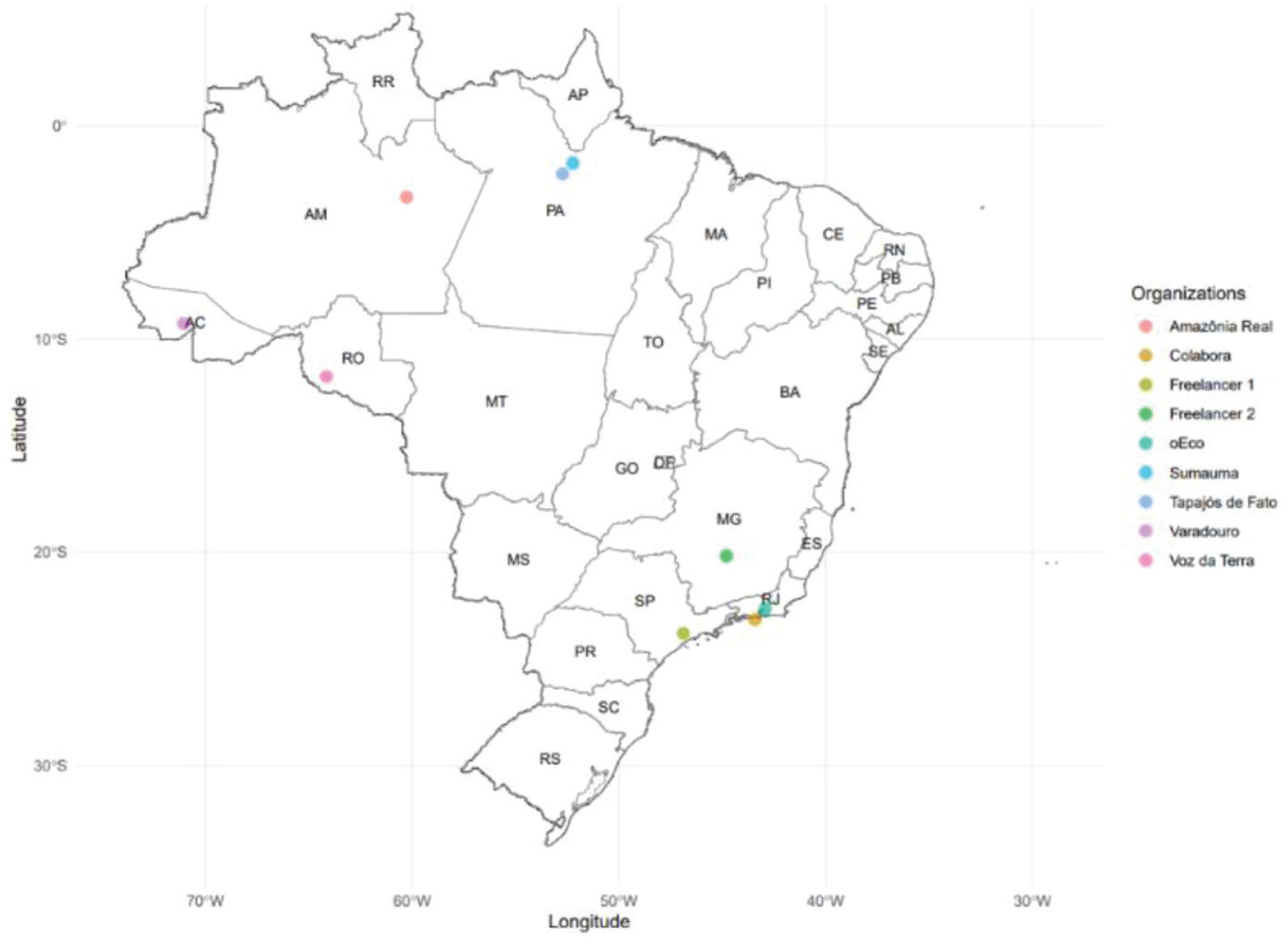
Work status of interviewed journalists.
Interview Guide
The interview guide included questions on motives to cover the environment, the perception of legacy news media coverage on environmental issues, ideal models of journalism, journalistic practices, journalistic roles, ethical values, and journalistic practice to include sources.
Procedure
Interviews were conducted in the first semester of 2024 using Microsoft Teams (Microsoft Corporation, Redmond, WA, USA). Interviews had an average duration of 39 min. We later transcribed them and translated them into English. Both steps were carried out by a Portuguese-speaking member of the research team. We used MAXQDA (VERBI Software, 2026) to code the interview transcripts.
We developed a coding scheme with 8 main categories and 45 subcategories to analyze how journalists frame their reporting and perceive their professional roles (see Online Supplemental Appendix for full definitions). These categories included: (a) Interventionism, assessing the level of journalistic involvement (Hanitzsch, 2007); (b) Journalistic Role Conceptions, such as watchdog or neutral observer based on the typology used by Tandoc et al. (2013) which is suited for comparing role conceptions and performances; (c) Audience Orientation, examining whether journalists prioritize public service or market demands (Hanitzsch, 2007; Kovach & Rosenstiel, 2001); (d) Epistemological Approaches, distinguishing between objectivist and constructivist perspectives; (e) Ethical Criteria for Source Selection, analyzing justifications for including or excluding sources (Herrscher, 2002; Plaisance & Skewes, 2003); (f) Perceived Media Bias, particularly toward political or economic interests (Chinn et al., 2020; Van Dijk, 2016); (g) Inclusion of Marginalized Voices; and (h) Types of Sources Quoted. We opted for an open coding scheme, which allowed the coders to add further categories if needed. Our analytical approach was primarily deductive, as the main categories were informed by existing theoretical frameworks on media bias and journalistic roles and performance. At the same time, we incorporated inductive elements through open coding, which allowed for the refinement of categories and the identification of empirical nuances emerging from the data.
Study 2: Qualitative Content Analysis
The articles collected were published before the interviews to avoid any potential changes in the journalistic practice resulting from the interview experience. We aimed for 10 articles per author but were unable to reach this number for all journalists, as some focused on publishing long-form investigative pieces. At the end of the sampling process, our final sample consisted of 85 published news articles. To examine the extent to which their self-proclaimed journalistic principles and practices were reflected in their work, we developed a second open coding scheme (see the Online Supplemental Appendix for a full explanation).
The coding scheme included different categories and subcategories. First, we coded (1) Article Category as: (1a) News Articles, (1b) Opinion/Comment, (1c) Reportage/Feature, (1d) Interview, (1e) Portrait. Second, we differentiated (2) Presentation Style as either (2a) Complex or (2b) Comprehensive, depending on how information is presented in terms of technicality, level of explanation, and structural clarity, reflecting different levels of linguistic complexity (Tolochko & Boomgaarden, 2018; see coding scheme for details). News articles that were considered too complex by the coders and without enough explanation on contextualization were coded in the first category, whereas more comprehensive articles were coded in the second. Third, (3) Issues or news topics were open-coded.
News frames were defined in line with our theoretical background in news biases and possible counter biases in environmental journalism (see Andersen et al., 2024; Boykoff, 2008; Brüggemann, 2017; Chinn et al., 2020; Mourão et al., 2022; Rossatto, 2010). Coders were allowed to code multiple frames a single article to capture a more comprehensive overview of the framing choices by journalists. (4) Frames were coded as (4a) Negativity, (4b) Solution-oriented, (4c) Elite View, (4d) Communities View, (4e) Polarization, (4f) Dramatization, (4g) Economic Focus, (4h) Institutional Responsibility and (4i) Sustainable Focus.
Finally, (5) Sources were grounded on previous study by Gonçalves (2024), as well as other sources relevant for environmental journalism, and were coded as follows: (5a) Political actors, (5b) Influencers and Celebrities, (5c) Indigenous Populations, (5d) Scientists, (5e) Activists, (5f) Riverside population, (5g) Communities, (5h) NGOs, (5i) Business people or organizations.
Findings
Study1: Semi-Structured Interviews (RQ1, RQ2 & RQ3)
The Coverage of Environmental Issues in Legacy News Media
Examining environmental journalists’ perceptions of legacy news coverage (RQ1), we identify five main types of perceived biases: (a) issues bias; (b) framing bias (c) elite bias; (d) economic bias; and (f) false balance bias. Regarding issue bias, journalists criticized the insufficient attention given to environmental issues. According to them, respective topics receive inadequate coverage, with reports often limited to disasters. There is a lack of follow-up stories that illustrate the ongoing nature of environmental challenges or the consequences. Additionally, there is a shortage of reports highlighting potential risks faced by populations in vulnerable areas. Legacy news media also tend to overlook issues occurring in noncentral regions. In Brazil, for instance, the Southeast region, which holds the most economic power, receives most of the media attention. In contrast, Northern states, including those home to the Amazon, are frequently neglected in news coverage: In fact, a series of situations outside the Southeast have gone unnoticed by the population as a whole. The thing is that you report that the Amazon River has dried up, for example, in the Itajaí region, there is not a continuity. People soon forget. And, for example, the Itajaí region, that region was destroyed, people all went back there waiting for the next catastrophe, you know? So, in my view, there’s a lack of continuity and more quality for this journalism to get closer to that sustainable level. I don’t see a problem with quality, but more with size. We need more and better press reaching more people on a continuous basis. (Interviewee 2)
The interviewees perceived environmental and sustainability issues as niche topics in journalism, highlighting an issue bias in news reporting. While independent news organizations specializing in these areas provide continuous coverage, legacy news media fail to integrate such topics into their daily reporting. Framing bias was also highlighted by some of the journalists interviewed. One journalist noted the absence of a “sustainable lens” in traditional journalism, criticizing the tendency of journalists to overlook the long-term impact of major political decisions. They argued that journalists should adopt a more critical perspective and actively question politicians, business organizations, and institutions about the long-term consequences of their actions. According to them, a sustainability perspective should be embedded in journalistic framing rather than treated as a separate or secondary concern. For example, when reporting on tax reductions for cars, journalists from legacy news media often focus on the economic consequences, such as the increase of employment rates. However, they should ask political actors about the long-term impacts of such decisions, including increased carbon emissions, higher rates of respiratory diseases, and worsening traffic congestion. One of the key problems associated with the framing bias is the lack of in-depth and nuanced coverage, which often leads to oversimplifications and the illusion of easy solutions. A journalist pointed out that reporters should trust the audience’s ability to engage with the complexity and uncertainty of the issues being reported: Reality is super complex. So, while we know how much we keep doing and giving in, you know? Like, putting things as if they were simple, as if the solutions were simple, as if there were technological solutions to things, as if scientific hype was going to solve the problems. We’re doing a disservice, so I think the big challenge is for us to really deepen our coverage, understand the complexities, the uncertainties and put that into our coverage. (Interviewee 8)
Elite bias is closely related to framing bias and was described by journalists as favoring the perspectives of elite voices. It is evident in how news is framed, often centering on political debates rather than on vulnerable populations. Elite bias is reflected in both framing and source selection. Even when environmental and climate issues are the focus of coverage, legacy news media tend to prioritize political actors over indigenous populations, communities affected by climate change, scientists, or NGOs. One journalist reflected on their own practice, comparing their early work to their current approach. They noted that including indigenous populations in their reporting was a recent development.
Elite bias is also closely related to economic bias. Several journalists noted that news stories tend to focus on the economic consequences of political decisions rather than their long-term sustainability impact. This framing is often reinforced by the inclusion of powerful business groups, whose voices are prioritized even in coverage of environmental and climate issues: I think that, above all, we’re experiencing this whole context of having the COP here in Belém. So this has somehow brought the sustainability debate to the mass media. However, it is a sustainability agenda that dialogues with those who destroy nature. They will listen, for example, to the X Institute, for example, the Y Institute, which are giant companies that operate here in our region, but which destroy the environment instead of promoting the necessary social and climate justice. (Interviewee 7)
Another bias mentioned was the well-known false balance bias. Journalists noted that news stories often attempt to balance perspectives by giving disproportionate space to voices promoting scientifically invalidated claims. This bias is also prevalent in news framing, particularly in word choice. For example, indigenous populations are often murdered by land invaders attempting to seize their territory. However, as one journalist noted, such events are frequently framed as “deaths due to confrontation” rather than being accurately described as murder.
Journalistic Roles
Addressing how journalists reflect on their own practices (RQ2), and more specifically their perceived journalistic roles (RQ3a), most journalists identified themselves as (a) translators, (b) disseminators, (c) advocates, and (d) mobilizers. Some journalists saw their role as “translating” the complexity of the issues they cover. This role was connected with significant challenges. One was balancing the complexity of scientific information with the need for clarity. Journalists identified the risk of oversimplifying or being too complex for the audience. A key challenge in achieving this balance was the relationship between journalists and scientists. Journalists noted that researchers were often unhappy with how their work was portrayed in the media, highlighting tensions between accuracy and accessibility in reporting: It’s still a complicated relationship, isn’t it? I think that throughout history, we’ve had a conflict between researchers and journalists, because sometimes the researchers want you to publish the article verbatim with the literal words. But it’s not always going to be accessible to the general public. So sometimes there are also researchers who are resistant to giving interviews. (Interviewee 10)
Another challenge in translating information was encountering accessible formats for local and vulnerable populations, who often have low literacy rates or limited education. One journalist created an investigative series in podcast format, enabling the local population to access information through audio rather than text.
The second identified role was the “disseminator.” Journalists perceived themselves as disseminating information needed for raising awareness for important environmental, and scientific issues. Part of this role was also to tell the stories of populations that are silenced and invisible in legacy news media. Our journalists tried to actively listen and tell the stories of these people. “I tell the stories of these populations. I tell them, as we say in our project. We want to tell the story of these people who, in fact, are invisible here, who are silenced, right?” (Interviewee 5).
The advocate role was related to the level of journalists’ involvement with the issues they cover. Some journalists saw their news stories as a tool for exerting pressure on institutions, using their reporting to drive change. Some journalists perceived themselves as having a cause, such as defending democracy, preserving nature, or strengthening scientific information. For some, advocating a standpoint did—in their view—not compromise journalistic integrity because they were standing for democratic values and human rights which are also journalist values. However, others explicitly identified as activists: I present myself as an activist for socio-environmental causes, an activist for LGBT causes and an activist for climate justice. So I believe that, personally speaking, that’s who I am and what I stand for as a person in society. (Interviewee 7)
In some cases, journalists also became a point of reference for indigenous communities, where access to information is often limited. They acted as a trusted source, guiding individuals on how to address authorities. Despite this dual role—both as reporters and as sources of guidance—journalists still perceived this role as an integral part of their profession: It is the role of a journalist, whether they like it or not, according to the Code of Ethics, to report violations and also to defend vulnerable populations and minorities. So I don’t think it’s an issue that we’re doing outside of our profession. (Interviewee 10)
The last role identified was the mobilizer role. Some aimed to motivate people to engage in civic activities or make more informed decisions through the stories they cover. One of them aimed to reach the especially indigenous communities and riverside population. Their goal was to make vulnerable populations aware of how environmental exploitation directly affects their lives: But we also want to communicate with people in the territories. And I think that a great example of this is the mobilization campaigns that we run, showing people in the territories how major projects can impact that environment. A very clear example of this is the impact of mining in our region, where mining has had a huge boom, and we try, through campaigns and tools, to talk to the territory to show the impact of mining in other places, saying look, if mining sees that it can happen here too. (Interviewee 6)
Journalists demonstrated an understanding that their framing and choice of issues can influence a wide range of attitudes, including voting behavior, political participation, and civic engagement. They pointed out that by adopting a sustainability lens and highlighting the impact of economic activities, public policies, and political decisions on the environment—and ultimately on people’s daily lives—they could impact public perception and individual attitudes. In part, this understanding of journalists as mobilizers was also connected with the political changes, such as the rise of negationist voices and disinformation. One of the journalists pointed out that the journalism roles must be updated, and that the neutral understanding of journalism was not appropriate anymore: We’re tired of being beaten up. I’m tired, you know, of living like this, damn it, I’m a science journalist, an environmental journalist. Then you see disinformation like this and you say: no. It’s no use, you know? We’re wiping ice, so maybe we need to get out of this thing of thinking: “But I’m a journalist, I just write. Ah, no, but I’m a journalist, like I’m not an educator, so I’m a journalist. An educator is a teacher.” We need to get off that pedestal too. (Interviewee 7)
The mobilizer role was connected to the understanding that journalists’ information has the potential to educate and raise awareness for complex topics. Some vulnerable populations, for example, have no concrete understanding of what climate change means. Interviewee 6 pointed out that they understand that the environment is changing, that they are not catching enough fish and that açaí (dark purple berry that comes from the açaí palm tree) is getting drier. “So people understood the effects on the territory, but they didn’t know what was going on” (Interviewee 6). A solution for informing the local population about the events was launching an informative printed booklet for the communities that do not have access to the internet: We adapted it by territory based on the narrative of each territory. So we have a specific booklet for indigenous peoples, one for quilombolas, one for extractivists and one for people from the floodplain area, in which we were able to adapt the language to dialogue with that specific territory. (Interviewee 6)
Ethical Values
When asked about ethics in environmental reporting (RQ3b), journalists mentioned five main ethical values: (a) avoid harm; (b) truth; (c) completeness; (d) civic mindedness; and (e) diversity. Journalists tried to avoid harm, especially to the sources they include and the communities they cover. In Brazilian protected areas, such as the Amazon, traditional communities face pressure from various actors interested in exploring and gaining access to the region. In this context, the sources of traditional communities are often at risk. Journalists were aware of such risks and tried to protect them as much as possible: Yeah, I don’t know, when it comes to journalism in the Amazon, there’s a lot of talk about violence as well. We’re in a border region with Bolivia and Peru, where criminal organizations operate very strongly. Today our [federal] state is unfortunately controlled by criminal factions. So these are issues that we sometimes try to be very careful and delicate in dealing with, to preserve our safety and also to secure our communities where they are infiltrated, because this has an impact on both sides. (Interviewee 4)
To protect them, journalists asked the community in advance if they are willing to have their names and pictures published. Journalists were first and foremost concerned with the safety of the people, and no fact was more important than preserving the lives of people and their families. Journalists were also aware of the power dynamics and understood that they were in a powerful position because they were the ones telling the stories of the communities. In this regard, they tried to use this awareness to do the best possible reporting: We’re the ones with the camera; we’re the ones talking to the recorder. So, we have a power over the other person’s story and I think it’s very important in these moments. So, to be careful about how you treat the story and how you relate to it. (Interviewee 3)
Concerning anonymous sources, journalists described the importance of being careful not to publish information that could identify the person or endanger the community. An example given by interviewee 6 was an indigenous community that is almost extinct and occupies a large protected area. When reporting on them, they avoid even mentioning how many indigenous people there are, so as not to show the vulnerability of the population to possible criminals: They get raided a lot and they’re only about X people. So I avoid it. When I tell the story, I avoid putting the name, the number of indigenous people, because they are susceptible to even more invasions, because they will see (. . .) how fragile they are.
Protecting sources is also important for preserving the relationship of trust between journalists and the sources: So these people are people who are extremely threatened with death, of having this data, of actually being set on fire. So how do you deal with it? Because these people, are they trusting you? So, the issue of anonymity is what keeps journalists and indigenous people together. (Interviewee 10)
To protect sources, Interviewee 10 mentioned that they always contact sources sometime after publication to check on their safety and if they need assistance. Such assistance also includes legal support.
Another prevalent ethical value was the pursuit of truth. Journalists mentioned that it is important to check sources and information and to verify the extent to which the information is valid. “And then you have to do a thorough investigation to find out who this person is, if the complaint they are going to make is really true and if you can trust them” (Interviewee 6). One problem was the lack of resources to go to the field. Journalists often covered stories in regions that are difficult, costly and dangerous to reach. Technology helped cover stories that otherwise wouldn’t be covered.
Also related to the pursuit of truth was the need to present comprehensive information. In this regard, another ethical value mentioned was the aim for completeness. Because they were not working for mainstream news media, the interviewees were able to do deep investigative reporting. “So, the stories that a big newspaper would do overnight, we have to spend a week insisting, looking for other sources” (Interviewee 2). As they sometimes were unable to go on the ground, other resources were also helpful to complete the information, such as satellite images. Yet, depending on the type of reporting, going to the field was crucial. Journalists and news organizations tried to prioritize the types of issues that needed in person reporting and the types of issues that could be addressed remotely: We only go to the field when it’s very necessary to make an image. When something really serious happens, or it’s something like that, a very serious violation and we can go, but most of the time we have to do it from a distance (Interviewee 10).
In order to reach this completeness of information, another crucial practice was diversifying the amount of sources: Everyone who tells the same story is going to tell it in different ways, from different points of view, and that’s precisely why I say that I find it very difficult to deal with this impartial journalism thing. Sometimes it’s even the place you’re looking at a scene from. You know, what I’m looking for, and this has been a learning experience, trying to listen more and more to people who are, who have always been left out, who have always been snubbed. (Interviewee 9)
The diversification of sources and the inclusion of silent voices is also related to the ethical value of civic mindedness. One journalist pointed out that they also had a commitment to the communities they were covering to make an ideal representation of the phenomenon. “So, taking care that my work really represents what I’ve seen and what I’ve experienced and what has been shared with me and that other communities have opened up” (Interviewee 3). This ethical value shows the civic responsibility of journalists to be attentive and respectful of the stories being told.
The inclusion of diverse sources is also linked to the ethical value of seeking diversity. Journalists claimed to actively include vulnerable populations, such as indigenous communities, in their reporting. “We listen to community leaders, union and association presidents, indigenous and religious leaders who are part of the land. So, our primary source, the number one source, is always the communities.” (Interviewee 4). They privileged the inclusion of communities, such as leaders who actively protest to defend their interests. Including leaders in reporting is also linked to the first ethical value of avoiding harm, since such leaders are already exposed. Journalists try to avoid including other community sources to avoid exposing them: One way we do it is to look for leaders. In other words, the guy who is already there, already known, already exposed if that’s the case, and not the people who are isolated in riverside areas and have no one speaking for them, in other words, the direct source. (Interviewee 2)
Another important source are scientists. “We have the network of contacts with researchers, scientists, masters and doctors, universities” (Interviewee 5). In general, journalists tried to give more voice to communities and scientists, while politicians were included in light of their responsibility to solve the issues. Privileging underrepresented sources shows journalists’ concern to diversify and include sources that are often not included in traditional news media.
Study 2: Qualitative Content Analysis (RQ4)
Sources Included
Regarding RQ4, our results showed that, in the news articles examined, indigenous people and researchers were the most common sources of information (see Figure 2). Public institutions were the third most common source, followed by NGOs, legal experts, and political actors. Other communities were not included as frequently as indigenous populations. However, the limited presence of other communities as sources of information is likely related to the types of issues covered. The news articles were mostly focused on environmental issues, such as indigenous protected lands and environmental crimes targeting Indigenous territories.
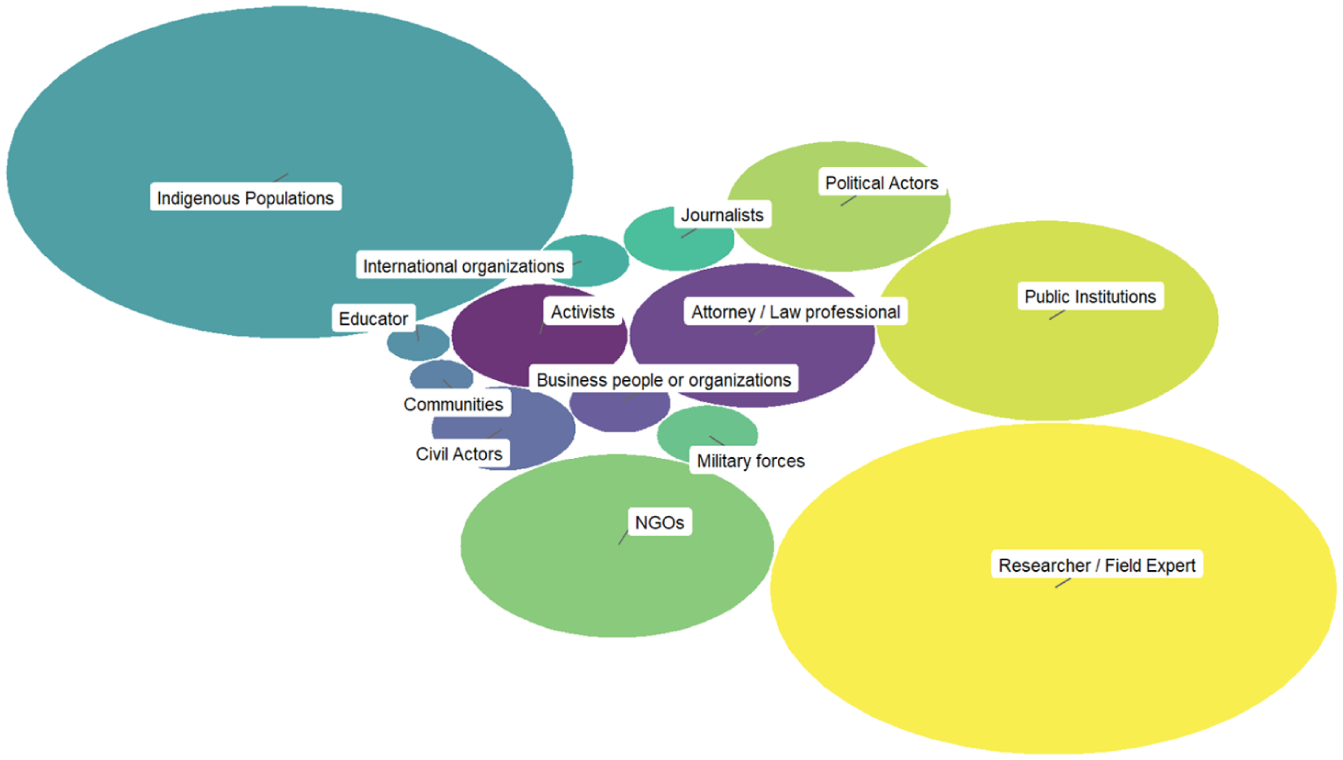
Circle packing of included sources.
Turning to the framing dimension of RQ4, Figure 3 illustrates the relationship between the sources of information and the frames used. We expected that political actors would be included in news articles in terms of their responsibility for solving problems. However, our data show that there is little overlap between them and the institutional responsibility frame. Instead, we find that political actors continue to appear in news articles by focusing primarily on polarization and negativity, reflecting the news biases that journalists highlighted in their interviews. However, the overlap is moderate. Overall, political actors were not included as much as other sources of information (Figure 2). In this respect, their weight in the frames used is lower than that of other sources of information.
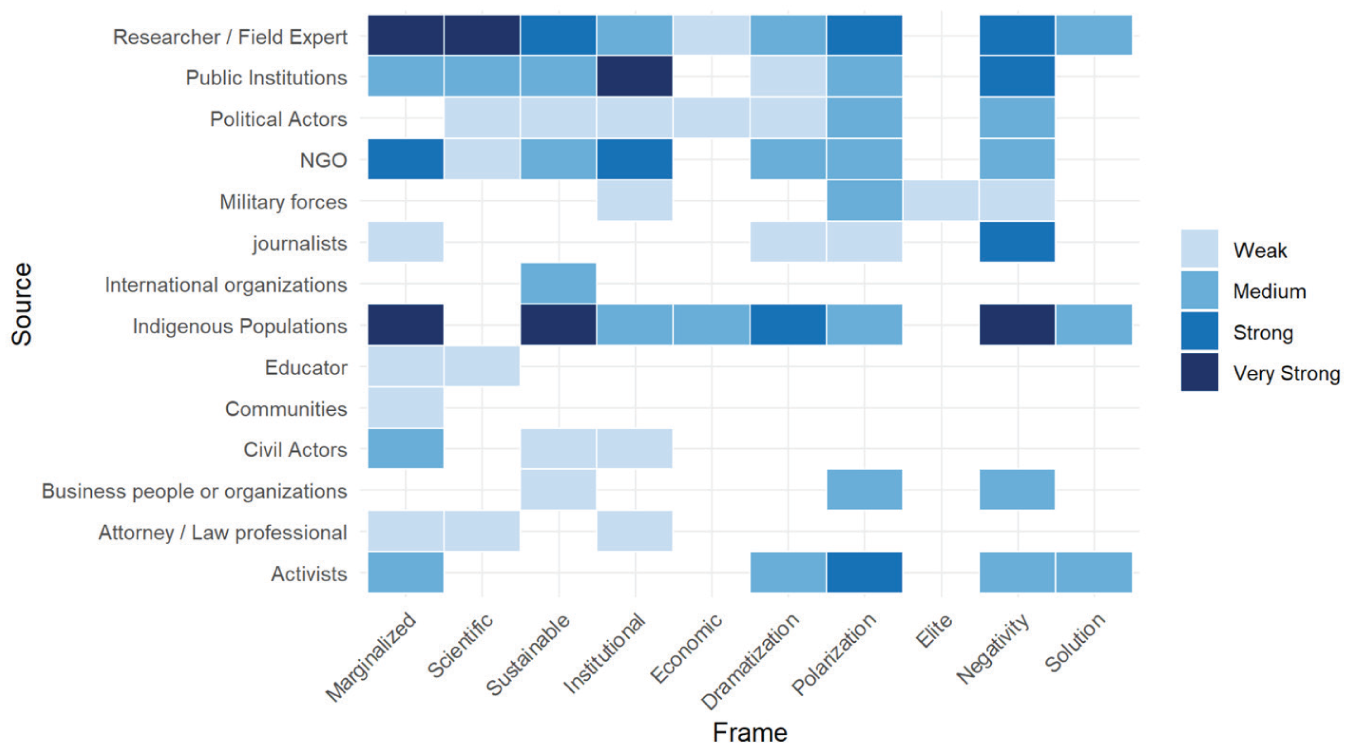
Overlaps between sources and frames.
Our data showed that the inclusion of researchers as sources of information is very strongly connected to the scientific view. The overlap of researchers is also very strong with the marginalized frame, as they often highlight the risks faced by indigenous populations because of climate change and environmental disasters. Researchers were strongly connected with the sustainable, polarization, and negative frames. Our results showed that overall, researchers were connected with a diverse set of frames.
Lastly, the inclusion of indigenous populations showed a very strong overlap with the marginalized and sustainable frame. News stories were likely to focus on the perspectives of the population, such as the problems they face and their role in the preservation of Brazilian territories. However, since many of these populations are targeted by criminal groups and business organizations trying to gain control over their territories, including indigenous people as sources of information also meant that the frames were very negative. Of course, the negativity of such frames is related to their constant struggle for territories and rights, which highlight the vulnerability of such populations.
Discussion
As previous studies showed (Andersen et al., 2024; Hase et al., 2021; Vicentini & Hintze, 2017), journalists perceived various biases when legacy news media cover environmental issues. This includes, for example, the perception that environmental issues received inadequate media attention and reports often focused on natural disasters. In their view, legacy news media did not only prioritize economic costs (neglecting long-term sustainability impact), but they also favored elite voices when covering environmental issues (marginalizing indigenous perspectives). Both perceptions are consistent with previous research (Chinn et al., 2020; Stecula & Merkley, 2019), showing how mainstream media often reproduce a series of news biases. Such biases reinforce a series of social inequalities, such as voices inequality (de Carvalho et al., 2024; Gonçalves, 2024) and geographic biases (Jones, 2008) and inequalities, as legacy media often privileges topics proximate of richer regions, such as the Southeast in Brazil. These findings speak directly to broader questions of environmental inequality, and the role journalism plays within it. Overall, legacy news media can act as legitimators of historical exclusions and inequalities, such as regional, racial, social, economic, sexual, and epistemological ones (Vicentini & Hintze, 2017).
In response to such perceptions, our findings also show that environmental journalists at independent news organizations aimed at covering topics, regions and voices that had been neglected by legacy media. This finding highlights the potential of journalism to re-center voices and regions that are often placed at the margins, contributing to a more equitable representation of those most affected by environmental issues. While comparing journalists’ reflections on their own practices with the content analysis of their published articles, the combination of studies revealed that their stated ideals were relatively consistent with their actual journalism practice. This finding points to the idea that journalists enjoyed greater editorial freedom due to less commercial pressure, as suggested in the literature (Harlow, 2019; Mellado et al., 2020).
Our findings revealed a diverse set of different journalistic role perceptions by environmental journalists in independent news organizations in Brazil. While most of the interviewed journalists identified as translators, disseminators, advocates, and mobilizers, we seldom examined traditional watchdog ideals. This is in line with recent studies emphasizing that most of Brazilian journalists support politically active roles (Girardi et al., 2018; Jacobi et al., 2024; Moreira, 2017; Silva et al., 2025) and, in particular, journalists working for independent news media take responsibility for political or social change (Harlow, 2019). In line with Takahashi’s (2024) framework on the prevalence of ethics-of-care among environmental journalists in Latin America, our findings show that journalists in independent news organizations reflexively challenge historically biased and constrained media practices by adopting environmental reporting that confronts hegemonic power relations while centering communities and ecosystems that have been historically marginalized.
In addition, our findings also point out challenges concerning financial stability and lack of security in local reporting, particularly in remote regions. Journalists often must use digital methods, such as instant-messenger apps, satellite images, and governmental information. Journalists face physical threats depending on the topics they cover, such as illegal mining, deforestation, and invasions of indigenous populations’ lands. The lack of security often causes self-censorship, as pointed in previous studies (see Barrios & Miller, 2021; Fadnes et al., 2020). Despite facing pressure of powerful groups aiming to expand agrobusiness, journalists actively incorporate perspectives from indigenous populations, scientists, and activists, rather than relying solely on political actors. These findings show the potential of independent news organizations to contribute positively to public discourse, as shown in previous empirical findings (Mesquita et al., 2025; Requejo-Alemán & Lugo-Ocando, 2014).
An important caveat, however, is that while independent news media may increase editorial autonomy and challenge structural biases of legacy mews media, their efforts to correct such imbalances may also be interpreted as a form of counter-bias. Our study therefore highlights a central tension of independent journalism: attempts to repair perceived inequalities in coverage may simultaneously raise new normative dilemmas. Future research should examine how such counter-biases emerge and what consequences they may have for journalistic practice.
Our study has limitations that could be addressed in future research. For example, it involved a relatively small sample of interviewed journalists; future studies could expand the sample to include more independent organizations and a wider range of countries. The articles analyzed were also heterogeneous in length, with some being substantially longer than others. Moreover, our analysis focused exclusively on text-based formats; future research could explore other forms of journalism, particularly in digital news organizations, that employ multimodal content combining text, images, audio, and video.
Despite these limitations, our study makes several contributions to journalism research and journalism practice: First, it deepens our understanding of journalistic roles in the specific context of environmental journalists in independent news organizations which we knew very little about so far and could hardly be captured by large-scale surveys like WJS so far. By comparing role perceptions and performances, our study helped to gain more insights into how normative role orientations and practiced ones interact in news production (Riedl & Hanitzsch, 2025). Moreover, our results demonstrate that journalistic role orientations cannot be understood independently of organizational structures, as the type of outlet plays a central role in shaping journalistic practice. Working outside legacy media reshapes how journalists interpret objectivity, advocacy, and responsibility in news production. Our studies particularly highlight how journalistic practices and organizational structures can either reinforce or challenge environmental inequality, particularly when it comes to inequalities in voice, visibility, and framing in environmental coverage. Taken together, our studies indicate that independent environmental journalism challenges conventional role frameworks: it foregrounds ethics-of-care orientations and is closely tied to emerging organizational models that reshape how journalistic roles are enacted in practice.
Supplemental Material
sj-docx-1-jmq-10.1177_10776990261462529 – Supplemental material for Challenging Environmental Inequality? Role Perceptions and Practices of Environmental Journalists in Independent News Organizations
Supplemental material, sj-docx-1-jmq-10.1177_10776990261462529 for Challenging Environmental Inequality? Role Perceptions and Practices of Environmental Journalists in Independent News Organizations by Isabella Gonçalves, Marlene Strehler-Schaaf and Oliver Quiring in Journalism & Mass Communication Quarterly
Footnotes
Acknowledgements
The authors thank all interview participants for their willingness to share their experiences with us.

Funding
The authors received no financial support for the research, authorship, and/or publication of this article.
Declaration of Conflicting Interests
The authors declared no potential conflicts of interest with respect to the research, authorship, and/or publication of this article.
Supplemental Material
Supplemental material for this article is available online.
Author Biographies
References
Supplementary Material
Please find the following supplemental material available below.
For Open Access articles published under a Creative Commons License, all supplemental material carries the same license as the article it is associated with.
For non-Open Access articles published, all supplemental material carries a non-exclusive license, and permission requests for re-use of supplemental material or any part of supplemental material shall be sent directly to the copyright owner as specified in the copyright notice associated with the article.
