







Abstract
The authors detail an educational ethnography of a university queer cultural center’s role on campus and in the surrounding community. The data include participant observation, in-depth interviews, and artifacts. The authors review lesbian, gay, bisexual, transgender, ally, and questioning (LGBTAQ) issues in higher education, heterosexual attitudes, and queer theory. The findings of barriers to the Center’s mission plus the suicide of a Center student prompted the authors to explore research poetry as a means to express the inexpressible. Furthermore, they illustrate tensions between contemporary queer and gay theories through the telling of a straight tale (traditional research report) and a gay tale (experiential research report), interrupted with queer tales (poetic interludes) and queer asides. At the heart of the tale is the transformation of the first author, a gay male, to a researcher and scholar of gay issues. This tale is therefore at all times queer, gay, and straight.
Keywords
Picture a broom closet, where the janitor keeps the yellow mop bucket with the obligatory “Caution: Wet Floor” warning, used to avoid those pesky torts lawsuits; the industrial-sized vacuum cleaner; a deep sink; and, of course, a broom. With the addition of a full-length window for a wall the closet becomes a fish bowl. After making the visual image of little fish fins with her hands behind her ears, while sucking in her cheeks and puckering her lips, the Center’s previous director explained that the analogy of a window giving access to anyone, especially the participants of campus tours. The tour guide points out the lesbian, gay, bisexual, transgender, ally, and questioning (LGBTAQ) office, also referred to in this article as the Queer Cultural Center or simply Center 1 , and the prospective students and their parents quickly peek in to satisfy their curiosity while trying to avoid the possibility of looking interested.
In our quest to discover why and how students choose to utilize the Center, three overall areas of focus emerged. First, we became interested in the Center’s purposes, separate from providing tangible resources. Second, we sought to meet the ethnographer’s “imperative to make what is familiar in these processes strange as well as to make the strange familiar” (Preissle & Grant, 1998, p. 8). Third, we wove the voice of the traditional scholar with a reflexive voice in order to explore Eric’s transformation as a researcher. The final two areas speak generally to the presentation of this article and specifically to the various forms of data representation that follow.
In the context of this study, Center is an inclusive term used to encompass the LGBTAQ office, social meeting room, and all other locations traveled on campus to do its work. There are other cultural centers on campus (e.g., Women, African American) all with dedicated buildings. The LGBTAQ Center is the only one housed in a pod of university offices (e.g., student activities, housing, Greek life).
The Researchers
Eric
I 2 came out of the closet as gay when I was an undergraduate college student. Having spent over nine years on college campuses, I never sought any type of support from a center. When the opportunity arose to study an LGBTAQ center, my interest was piqued to explore exactly who does seek out this resource and why. I could not fathom visiting such centers myself prior to this study. If you were to ask me why, I might tell you that it’s because I met a fellow college student whom I believed was gay. We became good friends, and he was all the support I needed. Because this is not true for everyone, I wanted to immerse myself in the LGBTAQ campus culture in order to gain understanding. Though I am part of gay culture, this is not the same as being part of the culture of the Center.
Maria
I have always considered myself an ally of people who are LGBTQ, even before I had a word to describe my stance. A stereotypical story for many heterosexuals is personal and poignant to me. I have a gay uncle I am proud of and love. I have stories of Uncle Dan going back to my earliest childhood memories. This is an example of Broido’s (2000) concept of meaningful contact. Related, as a feminist I have always felt that female issues are tied closely to homosexual issues. When things become bad for gays, they become bad for women and vice versa.

As part of my work as a researcher, I was asked by a university to evaluate the Center that Eric ultimately studied. My research occurred several years before Eric’s and provided a historic reference point for our discussions. This was time-intensive work that I took seriously with my primary recommendation being that sexual orientation is not an “activity” and should emerge from the auspices of student activities to the status of a university cultural center. I am now not as naïve and understand the study was conducted merely to check a box and is shelved, gathering dust as no changes recommended were enacted or indeed ever referenced in any context I have access to.
Coresearchers
We first met in a graduate research course where Maria was the instructor and Eric a student. As Eric continued his graduate work both as a research methodologist and JD, we became interested in similar research work. Ultimately this particular study came about when Eric enrolled in an educational ethnography course with Maria. As Eric conducted the research firsthand and Maria engaged with it secondhand, we both experienced a journey. For Eric the journey might be seen as a jubilant transformation from a gay male to an individual who is now also a researcher and scholar of gay issues. For Maria, the journey is complex as she moves from an ally of students who are queer to engaging firsthand with queer scholarship and research. This is a place of growth for her that is thought provoking and enhancing.
PLAY With Words
Setting: Three men, one straight, one gay, one queer walk into a bar and the academic asks, Why isn’t one transgender, bisexual, or lesbian and is the very construction of this setting essentialist?
Cast of Characters 3
Straight Man, a distinguished professor emeritus in “sex research.”
Gay Man, a respected professor who was part of the movement to bring Lesbian and Gay Studies into academia.
Queer Man, an assistant professor who sees other aspects of an issue without even trying, delights in the inverted, and with an excellent publication record is well on his way to tenure.
The authors have asked me to introduce this section and provide a historical overview. I’m not really comfortable with this, but I’ll try to be a good sport. I’m sure much of this tongue-in-cheek writing is aimed at me and misunderstands my intention to advance knowledge through sound research. In this section the cast reviews literature regarding LGBT student issues in higher education, heterosexual attitudes, and explores the narrative of tragic queer (Rasmussen & Crowley, 2004; Taulke-Johnson, 2008) versus what the authors term super queer. The authors suggest an alternative complex identity of capable and competent yet vulnerable (Lahman, 2008) queer or every queer. This context is voiced through three academic characters, of which I’m one. I would describe myself as a normal leadership figure in academia, but some see me as out of touch, and perhaps even poor intended. When I first started working in sex research we were seen as having the liberal intent of rescuing this area from “the clutches of religion” (Gamson, 2000, p. 350). You have to understand that for much of my early career, until the early 70s, homosexuality was considered a sickness that we could diagnose using the sophistication of the Diagnostic and Statistical Manual (DSM). 4 I wasn’t too upset when that changed, but I can see the perspective of colleagues who wonder why some male homosexuals persist in risky behaviors and see negative aspects of homosexuality as a problem to be fixed.
Straight Man was my mentor when I was a grad student. That’s why we still go out to a bar every now and then. Umm . . . he reminds me of my dad and uncles. Sometimes things have moved so fast they seem disoriented. He’s right, lesbian and gay issues are becoming more visible on college campuses (Evans & Herriott, 2004). Nevertheless, the media and scholarly research indicate lesbian and gay individuals and students are still subjected to negative attitudes, harassment, and violence in society and on campuses (Liang & Alimo, 2005; Lugris, 2004; Taulke-Johnson, 2008). Regarding this current article, little in-depth research has been conducted on LGBT university cultural centers’ role on campuses. 5
Gay Man is my departmental chair or I would just skip going to the bar. It seems no one can review the literature on queer theory without harking back through the historical cannon. Maybe we should examine this need to always link to the past. Gay and straight researchers have created a pervasive narrative about me, while a partial truth runs so strongly through who I am thought to be that I reject it and seek to invert the very notion of understanding. The moment you think you know me you are on unsure ground. The dominant narrative of queers is that of martyr-target-victim (Rofes, 2004), wounded identity, (Haver, 1997), the Tragic Queer (Rasmussen & Crowley, 2004; Taulke-Johnson, 2008). You who want to FIX me embraced this narrative and I am not sure the initial motives of queer allies are far from a need to hug the wounded. Take education for example, gay VICTIM dominates (Harwood, 2004; Rasmussen, 2004b; Rasmussen & Crowley, 2004): “the entire gay student population is . . . defined almost exclusively by reports of the prevalence, incidents, and consequences of anti-gay attitudes and behavior on campus” (Taulke-Johnson, 2008, p. 122). This narrative is partial and pathological, ignoring “that which is positive, affirming, pleasurable, empowering, and fulfilling” (p. 122). The tragic queer narrative places emphasis on negative aspects of the LGBT communities such as likeliness to commit suicide, use drugs, become depressed (Harwood, 2004), or be harassed (Liang & Alimo, 2005). How is this need to fix so different from diagnoses and inclusion in the DSM manual?
I do think though it is important to consider that studying the attitudes of heterosexuals and the dominant heterosexual campus culture might allow researchers to propose effective ways to develop an inclusive and welcoming campus culture (Evans & Herriott, 2004; Liang & Alimo, 2005). Allport (1979) proposed the contact hypothesis that states as members of different groups meet, negative attitudes decrease and “new information challenges stereotypes of stigmatized groups” (Liang & Alimo, 2005, p. 240). 6
(to Gay Man) Come on! That research “helpful” or not still sees sexuality as something that can be constructed and understood. For example, I am also seen as Super Queer by straight liberals who are glad they have one gay friend that they can refer to by saying . . . my gay friend said, or my gay friend did, or we are going to my gay friend’s home. This is a romanticized narrative, in which I am always “completely out” (Rasmussen, 2004a), a leader, a crusader, a “champion” worthy of superhero status. Let me run get my cape. Ugh . . . don’t put this on me. It is too much to live up to, too ridiculous, too stressful.
(In an aside to Straight Man and the audience). Privately, I will say sometimes Queer Man is exhausting. He has no idea how hard we fought and yes still fight to get treated with respect on campuses. I know much of the respect is probably false, but it is a first step. Yes, gay and lesbian academics are aware we banded together in an essentialist contract (Halperin, 2003) to help forge our way into the hallowed halls. It worked, didn’t it? It is not popular to say, but I still think if we had fought those first grand fights with the B and T attached to the G and L we would not be where we are today. I acknowledge that Queer Theory has done much for transgender issues (Halperin, 2003), but much of Queer writing is so theoretical it would not be understandable to their own constituents (Wilson, 2000). Let me stop, if I say too much on this issue. I am an Old Fag or some kind of new gay “Uncle Tom” willing to pander to the academic community for inclusion.
(To Gay Man). I know. I know . . .! Gay and Lesbian Studies had finally made sense to me and seemed more than the latest trend . . . good research that examined everyday life so we could understand gays better, but now this new offshoot Queer Theory. I feel uncomfortable even having to say that out loud. We were taught not to say queer anymore. I don’t even like reading it in poetry . . . My little horse must think it’s queer . . . . Now suddenly Queer is vogue. It seems anyone can be Queer if you have a different idea.
You don’t even need to be gay to be Queer!
Also, what about gay or queer scholarship indicates it should be written up differently? Why can’t it just be laid out in a fashion where one can find the necessary components to judge the work and use the findings? Take these authors’ work, is it a play, a poem, and what are queer asides? I find the asides annoying, glib, and interruptive of the text. This feels like messing around to me by people who couldn’t make it as poets. Scholarship wise much of what they say is essentialist and has been said more clearly by others.
Well, but I do believe the writing structures you were taught and taught me all send hidden messages about knowledge and power and how they are constructed and maintained in academia. It is not just an issue of easy of transmission of knowledge. We will have to continue to disagree on how research should be represented.
(Shaking his head in disgust and addressing Everyone and Anyone who will listen. Speaking over Gay Man’s closing words). Let me tell you STRAIGHT I am sick of being linked with these guys. Yes, I have been victimized and patronized, but I am complex . . . more than all these identities. Call me Every Queer. I’m QUEER, I delight in seeing things differently from you and will continue to try to show you what I see whether you like it or not, but I am also normal, average, LIKE YOU, with a story that has room for tragedy, super achievement, and the mundane. I am a capable and competent yet vulnerable, Every Queer. Try to capture me through research if you can!
Theoretical Framework
The theoretical framework for this study was a combination of queer theory 7 (Gamson, 2000; Plummer, 2005; Sedgwick, 1990) and constructivism (Schwandt, 1994). 8 When gay and lesbian researchers first wrested their research narrative from the hands of primarily positivistic, pathologizing researchers with the focus of fixing “the broken,” what was desperately needed was the documenting of experience, outside of the heteronormative purview, by members and allies of what came to be called in various forms the LGBTAQ communities. Academically, this research of experience is seen in anthropology and in Gay and Lesbian studies and was framed primarily by constructivism, which includes an emphasis on deconstruction (Schwandt, 1994) in order to reconstruct new understanding.

Soon queer theory emerged from this movement and was marked by a critical voice that mirrored queer politics. Queer theory’s birth is celebrated by some as the publication of Sedgwick’s Epistemology of the Closet (1990). Queer theory might be seen as an examination of and an advocating for change of the bifurcation of sexuality that underlies most forms of contemporary life. Queer theory, then, is less about the lives of queer constituents and more about questioning and contesting all ways of dominant, heteronormative knowing (Gamson, 2000; Plummer, 2005).
Gamson (2000) contended that qualitative researchers do not need to choose between gay experience or queer texts, the gay institution or queer discourse, or settle “the necessary competition between queer fluidity and gay solidity” (p. 360). Instead, researchers should focus on “transforming the tensions on which sexuality studies have been built into new sources of productivity” (p. 360). We argue that the new research Gamson calls for is a place of tension where faceted experience is documented, deconstructed, reconstructed, fragmented, fractured, but ultimately “known” for a transcendent moment in time. Without the possibility of “knowing,” research risks falling into a pointless endeavor of the exotic where academics speak only to academics, and what we research remains lost or hidden to our larger communities. Speaking to this concern Halberstam said, “It’s very tricky because you also do not want to produce narratives that run counter to the people with whom you are working” (Crowley, 2004, p. 464). While queer theorists may speak of gender fluidity or transcendence, those they study might see gender as a binary or “fluidity” as a phase (Wilson, 2002). “There is a dangerous tendency . . . to ignore real queer life” (Stein & Plummer in Wilson, 2002, p. 427). Kauffman (2010) has poignantly called this an issue of analytical erasure where the participants’ constructions of their lives are erased during the researchers’ analytical deconstruction. Too much emphasis on theoretical jargon limits research transparency and participants’ access to research, leaving only the most theory-deft academics access to queer work (Stein & Plummer in Wilson, 2002). This new research will fit the needs of the participants who often are not in a queer place and do not function with clearly defined “gay” identities.
In this article, we illustrate the tensions between contemporary queer and gay theories through the telling of a straight tale or traditional ethnographic report, a gay tale or experience of gay institutional life, and interrupting these tales with queer tales or poetic interludes 9 and what we have termed queer asides. 10 This tale is, therefore, at all times queer, gay, and straight. At the core of the tale is the story of a man who is gay engaging with an academic and queer community as a researcher. 11

Methodology
I initially conducted this educational ethnography (Lahman & D’amato, 2007), a subgenre of ethnography, as part of a doctoral course I was enrolled in. Primary participants included student leader members of the Center, five gay males and one lesbian: Pete, Jeffrey, Kevin, Philip, Ryan, and Sandra (pseudonyms). All were between 18 and 25 years old and undergraduate students except Pete, the center director, who was a master’s student. Jeffrey was copresident of the social group associated with the Center, and the others with subordinate leadership roles were heavily involved with all of the Center’s affairs.
I interviewed primary participants using a semistructured, in-depth interview (Merriam, 2009). Interviews were digitally recorded, transcribed in full, and verified by the respective participant through a member checking process (Merriam, 2009). I formally observed the LGBTAQ office, related social groups, and the Center-sponsored events over the course of a semester for approximately 40 hours. The following semester I maintained a relationship with the Center, but my emphasis changed to a participant more than observer as I became involved with classroom awareness panels and conducted follow-up questions during data analysis. Observations were planned to be representative of all times during a college day, including several evenings when special events were scheduled. The events observed included the National Coming Out Day and World AIDS Day booth and two speaker events: (a) the local district attorney and (b) Reverend Mel White. I also participated as a member of classroom awareness panels on four occasions. Along with field notes I maintained a journal reflecting on my experiences as a researcher and as a member of the group under study where I entered my thoughts, perceptions, and observations. Artifacts were collected from the Center and special events. The university archivist confirmed the archived data on the LGBTAQ Center had not increased from the few pieces of paper Maria viewed 5 years ago.
Find This! 12
I had finally found a block of time to walk over to the student union to immerse myself in the culture of the Center through participant observation. Unfortunately, the office door was locked, the lights were off, and no one was around. How could this be? The hours were posted and someone was supposed to be there. I decided to just sit in the commons area and look at the closed door, wondering what goes on in the Center when it is open. No one ever appeared to staff the office. This same scenario occurred repeatedly over the two semesters that I studied the Center. I later learned the Center was run by a part-time graduate student and several undergraduate volunteers. There was no full-time person in charge of the operation. Therefore, the Center’s schedule was always tentative.
During the many occasions I sat alone outside of the Center, waiting on someone to arrive, I pondered over the reasons why the Center was the only non-activity-based office in Student Affairs. Why is it hidden among the administrative offices? I couldn’t help but wonder how an invisible LGBTAQ Center can serve its intended community on this campus. Do the majority of students who are in need of the Center’s resources actually know of the Center’s existence?

Once I finally figured out that spontaneously showing up to conduct my study was not going to work, I began making appointments to visit with the volunteers. I also started participating in LGBTAQ events around campus. I volunteered to help run the World AIDS Day booth and was able to have a meaningful conversation with two of the undergraduate volunteers. I started by inquiring about their feelings toward the Resource Office.
How can the Resource Office reach its intended audience when the hours are limited and the location is hidden among administrative offices? To me, it isn’t even clear students are allowed to enter that area. If I were a freshman, I’d feel I had to get permission to enter that bank of offices.
Some of us think an actual cultural center, similar to the Women’s Center or the Hispanic Center, is warranted . . . .
I understand there are people who want a dedicated building to serve the LGBTAQ community, but I’m not so sure there are enough of us to merit that.
But couldn’t that be because a lot of students aren’t aware of the location of the Resource Office?
Yes; I’m sure that’s a huge part of it. Right now, it’s not well-known where the Resource Office is. There are no signs. I want it to be a little bit more like, “We’re right here; you can come to us!” As it stands now, queer students only know where the Resource Office is located by word of mouth or because they stumble upon it after an appointment in one of the student affairs offices next door.
That’s definitely true, but I think the principal focus should be directed at trying to push for a full-time director. Right now, each new year brings a new part-time graduate assistant who is responsible for running the Resource Office. I think a full-time person who’s as awesome as Pete would be amazing, because he’s done so much, he’s so good at organizing stuff; he’s really friendly and really good with people. And it’s going to be really sad to see him go, because we’re going to get someone new who might be just as effective as Pete but we’re going to have to build a whole new relationship with that person and that person’s going to have to figure out how to run the office, only to lose it again—a year later. So I think a more permanent person would be awesome. But I don’t think that will happen any time soon.
I agree with everything Sandra is saying, but I still feel that a bigger, more private space outside of student affairs is just as important as focusing on a permanent director. It seems like we’re being deliberately ignored, when almost any other cultural group has its own building. That sends a message . . .
that we’re second class citizens?
Exactly. I know for some people, the Center is like a sanctuary, but for me it’s just a place. It’s not really even a Center; it’s just an office. I guess it is nice to know that this university has a Gay, Lesbian, Bisexual, Transgender (GLBT) office and that it employs a person to advocate for our issues. And in a way I guess it kind of sealed the deal for choosing a school, kind of like all right, you know, this school has a place for me. I just wish it could be something more.
It really is a wonderful resource for people who are struggling with that whole process to have somewhere to go, because when I was struggling with the whole lesbian thing, it was great to have people to talk to. Even though they can’t tell you what your sexual orientation is, they can provide a lot of resources, and especially a support system if things go really badly when you come out.
After talking to some of the volunteers one day, I learned that a primary responsibility of the Center is to spread awareness of LGBTAQ issues. Many professors teaching introductory sociology and diversity courses schedule a time for a panel of volunteers from the Center to speak to their students on LGBTAQ issues. I couldn’t wait to observe the panels. How courageous of these young people to be willing to talk in front of a large group about their lives. The general immaturity of a college freshmen classroom certainly couldn’t be a comfortable place to talk, could it? I certainly didn’t think so and would never have volunteered to speak to them about being gay. Or so I thought . . .
To get a clear picture of what exactly goes on during the panels, I was preparing to attend several of the panels as an audience member. One day as I entered the Resource Office, Pete said he was “happy to see” me while the phone simultaneously rang. By the tone in his voice I could tell he wanted something! Then, Kathy came into the office and told me they were desperately seeking people to sit on panels and asked if I’d be able to help out. She told me that the panel starts in less than half an hour. Dear God! I had never before spoken to a large group about my sexuality. But I have to do it, don’t I? If I decline, won’t I ruin the rapport I have been working so hard to build with this group? Where is the courage going to come from?
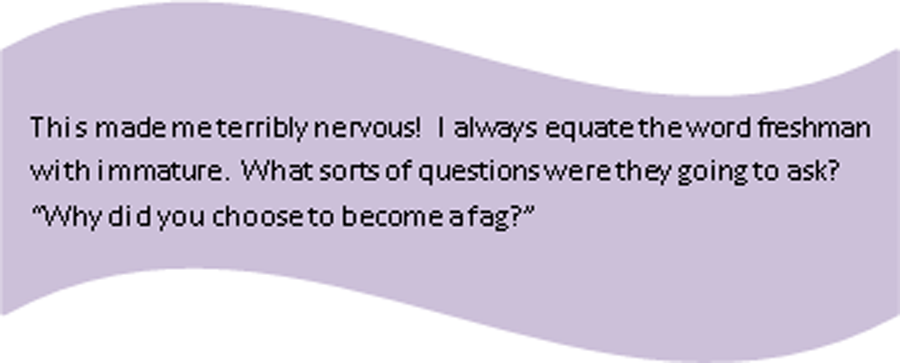
Before long it was time to head over to the building where the panel was being held. Shortly after we filed into the classroom and took seats at tables, the professor introduced us in general as members of the GLBT community and told the panelists this was a sociology 101 class, which he referred to as “Life 101.” That immediately told me the majority (if not everyone) of the students would likely be freshmen. Pete started, stating he is the graduate assistant of the GLBT Center, a graduate student on campus, and gay. And the volunteers went down the line, each introducing him- or herself to the class, including sexual orientation. I was last to introduce myself and before my turn came, I got the feeling I was at an alcoholics anonymous meeting. I said, “I’m Eric, I’m a PhD student in the department of applied statistics and research methods, and I’m gay.” I felt overwhelmed by the experience of introducing myself after I said “. . . and I’m gay.” I have never said those words to a large group of people before, or any group of people. I have only ever come out on an individual basis. I felt so liberated! I think I even got the chills!
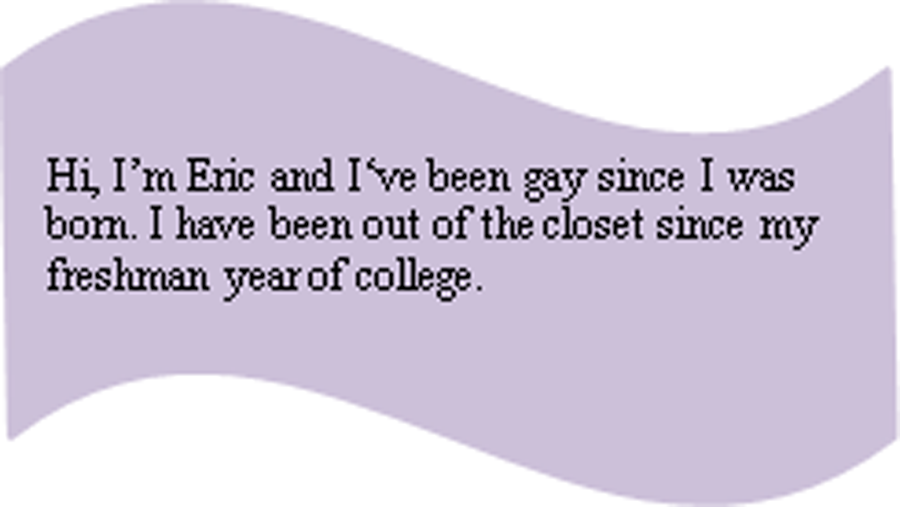
After the introductions, I was no longer nervous. Even though the spotlight was on the panel, I felt rather at ease, which didn’t make sense to me at the time. I was completely exposed at that point. I felt comfortable answering questions and even related a story of a time when I hid in the bushes on one of my nightly jogs because a Jeep-load of guys kept driving up and down the street saying “we’re going to kill you, you faggot.” Although this retelling of the story came forward in a humorous way, it was in no way funny when it happened. The humor seemed to ease the slight tension that was felt in the room.
Had Pete not been short on volunteers, I would have never even fathomed doing panels! I certainly wouldn’t have ever volunteered to speak openly about my sexuality. But it’s the best experience I’ve ever had. It was absolutely amazing to share my deepest, most personal feelings with a group of strangers. I’ve certainly never done it before, but I’ll definitely do it again! I was nervous at first, sure. But my nervous tendencies were pacified after I introduced myself. I let my guard down to the group of freshmen sociology students.
Later that day I went to see Pete in his office. I told him I enjoyed being on the panel so much I would like to volunteer again in the future. He also told me that after I left the panel, the professor asked who I was. Pete told me the professor said I added a lot of personality to the panel. Pete said I did an amazing job. I was not optimistic I’d be asked to be on another panel, because I was only asked in a moment of desperation. How untrue that was! I was asked several times during that semester, and twice I served as the panel leader.
The panelists were typically undergraduate students still in their teens. Every one of them was well spoken and thorough in answering controversial questions. I was proud of them. There’s no way I could have spoken out about such issues at their ages. What an amazing group of brave, young individuals. I simply had to know the reasons for their volunteering to be so vulnerable in front of strangers. I decided I would include a line of questioning during my next observational period.
Tell me, Philip; why do you purposefully put yourself in front of what could be a potential firing squad. Why are the panels so important to you?
Oh, I love doing panels. That’s probably one of my favorite things to do. I feel that I’ve accomplished something, that I’ve put part of myself out there, and maybe I’ve helped someone. I feel like I make more of a difference there than almost doing anything else, because that’s when people can ask me any question that they want.
But don’t you feel vulnerable and exposed to people whom you don’t even know?
Yes; I’m kind of in a sense almost baring my soul, letting them dig into whatever they want. But it’s good to show our peers who queer people really are . . . to try and dispel many of the negative connotations.
I agree with Philip. I think they’re a lot of fun and very important because it is an open forum for people to get their questions answered. Because, without knowledge, it’s the blind leading the blind. I think . . . hearing it from the horse’s mouth is always more important. . . . you get a varying degree of different opinions versus one opinion. Then you can make your own educated decision.
Having only done one panel so far, the environment seemed more comfortable than expected. I was quite impressed with the respect the students showed toward us. And it is nice to see the feedback forms include so many positive comments.
As the semester progressed, I became closer to the people of the Center and started to feel like an integral part of the awareness spreading. During many group and one-on-one conversations, I was able to glean two major barriers that were shared among the majority of my participants. These were the coming out process and disparate treatment. I inquired further into the nature of these two events that are a common occurrence for many LGBTAQ people.
Coming out of the closet is a liberating experience for many LGBTAQ individuals; it is a time to celebrate who we are, no longer allowing ourselves to be oppressed. But until we are able to openly share our sexuality, the closet is the default. When Mel White spoke at our campus, he said, “Closets are dark and dismal places where people die” (M. White, personal communication, October 22, 2008). Fortunately, all of you have told me you are out of the closet. How would you describe your sense of self pre- and postcoming out?
There’s a huge difference. I’m much more confident in myself now. Before I came out . . . I definitely wasn’t focused . . . a little less disciplined . . . . And then after I came out . . . that all kind of changed because I was forced to grow up pretty quickly. And when that happened, a certain reform of myself came about. I started to focus more and I started to realize, okay, I need to be more aware of what’s going on around me. I started to realize I’m definitely more comfortable in this skin and with that came the confidence.
My experience is similar to Kevin’s. There was a time when I kept my sexuality a secret even though I was already out of the closet. I was at band camp and roomed with a straight female. When no one knew that I was gay, I felt so awkward. I didn’t like it at all. I think this illustrates that a gay or lesbian individual is never done coming out. It is not a one-time event; it is a process. It’s impossible to come out just once—I’m always deciding on a regular basis, given a certain setting and surrounding circumstances, whether or not to come out.

Have there been instances where any of you regretted your decision to come out to someone?
Yes! When I was still in high school, several people I thought were good friends would send me Bible verses over MySpace about why being gay is WRONG. Sometimes I wish I hadn’t been so open with them. It’s because of comments like that that I feel so uncomfortable in churches. Getting a message from someone I considered a friend really hurt . . . it still does.
I can’t think of a time when I wished I hadn’t come out to someone. And to comment on the religion issue Sandra brought up, I’m pagan. I try to surround myself with those sorts of people because you define your own religion . . . you can pick and choose from religions. A lot of people can’t understand you can put Christianity into it . . . . I definitely lean way away from Christianity . . . . Because of my mother’s open-mindedness toward religion, I never suffered through religion. The people I hung around with never turned on me once I came out. I understand my case isn’t typical . . . I was lucky.
I still struggle with religious issues. My father is Catholic and believes I am living a life of sin. Though he didn’t raise me, I still visit him a lot and would really like to have his approval. We attend church together on a regular basis. My religious beliefs don’t condemn me to hell, but they say I am wrong to be gay. I still struggle. So, I didn’t come out . . . . I acted upon it, but I didn’t accept my sexuality until I was 18. My dad has not accepted me yet. I am apprehensive of the future of my relationship with my father. I’m not looking forward to the “are you sure?” and the “have you tried this?” line of questioning. I’m pretty sure I’m going to get the “there’s these camps you can go to” or the “there’s this psychologist . . .” I know we’re going to have “the talks” sooner or later.
Even though it’s obvious I am gay . . . well, at least I think it is . . . I mean, just listen to my voice, or look at the way I walk. Not to perpetuate stereotypes or anything. But there are still people who are oblivious to reality and I find myself having to agree with Sandra that coming out is a process. Not to change the subject, but after we recieved the evaluations from our last panel from a sociology of minorities class, someone wrote he will be staying in the closet for many more years. Why didn’t he come up and talk to us after class. I wish I could have just hugged him, telling him everything would be alright.
This instance has stuck with me for several years now. Soon after this conversation with Jay and the others, Jay killed himself. I wish I could have given him a hug and told him everything would be alright. The irony is overwhelming.
The most poignant pieces of the conversation are best represented by the following transcription poem:
Coming Out
(An excerpt, Teman, (2011), in press) 13
My mom and I were very close. She cried . . . She seemed to pull away. I’m not shunned from the family … Dad and I spent four years Doing nothing but fighting. … Oh, my God! What have I done to myself? I tried to have a crush on a girl. … It didn’t really seem abnormal. But it didn’t really seem normal either. … Oh, okay, so . . . yeah . . . I just like guys. I kind of want to flaunt it to the world.
Part of my fear in coming out on a daily basis during the panels is fear for my safety. I haven’t ever received a threat of physical violence yet, but I do worry at the possibility. I mean, just last summer, Angie Zapata (see Lahman, 2011), a young transgender female was beaten to death with a fire extinguisher right here in our community. So far it hasn’t been an issue on campus, but it is nonetheless a fear in the minds of many of us.
And not just physical violence, but verbal violence. That is an issue on campus. We have had conversations before: it is something that is feared and endured continuously by us. When I was in high school, I cut off most of my hair and my clothes weren’t exactly formfitting. I had “DYKE!” yelled at me and people would all-too-often inquire as to whether I was a boy or a girl! They also attempted to lock me in the band room. I thought I had left that sort of sophomoric behavior behind, but I get the same variety of comments now that I’m in college.
I have witnessed those comments. While I was already considered an ally in the gay, lesbian, bisexual, transgender and ally (GLBTA) community in high school, I was not very active until one day in my freshman year of college when I was walking with a gay friend. Someone came up to him and said, “You’re going to hell, you faggot!” This upset me deeply. I don’t understand how people can have so much hate. It was at this time when I decided to show that Christians are loving and accepting of everyone, no matter who they are. After that experience, I have become a very active ally.
Not too many are daring enough to be disrespectful to us during panels, but there was that one time when one young male asked whether or not any of us had ever thought about converting back. Interestingly, this was a sociology of minorities class. At first, I was not sure I heard him correctly, but I clearly heard the word back. Syntactically, this implied he was assuming that gay individuals were once straight individuals who converted their sexuality or that gay individuals need to be changed or fixed. Jay later told me that he read the student’s evaluation form and it was full of negative comments, condemning us to hell.

That’s the sort of rhetoric that leads to the high suicide rate among queer youth. A big part of the Center is to stock literature on suicide in the gay community. It sickens me.
I have heard personal anecdotes of people committing suicide because of being gay or because they were having difficulty coming out. I have also read news stories on the same issue, but I have never personally known anyone who has committed suicide for that reason . . . until now.
On Thursday, January 8, 2009, around 6:00 p.m., I opened my email and found the following message.
Unfortunately, you have to be included in this information on the passing of Jay, as the GLBTA Resource Office Email list is the only way I know how to reach out. This is in no way intended to be an official testament or tribute to Jay, as no words from me can do justice to the person who he was. Details on his funeral . . . .
My first reaction was, do I know this person? I knew a Jay, but I didn’t know his last name. I immediately emailed Pete asking what happened. I never got a response. I also began searching through archived email for Jay’s last name. If it was who I suspected, the awful feeling in the pit of my stomach probably wouldn’t go away any time soon. Eventually, I was able to piece together information on Jay. It was he who I had so desperately hoped it would not be. But how did he die? Maybe I read the email too quickly—maybe there is a clue there on what happened. There was a link to The Trevor Helpline included in the email along with a statement to seek counseling at the campus counseling center if necessary. I had no idea what The Trevor Helpline 14 was, so I clicked on it and it was a suicide help site. Dear God! Jay committed suicide! But, why? Little did I know, I would never find out.
Everyone in the LGBTAQ community seemed to assume Jay’s death was linked to his sexual orientation, but this was difficult to believe. He was always by far the most outspoken person on the panels, having something to say about all of the issues that came up, from religion, to coming out, to the nature versus nurture argument. In fact, he was the one who was affected by the student who said he would be staying in the closet for many years to come. Jay wanted the opportunity to tell that person that it would be all right. Jay seemed too comfortable with who he was to end his life. What went wrong?
Once time passed and the grieving period subsided, I began to inquire into the feelings of those who knew Jay.
How did you all react once you found out about Jay’s suicide?
I was shocked. I got a phone call from a friend who was asking if I knew any information. They said we saw this on Facebook . . . . . . . I started calling around basically saying . . . hey . . . does anybody know what’s going on . . .? . . . I tried calling the victim, because I had his phone number and the call didn’t go through. Then I called my friend back . . . and he goes . . . it’s been confirmed . . . . And I was upset but it didn’t sink in . . . um . . I was just kind of like . . . I’m dreaming . . . I’m going to wake up sort-of-thing . . . whatever . . . and did that all the way up to the funeral. And the moment that it finally hit me was they showed a picture . . . um . . . from his 21st birthday . . . and I had my arm wrapped around him and he was wearing his crown and all that stuff. Jay’s death was my first time dealing with the suicide of a close friend. This was the first time that I’ve actually had any serious interaction . . . any real friendship with somebody who’s done that. He and I almost dated at one point, but for some reason . . . we didn’t quite mesh right in that regard, so it didn’t work out. It’s been two months now, and, you know . . . I’m still pissed at him. I’m still mad at him because . . . we all left the doors open and he shut them all. . . . He knew that any of us were there . . . at any given time . . . . . . . obviously he went through something really bad because it was so out-of-the-blue. Nobody saw it coming . . .
I was so confused—I had no idea why he would choose to do something like that because he was always such a happy person. Like, he is the exact opposite of someone I would think as a suicide case. When I think of someone who commits suicide, I think of someone who has no friends, who sits at home alone and cries. Obviously there was something else going on.
I sat on panels with Jay, but I never knew him as a friend. In all honesty, it’s hard for me to look at a suicide as not being incredibly selfish. I have been on a panel with him once or twice and he seemed incredibly happy. So I was really surprised.
I did not know Jay for very long, but I considered him a friend. We chatted on several occasions, volunteered at special events together, and we were panelists together. I miss his smile. He always made me laugh.
The feelings expressed by Jay’s suicide are best represented in a poem.
Now, He’s Not Alive 15
(an excerpt, Teman, 2010)
This isn’t real. I’m only dreaming . . . I did that all the way up to the funeral. They showed a photo . . . I had my arm wrapped around him. That’s when it hit me . . . . There were no signs. Yesterday, he was fine. Great . . . we’ve lost another one. I am so confused.
Curtain
My first time meeting the students of the LGBTAQ Center was an uncomfortable one. At the time I wasn’t sure why. I was gay, too. Why wouldn’t they openly welcome me? Was it because I was older? Was it because they didn’t know me? Now I believe it is because I introduced myself as a researcher. I later learned that many students research the campus LGBTAQ population for various class projects, and they just assumed I was another one of those people—one-visit researchers. However, when I kept coming and poked my nose around in every aspect of the Center, everyone started warming up to me and realized I wasn’t just there for a grade for some class.
When I began this study I doubted I had anything in common with participants except that I, too, was gay. I felt age would be a major barrier in forging any friendships. I was wrong. I became friends with both Pete and Kevin. I had some extraordinary conversations with many of the individuals from the Center, separate from the interviews. I learned about each of these individual’s lives, such as future plans and aspirations—things that only friends would know. I will remember these individuals always.
Eulogy
The devastating event of a suicide occurred during the course of the study. As new students arrive and old ones leave, the effects of this tragedy will not be everlasting in the campus community, but will live in the minds of we who were here.
Footnotes
The author(s) declared no potential conflicts of interest with respect to the research, authorship, and/or publication of this article.
The author(s) received no financial support for the research, authorship, and/or publication of this article.