







Abstract
As part of an advanced doctoral course on representing qualitative research, the authors used collage to represent either who they were as researcher or the research they were conducting. The authors, comprised of the course professor and seven doctoral students, read about collage as inquiry and research representation and then participated reflexively in a course lecture on the background of collage, a collage creation activity, a gallery walk, written and oral reflection on each other’s collages, a research poster presentation at a campus research event, and a final reflection of the entire process. As the process unfolded the authors represented the experience in the form of a collective collage poem, and a methodological and pedagogical article. Elements of this article include a review of collage as an art and research inquiry form, an overview of the pedagogical experiences, and the authors’ experiences shared in the form of brief vignettes and collage images.
Keywords
A Collective Collage Poem
welcome tables overflow cast off magazines create a visual poetic representation pictures on a page a preposterous activity hearts pace what will unravel thoughts and emotions comingle calm productive buzz a quilting bee snip tear turn page after page after page observe colors images textures reflect distill evaluate represent order the scattered pieces periods of gentle conversation including congratulatory wishes for one who passed proposal stories emerge in form and color piece-by-piece surpassing anything created with pencil and pad salient eye-catching meaningful words images data flawed beautiful a symbol searched a lost pleasure a satisfying experience research falls out of colorful pages onto paper
Directions for the Class Activity
Collage is like a hall of mirrors. Every direction you look, you see something different and visually stimulating. (Nita Leland, 2011)
The birth of collage is widely traced to the early 1900s as a formal term, movement, and concentrated area in art history. At that time, collage as an artistic medium was evidenced in the thoughts and creations of Picasso and Braque (Vaughan, 2005; Wallach, 2012) who sought to invoke feelings, which would subvert the prevailing political and social norms of their day. In French, “collage” literally means to glue or stick, and these artists did just that, pasting newsprint, burlap, and pieces of chair cane to canvas, and then painting or drawing over the top. However, researchers have correctly pointed out that collage has existed for millennia in the practice of creating visual media by pulling together disparate elements and using them outside of their intended purpose to convey meaning not otherwise attainable (Davis & Butler-Kisber, 1999; Schapiro & Meyer, 1977). Schapiro and Meyer (1977) contended that women in particular have been amassing pieces, leftovers, scraps, and creating a new whole for thousands of years. They termed this feminist practice “femmage” to encompass decoupage, collage, photomontage, and assemblage.
Collage research, appropriated from the arts, continues to gain interest in the qualitative research community (Butler-Kisber, 2008; Butler-Kisber & Poldma, 2010; Leavy, 2008; Margolin, 2014; Vaughan, 2005). Research areas as diverse as early childhood education (Clark, 2017), feminism (Särmä, 2016; Schapiro & Meyer, 1977), and methodology (Kincheloe, 2006) have employed collage as a means of inquiry or representation, though limited attention has been given to collage as a means of data analysis.
Collage Research
An advanced doctoral course on representing qualitative research met for three hours at a time, once a week, over the course of a semester. Seven students from various programs enrolled. As part of the course, students were each asked to create a collage during class using the following guidance:
Consider the following quote from Butler-Kisber (2010, p. x): “theorizing write-up of ideas about codes and their relationships as they strike. . . the analyst’s momentary ideation based on data. . . with conceptual elaboration” (as cited in Glaser, 1978), is an important analytic tool used by qualitative researchers at all stages of the research process.
Butler-Kisber challenges us to “memo” with collage materials. Choose some aspect of the research you have been representing for this course and create a collage representation of it.
The room was quiet as students read the directions that Maria, the instructor, had projected onto the whiteboard. Maria watched for a moment as her students, tentative at first, and then with increasing confidence, milled about the classroom, selected a canvas, picked up scissors and glue, and leafed through the piles of magazines scattered on tables. Once they began to work, she selected an 11" × 17" sheet of art paper as her own canvas and joined the activity. The energy in the room fell into a collegial drone as all course members explored glossy pages of colorful images, ripping, tearing, dog-earing pages, and making piles of material.
Maria had allotted 45 minutes for this activity and they passed quickly. At that point, no one had a finished collage, and in fact, most students had not even begun gluing, but were still snipping colors, words, images, and organizing them in small piles. To ensure that there was sufficient time for all of the planned activities, Maria asked the students to continue to work as she delivered a PowerPoint lecture on collage and alternative representation in qualitative research.
The final hour of the course was typically set aside for students to meet in writing groups to comment on each other’s representations. Prior to this session, writing groups had read and commented on one another’s traditional manuscripts, so all course members were familiar with the data sets being used for the collage activity. This particular evening, the collages were discussed within that context, which brought another layer of knowing to the representations.
We determined as a class to hold a “gallery walk” (Facing History and Ourselves, n.d.) the following week, so that we could see and comment on all collages, not only those from our writers’ groups. Holding the gallery walk at a later date also allowed for Ivan, who was absent for the in-class collage session, to participate.
The Gallery Walk
The gallery walk took place two weeks after the collages were created, to give time for Ivan’s collage to be included. All course members displayed the collage they created on the walls of our classroom. The harshly lit, normally drab, and grubby classroom space, complete with dead moths in dusty corners, was temporarily tolerable due to the camaraderie of the group as they easily shared knowledge through art. Kim reflected on the gallery walk in her writing, The variation was astounding and the forms that were created spoke as loudly about the projects as the researchers could have. Those magazines had spoken to each of us in such different ways, and yet we had all heard exactly what we needed to hear while we listened. This activity was simple and yet quite powerful. Those two elements brought together a great teaching opportunity that led to deep reflection and learning.
Although the idea of a gallery walk has been around for some time in teaching pedagogy, we wanted to highlight it here as it was a major way learning and reflexivity were extended.
Collage Creators: A Quilting Bee
In the fine arts, collage has been described as the essential innovation of the 20th century, a means whereby established canons of representation may be critiqued, contradicted, or even subverted. (Davis & Butler-Kisber, 1999)
Each course member was asked to consider the process of creating their collage. What follow are each participant’s reflection on the process, a description of the representation in the context of their data set, and an image of their final collage.
Maria, Course Instructor
I created the course from a need I perceived in my own doctoral training. The course is offered every two years and this was my fifth time teaching it. I recall vividly my reluctance to have the course covered by someone else when I was on maternity leave. The experience to teach it is one I cherish. The course is always a much appreciated opportunity for me to reflect on how far the field of qualitative research has developed and how much this is or is not reflected in my own representations of research. As an early childhood teacher and researcher, now a qualitative methodology professor, I chose collage as one of the in-course representation activities because I find it to be an accessible and forgiving medium. Still, I recognized trepidation in some students, which is not part of the safe space I intend to create in class; however, a certain amount of nervousness may be a part of learning. Fortunately, this class was full of creative students who were flexible and willing to take a chance.
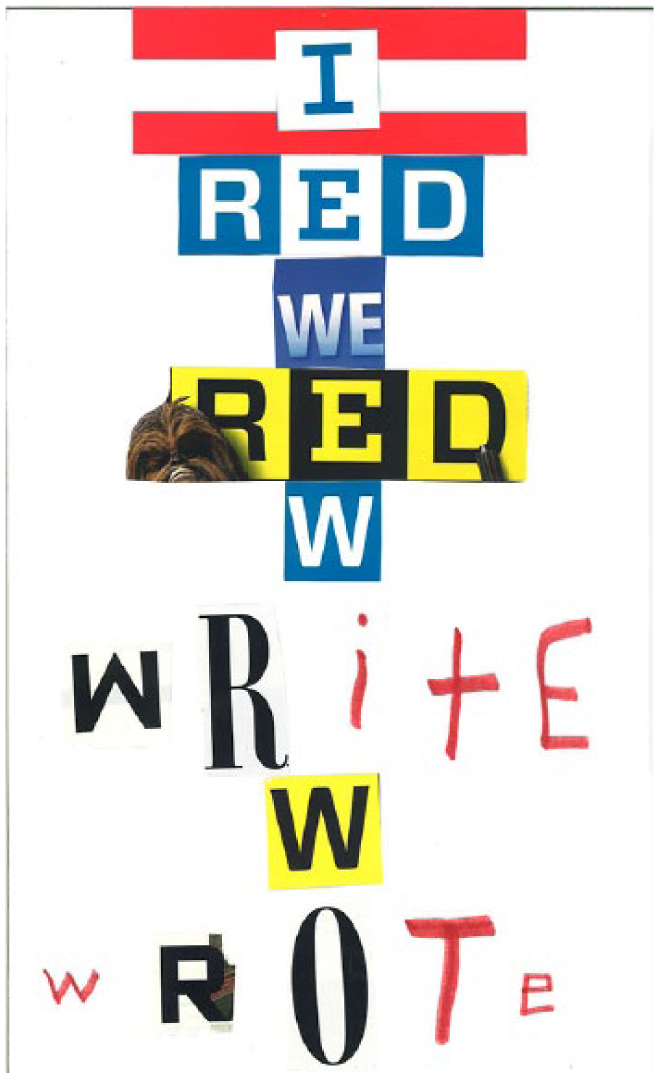
The piece that was difficult for me was the complex multitasking that always is part of instruction—switching between lecturing on collage, creating my own collage, and supporting others’ collage experiences. Through my collage, I attempted to illustrate an aspect of the course where I teach one must read and read to write well. The intensity of the multitasking is illustrated in my unfinished collage, where I marked in the letters I was searching for in time for the gallery walk (See Figure 1).
Instructor intentions: Maria Lahman.
Christina, Educational Studies
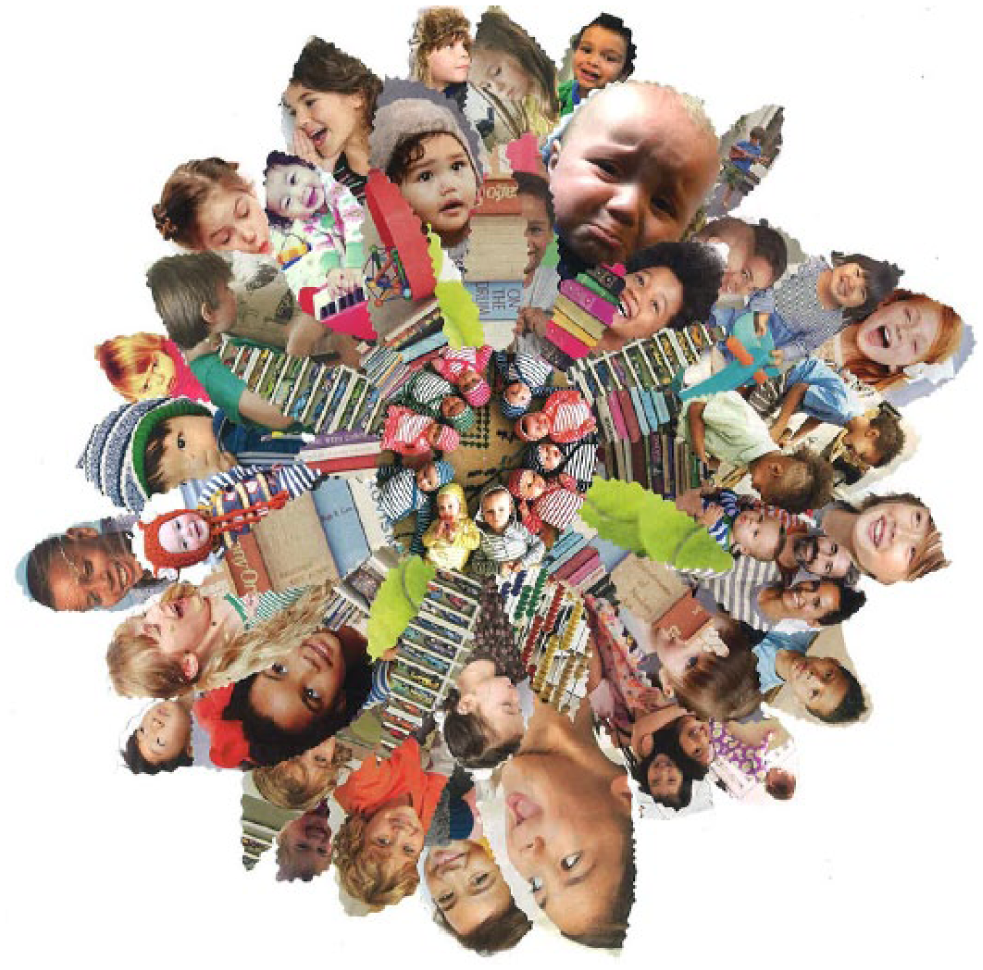
My data set came from an educational ethnography about the culture of a children’s area in a public library. As I had already represented the data set with a multitude of words, I decided to create a wordless, visual representation for the collage assignment (See figure 2). I thought a blossom with many petals would be an appropriate symbol for the unfolding growth of the children in the space. I searched magazines for images of children, families, books, and toys, and made a pile for later cutting. Next, I organized the images by size and cut them accordingly into petals using scissors with a fancy edge. I discarded the images of families because they did not fit the petal shape well. I used an image of babies in a circle for the flower’s center and arranged the paper petals from small to large around it by gluing down just the base of the petals. This created movement in the piece much like that of an actual blossom. I then cut the white cardstock base so it would not be visible beyond the blossom, freeing the piece from its rectangular foundation.
Culture in the children’s area of a public library: Christina Taylor.
Although I do not think the collage process caused me to have any revelations about the data, it was nonetheless a satisfying experience. The in-class assignment moved the room’s energy to the calm, thoughtful, productive buzz of a quilting bee. There were periods of snipping and tearing while all of us were silent, and periods of gentle conversation, including congratulatory wishes for one student who had passed her proposal defense. We chatted about class content and then worked through a lecture with quiet attention to both tasks at hand. The work challenged us to think about our data with different parts of our brains, and craft with our hands, an often-lost pleasure during academic journeys. Was it “real” research? Who would know? My hunch is “yes,” but I would be hard pressed to defend the position. It was for certain a delightful two hours and a half well spent, if only for the comment, “I haven’t felt THIS relaxed in a LONG time,” to which we all chuckled knowingly.
Lindsay, Educational Psychology
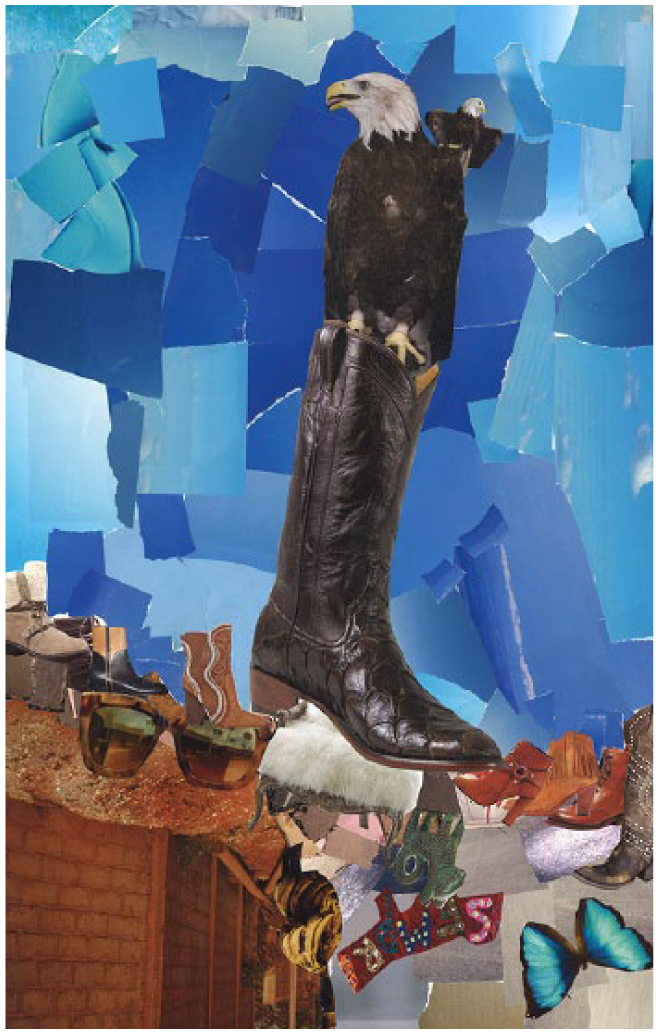
Creating this collage was a wonderfully random activity. I had two banks of information from which to draw a data set from my research on international service learning (ISL) in Peru, and a pile of magazines with their own data and information. I selected themes from my research and combined them with images, colors, and textures from the magazines. I then rearranged everything within a new context, constructed with glue and scissors. As I worked, I recognized that any number of variables would have changed the final product: a different selection of magazines, the size of paper I selected as my canvas, or a variation in the time constraints—all of these factors determined which research themes I selected, and how they ended up being represented in the final product (See Figure 3).
Wonderfully random: Lindsay Beddes.
As I flipped through the magazines to familiarize myself with my medium, I began tearing images at random. I sorted by color, texture, and image. As I worked, I wondered, “How on earth am I supposed to use these pages, replete with symbols of privilege, to represent the themes of my research?” Within 10 minutes, I ran across a picture of a cowboy boot, and then a page of fall fashion boots, “must-haves for a pre-winter wardrobe.” At that point, a line from a research poem I had written from the same data set came to mind, and became the guiding theme for my collage: But When you boil it down we really are the same. And with a little luck, and with a little hard work they could make something of themselves. Someone should tell them to pick themselves up by their bootstraps. I would do it But I don’t speak their language.
The collage began to take shape—first in my mind and then on the page. Expensive, opulent, impractical boots became the dividing line between the haves and the have-nots. A bald eagle (with another bald eagle on his shoulder) perched on the largest boot. These images are surrounded by blue sky, representing wide-open space and unlimited capacity for realizing the American Dream. At the bottom of the piece, and intentionally arranged upside down, are images representing Peru, as viewed from the perspective of the participants in my research.
It is important to note that this representation is a negative outcome that can result from poorly implemented programs. In ISL, students experience cognitive dissonance between their understanding of a social system (such as third-world poverty and privilege) and their actual experience within that system. If such dissonance is not properly and carefully addressed, the students are likely to reconfirm previously held notions of ethnocentrism.
Ivan, Higher Education and Student Affairs Leadership
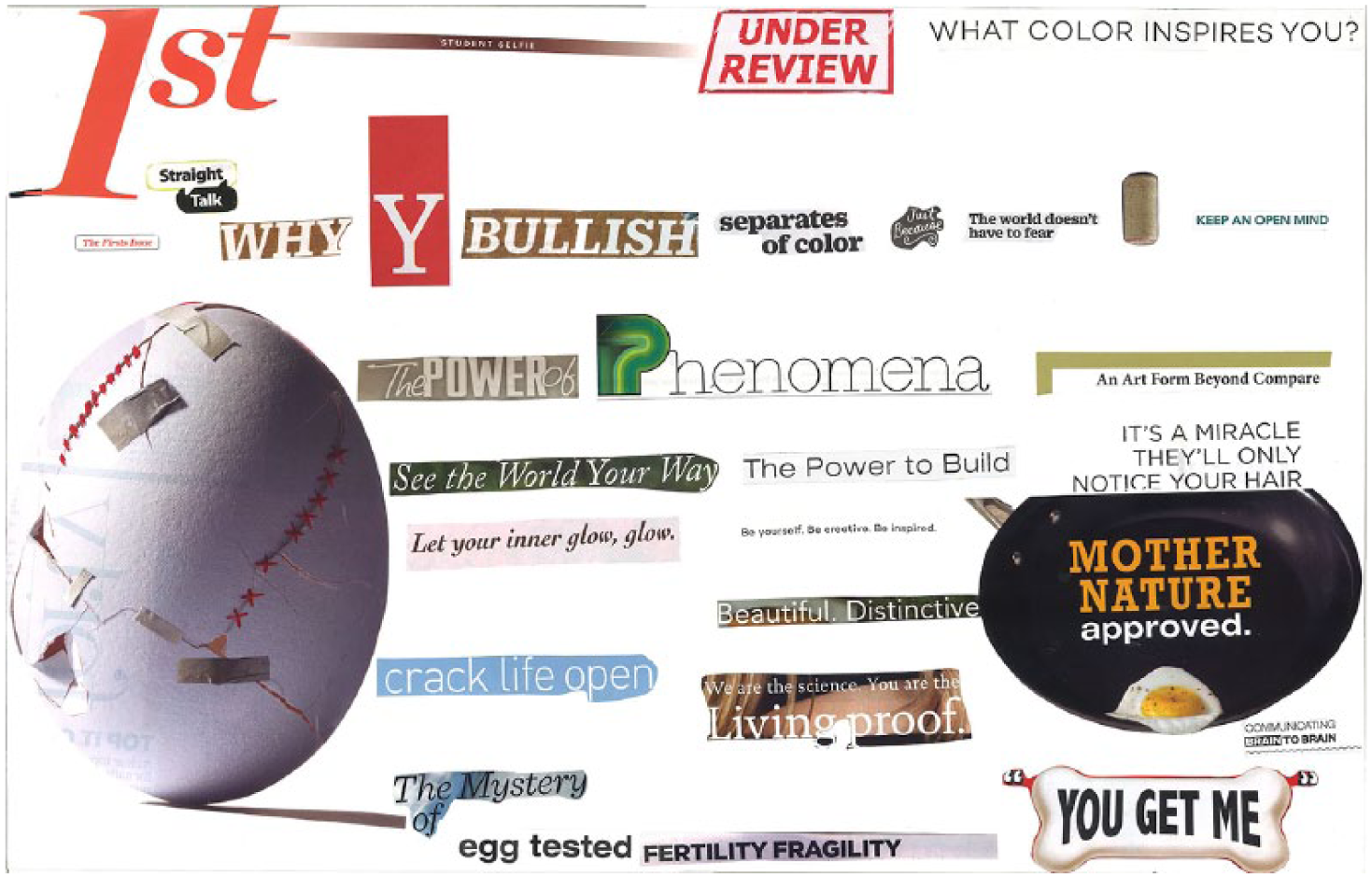
I was unable to attend class the night the collages were created. To participate, I created my collage at home using the same directions and collage materials provided by Maria before viewing any of my other classmates’ creations (See Figure 4).
Absent collage: Ivan Blount.
My heart paced and I felt anxious about what I would unravel. I did not have a process set in stone but I went with my feelings. I allowed the pages of the magazines to speak to me through pictures, phrases, and indicators of life. Ironically, the picture in my head was not clear and the words I envisioned as the pieces collected were organized in reverse order. I went through each magazine, one by one, and then placed them down and cut the pieces out. Ordering the scattered pieces was weird, considering I had never done it before. The final product was composed over the course of two and a half hours. I have never created a piece of work/reflective research in this format. The process was exciting and unnerving, considering I did not have any control over my resources (i.e., magazines). As a result, I went through each magazine and found at least one tidbit instrumental to the overall product created.
Kim, Educational Psychology
The tables were overflowing with cast-off magazines that welcomed us as we entered our qualitative writing and representation course. The regular household magazines were varied, but I began to doubt that I could find any that portrayed my study. And so it began, my thoughts predicting a preposterous activity that would become a search in vain. What actually happened was a great lesson in grounded theory supported by visualization, a succinct way to visually display an alternative representation of a data set, and a great lesson in differentiation for us graduate students (See Figure 5).
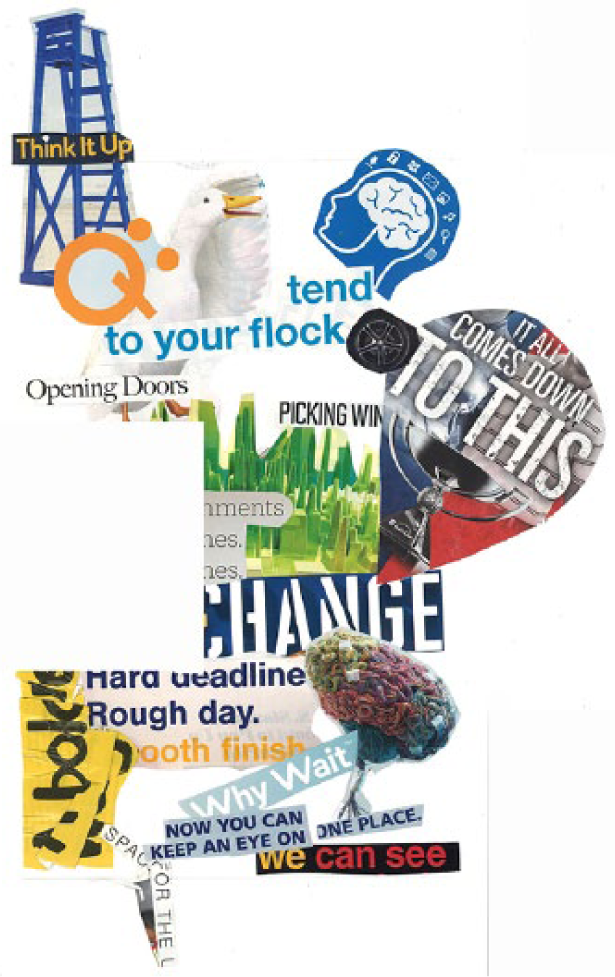
A preposterous activity? Kim Bontempo.
In a few ways, I was like the boy Daniel in The Karate Kid, who, after the urgings of his instructor, Mr. Miagi, put wax on cars and paint on fences; performing the same task over and over only to discover that this focus and repetition helped him instill the movements and thoughts it would take to win at karate. I began to turn page, after page, after page of the magazines, just observing. I concentrated on images and the intended semiotics of the images as they might relate to my project. I began to get into a reflective zone and to distill my research intentions. Each time I came to a page that caught my eye, I had to analyze, synthesize, and evaluate how it could represent my research project. In a way, it became me coding my research. Within a short time, the format of this genre forced me to categorize my own project differently than I had before. With that simple nuance, I noticed I had begun to enjoy this new paradigm and my research was almost falling out of the colorful pages and onto the paper. Soon the colors and images made to sell gasoline, cars, and cell phones were representing my thoughts. It was grounded theory come to life.
My trust for my instructor, who had much to teach, allowed me to trust the journey; actually, this is often what research is like. There is a certain level of trust that is needed to produce good research. Entering into a project with an open mind and the willingness to simply observe, hones a researcher’s skills to see, rather than to navigate and influence what is taking place.
Cyrus, Higher Education Student Affairs Leadership
Representing research in alternative formats is a difficult challenge. Treading the line between academically acceptable works while interrogating the boundaries of traditional research has been a worthwhile endeavor. My study examined student perceptions of sustainability and how students perceive universities respond to sustainability needs and challenges. Examining how students navigate through the abstractness of sustainability was interesting because no single all-encompassing definition of sustainability emerged from survey responses of 437 students. Further data triangulation through focus groups and photo journaling also confirmed the multiple meaning behind how students navigate through the abstractness of the concept.
But I wanted to stay true to the students’ experience showcasing the optimism students had with regard to sustainability while capturing the sentiment of an unreceptive university climate. Students perceived the university climate as unresponsive and slow toward pushes for sustainability. Students felt silenced or ignored when it came to enacting suitable change on a college campus. Somehow, a traditional journal manuscript could not exactly capture this significant aspect of the research finding.
When editing through my traditional journal manuscript, I printed out a copy (something I hate doing because of sustainability mind-set, but conducive to my editing process) and with a large black marker began excising tracts of sentences. The more editing I did, I began to notice how the nonredacted sentences visually stood out more. I am also an avid reader of travel magazines and enjoyed reading them for prose and those magazines made even the most unknown place sound like desirable destination. There was one article featuring the polar region of Norway and how it is attracting eco-tourists. When I began blacking out large tracts of the article, it dawned on me that something special was emerging (See Figure 6).
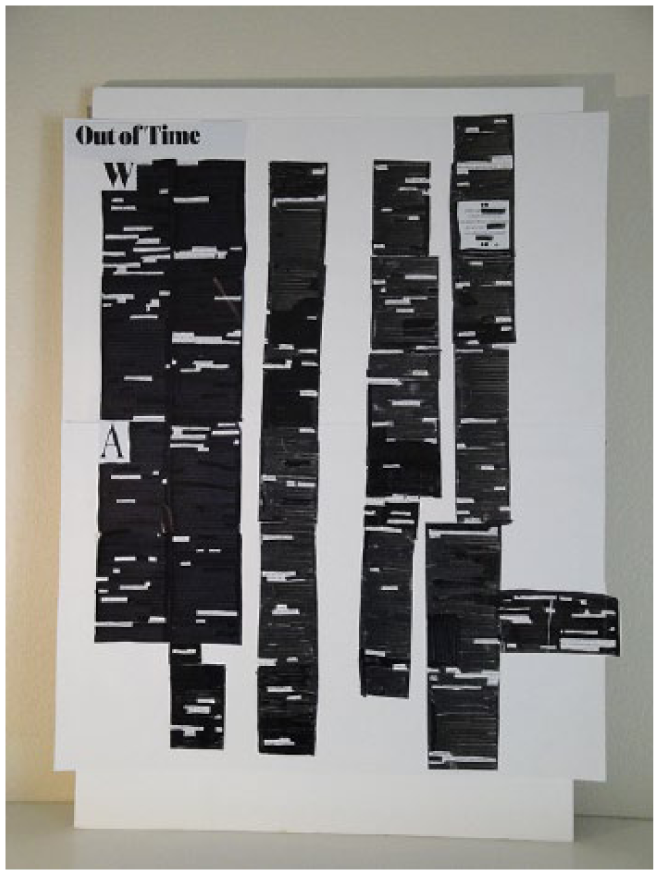
Voided collage: Cyrus Fernandez.
I ended up blacking whole sentences, paragraphs, and columns of the travel magazine and only stopping on words, which captured the essence of the article. I changed my pace and began incorporating verbs, adjectives, and fragments of a sentence, which I also found interesting. Rereading the article, I was fascinated by which words remained and its poetic flow. The large swaths of blacked out and redacted travel article felt lost and silenced. It felt much of the soul, the character and personality of the article was extinguished. It was visually jarring to see the stripped-down article, yet, got its point across with its various breaks in grammar. It was then I realized I had a poem, a voided poem, which could represent my manuscript.
The voided poem was effective at representing my students’ experience with navigating the abstractness of sustainability while reflecting the silencing and frustration they felt toward an unreceptive university climate. I adhered toward a key concept of sustainability and repurposed something already created for one use (a travel article), began redacting large tracts stopping at words and phrases that stood out. The “voided” sections represent the perceived silencing and discouragement around the importance of sustainability in a university setting. The preserved words illuminate the possible resilience sustainability can bring to a student culture. Altogether, the “voided poem” purposefully fumbles through a journey of finding the meaning to sustainability, hence the grammatical errors and nonsensical syntax. The end result was piloting a new way of representing research beyond the confines of a traditional journal manuscript, which maintained more fidelity to the participant’s experience.
It is of note that Cyrus’s display and professional talk at our end of semester research evening won a graduate school research award. This evening highlights research of all methodologies and across all the social sciences, and this was the first time an alternative representation was awarded. Cyrus’s creation was a much-appreciated introduction to this form for Maria who has since gone on to use this format in poetry and collage, referencing it as black out poetry (Kleon, 2014; Ladenheim, 2014; Lahman, Teman, & Richard, 2017) and collage poetry (Lahman et al., 2017) and suggesting critical researchers utilize the form while critiquing the term black out.
Barry, Counseling Psychology
This collage is a visual representation of my autoethnographic experience counseling with transgender clients. I started my therapeutic work as a cisgender composite of feminine ideals gleaned from Southern interpretations of poise and filtered through a lifetime delving popular culture for inspiration. As a graduate student, I was (and in many ways continue to be) naïve to my privilege and lacked the depth of understanding necessary to listen to my clients as they wanted me to. I am grateful for patience, for learning, and for opportunities to confront my biases to grow, which I hoped the collage could illustrate in some ways (See Figure 7).
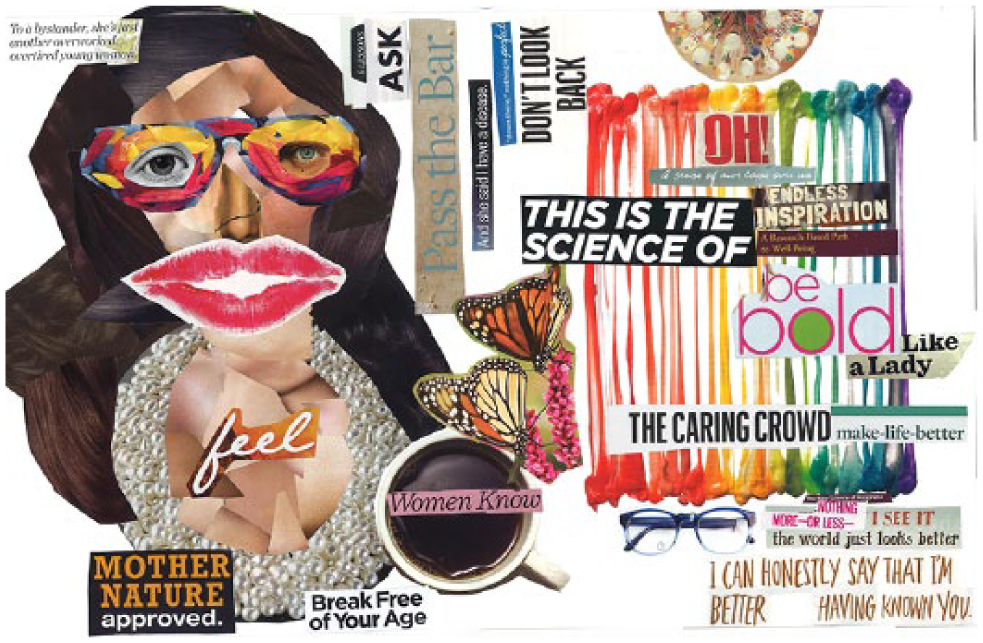
Autoethnography of counseling transgender clients: Barry Motter.
I thoroughly enjoyed this creative outlet in the class time. It reminded me in some ways of how more traditional qualitative analysis unfolds. The researcher is surrounded with so much data, they can hardly make heads nor tails of it. Piece by piece, salient, eye-catching, or somehow meaningful words and images emerge from the data, and are scattered around like so many phrases and colored scraps. Yet, somehow, a story emerges that maybe was not what the researcher envisioned. It is flawed and beautiful in its own right and conveys a meaning or a message that is more than the individual snippets. It comes together with intention, and in some ways it is the only story that can be told with that selected menagerie.
When I started my collage, I was intimately familiar with my data, particularly as it was my own experience: thoughts and emotions comingled together, insights and shortcomings alike. However, I had no idea how to create a visual or poetic representation for this collective consciousness of mine. Yet, somehow, the messages came through in form and color, Frankenstein-ed prose that far surpasses anything I could have created with a pencil and pad. I felt encouraged to reach into myself, relax without overthinking, and create something wholly mine—especially as I used autoethnographic data as my source material.
Josh, Sport Exercise Science
We close with Josh because his reflection is about a version of collage that he had initiated with students he coached (See Figure 8). Maria asked him to write about this experience so others might see a way to adapt and utilize this experience. Josh wrote the following.
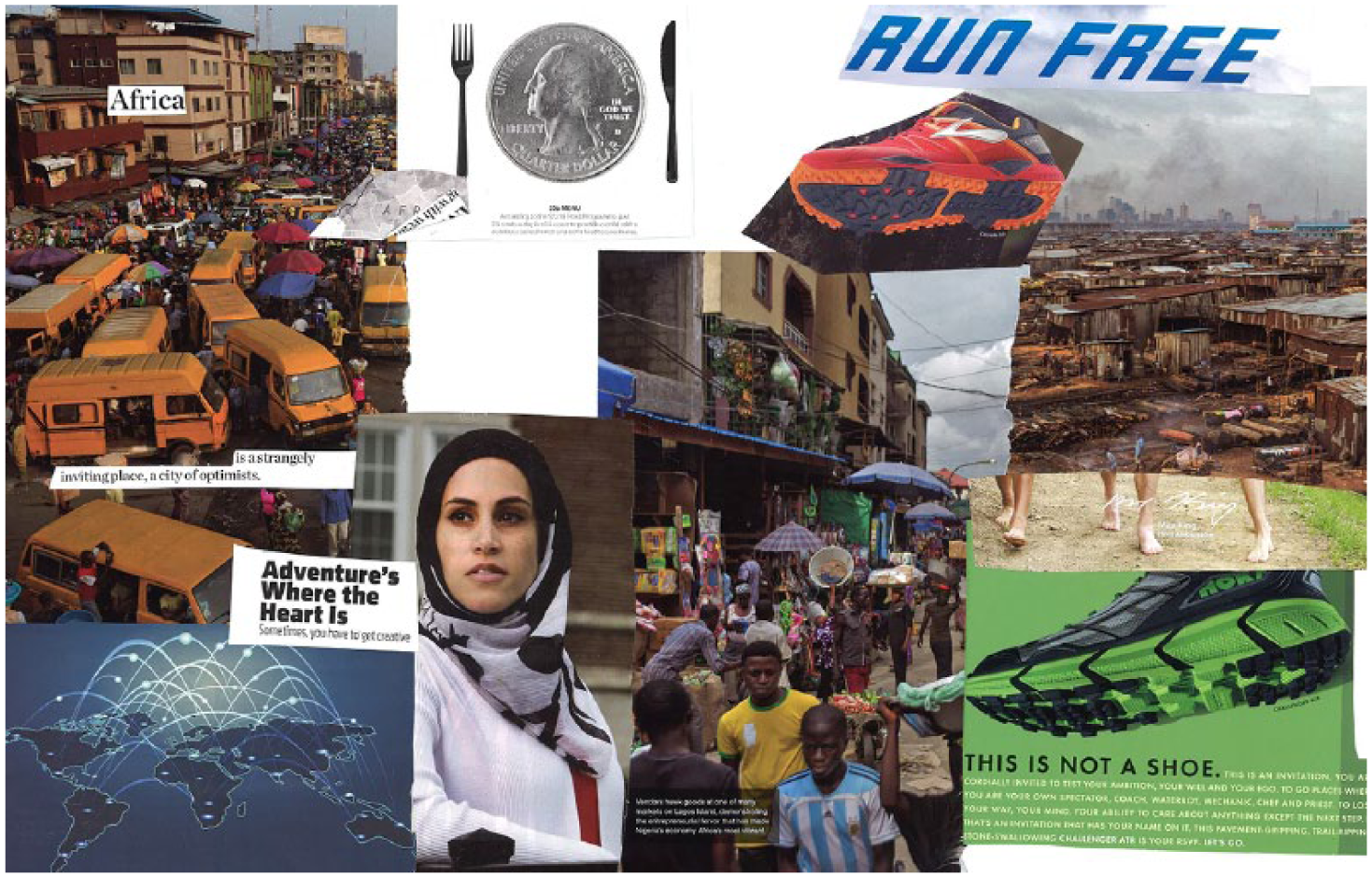
A running coach: Josh Coon.
When I became a head high school cross-country coach, I was having trouble getting athletes to drink enough water. They would come to practice weak, with headaches, and inevitably would always answer No to the question about water consumption. At my wits end, I decided we needed to find a way to get them to carry a bottle every day. I decided we would have “arts and crafts day” at practice. It seemed like a low risk, high reward idea. If it backfired, they would all give me a hard time for a while and when they did, we would talk about water. If it did not and they carried bottles around all the time, then perfect!
We had a short practice and then went inside the school and I had hundreds of magazines and clean bottles. I told them what to do: (a) decorate it and (b) bring it to practice EVERY day. That is it.
The runners dove in and had a ball. Each one took a long time to personalize it and make it intricate. They found inspirational quotes, pictures of their favorite athletes, scenic pictures, you name it—they found it. They cut and pasted to create cool looking words, measured down to the centimeter how it would all fit—and built some really cool bottles.
What was cool about it was how deep and personal the runners made the experience. You could see each runner’s persona clearly in how they did their bottle. They were so fascinating. I could see the competitiveness in one runner, and the depth of love for the team in another, I never intended for it to be so deep, I just wanted them to get hydrated! But, they found it as a powerful way to represent themselves—which makes perfect sense in a developmental sense. Identity is such a huge part of high school, the development of and the acknowledgment of.
We never had a water bottle problem at practice again. I would see their bottles whenever I would be at school, they carried them everywhere. I continued the bottle practice and started integrating it into our preseason camp. It became a normal activity and they looked forward to it every year.
Josh tried the same thing with college cross-country runners and reported similar outcomes as follows.
The college students took their time, were intricate, and built some really cool water bottles. They carried them around, not as much as the high school students, but I’d say 60% of the bottles survived the season. I had nothing but good feedback on them. Collage water bottles worked. Chalk that up to a coaching victory!
Metaphor and Collage
Qualitative researchers and artists alike capture and convey meaning through metaphor to create and communicate ideas, which may be difficult to convey through literal description alone. This use of metaphor is an avenue for authors and artists to distill and share vast and complicated experiences in ways that are knowable.
Course members used various metaphors to describe the collage process. Ivan “allowed the pages [of the magazines] to speak” to him, implying a co-creative relationship. Barry compared the process to Mary Shelly’s Frankenstein, as she selected static images and stitched them together to create new life. Christy likened the collective energy of the experience to the “productive buzz of a quilting bee,” where members create stories with fabric, stitches, and companionship. Kim referred to the metaphor-focused attention between student and teacher using the movie The Karate Kid as a cultural allusion.
Several students grappled with how to describe the sense that their collage had a mind of its own; that it “took shape,” as Lindsay said, or that “the story emerged,” as Barry described. Or, in Kim’s words, the “research [fell] out of colorful pages onto paper.” These descriptions orient the researcher as a conduit and creator.
Collage Throughout Qualitative Research
Our collage experience opened with the consideration of Butler-Kisber’s (2010) invocation of Glaser’s description of coding in grounded theory, with an emphasis on the importance of reflexivity in the analysis of a data set as emerging themes are conceptualized and elaborated. According to Butler-Kisber, such an approach is key to the analytic process of qualitative research. The use of collage throughout the process of research data collection, researcher reflexivity, and in this case in the analysis of qualitative data, affords a researcher a deeper understanding of the data, and simultaneously “hones research through an intuitive-rational process. . . and. . . contributes to new insights and understandings of research data” (p. 14). Much as Picasso and Braque sought to create an out-of-place feeling through collage as an artistic medium, researchers may use collage as a way to reflect upon and represent a data set, and in doing so, pull together ideas which were previously unconnected.
Footnotes
Declaration of Conflicting Interests
The author(s) declared no potential conflicts of interest with respect to the research, authorship, and/or publication of this article.
Funding
The author(s) received no financial support for the research, authorship, and/or publication of this article.