







Abstract
This article is an investigation of the agency of matter and an exposition of the new materialist methods I have been developing as part of a muti-sited trans-national ethnography that features socially engaged arts practices alongside more traditional ethnographic and qualitative techniques. I think through the agency of matter and consider the temporality of matter as part of its agency, understanding these agents as constitutive features of the research assemblage. Drawing on ethnographic fieldwork from the United Kingdom, I examine how matter’s space-time can impact processes of making the social. I develop theoretical resources for moving the field forward.
Keywords
This article is an investigation of the agency of matter (Barad, 2008) and an exposition of the new materialist qualitative methods I have been developing. 1 I employ a feminist, new materialist approach to ethnography, in which I investigate my experiences of the agency of matter in art-making as a way of explicating how the research methods I have developed for my project function. I focus on space-time folding and suggest that this aspect of the material-discursive agency of matter facilitates access to knowledges in ways that are specific to the materiality of creative making. My work embodies an ethos of political practice popularized by the phrase “the social turn,” a name that was first used by art historian Clare Bishop to describe socially engaged art that is collaborative, is participatory, and involves people as the medium or material. In her 2006 essay The Social Turn: Collaboration and Its Discontents, Bishop argues that art that operates under the umbrella of the social turn tends to happen outside museums or galleries, although this is not always the case. Because much of the art produced through socially engaged practices is collaborative and can focus on choreographing constructive social change, it is rarely commercial or object-based. Socially engaged art can be a political resource. It is also a means through which young people are able to co-create and communicate complex ideas. Art can make cultural, lived, ephemeral issues visible, as it communicates through images, icons, feelings, color, textures, and sounds. It can move us to feel positively or negatively about subjects and it asks its makers to access nontraditional knowledge forms, such as memory and attachment, in its creation. If aesthetic choices can be considered a core means through which young people communicate, and theories of affect help us to see the unconscious and material ways art impacts our emotions, one can consider that expressing “their culture” through art is a way through which young people continue to become who they are and come to feel secure in their beliefs, as well as come to respect different beliefs. Art offers young people a way to materialize relationships between different faiths in unique ways. Elsewhere (Hickey-Moody, 2013), I have written about the way art facilitates expression and changes embodied capacity as a process I call affective pedagogy.
My project has multiple methodological strands and these include focus groups, in-depth interviews, surveys, and socially engaged arts practice workshops with young people. This socially engaged work occurs largely not only in primary schools but also in resettlement services for refugees and migrants, mosques, and churches. I theorize the work of the young people in their socially engaged arts practice through the concept of intra-action. Intra-action is a Baradian term uses to replace “interaction,” because interaction necessitates pre-established bodies that then participate in action “with” each other. In contrast, intra-action understands agency not as an inherent property of an individual or human to be exercised, but as a dynamism of forces (Barad, 2007, p. 141) in which all designated “things” are constantly changing, exchanging, and diffracting, blending, mutating, influencing, and working inseparably. Through a diffractive lens, the materials used to make art are seen as part of the distributed assemblage of “the artist,” or author of a work. Here, diffraction is the relationship between materials, people, and ideas. Materials have agency, they change ideas in certain ways, and they “diffract” human agency in unexpected ways. Through a new materialist frame, artists are more than the people who work with, or intra-act with the materials in the process of making. Working with socially engaged arts practice as a research methodology, knowledge generation is always already collaborative. In bringing socially engaged arts practice together with new materialist methodologies, the materials that are molded, and craft practices that are employed in the process of making, are collaborators, and the physical nature of their form is central to how making happens. The materials with which we work prompt us to remember experiences, to modify materials in certain ways rather than in others, and to have emotional, sensory, intellectual, and memory-based responses that are quite specific to the material assemblages of making practices. This intra-action, or co-constitutive construction, mobilizes the forces of matter in ways that can require people to relinquish agency. It is this materialist collaboration as a core part of social practice that I work to theorize here in considering the methodological affordances and specificities of a new materialist, socially engaged research method.
Thinking about making as a process of intra-action acknowledges the impossibility of an absolute separation between an apparatus, a person using an apparatus, and the procedure performed. This theoretical approach rests on the assumption that nothing is inherently separate from anything else, but rather, separations are temporarily enacted so one can examine something long enough to gain knowledge about it. This view of knowledge provides a framework for thinking about how culture and habits of thought can make some things visible and other things easier to ignore, or even to never see. The contexts in which my research takes place, the geographical areas, the migration histories, and the socio-economic milieus in which my research participants live are all key to how research questions are shaped and answered. This dynamic intra-action is experienced in often quite profound emotional, sensory ways and this nexus of experience, memory, and making is part of what I examine in discussing agential realism.
For me, agential realism is useful, if not critical, for understanding how arts-based practices work. As I have suggested, matter, contexts, and people co-create knowledges in processes of art-making, and new materialist perspectives allow us to think about the agency of matter in new ways. This is important because, as I go on to argue, collaborative art production is a uniquely valuable research methodology that accesses past times and spaces and envisions future times and spaces in ways that other research methods cannot. I begin my exposition of intra-active agency of matter in art-making with an auto-ethnographic excerpt from my Interfaith Childhoods fieldwork in Manchester in 2017. The area in which I was working for this particular part of the project is called Levenshulme. It is an area with a multi-cultural, multi-ethnic population of 15,430. In the early 1900s, Levenshulme was a middle class suburb of Manchester but then suffered economic depression across the 20th century and was largely populated by Irish migrants during this time. The area is now gentrifying, and has a significant Asian/Asian British/Pakistani community, comprising 13.51% of the area’s population. When living and working in and around Levenshulme, one clearly has a sense of “two Levvies”: the Levenshulme for those who are part of the newer wave of gentrification and the Levenshulme occupied by families who have been in the area since the economic depression of earlier times. Typical housing in Levenshulme consists of “two up, two down” terraced houses built around 1880-1980 and maintained in very different ways. Gentrifying areas and streets in Levenshulme feature “open garden” days where people invite community to share enjoyment of their beautiful garden, and typically less gentrified areas are very multi-cultural and feature soundscapes, smellscapes, and streetscapes that perform this rich tapestry of life. Rather than local orchestras and birdcalls, both of which I have heard wafting along as soundscapes of gentrified streets of Levenshulme, in the largely less gentrified areas, selections of different languages and hoards of children playing spill out onto the street. Families stand and chat on the roads. Kids ride plastic bikes on the footpath and the older generation of working class White people who remain smoke cigarettes while looking through their stained windows out at the children playing on the street. Wildly different religious symbols are featured in the windows of houses, from Islamic texts and symbols stuck on glass doors and windows, to Catholic iconography and Christian messages. A sense that it takes all types emanates from the heady mix of life worlds displayed on Levenshulme streets. Grocery shops sell pomegranates, halal meat, and flat bread. As early as 2005, Cameron and Coaffee (2005) argued that a “model of gentrification can be recognized . . . [that] involves the use of public art and cultural facilities as a promotion of regeneration and associated gentrification” (p. 1). While the authors write about the ways Docklands are reinvented through public policy in the North of England—Salford Quays would be the local case in point—the broader cultural trends they identify are clearly visible in Levenshulme, a place in which street murals and free community libraries adorn the train station (see Figure 1), and a local produce/artist’s market attracts the largely white middle classes for brunch and live music on the weekend.
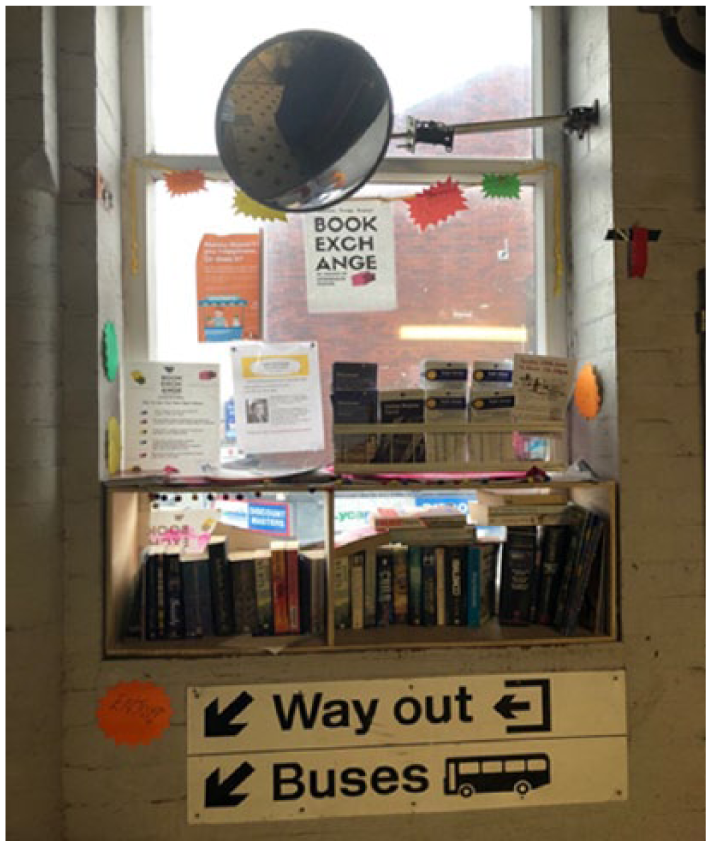
Library at the train station.
The local Medina Mosque is a notably less white cultural hub, in which I was welcomed to break the Ramadan fast by a substantial community of Asian British men and their children, who cooked for each other and feasted with me (the only woman and only white person in the building) after the sun went down. I was also generously given a tour of the Mosque and invited to sit in and enjoy evening prayer time before breaking the fast with them. I am still carrying the substantial translation of the Quran with me which I was given by the Levenshulme Medina Mosque Imam, along with specific instructions on how it is to be read. These are but two of many possible vignettes about community life in Levenshulme I can offer you, and I feel that these respective experiences illustrate sufficiently clearly the wildly different cultural practices, aesthetics, and communities that come together in Levenshulme, a place I call “home” for the time in which I undertake fieldwork in Manchester.
It was during a period of this embodied, immersive, ethnographic fieldwork in which I was living in Levenshulme, and researching community values and religious beliefs, that I was confronted by the agency of matter in the process of making. I was called to consider the broader ethical dimensions of having to give over our (human) control in processes of making. At the time, I was making art in a local primary school. Partly, my consideration of the extra-personal dimension of making and material agency began because I was working with a young girl who drew feces repeatedly both on her own artwork and on other children’s work: It seemed to me that she was asking me non-verbally why she had to shit on everything, why she had to shit all over other people’s work. But as I was working to answer this question, I was reminded of the many dimensions of the multiple knowledges that art creation makes one access and how often we don’t even know what we access, why, or how these processes happen. They just do. The italicized text below is an extended excerpt from my ethnographic field notes that illustrates the unconscious aspects of knowledge production that accompany art-making.
“I have spent days adding layers to a papier-mâché balloon. I have made three trips to the local Levenshulme hardware shop to buy wallpaper powder and glue, experimenting with the most cost effective but also practical binding agent for paper. I have tried, and failed, and then failed slightly less and succeeded slightly more, in perfecting the viscosity of the glue. I have chosen brown unwaxed paper as it’s stronger and holds together more thickly. Children will be able to paint and decorate the sturdy surface this makes. The friend with whom I am staying is away in Greece and the house becomes an art studio. Papier-mâché orbs hang from clothes racks, and ceramic vessels filled with wallpaper paste experiments populate the surfaces of the house: trails of my labor and investigations.
In the school, children have been working on symbols depicting ‘what really matters (see Figure 2).’ Space-time folds in which children have materialized their place attachment and symbols of cultural significance are assembled together through their creative labor to produce small pictures drawn in felt tip pen, or collaged, painted, and glitter glued so as to iconically represent ‘what really matters.’
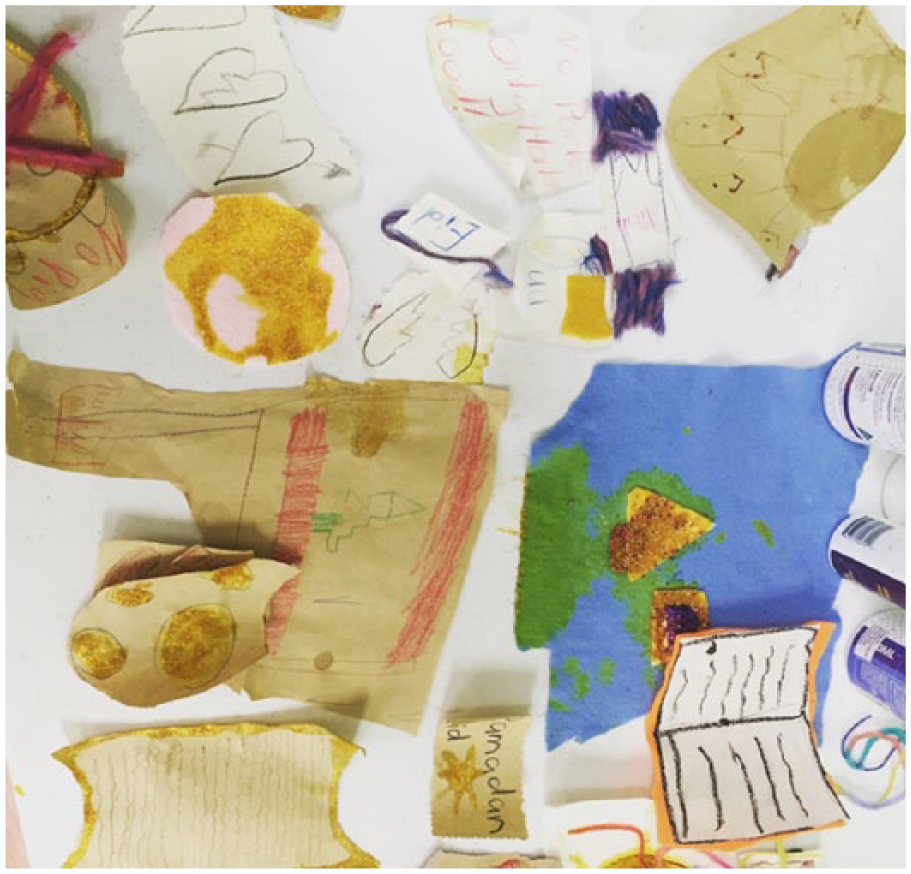
Symbols of “what really matters.”
Paper, felt tip pen, charcoal, felt, and glitter, become religious texts, celebratory sweets, Halal symbols: vernacular semiotics of cultural values. Children are carried by excitement, or perhaps the excitement is the agency of the papier-mâché object (see Figure 3), but either way, the children decorate with keen enthusiasm. The papier-mâché balloons need to be sturdy, they need to be an object that can hold a child’s enthusiasm. Now that their collaged symbols are ready, the surfaces on which they are to be applied need to be ready too. Its drizzly and cold in Manchester even though it is supposed to be summer. I can’t get the papier-mâché to dry. In desperation, after turning up the heating, and fanning the balloons, I try a hairdryer. I apply the hairdryer to the one remaining moist patch of my very best balloon, gently waving the gun over the damp paper surface. With a huge bang the balloon explodes and sucks inward with a wheeze, as the vacuum of air brings crackling paper in with it. The sudden sadness of losing the best balloon the children had to work on, and losing all my labor, is over ridden by another grief which rises up unexpectedly with the wheeze of the balloon’s last breath.”
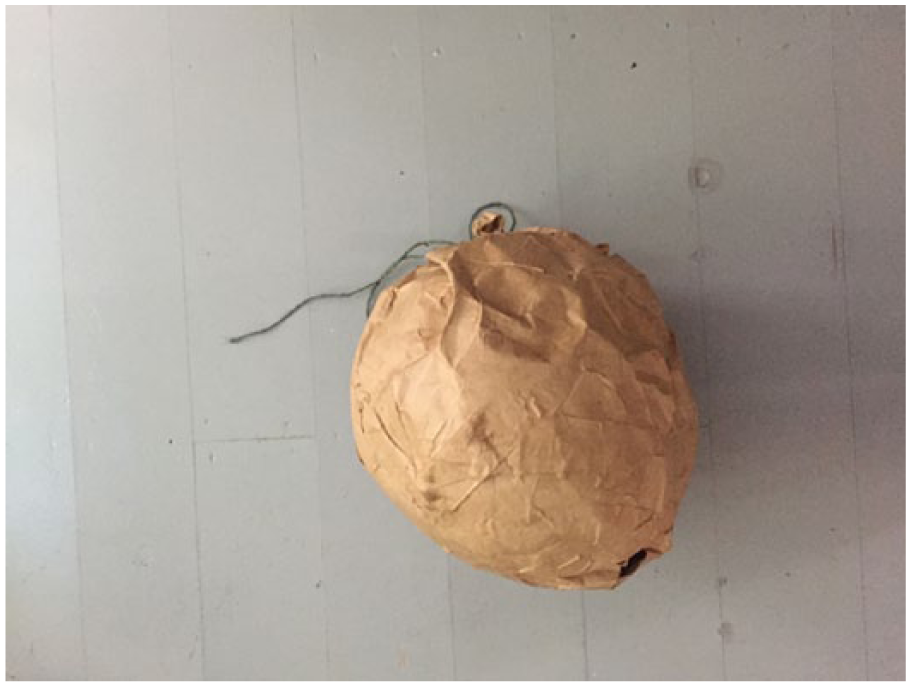
Popped balloon.
Moving from quoting my field notes to ponder the sadness they document, I can see that the balloon’s (see Figure 3) material exhalation sucks me in to a moment in 2002, in the Julia Farr Centre, which was founded in 1879 as the “Home for the Incurables” in Fullarton, Adelaide, Australia. At this time, the Julia Farr Centre was a marker of the State Government’s policy shift to deinstitutionalization. Entering the space, the smell of food and urine combined used to overwhelm me. I would brace myself for it each time I would visit, riding my bicycle through the streets of one of Adealide’s most affluent suburbs. I used to look at the surrounding houses and their aesthetics of privilege with contempt, wondering how long a home for “destitute” and “incurable” people would survive in such prime real estate. Not surprisingly, the building was demolished in 2011. By 2000, some floors were already uninhabited and I am still haunted by a memory of elevator doors opening to reveal a corridor of beds stripped bare, an empty drip standing in the middle of the space and a resuscitation dummy that had been left, seemingly incidentally, on a strange angle, leaning toward the drip, as if in need of medical care.
I had pressed the wrong button on the elevator, which led me into a gothic performance of the residues of institutionalized life. I pressed the correct button and the lift resumed its ascent. I wondered how many floors of the building looked like that. My father lived on the floor for behaviorally disordered people, in the men’s side of the ward. Arriving at the ward was something like entering a teenage boy’s bedroom. Heavy-metal posters, motorbike flags, and gang symbols surrounded the beds as one walked along the corridor: various articulations of the significance that risk taking had played in these men’s lives.
My father’s room was decorated with pictures of his race horses and memories of his earlier life in Ireland. Race horses were one of my father’s investments in risk and our family was consistently going without to support the addiction to gambling. I had been given half a horse for my 11th birthday. The soundscape of the behaviorally disordered ward is an inseparable aspect of my space-time memory of the place. One of the men used to yell “fuck off, you cunt” repeatedly, with a two-second pause in between statements” “fuck off, you cunt . . . fuck off you cunt . . . fuck off you cunt.” A chorus of occasional agonal howls echoed alongside him and constituted a wall of sound to be blocked out when attempting to hear my father’s labored attempts to communicate verbally despite severe muscle degeneration.
The balloon’s last breath in Manchester brought me back to my fathers’ last breaths in Adelaide. Agonal breathing is the medical name given to death breath. Agonal breathing is characterized by gasping, labored breathing, accompanied by strange vocalizations. Watching agonal breathing,
As the balloon popped, the deflating air moved the papier-mâché, like the breath that breathes the body in agonal breathing. The material agency of the balloon popping folded the temporality and spatiality of my father’s death into a failed act of preparing research materials. An institutional bed in the Julia Farr Centre folded into the lounge room in Levenshulme where I stood with a hairdryer in hand and a deflated papier-mâché balloon at my feet. A transversal line of death-time cut across space-time mattering in a zigzag that sewed different worlds, and different subjectivities, together. This remembering was valuable, because it reminded me of the emotional, personal, and social significance of the acts of making that I ask children to undertake.
I am asking children to excavate, to signify, and to hold the most important parts of their lives. Above I mentioned the little girl in Manchester who repeatedly drew feces on her own and other people’s work. The feces were actually accompanied by the occasional bottom. When I asked her if there was anything good about her home, and really pushed her to draw the best thing she had at home, she drew a “Frisbee.” A plastic toy, a very simple plastic toy, but an object that moves with freedom through the air. With my encouragement, the class teacher and I filed a duty of care report to the Department of Education. To date this is the only instance in which I have felt moved to lodge a report during fieldwork, but my balloon deflation reminded me that through my socially engaged practice, children are being invited to express their emotions through making and this is a potentially dangerous invitation.
When prompted to create symbols of what really matters to them, children often draw or make artifacts that perform the specificity of their home life, the material and visual languages of their religion, their attachment to the environment, and perhaps their social values. These are the things they say they want to carry forward with them into the future. Asking children to materialize what really matters (see Figure 2) to them is what I call a new materialist methodology, that is a research method that embraces the agency of matter and that provides a way to think about social value as it articulates through visual cultures, aesthetic codes, symbols, and practices of making across space and time.
Simply asking children what they want to take into the future can be slightly abstract, perhaps too abstract for some, but asking them what the most important things in their lives are and asking them to re-make the material, visual and symbolic codes, and semiotic systems associated with their lives creates an aesthetic materialization of social value that I then suggest they take forward into the future.
The methods I have developed explicitly mobilize the agency of matter and they ask young people to access the archive of their own experience through engaging creatively with art materials. They also ask young people to work together and make new forms of group subjectivity. The research questions I look to answer are as follows:
While I do not provide comprehensive answers to these questions here, I do speak to ways in which the methods I employ respond to these questions. Before I do this, I offer a broader overview of the project I theorize.
Interfaith Childhoods employs socially engaged arts practices to engage with the views of children, their parents, and community in Sydney, Melbourne, Manchester, and London. Socially engaged practices with interfaith children zigzag across, and bring together, a diverse selection of bodies, beliefs, knowledges, and skills, and negotiate difference in a process that creates a material-discursive documentation of emergent group subjectivity. Such a bringing together of different ethnicities and beliefs is urgently needed to bridge social divides created in relation to, or which socially frame, ideas of religion. The capacity to understand and empathize with others from very different worlds is imperative if violent responses to social difference are to be avoided. Such outcomes are already being achieved through the project, proving that a preventive approach to resolving social conflict needs to begin with community engagement.
This image of the two places of worship pictured above (see Figure 4) took the children who made it a long time to arrive at. Working together on a shared artwork is central to my method and the children are asked to collaborate on a shared canvass as a way of working together. For many children, rituals, words, symbols, and ideas become sutured to the idea of a given religion. Belonging articulates through material, visual and digital cultures that can be specific to religion. The image showing a church and a mosque side by side not only took a long time to create but is evidence of engagement, openness, discussion, and responsivity (see Figure 4). The proximity between the mosque and church is the result of labor and negotiation. The children I work collaboratively with will often say they believe in Allah “because he is pure and right,” or make similar, simplifying claims about religion that focus on purity, service, cleanliness, and the right way or the “truth.” The transversal lines of making art, having a shared discussion about “what matters”—or what might matter, what is valued, and what we believe—can encourage children to link simple ideas and words learnt through rote religious education with critical practices in ways they haven’t experienced.
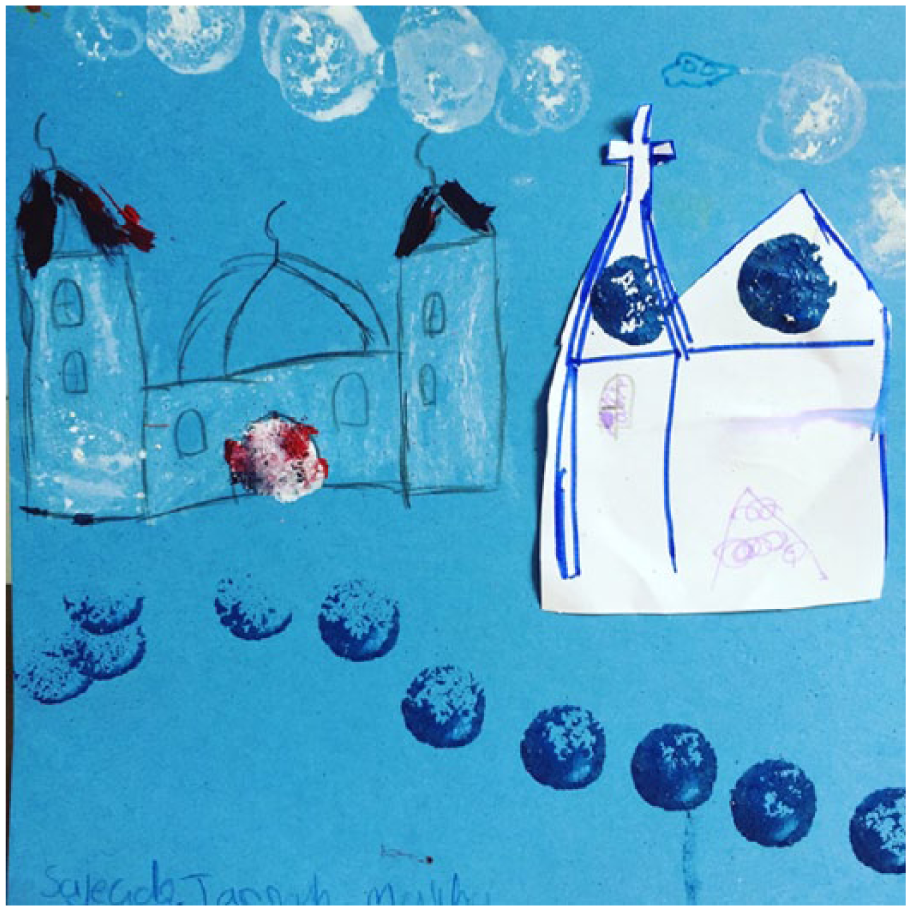
Mosque and Church.
Putting my theory of affective pedagogy to work in exploring aesthetics as a form of communication, and art as a way of crafting new affective relationships between interfaith children, affective pedagogies allow young people to re-make and represent themselves in—or as part of—very specific community assemblages. The children materialize themselves as part of a larger faith community in ways that are gender and age-specific, but each of which presents their subjectivity as already collective.
In all my research contexts I am working to negotiate quite complex social dynamics with fairly limited resources. Many children have limited art experiences. A 7-year-old girl in South East London exclaimed excitedly “this art is so much more fun than my iPad! I am coming to this class all the time.” She is in the minority of participants who would own their own iPad (most do not have computers at home). Even still, she has not experienced art classes that made her feel empowered and like she was being heard. She is a migrant from an Irish catholic family.
The Irish girl’s “self portrait”, (see Figure 5) is a re-presentation of a Sri Lankan Australian girl’s self portrait: a beautifully decorated image of Diwali celebrations that had caught her eye (see Figure 6). The Irish girl’s self portrait is positioned just before the image that inspired the picture. In the flesh, the two girls are from profoundly different worlds. The Sri Lankan Australian girl is dark skinned, very slight, with inky eyes and hair and she is always moving. She speaks Tamil at home, and is part of an actively Hindu family and culture, proud of their Tamil culture and rich in knowledge of performance art traditions associated with Tamil celebrations.
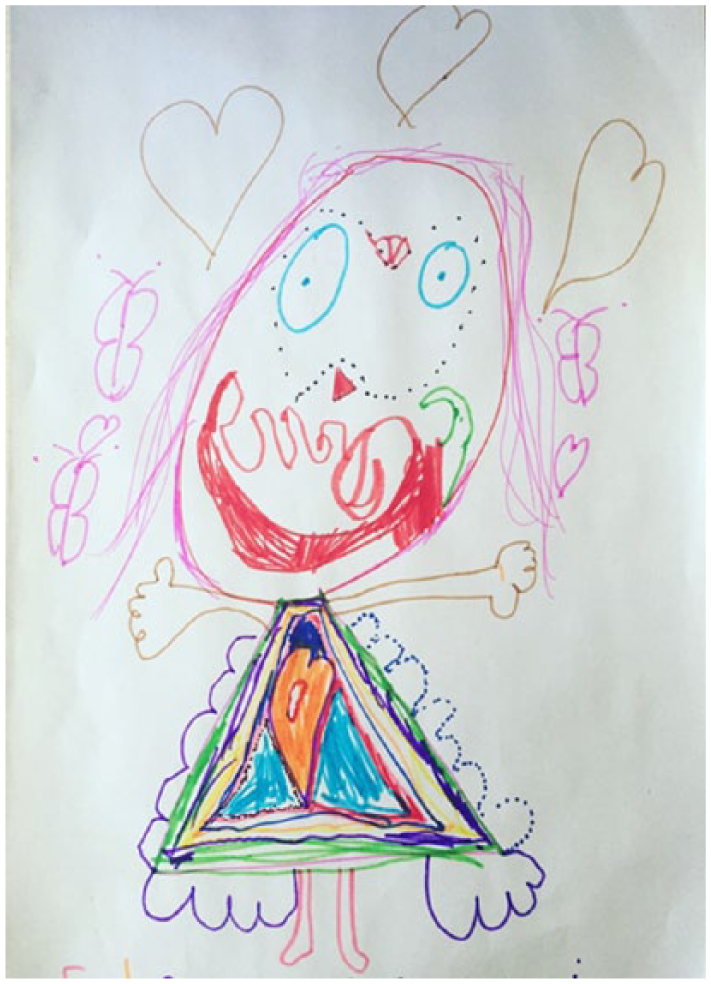
Irish girl’s self portrait.
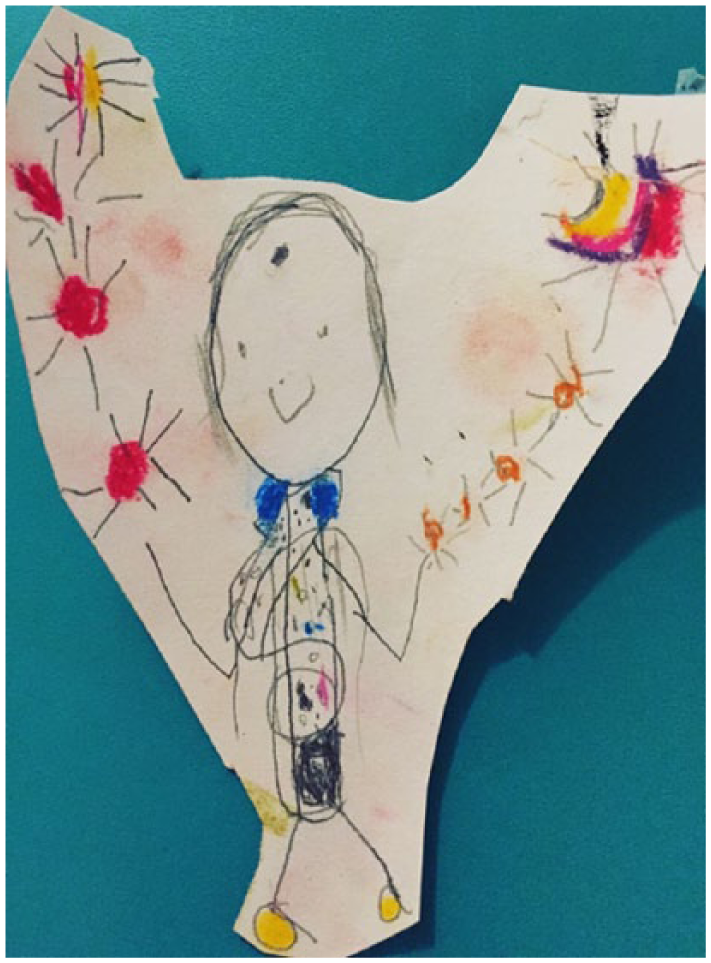
Sri Lankan Australian girl’s self portrait.
The Irish/English girl has very pale skin and a face covered with red freckles and light red hair. She has large blue eyes and a stocky frame. The aesthetic commonalities in their work bring their respective selves together as new materializations of their young feminine bodies in a way that may not otherwise be possible. The materiality of the Australian Hindu girl’s picture shaped the Irish/English girl’s self portrait (see Figure 5), and her expression of self unfolded in relation to the Hindu Australian girl’s expression of self (see Figure 6). Her re-citations of colors and symbols used by the Hindu Australian girl is important: It illustrates the agency of matter through the transference of visual symbols.
This process of re-creation of the self and my documentation of the self can be thought about as what Barad (2007), Warfield (2016), refer to as processes of making new cuts. My making workshops, the videos and photos I take to remember them, are “cuts” I make in existing material and conceptual assemblages. Barad (2007) argues that “agential realism” is useful to the analysis of social inequalities; it is a way of understanding the politics, ethics, and agencies of any act of observation, and indeed any kind of knowledge practice. Any act of observation makes a “cut” between what is included and excluded from what is being considered. Separations are temporarily enacted so one can examine something long enough to gain knowledge about it. My methods of asking questions, making, and recording cut into children’s memories, belongings, and attachments to material and visual cultures in a process that re-builds, folds, and expresses constellations of significance in their lives.
Stories That Unfold Through Making
The 2 years of making I have undertaken to date with children and the associated conversations I have had with their parents since beginning this project have taught me that narratives unfold through making (see Figure 7). Symbol, texture, and color carry and re-perform histories and critically inform how memory operates and shape the registers people mobilize in constructing narratives. There are many examples I can give that illustrate this point, and for the sake of brevity, I will give two, which illustrate the significance of symbol, color, and texture as agents of thought-assemblages or as narrative devices.
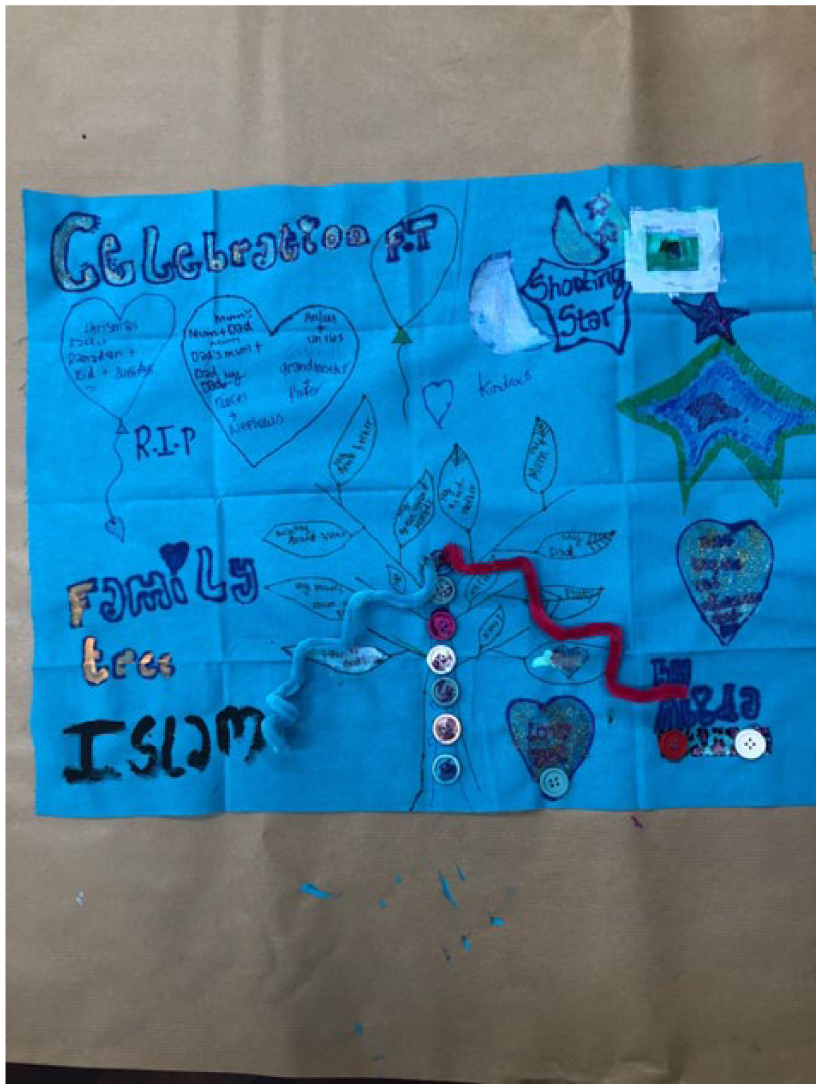
Narratives that unfold through making.
First, I begin with an example from one of the east London sites in which a girl was making her family story on textile materials, as a collage. I want to give a material-discursive-semiotic reading of the colors and symbols used before moving on to discuss the words she uses. Even if one was not able to read English, if one knew anything of Islamic visual and material culture, one could see the author becomes in relation to the Muslim religion and cultural practices. The use of textile is an almost accidental start. Textiles are, and historically have been, a significant and enduring medium in Islamic visual culture. This is partly because textiles are portable: more portable than ceramics, for example, and this is and has been a feature that makes them accessible to desert bound people across the world. Whatever the fabric choice for Islamic textiles, they tend to be patterned with non-representational symbols and particular shapes. The piece of work I discuss here, and pictured in Figure 7, is rich in symbolic and shape-based forms of visual communication. The color blue chosen for the work shows the artist/maker’s capacity for symbolic and visual communication very clearly. The color chosen is a dark Cyan, almost Prussian blue, printed with enough magenta to give the color depth. Cyan blue can be traced back to the color of cornflowers which were once used as a dye, and also to cyanide which derives its name from Prussian blue.
This color is an enduring feature of Islamic material and visual culture and locates the artist/maker’s work in this context. At the center of the image (see Figure 7) is a tree, which Gruber (2017) notes is a significant aspect of Islamic material and visual cultures. As one gets closer, we can see words adorning the leaves of the tree.
The tree features family names of the young British artist and is surrounded by other symbols of Islam, such as the crescent moon, the stars, and also featuring the words celebration and Islam. Family members who have died are named in a heart shaped balloon that says RIP. Texture and dimension is given through buttons, pipe cleaners, glitter, and paint. The colors and shapes here clearly cite a long tradition of Islamic visual culture (see Figure 7).
The second example moves us to Western Sydney and my fieldwork in a community refugee resettlement service (see Figure 8) in which color, texture, shape, and form express meaning is the pink painted Henna hand which traditionally symbolizes Eid celebrations in Muslim culture. The pink fabric is covered in pom-poms, sequins, and painted exploding stars, which are supposed to be fireworks, and in the center of the picture is a decorated hand, drawn by an Australian Muslim girl to symbolize the very special and embodied experience of celebrating Eid (see Figure 8). Both of these examples of textiles (see Figures 7 & 8) that tell stories through line, shape, color, form, and matter are, in part, the result of children talking to their parents about the project. I send home worksheets and homework packs for children and their parents to do together and this process of children and parents collaborating teaches the children about their family history, their religion, and their migration history.
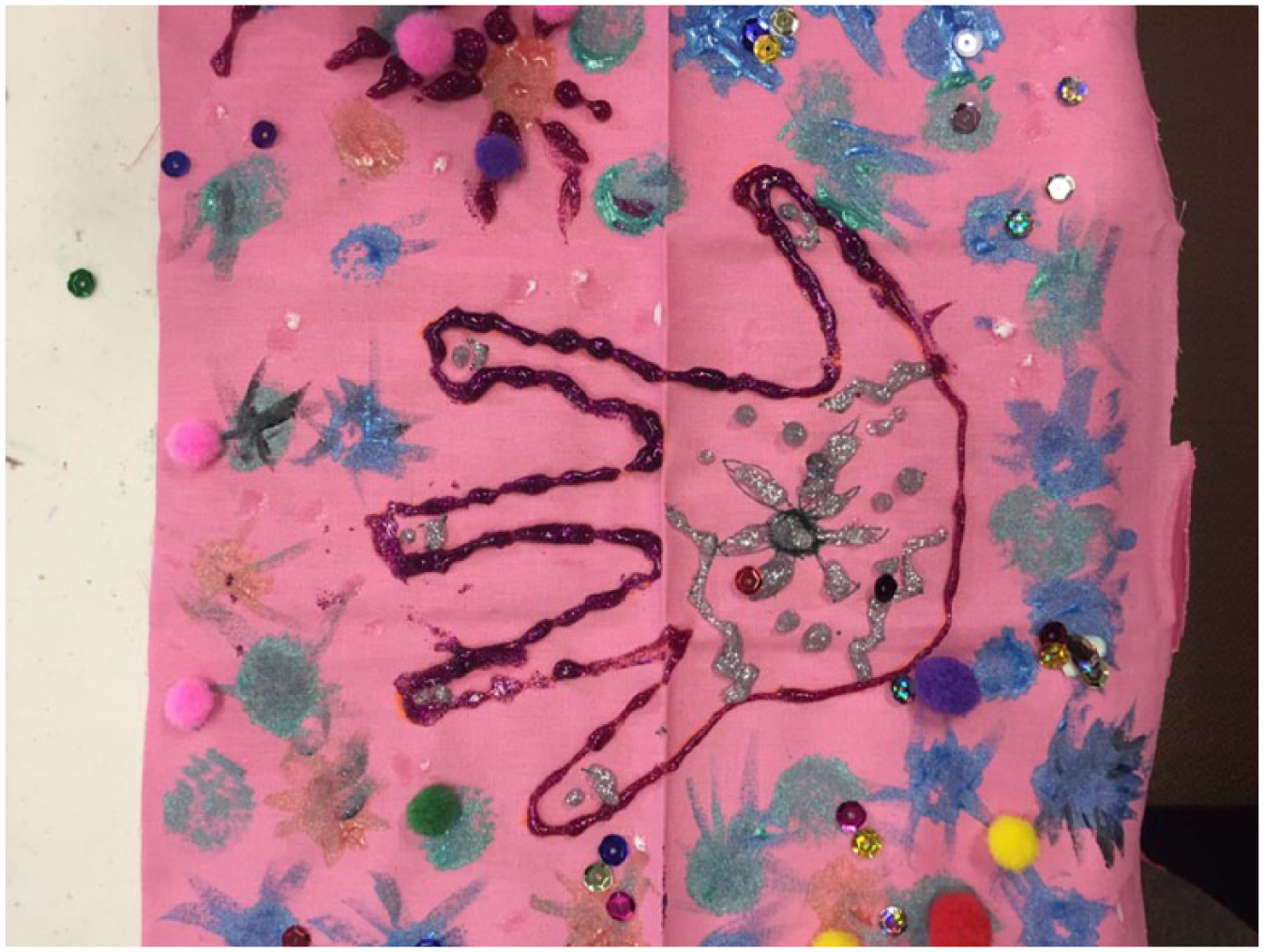
Islamic textiles.
I try to choreograph relationships between children and parents from different faith backgrounds in ways that encourage mutual understanding and empathy and which allow children to re-create themselves in relation to their broader faith communities. Research on interfaith community building is gaining momentum outside the realms of psychology, international relations, and politics. Bringing such work into the field of arts practice as research and thinking through diffraction and intra-action shows the agency of interfaith work, by highlighting the fact that bodies and beliefs are contextually co-constituted. Diffraction as a way of thinking draws attention to the agency of the non-human, the ways that the materials used to make art can change thinking and can change relationships between people and building more than human relationships. Arts-based practices offer offer a way not only way not only of accessing but also of re-organizing emotional investments. They provide an excellent vehicle through which to build convivial interfaith futures. While the intra-relationships between sex, gender, race, and culture and the negotiation of binaries and difference have been widely debated in gender studies and feminist theory, ideas of intra-action and diffraction offer new momentum and fresh insights into debates about interfaith subjectivities because they give us a way of understanding how community art projects make collective subjectivities and faith beliefs through collective artworks.
Footnotes
Declaration of Conflicting Interests
The author(s) declared no potential conflicts of interest with respect to the research, authorship, and/or publication of this article.
Funding
The author(s) disclosed receipt of the following financial support for the research, authorship, and/or publication of this article: This research is funded by The Asutralian Research Council Future Fellowship FT160100293, “Early Start Arts to Counter Radicalization.”
