







Abstract
Scholarship in postqualitative research has long examined the constructs of orientation and experimentation. How do we come to know and name experience? How do we value its matter as a form of mattering. Combining perspectives from phenomenology, feminist new materialisms, and sound studies, this article traces the intra-active encounters of the Museum of Contemporary Art–Detroit’s (MoCAD) performance of John Cage’s “How to Get Started.” Reading postphenomenological inquiry as improvisation, the article underscores that phenomenological ontologies are always already a be(com)ing, and that qualitative research more broadly is inherently an act of being “in-resonance-with.”
**1 1 **
6 . . . 10 . . . 1 . . . 7 . . . numbers slide across a 10 × 10 foot screen. A spotlight frames a chair on an open black box stage. Spliced by speech, Detroit community members, performers in this collaborative sonic experiment, speak off-the-cuff about an array of personal thoughts and concerns. Art. Culture. Work. Sex. At first listen, the Museum of Contemporary Art–Detroit’s (MoCAD) homage to John Cage’s “How to Get Started” is a sonorous story. A cacophony of voiceovers and ambient sounds from the audience are back-dropped by the tick of a clock counting down the remaining seconds of monologue. Another number appears. A new story begins. The acoustic layering of ideas, however, is more than a multimodal narrative. It is a performance of sound/bodies/materialities. It is, as I conceive of it here, an apparatus for theorizing sound and sonic experience through the lens of postintentional phenomenology. “How to Get Started,” however, is not the primary focus that I wish to breathe life into. Rather, I use it here as a performative hermeneutic, a tool to question what role sound, feminist new materialisms, and philosophies of improvisation may provide the qualitative researcher in thinking with postintentional phenomenology.
**2**
Scholarship in postqualitative research has long examined the construct of orientation and experimentation (Ahmed, 2006; Vagle, 2014). What does it means to be (re)oriented? How is it we come to know and name experience? What value is its matter as a form of mattering? John Cage, celebrated American composer, musician, and performance artist, had similar questions. The ruminations and initial inklings of the experiment “How to Get Started” were completed near the end of Cage’s life. Originating as a thought experiment to question the construct of improvisation, Cage was curious how the musician could overcome emotion, style, personality, hierarchy, intuition, habit, and, perhaps most important for our focus here, intention in the process of sonic improvisation.
As a novice postintentional phenomenologist, I see my primary job in thinking with the posts- as a way to write my way through what Vagle and Hofsess (2016) call “explosions.” Exploring sound in MoCAD’s “How to Get Started” with a postintentional phenomenological lens registers sound not as a hearing “of,” in the Husserlian (1983) sense of intentionality, but a witness to the withness of experience. In short, I see postintentional phenomenology as a “third” phenomenology. A (re)examination of the polyphony of aural experience, postintentional phenomenology extends Ihde’s (2007) now classic text, Listening and Voice: Phenomenologies of Sound.
Taking seriously that improvisation is a strategy for showing the passage from a “there” to a renovated “here,” the article uses a “stacked stories” (Burnett & Merchant, 2016) approach to understand how improvisation elicits an “in-resonance-with” across sites of sonic intra-action and inquiry. A stacked stories approach is a baroque technique that, like Deleuze and Guattari (1987), underscores how we are always already in the middle of things. It is an apparatus that attends to what Vagle (2014) terms a “whole-part-whole” analysis (pp. 98-99). In other words, through recursive stacked stories, I examine how postphenomenological theories and philosophies make sense of what counts as sound and self in qualitative inquiry.
Using Cage’s style of improvisation to (re)imagine the organization of an academic essay, the article invokes a “post-critical writing praxis” stance (Henderson, 2018) as a response to Lather’s (2013) call to “imagine forward” (p. 634) in qualitative inquiry. It charts what an orientation of “being-in-resonance-with” may entail for research concerning the more (than) human and conceptualizes how we may occupy knowledge differently. In concluding, I talk across my own autobiographical experiences of MoCAD’s sonorous story to highlight what a being-in-resonance-with orientation may entail.
**9**
**3**
Thinking With New Materialisms ←→ Sound Studies ←→ Philosophies of Improvisation to Posit a Postintentional Phenomenology of Sound
In line with the special issue’s focus on postintentional phenomenology and hermeneutics, I assume that phenomenological ontologies are always already a be(coming) and that qualitative research more broadly, is inherently an act of be(com)ing “in-resonance-with. 2 ” Combining perspectives from phenomenology (Ahmed, 2006; Heidegger, 1953; Vagle, 2014; van Manen, 2014), new materialisms (Barad, 2007; Bennett, 2004; Braidotti, 2013; Deleuze & Guattari, 1987; Deleuze & Parnet, 1987), and sound studies (Bull & Back, 2003; Droumeva, 2015; Feld, 1982; Gershon, 2011, 2013; Schafer, 1994), I trace the intra-active encounters of MoCAD’s performance of Cage’s “How to Get Started” to read postphenomenological inquiry as improvisation.
I use postintentional phenomenology here, like Vagle (2014), to signal my interests in chasing “lines of flight” (Deleuze & Guattari, 1987) through disparate and at first glance incommensurate philosophies and theories. 3 Posting intentionality, as Vagle and Hofsess (2016) suggest, insists “that meanings run through relations and are constantly being constructed, deconstructed, blurred, and disrupted” (p. 342). By entangling feminist new materialisms with philosophies of improvisation, I articulate an onto-epistemology in researcher reflexivity.
My new materialist framing does not seek an ontological speculation that omits the analysis of social forces that mediate one’s access to the world (e.g., social identity markers that are at times in tension with poststructural constructs such as power and discourse). As a queer researcher and educator, I am all too aware of how material and corporeal realities become texts that others read and silence. Rather, it operates as a queer partner-theory. As Ahmed (2006) contends, this turn toward the object within phenomenology (which as we see is about some objects and not others) is not about the characteristics of such objects, which we can define in terms of type, the kind of objects they are, or their function, which names not only the “tendency” of the objects, what they do, but also what they allow us to do . . . (p. 33)
Thus, I am interested in thinking with postphenomenological theories to reimagine sound and sonic experience as an improvisatory phenomenon in qualitative research. Phenomenological philosophy, from Husserl (1936/1970) to Heidegger (1953) and Merleau-Ponty (1947/1964), argues for intentionality, a theorization of how things “come-to-be” in relations. Thus, what follows is a philosophical improvisation, an invitation that welcomes theories to work at the interstices/edges/margins and explore what type of affective bloom spaces may emerge.
Assuming that improvisation is not merely a theoretical tool, but rather an onto-epistemological orientation of be(com)ing-in-resonance-with, this article details how improvisation is “the demands for a work” and “of a work” (Peters, 2009, p. 11). Postphenomenology is a queer partner theory for philosophies of improvisation. As Abram (1996) explains, (t)he sensing body is . . . an active and open form, continually improvising its relation to things and to the world. The body’s actions and engagements are never wholly determinate, since they must ceaselessly adjust themselves to a world and a terrain that is itself continually shifting. (p. 49)
Improvising then—across any domain—implies creation from pre-existing material. Hence, as this article will explain, examining a postintentional phenomenology as a “becoming in-resonance-with”, is an opening up by the multiplicity of crystallized creative gestures that impose “limits on what can and cannot be done on the occasion of the material’s subsequent reworking, whether improvised or not” (Peters, 2009, p. 11).
If, however, in phenomenology, we are tasked with the job of preserving or catching the beginning of experience without erasing the origin of its creation, then what may sound bring to conversations concerning postintentional phenomenology? How do we hear experience without killing the improvisatory nature of qualitative inquiry? It is not to theorize sound and the sonic as a material ←→ discursive decoding of linear time and discrete experience, but rather to explore the rhizome of affective and affinitive connections. 4 In short, to witness the withness of experience and (re)imagine sound’s place along the edges and margins of qualitative inquiry.
Sound carries both semiotic and non-semiotic messages about experience. Sound is a being/doing/making. Sounds form systems of meaning. Be(com)ing-in-resonance-with, as an affective hermeneutic, follows the unfolding of intra-action and takes seriously what Goodman (2010) calls “the ontology of vibrational force,” the idea that “everything in motion, is vibrating” (p. 83).
5
In other words, phenomena, configured here across material ←→ discursive planes, matter. “Since music is vibration,” as Eidsheim argues, there are multitudes of material circumstances that contribute to each of its particular articulations, each unrepeatable and hence unique, and each with a potential to affect us that can be revealed only in the particular articulation that takes place within and among each material situation and unique listener. (p. 155)
Sound, thus, highlights the materiality of sonic communication. It reflexively imparts a be(com)ing with. Sound leads us to “theorize an entangled post-reflexivity that aims to incite methodological movements and possibilities for qualitative inquiry” (Vagle & Hofsess, 2016, p. 334). As Voeglin (2010) explains, sound, when “listened to generatively, does not describe a place or object, nor is it a place of an object, it is neither adjective or noun. It is to be in motion, to produce” (p. 14). I would add to Voeglin and argue that it also means to be with. In this vein, the rhythmic realities of being with sound, during a performance piece or simply walking down the city street, are forms of becoming-in-resonance-with, a simultaneous thinking/living/becoming that requires reciprocity and active engagement with time/space/matter/bodies.
**6**
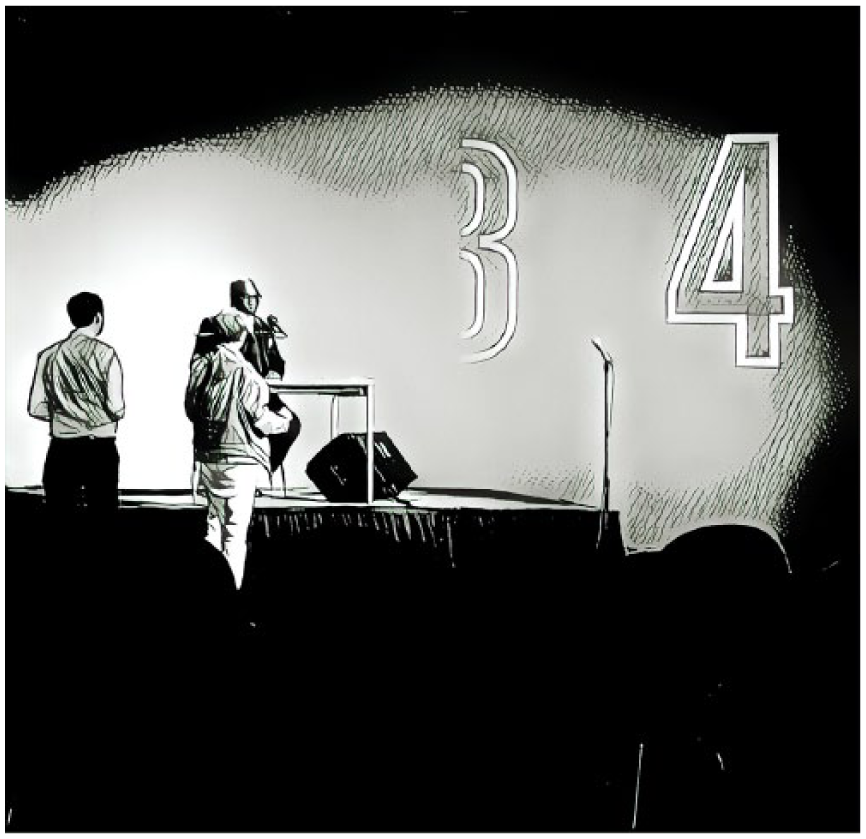
MoCAD’s How to Get Started.
**5**
Wargo’s Story: Improvising an Onto-Epistemology in Researcher Reflexivity
I was always enticed with John Cage. In the Fall semester of 2013, I used a YouTube video of his celebrated 4′33″ to talk across the politics of what my prospective teachers and I could define as children’s and/or young adult literature. 6 This curricular intervention was successful. In the same way that most walked away from Cage’s composition unnerved, entrenched in thinking that silence was unsatisfactory for a score, my students reconsidered how it is we define childhood and adolescence and how our own archetypes concerning childhood histories (mis)shape what our students should and should not read.
“Rhythm is a middle force that occupies the distance between events, hinting that there is no empty space or void waiting to be filled by human perception. It resides between actualized sensed perception and the abstract virtual sphere that encompasses it. It is the vibration prior to becoming sensed sensory action, the power that unearths ‘what risks remain hidden’ from the cracks in our perception” (Ikoniadou, 2014, p. 13)
Notwithstanding, as my interests in sound grew (see Wargo, 2017, 2018; Brownell & Wargo, 2017), so too did my vision concerning the responsibility of the sonorous in qualitative inquiry. Thus, when MoCAD was selected as a destination to tour Cage’s “How to Get Started” performance piece, I attended. Scanning the Facebook event invitation, I “liked” it <cliCK>, archived it as something I could go back to <SCROoollll> and then placed it in my iCal <beep>.
Situated against the cacophony of Woodward Avenue in Detroit, Michigan, MoCAD eagerly invited spectators and listeners in on a Sunday afternoon. With other listeners in tow, I brought my boyfriend to “earwitness” Schafer, R. M. (1994) the pop-up sound installation. We sat in the back. Arriving early, I was privy to sound check, hearing about the who would participate and the call and response that the sound director would signal when time was up and how another number would emerge on the screen. Two more friends arrived on the scene during sound check. One sat next to me and the other sat directly behind. Pleasantries were exchanged, and I was asked by one whether I could “sit still and be quiet” during a performance that was upward of two hours. I find this reflection interesting, as it still sits with me even now, writing about the event some 10 months after. How does my own timbre and body “sound” to others? In what ways is my “voice” written, or perhaps revised when I am first introduced?
As time presses on, more arrive and the small black box studio, bookended by changing installations transforms into an atmosphere of sound. Rows of black chairs against a black screen are now an affective field in which the audience is immersed. Pamphlets are handed out by barbacks <cling-clang-cling-cling-CLANG>. Glasses are filled. They sing as MoCAD staff serve draft beer and wine to guests only now taking their seats. “<wisp.WISP.>” “This thing on?” A voice asks from the front of the stage. The curator welcomes us to the installation, only now gaining consent from those around her to be audio recorded, and participate in the performance. I lean over and ask my colleague, “Where’s my institutional review board (IRB) form?” The first narrator moves to the chair, the heat of the spotlight emanates off the stage. I shuffle my way out of my black fleece quarter-zip, wipe my forehead with a bar napkin, and settle in.
Detroit.DetroitArt.ArtisDetroit. This is the sequence of story that the first presenter shares. I sit there, small Moleskine in hand, jotting notes down about feelings, rhythms, intentions. Despite the shared simulation of “improvisation,” this man is rehearsed. There is apprehension when the random digit is presented to him, a small gasp eeks out of the microphone as he mentally finds what he wanted to talk about during this minute sequence. Quiet. As the audio overlays previous minute monologues, the narrator (outside of MoCAD’s ambient sound) is the sole interlocutor heard. I feel unease as my boyfriend’s legs start to shift. He checks his phone. Airplane mode. He looks over and asks, “Wait, are you recording this?” I nod in response. “So,” he continues, “we can’t leave early?” Three. The last number in the first speaker brings him to a close <clapclapCLAPCLAPclapclapclappp>.
An interlude occurs between speakers. A middle that hints at a distance between narrated events. This acoustic territory of sustained silence provides no empty space seeking to be filled by cognitive perception. Rather, it is its own performance. Murmurs muffle small glances. Participants sidestep out of the aisle. It is, as Breuer and Roth (2003) describe, an epistemic window or “I-witnessing” of an event. The audience becomes-in-resonance-with the goal and vision of Cage as its own improvisation is a coda to narrated movements of talk. The second narrator makes her way to the stage. An artist and local resident. The storied moments that are heard now collapse my memory as I am jolted by a refrain of laughter. Dicks. A natural comedian, the student finds solace with the audience as she plays up her age. “I mean, I’m just a student . . . ” she proclaims, somehow yearning to locate herself in opposition to the art curator and historian who preceded her. Seven.The stories continued to be stacked. The sound operator is now looping five well-timed minute monologues together. The narrator stumbles upon the next number, catching herself to pause so the audience can once again laugh quietly and hear her “bag full of dicks” artist statement. She continues. “And I mean,” she started, “I have nothing against that. But, I’m just not like that. I’m not gay.” I am silent. What was once a belly laugh becomes a blow that affectively disconnects me from the axis of participant/observer. I look to my boyfriend who plays it off <eye roll>. Suddenly, sound became a marker for affinity. A figurative deafness to a world whose magnitude is larger than this context. Does silence signal complicity? The speaker’s segment stops. The narrator exits the stage. Some clap, I leave.
“Deleuze’s distinction between diversity and difference is cited in an attempt to show that the former represents the mere appearance of difference playing across an underlying sameness – pseudoimprovisation – whereas the latter describes the same eternally recurring willing of difference. That is to say, the same interruption of continuous time in the name of an origination of a future past that is always new: the same difference rather than a different sameness (diversity)” (Peters, 2009, p. 5).
**8**
Sound’s Story: The Fragility of Becoming-In-Resonance-With

Sound’s Story
**9**
Attuning Toward a (Re)Imagining of Data Analysis: Be(com)ing “In-Resonance-With” Sound
The stories, stacked together with gaps, contradictions, and discontinuities between them, turn up the volume on taken-for-granted dimensions of postphenomenological research. They operate here as sonic solicitations, phenomenological cleavages that think with queer partner theories to interrogate our own subjective intentionalities. Refracted through my own stories, the inaudible (seen here solely as a perception of silence) is produced and improvised in the moment. It, like the intended messages delivered through “How to Get Started” is an invitation to become in-resonance-with the other stories, productions, meanings, and materials associated with what art/music/place (and who goes to see particular styles of art/music/etc.) are. It also, however, highlights the fallibility of speech and the sonic. A looking back that highlights ontological tensions in describing/writing/making who “we” were then in the here of “we.”
Sound is a diffractive agent. It becomes semiotic, with its own messages dictating who can be part of the “we” that is voiced. This attentiveness to sound as a material archive, however, is not a new. As Kane (2015) writes, “Not only do listeners hear in sound morphological resemblances to other sounds, they hear in sound analogies to other practices and predicates in their culture” (p. 15). Thus, when considering the audible margins, edges, and in-betweens of postintentional phenomenology, we should take heed of how this immanence—an ontology of sonic vibration—sets in motion new ways of understanding experience, replacing the subjective with the affective.
Outside of the sonic narratives shared as part of MoCAD’s experiment “How to Get Started,” the fragile and fugitive materialities of sound continue to implicate my own understandings of how we come to know the action and affects of being-in-resonance-with phenomena in postintentional phenomenology. If we (re)consider reflexivity as an act of onto-epistemological improvisation, then the sonic and material experience are core to our own understandings of how we know inquiry, and I would argue how we know ourselves, more broadly. The material ←→ discursive is a reciprocal witness. As a queer cisgender researcher, I have come to see reflexivity as an action that is not temporally fixed, but fluid. My voice, whether written or recorded becomes a sonic artifact of multiple transgressions. Sound as space/time/matter unfolds into a continuum constructed across the digital and analog. It asks whom I can hear and who can hear me in the construction of the “I.” Being-in-resonance-with is expressive of the bodies/materials/doings of thinking with the “posts” in postintentional phenomenology. Sound not only interpolates what we know (epistemology) but also constitutes us as more (than) human beings (ontology). 7 It is, as Koro-Ljungberg, MacLure, and Ulmer (2017) contend, expressive of “data’s” onto-epistemological status. It attends to the ethico-aesthetic material of being “with.”
**7**
**10**
My goal in this article was to chart new theoretical and methodological possibilities for qualitative inquiry, and postintentional phenomenology, more specifically. Theoretically, I suggested that attuning to postintentional phenomenology as an intra-active encounter of be(com)ing-in-resonance-with elides more simple notions of witnessing phenomena. Methodologically, and through a series of stacked stories, I added to the improvisational sensibilities and possibilities of (re)orienting qualitative researchers. I connected with affective stimuli and opened my body up to be(com)ing-in-resonance-with new territories for the researcher, the researched, and the research process. In closing then, I want to explore how poststructuralist theories, Deleuzoguattarian perspectives, and feminist new materialisms more specifically, may (re)educate the senses to educational moments of sonic experience and intentionality. How will our be(com)ings reflect the broadening sense of improvisational doings and matterings as they come to be delicately connected to all other experiences and phenomena? What other theories, experiences, and lines of flight emerge from those who listen but might not hear in the traditional and often ableist sense of the word? What types of productive theoretical work can take place when we think with and in the margins of seemingly irreconcilable fields? It is in and through these questions and spaces, productions that I believe attune toward bodies and the inaudible “I” in postintentional phenomenology, that new and noteworthy sites of inquiry emerge.
Footnotes
Declaration of Conflicting Interests
The author(s) declared no potential conflicts of interest with respect to the research, authorship, and/or publication of this article.
Funding
The author(s) received no financial support for the research, authorship, and/or publication of this article.