







Abstract
In this article, I think retrospectively with art and passages of writing produced in connection to a study on aesthetic activity and urban nature with two classes of fifth graders attending school in a city of the American Midwest. For this, I take on the art philosophy of Deleuze, Deleuze and Guattari and Deleuzian scholars to discuss how aesthetics and processes of art-making can inform empirical gestures based on distance from and invention of worlds. Art extracts sensations from chaotic forces that function in excess, variation, and proliferation, offering valuable practices to attune toward the affectivity of post-phenomenological life worlds.
Keywords
Introduction
Environmental studies of childhood and childhood geographies are undergoing an ontological reorientation that seeks to end with binary understandings, and to relocate research in complex assemblages of urbanaturechildhoods (e.g., Duhn, Malone, & Tesar, 2017; Malone, 2007, 2016; Pyyry, 2017; Rautio, Hohti, Leinonen, & Tammi, 2017; Taylor, 2013; Taylor & Pacini-Ketchabaw, 2015, 2017). Informed by post-humanisms, new materialisms and science studies, this body of research questions a mystified view of nature as an intrinsically positive realm that disregards issues of environmental justice, and the growth of hazardous landscapes affecting children living in damaged and deprived worlds (Malone, 2007, 2016; Taylor, 2013; also see Haraway, 2016; Tsing, 2015). Thinking with concepts such as interdependence, intraaction, animal-child encounters, entanglements, vibrations, the focus of these studies is on ontologies that enact an immanent ethics of becoming with inhuman forces and more-than-human others in which humans, cities and nature form an ongoing continuum.
In this article, I think on how the ontological reorientations that articulate urbannaturechildhoods research can be attained via aesthetic processes of making, looking, talking, and relating to art. As Rousell and Cutter-McKenzie (2019) note, “[An] aesthetic dimension . . . is inseparable from the political and ethical issues that appear to necessitate an ‘ontological’ reappraisal of childhood in relation to nature” (p. 5). A statement that is in tune with other scholars in the fields of science, technology, art, and the humanities who seem to understand that the arts widen the field of interdisciplinary connections, invent possibilities for new affective relations to occur and provide spaces for public response-ability toward troubled complex worlds (e.g., Demos, 2017; Haraway, 2016). Taking on these debates, the focus of this article is to discuss how a Deleuzo–Guattarian art philosophy can inform aesthetically based research on urbannaturechildhoods that augment possibilities for more-than-human forms of sense between city dwellers; children and trees. I do this concentrating in three main arguments:
Art and research in post-phenomenological life worlds have a common interest in modalities of production directed by excess, profusion, and differentiation (Grosz, 2008; McCormack, 2016).
Art enacts provisional framings in which sensations are extracted from the chaotic forces of post-phenomenological life worlds to vibrate and intensify bodies (Grosz, 2008).
The extractive operations that art undertakes involve disconnections with the world more than practices of connection and intimacy. As I will articulate with more detail through the article, art is an escape from anthropocentric methods based on observation-recognition. Art functions as an event that is not retrievable to a visual experience in a phenomenal field.
Aesthetics as a Compositional Activity
For Deleuze and Guattari (1994), the most radical processes of becoming are originated in art (see also, Grosz, 2008; D. O’Sullivan, 2016; S. O’Sullivan, 2006). Art is a compositional movement where elements of the chaos of life are abstracted forming sensations (percepts and affects) that do not belong to the body but allow the body to become other through unexpected instances of form-taking activity. Deleuze and Guattari (1994) see this movement not as cognitive or semiotic but compositional. Flows of intensification, extraction, and abstraction are played in/by bodies in accordance with the messy forces of the world. What art does is to construct a frame. It inflicts a cut in the earth to snare chaotic states, contain them in a milieu and manipulate them. Art arranges these forces in forms and structures, so they can affect and be affected by bodies. Vibrations sensed in the nervous system become arrested and abstracted in blocs of sensations of colors, textures, rhythms, and movements that are returned to the world as an intensification of matter that makes matter “become more than itself” (Grosz, 2008, p. 4). This aesthetic movement is what lets both territory and body to emerge. It forms the territory as an immanent plane of composition “where qualities can become expressive” (Grosz, 2008, p. 11) in the midst of chaos, which in turn “can intensify and transform living bodies” (p. 11). The body reveals as a porous and desiring surface, that opens up to sense, enters in relation with unintelligible forces and energies to become more than what it is (Manning, 2007).
Deleuze and Guattari’s (1994) aesthetics leads me to assume that there is not a nature or a common world for children to encounter and that there are no worlds that would reveal themselves out of frequentation and deeper observation. Aesthetic territorializations are always abstractions. The plane of composition in which aesthetic activity proceeds is an iterative process of mixing, dismantling, and reassembling in relation to the capacities connected to a given media (e.g., drawing, painting, music, and video), combined with living forces that inflict constant variations. As Manning (2007) suggests, invention always pertains to the plane of composition and cannot be generalized. It needs to be experienced in its complexity, or concepts should be found to think it anew.
The Project
The project on aesthetic activity with two classes of fifth graders in the school block began with my own interest for practices of visual experimentation and invention with children in public spaces of the city (Trafi-Prats, 2009, 2012, 2017a, 2017b). The project eventually settled in the school block for the practical reasons of the children and I being able to frequent the space in a weekly basis. The school block was made of a three-story yellow brick building, a parking lot, a plastic playset, two fenced basketball courts of flat concrete, a little garden, and many surrounding trees and tall grasses. However, in the proposed aesthetic experimentation, we approached this space not as made of things and functions, but as a sensational array of textures, colors, sounds, and phenomena such as light, wind, snow, and wetness with which to engage creatively. Children worked with propositions (Manning, 2008; Springgay & Truman, 2018) such as “move the camera in the direction of lines found in the tree until the line ends. Repeat process with a new line”; “video-record a bunch of small, almost invisible things in and around the tree”; “explore the many possible drawings, rubbings and graphics that you can produce with leaves of the same tree”; “video-record as many possible colors of/around the tree,” and so on. Records in form of drawings, notes, and footage derived from acting these propositions were recomposed in further art projects, including: the creation of science fictional stories and mono-prints of trees, and video-essays of trees (Trafi-Prats, 2017a).
Aesthetics and Post-phenomenological Life Worlds
McCormack (2016) describes post-phenomenological life worlds as made of complex meshes of forces flowing, shifting that are always more than what comes manifested. Although, human experiences are not central to the thinking of these worlds, post-phenomenology is interested in how the excessive modalities of these worlds are felt, and how they shape bodied capacities, relationalities, and affectivities (Ash & Simpson, 2016). As Massumi (2002) argues affect challenges capture. As a preindividual point of emergence functioning at the physical level, affect carries immense potential for the body while it is not contained in it. Massumi suggests to think affect as a scape that is continuous, “like a background perception that accompanies every event” (p. 36). Considering not only the nonrepresentability but also the continuity of affect, McCormack (2016) suggests that “the labor of doing theory . . . [by] thinking about and with the circumstantial becoming of worlds . . . is much more compositional than analytical” (p. 8). Affect is synesthetic, it involves senses interfering and coordinating with other senses, enfolding and reoccurring over time, and being distributed in different levels of reality (Massumi, 2002). It is because affect does not have a shape or structure that it needs to be composed. Art as a plane of composition functions outside recognition and with the incorporeities of affect. It does this not through intentionality but with the power of bodies and materiality “to be connected or severed from” (Grosz, 2008, p. 71) other bodies and materials. Ingold (2013) explains such propensity of bodies and materials to link with the term correspondence, where the artist “join forces” (p. 21) with flows and fluxes that are already in movement in acts of form-taking activity that are mutually affective.
Responding to Data With Scenes and Concepts
In the second part of this article, I introduce writings, and art produced during the project, along with concepts derived from a Deleuzo-Guattarian aesthetics not to function as interpretations but to open the scenes and the art to further thinking (Colebrook, 2010). These concepts are resonance, semblance, and duration. I wrote these fieldnotes in the immediate aftermath of research events in an exercise of responding to the art produced by children weekly. I have titled these sections scenes following Stewart’s (2007) use of the same term for short narratives that attune toward the affective pull of ordinary events, and “perform the sensation that something is happening -something that needs attending to” (p. 5).
The selected art and writings are of research events related to one of the children who participated in the study, Tess. 1 Tess was the only girl in the class who belonged to a friendship group with two boys, Rishi and Jude. She dressed with baggy straight cut clothes, sneakers, and hair styled in cornrow braids. The first time that I met Tess, I thought that she was a boy and used masculine pronouns to refer to her. Rishi and Jude corrected me, “She is a girl.” Tess stayed silent, while I apologized. This terrible mistake did not refrain Tess from engaging in many activities of the project. Her participatory style was intimate, always devised with her small group of friends, who would situate themselves in one of the furthest corners of the school block, or in an independent table in the classroom.
According to Butler (2004), agential paradoxes, such as Tess being reclaimed as a girl by others while distinctively looking like a boy, are the condition for the possibility of redoing the human (e.g., children) toward other possible forms of life and views of nature not based on kinship. Tess nonnormative style performs the blurring of boundaries in which mystified ideas of nature have served to maintain fixed ideas about bodies (Taylor, 2013; Taylor & Blaise, 2014; also see Morton, 2010). Possibly, I felt attracted to Tess’ research activity because of the encounters that I thought were highly aesthetic and affective, in which Tess’ body resonating, vibrating, intensifying in encounters with leaves, trees, artwork, and video filled me with wonder (MacLure, 2013). Grosz (2008) suggests that sexual difference can be explored aesthetically as an intensification that differentiates the body for the reason to attract and form relations with things, forces, and other bodies. Thinking with this idea, I do not approach Tess’ related research events as implying that they feedback into Tess (queer?) identity. I rather attend to these events imagining concatenations of relations that blurred boundaries of bodies and materiality for the pure aesthetic pleasure of being attracted and attracting others (Morton, 2010).
Scene #1
Today the visual journals are full of rubbed leaves, leaf prints, leaf sketches, collected leaves kept flat between pages, and short annotations about leaves . . . I have looked at Tess and Ashata’s rubbings more intensively for a while. Tess’ journal contains pages and pages of rubbings. It is the journal with more rubbings by far. I observe the intense and gestural movement of the speedy lines and strokes. Many hackberry leaves all composed together in one page, and few large oak leaves dispersed in several pages. I imagine Tess in an intense rubbing activity. Body, hand, pencil moving frantically across the paper, and over the leaves. Graphite composing in lines, textures, shapes. Ashata’s journal only one page with several depictions of maple leaves, sketches, prints, rubbings. A rubbing of a rather large leaf sample stands out. The vibrancy of many layers of reds and oranges captures me. The leaf emerges with sharp edges, no stroke of color goes beyond its pristine contour. The venation reveals on the paper with striking detail telling that the many layers of crayon have been applied with extra pressure. I touch the rubbing and follow the veins-paper-relief with the tip of my fingers, back and forth. I wonder what sensations were felt in these encounters of girls and fallen leaves, and how this felt activity will carry through and shape future research activities (see Figure 1).
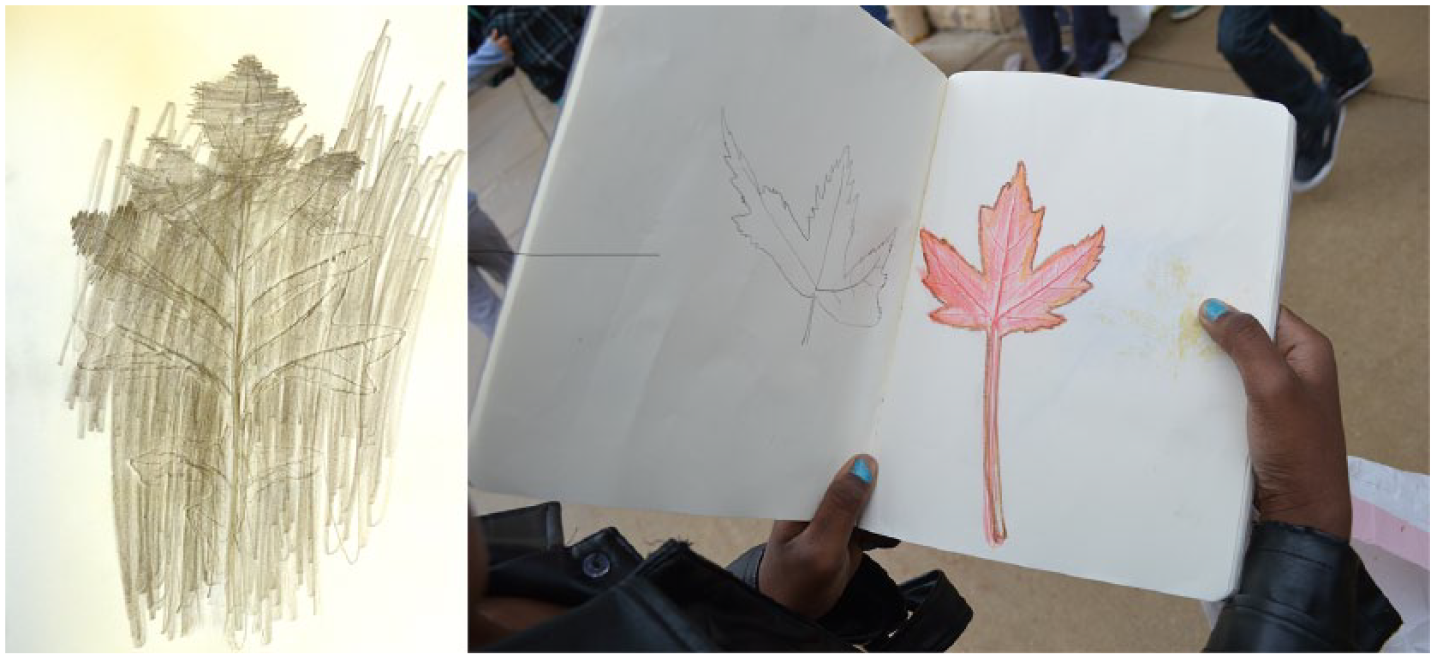
Tess and Ashata’s leaves rubbings.
Drawing as Resonance
I like to think in Ashata’s and Tess’ very different graphic renditions of leaves in relation to the concept of resonance. It allows me to consider these rubbings as a more than semiotic interplay of intensity and form. Intensity corresponds to the gestural movements occurring at the interface of Tess and Ashata’s bodies with things (pencil, paper, and leaves) as pure reactions that deliver marks in the paper. Form is associated to the expectation of body continuity, the possibility that a leaf-shape would issue. Intensity and form-taking participate in each other not as an organized sequence but more as the materialization of a vitality. Massumi (2002) describes this relation as one of resonation. In it, intensity, as a nonlinear and nonsemiotic process of vibration and movement, works in excess to narrative and function, but in accordance to the forces in the world (Grosz, 2008). With this idea, we can think of how Tess and Ashata’s rubbings enact a different play with intensity and form. In Tess’ rubbings, the array of loose lines in movement, twisting around each other, running loose and some not coalescing in a clean leafy structure, reveal “a process of movement and growth” (Ingold, 2013, p. 128). They express duration and reveal in the surface of the rubbing the affective dimensions of the image as event. Ashata’s clear and crisp graphics enact the interplay of intensity and form differently. Affect and the body appear tuned down to render the rubbing as a well-ordered symbolic convention of a leaf. Despite this, certain traces of material flux are still perceivable. If one touches the thick layers of crayon while attends to the vibrancy of the color mixes, the movement of Ashata’s body still resonates. As a Deleuzian, and Massumian concept, resonance produces sense from the middle of bodies and things; an assemblage of leaves, papers, pencils, crayons, bodies, and felt forces that operate compositionally. Art as a post-phenomenological research event occurs independently from an intentional subject and functions in excess to any semiotic construct.
Scene #2
Today I hung a documentation that includes more than a hundred images from pages of student’s visual journals. I needed a large space, so I placed it on one of the hallway walls and nearby the copy machine . . . As children left the class to use the bathroom, drink water, get something from the coat hangers, or simply have a walk, they stopped by the display. . . Tess came by the display alone. She slowly scanned across the display. After observing for a while, I couldn’t help myself and initiated a conversation. I said, “I noticed that you have been looking at the images for a while.” Tess replied, “Yes, what is this supposed to mean Mrs. Laura?.” I answered, “I guess what was important to me when I put these many images together was to share with everyone how many different things about the trees were happening in the journal pages. . . . I don’t know, what do you think?” Tess hesitantly responded, “I like the different leaves.” “Do you mind sharing some of the images that attract you?,” I asked. The question was followed by a silence. Tess quietly observed more. She moved across the space, with her eyes moving across images, and eventually began talking again and pointing out things. She uttered short, fragmented sentences, punctuated by moments of silence when she continued observing. “I like that some of the leaves that students chose are broken.” “Where?,” I asked. Tess pointed at two pages in different places of the display, one was a drawing of a maple leaf with a practically unnoticeable fragmented stem, and the other was a rubbing of a hackberry leaf partly chunked in one side. I notice these details for the first time as Tess pointed at them. Silence. “I like some of these . . . the mixing of rubbing and printing,” Tess pointed at some pages across the documentation, where other students had combined techniques. Silence. “Some colors are very pretty,” Tess signaled at a page with a leaf rubbing that fused strokes of blue and red crayon. Silence. Then she returned back to one of the images that she described as “leaves that are broken” and commented, “I like what it says here, the veins of the leaf look like a ribcage. I don’t think that the veins of any leaf look like a ribcage, but in this drawing they do.” (see Figure 2).
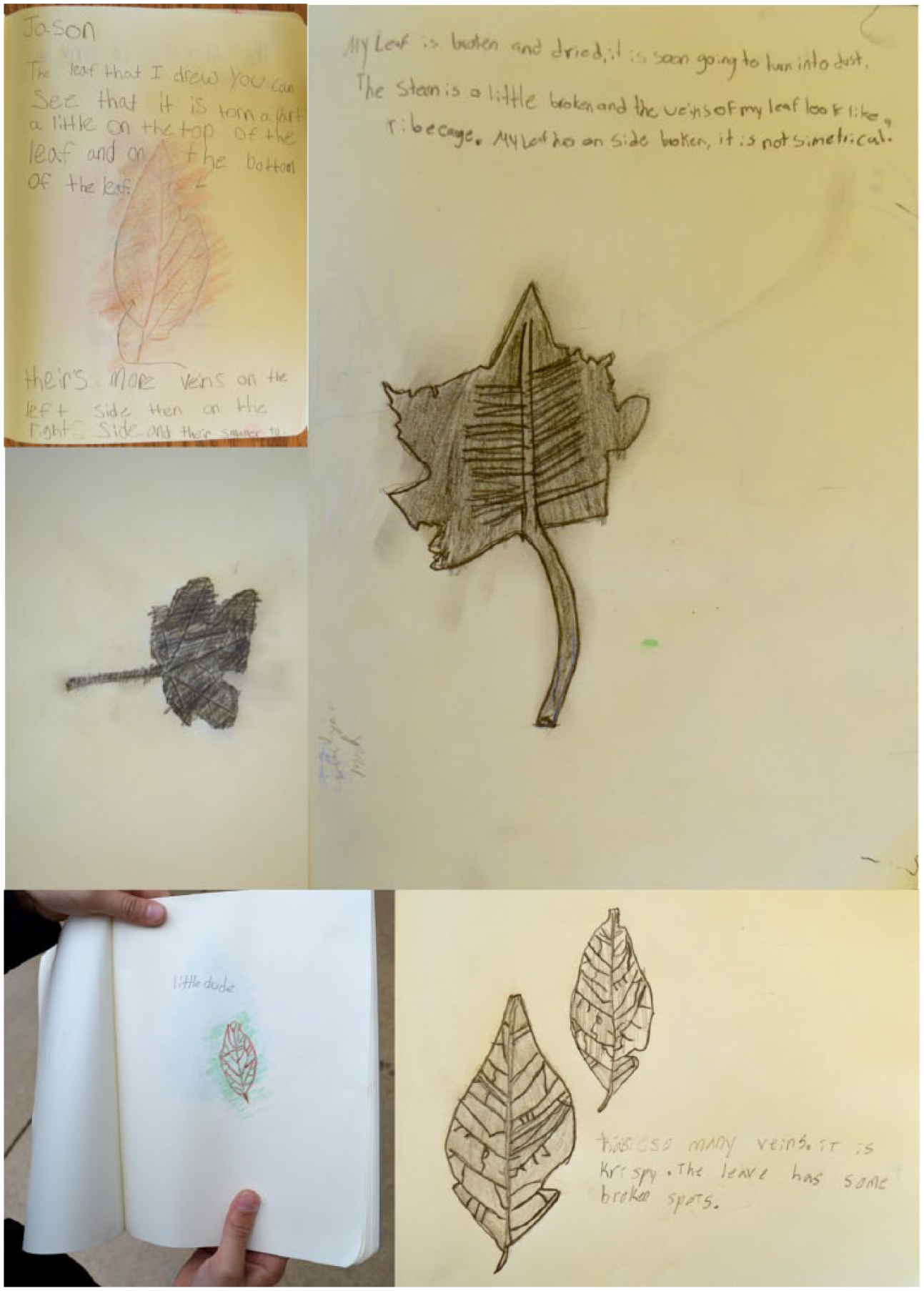
Broken leaves and leaf with veins that look like a ribcage.
Thinking-Feeling Semblance
We can think in the scene above as an event that relates to a typical concern of aesthetics, the perception of forms. Influenced by Bergson, Deleuze (1986, 1989) differs from phenomenological traditions that consider perception as something that begins in the subject and aligns the subject with the world. He instead proposes a view of perception that emerges as a cut from streams of undifferentiated movement and matter (Sauvagnargues, 2016). As De Freitas (2017) points out, Deleuzian theories bring a picture of perception not as connected to sense as meaning but to sense as sensation. In this case, perception is not a discernment of information but a highly speculative act that “disperses across a field of sensation” (p. 188). We notice in the scene how perception is not only an act of the eye but an animation of the senses. Tess moves, touches, speaks and possibly stills feels the material experience of making the drawings that now are in the display. De Freitas suggests that to perceive is to engage in a relational environment of accumulated sensorial and material experiences. In tune with this, Sauvagnargues (2016) describes perception as a pure material becoming where there are not subject-object distinctions. Massumi’s (2011) concept of semblance provides few additional clues of what this material becoming may entail. He affirms that in perception we don’t see objects, but we see in the form of objects. As Tess moves, looks, points, touches the display, she does not see leaves or drawings of leaves. What she does is to create a semblance, or a thinking-feeling of the object. In this what stands of the object is its vital affect: broken-leaves, and ribcages-in-leaves. Massumi affirms that this is not a experience of the thing but of its “likeness” (p. 49).
That likeness marks the object as a variation of itself. You perceive what it is like because in your life there have been other appearings “like” this one, and you implicitly anticipate more will come. The likeness is the invisible line of a continuing . . . The thing stands for itself, and for the difference from itself over time. Because in time it will appear episodically, under variation (Massumi, 2011, p. 49).
Similarly, De Freitas (2017) affirms that perception engages in continuous modulation and folds back into previous material and embodied happenings. Perception as a path toward becoming does not occur because we reorient our attention to more-than-human worlds, as research on childhood studies influenced by the new materialisms dominantly implies (Rousell & Cutter- McKenzie, 2019). It happens because a body becomes progressively extensive and porous over time blurring strict logical categories and depersonalizing. Tess’ perceptual activity with images of leaves is one that iterates, variates, and deviates because art encounters intensify and depersonalize the body to do so. These perceptual transformations do not occur through a relation with a phenomenal world but in a relation with post-phenomenological life worlds (art-as-worlding) that allow for the invention of new concepts to think and new realities to experiment with what is-not-yet (Olsson, 2013; O’Sullivan, 2016).
Scene #3
Today I showed Tess and Rishi the rough video footage of a young oak. Rishi disliked all the images. “I cannot see anything. This is lame,” he said. I discussed with him that to me some of the images showed interesting aspects of the tree. I also suggested that many of the images could be improved by slowing down the speed of the movements, doing some cropping, and brightening. I implemented some of these techniques on an image that showed part of the tree canopy against the bright blue sky. Both Rishi and Tess got excited about the changes. Rishi pointed at a number of images that he wanted to modify . . . I wrote down his instructions. Tess was happier with the images that she recorded. They contained close views of the canopy, the bark, a leave with spherical seeds attached to the back, revealing Tess’ movements around the tree. After looking twice at her footage, Tess pointed at few clips that she wanted me to get ride off because the movements and compositions felt “awkward.” She also asked me whether it was possible to keep the sound intact. I said that we could save the sound and align it with the images that she liked best. “I like what I said. I don’t want to record it again. It won’t be the same,” she noted. Just moments after this, Rishi argued, “I sound stupid. I don’t like to hear my voice.” I explained him that we could erase the existing sound and edit any other sound that he liked into the images . . . A week passed, and we met again to work in editing. I had all the images done according to the instructions that the two gave me. We reviewed them and began to discuss how to sequence all the footage, and how to add sound. Tess said that she wanted to add some footage of her visual journal, and she took a camera to record it. Rishi noted, “I don’t want to sound like me, I am going to rap.” He and me sat together in front of the images that needed sound and composed a rap that could work with them: “Oak is a tree, a tree against the sun. Leaves of my tree are smooth and floppy, dah. This is a leaf that felt on the ground. It is orange and brown and crispier that the ones in the tree. The bark has two small holes, we guess that it was either a woodpecker or a dope magical worm driving one of those magical vehicles with a drill, dah.” As Rishi and I worked on editing the rap with the images, Tess recorded us with one of the cameras. The final video-portrait contained the sequences of the rap against images of the tree, Tess original field images with very slight editing, and a “behind the scenes!” segment that included Tess’ visual journal, Rishi and I working together, and Rishi rehearsing the rap (see Figure 3).
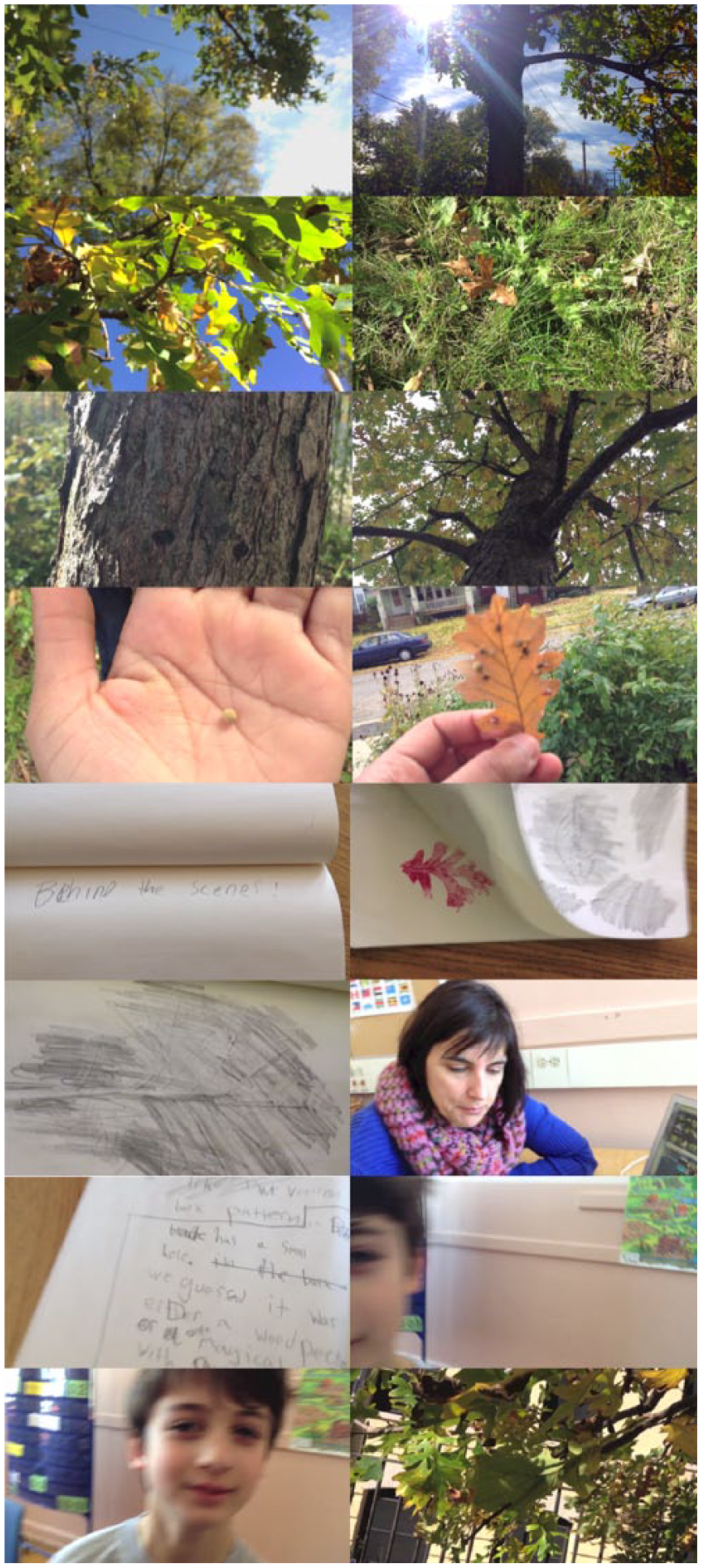
Selection of stills from the Video-essay of an oak tree.
Duration
So far, I have discussed how a Deleuze and Guattari (1987) and Deleuze (2003) aesthetics offer a philosophy of art that is not based on signification but on a physics of forces and sensation. This continues being elaborated in Deleuze’s (1986, 1989) cinema-philosophy books. In this work, Deleuze is highly influenced by Bergson’s thesis on the continuity of matter and perception formulated in relation to the new physics of perception that cinema as a new technology advances. For Bergson, matter, image, and movement are all the same, and exist in a universe of inexhaustible variation (Sauvagnargues, 2016). Thinking with cinema permits Bergson to formulate the concept of duration, which transcends the Newtonian idea of movement as the displacement of objects in space. Movement as duration is endowed with materiality, affect, and time, or as Sauvagnargues (2016) describes, movement vibrates.
Notice how Tess and Rishi when watching the footage, they see another reality than the one they felt-thought they saw when recording. It surprises them in different ways: the sound provokes Rishi’s aversion, and Tess describes some movements as “awkward.” Sauvagnargues (2016) discusses the capacity of cinema for extracting an alien point of view from the world with a different perspective and motor axis offering a continuous visibility, which in turn enables a new view and relation with the oak tree. What is important of this new view is not that the mediation of technology permits to see more or better but that depersonalizes and disembodies perception by offering visibilities, speeds, and scales that are not human. In doing this, cinema intensifies the vitality of images. Tess, Rishi, and I played with such intensifications by decoupling sound and image, importing and creating new sounds, refining framings, contrasting colors, and so on. We invented a new visibility and sonority for the oak tree.
The video-portrait of the oak tree is a dynamic composition where images and sounds emerge as actions and reactions related to other images and sounds in immanence. Duration is expressed as the energy of all the forces in play framed in a bloc of space-time or territorialization. As Grosz (2008) writes, The plane of composition is the field of all artworks, all genres, all types of art, the totality of all various forms of artistic production in no particular order or organization, that which is indirectly addressed and transformed through each work of art. (p. 70)
This quotation suggests that the video-portrait of the oak tree is a strange becoming that does not originate in the lived experience with the tree but from an event that erupts in-the-making of the artwork itself. It is making what intensifies Tess and Rishi’s bodies and propels that the video besides being the tree, it could also be drawings, a behind the scenes moment, a rap, and, and, and, and.
Colebrook (2001) affirms that in thinking with cinema Deleuze is not only considering modalities of thought characteristic of this art but how cinema can offer a philosophy “that forces us to confront the very becoming and dynamism of life” (p. 30). An idea that seems apt to end an article where I have foregrounded art as a compositional field that makes possible a thinking of the world based on distance, composition, and invention that deploys new possibilities of existence (O’Sullivan, 2016). A thinking that has in common with post-phenomenological life worlds forms of production that enact excess. In the philosophy of Deleuze and Guattari (1994) art is a frame or threshold through which such excess can resonate and affect the surface of bodies in ways that over time propel these bodies to be more of what they think they are. In this respect, art and aesthetics can inform empirical practice in urbannaturechildhood research centered on allowing strange, alien sensations to be perceived and affected. With aesthetic concepts such as those of resonance, semblance, and duration, I have considered empirical gestures that entertain the territory of the school block and Tess’ aesthetic activity as based on complex correspondences of bodies and materiality in ongoing form-taking activity. Art practices as empirical gestures are neither to represent, nor to organize the world but to write, draw, rub, video with it to intensify, extract sensations, enact unexpected participations of the senses in each other, and make bodies live lively.
Footnotes
Declaration of Conflicting Interests
The author(s) declared no potential conflicts of interest with respect to the research, authorship, and/or publication of this article.
Funding
The author(s) received no financial support for the research, authorship, and/or publication of this article.