







Abstract
If you are troubled with the way we know the world, with the “traditional” academic sets, with the way certain bodies (maybe your body too) are treated, and with the way certain things are hidden and excluded in academia, so this text is (maybe) for you! . . . if you think “science” is the way to know the world, “valid” knowledges are made in academic sets, and papers represent the “scientific product,” this text is also (maybe) for you too! Playing with our personal/political stories, we do a co-performance autoethnography to honor different way of knowledge. We invite you to think with us about science, resources, and possibilities embodied in our texts, in our lives.
Standards for assessing quality research are pedagogies of practice, moral, ethical and political institutional apparatuses that regulate and produce a particular form of science, a form that may be no longer workable in a trans-disciplinary, global and postcolonial world. (Denzin, 2009, p. 140) Who can speak for whom? Under what power relations? Which bodies continue to determine what constitutes legitimate scholarship [or science]? Which bodies continue to be excluded from the making of scholarship [or science]? (Moreira & Diversi, 2011, p. 230) “I thought you did science !?” I do science. In fact I do not do your “science.” There is no “data” in my practice. There are bodies. There is my body. In contact with other bodies, my body interacts and I-as-other have the possibility of existing. Making the personal political History/knowledge can be retold/remade. In this existence, in this place, I do science! Maybe for you my body does not exist. Or maybe it can exist only as data. But for me it is very real. A palpable reality, close, subjective and not at all neutral, who follows me in every moment that I do science. And your body, where does it exist?
On several occasions of our personal and professional formation, we came across questions about science. Before we could even respond to each of these questions, we were reminded of earlier moments in which that same question had been asked.
In some of these moments, we realized that our bodies sought to articulate an answer to describe the “science” we are doing. But even before we uttered what we had thought, those who questioned us had already given an answer that was often “opposite” to ours, demarcating the border of “what it is” and “what it is not” “science.”
Although these memories, questions, answers, and demarcations embodied in our existence, which is crossed by a multiplicity of positions and performances that we make and are made by, we try to resist the rigid and exclusionary concepts of science, where the possibility of different bodies can exist, not only as the honorable subject but also as the academic knowledge.
***
Do our objective here is to “demonize” science? Or to negate how human beings have benefited from it in our long existence in this planet? Or even to question the socially constructed concept and practice? . . . But, how power operates? Who benefits more? Under what circumstances? What are other possibilities of being and doing knowledge production committed with the principals of social justice—more dignity and respect for all and not only for the ones who look like us, or have the same desires, or believe in the same Gods?
***
2016. I’m tired. It seems that all the time I have is consumed by to justify my research and my choice for performance autoethnography. It’s like an eternal “coming out of the closet,” permeated by the expectation of “rejection” or “acceptance” of this analytical and reflective perspective, of . . . me (?) . . . And I do not know how . . . but when I finally feel free, outside, I find myself again between the closet doors.
Who puts me there again? Them? Me? Why do I have to escape again with each new meeting?
I have noticed that in many moments, due to the fear of being invalidated by others in the academy community, I end up masking my research with “technical” terms or quoting famous illustrious scholars, to somehow avoid criticism and find legitimation. But what I did not realize is that, with this mechanism, I end up entering their validation mechanism and thus negating what I do.
See! I also play a role here. Why would they have the authority to judge what I’m doing? The answer is clear, right? Who let they do that?! Me, again? Maybe. . . Enough! Meeting today with my colleague—a white heterosexual male engineer professor
was the last one that I hided my body, my practice, my research. You believe he told me, “I thought you did science! As a physician, I imagined you in a laboratory, researching the cure of cancer or some disease.”
***
2019. Let me start saying that I don’t do science. I don’t contemplate my work as science.
Performing autoethnographically is how I see my journey in academia . . .
Theorizing survival.
Theorizing from and with the body, my body, in the places I live and labor, in and from the borders I have crossed.
I see my fight not to have my work view as scientific . . . I fight for resources, for the right to do my work inside academic walls. To place my body inside the ivory tower as a public intellectual and not the honorable subject.
Interesting, how come the question of what I do is science is not that appealing to me?
Should I ask this question?
***
1996. One of my favorite cartoons just started. In the television room of the privilege of my house, I watch “Pinky and the Brain.” It was not very common for the houses in Brazil to have specific rooms to watch television, but in my house, I have. It is also not very common for houses in Brazil to have flat-screen TVs, bigger than 40″, but in my house, I have that too. At the same time, it might not be all too common for children to have a sheltered time to watch cartoons in the morning while maids take care of the housekeeping, but in my house, I do have.
I had fun with the plots of two lab rats that sought to take over the world. Imprisoned in a cage, inside a laboratory meant to “do science,” these two “friends” would articulate at night shapes and experiments to achieve their goals.
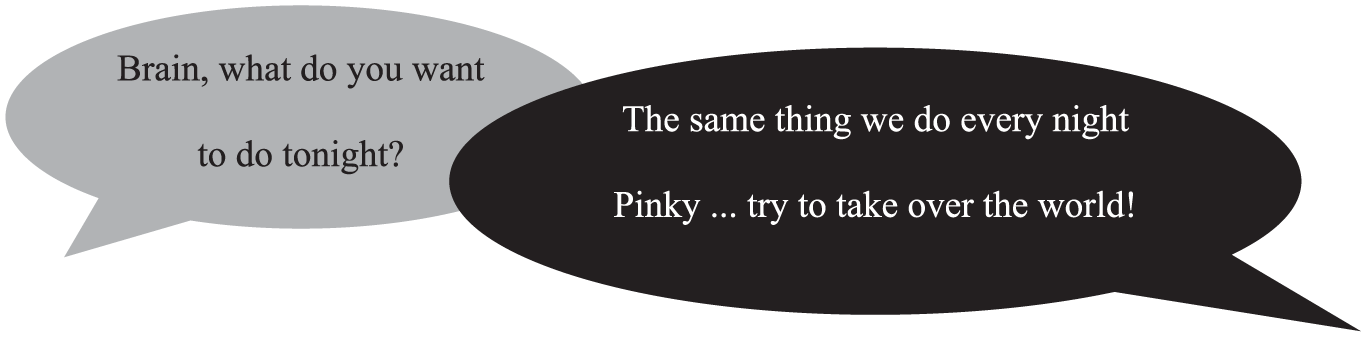
Brain, a genetically modified white mouse of small stature with reddish eyes, with an apparently older face, a crooked tail, and especially a big head, carries in its own body and name the representation of intelligence. An attribute that is often located in the brain, the rational center of our body, and that functions as a “fundamental prerequisite” to do science, right?! Wait a minute, couldn’t it just be a coincidence that his name is also the name of a part of the body?! Or, still, couldn’t it only be a backronym for the eponymous project “Biological Recombinant Algorithmic Intelligence Nexus” (Hastings & Spielberg, 1998)?! Or, couldn’t Brain be related to what we consider as masculine?!
Pinky, his cage and adventure friend, also a genetically modified mouse, has an appearance opposite of the Brain—tall, blue eyes, seemingly more youthful face, straight tail, and small head. His personality is marked by instability, hyperactivity, and emotionality. It seeks, at all times, to help the Brain to take over the world but by being “inattentive,” he distracts himself with trivia, television programs, and the “pop culture” fads. Therefore, he ends up disrupting Brain of his conquering the world dream. But what is the relation of the Pinky’s characteristics with what to do or not to do in science?! Couldn’t Pinky represent what can stop the brain from working?! Or, couldn’t Pinky is related to what we consider as feminine?!
But in today’s episode, one more character came on the scene—Snowball. A hamster of brown color, also genetically modified, of medium stature and red nose, with a face apparently older, and, mainly, with a big head. Former friend of Brain, but now a rival, also had the desire to take over the world by its extreme intelligence and revenge of the Brain. For this, he used methods of “brainwashing,” blackmail, and corruption. Even with Brain humiliating and abusing Pinky, I have a greater aversion of the Snowball that looks really bad. Does Snowball represent the “bad” characteristics of a scientist, which it opposes of the partnership between intellect and emotion?! But why are these elements of villainy in a Brown character?! Couldn’t Snowball be related to what we consider as the excluded, dangerous, stranger, Other?!
I had fun watching this and other cartoons. Permeated by laboratory mice, villains, white coats, test tubes, microscopes, and other laboratory equipment, they marked “The” place of “science,” as well as the producers and consumers of this “science.” The curious thing is that all my cartoon memories that had a relation with “science” were carried out by masculine and White characters, and their “enemies” sometimes were Brown characters, or they were other White masculine personages. The few female characters appeared sporadically and in a supporting role. Besides that, all these cartoons were North American and/or referred to the United States. Is this just a coincidence?!
But what if I did not have the privilege of having a television, of having protected time to watch cartoons, of identifying myself as White; what would my perceptions of “science” be like? And if the possibilities that what we become are related to the possibilities of performance that we have access (Madison, 2003), how many possibilities I learned with these cartoons? I learnt the first lesson: SCIENCE IS MADE BY . . . WHITE AMERICAN MEN And then I realized the second lesson: SCIENCE IS CREATED IN . . . LABORATORIES But, remember, . . . 2016. “I thought you did science!?”
***
2019. I am tired too!
Different bodies in different moments in our academic careers.
Surviving in the margins from the margins in academy
Unlike yet similar stories
In life
I don’t justify my work, my being anymore. I am not sure if I care enough for the concept of science. Differently from Gustavo, my grad education happened in the United States, not in Brazil; in communication not in public health. Gustavo is, after all, a physician. My fighting is not to be included in the concept of science, but for a legitimation of performance autoethnography as a form of academic knowledge construction as legit as others.
Because, why would I want to have my work, my being, to be part of such colonial project?
Smith (1999) words come to mind: From the vantage point of the colonized . . . the word “research” . . . is probably one of the dirtiest words in the indigenous world’s vocabulary. (p. 1)
Sometimes I wonder if in trying to fit our words in concepts, such as science and research, don’t we end up doing what we are trying to criticize? Don’t we all walk in a tight rope after all? As Guba and Lincoln (1994) wisely stated that paradigms come first.
Because I understand what I do as an ontoepistemological endeavor (Barad, 2003)—as being-in-knowing, and a being-in-doing, where “practices of knowing and being are not isolatable, but rather they are mutually implicated. We do not obtain knowledge by standing outside the world; we know because ‘we’ are of the world” (Barad, 2003, p. 829).
Is that a science? Again, do I care enough?
I write and perform. I live and labor. . .
Writing bordercrossing body
Schizowritingphrenic being (Moreira, Spry, & Wyatt, 2013) that I am, I write from despair and hope; from struggle and joy! I write to survive!
***
2008. Introduction to Scientific Thought. Second year of medical school. Among a mostly White, middle-upper-class, heterosexual group with a larger number of women, there I am. Looking forward to the new subject I’m about to start, I decide to sit straight ahead in the classroom next to my friend. But among the corridors of that university, we have both heard a cautious warning about this film. Some students who have taken this class before warned us that this film was boring and useless. But we are still excited because we want to become scientists and professors one day.
I have already understood by whom science was made and where it was created, but I still have not seen anything about it in the university, known as the place of knowledge, right?! Unable to remove my eyes from my thoughts, wandering in the space about what would be “doing science,” I realize that the professor had already arranged all the devices. “The name of the Rose” (Eichinger, Schaefers, & Annaud, 1986). Lights are turned off, sound is tested, and the movie starts.
I feel Sleep inviting me to rest, because it’s 7 in the morning. Like the one who makes himself present without being noticed, sleep decides to sit next to me. On the other side sits Curiosity that at various moments calls me to a parallel conversation during the film.
“Silence you two!” I said to both, Sleep and Curiosity. “You’re getting in my way of paying attention to the movie. I have already said that I want to be a scientist, let me learn it!” Even so, I hear Curiosity whisper in my ears several questions: “what ‘rose’ would be this? And why this romantic title for a movie that approach ‘science’?” “True, those are good questions.” I said to Curiosity, “but be quiet! I need to pay attention, because this movie will be in my finals. And do not forget, I want to ‘do science’ someday.”
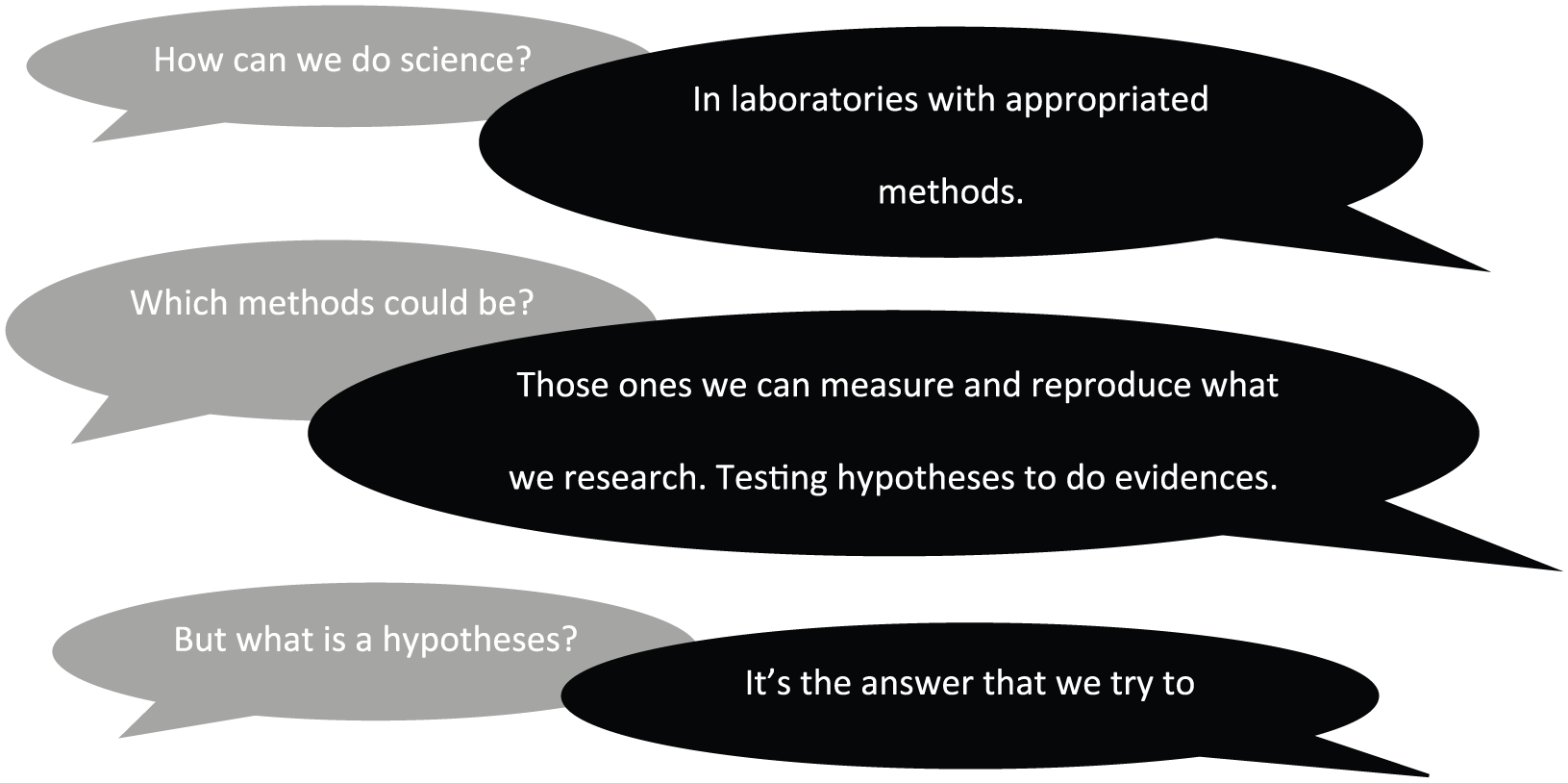
Sleep gave up sitting next to me and found better company in another corner of the room. But Curiosity stayed here, by my side. With an interesting plot, permeated by the mystery of events in obscure times, in which the power of the Church, or the State, demarcated the limits of knowledge, a monk sought to “do science” and find “the cause” and “solve” “the problem.” Filled with reflections and doubts about this film and science, a small debate arises: I got it! I learnt the third lesson: SCIENCE NEEDS . . . APROPRIATED METHODS MENSURABLE DATAS REPRODUCIABLE DATAS HYPOTHESES And then I realized the fourth lesson: SCIENCE TARGETS . . . TO CAPTURE THE REALITY TO CREATE EVIDENCES! But, can you remember that . . . 2016. “I thought you did science!?”
***
“The politics of evidence” (Morse, 2006) come to mind: Evidence is something that is concrete and indisputable, whereas politics refers to “activities concerned with the acquisition or exercise of authority”—Abate. (p. 395)
“The elephant in the living room” (Denzin, 2009) come to mind too: . . . the politics and political economy of evidence is not a question of evidence or no evidence. It is rather a question of who has the power to control the definition of evidence, who defines the kinds of materials that count as evidence, who determines what methods best produce the best forms of evidence, whose criteria and standards are used to evaluate quality evidence? . . . The politics of evidence cannot be separated from the ethics of evidence. (pp. 142-143)
***
2019. Tired? Yes, of dealing with rigid academic walls and of being defined by what I am not!
Not scientific enough!
See, I remember as well
Remember taking a sociology class in my master program where my professor told me that my final paper was only story telling. . .
Yes, it wounded me. . .
Different bodies in our historical moments. . .
Maybe I need to remember more. . .
***
Somewhere in the time.
I never watch this cartoon growing up. But, after reading Gustavo’s description of it (and a very brief search on the net), I believe I am in the Snowball team. . .
Science is made by White American men, he said. . .who wants to be in such a boys’ club?
Yet, I remember
The same sociology class, with the same professor.
The year is 2001, the name of the class is Social Inequalities in Latin America.
I remember the week in child labor. I remember being unhappy with the book assigned. I remember critiquing the book. I remember the professor asking me from what texts my critiques come from. I remember my answer saying that they didn’t come from any texts but from working since I was 10 years old. I remember the professor dismissing my comments, dismissing my life, ditching me!
I deeply remember reading that book and not finding my life in these pages.
Not able to simply exist in the book, in the classroom, in the academia.
Yes, I remember the desire to forget.
***
2016. After several emails and requests for reconsideration about the “denied” stamp in my doctoral research proposal, I was able to schedule a meeting with the Human Research Ethics Committee (equivalent to the Institutional Review Boards of the United States). Until that moment, I couldn’t understand the clear reasons for this refusal.
What about my proposal was considered unethical? For whom? Under what circumstances? Or Was it not a legitimate way of “doing science”? Remember: for whom? Under what circumstances? Or Am I not legitimate in this space? Remember: for whom? Under what circumstances?
With each step toward the meeting room, I feel my heart more and more apprehensive and the air, that made me breathe, now seems to no longer exist. With a claustrophobic feeling, which I can’t understand, I knock the door. “You may come in.” I’m going inside. Not knowing what to say, she told me to sit down and wait.
***
Somewhere in time.
I find myself thinking about my journey of “doing science.” I have known for some time that science is still predominantly male, White, from the North, with a valuation of research conducted in large laboratories, with appropriate methods for measuring hypotheses, which can be reproduced, creating “evidence.”
But what about my gay body? Where it is? How to think all these things and disconsider the historicity of my existence that goes through the research? Does it make sense? Is my life a bias that should be hidden by strategies that do not make explicit the body of the researcher? Or am I getting itwrong? But, by silencing my body, my experiences, my embodied reflections, wouldn’t I be reproducing a practice “about” and not “with” my body in relationship with others who touch my life? Am I making sense?
***
“Writing with and not about” (Conquergood, 1991) “Performances of possibilities” (Madison, 2003) “Making the personal political” (Holman Jones, 2005)
***
2016. After a few minutes, my mind still filled with questions, I hear noises from a person walking down the hall. At each step, the noise is made more and more present and the air becomes more and more absent, as to indicate that person who was walking in the room would probably enter.
In a few seconds the door opens, and a woman enters the room.
“Professor, the young man you have an appointment with is already waiting for you.” “Oh yeah, you must be the one that is proposing to do a research about the third-sex, isn’t it?! Come into my room to talk. I invited two more professors to discuss it.” Why couldn’t she talk just with me? Isn’t Science always talking to itself? What’d authorize she to invite two professors to talk about . . . my research, my body? Would it be the positions in the academic hierarchy? Would it be my commitment with the exclude bodies? Would it be the “protection” of her or of me? Would it be the “maintenance” of the system? But what is this “third sex”? My love life? Why would the first reference about my research be this term? Would it be because it’s an “unexpected” e “innovative” research proposal? But, isn’t this what we should do in the academia, especially in a doctoral investigation? Or should we do the same “forever and ever” with a “happy ending”? Again, for whom? Under what circumstances? Could this be related to a supposed unethical and/or illegitimate research? Again, for whom? Under what circumstances?
I am just proposing a performance autoethnography research with my gay body in contact with other bodies in a medical school where I work as a doctor and a professor.
AM I ASKING TOO MUCH?
What I want to understand are the performances of possibilities for non-hegemonic excluded bodies in a markedly
masculine, white, heterosexual, middle-upper-class educational space.
***
2016. Not quite understanding the initial questions, I follow the professor to her meeting room. Between two other professors, a man and a woman, I begin to feel the environment turn and I realize that my trial has begun. My body feels the need to defend itself and protect it from the accusation of denial and the “legal” impediment of not being able to exist in that space destined to “produce knowledge,” to “do science,” also known as academia.
With a large book in my hand, from internationally known authors, published in American universities, I thought I was a bit protected from what I could face because as a good defense attorney it could “clear me.”
But why had I turned to American authors?
To feel protect by the so-called “producer” “first world” “neometropoly” ?
Or was it because they published a specific book on performance autoethnography more than 20 years ago?
***
2019. Our position here is not to “demonize” science. Neither to negate how human beings benefited from it in our long existence in this planet . . . but to question this socially constructed concept and practice. . .
We cannot forget that performance autoethnography wasn’t created with the sole purpose to answer questions from the dominant paradigms . . .
As Stuart Hall (2010) reminds us, “without guarantees.”
From the intersection, the clash of social sciences and the humanities, anchored in the researcher’s political body, creating alternative ways of reading, being, doing . . .
Existing
***
2016. The judge sitting in front of me, literally in a higher chair, asks the jury, the two professors, to report their opinions in response to my request for reconsideration of the previous refusal. I was expecting several arguments against my request because in the previous protocol, the negative had been based on the “extreme subjectivity of the research” and the “biased results” that could be produced.
To my surprise, the other two professors were in my defense.
But the “judge” was full of opposing arguments even in the face of arguments favorable to research.
How will you do a research on what you think the people talk about you? [Insert here a scientific “valid” answers] How Are you going to be this “researcher-and-other”/“researcher-as-other” (Alexander, 2005)? [Insert here a scientific “valid” answers] How will you insert your body in the research? [Insert here a scientific “valid” answers] How will you protect yourself from possible lawsuits of your research? [Insert here a scientific “valid” answers] How Will you protect your institution? [Insert here a scientific “authorization” to develop this research] . . . Ok, so be a “spy.” . . . Several ways to move me away Without saying explicitly “get out of here”! Several ways to deny my personal existence to protect the institution Without saying explicitly “you don’t belong here”! Several ways to ask me to shut up Without saying explicitly “silence”! Several ways to . . . Without saying explicitly “. . .”! I learnt the fifth lesson: SCIENCE NEEDS . . . NEUTRALITY OBJECTIVITY DETACHMENT DENIAL OF THE BODY And then I realized the sixth lesson: SCIENCE (TRY TO) (RE)PRODUCE . . . THE HEGEMONYC POWER! But, can you still remember that . . . 2016. “I thought you did science!?”
***
“Beyond the text” (Conquergood, 1998) come to mind: Every power, including the power of law, is written first of all on the backs of its subjects—de Certeau. (p. 28) The ethnographer, in Geertz’s scene, stands above and behind the people and, uninvited, peers over their shoulders to read their texts, like an overseer or a spy. (p. 29)
“Autoethnography below equator” (Brilhante, Moreira, & Catrib, 2016) come to mind too: . . . all of us, academics, in one way or another, are responsible for the oppression spread around the world; from the complicity that our theories and methods historically have with the colonial project that creates and perpetuates exclusionary forms of knowledge about others. (p. 481)
***
1990s. Neutrality, detachment, distance . . . in many ways it is so easy for me to see the appeal of performance autoethnography for the beginner grad student I once was. Refusing the erasure of my viscera, of my being.
I remember that much later, toward the end of grad school, an offended professor telling that my work was not in any shape or form an example of social science. I remember sarcastically saying “thank you . . . for saying that. I try very hard not to be a social scientist.” Of course, it did not end well for me. The professor refused to accept my performance autoethnography paper as my final exam in her qualitative methods class. I had to recover some old interviews from my master years and create a half ass analysis of a work I did not care for. At least I got a B in the class. A B is really bad in grad school, but at least it was a passing grade that did not affect my student visa status. . .
Silenced and dismissed by. . .
The powers to be?
I guess I did not have “authorization to talk,” to do research. . .
I don’t think I have a desire to do science!
***
2017. Another meeting I just have. After several resources of silencing me have failed, I finally have the “authorization” to talk. After this meeting, I realize that I’ll face a lot of battles because between my peers, I will have many confrontations. The path of legitimation of performance autoethnography is as long one.
This encounter only reveals this to me because when I talked with my colleague—a white heterosexual upper class professor,
about what just happened, I realize another feature of invalidation or disqualification. After talking about my research and all the developments so far, she says, “ohhh, so your research is theoretical!”
I feel that by saying that the value, at least in the Brazilian medical field we are inserted, is directly proportional to the technical aspects of (implementation of) a research project. In this game of differentiation and exclusion, I feel disqualification and invalidation, expressing a hierarchy that erases what is not considered “experimental and applied science.”
But what is the point of separation between theory and practice?!
Would talking about my body in interaction with other bodies, with culture, be something only theoretical?! Aren’t we dealing with people’s lives including mine?
Are these interactions not practical?!
Performance autoethnography is always about how we use theory to understand lived experience, and our lived experience, our bodies, our lives, change and transform theoretical concepts.
So, is it really important to remember that . . . 2016. “I thought you did science!?”
***
2019. Couldn’t we recreate the concepts of science to include other possibilities? I totally understand that this concept is related to White, men, supremacy, domination, and colonization and can be considered as a “dirty word” (Smith, 1999).
We can enlarge this concept without denying any of this history. We can think about a kind of “recovery science,” starting by displacement (Minh-ha, 1989) and border crossing (Anzaldúa, 1987). But, wait.
Why I want to maintain this concept? For all of us, for me, for them? Isn’t it possible just do something without naming it “science”? Still remember: for whom? Under what circumstances? And what’s the problem to do what I’m doing without being considered scientific? For all of us, for me, for them? Why can’t I just explore other possibilities beyond the “science” boundaries? Still remember: for whom? Under what circumstances? But, leave this quote alone! 2016. “I thought you did science!?”
Because, We write with the hope we will invite historically marginalized outcasts into conversations about decolonizing knowledge production in academia. (Diversi & Moreira, 2017, p. 41)
And, please, remember what Anzaldúa (1987) pinpoints: The future depends on the braking down of paradigms, it depends on the straddling of two or more cultures. . . . The work of mestiza consciousness is to break down the subject-object duality that keeps her a prisoner and to show in the flesh and through the images in her work how duality is transcended. (p. 80)
***
2019. Perhaps, I positioned my body in this narrative trying to evoke Bacon’s (1979) notion of the distinction of tensive in contrast with tension (conflict) as constructed by Alexander, Moreira, and Kumar (2012): . . . in which tensiveness signals the presence of oppositional entities at odds with each other, yet held in a kind of stasis creating balance and unity, invoking the very life blood of the text. (p.132)
I am not trying to dismiss or negate Gustavo’s inquiry with the concept of science, or how it is hegemonically constructed. Neither trying to change his thoughts per se. . .but attempting to create a pull and a push with our somewhat different positionalities in this performance text, and in our lives. . .with the dynamism present in our current approaches to theory and scholarship.
Hence, I hope that my disgust? (it may be a too strong name for my feelings) for the word science and research does not influence much, just a little—kidding but not really—Gustavo’s own positionality toward such concepts, we both are not here for this. So,
***
TODAY. Perhaps you, reader, can read this text and think that it is a personal narrative, stories, performed by someone who insist in seeing the discussion about performance autoethnography moving away from the “it is science” conversation, to a discussion of resources that goes behind legitimacy. It is the hope that other Gustavos and Claudios and Nelsons don’t need to leave their land, to travel thousands of miles to learn and work . . . that grad students can immerse in this theory/method without the fear of retaliation on the job market . . . the same for assistant professors, where the discussion becomes a matter of how to help and support them to succeed and not a problem with their scholarship . . . it is not only a simple matter of legitimation . . . performance autoethnography is here . . . I am a tenured professor after all and there are others. . . books, articles, performances are out there to be found . . .
Resources!
***
TODAY. Perhaps you, reader, can read this text and think that it is personal stories or fiction or stories of resistance, performed and revived by someone unknown who insists (maybe not anymore) on “doing science.” Between this “story-telling,” permeated by short or long quotations, my body is presented in a scientific logic that insists on questioning. How much longer will we silence or deny oppressed bodies to find what we believe and call “truth,” “evidence,” “science”? However, the question remains . . . “whose science? Whose scientific principles?” (Denzin, 2009, p. 141).
Besides that, this text is the hope that other Gustavos and Claudios and Nelsons can exit in the system of oppression that we live in our countries, in our societies, in our workplaces, in our relationships, breaking the hegemonic silence imposed over excluded and missing bodies in the side of the academic walls. If we bear the fear of criticism and misunderstanding, maybe we can seek help and support from other scholars and thinkers who came before us. But now, as for me, I prefer to think in terms of Conquergood’s caravan: “a heterogeneous ensemble of ideas and methods on the move” (Conquergood, 1998, p. 34) that move people into action and not only provoke emotional reactions, promoting . . .
Possibilities!
Footnotes
Acknowledgements
We would like to thank Professor Danilo Borges Paulino who through his generous reflections and debates allowed us to improve this text. We would also like to thank the Coordination of Improvement of Higher Level Personnel–Brazil (CAPES) for the scholarship.
Authors’ Note
It is the authors’ first time writing together.
Declaration of Conflicting Interests
The author(s) declared no potential conflicts of interest with respect to the research, authorship, and/or publication of this article.
Funding
The author(s) disclosed receipt of the following financial support for the research, authorship, and/or publication of this article: The first author received a scholarship by the “Programa de Doutorado Sanduíche no Exterior” (PDSE), number 47/2017, process number 88881.188456 / 2018-01 from CAPES, to be a visiting scholar at UMASS Amehrst (2018-2019).
