







Abstract
This article argues for a culturally relevant methodology that can aid minoritized and justice-oriented qualitative researchers in amplifying and sustaining the cultural epistemologies and counter-stories of minoritized research participants. The author uses the hip hop aesthetic of sampling as a structural metaphor to assemble the elements of a culturally relevant methodology capable of protest by sampling from the arts-based method of poetic inquiry, culturally relevant pedagogy, and critical race theory. This article explains criteria for a culturally relevant methodology of critical poetic inquiry and provides examples of research poetry that meet the criteria.
Keywords
In this contemporary moment characterized by frequent, overt attacks on minoritized (Gutierrez & Rogoff, 2003) people in their own communities and in the academy, it is imperative that scholars alongside community members and practitioners effectively use tools that aid us in learning, living, and altering life in an era of oppressive politics, polarized schools, and endangered community spaces. The protests that respond to these conditions require an interrogation of the American society and the tools for meaning making in ways that have global implications. For example, the Black Lives Matter Movement, Women’s March, #MeToo Movement, Dakota Access Pipeline protests, protests that followed the Pulse Shootings, and March for Our Lives are protests that countered the oppressive master narrative. Critical qualitative researchers worldwide need tools appropriate for liberationist objectives that can respond to present and future protest movements.
To achieve a liberatory research praxis, I turn to the hip hop aesthetic of sampling, characterized by taking previously recorded music and piecing it together with a variety of techniques to create a new instrumental track (Petchauer, 2015; Schloss, 2004). In this article, I propose a sampling of poetic inquiry (Faulkner, 2009; Leavy, 2015; Prendergast, Leggo, & Sameshima, 2009), critical qualitative research (Denzin, 2017), and culturally relevant pedagogy (CRP; Ladson-Billings, 1995, 2014) to argue for critical poetic inquiry as a culturally relevant methodology. By sampling elements of each, I propose a new entry into qualitative research for researchers and participants that do not neatly fit into the White, hetero, Western identities sanctioned as “normative” in academia. In addition, this method assists scholars who do share those identities and seek to do “ethically responsible activist research” (Denzin, 2017) that centers the voices of minoritized populations. I argue critical poetic inquiry is an entry point for minoritized scholars and participants to protest dominant, eurocentric epistemologies, research texts, and societal injustices. This article outlines the purpose, process, and product of critical poetic inquiry as one culturally relevant methodological tool.
I will specifically focus on my minoritized identity as an African American, woman, and poet-researcher conducting a poetic inquiry study on minoritized youth civic actions. The data and research process referenced in this article are from a larger study on minoritized youth activism. The purpose of this study was to amplify minoritized youth voices and propose a counter-narrative to the existing deficit-based views of minoritized youth civic actions as one way to develop an engaged youth citizenry in the democratic society. The research questions for this study were as follows: (a) In what ways are spoken word poets aged 18 to 21 civically active and why? (b) How do spoken word poets construct civic identities? (c) How do schools, community centers, or digital contexts influence youth poets’ civic actions and identities? The participants in this research included 15 American youth who earned the title of Youth Poet Laureate for their city based on a record of civic action and literary excellence. The critical poetic inquiry methodology used for this larger study is used in this article to provide examples of critical poetic inquiry as a method capable of being a culturally relevant tool of research and protest.
Sampling Liberationism and Methodology
Freire’s (1972) call for the work of liberation to be understood as the process of working daily to become more fully human is fitting for this discussion of poetry as a research tool because poetry is also a process of becoming. Leggo (2005) argued for poetry as ontological, noting “poetry as a way to be and become in the world” (p. 2). In addition, Black American poet and activist Amiri Baraka articulated that poetry is a process of discovery. Situating poetry ontologically as a way to become and discover makes it an excellent tool to do the work of qualitative research, which seeks to capture and understand the human experience (Savin-Baden & Major, 2013). As researchers and oppressed participants work daily to become more human, tools are needed that can partner with them to fully traverse the messy terrain of both liberatory research and human becoming. Furthermore, my argument here is not for any qualitative research but one that can allow persons too often silenced, made invisible, and negatively represented to exist and become fully during the research act. I propose that with a culturally relevant methodology the research process can assist the oppressed in accessing liberation as well as protesting injustice.
Criticalists call for action-oriented research efforts that not only chronicle social inequities but also participate in confronting and disrupting them to achieve a more equitable society. In explaining the present place of critical qualitative research in the field, Denzin (2017) noted the need for a new generation of engaged scholars leading “decolonizing methodological projects.” Likewise, Ladson-Billings (2012) reminded educational researchers that race continues to condition research and therefore requires researchers and methods capable of addressing race in equitable ways for all. Finally, Paris and Winn (2014) offered humanizing approaches to qualitative research that “involved building relationships of care and dignity and dialogic consciousness raising for researchers and participants” (p. xvi). I continue in the traditions of these critical qualitative researchers by proposing critical poetic inquiry methodologically be understood as a liberationist praxis.
Liberatory praxis is one way to prepare the oppressed and their allies to engage in the fight for equity. Liberatory praxis requires an epistemology rooted in culturally relevant content, a belief that all people can learn, valuing multiple forms of knowledge, and viewing learning as a process of mining for knowledge (Freire, 1972; Ladson-Billings, 2009). Furthermore, a Freirean (1972) liberation is dialogic in nature. Freire argued that a liberationist pedagogy for the oppressed is rooted in dialogue among the educator, society, and the student. He defined dialogue as the word, which is a praxis rooted in work. For Freire dialogue required both reflection and action together. The word with only reflection without action was mere chatter. The word with only action void of reflection was dangerous and uncritical activism. Most importantly, Freire stated clearly, “there is no transformation without action” (p. 87). Freire’s statement leads me to argue that critical poetic inquiry is a form of dialogue that amplifies minoritized researchers and participant voices and serves as an act of protest. I propose that the principles of liberationist pedagogy can and should be sampled and applied to methodology as an epistemological sense making strategy as well as an ontological tool of becoming in the research process for researchers and participants alike. Similarly, Freire (1972) wrote, “Human beings are not built in silence but in word, in work, and in action-reflection” (p. 88). This leads me to reason that the dialogic that disrupts silence allows researchers and participants to become more fully human; together they/we are able to build more full versions of ourselves and more equitable versions of our research sites and world.
Moreover, Freire (1972) posited that the a priori structure of dialogue is constituted by love, humility, faith in humanity, hope, and critical thinking that are all working in tandem to build mutual trust among those engaged in dialogue. This a priori is apparent in critical poetic inquiry as well because the poet-researcher is constantly tasked with answering who am I, who are we, and what might be/what possibilities exist (Sameshima, Fidyk, James, & Leggo, 2017). Poetry writing is an introspective, interpretive act of critical thinking that can foster the structure necessary for liberationist dialogue.
Next, an overview of the field of poetic inquiry is offered followed by my own process of critical poetry inquiry used in the exploration of minoritized youths’ activism.
Sampling Poetic Inquiry
What Is Poetic Inquiry?
Poetic inquiry developed among arts-based research methods from feminists and multiculturalists calls to include the voices of narrators, participants, and diverse researchers in the 1990s (Felshin, 1995). Poetic inquiry as a field within arts-based research methods has a thriving history that marks its formal inception in higher education as the International Symposium on Poetic Inquiry held in 2007 organized by leading poetic inquirers Carl Leggo, Monica Prendergast, and colleagues (Sameshima et al., 2017). Since that first symposium several methodological texts have been published that detail possible steps, best practices, and other poetic inquirers ways of using poetry as a sense making tool (Faulkner, 2009; Leavy, 2015; Leggo, 2005; Prendergast, 2015). Each note that the method is creative and intuitive not prescriptive.
Poetic inquiry is an interdisciplinary field with practitioners and methodologists from a wide range of expertise who conduct research that is both local and global in scope. Because of the great diversity in the field and types of projects, poetic inquirers hold a variety of intersectional, minoritized identities as people of color, a range of gendered identities, sexual orientations, and citizenship statuses, with both public and university affiliations. Poetic inquiry includes a rigorous inductive research process characterized by crafting poetry. Since its inception, the field of arts-based methods has embraced notions of criticality to deepen the analysis and usefulness of arts-based methods to identify and call out injustices in society (Burford, 2018; Davis, 2018; Denzin, 2017; Faulkner, 2018).
Critical poetic inquiry, distinct from poetic inquiry and literary poetry, is the process of using poetic devices to critically analyze a research inquiry to advance movement toward relevant forms of justice and produces research poetry as a product. Prendergast (2015) articulated the power of poetic inquiry to be a justice-oriented research tool when she wrote, “Critical poetic inquiry invites us to engage as active witnesses within our research sites, as witnesses standing beside participants in their search for justice, recognition, healing, and a better life” (683). Although Winn and Ubiles (2011) are not arts-based methodologists they expanded the notion of researcher as witness by suggesting the notion of “worthy witnessing;” the idea that the researcher must engage in reciprocity and mutual respect that advances social justice beyond observation. Worthy witnessing must be earned and is crucial when minoritized participants are concerned.
How and Where I Enter: Adding Culture to Critical Poetic Inquiry
My positionality as African American woman and poet-researcher allowed me to learn to become a worthy witness by standing alongside my participants as a coconstructor in designing meaning. For example, the analytic process of poetic inquiry served as a vehicle for me to write through my own bias and assumptions in the data to arrive at an accurate, participant-voiced re-presentation of the findings through the creation of research poems.
I fumbled upon poetic inquiry as one sentence in a short paragraph on arts-based methods mentioned in a comprehensive qualitative research textbook (Savin-Baden & Major, 2013). When I read the term “poetic inquiry,” I saw myself for the first time, in more than 7 years of graduate education. Long before I was an “official academic,” I was a poet; a student of word, voice, and sound. I used poetry as a sense making tool. I credit my very first introduction to poetry to the call and response ceremony of reading Psalms aloud at a Black Baptist church as a child. Something about the rhythm and playfulness of language that my pastor used when he verbally signaled for the congregation to engage in the performance of scriptural recitation gave me a license to become. I saw a similar opening when I first met poetic inquiry as a method of qualitative research. Poetic inquiry gave me an entry to become a scholar but as it existed in the methods books I read, it was incomplete.
The Processes of Poetic Inquiry
The steps of the data collection process include first collecting qualitative data in the form of written responses or interview transcripts. These data are often not in poetic form nor from poets. For my research, I used semi-structured one-on-one interviews with 15 youth participants. My participants were poets due to the focus of the specific research inquiry. After each interview, it is suggested that a researcher write analytic memos detailing initial interpretations of the interview data. Then, thematic coding and poetic analysis are conducted (Charzman, 2008; Faulkner, 2009; Leavy, 2015).
Poetic data analysis is an approach derived from grounded theory in which the codes develop inductively from the data. The poet-researcher employs extensive thematic coding to the data collected to uncover the poem in the existing data set. The final data are presented in poetic form, which helps readers access the subtexts that shape human experience and democratize the use and understanding of the findings (Leavy, 2015). Prendergast et al. (2009) grouped research poetry into three categories, which include researcher-voiced, participant-voiced, or literature-voiced. The voice of the poem indicates where the ideas and text in the research poem originate.
Furthermore, Leavy (2009) noted that trustworthiness is added to arts-based research data using analysis cycles during which a researcher cyclically revisits the data throughout the analysis. Thus, crafting the poems requires several re-readings and revisions of arranging quotes and phrases from the transcriptions. This relates to the notion that poetry, like all qualitative research data, is a living breathing narrative that aims to inspire an intellectual and emotional response from the reader (Leavy, 2015).
I honor this body of methodological literature as the gateway through which I entered. I am grateful to the poetic inquiry pioneers for opening a door, yet here I want to sample these existing methods and layer in processes I found useful to sustain my cultural presence and those of my participants. I complicate the grounded theory method of coding (Charzman, 2008) that suggests that meaning is already present in the data by acknowledging that my intersectional identity as woman, person of color, educator, poet-researcher, and sense maker was transposed onto the data. I used my own cultural tool of spoken word poetry to inform how I conducted my analysis.
I used the tool of inductive coding alongside extensive memoing in free verse poetry form (sampled from traditional qualitative methods) to critique my own thinking and presence on the data. My free verse poetry memos were written in the form of free writes. Free writing is a stream of consciousness writing exercise, I learned as a youth poet and a poetry teacher employing a spoken word poetry pedagogy (Davis, 2018; Fisher, 2005; Hill, 2009). My free writes detailed my emotions, participants’ key ideas, and phrases that lingered in my thoughts as significant. During this free writing process, I critically pondered which voices and worldviews I privileged and which were missing in my reading of the data.
One thing that makes my methodological process different and culturally relevant is that my poetic analysis began during listening to the audio files. While transcribing, I took note of cadence, voice, tone, pause, vernacular and transcribed interviews verbatim to maintain the participant’s speech patterns. I spent extensive time with the participants’ vocality and pitch of voice so that it was later sustained in the research poems produced. Their voices, not as metaphors for their identities and experiences, but the actual sound of their voices was important to me as a researcher seeking to sustain their presence. Clearly, verbatim transcription is not novel, but the sensitive attention to maintaining participants tone and vocality is deeply linked to cultural forms of communicating. I wanted the poems to capture the sound of the playfulness, seriousness, and diversity of participant voices. Therefore, recitation of the written work was an important step in my process. If the sounds of the words and flow of the poetic structure did not accurately re-present participant voices, I altered the writing. When I mention this, I am not suggesting the linguistic analysis of the word choice but more of a creative, emotional comprehension of the sound of a human voice. Similar to the emotional commentary of a song; it holds an added meaning in addition to the words stated.
For example, in my free write memos I have a line about one African American male participant that reads, “He speaks with GREAT JOY/smiling in his voice.” To capture the quality of his smile on paper, I wrote the research poem titled, “The Happy Moments” which responds to the theme that minoritized youth identify many assets in their communities. An excerpt reads: Leon lets the bass blast from the trunk of his baby blue Cutlass Deville Like we each have our own theme song Shoulder shrug, play nonchalant, flash the pearly whites Watch the sun beam down on us like we matter
In this poem as poet-researcher, I use the words on the page to say one thing and the vocality of the poem to make another, in this case complementary statement. Of course, this idea of sampling and sound in spoken word poetry is difficult to capture on the page entirely and thus requires a multimedia publication medium. For a different study, I collected data and performatively presented the voices of participants in a Tedx Talk (See Davis, 2017).
After transcription, I conducted an inductive thematic analysis of the content of the transcripts. Then, I identified the recurring themes across participants as significant themes. I analyzed for poetic devices and other sense making tools in the transcriptions such as stories, metaphors, and comparisons, and images, which are culturally specific sense making tools. For example, one participant told a story about how his father was a “panther back in the day” referencing the Black Panther Political party of the American 1960s Civil Rights Movement. This participant noted that his father’s stories of “back in his day” deeply influenced his own activism and civic identity. In addition, another participant answered every question I asked him with a story that was nonlinear in detail and in some way connected to the previous story. He explained that his Muslim identity was connected to all living things. Hence, his religious identity and circular storying were cultural tools he employed to understand his civic identity and activism.
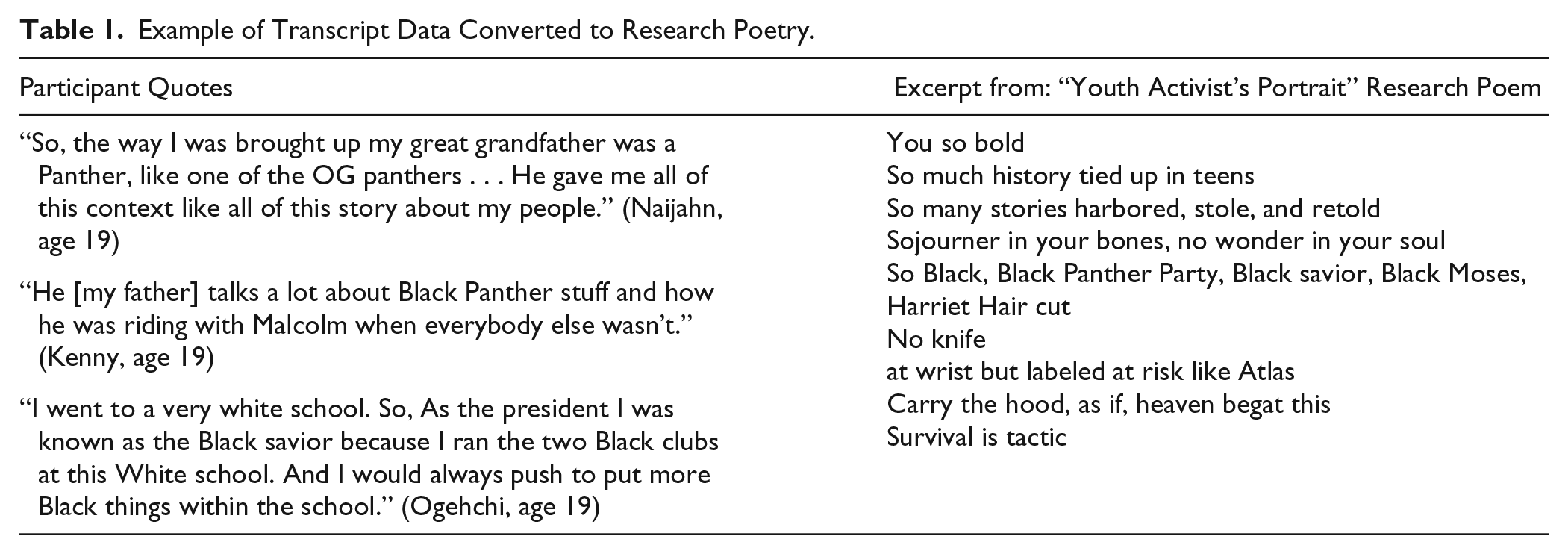
In the research poems created from the data, I used an interpretive, intuitive system of recreating participants’ tone, vocality, and cadence through word choice, phrases, and ideas from the transcriptions. The poems were not verbatim lines from the transcripts as is done in found research poetry but all the ideas were derived from the data. For example, Table 1 shows participants’ verbatim quotes alongside an excerpt from a research poem created based on the ideas in the transcripts. The structure of the poem uses short lines to capture the frank, intensity of the statements, and imagery that connects each idea to the next based on the word choices, all of which were expressed in the interview transcripts. For example, the transcript and the stanza capture the ideas of history, Black identity, and archetypes of Black American activism.
Example of Transcript Data Converted to Research Poetry.
In addition, my critical poetic inquiry process differs in that I used the analytic of poetry writing to write through challenges I faced in my own poetic processing. In my free verse poetry writing, I responded to participants and wrote through my own interpretations and bias. Writing through is a form of thinking that utilizes writing as an analytic tool to make sense of the analysis. While writing through, I interrogated what I found and what questions remained. To ensure it was a critical analysis, I asked myself whose voice was dominant? Whose voice was missing? Why? How was I yielding, maintaining, or disrupting narrative control? This recursive, reflective writing made this research act a vulnerable one from which I as poet-researcher could not hide. In this way, poetry writing was an embodiment of my own becoming: my thinking, feelings, interpretations, doubts, and shifts in understanding. It is an unstable process filled with necessary analytic shifts.
The following poem “On Validation” captures my own writing through the idea that I was searching for an answer to my research question, “In what ways are minoritized youth poets civically active?” that was not participant centered and initially prioritized eurocentric definitions of civic action. I probed for actions beyond the poem, but the answer from my participants rejected that probing, so I had to return to the data by writing through my bias and assumptions to more clearly see what was apparent in this data set. The multi-vocal perspectives captured in the shifts between first person and third person points of view in the research poem below make visible my presence as a researcher making meaning alongside participants.
“On Validation” I scribe eulogies for friends and welcomes for new babies, yet the earth rotates unwaveringly as we struggle to live here so I ask, does any of it matter? Does it matter that Brittany’s brother was murdered and they had the visual? Does it matter that his homegirl Neborah went missing and they had the rally? Does this blood and all these lives that line the pages of books overweight with my worry stacked like skyscrapers on my side of the bedroom, matter? It must It must because it is their reason to wake up in the morning Waking is radical when you sleep in a casket with your nose pressed tight against the suffocating fallacy that you don’t belong here in your own nation They cry tears made of gasoline and breathe fire Reject my premise, say their very existence is proof Mohammed, said his mother gave him a name that mattered so he, born in charcoal hue, would never wonder about worth Dayonna, said her mother’s abandonment gave her rubber for skin to battle the abuse so these politicians’ slurs ain’t no match for her Ogechi, said she’s ready for wars should the hood need a savior, enlisted, created the list herself Ninel, spoke more like the dragon than the damsel became her own hero first then wrote the lifeboat like scripture should we choose to follow Kenny, said it was his hood, where he was never afraid but sure he belonged because he knew everyone’s name, played ball for days, yet spoke kinda white, had to dis assimilate himself daily after the school bell rang just to remember who he was and that he belonged there among cousins and dropouts though he was always more scholarship than bail bond money, he spits poems in prisons for that very reason Thus, it matters It must all matter For them They tell me this is fearless work about survival The cost is life My job is to bear witness not to worry if it matters.
Sampling Culturally Relevant Pedagogy
Research capable of protest and advancing justice must go beyond the study of minoritized persons lived experiences toward validating and sustaining their epistemologies, literacies, and languages in ways that embody their liberation. Otherwise, the social justice research agenda becomes another form of oppression for minoritized participants and researchers. Working from a creative constructionist paradigm of sampling old tools to innovate new possibilities, I argue critical poetic inquiry provides one culturally relevant (Ladson-Billings, 1995, 2014) methodological tool capable of capturing the lived experiences and cultural epistemologies (Ladson-Billings, 2000) of minoritized researchers and participants.
As a teacher educator in educational foundations working toward educational equity for minoritized students, CRP is an apparent tool for me to sample as I theorize a culturally relevant methodology. The craft of sampling is the creative process of taking the existing tools and, in this case, theorizing a new way of being and doing poetic inquiry. Furthermore, pedagogy and methodology are congruent in many ways especially useful to educational researchers. Denzin (2017) described the need for critical qualitative research that is pedagogical. A pedagogical approach to research can be distilled for methodologists and students alike from critical poetic inquiry as a culturally relevant methodology that centers the oppressed. When methodology operates pedagogically the research act can offer lessons and tools of discovery that are useful to research participants as well.
If we understand methodology as a creative sense-making strategy that can aid researchers and participants in becoming more fully human (Freire, 1972), then the theory of CRP as one tool of liberationist praxis can be sampled to achieve the intent of this argument. Although many scholars (Emdin, 2011; Gay, 2010; Paris, 2012; Paris & Alim, 2014) have expanded on CRP, Ladson-Billings (1995) original framework laid the blueprint for how educators understood the need for a pedagogy that centralized difference as an asset and as such is a useful primary source for this argument. Ladson-Billings’ work focused on teacher actions; I focus here on researcher actions.
The theory and practice of CRP (Ladson-Billings, 1995, 2014) created a much needed pathway for educational researchers and teachers to rethink how youth of color, namely African Americans, were educated in American schools and today expands to international classrooms where educators are concerned about equitably educating all children. CRP centralizes “student achievement and helps students accept and affirm their cultural identity while developing critical perspectives that challenge inequities that schools and other institutions perpetuate” (Ladson-Billings, 1995, p. 469). Ladson-Billings developed three propositions for culturally relevant pedagogy:
(a) Produces students who can achieve academically
(b) Produces students who can demonstrate cultural competence;
(c) Develops students who can understand and critique current social inequities
Ladson-Billings theorized this pedagogy as a way to do teaching. I propose that this framework is useful to understand methodology as a way to do research.
Sampling the propositions for CRP, I frame propositions for a culturally relevant methodology as follows:
(a) Produces trustworthy research findings
(b) Uses cultural competence as a sense making tool
(c) Develops research that can critique and address social inequity
It is important to note that these terms from CRP do not fit the proposed methodology perfectly; this is a starting place, not a finished framework. These terms are useful to my argument but incomplete so in the aesthetic of hip hop sampling, I continue to layer and build by sampling terms from liberationist theory (Freire, 1972) and constructionism (Savin-Baden & Major) to explain how critical poetic inquiry qualifies as a culturally relevant methodology.
First, Freire calls for the oppressed to be fully human by dismantling the oppressed to oppressor power differential. The notion of the researcher as positivist, objective knower projects violence upon the participant as merely subject or informant (Ladson-Billings, 2000). Freire (1972) argued, “one cannot expect positive results from an educational or political action program, which fails to respect the particular view of the world held by the people. Such a program constitutes cultural invasion, good intentions notwithstanding” (p. 95). Here, the research act is considered as a political program, which is a decidedly political act for minoritized researchers (Ladson-Billings, 2000). Thus, in the political act of researching, the objective, positivist researcher engages in the oppression of the participants by silencing them and yielding control of the reality that is presented about their lives. On the contrary, my critical poetic inquiry research rejected this notion and instead positioned me as a participant in the relationship with the topic of research and the research participants as coconstructors of meaning.
Furthermore, the analytic process of poetry writing espouses a culturally relevant methodology that fulfills liberationism because it became a type of dialogic between researcher and data, researcher and participants, as well as researcher and society. In these dialogues, participant perspectives and ability to name their realities were amplified because all the images, metaphors, and themes in the poetry were mirrored the data. Next, the writing act became a form of action in response to the analytic reflection done in data analysis, and thus, critical poetic inquiry fulfills the action-reflection requirement in Freirean’s (1972) dialogue and serves to illustrate participants’ own liberationist acts. In this way, critical poetic inquiry does not constitute cultural invasion because it makes evident participants’ cultural ways of knowing, through poetic processing and products.
Sampling Counter-Storytelling From Critical Race Theory
Next, I draw on Solorzano and Yosso’s (2002) definition of critical race theory in education as “as set of basic insights, perspectives, methods, and pedagogy that seeks to identify, analyze, and transform those structural and cultural aspects of education that maintain subordinate and dominant racial positions in and out of the classroom” (p. 25) to situate critical poetry inquiry research poems as forms of counter-storytelling.
The poetic mode of expression presents a form of counter-storying that disrupts the normatively accepted master narrative. In outlining the usefulness of counter-storytelling as an analytical framework for a “critical race methodology” for education research, Solorzano and Yosso (2002) defined counter-story as a “method of telling the stories of those people whose experiences are not often told . . . Storytelling and counter-storytelling these experiences can help strengthen traditions of social, political, and cultural survival and resistance” (p. 32). The critical poetic inquiry that I conducted centralized my experience as a researcher of color as well as the experiences of the minoritized, urban youth participants in my research. It allowed my participants and I to name our own realities by using a tool that elucidated my positionality and our collective ethnic epistemological claims (Ladson-Billings, 2000). “Critical writers use counter-stories to challenge, displace, or mock these pernicious narratives and beliefs” (Delgado & Stefancic, 2000, p. 430). Similarly, research poems function as counter-stories by affirming the oppressive experiences of minoritized youth and, thus, can begin the process of adjustment in the audience’s beliefs and reminds them of their common humanity.
In addition to the content of the poetry, the poetic form of re-presenting data also offers a literal counter-story. Critical poetic inquiry can capture and present multi-vocal perspectives because the structure of poetry can encompass many voices of diverse participants or craft one composite voice representative of a cultural community. In this way, critical research poetry sustains the realities of intersectional, shared identities, and communities when re-presenting data. Equally, the research poem can mirror the narrative structures and cultural ways of knowing of minoritized groups. For example, the African and African American traditions of call and response (see Fisher, 2003, 2004, 2005; Souto-Manning & Winn, 2017) in which a narrative is told through an exchange of chorus responses to a speaker is one example of a narrative structure that differs from the “standard” linear narrative structure. Another is when voices are allowed to “testify” or comment with affirmation during a narrative.
Next, the critical poetic inquiry research text can take any variety of forms and thus is capable of capturing and mirroring diverse home languages and linguistic features of minoritized scholars and participants. Therefore, the data taken from one’s lived experience as researcher or participant are not culturally cleansed merely to exist as a research text. This also sustains culture by juxtaposing home languages as valid as mainstream American English as well as employing participants’ own cultural sense making tools such as images, comparisons, and metaphors whether spoken or written. In this way, it is a humanizing method that allows researcher and participant to approach the research act with their full human dignity and languages as well as liberate that humanity throughout the research process.
Next, a poem titled “Civic Identity a Multifaceted Intersection” is an example of my use of multiple voices, African American vernacular English, line breaks, and stanzas to craft a counter-story of my data on youth civic identity development.
Civic Identity: A Multifaceted Intersection—Multi Voiced Poem.
Honk! Honk! Shuffle, Shuffle Move, Gotta get goin Does my voice fit here? Join this org! We makin’ picket signs or texting post? Let’s Go DO SOMETHING! What you? Frail-little-Indian-immigrant-girl Who you? Black-skinny-woman What you gon’ do? Huh?Huh? Hurry up? Decide! Places to go Honk! Honk! I learned empathy at school Move on! Gotta get goin’ You gon’ rally with us? go I researched outside of school Is this your issue? They increased the budget by $3 million dollars after my poem Shuffle, Shuffle Need directions? Organizations like street signs Ann Power, Radical Leftist, Black Lives Matter Movement, Writers in the Schools, Museum of Art Collective, Doodle, One Pen; One Page, Southern Word, Home Honk! Honk! Green light. Teachers were advocates. Shuffle, Shuffle, Posted events and stuff You tryna go? Facebook ping “Donald Trump’s Latest Racist Statement” - 5 Minutes ago Gotta get goin’ Hustle, Hustle You catch that episode on TV? I’m not allowed to watch objectified commodified forms of bodies like mine momma ain’t goin for it Red Light. Moms asked did you write that analysis of the movie I assigned you? Honk! Honk! Depends on who I’m reading at the time Yellow light. My organization trained me Workshopped my consciousness Gave me the grant money to build the bridge Hustle, Hustle, Let’s go! I was only 14 as a United States Delegate Move Green Light. Go! Access granted Platform: bustling sidewalks. Platform: stages. Platform: executive meetings turned to testimonials. Move. I don’t have any money Hear me Respect me Mutuality Come on gotta get goin’ A lot of people listen through the traffic.
In addition, a unique contribution this article offers to the existing body of literature on critical poetic inquiry is the addition of spoken word poetry (Davis, 2018; Weinstein & West, 2012; Winn, 2019) as an option of culturally relevant poems that can be created using this method. Voice goes beyond language alone because when people speak we reveal tone, pitch, and vernacular all of which are culturally informed and indicative of deeper meaning. The vocality of spoken word research poetry sustains oral cultural traditions and makes the nuances of spoken language even more apparent in ways that further substantiate the presence of research participants in coconstructing and naming meaning.
Nevertheless, in a Freirean definition of dialogue voice alone is not sufficient to achieve liberation. The goal is for voice to inspire action to create change. Likewise, critical race theorists note, “Stories can name a type of discrimination; once named, it can be combated” (Delgado & Stefancic, 2000, p. 43). Thus, the call for a culturally relevant method presumes that naming is only a piece of the work; combating oppression requires action. Critical poetic inquiry can be an act of protest.
Sampling Protest Practices
Poetry has long existed as a type of protest in community and literary spaces. For the purposes of this argument, protest is the overt challenging or speaking out against an oppressive idea or practice in an attempt to create positive change. The argument espoused here for critical poetic inquiry as a form of protest evidences its particular value for minoritized participants and researchers. It also contributes to the existing body of scholarship that documents poetic inquiry as rigorous qualitative research.
First, critical poetic inquiry can protest against eurocentrism in the academy purported as normative by offering minoritized voices that center the oppressed as actors and not merely objects of research. It acknowledges that all research is political and this truth is merely heightened for minoritized researchers and participants who live and work daily in politicized bodies. For example, my youth activism research act rejected tools that can sanction White supremacy and eurocentrism by selecting culturally specific research tools that participated in the activist tradition of broadening visibility and voice to communities that are most often silenced (Prendergast, 2015). In many ways, traditional forms of youth civic action research remain complicit with White supremacists’ narratives of youth by employing the tools of the oppressor to describe and measure minoritized community actions without acknowledging the limitations of those tools. On the contrary, this critical poetic inquiry research act protested by offering the words, experiences, and meaning making tools of minoritized youth as tools appropriate for this research task.
Next, critical poetic inquiry can protest the power and presumed knowledge differential between researchers and participants to reveal the vulnerability of the researcher alongside the participant as they coconstruct meaning in culturally relevant ways. Together and introspectively the researcher and the participant coexist, cocreate, and rebel. This space is one in which agency is granted to the researcher and the participant to identify and explore their own paths to liberation that are not dictated by oppressive structures of traditional-positivist research that renders personal history and experience irrelevant. The critical poetic inquirer employs the whole self to explore the totality of the research topic from multiple perspectives.
Furthermore, the research poem as product can inspire transformation in audiences and thus serves as a form of protest that instigates the movement of others toward positive change. My research act fostered a public sharing of knowledge that was both accessible and comprehensible to all concerned persons via a public reading of the research poetry, as opposed to harboring the findings for the academic audience. Returning the findings to the participants or community using a transparent code of ethics to protect participant identities, and sensitive information is a protest against intellectual mining in minoritized communities.
The protest is in the cycling back to community as well as the rendering the poem as resistance in traditional spaces. For example, I have found that the research poem at the traditional academic conference is a protest of resistance for me as a minoritized researcher that pronounces, “I am here and my cultural way of knowing is as valid as the ten minute speech.” The research poem as data is an affront to the stoic, bounds of academic gatekeeping policies that demands recognition of who I am as minoritized scholar, poet-researcher, and community member. Equally returning data to community contexts in the form of research poetry is a personal act of protest about existing fully in multiple spaces. Furthermore, returning data to communities is often a returning home for minoritized scholars and carrying the participants’ narratives in this cultural form sustains participants’ power alongside the researchers.
The Compilation: Conclusion and Challenges
In summary, critical poetic inquiry offers a culturally relevant methodology informed by theories that sustain liberationism in the research act capable of expanding minoritized participants’ and researchers’ fight for full inclusion in the field of research methods. This means that qualitative research can also participate in civic discourse as protest and not serve only as tools to measure issues related to civic action and identity. The research act can democratize knowledge, present counter-stories, and rebel against eurocentric norms in the academy to make more explicit cultural ways of knowing significant. A culturally relevant methodology matters because methods are needed that can fully capture and amplify the lived experiences of minoritized persons in anti-oppressive ways that make non-White researchers and participants accurately visibly in research. Otherwise, the social justice research act may risk becoming an exercise in assimilationist practice. Therefore, as it concerns civic action and democracy in the 21st century, the critical poet-researcher can be positioned as a citizen serving the democracy through the research act.
One challenge is that some may confuse the call for a culturally relevant methodology as a segregationist request among colleagues that have moved to the imaginary place “beyond race.” First, it is not segregationist to create more inclusive spaces that allow minoritized, oppressed, and silenced people to use their cultural and epistemological tools in the research act as readily as Western, heteronormative, White scholars. Even more important, when this type of space is permitted we move away from the false dichotomy of them versus us toward a more rich culturally sustaining place in which constantly shifting notions of culture are realized. Likewise, this method is not for any one type of researcher. Anyone who takes the care to build the relationships with themselves and participants to critically and reflectively use cultural competency to engage in writing through and building meaning with minoritized populations can become equipped to do this necessary work.
Although we have apparent examples in popular culture and research data that systemic disparities across lines of racial identity remain global inhibitors to equity, it takes only to examine the global field of arts-based research methods and acknowledge which identities are missing among our colleagues to see there is a lack of diversity that starts at access to higher education and is narrowed even further when arts-based methods are attempted. By accepting and including frameworks for culturally relevant methodologies as options the academy may attract more diverse methodologists, scholars, and students. Furthermore, practitioners and activists may see an entry point for their action oriented work in the academy.
One area of continued exploration of theorizing for a culturally relevant methodology requires poetic inquirers to identify diverse culturally relevant theories of liberation for, about, and by more people of color, non-normative, identities that are global in scope. This framework could be improved upon by historical and new innovations on Black, Latino, Asian, Indigenous, queer, and feminist liberationist theories as meaning-making tools to conduct critical poetic inquiries. More discussion of this sort will strengthen the collective work and substantiate a place for a culturally relevant methodology in the field of qualitative research. I believe deeply that collectively, those of us committed to ethically responsible critical qualitative research must advance this work.
I close with a quote from Ayla, a participant in my research study that told me: “If you want to believe in your community, it has to be sacred. That your war has to be poetry.”
This is my war.
Footnotes
Declaration of Conflicting Interests
The author(s) declared no potential conflicts of interest with respect to the research, authorship, and/or publication of this article.
Funding
The author(s) received no financial support for the research, authorship, and/or publication of this article.
