







Abstract
This poetic autoethnography explores the author’s experiences of the death of his father, processes of mourning, and ways of addressing through writing a difficult family legacy related to the Holocaust. Employing journal, narrative, poetic, and reflective research writing, this poetic autoethnography documents a twelve-week period in which the author’s father died and he traveled back to the place in which he was born to address the murder of his grandparents and deportation of his father on the Kindertransport. This study offers some insight into mourning and the long-lasting effects of familial trauma related to the Holocaust. In addition, this poetic autoethnography provides a model and example of how research writing can be used as part of a mourning process and as a way of exploring difficult personal contingencies.
Without either a sense of loss or a sense of involvement, there is no psychic space for the work of mourning.
The poetic autoethnography presented here documents a period of twelve weeks in which my father died and I traveled to the place of his birth in the attempt to mourn and to address a difficult historical legacy related to the Holocaust. As an experienced poetic autoethnographer throughout this period, I wrote. I wrote my thoughts at the airport, on the plane to my father’s funeral, and at night in the dark. I wrote a eulogy to my father and poetry of mourning in order to understand the paradoxes of my feelings in the weeks after his death. I journaled, reflected, and wrote poetry as I traveled back to places in which my family’s trauma is situated.
There is a history of writing as both a healing process (Berzoff, 2006; Frattaroli, 2006; Furman, 2004; Lange et al., 2003; Lengelle & Meijers, 2009; Pennebaker & Beall, 1986) and as a form of inquiry (Denzin, 2014; Denzin & Lincoln, 1997; Ellis et al., 2010; Furman, 2004, 2007; Hanauer, 2010, 2012a, 2012b, 2013, 2014, 2018; Richardson, 2000). For the purposes of this poetic autoethnography, both perspectives were important. I wanted to use my own academic, research writing abilities to find some relief from difficult emotional and life contingencies and to understand my own processes of mourning. I also wanted to explore ways in which the legacy of the Holocaust could be addressed. I assumed that there was value in this for myself and for my readers. I am not alone in experiencing the mourning that emerges from the loss of a parent and I am not alone in having a familial history entwined with the genocidal intent of others.
Underpinning my approach is a model of healing situated within the poetry therapy literature (Lengelle & Meijers, 2009; Mazza, 2003). The “transformation-through-writing” model, explicated by Lengelle and Meijers (2009), functions through a process in which an initial, painful narrative writing concerning personally experienced traumatic events is rewritten so as to produce a “life-giving” second version of this story. The transformative process between these two writings consists of observing and dialoguing with the story and with others in order to achieve far greater understanding and acceptance of the events that have been experienced.
Poetic autoethnography as both a research and healing process functions through a similar mechanism (Hanauer, 2010, 2012a). Poetry is written in response to the lived events but is then at a later stage integrated into an autoethnographic account that both narrativizes and reflects on the experiences presented. It is through the process of externalized experience in writing, questioning, self-observation, and discussion of that writing that understanding of oneself emerges (Adams et al., 2015; Denzin, 2014). As seen in the scholarship on poetry writing, rewriting activates a process of emotional and cognitive insight leading to increased emotional clarity (Bizarro, 1990; Gerrish, 2004; Hanauer, 2010; Peskin & Ellenbogen, 2019; Schwartz, 1983). The rewriting or refocusing process brings with it the need to explore what has been expressed and questioning its accuracy in terms of experienced events.
Poetic autoethnography involves a particular form of witnessing of personal events: Writing and the act of witnessing one’s own life offers the option of exploring the complexities of personal experience and presenting it for observation by another. Through personal narrative and poetry writing a conceptual, psychological and emotional space can be opened between propagated societal discourses of anticipated and expected existence and phenomenological personal experience. (Hanauer, 2012a, pp. 845–846)
This critical interaction, with the internalized meanings and ways of understanding personal events, is crucial for autoethnographic work and the point at which this type of research diverges from autobiography or storytelling (Chang, 2008; Ellis et al., 2010). The meanings which emerge from the type of critical process are often contradictory and paradoxical, surprising the writer about their own experience. When done diligently, honestly, and professionally, the meanings which emerge present a picture of the process of contending with the ways in which powerful discourses impose their meanings, in the attempt to erase the contextualized individuality and positionality of each person. Importantly, for my own personal history, poetic autoethnography has the potential to counter the collectivizing nature of nationalist, racist discourse in the individual.
My aim with this particular poetic autoethnography, beyond the expression of my own understandings and experiences, was to provide my readers with a model of what this type of writing can be. Writing models and writing methodologies are crucial in helping to understand how writing can be practiced and what types of outcomes can be expected. Like Bochner (1997) and in response to similar circumstances of the passing of a father, I have long argued, under the heading of meaningful literacy approaches to instruction (Hanauer, 2011), that the artificial distance between academic research and human life should be broached and that part of our mission as researchers and literacy instructors is to provide useful tools and approaches that can be used by a broad range of people for exploring their own contingencies. This autoethnography is an attempt at broaching this divide as well as offering others an example of a writing methodology to explore themselves.
Methodological Approach
The poetic autoethnography presented here used writing as a research methodology. This included the following stages and types of writing:
a. Field Notes and Reflective Comments: Throughout the stages of this project, field notes and reflective comments were hand written using a dedicated portable notebook. This form of writing was performed multiple times a day and included noting contradictory and intrusive thoughts, striking images, meaningful events, and lines of poetic language. The product of this process was an on-going written journal of the thoughts and events that I experienced over a twelve-week period from the beginning of August till the end of October 2019.
b. Poetry Writing: In parallel to the journaling process, every few days I wrote poetry. This was usually in the evening or at night. Poetry was written as a response to the stressors of the quite intense emotions and experiences of this period. Lines of poetic language and event descriptions from the journal notebook were an impetus to the poetry writing that was conducted. This poetry often reflected emotional complexities, personal confusion, and conceptual ambiguities. Poetry was written by hand and on a laptop. All poetry written was dated and accompanied by notes on the impetus for writing a poem.
c. Poetic-Autoethnographic Writing: During the month of October 2019, at the University of Wurzburg, time was dedicated to autoethnographic writing concerning the legacy of my family with the Holocaust and the passing of my father. All notes and poetry were read and thoughts concerning the events were recorded. The autoethnography was written in sections, each initially consisting of some poetry and its contextualization. Over several sessions, each of these sections was revised, focused, and the meanings explored and questioned. Discussions were held with a series of discussants to understand the issues, meanings, and emotions at play within these writings. Importantly, discussions were held with people who had different types of access to the issues, including familial, psychological, historical, and artistic considerations. Ramifications from these discussions were integrated into the emerging poetic autoethnography.
d. Final Reflection and Discussion: As a final stage, the sections of the poetic autoethnography were integrated into a single progression and sent to readers with experience of poetic autoethnography for their consideration. A series of discussions were held with these readers. Following discussion, additional modifications were made to the poetic autoethnography and final decisions were made.
As can be understood from the preceding discussion, the methodology involves the movement of writing from the very personal immediate note, to reflective response, to poetic synthesized focused description, to discussion with others in a reiterative process. The various levels of writing from the personal to the dialogic and reflective were designed to provide for the writer/researcher a fuller picture of the issues involved in personal experience. The result of this writing inquiry process was a poetic autoethnography entitled Mourning Writing.
Mourning Writing
The Mirror
As I look into the shaving mirror, I see my grandfather’s face staring back
Asking
Have I saved my father.
On the 2nd of August 2019, my father John Hans Hanauer passed away. With his death and the special circumstances of his passing, a central part of my life changed. My father became unresponsive and shortly died a day after he gave his first full testimony of his life experiences to the Holocaust Museum Yad Veshem. He had turned down the opportunity to speak about his Holocaust-Kindertransport experiences to Yad Veshem several times in the past. But on this occasion, he decided he wanted to tell his story. In this interview, which lasted for four hours, my father described his experiences of early life in Wurzburg Germany, his life as a child growing up in a protective and loving family during Hitler’s antisemitic reign before the Second World War, his final parting from his parents at a train station in Frankfurt to go on the Kindertransport to England, his experiences with his foster family in London, his life during the Second World War as a refugee in England, his meeting with my mother, his life with her, and the family he created. During the interview, he insisted on completing the full story even though the interviewer suggested a break or even coming back at a later date. My father wanted to tell his life story.
I spoke to my father on the phone the day after he gave this interview and several hours before he fell ill and became unresponsive. It was a difficult conversation. He asked me if his parents really loved him. I told him that to send your child off into the unknown, to a foreign country, when you knew in your heart that you would probably never see him again in order to save his life, is an act of bravery and the ultimate expression of selfless love. I told him that I could not have done it, that I was not that brave. To love your child so much that you are willing to part from him in order to save his life. My father was silent on the phone for a few moments after this exchange and then he said “I feel so guilty I left them.” It was the first time he had ever expressed his guilt to me. I explained to him what I knew about survivor guilt and that this was a very familiar aspect of Holocaust survivor’s experiences. I told him that he was, at the time, a child. How could a child of nine be responsible for the events of the Holocaust? He repeated that he felt guilty. I tried to make him feel better.
That was the last conversation I had with my father.
On the way to see him in hospital, while I was waiting at Toronto Airport, my nephew called me and told me my father had died. I never got to say my last words to him. I never got to hold his hand and tell him that I loved him one last time. I had thought for a long time what I would say to my father on his death bed. I wanted so much to tell him that I believed that he would be reunited with his parents, that at long last, after all these years, he would once again be with his parents and in their loving arms. That they would be together for eternity and in peace. That he would be whole again. That it was okay for him to go to leave this life and be with them. I wanted those last moments of his consciousness before slipping into death to be with the thought of his reunion with his parents. I wanted to ease that final parting with the promise of reunion.
Parting
Incoherent prayers, Comfort me not.
Your face
Looking back to me From the computer screen Telling your story In the dark
As everyone sleeps.
We say goodbye for the last time.
The night before the funeral, I could not sleep at all. As everyone slept, I opened my computer and put on the video of my father’s testimony to Yad Veshem. I watched as my father came to life before me. I spent several hours with my father in the dark and silence that engulfed me. He told me his story and I listened. I was close to him and he to me. I had heard the story before and even had made it into a poetic ethnography (Hanauer, 2012b). But this time it was different. It was not the facts or even the telling. It was the presence of my father in the interview. He wanted to tell his story. As I watched, I thought about the gift he had given me and my family. A full video of his life’s experiences on the day before he died. I was struck by his vitality in telling the story, his strength, and frailty as he moved through the different events of his life. It reinforced my sense that parting was at the center of my father’s story.
What does it mean to tell your story under these circumstances? I have often thought to myself that as I died, I would have a pen in hand and write out my final thoughts as life slipped away from me. I had thought this to be a form of fantasy as who knows the moment when one will die? But here my father clearly knew he was dying: his insistence on telling the story, his persistence on having just this one sitting for his testimony, the fullness of the presentation. Once he had told the story, he seemed to sigh as if he had reached an end. I knew my father was toward the end of his life and to myself I had thought that it was the time to deal with his past and the meaning of his life events. Up until this testimony, he really had been avoiding dealing with this past and all attempts I had made to get him to speak to a counselor experienced in dealing with Holocaust survivors had been rebuffed. And yet, here at the very end of his life was the testimony. I believe that life is a circle in which at the very end one needs to return to the beginning and reconcile with the complexities of lived experience before leaving one’s own consciousness.
As I watched my father’s testimony, I thought how different this was from the murder of his parents. A death in which there was no justice, no dignity, no fullness of circle, no burial, and no prayers. A death beyond comprehension and beyond humanity. My father died in the arms of his granddaughter and after hearing of the eternal love of my mother. He died at the age of ninety after a full life and a life that he termed as loving. How different are these two sets of death? In my father’s life there was deep sadness at the parting from his parents, a wound he never recovered from. I think for him, he would have preferred to have died with his parents in Riga.
At his funeral, as he lay in a white shroud before me, I did ultimately tell him what I had planned to tell him on his death bed. I told him to go to his parents, to reunite with them, and to be in a better world than the one he had just left. After, the funeral procession walked through the dust and sand of the Jewish cemetery. I said traditional prayers for him and for his parents as he was lowered into the ground. With a last look at the body, I turned away.
We part, Without fear In acceptance
Not at the train station in Frankfurt
Not as children
Not with your parents waving a last goodbye
Not as a deportation
Not as a crime.
We part.
Mourning
My face
Is no longer mine
As I avoid looking in the mirror
Rough with unkept bristles
I mourned my father in my parents’ apartment. I did not shave for a week and let my appearance become that of another. In myself, I felt the weight of the past, my own, my father’s, and my grandparent’s. I felt the way in which the past had scared, scarred, and shaped me. How I had become enmeshed in my father’s psychology and how his and my own fears and anxieties became entangled. I felt how my history had impacted my children through the decisions I had made. It weighed on me. I thought of death and of being close to death. I thought of the army, war, the Holocaust, and the ways in which hatred and racism were present in the world. I felt the physical presence of death and its closeness to me as if I had always known death and it had always been close, constantly in the background of my consciousness.
As I mourned for my father, I thought about all the rational decisions I had made that were based on a deep-rooted sense of the fear from national racism and how these were different and yet the same as my father’s rational decisions. Slowly, as I mourned, the differences between my self and my father became more present to me as I could feel the sudden amputation of our relationship. He was gone and although I had prepared myself for his impending death, I was still shocked at the realities of the void. I felt myself emerge to an extent from behind the presence of my father. I wondered how old I was psychologically? I felt the repression of my own depression. I wondered what it meant to be alone and without the constant worry of looking after him. I felt my own story change.
The worried cloth once taut
Worn thin
I am unravelling.
The threads Pulling away from the edges Of a frayed hem.
A tapestry becoming translucent
Disintegrating into dust
At the passing of my father.
Memories of Wurzburg
Like a white shroud,
Quivering away
Down the streets of Wurzburg Is my memory Of my murdered grandmother Helen Hanauer. Like a phantom pain, Of a severed limb That I never had Is my memory Of my murdered grandfather Alfred Hanauer. Their faces, A few battered photographs All I have of them and my father’s words. And yet, I have met my grandparents After death. Their faces, White and drawn, Strained, But with kindness and curiosity Are carved in my dream memory. If I close my eyes, I can see them. And now I travel to Wurzburg, The place of my father’s birth The place of my father’s escape from Kristallnacht The place of my father’s hiding The place of my father’s deportation, The place of my father’s final parting from his parents The place of my Grandfather’s incarceration
The place of my grandparent’s deportation
to a concentration camp and death.
I went to Wurzburg, the city of my father’s childhood, the home of my grandparents Alfred and Hella Hanauer, and the place in which so much pain existed. A few weeks after my father’s passing, I took the train from Frankfurt to Wurzburg, traveling in reverse my father’s childhood parting from his parents, his childhood, his home. At Frankfurt airport, for the first time, I used my German passport. I reclaimed what had been stolen as a ritual act. An official identity grounded in a legal injustice of my family’s history. And that is exactly the problem. How to live and relate to a past that is at once mine and not mine at the same time? I so deeply desire for the past, not to have happened. For my father not to have had to live with the psychological pain he suffered from his whole life. For my family not to have had to grow up with the history of murdered grandparents and the terrible ramifications of parting from a child so young in war time. For my life to have been different psychologically. For racism not to exist and for nationalism to be a sign of shame and disgrace.
In Wurzburg, at the beginning, the disconnect was very real and very present. As I looked around, I saw a lot of evidence of multiculturalism. Different languages were spoken on the street, food stalls from various countries, people of different backgrounds easily walking together. But in exactly that place my grandparents and the Jews of Wurzburg were marched through the streets on the way to the train to be deported and murdered in Riga. These were the same streets that now house this evidence of commercialism, affluence, and multiculturalism. These were the same streets which manifest the new Germany following the Second World War. But in my mind, as I walked around, hidden in the cobble stones, just below the road’s surface, a tactile memory of pain exists. In Wurzburg, I see what I see and I see what I imagine of my family’s history in that place simultaneously. I recognized the mundaneness and normality of the streets of Wurzburg and at the same time felt the sacredness of the places my father and grandparents were in. No one around me was aware of this disparity, as they lived their lives in that place and I looked like just another nondescript tourist.
I went to the site of my grandparent’s apartment. Close to a school and a main road, it seems that the apartments in this building are rented out to students. In front of the building are two small copper cobble stones embedded into the ground with the names of my grandparents on them, the date they were deported and the word murdered. I was at the ceremony in which these stones were laid in the ground in front of this building. My father and my whole family were there as well. It was a kind of burial service, a concrete presence for the memory of my grandparents and what was done to them. As I looked down at the stones in front of this nondescript building, I could see that they were dirty, covered with grime, unnoticed by the surroundings. I spent several hours standing and looking at these stones as people passed by on their way. No one looked down at the stones. For me a sacred place; for those around me not a place at all.
I thought about the movement of the people, the everydayness of their existence in time while I struggled with the particular legacy of this place. In my journal, I wrote “I am haunted. I can feel the people of the past in this place just beyond my sight they are here, now as I stand here. I can, just beyond my senses, sense them.”
Walking the Streets of Wurzburg
I walk through the dark streets of Wurzburg
Where my grandparents dispersed into nothingness Searching for something that is not here.
I want reconciliation with the past and to be able to live beyond the Holocaust. I long not to be forced to contend with the shadow of a historical reality of racism, humiliation, deportation, and murder that invades my thoughts as I try to distance it from me. I would like to just be. But this is just not possible. The size of the family trauma is such that it cannot be silenced. The responsibility of remembrance and dignity are too deep. It would seem like a betrayal of those I never knew but for whom I am responsible. Physically, in my stomach, it sickens me what was done to my father and grandparents. I think this as I walk the streets of Wurzburg, retracing the steps of my grandparents. I am physically present in the places they lived. Why? What is it about this place that makes it meaningful? It is as if there is a residue, a shadow of my grandparents and my father in these places. It is sacred ground, a place of death. It is an unsolved pain that is difficult to be with.
And yet, I like Wurzburg. I understand that the past is embedded in my relationship with my father. It is not here in Wurzburg at all. It is in the psychological realm of the stories and images, stated and imagined, of the traumatic past and the constant reenactment of these stories in the news and events of the present. It is in my mind and in the discourse and relationships in my family. I will never escape. I will not have reconciliation with the past.
Pictures of the Past
Source. These photographs come from Yad Veshem (“Würzburg During the Holocaust 27 November 1941—The First Deportation From Würzburg to the East,” 1941).
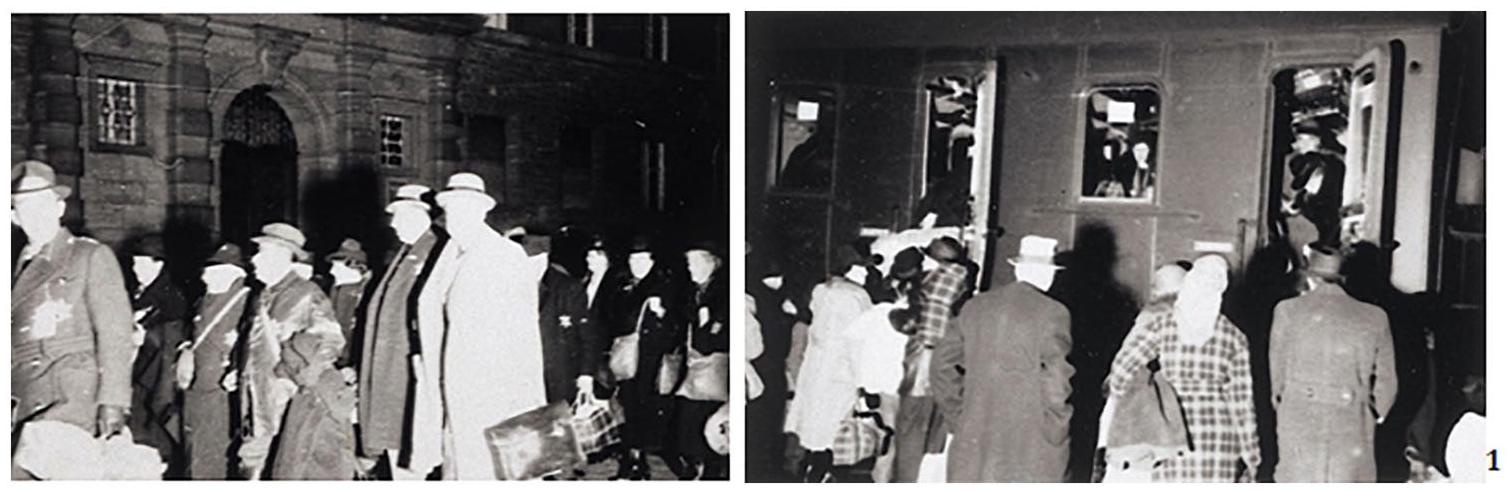
In Wurzburg, I was given pictures of the night my grandparents were deported to their deaths in Jungfernhof camp in Riga. It is dusk and a group of huddled people walk with limited belongings to be checked and processed by Gestapo functionaries. They walked through the streets of Wurzburg from Schrannenhalle where they were ordered to report to where, several hours later, they were deported at Aumühle freight train station. They were forced to voluntarily sign away their citizenship and to board a train to their murder. This is what nationalism means. A sickening manifestation of an imagined collective of people which dehumanizes everyone else. Not a master race, but a delusional few grasping at an identity to entitle their sadistic tendencies. I am angry. But anger does not capture my feelings
These pictures, I was given, are concrete evidence of what happened on that night in 1941 to my grandparents. They are difficult to ignore or repress. I stared at them searching for my grandfather. How can humanity be this cruel? How can people behave in this way? I have difficulty living with it. While in Wurzburg, I asked a German friend about this. He told me that when he was growing up he knew of people who were former Nazis still proud of their actions. That it was the dehumanization of the Jews that allowed such a thing to occur. That they still believed that what they had done was right. He told me this as we sat drinking beer, in the sun on a porch overlooking the green-gray Main river in Wurzburg.
I walked with a kind, caring German woman who had dedicated her retirement to the remembrance of the Jews who had lived and been deported from Wurzburg and understanding their histories. She took me on the walk, the march that my grandparents had made on the 27th of November 1941, from a collection spot in the town to the train that deported them to the camp in Riga. We walked the streets until we reached a wooded area in which the old train depot had stood. Now only furrows in the ground of former train rails and stones half hidden remain of the original freight train station. She pointed out the cobble stones that my grandparents had stood and walked on, the place that they would have been forced to leave all their belongings and the spot that they would have had to get on the train. She described the bureaucracy of evil that allowed this deportation to seem a legal act and how this particular deportation was done at dusk and in semi-hiding by the Gestapo. She explained how children were on this train and how no one was given food or water for three to four days during the trip. She described how on arrival in Riga, there was chaos as the Latvian SS collaborators had not yet managed to murder through shooting all the Jews who had been sent from Latvia previously and were unprepared for the arrival of Jews from the Reich. She described how the Jews from Wurzburg were forced to sleep in the open in freezing temperatures in the clothes they wore. She described the different ways the murder of deportees and my grandparents among them had taken place and I listened as I stood in the place of their deportation at the old depot station in Wurzburg.
I felt my own, very real, and very present depression in this place. Wurzburg and the past were ambiguous no more.
Poetic Rituals
On my knees
Wiping away the grime Of the cobble stones With vinegar and salt So that the names reappear. Under the bridge, where my father happily held hands with his mother so long ago, I dance
The blank page
I write and cry.
Walking the streets of Wurzburg Thinking of my grandparents.
I cannot escape
Or resolve
Or cure.
I try not to bleed.
Postscript
Not every story ends with a resolution. This is one of those stories. At this point in my writing, I am not resolved. The past is not repaired. Writing has not healed me. The incomprehensibility of the horror and the fear is still with me and my father is not. I miss him.
But still there is a transition. As I read my own writing, I appreciate the beauty of the language and the value of the description. I appreciate the presence of my father and grandparents in this writing. I hope that others who read this may understand just a little bit better what the Holocaust means and how its presence is still with some of us. Some will learn of the actual experiences of my grandparents and how they relate to real places in the city of Wurzburg. In some small way, my father and grandparents live on in this text and this offers me some relief.
I also hope that others may learn and benefit from the writing process exemplified and practiced here. When faced with the passing of a loved one and the family histories that this involves, writing can be beneficial. At the very least, poetic autoethnography offers a way of committing thoughts, feelings, and experience to paper and the option of acknowledging the feelings, difficulties, and contradictions that are present.
Mourning Writing is a container and acknowledgment of that which is most painful. It offers a point of access to discuss with others and oneself what these life experiences mean and as such invites the writer to continue the dialogue that life is actually made up of. In this sense, Mourning Writing is life affirming. I hope that the writing of this autoethnography will serve as a model for others on how to use writing when faced with the inevitable difficulties of life and family events.
Footnotes
Acknowledgements
This poetic autoethnography was written while being hosted by the Welz-Haus, the Siebold-Collegium Institute for Advanced Studies (SCIAS), and the Department of Communication Psychology and New Media (Kommunikationspsychologie und Neue Medien) at the University of Würzburg. I thank all members of these different organizations for their support of my work during my stay. A special thanks goes to Prof. Dr. Markus Appel of the University of Würzburg and Dr. Rotraud Ries of the Johanna Stahl Zentrum for their continual support and many conversations about the work presented here.
Declaration of Conflicting Interests
The author(s) declared no potential conflicts of interest with respect to the research, authorship, and/or publication of this article.
Funding
The author(s) received no financial support for the research, authorship, and/or publication of this article.
