







Abstract
Xing Teng has spearheaded ethnic minority education and educational anthropology in China. As a member of the Han majority and an ally to ethnic minority groups, he has endeavored to open space for ethnic minority education in China. I sat down with Professor Teng in the summer of 2018. After transcribing the original interview into Chinese and in consultation with Professor Teng, four segments from the interview are translated for this Special Issue, with added footnotes. Statements are also included in the text for clarity. The final version has been lightly edited and condensed for length and clarity.
Keywords
The Pursuit of Ethnic Minority Education
Hsiung: Professor Teng, could you talk a little bit about how you started your journey into anthropology and ethnology? You’ve mentioned that anthropology needs to include perspectives of disadvantaged groups. But being an ethnologist of Han ethnic origin 1 seems to presume that your standpoint would be of the mainstream, dominant ethnic group. So how did you end up in the field of ethnic studies and ethnic minority education?
Teng: I guess in life we can achieve nothing solely because we intend to. A lot of things are determined by fortune. To put it shortly, I grew up in Beijing. During the Cultural Revolution, my family possessions were confiscated and we were forced to move back to the place of our family origin, Shaoxing, Zhejiang Province. I worked there in the countryside for 6 years. Since there was not enough farmland to feed so many people, my younger brother and I, as “educated youth,” transferred our registered residence to a production team in Beidahuang 2 during the “resettlement in the countryside movement.” The steppe there was inhabited by the Mongols in the past. It is called Horqin Steppe—the origin of Empress Dowager Cixi’s family. 3 I herded horses there for 3 years. I also worked as a production team accountant and a brigade accountant. That was a total of 13 years of resettlement in the countryside.
My father was classified as a “bourgeois reactionary technological authority” at that time. He was sent to the Great Northwest of China to be locked up and reformed through labor in a “cowshed”—a kind of detention facility set up by the “rebel faction” during the Cultural Revolution. Therefore, I became a child of a “black-nine-category” parent, excluded from everything, such as joining the Party, being promoted to a cadre, and admission to college. At the time, this kind of discrimination based on social stratification resembled that of the Indian caste society: We were like “the untouchables.”
In 1978, after Deng Xiaoping’s political and economic reforms, everyone was allowed to take college entrance examinations. Before that, you could only get into college through a reference, and only children of workers and poor and lower-middle peasants could get reference for college. In my family, my grandfather graduated from Fudan University before 1949 and my father majored in civil engineering at the university in Shanghai. Consequently, we were denied the opportunity to go to school during the Cultural Revolution. It was not until 1977, at the end of the Cultural Revolution when the college entrance examinations were resumed that I got admitted to a university (in 1978). After graduation, I was assigned to [teach at] today’s Minzu University of China 4 in Beijing, then it was called Minzu Institute of China. At that time, I knew all the students at Minzu Institute of China were ethnic minorities, but I had no clue what the notion of ethnic minorities referred to. I only knew we had had Mongolians in the area where my production team was located, but nothing about other ethnicities. When I got there, I found out that there was no department of education, just a teaching unit. I was appointed to teach the common required course Pedagogy because after graduation, some students would go back to ethnic minority areas and become teachers; also, because as an undergrad, I studied pedagogy and psychology at the Northeast Normal University.
My first class was really hard. There was a cadre-training division in the Institute responsible for training mostly county-and-above-level cadres from ethnic minority areas. In the 1950s, the sole mission of the Institute’s predecessor was to train cadres from ethnic minority areas. These cadres were the elites of their ethnic minority group. The Chinese Communist Party (CCP) wanted to win over their support. However, they couldn’t attend the regular schools because many of them didn’t know Mandarin [the Han language], some were even illiterate or semi-literate. To address the issue, the state established many minzu institutes. At the institutes, the CCP set up preparatory programs to help students complete their primary and secondary school knowledge before starting university curriculum. The difference between minzu institutes and the national education in regular universities is that the minzu institutes have these preparatory programs, and the evaluation criteria in the preparatory programs is lower.
Back to the topic of our cadre-training division. The first class I was asked to teach was to the students in the preparatory program. I remember they were county-level Uighur cadres from Xinjiang. None of them spoke Mandarin. I didn’t speak any Uighur. How did I teach then? An interpreter stood next to me. I would lecture one section and then the interpreter translated it. I didn’t even know if they understood what I was teaching. The course was delivered that way.
Hsiung: What did you lecture on?
Teng: Pedagogy, in other words, general pedagogy. At that time, general pedagogy in China was still mainly the four major topics translated from Kaiipob’s Soviet system: Principles in Education, Teaching and Learning Theory, Moral Education, and Educational Management. Very rigid stuff. I just kept talking, “blah-blah,” till the end of the semester without knowing if they understood me or not. At the end, the final exam required everyone to write a short paper of about 3,000 words. I marked papers after they handed them in.
Hsiung: Did they write in Chinese [Han] characters?
Teng: In Uighur. They didn’t speak Mandarin [the Han language] and didn’t know how to write the Chinese characters either. I couldn’t understand a single Uighur word they wrote. An interpreter read a paper aloud in Mandarin and I assigned a grade out of 100, based on my impression of the translation. I wanted to add some points to their grades so that everyone got at least 80 out of 100. I assumed that should be fine regarding their grades. After the grades were posted, to my surprise, the students exploded. They besieged my dorm room in waves, blocking me at the door. I couldn’t understand what they were saying. I immediately asked for an interpreter. I was told that the grades I gave them were too low. I explained to them I had already bumped up the marks. How could they still consider them to be too low? They said “no”—grades like these would affect their promotion after they returned to their office. They also said, “Professor Teng, we think your lectures were very good, you are an excellent teacher. It was the translation. Whoever did it, they didn’t do a good job.” They knew how to talk smartly. They didn’t say my lectures were not good or I was unfair. Who did the translation were to blame: “That’s why the grades you gave us are lower than what we deserve.” They demanded a boost in their marks. The incident stunned me quite a bit. How did I manage to solve their grievance? I had to give them higher marks. Each of them got higher than 90. The circumstances didn’t allow me to have a real dialogue with them. What could I tell them? Communication was also a problem. I couldn’t say the interpreter was not competent, which would lead to more conflict. I couldn’t say I didn’t lecture well either. It was undoubtedly a cultural shock to me. For the first time, I realized that the Minzu Institute of China was a multiethnic school of higher education and that the educational theories developed by Kaiipob in the Soviet Union, which I had learned in the department of education at the Northeast Normal University, simply were not applicable to the teaching practice of a multicultural class setting. This was also the first time I realized that the pedagogical theory taught at Northeast Normal University could not address issues in multiethnic education in China among those from ethnic minority areas. It seemed that this set of theories did not fit. To deal with issues in ethnic minority education, one must learn the cultures of ethnic minorities.
Where to find a suitable place for studying ethnic minority culture [in China] then? Precisely in our Minzu Institute of China. It was home-base for Chinese sociology, ethnology, and anthropology at the time. In 1952, during the “adjustment of colleges and departments in universities,” all prominent scholars in ethnology, anthropology, and sociology had been sent to our Minzu Institute of China, such as Mr. PAN Guangdan, Mr. WU Wenzao, Mr. FEI Xiaotong, my mentors Mr. LIN Yaohua and Mr. YANG Chengzhi, and so on. Only then did I learn that there was such a discipline called anthropology, or ethnology, so to speak. It is the study of culture. Starting in the 1950s, this discipline has mainly focused on studying ethnic minority issues in China. I realized that in order to engage in research on ethnic minority education, I must study anthropology. I read many books on anthropology. Subsequently, I was admitted into the PhD program under the supervision of Mr. LIN Yaohua and then started to do fieldwork. I have been doing fieldwork for more than 30 years. I spend 2 to 3 months each year in ethnic minority areas doing research. I have been to almost all ethnic minority areas in China. Many places I have been to were too forbidding for an average Chinese to go, utterly poor, very pristine areas. I have been doing fieldwork for a long time at the China–Myanmar border in Yunnan province, in southern Xinjiang, and in Liangshan of Sichuan province. Sometimes a single project lasted for a decade. Sometimes my students and I kept a few projects going at the same time, doing long-term observation in a few fieldwork locations.
Earlier, you asked how I got into this line of work. It just happened rather unexpectedly. First, after the “reform and opening,” the first round of college entrance examinations became available; muddle-headed, I tried my luck and got admitted to the Department of Education of the Northeast Normal University. Why did I choose to study pedagogy? Back then, the college entrance examinations had just resumed after the Cultural Revolution. I came to Beijing and ran into a childhood friend. He was admitted to the Beijing Normal University in 1977. He said to me: “Just put departments of education in your entrance examination application. I heard all graduates from education departments can stay in medium-sized cities.” I didn’t want to go back to Inner Mongolia, so I put down the Department of Education in my application. At that time, I knew nothing about this discipline. Only later, I found out I was about to study pedagogy and psychology. After my graduation, the state assigned me to Minzu University of China to teach. I studied for my doctorate degree in ethnology and anthropology in the Department of Ethnology. Then, I started to visit ethnic minority areas for fieldwork research on ethnic minority education and educational anthropology, gradually building my knowledge base for my current research area. Recently, the Commercial Press published a book I edited, A General Theory of Educational Anthropology. I put it together because I thought a subject needed to have a textbook. Otherwise, there is no way to pass on the knowledge to future generations of students. This book could be considered a rather comprehensive textbook in China.
Being a Han Intellect
As a person of Han ethnicity, from the mainstream, you need to make friends with the locals for the most part if you want to do research in an ethnic minority region. I think as long as you want to fit in, people are quite easy-going and willing to accept you. I have many friends in ethnic minority areas. When I was out there, I could easily and comfortably mingle around for years. Not a problem. I think in order to overcome any kind of superficial interaction, you need to really want to get along with the people and really want to get involved. Naturally you will fit in this way but it is impossible to truly get rid of you own ethnic mindset because, whether you realize it or not, you maintain your position. For instance, throughout the years, I have been advocating for ethnic minority education, and have contributed a lot to ethnic minorities and their education, like having managed to get funds and favorable policies for them, and so on. To a large extent, I have functioned as a bridge between the central government and the local ethnic communities. I wrote many internal briefs for the Party Central Committee regarding remedies for the problems. I helped them with many issues that they benefited from and were grateful for. However, even after you have done quite a bit, you could not claim to have completely shifted to their perspective. You can’t make such a statement because it would be too dogmatic.
Han ethnicity is not homogeneous, nor are ethnic minorities. Ethnic minorities have their own stratifications, belong to different regions, and have different cultures and languages. Within one ethnic minority, there is still the urban and rural divide. Ethnic minority elites and the common people can have completely different needs. It is very interesting that pleads made by ethnic minority elites are often related to their own interests. The elites say they work for the interest of their people and they represent the people but, in reality, the non-elites do not necessarily agree the elite’s position. This is often the case I see. Let’s take bilingual education as an example. I have been to many regions and worked on bilingual education for many years. I noticed that all elites strongly hoped to promote education in native languages although native languages were no longer popular and some were already dead. But they still wanted to promote this. The reason is that in China, especially in ethnic minority regions, finances are quite tight. To support one educational system is already a stretch. Money needed to develop bilingual education is many times more than monolingual education. Isn’t that an impossible enterprise? If you set up bilingual education for them, another question comes up—they want to build an entire education system in their native language from primary school to university level. The funding for this would be incredible. First, do you have reliable sources of finances? Second, you need to train instructors, which help to fulfill certain social functions of education that I will talk about later. Third, you need a series of textbooks but only a very small run of them: Printing costs, typography, everything is a major undertaking. Fourth, the last problem, after studying this set of curriculums, students can’t find a job because the society has been integrated. Television, computer programs, and the internet use Mandarin [the Han language]. You can’t communicate with other people and enter the mainstream society. These people can’t find jobs. How do you solve this social problem? The radical policy of integration in ethnic language education that the ethnic minority and elites appealed for, seems to suggest that they are fighting for their own ethnic cultures and language. But you see them sending their own children to the mainstream, Han languages schools. Aren’t you advocating for native language education? Why do your children get education in Mandarin? How can one find a job without going to a Mandarin school? You want to set up native language schools but let children of common folks go there. Ordinary parents won’t do it. Why on earth are you able to send your children to Han language schools? And your children can work in Beijing and mine can only stay in remote ravines for nothing after school, why?
In fact, this situation can be well explained by Maslow’s hierarchy of needs. Ordinary people in ethnic minority areas were on the level of physiological needs. When I was in Liangshan [a Yi minority region in Sichuan province], I conducted interviews. One day, I held a parent meeting. Local students’ parents were illiterate and of Yi ethnicity. I asked them through an interpreter that if the school had two classes, one taught in Mandarin, one in Yi language, which one they would send their children to. This happened more than 20 years ago, in the 1990s. A fifty-something parent said: “Teacher, which of these classes will make my child a cadre? I would send my child to that one.” As transportation was underdeveloped in that area, what he could see were just village cadres and township cadres. He knew township cadres had monthly salary, which was an “iron rice bowl.” As to village cadres, as long as you knew a little bit of Mandarin, you could become one. Village cadres had monthly subsidies. Ordinary people were very poor. In that area, at the altitude of 1,500 meters, only corn grows; at 1,800 meters, only potato. The local Yi people, living at the altitude of 1,800 meters, only had one crop per year. They only grew potatoes. Two meals a day, potatoes in the morning and potatoes in the afternoon. That region was so poor that houses were shelters built with earth, very dark and nothing inside, except three stones with an iron pot on it in the middle. They dug potatoes from the field, brought them back, and threw them into the pot with the dirt still on. Then, they gushed water into the pot and made a mud soup. When ready, everyone sat at the fire pit and grabbed a potato from the pot. The peels were thrown back into the pot and carried out for the piglets, which grunted and devoured all. The pot was then brought back without washing, ready for the next round of potatoes, dirt, and water. Two same meals every day, 356 days a year. The utter poverty is something you can’t imagine. But what they witnessed is that village cadres didn’t have to eat potatoes every day. They had subsidies to get some rice. Township cadres with a monthly salary had rice every day. They didn’t have to eat potatoes twice a day. Becoming a cadre was the best job choice. That is why the parent asked which class could make his kid a cadre and he would let his kid attend that class. Their need was the lowest survival requirement—security and survival needs. As to the elites, some were professors, some township or county heads. They were well-fed and started to have this self-identity. In social interactions, they needed an identity and social achievements; therefore, they needed to emphasize their own culture. I am different from you [the Han people]; I need to advance my own ethnic culture. There is nothing wrong for them to have had these needs because their needs were at a different level. But their emotional needs could only be met at the cost of the local people’s survival needs. They adapted to Han culture so well that they sustained their current positions but they opposed the local ordinary folks’ adaption and used them to satisfy their own social sentimentality and to develop their own ethnic culture. It is such a dilemma.
On the Urban and Rural Divide
About 15 or 16 years ago, five of my ethnic minority graduate students and I went to the China–Myanmar border, close to the Golden Triangle, to study the problem of dropping out [of school] among Lahu girls. In order to really implement the 9-year compulsory education among the local Lahu ethnic minority, all kids had to go to school, mandatorily. If there was one who didn’t go, the headmaster would be removed from the office. It was a non-negotiable political requirement. When superiors came to do inspections, students had to be in school. However, local people were simply not interested in schooling. They were either indifferent or simply didn’t want to go. So, when superiors visited for inspections, everyone was mobilized to get the students into school. When the inspection was over, nobody seemed to care anymore, and students stopped coming. It was just going through the motions.
When I went there to conduct research, I realized students weren’t going to school. We visited and interviewed local families. This is an area of forest and mountains and so we had to walk to the mountain tops where the Lahu lived. Alas, what a climb! Once it took me 4 hr to get there. The task [of getting students to attend school] was divided and implemented at each level, and at the end assigned to every teacher in charge of a class. If one student didn’t come to school, the teacher’s salary would be deducted; if two or three students didn’t come, more would be deducted because the teacher was expected to be responsible for having kids in school. Village teachers were not well paid. In order to persuade students to come to school, they would walk dozens of miles to the mountain areas to talk to the parents who would otherwise avoid meeting the teachers.
At one time, when we went there to investigate, parents also hid to avoid running into us. After 11:00 p.m., he [the father] snuck back home and saw us sitting right in front of the door. Then, he said their child was about to get married—their 12- or 13-year-old child was going to get married very soon. He told me their child was 18 years old. “Nonsense, isn’t she twelve?” I said. Anyway, parents would come up with all kinds of excuses. That day, we walked back through the mountains. Imagine, dozens of miles of mountain pass, but you had to walk back even it was so late at night. Tottering on the mountain pass really exhausted us. My students started to complain while walking. “Prof. Teng, no wonder the Lahu people are poor, they really deserve it!” they said. “How come?” I asked. “Look at the parents, how backward their ideas are! They don’t send kids to school. No wonder they are poor. They deserve it. They don’t take education seriously. Look at parents in Beijing. They don’t let their kids rest even on Saturdays and Sundays. Dance class, piano class, drawing class, yoga class. All their money was invested in education. Look at these parents here. They don’t even need to pay for their kids’ education. They still don’t send their kids to school.” I said, “This is your outsider’s point of view. Why do you think parents in Beijing are so enthusiastic about education? All diligent parents send their children to school. Why do Lahu parents allow children to not go to school? Have you ever thought about it? When you said they were backward, you already had a conclusion that their backwardness was caused by their neglecting education. But consider why they don’t take education seriously. If you apply the ‘rational individual’ theory in economics, regardless of a person’s level of education, every action of every individual is thoughtful and rational. When he feels that something is in his interest, he will do it. If not, he won’t do it. When you think from the theoretical perspective of the rational individual: what would rational parents do if they felt that sending their kids to school wouldn’t benefit them but rather, would harm them?”
I asked them further to consider this: After our communist party took over in 1949, the Golden Triangle Area set up the first school in local history. It had been 50 years but not a single student has graduated from junior high school. After primary school education, students turn illiterate again. The quality of education was way below standard. This kind of education was at the most peripheral area of state power. State power deteriorates and deteriorates, and in this location, it had become very weak. State influence had reached there, through teaching and education, but the quality of teaching was very poor. They were all local substitute teachers. Primary school graduates taught at primary schools. Their Chinese was either not quite adequate or not sufficient at all. But they were able to become teachers without knowing enough Chinese characters. What kind of students could they produce?
After generations of deterioration, school had become just a “window dressing.” Local teachers and parents had seen that schooling wouldn’t bring any benefit to the family and the child. Schools were established to help youth in poor areas to move upward socially through education. Primary school, junior high, senior high; junior high in township, senior high in the county. Then college in Kunming, then Beijing, the United States—the West. Schools had been set up for 50 years but never functioned as the bridge. Parents hadn’t seen a single benefit in schooling. When they saw the situation, they knew there wouldn’t be any rewards. In fact, they saw damage to the family because children could take care of younger brothers and sisters if not in school. Children could also go into the mountains to gather mushrooms and wild vegetables, or dig bamboo shoots to make a little money. They couldn’t do any of these while in school. Also, when compulsory education was introduced later, the boarding system followed everywhere. To go to the township, children needed to bring rice. But the Lahu in this area had been hunting and gathering tribes. Han people came here later and taught them how to cultivate. 5 But their annual grain yield could only feed them for 6 to 8 months. For the rest of year, they had to rely on mushrooms and bamboo shoots picked in the mountains, small game, and wild honeycomb they dug. In a semi-gathering and semi-agricultural life, food and supplies gathering was needed in order to live, and those activities needed human labor. When your children were in school, you became short on manual labor. Children also needed to take rice to school, but rice was the food for the family for six to eight mouths. If one or two children in a family had to go to school, the rice that had to last for the entire family became even less. There was also no free compulsory education at that time. There were fees the family had to pay. Without money, they had to sell rice. For tuition, they needed to sell rice. Textbook, coal, electricity, and accommodation stipends all needed to be paid in cash by selling rice. So, the original 8 months’ food stock was reduced to 6 months’ supply. The family turned poorer. When parents did this calculation, they realized that life was less onerous without sending their kids to school. Rice could support them for two additional months without school and life would be easier. This is why parents didn’t want to send their kids to school.
My graduate students looked at the issue from the mainstream ethnic majority perspective in Beijing and concluded that Lahu’s backwardness was caused by parents not sending their children to school. Yet, I told my students to think what they would have done if they had been the Lahu parents as in my analysis. From the rational individual perspective in economics, their behavior made perfect sense. They were not stupid. You think they were stupid? The school didn’t function for upward social mobility. Under normal circumstances, formal education is kind of social filtering but those schools couldn’t function as such because the quality of teaching was so substandard. Therefore, you can relate theories to the social problems and then discuss them. If one doesn’t step into [ethnic minorities’] social realities, all the theories one learns are simply abstract concepts. Therefore, doing fieldwork is very important in the study of ethnic minority education. The process of doing fieldwork, analyzing one’s data, and testing a theory is very important to refine and modify a theory.
Children of Blessing—Education of Ethnic Minority Girls
I once carried out a philanthropic project on primary and secondary school education for Lahu minority girls. With funding from my project, I supported school-age girls selected from 46 of the poorest families for the entire 9-year compulsory education. We made a film, Children of Blessing to document the girls’ journey from the fourth grade to the fifth grade, how they overcame linguistic and cultural barriers, how they entered mainstream society through school education, and what problems they had encountered. The film recorded this period of their life.
I did the project as an experiment. Instead of sending these Lahu girls to the local central primary school, I settled them in a nursing home that was almost empty, with only seven seniors in a very large courtyard. I then set up a control class with 18 school-age children from Han cadres’ families in the same nursing home. This way, we had two classes, one class of Lahu girls and the other, a Han control class. I equipped them with four teachers, three Lahu teachers and one Han, who taught Han language and took charge of the classes. The experiment was designed to compare the two classes in the same environment, with the same teachers, the same course material, and in the same teaching language.
Why did I want to do such comparison? When I was doing research in the United States, I saw various theories on students’ academic achievements. One of them was the theory of hereditary differences, coined by James Watson. The theory claimed that Black American kids’ subpar academic performance was caused by hereditary genetic differences. The issue was raised in the 1960s. Shortly after the Second World War, the issue was politically out of place and was criticized. People attacked it mostly from a political perspective, but if biologists did the research, could they conclude that generic racial differences really didn’t exist? I was in Berkeley in 1992 when a Harvard biology professor and a psychology PhD came up with a major theory and raised the question again, asserting the existence of racial differences.
I was thinking about the Lahu people after returning to China. In 1987, there was a national assessment, the only one, of the nutritional, physiological, and psychological conditions of the 56 ethnicities in China. The Lahu people were at the very bottom because they were thin and tiny. Their skin looked dull and they were thin and short. Before 1949, they lived on trees and in mountain caves, and they intermarried. It was a matrilineal society. When I was there, the matrilineal society still existed. Their mountain village-tribes were almost all matrilineal. Villages and families were matrilineal with traces of traditional communes. If one family slaughtered a pig, everyone in the village would come to share the meat. Many things in the village were collectively owned. Generally speaking, it was like that.
In the 1987 assessment, they not only ranked at the bottom in their physical, physiological, psychological, and intellectual conditions, but also, according to other data, in the academic performance of Lahu students: at the very bottom in every annual evaluation in Yunnan Province. Lahu was not the smallest ethnic community in Yunnan. The Bulang and Hani were even smaller population-wise but their students showed better academic performance. Only the Lahu students performed this badly. Was it the result of hereditary racial differences? I wanted to conduct an experiment and test James Watson’s theory, to see if China faced the same issue of hereditary radical differences. If the experiment was set in the central primary school, there would be too many factors that were hard to control. A nursing home was a simplified environment. With two classes and the same four teachers, irrelevant factors were left out in the experiment.
It is interesting that the starting points of the two classes were different. The Han children had been to kindergarten in the township and had learned about 1,500 Chinese/Han characters when they entered primary school and could read popular science books with pictures written for children. They spoke Mandarin/Han fairly fluently. The Lahu girls had never had any face-to-face contact with Mandarin before coming to the township, so they didn’t speak a single word of it. These Lahu girls were placed under three Lahu teachers and a Han teacher.
I found the Han teacher in a village primary school 5 hr walk away. She had worked as a substitute teacher there. Right after graduating from the Lancang Normal School, she became unemployed because the poor county had a limited quota for officially hired teachers. All posts were occupied then due to the limited governmental budget. What could one do? They usually went to remote areas that lacked teachers, to work as a substitute. Substitute teachers did the same work as teachers officially hired by the government but they were paid much less. Substitute teachers made about 150 RMB per month, while the officially hired at least 680 RMB. The difference was huge. Why did substitute teachers still do it then? Because they hoped some day they could be officially hired.
I visited the party secretary of Lancang County. He told me that in his county there were 4,500 teachers and 1,500 of them were substitute teachers. The annual budget could only allow 10 substitute teachers to get officially hired, so it would take 150 years to change the employment status of all substitute teachers. Therefore, most substitute teachers worked as substitutes when they were young and remained that way until they retired.
This particular teacher [hired for the experiment] had been a substitute teacher for 2 to 3 years at that time. I assessed her teaching and found that she, only 20 years old back then, spoke very good Mandarin and taught Chinese/Han very well, in a very logical way and in the standard language. A very good teacher. I then asked her if she was able to take charge of the Lahu class and take care of it for 6 years. I said if she did a good job, I would negotiate with the county authority to make her an officially employed teacher and reassign her to the county’s ethnic minority primary school. My offer in fact was quite tempting. For the sake of the experiment, I made a deal with the county and she started to teach.
In the first year of the experiment, the control class performed better than the experimental class in both mathematics and Chinese/Han language. In the second year, the situation changed. The control class did better than the experimental class in Chinese/Han language, but in mathematics, the two classes performed the same. In the third year, the experimental class did better in both Han language and mathematics. It took just 3 years. One must count in the “Pygmalion effect” here because the Lahu class became famous nationally and appeared on the Chinese Central Television. These kids were very smart. They knew they got a lot of attention while the other class didn’t. All officials came to see them with gifts. Local officials, officials from the county, the province, the region, and even from Beijing. They all came and they thought: “We got the attention so we need to work hard.” This is the Pygmalion effect. But regardless, you had to ask the question, “Do hereditary differences exist?” I felt that as long as we could better our education—school education—the Lahu students would be able to move upward socially through the system.
But here came another problem. After the film was screened, some said that these people had lived in the mountains for centuries, wasn’t my project cultural interference? Was it their [the Lahu student’s] idea to change? Originally my project was to make 46 educated Lahu mothers—a project of future mothers. My sense was, why were they poor? It was because of their knowledge. I thought I could change that. They lived in a matrilineal society, so I educated 46 [future] mothers in order to change the lifestyle and customs of thousands of years, starting with mothering. These are things the American culture personality school did, for instance, . . . to change a people by changing its parenting practices through education . . . But our experiment ran into a problem right after those Lahu girls graduated from junior high school. Many of them didn’t want to go back to their communities, which was not our initial intention. I was puzzled and spent more than a year thinking about it. In the end, I realized that I needed to give the Lahu girls the right to choose regardless of the original expectation of my project. They also had human rights. They had already integrated into the mainstream society. From the point of view of human evolutionary theory, they saw what was good: neon lights, internet cafes, computers, asphalt roads, cars, and so on. Once she entered the industrialized urbanized society, she realized that there was another kind of society and lifestyle beyond the Lahu mountains. She was able to compare. She didn’t want to go back. She also wanted to live in an air-conditioned room instead of a thatched shed, which was freezing cold at night and smothering hot during the day. She didn’t want to live like that. We couldn’t say “you must go back because the project wanted you to.” Things happen. In many studies, you have your initial ideas but only find out later in the process that many changes come along and many new issues come up.
Preserving Indigenous Knowledge Through Textbooks
From 1949 to 2000, the Chinese education system was built on the principle of “one curriculum, one textbook.” The Department of Education dictated a standardized curriculum and edited a single set of textbooks for the entire nation. Between 2000 and 2010, in response to the appeals of Teng and other scholars, a new principle of “one curriculum, multiple textbooks” was released. It allowed some provinces, cities, and colleges (like the Beijing Nominal University) to create alternative textbooks based on the standardized national curriculum. Although the new principle allowed for a slightly more flexible approach, it continued to ignore ethnic, regional, class, and linguistic differences. Pressured by Chinese academics, the most recent “national, regional, and school-specific curriculum” structure was established a decade ago within the perspective of cultural diversity. The new design requires curriculum to have 80% national standardized content and 20% regional and school-specific content. Although this makes it possible for individual schools to locally develop their own textbooks, the breakdown seems arbitrary. In addition, under current system, the state expects provincial governments pay for their regional curricula and individual schools are left to develop their own textbooks. But ethnic minority regions are generally poverty-stricken and their schools lack the financial, human, and material resources to develop textbooks on their own.
While doing fieldwork in ethnic minority regions, Teng noticed how the country’s school system, which functions as a mechanism of selecting and elevating students to the “mainstream urban life,” led to two devastating consequences. One was a grave waste of educational resources because only a very small percentage of students from ethnic minority areas had the chance to receive college-level education due to the subpar quality of schooling at local levels. The vast majority of students dropped out before the end of the 9-year mandatary education, although official statistics might show otherwise. The other was that the curriculum shaped students’ mindset so that they were no longer interested in local knowledge and local means of production. Teng saw the disconnection between local people’s way of life and the curriculum, which dogmatically professed modernization, urbanization, and mainstream values. Teng decided to find an alternative. The textbooks that Teng and his ethnic minority graduate students developed in collaboration with local teachers are aimed not only at preserving local knowledge, but also making it accessible and relevant to local ethnic minority students and their lives upon graduation.
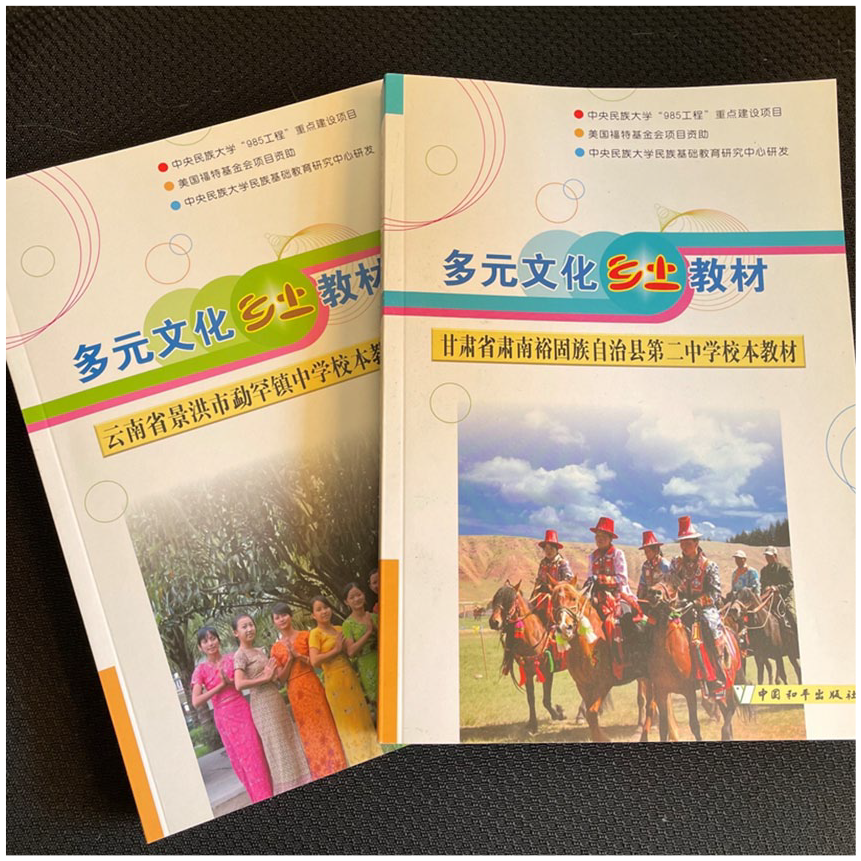
I put together two series of textbooks for the junior high school level: one agriculture, the other livestock husbandry. Each series has three volumes, for the 3 years of junior high school. Why for junior high? Because 90% of the local students stopped schooling after junior high and they had to do farm work when they went back home. Many of them didn’t know the kind of work their parents had been doing. So, we put together textbooks. How did we do it? First, I trained two teams of my ethnic minority students before sending them to the field. I prepared them with knowledge relevant to compiling a textbook, including what the general cultural-economic patterns were and how to investigate locally specific cultural-economic patterns. I taught them research methods. Then I taught them what a textbook was all about, how to edit a textbook, what a syllabus was, how to develop a syllabus, and how to put together a textbook according to the syllabus, including some principles in textbook editing. Then, I taught my students how to train the local teachers. With this knowledge, we did systematic training before going to the field, inviting specialists to give lectures and organize workshops.
After the training, my students went to study the local knowledge with me. We used anthropological methods for the fieldwork: observation and interviews. We sought local knowledge, interviewing experts in different lines of work, for instance, experts who specialized in tropical rainforest in Xishuangbanna, 6 in rice growing in Xishuangbanna, in rubber tree planting in Xishuangbanna, in tropical and subtropical flora and fauna in Xishuangbanna—basically for knowledge regarding every aspect of life in Xishuangbanna, to learn about its crops, the flora, the fauna, and the ecology. After analyzing the data, we discussed how to put the information into textbooks. As there was a lot of local knowledge, we needed to decide which parts should be included in the textbooks. How much could we actually include into the textbooks? We formed local expert teams and discussed the topics with them. With all the insights learned, these teams became the main force in compiling the textbooks. We were mainly responsible for the training.
[Ethnic Minority Textbooks]
Hsiung: Could you talk more about the training?
Teng: About the training. When we started, the teachers didn’t even have computers, let alone know how to use them. We bought the teachers computers and started to teach them computer skills, then trained them so that at the end they could compile the textbooks by themselves. We bought them cameras too. They went out to take photos; they did the typeset as well. We taught them how to do typography, from the scratch, step by step. Our two teams stayed there for 5 years. It turned out that they mingled with the locals perfectly and are still well-remembered by the locals even today. Really good relationships. Teachers were made experts. When I showed our textbooks to the editors at the People’s Educational Publishing House [in Beijing], they said our textbooks were put together better than theirs. Local teachers in the rural areas were in fact very smart. As long as you teach them, they start slowly but surely and will master it fairly fast. I found these young people had great potential.
Later in the Qilian Mountains, we taught the local teachers the same way. Parents welcomed the textbooks we had put together because they were closely related to the vital aspects of their life. For instance, in the Qilian Mountains, the full ecological cycle consists of humans, livestock, and the alpine steppe. Cattle and sheep rely on the steppe: If the steppe grows well, cattle and sheep get fattened up and when cattle and sheep get fattened up, people are better off. People get better dairy products, more wool, and subsequently better income. All the local knowledge operates around this ecological cycle: humans rely on livestock, livestock on steppe, humans protect steppe. Yet, what specific knowledge does it entail? Let’s take the grasslands as an example. Since the size of a pasture can’t be changed, there is a numerical relationship between a pasture and livestock. If a pasture, for instance, can only support 1,000 sheep, in other words, graze 1,000 sheep, more sheep will simply destroy it. The ecosystem of alpine steppes is very fragile. The pastures are results of thousands of years of evolution. The soil layer is very thin. Once you overgraze it and let the livestock eat the roots, this land will not recover even after hundreds of years. Local herders had this knowledge and knew how to handle it. So, if a pasture can graze 1,000 sheep, they wouldn’t herd 1,100 sheep onto it. They knew it very well.
To avoid overgrazing, they must do rotational grazing. They came up with the ideas of winter pastures and summer pastures. A winter pasture was right in front of one’s home. It was not for summer grazing—it was left alone to grow in the summertime when herders moved to the foot of snow-capped mountains with available water to graze. During the winter, those areas were covered with heavy snow, and cattle and sheep came back home to graze. In addition to the knowledge about winter and summer pastures, herders had to know how to maintain pastures because sometimes poisonous weeds grew. All cattle and sheep would perish after eating these weeds. How to stay away from poisonous pastures? What temperature is easy for poisonous weeds to grow? How to prevent poisonous weeds? They had a bunch of indigenous ways to deal with these issues.
Also, when sheep get sick, how to treat them? Livestock epidemic prevention was another realm of knowledge.
Furthermore, since herders wanted to increase their income but the capacity of each pasture is limited, how to make it happen? As wool was their main income, they had to improve the quality of the wool. They then introduced merinos from Australia to crossbreed with local sheep in order to get better wool. This knowledge helped them earn more income. Breeding was another realm of such knowledge. To survive in the local environment, you needed to know when and how to breed livestock. You also needed knowledge about the climate. The standardized curriculum did not provide any of these kinds of knowledge. That’s what we focus on in our textbooks. This way, when students graduated, they sometime knew better than their parents because we had applied classes. As to how to breed, we had applied classes that we ran at the local breeding stations. Students went there to practice. The stations offered workshops so they could do the breeding with their own hands. As to poisonous weeds, students visited pastures to look for them after studying them in class. They learned why poisonous weeds would grow, how to avoid them, what herbicide could bring them under control. Our course also included knowledge about merino wool and shearing. We had it all and many applied classes.
We also worked in Xishuangbanna, which had rubber trees that were highly profitable. Every family there grew rubber trees and one only needed to count the trees to see if a family was well off. So, nobody went to college. The number of rubber trees indicated the wealth of a family and everyone there was doing very well. With 400,000 to 500,000 RMB per year, what was the point of going to college? Not much money after graduation any way. Some families did send children to college. But when they landed jobs after coming back, they couldn’t make much money in this region and ended up going home to grow rubber trees but rubber tapping was an issue for them. Rubber trees begin to produce latex 5 or 6 years after planting. If the tapping is done in the right way, the tree will continue to be productive for 30 years; if not, it dies after 8 or 9 years. So how to tap is the key. We had a rubber forest at our school and invited rubber tapping masters for training. When we had this class, we went to do the tapping in the forest. Students learned how to tap by practicing. We had many of this kind of hands-on class. We incorporated both applied and theoretical lessons seamlessly in one course. We had this one continuous course for the three grades of junior high school because junior high was the final stage of the 9 years of compulsory education. After graduation, students set out to make a living for themselves. They would do better if they knew about their hometown, what their hometown could offer, what the means of production was, what the lifestyle was like, what festivals people celebrated, how people made sense of them, what people believed in—all the local knowledge. This course helped students gain better understanding of their hometown. As these two series of textbooks were highly functional, we got wonderful feedbacks after a few years’ trial.
However, there is still a big unsolved problem—our evaluation system. The criteria of evaluating among school principals is based on how many students pass the senior high school entrance exams and how many passed the college entrance exams. It boils down to the promotion mechanism. Some principals said to me, “Your stuff is good. The problem is it doesn’t count in my evaluation.” Therefore, the evaluation system needs to be reformed as well. If teachers offer courses based on local textbooks, they should score points for doing so. Our country’s current systems do not match. The system of national, local, and school curriculum was introduced but the evaluation system has not aligned with it. These things in China need systematic social engineering. Systems don’t work together in their implementation. Why? It is directly related to our bureaucracy: dereliction of duties.
Hsiung: Afraid of making mistakes?
Teng: Dereliction. Not really about making mistakes. What benefits can I get doing these things?
Hsiung: Oh, it has to be tied to that.
Teng: Only when the system says, “If you carry out these tasks, you will earn x number of merit-points,” will it be done. This is the point. They will only do it if it is part of the duties that are essential for promotion, you see?
Footnotes
Declaration of Conflicting Interests
The author(s) declared no potential conflicts of interest with respect to the research, authorship, and/or publication of this article.
Funding
The author(s) received no financial support for the research, authorship, and/or publication of this article.
