







Abstract
What is activated at that joint where time is at once toofast and tooslow? What is felt? Propositions for Social Dreaming, a quilt-based project by Andrew Goodman and Erin Manning, explores this active interval of time in the making by inquiring into the dreams that fissure it. Thoughts swirl from algorithmic potential to the disorder of beds of unmade. Living otherwise is the problematic that moves the thinking, living in modes neurodiverse, in an ethos of minor sociality.
Slowness, at its limit, almost not moving/not moving at all, an infrathin speed indistinguishable from stasis and yet in the moving-still. 1
What does slowness resist? Not speed as such, but perhaps efficiency, conclusion. Is it going too far to say it resists personhood, avoiding being done, finished with, concluded, preferring instead to dally, idle, daydream?
I am directed, oriented, seamlessly slipping into the stream of the fast and efficient (but hopeless, in all senses of the term) academic machine—work done on time, always ready, always responsive. It drives me crazy.
I live with possibly the slowest, dreamiest person ever, eternally sidetracked, never quite ready, never quite on top of things, supralinear in their powers to extend delay.
It drives me crazy.
Lately I have been trying to be generous, to give up hope of shifting this slowness, and to think of this slowness as a form of resistance, a radical incompleteness. This infraconscious state of never-quite-being-finished and never-quite-being-ready holds time hostage. The metric of productivity is hijacked, time not stopped exactly as rendered inefficient. Because this is not a conscious resistance, a deliberate jamming of the flow(chart). It’s a moving-to-another-rhythm that comes with an implicit disregard for what seems so pressing.
If the tempo of capital’s time, of time productive, is deferred, undone, do we still have personhood?
Sometimes I wonder, in the offing of the frustration of my infinite nagging to get things done, if this isn’t an adjacent project for living, a project for a more-than-human encounter with other speeds. Because their movements are also deliberate, are also careful and precise. Is being itself what is called into question, never-quite-determinately?
How often have I felt condemnation for moving too fast? Toofast, code for an inability to perceive the environment in all its vast complexity, carries a moral overtone. Toofast, it is said, is to participate, willingly, in capital’s rat race.
But what if toofast is another kind of tooslow? What if toofast is not a speed but a rhythm, a modality of encounter with a world that jumps at differential cadences. What if toofast is not rushing in disregard of process but connecting to the bursts of liveliness of a world always underway?
As a child I was tooslow. To walk with me was to put up with infinite deviations, stops, and slowdowns. To eat with me was to commit either to a never-ending first course or to move me to another table, to another room, so clean-up could occur and lives could be got on with.
As a child, I was toofast: toofast to sit still, to learn to read, or then to spell; toofast to sleep or stay indoors; and then toofast to listen to the teachers when the answers were already there. As an adult, I am still toofast to sleep, toofast to know my colors when I can taste their vibrations instead, and toofast to straighten up and focus on one thing.
Toofast and tooslow move at infinite differential speed, their movement out of sync with measure. Theirs is a movement that vibrates, committed less to getting somewhere (or resisting) than to fielding the rhythms of existence at paces uncertain. The yield of toofast is a burst, an opening onto tendencies not yet explored. But so is that of tooslow, if at the pace of a color shift. The synesthesia of tooslow merges with the toofast of crisp yellowness, dry on the tongue. They connect.
In 2017, we began a quilting project called Collective Fabulations: Propositions for Social Dreaming (Manning, 2021). The aim was to collaborate on an experiment that would take us on an infra-active textile journey to explore sleep and its infinite movements and speeds. Over 2 years, three quilts were hand-sewn, electronics (speakers, sensors) embroidered into their crevices. A diagonal insertion of 2-m bend sensors formed a cross and tiny light sensors were arranged in horizontal lines across the quilts. These sensors are fuzzy (not precise) in their operation. The bend sensors are just too long to accurately measure the pressure or torsion of the fabric, instead responding to every micro-movement and micro-folding and type of pressure or weight (human and nonhuman bodies, pillows, sheets, the quilt itself, perhaps even the weight of dreams), constantly adding and/or subtracting these differential registerings as flickering shifts in intensity. The light sensors are similarly too sensitive, primed to respond to shadows, bodies blocking light, incidental foldings of cloth, and the differing speeds in the changes in the light at different times of day and different times of the year. The system composes with these intensities: They are gathered across beds and seasons and bodies and permutations. It both sparks the entanglement of the algorithmic processes, visible in an interface connected to each quilt, and returns to the ecology of the bed in microvibrations expressed by tiny embedded speakers, in turn triggering more flickers of registered micro-movement.
The quilts are not machines that learn (Goodman, 2020). Their electronic components cannot be directly managed or ordered. The interface is not a translation of the ecology. It will tell you nothing about the infrathin of movement-moving. How we move in our sleep, or how the environmental conditions shift—these effects are registered, and, in a nonlinear way, shared with the other quilts, as tendencies—incipient ecological movements. What is experienced is never the result of a single act (Manning, 2012). It is the differential field that is shared, a field as much of sleep as of the glitches of unsteady internet connections, frozen interfaces, and the collective unease of sleep unachieved.
We move together, half-asleep and wide awake, across space and time. But this collectivity of the dreamscape is never returned to us as a package. Only in fabulation do we encounter each other’s movements.
The aim is not to parse or make sense of the dreamscape. It is not to fill it with content or to attempt to translate it into another form. We do not hope to gather the dream and share it. We do not care to transfer a movement. What is of interest is the shape of the dream, the quality of the wakefulness, and the intensity of the uncertain field of sociality fabulated into being through the thirdness of the quilts in collective expression. The emergent sociality is not reducible to the bodies that sleep—to be in the dreamscape is to be in a minor sociality that in all senses exceeds the figure of the human sleeper. For dreams are not reducible to us, they are not graspable. Like the effects of the computational fabulation, they exceed a body’s capacity to sense, to make sense, opening themselves to expressions of experience more-than-human. It is this more-than-human angle that the algorithm plays with. Or, perhaps better said, the algorithm becomes entangled with that which it cannot make sense of because it is not of the register of sense-making. The algorithm is a participant in the excess on itself of sense that might be called sociality.
Minor sociality is the quality of expression activated in the relation. Infinitely irreducible to the one (or the one-two), minor sociality is the field as expressed through its transduction (Simondon, 1992). Not a person, not a given speed—an ecology. The quality of an angle of sound, the feel of light, the touch of a fold, a shiver. But also the lingering effect of a dreamscape in a bed shared across a thirdness, the impossibility of knowing for sure where the thought begins and ends.
Sensors are not necessary. They are simply amplifications of an existing temperament Minor sociality is always active and dreamscapes move between sleepers and insomniacs always. Their role here is not to presume to carry something particular, or even to record something that would otherwise lie dormant. They are simply facilitators of a certain hospitality, invitations for dreaming with style.
Ursula Le Guin’s (2003) short story, The Collective Dreaming of the Frin, accompanied us in this journey. 2 This account of a culture that shares their dreams at an infraconscious level fostered a proposition: Could dreaming activate a sociality in excess of the one-two? Might dreaming allow us to envision an excess on the interpersonal? 3
LeGuin’s writing takes us on a resolutely non-Freudian journey of the dream: The dream is not an individual act. It is a collective tonality, a plane of existence that accompanies us even in our waking hours, fostering a coming-into-resonance that exceeds the conscious. To dream is to be collectively attuned. Sociality is here reimagined—no longer reducible to what occurs between-two, sociality is the style of a dream that carries across a multiplicity, feeling (and fielding) its resonant folds. As the Frin remind us, the aim is not to catch the content of the dream, but to field its style. What style might the hospitality of the ecology call forth? What quality of the minor might it fabulate?
Collective Fabulation is a proposition to activate emergent connectivity between sleepers, gathering space and time into a collective, social, and ecologically generative act.
The quilts are useless. They do not collect and parse data: They are always in-forming, never informational. They do not condition sleep as a private realm but unmake beds, throwing them open to experience. They do not create a product, their refusal to amalgamate data programmed in. They don’t work: on themselves or each other. They don’t improve (sleep). They gather, unraveling the edges that entangle relation into unknown futures. They proceed in stutters and setbacks and on borrowed or stolen time. They falter—they do not go anywhere, are untimely in their fabulatory reach—they circle around, reorganize, and remake or unmake each other through their incessant and generous gifting, keeping on moving and inventing (like a dream) always in a debt of gratitude to each other, distributing resonances.
In early conversations, we inquired into the history of the quilt. Women’s work, patchwork, pathwork. 4 Necessity. Aesthetics. Politics. Before the abolition of slavery, quilts marked escape routes and houses of refuge for runaway slaves (Hicks, 2016). In more recent times, in a collective sharing of solidarity and grief, quilt making turned toward the memorial, to the necessity of a collective movement, a sociality in the making. 5
The blue quilt composes with the aesthetic force of a history of materials repurposed and humans bought and sold (Figure 1). Hand-dyed with indigo, the traces of its blue on skin a remnant of what is never completely forgotten, it inquires into the currency of how value is produced. Tightening onto the individual, holding a person to its currency, the blue becomes the modality of exchange, the violence of extraction.
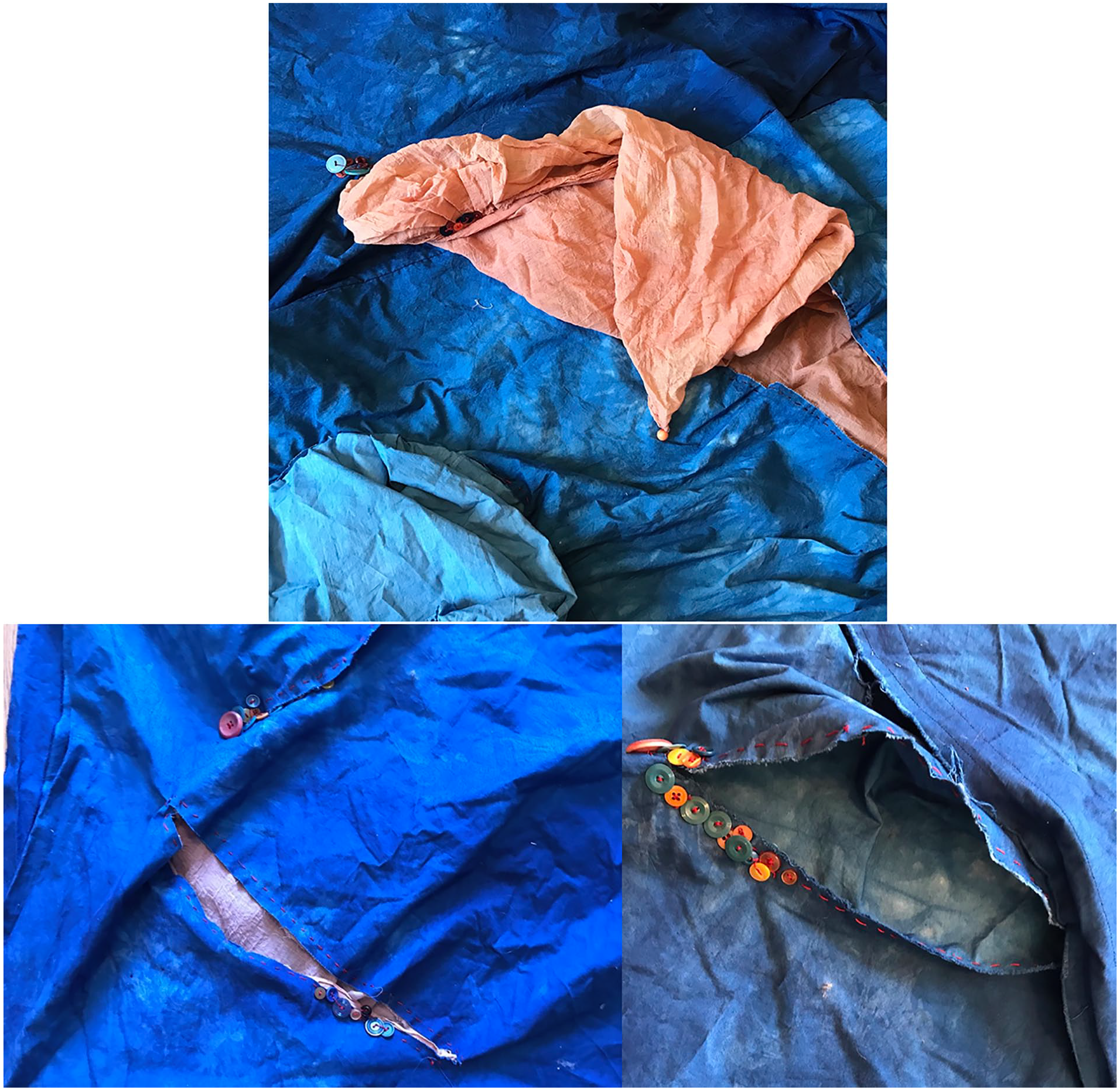
Manning, E. & Goodman A. Propositions for Social Dreaming (detail) (2017–)[mixed media]. Collection of the artists.
While indigo creates conditions for indentured labor first in India, it isn’t long before it begins to be traded in Africa, used as currency—a length of cloth for a body. In the United States, it is then cultivated, its profits outpacing sugar and cotton by the 1700s. During the American Revolution, when the dollar no longer has value, indigo cakes are traded for the slaves who cultivate it, the original American flag dyed with their labor (McKinley, 2011).
The blue quilt is king size. Made of Indian cotton, it is dyed in a single indigo vat, its color increasingly uneven as the dye begins to run out. A single cotton nightgown is sewn through it, creating a topological yawn in its otherwise flat surface. It can be worn as a dress. A slit in the middle, filled with orange hand-woven fabric purchased in Tunisia from one of the last old men who weave with the traditional tools, invites space for a cat. A double layer with its own smaller quilt is an invitation for a child or a friend. Orange and yellow and blue buttons click together when the fabric moves. It is thick with pure cotton batting. It leaves you blue.
What if we made quilts that did not seek to build worlds, but to untether or gather? Quilts that might unmake beds, holding on not to the homely or the unhomely (not domestic or surreal) but to something recessive or fugitive or unmakeable? For quilts unappear, so habitual are they in our lived environments.
Unappearing, tooslow, we have found Collective Fabulations to be unappealing to the gallery context, the quality of its sociality too imperceptible perhaps. But this is also its force—that it has no capacity to be experienced from a distance and that it cannot be grasped as though 1 + 1 + 1 = 3. And yet, like the indigo they are made of, the quilts are in excess of themselves, more-than, full of inheritances, beautiful and painful, the legacy of how they (de)value experience woven into each thread.
The quilts are not a homogeneous whole. Quilts never are: Their history, politicized by a culture that has never cared for the slow work of the mundane, that has never honored the care for what remains, and that has never recognized those who labor behind the scenes, is always singular. Their work is precisely that to expose the singularity of what is left over, of time taken, and of materials gathered. In this sense, sewn alone or in a group, quilts are collective—they bring together aspects of existence that lie at the edges of what is perceptible, those fabrics that would otherwise have been thrown away, or those designs that get rumpled, night after night, as the quilts hug us to sleep.
Quilts take time.
The first thing to notice about the quilt assemblage in all its computational glory is that there is nothing to notice—it is working so slowly that you cannot sense its movements; it is not working at all; or it is both these things.
We once made a work—Where Forces Meet 6 —in which the probabilistic entanglement of a series of fans to reach a state of self-organizing criticality took half an hour each day—they predictably arrived at a state of unpredictability every morning in the gallery right on time. Self-organizing criticality is the motif of the quilt project as well. Not digitized randomness but emergent collectivity, programmed into uncertainty by veering away from equilibrium and far into differential intensity. This criticality is a limit at which the enmeshment of potentials is pushed to a point of relational complexity where new system-wide potentials arise, symbiogenetically. Perhaps—we fabulate—this is a proto-mathematical sociality? These new creative potentials are driven by differentiality, they seed the field with novelty and enliven the dreams, invoking a milieu rather than modeling or controlling via a plan. This criticality is not an end point. It is a fabulation, an opening out as much as an enfolding of futures. How long will the quilts’ algorithms take to achieve this criticality? We cannot say. They entangled for 6 months and still we do not have an answer. Either they hid their complexity from us or they were still on their way, gathering, waylaying, segueing in a nonhuman dance of deferral.
How to value what requires a co-composition, a movement toward the unsettledness of a dream barely remembered? To move with fabulating ecologies is to commit to a time undemarcated, to a year of sleeping in, to a yawning time span, to a work that is both toofast and tooslow. How to relax into this time differential where movement eludes us in its arrhythmia?
The quilts dwell in the “mean time” (Akomolafe & Leberecht, n.d.). Mean time is the time of the between, the time in the interstice of time making itself felt. Sleep gathers the mean time into itself—a time outside calculation, beyond computation. Dream time lives here and it is this quality of time the quilts seek to foster. Endlessly distracted, useless in their flourishes, infinite in their capacity to fold into and out of themselves, the quilts gift themselves. Theirs is a landscape of missed encounters, of barely grasped dreams, of undocumented connections. Social dreaming: forget more than you remember, field the reach of what exceeds you, become in the infrathin interstice of a deferred wakefulness, sleep the dream of the other.
We were once asked how we would know when our work achieved criticality, a question that had never occurred to us to care about. Our aim was never to reduce the work to its components. Surely the electronics were not more potent than the dreams that entertained them? The planes are forever intersecting.
Perhaps at a certain limit point of absolute slowness, truth and fabulation are indeterminable from one another, their paths touching for an infrathin time? Gilles Deleuze (2005) speaks of the powers of the false, reminding us that stories tell us, that dreams dream us.
The power of the false is the fabulatory angle of minor sociality. It is how the coming-into-relation expresses itself, always in excess of the one way, the one story, the one person. Collective Fabulations is a curiosity about the activity of the field of relation itself, which is to say, its sociality. We are made by this sociality (not the other way around). Uninterested in the details of how we perform for each other, the quilts invite us to move with them into a fabulation of all that uneasily connects the more than that we are, to more than what we know. The quilts do not begin from a point of separateness that then intertwines. Like the dreaming of the Frin in Le Guin’s tale they only and always begin in the middle of the field of relation already-in-progress. We meet ourselves in the dreams that refuse beginnings and ends. We compose, we are composed, in their emergent expressions of affectibility. They do not capture movement inductively (universalizing rules), but seek to stay at a crest of emergence and a point of collapse, never proper or proprietal, together as a holobiont.
The second quilt, also king size, is dyed with saffron, made from a dozen or so sleeping garments from the turn of the 20th century, and finished with antique silk cuts of Japanese kimono (Figure 2). Saffron might be considered indigo’s cousin, also a currency, also a substance that requires, and produces, indentured labor. Still worth its weight in gold, saffron was traded on the spice route, used for royal (and Buddhist) robes, prized by the ancient Greeks and Romans as a perfume, used in ancient Persia as thread for Persian royal carpets and funeral shrouds. It was offered to deities, mixed into teas, and used as medicine in China.
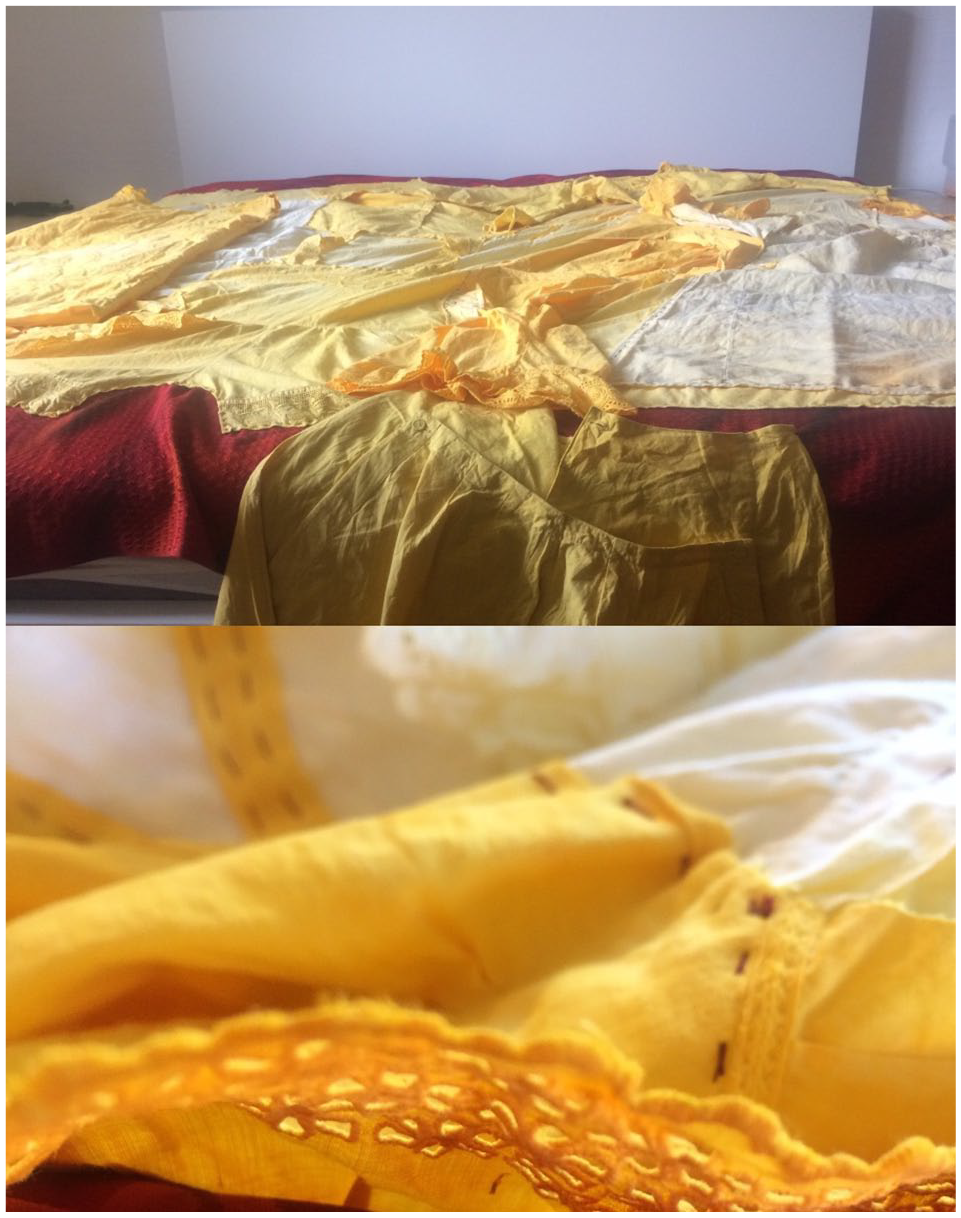
Manning, E. & Goodman A. Propositions for Social Dreaming (detail) (2017–)[mixed media]. Collection of the artists.
The yellow-gold hues of the saffron used as dye are particular in that they cannot be stabilized. No mordant works for saffron, as a result of which it holds no promise of color fastness. To dye with saffron is to have to dye again. It is called a fugitive dye. In the spirit of the power of the false, we might say that indigo’s committed bite is the counter to saffron’s ephemerality.
The saffron quilt, like the indigo one, is made of only one dye bath. This explains the deviation of color from intense yellow to almost white. Composed only of the garments, it is a quilt that invites multiple entry points: It can be entered through a nightdress and exited through a second one, the bloomers can be put on, the coat can be entered into, and it too has a second smaller quilt connected to it for an adjacent sleeper.
What are we valuing when we tell a child to clean their room and make their bed? What are we asking when we claim the bed as a neutral space, returned to its formal conditions morning after morning? What are we telling the child about the boundary between night and day, about the socialities produced, the collectivities fabulated in the sleepy half-awareness of dreams?
To discipline the night is to believe the dreams can be aborted, individualized. To discipline the night is to relegate the bed-fort and the bed-tent and the bed-ship of childhood to oblivion, replaced by hospital corners. The dreaming becomes a parenthesis, and the bed becomes mine, not a bed to share dreams in.
The third quilt, a small double, is made from shiny satin, its yellow echoing the second saffron but tending toward a futuristic aesthetic, the slipperiness, holey-ness, and reflectiveness of its surface a lure (Figure 3). This surface, constructed through or in parallel to a reading of the fabulatory science fiction of Le Guin and Octavia Butler, thinks in its mixed and organic forms of imagined and inhuman ecologies—the polymorphic possibilities that Butler (2014) explores in her Xenogenesis series, where alien species swap and combine nonpatrilineally like earthly bacteria.
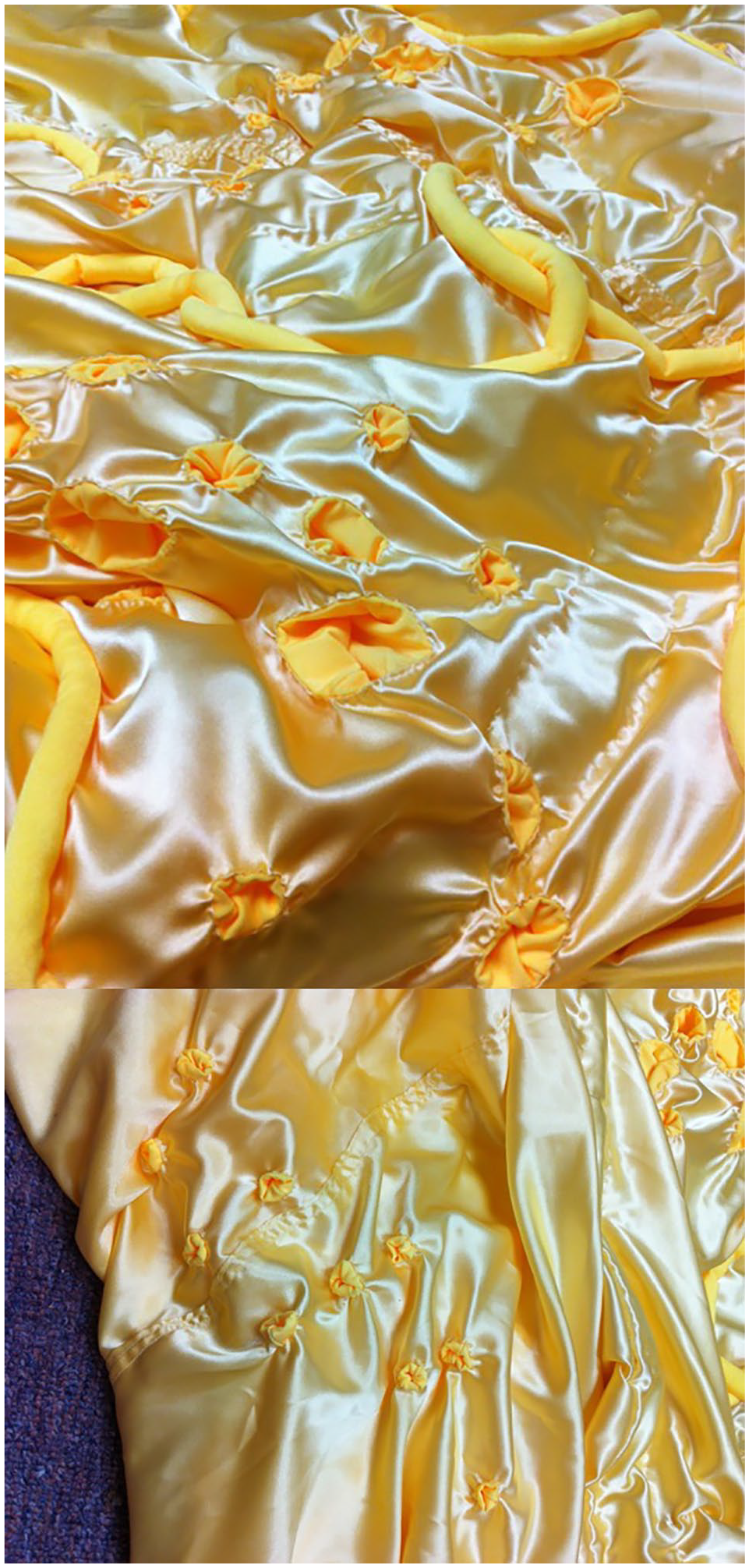
Manning, E. & Goodman A. Propositions for Social Dreaming (detail) (2017–)[mixed media]. Collection of the artists.
It too has entry points for play—tentacular “feelers” that intertwine on its surface (Bertelsen, 2021) and many small orifices that perforate and enfold the layers, inviting fingers or paws to investigate. Like the other quilts, any sense of wholeness or functionality is troubled by the attention to these hand-sewn details and fragility of the construction, by the collapse of a sense of a definitive top and bottom and by the multiple and contradictory invitations to bodily engagement.
The quilts lure the sleeper into the half-sleep in the feel of a fabric-become-dream, a dreaming-weaving, their enfolding of fabulatory potential a kind of bodying. To sleep is to become quilt, to quilt, to enfold (and be enfolded in) an activity of undisciplining the fragile territory between sleep and wakefulness. An un-disciplining of the bed.
Does the undisciplining of the bed trouble the algorithm? Is the algorithm’s speculative potential, its self-organizing criticality, itself enmeshed, enfolded? What might algorithms dream of when they are freed from all-too human tasks, from the humanist (white) project of taking control, of extracting results? What might an algorithmic speculative field provoke—their dreams entangled into their own uncertain protocols, uncertain because the criticality is so difficult to ascertain from the outside? In a project that moves the interactive away from the 1 + 1 toward emergent sociality, there rests a deep commitment to also ask what else algorithms can do. If the normative algorithm is, as Harney and Moten (2021) propose, an extension of the “killing rhythm” that makes the world through individuation and commodification as “a zero-one, zero-one [sorting] thoughts, affects, information, nerves, in ever more precise and minute attributes of duplicate separation,” might Collective Fabulations call forth an analgorithm, an imprecise, uncomputable sociality?
To think that any algorithm can escape the toxic and ongoing legacies of their complicity in, among other things, the slavery of the middle passage and the plantation, or the categorization and pathologization of neurodiverse, trans and queer bodies (in other words, calculations of the humanist project), is a false hope (Goodman, 2020; Harney & Moten, 2021; McKittrick, 2014). Similarly, it would be hopelessly naive to think that self-organization in itself offered an easy path toward emergent sociality, complicit as generative algorithms are in the marketing of thought and the abstraction and quantification of life through machine learning. And yet—why not delve further into the project of a pragmatics of the useless, of an emergent valuation of what uselessly computes, of what ultimately uncomputes? This is the project of Collective Fabulation: Propositions for Social Dreaming: to take seriously the ableist and racist histories of computability while concurrently proposing a different mode of algorithmic thought. Or put otherwise to uncompute value to the degree that the opening onto life generated through minor sociality might be more readily felt. All of this is useless in the most emphatic way: It produces nothing. This revaluation of value is at the heart of the project. A pragmatics of the useless is a refusal of the representation of the useful. Collective Fabulations represents nothing.
Is there a mode of thought not already welded to the human in its compartmentalized and atrophied modalities? The quilts propose to draw on fugitive or minor modes that trouble mastery, completeness, and separability. When we imagine what they might call forth, we fabulate a quality of dreaminess at the edge of consciousness that amplifies the economy of the gift with its entangling webs of unresolvable debt, we speculate about the queerness of failure—a failure to take command and perform efficiently (to resolve tasks and order information) and we return to the incomputable strangeness of Omega—incomputable binary numbers whose ugliness defies the abstraction and generalization that would return us to a presumed (white) center of thought. 7 We are interested in the unparsable excesses of information that remain as flows as much external as internal to any one algorithmic process, excesses on experience that perhaps call forth neurodiverse experience. 8
But again, the quilts do not depend upon these algorithms: Their relational pull is not purely predicated on a technological interface. When the connection drops out, when the computers crash, the quilts still gather on other planes, they continue to fabulate. Collective Fabulation is as much a fabulation on the algorithm’s role in the relational web of existence as it is a fabulation on sociality itself.
Collective Fabulation is as much a fabulation on the algorithm’s role in the relational web of existence as it is a fabulation on sociality itself. What if algorithmic life were to take these technics as its starting point, to explore algorithmic incalculability and incompleteness, and the inseparability that is a minor sociality, rather than quash this with a determined calculability? Rather than getting their work done to the beat, assuming and enforcing separability, could they begin to compose collaborations that generate difference and entanglement? What if, in their emergent state of self-organizing criticality, algorithmic collectivities remained as unformed and social as our beds? What if they started not with an intention to resolve or fix anything, nor to incite speculation to siphon off a profitable excess, but to experiment with an irresolvably open hospitality—an affectability?
If calculation has a core assumption of separability, an implicit refusal of da Silva’s (2018) “difference without separability,” its focus on the quantified edge of what must compute, what might an algorithmic process be that is qualitative to the core? What needs to be fabulated to be enticed into moving into the incalculability of a process that nonetheless carries a bordered commitment to a protocol? Collective Fabulation experiments here, offering a rhythm, tooslow, toofast, that invites a different kind of knowing, of living. In a refusal of a time colonialist/capitalist, and yet with the knowledge that we are cut through with those tendencies, Collective Fabulation asks what it might feel to lose control, what it might feel like to dream each others’ dreams, dreams that could never be reduced to me alone. What kind of algorithm might enfold that kind of experience, that style of semi-wakefulness, that moves without a plan, without a task to achieve, without the colonial machine that naturalizes separability (da Silva, 2018; Harney & Moten, 2021)? Is there, as the quilts’ analgorithmic modes of thought fabulate, a potentiality for an algorithmic life that does not assume or reinstate subjectification?
How could the quilts fabulate practices rather than calculate and determine lives?
Footnotes
Declaration of Conflicting Interests
The author(s) declared no potential conflicts of interest with respect to the research, authorship, and/or publication of this article.
Funding
The author(s) received no financial support for the research, authorship, and/or publication of this article.
