






Abstract
Qualitative researchers continue to push methodological boundaries to study social phenomena using arts-based practices. Research methodologists suggest that the arts open new possibilities in research through the very nature of the arts to stimulate and evoke perspectives. The arts promote dialogue, which yields new insights, highlights multiple meanings, and questions norm-based traditions. This article presents findings from a duo-ethnography to explore the application of the arts as a dialogic-reflexive process during the data analysis phase in qualitative research. Findings contribute with insights into how science and culture are combined methodologically to facilitate dialogic-reflexivity in research and meaning-making.
Keywords
Introduction
We sat at her kitchen table on a warm October day engulfed in a candy store of knowledge and inquiry as represented by our computers and numerous books about leadership. We were two professors in organizational development and quality management, gathering for the first time face-to-face to explore and develop a collaboration between our universities. Our correspondence had been digital to bridge the miles of the Atlantic Ocean between us. I was living and working in Sweden, whereas Liz was in the United States. Our conversations were delectable. We dug deep into theories, sharing our perspectives of leadership as a way of getting to know one another. By midmorning, just about the time of our second cup of coffee, Liz began to share with me one of her current research projects that was focused on women in high-level leadership positions. Her empirical database, rich with in-depth interviews illuminating key insights into these women and how they aspired to top leadership positions, was stimulating, and challenging; She had hit a wall in the data analysis process and was struggling to find her way into their stories. She wanted to ensure that her interpretation would represent the voices of these women and not the voice of herself as a researcher.
As I sat listening to her talk about her research, a wave of excitement came over me. Not because I had the answer to her challenge, but because I saw an opportunity for us to explore her challenge using arts-based practices. And suddenly, I heard the words come flying out of my mouth: “Liz, why don’t you dance your data, and I’ll improvise with you on my flute.” “Dance my data?” she repeated, a bit perplexed, “yes,” I responded, “you dance your data, and I’ll improvise on my flute, and we’ll see what happens.” We looked at each other, staring in silence, contemplating the possibility of what this might mean. Liz was a professionally trained dancer, and I was a professionally trained musician who had left the arts for careers in academia. We were both researchers using qualitative methods and were eager to explore.
The interpretive nature of qualitative research stimulates methodological questions about how researchers can incorporate reflexive praxis during data analysis: among others, becoming aware of their own and how it affects both the interpretative process and the representation of voice for others (N. Brown, 2019; Leavy, 2015; López-Deflory et al., 2022). Research methodologists suggest that the arts open new possibilities in research through the very nature of the arts to stimulate and evoke perspectives. The arts promote dialogue that yields new insights, highlights multiple meanings, opens space for diversity, and questions norm-based traditions.
Many examples of arts-based research (ABR) exist in which the arts are used for either data collection or data representation. Less developed is the use of arts during the data analysis phase in qualitative research. The use of the arts during the data analysis phase is a critical gap in the methodology literature that needs attention. The interpretative nature of qualitative data analysis requires that researchers set aside their assumptions and open space for the voices and representation of the study’s participants (Patton, 2002). Critical theorists and feminist epistemologists have argued for decades about developing a praxis in qualitative research that de-privileges the researcher’s role, thus emancipating the study’s participants (Lather, 1991).
This article presents findings from a duo-ethnography to explore the application of the arts as a dialogic-reflexive process during the data analysis phase in qualitative research. The study is situated within a discourse in qualitative research methodology that questions knowledge creation, meaning-making, and voice (N. Brown, 2019; Denzin & Lincoln, 2017; Freeman, 2017). It assumes a critical theoretical and feminist epistemological (Harding, 1988) foundation that calls for reflexive practices to explore and understand how meaning is created in relation to others, and the need for researchers to explore their own ontological praxis as part of the co-construction of meaning. Understanding the application of the arts requires that we explore knowledge creation and meaning-making from a broader perspective that moves us beyond cognitive skills to embodied and dialogic knowledge creation. Furthermore, conceptualizing language from a broader perspective than based on words invites the possibility to see how visuals, sound, and movement can also serve to communicate and thereby shape meaning and knowledge.
Background
The arts are known to provoke thought, invite reflection, engage the audience, and stimulate emotion (Eisner, 2002). Whether it be film, painting, dance, drama, literature, or music, the arts can highlight the connection between body, mind, and soul, to connect the cognitive to the emotional. Goldberg (1992) describes artists who talk about the deep connection between self-expression and knowing, and the role of the arts in expressing that which is not yet consciously known to the artist. She quotes Katherine Dunham, a dancer, as saying that “physical expression is an expression that can free people from oppression.” Goldberg goes on to suggest that the arts are powerful as creators of space and freedom in the human mind and spirit by “providing structure in which imagination and creativity can flourish” (Goldberg, 1992, p. 620). These insights into the power of the arts have since been applied by researchers to advance qualitative methodologies to problematize and challenge notions of voice and representation.
Participatory ABR practice has been explored since the mid-1970s, with much of its roots in autoethnography (Ellis et al., 2010). Today, ABR 1 is considered by many to be a stand-alone approach to research, distinct, yet closely related to qualitative research. As a research method, it uses the expressive qualities of the arts to awaken and convey meaning (Barone & Eisner, 2012). As Eaves (2014) suggests, “arts-based research employs aesthetic judgment and blurs discipline boundaries, enabling an interplay of form and content and building layers and interconnection” (Eaves, 2014, p. 149). Others, such as Haseman (2006), argue that ABR has emerged as its own research paradigm, which he calls “performative research.” The premise being that arts in research stimulates new modes of enquiry and methodology.
Among the central features of performative research (performance-based research) is the value of embodied knowledge (Pelias, 2008) as essential for expanding thought and inquiry. Embodied knowledge is formed through the interaction between the mind and body in which knowing is situated within us, experience-based, and emotive, not merely cognitive. The interactive, emotive component of embodied knowledge has stimulated new questions and explorations about the interrelationship between researcher and subject and the situatedness of the researcher as both performer and researcher. Framed within a critical theoretical and feminist epistemological perspective, embodied knowing and performance ethnography have pushed the boundaries of what it means to conduct research in a broader social context.
Hamera (2018) writes that performance ethnography “exposes the dynamic interactions between ‘power, politics, and poetics’ and challenges researchers to represent these interactions to make meaningful interventions” (p. 360). Performance ethnography as performative research is social in nature and postulates the inherent situatedness of the researcher in a larger social context as both subject and object. The approach to research has its roots in critical theory, with the aim to problematize positions of power and perception to make visible the limited perspectives from which knowledge is often shaped (Markula, 2006). As Hamera (2018) writes, “performance reminds ethnography that embodiment and the politics of positionality are as central to representing the fieldwork encounter as they are to participating in it” (p. 363). As Markula (2006) surmises from Denzin’s (2003) work with performance ethnography, “the research act, the research results and ultimately the knowledge that we produce represent multiple voices” (p. 354).
One of the continuous challenges raised by researchers in performance-based research is what is the role of “performance”: is it an act? an outcome? a representation? or something else? Markula (2006, 2011) has explored this question through a series of studies examining the perception of injury among dancers. Building on Denzin’s distinction between performance and performativity, Markula (2006) raises the question about the way in which her own role as performer can be understood in relation to her research of dancers. In her first piece (2006), she concludes that “it is not sufficient for a performance ethnographer to conceptualize research as performance or even represent one’s research results in a performance, but one needs to harness the performative, the aesthetic, to transgress social boundaries” (p. 355). She concludes her exploration returning to Denzin citing “these performance-sensitive ways of knowing . . . contribute to an epistemological and political pluralism that challenges existing ways of knowing and representing the world” (p. 361) (Denzin, 2003 in Markula, 2006).
In several follow-up studies, Markula (2011, 2015) continued to probe the depths of performative ethnography problematizing the interrelationship between performance and performative. Among her contributions was the application of a theoretical framework of (a) affect and sensation of art, and (b) stratification from Deleuze and Guattari that enabled her to examine more deeply elements of perception among her dance subjects. Of interest to us in this article is the reinforcement that the use of arts-based practice in research also requires a structure and methodology; otherwise, it becomes pure performance.
To this article, we explored the use of the arts specifically as a process to facilitate dialogic-reflexivity and address challenges of voice that are inherent in qualitative research. Subsumed within this exploration is a critical theoretical intent to give rise to multiple voices. As researchers, it is important for us to be aware of our own dispositions and embedded knowledge histories, and the way in which they affect our scientific inquiry and representation of the subject of study.
Breaking Free From Assumptions Through Embodied Knowledge
Arts-based practices in research open spaces for inquiry and knowing that stretch us beyond our comfort zones and cognitive ways of knowing (Nissley, 2010). The arts engage us in acts of embodiment that interconnect thinking with feeling (Bresler, 2008). Embodiment is the seamless interdependence of the body and mind: the “integration of the physical and the biological body and the phenomenal or experiential body” (Bresler, 2008, p. 231). Bresler contends that “to work in a paradigm of embodiment is not to study anything new or different, but . . . to address familiar topics . . . from a different perspective” (Bresler, 2008, p. 231). Similarly, Snowber (2018) writes that “embodiment is the interconnection of body, mind, heart, imagination” and so forth. Embodiment is not just about the body, but about living from integrative place of body, heart, and mind. Research based on embodiment can this serve to break the mold of traditional ways of knowing, opening space for multiple perspectives and voice (Snyder, 1998).
As a critical approach, embodied knowledge help to address the challenge of “assumptions” (Bresler, 2018), which are innately inherent in the analysis of qualitative data. According to Brookeld (1995, in H. Brown & Sawyer, 2016) “we are our assumptions”; consequently, “becoming aware of the implicit assumptions that frame how we think, and act is one of the most challenging intellectual puzzles we face in our lives” (p. 2). Using arts-based methods to create interactive spaces that evoke embodied experience provides researchers with tools that can serve to make visible assumptions and to challenge those assumptions.
Bresler (2018) has given considerable thought to this challenge and suggests that challenging assumptions is about inviting space for the act of “unknowing.” In her thesis, she contends that we, as a research and educational community, have developed a fixation with the need to know, which often leaves us at the superficial level and surface findings. As academics, entrenched in our own obsession with knowledge and expertise we limit our ability to see. Going deep beneath the surface requires that we “leave behind the grids of the known” (p. 653). Herein lies the power of both transdisciplinary spaces and embodied knowledge through artistic practices that has the potential to catapult our center of gravity to new spaces beyond the known.
The interpretive nature of qualitative research calls for researchers to engage in self-reflexive praxis to identify their assumptions and develop awareness about the implications of interpreting the data from a broader perspective than self (N. Brown, 2019). Reflexivity as a praxis, positions the researcher in relation to the data (N. Brown, 2019), suggesting that there is necessarily an interactive and co-constructive process of meaning-making that takes place during and through qualitative research (Finley, 2003).
This view of meaning-making and knowledge as interactive and co-constructed challenges traditionalists’ perspectives of meaning as shaped by the written and spoken word. Framed within embodied knowledge (Tanaka, 2011), language is expanded to include a variety of ways of knowing. Muntanyola-Aura and Kirsh (2010) talk about the unique interaction that the body and mind can offer a thought. In their words, the body can serve as a “simulation engine or as a representational system, that allows thinking to interactively formulate thoughts about a domain. Thought can be more body-centric” (p. 1). This is in line with Kirsch’s (2011) writings on physical thinking. For example, music creates an interactive space, as both performer and listener, that engages mind, body, and soul that opens us to new experiences. Through the interaction between the cognitive and the experiential, music opens us to new insights and ways of perceiving. When applied in a research context, music can serve to create structures for listening, shape patterns and forms through melodies that mirror the date, and create a disequilibrium through dissonance to stimulate thought.
Evans (2009) coined the phrase, “Languaging” to suggest that language is something complex, in which we are immersed (i.e., being in the language) and thereby, experiential.
In viewing language as emergent from the experience, and observed awareness of these interactions, my conjecture would be that how we handle language within this complex of operations, is also key. Being, doing, observing, describing can then all be seen to be integral to one another, and thus the way any one of these operations is conducted, will influence the nature and development of the reflexive discourse between them. (p. 210)
His concept of “languaging” connects to the power of the arts in research to create an interactive space that is rich with a complex language derived from various art forms. Using arts-based methods to create interactive spaces that evoke embodied experience provides researchers with tools that can serve to make visible assumptions and to challenge those assumptions (Bresler, 2008; Eisner, 2008) through continuous inquiry and exploration (Irwin et al., 2018).
Dialogic Reflexivity Through Arts-Based Practice
One of the unique elements of arts in research offers researchers the opportunity to disrupt perspective through their participatory practice and reconceptualize perception from their new embodied experience (Rashid, 2018). This strength is promoted as an evolutionary development in qualitative research, extending several methodological periods, including the narrative turn, the reflexive turn, the relational turn, and the creative turn (N. Brown, 2019). The arts promote dialogic-reflexive (N. Brown, 2019; Finley, 2003) processes through embodied knowledge (Tanaka, 2011), highlight multiple meanings, and question norm-based traditions.
Engaging in dialogue that includes self-reflexivity (N. Brown, 2019; Hertz, 1997) creates consciousness about who we are in relation to one another, including our ideological perspectives and cultural backgrounds. Bakhtin (1986) contends that dialogue can serve as an important framework for knowledge construction. Moreover, Brown and Sawyer (2016) argue that dialogue is important to move acts of reflexivity from the solitary to the collective, suggesting that new perspectives can be stimulated through interaction. The interactive nature that emerges through the arts provides a vehicle for the researcher to interact and challenge assumptions, both in terms of data collection, analysis, and representation.
H. Brown and Sawyer (2016) connect embodied knowledge to the dialogic nature of the arts. Dialogic practice, they suggest, stimulates “critical thinking and meaning-making in relation to new images and narrative” (p. 4). The key to dialogic reaction is in new structures that emerge to stimulate new perspectives. By promoting a dialogic space, the arts can challenge assumptions, both in terms of data collection, analysis, and representation. Bresler (2018) echoes this, suggesting the power of the dynamic between resonance and dialogue that emerges through ABR. “Resonance mobilizes perception and engagement, enabling a bridge between the inner and the outer [self]” (p. 659).
One of the unique elements in arts-based disruption is that the researcher is a participant in the disruption, experiencing its effects and reconceptualizing perception from their new embodied experience. This is in line with Dewey’s notion of reflexivity that emerges from learning by doing. Leavy (2015) states that the dialogic, embodied nature of ABR opens the doors not only for questioning assumptions and expanding perception but also for addressing the power balance between the researcher and the researched. The arts, she suggests, have the power to challenge dominant stereotypes, provoke, evoke, invite participation, and stimulate critical thinking. Engaging in dialogic reflexivity is often strengthened by the use of guiding questions (Bresler, 2018). According to Bresler, this helps to shape both what we look for in our investigation and how we engage with it. The kinds of questions then become relevant to challenging the dominant views held within the cells of our mind.
Applying Art in Research
Leavy (2015) explores the array of artistic forms and their application to research. In this article, we highlight music and dance to reflect our own artistic backgrounds applied in this study. Music’s role in society has been central for centuries, serving as a social function as well as in healing (Stevens, 2012). Music is also used in education to stimulate learning, facilitate expression, and develop skills in listening, collaboration, and teamwork (Snyder & Cooper, 2015). Musicians have a unique ability to listen and interact with sounds (Rostron, 2003; Sorsa et al., 2018). They are trained in fine-tuning their listening skills to identify small nuances. As Leavy (2015) suggests, “music-based approaches to research can help researchers access, illuminate, describe and explain that which is rendered invisible by the research practices” (p. 128). She quotes Huxley who said that “after silence, that which comes nearest to expressing the inexpressible is music” (in Leavy, p. 128).
Bresler (2009) cites that music can help researchers build their listening skills, which is essential in qualitative research. The language of music, based on melody, harmony, rhythm, tonality, form, and dissonance can be transferred to everyday settings to help researchers fine-tune their skills in listening (Bresler, 2009; Snyder, 2019). Leavy (2015) suggests that the components of music can help qualitative researchers enhance their perception, conceptualization, and communication. She also recommends that researchers consider the above categories when analyzing interview data.
Dance is another art form that can serve well as a research methodology, according to Leavy (2015). Similar to musicians, dancers use form, structure, and rhythm to express themselves and to integrate the body as a place of knowing (Snowber, 2018). As a form of knowing, dance has been described as physical thinking; a process of using the body as an instrument of cognition (Kirsch, 2011). Muntanyola-Aura and Kirsh (2010) talk about the unique interaction that the body and mind can offer a thought. In their words, the body can serve as a “simulation engine or as a representational system, that allows a thinker to interactively formulate thoughts about a domain. Thought can be more body-centric” (p. 1). Leavy (2015) refers to the work of Clark-Rapely (1999) who suggests that dance “is a form of transformative human action that expresses an individual’s being . . . and can thus support, rather than alienate communal relations” (Leavy, p. 159).
In Snowber’s work (2018), she writes about the living, moving nature of dance as a way to integrate the body with places of knowing. She writes, “We are embodied beings, living through and in our bodies” (p. 247). Accordingly, “the choreographer, the dancer and the improviser have long known that dance making is a creative process, one of questioning, sifting, forming and unforming, making and remaking, and always a place of discovery” (p. 253). Her view supports the power of embodied knowledge to challenge assumptions and decenter/re-center perspectives in research.
Combining music and dance in a duet enriches the embodied experience through the interaction of different forms of expression. The use of a duet, as performed by distinct art forms, adds perspective in unique ways. It stimulates a dialogic-reflexive component that can strengthen the researcher’s ability to challenge assumptions that lie within their own perspectives. Both music and dance use form and rhythm to express and communicate. Dance also introduces movement to the duet, whereas music introduces tonality and melody. Interacting in this expanded space opens the possibilities to stimulate thought and develop a more complex interaction that may serve to reflect the complexities embodied in human experience (as derived from the qualitative data). In so doing, the improvisational duet has the potential to become an embodied act of dialogic-reflexivity.
Method
The study presented in this article is an embodied experiment (Finlay, 2014) based on a duo-ethnographic methodology that intentionally juxtaposes multiple perspectives to decenter/re-center preconceived notions of reality. The researcher’s background is used to probe, explore, question, and stimulate perspectives around the research data (Sawyer & Norris, 2009). With this form of personal inquiry, two researchers investigate a topic of interest using their own life as the curriculum that drives the dialogue and the subsequent research. Dialogue (Bohm, 2004), interaction, and reflection are central to the methodology to stimulate new insights and understandings. The collaborative approach and multimodal use of different art forms provides a dialogic component (Finley, 2018) that enhances exploration and decentering/re-centering of perspectives.
As researchers, we are both academics and artists. We are professors in leadership and organizational development and quality management. One is a professionally trained dancer, and the other is a professionally trained musician. The common knowledge base for the experiment was leadership studies and artistic expression. The point of departure was qualitative interviews conducted by one of the researchers in a separate study that examined what women in high positions of leadership experience during their rise to the top. The other researcher was not privy to the interview data and thus served to interrogate the perspective from a distance.
Process
The experiment was carried out over a 2-day period during which improvisation and reflective dialogue were integrated. The experiment was guided by the question, “How can embodied knowledge (as created through music and dance) inform a deeper understanding of the concept, ‘Deviance,’ which was identified in the initial qualitative analysis of the interview data?” Two practices were included in the experiment: (a) free improvisation, and (b) dialogic as reflective practice. Improvisation is the creation of something without a preconceived plan (Nunn, 1998). Self-reflexivity is a process used by researchers to mediate the balance of position between the researcher and researched to lend voice to the respondents (Russel & Kelly, 2002). Dialogue is defined as a conversation without sides (Isaacs, 1999). It reflects a communication paradigm in which “process” is given more weight than “outcome.”
The improvisation was approached as a dialogue between the flute and the dance. The function of the flute was to listen in, feedback, mirror, and challenge what was performed in the dance. The function of the dance was to express different aspects of the stories shared by the interviewees that reflected their journeys to high positions in leadership.
Data Creation
Four dances were completed and recorded. The first two dances (warm-ups) lasted between 3 and 5 min in length. The second two dances (reported in this article) lasted between 7 and 15 min. Following each dance, a reflexive dialogue was held, during which we explored our embodied experience as it related to examining more deeply the qualitative research data from the interviews. We worked to understand each other, what we were experiencing, communicating, and what more we might need to add to our free improvisation to take us into the deeper levels of data analysis with the interviews. Among the elements that we explored were space, rhythm, listening, and collaboration. Of significance was to understand how our different artistic forms could be in dialogue with one another and integrated to support the analytical process.
Results
The Butterfly and the Hawk
Our experiment began with two warm-up improvisations, the Butterfly and the Hawk, as a way to develop an understanding and process for working (Figure 1). Among the elements that we explored were space, rhythm, listening, and collaboration. Of significance was to understand how our different artistic forms could be in dialogue with one another and integrated to support the analytical process.
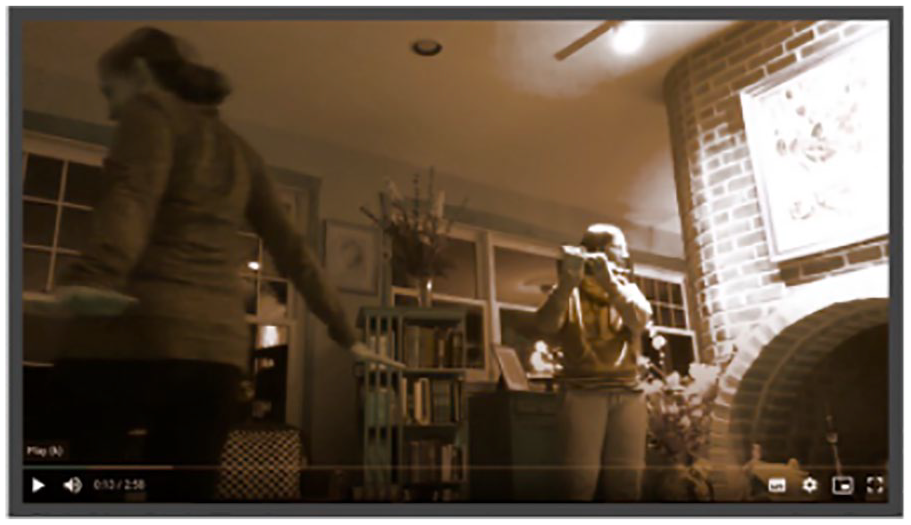
A sample from the second dance of the Hawk.
After each of the dances, which lasted approximately 3 min each, we engaged in a reflective dialogue about our experience and process. We worked to understand each other, what we were experiencing, communicating, and what more we might need to add to our free improvisation to take us into the deeper levels of data analysis with the interviews (Figure 2). For example, Liz reflected,
“I couldn’t see your eyes open, but I could feel you were following me with your music.”
“Interesting,” I said, “I found that my breath couldn’t keep up with your movements. I wanted to be able to stay inside your movement. But I needed to breathe, which meant that I would break up the pattern. And then I wondered how I am going to break up the pattern and how am I going to affect you if I break up the pattern. You have a longer breathing rhythm by movement than I do by breath. My physical movement could be with you, but my breath doesn’t have that capacity.”
“Well, I can elongate my movements.” “I could just do this” [and she stretched her arms long and held them for an extended period].
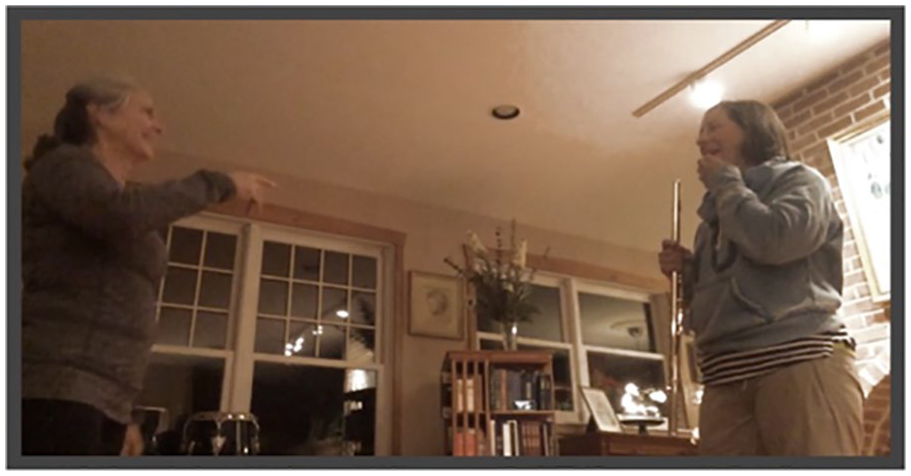
Image from our dialogic-reflection about our process.
During our reflective dialogue, we pondered the question: Should you adjust? Or if one should adjust, how does one adjust? In sculpture and painting, there is always a positive and negative space created by white and black. In music, it is created by silence or sound. A duet is about give and take, sound and silence, white and black. And it’s all about a kind of space in relation to something else. Silence is its own space. Movement or non-movement is its own space. This kind of reflective dialogue was important to free our improvisation and to give a kind of common language and structure to the abstract.
The Deviance Improvisation Part 1
After the first two improv dances, we had begun to develop a way of working together through improv and were ready to embark on an attempt to analyze the data. Liz began with a reflection about the kinds of questions she was grappling with in the data, and decided upon a choreography to start her off. Her topic was exploring women in high leadership positions and how, and if, they deviate from the norm.
To get inside the stages and experiences that the women leaders went through to achieve their high appointments over the years, the dance began low, on the floor, spiraling up over time to reflect the stories of the women interviewees and their rise to power. The spiraling elements reflected their nonlinear journeys. The music began on the lowest tone of the flute and meandered up the scale, slowly, spiraling with the dance, and interacting with the movements as they emerged becoming intertwined. At times, the dance returned toward the floor, representing elements of the backlash to success that many of the interviewees experienced along their journey, reflecting once again the nonlinear dimensions for women to achieve positions of power.
As the dance progressed, wandering sideways and upward to success, the tonality in the music shifted from one of a heavy burden to lightness and inspiration, reflecting the inner strength that was evident in the stories of the interviewees. The dance began to reflect the steps that the women leaders took on their journey to rise through the ranks, emancipating their power. Pushing through power plays, moving barriers, claiming space (Figure 3).
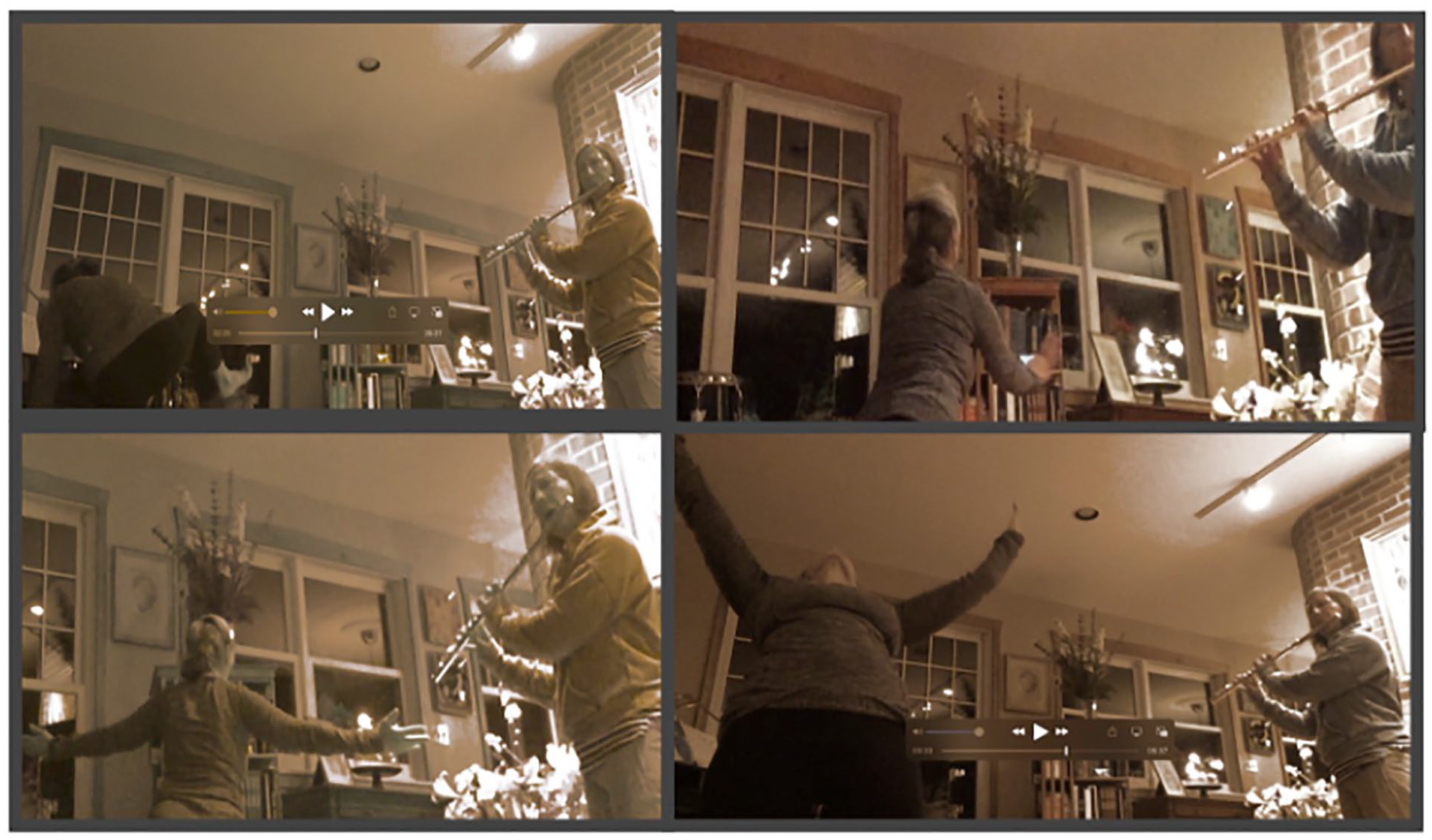
Exploring boundaries in the first deviance dance.
The dance ended with upward movements and large steps forward that reflected a sense of arrival shared by the women leaders when they had achieved a certain position in the ranks. And the end of the dance, we both found ourselves inspired to want to climb more and continue spiraling upward. The dance ended after 5 min 37 s. We paused for a moment, soaking in the experience. Liz began to feel that she was entering the data but needed to have more with her if she was going to dig deeper into the complexities of deviance. She began to reflect out loud:
“Let’s get a theme, otherwise I am just doing random movements. How about the concept of encounters. I feel the need to get more percussive. Aggressive. Assertive.”
“Why these themes?” I asked.
“I think these ideas can help me get inside the concept of deviance, that I perceive is a part of the experience for women in high leadership positions; that they ‘deviated from the norm to get to where they are today.’”
The Deviance Improvisation Part 2
And so began the dance for a second time. Just like the first dance, this one also started from the floor to represent the journey of the women in leadership. Yet this time, with more focus on the theme of encounters and the expression of percussiveness, which is related to the concept of deviance that was identified in an earlier analysis of the data. The dance evolved around the elements of struggle, reflected in more percussive gestures, and deeper emotional movements, reflecting frustration, fear, at times confusion, questioning, and testing possibilities (Figure 4).
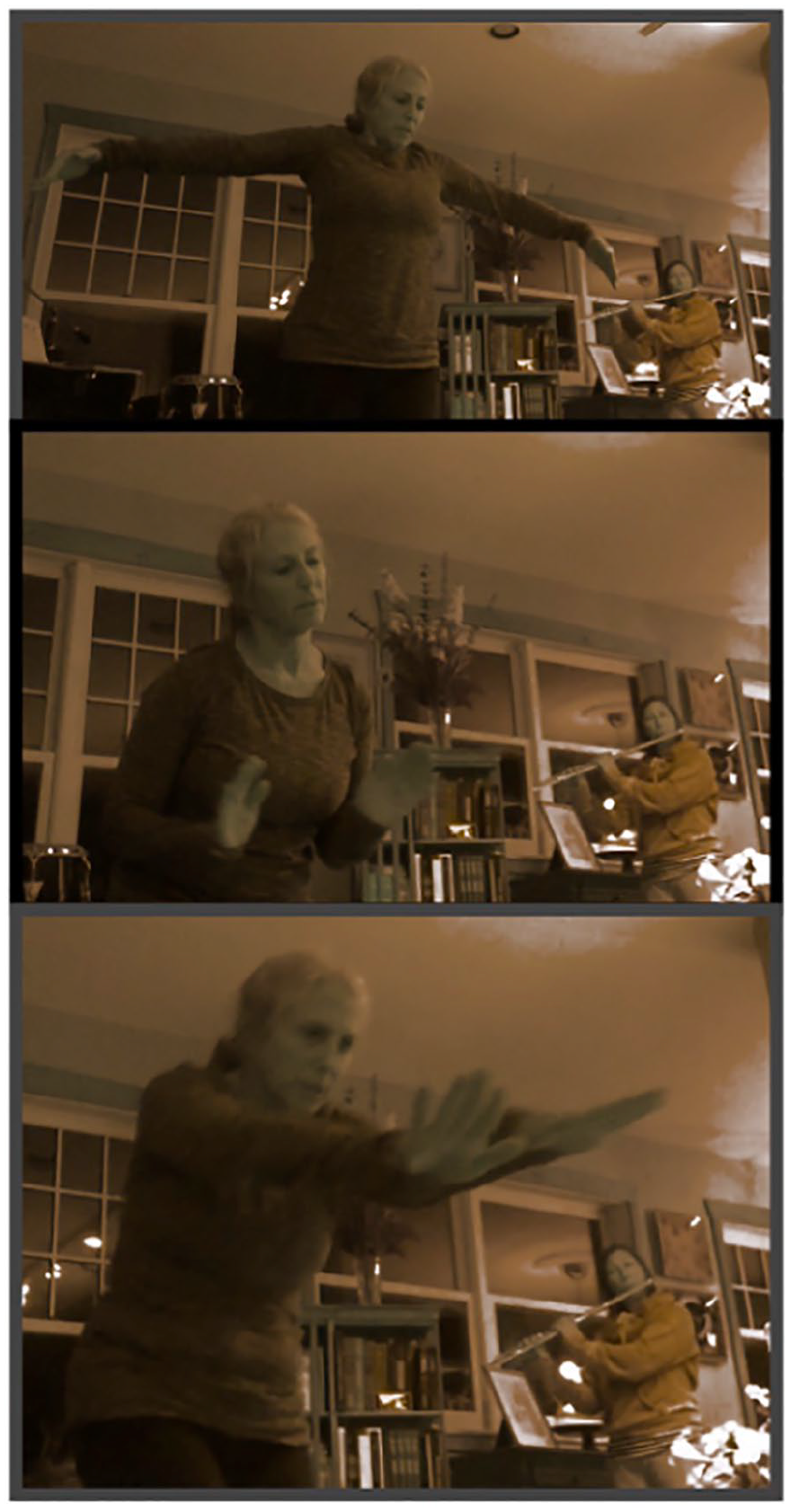
Exploring the concept Deviance in the Deviance Dance 1.
The music followed the rhythm of the dance more closely this time, speeding up with quick movements and slowing down with softer movements. When the moves were directed upward, so too followed the music. This close interaction with the music mirroring the dance was intended to give space for reflexive improvisation as the dancer navigated insights into the themes of encounter, percussive-aggressive-assertive (Figure 5).
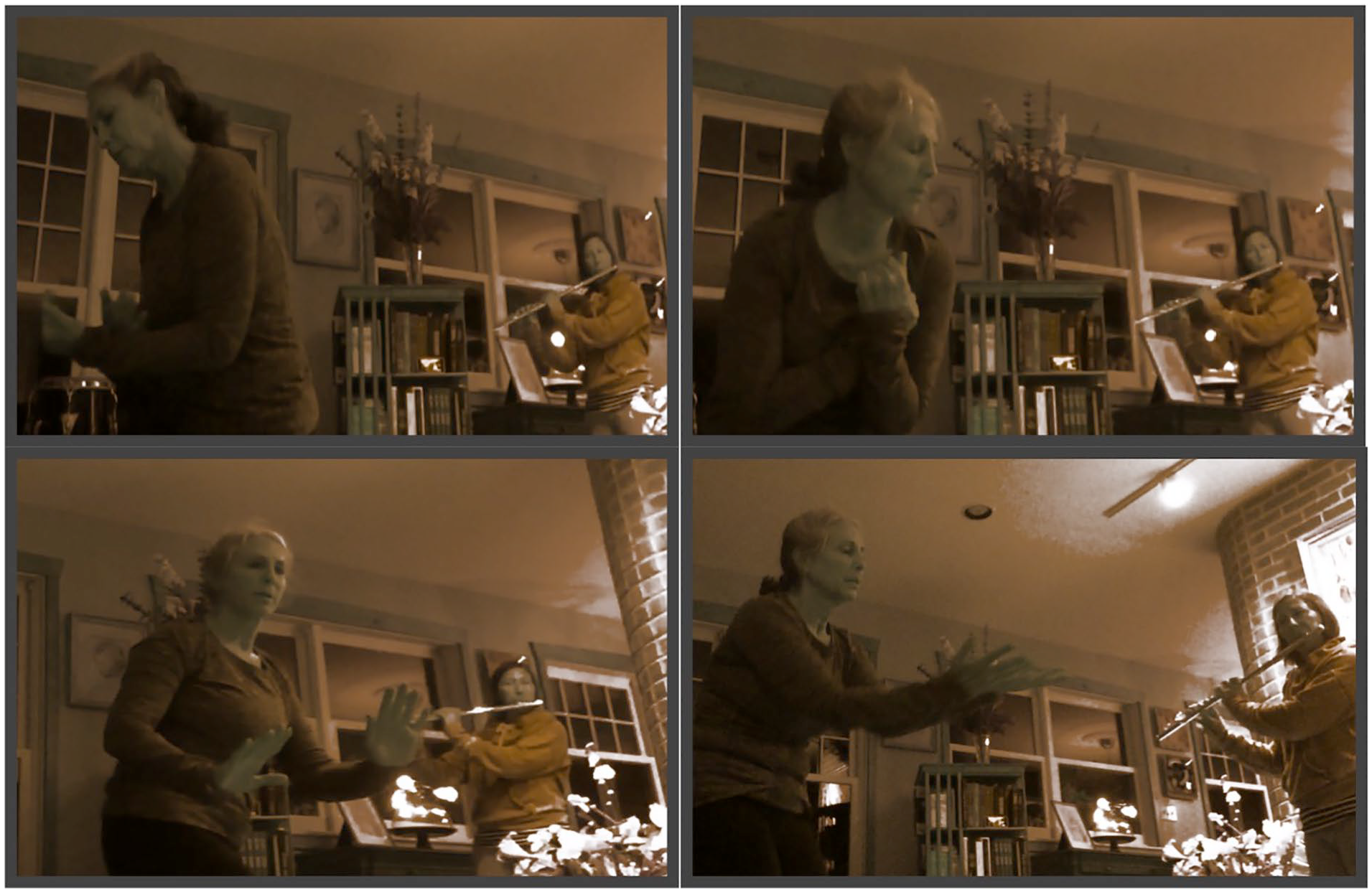
Navigating emotions in the deviance Dance 2.
After 5 min 43 s into the improvisation, Liz stopped abruptly, looked, and said, I need to make noise! And she started to stomp on the floor in a percussive dance as she grasped her fists and pounded against the air above her head. The flute followed with a crazed melody, bouncing off the percussive steps of the dancing feet, and the wildly swirling hands. The percussive gestures repeated themselves, each time with new elements from facial expressions that illuminated a sense of inner craze (Figure 6).
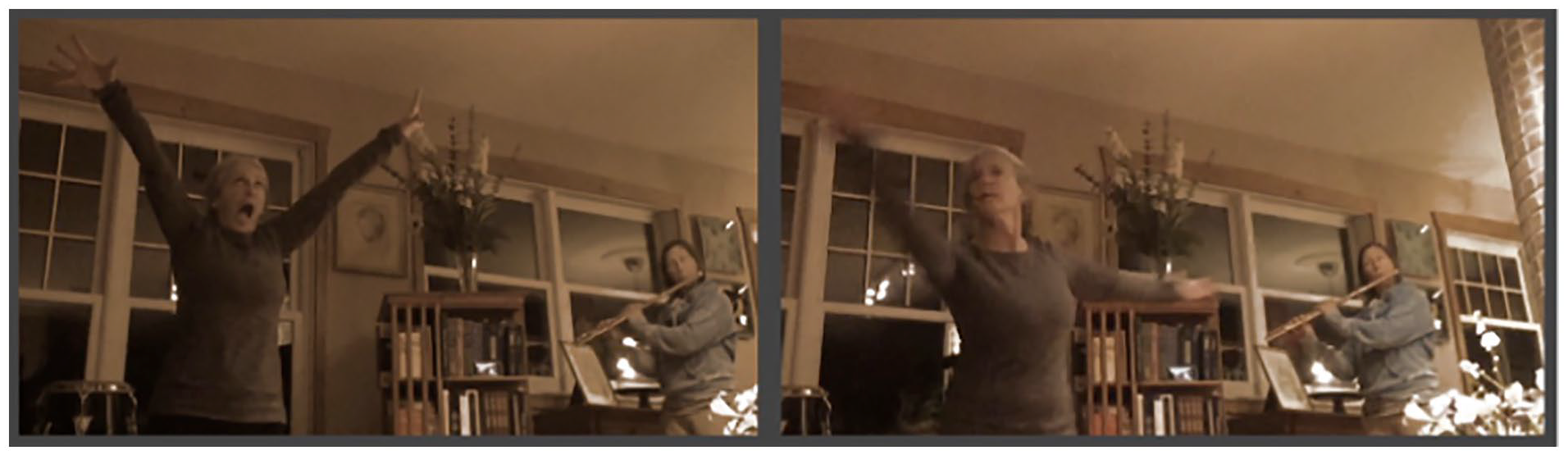
Illustrating the climax and resolve in the deviance dance.
After the third such gesture, the dance turned toward a kind of resolve: the energy of frustration had been identified and released. The movements began to spiral back down through a series of fighting gestures that ended in a calm. The flute followed as the arms extended softly while the body continued to spiral out of the percussive encounter, landing in a sense of peace and calm. The movements became elongated as the dancer circled through the entire floor space with strength, reflecting a kind of empowerment that appeared to engulf the women in leadership in the study. The dance ended shortly after (at 7, 23 min), and there began our deepest reflection that also served as the pivot point in the analysis.
Liz shared,
“There is something missing, I am not being honest.” “There is something that I really couldn’t express.” Could you understand that while I was dancing?
I think so. I found myself playing in a chromatic scale for a while and then I realized that I needed to change my own playing to also help you to come out. I saw that your gestures were ready to move out and expand to celebrate the women’s power. If I were to write the music, it would be similar to Copeland’s Appalachian Spring, where the music just opens up.
“I felt that too,” shared Liz “It was really a sense of freedom to be whoever you are, wherever you are. That’s one of the powerful findings from the data that I began to see more clearly.”
I also realized for myself (Liz continued) that I couldn’t dance out something like “Deviance” by myself. I needed to push against someone. In the process, there is a lot of misunderstanding; hurt and fear. I was trying to do the experimentation. But I couldn’t get to it. Part of it was that the music didn’t feel like it fit the deviance that I was feeling inside. That was a place perhaps that the music could have stopped. I could have just pounded out alone because there is nothing gentle about that. The other thing is that I don’t dance percussive.
I reflected upon this:
I wonder, if you were to do a feministic self-reflexive process on your research you could explore further your notions of deviance. What you are describing is a typical perception what is deviance and how does it occur.
Yes, I think so. It feels like that it is how it would be to be deviant. I was thinking about people who are deviant in society as I was dancing.
What if that’s not what women in high positions actually go through? What if there is another picture in the data that is not illuminated because we are guided by that one perspective (traditional) of deviance. If we keep the traditional notion of deviance, we assume that the women in your study must have gone through hell, must have gone through battle. But did they?
Yes, some of them really did. Some of them didn’t. Some talked about being moved in to positions of power because of their networks.
You described in your dance needing to have something to push against. Did the women also describe things that they pushed against?
Yes, like husbands. But some of them weren’t willing to share those kinds of details. They just talked about the straight path and mentioned there were battles, but not what they were.
It’s interesting to hear you reflect about the improvisation and how parts didn’t work for you or some elements that were missing. Might we examine and ask questions about the things that were missing or didn’t work to see if there are new questions that you can bring to your analysis?
That’s a good question. And what you asked me about “Did all the women go to battle” is one of those kinds of questions. And did they feel they were getting out of a comfort zone? Did they feel free? When you discover that you are not the norm, what happens?
Our conversation continued along this path to explore the concept of “being different.” Over time, the dialogue moved back to the start of the conversation, to deviance, recognizing that the concept of deviance needed to be further explored and considered from multiple lenses. We also returned to our improvisation to understand it more deeply, including perhaps hidden elements that we didn’t consider and their potential implications to explore deviance. Liz began reflecting on different movements that she could have chosen to explore more in-depth her own inner experience with the concept of deviance. We also began to reinterpret some parts of our interaction that we initially determined to be problematic. We reflected, for example,
If we go back to our improvisation, the music tried to follow the dance. At times it was disturbing because it wasn’t in sync with, for example, the stomping. But how might that music then represent something else that is a part of the bigger picture?
Yes, the music that was playing was a kind of constancy. The world goes on, and here I am stomping, but the music kept going.
Yes, that right, and that’s how it should have been. I just should have kept going and stomping and been even more out of sync with the norm (a sign of deviance).
We began to reflect on the experience and power of the improvisation to access emotions, assumptions, and perceptions. It became an analytical device embedded within an ethnographic study, which stimulated us to ask questions of one another, of our interpretations, and possible alternative interpretations as well:
How about you? You weren’t playing deviance. How would you do that?
If I think about deviance, and I take the flute and it has a pureness in its sound, we expect the purity to be there, we expect the melodies to be beautiful. So if I were to play “deviant,” I would alter the expectations that we have the flute. Change keys in the middle unexpectedly. Use tonal experimentation to create a harsh sound.
And then that would be it “deviant” until you are comfortable being out of the circle, Liz reflected.
We paused, standing in silence for a few minutes, and then resumed our reflective dialogue: “there is an assumption that deviance isn’t beautiful. But if we think about some of the great artists who didn’t follow the norm, they created beautiful art, but it deviated from the norm of acceptability.”
This is interesting. There is an assumption that deviation is tough. But you can deviate from a musical scale, and it still has beauty.
Analysis and Discussion
In the analysis, we highlight five key insights drawn from the experiment to understand how the arts can be used during the data analysis phase to stimulate perspective and decenter/re-center the researcher’s subjective eye. These insights are offered as a way to concretize the application of arts-based practice from a methodological perspective. Among the five insights highlighted are (a) Use questions as a guidepost for improvisation and exploration, (b) test improvisational forms and negotiate a collaborative space, (c) build reflective dialogue into the improvisational space, (d) allow time for dialogical reflection to emerge and crystallize, and (e) journal continuously to promote dialogic reflexivity and deep learning.
Use Questions as a Guidepost for Improvisation and Exploration
The experiment in “deviance dance” showed several key elements that were important to both process and transformation of thought. The process was guided by curiosity and question. The curiosity was to explore how we might use our artistic forms of expression (dance and music) as a vehicle to interpret qualitative interview data that gave space for voice and multiple perspectives. The question behind this curiosity was derived from the research setting in which one of the researchers articulated a need to probe the multiple perspectives in the voices of the respondents in new ways. The curiosity and the need became the guideposts within which the architecture of our experiment was shaped.
Asking big questions, getting curious, and staying open to possibilities are significant to frame strategic thinking and innovation (Brown et al., 1999). It is through our questions and getting curious that we are stimulated into reflexive dialogue and reflection. As Bresler (2018) points out, and Markula (2015) illustrates, incorporating guiding questions and theoretical frameworks can assist in the interpretative process during a reflexive dialogue. When we “merely” improvised without direction, our efforts became exploratory at best. We would even say that we did not reach the level of performance to which Denzin (2003) refers. It was when we incorporated guiding questions that our act became a kind of performance that began to blend into the performative.
Test Improvisational Forms and Negotiate a Collaborative Space
Combining artistic forms (music and dance) in the research process was new to both of us and, as such, it required a phase of experimentation. The first two dances were performed as pure exploratory improvisations, during which we developed an understanding and praxis for how we would work together. Among the key insights were (a) The need to frame the dance with a particular research-based question. When the music and dance were combined without a probing question, it became just another dance. Connecting the arts and science needs a common denominator. (b) The need to understand the interplay between the different art forms and their role in the nonverbal dialogic process. In our experiment, the dancer had knowledge about the data and thereby was interacting with a third dimension. The musician was interacting with the dance. This raised questions about how the decisions we make (i.e., to take a breath, to stop a movement, or to change the rhythm) affect each other. This is a standard component of dialogue in which we interact with one another’s words (Isaacs, 1999), intonation, rhythm, and the like. When the words are missing from the dialogue, we need to develop new spaces in which to interpret and understand one another. (c) Understanding space, what it is, and what role it has in dialogue and reflection is important. Space can be conceptualized and communicated differently in the arts. For example, in painting and sculpture, black and white create a spatial balance. In dance, movement and stillness are used to create space, and, in music, sound and silence create space. The inquiry into the movement in space and time can open to reflections about how we as researchers cause others to move in our rhythm, and our perceptions.
Build Reflective Dialogue Into the Improvisational Space
The dialogue was an integral part of each dance. For example, in the first two dances, the dialogue reflected the experience of partnering to create a common language for communication. In the latter two dances, the reflective dialogues focused on digging deeper into our interpretations around a research theme and drawing on theoretical knowledge as well as embodied knowledge. This experience illustrates how the arts in research can invoke space to disrupt assumptions (Eisner, 2008; Finley, 2008). It also reinforces the importance for reflexivity to take place through interaction: it is not a solo act (N. Brown, 2019).
Allow Time for Dialogical Reflection to Emerge and Crystallize
Building on a previous improvisation enabled both of us to deepen and enrich our exploration of the data, this time adding to the pot the new themes. It also made visible the layers of understanding that we go through to gain new insights into our own assumptions and position in relation to the data. This was made evident in particular when the dancer began to reflect upon her own ability to dance “deviance.” The conversation began to revolve around not only what performing deviance might entail, but also our own assumptions about what is deviance. Through the dialogue, we were able to open new spaces for deeper exploration of ourselves and the data during the second iteration of the dance.
This suggests the need to create time, space, and structure for dialogue and reflection to occur; one that allows for iterations of thought and experience to shape understanding. Coetzee (2009) talks about this in her work on exploring identity through performative inquiry. She argues that humans can become fixated on a thought or identity. As researchers, we need to experience ambiguity to open our minds to new perceptions that can occur through embodied experience. We suggest that embodied experiences need time for reflection to emerge.
Journal Continuously to Promote Dialogic Reflexivity and Deep Learning
Journaling about what was learned was an important part of the process, no matter the form. In our experiment, we both used different kinds of journals. Digital journaling was used to capture the dialogues and improvisational performances. Text-based journaling was used as well during the improvisational space as well as after. The continuity of journaling both during and after the event created a space for continued reflection, which when shared with others served to stimulate new insights and understanding of multiple perspectives. This reinforces processes of dialogic-reflexivity that occur in relation to something external to ourselves. The dance became the experience; our dialogues became a gateway into the reflective-reflexive process. The journal extended the dialogic-reflexive space, transferring the interaction to a new space.
Conclusion
The five insights reflect some of the key learnings that we draw from the duo-ethnographic study. They suggest ways in which the arts can serve as a dialectic tool in qualitative data analysis to provoke an awareness of assumptions and perspectives. The dialogue that took place during the improvisations included a conscious commitment to diversity and voice. We were keenly aware that we needed to develop a praxis to open our minds to consider different perspectives, to shake our assumptions. Transferring the dialogue to a collective experience stimulated new awareness about our spatial relations with one another: how we affect each other and are affected by one another.
Using the arts during the data analysis phase of the study disrupted assumptions, perceptions, and created a backdrop against which to ask new questions. As artists ourselves, we had the opportunity to explore such an interactive space freely and acknowledge that having artistic skills was beneficial although not necessary. Moreover, we suggest that the dialogic nature of our duet was most critical to disrupting assumptions and our own positions as researchers in relation to the data. It is this key insight that we want to reinforce to suggest that it is not necessary for a researcher to be skilled in the arts to embrace the arts.
This study demonstrated a broader experience in which the arts were integrated into the research process. Researchers can partner with artists to open new spaces for interaction that hold promise to enrich the data analysis process. For example, researchers can present their data to an artist, who then interprets the data or findings in an artistic performance. It is in the dialogic-reflexive space of the embodied interaction that perception is disrupted and opened to new ways of seeing. Moreover, most of us can move, draw, take a photograph, sing, or at least make sounds. These are the fundamentals of the arts, which when we apply them in relation to thought can serve to express and communicate through embodied experience. In so doing, we become our own artists, shaping our own embodied experience. Although the embodiment may not be as rich as partnering with a dancer, musician, or painter, it does reflect a possibility for us all to see ourselves differently, as embodied beings with the ability to express and create meaning beyond words on a page.
Footnotes
Declaration of Conflicting Interests
The author(s) declared no potential conflicts of interest with respect to the research, authorship, and/or publication of this article.
Funding
The author(s) received no financial support for the research, authorship, and/or publication of this article.
