







Abstract
With this autoethnography, it is my intention to explore experiences of bereavement and loss through the diffractive lenses of cultural intra-actions with literary texts, narratives, and sensory affordances. Bringing my own biographic experience of grief into these pages allows me, as a researcher, to make sense of death and its rituals, fundamental for healing purposes. I wonder: What does the affective materiality of bereaving do? My lived experience helps me to connect empathically and compassionately to events by looking at how society went through the impossibility of delivering care to the dead and their families during COVID-19 lockdowns and by questioning the “crisis of care.” To conclude, I reflect on how autoethnography can be a sensemaking process, leading to healing, opening to reflexivity, and reaching out to socially relevant questions about practices and ethics of care.
Remember me.
Remember me in your heart:
Your thoughts, and your memories,
Of the times we loved,
The times we cried,
The times we fought,
The times we laughed.
For if you always think of me, I will never have gone.
Margaret Mead, Remember Me
Surviving Loss
My mother passed away. My marriage has died. I am a survivor of both losses. In times of pandemic, when counting diseases and deceases has taken over all levels of human communications, my own life feels like a rocking boat, prey to storms. This autoethnography is the story of a researcher’s experiences of and reflections on death and loss. Its purpose is to reach out to other lives in grief, to make sense of feelings and events.
My understanding of death is influenced by posthuman thinking, specifically Rosi Braidotti’s (2011, 2019; Braidotti & Bignall, 2018) affirmative and vitalistic reframing of what is not imaginable to the gendered, racialized, and naturalized man: death as a world without him. Death as contained in the transformative force of life and already happening at the time of birth, is something that the posthuman thinking helped me understand in philosophical terms, but that was already part of my thinking through the reading of Samuel Beckett’s works. On the edge of the dissolution of modernity and the rise of postmodernity, Beckett voices in poignant ways the experience of the death/life continuum, for instance, in this passage of Waiting for Godot: One day, is that not enough for you, one day like any other day, one day he went dumb, one day I went blind, one day we’ll go deaf, one day we were born, one day we shall die, the same day, the same second, is that not enough for you? [Calmer.] They give birth astride of a grave, the light gleams an instant, then it’s night once more. (Beckett, 1990, p. 83)
I look at ecology as the “paradigmatic concept in Western theorizing of life and society and much else, and because of the way it points to Indigenous and non-Western philosophies of matter–mind relationality and geontology” (de Freitas & Truman, 2021, p. 523). Standing on this troubled ontology, I focus on cultural and aesthetic expressions, as the agentic (Harris, 2021), affirmative (Braidotti, 2019) life-force (zoe/bio) at the interstices of posthuman relationalities and knowledges. One of the eco-logical elements in this way of inhabiting materialities and discourses is Deleuze’s assemblage/agencement, understood as the capacity to affect and be affected. In other words, co-affectivity calls for complex entanglements in ecologies that are creative and creating. Harris and Rousell (2022) describe the vitalistic agency that constitutes co-creative ecologies as: the capacity for creative experience (that) is attributed to processual events, rather than persons or things. Each event participates in a world of creative activity, a world constituted anew, with each moment, through the relational interplay between discrete occasions of creative experience as they come into mutual expression. (p. 428)
In this autoethnography, I investigate death as a cultural enactment of a vitalistic becoming, by looking at the affectivity and materiality involved in bereavement: (a) the ritual celebration of life, honoring the dead, connecting and healing for who/what is left behind, (b) the ethos of engagement (Braidotti, 2011, p. 334) that, here, is related to an aesthetic practice of knowing through the body and care of/for the other. My intention is to contribute to the understanding of creative ecologies as complex entanglements of material, affective and discursive practices, all intra-actively responsive. The response-ability (Haraway, 2016) of eco-systems is creative: it is the ability to create novelty that is appropriate to ever-changing needs. Creative eco-systems are performative, participants share together as an en-semble (Chemi, 2020b) a (vitalistic) purpose through agentic practices (Harris, 2021), repeatedly (performativity), all differently. As in Braidotti (2011), “transversal ensembles” are the only ways for “acting collectively” (p. 182) in the same conditions but all differentiated by choices and perspectives. This being together, all different and all inhabiting the same ecosystems is fundamental to the lines of flight departing from this autoethnography. My impulse is an act of care through words. On one hand, autoethnography opens the cracks of self-healing, whether it is its purpose or not. On the other, this text is a loving memorial to the ones who are not here, in my life and in our communities. More importantly, I offer this investigation to a shared reflection on posthuman manifestations of vitalistic ecologies on/of death and ask: What does the affective materiality of bereaving do?
Companions Through Life
My dog and I are life companions (Haraway, 2003). When I say “my” this is not out of possession but out of reciprocal kinship: we are each-other’s. We follow each other’s steps through storms and sunshine. One of our favorite walks crosses the local cemetery, with plenty of flowers, plants, fresh air, and a beautiful view on the lake. In Denmark, where I live, graves are displayed in the old-fashioned way in the church grounds and are dug in the earth, differently from what we do in Italy—the country I come from—where there are usually mausoleum-style graveyards outside the towns. It has been so since 1804 when Napoleon reformed cemetery practices in Italy with the Décret Impérial sur les Sépultures, known as the edict of Saint-Cloud (Le ministre de l’intérieur, 1804) and discussed in Ugo Foscolo’s poem Dei sepolcri (Foscolo, 1858), or Sepulchers (Foscolo, 2015). This poem addresses the institutional innovation introduced by Napoleon, lamenting the fact that tombs had to be removed to the outskirts of towns. The graves of great men (the poem, written in 1806, is of course not gender-aware) far from public gaze, could no longer inspire citizens by their deeds. Foscolo makes the point that tombs disseminate greatness, which sounds naïve today, considering our awareness that human creativity only emerges through collective and relational exchanges (Glăveanu, 2020). However, the poem contains some elements that can be used to make sense of losses, experienced personally and collectively, such as pandemic, war, and environmental catastrophes.
Back to the Danish cemeteries. Walking through the graves as part of my companionship routine, I started noticing the inscriptions on the tombstones: “to our beloved mother,” “always missed,” “loved and missed.” These testimonies are all messages of love. None of them contains anger, resentment or hate, which also are part of human life. Not even grief is predominant: only love.
This made me think about Dei sepolcri and how its eulogy of the care of memory beyond death had now a different meaning. In my life, new unbearable grief brought back old losses and I had to deal with this while writing about it (Chemi & Firing, 2023). For the world, the disruptive time of the COVID-19 pandemic amplified individual bereavement. Isolation and the suspension of what we (the privileged, Western “we”) used to perceive as normality extended to a socially shared grief. All different and all in different ways, we were in it together (Braidotti, 2019) in an extremely tangible way: shops shut down, no theater performances, sometimes curfews, and limitations to taken-for-granted freedoms. In the meantime, as lockdowns extended, digital lives substituted in-person education, gatherings, even informal coffee meetings (Chemi, 2021). Studies from a number of disciplines mapped the implications of this situation for several groups (Markham et al., 2021). To make it worse, the rituals of grieving, so fundamental to healing (Houlbrooke, 1989) were forbidden to contain the spreading of contagion. The impossibility of going through the material-discursive (Barad, 2007) practices of grieving felt like a vibrant (cultural) trauma (Lykke, 2022). As Foscolo (1858, pp. 51–53) mourns, the opportunity of providing care to/for the dead is part of a profound (“heaven-sent”) and reciprocal (“correspondence”) affective relationship with the other (“amorosi sensi” literally means “loving affects”), beyond the limitations of death. It is the only way to practice remembrance and healing (“comforts”).
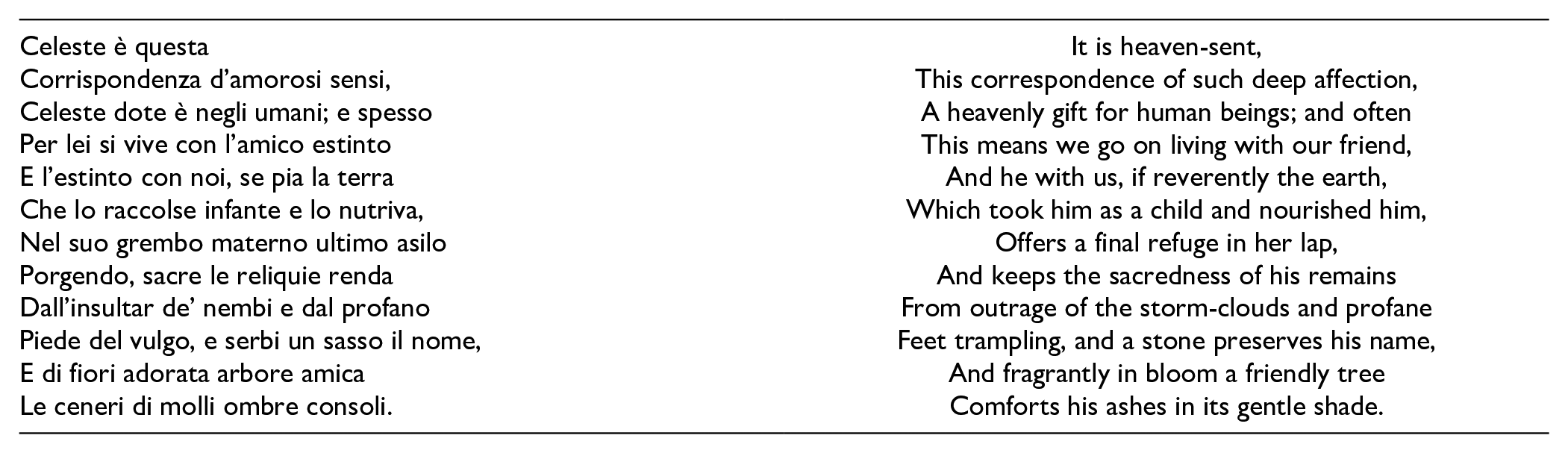
In this diffractive reading of Foscolo, the death of the individual becomes meaningful to a whole society, affecting the flow of history. This intuition of Vygotskian flavor can be turned upside down with Ahmed’s understanding of affect as cultural politics (Ahmed, 2014): Cultural performativity of discourses (the lives of great men) is “sticky” with consequences for the way in which materiality (the graves) affects emotions (of grief). Foscolo, fully immersed in Western cultural politics, interprets the materiality of the graves as thick signs of an affectivity that bridges past to future. Cemeteries are not just a collection of stones but are the materiality of affects (Malinowska & Gratzke, 2017) standing as legacy for the future. As in Shakespearian sonnets (Shakespeare, 1978), these artifacts materialize an enduring remembrance (“memoria perenne”) that humans can actively engage with to keep the affective relationship alive and to critically question the present, in light of exemplary life-stories. As Foscolo was aware, to take away the materiality of affects from bereavement and its rituals endangers the human capacity of sensemaking about death, and, I would suggest, in line with Spinozian and posthuman theories, it compromises the human capacity of transforming death into vitalistic practices (Braidotti, 2019; Lykke, 2022). Grief and its performance become expressions of love, and being prevented from them can become an existential threat, for instance, “to most Igbo people (. . .), to be deprived of a proper funeral is an almost existential fear” (Adichie, 2021, p. 60), not because of the impossibility of imagining life without the human, but for the impossibility of imagining the human without love.
Public Grief
Because of the COVID-19 pandemic—and possibly an irresponsible management of the crisis—Italian hospitals have been struggling to keep up with the health emergency. Many died. As of May 11, 2023, the number of deaths since February 2020 is 190,080 (Statista, 2023). The images of military tanks bearing coffins at a slow pace through the gray Northern Italian landscape are still vivid in my eyes. Tattooed onto my heart and my consciousness, these images of my home on its knees brought unbearable pain. Watching them from my other home far away was even worse. Many families lost their relatives. For fear of the disease spreading, all human interactions were suspended, including mourning rituals. Many families did not have any chance to say goodbye or even honor the departed with whatever ritual is meaningful to the single communities (Gabay & Tarabeih, 2022). This felt to me even worse than the losses themselves. To be deprived of a beloved one is painful, but it is something else not being able to be present for each other during events of life and death. In Haraway (2016), one of the fundamental strategies for surviving in this chaotic life is to “go visiting” the Other, consistently with feminist theories that have been reframing the notion of love as an action (hooks, 2000): “care intimacy is meeting the other’s needs and desires, and being ready to support and help the other, willingly” (de la Brena, 2022, p. 33). The impossibility of providing active care to/for the dead and relatives in bereavement is an excruciating experience that eradicates the social performativity of care with its function of supporting social connectivity. As the lover who is not able to provide care to his or her beloved (de la Brena, 2022), societies unable to perform ethics of care experience a crisis of care affordances.
During the COVID-19 lockdowns, I witnessed families all over the world bearing the unbearable (Cacciatore, 2017), which is not about conceiving death abstractly, but about being unable to perform rituals of bereavement. In the meantime, I was in the process of losing my mother. Aware that any day was precious, I visited her often at the care home. Even when visitors were not allowed within the walls of her home, I kept calling from a distance, she looking out of her window, I standing outside. An unlikely Romeo and Juliet on a stage of anxiety, love, and disbelief. The images of COVID-19 deaths did not mitigate my personal grief, on the contrary, they intensified it.
Private Grief
My mother died after an 8-year-long Alzheimer’s condition that took her away tangibly and slowly. The disease took away what she cherished most dearly: her mind, the ability to read, think critically, and share experiences. I know it because she told me. She managed to share her grief before her condition worsened, then I felt it urgent to document the difference she had made in the world as an inspiring teacher (Chemi, 2020a). I started putting together by means of informal conversations with her and retrospective narratives the stories and anecdotes she would share and what I had collected as a child, when she would bring me along to her class or on study-tours. As autoethnography demands strong ethical considerations, I can report not having asked her informed consent officially, but she would always respond happily to the invitation to talk about her work. Because it would be unethical to steal her voice, I now wish to retell her story through my eyes of witness.
Both my parents were teachers. My father was a secondary school teacher and my mother a primary school teacher. She experienced both the old-fashioned model, where one teacher taught all subjects, and the subject-divided model, where she chose to teach the subjects she loved most: history and geography. Nevertheless, when I asked her to tell me which model was the best, she pointed to a completely different didactic form: the interdisciplinary and real-life projects that she used to develop and lead. Her work at a small school on the outskirts of Naples consisted of and was closer to social work than pedagogical work. When my mother taught there, the buildings and streets around the school still revealed that this area used to be a village. Pupils at the school mostly came from non-privileged families, some even with ties to crime (camorra). Most of these children saw it as natural to visit relatives in prison, to bet on the illegal lottery system and to be physically punished to comply with the status quo. These children had a very heavy social heritage and society did not expect them to be able to go far, either physically or mentally. They had never been to the city centre of Naples, had never known that the lottery system they were betting on was illegal and that somewhere else there were playgrounds and gardens. Their playground was the cemetery because it was the only place with green areas, and they used to jump on graves and find flowers to steal to give to their beloved teacher. Each time my mother received flowers that were not wrapped in florist’s paper, she would know that some grave was missing its floral decoration. They were not bad kids, she would insist, on the contrary, they just did not know any better. My mother could read the potential of these children, their intelligent curiosity, and she was able to stimulate them, discipline them without brutality. She saw them. All her educational work aimed at showing them a life that would allow them to buy a single flower or enjoy a playground in a real park. She involved her colleagues in one project after another on themes that were relevant and that could make these children think, see the world, experience, and wonder. Projects that would bring them closer to their proud cultural heritage, in contact with experts, on excursions outside the social cage in which they were confined. All her work was devoted to this one purpose: to show these children the world outside them and the potential within them. She managed to save many of them from poverty, ignorance, cynicism and helplessness. The idea of growing beans, making pizza, brewing wine like the ancient Romans, visiting the president of the republic, experiencing children’s theatre and street police practices were new and appropriate to her context. The projects seemed to work optimally for the children, who were enthusiastic and inquisitive. I know that these projects changed these children, and to such an extent that some of them got a life that they could never have dreamed of. For example, Enzo (fictitious name), who struggled with school for many years. He repeated the first classes many times and, when my mother met him, he was a big teenager in a group of small children. Enzo worked hard and my mother opened his little world in terms of experiences and knowledge. She believed in him and supported his attempt to get a vocational education. Enzo continued to visit his maestra and proudly one day told her that he had become a stage technician at the Teatro di San Carlo, one of the oldest and most prestigious opera houses in the world. I am sure Enzo still remembers my mother as she remembered him. They changed and transformed each other. Forever. (adapted from Chemi, 2020a, pp. 232–233)
As an educator myself, I felt her sadness in losing her most valuable tool. It filled me with anxiety to witness her excursions in and out forgetfulness, and the progressive degeneration of all her skills. The care I delivered felt constantly limited. Latimer (2013) describes moments of coexistence as “being alongside,” an act of togetherness that moves away from the centralized “being with” and re-imagines sociality with the possibility of a “partial connection” that is still loving and caring, but alternative to “kinship” (Haraway, 2016) and to “division, comparison or even hybridity” (p. 80). I still feel insecure as to whether my actions wove a blanket of kinship beyond private (my mother’s dementia) and public (COVID-19) illness or whether they were manufacturing a felt of partial connection to the sick. Regardless of the texture of my actions, grief took me unprepared.
Midway Upon the Journey of My Life
January 8, 2022
Moody is a beautiful, dark-haired boy of 13. He is at my doorstep, excitingly waiting to meet my dog. His mum and I arranged the meeting because Moody loves dogs but he is not allowed to have one at home. She described him as an “introvert,” a character trait that I absolutely cannot find in this smiling face. During our walk, Moody is talkative and a good listener. We chat about food, religion, dogs, dog and human behavior, favorite cartoons, school, and family. He is not bothered by the age difference or by the fact that I am a stranger to him. Our conversation glides uncomplicatedly forward, just as our steps do. It is also uncomplicated to say goodbye. At the end of the road, he politely tells me that now he is tired and would like to go home. We thank each other for the encounter, he hands me over the dog’s leash that he had been holding during the whole tour, and I proceed back home, through the woods.
It is dark, dark as it can be on a January late afternoon in a Nordic country. The path is muddy and uneven, but it is very familiar to me, it is a safe one. However, just in case, I switch on the light function on my mobile. When the call comes in, I notice it immediately, although my phone is always on mute. In my hands, the dementia center is calling. The sweetest caregiver is on the other end. We just said goodbye when I was visiting less than 1 hr ago. She tells me that my mum had breathing problems. I listen patiently. My mum has been living with Alzheimer for about 8 years. Three months ago she was diagnosed with leukemia, and 1 month ago she suffered a fit of epilepsy. All this on top of her lifelong problems with cholesterol, high blood pressure, and heart condition. The caregiver’s voice on the phone goes on explaining. I listen. In the dark. Still walking through the woods. My dog on the leash.
The day before, the doctor had ordered pills for cystitis and we had some problems getting them. It must be that. I listen attentively, as she goes on “. . . and so I am sorry to inform you that your mother is dead.” No. “I am sorry, she is dead.” No. “I am so sorry, my condolences.” No no no no. I hear my voice crying. “I am coming over.” I cannot hang up and I keep telling her that I will be there soon. The call is over. I am in the middle of the woods. In the middle of the darkest dark. I do not know where I am, or where I am going. I feel the path underneath and I perceive vaguely that my legs are still moving, my feet still pushing themselves forward.
Crying, I call my (now former) husband, he cannot recognize my words. I cry out “I am in the middle of the woods, I don’t know where I am!” probably he cannot figure out what I am saying. For sure, he knows that something has happened to my mum. We have been waiting for this to happen for a long time. We have been preparing for this to happen. Guess what? Nothing can prepare you for loss. I hear my voice shouting in the dark. Now I start panicking. I feel lost. In the dark. My dog is on a leash. My feet still moving forward. They know, they will bring me to a place I know. I let them. I follow them, crying. It has happened. I cannot go back to her anymore. The kisses I gave her 1 h ago, the hugs and the caresses were a farewell. We did not know then. Relief. I did manage to say goodbye. Relief. I see some lights. I know where I am. The path has become road. Electric lights. Houses. Still in shock, I take the right turns and I reach home.
The home that will not be mine very soon. The home whose reason for existence was the multigenerational project of taking care of her. She is gone. The house will be gone soon. The marriage is gone too. My mind knows that this was for the best. She is free from pain; she has probably (the skeptic of the atheist) joined her son, dead in childhood, and other beloved ones. She never made peace with this horrible dementia, which was taking her identity of schoolteacher.
When I meet her, she is still warm. Peaceful. It went fast, the caregiver tells me. What a blessing. I was there for her until the end, taking care of her. I am grateful. I choose her clothes. Elegant. She was fond of beauty. They dress her and prepare a display of photos and candles.
The doctor comes in, Caucasian, male, old. He does not introduce himself or his role. Steps in, looks at the two only persons in the room and addresses my ex-husband. He keeps doing this in spite of my ex-husband telling him to address me, the daughter. He even points at me with his finger. I look at this representative of our sexist culture straight into his eyes and wait until he decides to drop his sexist prejudices and talks to me. He does not. He declares my mum dead. He asks, “what was her problem” and I articulate the long list of diseases, slowly, looking at him firmly in his eyes. I hope he feels stupid by asking these questions on a deathbed in a dementia center.
January 9, 2022
All this happens during the third wave of the COVID-19 pandemic crisis. We are facing the Omicron variant. Most of the population has gone through three rounds of vaccination—we included—and the behavioral restrictions are mild. Still, we are requested to wear face masks and disinfect our hands during our visits to the dementia center, which is a care home specializing in advanced-stage dementia patients. My heart is pounding and breathing comes with difficulty. The caregiver allows us to pull the mask down. “Of course you can take it off!” It is not something that we take for given, in these times where the basic care for the dead is taken away.
The Care for the Dead (Mother)
January 17, 2022
It has been almost 1 month since last time I recorded my thoughts about my mother’s death. On the January 11, I managed only to write a date. Then I was taken away by administration, exams, everyday and extraordinary stuff. But the pages were calling me as the sirens called Ulysses. I have not forgotten any details of this moment. Crystallized in my body and soul as any trauma I have experienced. What is left is to make sense of it. To try to understand how a body—my body—reacts to trauma. She is in the coffin. Sleeping. Getting cold. A cheap coffin. She is going to be cremated anyway. No meaning in getting her an expensive one. But the urn. . . well, the urn must be hers: green with a golden ring around. No black, she hates black. No white, white is for children’s coffins—immediate association to my brother’s death. No gray(s), too sad. No blue, blue is boring—my god! Do you remember how difficult it was to find any clothes you liked? Blue was the color your mother favored. It was for her. What else? No red, not your color, you were no here-I-come person. No yellow—are we even talking about it? No pink, unless in the right shade. The same for orange, browns and. . . GREEN!!! You definitely liked green. This green is perfect. Then adding the little vanity of the gold ring, it is you. Worth paying a little more for this one. By now, you lay in your still open coffin. The undertakers got you there and they are keeping the box open for us to say goodbye. Bodies standing around you in silence. Breathing the air you do not need anymore. Breathing softly, soundlessly as if you could hear us, as if we could disturb your sleep. As parents bending over their newborn’s cradle. Awareness of all this escapes me, the only attention I can hold is to your braided fingers holding an old photo of us three on the spiaggia so beloved to us. You, little brother and me in our swimsuits, struggling up the shingle on the shore of Scilla. You hold our hands tight as if dragging us up from the sea—which very realistically was the actual situation, as we never had enough of splashing in the water, and you feeling exhausted after calling us to come out. The photo does not steal my focus, I know it very well. After your son’s death, for years, I have consumed it, trying to conjure up his presence, to bring to life my sensations back then, when he was with us. I wore out those photos in secrecy, always feeling guilty because I wanted him with me and not with the angels and Jesus—who is this Jesus anyway to take my brother like this? I am standing there, not aware of what my body or the other bodies are doing, not looking at the photo you hold in your hands and the only thought I can formulate is “I am not going to cut your nails anymore.” You will not need me to cut your nails anymore. In a split second, I am compelled by the irrational need to get a nail-cutter and do it now. Please, wait, she needs to cut her. . . nails.
Death turns us into fools. Irrational. Ridiculous. Malfunctioning fools. Sorrow is taking all my body, flowing in and out like sticky substance with no start, no end, only movement of its own. It is slowly expanding. I can’t think, I can only feel, and what I feel is pain. Disconnection. We are not two anymore. It is me. Alone. Alone. Alone.
The helpers at the care home ask me if I want to “sing my mother out.” I am not sure what they mean, so I ask twice. It is not a tradition we share, so I say no, but they can be there in silence and say goodbye to her. They do. They cry. Like us. I feel the warmth of this spontaneous act of sorrow. It is for my mum. I feel the love and care they gave her. It is a gift to me too. As are their embraces. Body to body, silent conversations when there is nothing, truly nothing, to say. As the embrace the helper gave me earlier when I entered the room. She was the one who was with her while she was dying. She was there in the brief moment when my mother’s lungs decided not to breathe anymore. She was me, for her. Her body was holding her as I am now holding her in a strong and soft embrace. Silent. She knows I need it. Only through this embrace I can communicate to her my gratitude. I feel her warm body, her breasts against my chest, my cheek against her hijab, soft. She knows what this embrace means. We do not need to explain. We breathe together. I am not alone. After all.
The Care of the Living (Relatives)
It could have been worse, I tell myself. Her dignity could have been taken for a longer period and in more brutal ways. Physical pain could have vexed her: After all, she was “just” very tired and pretty much confused. It could have been necessary to transport her to a hospital: She was after all in the safe frames she felt protected by. It could have been impossible for us to say goodbye: We did say our farewell no less than 1 hr before she left me. “I” was with her in the body of another daughter, her caregiver. This made me wonder about the role of care and caregivers entangled with bodies (alive, dead, and dying), affects, and materialities.
As a working woman and mother myself, the care of my sick and aging mother has been a constant negotiation. Feeling inadequate is the least of problems, in light of what Fraser (2016) describes. In welfare models of care (Hansen & Dahl, 2021), the ability to structure the preconditions for faring well lies in the understanding of human relationships as democratic and equal. A crisis of care characterizes societies at all levels (Fraser, 2013, 2016): In capitalist systems, the nuclear family and women’s workforce exploitation grants free-of-charge care for the elderly, children, and working men. As this family structure and gender roles have collapsed, “social reproduction” (Fraser, 2016, para. 1) is threatened and starts colliding with economic production (capitalism’s inherent contradiction). Out of the collision of these complex struggles there emerged a surprising result: a ‘progressive’ neoliberalism, which celebrates ‘diversity,’ meritocracy and ‘emancipation’ while dismantling social protections and re-externalizing social reproduction. The result is not only to abandon defenceless [sic] populations to capital’s predations, but also to redefine emancipation in market terms. (Fraser, 2016, para. 6)
This led to policies dismantling public investments in care and education and to a dramatic domino effect from Western financialized capitalistic strategies (reduction of real wages, raising the number of hours of paid work, transfer of care work to others, often racialized in new forms of colonialist exploitation) to the privatization of racialized care. While “a massive reorganization of the relation between production and reproduction” (Fraser, 2016, para. 6) is being envisioned and experimented with, real people suffer.
In educational institutions this is tangible at microlevel in students’ stress and educators’ burnouts but also at systemic level, where dysfunctional participation in learning opportunities (exclusion of underprivileged or diverse groups and psychological pressure on learners) threatens equal access. Education that pretends to be “neutral” (Maxwell & Aggleton, 2013), asserting “cold intimacies” (Illouz, 2007), has the consequence of dehumanizing the diverse, vulnerable “other” and of othering whoever has not the privilege of access. This is critical for all, especially for professions that actively involve (or are supposed to involve) the practice of care. Caregiving is a key skill for professions in health care and social work. In their everyday occupation, professional caregivers deal with extremely complex and unforeseeable situations. Education does a brilliant job in providing skills and knowledge to these key professionals, but too often the focus is on technical, clinical skills and less on the warmth of human presence. Either in “kinship” (Haraway, 2016) or in “being alongside” (Latimer, 2013) models of relationality, care practices need to be learned and trained. As a caregiver who was able to hold my embrace in silence, I wonder: How much is this instinct of compassion or trained empathy? How much are caregivers left to their own notion of what are appropriate responses in bereavement situations and how much can education provide knowledge, reflexive room or experiences about/with these responses? In which ways does our society perform care practices in case of death and bereavement? And how do professionals prepare—or not—(Chemi & Firing, 2023) for death affordances? Especially, looking back at times where care for the dead and the living relatives in grief was not impossible or suspended by pandemics, what can we learn from the need for performing meaningful rituals of presence for the concrete other?
Ice-Cube, Death, and Autoethnography
According to Cacciatore (2017), “grief and love occur in tandem” (p. 12). Tracing affects is what the autoethnographic epistemological project is about. Autoethnography’s capacity to engage effects for transformative experiences bridges out to material-affective epistemologies (Kolehmainen et al., 2022) for methodological purposes. Here, different strategies converge—the subjectivities’ becomings and the method to the madness of understanding. An example of this complex sensemaking through and across materialities and affects is the collective writing project launched and led by Markham et al. (2021). Conceived as a 22-day-long workshop with daily writing tasks, the setting allowed researchers to collaborate and inspire each other creatively during the COVID-19 lockdown. One of the daily prompts invited the participants to engage in intra-active entanglement with an ice-cube: Observing, sensing, sensemaking: You’ll need an ice cube. Get an ice cube. If comfortable for you to hold it in your hand, do this, and keep it there until it melts (if not comfortable, it’s fine to place it somewhere it will melt). Don’t look away. When it’s gone, write for 15 minutes without stopping your typing on a keyboard or lifting the pen from the page. You have 24 hours to complete this task. (Prompt #7, 24 May 2020)
Participation in this project led me to experience through my engagement with the non-human (ice-cube) what Lykke defines “death imbued with life” (Lykke, 2022, p. 7), a Spinozian “conatus” that is both a vitalistic and affective element of death. This brought me back to another grieving experience: to my father’s death.
Oh no, I don’t feel like doing it. Not a cold thing in my hands. How long will it take to melt? Will I be able to withdraw from the task if I don’t feel comfortable anymore? What will it do to my writing? I will never give up. Of course, I will do it. . . perhaps tomorrow. . .
Ok, I did it. It was as awful as I expected. After procrastinating the task as long as possible, I went in search of an ice-cube. Not happy about it, but I will do it. I took it out of its blue plastic and placed it right at the center of my right palm and it began to burn, as I had imagined it would. I gently slid it to my left palm. Interesting: in the left hand the burning softens. I turned it back and forth, at the center of the two palms. I noticed that tiny holes “puffed” out air from the ice. It was breathing. Then I got brave and started sliding it to my fingers, first all over one hand and then the other. Is it allowed? Am I playing by the rules? We are making our rules. Why not? This is my rule. It is allowed. How long will it take to melt? I am bored. I wish it was summer, so it would melt faster. Remember to keep looking. I am. What am I supposed to see, anyway? It is melting into water and it drops in the sink, on which for convenience I am leaning. Here I can find a better light too. I start having a headache. Is this going to make me sick? I imagine all the others in this community doing the same. A tiny smile appears on my lips. I notice the structure of the ice, it begins to be transparent. I can see my skin through it. It’s beautiful. I see tiny needles inside it, its core. Is it its heart? Suddenly the ice-cube melts at a faster pace. Just like life. It hurts all way through it. It hurts even when we experience pleasure, and all of a sudden it will be over. When it hurts less, it melts faster, like life. What have I done with my life? Will I ever be there, present when my ice-cube melts its last drops? The last moments of the ice-cube bring me to my father’s deathbed. I hold his hand while he breathes his last breaths. We look in each other’s eyes. I am here present for this disappearing ice-cube. I hold its last breaths in my palm. I am mesmerized. Time ceased. It will last forever. All in slow motion, crystallized in my memory/body. I feel my dad’s last breath. Like a difficult birth. But motionless. I hold my own breath while I see the ice disappearing in its own water. Is it over? He is still here. For a moment. An infinitesimal moment. I cannot believe this is happening. Is it now? Is the ice-cube gone? Not quite yet. An infinitesimal flake is floating in a pool of melted ice in my palm. I can’t believe that it is already over.
It was beautiful.
Autoethnography and the Future of Care (for Bereavement)
When system structures shape a crisis of care, care becomes an affordance that needs attention. Reciprocal care and the ability to provide and receive care are, according to feminist theories (hooks, 2000; Irigaray, 2004), concrete and situated practices. Differently from Western philosophical approaches to love, intended as abstract as in Plato and Aristotle (Reeve, 2023) or romantic engagement of cisgender couples of Victorian ideals (Dau & Preston, 2015), the feminist rethinking of love implies actions, the “doing” of loving relationships, even extended to the non-human (Haraway’s interspecies kinship). This love is always an action: “to begin by always thinking of love as an action rather than a feeling is one way in which anyone using the word in this manner automatically assumes accountability and responsibility” (hooks, 2000, p. 13). The ability to respond to the (concrete) other and to hold on to one’s accountability (toward oneself or the human/non-human other) is an act of care. How can practices of care survive in financial capitalist structures as the ability to touch and be touched (Thompson, 2023)? Care aesthetics advocate for artistic sensory tactics that are able to address both physiological and psychological needs (Thompson, 2023), but for bell hooks, although “care is a dimension of love, (. . .) simply giving care does not mean we are loving” (hooks, 2000, p. 8). Behind both approaches, caring actions emerge from the power of imagination: envisioning possibilities leads to change, which leads us toward our desired journey and destination. In this sense, caring and loving are the practices of allowing for one’s own and the other’s flourishing.
By engaging with aesthetic imaginative practices, life events become materiality that can be shared, reflected upon and possibly changed. Writing is one of these practices that touch intimately (Gale et al., 2012). Writers in intra-active entanglement with each other and their contexts establish “connection through text. Love in script” (Gale et al., 2012, p. 32). Not only through self-care and self-love habits, autoethnography contains elements of (self)therapy and is able to enhance cathartic effects, eventually leading to healing (Jones et al., 2016; Wyatt, 2018). This is the rationale behind creative ecologies that can transform (traumatic) events into vitalistic agencies. Autoethnographic writing and performing becomes a necessary tactic in learning and education because it bridges affects to materiality and can become in itself an act of care. More concretely, in the impossibility of performing rituals of grieving when death occurs, alternative forms of caring, sharing and healing might be necessary. In order for this to happen and transform ecologies of death, pedagogical practices that engage with materiality, affects and care in their situated structures and forms are needed as much as methodologies that support this change. Writing (and) autoethnography holds the potential to perform this vitalistic role in eco-logical practices.
Footnotes
Declaration of Conflicting Interests
The author(s) declared no potential conflicts of interest with respect to the research, authorship, and/or publication of this article.
Funding
The author(s) received no financial support for the research, authorship, and/or publication of this article.
